




Abstract
The present study sought to examine the extent to which the cultural portrayal of online gamers, often in comical, caricatured, or sensational forms, has become transformed into sets of cognitive associations between the category and traits. A total of 342 participants completed an online survey in which they rated how applicable each of a list of traits was to the group of online gamers. Ratings were made for both personal beliefs (how participants themselves see gamers) and stereotypical beliefs (how most others see gamers). While these beliefs were highly consensual as stereotypes, personal beliefs varied, suggesting that the cultural portrayal of online gamers is beginning to shift into cognitive associations. The role of stereotypes in negotiating a group’s social position are discussed arguing that these stereotypes currently position online gamers as low in social status and socially peripheral. The function of the media in generating stereotypical representations of social groups and convincing the public of their validity is also discussed.
Isolated, pale-skinned teenage boys sit hunched forward on a sofa in some dark basement space, obsessively mashing buttons.
For most people, the above description probably calls to mind specific social group—online video gamers. Since the development of PC gaming and consoles with Internet capability, online video gaming has become an increasingly popular activity among teenagers and adults alike. In the United States, the online gaming population is growing at 10 times the rate of the general Internet population (Alvarez, 2009; Riley, 2007), and by 2013 online games are expected to constitute more than 38% of global video game software earnings (Wu, 2010). For better or worse, online gaming as a form of activity (and online social interaction more generally) is occupying an increasingly central position in more and more people’s day-to-day lives.
For numerous reasons, perhaps in part because of its rapid growth, online gaming is also an activity that has become highly stereotyped. That is, it is an activity that has come to be associated in popular culture with a highly specific, caricatured, and also negative image (Williams, 2005; Williams, Yee, & Caplan, 2008). This image, captured succinctly in the above quote, is reflected in numerous television shows, print media, news reports, current affairs programs, and other sources of popular culture. As Williams et al. (2008) put it, “Game players are stereotypically male and young, pale from too much time spent indoors and socially inept. As a new generation of isolated and lonely ‘couch potatoes,’ young male game players are far from aspirational figures” (p. 995). As online gaming continues to grow, these “far from aspirational figures” will become an increasingly meaningful social category that must be incorporated into perceivers’ representations of their social world. Understanding the formation of stereotypes about this group and how they are internalized will help us understand society’s attitudes toward this activity and how its participants are positioned within the status hierarchy.
Where the stereotype of the pale teenage gamer came from and whether there is any truth to it are clearly important and interesting questions, but they are not the focus here. Our primary concerns in this article are the extent to which this social stereotype has been transformed into a cognitive stereotype, what form this cognitive stereotype takes, and what this can tell us about society’s attitude toward gaming as an emerging form of social or asocial activity.
Stereotypes “In Here” and “Out There”
The dominant paradigm for research on stereotypes within psychology is the cognitive perspective (Fiske & Taylor, 1991; Hamilton, 1981). Within this approach, stereotypes are conceptualized as cognitive structures located within individual minds. They exist as sets of cognitive associations between categories and traits (e.g., gamer = pale) that, once learned, are relatively fixed and become automatically involved in processing information about people when social category information is activated (e.g., Macrae, Milne, & Bodenhausen, 1994; Sherman & Frost, 2000). A key function of stereotypes is to conserve cognitive resources, so they are particularly useful when people lack the motivation or ability to engage in more thoughtful processing of others. Research shows that when perceivers are cognitively busy or distracted they tend to think about others in stereotypical ways (e.g., Sherman & Frost, 2000). As cognitive associations, stereotypes also exist implicitly, or outside of conscious awareness (Greenwald & Banaji, 1995), where their influence on evaluations and behavior cannot be controlled (Bargh, Chen, & Burrows, 1996; Correll, Park, Judd, & Wittenbrink, 2002; Dijksterhuis & van Knippenberg, 1998). Thus, from the cognitive perspective, stereotypes exist as sets of associations inside the heads of individuals, where they may remain unnoticed until automatically activated by category cues. Stereotypes may be widely shared, but their sharedness is irrelevant to their cognitive function (Judd & Park, 1993).
In contrast to the cognitive approach to stereotypes “in here,” others within social psychology emphasize the shared nature of stereotypes as fundamental to their nature and functions (e.g., Haslam, 2002; Spears & Haslam, 1997). The power of stereotypes to shape social realities comes largely from the fact that they are widely shared, and to the extent that they are shared they must also exist “out there,” in language (Kashima, Fielder, & Freytag, 2007; Maass, Milesi, Zabbini, & Stahlberg, 1995), in political discourse (Augoustinos, LeCouteur, & Soyland, 2002), and in the media (e.g., Lester & Ross, 2003; Pickering, 2001). Within this approach to stereotypes and stereotyping, the focus is on how stereotypes are circulated and the social functions they serve, which include facilitating communication (Clark & Kashima, 2007), differentiating in-groups from out-groups (Spears, 2002), making sense of group behavior (McGarty, Yzerbyt, & Spears, 2002), and rationalizing and legitimizing social inequalities between groups (Glick & Fiske, 2001; Jost & Banaji, 1994; Tajfel, 1981). For example, early Victorian stereotypes of Africans as childlike, apelike, and primitive positioned Africans as an out-group both far from and far beneath Europeans, and so helped justify European colonial expansion (Pickering, 2001). The central questions are not so much how these beliefs are represented cognitively or how they affect cognitive processing but rather on when, how, and why they are endorsed, communicated, perpetuated, and challenged in the service of self-, group-, or societal interests (see Jost, Banaji, & Nosek, 2004).
The above-mentioned approaches to the study of stereotypes, which can be referred to as cognitive and sociocultural, respectively, are clearly divergent in their focus on different aspects of stereotype formation and function. This divergence is reflected in the general lack of integration between them. Within the vast stereotyping literature, there is relatively little empirically that attempts to link social stereotypes “out there” to cognitive stereotypes “in here.” Relatively little is known about how stereotypes, as they exist in culturally shared forms, become internalized as sets of cognitive associations and personal beliefs. In the case of racial and gender stereotypes, for example, which are already firmly established at both cultural and personal levels, there is little scope to consider this process. But in the case of stereotypes about online gamers, who are a relatively new and emerging social category, we are able to ask to what extent the cultural portrayal of online gamers, often in comical, caricatured, or sensational forms, has become transformed into sets of cognitive associations between the category and traits. This will tell us not only about how this new emerging groups is being made sense of and positioned in society but also about how the group itself is responding to that positioning.
The Gamer Stereotype “Out There”
Within popular culture, a clear characterization of online gamers has emerged. Frequently caricatured, this “stereotype” has been disseminated throughout the print media, as well as television and web-based programs. One poignant example comes from the popular U.S. animated series South Park. In an episode devoted to the Massively Multiplayer Online Role Playing Game (MMORPG) World of Warcraft, the stereotypical gamer was portrayed as overweight, lazy, isolated, and aggressive. Additionally, the four main characters of the series became increasingly overweight, lazy, and developed acne as their immersion into the game deepened (Parker & Stone, 2006). A primary character in the U.S. television series The Big Bang Theory also conforms to stereotypic expectations as she becomes obsessive, reclusive, and unkempt upon playing a fantasy-based online game (Lorre, Molaro, & Kaplan, 2008).
The highly successful web series, The Guild, takes a more comical approach as they follow a group of online gamers who decide to meet each other in the offline world after many months of regular online interaction. In the opening scene of the first episode, the main character is told by her therapist that her online friends do not constitute a genuine support system and that immersion in an imaginary social environment is stunting her personal growth. Within the first few minutes of this episode, themes of obsession, addiction, reclusiveness, and loneliness arise (Day, 2007).
The stereotypical portrayal of an online gamer has also taken more serious forms. In an episode of Law and Order: SVU, a popular U.S. television series, two individuals are arrested and accused of neglecting their child due to their immersion in an online gaming world (Truly, 2010). In addition to the depiction of the more physical aspects of the stereotype (both suspects are overweight and have poor personal hygiene), the obsessive and addictive qualities of online gaming are implicated in a much more serious context of child neglect.
This negative characterization has been further sensationalized by news reports focusing on the potential consequences of gaming, as reflected in the following headlines:
“Addicted: Suicide Over Everquest” (CBS News, 2009)
“Chinese Man Drops Dead After 3-Day Gaming Binge” (Fox News, 2007)
“Chinese Gamer Sentenced to Life” (BBC News, 2005)
The problematic and addictive nature of video games is often highlighted by the news media, and a variety of Internet websites, magazine articles, and news articles dispense advice for individuals with problematic playing behaviors (it is worth noting that problematic video game behavior has not been officially designated as an addiction by the American Medical Association (see Davis, 2008). One example comes from Mothers Against Video Game Addiction and Violence. This organization stands strongly against any kind of video gaming activity and warns of stunted social skills, weight gain, and increased anxiety and irritability as consequences of online gaming (www.mavav.org).
Taken together, these media portrayals, news reports, and Internet fora present a consistent and negative image of online gaming and its participants. Online gaming is presented as a dangerous activity that may lead to social withdrawal, physical and mental ill health, and even suicide. These concerns are reflected in stereotypical portrayals of online gamers as socially anxious and incompetent, mentally stunted and withdrawn, and physically unhealthy (e.g., overweight, pale).
The origins of this stereotypical image are unknown. It may be an extension of preexisting stereotypes about similar activities (e.g., the violent film or video game and aggression hypothesis), a subtype of a broader “nerd” stereotype (Griffiths, 1998), or a general cynicism about a new and rapidly spreading form of social activity and interaction. The social, psychological, and historical factors that led to this stereotype are clearly interesting and worth exploring, but that is not our aim here.
It is important to note that the occurrences of the cultural stereotype described above are largely examples of the stereotype of an MMORPG player rather than online gamers more generally. MMORPG players appear to be the prototype of online gamers, as caricatured by numerous television and web-based programs. While this categorization of this particular community provides some insight into how online gamers may be viewed more generally, the current investigation aims to examine the broader perception of online gamers and the extent to which the social stereotype of online gamers has been transformed into a set of widely shared cognitive associations about gamers and what these associations are. To this end, we asked participants (both gamers and nongamers) to indicate what most other people think online gamers are like (see Cuddy et al., 2009, for a similar approach). To the extent that stereotypical portrayals of online gaming and gamers have given rise to shared trait associations, there should be strong agreement across both gamers and nongamers with regard to how gamers are perceived by others in general. A further aim of the study was to examine the extent to which these trait associations about gamers have been internalized as personal beliefs. To be aware of a social stereotype is one thing, but to personally endorse it is quite another. To this end, we also asked our participants to indicate their personal beliefs about the traits of online gamers. Given the generally negative stereotype of online gamers and the well-known tendency for group members to seek a positive group image (Brewer, 1979; Tajfel & Turner, 1979, 1986), we anticipated nongamers to show higher levels of endorsement than gamers.
Method
Participants
Participants were primarily recruited online. Advertisements for the study were posted on a popular social networking site (www.facebook.com) as well as a variety of forums oriented toward the gaming community (such as FragSoc, The University of York’s digital games club). Additional participants were recruited through word of mouth by the primary researcher. The majority of the participants were either university students (48%) and/or full- or part-time workers (51%).
In total, 349 participants completed an online survey. Seven participants under the age of 18 years were removed prior to analysis, leaving 342 participants. The majority of the participants resided in the United States or the United Kingdom. Just over half of the sample (55.3%) was male and most were Caucasian (86%). Ages ranged from 18 to 71 years, with a mean of 28.1 years (SD = 9.6 years). A large majority of the sample (77.8%) reported having played online games at some point, indicating the popularity of this subset of digital games. Obtaining a participant pool of individuals with experience in online gaming environments is advantageous, as they are more likely to have an awareness of the characterization of the population. Over half of all participants (51.5%) considered themselves a gamer.
Participants were classified as a gamer or nongamer on the basis of whether they answered “yes” to the question “Do you consider yourself a gamer?” Subjective identification with a group is often a better predictor of group attitudes and behavior than more objective measures (e.g., mean average time spent playing video games; see, e.g., Jetten, Branscombe, Schmitt, & Spears, 2001; Turner, 1984).
In total, there were 176 self-identified gamers and 166 nongamers. Gamers were more likely to have played online games (100%) than nongamers (54.2%) as well as reported playing them at a greater frequency. On mean average, gamers reported playing online games between 1 and 10 hours a week, whereas nongamers played between once a month and once a week. The mean ages of gamers (M = 27.7 years) and nongamers (M = 28.5 years) were comparable, but gender distributions considerably varied among these groups, with 85.6% male gamers and only 14.4% female gamers.
All participants gave informed consent before participating in this study by reading an information sheet prior to the start of the survey and choosing to continue.
Procedure and Materials
An online survey was constructed that asked participants to rate online gamers on 30 adjectives. The adjectives were selected through three different avenues. First, adjectives discussed in the academic literature pertaining to the stereotypes of online gamers were included (Griffiths, Davies, & Chappell, 2003; Williams, 2005; Williams et al., 2008). While academic literature has not discussed the stereotype extensively, researchers report an awareness of the cultural perceptions of online gamers as socially inept, introverted, isolated, and unattractive, young, males. As the stereotype of online gamers has not been empirically validated, the breadth of the characterization is unknown. Thus, additional relevant traits were taken from Katz and Braly’s (1933) list of adjectives originally used to describe ethnic groups. Additionally, the question “What is the stereotype for those who play online games?” was posted on a popular networking site (Facebook) and forums oriented toward the online gaming community (such as online gaming realm forums), where the population was primarily digital game playing, university students. This was to ensure that pertinent traits not mentioned within the research literature were incorporated. The adjectives most frequently reported were included in the list. A mix of positive (e.g., intelligent) and negative (e.g., unattractive) traits was included to reduce effects of acquiescence bias. The adjectives were randomized and presented in the same order to all participants.
Participants were asked to evaluate the list of adjectives and rate each one in terms of how applicable they believed the trait to be of online gamers. Responses were given on a 7-point Likert-type scale, ranging from 1 (not at all applicable) to 7 (very applicable). To ensure the evaluation of online gamers more generally, the definition provided for this group was quite broad, “Someone who plays interactive video games through a networked Internet connection which allows them to connect with other players.”
Participants were first asked questions relating to basic demographic information (gender, age, ethnicity), as well as information about their online gaming habits (which games they play or had played, frequency of play, and whether they consider themselves a gamer). They were then asked to rate each of the 30 adjectives according to how they personally perceived online gamers (stereotype endorsement) and how they thought other people perceive online gamers (stereotype). The tasks were presented in this order to maximize the independence between personal and stereotypical ratings.
Results
Factor Analysis on Stereotype Ratings
Since we assessed a wide range of adjectives from different sources and had no a priori expectations about underlying dimensions, we performed an exploratory factor analysis to identify the principle components of the gamer stereotype. Prior to analysis, the 15 negative adjectives (such as “lazy”) were reverse scored so that higher scores on all adjectives represent more positive ratings. Principal component analyses (PCA) were conducted on the 30 items with orthogonal rotation (varimax). Separate analyses were performed on gamers’ and nongamers’ stereotype ratings.
For gamers, the Kaiser-Meyer-Olkin (KMO) measure verified the sampling adequacy for the analysis, KMO = .88, and all KMO values for individual items were >.65, which is well above the acceptable limit of .5 (Field, 2009). Bartlett’s test of sphericity, χ2(435) = 2591.13, p < .001, indicated that correlation between items were sufficiently large for PCA. The same pattern was found for nongamers, KMO = .846, χ2(435) = 2479.89, p < .001.
Seven factors with eigenvalues over 1 emerged from both gamers’ and nongamers’ ratings, explaining 63.7% and 64.2% of the variance, respectively. The scree plots were slightly ambiguous and showed inflexions that would justify retaining either six or seven factors. Inspection of the factor loadings after rotation revealed four similar factors for both gamers and nongamers, with largely overlapping items. These four factors, their respective items (those common to gamers and nongamers), and factor loadings are shown in Table 1.
Factor Loadings for All Factors and Factor Items for Gamers (n = 176) and Nongamers (n = 166)
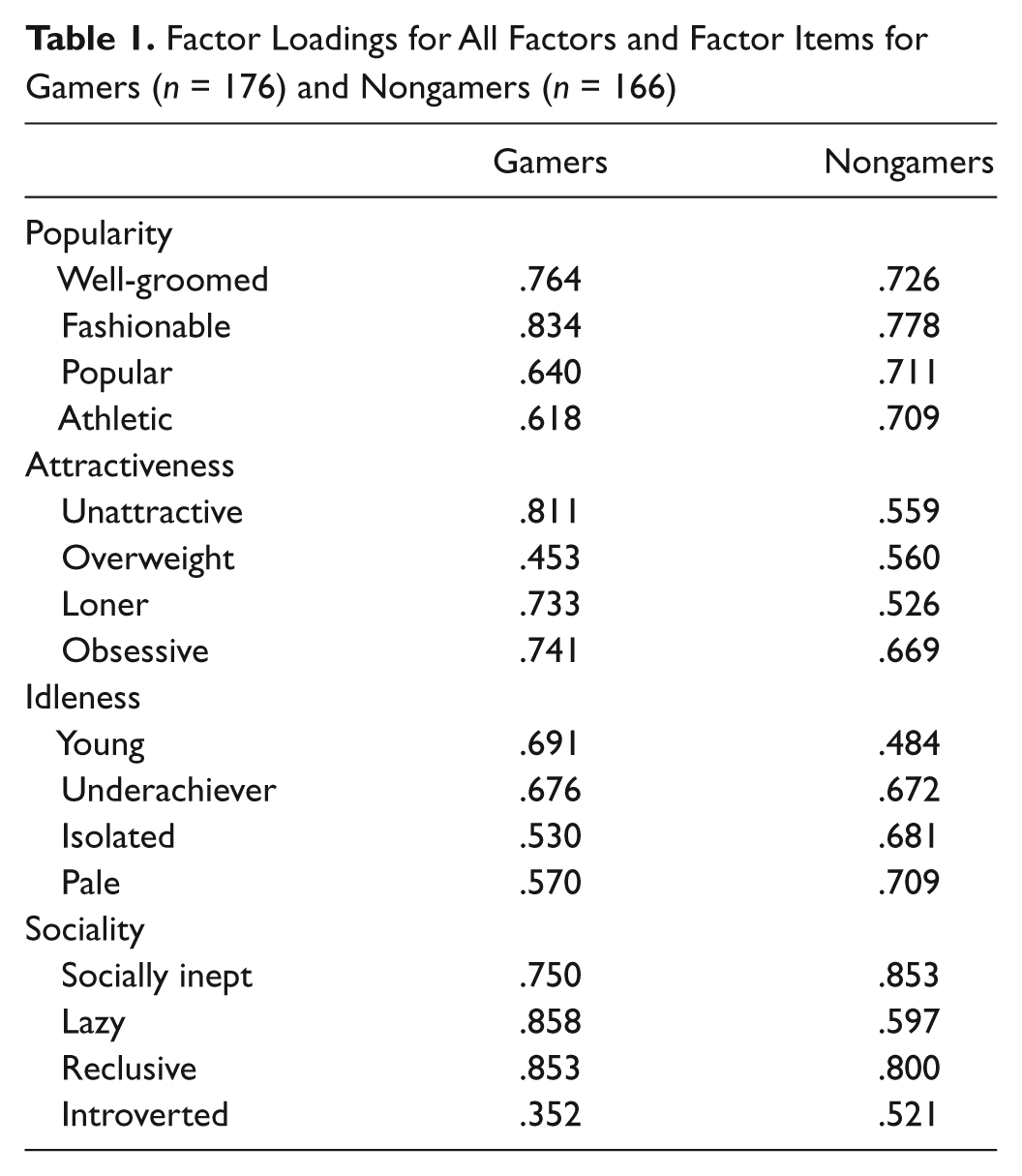
The other factors had fewer items and were not consistent across gamers and nongamers, so they were considered peripheral to the core stereotype of online gamers. Factor scores were computed for each of the four consistent factors by averaging scores for individual items within each factor. Reliability coefficients (Cronbach’s alpha) were all above .75, indicating acceptable reliability.
Factor analyses on ratings of how gamers and nongamers personally perceived online gamers revealed broadly similar factors to the stereotype ratings. In order to compare stereotypical and personal beliefs, personal belief scales were computed on the same four factors as the stereotypes (popularity, attractiveness, idleness, and sociality). Reliabilities for these scales were somewhat lower than those for the same stereotype scales, but still acceptable as they were between .62 and .80.
Stereotype Endorsement Among Gamers and Nongamers
To assess the extent of stereotype endorsement among gamers and nongamers, stereotype ratings were compared with personal beliefs. Stereotypical and personal ratings of online gamers were compared using four separate 2 (rating type: stereotype vs. personal belief) by 2 (rater group: gamer vs. nongamer) mixed ANOVAs with repeated measures on the first factor. Due to the fact that unequal gender distributions between gamers and nongamers were evident, and gender differences are often found on game-related issues (Lucas & Sherry, 2004; Ogletree & Drake, 2007), gender was held as a covariate in all of the following analyses.
There was a significant main effect of rating type on all four factors (Fs > 19, ps < .001), showing stereotype ratings to be more polarized than personal beliefs. There also was a significant interaction between rating type and rater group on all four factors (ps < .05), showing larger discrepancies between stereotypical and personal beliefs among gamers than nongamers (see Figure 1).

Stereotypes and personal beliefs about gamers by gamers (n = 176) and nongamers (n = 166). Scores are deviations from the midpoint of the scale
Simple main effects analyses showed that gamers and nongamers did not significantly differ in their stereotype ratings, indicating that overall gamers and nongamers agreed about the stereotype of online gamers. In contrast, gamers’ and nongamers’ personal beliefs differed significantly on all four factors (Fs > 5.00, ps < .03). Online gamers were rated more positively by gamers than by nongamers. No significant effects of gender were found.
One-sample t tests revealed that nongamers’ personal beliefs significantly differed from the midpoint of the scale (i.e., 4 in the 1-7 scoring) in a stereotypical direction, for every factor but attractiveness (p values < .05). Gamers’ personal beliefs skewed in the opposite direction. Attractiveness and idleness significantly differed from the midpoint of the scale in a counter-stereotypical way (p values < .002), with sociability reaching marginal significance (p = .085) in this direction. Popularity emerged as the only factor in which gamers’ personal opinions shifted in the direction of the stereotype, t(175) = −8.97, p < .001, signifying that nongamers endorsed the stereotype to some extent but gamers largely polarized away from it.
Discussion
This study aimed to examine the extent to which stereotypical representations of online gaming and gamers have given rise to consensual trait associations about gamers and the extent to which these trait associations have been internalized as personal beliefs. Even though online gamers are a relatively new social category within society, the results demonstrate that a collective stereotype about this population has emerged. All participants showed an awareness of a shared stereotype that is in accordance with the anecdotal characterizations commonly portrayed by popular media (Griffiths, 1998). Stereotype ratings were consistent across gamers and nongamers, suggesting that these beliefs are widely shared within society. Based on the results of this study, it can be concluded that the current stereotype of online gamers is largely negative, based on the traits of popularity, attractiveness, idleness, and social competence. Online gamers are stereotypically unpopular, unattractive, idle, and socially incompetent, a characterization that seems to match common stereotypical portrayals in the media, television, and Internet fora.
While both gamers and nongamers reported the same social beliefs about gamers, they did not personally endorse them to the same degree. While this was entirely expected, it was interesting to note that nongamers in our sample endorsed the stereotypical traits of gamers to some degree. Personal belief scores were lower than social belief scores on each stereotype factor, but for three of the four factors they were still significantly above the scale midpoint in the direction of “applicable.” Thus, nongamers indicated that they personally believed the stereotypical traits of unpopular, idle, and socially incompetent were applicable to online gamers. This is not trivial, because being aware of a social stereotype does not imply that individuals necessarily endorse it. Indeed, individuals are generally reluctant to use stereotypes, particularly negative ones, and there is often a discordance between expressed stereotypical associations and associations measured implicitly (e.g., Nosek, Banaji, & Greenwald, 2002). Furthermore, studies of the demographic profile of gamers provides no evidence of a veridical foundation to these stereotypes (see Axelsson & Regan, 2002; Cole & Griffiths, 2007; Griffiths et al., 2003; Williams, Ducheneaut, Xiong, Yee, & Nickell, 2006; Williams et al., 2008; Yee, 2006, 2007). Thus, there would seem to be little reason for the (nongaming) participants to internalize stereotypical beliefs as personal beliefs, and yet they appeared to do so. This points to the power of media portrayals to not only generate stereotypical representations of social groups but also to convince the public of their validity.
While nongamers appeared to endorse the social stereotype to some degree, gamers for the most part did not. Indeed, the only stereotypical dimension they believed was applicable to their own social group was “unpopular.” This may be because popularity is somewhat more objective than the other dimensions, in that it refers to others’ opinion (i.e., nongamer’s or the general population). Therefore, perhaps gamers could not deny that in the eyes of others they were not popular. However, gamers believed the other three dimensions of unattractiveness, idleness, and social incompetence were not applicable. A variety of motives are known to influence one’s tendency to endorse a particular stereotype, but it is widely acknowledged that individuals are intrinsically motivated to hold positive views of their own in-group and negative views of out-groups (Brewer, 1979; Tajfel & Turner, 1979). Thus, gamers appeared to at least deny the stereotypical associations between gaming and these traits and may even define their in-group in contrast to the stereotype (as attractive, nonidle, and socially competent).
Limitations and Directions
One limitation of this study is that we did not provide direct evidence that the stereotypical associations with gamers were generated by the media, television, and Internet fora, as opposed to, for example, personal experience with the gaming population. The origins of the stereotype are unknown, but we believe it is unlikely to be based on personal experience with the gaming population. First, there were no differences in stereotype knowledge between gamers and nongamers, despite presumably vastly different personal experiences with gamers; second, if stereotypical beliefs were based on personal experience there would presumably be more consistency between awareness of the social stereotype and personal endorsement of it; third, all available evidence on the demographics of online gamers suggests the stereotype is unfounded (e.g., Griffiths et al., 2003; Williams et al., 2008; Yee, 2006). Therefore, the most likely sources of widely shared traits associations about gamers are the cultural representations of gamers disseminated through popular media. Nevertheless, further research should explore exactly how cultural representations of groups are translated into trait associations and whether different forms of cultural representation (e.g., comedy, news, chatrooms) lead to different forms of stereotype uptake in the population (cf. Moscovici, 2008).
A second limitation is that stereotypical and personal beliefs were both measured explicitly using self-report. This method revealed the hypothesized patterns, but explicit self-report measures are vulnerable to social desirability concerns and participants may not have disclosed their true personal beliefs nor even accurately reported their awareness of the cultural associations. Further research could make use of implicit measures of stereotyping and compare gamers and nongamers’ implicit and explicit stereotypes as an alternative measure of learned associations and publically expressed opinions.
As this investigation was largely exploratory, care needs to be taken in interpreting the results, and further research is needed to confirm the factors that emerged here. For instance, it is uncertain if the results found here are reflective of the generalized stereotype of gamers (including online gamers more generally) or the popularized prototype of the MMORPG gamer. While some have found that MMORPG gamers are viewed more negatively than the generalized construct of the online gamer (Kowert & Oldmeadow, 2012), future research is needed to further examine the global stereotype in relation to the subgroups contained within it. This will provide clarification into the stereotypical differences among the broad categorization of online gamers as compared to more specific subgroups, such as MMORPG gamers or casual online gamers (e.g., individuals who play online games that require no major time commitment or special set of skills to complete, such as the highly popular Zynga game, Farmville).
Conclusion
The stereotypical representation of online gaming and gamers disseminated through popular media, television, news stories, and Internet fora presents gaming as a dangerous activity that produces social, physical, and psychological impairments. In this study, we have shown that this representation has given rise to a widely shared set of cognitive associations about gamers as being unpopular, unattractive, nondominant, and socially incompetent. While these associations are merely stereotypes, they appear to have been internalized as personal beliefs to some extent among nongamers, while gamers themselves largely deny their veridicality and instead define themselves in contrast to this characterization. This points to an important role for cultural representations as forming a backdrop for emerging and contested social identities. Future research may provide further insight into the progression of the shared beliefs about online gamers “out there” developing into internalized cognitive associations “in here.” Somewhat fortuitously, the stereotype of online gamers is still undergoing formation within society, providing researchers with the unique opportunity to study this characterization as it continues to evolve.
Footnotes
Declaration of Conflicting Interests
The authors declared no potential conflicts of interest with respect to the research, authorship, and/or publication of this article.
Funding
The authors received no financial support for the research, authorship, and/or publication of this article.