




Abstract
The interaction between the concepts of character attachment, agency, and choice in a video game narrative was investigated using BioWare’s Mass Effect trilogy. Posts on a BioWare forum discussing the depiction of their player characters in the ending sequences of Mass Effect 3, the final game in the trilogy, were downloaded and analyzed using thematic analysis. Players demonstrated emotional attachment for the characters and narrative and expected to see the consequences of their choices play out, as in the previous games. Furthermore, players conflated winning the game with achieving a narratively satisfactory ending for the game world and its characters indicating emotional consequences for players that developers should consider when designing games with a high degree of player choice and agency. However, for some players character attachment is incongruous as they described Shepard as “acting out of character,” which needs further research.
Introduction
It is generally accepted that as choices are increased in a video game, the level of narrative must be decreased (Joyce, 2015). Although recent video games have focused on making choices more prominent (Muriel & Crawford, 2018), the popularity of narrative also remains high among players. However, BioWare’s Mass Effect video game trilogy was able to allow players more choices while maintaining a developed narrative by using a branching narrative, so players could experience and interact with the narrative by choosing from various choices available to their player character (PC) of Shepard (Carvalho, 2015). These choices given during conversation sequences are between various dialogue options and actions and have multiple outcomes for different plot points (Bizzocchi & Tanenbaum, 2012), which can also affect the choices and the narrative of subsequent games in the trilogy (Bizzocchi & Tanenbaum, 2012). The concept of character attachment was developed to more completely understand how the interactive nature of a video game influences the relationship between the player and their on-screen PC. Unlike the protagonists in other media, for example, film where the protagonist is simply watched, video game protagonists are controlled or embodied by the player (Daviault, 2012). The concept of character attachment (Lewis, Weber, & Bowman, 2008) and the relationship between the player and their PC in the Mass Effect games were the focus of this research and provided the first research question:
The specific context for this investigation is what has become known as the “Mass Effect 3 Ending Controversy,” which started within a few days of the March 6, 2012 release of the final game in the trilogy, Mass Effect 3. The controversy was due to criticism from players concerning the game’s ending.
In response to this criticism, players started several petitions, polls, and forum threads, all requesting that the ending be changed (Jennings, 2016). The criticism ranged from the lack of any possible “happy ending” to the ending making no sense in the context of the fictional galaxy created throughout the narrative in the two previous games, Mass Effect and Mass Effect 2 (Carvalho, 2015). The most common complaint was that all the game’s endings were similar, if not the same, and did not take into account players’ previous narrative choices, including a final choice immediately prior to the last cut-scene (Jennings, 2016). Players had found the other endings on YouTube and in forum discussions to reach this conclusion and the players who criticized the ending quickly unified themselves into the “Retake Mass Effect 3” Facebook group and began public relations stunts to protest and increase awareness of their cause (Jennings, 2016). One example was organizing the delivery of 300 cupcakes to the BioWare offices. Each cupcake had different icing, but all were vanilla flavored to symbolize that all the possible Mass Effect 3 endings were thematically similar and removed player choice (Jennings, 2016). This research into the Mass Effect Ending Controversy contributes new knowledge concerning the interaction of character attachment, agency, and choice in a video game narrative and how this interaction reveals new understandings about the causes of the Mass Effect 3 Ending Controversy, which highlight the implications of players’ expectations.
Literature Review
Character Attachment
Research into video games has found an emotional connection between players and their PCs, also termed avatars. This connection would appear to be logical, since PCs are integral parts of video games that allow players to be represented and interact within their virtual environments (Klimmt, Hefner, & Vorderer, 2009; Treptre & Reinecke, 2010). Players have shifted from viewing their PCs as merely tools or a collection of pixels to sometimes fully realized characters (Banks & Bowman, 2016). For example, Lankoski (2011) notes that although players do not see their PC of Gordon Freeman in Half-Life, due to the first-person viewpoint of the game, they are attached to him. Parasocial relationships and identification are two different ways that have been proposed to understand this emotional connection (Huang & Yeh, 2016). Parasocial relationships emerged from the study of television viewers and their relationships with television characters (Cohen, 2003) and are used to conceptualize one-sided relationships in which one knows a lot about the other, but the relationship is not reciprocal (Ashe & McCutcheon, 2001). Identification is a cognitive and emotional state involving the player losing awareness of themselves as a player (Cohen, 2001) and merging or imagining their sense of self with the PC they are controlling (Klimmt et al., 2009). The interactive nature of video games, including the necessity to control a PC, helps facilitate the process of identification (Klimmt et al., 2009). The concept of character attachment incorporates both these conceptual approaches (Banks & Bowman, 2016) and allows for a method, specific to video games, to understand the emotional connection between players and their PCs.
Lewis et al.’s (2008) definition of character attachment is that of a psychological merging of the mind of a player and their PC. It is a multidimensional construct that encompasses feelings of friendship, identification, suspension of disbelief and responsibility, and a heightened sense of control of the PC by the player (Bowman, Schultheiss, & Schumann, 2012). The concept was developed to account for the interactive nature of role-playing video games (RPGs), which influence the relationship between the player and their PC due to the genre’s focus on storytelling and characterization, and because the overall purpose of RPGs is to allow their players to immerse themselves in their virtual worlds and the psyche of their PC (Lewis et al., 2008). Players’ feelings of character attachment for their PC are reinforced when they actively bring about their actions and the consequences, which is in contrast to the passive audiences of movies or television (Banks & Bowman, 2016). This conceptualization of character attachment is important because the extent to which players are attached to their PC can help explain how they interact with game worlds (Bowman et al., 2012). For example, Lewis et al. (2008) found that character attachment was positively associated with game enjoyment, time spent playing, and players’ motivations to play games. Therefore, players of video games—especially RPGs—can develop connections, including emotional ones, to their player characters and the concept of character attachment was developed to better understand these connections. Further investigation of character attachment to video game PCs and how it interacts with agency in RPG interactive narratives may add new knowledge and understanding to the concept/s and players’ connections to their PCs.
Agency Within Interactive Narrative
Banks and Bowman (2016) note that in the research context of RPGs, when there is a strong feeling of character attachment and the player feels merged with their PC, the player feels greater agency during the gameplay. Agency here is taken to mean the degree to which the player or their PC see themselves as being able to control the gameplay experience within a video game’s narrative and story (Banks & Bowman, 2013). However, as observed by Joyce (2015), the consensus among many Game Studies’ scholars is that the relationship between narrative and agency is tenuous at best because increasing the narrative in a game must result in a decrease of player agency and vice versa. They contend that storytellers need to fit events together in a coherent manner and so need to minimize player choices because they can interrupt the story (Bizzocchi & Tanenbaum, 2012), but if a game constrains players with a linear play experience, then the gameplay ceases to be meaningful (O’Donnell, 2012). Joyce (2015) notes the example of Bethesda’s Skyrim that allows the player a high level of ludic agency, which she describes as the ability to move and to interact with the virtual environment within the game, but the narrative is not coherent. In contrast, Mass Effect 2 has a rich and deep narrative and choices available for players, but these are constrained so the narrative is not disrupted by using binary morality choices or a select number of dialogue choices that cannot be exited from without completing the conversation (Joyce, 2015). The contention that the player is constrained through limitations appears to conflate agency with freedom from restrictions, which Tanenbaum and Tanenbaum (2010) note often occurs when agency is discussed in the context of video games. The concerns regarding the limitations and constraints of narrative on agency and gameplay appear to support their observation.
It has been implied that players of video games are primarily interested in asserting authorial control over the plot and outcomes of a game’s story, while storytellers need control over the sequence of events, and this conflict is the reason given for the inharmonious connection between agency and narrative (Bizzocchi & Tanenbaum, 2012). For example, Rigby and Ryan (2011) describe agency as the ability to act or exert power, placing the emphasis on the player’s power. The focus on players’ desire for authorial control has led to researchers investigating if players cocreative behavior could be considered authorship. Authorship of video games involves the ability to craft and shape content, structure, and form of video game works (Jennings, 2016), which players do through the creation of mods (Glas, 2012) such as cosmetic changes to characters and interfaces and new quests and content (Postigo, 2007). Other examples of the extensive cocreative, participatory behavior of video game players include the creation of walkthroughs, FAQs, and the maintaining of wikis devoted to the video game (Hunter, 2011). Despite being said to lack the emotional motivation of traditional media fans (Wirman, 2007), video game players have also engaged in the interpretative behavior of these fans such as theorizing and the creation of fanfiction, which provide alternate content and interpretations of the original video game narrative (Newman, 2013). Jennings (2016) notes that authorship is not an interpretative power alone and suggests that authorship in video games is fluid and negotiated. Mallon (2007) believes that players are aware of the restrictions placed on them in video games by their developers, but are satisfied with the illusion or perception of authorship, rather than having tangible, actual control. This view aligns with Murray’s (1997) often-quoted definition of agency as “the satisfying power to take meaningful action and see the results of our decisions and choices” (p. 126). Murray also notes that interactors can only act within the possibilities that have been presented to them. Therefore, the focus on seeing agency as players desiring literal and unilateral control and authorship appears to have confused the kind of agency they actually desire.
Recently, Muriel and Crawford (2018) reinforced Murray’s (1997) point observing that players are limited by the restrictions and possibilities of video games. They also contend that the meaning of the term “agency” is often taken as a given and is rarely interrogated with any depth, which would explain the contradictions outlined above. Muriel and Crawford (2018) categorize agency as transformations that occur, rather than the desire, will or intention of the player, and state that the core of agency is affecting some sort of change. Therefore, their focus on change is not conceptually dissimilar from Murray’s definition. Backe (2012), building on Murray’s (1997) definition, describes agency as being able to meaningfully influence the world of the video game through contributing nontrivially to events and at a minimum determining their outcomes. Atkins (2003) also focuses on change when discussing agency describing it as casting the player as an investigator whose main interest with a video game is uncovering new responses through interaction and suggesting the enjoyment derived from play is due to the relationship between action and effect in the game. Tanenbaum and Tanenbaum (2010) suggest that Murray’s definition is still relevant to Game Studies’ scholars today and that researchers have focused too much on the part of her definition concerned with the ability to make choices and have marginalized the meaningful consequences that result. Salen and Zimmerman (2004) describe meaningful play in a video game as when the relationships between the actions and outcomes are both apparent and integrated into the larger context of the whole game. Therefore, the transformations that are the result of players’ actions need to be coherent when considered in the context of the game world or players are liable to become frustrated with the game (Johnson, 2015). In summary, if agency is understood to focus on meaning and transformation, rather than complete power and control, then there should be no conflict between agency, narrative, and storytelling in video games—especially if a player believes they have created a meaningful transformation or outcome through play and engaging with the story.
Several researchers have provided new explanations of agency to smooth over the conflict between narrative and agency. Tanenbaum and Tanenbaum (2010) suggest that when a video game contains emphasis on both story and the gameplay, agency is better understood as a player’s commitment to meaning, rather than a desire to act free from restrictions. Mallon (2007) sees agency as the player having the perception of creating or having some form of impact. In Mallon’s study involving 13 participants who played and then discussed a set list of video games, she found that this sense of agency was greater when players could handle the game’s level of challenge because they had the sense that through their PC they were responsible for achieving the goals of the game. Interestingly, the core or main pleasure from gameplay has been found to be overcoming challenges (Bizzocchi, Ben Lin, & Tanenbaum, 2011), achieving goals (Pearce, 2002) or winning (Ryan, 2009). Mallon’s findings appear to add more nuance to this and align with how Ermi and Mäyrä (2005) distinguished between what they call challenge-based immersion and imaginative immersion. The former occurs when the player is able to find a satisfying balance between their skills and the challenges of the game, while the latter is concerned with the stories, game world, and characters. Therefore, agency and choice do not necessarily have to conflict with the inclusion of narrative and story in a video game because players do not necessarily desire absolute freedom or authorial power. Instead, they desire meaningful transformation and outcomes, while being aware of and satisfied with the limitations the developer has placed on them within the game. Thus, players’ feelings of agency would appear to be based on their perceptions and the Mass Effect trilogy would appear, at least until the ending of the third game, to be an example of agency, choice, and narrative coming together in a video game context to provide players with these meaningful transformations and outcomes.
Mass Effect 3 and the Research Context
The Mass Effect trilogy is best described as a science fiction shooter and RPG hybrid (Carvalho, 2015) set in 2183 by which time humanity has made contact with several alien races and integrated into the galactic society (Zakowski, 2014). The PC named Shepard is an elite military operative with a customizable appearance and abilities playable as either male or female, who is tasked with saving the galaxy from an enemy called the Reapers (Carvalho, 2015). Although all players experience this same general story, they can make decisions about how certain plot points will unfold, Shepard’s demeanor during conversations, and with which squadmates they take the time to converse and build a relationship (Bizzocchi & Tanenbaum, 2012). During these conversations, realized through motion capture of body movements, facial expressions, and hours of fully voiced dialogue, players select from a variety of dialogue options for their PC to say and each may involve one or several forks in the conversation (Ward, 2008). This style of story is a branching narrative (Carvalho, 2015), which has been dismissed in the past for being too confusing for writers and needing powerful hardware to create effectively (Crawford, 2005; Murray, 1997). However, as technology has advanced, branching narratives are now recognized as a way to maintain a narrative in video games while still allowing players choice and interactivity (Egenfeldt-Nielsen, Smith, & Tosca, 2008). O’Donnell (2012) observed that when a narrative is included in a game it must align with the game mechanics to provide the player with ways to meaningfully interact with it. The Mass Effect trilogy achieved this by offering the player choices via their PC of Shepard during conversation sequences.
Therefore, the Mass Effect trilogy involves what Bizzocchi and Tanenbaum (2012) describe as two forms of gameplay: extended conversation sequences and linear combat missions in a third-person shooter style. The player can form in-depth relationships with numerous companion characters, known as squadmates, through these conversations and determine how plot points will unfold by selecting from several options offered (Jørgensen, 2010). Mass Effect still constrains the player, despite their interaction with the story and choices they encounter, therefore, aligning with Riedl’s (2010) argument that successful interactive narrative needs to be coherent and fully formed. Joyce (2015) states that when choices are offered in narrative-focused video games, players must be able to deliberate on their choices carefully and critically so their actions are the result of intent, and they must be able to understand their options and care about them. It also has been suggested that presenting the player with significant decisions makes them believe they have more choices than they might actually have (Moser & Fang, 2015)—a technique that the Mass Effect trilogy employs. An example is the suicide mission quest in Mass Effect 2 where the PC of Shepard must assign roles to various squadmates during the mission. If the player assigns a character to a role they are not suited to, they or another character will be killed and not reappear in the next game (Mass Effect 3). Therefore, player choices in the Mass Effect games can emotionally affect them and their outcomes can have a lasting significance, transform the game, and provide players with feelings of agency. The first two games in the series and up until the ending of Mass Effect 3 players had choices with different outcomes and so players expected these for the ending too, which explains players’ complaints about their absence (Jennings, 2016). As players can engage with agency through their PC of Shepard, the two concepts of agency and character attachment in tandem represent an innovative way to investigate video game players and thus Mass Effect 3’s ending provides a second research question:
Methodology
This research adopts a qualitative approach using thematic analysis following Braun and Clarke’s (2006) guidelines. Thematic analysis is a flexible method that can be applied across a range of theoretical approaches (Braun & Clarke, 2006) to understand how people feel, think, and behave in specific contexts (Guest, MacQueen, & Namey, 2012). Therefore, it is an appropriate method to use in the context of video game-focused research, which is often interdisciplinary in nature (Hjorth, 2011). On March 17, 2012, 11 days after the release of Mass Effect 3, a thread asking for feedback from players titled “ME3 Suggested Changes Feedback Thread: Spoilers Allowed” was posted by one of BioWare’s developers on the official BioWare Social Network forum for Mass Effect 3. This thread received 70,052 posts from the date it was created up to May 6, 2013 when posters stopped replying. It was downloaded in its entirety and the analytical software program Leximancer was used to analyze and extract the major themes. Leximancer can be used to identify high-level concepts and extract their semantic and relational information from large volumes of text (Leximancer Pty Ltd., 2017). Utilizing Leximancer also allows for analysis that is repeatable. For this analysis, Leximancer’s text duplicate sensitivity setting was used to remove repeated procedural phrases such as “This topic is locked,” and to account for posters quoting each other. Compound concepts were conflated when they were names that had not been consistently capitalized, for example, “BioWare” and “bioware.” Several stop words—including “Top,” “topic,” “post,” “posts,” “quote,” “edited,” “March,” and “lol”—were also added to Leximancer’s setting, due to their frequent usage.
The thematic analysis was conducted with a theoretical rather than an inductive approach (Braun & Clarke, 2006) to provide a nuanced account of specific themes, rather than a description of all the data. The data were interrogated in relation to the theories and concepts of character attachment, agency, and interactive narrative to focus the analysis and provide answers to the research questions. Of the top-level themes Leximancer identified, the theme “Shepard” was the most relevant to the theories and concepts and was also the most highly related and connected theme in the Leximancer analysis of the thread. This theme consisted of 25,209 posts was manually investigated more closely by the researcher to better merge and separate the themes and subthemes and realign their relationships with each other. As a result, only the data relevant to the research questions were examined, rather than the entire forum thread of 70,052 posts. A codebook was derived from the thematic analysis that includes definitions of each theme and example quotes.
Results
The analysis identified several relevant themes and subthemes that are presented in Table 1 with definitions and example quotes, some shortened for clarity.
Codebook.
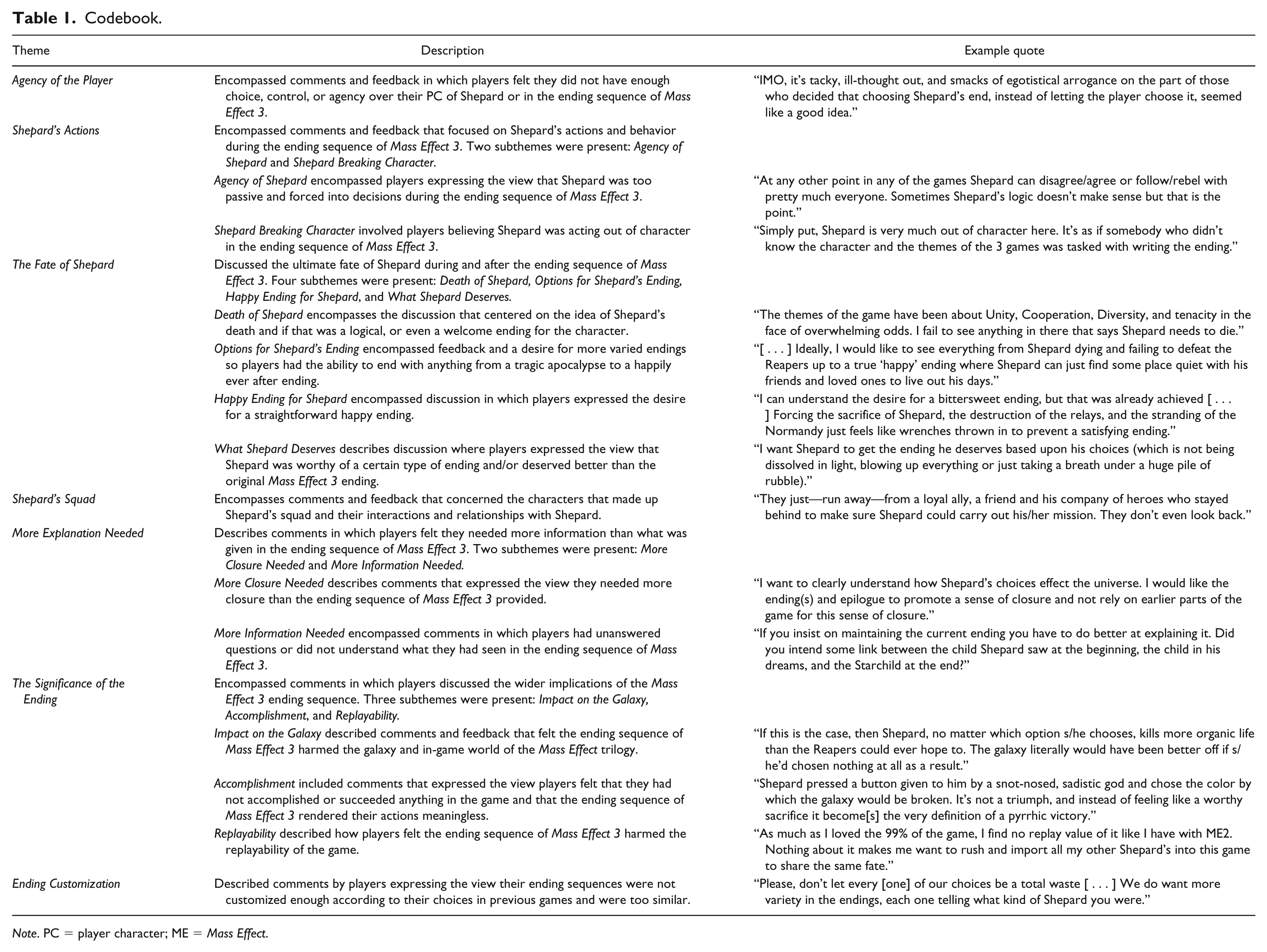
Note. PC = player character; ME = Mass Effect.
Discussion
The Absence of Choice and Agency for the Player and Player Character
The themes discussed in this section illustrate the agency felt by players or their perception of their lack of agency. Players discussed how they were used to being given choices in the Mass Effect series that they believed resulted in meaningful, divergent outcomes, which allowed them some influence over the story and plot of the games. Though the number of choices, and thus outcomes, were limited by the developers, the transformations that resulted from them were significant enough that players felt they were having an impact on the narrative and fictional universe of the Mass Effect games. Thus, the removal of significant, diverging outcomes meant that players felt that they had lost the choices they were entrusted with and the agency that went with them. Furthermore, in addition to players feeling they had lost their agency, they also believed that the vehicle for making these choices—their PC of Shepard—had too, which could be evidence of Lewis et al.’s (2008) definition of character attachment. Players felt that Shepard’s distinct personality and characterization was inextricably connected to the character’s choice making and their comments indicate that they felt that the removal of Shepard’s choices caused damage to the characterization of the character. Therefore, players could be said to have both their agency and the character of Shepard taken from them.
Agency of the Player
The Agency of the Player theme encompasses feedback and comments from players who felt that they had no choices or not enough, and thus their agency was reduced or removed. Interestingly, this critique was only focused on the game’s ending. Several players noted how they loved “that Shepard’s story has always been YOUR story,” and the story was something “that I, the player, was entrusted to complete.” Despite the praise for the choices players were offered, they did not confuse them with unilateral authorship or control; one player explicitly acknowledged that BioWare “obviously need to choose certain actions for Shepard,” but also noted that these should be limited. Players followed up their praise with critique, for example, “The problem with the ending is not that Shepard sacrifices herself, or that its sad, its that we are railroaded into an end where there is essentially no choice at all,” and “we should be able to choose our own destiny/fate.” Players felt that the ultimate fate or ending of the characters the players had played or directed were “story elements that I had always had significant control over.” Player feelings of lack of choice in the Mass Effect 3 ending aligns with Mallon’s (2007) description of agency in narrative-focused video games, which is of players having the perception of creating an impact. Players stated they were familiar with choosing between plot points and then watching them unfold, but they felt they had no choice regarding which ending they would receive, and so there would be none of the transformations that would be normally attributed to their choices (Muriel & Crawford, 2018). Therefore, Murray’s (1997) definition of agency gained from taking meaningful action and seeing the results is unobtainable. Players’ perception is that they lack choices and outcomes they were used to obtaining from prior games in the series. Furthermore, even if a definition of agency focusing on player control is accepted, players still lacked agency because they had no control over the ending. However, such an objective measure of agency would appear incompatible with a definition of agency in a narrative-focused video game. Although a player may have several choices, if they realize they lead to the same or a very similar outcome, then they will perceive an absence of agency due to the lack meaningful outcomes.
Ending Customization
The Ending Customization theme encompassed discussion critiquing the lack of customization of the ending of Mass Effect 3 the player experienced based on their previous choices. Players also unfavorably compared the amount of customization with the previous games. One player noted that, using the Mass Effect 2 ending as an example, “we got endings based on our choices from everything (including Shepard) dies to everyone lives” (Ending Customization). Another player summed up the various Mass Effect 3 endings as being “[ . . . ] 90 percent alike, and the greatest difference is in explosion color.” Players explicitly wanted to see the outcomes their choices were expected to deliver. One player even sent this message to BioWare: “don’t let every [one] of our choices be a total waste [ . . . ] We do want more variety in the endings” (Ending Customization), which explicitly linked their play of the Mass Effect trilogy with wasted time if there was a lack of outcome and impact from their choices. Players also linked the desire for a more customized ending with their feelings for the characters in the trilogy. One player noted that “People want to see the impact Shepard’s decisions have made on people we have interacted with over the 3 games” (Ending Customization), partially conflating themselves with the character of Shepard and thus reflecting Lewis et al.’s (2008) concept of character attachment as mind-merging. Another player focused more on Shepard, noting that the ending should “better reflect the Shepard we’ve spent three games building and growing attached to” (Ending Customization), thus explicitly establishing the emotional connection between themselves and Shepard. Therefore, the desire for more customization of the ending stems not only from players’ desires to see the outcomes expected from their choices in previous games in the trilogy but also for the characters to see and experience those outcomes.
Agency of Shepard
The Agency of Shepard theme discussed the perceived lack of agency afforded to the player character of Shepard, as opposed to the lack of agency felt by the player. The lack of choices available for Shepard was heavily criticized by players and sparked lengthy discussions. For example, one player wrote that “The end game reduced Shepard to a pathetic figure incapable of making a stand. Shepard does NOT passively sit there and accept what some unknown quantity has just told her/him.” Other players agreed, with one asserting that Shepard was “railroaded into making one of three equally unpalatable decisions,” while another player noted that “the ending seems to force my Shepard to act contrary to everything she has believed in and fought for over the course of the preceding games.” The use of words such as “railroaded” and “forced” highlight the lack of choice players felt Shepard had, and the comments also note how this was unexpected for players. Furthermore, the criticism of choices is also primarily from Shepard’s point of view, which might suggest a lack of character attachment. If players were experiencing Lewis et al.’s (2008) definition of character attachment—a psychological merging of the mind of a player and their PC—they would not be expected to discuss their problems and criticisms of the choices in the game from Shepard’s point of view. Instead, they were ascribing the character with a distinct identity and characterization. The criticism of the lack of choice also appears to result from anger that Shepard has been tarnished or forced into something against the character’s will. The anger seemed to result partially from the damage done to Shepard, rather than to the player themselves.
Shepard Breaking Character
The comments coded as Shepard Breaking Character also expressed the opinion that Shepard was acting out of character at the end of the game, but focused on their characterization rather than lack of agency. One player stated that “The man standing there, at the ending, isn’t the Shepard we all know and love. The Shepard who never gives up, and can always find another alternative,” and another advised BioWare that they should “not have Shepard break character at the end and roll over at the options presented with no questioning, pushback, examination, searching.” According to the comments, the way that Shepard acts out of character appears to be because Shepard does not have the dialogue options players expected, which Bizzocchi and Tanenbaum (2012) describe as one of the two forms of gameplay. One player put it explicitly: “dialogue options do not provide an avenue to have the Shepard we’ve being playing for 100+ hours be himself.” Therefore, the critique of Shepard’s lack of choice, as well as possibly the lack of choice from the player’s point of view, could be a result of players’ feelings of frustration as the gameplay is suddenly not producing the expected results (Johnson, 2015). Rigby and Ryan (2011) note that once players believe they understand the conventions and rules of a video game, they become confident that the outcomes will reflect their actions. By removing the choices available to Shepard, and so the agency of the character, players perceive Shepard’s characterization has been altered when compared with what they experienced in the previous games and that the internal coherency of the character has been damaged. However, the assertion that Shepard has a character or personality strong enough to “break” is also interesting as it runs contrary to Frasca’s (2003) assertion that more player agency results in less personality for their PC. Furthermore, it might imply players have not merged their minds with their PC of Shepard’s because the player appears separate enough to perceive Shepard’s personality and character and recognize when this personality and character is “broken.”
The Absence of Meaningful Play, Outcomes, and Accomplishments
The themes discussed in this section were all linked to the outcomes that players received during their ending, which players perceived to be insufficient. Players wanted to see expansive and meaningful outcomes due to their narrative investment in the Mass Effect series, but a group feared they had destroyed the fictional setting of the series. Players believed that the ending cut-scene they had initiated by completing the final sequence of gameplay had resulted in the destruction of life in the galaxy. Other players focused on the lack of information about the characters they had interacted with and formed relationships with over the course of the three games. Players were thus identifying the type of outcomes and transformations they expected their choices would result in—the saving of the galaxy and the life of the characters they had encountered while doing so. Players’ perception of the destruction of the galaxy through their actions and gameplay left them without feelings of accomplishment and even a belief that they were prevented from winning the game. As a result, players noted they were unable to replay the game because the outcomes were too tragic.
Impact on the Galaxy
Players discussion about the effect of the Mass Effect 3 ending on the galaxy depicted in the series was encompassed by the Impact on the Galaxy theme. The outcomes and results that players wanted to see were driven not only by the action of making choices but also from players’ feelings of investment in the narrative of the Mass Effect games. Unfortunately, as one player explained, “[ . . . ] all ending choices are made worse if you actually know a lot about the Mass Effect Universe [ . . . ],” which was a sentiment expressed by many other players. The original endings of Mass Effect 3 involved a cut-scene that appeared to depict the mass relays exploding, which were a method of transportation fast enough to make intragalactic travel practical. Players noted this meant that “by having all the Mass Relays blow up Shepard basically destroys the entire galaxy” and “Shepard just killed the galaxy.” This referred to the downloadable content (DLC) for Mass Effect 2 titled “Arrival” that had established during its story that destroying a mass relay causes an explosion that destroys the solar system in which it is located. Other players, perhaps not aware of the information contained in the DLC, still assumed that “many more will die from starvation, injuries, thugs, etc.” because they would be unable to travel back to their home worlds without the mass relays after the final battle against the Reapers. As one player noted, “Over time, that will cause the deaths of everyone you united. Way to go, Shepard, your attempts to save the galaxy have doomed it.” Far from being the meaningful play as described by Salen and Zimmerman (2004), the content in the ending did not appear to be integrated into the previously established game world. Players expressed the view that their play as the PC of Shepard was responsible for the destruction of the game world and story that they had been engaging and interacting with for the approximately 100 hours it took to play the three Mass Effect games.
More Information Needed
The More Information Needed theme encompassed players questions about the final cut-scene they had witnessed with numerous players noting they needed answers. Several players directly mentioned the explosion of the mass relays in this regard, for example, one wrote that “I want to know why this particular brand of exploding mass relays is different to Shepard taking out the Alpha relay (and the star system it resides in), in the Arrival DLC.” Players also repeatedly asked why Shepard’s command ship piloted by the character of Joker and the crew were seen leaving Earth, and how the Catalyst worked. A desire to know what happened to the characters and societies that the player had encountered through the games was expressed often, for example, “The lack of an epilogue of some sort is what most people found unnerving. No results of Shepard’s sacrifices, no seeing the galaxy come together to rebuild,” and “Instead, we got more questions. We fought the greatest battle in history—I think we deserve to know what happened after: with galaxy, people Shepard cares about [ . . . ].” The desire for an epilogue was sometimes directly connected to players’ desire for, but lack of, closure. One player expressed closure as being “[ . . . ] how you show that it was worth it. Closure is how you show what happens according to Shepard’s decisions.” If agency in narrative video gameplay is associated with affecting change (Mallon, 2007) and seeing the results of decisions (Murray, 1997), then the final cut-scenes of Mass Effect 3, in addition to not being meaningful, can be understood as presenting some players with no choices. Therefore, while some players were aghast that they were complicit in what they believed was the destruction of the Mass Effect galaxy, others were more distressed that they were prevented from knowing what happened to the characters and society after the game’s narrative ended. Thus, players were identifying the lack of transformations and outcomes they were expecting to result from their actions.
Accomplishment
The Accomplishment theme encompassed discussions about players’ sense of accomplishment upon completing the Mass Effect trilogy. The apparent destruction of the Mass Effect universe, when the plot of the trilogy had revolved around saving it, resulted in players lacking these feelings of accomplishment. One player noted that “[ . . . ] the destruction of the relays, the unknown fate of the Normandy’s crew and the other races in the galaxy left me feeling like it was all for nothing.” Referring to the final cut-scene the player sees that appears set some time after the events of the Mass Effect trilogy and depicts a man and a child discussing the legend, “the Shepard,” another wrote that “There is no sense of accomplishment: Telling us that Shepard is now a legend does nothing for us because we don’t feel like that’s the case.” Again, there is evidence that players felt the games prior to Mass Effect 3’s ending provided meaningful choices and outcomes, to the extent that the suggestion of these choices being trivialized was disliked. Players wanted to see and understand that their choices and actions had resulted in outcomes, instead of being informed they had. Furthermore, as one player put it by “killing off Shepard (and stranding billions of allies in the Sol system by blowing up the relays)” BioWare had “forced a nihilistic ending,” meaning that players were unable to find a sense of accomplishment or the meaningful results they had anticipated. Instead, the previously established story told the players it was their actions that had destroyed the game world. Some players went further, for example, noting that the ending left them “with a feeling of failure” and that they could not win the game. For example, one player accused BioWare of refusing “to give us a true victory for our Shepard,” and another asked “Is it too much to ask that we’re allowed to win the game?” As noted, the ability to achieve goals (Pearce, 2002) or win (Ryan, 2009) are the core pleasures that result from gameplay. Players had reached the end of Mass Effect 3, negotiated the challenges of the gameplay, many through all of the games in the trilogy, but the ending meant this accomplishment was negated and they perceived an inability to win due to the game’s story.
Replayability
The Replayability theme described how players’ comments that the ending sequence of Mass Effect 3 harmed the replayability of the game. Players discussed how they would not replay the game and also assumed other players would behave similarly. For example, one player expressed the opinion that “This ending kills the franchise and I guarantee that very few people will buy non-ending DLC as ME3 has no replayability.” The lack of players’ desire to replay the game was also often explicitly connected to what happens to their PC of Shepard in the ending. One player asked, “seeing as my options are everybody dies or [there is no other option] then good God, why would I put them all through that again?” The narrative conclusion being the reason for the lack of replayability was also implied in another comment that stated, “NO ONE WANTS to replay tragedies, at least not when you are as emotionally invested in a character as Shepard [ . . . ].” The tragic nature of the narrative as the cause for the loss of replayability echoes Juul’s (2013) argument that players, since they experience their PC’s emotions through the gameplay, would not wish to play tragic games. However, in Mass Effect 3, the players appear to have done so unknowingly as they were not expecting a sad narrative conclusion. Another player noted that the ending “killed replay value of [the] whole series. You forgot that many of us, fans, wasn’t [sic] just play Shepard, we actually became him.” The differing use in pronouns in these quotes is also interesting. Some players did exhibit Lewis et al.’s (2008) concept of character attachment through their merging of the character and their own identity, but other players talk about Shepard as a distinct and separate character and identity to themselves. However, judging from the comments, both types of players were affected by the perceived tragedy that befalls Shepard.
Characterization and Feelings of Character Attachment
The themes discussed in this section concern the characters that players had encountered and formed emotional connections with in the game and how those emotional connections were linked to players’ perception of a lack of a choice and agency in the ending. Throughout the game through their PC of Shepard, players had developed relationships with the squadmates, who accompanied them. The events depicted in the ending cut-scene resulted in players feeling these squadmates had, despite these existing relationships, abandoned both them and Shepard, which players found inconsistent and hurtful. Players also found the death of Shepard present in almost all versions of the ending cut-scene distressing and ill-suited to the game and narrative they had experienced. Players used these points to argue for more options to be included in the ending and their desire for more agency and choice was motivated by their emotional attachments to these characters. Players still wanted the option for a tragic ending, but they also wanted the ability to obtain an unambiguous happy ending. Some focused on requesting this because of their emotional attachments to Shepard and the squadmates. These emotional attachments appear to parallel those felt by traditional media fans for characters and narratives, which may explain the organized protest movement against the ending.
Shepard’s Squad
The Shepard’s Squad theme encompassed comments that focused on the characters that made up Shepard’s squad. The way Shepard’s squadmates were presented in Mass Effect 3, especially in the ending, was also a subject that garnered criticism and feedback. A common point of criticism was that the squadmates left Shepard behind on Earth at the end of the game, for example, “they just—run away—from a loyal ally, a friend and his company of heroes who stayed behind to make sure Shepard could carry out his/her mission. They don’t even look back.” Players used emotive language to make this point when writing, for example, “The crew—effectively Shepard’s family—was one of the most important parts of the entire series. You do not abandon family during the end of the world,” and “To leave these people we’ve come to know and love stranded on an unknown planet without any resolution to their relationship with Shepard is an insult to the squadmates.” The Mass Effect games have been noted for their inclusion of well-developed characters with whom the PC of Shepard can form romantic relationships if the player chooses (Jørgensen, 2010). Video game players enjoy developing relationships with nonplayer characters, particularly ones of a romantic nature (Mallon & Lynch, 2014). Coulson, Barnett, Ferguson, and Gould (2012), when investigating the factors concerning how video game players become attracted to video game characters, found that real and meaningful emotions including love can be felt by players for characters. Players who left feedback discussing the Mass Effect 3’s squadmates had developed deep relationships and emotional attachments with these characters as their PC of Shepard. There is also evidence of character attachment in these comments, for example, in reference to the squadmates, one player quoted above wrote, “we’ve come to know.” Therefore, players are likely not only to be upset that the squadmates left their PC of Shepard behind, but they also left them, the player behind. However, the insistence that the squadmates would not do such a thing also implies a parasocial relationship because the players know enough about the characters to identify out-of-character actions by them, yet the relationship is one-sided (Cohen, 2003) as the squadmates do not know the players, only their PCs of Shepard. Furthermore, some players’ comments were also written positioning Shepard as a distinct entity as opposed to an extension of the player themselves.
Death of Shepard
The Death of Shepard theme encompassed feedback and critique of the potential death of the PC of Shepard as part of the ending. Shepard appears to die in all of the three original endings of the game, unless the player selects one in tandem with playing the multiplayer mode. Then a brief cut-scene is inserted into the ending of a character whose face cannot be seen, but is wearing Shepard’s armor, taking a breath surrounded by rubble (Francis, 2012). However, the focus on Shepard’s death in these comments appears to indicate many players did not witness this cut-scene. Some discussion revolved around whether thematically Shepard’s death was necessary, for example, one player wrote that “Shepard doesn’t necessarily NEED to die, as Shepard is not a ‘tragic’ character archetype [ . . . ].” Another felt that “the game has been bittersweet up till this point. You don’t have to kill Shepard to maintain the feeling of sacrifice when millions have already died, including several old friends from the past.” Most players agreed that allowing Shepard to live still ensured a bittersweet game with the appropriate gravitas for a narrative set during a war.
Options for Shepard’s Ending
The Options for Shepard’s Ending theme encompassed feedback and a desire for more varied endings so that players could experience everything from a tragic to a happy ending. For example, players asked for endings that varied from “total destruction of everything to Shepard surviving with his/her crew and retiring with love interest [ . . . ],” and that BioWare “add some ‘Disney’ option where all live happy ever after, and add some malicious option where Shepard pulls a stunt at the end and betrays everyone [ . . . ].” Thus, players still wanted their choices to have the potential to result in tragic and disastrous outcomes, but they also wanted the ability to avoid those types of endings through the choices. However, many more asked for the ending options to be expanded by only explicitly asking for a happy ending, such as “you can leave bleak outcomes for those players who fancy these kinds of endings, but don’t deprive many others of a happier one,” and “if you want your Shepard to die, great, go right ahead. I want mine to live, and after 5 years of helping him cheat death, grow strong, build friendships and relationships” (Options for Shepard’s Ending).
Happy Ending for Shepard
The Happy Ending for Shepard theme encompassed the requests by players for a happy ending for their PC. These players did not couch their request for a happy ending in terms of adding more options, instead, they just wanted to experience something they could perceive as a happy narrative conclusion. Players stated that “I want my Shepard to live and make a home with their LI [love interest] of choice and settle down together raising a brood of children,” and “What a lot of us are asking for is the choice for a truly ‘happy’ ending.” Shepard making a life with the character they romanced was frequently requested in the context of this discussion. When taken with the comments that Shepard was acting out of character, these comments are interesting to consider with regard to character attachment. Although there are feelings of responsibility, which is one of the constructs of character attachment (Lewis et al., 2008), the comments are not using the first person when referring to the player, but instead refer to Shepard as a separate entity. The requests for more endings do not come from the lack of meaningful outcomes and play, but are emotional because players have formed strong parasocial relationships with the squadmates that are potentially romantic. However, the extent to which players feel character attachment, as conceptualized by Lewis et al. (2008), appears unclear. Players may instead be feeling a different form of emotional connection, for example, emotional attachment directed at Shepard as opposed to character attachment. The negative reaction to the Mass Effect 3 ending and resulting protest movement would support this view. Activism and protesting provoked by a development in a narrative is a recognized behavior of traditional media fans, who have an intense emotional attachment to that narrative and its characters (Jenkins, 2012). Media fans are known to be active and vocal audience members, particularly if they perceive the narrative they are a fan of has developed in a way that has not been adequately explained or justified (Jenkins, 2012). The lack of choices and outcomes that players perceived the Mass Effect 3 ending gave them, when compared with those offered in the previous two games, could be considered an example of a change not adequately justified.
Although previous research disputed that video game players have the sufficient emotional attachment to be classified as fans (Wirman, 2007), Newman’s (2013) more recent research has identified that they are engaging in the same behavior as media fans motivated by intense emotional attachments and uses the activism in response to the Mass Effect 3 ending as an example. Research into media fans has long recognized that they think of themselves as a consumer advocacy group (Jenkins, 2006) and are increasingly willing to use their power as consumers (Goodman, 2015), so their activities have parallels to various marketing concepts (Burgess & Jones, 2018). Although video game developers may craft any narrative they want and ignore requests to alter their finished product, the reaction to the Mass Effect 3 ending highlights the implications when video game players have the emotional attachment and mind-set of traditional media fans.
Players also suggested that a happy ending should be difficult to achieve, or even a sort of prize. For example, players wrote that a happy ending should be “[ . . . ] earned through hardships, correct choices, or even skilled gameplay” and they “[ . . . ] want to be rewarded for doing everything right by getting a perfect ending [ . . . ].” Another stated that “we want the opportunity to earn something better for Shepard and all Shepard knows and loves.” Therefore, a happy ending appears to be how players conceptualized winning the game. Rather than just stopping the Reapers, players wanted to be able to create a situation where Shepard and the characters they felt they had developed relationships with were happy. The chance for more ending options was even described by some players as being something the character of Shepard deserved. For example, one player stated that “Shepard deserved a real ending and if the player gave it their complete best then their commitment should have resulted in an ending of a Shepard surviving [ . . . ].” Another, referring to the various fates of Shepard, agreed: “I want Shepard to get the ending he deserves based upon his choices (which is not being dissolved in light, blowing up everything or just taking a breath under a huge pile of rubble).” Interestingly, these players were talking about what Shepard deserved, not what they deserved, indicating a strong emotional connection, but not character attachment (Lewis et al., 2008).
Conclusion
Murray (1997) describes agency as the taking of meaningful action and its results. Our analysis of over 25,209 posts from players of Mass Effect reveals that players report no agency in the Mass Effect 3 ending cut-scenes. These cut-scenes lacked choices and options for meaningful actions for players to obtain the expected and satisfactory results that they had experienced in the other Mass Effect games in the series. Furthermore, as players conflated winning the game—the main pleasure resulting from the gameplay (Ryan, 2009)—with achieving a narratively satisfactory ending, their frustration increased when they perceived that winning was impossible. This analysis also demonstrates that players’ emotional connections to the game world and characters, including their PCs, greatly shape what they perceive to be winning or losing the game. Many players due to their emotional attachment wanted a happy ending for the characters and the game world that the Mass Effect 3 game did not provide. Emotional attachment is a recognized motive for fans to engage in activism to protest or change a development in a narrative, which the players of the Mass Effect trilogy did (Newman, 2013). Furthermore, the players’ comments indicate that they were not willing to replay the Mass Effect games or buy other games in the series and merchandise because of the ending. Therefore, it appears that the players whose posts were analyzed by this research were exhibiting the emotional attachment of traditional media fans. Developers should be aware of this possibility when making changes to continuations of narratives that players may be emotionally attached to because they may adversely affect players’ expectations and cause an organized fan protest movement.
The results of the analysis are also noteworthy regarding character attachment. Comments from some players provide evidence for Lewis et al.’s (2008) conceptualization of character attachment as the merging of minds because they considered Shepard and themselves as one and the same. However, other players commented that Shepard had a distinct personality and recognized when Shepard’s actions were out of character. Therefore, this research found that feelings of character attachment were inconsistent if Lewis et al.’s (2008) strict definition is applied because some posts appeared to indicate that the player felt strong character attachment, while others did not. Feelings of character attachment could thus be dependent on the personal characteristics of each player or manifest in different situations or with different prompts. The emotional attachment and connections felt by traditional media fans, as well as video game players based on the findings of this research, could also be another option for understanding players’ relationships and interactions with video games, perhaps even in conjunction with character attachment. Therefore, character attachment needs further research and refinement in cases of strong characterization of PCs, as is the case of Shepard, to account for the characteristics of players and their interaction with the game world.
Footnotes
Acknowledgements
The authors would like to thank the two anonymous reviewers for their feedback and suggestions. The corresponding author wishes to acknowledge the Commonwealth of Australia for providing financial assistance under the Research Training Program scholarship.
Declaration of Conflicting Interests
The author(s) declared no potential conflicts of interest with respect to the research, authorship, and/or publication of this article.
Funding
The author(s) received no financial support for the research, authorship, and/or publication of this article.
