




Abstract
The purpose of this descriptive and exploratory study was to measure the perceptions regarding a variety of science, technology, and society (STS) topics among a sample of Uruguay underclassmen college students. These perceptions were compared with the viewpoints of a group of professional scientists. It was found that, for some STS topics, such as the role of humans in global climate change, the perceptions of Uruguay underclassmen and scientists were statistically identical. For topics, such as the problem of human overpopulation, both groups find themselves on the same side of the issue but with a statistically significant gap between them. Uruguay underclassmen and professional scientists have opposite views on STS topics such as the use of animals for scientific research. A sizable proportion of Uruguay underclassmen were not familiar with several STS topics, such as the scientific work of the International Space Station. Implications for formal and informal STEM education efforts are discussed.
Introduction
Many years ago, the scientific education community reached a consensus regarding traditional, textbook-driven, direct instruction as a less effective approach for maximizing student learning (National Research Council, 1996, 2012). An enormous variety of evidence-based science teaching methods have been described and supported, from those that emphasize modeling (Dukerich, 2015; Jackson, Dukerich, & Hestenes, 2008), inquiry (Furtak, Seidel, Iverson, & Briggs, 2012; National Research Council, 2000), and projects (De los Santos, Montes, Sánchez-Coronilla, & Navas, 2014; Han, Capraro, & Capraro, 2015) to those that focus on technology integration (MacKinnon & Williams, 2006; Tinker, Horwitz, & Bannasch, 2007), interactive engagement (Hake, 1998), and cultural relevance (Gay, 2000; Ladson-Billings, 2014). A well-researched approach is to introduce and analyze science topics in the context to of its relationship with technology and society (Croissant, Restivo, & Bauchspies, 2005; Fischer, 2006; Hackett, Amsterdamska, & Lynch, 2007; Yager, Choi, Yager, & Akcay, 2009). This approach, referred to as STS (science, technology, and society), emphasizes the importance of citizens making informed science and technology decisions, the motivating context of STS for learning, and the role of science and technology as central to people’s well-being and success (National Science Teachers Association, 2010).
The Organization of Ibero-American States has been a leader in researching about STS and synthesizing government and academia studies originated in many countries in Latin America (Organización de Estados Iberoamericanos, 2016). Similarly, organizations such as the Pew Research Center (2015) and the European Commission’s (2014) Eurobarometer have published surveys about the public’s perception of STS issues in the United States and Europe, respectively. In Uruguay, the country of interest for this study, a survey about the public’s perception of science, technology, and innovation was completed in 2015 (Bernheim & Vaz, 2015). In contrast to the present study, Bernheim and Vaz’s (2015) study was broader, aimed at the general public, did not ask for levels of knowledge about specific scientific topics, and focused more on how science, technology, and innovation affected everyday life, the economy, and public policy.
Interestingly, research on the science perception of students, who recently completed secondary school and are attending college, is lacking in the literature. This group is of particular interest because it can help pinpoint to what extent the national high school (bachillerato) science curricula in Uruguay, normalized and prescribed at the national level by the Consejo de Educación Secundaria or CES (Council for Secondary Education), part of the Administración Nacional de Educación Pública or ANEP (National Administration for Public Education), is being successful in promoting high levels of scientific literacy (CES, 2006; Inspección de Física, 2006).
The purpose of this descriptive and exploratory study was to measure the knowledge and perception of science topics among a sample of Uruguayan “bachillerato” graduates that are completing underclassmen college courses (UCS), and to compare them with a knowledgeable “control group,” a representative sample of 3,748 professional scientists (PS) from the United States. Although a group of scientists from other countries could have been selected, the researchers settled on this “control group” because of the publication of a recent report from the Pew Research Center that included enough statistical details to establish robust comparisons. A secondary goal of the study was to analyze UCS responses by gender, age, and geographic variables, and to document additional perceptions about the status of science, research, and science education in Uruguay.
The research questions that guided this study were as follows: (a) For what science topics are the perception of UCS and PS statistically identical or similar? (b) For what science topics do UCS and PS disagree in their perceptions? (c) What science topics are less familiar to UCS? (d) How do UCS perceive national science, science education, and research efforts? (e) What factors, such as gender, age, and location where participants completed their middle and high school, are related to UCS’ perception of science topics?
Methodology
With an enrollment of about 7,300 students, Catholic University of Uruguay (CUU) is the largest private university in the country. In order to collect data from UCS, students enrolled in first year courses, in all seven CUU faculties were identified for the study. After the research proposal and survey were reviewed and approved by the CUU Human Subjects Committee, the researchers coordinated their visit to 29 classrooms, selected using convenience sampling (classrooms where professors agreed to let the researchers recruit students for the study). UCS received the consent form, the survey, and an answer sheet.
A total of 662 UCS completed the survey. Of those, students 25 years old or older were removed from the analysis because they were taught using a prior “bachillerato” curriculum. The revised sample size was 564 UCS, almost evenly divided by gender (49.4% male students and 50.6% female students). With 35.6%, 17.9%, and 17.2%, respectively, the faculties of Business Sciences, Human Sciences, and Engineering and Technology were the most represented.
The remaining students came from the faculties of Nursing and Health Technologies (10.6%), Psychology (8.3%), Law (6.4%), and Odontology (3.5%). About 60% of the UCS completed all their middle and high school in the capital, Montevideo, and about 27% completed all their middle and high school outside of the capital. Similarly, about 60% of the UCS recently completed high school (18 or 19 years old), while the rest of the students were 20 to 24 years old.
The research survey given to the UCS was modified from the same Pew Research Center (2015) survey that 3,748 scientists answered. Survey questions were translated into Spanish, piloted with two Spanish-speaking CUU faculty members and experts in education, and revised based on their suggestions. The final version of the research survey had 9 items about STEM in Uruguay, 4 items related to STEM education in Uruguay, 5 demographic questions, and 13 items specifically targeted toward science issues.
Descriptive statistics were calculated for all the survey items. Due to the nature of the survey, inferential nonparametric statistics were used for most comparisons. Chi-square statistics were calculated to compare the proportion of participants and scientists who agreed or disagreed with the questions. “Do not know” answers were not included in the chi-square analysis but were reported elsewhere. The number of males versus females reporting “I don’t know” were compared across all the STS-related items, and those data were analyzed with a student’s t test. Item responses by gender (male vs. female) and age (ages 18-19 vs. ages 20-24) were compared using a Mann–Whitney U test. Item responses about where UCS completed their middle and high school (6 years completed at the capital city vs. 6 years completed in other cities/towns vs. a combination of both) were compared using a Kruskal–Wallis test (reported as a chi-square statistic). For all inferential statistics, the researchers established a significance level of p ≤ .05. Do keep in mind that the study required the use of a large number of statistical tests. Each test adds to the overall “family” Type I error risk. However, the main purpose of this study was descriptive and exploratory, it was not a confirmatory study with hypotheses testing.
Results and Discussion
Uruguay Science, Research, and Science Education
Overall, 85% of UCS think that science makes life easier for people, compared with students who think there is no net effect (4.9%), that science makes life more difficult for people (4.7%), or that do not know enough about the subject (5.4%). The effect of science has been much more positive for health services (69%) than for food (42%) or the environment (23%). The most negative effect of science is seen in the environment (27%). The percentage of UCS who reported not knowing about the effect of science on food, health services, or the environment in Uruguay ranged from about 10% to 20%.
When UCS were asked to compare Uruguay’s scientific achievements with those of other industrialized countries, they perceived that their country lagged behind other nations. About 5% of the students perceived Uruguay’ scientific achievements as the best (0.2%) or above average (4.8%). About 37% and 55% of UCS thought their country ranked average or below average, respectively. About 4% of the students indicating not knowing how Uruguay would compare with other nations in this criterion.
UCS have a better perception of government resource investments in engineering and technology than those for basic scientific research. About 56% of students stated that engineering and technology investments are worthwhile and will produce long-term positive results, compared with only 39% for a similar question but concerning basic scientific research. Also, UCS split almost evenly in terms of the relative importance of government (39%) and private (37%) resource investments for scientific progress. About one in four students did not know about this topic.
UCS perceived mathematics education K-12 to be relatively better, compared with science and technology education K-12. Their overall assessment of K-12 STEM education in Uruguay is average to below average, when asked to compare with other industrialized nations. Considering that Uruguay ranked 55th out of 65 participating countries in the 2012 PISA (Program for International Student Assessment) tests and that these results have been in many national news outlets, the participants’ perception is hardly surprising (Organisation for Economic Cooperation and Development, 2012).
Comparison Between UCS and PS
Of the 13 science topics selected, the responses could be classified into three categories: total agreement (response percentage gaps were not statistically significant, p > .05); partial agreement (UCS and PS were on the same “side” of the issue, but response percentage gaps were statistically significant, p < .05); and total disagreement (UCS and PS were on opposite “sides” of the issue).
UCS and PS reported total agreement in only three science topics: the anthropogenic nature of global warming, that some plants should be genetically modified to produce biofuels that can replace fossil fuels, and that offshore oil platforms are not a good idea. UCS and PS reported partial agreement in favor of biological evolution through natural selection, compulsory pediatric vaccination, overpopulation as a problem that will stretch national resources thin, and that investments in the International Space Station are worthwhile; and against the use of fracking to extract fossil fuels and risking astronauts’ lives for space exploration. There was total disagreement between UCS and PS in topics such as the use of animals in scientific research, building nuclear power plants to create electricity, and the safety of genetically modified foods and of crops that were planted in fields where pesticides were used. Table 1 summarizes the results for this section.
Perception Comparison of Science Topics Between UCS and PS.
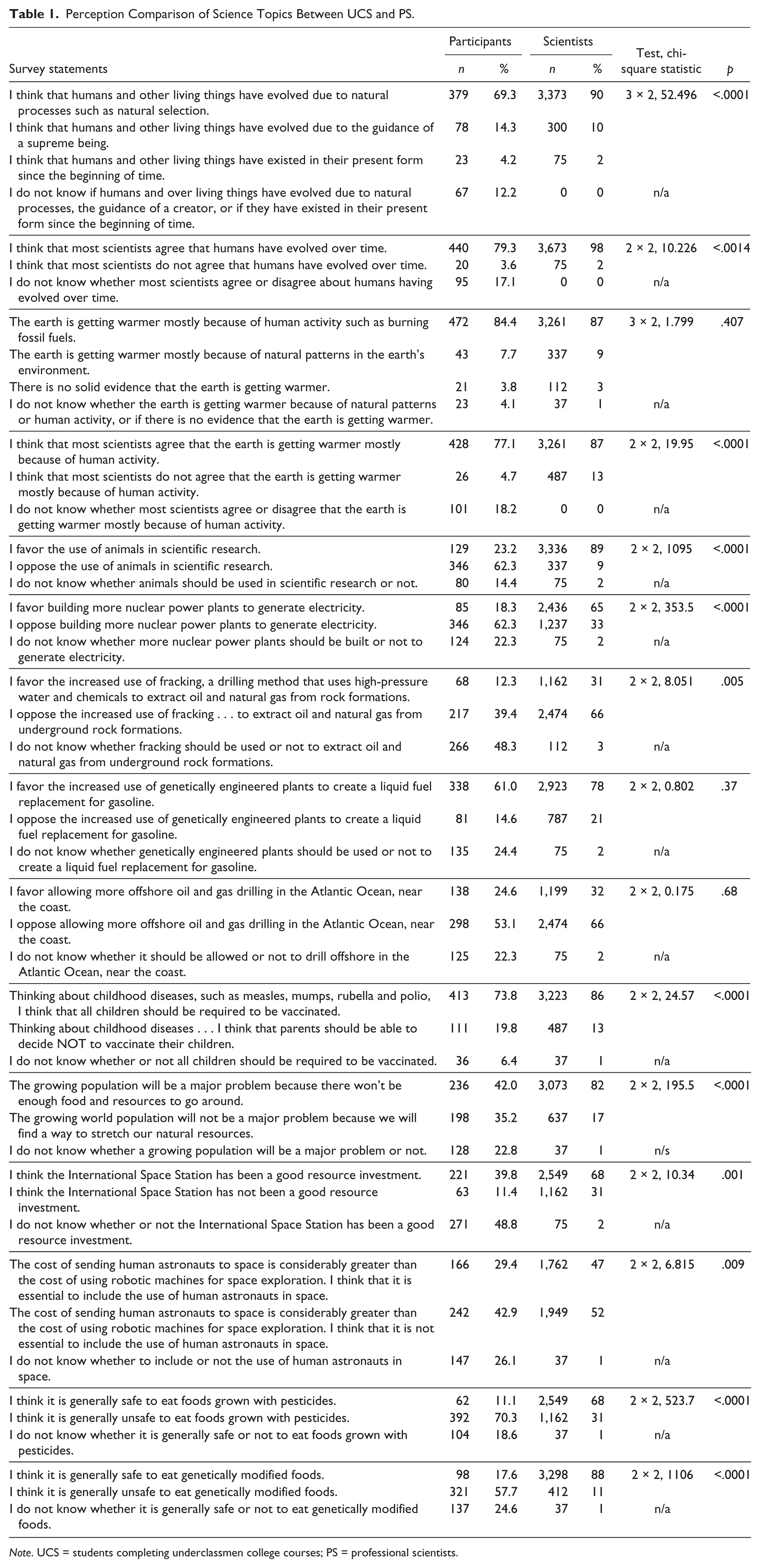
Note. UCS = students completing underclassmen college courses; PS = professional scientists.
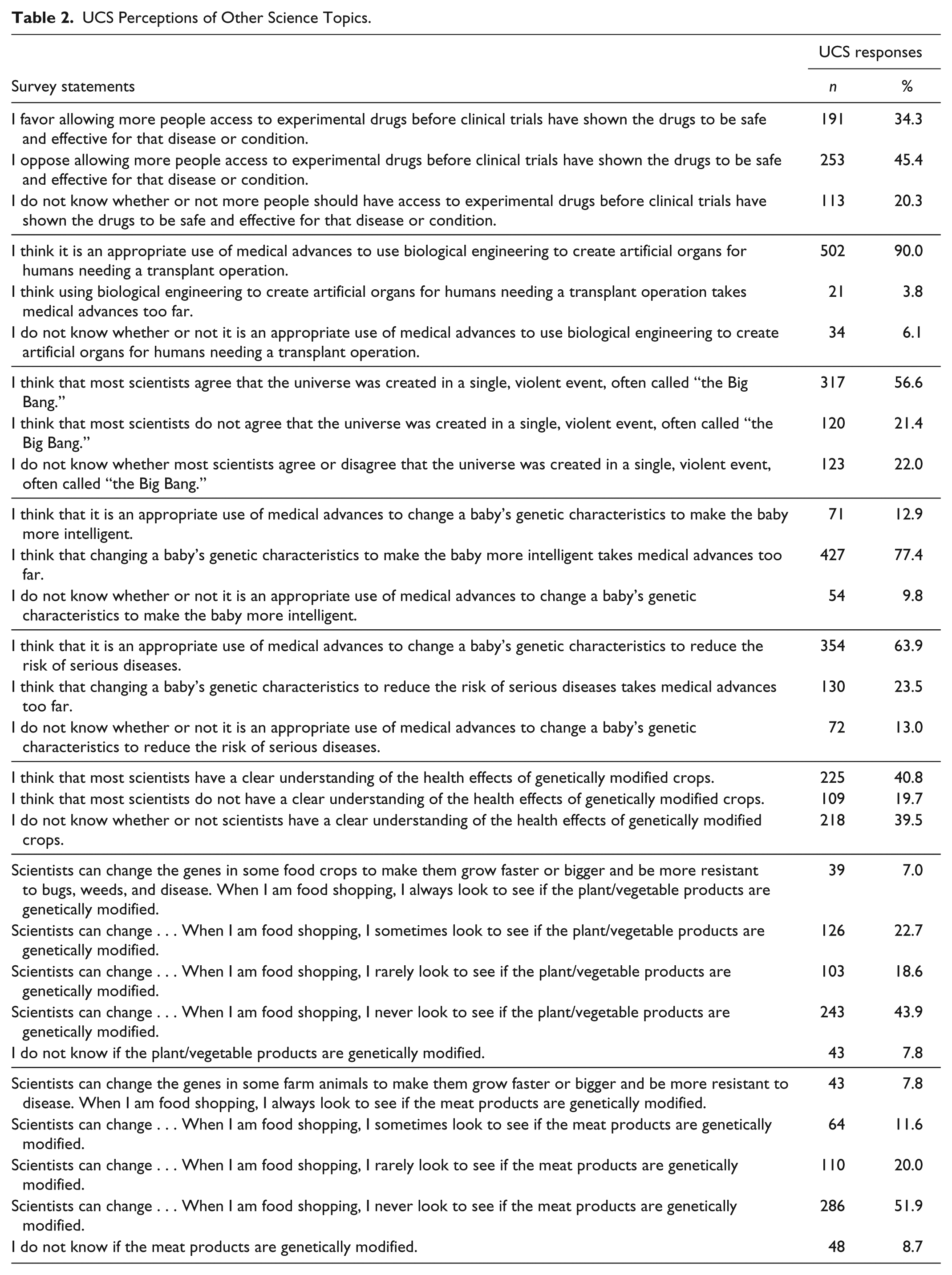
The survey also included 10 additional science topics of interest to the researchers. These topics were not part of the PS survey. Table 2 summarizes them.
UCS Perceptions of Other Science Topics.
UCS: Differences by Gender
The Mann–Whitney U test results uncovered that male UCS had a significantly better perception of Uruguay technology (U = 32305.5, p = .01) and engineering K-12 education (U = 30549, p = .002) compared with female UCS. There were no gender differences in the students’ views of science and mathematics K-12 education. Male UCS keep track of science news significantly more often than female students (U = 33087.5, p = .036).
Responses were significantly different by gender in topics such as whether PS are in agreement about whether humans have evolved over time (U = 34122.5, p = .044) and have caused global warming (U = 33156, p = .023), whether genetically modified plants should be used to create biofuels (U = 30655.5, p < .0001), whether overpopulation is a problem that will strain our food resources (U = 31345, p = .002), whether the International Space Station has been a good investment (U = 25514.5, p < .0001), and whether it is not essential to send astronauts for space exploration (U = 30057, p < .0001). For these science topics, male UCS were significantly closer to the scientists’ view.
In addition, responses were significantly different by gender in topics such as whether global warming is caused by anthropogenic causes, such as the burning of fossil fuels (U = 33479.5, p = .012), whether fracking should be used for the extraction of oil and natural gas (U = 31182, p = .002), and whether oil extraction platforms should be placed offshore near the coast (U = 24545.5, p < .0001). For these science topics, female UCS were closer to PS.
Even though both male and female UCS share opposite views on whether animals should be used in experimental research (U = 33215.5, p = .032) and whether more nuclear power plants should be built (U = 32417, p = .016), female students are significantly more opposed than male students.
Across all science topics, an average of 18% of male UCS and 21% of female UCS responded, “I do not know”; an unpaired t test showed that the difference was not significant (t = 0.985, degrees of freedom = 44, p = .3298). Topics that were less familiar to female students were related to the International Space Station, fracking, the safety of genetically modified foods, and human space exploration. For male students, the topics with the highest percentage of “I do not know” responses were related to fracking, the International Space Station, the safety of genetically modified foods, and the safety of crops that were planted in fields where pesticides were used.
UCS: Differences by High School Location and Age
UCS who completed all of their high school outside Montevideo have a significantly more positive view of the long-term effects of engineering and technology investments that the government is making (χ2 = 6.378, p = .041), and are significantly more confident of the scientists’ understanding of the health effects of genetically modified foods (χ2 = 6.021, p = .049), compared with students who completed all or some of their high school in Montevideo. UCS who completed some of their high school in Montevideo have a significantly more negative view of the effects science had on the quality of health care (χ2 = 6.451, p = .040) and were significantly less convinced that human activities are causing global warming (χ2 = 5.99, p = .050), compared with students who completed all of their high school in Montevideo or all of their high school in the interior.
For statistical purposes, UCS were divided into two main groups: relatively young (ages 17-19) and relatively old (ages 20-24) students. Relatively older UCS have a significantly more positive view of the long-term effects of basic science investments that the government is making (U = 32473, p = .046) and keep updated about science news significantly more often than relatively young students (U = 32020, p = .011). Also, relatively older UCS have a significantly more positive view of the effects science had on the quality of the environment compared with relatively young students (U = 31187, p = .006).
Conclusion
Overall, this study shows important “good news” regarding UCS perception of science topics, research and STEM education in Uruguay, as well as areas that definitely need to be improved at the national level. The study uncovered that many UCS tend to have an optimistic attitude toward science, and that they recognize its importance and everyday relevance. This information can be used to identify actions that, over time, maintain and strengthen this perception among high school students and the general public. Also, there was a good alignment between UCS and PS in many science topics, which can be seen as a partial victory for some of the national school science education policy priorities, especially those sponsored by ANEP, CES, and the Ministerio de Educación y Cultura or MEC (Ministry of Education and Culture).
On the other hand, the fact that in about 30% of the science topics the perceptions of UCS and PS were not aligned should be an eye-opener for Uruguay’s formal and informal science education efforts. For these science topics, there is a gap between the high school curricular goals, their implementation, and the ultimate goal of producing scientifically and technologically literate citizens that are ready to make personal and social decisions based on sound science. This is consistent with criticism from some scholars, who argue that the latest curriculum reform (completed in 2006) focused on coverage of a number of disconnected science topics, taught mainly in the old “positivistic” style, and with limited time for the analysis of the topics’ social and technological affects (Coll-Cárdenas, 2009). For members of the CES, including the Inspectors (whose main task is to assess teacher quality across Uruguay), the findings of this study will be extremely useful in updating national curricula and teacher assessments, and strengthening it with STS approaches.
The findings and conclusions of this study must be examined in the context of its limitations. First, the use of a 20-minute, paper-and-pencil survey limited the type of questions that could be asked. Second, the fact that a convenience sample of college students in one private university in Montevideo was selected, makes it difficult to extrapolate the findings to other populations of interest. This study is, however, an important baseline that can be expanded with future mixed-methods or qualitative studies targeting other populations of interest.
Scientific literacy is not only the responsibility of formal education. Despite many efforts from MEC and partner organizations, the development and improvement of additional communication channels that can contribute to informal science education seems an urgent matter. Only through enhanced mass media and community engagement can citizens become fully informed of the most recent national and international scientific and technological advances and their implications for all Uruguayans. Efforts tailored to women should be strongly encouraged if the findings of the study are to be followed.
Footnotes
Acknowledgements
The authors gratefully acknowledge use of the services and facilities of the Catholic University of Uruguay and Morehead State University.
Declaration of Conflicting Interests
The author(s) declared no potential conflicts of interest with respect to the research, authorship, and/or publication of this article.
Funding
The author(s) disclosed receipt of the following financial support for the research, authorship, and/or publication of this article: This research was supported in part by the Fulbright Scholars Program, U.S. Department of State, Bureau of Educational and Cultural Affairs, and Fulbright Uruguay.