



Abstract
This qualitative study highlights the experiences of seven parents of preschoolers who engaged in persistent challenging behaviors. The study included an in-depth interview with each parent, member checking, and a follow-up discussion with each participant to clarify any ambiguous participant comments. Results revealed four major themes regarding the impact of challenging behavior on families: (a) choosing activities, (b) siblings, (c) stress, and (d) questioning parenting competency. Future research ideas and implications for researchers, practitioners, and policy makers who work with or on behalf of young children with challenging behaviors are discussed.
Keywords
Educators, researchers, and policy makers have become increasingly aware that many young children begin school without the requisite emotional, social, behavioral, and academic skills necessary for success. There is a growing body of research that points to the correlation between social competence and school success (Fox & Smith, 2007; Raver, 2002). When young children lack social and emotional skills, they may develop challenging behaviors. Challenging behavior in young children ages 3 to 5 has been defined as a repeated pattern of behavior that interferes with learning or pro-social interactions with peers and adults (Powell, Fixsen, & Dunlap, 2003; Smith & Fox, 2003), as aggression toward others, property destruction and self-injury (Turnbull & Ruef, 1996), and as “behavior that interferes with learning, is dangerous, or is considered problematic by the family” (Boulware, Schwartz, & McBride, 1999, p. 21). The importance of listening to the family’s own definition of challenging behavior is emphasized by Fox, Clarke, and Dunlap (2013).
The Division for Early Childhood (DEC, 2007) of the Council for Exceptional Children’s position statement on identification of and intervention with challenging behavior calls attention to the central role of families and the effect of challenging behavior on the family. For many parents, one of the most difficult issues they confront surrounds their child’s behavior (Boulware et al., 1999). A child who engages in challenging behavior can influence family life at home and in the community (Fettig, Schultz, & Ostrosky, 2013; Turnbull & Ruef, 1996) and has a substantial impact on parents, siblings, and other members of the family system (Dunlap, Ester, Langhans, & Fox, 2006; Long, Gurka, & Blackman, 2008). Family stress and isolation are frequent themes within studies focusing on the results of parenting a child with challenging behavior (DeVore & Bowers, 2006; Hutton & Caron, 2005; Long et al., 2008; Powell, Dunlap, & Fox, 2006; Worcester, Nesman, Raffaele Mendez, & Keller, 2008). Work pressures, resulting from repeated absences due to a child’s challenging behavior, have been reported as stressful (Vaughn, White, Johnston, & Dunlap, 2005), and parents have described how they adapt their life to avoid triggering the child’s difficult behavior and the emotional pain and isolation of staying at home due to their children’s frequent tantrums when in public places (Fox, Vaughn, Dunlap, & Bucy, 1997; Hoppe, 2005). In summary, research has shown that parents of children who engage in persistent challenging behavior experience struggles with obtaining useful information about their children’s behavior, financial and emotional stressors, feelings of isolation, and difficulties obtaining services and supports for their children. Parents also experience difficulty when trying to find childcare providers who could support them in addressing their children’s challenging behavior, with families of children with disabilities who engage in challenging behavior or who have health problems experiencing greater difficulties placing their children in group care than other families (DeVore & Bowers, 2006).
Successful interventions to reduce challenging behavior are based on a collaborative relationship with parents (Buschbacher, Fox, & Clarke, 2004; Duda, Clarke, Fox, & Dunlap, 2008; Fettig et al., 2013; Marshall & Mirenda, 2002; Moes & Frea, 2002). Listening to and respecting the parent perspective will enhance the process of building a relationship that is focused on providing interventions for young children (Stoner et al., 2005; Turnbull, Turnbull, Erwin, Soodak, & Shogren, 2011). The present study extends the literature by examining parent perceptions when young children, ages 3 to 5, engage in persistent challenging behavior. This qualitative interview study addressed this research question: How does a young child, ages 3 to 5, with challenging behavior influence the family system?
Method
Data were gathered by interviewing parents of young children who engage in challenging behavior. An interview approach has been described as one of the most powerful ways to understand another’s perspective (Fontana & Frey, 2000). For the purpose of this study, challenging behavior was defined as behaviors that cause a young child in a childcare setting to be expelled (asked to leave or is disenrolled), or be at risk of being expelled (parent is told that the behavior must improve or the child will be disenrolled) from the childcare program. This was the only criterion used to recruit parents of preschoolers ages 3 to 5.
Recruitment posters explaining the study and inviting interested parents to participate were posted by the first author on bulletin boards in all of the childcare centers (15) within one midwestern county. The researcher also asked childcare administrators to include the recruitment invitation in the newsletters they disseminated to families. Parents responded to the recruitment invitation through email or by phone. Inclusion in this study was based on parents’ willingness to participate in two interviews.
All seven parent participants were mothers who ranged in age from 18 to 38, M = 30. Six of the mothers reported their ethnicity as Caucasian and one parent reported her ethnicity as bi-racial. Three participants resided in communities with a population of 500 to 3,000; two lived in a community of 5,000; and two parents resided in a large urban community. Two of the parents had high school diplomas, and two parents had attended programs beyond high school that provided a certificate. One parent had an associate degree from the local community college, and the other two parents held bachelor’s degrees. Six of the children had gone through a community Child Find screening, but no delays were noted. None of the seven children were supported by Individualized Education Programs (IEP). The names used are pseudonyms. Child information, as reported by the parent, is shared in Table 1.
Participant Demographics.
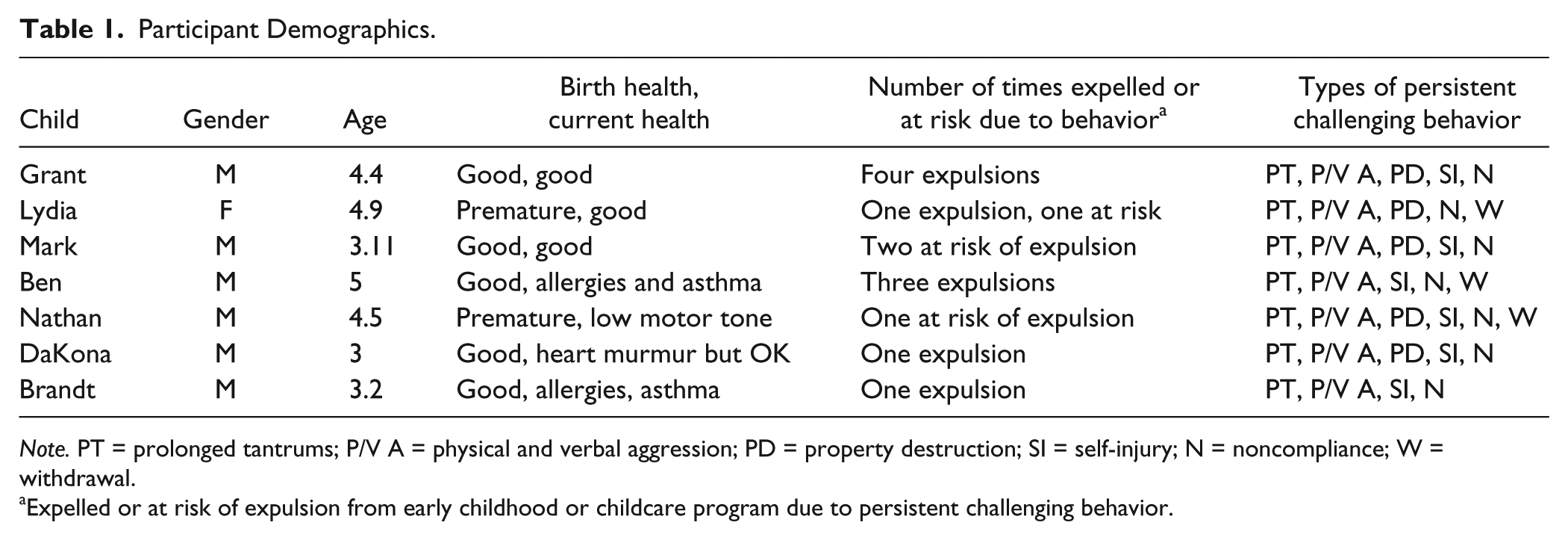
Note. PT = prolonged tantrums; P/V A = physical and verbal aggression; PD = property destruction; SI = self-injury; N = noncompliance; W = withdrawal.
Expelled or at risk of expulsion from early childhood or childcare program due to persistent challenging behavior.
Instruments
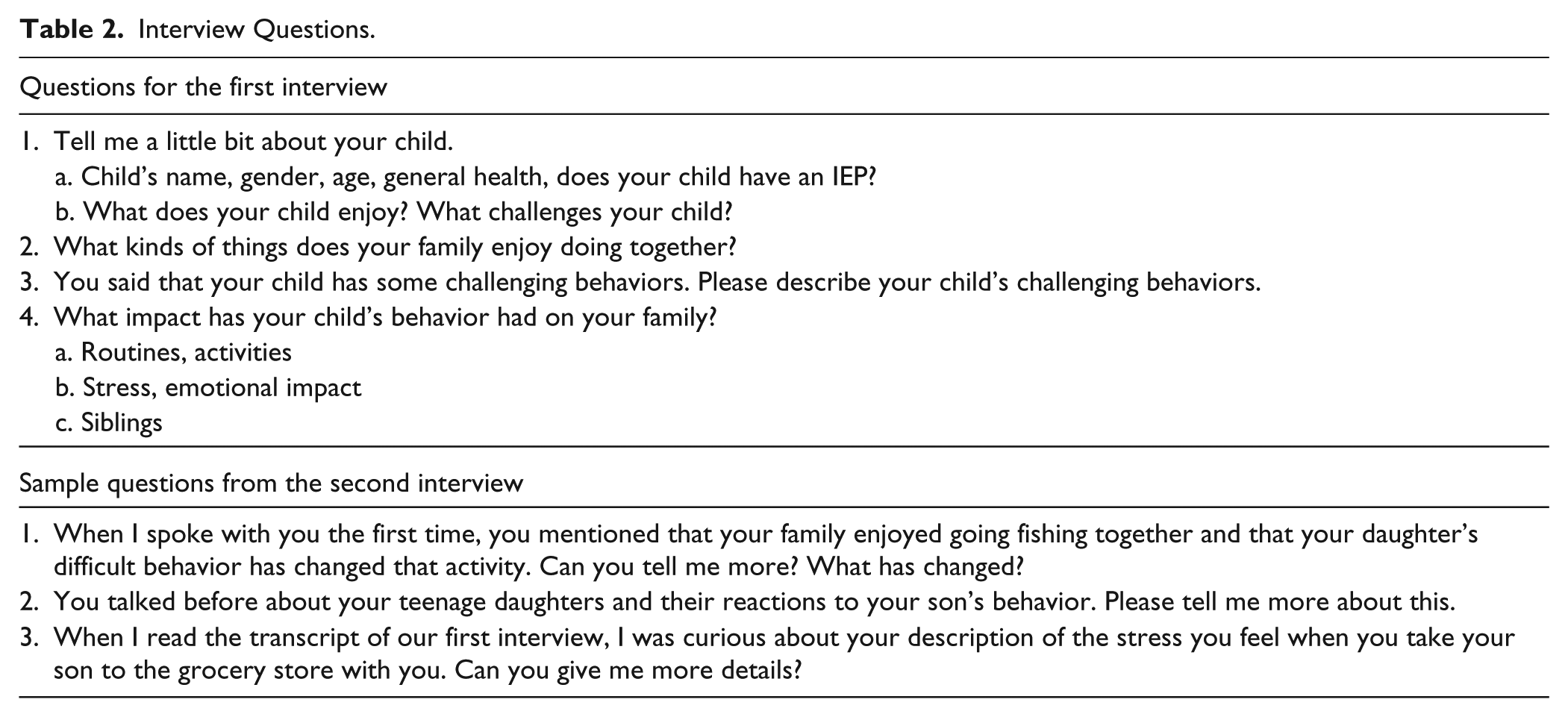
Semi-structured interviews were conducted with seven mothers to gather multiple perspectives about their experiences when parenting a child who engaged in persistent challenging behavior. Questions for the interviews were based on literature related to parents and young children with challenging behavior (Fox et al., 1997; Worcester et al., 2008). All participants were interviewed twice within a 2-month period. Data were analyzed after the first set of interviews was transcribed and relevant questions for the second interviews were focused on gathering more information for clarity and adding depth about the topic (“Can you tell me more about your child’s tantrum behaviors?”). The researchers determined that saturation had been reached as participants began repeating information that had already been shared. See Table 2 for interview questions from the first interview and examples from the second interview.
Interview Questions.
Data Collection and Analysis
Data collection began with a pilot study to evaluate the interview protocol (e.g., clarity, level of detail gleaned from participants’ responses, time, and order of questions). One parent, who fit the description of the target participants, was interviewed by the first author to pilot the questions. The interview was audiotaped and then transcribed by a professional transcriber. The authors then read the transcript and discussed alterations to the interview protocol based on the pilot.
Semi-structured interviews with parents of young children who engage in challenging behavior were then arranged and conducted. All interviews were conducted in person by the first author, were audio recorded, and were held at parents’ homes or private meeting rooms at community libraries. The first interviews averaged 38 min (range = 30–45). Questions for the second set of interviews were developed after the data from the first set of interviews were analyzed and discussed. The follow-up interview averaged 20 min (range = 15–25 min). All audiotapes were transcribed by a professional transcriber. The first author reviewed the transcriptions for accuracy by listening to each audiotape as she reviewed the transcript.
Member checking, the process of asking participants to review their transcript for accuracy, was used to confirm the findings from the interviews (Janesick, 2000). All participants reported that no edits were needed on their interview transcripts. These steps served as credibility measures (Brantlinger, Jimenez, Klinger, Pugach, & Richardson, 2005).
Content analysis procedures, described by Johnson and LaMontagne (1993), were followed. This process included six steps: (a) preparing the data for analysis, (b) becoming familiar with the data, (c) identifying units of analysis, (d) defining categories for coding the responses, (e) refining categories, and (f) establishing category integrity. Miles and Huberman’s (1994) description of common features of analytic methods to determine movement through the analyses stages was also used, and the resulting data analysis plan was a merging of these sources.
After all interview data were prepared for analysis (e.g., transcribed, reviewed by participants and the authors), the next step was to become familiar with the data by reading and reviewing the transcribed interviews. Reviewing the transcriptions, looking for participants’ references to topics, and writing notes on potential themes are referred to by Miles and Huberman (1994) as a step to identify similar phrases, relationships, and patterns across the data. The authors met to review and discuss each transcript and talk about emerging categories. Discussion continued until consensus was reached on all categories. Brantlinger et al. (2005) described this as “peer debriefing” (p. 201) and reflects on the use of this step to increase credibility.
Schwandt (2001) defined the procedure of “breaking down the data into manageable segments” (p. 26) as coding. The authors independently coded the first three interview transcripts into tentative categories, met and compared categories, and reached consensus on all categories. By refining the categories through this process, the rest of the responses were then coded independently, followed by discussion, and consensus. Each author has more than 30 years in the field of early childhood, interview experience with parents of young children, and research experience with young children’s social and emotional development and challenging behavior.
To establish category integrity, a naïve independent coder, a graduate student in early childhood special education who was naïve to the purpose of this study, was asked to read and code 36% of the segments, or units of analyses. Following the independent coder’s sorting of data into categories, a comparison of ratings between the authors and the naïve coder resulted in 94% agreement. Discussion followed until consensus (100%) was reached on all disagreements.
In an attempt to add to the credibility, transferability, dependability, and confirmability of this study, the authors followed qualitative criteria for assessing research quality and rigor as presented by Anfara, Brown, and Mangione (2002) and Brantlinger et al. (2005). The measures of credibility followed in this study include investigator triangulation, researcher reflexibility, member checks at the first level, collaborative work, external auditors, peer debriefing, thick, detailed description, and particularizability. Further information is provided in the “Limitations” section of this article.
Results
All participants were asked to describe how parenting a child with challenging behavior has affected their family. This question was followed by prompts regarding family routines and activities, and sibling reactions. Four categories emerged from the data and are discussed below: (a) choosing activities, (b) siblings, (c) stress, and (d) questioning parenting competency.
Constraints on Family Activities
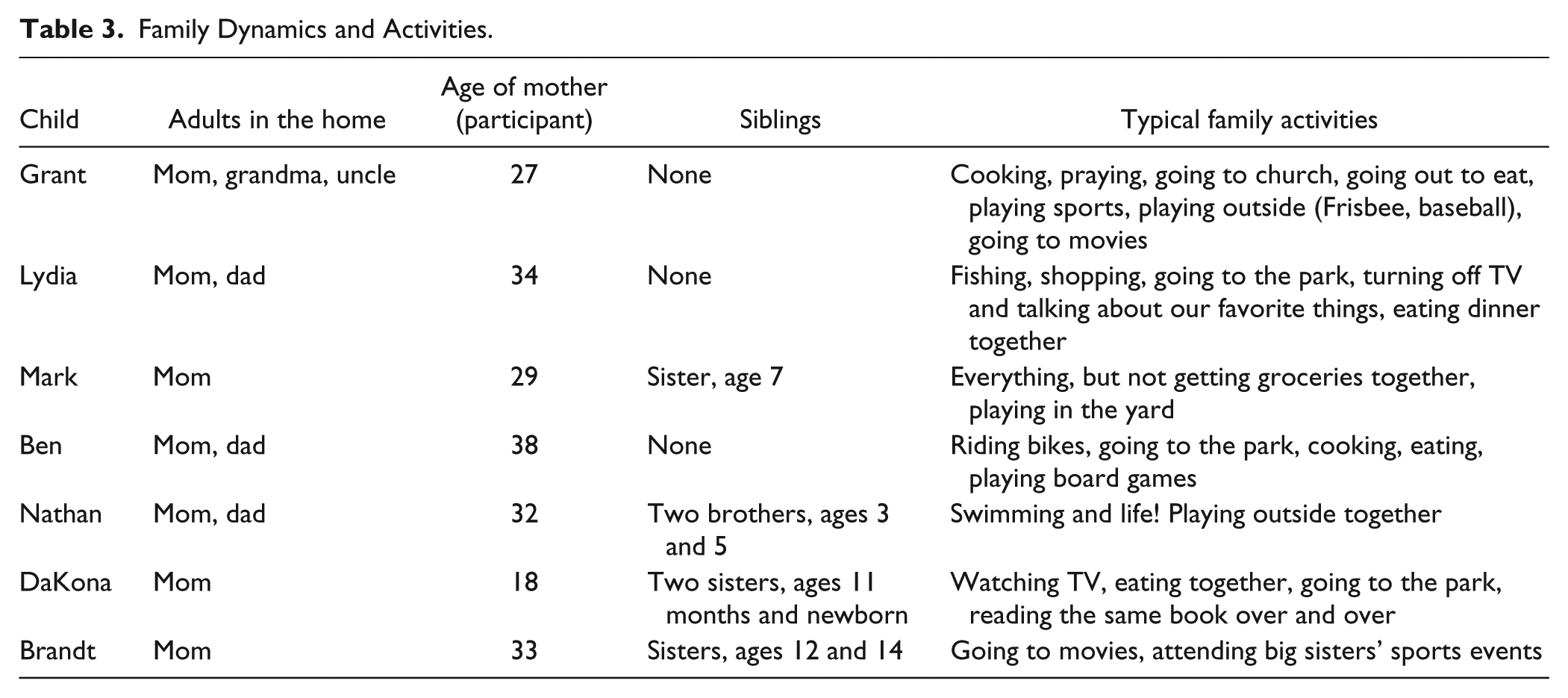
Data on the participants and their typical activities are included in Table 3. The seven families represent a variety of configurations from one adult in the home to three adults, with four of the seven children living in single parent homes. There is diversity represented in the number of siblings in the home, with three families having one child, one family with two children, and two families with three children. Data about typical family activities as described by study participants are important when considering the impact of children with challenging behavior on the family system.
Family Dynamics and Activities.
All seven parents discussed how having a child who is engaged in challenging behavior changed typical family activities. Parents also shared their emotions and feelings related to dealing with their child with challenging behaviors. For example, one parent spoke about the frustration and guilt she feels when faced with canceling family plans as a result of her son’s behavior: I would say it’s been very frustrating because I have a hard time myself, if I had plans, we were gonna do something, I had promised him [Grant] that we’d do something, and he hadn’t had a good day, then I take it away. I struggle with that guilt complex. But like I said, maybe just preventing us from doing it. If it was promised or we were gonna do it, then I use it as kind of a disciplinary word, “We’re taking it away; we’re not gonna get to do that now.” So I feel like we’ve had to miss out on doing some things.
Lydia’s mother reported feeling embarrassed when her daughter’s behavior escalated during family gatherings: Well, like a family reunion or like when we have family together, it’s kind of embarrassing ’cause she’s—when she’s around a big group of people, Lydia gets more hyper, ’cause she doesn’t know what to do with herself. And—and so, it kind of—we’re constantly, “Calm down, not so loud.” Her voice just goes loud. She’s just excited when she’s around other people.
Concerns about the child’s behavior often kept parents at home as reflected in the following quote: It’s easier to deal with at home than it is out in public. ’Cause in public, I try so hard to keep him [Brandt] behaved, and I’m constantly worried about where he’s going, what he’s saying. Just too tense, trying to keep him behaving. Where at home, I can just whatever, and relax and just let him throw a fit or whatever.
Some parents reported that at times, the whole family did not attend public events and other plans were made so that the child with challenging behavior stayed home. Such choices affected families’ abilities to go places as a unit. Mark’s mother explained that she would not take him to a store: “I go alone to the store now. Anything involving where there’s candy or toys, the outbursts are totally—no, can’t do it anymore.” DaKona’s mother spoke of staying home due to her son’s unpredictable behavior: “We don’t go that many places, ’cause he’ll—wherever we’re at, he does it [tantrum].” Avoiding restaurants was mentioned by another parent who stated, “we didn’t really want to take Ben to some functions because he just—if he was bored, he was just bouncing like a pinball.” Mark’s mother reported the impact his behavior has on leaving the house on time for family events. She said that it sometimes will “take hours” for him to put away his toys before they can leave to go somewhere as a family.
Parent participants also talked about how they adapted or changed family activities to meet their children’s needs. For example, Ben’s mother noted, “We tried to take Ben to a wedding over the summer, and had to leave before the reception, where other kids were just fine.” A parent who listed fishing as their favorite family activities, talked about the fact that her family is currently not able to enjoy this activity together.
When we’re by ourselves and go fishing, you know, my husband likes to relax and be quiet. And Lydia—that’s hard for her. And then, her and I are constant bickering. He’s like, “This is not relaxing.” So he goes fishing by himself a lot. That can be a challenge.
Only one mother reported that her family does not allow their child’s challenging behavior to alter their activities: “We really don’t let it. We don’t. We don’t not go somewhere because of Nathan. We just make sure there’s enough grownups to go along.” This family had developed a strategy to enable them to continue to enjoy favorite family activities such as swimming and playing outside. The mother reported that they were fortunate to live next door to both a sister-in-law and mother-in-law who were actively involved and willing to provide extra help when needed.
Negative Impact on Siblings
Four children in this study had siblings, and their parents spoke about sibling reactions to the child with challenging behavior. The themes that emerged in response to this topic were negative physical and verbal interactions, and hurt feelings due to the parent needing to miss activities in which the other siblings are involved.
One mother described the negative physical interactions of her children: “DaKona, he kicks her and punches her and hits her [sister age 11 months]. Now she’s starting to fight back. She’ll pull his hair and run.” It appeared from the mother’s description that the younger sibling was starting to assert herself in response to DaKona’s aggression. In another family with three children (ages 3, 4, and 5), the parent described their play: They [the 3 and 5 year old brothers] don’t really play with him as much as they play with each other. It’s getting a little bit better. The littlest brother will tell you that he doesn’t like Nathan. You know, he’ll say, “I don’t like Nathan. He’s mean.” And, yeah, he is, but he still plays with him on occasion.
The occurrence of negative verbal interactions and emotions in response to a sibling with challenging behavior is evident in the following quote from Brandt’s mother: It just depends on what kind of mood they’re in. I mean, sometimes they can handle it well, and try to play with him and try to change his moods and this and that. And then, if they’re having a bad day, they’re just—they just scream at him [Brandt], “Shut up. Leave us alone. You’re driving us nuts.” So, even at home it’s more of a stress.
Two parents shared how their children’s challenging behavior affected the siblings’ opportunities to be engaged in activities and to receive parental support. Both of these families had older siblings. Reports of jealousy and hurt feelings were shared through quotes such as “Mark gets everything when he does it [engages in challenging behavior], she [older sister] thinks. Yeah, she’s jealous. She’s very, very, very jealous of Mark.”
In addition, Brandt’s mother discussed the impact on older siblings as she reflected on missed activities and her attempts to help her other children understand her absences from their extracurricular activities: I don’t feel that we can go do a lot of fun stuff because of Brandt, because of his behavior. I’d rather just sit home and not do anything than have to deal with him in public. I can’t go to some of their events that they’re in, their sports or school activities. They’re probably hurt sometimes, the fact that I can’t go. And they know why, I’ve explained why. And even though they understand it, they still wish I could be there.
Increase in Family Stress
When the seven participants were asked about the impact of their child with challenging behavior on the family, comments about stress were expressed by every participant. Mothers shared information about their stress as it relates to their family experiences at (a) home, (b) childcare or preschool, and (c) work. It appears that multiple settings were affected by the challenging behavior displayed by these parents’ children.
When parents discussed stress as it relates to their home environment, Mark’s mother shared that there is stress “Every day. From the time I get them [Mark and his sister], about 3:00 or 3:30 in the afternoon, from daycare, until they go to bed at 8:00 o’clock, he has at least 7 tantrums.” She continued this line of thought with the following quote emphasizing her reactions to Mark’s behavior and the impact on the family: Just at home, my stress level goes higher. And I could be in a good mood, and then, if he’s crying and whining—’cause he [Mark] whines a lot and cries a lot. That really gets on my nerves. I get stressed out really easily about that. It makes me in a bad mood then. Then everybody is like stressed out. There’s a lot of yelling and stuff.
Ben’s mother discussed the impact of her son’s challenging behavior on extended family members who help care for him in their home: “He [Ben] hits his grandmother sometimes when he doesn’t get his way. We had one incident [biting] over the summer with his other grandmother. This is not OK.” Ben’s mother then talked about the strain this has caused on their family relationships.
The stress parents feel related to caring for their child and the amount of time that is expended to ensure their child’s safety at home can be summarized by a quote from Nathan’s mother: “He can’t be sent out of the room to get his shoes, or even to use the bathroom without playing in the water or flushing the toilet 14 times. He just has to be constantly supervised.” Nathan’s mother also discussed the stress his tantrums cause for the family, citing “once he’s out of control, he’s out of control until he goes to sleep.”
The topic of family stress as it relates to childcare or preschool environments was a topic discussed by several parents. For example, Lydia’s mother was concerned about the response she anticipates getting from teachers when Lydia goes to preschool: “Teachers are not going to give in when she goes to school.” She also discussed her concerns regarding the impact of challenging behavior on Lydia’s opportunities to develop friendships at school: I’m more concerned about how she’s gonna socialize with others, you know? As friends and stuff. With her age. And I think even adults sometimes, ’cause like at a school setting, I mean, she’s gonna have to learn to be quiet and not be so mad—and go off the deep end, you know.
Several family members shared negative and stressful experiences in connection with childcare programs. Ben and his family were expelled from four childcare programs due to his persistent challenging behavior. His mother discussed the family stress related to all of the transitions between programs. Her emotions were still raw as she described an interaction with childcare staff when they “informed me that they hadn’t had the ‘sorry chair’ [place to sit during time out] out in 4 years, until Ben came in [to the classroom].” Grant’s mother shared that they were expelled from three childcare programs. She described one very stressful interaction surrounding one of the expulsions: When he was removed after a week at [the new childcare center], I thought I was going to lose my mind. And they did it in a very unprofessional manner, and name called him, called him an “out-of-control nightmare.”
There was discussion about the confusion parents felt when some early childhood staff highlighted the importance of academic skills. One mother tried to promote academic skills even though her son’s behavior made it very difficult for him to focus. Ben’s mother shared, First of all, I felt like I started trying to push him [Ben] to learn. I felt like he wasn’t developed like he was supposed to. And so, we were on him, “You gotta do your letters, and you have to sit still.” We started disciplining him differently and talking to him in a different way, that was all making it worse. We were stressed.
Brandt’s mother felt confused with the source of his challenging behavior and the quality of care he was getting in the childcare setting. She described her concerns that he was learning biting and pinching at childcare.
You know, ’cause he was starting to become mean. And then, of course, he would get in trouble from the babysitter, and then, she’d tell me about it. And, of course, I would try to discipline him. And, I just feel that he wasn’t getting the care he needed or deserved [at childcare program]. I don’t bite him. I don’t pinch him, so he’s not learning that from me.
Several parents described family stress as it relates to their time while at work and away from their young child. Ben’s mother had a difficult time while he was in a childcare program. “We were stressed. I was stressed out. I mean, trying to work and not knowing what was going on at school. Wondering what was really wrong with Ben.” Grant’s mother worked and attended college classes. She discussed the stress of placing blame on herself for his challenging behavior: “And it gave me concerns about what was triggering him to do it [challenging behavior]. Because I was always trying to blame myself. I’m like—I’ve always worked and I’ve been in school for most of the time.” Also, Brandt’s mother described her frustration with being at work while her children are “shuffled” between three environments each day. She questioned the impact that not being with her son, while she is at work, might have on his behavior.
Questioning Parental Competence
The final category that emerged from the interview data focused on how parenting a child who engages in persistent challenging behavior can affect parents’ beliefs about their parenting capabilities. All seven mothers described how they began to doubt their parenting skills and abilities based on their child’s behavior. When asked about the impact of a child with challenging behaviors on her family, Brandt’s mother replied, “Stressful, embarrassing. Like ‘Oh, she can’t control her kids.’ And really—I can’t.” A second parent shared her confusion about her child’s behavior: He’ll be sitting down like he is right now, just fine. Nobody does nothing to him [DaKona]. He’ll jump up out of nowhere and just scream and cuss people out, just for no reason. And then, he’ll go back to sitting down, like he did nothing wrong. I don’t know what this is about.
A recurring theme was that parents do not know what to do to prevent or reduce their child’s challenging behavior. Parents discussed some of the strategies or responses they have tried, but ended up saying that none of the ideas have improved their child’s behavior. Grant’s mother reported a lack of trust for the suggestions given to her. She also said “I was hoping that with maturity he would grow out of it. That has not happened. He has grown into it [the challenging behavior].” Four mothers described strategies or responses they have tried with their children and the feeling that challenging behavior has not decreased: He [Mark] has hurt his sister and me. I have not gotten notice of any other violence towards other children. He hits me, kicks me and his sister. Tantrums. Terrible. I walk away. Screaming, kicking, bounces his head off the wall, the floor, whatever, for attention. He does not hurt himself. He’s sent to his bed, if we’re at home. If we’re somewhere else, then pretty much I don’t know what to do.
Mark’s mother talked about walking away from her child when they are out in public and he is having a tantrum: It starts with wanting a candy bar. Checkout. I hate checkout lanes. I hate ’em. “No, we don’t have enough money. No, we don’t need it.” At the grocery store, I’ve left him [Mark] there. I’ve walked outside of the grocery store, left the groceries, and just walked out. And then, he stopped and acted like he was fine, and got up, “Oh, mom is gone!” I wait outside the door, and he comes outside, “Mommy! Mommy!” I waited, I was watching and could see in the grocery store, kind of watch where he is at. Just waited. I don’t know how else to do it.
Nathan’s mother described her family’s response that seemed to reward his negative behavior and not reduce it: Because of the prematurity and everything that he [Nathan] went through, he was pretty spoiled, ’cause we were just glad he was alive! And so, when he was ornery, we just—because he’s funny and really cute, we just giggle, “Oh, he’ll get better.” But . . . it has not gotten better.
Brandt’s mother decided that one way to reduce his challenging behavior is to avoid disagreeing with him: His moods change a lot. ’Cause like, for example, I can go into day care, pick him [Brandt] up, and he’ll be happy-go-lucky, and then, I’ll say one thing, and he’ll just get in a bad mood, kick me, and hit me, or go, “Ooooh,” just give me snarly sounds and facial expressions—that I don’t like. Well, if you don’t want him to throw a fit, just give him whatever he wants.
Finally, Lydia’s mother shared a positive example of strategies she is trying to implement to help change behavior: And I did learn as a parent, though, I’ve gotta be more consistent. So I’ve grown as a parent, too. ’Cause I think she learned if she threw a fit and cried or whatever, mom will give in. And I had to stop that. So that was a growing experience for me. But I stopped that [giving in] and—She has a hard time accepting it—She’ll get there.
In summary, interview data revealed that parent participants had strong feelings about the impact of a child with challenging behavior on the family system. All seven parents talked about how their children’s behavior affected their choices of family activities. Six parents discussed not being able to engage in typical family activities because of issues associated with including their young child with challenging behavior. One parent, Nathan’s mother, spoke of enjoying favorite family activities provided that a strong adult support system was in place.
In addition, parents described siblings’ hurt feelings when parents missed their activities, and parents spoke of siblings’ feelings of jealousy as a result of one child’s persistent challenging behavior. Parents reported feeling stressed and wondering whether something was wrong with their children. They also commented on the stress they felt at home, at childcare, and at work. Mothers shared numerous examples of how their children with challenging behavior affected the mood of everyone in the house. Feelings of parent confusion with parenting approaches and diminished feelings of competence also emerged from the interview data.
Discussion
While examining the impact of parenting a young child with persistent challenging behavior, four key issues emerged that are worthy of further discussion: (a) a variety of family stressors, (b) a lack of collaborative parent/professional relationships, (c) a need to reduce expulsion rates for young children, and (d) the benefits to families when behavioral interventions and support services are implemented. These key issues are examined and connected to the current literature in the following sections.
Although other studies have reported on family stress surrounding their children’s behavior (Fox et al., 1997; Guralnick, 2000; Hoppe, 2005; Hutton & Caron, 2005; Vaughn et al., 2005), this study extends the research by including parents of preschool-age children and reports on family responses to expulsion from early care and education programs. Parents reported stress in several areas of their lives as a result of their young children’s challenging behavior. The areas of stress included difficult family experiences at home, at childcare, and at work. Parents also described having their confidence shaken as they questioned their own skills and abilities related to the challenging behavior of their young children. These feelings of inadequacy were intensified when childcare staff, family members, and friends made comments about participants’ parenting skills. This information is important to consider if we truly value parents as experts about their children and partners in designing and implementing interventions (Fettig et al., 2013). Positive parent–professional relationships can be in jeopardy if parents feel judged or inadequate about their own parenting skills.
The lack of parent–professional collaborations is an additional finding worthy of discussion. Rather than collaborating to seek solutions, parents described multiple expulsions from childcare programs and the stress this caused their families. Perry, Holland, Darling-Kuria, and Nadiv (2011) summed up this dilemma: “Expulsion from childcare is the most extreme outcome of early care and education providers’ inability to cope with challenging behaviors” (p. 5). When there are supports, such as professional development, positive parent/professional relationships, or behavioral/mental health consultants, there are lower rates of expulsion (Gilliam, 2005). Parents’ descriptions of frequent expulsion are disturbing considering there are evidence-based practices that are known to prevent or reduce challenging behavior. Parents described experiences and interactions with care providers, which did not include parent–professional collaborations, a paramount feature in reducing challenging behavior for young children (Fox et al., 2013; Perry et al., 2011). Parents shared several examples of not knowing what to do to address their children’s behavior, and then with little or no communication from teachers or early childhood directors, their children were expelled from the childcare programs. This finding echoes results reported by Perry et al. (2011). The gap between parents seeking information about strategies to try, and subsequently learning their child is being expelled, must be addressed.
The third finding worthy of discussion is the lack of knowledge about evidence-based strategies and approaches for both parents and childcare staff to use when a child engages in persistent challenging behavior. Parent participants did not report knowing or using any strategies that worked to prevent or reduce challenging behavior. All of the children were in childcare programs, yet the parents did not report receiving support from teachers or directors. This is disheartening, considering the plethora of resources and materials available to give guidance to programs in support of children with challenging behaviors (e.g., http://www.challengingbehavior.org/; http://csefel.vanderbilt.edu/). In addition, as discussed by Yu, Meyer, and Ostrosky (2013), teachers share a responsibility to create early childhood programs where all children feel accepted. Collaborating with families, gaining knowledge and skills on evidence-based strategies, and creating classroom communities where all children feel accepted are practices that are in direct contrast to expelling children from programs when they engage in persistent challenging behavior.
The final topic worthy of discussion focuses on the implementation of behavioral interventions and support services, and the benefits of such services to families and their young children. Data from parent participants suggest the importance of providing behavioral support to families that empower them to successfully include their children in valued home and community activities. This is consistent with literature highlighting the benefits of positive behavior support (PBS), focused on improving valued but problematic family activity settings (Buschbacher et al., 2004). Research has also shown that PBS results in improved sibling relationships within home and community settings (Duda et al., 2008; Lucyshyn et al., 2007), again signaling the need to link families, such as those who participated in the current study, with interventions and supports to change their children’s behavioral trajectory. Finally, the current study suggests the importance of ensuring that behavioral support to families is designed to promote self-efficacy (Sanders & Wooley, 2005). Several participants reported feeling inadequate in the role of parent to a child with persistent challenging behavior. This finding increases the significance of interventions, such as PBS, which promote the feelings of parental competence and confidence.
Limitations
Although this study resulted in rich data on the impact of parenting a young child with challenging behaviors, it would have been helpful to have a larger and more diverse group of participants. All seven participants were mothers; the voices of a diverse group of fathers would have added breadth to this study and resulted in data reflecting a wider variety of parent experiences. In addition, all participants were recruited from one county in a midwestern state. Increasing the geographic area of recruitment might have increased the generalizability of the findings. Although this study does meet the majority of the credibility measures for qualitative research (Anfara et al., 2002; Brantlinger et al., 2005), it is important to consider the unmet criteria, which may affect generalizability. Limitations include the lack of data triangulation (i.e., with direct observations), member checking at the second level, and prolonged field engagement.
Implications for Practice and Research
Despite the limitations, the results of this study have implications for the following key stakeholders who work with families of young children: (a) practitioners, (b) policy makers, and (c) researchers. Each stakeholder group would benefit from the information that parents shared regarding the impact of persistent challenging behavior on the family unit.
There is a clear call for help from all of the parents in this study. All of the children were enrolled in childcare programs and were expelled from programs or were at risk of expulsion. There are resources and materials available to support early childhood programs with the tools needed for professional development on the topic of social and emotional development for all children. The Pyramid Model is a conceptual framework and multi-tiered model focused on prevention, promotion, and intervention, all of which should be in place to address the needs of young children within early childhood programs (Benedict, Horner, & Squires, 2007; Doubet & Corso, 2010; Hemmeter, Fox, & Snyder, 2013). Program-wide implementation of the Pyramid Model follows a systems approach to ensure that appropriate policies and practices are in place (Fox & Hemmeter, 2009; Fox, Lentini, & Binder, 2013). Quesenberry, Ostrosky, and Hemmeter (2010) reported without clear policies, early childhood staff are less likely to consistently implement procedures to support young children’s social-emotional development. Professional development has the potential to support improved social and emotional outcomes for children and their families (Hemmeter et al., 2013).
All parent participants had experienced problems with childcare services due to their children’s challenging behavior. Some parents had to change care providers multiple times in their young child’s life. Stakeholders would benefit from considering parents’ perspectives when developing plans to support families. Special attention should be paid to the impact that a young child with persistent challenging behavior has on parents’ feelings of competency. In addition, the central issue of parent–professional collaboration, and its absence in the data set, offers fertile ground for policy implications. Programs should look carefully at the policies they have in place to support young children who engage in persistent challenging behavior by collaborating with family members (Quesenberry, Hemmeter, Ostrosky, & Hamann, 2014) to gather functional assessment information and design behavior support plans, and by accessing community resources if needed. Quesenberry et al. (2014) also suggest that programs that do not have policies and procedures in place consider organizing collaborative teams to develop comprehensive, proactive policies and procedures to support staff, children, and families.
The issues identified in this study suggest several areas for future research. Further investigation into this topic needs to include the voices of fathers, childcare providers, mental health professionals, and social service staff involved in providing support to young children and their families. By including the perceptions of these stakeholders, a more comprehensive perspective on this topic could be realized.
Future research should include observations of families of children with challenging behavior across environments including home, school, and community. This information could be triangulated with parent interviews to gain a better understanding of the impact of persistent challenging behavior on the family system. Studies are needed that include outcome data to measure the effects of interventions intended to improve parents’ experiences. For example, a series of parent education sessions could be conducted, measuring parents’ feelings of competence before and after the training along with changes in child behavior.
It is critical that stakeholders understand the parent perspective of the children whom they serve. The Division for Early Childhood (DEC, 2007) of the Council for Exceptional Children’s position statement on identification of and intervention with challenging behavior emphasizes support plans for young children. The importance of collaborative teaming with families is essential when providing support to children who engage in persistent challenging behavior (Fettig et al., 2013; Fox et al., 2013).
Although this study adds to the existing literature by expanding our knowledge about the impact of parenting young children who engage in persistent challenging behavior, much research remains to be conducted on young children’s challenging behavior and the influence of this behavior on the family system. Without this perspective, researchers, practitioners, and policy makers will continue to study challenging behavior through a blurry lens.
Footnotes
Declaration of Conflicting Interests
The author(s) declared no potential conflicts of interest with respect to the research, authorship, and/or publication of this article.
Funding
The author(s) received no financial support for the research, authorship, and/or publication of this article.