




Abstract
Young children with complex communication needs are often severely restricted in their ability to communicate and develop language skills. A major barrier preventing these children from accessing communication is a lack of appropriate means to communicate. The present study investigated the implementation of nonelectronic visual scene displays (VSDs) as an augmentative and alternative communication (AAC) tool, in combination with aided modeling with preschool children with complex communication needs. A single case, multiple probe design across participants was used to evaluate an intervention combining low-tech VSDs and aided modeling to increase the number of communication turns and unique semantic concepts expressed by preschool children. All children demonstrated notable increases in the number of communication turns and unique semantic concepts expressed. The findings of this study indicate preliminary positive results for a novel, low-cost AAC intervention that could be useful for preschool children to increase their participation in social communication contexts.
Keywords
Young children with complex communication needs (CCN) are at increased risk for delay in all areas of development (Light, Drager, & Wilkinson, 2012). Often they are severely restricted in their ability to communicate their needs and wants, build social relationships, and develop language skills (Light & Drager, 2002). Augmentative and alternative communication (AAC) interventions greatly benefit individuals with CCN who have impaired speech and language skills (Light & McNaughton, 2013). However, children need to be exposed to how to use an AAC system before they can be expected to use it themselves (Sevcik & Romski, 2002).
Although preschoolers have shown success with using AAC, traditional AAC technologies do impose significant learning demands on young children. For example, grid layouts where each symbol is represented in a separate square in a row and column organization could impose increased metalinguistic demands on young children as it forces them to think about words or concepts out of context (Light et al., 2004). Visual scene displays (VSDs) may be a more appropriate option than grid displays for infants, toddlers, young preschoolers, and beginning communicators (Light et al., 2012).
Visual Scene Displays
Visual scene displays are contextually rich images represented as pictures, photographs, line drawings, or images that illustrate situations or experiences representing interactions between people, objects, or events (Dietz, McKelvey, & Beukelman, 2006). Language concepts are embedded as “hotspots” within visual scenes where each hotspot can be used to communicate a concept (Light et al., 2012). An effective VSD may include the following attributes: (a) highly personalized (Dietz, Weissling, Griffith, McKelvey, & Macke, 2014); (b) motivating and meaningful content (Light et al., 2012); (c) individuals and objects involved in an activity or event (Wilkinson & Hennig, 2009); and (d) familiar people (Wilkinson & Light, 2014).
Typically developing children learn language concepts in a rich, context-based environment (Wilkinson, Light, & Drager, 2012). VSDs provide similar context by embedding language concepts within scenes to support language development. Young children between the ages of 1 and 3 years, with a range of disabilities (e.g., cerebral palsy and Down syndrome) increased the number of communication turns they took and acquired a range of semantic concepts when VSDs were used (Light et al., 2012). In addition, the use of VSDs was also found to be effective in increasing communication participation in school-age children and young adults with CCN (Drager et al., 2017; Holyfield, Drager, Light, & Caron, 2017).
To date, information on the use of VSDs with individuals with developmental disabilities has been limited to presenting the displays on computerized systems. However, low-tech VSDs have been successfully used with adults who have acquired language disorders (Hux, Buechter, Wallace, & Weissling, 2010). Although the VSDs developed for adults were constructed differently (e.g., they included text), they had similar goals as the high-tech VSDs tried with children: to provide contextually rich pictures.
There are many reasons why it would be advantageous to implement VSDs via noncomputerized low-tech means. For example, noncomputerized VSD interventions are a low cost intervention that could be utilized in communities where access to computers and high-tech devices are not easily available, they can be a way of trying out a form of AAC before investing in a more formal system and could be incorporated in environments where a computer is not ideal, such as in a swimming pool or a sand box.
Aided Modeling
Identifying appropriate systems for young children who require AAC is critical; however, it is not sufficient to just provide children with an AAC system. Children also require adequate supports to learn the linguistic, operational, social, and strategic skills necessary to communicate effectively using AAC (Light & Drager, 2007). A significant factor that contributes to the development of a typically developing child’s language is the number of language models a child receives (Drager, 2009). Children who use AAC receive many fewer AAC language models, as compared with their typically developing peers (Barker, Akaba, Brady, & Thiemann-Bourque, 2013). These children also receive language input via the spoken mode, but they themselves are expected to use a different mode for language output (e.g., picture symbols, manual signs). This creates a language asymmetry between the input and output (Smith & Grove, 2003). Aided modeling refers to the use of natural speech while pointing to and labeling symbols on an individual’s AAC system (Dada & Alant, 2009). There are variations of aided modeling techniques mentioned in the literature such as Aided Language Stimulation (Goossens’, 1989), System for Augmented Language (Romski & Sevcik, 1996), Natural Aided Language Stimulation (Cafiero, 2001), Aided Language Modeling (Drager et al., 2006), and Aided AAC Modeling (Binger & Light, 2007). As Drager (2009) indicated, although these techniques differ in various ways, they all have two common components: AAC is implemented in naturalistic contexts, and the input the child receives is augmented and modeled to expand on his or her vocabulary. These strategies not only provide a model for the child on how an AAC system can be used but may also demonstrate that it is acceptable to use AAC to communicate (Romski & Sevcik, 1996). A systematic review on aided modeling reported that it produced clinically relevant effects across 4 areas of language: pragmatics, semantics, syntax, and morphology (Sennot, Light, & McNaughton, 2016).
The Current Study
There is an emerging body of research documenting the benefits of using VSDs with children who have CCN, using high-tech systems (e.g., Ganz, Hong, Gilliland, Morin, & Svenkerud, 2015; Light & Drager, 2005). However, there is a significant need for research on low-tech VSD interventions. Both VSDs and aided AAC modeling may be appropriate for preschool children with CCN. We investigated an intervention combining low-tech VSDs and aided AAC modeling with preschool children with CCN. The following hypotheses were tested:
Method
Participants
Participants were recruited through several avenues: letters about the study were sent out to local preschools and schools, the university speech and hearing clinic distributed letters to families, and personal contacts and private speech-language pathologists. Inclusionary criteria were met by Participants who (a) were preschool children between the ages of 2 and 5 years; (b) demonstrated a significant communication impairment that restricted participation in education, social interaction, or communication activities (as reported by caregivers and determined by the investigator); (c) were at a presymbolic level (Level IV—Conventional Communication) or lower on the Communication Matrix Profile assessment (Rowland, 2011); (d) showed interest in looking at photographs of familiar people, objects, or events (as reported by caregivers); (e) had adequate vision (with or without correction) to interact with others during daily routines (as reported by caregivers); (f) had adequate hearing to respond to conversation speech (as reported by caregivers); (g) had adequate motor skills to be able to select directly with their hand or finger (as observed and reported by caregivers); and (h) had signed consent from parents or guardians to participate. Three participants were recruited. Pseudonyms were used for all participants.
Anna
Anna was 4 years 10 months at the start of the study. She was diagnosed with autism spectrum disorder (ASD). Anna was Caucasian and her family’s primary language was English, and English was the only language spoken at home. Anna had adequate fine motor skills and was consistently able to isolate a finger to make selections. She seldom vocalized and was reported to say two words infrequently (yes and no) and use three signs consistently (PUSH, UP, and MORE). Anna was categorized as being at Level III on the Communication Matrix (characterized by primarily nonconventional presymbolic communication) and identified as expressing eight vocabulary concepts (words and signs) on the MacArthur-Bates Communicative Development Inventories (M-CDI) expressive measure (Fenson et al., 2007). At the beginning of the study, she had access to a binder with 15–20 picture communication symbols (Mayer-Johnson, 1992), but she only used four of these consistently for requesting food and access to preferred toys. Anna received speech, occupational, and physical therapy services at school. She attended an inclusive preschool.
Julia
Julia was 4 years 8 months at the start of the study. She was diagnosed with isodicentric15 (idic15) syndrome. This syndrome is caused by an anomaly in chromosome region 15q11q13 (Battaglia, 2005). It is characterized by hypotonia, moderate to profound developmental delay or intellectual disability, and behaviors that have been widely described as autistic or autistic-like (Battaglia, 2005). Julia was Hispanic and her family’s primary language was Spanish, and Spanish was the only language spoken at home. However, English was the only language used at her preschool. Julia had poor fine and gross motor skills. She was able to isolate a finger inconsistently. Julia produced some infrequent vocalizations. She was reported to sign MORE when engaging with one particular favorite toy. Julia was categorized as being at Level III on the Communication Matrix (characterized by primarily nonconventional presymbolic communication) and identified as expressing three vocabulary concepts (words and signs) on the M-CDI expressive measure (Fenson et al., 2007). At the beginning of the study, she had access to a binder with six picture communication symbols (Mayer-Johnson, 1992), but she only used one or two of these pictures consistently for requesting. Julia received speech, occupational, and physical therapy services at school. She attended an inclusive preschool.
Barry
Barry was 2 years 1 month at the beginning of the study. He had no specific diagnosis and was classified as having a developmental delay. Barry was Caucasian and his family’s primary language was English, and English was the only language spoken at home. Barry had adequate fine motor skills and was consistently able to isolate a finger to make selections. Barry was able to vocalize. He was reported to say nine words and used one sign (MORE). Barry was categorized as being at Level IV on the Communication Matrix (characterized by primarily conventional presymbolic communication) and identified as expressing nine (words and signs) on the M-CDI expressive measure (Fenson et al., 2007). At the beginning of the study, he had access to a binder with eight to 10 pictures (some photos and some picture communication symbols), but he only used five of these consistently to request access to food and some toys. Barry received speech, occupational therapy, and services from a developmental therapist. He attended an inclusive child care.
Setting and Materials
All sessions took place at the children’s preschools or child care centers (three different facilities). Playing with toys and singing songs served as the social communicative contexts. One consistent set of toys and songs, identified during the preference assessment, was used across each of the participants during baseline and intervention, but not all the toys and songs were introduced at the same time. Every second session a previously unused toy and/or song (from the original set) were introduced during both baseline and intervention.
During baseline and intervention, the play activities and songs were represented by six-symbol grids; the grids did not have any removable hotspots (see Figure 1). During intervention, the play activities and songs also were represented by one to three VSDs. The VSD displayed the context of the activity or song along with the child and other familiar people present during the intervention (e.g., paraprofessional, interventionist). Each visual scene had between one and six hotspots embedded within the scene. The number and size of the hotspots differed depending on the child’s motor abilities. For example, both Anna and Barry had between two and six hotspots per page due to having adequate fine motor abilities to point to or remove multiple, small hotspots from a scene, whereas Julia had just one large hotspot on her scenes due to poor fine motor abilities.
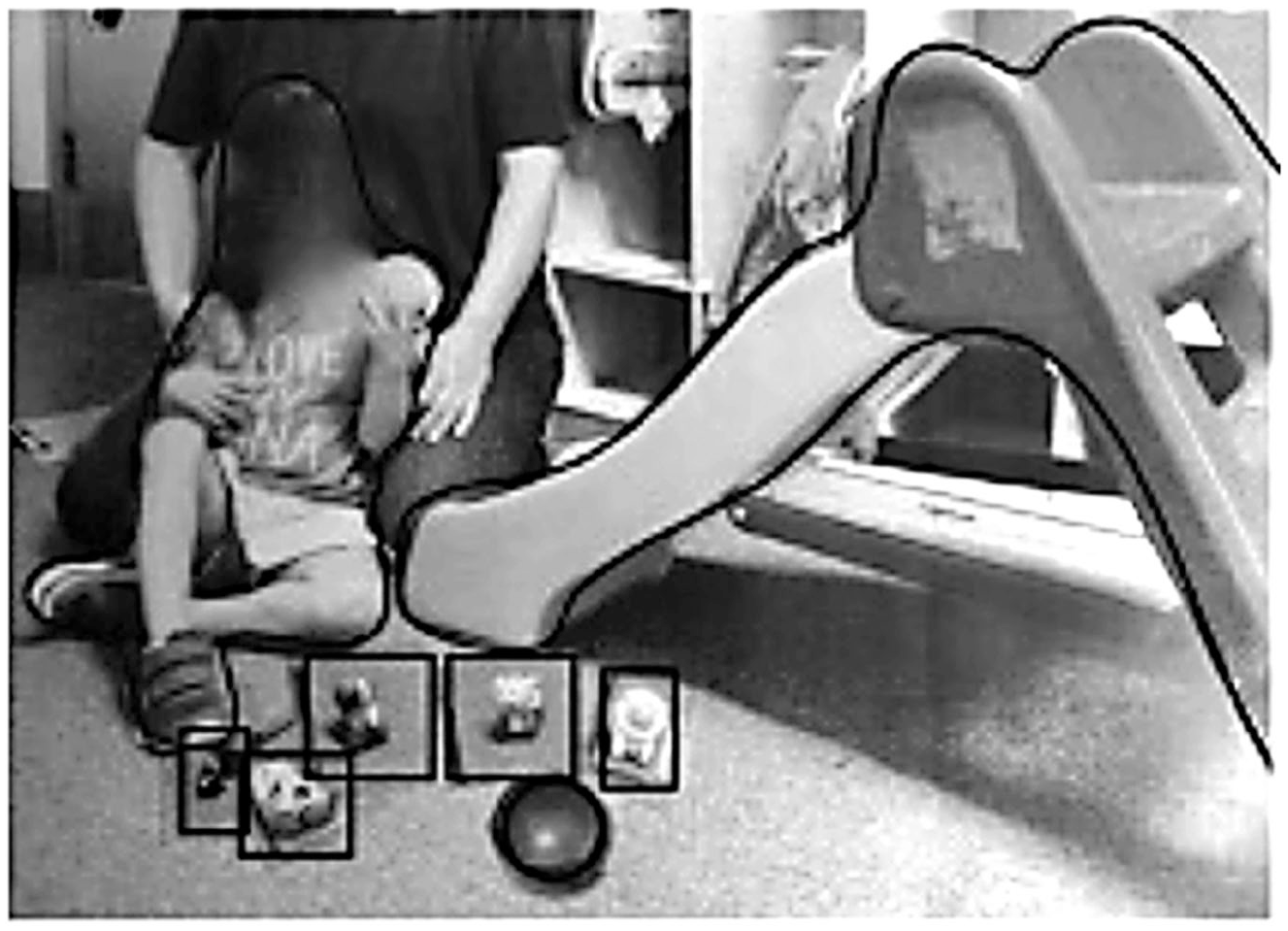
Visual scene display showing multiple hotspots.
The visual scenes were printed color photographs that were protected with contact paper. Each visual scene was the size of letter-sized paper, measuring 216 × 279 mm. An additional identical photograph was printed, and hotspots were cut out from the second photo. The cut-out hotspots were protected with contact paper as well and then attached with transparent Velcro on to corresponding locations of the first printed photo or VSD, to serve as hotspots. Therefore, even when the hotspots were removed from the VSD, the context was still preserved in the scene. Transparent Velcro was used, so that the context behind the Velcro would be visible. As can be seen in Figure 1, vocabulary for objects, individuals, and some verbs served as the hotspots in the VSDs. Generally, the most salient aspects of the VSD were selected as hotspots. In addition, any language concepts that the child was motivated or interested to communicate about were also incorporated as hotspots. The VSDs were contained in a separate three-ring binder for each individual child. The play activity VSDs were separated from the song VSDs by a divider. In addition, a menu showing the available play activities and songs was represented as smaller versions of the actual VSDs on the front of the binder.
Experimental Design
We used a single case multiple probe across participants design to evaluate the effectiveness of an intervention package combining low-tech VSDs and aided modeling. Experimental control was established when the participant’s performance changed when and only when the intervention is introduced and not in subsequent tiers (Kazdin, 2011). Intermittent probes were conducted as it was unlikely there would be considerable changes in baseline data due to the participants’ limited modes of communication (e.g., limited sign usage, limited word use, and limited access to play-based vocabulary on their existing communication systems). Intermittent probes also were considered less intrusive, time efficient, and minimized disruptions to the child’s schedule (Kazdin, 2011).
Assessments
Assessments were administered by the first author, a certified speech-language pathologist. Information regarding the children was provided by the participant’s teachers, paraprofessionals, or caregivers. They also completed the Communication Matrix (Rowland, 2013) to obtain an overall understanding of the children’s communication skills. The Matrix was scored by calculating the level at which the highest percentage of cells were scored as emerging or mastered (the primary level; Rowland, 2013). In addition, the M-CDI was completed to assess the children’s expressive vocabulary (Fenson et al., 2007). Prior to the start of the study, a preference assessment questionnaire was completed to determine toys and songs the children enjoyed.
Dependent Measures
There were two dependent measures for this investigation. The primary dependent measure was the number of communication turns taken by children during a 10-min session. The operational definition of a communication turn was adapted from Bruce and Vargas (2007) and Rowland (2011). A communication turn needed to consist of all three of the following components:
Intentional: The child attempted to initiate or respond to a communication partner by attending to the partner, object, activity, or VSDs through (a) eye gaze, (b) gesture, (c) leaning toward, (d) touching, or (e) vocalization or verbalization.
Communicative: The child initiated or responded in a nonconventional form (vocalization or gesture) or conventional form (speech, speech approximation, sign, sign approximation, pointing to, touching or pulling off a hotspot on a VSD) that is recognized by a communication partner or others (such as members of the research team).
Symbolic: There was a 1:1 correspondence between the symbol and its referent that was used consistently to refer to an object/concept that was recognized by a communication partner or others (such as members of the research team).
A turn is needed to meet all three of these criteria. It was counted as a turn either if initiated by the child or in response to a communication partner. The end of a child’s communication turn was signaled by a communication partner speaking or a 2-s interval between the end of one communication turn and the beginning of the next turn.
The secondary dependent variable was the number of unique semantic concepts expressed by the children, to determine whether they used a variety of different semantics concepts and words. Semantic concepts were determined to be unique based on content only and not mode. A frequency count was obtained to determine the number of unique semantic concepts expressed by the participants. For example, saying the word truck and pointing to the picture of a TRUCK were both counted as one semantic concept, and not two separate ones.
Procedures
The study consisted of two experimental conditions: baseline and intervention. All sessions were conducted by the first author and also included an additional communication partner (e.g., for Anna and Julia, this was their teacher’s aides, and for Barry, this was a research assistant) to help the children participate in the sessions (e.g., supporting Julia as she sat to accommodate inadequate motor control). Each session within each condition was between 10 and 15 min long, with data coded for 10 min of each session. For sessions longer than 10 min, the data were coded for the middle portion, to equal 10 min. Sessions took place 1–2 times per week, depending on the participant’s availability and the schedules of the preschools or child care centers. The sessions took place individually in the hallway outside the children’s classrooms. The participants and adults were seated on the floor. During both conditions of the study, participants were videotaped while engaging in naturally occurring social routines such as playing with toys and singing songs.
Baseline
Baseline data were collected until each participants’ primary dependent variable stabilized with a minimum of five baseline data points (Kazdin, 2011; Kratochwill et al., 2010). The baseline condition occurred for 3 to 5 weeks. Six-symbol grids with picture communication symbols (Mayer-Johnson, 1992) that corresponded to the play activities or songs were available during all of the sessions. The symbol grids, along with the children’s other natural modes of communication, provided availability of vocabulary and access to AAC as a means to communicate, although they were not taught or referred to. The grids were in a binder and left open next to the children. No aided modeling was provided during baseline.
The investigator provided a minimum of eight communication opportunities within each 10-min baseline session. A communication opportunity was defined as a comment, question, or choice directed to the participant followed by a wait time of at least 5 s or followed by a response from the participant before 5 s (adapted from Light, Collier, & Parnes, 1985). The following steps were followed: (a) a communication opportunity was provided; (b) the child responded to the opportunity; (c) the intent of the child’s response was fulfilled (e.g., if a toy was requested, it was given to the child). If the child did not respond to the communication opportunity the following prompting hierarchy was followed: (a) wait 5 s, if he or she still did not respond and (b) provide a gestural cue (point to the toy or object; Light & Drager, 2009). If the participant still did not respond, a different communication opportunity was provided.
Intervention
After each child’s baseline data were stable, intervention was started with Anna, whereas the other participants continued in their baseline conditions. Once Anna started to show an intervention effect after the introduction of the intervention, over a minimum of three data points, the intervention was then introduced to Julia, whereas Barry remained in baseline. Once Julia started to show an intervention effect over a minimum of three data points, the intervention was then introduced to Barry. The intervention condition was completed within 2–4 weeks for all participants. During the intervention condition, participants had access to a binder containing the low-tech VSDs. The same six-symbol grids used during the baseline condition were also placed in close proximity to the children in the same manner as during baseline. The independent variable or intervention package consisted of two components: (a) provision of VSDs that represented play activities and songs and (b) aided AAC modeling by pointing to the VSDs (or hotspots) and verbally naming keywords when providing communication opportunities. The children were provided with a minimum of eight communication opportunities and eight aided AAC models during each 10-min intervention session. The same steps and prompting hierarchy described in the baseline condition were followed. In addition, extra photos and Velcro were available during each intervention session in case any of the children showed interest in any other elements on the VSDs that had not been included as original hotspots. If the children pointed to or showed interest in an additional element (e.g., backpack in the background), the element would have been cut out from the extra photo, Velcro would have been added to it, and a new hotspot would have been created. None of the children in the study indicated a desire for a new hotspot.
Coding
Every 10-min session for each condition of the investigation was videotaped and coded. The participants’ communicative behaviors were coded by an undergraduate student majoring in Communication Sciences and Disorders. The student was trained on the coding procedures by the primary investigator. The videos were coded for communication turns. The following were recorded on each transcript: the context (name of the activity or song), communication turn expressed, time on the video at which the turn was expressed, the mode used (vocalization, speech, speech approximation, gesture, sign, sign approximation, or picture) and the 1:1 correspondence between the symbol and its referent.
Procedural Fidelity
To ensure accurate implementation of the intervention, two undergraduate students majoring in Communication Sciences and Disorders were trained to assess procedural fidelity. Two students were trained on procedural fidelity by watching and coding videos from a pilot study, until reliability of 90% or better was established. Procedural fidelity was evaluated on the following: provision of at least eight opportunities within a 10-min session, the number of steps correctly implemented in the prompting hierarchy, and provision of at least eight models within a 10-min intervention session. Procedural fidelity was assessed randomly on approximately 20% or more of the data in each condition. Procedural fidelity on both the number of opportunities provided and the number of models provided was consistently above the required minimum number of eight (100%). The mean procedural fidelity for the number of steps correctly implemented in the prompting hierarchy ([number of steps correctly implemented / the number of correct + incorrect steps] × 100) was 100%, indicating that the interventionist accurately implemented the prompting hierarchy during both the baseline and intervention conditions.
Data Reliability
The same two undergraduate students were trained to calculate reliability on the coding of communication turns as well. The two students were trained on data reliability by watching and coding videos from a pilot study. Reliability was checked randomly on 20% of the data in each condition. The coders used the same operational definitions for coding a communication turn. The turns were coded as accurate based on the context (activity or song), communication turn expressed, time recorded at which the communication turn was expressed (±3 s), mode used, and the 1:1 correspondence between the symbol and its referent. Reliability was calculated using the formula ([number of agreements / agreements + disagreements + omissions] × 100). The mean reliability scores for each participant were as follows: Anna 97.5% (range: 85%–100%); Julia 94% (range: 80%–100%); and Barry 95% (range: 83.3%–100%). Any disagreements identified during the reliability process were resolved through negotiation. These percentages meet contemporary design standards (Kratochwill et al., 2010).
Data Analysis
The data were graphed and visually analyzed for within and between condition data patterns (Kratochwill et al., 2010). Specifically, the level, trend, and variability of data within each data condition were examined. In addition, the graphs were visually inspected for overlap of data from one condition to the next. The percentage of nonoverlapping data points across conditions was also calculated (Kazdin, 2011).
Number of Opportunities
A post hoc analysis of the number of opportunities provided to the participants during both the baseline and intervention conditions was conducted. Although a minimum number of opportunities were provided for each session, it is possible the interventionist inadvertently provided more opportunities during either the baseline or intervention conditions. If so, an increase in the communication turns during intervention may have been due to an increase in communication opportunities and not because of the introduction of the intervention (low-tech VSDs and aided modeling).
Social Validity
Social validity of the results was assessed to measure caregivers’, aides’, and a speech-language pathologist’s satisfaction with the study and potential applicability of the intervention. Anna and Julia’s classroom aides who participated in the sessions completed the social validity measure. None of Barry’s communication partners were directly involved in the study, therefore, his mother and speech-language pathologist viewed a compilation of video clips (approximately 5–6 min long) and completed the social validity survey based on their observations. The adults responded to written questions about the ease of using the low-tech VSDs and whether they would use this intervention if it were available. They also responded to what they liked best about the intervention, what they liked least, and made suggestions for further improving the intervention.
Results
Communication Turns
The number of communication turns produced by the children in both baseline and intervention conditions are seen in Figure 2. The level, trend, and variability of the data were visually analyzed. The level of baseline data for all three participants was relatively stable within the baseline and intervention conditions. In addition, all three participants showed a level change concurrently when the intervention was introduced, demonstrating a functional relation between the intervention and the number of communication turns.
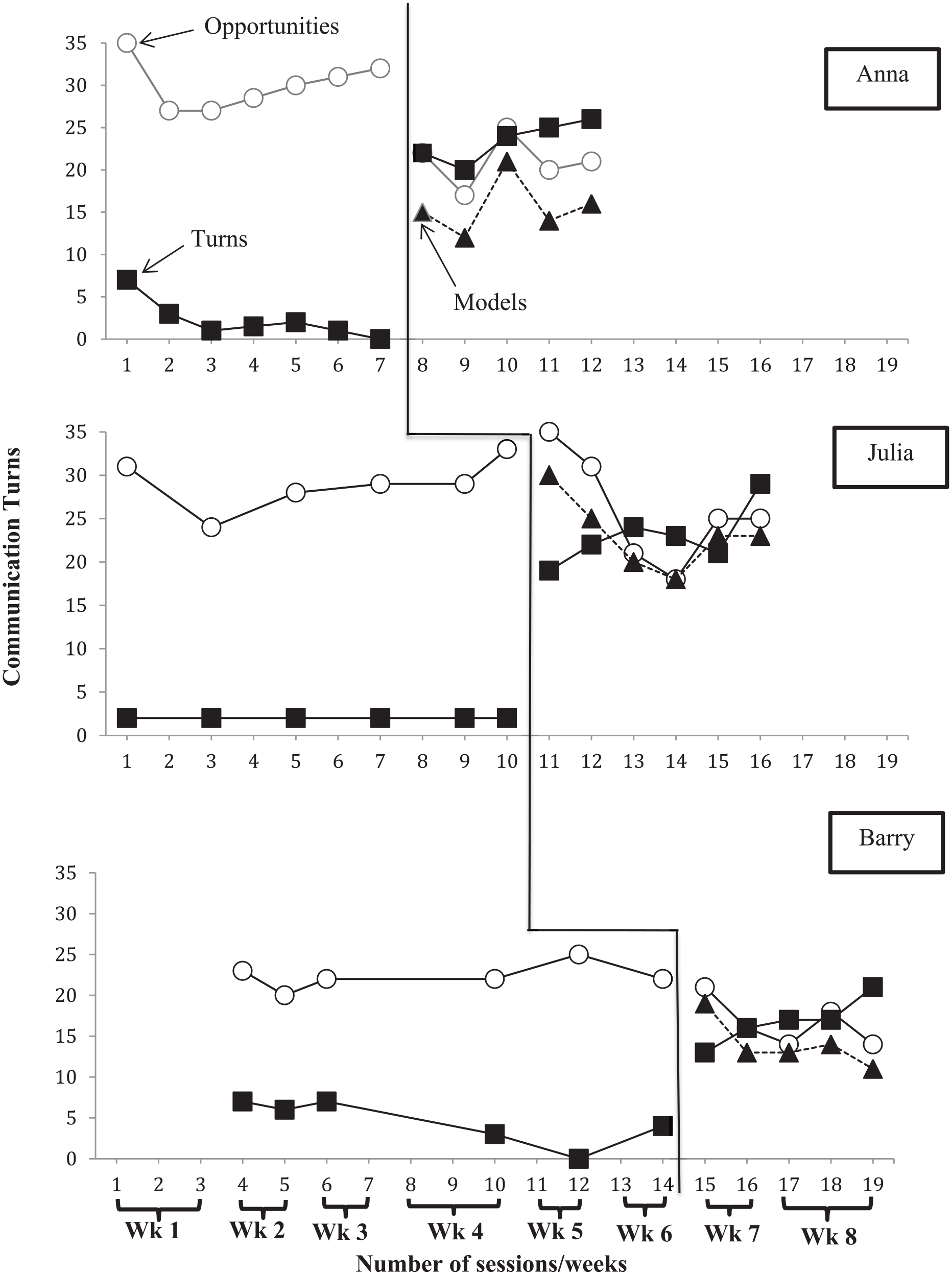
Communication turns, opportunities, and models (only during intervention) across all sessions.
During baseline, Anna expressed between zero and seven communication turns, all of which were signing MORE. Although she had access to the six-symbol grids during baseline, she did not use them. During intervention, she demonstrated an increase to between 20 and 28 communication turns. All of these turns were expressed by pointing to hotspots on the VSDs. Anna’s initial baseline data showed considerable variability; however, the last four baseline data points were relatively stable. Her intervention data were moderately variable and had no overlap with baseline data (Lane & Gast, 2014). In terms of the trend in data, Anna’s baseline data showed a decelerating trend, but after introduction of intervention, data showed a directionality shift demonstrating a treatment effect.
During baseline, Julia consistently expressed two turns. All of these turns consisted of using the sign MORE (11 total turns), except for one instance of using the six-symbol grid. During intervention, she demonstrated a notable increase in the number of communication turns produced. Julia took between 19 and 33 communication turns during intervention. A majority of these turns were taken using the VSDs (135 total turns); she also used signs (15 total turns) during intervention. Julia made selections on the VSDs both by pointing to hotspots on them and occasionally by pulling the hotspots off the VSDs. Julia’s baseline data were stable; her intervention data were variable, but no overlap with baseline data. Julia’s data showed zero-celerating trend in baseline and with introduction of intervention showed a directionality shift and an accelerating trend.
During baseline, Barry expressed between zero and seven communication turns. A majority of his communication turns consisted of using speech and speech approximations (19 total turns) with 7 turns using the six-symbol grids. During intervention, he demonstrated an increase in the number of communication turns produced: between 13 and 21 communication turns. A majority of these turns were picture based using the VSDs (65 total turns), with some words/word approximations (16 total turns) and a few gestures (3 total turns). Barry primarily made selections on the VSDs by pulling the hotspots off the VSDs. Barry’s baseline data were variable; however, there was no overlap with baseline data. Barry’s initial baseline data showed a decelerating trend, except the last baseline data point which may have indicated an upward trend; however, the data point remained within the variability of baseline, being lower than the highest baseline point. Barry’s intervention data showed a fairly large level change and an accelerating trend in data indicating a treatment effect.
Overall, the data indicate that the treatment package combining low-tech VSDs and aided modeling resulted in an increase in the number of communication turns taken by the preschool children with CCN. All three children demonstrated behavior change at different points in time which is indicative of a functional relation.
Number of Opportunities
Figure 2 also presents the number of communication opportunities, the number of models provided (during intervention sessions), and the number of communication turns taken by each of the participants, demonstrating that the number of opportunities provided in intervention did not exceed the number provided during baseline. Thus, the increase in communication turns did not appear to occur as a result of a greater number of communication opportunities.
Semantic Concepts
The number of unique semantic concepts expressed by Anna, Julia, and Barry during both baseline and intervention conditions are depicted in Figure 3. During baseline, Anna expressed just one semantic concept, MORE. During intervention, she produced between eight and 13 different semantic concepts (M = 9). During baseline, Julia expressed just two semantic concepts, MORE and DOG (M = 1.1). During intervention, she produced between seven and 11 (M = 9.1) different semantic concepts. During baseline, Barry expressed between zero and four semantic concepts (M = 2.1), with his highest amount of four during his first and last baseline session. During intervention, he produced between six and 18 (M = 11) different semantic concepts.
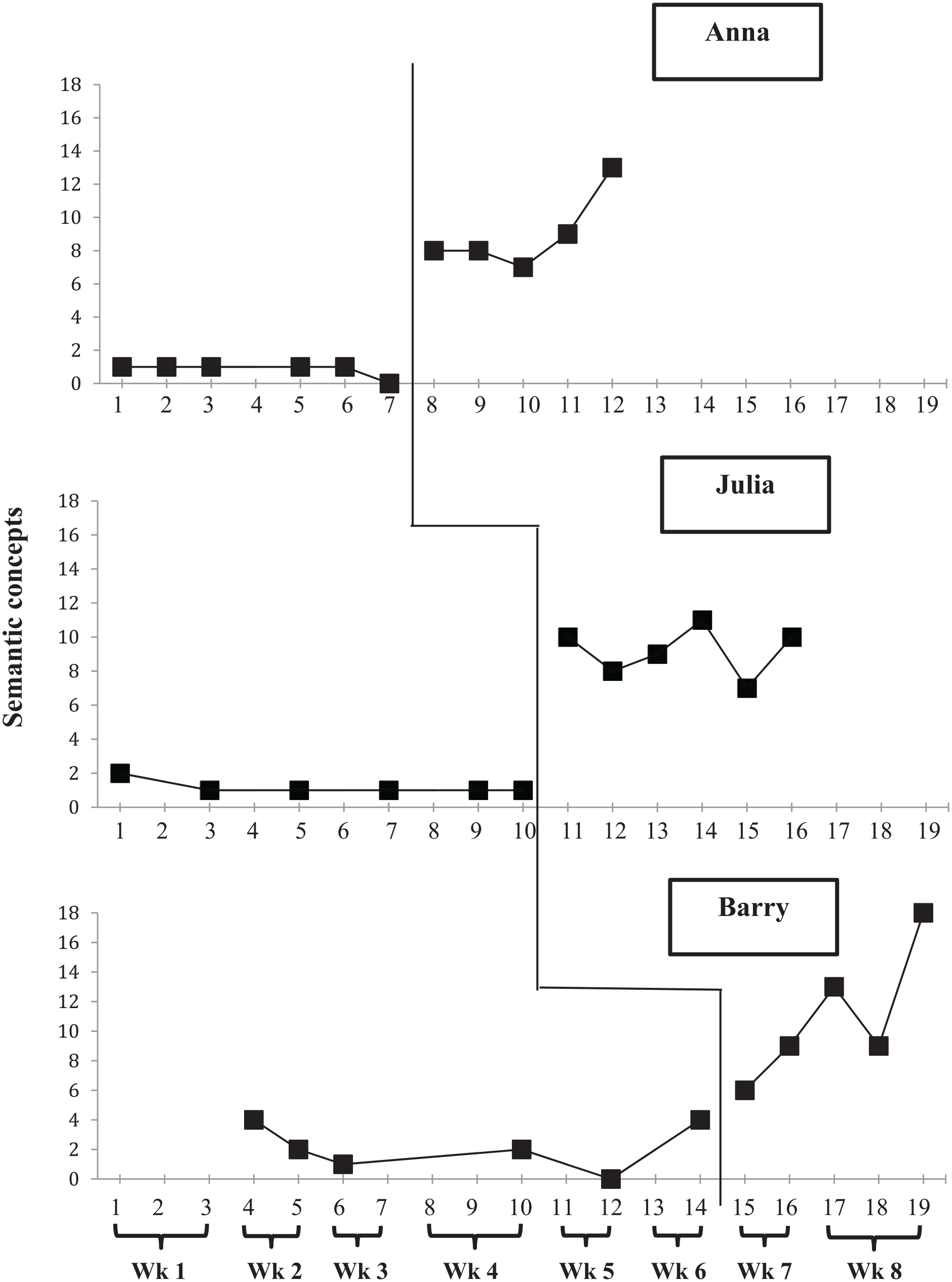
Number of different semantic concepts.
Both Anna and Julia demonstrated a clear increase in different semantic concepts upon introduction of the intervention. Although Barry’s number of different semantic concepts also increased with intervention, he did not demonstrate as large of an increase upon initial introduction as the other children. In addition, his performance at baseline was more variable, including an increase during his last baseline session to the level of his first baseline session, making an intervention effect less obvious. Thus, behavior change occured for Anna and Julia after implementing the treatment package, but was not clear for Barry, which precludes the identification of a functional relation.
Social Validity
The communication partners perceived the intervention to be somewhat easy or very easy to implement. Three of the four adults completing the social validation questionnaire indicated that if the intervention were available to them, they would definitely use it, whereas one of the teacher’s aides stated that she may or may not use it. Aspects of the intervention they liked the most were the VSDs represented the children’s real life experiences, the children’s interest and enjoyment in seeing and touching the pictures, the hotspots being removable/moveable, seeing the progress the children made, and the ease with which the children used the VSDs to communicate. Aspects of the intervention they liked the least were flipping through the pages to find the relevant VSD, difficulty in creating VSDs to represent all the toys and activities available to the children, and the photos being too visually busy (too much information in the background). Suggestions for improving the current treatment approach included implementing the intervention within the classroom setting, making pictures or photos for various centers within the classroom, and leaving the VSDs at those centers instead of putting them in a binder, using only the most salient information in the photos, removing the background clutter (leaving the background a solid color), and reducing the size of the photos to help with navigation.
Discussion
The purpose of the current study was to ascertain whether an intervention combining the use of low-tech VSDs and aided modeling could facilitate increased communication by three preschool children with CCN. All three participants demonstrated notable increases in the number of communication turns taken and the number of unique semantic concepts expressed following the intervention. These communication gains occurred in 8 weeks, in a total intervention time ranging between 50 and 60 min. In addition, the preschoolers used a variety of communication modes to communicate: VSDs, signs, and speech. Although all three participants were provided an equal or higher number of communication opportunities during baseline, they expressed a higher number of communication turns during intervention, indicating that provision of a means of communication (VSDs) and being taught how to use the VSDs (aided modeling) may have facilitated their expressive communication.
One reason the intervention may have been successful was the minimal learning demands placed on the children, allowing them to learn to use the low-tech VSDs with relative ease. Designing AAC technologies that minimize the cost of learning, while maximizing the power of communication (Beukelman, 1991; Light & Drager, 2007), can be accomplished in part by providing AAC tools that are developmentally appropriate. VSDs preserve the context of the scene and use a schematic approach to organize language, which is consistent with how typically developing children below the age of 5 years tend to organize and learn language (Nelson, 1996). Drager, Light, Speltz, Fallon, and Jeffries (2003) suggested that language should be presented in a similarly supportive context to young children who use AAC. The low-tech VSDs used in this intervention were consistent with young children’s schematic organization of language; therefore, minimizing the time and resources needed to learn to use them and maximizing the children’s communication skills. However, it is interesting to note that some communication partners perceived that having the added context could make the photograph “busy.” This may indicate a need to educate communication partners on the reason behind why the context is being used and how it may be a benefit for young children with CCN. Using VSDs in a low-tech form gave the preschoolers added flexibility to make selections either by pointing to hotspots or by pulling them off the VSDs. Two of the children in the study pointed to the hotspots, while the third preferred to pull the hotspots off the scenes.
Another factor that may have contributed to positive outcomes was the types of activities that were used during the intervention. The current intervention was a social communication intervention with the goal of increasing children’s participation in meaningful contexts. Seeing familiar people and themselves in the scenes may have increased their motivation and interest to look at and touch the VSDs. This supports findings in the literature that the people in visual scenes attract more visual attention than other elements (Wilkinson & Light, 2014; Wilkinson et al., 2012). VSDs that include people not only take advantage of children’s innate visual attention toward humans but also capture the social elements related to those individuals, which are essential for communication development (Light et al., 2012). This also supports findings from typical language development that emphasizes the importance of social interactive contexts supporting early language acquisition (Snow, 1999).
All the participants in the study also increased the number of unique semantic concepts expressed. The low-tech VSDs appeared to help scaffold the expression of a variety of semantic concepts within a familiar context. It should be noted that these vocabulary words may or may not have been acquired during the study. However, using VSDs may help facilitate episodic memory, or memories that are directly related to personal experiences and memories of events (Wilkinson & Hennig, 2009). The photos used in the low-tech scenes were of play activities, songs, and people that were familiar and within the children’s personalized schemas. Wilkinson and Hennig (2009) speculated that episodic memory could facilitate learning of more abstract word meanings, which eventually become part of semantic memory.
Another factor that may have contributed to the success of the intervention was moveable hotspots on the VSDs. The moveable hotspots helped promote an additional cue of motion. In the current study, the interventionist incorporated motion when modeling on the VSDs (e.g., taking the hotspot of the pig and showing it sliding down the slide). The benefits of motion are not just limited to perceptual and attentional enhancements, but they may also help trigger higher level cognitive and spatial operations (Jagaroo & Wilkinson, 2008). Motion may help convey functional properties of objects, the relationship between objects in a scene, and causal patterns associated with movement (Jagaroo & Wilkinson, 2008). In addition, fixing the hotspots on to the VSD may have made the hotspots more salient by creating a three-dimensional effect. Using the VSDs and hotspots in this matter may have encouraged multimodality learning (e.g., visual, auditory, and tactile).
In addition, the use of aided modeling may have contributed to the children successfully using the VSDs. Aided modeling using the child’s AAC system has been reported in the literature as being an effective intervention to increase symbol comprehension and production in individuals who require AAC (Binger & Light, 2007; Cafiero, 2001; Drager et al., 2006; Harris & Reichle, 2004). Aided modeling helps to increases the symmetry between the children’s linguistic input and output (Smith & Grove, 2003). It is impossible to separate out the effects of the use of aided modeling from the use of the low-tech VSDs. It is possible that the intervention’s success may have been due to the combined use of these strategies. This is consistent with the argument that for AAC interventions to be maximally effective, it is not sufficient for young children to just have access to appropriate AAC systems (e.g., low-tech VSDs), but they also need appropriate instruction to learn the skills required to communicate effectively (e.g., aided modeling; Light & Drager, 2007).
Clinical Implications
This study demonstrated positive results for three preschool children who had differing diagnoses (i.e., ASD, idic15 syndrome, and developmental delay) and who were primarily at a presymbolic or early symbolic level of communication. It may be a suitable low-cost option for low-resource communities that may not have access to high technology or computers. It can also be used as a precursor to high-tech devices, used in the interim for children waiting on devices to be approved, or as a backup solution for a child with a high-tech system.
Additional translational research is required to provide more children and individuals with CCN access and opportunities for communication (including those in low-resource communities). The current intervention supports the implementation of an AAC intervention with preschool children in a low-cost, practical way (with some expenses associated with printing and constructing the VSDs). Low-tech VSDs can be developed easily and incorporated into social communication contexts by speech-language pathologists, teachers, and parents. This was indicated in the social validity questionnaires completed by the participants’ communication partners who revealed that they felt the intervention was relatively easy to implement with the children. In addition, a majority of partners stated that they would use the VSDs if they had access to it, the children appeared to enjoy using the VSDs and saw improvements in the children’s communication abilities.
Limitations
Although the investigation demonstrated preliminary evidence for using a low-tech VSD and aided modeling intervention to increase participation for preschool children with CCN, the study did have some limitations. Only three children participated in the study. In addition, the three children differed in their primary languages and in their communicative functioning, which limits the external validity and generalization of the results. The intervention consisted of a treatment package using both low-tech VSDs and aided modeling, and it is difficult to determine whether VSDs or aided modeling, or both, resulted in changes in the participants behavior.
Another factor that limits generalization is that the interventionist for all the children was the primary investigator. It is unknown if the results of the intervention would have been as effective if the intervention was implemented by the participants’ daily communication partners. In addition, no maintenance data were collected at the conclusion of the intervention. The binders containing the VSDs were left at the preschools for Anna and Julia, and Barry’s binder was given to his SLP; however, it is unknown if the communication partners continued to use the VSDs long-term following the duration of the study. Although both generalization and maintenance would have provided additional information regarding the use of low-tech VSDs, the current study was an exploratory study looking at the use and effects of low-tech VSDs.
This study met the minimum design standards for a multiple probe design by having six conditions (three baseline and three intervention conditions across the three participants) with at least five data points in each condition (Kratochwill et al., 2010). However, as can be seen in Figure 2, Barry had a delayed start and did not begin the study until the second week. Although this is a limitation in the research design, it is notable that increases in communication turns were not seen until after the introduction of the intervention for all three participants. In addition, Barry’s performance at baseline with the number of different semantic concepts (seen in Figure 3) was variable which limits confidence in the behavior change.
Future Research
Replication of this study across additional children with varying diagnoses would further establish the benefits of this intervention. In addition, replicating the study using the children’s communication partners as interventionists would strengthen the generalizability of this intervention. Another area for future research would be to implement this intervention within the children’s natural environment (e.g., homes or classrooms).
The intervention was a treatment package consisting of low-tech VSDs and aided modeling. It is not possible to disentangle the treatment effects to determine which component was responsible for the improvements in communication, or whether it was a result of the combination. Future investigations including aided modeling in both baseline and intervention conditions while only varying low-tech VSDs could help identify which aspect of the intervention package is most useful. Another way would be to conduct a multicondition intervention study in which low-tech VSDs is “intervention A” and aided modeling is added as “intervention B” to help distinguish if both intervention components are required or not. However, the two intervention components are highly compatible, and it may not be necessary to separate out the effects.
Communication partners completing the social validity questionnaire suggested possible modifications to the current design of the low-tech VSDs itself; for example, they suggested reducing the size of the VSD, so it is not an entire page and asked for ways to make navigation of the binder easier. Future research should explore these modifications, for example, using smaller sized VSDs to ease navigation, reducing printing costs, and enhancing the visual look of the VSDs could be additional benefits of these low-tech VSDs.
Conclusion
In this study, we explored the effectiveness of using low-tech VSDs with children with CCN. Overall, the results provide preliminary evidence that this intervention was effective in increasing the communication turns and number of unique semantic concepts expressed by preschool children with CCN. Low-tech VSDs are a low cost, novel intervention that could be used in contexts where there is limited access to computers or high-tech devices. In addition, low-tech VSDs can be easily developed and implemented by clinicians with preschool children in social communication contexts.
Footnotes
Declaration of Conflicting Interests
The author(s) declared no potential conflicts of interest with respect to the research, authorship, and/or publication of this article.
Funding
The author(s) received no financial support for the research, authorship, and/or publication of this article.
