



Abstract
The primary goal of this study was to examine the similarities and distinctions between two types of popularity, sociometric and perceived, in their associations with friendship characteristics and how they in turn are related to depressive affect and self-esteem. Among 245 eighth graders, sociometric popularity was associated with a greater number of reciprocated friendships characterized by lower rates of conflict, whereas perceived popularity was related to both more friendship support and conflict. Friendship conflict mediated the association of sociometric popularity with depressive affect for both boys and girls and with self-esteem for boys. Perceived popularity was uniquely related to decreases in depressive affect and increases in self-esteem, adding to the prediction of adolescent friendship characteristics. Results evidence the discriminant validity of sociometric and perceived popularity in their associations with friendship factors and their implications for depressive affect and self-esteem.
Keywords
Peer relationships are critical for social and emotional development in adolescence and have been associated with school success, criminality, and psychological adjustment (Juvonen, Nishina, & Graham, 2000; La Greca & Harrison, 2005; Lonardo, Giordano, Longmore, & Manning, 2009). Sullivan (1953) theorized that group-level acceptance and successful friendships are both important for development. Consistent with this notion, research shows that sociometric popularity and friendship are related but not overlapping constructs that each make unique contributions to adaptation (e.g., Oldenburg & Kerns, 1997). To date, however, research has yet to consider whether similar patterns of association emerge between perceived popularity and friendship and how they jointly predict adjustment. The goal of this study was to examine the associations between sociometric popularity, perceived popularity, and dimensions of friendship during adolescence and how they are in turn related to depressive affect and self-esteem.
Over the last decade, increasing consideration has been given to understanding the distinction between being well liked and being popular, as significant evidence has demonstrated that these constructs are only moderately correlated (Parkhurst & Hopmeyer, 1998). Sociometric popularity is a measure of how well liked (vs. disliked) an adolescent is by peers, whereas perceived popularity reflects adolescents’ popularity (vs. unpopularity) and dominance within the social hierarchy (Parkhurst & Hopmeyer, 1998). While the term “popularity” was used for a number of decades to represent liking, children and adolescents have consistently been shown to define the term popularity as more than likeability (e.g., LaFontana & Cillessen, 2002). Youth high in sociometric popularity have prosocial characteristics (e.g., cooperation, kindness, trustworthiness) and engage in few antisocial behaviors (LaFontana & Cillessen, 2002; Parkhurst & Asher, 1992). Youth high in perceived popularity also behave prosocially but exhibit negative traits as well, such as physical and relational aggression (see Cillessen & Rose, 2005, for a review). This combination of prosocial and aggressive behaviors is used to gain and maintain social visibility, status, and power in the peer group (Pellegrini & Bartini, 2001). With this distinction in mind, we hypothesized that sociometric and perceived popularity are associated with different dimensions of friendships and that the mechanisms by which they are linked to adolescent adaptation in combination with friendship may differ.
Popularity and Friendships
Early researchers theorized that sociometric popularity is a precursor to friendships and that well-liked youth are likely to have high quality friendships (Bukowksi & Newcomb, 1984). Indeed, sociometrically popular adolescents have more friendships (Bukowski, Pizzamiglio, Newcomb, & Hoza, 1996) characterized by higher levels of intimacy (Oldenburg & Kerns, 1997) and less conflict (Rose, Swenson, & Carlson, 2004) than rejected adolescents. In part, these differences are attributed to the larger social network that accompanies social acceptance, which likely provides more opportunities to form friendships and promotes the development of skills necessary for building positive friendships (Bukowski et al., 1996). While a similar association between perceived popularity and friendship has been hypothesized (e.g., Townsend, McCracken, & Wilton, 1988), it has rarely been examined. In the one study to date, Rose and colleagues (2004) found that perceived popular youth had more friends and higher levels of friendship support than unpopular youth, but no association was found with friendship conflict.
To assess the distinct implications of perceived and sociometric popularity for friendship, the consideration of multiple “levels” that characterize friendship (Bukowski & Hoza, 1989; Hartup, 1996) may be necessary. Empirical evidence has indicated that quantifying friendships along multiple dimensions is important; whether a child or adolescent has a reciprocated friendship, the number of reciprocated friendships they have, and the quality of their friendships have all been found to contribute to youth’s socioemotional adjustment (Brendgen, Vitaro, Doyle, Markiewicz, & Bukowski, 2002; Demir & Urberg, 2004; Parker & Asher, 1993; Townsend et al., 1988).
Consistent with past findings, we anticipated that given the social skills and larger social networks associated with sociometric popularity, it would be related to a greater number of friendships (e.g., Nangle, Erdley, Newman, Mason, & Carpenter, 2003) characterized by high support (e.g., Demir & Urberg, 2004) and low conflict (e.g. Rose et al., 2004). In contrast, based on the documented experiences of perceived popular adolescents (e.g. Eder, 1985), we anticipated that perceived popularity would be associated with both higher support and higher conflict. Perceived popular adolescents have a unique position in the social hierarchy imbued with power, visibility, and dominance (LaFontana & Cillessen, 2002). Eder (1985) and Merten’s (2004) ethnographic works suggest that the joint experiences and feelings that result from this prominent social position may facilitate greater camaraderie and positivity regarding friendships within the group. However, adolescents must also maintain their status and appear to do so by both rejecting adolescents who are not part of their social group (Eder, 1985) and subjugating their own needs in favor of promoting relationships that are supportive of their popularity goals (Merten, 2004). It is plausible that adolescents’ egocentric needs are sometimes given priority and that this gives rise to conflict with their friends. Rose and colleagues (2004) found no association between perceived popularity and friendship conflict, but their predictive model did not take into account the overlap between sociometric and perceived popularity. By estimating the influence of sociometric and perceived popularity simultaneously, the unique associations between each form of high status and friendship can be examined. This approach is also consistent with the reality of adolescents’ social lives in which sociometric and perceived popularity may occur in varying degrees and have different associations with friendships.
Given the role that manipulation and jockeying for status may take in attaining perceived popularity, we anticipated that perceived popularity would also be associated with fewer friendships. Parkhurst and Hopmeyer (1998) found that early adolescents who were rated high on perceived popularity but not sociometrically popular were aggressive and stuck-up but not as kind and trustworthy, characteristics unlikely to lead to friendship reciprocation. As noted by Merten (2004), the demands of perceived popularity at times are inconsistent with the demands of friendship, thus likely leading some to choose one over the other and in turn for reciprocation to be less likely to occur. Perceived popular groups are also characterized by exclusivity. In this manner, perceived popular adolescents may identify certain youth as friends in a strategic attempt to further gain or maintain status but are likely very selective regarding the number of friendships they form. As well, qualitative studies have indicated that adolescents are interested in including perceived popular peers within their social groups but are not always eager to actually befriend them (Adler, Kless, Adler, 1992; Babad, 2001).
Popularity, Friendship, and Adolescent Adaptation
Previous peer relations research has examined the implications of social relationships for adjustment and has linked negative peer experiences with poor adaptation (Lopez & DuBois, 2005; Luthar & McMahon, 1996; Townsend et al., 1988). The attenuation of depression and bolstering of self-esteem are two particularly salient aspects of positive development during adolescence (e.g., Petersen et al., 1993; Trzesniewski et al., 2006), while poor adjustment in these domains place adolescents at risk for later maladjustment (e.g., Devine, Kempton, & Forehand, 1994; Gjerde & Westenberg, 1998; Stice, Ragan, & Randall, 2004; Windle, 1992). Being disliked by peers is related to depressive feelings and greater feelings of loneliness in early adolescence (Oldenburg & Kerns, 1997; Parkhurst & Asher, 1992). Further highlighting the impact of sociometric popularity on adjustment, Nolan and colleagues (2003) found that low sociometric popularity predicted early adolescents’ depressive symptoms three years later. Studies have examined the joint contributions of sociometric popularity and friendship to adjustment in childhood and demonstrated that they make overlapping yet independent contributions (e.g., Parker & Asher, 1993). While Oldenburg and Kerns (1997) found that both sociometric popularity and friendship quality (negatively) predicted depressive symptoms in adolescence, few studies have examined the joint impact of these factors on self-esteem. Only Townsend and colleagues (1988) found friendship intimacy to be predictive of self-esteem, with no differences for more or less accepted adolescents.
Building on our earlier hypotheses regarding the links between sociometric popularity and friendship characteristics, perhaps sociometric popularity predicts adolescent adaptation through its association with friendship. Sociometric popularity may help adolescents develop the skills needed to navigate the often unstable arena of early adolescent friendships. The importance of sociometric popularity seems to decrease in adolescence, as evidenced, for instance, by smaller associations with behavioral outcomes (e.g., Cillessen & Mayeux, 2004). As such, its influence may be particularly felt through its impact on friendship. Having a number of high quality, supportive, and nonconflictual friendships may in turn explain the link between sociometric popularity and lower rates of depressive affect and higher self-esteem. In contrast, rejection may be associated with fewer friendships that are poor in quality and may therefore be related to depressive affect and low self-esteem, as friendship conflict, for instance, has been found to predict both depressive symptoms (La Greca & Harrison, 2005) and lower self-esteem (Keefe & Berndt, 1996). Therefore, we anticipate that the link between sociometric popularity and both depressive affect and self-esteem will be mediated by friendship factors.
Few studies have examined the links between perceived popularity and depression or self-esteem. While the importance of sociometric popularity seems to decrease in adolescence (Cillessen & Mayeux, 2004; Demir & Urberg, 2004), perceived popularity becomes more predictive of adjustment (e.g., Kiefer & Ryan, 2008). Moreover, growing empirical and qualitative evidence indicates that perceived popularity is highly valued in adolescence (de Bruyn & van den Boom, 2005; Eder, 1985), prized above achievement, friendship, and romantic relationships (LaFontana & Cillessen, 2010). The attainment of this status may therefore contribute to a notable sense of accomplishment and satisfaction, bolstering self-esteem. Experiencing high status in the hierarchical system of peer relationships may also guard against negative attributions and cognitions that are characteristic of depressive affect. Consistent with this notion, Sandstrom and Cillessen (2006) found that among boys, decreases in internalizing symptoms were associated with perceived popularity. Researchers have yet to examine the additional contributions of friendship features. In contrast to the sociometric popularity hypotheses, we anticipate that perceived popularity and friendship characteristics will both make direct and unique contributions to depressive affect and self-esteem. As such perceived popularity may contribute directly to decreased depressive affect and increased self-esteem, while having a number of reciprocated friendships that are supportive and low in conflict will also independently reduce depression and increase self-esteem.
Gender Differences
Finally, gender may play an important role in the processes considered in this study. The literature on the associations of sociometric and perceived popularity and friendship with adolescent adaptation has been largely incongruous and theoretical work is only beginning to become available to guide hypotheses. For instance, in children, some researchers have found friendship difficulties to be more predictive of internalizing distress for girls than for boys (e.g., La Greca & Lopez, 1998; Vernberg, Abwender, Ewell, & Beery, 1992); others have found rejection to be more predictive for girls (Oldenburg & Kerns, 1997); still others have found no gender differences (Parker & Asher, 1993). Furthermore, while perceived popularity appears to be more valued by boys than girls (Benenson & Benarroch, 1998; LaFontana & Cillessen, 2010), the implications of this gender difference for friendship and adaptation are unclear. Therefore, analyses of the role of gender in this study were exploratory.
Current Study
In summary, this study addressed the unique associations of sociometric and perceived popularity with friendship, and their joint predictions of depressive affect and self-esteem. Structural equation modeling was used to examine the unique associations of sociometric and perceived popularity with friendship characteristics and their joint effects on depressive affect and self-esteem. It was hypothesized that the influence of sociometric popularity on depressive affect and self-esteem would be mediated by friendship. It was also hypothesized that perceived popularity and friendship would have independent beneficial effects on depressive affect (less) and self-esteem (more). The moderating role of gender was considered in all analyses.
Method
Participants and Procedure
Participants were 281 13- to 15-year-old adolescents (163 girls, 118 boys;
In the spring of the school year, all students attending the eighth grade of each school were recruited for participation via a letter sent home with them that was also mailed directly to their homes. Consent forms were returned by 62% of the parents (N = 388). Of these, 72% gave consent for participation (N = 281, 53% of the total population). One student was absent and one refused to participate on the day of testing. Thirty-four students were excluded from the analyses because they named friends who were not in the study and therefore did not have a friendship reciprocation score, yielding a final sample of 245 adolescents. A comparison of the 34 adolescents without a friendship reciprocation score with the remaining 245 yielded no significant differences for any of the other study variables. Data collection took place in the participants’ classrooms in two 45-minute sessions.
Measures
Sociometric popularity
Peer nominations were used to measure sociometric popularity. Participating students were provided with an alphabetized list of all grademates in their school and were asked to select an unlimited number of peers who they “like most” and “like least.” The number of like most and like least nominations received was counted for each student and standardized within grade. A continuous score for sociometric popularity was computed by subtracting the standardized like least score from the standardized like most score and again standardizing the resulting difference score within grade to z scores (
Perceived popularity
Peer nominations were also used to measure perceived popularity. Using the same list of grademates, participants selected an unlimited number of peers as most popular and least popular. Participants were not provided a definition of “popular”, as researchers have shown that early adolescents have a relatively consistent peer-constructed understanding of this status (e.g., LaFontana & Cillessen, 2002). The number of most popular and least popular nominations received was counted for each student and standardized within grade. A continuous score for perceived popularity was computed by subtracting the standardized least popular score from the standardized most popular score, and again standardizing the difference score to z scores within grade (
Friendship reciprocation
From a list of all grademates, participants were to indicate their five best friends by placing the numbers 1 through 5 next to their names, with 1 representing their very best friend, and 5 representing their fifth best friend. On average, participants received .49 nominations (SD = .75) with a range from 0 to 5. Participants were classified as having a reciprocated best friendship if a best friend also nominated them as one of their five best friends. Reciprocation was therefore only possible when the best friend nominee was also participating in the study. To control for differences in the number of possible reciprocations due to missing participants, a proportion score was computed for each participant that indicated the number of reciprocated best friends out of the total number of reciprocated friendships possible. Therefore, if an adolescent nominated five friends, only four of these five friends participated in the study, and three of these four participants reciprocated the nomination, this adolescent would receive a score of .75, having received 3 of 4 possible reciprocations.
Friendship quality
Participants rated the quality of their same-sex best friendship using the Network of Relationships Inventory (NRI; Furman & Buhrmester, 1985). The items of the NRI consist of behaviors that occur in the context of the friendship. Adolescents responded to each item using a scale from 1 (little or none) to 5 (the most). The items assessed 11 dimensions that form two broader factors: friendship support (companionship, instrumental aid, nurturance, affection, admiration, reliable alliance, support, intimacy) and friendship conflict (conflict, antagonism, criticism). Furman (1998) reported adequate internal consistency for the subscales and broadband scales (α’s > .80). In this study, Cronbach’s α was .96 for friendship support and .89 for friendship conflict.
Ninety-six percent of participants complied with directions and named same-sex best friends while 4% rated an opposite gender friendship. Comparison to other data measuring dating relationships, not reported in this study, indicated that these were not dating relationships. Thirty-five percent (n = 86) of adolescents had reciprocal ratings on the NRI, such that they rated a best friend who also rated them. Twenty-seven percent (n = 67) of participants did not provide reciprocal ratings on the NRI and another 37 % (n = 92) of ratings were not reciprocated because the peer the adolescent rated was not a study participant.
Depression
Participants completed the Children’s Depression Inventory (CDI; Kovacs, 1992) to measure depressive affect. The CDI is a widely used 27-item self-report measure that assesses affective, cognitive, motivational, and somatic symptoms of depression. The item assessing suicidal ideation was not used, resulting in a 26-item scale. Each item contains three statements, scored 0, 1, and 2, in order of increasing severity. Participants decided which statements best described them over the past 2 weeks. Mean scores were computed for each student, with higher scores reflecting more depressive affect. The CDI is a reliable and valid index of depressive affect (Saylor, Finch, Spirito, & Bennett, 1984). In the current sample, Cronbach’s α for this measure was .87.
Self-esteem
Rosenberg’s (RSE; 1965) 10-item questionnaire was used to measure self-esteem. Youth rated items on a 6-point scale (1 = does not describe me at all, 6 = describes me very well). Mean scores of the 10 items were computed for each student, with higher scores reflecting higher self-esteem. Cronbach’s α for this measure was .90 in this study.
Results
Preliminary Analyses
Table 1 presents the means and standard deviations for all variables in the total sample and by gender. Comparisons using t tests indicated that there was one gender difference. Girls scored higher than boys on friendship support. The size of this effect was large.
Descriptive Statistics for Main Study Variables

Note: Means that are underlined were significantly different by gender, p < .05.
Simple bivariate correlations are presented in Table 2 in order to provide descriptive information regarding the associations of variables. Sociometric and perceived popularity correlated positively, but not so high as to indicate redundancy. Self-esteem and depressive affect were negatively correlated. For girls, sociometric popularity correlated positively with friendship reciprocation and perceived popularity correlated positively with friendship support. For boys, both sociometric and perceived popularity correlated positively with friendship support and reciprocation. For both genders, depressive affect correlated positively, and self-esteem negatively, with friendship conflict. For girls only, self-esteem correlated positively with friendship reciprocation.
Correlations Among Main Study Variables for Boys (n = 103) and Girls (n = 142)
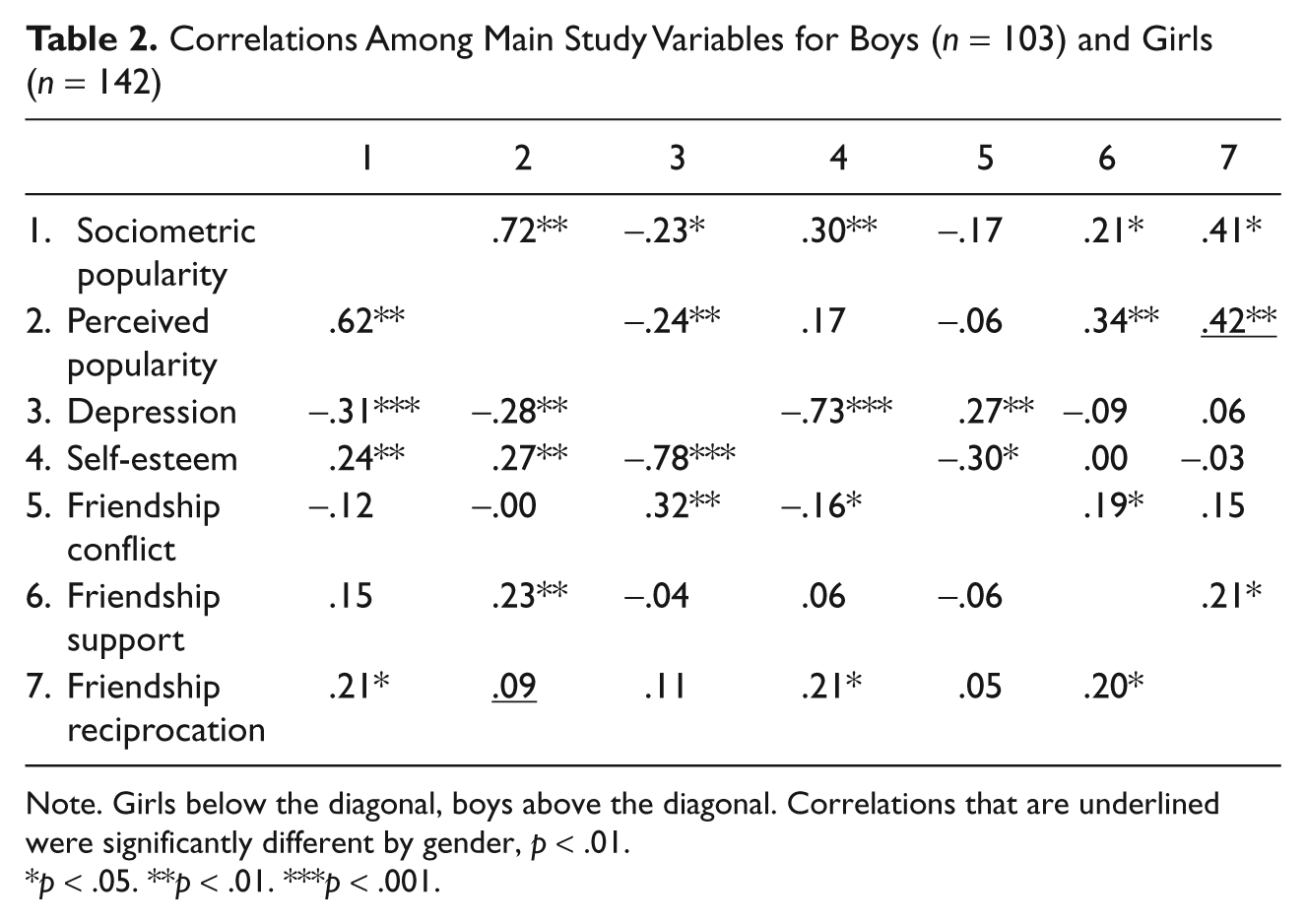
Note. Girls below the diagonal, boys above the diagonal. Correlations that are underlined were significantly different by gender, p < .01.
p < .05. **p < .01. ***p < .001.
Effects of Popularity and Friendship
Structural equation modeling (SEM) was conducted to examine the effects of sociometric and perceived popularity on depressive affect and self-esteem, with the number of reciprocated friendships, friendship conflict, and friendship support as potential mediators. This SEM tested the theoretical model and hypothesized associations, such that the paths between each form of popularity and the other constructs reflected the unique effect of each form of popularity controlling for the other type of popularity (e.g., the effect of sociometric popularity on number of reciprocated friends controlling for perceived popularity). A single model with all possible paths included was saturated and therefore did not produce a chi-square; however, other indicators of fit suggested a mixed picture with a CFI = 1 but an RMSEA = .30. In order to create a more parsimonious and better fitting model, all nonsignificant and nontheoretically relevant paths were trimmed from the model. The model was recalculated and produced an excellent fitting model, χ2(6) = 5.80, p = .45, CFI = 1.00, RMSEA = 0 (see Figure 1).

Structural equation model examining the association of perceived and sociometric popularity with friendship factors and the link to depressive affect and self-esteem
Higher sociometric popularity predicted more reciprocated friendships (β = .29, p = .001) and less friendship conflict (β = −.28, p = .002). Friendship conflict predicted higher depressive affect (β = .28, p = .001) and lower self-esteem (β = −.21, p = .001). Sobel’s tests indicated that the direct paths from friendship conflict to depressive affect and self-esteem were significant (z = −2.59, p = .01, and z = 2.31, p = .02) signifying that the associations of sociometric popularity with depressive affect and self-esteem were mediated by friendship conflict. Adding the direct paths from sociometric popularity to depressive affect and self-esteem did not improve model fit and both paths were not significant. Thus the associations of sociometric popularity with depressive affect and self-esteem were fully mediated by friendship conflict.
Higher perceived popularity predicted both more friendship conflict (β = .16, p = .05) and support (β = .25, p = .001). Perceived popularity also directly predicted lower depressive affect (β = −.24, p = .006) and higher self-esteem (β = .17, p = .05). There was no evidence for mediation by friendship conflict between perceived popularity and these two outcomes because the direct paths from perceived popularity to depressive affect and self-esteem were significant and added to the fit of the model. Moreover, the Sobel tests were not significant (z = 1.70, p = .08, and z = −1.61, p = .11, for depressive affect and self-esteem, respectively).
Gender was examined as a moderator of the direct and mediated relationships in this model. This was done in two steps. First, two versions of this model were compared: one in which all paths were estimated freely for boys and girls (fully unconstrained model) and one in which all paths were set equal for boys and girls (fully constrained model). A significant χ2 difference between these two models indicated that there was moderation by gender. Second, it was then examined which paths of the model were responsible for the overall gender difference. This was conducted by constraining one path at a time between genders and determining if this reduced model fit in which case that path was moderated by gender. This procedure was followed for all paths, including those that were not significant in the overall sample, because an overall nonsignificant path might still be significant for one gender but not the other, or go in opposite directions between both genders. Indeed, both these scenarios occurred. Of all the paths in the model, three were significantly different by gender. Conflict significantly predicted self-esteem for boys, β = −.29, p = .003, but not girls, β = −.11, p = .20. Sociometric popularity was a stronger predictor of depressive affect for girls, β = −.12, p = .22, than boys, β = .08, p = .50. The correlation between conflict and support was stronger for boys (.19, p = .07) than girls (–.13, p = .15). Notably, the direction of the effects was different for boys and girls in both the associations between sociometric popularity and depressive affect as well as conflict and support. The fit of the model in which these three paths varied by gender, while all others were set equal, was excellent, χ2(23) = 27.20, p = .25, CFI = .99, RMSEA = .03 (see Figure 2).
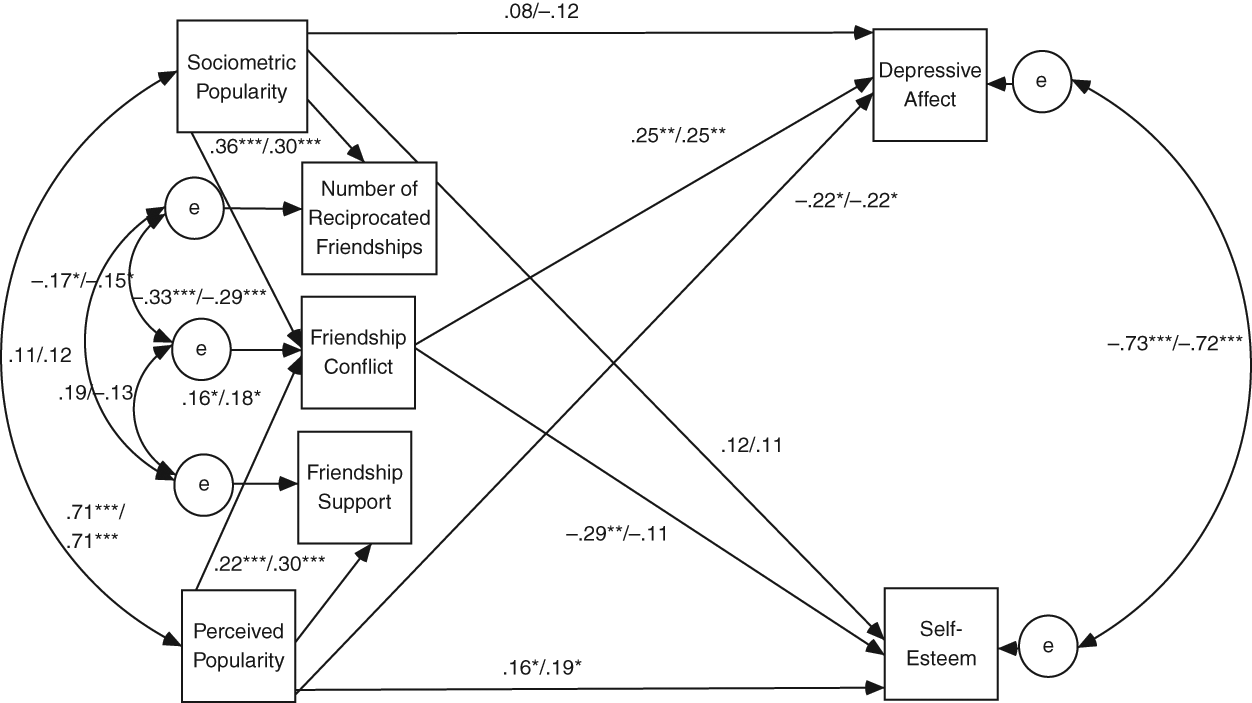
Structural equation model examining the association of perceived and sociometric popularity with friendship factors and the link to depressive affect and self-esteem with moderation by gender
Mediation analyses were repeated with this modified model for the pathways from conflict to depressive affect and self-esteem. Conflict continued to mediate the association between sociometric popularity and depressive affect for boys and girls (z = −2.06, p = .04, and z = −2.13, p = .03, respectively). However, regarding conflict as a mediator of the link between sociometric popularity and self-esteem, the Sobel test indicated that was the case for boys but not for girls (z = 2.23, p = .03 vs. z = 1.21, p = .23). 1
Discussion
The current study examined the unique associations of sociometric and perceived popularity with friendship factors and how they jointly predicted depressive affect and self-esteem. This study built upon past research on sociometric popularity and friendship and their contributions to adolescent adjustment, and extended it to perceived popularity. Consistent with evidence that sociometric and perceived popularity are distinct constructs, different friendship factors and unique effects on adaptation were observed.
The primary test of our hypotheses was the proposed theoretical model tested through SEM. The findings reflect the unique influences of sociometric and perceived popularity. As predicted, sociometric popularity was uniquely associated with more reciprocated friendships that were characterized by less conflict. Reciprocal friendships reflect strong affective bonds (Bukowski & Hoza, 1989) distinguished by greater stability, contact, positive affect, equity, and closeness (Newcomb & Bagwell, 1995). Baumeister and Leary (1995) proposed that humans are motivated to form lasting relationships to meet their need for belonging. In adolescence, sociometric popularity is associated with prosociability but not aggression. These behaviors and associated social needs may be linked to both the ability and motivation to form high quality friendships. This ability may be applied to conflict resolution to minimize relationship disruption, facilitate smooth interactions, and further success in the broader peer context.
In contrast to our hypothesis, when controlling for perceived popularity, sociometric popularity was not associated with more supportive friendships. Other studies also found that sociometric popularity is associated with lower conflict but not necessarily with higher support (e.g., Rose et al., 2004). However, we had not anticipated that well-liked adolescents would not experience more positivity in their friendships. The literature has demonstrated that friendship support and conflict are orthogonal constructs rather than two ends of one dimension (Bukowski, Hoza, & Boivin, 1994). This means that a relationship low in conflict is not necessarily high in support; however, future research should further investigate the association of friendship support with sociometric popularity.
Perceived popularity, when accounting for sociometric popularity, was associated with friendships that were both more conflictual and more supportive. Apparently, friendships with perceived popular adolescents are a “mixed bag” of positive and negative experiences. Among adolescents, perceived popularity has been linked with prosocial behavior (de Bruyn & van den Boom, 2005). This prosocial behavior may be used to maintain high levels of popularity without frustrating and angering peers. Having a highly supportive friendship may be particularly important in navigating a competitive social context in which popularity is always up for grabs. Perceived popularity may foster positive friendship qualities that yield a supportive ally or even coconspirator with whom to perpetrate aggressive acts (Rose et al., 2004) in order to solidify one’s own position in the social hierarchy. However, in the ever changing social landscape of adolescent peer groups and popularity, friends may at other times become the recipient of this aggression. Tactical approaches appear crucial to solidifying high status and power in the social hierarchy. Friends may therefore not be immune to the strategic use of aggressive and manipulative behavior if it serves the adolescent’s need for ensuring dominance.
Beyond the behaviors that contribute to support and conflict, the experience of popularity in early adolescence may be particularly important to understanding the contribution of popularity to friendships. Perceived popularity appears to be highly cherished in adolescence, valued above achievement, romantic relationships, or friendship (LaFontana & Cillessen, 2010). This is notable given decades of theorizing about the growing importance of dyadic friendships in adolescence (Sullivan, 1953) but is in keeping with ethnographic findings that popularity and friendship may sometimes be at odds, with differing or conflicting goals (Merten, 2004).
While popularity is reflective of a hierarchical structure characterized by visibility and self-serving interests, friendship is a relational construct that reflects equality, mutual benefit, and private exchange (Hartup & Stevens, 1999). Yet adolescents do not see these two constructs as exclusive. Adolescents often attempt to befriend popular peers to enhance their own popularity; the rejection of these bids is a way by which adolescents maintain their dominance in the social hierarchy (Eder, 1985). The achievement of popularity often comes at the cost of dropping previous friendships and betraying previous secrets (Merten, 2004). Yet, once popularity is achieved, friendships may help to maintain one’s position in the group. These affiliations may be seen as alliances bound by a similar goal for status rather than true friendships. The partners may bask in the positive experiences associated with high status and experience similar feelings of affective enjoyment and bonding. However, it is possible that these friendships are also tenuous and open to disagreement. Merten (2004) suggested that high status may come at the cost of denying one’s own needs and characteristics in the service of being acceptable and popular. Perhaps when adolescents prioritize their own needs instead of popularity needs, conflict arises between these friends.
This mixed experience may account for why perceived popularity was not associated with number of reciprocal friendships. These positive and negative experiences together may temper how attractive popular adolescents are as friends, or make them appealing friends for only some youth in some circumstances (e.g., other adolescents seeking similar levels of popularity). While this is in contrast to some ethnographic research suggesting that perceived popular adolescents are sought after companions (Eder, 1985), it is consistent with other qualitative studies that found that while adolescents sought social proximity and shared group membership with popular peers, they did not necessarily want to be their friends (Adler et al., 1992; Babad, 2001). Perceived popular adolescents may be using friendships to bolster their status and support their maneuvering for position rather than forming close and jointly satisfying bonds. While this is inconsistent with Rose and colleagues (2004), it is plausible that the association between perceived popularity and number of reciprocal friends in their study was a function of the overlap between perceived and sociometric popularity since the latter was not controlled. Further examination of this association may be necessary to clarify these links.
While the SEM analyses were the primary focus of this study and the correlational analyses were meant primarily for descriptive purposes, when considered together, the path and correlation coefficients suggest something interesting about the nature of the associations between popularity and friendship. For instance, for both boys and girls perceived popularity is only associated with friendship conflict when liking is accounted for. This might suggest that the prosocial skills that are inherent in sociometric popularity serve to buffer those youth who are perceived and sociometrically popular from high levels of conflict within their friendships. However, when only considering the high status aspects of popularity and the behaviors that are often used to obtain and maintain this status, conflict within these friendships is more common.
For boys, the bivariate correlations suggest that sociometric popularity is associated with friendship support but not conflict while the SEM findings indicate that sociometric popularity is associated with lower conflict but not support. These findings suggest that boys who are both well liked and popular experience high levels of support within their friendships while those who are only well liked experience low conflict.
The story was slightly different for girls. For them, sociometric popularity was unrelated in either analysis to friendship support; however, similar to boys, when controlling for perceived popularity, sociometric popularity was associated with less conflict. Regardless of whether perceived popularity was controlled for, sociometric popularity was linked with more reciprocated friendships for both genders. Notably, when considering the bivariate correlations, boys who are perceived popular have more reciprocal friends; however, this same association is not characteristic of girls and not present when sociometric popularity is controlled for. Perhaps perceived popular boys who are also sociometrically popular use their prosocial skills to attain popularity and this facilitates formation of mutual friendships; however, when the association with sociometric popularity is controlled for, this link is no longer present.
These contrasting findings and the fact that sociometric and perceived popularity produced distinct friendship patterns, suggests that future research may investigate these unique patterns through person-centered analyses that identify adolescents who are perceived popular, sociometrically popular, and both. Perceived popular youth are a heterogeneous group, including youth who are primarily prosocial and others who are both prosocial and aggressive (Rodkin, Farmer, Pearl & Van Acker, 2000). These two types may differ in the number and quality of their friendships. As indicated above, adolescents who are primarily motivated by popularity may seek friendships to support their bids for status and power rather than for the typical provisions of friendship (e.g., validation, support, aid).
In contrast, adolescents who are motivated to form high quality intimate relationships may be especially well liked in the peer group. If these adolescents are also attractive, athletic, or participate in valued extracurricular activities that distinguish perceived popular adolescents (e.g., cheerleading; Meisinger, Blake, Lease, Palardy, & Olejnik, 2007), they may be able to simultaneously attain sociometric and perceived popularity. These adolescents may have many high-quality friendships while experiencing the benefits of being both accepted and popular. Person-centered analyses that also examine adolescents’ motivations for forming and maintaining friendships (and with whom) could address these issues. This approach may also have implications for pathways to adjustment. Future analyses may build on the findings of the current study to examine whether sociometrically popular, sociometrically and perceived popular, and perceived popular adolescents’ adaptation are explained by or jointly predicted by friendship factors as was found in the current study.
Both sociometric and perceived popularity were significantly related to depressive affect and self-esteem; however, their mechanisms of influence differed. Perceived popularity contributed directly to less depressive affect and higher self-esteem; sociometric popularity contributed to adjustment through friendship conflict. Well-liked adolescents were less likely to experience conflict with friends, which in turn guarded against depressive affect. This is in line with previous findings of a mediational pathway from sociometric popularity to adolescent internalizing symptoms (Nangle et al., 2003; Pedersen, Vitaro, Barker, & Borge, 2007). Perhaps the effect of sociometric popularity on adolescent adaptation is primarily through dyadic friendships.
Conflict was a stronger predictor of self-esteem for boys than girls. Our study replicated that girls and boys experience similar levels of friendship conflict (Bukowski et al., 1994; Lempers & Clark-Lempers, 1993). However, perhaps conflict is a more significant risk for negative adaptation in boys than girls. Boys have more difficulty resolving conflict (Parker & Asher, 1993) and adopt antisocial rather than prosocial goals in response to conflict (Rose & Asher, 1999). This may explain boys’ lowered self-esteem in response to conflict in our study. In addition, girls more frequently than boys express distress and seek support to manage negative emotions and experiences (Rose & Rudolph, 2006). This active coping may attenuate the stress associated with conflict (Bird & Harris, 1990; Chapman & Mullis, 1999). Even if boys seek the same kind of support, they may be less skilled at it (Kunkel & Burleson, 1999). Moreover, boys’ use of humor to deflect distressing experiences may not be as effective in buffering them from negative socioemotional consequences (Plancherel & Bolognini, 1995).
Neither number of friendships nor the supportiveness of these friendships explained the link between sociometric popularity and either depressive affect or self-esteem. These friendship factors could not serve a mediating role as neither number of friends nor friend support was associated with depressive affect or self-esteem. This was not predicted and is in contrast to other studies in which number of friends was a mediator (Nangle et al., 2003; Pederson et al., 2007). While the contribution of a friend to adjustment has been well established (e.g., Parker & Asher, 1993), the added benefit of having more friends has been less clearly demonstrated. The characteristics of these friends may also have attenuated their influence on adolescent outcomes. For example, friends who are depressed (Hogue & Steinberg, 1995) or reinforce ruminative coping styles (Rose, 2002) may diminish the benefits of friendship quantity.
In terms of support, Nangle and colleagues (2003) treated friendship quality as a unitary dimension in which conflict (reverse scored) was combined with positive dimensions (validation and companionship). Therefore, a direct comparison of these findings to ours was not possible. It is puzzling why a highly supportive friendship would not predict adaptation. Perhaps the avoidance of a noxious friendship experience (conflict) is more salient to adaptation at this developmental juncture, playing a more substantial role in internalizing distress and feelings regarding the self, than friendship support.
Notably, perceived popularity made unique contributions to adolescent adaptation, predicting less depressive affect and higher self-esteem. This may be explained by the fact that high status affords adolescents peer reinforcement in which they are sought out as friends, provided support, admired, and emulated (Sandstrom & Cillessen, 2006). Popularity has also been associated with increased alcohol use and sexual activity (Mayeux, Sandstrom, & Cillessen, 2008), so although high status might protect against internalizing distress and negative self views, it can also potentiate risk behaviors that undermine youth functioning in the long run. Alternatively, perceived popularity may continue to buffer against long-term negative consequences. Further longitudinal research is needed to untangle this “cycle” of influence.
While not directly tested in this study, it is plausible that the importance attributed to popularity during this developmental stage (LaFontana & Cillessen, 2010) explains why perceived popularity makes a unique contribution to adolescents’ well-being. Prinstein and Wargo Aikins (2005) found that adolescents’ valuing of peer acceptance moderated its influence on depressive affect. It is also possible that the unique effect of popularity can be attributed to the significance of popularity regardless of the cost to friendships. Adolescents whose friendships suffer because they prioritize popularity may discount the contribution of friendship to their well-being—perhaps seeing their friendships as either a vehicle toward or an obstacle to popularity. Current quantitative approaches for assessing friendship quality may not yet capture a more complex interplay between these social experiences. Future research that assesses the stability of friendships and the changing nature of friendship experiences across more frequent intervals may clarify these associations.
The duality between the negative effects of perceived popularity on emotional functioning via friendship conflict, versus the positive direct effects on self-esteem and lower depressive affect, is quite interesting. It may reflect the complexity of perceived popularity within the peer group. Perhaps some youth can attain and maintain popular status in a group while avoiding conflict through less confrontational approaches, more adept social skills, or better emotion regulation. These adolescents may benefit from their status by experiencing bolstered self-esteem and diminished depressive affect. Other adolescents may experience their pursuit of status as a more conflictual process that aggravates peers, thereby undercutting friendships, which in turn may undermine personal adjustment. Together these findings suggest that socially skilled adolescents experience the benefits of popularity without the costs, but for others, the eventual expense may dampen the advantages that such status affords.
Applying a developmental framework can shed further light on the ways in which adolescent peer experiences differ from childhood experiences. Researchers have long supported the idea that intimate friendships play a greater role as children enter adolescence, possibly overshadowing the role of group-level acceptance (e.g., Demir & Urberg, 2004). On the one hand, our study supported that sociometric popularity has a less direct impact on early adolescent adjustment and rather is explained by friendship. On the other hand, perceived popularity directly impacted depressive affect and self-esteem. Thus neither friendships alone nor group-level status alone can explain adolescent well-being.
In adolescence, the social landscape changes. Elite peer groups emerge due to involvement in extracurricular activities (Eder & Kinney, 1995) and clique membership (Brown & Klute, 2003). Members of these groups form friendships to maintain their status—engaging in behaviors that strengthen their bonds with some peers, while alienating others. Given the prized status of popularity, these estranging behaviors do not seem to come at the same cost as they might in childhood (Eder, 1985). The esteem of popularity and the existence of elite groups may allow adolescents to engage in these behaviors without significant costs. In childhood, when these groups are just emerging and the difference between sociometric and perceived popularity is less clear (Eder, 1985), the impact on well-being may be more significant. Perhaps, in childhood more significant censure results as children have not yet developed skills to manage their behavior and may be less adept in using relationships to facilitate popularity. Future longitudinal research on the changing association between both forms of popularity and friendship and their implications for adaptation can clarify these developmental changes.
This study provided further evidence that sociometric and perceived popularity are distinct constructs with unique associations and effects. However, there are limitations to this research. The associations of each type of popularity with friendship at earlier and later developmental periods as well as their joint influence over time are unclear. Given the concurrent nature of these results, future longitudinal studies beginning with an earlier developmental period and following youth over time are important to distinguish developmental processes. It is possible that the direction of effects is more complex than our model; opposite or bidirectional effects are plausible. For example, interpersonal processes associated with depression may undermine friendship quality (Joiner, Alfano, & Metalsky, 1992).
Another limitation was that participants rated the quality of perceived best friendships, rather than only reciprocated friendships. The inability to include all adolescents in the analyses prevented the limitation to reciprocated friendships. Previous research has found more support and less conflict in reciprocated than unreciprocated friendships (Newcomb & Bagwell, 1995). In our sample, reciprocated and unreciprocated dyads did not differ in friendship support or conflict, suggesting that this issue was less critical here.
The emphasis in this study on how different adolescent peer experiences are related to well-being is consistent with calls to integrate them and capture adolescents’ real social experiences while examining the processes by which they lead to adaptation (e.g., Asher, Parker, & Walker, 1996; Parker & Asher, 1993). While the focus was on internalizing symptoms and self-esteem, future research should also examine externalizing outcomes. In those evaluations, it will be important to include characteristics of the friend, as friendships with a popular and deviant peer may magnify the influence of popularity on emerging risky behavior.
Footnotes
Acknowledgements
The authors gratefully acknowledge the participation of the students, teachers, and school administrators who made this project possible.
The authors declared no potential conflicts of interest with respect to the authorship and/or publication of this article.
The authors received no financial support for the research and/or authorship of this article.