



Abstract
This study supported associations between three theoretically driven conceptualizations of racial and ethnic identity (REI; Multigroup Ethnic Identity Measure; Multidimensional Racial Identity Measure; Bicultural Identity Measure) and with adaptive functioning among Canadian indigenous adolescents in middle school to high school. Age differences were found across the ethnic identity statuses but not for the continuous REI measures. Overall, adolescents placed predominantly at the traditional (identified with indigenous culture) and marginal (neither identified with indigenous nor mainstream culture) ethnic identity statuses with fewer marginal and more bicultural (identified with both indigenous and mainstream cultures) categorized adolescents across the age-range. Traditional students followed by those classified as bicultural evidenced greater REI and adaptive functioning in comparison with marginal and mainstream students. Predicted relationships between REI and adjustment among Canadian First Nation adolescents were supported; findings suggest potential benefits of First Nation communities for REI development.
Keywords
The exploration and consolidation of one’s sense of self or identity is the major developmental task of adolescence (Erikson, 1968; Marcia, 1966). This may be more complicated for minority youth as it involves the integration of one’s heritage, ethnicity, and/or racial identity into one’s self-definition (Phinney, 1992). Indeed, the process may be further compromised due to cognitive advancement during adolescence that leads to awareness of social and personal inequities, prejudice, discrimination, and racism associated with disadvantaged minorities (Cross, 1995; Spencer & Dornbusch, 1990). Nevertheless, there is a growing research literature that considers racial-ethnic identity (REI) to be an asset and protective factor that purports resilience to offset adversity for many minority youth (Branscombe, Schmitt, & Harvey, 1999; Chao & Otsuki-Clutter, 2011; Miller, 1999; Oetting & Beauvais, 1991; Ong, Phinney, & Dennis, 2006; Phinney & Kohatsu, 1997; Spencer, Noll, Stolzfus, & Harpalani, 2001).
Although there are distinct historical differences between race and ethnicity (Cokley, 2007), advances in conceptualizing race, ethnicity, and culture acknowledge the dynamic nature of these constructs (Phinney & Ong, 2007; Yeh & Hwang, 2000). Race and ethnicity are viewed as socially constructed and ascribed statuses that reflect broader sociohistorical and political influences and any differences between them is related to perceived differences with either racial or ethnic heritage. Alternatively, culture refers to the process of adapting and learning what it means to be a member of one’s society (Chao & Otsuki-Clutter, 2011; Quintana, 2007; Quintana et al., 2006).
Research has focused on prominent American minorities (e.g., African Americans, Hispanic Americans, Asian Americans) yet minimal published work has considered indigenous people (Sarche & Whitesell, 2012). This is unfortunate as indigenous young people have been considered to face the greatest challenges in negotiating issues of identity development (Arnett, 2004; Trimble, 2000; Weaver & Brave Heart, 1999). Native American Indian adolescents have been found to have the lowest ethnic identity scores in comparison with Hispanic and Asian adolescents (Martinez & Dukes, 1997). These concerns have been linked with historical disadvantage by government policies of cultural suppression and forced assimilation that systematically undermined protective cultural factors, socialization, cultural values, ceremony, language, and traditions (Duran, Duran, & Brave Heart, 1998; Kirmayer, Simpson, & Cargo, 2003) with continuing multigenerational impacts of colonization (Tafoya & Del Vecchio, 1996; Weaver & Brave Heart, 1999). Aboriginal youth experience higher rates of physical, social, and mental health problems in comparison with other groups. This is well-documented in terms of depressive symptoms, suicide, delinquency, incarceration, victimization, teen pregnancy, lack of school completion, low college attendance, unemployment, drug and alcohol abuse (Comeau & Santin, 1995; Pavkov, Travis, Fox, King, & Cross, 2010; Townsend & Wernick, 2008).
This research investigated Canadian First Nation adolescents. In Canada, “First Nation people” refer to Status and Non-Status “Indian” peoples and many reserves use the term “First Nation” in the name of their community (Indian and Northern Affairs Canada, 2011). Although 4% of the Canadian population identify themselves as Aboriginal (including registered Indians, Metis, Non-Status Indians, and Inuit), more than 15% of the population in the central midwest is First Nation; 61.7% live on reserves; 60.5% are under 30 years of age (Indian and Northern Affairs Canada, 2011). Indeed, the young Aboriginal population is the fastest growing demographic in Canada (Steffler, 2008). Apart from the focus on this special group, current findings are expected to have relevance for indigenous adolescents elsewhere, in the United States, Australia, New Zealand, and Norway.
The objective of this study was to provide an overview of REI development among Canadian First Nation adolescents who live and attend school in their First Nation communities. It utilized information collected prior to the onset of an educational initiative program. This school-based program was designed to incorporate cultural content into the school curriculum in order to enhance REI development among students and thereby to facilitate students’ academic achievement, school retention, and completion. First, age-related and biological sex differences were examined in students’ REI over the middle school and high school years, from grade 5 through grade 12. Comparisons are given for three theoretically different REI models and measures. Subsequently, REI was investigated in relation to adaptive functioning (prosocial behaviors and cultural involvement) and compromising behaviors (problem behavior including minor delinquency, alcohol and drug use). The following sections provide a brief background to the study followed by the goals and objectives.
Identity Development
Erikson considered ego-identity development the central concern for adolescents (Erikson, 1968). Marcia (1966) conceptualized this process in terms of two dimensions: exploration and commitment. Exploration involves examining, probing, questioning, and reflecting on alternatives and options whereas commitment occurs when one takes some initiative and makes choices in ideological (occupation, politics, religion, lifestyle) and interpersonal (friendships, dating, sex roles, recreation) domains. Taken together, these processes define four identity status configurations: diffusion (neither exploration nor commitment), foreclosure (commitment without prior exploration), moratorium (active exploration without commitment), and achievement (both exploration and commitment). Theoretically and empirically, the statuses reflect an orientation to oneself and the social world, along with attitudes and behaviors characteristic of these statuses (Adams, 1998). The general developmental progression involves foreclosure and diffusion among children and young adolescents followed by the emergence of moratorium during adolescence and young adulthood, and subsequently, identity achievement (Mees, Iedema, Helson, and Vollebergh, 1999; Waterman, 1993). The incorporation of one’s cultural background or heritage, ethnicity, and/or race is an important component of identity development for minority youth (Phinney, 1992); at the same time these young people must adjust to the demands of the dominant society.
Acculturation Models
Acculturation models (Berry, 1970; Berry & Sam, 1997; Phinney, 1996) emphasize the complexities of integrating one’s cultural, racial, or ethnic group identity along with functioning adaptively in the majority culture. This includes the extent to which one identifies with both one’s own culture and with mainstream society as separate dimensions. This conceptualization provides four ethnic identity statuses: bicultural (identified with both cultures); mainstream or assimilated (identified with mainstream culture only); traditional or separated (identified solely with one’s own culture); and marginal (identified with neither culture). In general, bicultural individuals tend to function optimally in their own community as well as in mainstream society, successfully negotiating the demands in both contexts. Conversely, marginal individuals who are not aligned with the values and ideology of either their own culture or that of the dominant society evidence the greatest maladaptive behavior and difficulties (Oetting & Beauvais, 1991; Phinney, 1989; Phinney & Alipuria, 1990). In other words, bicultural ethnic identity has been associated with positive adjustment, mental health, and well-being among minority group adolescents. In comparison with other minorities, indigenous people are more likely to reflect marginal ethnic identity that is, alienation from their own as well as the majority culture (Berry, 1970; John, 1998). According to Garrett and Pichette (2000), marginal status related negatively with psychological and social adjustment while bicultural and traditional statuses associated positively with these measures of well-being among indigenous youth. Jones and Galliher (2007) did not support these relationships with ethnic identity status among Navajo high school students who resided on reserves. The authors explained these unexpected results as due to a lack of variability in students’ strong identification with their Native American Indian culture. Navajo adolescents’ elevated ratings for their own culture limited the usefulness of partitioning respondents into the respective identity status groups and few could be considered as “authentic” in the marginal status. Alternatively, when these youth were categorized in terms of high scores on both exploration and commitment, advancement on several measures of adjustment were found in comparison with students who scored low on these two dimensions. In other words, ethnic-group exploration and commitment rather than merely attachment or belonging to one’s ethnic group and/or mainstream society was associated with adjustment. Indeed, these divergent findings differentiate between acculturation (the extent of attachment to one’s own group and to the majority group) and enculturation or REI (the extent to which one’s own group has been examined, evaluated, and integrated into one’s self-definition.).
Racial and Ethnic Identity
REI models focus on feelings of belonging and attachment to one’s group and the meaning attributed to this association (Phinney, 1992; Sellers, Rowley, & Chavous, 1997). Following Eriksonian theory, Phinney (1992) emphasized the relevance of cultural group exploration and belonging. Similarly, Sellers et al. (1997) focused on the extent to which one’s social or racial identity is salient to one’s sense of self, reflects positive or negative beliefs about the self, and how favorably one perceives that others feel toward them.
Theoretical assumptions in REI models indicate a developmental progression. This involves increased searching or exploration in adolescence (French, Seidman, Allen, & Aber, 2000; 2006; Pahl & Way, 2006; Whitesell, Mitchell, Kaufman, Spicer & the Voices of Indian Teens Project Team, 2006). Most REI models consider developmental advancement from lack of awareness or understanding of one’s ethnicity that proceeds through a period of exploration, questioning, and evaluating to learn more about one’s group. This leads to an achieved ethnic identity characterized by a commitment to one’s ethnicity based on a clear understanding of the implications of achieved identity and a secure, confident sense of group (Cross, 1991; Helms, 1990; Phinney, 1989; 1993). Phinney (1992) reported higher ethnic identity scores associated with age due to increased ethnic identity consolidation. Roberts, Phinney, Masse, Roberts, and Romero (1999) found no correlation between age and ethnic identity scores among middle school adolescents yet their mean scores were lower than those reported for older adolescents in other research (Phinney, DuPont, Espinosa, Revill, & Sanders, 1994). Branch, Tayal, and Triplett (2000) found higher ethnic identity scores among adolescents than young adults; this was considered to reflect globalized endorsement for superficial or banal aspects of ethnicity rather than integrated ethnic identity ideologies. This is consistent with Spencer and Markstrom-Adams (1990) and with Quintana’s (1998) social-cognitive model of ethnic identity understanding that includes an increased sense of belonging and attachment to one’s ethnic group among younger adolescents reflecting conformity that precedes questioning, evaluation, and consciousness raising.
Several studies (Seaton, Scottham, Sellers, 2006; Yip, Seaton, & Sellers, 2006) examined ethnic identity development in terms of sequencing from unexamined (foreclosure and diffusion) to examined forms of REI (moratorium) and ultimately achievement. Similarly, racial identity ideologies are assumed to involve successive differentiation of increasingly advanced status ideologies (Helm & Cook, 1999; Worrell, Cross, & Vandiver, 2001). However, according to Quintana (2007) the sequencing of REI stages may be specific to different REI models.
The current study examined three conceptually different REI measures adapted for use with our First Nation children and adolescents. These were: the Bicultural Identity Measure (BCIM; Moran, Fleming, Somervill, & Manson, 1999); the Multigroup Ethnic Measure (MEIM; Phinney, 1992); and the Multidimensional Measure of Racial Identity (MMRI; Sellers, Smith, Shelton, Rowley, & Chavous, 1998). This focus was prompted by the increasing number of REI measures that are available and frequently used interchangeably (Ponterotto & Park-Taylor, 2007). However, most REI measures are multifaceted and although many of the dimensions may correlate, they encompass distinct aspects that should be considered separately rather than arbitrarily or using a composite score (Cokley, 2007; Ong, Fuller-Rowell, & Phinney, 2010; Phinney & Ong, 2007; Quintana, 2007). Nevertheless, few studies have examined the association and shared variability between these constructs or used multiple measures with the same sample (Casey-Cannon, Coleman, Knudtson, & Velazquez, 2011). A number of studies reported differential relationships between various components of REI with different predictor and outcome measures (Cameron, 2004; Juang & Syed, 2010; Kiang, Yip, Gonzales-Badken, Witkow, & Fuligni, 2006; Yip & Fuligni, 2002). Different aspects of REI have been found to exhibit variable developmental trajectories (French, Seidman, Allen, & Aber, 2006; Umana-Taylor, Gonzales-Backen, & Guimond, 2009) and biological sex differences (Umana-Taylor, Gonzales-Backen, & Guimond, 2009). In addition, relationships between components of REI may be specific to particular ethnic groups as well as specific contexts (Helms, 2007; Yeh & Hwang, 2000; Yip et al., 2006). According to Yeh and Hwang (2000), REI may be dynamic within a person so that its meaning changes based on the cultural context and the individual’s recent experiences.
Although the REI measures used in this study are based on different theoretical models, associations were expected between corresponding components. Following general identity development, the prediction was for increased REI among older First Nation adolescents.
Considerable research underscores the role of REI as supportive of overall health (Harrell, 2000; Wexler, DiFluvio, & Burke, 2009) and well-being for minority adolescents (Greene, Way, & Pahl, 2006; Kiang & Fuligni, 2009; Kiang, Yip, Gonzales-Badken, Witkow,& Fuligni, 2006; Landrine & Klonoff, 2004). This is seen in positive associations with self-esteem (Bracey, Bamaca, & Umana-Taylor, 2004) and academic adjustment (Altschul, Oyserman, & Bybee, 2006; Byrd & Chavous, 2009); inverse relations with internalizing and externalizing problems (DuBois, Burk-Braxton, Swenson, Tevendale, & Hardesty, 2002), alcohol and drug abuse (Moran & Bussey, 2006), hopelessness, depression, and suicide (LaFromboise, Albright, & Harris, 2010; LaFromboise, Medoff, Lee, & Harris, 2007).
For this study special attention was given to the outcome measures deemed relevant for FN adolescents. Sensitivity in this regard is of paramount concern when working with indigenous communities due to the negative impact of earlier involvement with government agencies, educators, and researchers. Collaborative efforts require building trust and careful consultation with FN communities (Thompson, Whitesell, Galliher, & Gfellner, 2012). Prosocial behaviors included positive activities with family and friends, at home, school, and in the community; this is consistent with the positive youth development perspective (Lerner, Phelps, Forman, & Bowers, 2009). In addition, involvement in traditional, spiritual, cultural activities, and value ideology are considered the foundation of indigenous well-being (Iwasaki, Bartlett, & O’Neill, 2005; McCormick, 2000; Sunday, Eyles, & Upshur, 2001; Zimmerman, Ramirez-Valles, Washienko, Walter, & Dyer, 1996). This was employed as an outcome variable considering the salience of the Native revitalization movement to reclaim one’s roots and heritage given ramifications of cultural loss due to colonization efforts. The variables were endorsed by our First Nation community partners. Compromising behaviors included minor delinquency as well as alcohol and drug use. These are typical examples of normative problem behaviors among adolescents as they are more likely than younger students to engage in such experimenting as part of identity development (Jessor & Jessor, 1977; Moffitt, 1993).
The objectives of the study were as follows.
Age-related and biological sex differences were examined for the REI measures, prosocial and compromising behaviors. As indicated previously, higher REI scores were expected as a function of age. In addition, older adolescents were expected to be involved in more compromising behaviors than younger adolescents. Sex differences were explored but there were no predictions.
Positive associations were expected among corresponding REI measures, REI measures and prosocial behaviors; and inverse associations between REI measures and compromising behaviors.
Age-related differences were predicted for the ethnic identity statuses. Young adolescents were expected to be classified predominantly as marginal and traditional (i.e., not yet exploring; more normative/traditional and diffused); a higher proportion of older adolescents were expected to be categorized as traditional and bicultural (i.e., having engaged in some ethnic identity exploration and/or commitment).
REI development on the REI measures was predicted to relate to ethnic identity status. In particular, adolescents categorized as bicultural and traditional were expected to score higher than mainstream and marginal students on the REI measures.
Differential associations were predicted for involvement in prosocial and compromising behaviors in relation to ethnic identity status. Specifically, adolescents classified as bicultural, mainstream, and traditional were expected to report less involvement in compromising behaviors and greater involvement in prosocial behaviors than students classified as marginal in ethnic identity status.
Method
Participants
There were 227 (
Students reported their living situation as: 46% with both natural parents; 17% with mother only; 9% with mother and stepfather, 16% with grandparent(s); 1.6% with father only; 2.1% with father and stepmother; 2% part-time with mother and father; 1% adopted; 3% in foster homes; and 2.6% with court-appointed guardian. Student reports of educational attainment by parents was high school completed for both mother (
All participants indicated they had siblings; this was on an average 5.3 (SD = 1.4) siblings.
Measures
Bicultural Identity Measure
The BCIM (Moran et al., 1999) indexes the degree to which respondents identify with both their own culture and with mainstream or White culture. Eight items address First Nation identity including involvement in Native traditions, use of one’s Native language, adoption of the Native way of life, following spiritual practices, and plans to participate in the cultural community as an adult; similar items were used to assess White identity except the items for language and spirituality. Items were rated on a 4-point scale with higher values indicating identification with the culture. Cronbach’s alphas were .83 for First Nation and .85 for White identity scales. Mean scores were calculated for these scales and they were used as continuous variables as well as in the categorical analysis. The mean scores were 2.74 (SD = .71) for First Nation identification and 1.91 (SD = .72) for White identification.
Respondents were assigned an identity status category (bicultural, mainstream, traditional, marginal) on the basis of scores on both the First Nation and White identification scales. As the scale of these measures ranged from 1 to 4, scores above the scale midpoint, 2.5, indicated general endorsement of a particular identity and scores below the midpoint showed minimal endorsement of that identity. Thus, mean scores above 2.5 indicated high identity and those below 2.5 indicated low identity. However, the classification of students with scores close to the midpoint of one category or the other would be somewhat arbitrary in view of sampling variability. These borderline cases may not reflect a consistent identity status. In order to avoid such spurious cases, and with consideration of the longitudinal intent of this research, cut-points slightly below and above the scale midpoint were used. Scores at or below 2.25 were considered low on identity and scores at or above 2.75 were considered high. Students that scored high on both First Nation and White identity scales were classified as bicultural; those scoring low on the First Nation scale and high on White identity scale were classified as mainstream or assimilated; those scoring high on the First Nation scale and low on the White scale were classified as traditional; and students who scored low on both scales were classified as marginal. Overall, 40 cases (18%) were lost in the classification process.
Multi-group Ethnic Identity Measure
The MEIM (Phinney, 1992) is a global index that has been found to be valid and reliable with a number of ethnic groups. Findings show increased ethnic identity scores among minority in comparison with mainstream adolescents and youth (Branch, 2001; Phinney & Alipuria, 1990), as well as in conjunction with the ethnic composition at school (Lysne & Levy, 1997) and in the community (Markstrom, Berman, & Brusch, 1998). The MEIM consists of 14 items with subscales for: ethnic affirmation and belongingness (5-items that measure attachment to one’s ethnic group); ethnic behavior and practices (2 items); ethnic identity achievement (7-items that reflect ethnic identity exploration); and a total ethnic identity score (14-items). Items were rated on a 4-point response scale that ranged from “strongly disagree” to “strongly agree.” Cronbach’s alphas were .84 for the full scale, .83 for affiliation/belonging; and .52 for achievement.
Multidimensional Racial Identity Measure
The MRIM (Sellers et al., 1998) developed for use with African Americans, subsequently used with other minorities, was modified for use with First Nation adolescents. Three scales were used. Centrality (8-items) measures the extent to which the person normatively defines the self with regard to race/ethnicity. Private regard (6-items) measures the extent to which respondents feel positively or negatively toward indigenous people and how one feels about being an indigenous person. Public regard (5-items) measures how one feels that others view indigenous people and how the group is viewed or valued by mainstream society (e.g., “People think that First Nation people are as good as people from other groups.”). Items are rated on a 7-point scale from “strongly disagree” to “strongly agree.” Cronbach’s alphas for the three scales were .74, .74, and .46, respectively.
Positive behaviors
Two measures of adjustment were developed for this project. Prosocial behaviors were assessed by adolescents’ ratings of involvement over the past three months in 23 behaviors (e.g., finished homework, went to school every day, helped a friend with homework or a problem, avoided fighting, helped at home). Items were rated on a 7-point scale with end-points from “never” to “most of the time.” The Cronbach’s alpha coefficient was .92.
Similarly, the adolescents indicated the extent of their involvement over the past six months in 23 traditional and culturally relevant activities and value ideology (e.g., powwows, Sundance, smudging, sweat lodge, use of cedar, jingle dancing or drumming, adherence to the seven teachings) on a 5-point scale from “never” to “most of the time.” The measure was developed for the project by collaborators in our First Nation communities. The Cronbach’s alpha was .92.
Compromising behaviors
These included two measures. An 18-item problem behavior checklist (adapted from Gfellner, 1994) indexed the extent of engagement in minor delinquency (e.g., took something from a store without paying, destroyed property for fun, cheated on a test, stayed out late without permission, teased or picked on other students) over the past 12 months. Items were answered in terms of seven alternatives from “never” to “more than 16 times.” The Cronbach alpha was .91.
Alcohol and drug use (Gfellner, 1994) was assessed for six substances (alcohol, marijuana, sniffing glue, sniffing solvents, amphetamines, downers) in the past six months. There were six response alternatives from “never” to “more than 10 times.” The Cronbach alpha was .72.
Procedure
The “Artists in the Schools” educational project was developed in conjunction with the participating First Nation community schools. The program was well-publicized in each community and all students in the schools were invited to be involved. Consent was obtained from parents or guardians and student assent was received for participation in the survey. Students took home consent forms that were subsequently returned to teachers and collected by school-based project coordinators prior to data collection. Older students completed the surveys in their classrooms; younger students were administered the surveys in small groups or individually in their classrooms by First Nation research assistants. Students received seasonal-themed pencils and erasers in the process survey administration. The survey required from 35 to 45 minutes to complete.
Overall, 69% of students registered in the First Nation community schools completed the survey; another 15% were absent on the survey administration occasions or had incomplete data; 16% refused consent.
Results
The first objective was to examine age-related and biological sex differences for the REI and behavioral variables with predictions for higher scores among older adolescents. A series of grade-level (3) by biological sex (2) ANOVAs were run for these measures. Neither grade nor sex effects for any of the REI variables (MEIM, MMRI, BCIM scales) attained significance. The main effect of grade-level was significant for traditional, F (2, 226) = 8.77, p < .0001, and for prosocial behaviors, F (2, 226) = 3.26, p < .05. In both cases the highest scores were seen among students in grades 7 and 8 for traditional (
Similarly, the grade-level main effect attained significance for problem behavior, F (2, 226) = 23.50, p < .0001, and for alcohol and drug use, F (2, 226) = 27.52, p < .0001. As expected, high school students showed greater involvement in problem behaviors (
The second set of predictions focused on relationships between the REI measures, prosocial and compromising behaviors. Positive associations were predicted between the REI measures with the prosocial behaviors and negative associations with compromising behaviors. Inter-correlations between the variables are shown in Table 1. As expected, most (31 of 36) correlations attained significance for the REI scales. Few differences were seen with age controlled; this was done to further examine potential age-related associations. As shown in the last row of Table 1, age correlated with students’ involvement in traditional activities, problem behavior, alcohol and drug use.
Inter-correlations for Scores on the Ethnic Identity Measures, Positive and Compromising Behaviors (With Age Controlled), and Age.
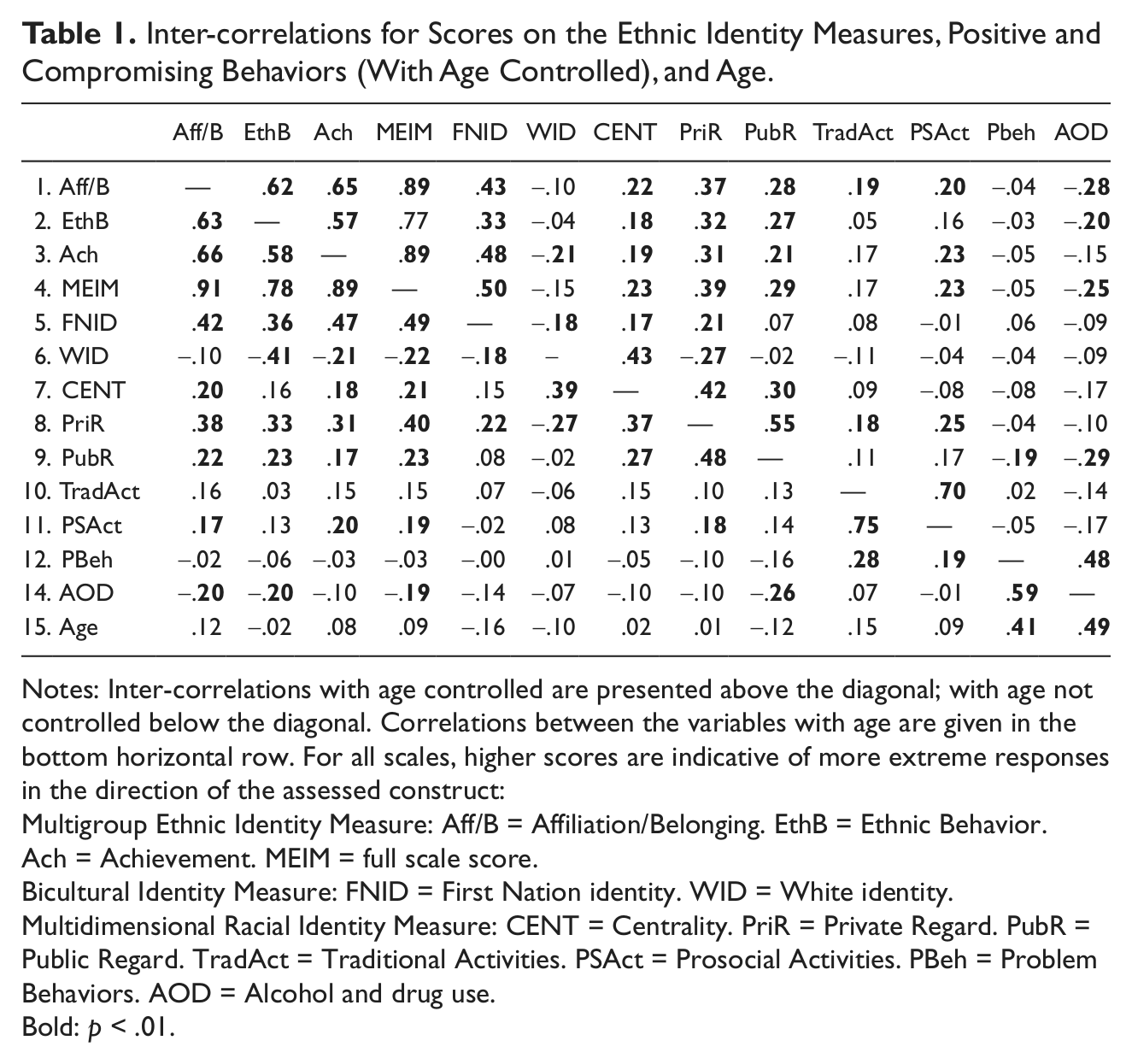
Notes: Inter-correlations with age controlled are presented above the diagonal; with age not controlled below the diagonal. Correlations between the variables with age are given in the bottom horizontal row. For all scales, higher scores are indicative of more extreme responses in the direction of the assessed construct:
Multigroup Ethnic Identity Measure: Aff/B = Affiliation/Belonging. EthB = Ethnic Behavior. Ach = Achievement. MEIM = full scale score.
Bicultural Identity Measure: FNID = First Nation identity. WID = White identity.
Multidimensional Racial Identity Measure: CENT = Centrality. PriR = Private Regard. PubR = Public Regard. TradAct = Traditional Activities. PSAct = Prosocial Activities. PBeh = Problem Behaviors. AOD = Alcohol and drug use.
Bold: p < .01.
The third objective was to examine age-related differences for the ethnic identity statuses. Predictions were that young adolescents would be classified predominantly as marginal and traditional with a higher proportion of older adolescents categorized as traditional and bicultural. Table 2 shows the breakdown by grade-level and biological sex for students classified in terms of the four ethnic identity statuses: bicultural, mainstream, traditional, and marginal. Overall, more students (43%) were classified as traditional followed by marginal (30%) then bicultural (21.3%) with only a few mainstream (5.4%) in ethnic identity status. The chi square of 16.5 (6 df), p < .01 was significant for grade-level. This indicated that the youngest students were classified predominantly at the marginal and traditional statuses (77%) and more than half (54%) of the grade 7 and 8 students placed at the traditional with fewer categorized as marginal (17%) in ethnic identity status. The pattern was maintained at the high school level with a third of the students classified as bicultural. These findings support age-related differences in ethnic identity status that is obscured on the continuous REI measures. Biological sex differences were not found.
Ethnic Identity Status Distribution as a Function of Grade and Biological Sex.

Notes: Chi square for grade-level (6 df) = 16.5, p < .01. Chi square for sex (3 df) = 2.85, p < .43
The fourth objective was to examine the relationship between REI measures and the ethnic identity statuses. Students categorized as bicultural and traditional were expected to have higher REI scores than those categorized as marginal and mainstream. A series of ethnic identity status (4) by grade-level (3) by biological sex (2) ANOVAs were generated for each of the REI scales and the behavioral measures. Table 3 shows the findings. Predicted associations for REI scores on the continuous measures were supported across the ethnic identity statuses along with some interesting variations. In particular, the highest MEIM scores were seen for traditional status students followed by those categorized as bicultural with the lowest scores for mainstream and marginal students. Traditional status students’ scores exceeded those of all other statuses for achievement and private regard. Traditional and bicultural students did not differ significantly in terms of affirmation / belonging and ethnic behavior; they exceeded mainstream and marginal students significantly on these measures. Alternatively, bicultural and mainstream status students’ showed the highest scores for centrality; these were significantly higher than those for traditional status students and they exceeded marginal students’ scores.
Means (Standard Deviations) for Ethnic Identity Variables, Prosocial and Compromising Behaviors by Ethnic Identity Status.

Notes: AOD = Alcohol and drug abuse. MEIM = Multigroup Ethnic Identity Measure.
Different superscripts (a,b,c) indicate significant differences between the means
p < .01. ***p < .001. ****p < .0001.
The fifth objective was to investigate relations between the outcome measures and the ethnic identity statuses. The prediction was that adolescents classified as bicultural, mainstream, and traditional would report less involvement in compromising behavior and greater involvement in prosocial behavior than students classified as marginal in ethnic identity status. As expected, students classified as marginal demonstrated the lowest scores for involvement in traditional and prosocial behaviors. Conversely, lower problem behavior scores for marginal students and higher scores for bicultural students appear to reflect normative age trends in these behaviors given the concentration of younger students as marginal and older students as bicultural.
Discussion
This study examined associations between various components of REI and relations with adjustment among Canadian indigenous adolescents. Age-related differences were not supported for the continuous REI measures. This was unexpected in view of earlier studies that showed both an increase in ethnic identity scores and exploration on the MEIM as function of age (French et al., 2000; 2006; Phinney, DuPont, Espinosa, Revill, & Sauders, 1994). However, Roberts et al. (1999) found no relationship between ethnic identity scores and age among early adolescents. Similar to the latter study, present findings may reflect the restricted age-range from middle school through high school in contrast with the previous studies that included greater age-variability in terms of older adolescents and young adults. A recent study by Syed and Azmitia (2009) indicated considerable growth in ethnic identity over the postsecondary years. It may be that school-aged adolescents have yet to advance in REI as indexed on these continuous measures. At the same time, a number of studies reported differences in REI across diverse ethnic groups (Lee & Chol Yoo, 2004; Phinney & Ong, 2007). There is no reason to assume that a one-size-fits-all solution applies to REI, and relationships among REI components may be specific to particular ethnic groups as well as to explicit contexts (Helms, 2007; Quintana, 2007; Yeh & Hwang, 2000; Yip et al., 2006). Indeed, REI development may be expected to vary across ethnic groups given differences in history, heritage, and social factors.
The predicted associations were found between the different REI measures in the bivariate analysis. This is consistent with other studies using the MEIM and MMRI (Casey-Cannon et al., 2011; Yip et al., 2006). Ethnic identity scores (with the exception of BCIM for students’ identification with indigenous culture and with White culture as separate dimensions) correlated positively with prosocial activities and negatively with alcohol and drug use.
In contrast to results for the continuous REI measures, age-related differences were supported in ethnic identity status among Canadian First Nation adolescents. Early adolescence was characterized by marginal and traditional ethnic identity; in middle adolescents there were a higher proportion of students at the traditional status and fewer at the marginal status. Older adolescents were prominent at the bicultural status, although the majority of students placed as traditional with no apparent difference in the proportion at the marginal status. This is consistent with the developmental progression for personal identity (Waterman, 1993) as well as REI (Cross, 1995; Phinney, 1993). Young adolescents and children are likely to be diffused or foreclosed; they have not yet begun to consider identity issues and some may endorse banal directives from others (parents, school, or the community) without question. In other words, early REI reflects either a lack of awareness or unquestioning affiliation and belonging as indicated in the respective marginal and traditional statuses. This is followed by the gradual onset of questioning, searching, or experimenting that may become more focused and subsequently lead to resolution and identity achievement during later adolescence and young adulthood. However, this transition is not necessarily smooth and it may be fraught with plateaus and reversals (Kroger, 2004).
A number of researchers have differentiated between behavioral and psychological aspects of ethnic identity (Bracey, Bamaca, & Umana-Taylor, 2004; Helms, 2007; Quintana, 1998; Spencer et al., 2001). It may be argued that REI measures reflect psychological functions whereas ethnic identity statuses may tap into more subtle behavioral components. From this perspective the behavioral aspects of ethnic identity such as those represented by the ethnic identity statuses may be more prominent and less differentiated than psychological components such as attitudes, self-perceptions, and emotional responses of REI as conceptualized on many of the continuous measures. As indicated elsewhere (Casey-Cannon et al., 2011; Helms, 2007; Yeh & Hwang, 2000), further work is needed to examine the different components of REI and how they may be unique among various ethnic groups and different contexts, and in relation to outcome variables.
As seen in the ethnic identity status ANOVAs, most of the REI measures related as expected with the ethnic identity statuses. Traditional status students scored highest on many REI measures including achievement (which reflects searching, exploration, and commitment to one’s ethnicity), composite MEIM, and positive regard (the valence associated with race / ethnicity in one’s sense of self). There was some variability for bicultural status students across the measures although they were similar to traditional status students on affirmation / belonging and ethnic behaviors. The lowest REI scores were for students categorized as marginal and mainstream. An unexpected finding was increased centrality scores for bicultural and mainstream status students followed by traditional students with the expected lowest scores for those at the marginal status. Centrality, defined as “the extent to which one defines oneself in terms of race and ethnicity,” may reflect an element of REI that requires greater abstraction, and evaluation. It is more likely to be found among older adolescents with advanced cognitive functioning.
Findings supported predictions concerning marginal status students in terms of the least involvement in traditional and prosocial behaviors; and the greatest problem behaviors. Overall, many of the positive effects were elevated for students categorized as traditional followed by those in the bicultural status. This was consistent with the Garrett and Pichette (2000) report of more positive adjustment associated with bicultural and traditional statuses among American Indian adolescents.
Given similarities in terms of exploration and commitment, current findings may be seen to align with the Jones and Galliher (2007) study insofar as they reported the highest well-being (in terms of school, psychological, social, and behavioral functioning) for Navajo high school students categorized in the achievement status based on MEIM scores above the median for affirmation/belonging and for achievement. This indicated that students had undergone exploration followed by commitment to one’s ethnicity. However, in that study ethnic identity effects were not found when students’ were classified on the Orthogonal Cultural Identification Scale (Oetting & Beauvais, 1991). This unexpected result was attributed to the restricted range in adolescents’ endorsement of their indigenous identity; most rated it high in valence which would curtail its usefulness in identifying marginal youth. The wider age-range of adolescents in the present study along with the use of mid-scale cutting points appears to have circumvented this problem. At the same time, the indigenous adolescents in both studies resided and attended nonintegrated reserve schools. In such a context REI is expected to be enhanced.
Present findings underscore the importance of a traditional ethnic identity status in terms of REI development and adjustment among indigenous adolescents. As indicated previously, the salience of traditional identity appears to reflect a supportive proximal context for indigenous identity development. Indeed, residence and school attendance in a First Nation community provides an environment replete with social capital whereby family, school, and community mutually reinforce the value ideology of FN culture. A number of studies have indicated the importance of school climate in terms of school experiences on REI development (Nasir & Hand, 2006; Warikoo & Carter, 2009). This may be reflected in the low proportion of students categorized at the mainstream ethnic identity status in this study. Careful consideration of school variables including relevant teacher and peer behaviors may provide a more nuanced account of these proximal factors and how they may influence REI development of indigenous adolescents.
Other studies have shown that ethnic identity can vary as a function of density of an ethnic group within the neighborhood and school environment (Garcia & Lega, 1979; Phinney & Rosenthal, 1992; Spencer & Markstrom-Adams, 1990). However, this may vary by ethnicity and context. For example, Umana-Taylor (2004) found that Latino adolescents had higher levels of ethnic identity in schools that were predominantly non-Latino. Conversely, Lysne and Levy (1997) reported that Native American adolescents attending high school with a predominantly Native American student body demonstrated greater ethnic identity exploration and commitment than Native American adolescents from schools with a predominantly White student body. Although the present study did not provide a comparison group of First Nation students living off-reserve and attending integrated schools, current findings underscore the supportive environment of the First Nation community for REI development. Indeed, students are learning about their culture at home, at school, and in the community where a plethora of role models, elders, teachers, family, and opportunities to engage in cultural behaviors are available. Such supportive factors are more likely to occur in First Nation communities than in other environments with positive benefits on REI development.
In the present study cultural capital may be further enhanced by the cultural initiatives program that is being incorporated into the school curriculum; it includes community participation and support that is expected to function in an optimal manner. The program involves the integration of elders and artist educators into school content in coordination with the school and community. In this way a positive school climate is provided that is expected to augment REI development of these First Nation students. This approach is in keeping with the Native revitalization movement that emphasizes the benefits of indigenous culture on health and well-being (Iwasaki, Bartlett, & O’Neill, 2005; LaFromboise, Hoyt, Oliver, & Whitbeck, 2006; Zimmerman et al., 1996). As indicated above, First Nation communities would be expected to provide additional family and community supports and opportunities for cultural socialization. Conversely, Chandler, Lalonde, Sokol, and Hallett (2003) emphasized the importance of macro-level factors in Native communities that influence REI and adjustment. Our findings support the assertion that First Nation communities may offer special advantages in terms of REI development and resilience.
This study did not assess specific socialization practices used by parents or adolescents’ perceptions of cultural socialization. A review article by Hughes et al. (2006) emphasized the dearth of research on parents’ racial-ethnic socialization behaviors. They summarized themes relevant to REI and adaptive functioning in the broader societal context and indicated the need for comparative studies. This is an important avenue of inquiry for indigenous people given the challenges in their historical background. It would be advantageous for future research to examine specific aspects of cultural socialization among indigenous adolescents in order to address the complexity of influences on REI and adjustment.
To summarize, findings underscore the relationship between traditional ethnic identity and resiliency in the context of First Nation communities. Others contend that cultural identification and cultural competence, whether it is with a single culture or multiple cultures, conveys adaptive consequences for health and well-being among indigenous people (LaFromboise, Albright, & Harris, 2010; Oetting & Beauvais, 1991). According to this rationale, current results are not incongruent with studies that emphasized biculturalism.
The present findings suggest consideration of potential factors associated with developmental and social transitions that may influence REI formation among indigenous children and adolescents. Further study is required to determine how FN students integrate their REI and adapt to the demands of later development including changing environments such as when they may be required to leave their community for further education, career development, and employment. An advantage of this study was the inclusion of young adolescents; this will enable a critical baseline from which to track changes in REI development as it unfolds.
Several limitations of this study warrant consideration. First, the cross sectional design provides only a snapshot view of age differences in REI development and factors associated with it during adolescence. Longitudinal follow-up is essential to determine age-related changes in REI that may help to unravel the complexity of influences on outcomes in the process. As the project continues, information will be included on school achievement, retention, and completion; these are the long term goals of the cultural curriculum integration program. In addition, it would be informative to include proximal antecedents such as variables in the family, school, and community contexts.
Adolescents in this study attended nonintegrated schools in their First Nation communities. Thus, findings may be restricted in generalizability so that indigenous students in urban centers, towns, rural and remote regions, those attending integrated schools, as well as those belonging to different tribes and bands may differ.
Finally, the study was limited by the low representation of high school students. This was due to elevated rates of absenteeism and dropout at the high school level. Participation among older adolescents may be selective and reflect a more positive profile among these students than would be expected from the adolescent population as a whole. The inclusion of older adolescents is important as this period has been associated with major advances in social-cognitive capacities and identity development. The retention of older adolescents is essential in order to investigate early precursors of REI development and adaptive functioning in longitudinal follow-up study.
Nevertheless, findings underscore the supportive role of First Nation schools and communities as evidenced by parents’ endorsement of their children’s involvement in this study. Special attention is warranted to family and school factors that may ameliorate the high dropout and lack of school completion among many First Nation students. This will inform the community and offer potential avenues for intervention.
In conclusion, results supported associations between REI and adaptive functioning among indigenous Canadian adolescents who reside and attend school in their First Nation communities. The study was based on data from the first year of a five-year project; we look forward to continuing this investigation over the formative years of adolescence to examine trajectories of indigenous identity development in longitudinal analysis.
Footnotes
Declaration of Conflicting Interests
The author(s) declared no potential conflicts of interest with respect to the research, authorship, and/or publication of this article.
Funding
The author(s) disclosed receipt of the following financial support for the research, authorship, and/or publication of this article: This research was funded by a Social Sciences and Humanities Research Council of Canada Community-University Research Alliance (SSHRC-CURA) Grant.