




Abstract
The current study investigates the longitudinal association, across a 1-year period, between self-esteem and narcissism with bullying and peer victimization. The sample consisted of 1,416 (50.1% girls) Greek Cypriot early adolescents (M age = 12.89) who completed a battery of self-report measures. The small correlation found between self-esteem and narcissism suggests that the two constructs are distinct from one another. Results from the Hierarchical Linear Regression analyses suggested that the combination of low self-esteem (i.e., fragile self-concept) with high narcissism (i.e., grandiose self-view) may contribute to the continuation of both bullying and victimization. Person-centered analyses clarified narcissism predicted membership into “bully” and “bully-victim” groups, although “bullies” were distinguished by low self-esteem when compared with uninvolved children. Current findings can help provide an explanation of the inconsistency reported in the literature in terms of the association between self-esteem and bullying behavior, in that low self-esteem is more strongly associated with bullying for narcissistic youth.
Bullying at school is a disturbing phenomenon with potentially serious short-term and long-term consequences for both the victim and the perpetrator (e.g., Copeland, Wolke, Angold, & Costello, 2013; Isaacs, Hodges, & Salmivalli, 2008; Olweus, 1993). Bullying is defined as a physical, verbal, or psychological attack or intimidation that is intended to cause fear, distress, or harm to the victim (Olweus, 1993). Bullying differs from other types of aggressive behaviors in that it refers to aggressive acts that are systematic or repetitive and characterized by an imbalance of power (Cook, Williams, Guerra, Kim, & Sadek, 2010; Rigby, 2002). Victims of bullying are usually students who are perceived as vulnerable, submissive or different (Naylor, Cowie, & del Rey, 2001; Tanaka, 2001) by peers who are in a dominant role, either by virtue of their own strength or by virtue of being associated with a powerful group (Kaltiala-Heino, Rimpelä, Rantanen, & Rimpelä, 2000). Understanding the developmental processes that lead to children’s involvement in bullying is important for informing interventions designed to remediate or prevent problems with peer aggression. Self-esteem and narcissism are two personality factors that have been implicated in involvement with bullying. This study examines their joint and interactive contributions to bullying and peer victimization over time.
Self-Esteem
One common perception is that low self-esteem, which refers to the global and evaluative view of oneself, is a primary factor leading children to be bullies (Frisen, Jonsson, & Persson, 2007). However, the research to date on low self-esteem as a risk factor for bullying is inconclusive. Although some studies conducted with community samples of children and adolescents find that bullies tend to have low self-esteem (e.g., O’Moore & Kirkham, 2001), others have found no self-esteem differences between bullies and the children they victimize (e.g., Seals & Young, 2003), or that bullies have higher self-esteem (e.g., Karatzias, Power, & Swanson, 2002). Low self-esteem has long been theorized to be a risk factor for aggression and antisocial behavior. For example, psychodynamically oriented psychologists have posited that feelings of inferiority lead to aggressive behavior, and sociologists have proposed that low self-esteem leads to weaker social bonds, which place youth at risk for antisocial behavior (Donnellan, Trzesniewski, Robins, Moffitt, & Caspi, 2005). However, similar to the bullying literature, research linking self-esteem to aggression has resulted in mixed findings (Ostrowsky, 2010), with a number of studies finding no associations between self-esteem and aggression (e.g., Kupersmidt & Patterson, 1991; Prinstein, Boergers, & Vernberg, 2001). Thus, the prevailing view that bullies and aggressive youth have low self-esteem has been put into question. On the contrary, the association between peer victimization and low self-esteem might be more consistent because victimization is associated with self-blame, loneliness, anxiety, and low self-worth (Graham & Junoven, 1998; O’Moore & Kirkham, 2001), and experiences of low self-regard are likely to place youth at higher risk to be victimized by peers (Egan & Perry, 1998).
Narcissism
Whereas self-esteem is associated with overall acceptance of oneself, feelings of worthiness and self-confidence, narcissism is associated with self-enhancing tendencies, a grandiose and fragile self-view, exploitation of others for personal gain, inflated self-appraisals, and superiority beliefs. In addition, narcissism comprises one dimension of psychopathy that has been linked to antisocial behavior in youth (Frick & Hare, 2001). Narcissism has been positively associated with different types of aggressive behavior in children and early adolescents, including bullying (Ang, Ong, Lim, & Lim, 2010), and according to Fanti and Kimonis (2012), narcissism predicted a more stable course of bullying behavior over the course of 3 years. Further, narcissistic youth reported higher levels of victimization (Fanti & Kimonis, 2012), and tended to perceive themselves as victims of others’ interpersonal transgressions more so than other youth (McCullough, Emmons, Kilpatrick, & Mooney, 2003). Because narcissistic youth show a fragile self-view they might be more likely to encounter threats from others (Baumeister, Smart, & Boden, 1996), such as victimization by peers. These findings suggest that narcissism might be implicated in both bullying and peer victimization, although evidence using variable centered analyses suggests that narcissism is more strongly associated with bullying than victimization (Fanti & Kimonis, 2012).
Interaction of Self-Esteem and Narcissism
Narcissism may also help explain in part the inconsistent findings regarding self-esteem and bullying. Although self-esteem and narcissism are sometimes conceptualized as similar constructs (Raskin, Novacek, & Hogan, 1991), C. T. Barry, Frick, and Killian (2003) found that global self-esteem and narcissism were relatively uncorrelated (r = .02) in childhood and early adolescence, and the two interacted such that children with low self-esteem and high narcissism were at particularly high risk of externalizing and conduct problems (C. T. Barry et al., 2003). We examine whether this finding extends to bullying behavior. Youth low on self-esteem but high on narcissism might be particularly prone to engage in self-enhancing behaviors or might be seeking constant attention to protect their vulnerable self-esteem and enhance their grandiose self-image, characteristics associated with the construct of defensive egotism proposed by Baumeister et al. (1996). Bullying behavior is a social phenomenon with other students acting as assistants or reinforces of bullying and as such it can provide the means for enhancing ones self-image (Salmivalli, Kaukiainen, Kaistaniemi, & Lagerspetz, 1999). By dominating others, bullies acquire status which allows them to maintain their feelings of importance in the peer group. Indeed, bullying behavior was found to be associated with prestige and peer perceived popularity, and with motivation to acquire status among elementary and middle school students (Caravita & Cillessen, 2012; Sijtsema, Veenstra, Lindenberg, & Salmivalli, 2009). Therefore, because bullying is a behavior driven by status-related goals, it may be used by individuals low on self-esteem and high on narcissism to serve the instrumental goal of enhancing their self-image (Caravita & Cillessen, 2012; Sijtsema et al., 2009).
Some empirical evidence provides initial support for the proposition that self-esteem and narcissism should be considered together to understand bullying behavior and victimization. Salmivalli et al. (1999) employed a person-centered analyses with a sample of Finnish eighth-grade students and, based on measures of self-esteem (self and peer reported) and defensive egotism (measured with three items indicative of high narcissism: always wants to be the center of attention, thinks too much of himself or herself, and cannot take criticism), provided evidence that adolescents with defensive self-esteem (i.e., high defensive egotism and average self-esteem) exhibited high levels of bullying, while adolescents with low self-esteem and low defensive egotism were more likely to be victimized by their peers. The group of adolescents with high self-esteem and low defensive egotism reported lower levels of both bullying and victimization. These findings provide initial support that including self-esteem and narcissism in the same analysis can provide important evidence to distinguish between bullying and victimization. In particular, youths’ narcissistic traits may play a role in determining the extent to which self-esteem is related to bullying.
In this study, we test the hypothesis that in addition to its main effects on bullying and victimization narcissism moderates the effect of self-esteem in predicting bullying in a large sample of early adolescents. As noted, such an interactive effect between self-esteem and narcissism has been found for conduct problems (C. T. Barry et al., 2003), and the current study expects low self-esteem and high narcissism to be associated specifically with bullying behavior.
Self-Esteem and Narcissism Distinguish Bullies, Victims, and Bully-Victims
Another possible reason for the inconsistent findings on low self-esteem as a risk factor for bullying is that bullies represent a diverse group of children who engage in bullying for a variety of reasons. One factor key to differentiating types of bullies is whether the bully is also a victim of bullying. Children classified as bullies or bully-victims in childhood and early adolescence are more likely to endorse attitudes consistent with narcissism (i.e., cynicism, emotional detachment, and interpersonal manipulation) than victims or uninvolved youth (Andreou, 2000; Sutton & Keogh, 2000). Findings from a recent study comparing bullies, victims, and bully-victims on measures of psychopathic traits, including narcissism, suggest that indeed bullies and bully-victims tend to score higher on narcissism compared to victims and noninvolved youth (Fanti & Kimonis, 2013). However, it is unclear from prior work whether bullies or bully-victims show a combination of low self-esteem and high narcissism. Drawing upon research on youth aggression may inform the understanding of the relationship between bully status with self-esteem and narcissism, given that bullying has been referred to as a “distinct type of aggression” (Cook et al., 2010, p. 65). Importantly, psychopathy-linked narcissism show robust positive associations with both reactive (i.e., defensive, retaliatory, triggered in response to a real or perceived provocation) and proactive (i.e., instrumentally using purposeful and goal directed aggression to achieve a desired goal) aggression (T. D. Barry, Thompson, et al., 2007; Fossati, Borroni, Eisenberg, & Maffei, 2010; Washburn, McMahon, King, Reinecke, & Silver, 2004).
Bullying is considered as a form of proactive aggression that involves achieving dominance over peers through intimidation to construct or reinforce a grandiose self-image (Griffin & Gross, 2004; Washburn et al., 2004). The motivation to acquire status and to dominate others seen among bullies (Peeters, Cillessen, & Scholte, 2010; Salmivalli, 2001; Sijtsema et al., 2009) are characteristics common to psychopathy-linked narcissism (Frick, 2009; Patrick, Fowles, & Krueger, 2009). Bullying behavior is intentional, and bullies tend to victimize and dominate weaker peers who are low on social status (Sijtsema et al., 2009). Thus, bullies tend to target victims who are weaker, either physically or socially, than them (Olweus, 1995). In fact, “pure” bullies might target weaker peers because they lack confidence in their abilities, suggesting that bullies are likely to be characterized by low self-esteem (Salmivalli, 2001). As a result, youth at highest risk of being classified as bullies might show a combination of low self-esteem and high narcissism. In terms of “pure” victims, Salmivalli et al. (1999) proposed a vicious cycle in which rejection and harassment by others promotes insecurity and low self-esteem, and in turn low self-esteem places children at risk for being targeted for subsequent bulling. Furthermore, the low self-esteem of victims might be the reason that they were chosen by bullies in the first place. The continuous experiences of rejection and harassment by peers may lead to the development of unhealthily low self-esteem (Sijtsema et al., 2009).
Bully-victims have been referred to as reactive or provocative victims because they tend to respond aggressively to being victimized (Camodeca, Goossens, Terwogt, & Schuengel, 2002; Salmivalli & Nieminen, 2002; Smokowski & Kopasz, 2005). The need to be viewed by others as superior might be a sign of fragile self-concept, indicative of high narcissism, and individuals with these characteristics may be more likely to react violently (i.e., reactive aggression) when their inflated senses of self are threatened (Baumeister et al., 1996). Cale and Lilienfeld (2006) applied the threaten egotism idea to psychopathy, and found that incarcerated adults scoring high on psychopathic traits, including narcissism, were more likely to react aggressively in response to ego threats. Thus, it is possible that some youth, when their feelings of self-worth come under attack through victimization by bullies, might respond aggressively (Thomaes, Bushman, de Castro, Cohen, & Denissen, 2009; Thomaes, Bushman, Stegge, & Olthof, 2008), suggesting that bully-victims may show high levels of narcissism. In addition, their experiences as victims might predispose them to insecurity and low self-esteem, leading to a combination of low self-esteem and high narcissism.
Current Study
The current study prospectively examines self-esteem and narcissism as predictors of bullying and peer victimization one year later in a large sample of early adolescents. Findings are expected to add to a growing body of longitudinal research with samples spanning several continents documenting developmental processes leading to bullying and victimization. Focusing on these two personality factors as they relate to bullying and peer victimization in early adolescence may be particularly important given (a) levels of bullying and peer victimization are highest in this age period, (b) the salience and malleability of self-image and self-esteem during early adolescence, and (c) because status goals and popularity, which might explain the link between narcissism and bullying behavior, become more important during adolescence than childhood (Caravita & Cillessen, 2012; Sijtsema et al., 2009; Simmons & Blyth, 1987; Simmons, Rosenberg, & Rosenberg, 1973; Shahar & Henrich, 2010; Wang, Iannotti, & Nansel, 2009). Given the limited amount of prior work associating self-esteem and narcissism with bullying and victimization, the current study employs a short-term longitudinal design to investigate these associations specifically during early adolescence. This design allows for controlling for initial levels of bullying and victimization, and whether self-esteem and narcissism, and their interaction, is associated with future engagement in bullying and victimization. We hypothesize that (a) low self-esteem and high narcissism are risk factors for subsequent bullying and victimization, and (b) narcissism moderates the effect of self-esteem on subsequent bullying, such that early adolescents with low self-esteem are hypothesized to be at highest risk of subsequent bullying if they also score high on narcissism. In light of empirical evidence that self-esteem and narcissism may be interactively associated with victimization (Salmivalli et al., 1999), we also explore the interaction of self-esteem and narcissism in predicting victimization.
Because bullying and peer victimization are not mutually exclusive (e.g., Fanti & Kimonis, 2013; Fanti, Frick, & Georgiou, 2009) and bully-victims are at highest risk of a host of adjustment problems (Andreou, 2000; O’Moore & Kirkham, 2001; Rodkin & Berger, 2008; Toblin, Schwartz, Gorman, & Abou-ezzeddine, 2005), this study also investigated whether self-esteem and narcissism (both additive and interactive effects) differentiate between subgroups of early adolescents exhibiting pure or combined forms of bullying and peer victimization (i.e., bully, victim, and bully-victim) from noninvolved youth. Specifically, compared with uninvolved youth, who are expected to have high levels of self-esteem, bullies and bully-victims are expected to show a combination of low self-esteem and high narcissism, while pure victims are expected to show low self-esteem. We also test whether self-esteem and narcissism differentiates bullies from bully-victims and victims.
Method
Participants
The sample consisted of 1,416 early adolescents living in Cyprus (50.1% girls; aged 11-13 years at the first assessment, M age = 12.89, SD = .78). Following approval of the study by the Cyprus Ministry of Education, 13 middle schools were randomly selected (12 public, 1 private) from three of the four school districts (Lefkosia, Larnaca, Lemeso) in Cyprus. After approval of the study by the school boards, students were given an informed consent form for their parents to sign, and 96% of invited parents provided consent for their child to participate in the study. Only students with parental consent were permitted to participate in the study. Prior to the first assessment, parental consent was obtained from 1,513 students, and these students completed questionnaires administered during Year 1. In the classroom, students were informed about the study and were also informed about their rights as participants. Group assessments were conducted with questionnaires being administered by trained research assistants. At the second assessment 1 year later, 93.59% (n = 1,416) of the original sample of students participated. Attrition was due to an inability to contact students who had moved away or transferred to a different school. The sample was diverse in terms of parental educational levels (20.1% did not complete high school, 46% had a high school education, and 33.9% had a university degree) and parental marital status (7.2% of the families consisted of one-parent households).
There were no differences between participants who dropped out and those who remained in the study in terms of Year 1 bullying behavior, t(1512) = .182, p = .86, victimization, t(1512) = .703, p = .48, self-esteem, t(1512) = .033, p = .97, and narcissism, t(1512) = .352, p = .73. An ANOVA was also conducted to examine whether the main study variables differed across schools; post hoc analyses did not reveal any differences between the schools on any of the measures under investigation.
Measures
Self-esteem
Self-esteem was measured with the Rosenberg Self-Esteem scale (RSES; Rosenberg, 1965). RSES is a 10-item (e.g., “I feel that I have a number of good qualities”) measure of global self-esteem and it has been widely used with adolescents and adults. The items are placed on a 4-point scale (ranging from 0 = not at all true to 3 = definitely true), and for the current study youth responses were summed with higher scores indicating higher self-esteem. The internal consistency estimate for the current study was of 0.85. RSES scores have been found to be associated with ratings of aggression and delinquency (C. T. Barry, Pickard, & Ansel, 2009; Bushman & Baumeister, 1998).
Narcissism
The Antisocial Process Screening Device–Youth report (APSD; Frick & Hare, 2001) was used to measure narcissism. The APSD is a well-validated measure that assesses children’s behaviors on dimensions associated with psychopathy. For the present study, only the seven-item narcissism subscale (e.g., “You think you are better or more important than other people”) was used, with an internal consistency estimate of 0.73. The seven items were placed on a 4-point scale (ranging from 0 = “not at all true” to 3 = “definitely true”), and youth responses were summed with higher scores indicating higher narcissism. There is substantial support for the validity of the self-report version of the APSD, and for its ability to designate a group of antisocial youth with deficits in emotional functioning (e.g., Kimonis, Frick, Fazekas, & Loney, 2006). Furthermore, the self-report scores on the APSD were associated with parent ratings of psychopathic traits, aggression, conduct problems, and delinquency (Munoz & Frick, 2007).
Bullying and peer victimization
The Student Survey of Bullying Behavior–Revised (SSBB-R; Varjas, Meyers, & Hunt, 2006) was administered at Years 1 and 2 to measure school bullying and peer victimization. Participants indicated whether they had engaged in different types (physical, verbal, and relational) of bullying behavior or how often different types (physical, verbal, and relational) of victimization happened to them on an ordinal scale of: 0 = never, 1 = once or twice a year, 2 = monthly, 3 = weekly, or 4 = daily. The scale never mentions the word bullying, but before completing the questionnaire, youth were instructed as follows: Sometimes there are situations where older, bigger, more popular, or more powerful kids intentionally pick on younger, smaller, less popular, or less powerful kids. Sometimes, kids get picked on more than once over a period of time. Think about these kinds of situations as you answer the rest of the questions on this survey.
The SSBB-R includes 12 items assessing bullying (e.g., “How often do you pick on younger, smaller, less powerful, or less popular kids by hitting or kicking them?”) and 12 items assessing victimization (e.g., “How often do older, bigger, more popular, or more powerful kids pick on you by hitting or kicking you?”), and these items are summed to create overall scales of bullying and of victimization, with possible scores on each ranging from 0 to 48. Overall scale scores were used because factor analytic examination of the measure’s psychometric properties indicated that the physical, verbal and relational domains of bullying and victimization are not distinct, but rather serve as indicators of overall bullying and peer victimization (Varjas, Henrich, & Meyers, 2009). Previous research using the SSBB-R successfully measured school bullying and school victimization in community samples of children and adolescents in Cyprus and the United States (Fanti et al., 2009; Hunt, Meyers, Jarrett, & Neel, 2005; Varjas et al., 2006). The Cronbach’s alpha for the bullying scale was .89 during Year 1 and .92 during Year 2, and for the victimization scale the Cronbach’s alpha was .90 during Year 1 and .92 during Year 2.
Identification of subgroups of early adolescents exhibiting pure or combined forms of bullying and victimization
Criteria developed by Hunt and colleagues (2005) based on recommendations by Solberg and Olweus (2003) were used to classify students as uninvolved, bullies, victims, or bully-victims. First, each bullying and victimization item measured at Year 1 (Y1) and Year 2 (Y2) were rescored to be dichotomous. A score of 1 was assigned if youth reported that bullying or victimization incidents occurred weekly or daily (i.e., a score of 3 or 4 on the original response scale). A score of 0 was assigned if youth reported the behavior less frequently (i.e., scores of less than 3 on the original response scale). This cutoff selection was based on conceptual considerations (Hunt et al., 2005). As reported by Solberg, Olweus, and Endresen (2007), cutoff criteria need to take into account that bullying happens over time and with repetitiveness, and therefore less strict criteria, such as monthly, might provide misleading information or might identify youth exposed to temporary victimization. The dichotomized items were then summed across the 12 bullying and 12 victimization behaviors, respectively, resulting in a new scale for each, ranging from 0 to 12. Following guidelines set by the developers of the survey, which specify that scores of 2 or higher on the sum scores of dichotomized items be used as the criteria for classifying youth (Hunt et al., 2005), early adolescents who indicated that they engaged in at least 2 of the 12 bullying behaviors weekly or more (i.e., a score of 2 or greater on the bullying sum score) were classified as bullies (Y1: 6.4%, 62.2% boys; Y2: 6.5%, 66.3% boys). Participants indicating that they were the target of at least two of the 12 bullying behaviors weekly or more (i.e., a score of 2 or greater on the victimization sum score) were classified as victims (Y1: 15.3%, 52.6% boys; Y2: 10.6%, 47.9% boys). Participants who met the classification criteria for both bullies and victims (i.e., they had a bullying sum score ≥ 2 and victimization sum score ≥ 2) were classified as bully-victims (Y1: 10%, 62.6% boys; Y2: 8.7%, 69.5% boys). Participants who did not meet the criteria for either a bully or a victim (i.e., they had a bullying sum score ≤ 2 and victimization sum score ≤ 2) were classified as uninvolved (Y1: 68.3%, 43.7% boys; Y2: 74.2%, 45% boys). The percentages of youth assigned to the various bully/victim groups approximate percentages reported by prior work, and agree with findings that a higher percentage of youth tend to be identified as victims than bullies or bully-victims (e.g., Fanti et al., 2009; Kristensen & Smith, 2003). According to χ2 analyses, boys were more likely to be identified in the bullying and bully-victim groups compared with girls at Year 1, χ2 (3, N = 1416) = 39.70, p < .001, and Year 2, χ2 (3, N = 1416) = 36.85, p < .001.
Results
Descriptive Statistics
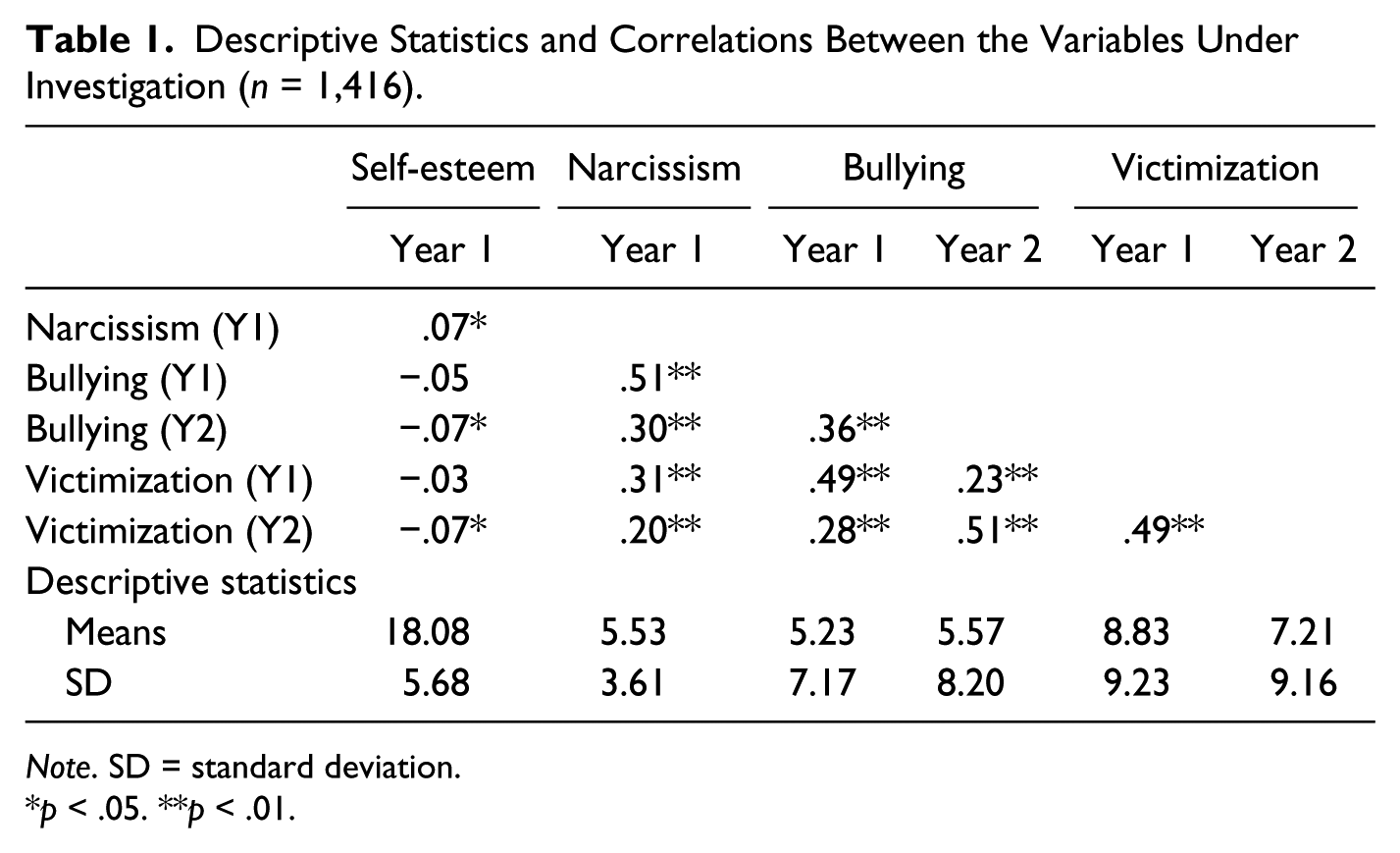
Table 1 reports the descriptive statistics of the study’s variables measured at Year 1 and Year 2. According to paired-sample t tests, there was a significant mean-level decrease in peer victimization from Year 1 to Year 2, t(1415) = 5.81, p < .001. There were no mean-level differences in bullying from Year 1 to Year 2, t(1415) = 1.80, p = .07. Table 1 also reports the correlations among the variables under investigation. As shown in Table 1, there was a statistically significant, but small, correlation between self-esteem and narcissism. Narcissism in Year 1 was related positively to bullying and victimization at both time points, whereas self-esteem in Year 1 was negatively and weakly related to Year 2 bullying and peer victimization. Bullying and peer victimization were positively intercorrelated across both time points.
Descriptive Statistics and Correlations Between the Variables Under Investigation (n = 1,416).
Note. SD = standard deviation.
p < .05. **p < .01.
Effects of Self-Esteem, Narcissism, and Their Interaction on Bullying and Victimization One Year Later 1
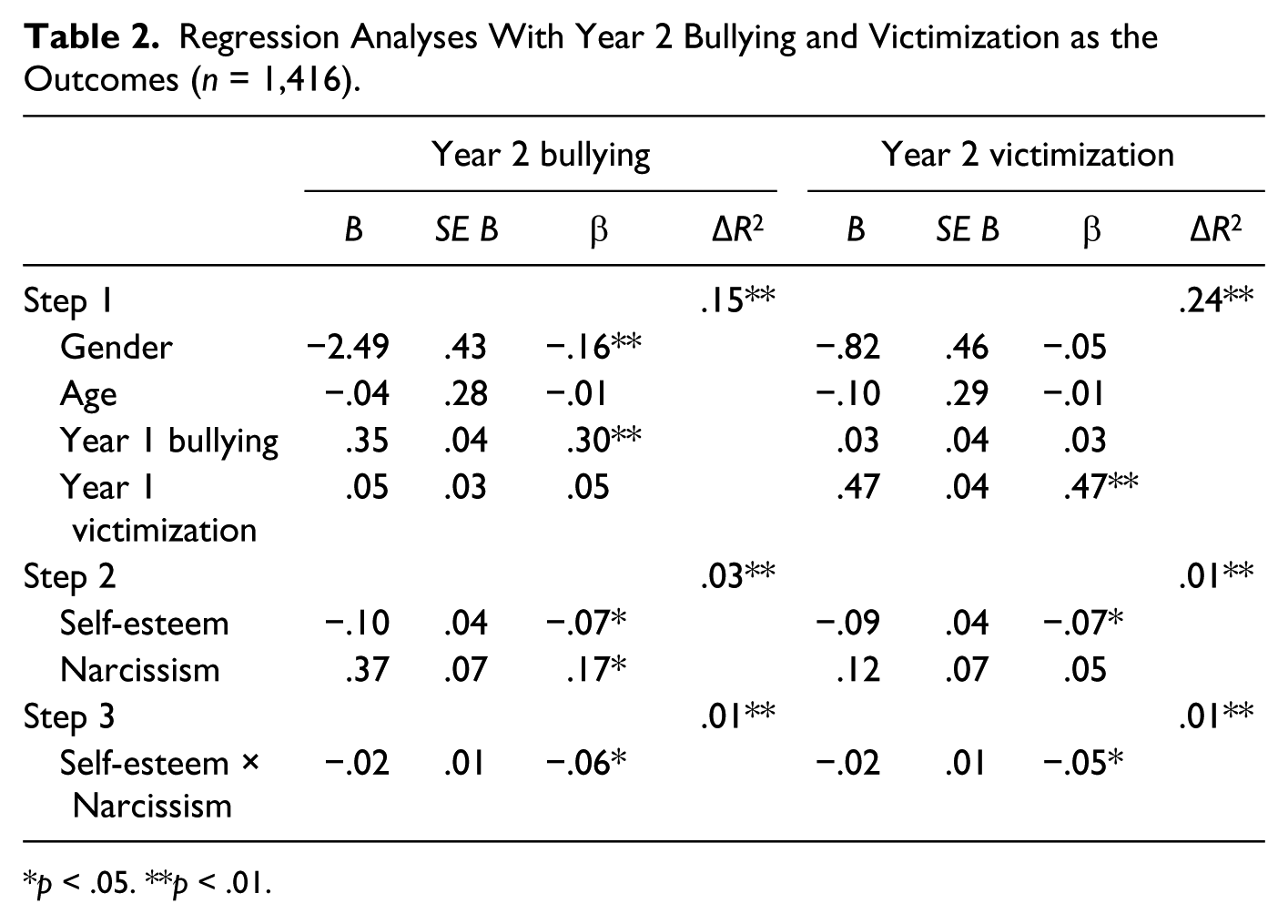
Hierarchical linear regression analyses were used to investigate the unique and interactive effects of Year 1 self-esteem and narcissism on Year 2 bullying and peer victimization. In all the analyses, gender, age, and Year 1 bullying and peer victimization were included in Step 1 of the regression. Gender was coded with 0 for boys and 1 for girls. Self-esteem and narcissism were included in the second step of the regression equation. All continuous variables were mean centered. Step 3 included the 2-way interaction product term between self-esteem and narcissism. To probe the interaction effects we used the procedures described by Aiken and West (1991).
Bullying
Table 2 shows the results of the hierarchical linear regression analysis with Year 2 bullying as the dependent variable. Gender was significantly associated with bullying, suggesting that boys exhibited higher levels of bullying behavior. Bullying—but not victimization—at Year 1 was associated with bullying behavior 1 year later. Step 2 suggested that self-esteem was negatively and narcissism was positively associated with Year 2 bullying behavior, above and beyond the demographic variables and Year 1 bullying and victimization. In addition, the Self-Esteem × Narcissism interaction predicting Year 2 bullying was significant (Figure 1). It shows that self-esteem was not significantly associated with Year 2 bullying for early adolescents with low levels of narcissism, β = −.02, p = .56, and was negatively associated with Year 2 bullying for early adolescents with high levels of narcissism, β = −.13, p < .001.
Regression Analyses With Year 2 Bullying and Victimization as the Outcomes (n = 1,416).
p < .05. **p < .01.
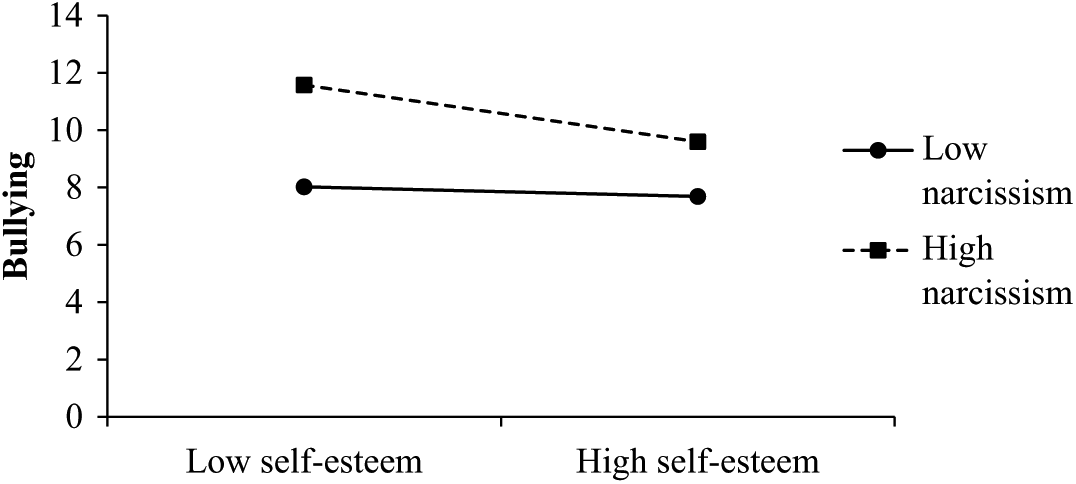
The interaction between Year 1 self-esteem and narcissism predicting Year 2 bullying.
Peer victimization
Table 2 also shows the results of the hierarchical linear regression analysis predicting Year 2 peer victimization. None of the demographic variables was significantly associated with Year 2 peer victimization. Peer victimization—but not bullying—assessed at Year 1 predicted peer victimization 1 year later. Self-esteem was negatively associated with Year 2 peer victimization. There was no significant unique effect of narcissism. According to Step 3, there was a significant interaction between self-esteem and narcissism predicting Year 2 peer victimization. As shown in Figure 2, self-esteem was not significantly associated with Year 2 peer victimization for early adolescents with low levels of narcissism, β = −.02, p = .49, but was negatively associated with Year 2 victimization for youth with high levels of narcissism, β = −.11, p < .01.
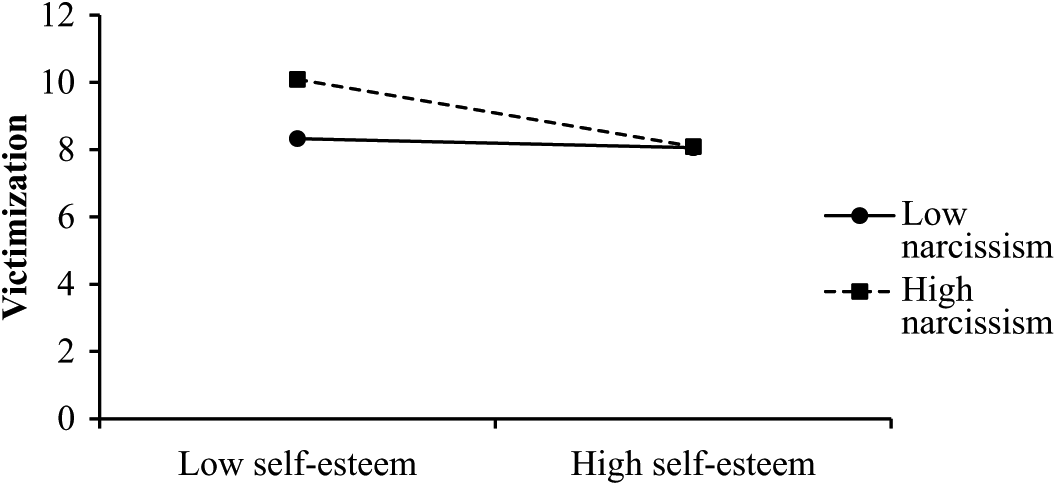
The interaction between Year 1 self-esteem and narcissism predicting Year 2 victimization.
Effects of Self-Esteem, Narcissism, and Their Interaction on the Likelihood of Being Classified as a Bully, Victim, or Bully-Victim One Year Later
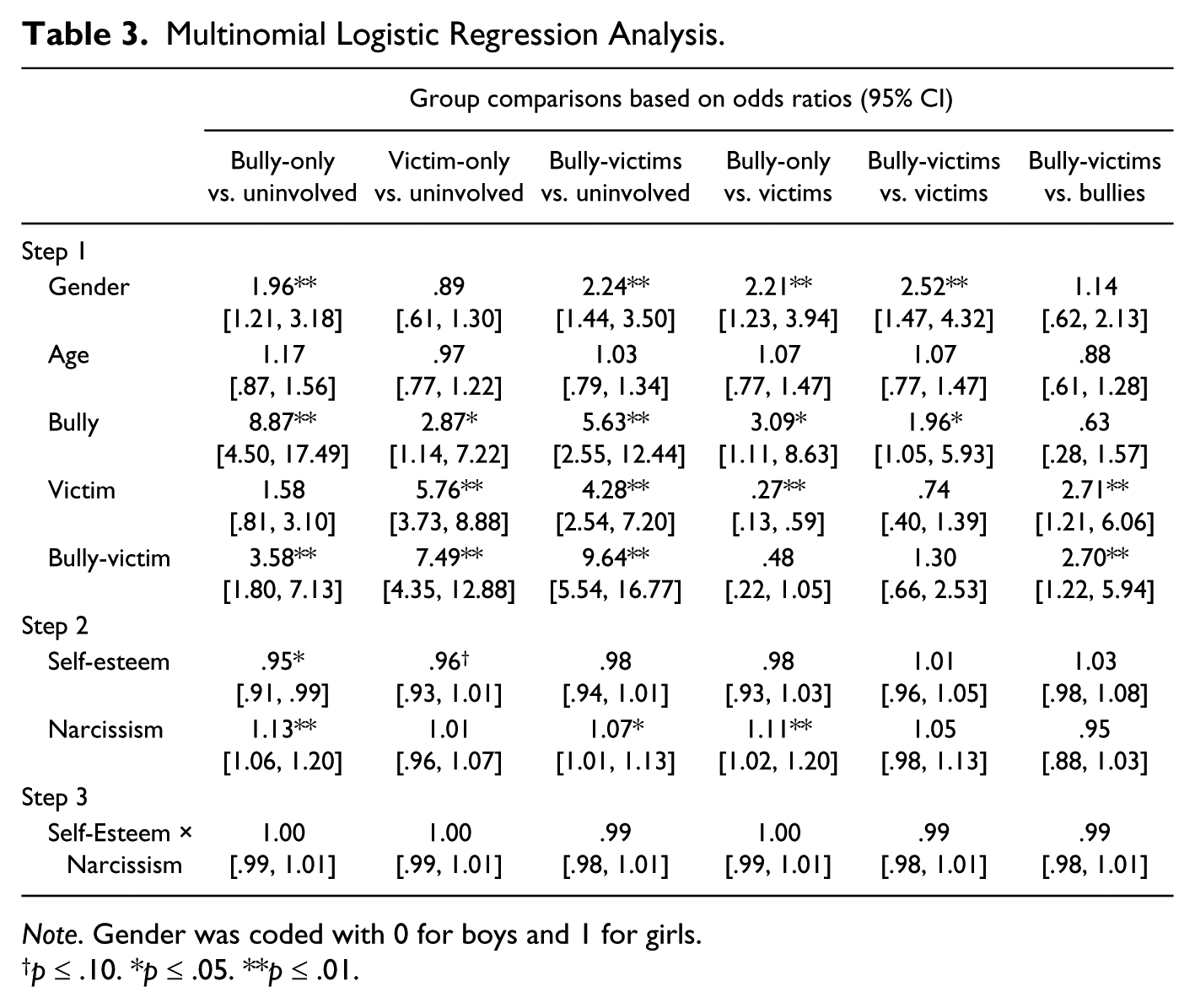
Hierarchical multinomial logistic regression analyses were used to investigate the unique effects of Year 1 self-esteem, narcissism, and the interaction between self-esteem and narcissism on the likelihood of being classified as a bully, victim, or bully-victim in Year 2. The first step included Year 1 demographic variables as well as dummy-coded variables representing classification as a bully, victim, or bully-victim, as compared with uninvolved at Year 1. The second step of the logistic regression included the main effects of Year 1 self-esteem and narcissism. The third step of the logistic regression included the interaction between self-esteem and narcissism. Results are shown in Table 3. Odds ratios are incorporated to compare the different groups. In general, odds ratios reflect the odds likelihood of being in one group over the other, on the basis of the level of the independent variable.
Multinomial Logistic Regression Analysis.
Note. Gender was coded with 0 for boys and 1 for girls.
p ≤ .10. *p ≤ .05. **p ≤ .01.
The first step of variables had a significant impact on model fit, χ2(15, N = 1416) = 212.41, p < .001. Boys had a greater likelihood of being in the bully-victim and bullying only groups compared with the uninvolved and victim-only groups. Early adolescents who were classified as bullies or bully-victims at Year 1 were more likely to be classified in the bully-only, victim-only, and bully-victim groups at Year 2 compared with the uninvolved group, and early adolescents classified as bullies were more likely to be in the bully-only and bully-victim groups compared to the victim-only group. Early adolescents classified as bully-victims were more likely to be classified in the bully-victim group than the bully-only group. Early adolescents classified as victims at Year 1 were more likely to be classified in the victim-only and bully-victim groups at Year 2 compared with the uninvolved and bully-only groups.
The inclusion of the main effects of self-esteem and narcissism in the second step of the multinomial logistic regression improved model fit, χ2(6, N = 1416) = 24.25, p < .001. Early adolescents with lower self-esteem were more likely to be classified in the bully-only group compared with the uninvolved group, and youth with higher narcissism scores were more likely to be classified in the bully-only and bully-victim groups compared with the uninvolved group. Early adolescents with higher narcissism were also more likely to be classified in the bully-only group compared with the victim-only group. Levels of self-esteem and narcissism at Year 1 did not differentiate the odds of being a bully versus a bully-victim at Year 2. The addition of the interaction between self-esteem and narcissism in Step 3 did not have an impact on model fit, χ2(3, N = 1416) = 2.33, p = .51.
Discussion
The current study contributes several novel findings to the literature on the development of bullying and peer victimization during early adolescence. Our findings provided some evidence that narcissism is associated with bullying but not peer victimization. The findings also indicated a small association between self-esteem and narcissism, which is in agreement with prior work that distinguishes the two personality factors (Barry, Grafeman, et al., 2007; Bushman & Baumeister, 1998). Whereas findings from the first set of regression analyses suggested that the interaction between self-esteem and narcissism was associated with both bullying and victimization one year later, supplementary analyses classifying early adolescents into groups based on their involvement in bullying revealed that low scores on self-esteem and high scores on narcissism mainly characterized the bully-only group. Bully-victims were only differentiated from the uninvolved group on narcissism scores, and the victim-only group was only differentiated from the uninvolved group on self-esteem, although this effect only approached significance. Narcissism was the only variable that differentiated “pure bullies” from “pure victims.” These findings are discussed below within the context of the broader literature.
The hypothesis that narcissism moderated the effect of self-esteem on reports of bullying behavior was supported by the first set of regressions predicting bullying behaviors. Low self-esteem was associated with increased bullying over time for youth high in narcissism. In this way, the combination of a low or a fragile self-concept, indicative of low self-esteem, with a grandiose self-view or the need to be viewed in a grandiose manner by others, indicative of high narcissism, may contribute to the continuation or worsening of bullying. Thus, current findings can be used to explain the inconsistency reported in the literature in terms of the association between self-esteem and bullying behavior, in that low self-esteem is more strongly associated with bullying for narcissistic youth. We also found that narcissism moderated the effect of self-esteem on victimization, such that low self-esteem more strongly predicted increased victimization over time for youth high in narcissism. Thus, it is possible that highly narcissistic youth with low self-esteem may engage in bullying as a self-enhancing, attention-seeking behavior to increase social status and protect their vulnerable self-image. However, the interactive effect on victimization indicates that such a strategy of self-enhancement might backfire, resulting in decreased social standing, placing highly narcissistic youth with low self-esteem at increased risk of peer victimization over time. An alternative possibility is that these youth are more likely to view themselves as victims (McCullough et al., 2003).
The person-centered analysis also provided evidence that early adolescents in the bully-only group were characterized by low self-esteem and high narcissism. Bullies might have a fragile (low self-esteem) but favorable (high narcissism) self-view, which has been associated with more severe antisocial behavior (Fanti, 2013). Bullies tend to use aggression strategically to achieve a desired goal or to solve problematic situations (Griffin & Gross, 2004). This level of planning and control that is required for effective delivery is consistent with prior findings of high levels of proactive (i.e., planned, instrumental) aggression among youth high on narcissism (Fossati et al., 2010; Washburn et al., 2004). The imbalance of power that characterizes acts of bullying may motivate early adolescents high on narcissistic traits to commit such acts because of their grandiose narcissistic self-views and exaggerated concerns over their social status (Salmivalli, 2001). Among youth low on self-esteem and high on narcissism, strong feelings of entitlement combined with the willingness to exploit weaker children, who are less likely to retaliate, for their own personal gain may drive the persistence of these behaviors across development. Importantly, narcissism, but not self-esteem, differentiated “pure bullies” from “pure victims,” providing evidence that narcissism is a unique personality characteristic associated with bullying behavior. This finding can provide important information for the development of future interventions aiming to reduce bullying behavior.
Narcissism, but not self-esteem, also differentiated bully-victims from uninvolved youth. Thus, narcissism was associated with the co-occurrence between bullying and victimization over the year, regardless of levels of self-esteem. This finding points to the robustness of narcissism as a risk factor for bullying behavior, with or without co-occurring victimization. Furthermore, this finding contradicts prior work that bully-victims are at high risk for low self-esteem (e.g., O’Moore & Kirkham, 2001), and suggest that the reactive aggressive tendencies characterizing bully-victims might be due to their narcissistic self-views. As suggested by prior research, youth who are high on narcissism might be more likely to act aggressively toward their peers to defend their highly view of themselves (C. T. Barry et al., 2003; Thomaes et al., 2009). This finding follows the threatened egotism model, which states that someone with a highly favorable view of self is more likely to act aggressively against someone who seeks to dispute or question that view (Baumeister et al., 1996; Bushman & Baumeister, 1998). Our findings might suggest that when the ego of a bully-victim with high narcissism is threatened, he or she is more likely to act aggressively toward peers to perpetuate their views of self as superior to others or to defend these inflated self-views from real or perceived ego threats (Barry, Thompson, et al., 2007; Washburn et al., 2004). Additional studies investigating the association of narcissism with bully-victim status are needed to understand this higher risk group of youth.
This study’s longitudinal findings also shed some light on how bullying and victimization change over time in early adolescence, at least over a 1-year interval. In our sample, victimization decreased during the 1-year period under study. Prior work by Pellegrini and Bartini (2000) and Georgiou and Fanti (2010) also found that victimization declined across time, suggesting that adolescence is associated with lower victimization rates. Findings also suggested that children who are pure bullies or bully-victims are more likely to continue exhibiting bullying behavior or to be victims of bullying behavior or both across time than uninvolved children. The actions of narcissistic youth with low self-esteem, characterizing bullies, may harm their social standing in the school (Coie, Dodge, & Kupersmidt, 1990), and place them at risk for being subsequent targets of victimization. However, pure victims were only at higher risk to continue being victims or bully-victims at Time 2, indicating that pure victims might engage in bullying behavior only as a response of being victimized. This finding also provides some evidence that pure victims do not necessarily remain passive victims across time. In terms of demographic differences, boys were more likely to bully, as bullies or bully-victims, but they were at the same risk as girls to be victimized. These findings are in line with prior findings that boys are more likely to engage in bullying behaviors (e.g., Fanti et al., 2009; Seals & Young, 2003). Finally, our findings replicate those of previous studies showing that a higher percentage of youth tend to be identified as victims than bullies or bully-victims (e.g., Fanti et al., 2009; Kristensen & Smith, 2003), and that a higher percentage of youth are identified as bully-victims than bullies (Andreou, 2000).
Strengths, Limitations, and Future Directions
The large sample of early adolescents, which allowed for testing and interpreting interactions, and the short-term longitudinal design were strengths of this investigation. However, the 1-year follow-up time might be considered to be a limitation, as additional time points of measurement would have allowed the investigation of trajectories of change over time in bullying and victimization (Singer & Willett, 2003). Moreover, the data were based on adolescent self-report for all variables, and the correlations could have been inflated due to shared method variance, or possibly the underreporting of undesirable bullying behaviors or victimization experiences (Pakaslahti & Keltikangas-Jarvinen, 2000). In addition, narcissistic youth may be more likely to perceive themselves as being victimized, compared with what their peers observe. Nevertheless, self-report instruments administered to adolescents have the advantage that the individual’s attitudes and emotions may not be apparent to other people (Essau, Sasagawa, & Frick, 2006). In addition, the validity of self-report measures on psychopathology and personality increases in adolescence, whereas the validity of parent and teacher report measures decreases during adolescence (Kamphaus & Frick, 1996). Future work should consider collecting data from multiple reporters. For example, Salmivalli et al. (1999) provided evidence that the inclusion of self- and peer-reports of self-esteem might provide important evidence to distinguish between bullying and victimization.
In the present study, we used an overall measure of narcissism; however, future studies should consider different dimensions of narcissism in association with self-esteem, and how these constructs relate to both bullying and victimization. For example, Barry, Grafeman, et al. (2007) distinguished between adaptive (leadership, authority, self-sufficiency) and maladaptive (entitlement, exploitativeness, exhibitionism) narcissism, and provided evidence that adaptive narcissism was more closely related to self-esteem and that maladaptive narcissism was a better predictor of aggressive and externalizing problems. Furthermore, individuals characterized by maladaptive narcissism may be more concerned of their social status than individuals characterized by adaptive narcissism, which might lead to aggressive behavior (Barry, Grafeman, et al., 2007; Raskin et al., 1991). In addition, research is needed to explore the dynamics of bullying behavior in early adolescents with narcissistic traits with or without low self-esteem to determine whether such acts are more likely to result from direct or displaced responses to ego-threats or unprovoked acts to achieve domination and maintain a sense of superiority (Fossati et al., 2010; Washburn et al., 2004). Longer term longitudinal research is needed to tease apart the extent to which personality factors may play different roles in the onset versus the subsequent change over time in bullying and other aggressive and antisocial behaviors in childhood and adolescence. The associations investigated in the current study might be unique to the early adolescence age period, and future research should investigate the interactive effects of self-esteem and narcissism in younger children and older adolescents.
In conclusion, our findings point to the potential importance of investigating the interaction between self-esteem and narcissism to better understand the role of personality factors in the development of bullying and victimization. Person-centered analyses clarified narcissism predicted membership into “bully” and “bully-victim” groups, although “bullies” were distinguished by low self-esteem when compared with uninvolved children. The predictive utility of the construct of narcissism to different types of aggressive behavior has not been studied extensively in youth (Edens, Skeem, Cruise, & Cauffman, 2001). For example, there are only a few studies investigating how narcissism is related to bullying behavior, and the current study’s results support the need for further research in this area. Linking narcissistic traits to bullying and victimization can provide opportunities for antibullying interventions hone their focus on the role of personality risk factors so that efforts can aim to simultaneously enhance self-worth and discourage grandiosity. For example, simultaneously focusing on fostering healthy or adaptive self-views and teaching youth alternative ways to deal with ego threats or concerns over their social status may increase the effectiveness of interventions to help children cope with bullying and to reduce bullying (Sijtsema et al., 2009). Schools might provide different ways for students to fulfill their status goals, such as engaging in their choice of a variety of extracurricular activities (e.g., sports, arts, and other structured activities), which can build status for victims, and also redirect bullies away from bullying behaviors. Because bullying is a social phenomenon, uninvolved children or bystanders should be encouraged not to reinforce or attribute status goals in this type of behavior, which is at the expense of one or more of their peers.
Footnotes
Declaration of Conflicting Interests
The author(s) declared no potential conflicts of interest with respect to the research, authorship, and/or publication of this article.
Funding
The author(s) disclosed receipt of the following financial support for the research, authorship, and/or publication of this article: This research was funded by the European Community’s Seventh Framework Programme (FP7-PEOPLE-2007-4-3-IRG) under grant agreement 224903.