




Abstract
In the present study, we sought to examine the relationship between perceived economic stress and adolescents’ bullying victimization and extended previous literature by examining the mediating effect of self-esteem as well as the moderating effects of student-student relationships and gender in this association. The research hypotheses were tested among 2407 adolescents from China (M age = 12.75 years, SD = 0.58) with a moderated mediation model. Results indicated that adolescents with high perceived economic stress were more likely to be bullied. Self-esteem mediated the relationship between perceived economic stress and bullying victimization. Furthermore, student-student relationships moderated the relationship between perceived economic stress and bullying victimization and the relationship between perceived economic stress and self-esteem. Gender did not moderate the direct and indirect relationships between perceived economic stress and bullying victimization. These findings have potential applications for reducing the risk of bullying victimization and promoting positive development for adolescents.
Introduction
Bullying victimization at school is a significant health and educational issue. It refers to the frequent exposure to direct physical and verbal aggression, as well as indirect relational aggression involving power imbalance between aggressors and victims (Olweus, 1999). Estimates of the prevalence of bullying victimization among adolescents range from 15% to 30% (Maynard et al., 2016). It has aroused a considerable amount of attention from researchers. Victimized adolescents are more likely to experience psychological distress, adjustment problems, physical symptoms, poor academic performance, and even suicide (Herge et al., 2016; Juvonen et al., 2011; Kim, 2005; Loukas et al., 2012; Ma et al., 2018). Moreover, the detrimental effects can last a lifetime (Vaillancourt et al., 2013). Given the extensive negative consequences, it is of theoretical and practical importance to uncover the potential antecedents of bullying victimization.
It is important to note, however, that prior studies have primarily focused on the relationship between objective economic conditions (e.g., family income) and bullying victimization (Due et al., 2009; Jansen et al., 2011), and the potential relationship between subjective economic conditions and bullying victimization has received scant attention. Conger and colleagues (1992) first conceptualized the term, economic hardship, as a negative family economic situation based on low income, unstable employment, high debt-to-asset ratio, and loss of income. One result of economic hardship is economic pressure. However, economic hardship is not equally stressful for all individuals (Armstrong & Schulman, 2010). That is, the subjective assessment or perception is a construct distinct from the experience of economic hardship and may exacerbate or mitigate the experience of stress (Hayes et al., 2016). It has been proposed that the subjective experience of economic hardship (e.g., perceived economic stress) has a greater impact on adolescent outcomes than the objective experience of economic hardship (Conger & Donnellan, 2007; McLoyd et al., 1994). Economic hardship has been documented as one important factor that significantly increases the risk of bullying victimization (Hu et al., 2018). It is less clear, however, whether perceived economic stress potentially increases adolescents’ bullying victimization. Thus, the current study was to explore whether perceived economic stress would be significantly associated with adolescents’ bullying victimization and extend previous studies by exploring the mediating effect of self-esteem as well as the moderating effects of student-student relationships and gender in this association.
Perceived Economic Stress and Adolescents’ Bullying Victimization
Perceived economic stress refers to a subjective evaluation of the families’ economic environment and experience of material deprivation (Conger et al., 2002; Fang, 2020). The measure of material deprivation encompasses adolescents’ ratings of circumstances in which the family and adolescents’ basic needs are not met (Fang, 2020). Material strain creates a high level of cognitive load and detracts from decision making (Mani et al., 2013). Theorists and prior empirical research have long argued family economic circumstances are associated with negative adolescent development such as bullying victimization (Hu et al., 2018; Napoletano et al., 2016). The stress and coping model may serve as a theoretical foundation for understanding these effects. The model emphasizes cognitive appraisals, which center on the evaluation of harm, threats and challenges, as well as on the options to cope with such threats (Lazarus & Folkman, 1984). Stress may arise when one evaluates that available resources are not adequate to meet the demand and stress would intensify if the discrepancy were expected to continue (Shek, 2003). Under chronic family economic stresses, adolescents are more likely to experience diminished psychological resources, an increased sense of continuing entrapment (a psychological process in which the individual subjectively perceives his or her environment as uncontrollable and inescapable) (Gilbert et al., 2004), and negative emotions such as fear, hopelessness, and frustration (Lee et al., 2013). These negative emotions lead to them being rejected or not having effective strategies to cope with bullying. In line with this theory, a study indicates that relative deprivation uniquely contributes to the risk of bullying involvement (Napoletano et al., 2016). Therefore, it is reasonable to deduce that perceived economic stress would be positively related to adolescents’ bullying victimization.
Previous studies have provided evidence of the relationship between economic hardship (e.g., low family income) and adolescents’ bullying victimization (Hu et al., 2018). Compared with actual income, material deprivation has a more significant impact on children’s social and emotional development (Gershoff et al., 2007). Individuals who perceive material deprivation often fell that they cannot pay their bills or are unable to purchase material necessities (Fang, 2020). It is important to note that the concept of material deprivation is essentially a relative phenomenon. Income might be above the poverty line or overall living standards might improve, but people might still be found to be deprived in relation to the expectations and conventions of the day (Acar et al., 2017). Likewise, subjective evaluation of economic difficulties is a stronger predictor of adolescent maladjustment than the objective experience of economic hardship (Conger & Donnellan, 2007; McLoyd et al., 1994).
To our knowledge, however, no previous studies have examined whether perceived economic stress is positively associated with adolescents’ bullying victimization. Based on the literature discussed above, we put forward the following hypothesis:
Perceived economic stress would be positively associated with adolescents’ bullying victimization.
The Mediating Role of Self-Esteem
Self-esteem is defined as an individual’s subjective evaluation of self-worth as a person (Leary et al., 1995). It plays an important role in adolescents’ development and also reflects adolescents’ success in adapting to the world (Rosenberg, 1979). The risk and resilience model states that the ecology of risk exposure may hinder adolescents’ self-system processes (e.g., self-esteem), by compromising their accomplishment of developmental competence and threatening their satisfaction of basic needs, and consequently lead to maladjustment (Xiong et al., 2021). These self-system processes are influenced by earlier experiences of adversity or stress and, in turn, influence the assessment of and response to threats in future adversity (Sandler, 2001). Drawing from this model, we proposed self-esteem as a potential mediator of the association between perceived economic stress and adolescents’ bullying victimization. Specifically, perceived economic stress may damage adolescents’ self-esteem, which in turn, increases their likelihood of suffering from bullying victimization. Based on the previous literature, we expected that self-esteem would mediate this relationship between perceived economic stress and adolescents’ bullying victimization. In the following section, two reasons underlie our argument for self-esteem as a mediator.
First, the family economic environment is an important family contextual factor relating to self-esteem (Twenge & Campbell, 2002). Most prior studies have focused only on the relationship between objective economic circumstances and self-esteem (Jiang, 2020). However, subjective economic circumstances are more closely related to self-esteem than objective economic circumstances (Kim, 2021). One meta-analysis indicates that although objective socioeconomic status (SES) is related to self-esteem, this correlation is very weak in adolescents (Twenge & Campbell, 2002). These studies prompt us to examine the role of perceived economic stress, which is the economic dimension of subjective SES, rather than objective economic conditions. In fact, it is not the possession of wealth that strongly affects adolescents’ self-esteem, but rather the interaction of the wealth they have with their attitudes toward money (Zeng et al., 2017). As French and Kahn (1962) argued, adolescents differ in what they consider important to their self-esteem: dimensions of the self may differ in their psychological “centrality.” In terms of family’s economic environment, adolescents may differ in the importance they place on wealth in their overall equation for self-esteem (Twenge & Campbell, 2002). That is, self-esteem levels are influenced by their subjective perceptions of how much money they possess. Thus, adolescents’ perceived economic stress (i.e., their subjective evaluations of the family’s economic environment) may be significantly related to self-esteem.
Second, adolescents with low self-esteem are more prone to be bullied. There is a considerable body of research to suggest that self-esteem is connected to bullying victimization (Boulton et al., 2010; Neary & Joseph, 1994). Furthermore, the stability of this negative relationship is strongly supported by the results from longitudinal studies. The initial levels of self-esteem can significantly predict adolescents’ bullying victimization (Guerra et al., 2011; Salmivalli & Isaacs, 2005). For example, self-esteem significantly predicts bullying victimization 12 months later (Salmivalli & Isaacs, 2005). Recently, a meta-analysis indicates that there is a significant bidirectional relationship between self-esteem and bullying victimization (van Geel et al., 2018). In other words, bullying victimization and low self-esteem operate as mutually reinforcing systems. There seems to be a causal cycle where low self-esteem may lead to an increased risk of bullying victimization, which in turn may decrease the self-esteem of adolescents. Based on the theoretical and empirical grounds, we proposed the following hypotheses:
Adolescents’ self-esteem would mediate the association between perceived economic stress and adolescents’ bullying victimization.
The Moderating Role of Student-student Relationships
Although perceived economic stress may lead to adolescents’ bullying victimization via self-esteem, not all adolescents with perceived economic stress homogeneously experience bullying victimization. Therefore, it is necessary to explore potential moderators in this relationship. The most direct influences on adolescents’ bullying, according to Hong and Espelage (2012), are within the micro-system, which is composed of individuals or groups within immediate settings (e.g., home, school) with whom adolescents have interactions. Moreover, adolescents are in the stage of detaching themselves from their parents and attaching themselves to peers to form an identity. Student-student relationships may provide important support that is not available within the family, which is important for the psychological and behavioral development of adolescents (Beckmann, 2020). Thus, this study suggested that student-student relationships would moderate the relationship between perceived economic stress and adolescents’ bullying victimization as well as perceived economic stress and self-esteem.
Student-student relationships refer to the degree of warmth, caring, supportive and respectful patterns of interaction and relationship-building among students at the class level (Thornberg et al., 2018). These relationships contribute to creating a positive relational climate that, in turn, affects adolescents’ beliefs, attitudes, and behaviors (Wang et al., 2019). More importantly, student-student relationships are one of the factors in schools most likely to influence social development and adjustment of adolescents (Eliot et al., 2010). According to the social support buffering hypothesis (Cohen & Wills, 1985), student-student relationships, as a source of social support (Malecki & Demaray, 2003), can buffer adolescents from the influence of stressful events and the impact of some risk factors. Specifically, positive student-student relationships serve as effective buffers against peer victimization and reduce the negative impact of risk factors on adolescents’ bullying victimization (Marchante et al., 2022). Negative student-student relationships may exacerbate the risk of bullying victimization among adolescents (Stefanek et al., 2011). Previous studies suggest that victims report poor student-student relationships, characterized by low peer acceptance, support, and reciprocity (Perren & Alsaker, 2006). Thus, it is theoretically possible that student-student relationships, as an important part of the school context, would moderate the relationship between perceived economic stress and adolescent’ bullying victimization. Some empirical studies roughly supported this expectation. For instance, friendship moderates the relationship between early harsh home environments (e.g., day-to-day family stress) and later peer victimization (Schwartz et al., 2000). In other words, peer relationships are beneficial in helping adolescents compensate for the vulnerability gained from stressful experiences in the family (Bolger et al., 1998). In addition, one previous study indicates that student-student relationships are a significant predictor of change in perceived friendship quality over time (Way & Greene, 2006). Specifically, when student-student relationships are characterized by caring, supportive, fair, and respectful interaction patterns, it will contribute to adolescents’ ability to find and maintain supportive friendships. Thus, it is theoretically logical to assume that student-student relationships would moderate the relationship between perceived economic stress and bullying victimization as well as the relationship between perceived economic stress and self-esteem. Based on the literature discussed above, the following hypothesis was established:
Student-student relationships would moderate the relationship between perceived economic stress and bullying victimization and the relationship between perceived economic stress and self-esteem.
Gender as a Potential Moderator
The last aim of the current study was to examine whether the relationship between perceived economic stress and adolescents’ bullying victimization differed across boys and girls. One previous study found a greater prevalence in boys (Peng et al., 2020), while other study found that bullying victimization was more prevalent among girls (Veenstra et al., 2005). Meanwhile, some evidence also suggested there was no gender difference in bullying victimization (Lahav-Kadmiel & Brunstein-Klomek, 2018). Moreover, in Elder and Caspi’s (1988) seminal work on the adaptation of children and families to economic hardship during and after the Great Depression, it was found that girls were more likely than boys to be negatively affected by economic stress during adolescence. However, other studies of both early and later adolescence find no adolescent gender differences in response to economic stress (Flanagan & Eccles, 1993). The issue of gender differences in the relationship between perceived economic stress and adolescents’ bullying victimization has not been adequately addressed in the literature. Thus, we examined whether gender would moderate the direct and indirect pathways of perceived economic stress and adolescents’ bullying victimization, but did not propose a specific hypothetical pattern.
The Present Study
To sum up, the purposes of this study were threefold. First, the current study examined whether perceived economic stress would be positively related to adolescents’ bullying victimization. Second, the current study examined whether self-esteem would mediate the relationship between perceived economic stress and bullying victimization. Third, this study examined whether student-student relationships and gender would moderate the direct and indirect relationships between perceived economic stress and adolescents’ bullying victimization via self-esteem (Figure 1). The proposed moderated mediation model.
Method
Participants
Data from 2407 middle school students were used in the current study. The participants were recruited from seven middle schools in Taiyuan and Changzhi, China. A total of 48 classes participated in the study and the class size approximately ranged from 40 to 60. The total sample included 1191 boys, 1202 girls, and 14 participants who did not report gender. The mean age of the participants was 12.75 years (SD = 0.58, range = 11–16 years). For the total sample, 71.8% of the participants came from urban and 28.2% came from rural. Regarding of per capita monthly family income of the participants, 12.2% of participants had a per capita monthly family income of less than 1000 Yuan; 20.8% of participants had a per capita monthly family income of between 1000 and 2000 Yuan; 24.3% of participants had a per capita monthly family income of between 2000 and 3000 Yuan; 42.7% of participants had a per capita monthly family income of more than 3000 Yuan. According to the economic data released by the National Bureau of Statistics of China in 2021, the annual per capita disposable income of the country’s residents was 35,128 Yuan, and the average resident had a monthly disposable income of 2927.3 Yuan. With reference to the educational level of the participants’ parents, 6.7 and 7.2% of their fathers and mothers respectively had completed elementary or lower level; 38.5 and 39.0% of their fathers and mothers respectively had completed junior middle school level; 27.4 and 27.7% of their fathers and mothers respectively had completed senior middle school level; and 27.4 and 26.1% of their fathers and mothers respectively had completed bachelor’s degree or higher level.
We chose this age group because adolescence marks growth in cognitive processing skills, and the ability to integrate one’s own experiences and the experiences of others, which undoubtedly lead to an increased awareness of the social meaning of being socioeconomically disadvantaged among adolescents (McLoyd et al., 2009). This means that individuals’ awareness of their socioeconomic disadvantage is great during adolescence. Moreover, the socioeconomic disadvantage is likely to have a greater impact in adolescence than in earlier developmental periods (Nurmi, 1991). Therefore, when linking material deprivation to adolescents’ psychosocial adaptations, their own economic stresses are more pronounced than childhood (Wadsworth & Compas, 2002).
Measures
Perceived economic stress
We measured adolescents’ perceived economic stress using the four-item Current Economic Stress Scale (Shek, 2003). Examples of items were “In the past 6 months, has your family had inadequate money to cope with the family expenses” and “In the past 6 months, has your family delayed the payment of bills because of financial difficulty”. Adolescents rated it on a four-point scale ranging from 1 (never) to 4 (always), with high scores indicating high levels of perceived economic stress. This scale has been used in Chinese samples with acceptable reliability and validity (Zhao & Liu, 2010). McDonalds’ omega was determined to be 0.68 and Cronbach’s α was 0.64 for the current sample.
Self-esteem
We assessed adolescents’ self-esteem using the Rosenberg Self-esteem Scale (Rosenberg, 1965). This questionnaire consists of 10 items (e.g., “I am able to do things as well as most other people” and “On the whole, I am satisfied with myself”). Ratings ranged from 1 (strongly disagree) to 4 (strongly agree). Higher scores reflected higher levels of self-esteem. This scale has been used in Chinese samples with good reliability and validity (Wang et al., 2017). McDonalds’ omega was determined to be 0.80 and Cronbach’s α was 0.80 for the current sample.
Student-student relationships
We measured the levels of student-student relationships using an 8-item scale that comes from My Class Scale (Jiang, 2020). Each item is rated on a 5-point Likert scale ranging from 1 (completely not true) to 5 (completely true). Examples of items were “If anyone has concerns, other students will care for him or her” and “Students support and encourage each other”. High scores indicated that adolescents perceived positive student-student relationships. This scale has been used in Chinese adolescents (Wang et al., 2019). McDonalds’ omega was determined to be 0.84 and Cronbach’s α was 0.82 for the current sample.
Bullying victimization
We used the victim subscale of the Olweus Bully/Victim Questionnaire (OBVQ-C) to measure the frequency of bullying victimization (Olweus, 1994). Adolescents were asked to indicate how often they were victimized. The victim subscale contained six items and reflected three different types of victimization: physical victimization (e.g., “being hit, kicked, or slapped by others”), verbal victimization (e.g., “being laughed at by others”), and relational victimization (e.g., “being excluded by others”). Adolescents rated the frequency of their victimization at school in the past 6 months using a 5-point Likert scale ranging from “never” to “almost always”. This scale has been widely used in Chinese samples with good reliability and validity (Zhao et al., 2021). McDonalds’ omega was determined to be 0.85 and Cronbach’s α was 0.83 for the current sample.
Procedure
This investigation was approved by the first author’s University Ethics Committee. We obtained assent from all participating students before data collection. Specifically, before the assessment was conducted, we sent each participant an informed consent letter, which briefly described the purpose and the procedures of the study. Furthermore, the letter stated that participation was voluntary and participants’ personal information would be kept confidential. The letter also informed that students were free to withdraw their participation anytime. Under the instruction of researchers, adolescents filled out questionnaires in a quiet classroom. We checked all questionnaires for completeness when participants finished and assured the confidentiality of their responses.
Data Analysis
First, we computed descriptive statistics and calculated bivariate relationships among perceived economic stress, bullying victimization, self-esteem, and student-student relationships. Second, the mediation effect was tested using MacKinnon’s four-step procedure (MacKinnon, 2008). Third, we further explored whether the mediation process was moderated by student-student relationships and gender using Hayes’s PROCESS macro (Hayes et al., 2016).
Results
Descriptive Statistics and Correlations
Descriptive Statistics and Correlations for Variables.

*p < .05; **p < .01; ***p < .001.
Means and Standard Deviations among Variables.
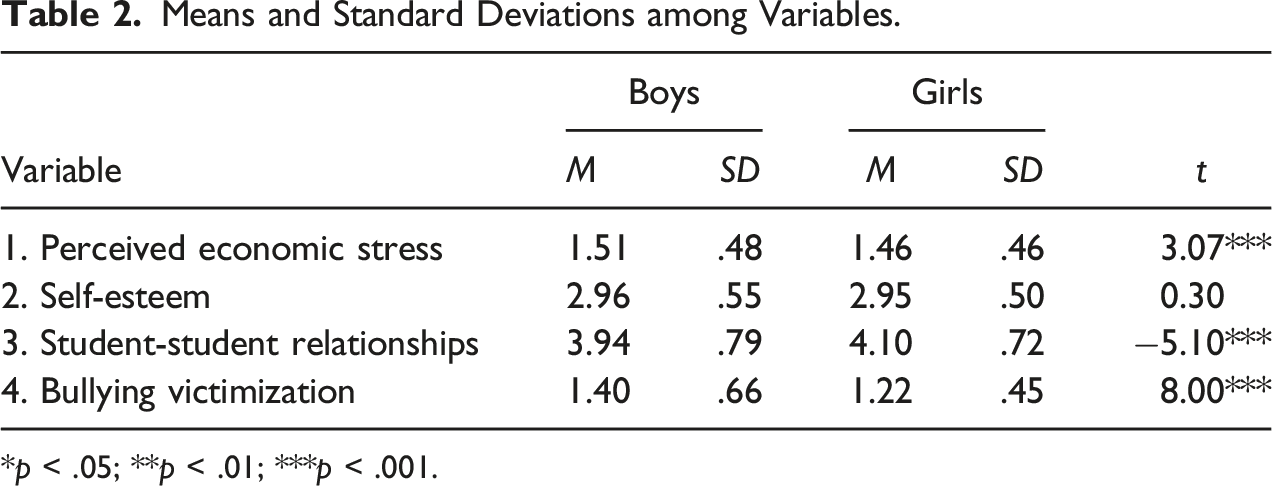
*p < .05; **p < .01; ***p < .001.
Testing for Mediation Effect
In Hypothesis 2, we anticipated that self-esteem would mediate the relationship between perceived economic stress and bullying victimization. To examine this hypothesis, we followed MacKinnon’s four-step procedure to establish the mediation effect (MacKinnon, 2008), which required (a) a significant association between perceived economic stress and bullying victimization; (b) a significant association between perceived economic stress and self-esteem; (c) a significant association between self-esteem and bullying victimization while controlling for perceived economic stress; and (d) a significant coefficient for the indirect path between perceived economic stress and bullying victimization via self-esteem. The bias-corrected percentile bootstrap method determined whether the last condition was satisfied.
Testing the Mediation Effect of Perceived Economic Stress on Bullying Victimization.
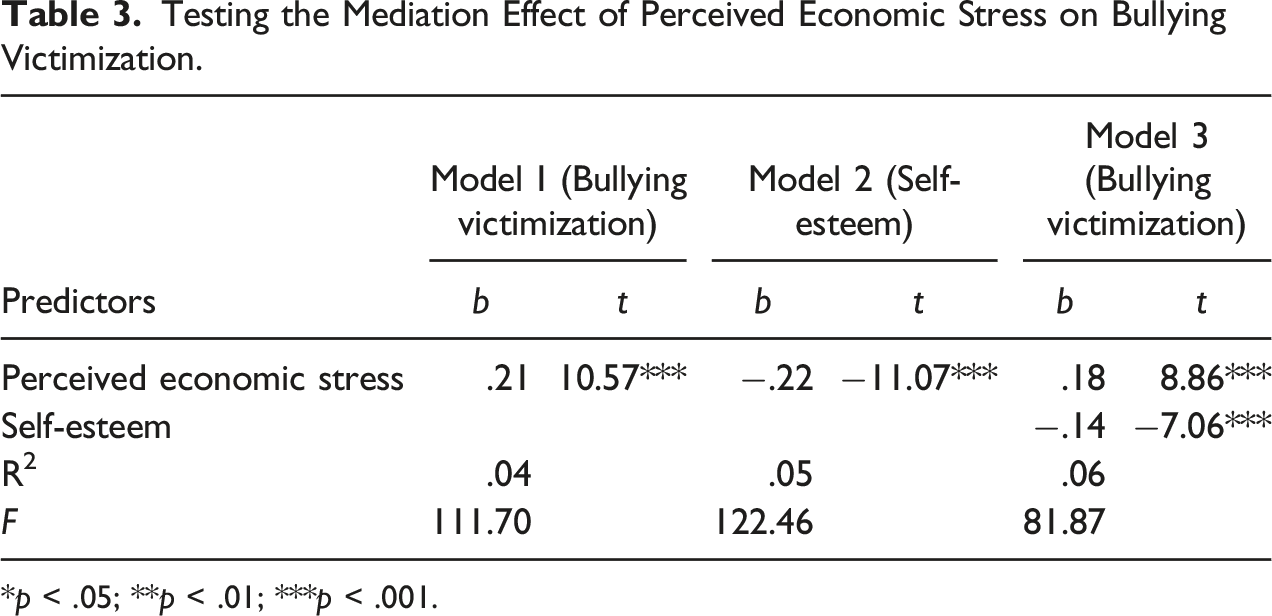
*p < .05; **p < .01; ***p < .001.
Testing for Moderated Mediation
Testing the Moderated Mediation Effect of Perceived Economic Stress on Bullying Victimization.
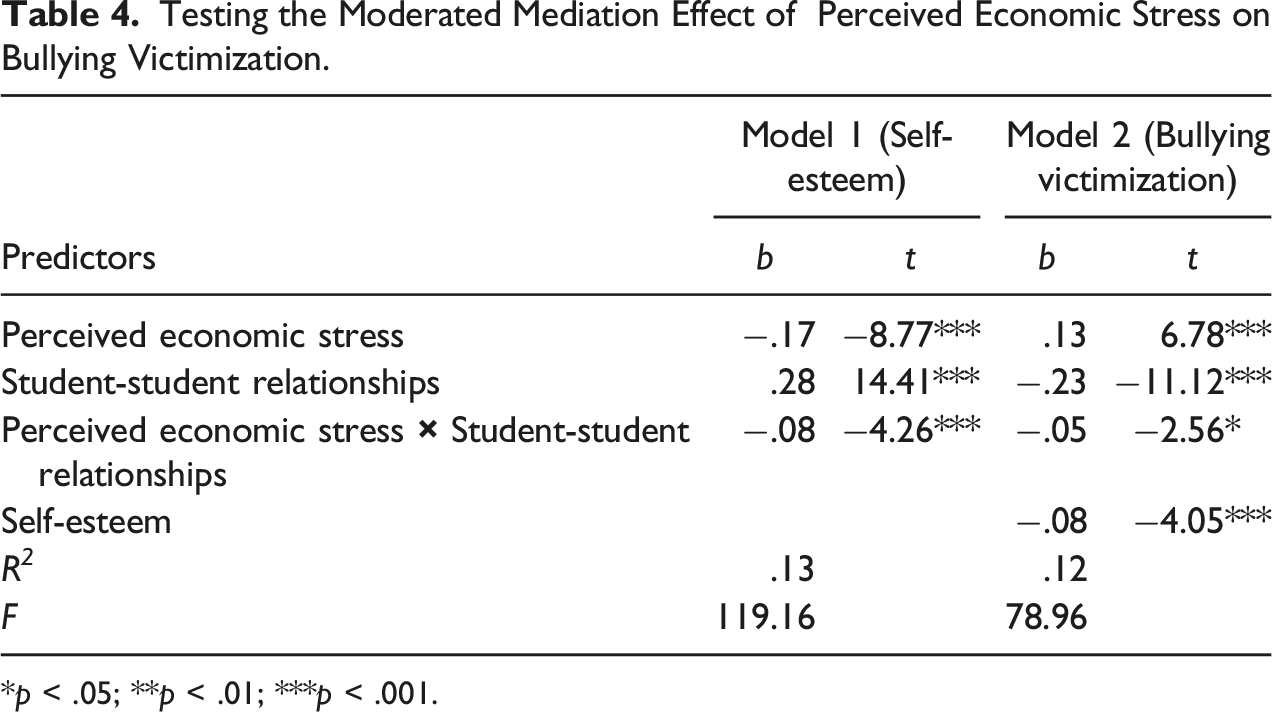
*p < .05; **p < .01; ***p < .001.

The interaction between perceived economic stress and student-student relationships on self-esteem.
The relationship between perceived economic stress and self-esteem was also moderated by student-student relationships. For the descriptive purpose, we plotted predicted self-esteem against perceived economic stress, separately for negative and positive student-student relationships (Figure 3). Simple slope tests showed that for adolescents with positive student-student relationships, perceived economic stress was significantly and negatively associated with self-esteem, b simple = −.25, p < .001. However, for adolescents with negative student-student relationships, this association was still significant but weaker, b simple = −.09, p < .001. Although the effect of student-student relationships is less strong at higher levels of perceived economic stress, it is still important relative to those with negative student-student relationships. In Figure 2, adolescents with negative student-student relationships had lower self-esteem regardless of their level of perceived economic stress than those with positive student-student relationships. Thus, although adolescents with positive student-student relationships did poorer under conditions of high than low perceived economic stress, they still had higher self-esteem than those with negative student-student relationships. The interaction between perceived economic stress and student-student relationships on bullying victimization.
We also used Hayes’s PROCESS macro (Model 59) to explore whether gender would moderate the relationship between perceived economic stress and adolescents’ bullying victimization. Specifically, the relationship between perceived economic stress and adolescents’ bullying victimization was not moderated by gender, b = −.07, p > .05. The relationship between perceived economic stress and self-esteem was not moderated by gender, b = −.02, p > .05. Finally, the relationship between self-esteem and adolescents’ bullying victimization was still not moderated by gender, b = .03, p > .05.
Discussion
Among the many risk factors that affect adolescents’ bullying victimization, family environment as a major factor has long been recognized (Ding et al., 2020). However, most of the existing research on the relationship between family environment and bullying victimization has focused primarily on objective economic conditions (Due et al., 2009; Jansen et al., 2011). Much less is known about whether and how perceived economic stress increased the risk of adolescents’ bullying victimization. More specifically, questions regarding the mediating mechanism (i.e., how perceived economic stress is associated with bullying victimization) and moderating mechanism (i.e., when the protection is most potent) underlying this relationship stay largely unanswered. Thus, we formulated a moderated mediation model to answer these questions. Our results indicated that perceived economic stress was positively associated with adolescents’ bullying victimization, and this adverse effect was explained in part by decreased self-esteem. We also found that student-student relationships moderated the relationship between perceived economic stress and bullying victimization as well as the relationship between perceived economic stress and self-esteem. Gender did not moderate the direct and indirect relationships between perceived economic stress and adolescents’ bullying victimization.
Perceived Economic Stress and Bullying Victimization
Consistent with our hypothesis, we found that perceived economic stress was positively associated with adolescents’ bullying victimization. In other words, perceived economic stress as a risk factor can significantly increase adolescents’ bullying victimization. This finding is consistent with the stress and coping model. The model views the process of cognitive appraisal as an evaluative process that reflects the person’s subjective interpretation of the event (Lazarus & Folkman, 1984). When adolescents’ evaluation of their family’s economic situation as threatening, and limiting opportunities for personal growth and/or as uncontrollable, it may have a negative impact on their adjustment and be detrimental to the development of social skills and the acquisition of strategies to cope with bullying (Pakenham, 2001). In addition, chronic economic stress also disrupts the body’s physiological response, such as allostatic load (Dowd & Goldman, 2006). This dysregulated stress response, in turn, leads to physical health problems. As a result, adolescents who perceive high economic stress are likely to have more difficulty defending themselves against attacks in the face of bullying.
The Mediating Role of Self-Esteem
Self-esteem mediated the association between perceived economic stress and adolescents’ bullying victimization. That is, self-esteem is one of the explanatory factors for why adolescents with high perceived economic stress are more likely to be bullied. In the previous studies regarding adolescents’ bullying victimization, the stress and coping model emphasized the adverse effect of economic stress, whereas the risk and resilience model focused on the effect of self-system processes (e.g., self-esteem). However, these two theories have developed separately without linking the possible association between perceived economic stress and self-esteem. We innovatively integrated studies from both theories to unpack adolescents’ bullying victimization to fill this gap. Specifically, we considered the potential association of perceived economic stress with bullying victimization and examined the mediating effect of self-esteem. Our integrated model shows that adolescents with high perceived economic stress are more likely to impair their self-esteem, which in turn is more prone to be bullied.
In addition to the overall mediation result, each of the independent links in this mediation model is worth discussing. For the first stage of the mediation process (i.e., perceived economic stress → self-esteem), our results support the premise that perceived economic stress can undermine adolescents’ self-esteem. That is, adolescents with higher perceived economic stress are prone to negative self-evaluation, which may reduce their self-esteem. Specifically, perceived economic stress is personal inferior status perceived from social comparison, which may lead adolescents to have negative self-evaluations or low self-esteem (Liu et al., 2017).
For the second stage of our mediation model (i.e., self-esteem → bullying victimization), there was a significant link between self-esteem and bullying victimization. This finding is consistent with the previous studies (Guerra et al., 2011; Salmivalli & Isaacs, 2005). That is, adolescents who have lower levels of self-esteem are more likely to suffer from bullying victimization. One explanation is that high self-esteem protects adolescents from being bullied. Adolescents with high self-esteem can stick up for themselves and stand up to bullies (Guerra et al., 2011). Adolescents with low self-esteem will not defend or fail to defend themselves when victimized, leading to the likelihood of repeated victimization. In addition, according to the decision making-process between the benefits and the costs, bullies tend to choose “low-cost victims” with whom there is little chance of retaliation (Choi & Park, 2018), which may also increase the risk of bullying victimization for adolescents with low self-esteem.
The Moderating Roles of Student-Student Relationships and Gender
Student-student relationships moderated the relationship between perceived economic stress and bullying victimization. This finding can be explained by the social support buffering hypothesis. According to the social support buffering hypothesis (Cohen & Wills, 1985), as the increasing engagement of adolescents to the school and the peer group, the social-relational resources available at school (e.g., student-student relationships) more specifically exert the compensatory potential for the social environment beyond the family sphere (Beckmann, 2020). Specifically, positive student-student relationships create a class climate of care and support for each other, which enhances students’ sense of class membership and reduces peer conflict. The beneficial effects of positive (caring, warm, and supportive) student-student relationships help adolescents compensate for vulnerabilities gained from stressful family experiences (Bolger et al., 1998). Most importantly, positive student-student relationships are likely to alter problematic developmental trajectories (e.g., the pathway between perceived economic stress and bullying victimization) by enhancing the accessibility of knowledge structures and schemata that guide self-regulation and facilitating the development of other core social competencies (Parker & Gottman, 1989). Thus, for adolescents with positive student-student relationships, the relationship between perceived economic stress and bullying victimization becomes much weaker.
Student-student relationships also moderated the relationship between perceived economic stress and self-esteem. Notably, this pattern was the exact opposite of the social support buffering hypothesis. It is called “overwhelming-risk”, meaning that the positive benefits of social support are dampened in stressful contexts (Li et al., 2007). Specifically, the association between student-student relationships and self-esteem was weaker for adolescents with high perceived economic stress compared to those with low perceived economic stress. In other words, the effects of positive student-student relationships become limited as protective agents when they are overwhelmed by perceived economic stress. This may be similar to Belle’s (1982) warning that receiving social support is not simply a positive process and the support provider may also serve as a source of distress. Specifically, according to the upside comparison, when students provide social support for a person, it may also put pressure on the adolescent to perceive him or her as inferior to others, which may to some extent counteract part of the supportive effects of positive student-student relationships.
The pattern of direct or indirect associations between perceived economic stress and adolescents’ bullying victimization did not vary by gender. One possible explanation is family economic pressures have a negative impact on the adjustment of both boys and girls (Conger et al., 1994), which leads to them having diminished resources to cope with bullying (Pakenham, 2001). Therefore, adolescents with high perceived economic stress would be more likely to be bullied regardless of their gender.
Limitations and Practical Implications
Several limitations should be addressed when interpreting the results of the current study. First, this research was cross-sectional in design, so we cannot make any causal inferences about the associations. Longitudinal data are in need to further confirm the causal relationships. Second, the data were collected only through self-report measures, which might affect the validity of the current study due to social desirability and other biases. Future studies can manage to collect data from multiple informants (e.g., peers, parents, and teachers) and would be beneficial in decreasing this limitation. Third, the present study was based on adolescents living in the context of Chinese culture, and the generalizability of the results is limited. Thus, it is worth further exploring whether the results of the current study are suitable for Western culture. In fact, wealth is more an externally imposed judgmental standard than a personal goal in Chinese culture (Zeng et al., 2017). Future studies should include adolescents from different cultural groups.
Despite the limitations mentioned above, the findings of the present study have several practical implications. Understanding the risk and protective factors for adolescents who are bullied is important to develop prevention and intervention plans to reduce bullying victimization. First, we extended previous studies on bullying victimization by confirming that adolescents with high levels of perceived economic stress are more likely to be bullied. The adverse effect of perceived economic stress on bullying victimization deserves greater attention in both research and practice. For instance, the threat perception bias may be the possible origin of adolescents’ bullying victimization, rather than negative life events alone. Second, our study confirms that adolescents’ self-esteem as a “bridge” mediates the relationship between perceived economic stress and bullying victimization. Thus, prevention and intervention programs will be more effective when they take adolescents’ self-esteem into consideration and develop strategies to enhance their self-esteem. For instance, parental warmth and supportiveness could enhance adolescents’ self-esteem (Whitbeck et al., 1991). Finally, our findings support the social support buffering hypothesis that student-student relationships buffer the adverse effect of adolescents’ perceived economic stress. This model can help researchers understand when the adverse effect of perceived economic stress on adolescents’ bullying victimization is likely to be maximized or minimized. Specifically, positive student-student relationships buffer the relationship between perceived economic stress and adolescents’ bullying victimization. Although the beneficial effect of student-student relationships on self-esteem is reduced under elevated levels of perceived economic stress, adolescents with positive student-student relationships have higher self-esteem regardless of their level of perceived economic stress. This means that student-student relationships are a key protective factor that can alleviate the adverse effect of perceived economic stress. Thus, improving student-student relationships is a complementing component of intervention programs that target reducing adolescents’ bullying victimization.
Footnotes
Declaration of Conflicting Interests
The author(s) declared no potential conflicts of interest with respect to the research, authorship, and/or publication of this article.
Funding
The author(s) disclosed receipt of the following financial support for the research, authorship, and/or publication of this article: The present study was supported by Program for the Innovative Talents of Higher Education Institutions of Shanxi (PTIT) and the Ministry of Education of Humanities and Social Science Project of China (20YJC190021).
