



Abstract
Fathers have often been ignored in the parenting literature. The current study focused on male cohabiting partners (MCPs) who can serve as “social stepfathers” and examined the association of coparent support and conflict with their positive parenting behavior (i.e., acceptance, firm control, and monitoring) of adolescents. Participants were 121 low-income urban Black cohabiting stepfamilies (mother, MCP, adolescent). The mother and MCP completed measures on coparenting support and conflict, and the young adolescent completed measures on MCP parenting. Using structural equation modeling (SEM), support, but not conflict, was associated with positive parenting. Support and conflict did not interact to influence parenting. The findings suggest that fathering in these families is contextually sensitive and that support from a mother is central for MCPs to engage in positive parenting of adolescents.
The absence of fathers in parenting research has been an ongoing concern for at least two decades (for reviews, see Doherty, Kouneski, & Erickson, 1998; Fabiano, 2007; Phares & Compas, 1992; Phares, Fields, Kamboukos, & Lopez, 2005; Phares, Lopez, Fields, Kamboukos, & Duhig, 2005). Fortunately, both research on fathers and recognition of the complexity in identifying what constitutes fatherhood have increased in recent years (see Hubin, 2014; Roy, 2014). Nevertheless, fathers have received far less attention than mothers (e.g., Phares, Fields, Kamboukos, & Lopez, 2005). Although fathers often play a less prominent role in parenting than mothers (see Doherty et al., 1998, for a review), they can and do contribute to a child’s development (e.g., Forehand & Nousiainen, 1993; also see Doherty et al., 1998; Lamb, 2000).
When stepfathers are considered, we know even less about their parenting (DeGarmo & Forgatch, 2007). The existing research in this area suggests that these fathers are less involved in parenting than are biological fathers (see DeGarmo & Forgatch, 2007), leading them to be described in terms such as playful spectators and polite strangers (DeGarmo & Forgatch, 2007; Hetherington & Henderson, 1997; Patterson, 1982). Of relevance, DeGarmo and Forgatch suggested that “marital dynamics” (p. 349) are important in stepfather’s parenting. Specifically, the relationship between the mother and stepfather may contribute to his parenting.
A population that has been ignored in the stepfathering literature is Black single-mother headed families. As almost three quarters of Black children are born out of wedlock (Martin et al., 2013), it might be assumed that a father figure is not present in most of these homes. However, this is not necessarily the case as many families, particularly those living in poverty, have a biologically unrelated male living in the home (Dunlap, Golub, & Benoit, 2010; Kreider, 2008; Lichter, Turner, & Sassler, 2010). For example, Bumpass and Lu (2000) reported that 40% of children will spend some time before age 16 in a cohabiting family. Furthermore, the number of cohabiting families is rapidly increasing (see Bianchi, 2014; Dunifon & Kowaleski-Jones, 2002), making the study of the role of these men critical for understanding and enhancing the psychosocial adjustment of children and adolescents living in high-risk environments (Manning & Lamb, 2003).
A male cohabiting partner (MCP) potentially can serve as a “social stepfather” or “social father” for a child (e.g., Bzostek, 2008; Dunlap et al., 2010), engaging in coparenting with the biological mother. Although some data suggest MCPs are involved in childrearing activities (e.g., helping with homework, transporting a child to school), but to a lesser extent than mothers (Carlson & Berger, 2013; Forehand, Parent, Golub, & Reid, 2014), the parenting behaviors utilized during this involvement have not been examined. The purpose of the current study was to examine a MCP’s positive parenting of a young adolescent in predominantly low-income urban Black mother-headed families with a MCP and, in particular, to examine if two relationship variables of the cohabiting adults, mother-MCP conflict and support in coparenting, are linked to a positive parenting construct.
Drawing from Family Stress Theory (see Conger & Donnellan, 2007), the parenting of a MCP may be particularly important in low-income families where financial strain can lead to compromises in effective parenting by a mother. His involvement in coparenting may enhance the effective parenting of children in the household relative to a single-parent family; alternately, family roles may not be clearly defined as cohabiting fathers often do not have the rights of biological fathers or married stepfathers, and a weak MCP-child relationship may exist, which can hinder parenting (see Cherlin, 1978; Cherlin & Furstenberg, 1994; Hofferth & Anderson, 2003; Manning & Lamb, 2003; Thompson & McLanahan, 2012).
What behaviors are important for MCPs to effectively coparent in cohabiting stepfamilies with a young adolescent age child? Based on extensive research with married and single parents (see McKee, Jones, Forehand, & Cuellar, 2013, for a review), three positive parenting behaviors have been identified as critical for an adolescent’s development. First, acceptance from a parent can provide various types of social support (e.g., emotional, instrumental), which can buffer an adolescent against stressors (e.g., Goodrum, Jones, Kincaid, Cuellar, & Parent, 2012; Sterrett, Jones, & Kincaid, 2009). Second, firm control provides children and adolescents with clear expectations about what is acceptable, reducing ambiguity about rules and, therefore, conflict. Third, monitoring of a child’s activities, particularly for those living in high-risk environments, is important as parents can encourage prosocial behavior and redirect adolescents from risky behaviors (Amato & Fowler, 2002; also see Dishion & McMahon, 1998).
Our goal in this study was to identify relational characteristics between adults in these homes, which potentially can enhance or hinder the positive parenting of MCPs. The parenting of fathers in general has been viewed as “a more contextually sensitive process than mothering” (Doherty et al., 1998, p. 287). These contextual influences (e.g., social support in the dyadic relationship from the mother) may be particularly salient in the coparenting process for MCPs who, as has been noted, often have less defined rights and roles in the family.
Coparenting has been defined as two adults who “take on the care and the upbringing of children for whom they share responsibility” (McHale & Lindahl, 2011, p. 3). Coparenting can be constituted by support (e.g., how often adults help each other in their parenting) and conflict (e.g., adults disagree about parenting; see Jones & Lindahl, 2011). It is important to note that support and conflict are not opposite ends of the same continuum but rather represent two separate constructs. For example, absence of conflict about coparenting does not mean that there is support. Drawing from a family systems theoretical perspective (Fagan & Cabrera, 2012; also see Carlson & Hognas, 2011) where multiple dyadic subsystems (e.g., adult-adult, MCP-adolescent) are recognized in the family and from the spillover hypothesis (conflict or support in one subsystem “spills over” into another subsystem; see Cummings & Davies, 2010, for a review), conflict with a coparent can disrupt positive parenting whereas support can increase it (see Cummings & Davies, 2010; Jones & Lindahl, 2011). However, most of the research supporting these conclusions has been conducted with married, middle-class White couples.
Some research has focused on the parenting of Black single mothers and the role of conflict and/or support with coparents (e.g., child’s aunt, grandmother, mother’s boyfriend). Of particular relevance, Jones et al. (2005) contrasted the associations of coparent conflict and support with maternal parenting (warmth and monitoring) and found the former, but not the latter, aspect of coparenting related to both dimensions of parenting. More recently, studying a second sample, Goodrum et al. (2012) extended the research to the coparent’s parenting by examining conflict between the mother and the coparent and one component of positive parenting (warmth) in single-parent African American mothers. Their findings suggested that conflict between the mother and the coparent is negatively related to the coparent’s use of warmth when parenting.
Both Jones et al. (2005) and Goodrum et al. (2012) included coparents with varying identities but who were primarily biologically related females (e.g., child’s grandmother, child’s aunt) and did not examine residential status (i.e., did the coparent live in or outside the home) of the coparent. In recent research, both identity and residential status of the coparent have been shown to relate to parenting in single African American households (Parent, Jones, Forehand, Cuellar, & Shoulberg, 2013). In addition, reaching conclusions about MCPs based on data from mothers and predominantly female coparents can be risky. For example, some research suggests that general relationship quality between mothers and MCPs is related to firm control parenting behavior of mothers but not that of MCPs (Parent et al., 2014). Furthermore, other research indicates fathers, and particularly “social fathers,” typically are less involved and play different roles in childrearing than mothers (e.g., Bianchi, Milkie, Sayer, & Robinson, 2000; Forehand et al., 2014; also see Doherty et al., 1998); therefore, conflict and/or support may not impact parenting of fathers in the same way as it does other caregivers. And there is some evidence to support such a conclusion: Interparental conflict can disrupt parenting of fathers more than mothers (see Coiro & Emery, 1998), and support is particularly important for father involvement in childrearing activities (e.g., helping with homework; Forehand et al., 2014; Rienks, Wadsworth, Markman, Einhorn, & Etter, 2011; also see Doherty et al., 1998). However, involvement in childrearing is substantially different than utilizing positive parenting skills during this involvement; at this point in time, skills for providing positive parenting to young adolescents have not been studied. In sum, research suggests that both coparent conflict and support could be associated with a MCP’s positive parenting; however, the unique and relative associations of these two dimensions of coparenting with the positive parenting of a MCP have not been examined.
Addressing the absence of research on fathers in parenting research, the current investigation focused on one specific type of father: a MCP who resides in a single mother-headed Black family. The study of this sample eliminated potential confounds arising from the gender, biological relatedness, and residential status of the coparent by studying males who were not related to the adolescent and who resided in the home. The current study builds on the following research findings: (a) the link between coparenting conflict versus support with single African American mother’s parenting (e.g., Jones et al., 2005), (b) the association of conflict between a mother and a predominantly female coparent with the coparent’s use of warmth in parenting (Goodrum et al., 2012), and (c) the absence of a link between a general measure of relationship quality and a MCP’s use of one parenting skill—firm control (Parent et al., 2014). Specifically, we simultaneously examine coparent conflict and support assessed from the perspective of both the mother and the MCP, as well as the MCP’s positive parenting behaviors assessed from the perspective of the adolescent. This approach allowed us to ascertain the unique association of each coparenting variable with a parenting construct for the MCP, which provides recognition that the individual parenting behaviors operate in conjunction with each other to provide positive parenting for an adolescent (see McKee et al., 2013). We utilized adolescent report of parenting to have an independent informant of this construct because previous research indicates that adolescents are better informants of parenting than are parents (e.g., association with observational data; Scott, Briskman, & Dadds, 2011; Sessa, Avenevoli, Steinberg, & Morris, 2001).
Based on Doherty et al.’s (1998) proposal that fathering is a contextually sensitive process and research supporting this proposal (e.g., Morrill & Cordova, 2013), we hypothesize that both coparent support and conflict in the mother-MCP relationship will be associated with positive parenting of the MCP. However, we test competing hypotheses regarding these two constructs and their relation to a MCP’s positive parenting. Based on the literature with single African American mothers, conflict with a coparent (e.g., child’s grandmother) is related more strongly to her parenting than support (e.g., Jones et al., 2005). However, it is important to note again that the coparents were not only MCPs but also, among others, the child’s aunt and grandmother and that coparents did not necessarily live in the home. Thus, the extent to which the findings can be generalized to MCPs is not clear. Alternately, based on the centrality of the concept of support in Doherty et al.’s (1998) model for responsible fathering, this construct may be the primary adult dyadic relationship variable that is linked to a construct of the MCP’s positive parenting. In addition, as some research suggests that coparent conflict and support may interact to influence parenting (Jones et al., 2005), we examined not only the unique contribution of these two aspects of coparenting but also their multiplicative association with positive parenting of a MCP. Jones et al. found that high levels of support in combination with low levels of conflict were associated with the highest level of maternal monitoring. An interaction failed to emerge for maternal warmth. Based on the Jones et al. finding of an interaction for only one of two parenting behaviors and our smaller sample size, we considered the examination of an interaction between conflict and support to be exploratory in nature.
Method
Participants
Participants were 121 single-mother Black families with a MCP and a young adolescent living in New York City. The MCP was not married to the mother and was not biologically related to the adolescent. 1 Cohabitation was defined as “moving in together with a (girlfriend/boyfriend) or allowing a (girlfriend/boyfriend) to move in with you.” The mean ages of participating youth, mothers, and MCPs were 13.17 years (SD = 1.97; 56.2% girls), 38.5 years (SD = 7.86), and 40.66 (SD = 10.74), respectively. Of the mothers, 38% did not complete high school, 33% completed high school/General Educational Development (GED), and 29% had some college/vocational school after high school. Of the MCPs, 29% did not complete high school, 57% completed high school/GED, and 14% had some college/vocational school after high school. Household incomes averaged US$22,966 per year (SD = US$18,361), and the median income was US$17,844. In all families, at least one member identified as Black with 98% of the single mothers being Black. The mean number of children per family was 2.09 (SD = 1.3). In less than 5% of the families there was another adult in the home who contributed to childrearing. Sixty-two percent of the mother-MCP relationships were “established” (13 months-5 years) and 38% were “new” (together 12 months or less). A dichotomous, rather than a continuous, measure was used as many of the mothers could not specify the exact length of the relationship.
Procedure
The National Development and Research Institute (NDRI) Institutional Review Board reviewed and approved the study. All participants initially signed consent (mother/MCP) and assent (adolescent) forms. Study participants were recruited by field staff members experienced in working with low-income Black residents of New York City. Field staff used existing networks of research study participants, field informants, street recruiting, and social services agency contacts to recruit potential participants. The mother and adolescent had to agree to participate, and the MCP was urged to participate. Families completed the assessment either at a community site or in their home, according to the preferences of each family. Family members completed the assessments separately and privately with interviewers, who entered the responses into a computer database. The mothers, MCPs, and adolescents completed measures assessing a range of variables related to personal and family psychosocial functioning, including the variables of interest in the current study. Each interview took approximately 60 minutes to complete; adults were compensated US$40, and adolescent were compensated US$20 for their participation.
Control Variables
Key demographic variables that may influence MCP parenting (e.g., MCP age and education, adolescent age and gender, MCP status as a coparent) were assessed. Furthermore, as MCP depressive symptoms can impact MCP parenting (see, for example, Rienks et al., 2011), these symptoms were assessed.
Demographic information
Mothers and MCPs responded to demographic questions about themselves (e.g., age, race, education), their families (e.g., family income), and the length of their relationship (established = greater than 12 months or new = 12 months or less). Youth reported on their gender and age.
Coparent status
The mother indicated whether she viewed the MCP as a coparent of the adolescent (coded as 0 [not a coparent] and 1 [a coparent]). Coparent was defined as someone who helps parent the adolescent child.
MCP depressive symptoms
MCP depressive symptom severity was assessed by the 9-item Patient Health Questionaire–9 (PHQ-9; Kroenke, Spitzer, and Williams (2001), which is a self-report version of the Primary Care Evaluation of Mental Disorders (Spitzer, Kroenke, & Williams, 1999), diagnostic instrument for psychiatric disorders. Each item is scored from 0 (not at all) to 3 (nearly every day; scale range = 0-27). Scores are summed and scores of 5, 10, 15, and 20 represented mild, moderate, moderately severe, and severe depression, respectively (Kroenke et al., 2001). The PHQ-9 has demonstrated strong psychometric properties in a recent meta-analysis (Gilbody, Richards, Brealey, & Hewitt, 2007). In the current sample, the alpha coefficient was .87 for MCP report.
Coparenting Support and Conflict
Coparenting support
Coparenting support was assessed by the mother and MCP on the Support subscale of the Parenting Convergence Scale (PCS; Ahrons, 1981). This subscale consists of two items (“When you need help with [target child], how often do you go to [partner/custodial parent] for help?” and “How often would you say that [partner/custodial parent] is a help to you in raising this child?”) rated on a 1 (none/very little) to 5 (a lot) Likert-type scale, with higher scores indicating more coparenting support. As only two items constitute the subscale, a correlation coefficient was calculated for each reporter. The two items on the Support subscale were highly correlated for mother (r = .59, p < .001) and MCP (r = .50, p < .001) report.
Coparenting conflict
Two items from the Conflict subscale of the PCS (Ahrons, 1981) were used to assess general coparenting conflict from the perspective of the mother and MCP (“When you and [coparent/custodial parent] talk about how to raise [the target child], how often is the conversation hostile or angry?” “Do you and [coparent/custodial parent] have big differences of opinion as to how to raise [the target child]?”). The items were rated on a 1 (none/very little) to 5 (a lot) scale with higher scores indicating more coparenting conflict. The two items on the Conflict subscale were moderately correlated for mother (r = .46, p < .001) and MCP (r = .33, p < .001) report.
MCP Parenting
In order to measure the three components of the MCP’s positive parenting, two measures of parenting were administered: Children’s Report of Parent Behavior Inventory (CRPBI; Schludermann & Schludermann, 1988) and a four-item monitoring scale (Miller, Forehand, & Kotchick, 1999). The former scale was utilized to measure acceptance and firm control, and the latter scale was used to measure monitoring. Adolescents completed both measures.
For the 30-item version of the CRPBI (Schludermann & Schludermann, 1988), adolescents indicated whether the MCP is “not like” (score = 0), “somewhat like” (score = 1), or “a lot like” (score = 2) such statements as “my mother’s partner insists that I must do exactly as I am told” and “my mother’s partner enjoys doing things with me.” The original factor analysis of the measure yielded three factors: Acceptance Versus Rejection, Psychological Control Versus Psychological Autonomy, and Firm Control Versus Lax Control. The CRPBI factors have been shown to be internally consistent and convergent, and discriminant validity has been well demonstrated in prior research with predominantly middle-class White samples (see McKee et al., 2013, for a review). As the measure was not developed and validated for use with MCPs in low-income Black families, we performed an exploratory factor analysis on the scale. Five factors emerged with two of them being most relevant for assessing behaviors of positive parenting: a 7-item acceptance/warmth factor (e.g., “my mother’s partner becomes very involved in my life”; α = .67) and a 4-item firm control factor (e.g., “my mother’s partner sticks to a rule instead of allowing a lot of exceptions”; α = .73). Scores could range from 0 to 14 and 0 to 8 for the two scales with higher scores indicating more acceptance/warmth and firm control.
We used four questions, derived from the Strictness/Supervision Scale (Steinberg, Lam-born, Dornbusch, & Darling, 1992), to assess parental monitoring. The four-item monitoring scale was completed regarding the MCP’s monitoring of the adolescent’s behavior. For each item, adolescents indicated whether the MCP “never” (score = 1), “sometimes” (score = 2), “a lot” (score = 3), or “all the time” (score = 4) knows “where you go when you are not at home,” “what you do when you are not home,” “who you are with when you are not home,” and “what time you will be coming home when you are out.” The four-item monitoring scale has been shown to be internally consistent and convergent, and validity has been demonstrated in prior research with Black adolescents from New York City (Miller et al., 1999). The alpha coefficient for the monitoring scale completed by adolescent was .88. Scores could range from 4 to 16 with higher scores indicating more monitoring.
Data Analytic Plan
Missing data
Missing data ranged by reporter with no missing data for mother-report variables, 2.8% missing for adolescent-report variables, and 24.2% for MCP-report variables. The large percentage of missing data for MCP report was due to 30 of the MCPs not participating in the study. Little’s Missing Completely at Random (MCAR) test was conducted for all main study variables with missing data and was non-significant for MCP, χ2(4, N = 121) = 5.25, p > .10, and adolescent-reported variables, χ2(4, N = 121) = 4.97, p > .10, suggesting that the data are missing completely at random (MCAR). Therefore, missing data were treated as ignorable (MCAR) and full-information maximum likelihood (FIML) estimation was used for inclusion of all available data.
Preliminary analysis of study and demographic variables
To determine which demographic variables to control in subsequent analyses, correlations for continuous variables (e.g., adolescent age) and analyses of variance with dichotomous variables (e.g., adolescent gender) were computed with each of the three components of positive parenting. Correlations of coparenting conflict and support with each component of MCP positive parenting (i.e., acceptance/warmth, firm control, and monitoring) were conducted to examine the individual relationships between the independent and dependent variables.
Primary analyses
Structural equation modeling (SEM) was used to examine the measurement model and the structural model in order to identify associations between coparenting and MCP positive parenting. A confirmatory factor analytic measurement model was estimated prior to estimating structural models in order to test the fit of the factor structures under investigation and to determine the factor loadings for each indicator. SEM using maximum likelihood (ML) estimation, as implemented by Mplus 6.1 software (Muthén & Muthén, 2010), was employed to test the primary hypotheses. The following fit statistics were used to evaluate model fit with a small sample: root mean square error of approximation (RMSEA; <.10 acceptable, <.05 excellent), the comparative fit index (CFI; >.90 acceptable, >.95 excellent), and the standardized root mean square residual (SRMR; <.08 acceptable, <.05 excellent; Hu & Bentler, 1999; MacCallum, Browne, & Sugawara, 1996).
Models tested
The primary model was computed with latent constructs of coparenting conflict (mother and MCP report) and coparenting support (mother and MCP report) as independent variables and a latent MCP positive parenting construct as the outcome. Subsequently, in an exploratory analysis, we added a latent variable interaction term between coparenting conflict and support to the primary model. To test the latent variable interaction, a ML estimator with robust standard errors using a numerical integration algorithm was used (Muthén & Muthén, 2010).
Effects of covariates on the model
The effects of covariates on the MCP positive parenting latent variable model were examined by computing multiple-indicator/multiple-cause (MIMIC; Muthen, 1989) models. MIMIC models can examine and control for the effects of covariates when using SEM. We regressed all major constructs of the final structural model on each covariate. If paths in the structural model remained significant with the inclusion of these control variables, it was concluded that the control variables did not influence the relationships among variables in the model.
Results
Preliminary Analyses
Preliminary analyses with control and study variables
For demographic variables, the following categorical variables were not related to any of the three components of MCP positive parenting: Mother or MCP education; and relationship length (coded as established [13 months-5 years] or new [12 months or less]). Furthermore, the following continuous variables were not related to any of the three components: Family income, MCP age, and maternal age. Therefore, none of the above demographic variables were controlled for in the primary analyses. Adolescent age and gender, coparent status, and MCP depressive symptoms were all significantly associated with at least one of the three MCP positive parenting behaviors. Therefore, each of these demographic variables was evaluated as covariates in the MIMIC model.
The mean levels for the main study variables, as well as MCP depressive symptoms (PHQ-9), are presented in Table 1. The mean scores for conflict and support are below and above the scale midpoint, respectively. The mean scores for acceptance, firm control, and monitoring are above, below, and at the scale midpoint, respectively. The mean score for MCP depressive symptoms was in the “not depressed” range (i.e., score less than 5). Correlations between coparenting support based on mother report and on MCP report and each of the three components of positive parenting were all significant (see Table 1). Correlations between coparenting conflict based on mother report and on MCP report and each of the three components of positive parenting were all not significant (see Table 1).
Descriptive Data and Bivariate Correlations Among Main Study Variables (N = 121).

Note. M = mother report; MCP = male cohabiting partner; Y = adolescent report on the MCP.
p ≤ .05. **p < .01
For comparison purposes, we contrasted the mean youth reported scores for parenting by MCPs versus mothers. For all three positive parenting behaviors, MCP scores were significantly lower than mother scores, in all cases t(120) > 5.10, p < .001: acceptance (9.93 vs. 11.20), firm control (3.41 vs. 5.71), and monitoring (10.68 vs. 13.69).
Primary Analyses
Evaluation of the measurement model
The first indicator for each latent factor was set at 1.0 to establish the metric, and all factors were allowed to covary freely. Standardized factor loadings are reported. Inspection of the initial measurement model suggested that freeing the error between the two support items for mother and the same two items for MCP report would improve fit. In both cases (for mother and MCP), the two items were indicators of the same construct and reported by the same family member. Therefore, the correlated error is not surprising. All factor loadings were significant, with one exception were above .45, and are displayed in Figure 1. The final measurement model demonstrated excellent fit: χ2(39, N = 121) = 32.90, p > .10, RMSEA = .00, 95% confidence interval (CI) = [.00, .05], CFI = 1.0, SRMR = .05.

Structural model of the association of coparent support and conflict with MCP positive parenting.
Evaluation of the structural model
The results of the structural model with MCP positive parenting as a single latent construct are depicted in Figure 1 and presented in the top of Table 2. The proposed model demonstrated excellent fit, χ2(39, N = 121) = 32.9, p > .15, RMSEA = .00, 95% CI = [.00, .05], CFI = 1.0, SRMR = .05. Coparenting support, but not conflict, was significantly related to MCP’s positive parenting such that higher levels of support were related to higher levels of positive parenting. Coparenting support and conflict were not significantly related to each other. When the interaction of coparenting support and conflict was added to the model (not depicted in Figure 1), the interaction term was not significant, β = .38, SE = 1.13, 95% CI = [−1.8, −2.6]. 2
Summary of Model Paths and Latent Variable Correlations (N = 121).
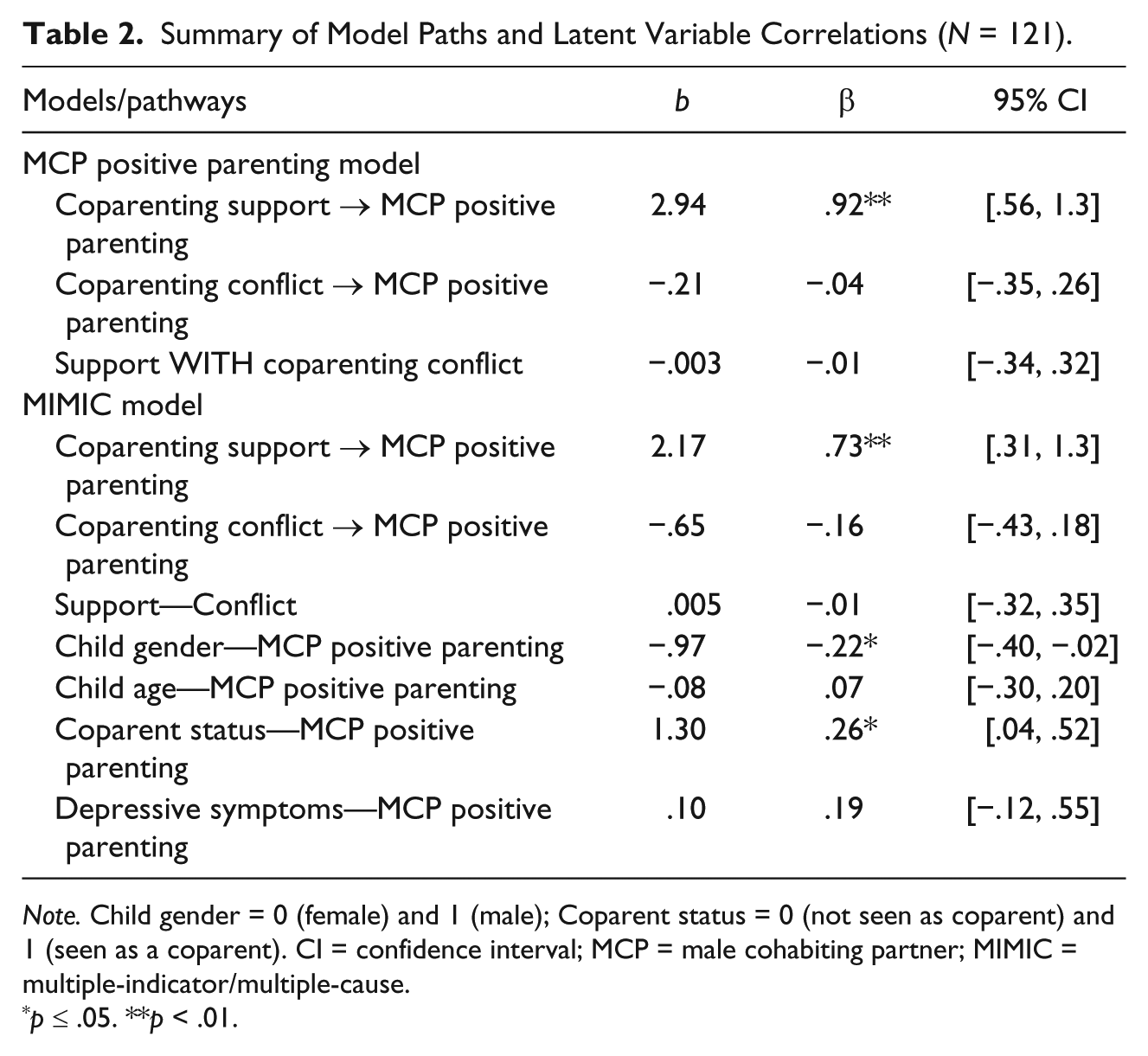
Note. Child gender = 0 (female) and 1 (male); Coparent status = 0 (not seen as coparent) and 1 (seen as a coparent). CI = confidence interval; MCP = male cohabiting partner; MIMIC = multiple-indicator/multiple-cause.
p ≤ .05. **p < .01.
MIMIC model
The effects of adolescent’s age and gender, coparent status, and MCP’s depressive symptom severity were tested by running a single MIMIC model; MCP positive parenting was regressed on all the covariates (see bottom part of Table 2 for the results). When accounting for the covariates, the path from coparenting support to MCP positive parenting was reduced in magnitude (β = .92 to β = .73) but remained significant (p < .01). Of the covariates examined in the MIMIC model, coparent status (coded as 0 = not seen as a coparent and 1 = viewed as a coparent) was positively related to MCP positive parenting, and adolescent gender (coded as 0 = female and 1 = male) was negatively related to MCP positive parenting.
Discussion
Although both the recognition of the complexity of the construct of fatherhood and research examining fathers are increasing (see Hubin, 2014; Roy, 2014), parenting of fathers continues to be understudied (Phares, Field, et al., 2005). In particular, MCPs, who can serve as “social stepfathers,” have often not been included in research studies; however, these men are increasingly present in homes (Bianchi, 2014; Bumpass & Lu, 2000; Lichter et al., 2010), particularly in economically challenged Black families (Dunlap et al., 2010). The current study examined the parenting behaviors of MCPs with a young adolescent in the family and, responding to Doherty et al.’s (1998, p. 285) call to “illuminate the distinctive influences on fathering,” examined the link of coparenting conflict and support with a construct of positive parenting. We predicted that both coparenting support and conflict would relate to a MCP’s positive parenting; however, we tested competing hypotheses regarding these two constructs and their relation to his positive parenting. Finally, in exploratory analyses, we examined the association of the interaction of coparenting support and conflict with the positive parenting construct.
Our findings provided partial support for our hypotheses. First, coparenting support was related to a MCP’s positive parenting of a young adolescent. However, counter to our hypothesis, coparenting conflict was not related to this construct. These findings provide evidence for the importance of coparenting support (i.e., a mother believes she can count on a MCP for help in parenting) for a MCP’s involvement in positive parenting. In addition, in exploratory analyses, we failed to find that support and conflict interacted in their association with the construct of positive parenting.
Doherty et al. (1998) proposed that responsible fathering is contextually sensitive and that support from a mother is central for fathers to engage in parenting. Our findings suggest that when mothers perceive MCPs as helpful in coparenting, MCPs engage in more positive parenting. Interestingly, these findings differ from some of the prior research in that coparent conflict was more highly associated with a Black mother’s parenting than coparenting support (Jones et al., 2005). The current study focused on the parenting of a MCP rather than a mother’s parenting, which may account for the different findings. In addition, as we have noted, the earlier research involved coparents who may or may not have been residing in the home. A MCP has a daily presence in the family, and a mother likely has an investment in him being an active member of the family; therefore, she may encourage (i.e., support) his collaboration in the parenting process. This can occur through supporting and expecting his use of positive parenting behaviors and his involvement in daily childrearing tasks (e.g., helping with homework).
It has been recognized for decades that mothers exert considerable influence over father’s parenting (e.g., Patterson, 1982) and, more recently, the concept of maternal facilitative and inhibitory gatekeeping (the extent to which a mother supports or resists a father becoming involved in childrearing) has been highlighted in the literature (Dush, Kotila, & Schoppe-Sullivan, 2011; Raley & Wildsmith, 2004; Schoppe-Sullivan, Brown, Cannon, Mangelsdorf, & Sokolowski, 2008; see Puhlman & Pasley, 2013, for a review). A supportive coparenting relationship in which the mother believes she can count on the MCP to effectively parent her adolescent is congruent with both low levels of inhibitory and high levels of facilitative gatekeeping, leading a MCP to engage in positive parenting. However, it is important to note that our data are cross-sectional, preventing causal conclusions from being reached. It is equally plausible that a MCP who displays positive parenting behaviors is likely to be perceived as supportive in his coparenting efforts by a mother. In reality, the process is likely transactional with a supportive coparenting relationship promoting a MCP’s positive parenting behaviors and, in turn, a MCP’s positive parenting encouraging a mother to perceive him as more helpful in parenting.
In 1982, Patterson identified three roles fathers can play in regard to parenting: (a) support system for the mother, (b) direct responsibility of some components of child management, and (c) as a “reserve force” for when the mother “confronts children on some critical issue” (p. 285). Our study does not directly address the third role; however, it does suggest a link between the first two roles. Specifically, mutual support of a mother and a MCP to engage in coparenting is linked to a “social father” engaging in positive parenting. The loading of acceptance, firm control, and monitoring on a positive parenting construct that is related to coparent support is noteworthy: Exerting firm control in the home and monitoring an adolescent outside the home requires a different set of parenting skills and investment in the family than developing a warm and accepting relationship with an adolescent. The latter could emerge by a MCP simply “being present and interested” in an adolescent but exercising little authority. In contrast, the former set of skills requires that a MCP is both granted the right, and then is willing to assume the responsibility, to impose limits on an adolescent, which is by no means an easy task. Importantly, for prevention and intervention programs, our findings suggest that increasing coparenting support may lead to changes in both acceptance and control/monitoring of an adolescent by a MCP. Longitudinal designs and interventions (with appropriate control groups) targeting coparenting support are necessary to confirm this tentative conclusion.
Our exploratory analyses failed to find support for coparenting support and conflict interacting to influence parenting. As we noted, in some of our earlier work with another sample (Jones et al., 2005), we found that a combination of a high level of support and a low level of conflict with a coparent, who may or may not have resided in the home, was associated with a Black single-parent mother’s monitoring, but not her warmth. The focus on the parenting of a “social father” rather than a mother, the difference in residential status of the coparent, and our smaller sample size than the one studied by Jones et al. may account for the differences.
Beyond examining the relationship of support and conflict with parenting, our findings also provide some insight into the level of parenting by MCPs. Not surprisingly, they engage in lower levels of acceptance, monitoring, and firm control than mothers; however, their mean levels were at or above scale midpoints for the first two parenting behaviors. This suggests that MCPs are active in some components of positive parenting and are more than “polite strangers” in these families.
In terms of strengths of the current study, our measures of support and conflict were assessed both from the perspective of the MCP and the mother and the items on each measure loaded on the construct of interest. Future research could utilize more than two items to assess each of these constructs. Second, parenting was independently assessed from the perspective of the adolescent. Finally, a major strength of the study was our focus on fathers, in our case “social stepfathers.” Relative to mothers, fathers in general have been ignored in the literature (Phares, Fields, et al., 2005), and both married and cohabiting stepfathers have received even less attention. As MCPs are increasingly prevalent (Lichter et al., 2010) and as positive parenting is particularly important for adolescents living in at-risk environments (Manning & Lamb, 2003), attention to the role these men play in parenting is critical. These strengths should be considered in the context of several weaknesses of the study, including the cross-sectional nature of the data, the relatively low loading (.32) of one item on the coparenting support construct, and the absence of measurement of the socio-cultural context in which the participating families lived. These contextual variables may have influenced our findings.
Future research could explore the role of demographic variables in MCP’s positive parenting. Of particular interest, our findings suggest that male youth report less MCP positive parenting than female youth. In the current analyses, we controlled for this and other demographic variables. With larger samples, variables such as adolescent gender could be examined as moderators of the association of support and conflict with MCP positive parenting. In addition, our findings point to other questions for future research, including identifying why MCPs choose to parent a non-biological child, how their parenting differs from that of MCPs who are biological fathers, and the process by which women in these families select partners who they believe can coparent.
The implications of our findings for prevention and intervention are twofold. First, as DeGarmo and Forgatch (2007) hypothesized, “marital dynamics” (p. 349), specifically coparenting support in our case, are related to a stepfather’s positive parenting. In order to facilitate and maintain these parenting behaviors by “social fathers,” it is important to emphasize coparenting support in programs designed for parents. Second, based on prior research (Forehand et al., 2014) and the current study, “social fathers” are involved in childrearing tasks and utilize positive parenting behaviors. They should be included in parenting programs rather than viewed as “polite strangers” or “playful spectators.”
Footnotes
Declaration of Conflicting Interests
The author(s) declared no potential conflicts of interest with respect to the research, authorship, and/or publication of this article.
Funding
The author(s) disclosed receipt of the following financial support for the research, authorship, and/or publication of this article: Funding for this project was provided by a National Institute of Child Health and Human Development Grant (RO1HD064723) (PI: Andrew Golub), and a NICHD Research Supplement to Promote Diversity in Health-Related Research (R01HD064723-02S1).