




Abstract
To provide further insight into stress generation patterns in boys and girls around puberty, this study investigated longitudinal reciprocal relations between depressive symptoms, dysfunctional attitudes, and stress generation, the process by which individuals contribute to the occurrence of stress in interpersonal contexts (e.g., problematic social interactions) or in noninterpersonal contexts (e.g., achievement problems). A community sample of N = 924 German children and early adolescents (51.8% male) completed depressive symptoms and dysfunctional attitudes measures at T1 and again 20 months later (T2). Stressful life events were reported at T2. Dysfunctional attitudes were unrelated to stress generation. Interpersonal, but not noninterpersonal, dependent stress partially mediated the relationship between initial and later depressive symptoms, with girls being more likely to generate interpersonal stress in response to depressive symptoms. Findings underscore the role of interpersonal stress generation in the early development of depressive symptomatology, and in the gender difference in depression prevalence emerging around puberty.
Keywords
Introduction
Background
The theory of stress generation (Hammen, 1991, 2006) has substantially contributed to an advanced understanding of the stress–depression relationship and of the mechanisms involved in the maintenance and recurrence of depression. While traditional research examining the association between stress and depression was largely shaped by the assumption of unidirectional stress exposure effects, in which the experience of stress increases risk for depression, Hammen’s (1991) model of stress generation posits a reciprocal relationship in which depression-prone individuals actively contribute to the occurrence of certain stressful events. Thus, the individual is conceptualized not only as a passive respondent to life stress but also as an active agent in the creation of stressful events and conditions (Liu & Alloy, 2010). Depressed individuals are thus proposed to be more likely than nondepressed individuals to experience dependent stressful events, the occurrence of which at least partly depends on their behavior or personality, while they are not necessarily more likely to experience independent (“fateful”) events.
Given the dramatic rise in depression prevalence rates around the time of puberty (Avenevoli, Knight, Kessler, & Merikangas, 2008; Rohde, Beevers, Stice, & O’Neil, 2009), the transition to adolescence is a crucial developmental period for the examination of early processes in the development and consolidation of depression. However, despite numerous studies generally providing support for the stress generation theory (Liu & Alloy, 2010), some important questions regarding stress generation in youth have not yet been answered conclusively. It is the aim of the present study to address these questions, which will be outlined in more detail below.
Interpersonal and Noninterpersonal Stress Generation in Children and Early Adolescents
Effects of stress generation have consistently been shown to occur already during childhood and adolescence (Cole, Nolen-Hoeksema, Girgus, & Paul, 2006; Johnson, Whisman, Corley, Hewitt, & Rhee, 2012; Shih, Abela, & Starrs, 2009). A more detailed picture of stress generation effects has been enabled by a differentiation between dependent events of interpersonal versus noninterpersonal nature, with dependent interpersonal events usually encompassing all types of problematic social interactions, for example, conflict with family members or peers. In contrast, dependent noninterpersonal stress involves events which occur at least partly because of actions or characteristics of the individual, but which do not primarily reflect a problematic social interaction. Typical events in this domain are achievement-related such as poor academic or athletic performance, but also trouble with the police, causing an accident and similar events belong to this category (Hankin, Mermelstein, & Roesch, 2007; Rudolph, 2008; Rudolph & Hammen, 1999).
To date, a number of findings suggest that effects of stress generation are particularly pronounced for dependent interpersonal events (Hammen, 1991; Joiner, Wingate, Gencoz, & Gencoz, 2005; Shih, 2006). Consequently, effects and mechanisms of interpersonal stress generation have received much research attention (e.g., Daley et al., 1997; Flynn & Rudolph, 2011; Hamilton et al., 2014). At the same time, however, there is comparatively little evidence from studies addressing both interpersonal and noninterpersonal stress generation, especially in a longitudinal design, which is mixed in children and adolescents: Although some report significant stress generation effects for interpersonal, but not noninterpersonal events (Hammen & Brennan, 2001; Kushner, Bagby, & Harkness, 2017; Rudolph, 2008), others also found relations between baseline depression and later dependent noninterpersonal stress (Hamilton et al., 2013; Shapero, Hankin, & Barrocas, 2013; Shih et al., 2009).
Thus, it is not clear to date whether the tendency of depression-prone individuals to generate life stress is specific to the context of social relationships, or whether other domains of life are affected, too. The first aim of the current study is, therefore, to explore prospective relations between depressive symptoms and the generation of interpersonal versus noninterpersonal stress in children and early adolescents.
Role of Dysfunctional Attitudes in Stress Generation
The finding that stress generation can be observed not only in currently depressed but also in remitted individuals (Daley et al., 1997; Hammen, 1991) has stimulated a growing body of research examining influences of enduring personality characteristics on the generation of life stress (Liu & Alloy, 2010). In this context, the role of depressogenic cognitions has received special attention. To date, evidence is accumulating suggesting that cognitive vulnerability variables, such as negative inferential style, ruminative response style, or perfectionism, play a significant role in the generation of life stress in both adulthood and youth (Auerbach, Eberhart, & Abela, 2010; Calvete, 2011; Hamilton et al., 2013; Kleiman, Liu, Riskind, & Hamilton, 2015; La Rocque, Lee, & Harkness, 2016; Shapero et al., 2013; Stroud, Sosoo, & Wilson, 2015).
However, little is known about possible contributions to stress generation by dysfunctional attitudes (Liu & Alloy, 2010), the key cognitive vulnerability variable of Beck’s prominent cognitive diathesis-stress model of depression (Beck, 1967). Preliminary evidence from adult populations has been provided by a small cross-sectional study by Simons, Angell, Monroe, and Thase (1993), who did not find associations between dysfunctional attitudes and dependent stress, and by a longitudinal study conducted by Safford, Alloy, Abramson, and Crossfield (2007), who found that a cognitive vulnerability score comprising negative inferential style and dysfunctional attitudes predicted dependent interpersonal, but not achievement-related stress in undergraduates.
Finally, Eberhart, Auerbach, Bigda-Peyton, & Abela (2011) showed that maladaptive schemas, which are theorized to underlie the manifestation of dysfunctional attitudes (Beck, 1967), were related to interpersonal stress generation in a sample of female undergraduates.
Although dysfunctional attitudes have been shown to confer vulnerability to depression at a comparatively young age already (Abela & Sullivan, 2003; D’Alessandro & Burton, 2006), possible contributions of dysfunctional attitudes to stress generation processes in younger populations have so far only been addressed by one study conducted by Shapero et al. (2013). In this study, dysfunctional attitudes were longitudinally related to the generation of interpersonal and achievement stress in adolescents, but this effect disappeared when baseline psychopathology symptoms and other cognitive, interpersonal, and temperamental vulnerability variables were controlled for.
As the sample in this latter study consisted of ninth and 10th graders mostly, however, little information is available so far regarding stress generation processes during the transition to adolescence. Therefore, it is the second aim of the current study to explore prospective effects of dysfunctional attitudes on dependent life stress in a sample of early adolescents. In line with the findings obtained by Safford et al. (2007), we hypothesize dysfunctional attitudes to predict the generation of interpersonal stressors because a strong need for approval expressed by Dysfunctional Attitudes Scale (DAS) items may elicit problematic interpersonal behaviors such as excessive reassurance-seeking, co-rumination, or ineffective interpersonal problem solving, which in turn have been shown to contribute to interpersonal stress generation (Hankin, Stone, & Wright, 2010; Hernandez, Trout, & Liu, 2016; Shih et al., 2009). Given that results regarding the generation of noninterpersonal, or achievement, stress have been more ambiguous so far (Safford et al., 2007; Shapero et al., 2013), an exploratory examination of effects on noninterpersonal stress by dysfunctional attitudes will be conducted.
Consequences of Interpersonal and Noninterpersonal Stress Generation
Stress generation has been identified as an important mechanism contributing to subsequent depressive symptoms and diagnoses (Liu & Alloy, 2010). In particular, dependent interpersonal stress seems to be strongly linked to future depression (Kendler, Karkowski, & Prescott, 1999). A number of studies demonstrating effects of dependent interpersonal, but not noninterpersonal stress, on future depression (Flynn, Kecmanovic, & Alloy, 2010; Flynn & Rudolph, 2011; Rudolph & Hammen, 1999) suggest that interpersonal stress generation may be the more relevant process in the development of depression. This idea has been expressed in various theoretical models of depression (Hammen, 1999; Hankin & Abramson, 2001), but was only rarely addressed directly in child and adolescent depression research (Flynn & Rudolph, 2011; Hamilton et al., 2013).
Apart from contributing to subsequent depression, generated stress has also been found to affect cognitive and interpersonal vulnerability variables (Calvete, Orue, & Hankin, 2015; Hankin et al., 2010). However, reciprocal relations between cognitive or interpersonal vulnerability and stress in children and adolescents, too, have only rarely been investigated to date.
Taken together, further clarification is needed regarding the mediating role of self-generated interpersonal, as opposed to noninterpersonal, stress of the relationships between initial and subsequent depressive symptomatology and cognitive vulnerability in youth. To address this third aim of the current study, effects of interpersonal versus noninterpersonal stress generation on subsequent depressive symptoms and dysfunctional attitudes will also be examined.
Gender Differences in Interpersonal and Noninterpersonal Stress Generation
A recurrent finding in the stress generation literature is that stress generation, and in particular generation of interpersonal stress, seems to be of greater relevance to women than to men (Liu & Alloy, 2010). This has resulted in interpersonal stress generation being suggested as one potential mechanism explaining the marked gender difference in depression prevalence (Hankin et al., 2007; Shih, Eberhart, Hammen, & Brennan, 2006). With this gender difference emerging around the transition to adolescence (Avenevoli et al., 2008), this developmental period may be particularly informative when trying to clarify the role of interpersonal stress generation for women’s greater risk of developing depression.
However, despite a considerable body of literature, the significance of interpersonal and noninterpersonal stress generation in the early development of depression in boys and girls remains somewhat elusive: First, although adult and (late) adolescent females have, overall, quite consistently reported higher levels of dependent interpersonal stress than their male peers, evidence for such a gender difference is less coherent regarding children or early adolescents (see, for example, Connolly, Eberhart, Hammen, & Brennan, 2010; Flynn & Rudolph, 2011; Harkness, Lumley, & Truss, 2008; Rudolph et al., 2000; Shih et al., 2009). Similarly, evidence for higher levels of noninterpersonal dependent stress in boys is contradictory (e.g., Harkness & Stewart, 2009; Rudolph & Hammen, 1999; Shapero et al., 2013; Shih et al., 2009).
Second, reciprocal relationships between depression and interpersonal dependent stress have been found to differ between men and women (Davila, Bradbury, Cohan, & Tochluk, 1997; Hammen, 2003; Jones, Beach, & Forehand, 2001; Rudolph, 2002). However, there are few findings from studies testing gender as a moderating variable in child and adolescent samples (e.g., Connolly et al., 2010; Flynn & Rudolph, 2011; Hankin et al., 2007).
In summary, there is a large body of evidence supporting various aspects of the idea that interpersonal stress generation may, at least in part, account for the gender difference in depression risk. At the same time, it remains unclear in what way interpersonal stress generation might contribute to the gender difference emerging at the transition to adolescence: Girls might have a greater risk of becoming depressed because they may generally have a greater tendency to generate interpersonal stress than boys, because they may react more strongly to the experience of depressed mood with generating interpersonal stress, because girls’ and boys’ reactivity to the experience of interpersonal or noninterpersonal stress differs, or because of a combination of some or all of these factors. Thus, it is the fourth aim of the current study to enhance evidence on the role of interpersonal and noninterpersonal stress generation in the development of depressive symptoms in boys and girls in order to contribute to a clarification of the mechanisms involved in the gender difference in depression prevalence. To this end, patterns of associations between both genders will be compared, and mediational effects of interpersonal/noninterpersonal stress generation in the gender–depression relationship will be tested.
The Current Study
The current study aims to approach a comprehensive picture of patterns of stress generation in youth by analyzing reciprocal relations between depressive symptoms, interpersonal and noninterpersonal dependent stress, and dysfunctional attitudes in children and early adolescents. We hope to enhance insight into stress generation during this developmental period by incorporating both interpersonal and noninterpersonal dependent stress into analyses, and by examining both predictors and consequences of generated stress. Moreover, the role of dysfunctional attitudes in this context will be addressed specifically for the first time in an early adolescent sample. Finally, we seek to provide further evidence on the role of stress generation in the gender difference in depression prevalence emerging around puberty by explicitly testing both moderating effects of gender in stress generation processes and mediating effects of stress generation in the gender–depressive symptoms relationship.
We expect reciprocal relationships between depressive symptoms and dependent stress to be stronger for interpersonal than for noninterpersonal events, and relationships between depressive symptoms and interpersonal dependent stress to be stronger for girls than for boys. Moreover, dysfunctional attitudes are hypothesized to be reciprocally associated with dependent interpersonal stress, and associations with noninterpersonal stress will be examined exploratorily.
Data will be drawn from the PIER study, a large longitudinal project examining intrapersonal developmental risk factors in childhood and adolescence. With the experience of depression and negative events rising dramatically at the transition to adolescence, and the gender difference in depression prevalence also emerging at this time, the transition from late childhood to early adolescence can be regarded as a particularly crucial developmental period. For this reason, a large sample of children and early adolescents who entered the study at age 9 to 13 years was used. Participants reported depressive symptoms and dysfunctional attitudes at baseline. Approximately 20 months later, a stressful life events interview and again the depressive symptoms and dysfunctional attitudes measures were completed.
Method
Participants
Participants were recruited from local schools in Potsdam and the surrounding federal state Brandenburg (Germany), and took part in a larger longitudinal project (PIER study). Data used for the current study were first collected in 2011/2012 and again in 2013/2014 with a mean interval between assessments of
At Time 1, 924 children aged between 9 and 13 years (
Procedure
After parents had provided written informed consent, participants completed the assessments in standardized individual sessions in their schools, at the children’s homes, or on the university campus if schools were unable to provide rooms. Participants completed all questionnaires privately on a netbook or via paper and pencil, except for the stressful life events interview, which was conducted face-to-face. All participants received a cinema voucher in reward for their participation. The procedure and instruments applied in the study were approved by the Ethics Committee of the University of Potsdam and the Ministry of Education of the German Federal State of Brandenburg.
Measures
Depressive symptoms
The Depression Test for Children (“Depressionstest für Kinder” [DTK], Rossmann, 2005), a German self-report depression inventory designed for screening purposes, was used to assess depressive symptoms at T1 and T2. We used the two subscales “dysphoria/self-esteem” (25 items) and “tiredness/psychosomatic complaints” (14 items). 2 The items are answered in a yes/no format and added up to a sum score, which represents the total number of reported depressive symptoms. The two subscales have demonstrated good reliability and validity including high correlations with the Children’s Depression Inventory (Frühe, Allgaier, Pietsch, & Schulte-Körne, 2012; Kovacs, 1992, 2003; Rossmann, 2014), and have successfully been used in depression research in child and adolescent samples (Bondü & Esser, 2015; Schwarz & Beyer, 2008). In the current study, it reached a Cronbach’s α = .86 at both T1 and T2.
Dysfunctional attitudes
At T1, all participants completed a German translation of the Dysfunctional Attitudes Scale for Children (DAS-C) by D’Alessandro and Burton (2006). The DAS-C was designed to assess dysfunctional attitudes in children up to age 14 based on the DAS by Weissmann and Beck (1978). Items comprise statements reflecting depressogenic schemata and are answered on a 5-point Likert-type scale (0 = disagree to 4 = agree).
Because a considerable proportion of the sample (39.1%) was older than 14 years at T2, and the necessity of age-appropriate measurement of cognitive vulnerability has been emphasized (Lakdawalla, Hankin, & Mermelstein, 2007), participants aged 14 and older completed the Dysfunctional Attitudes Scale for Adolescents (DAS-J) at T2 (“Skala dysfunktionaler Einstellungen für Jugendliche”; Keller, Kirchner, & Pössel, 2010). Like the DAS-C, the DAS-J measures dysfunctional attitudes based on Beck & Weissmann’s DAS on a 5-point Likert-type scale. Participants younger than 14 years again completed the DAS-C at T2.
For the T2 dysfunctional attitudes data, a procedure of extracting content equivalent item pairs from the two scales and subsequently collapsing scales across age groups was applied to ensure that dysfunctional attitudes were measured in an age-appropriate manner without requiring a division of the sample: First, pairs of content equivalent items from the DAS-C and DAS-J were identified so that for each item drawn from the DAS-C, one item expressing comparable content was drawn from the DAS-J (e.g., Item 13 from the DAS-C “If I disagree with other people, then they will hate me” was paired with Item 5 from the DAS-J “If someone disagrees with me, it probably means that he/she doesn’t like me”). Items for which no comparable counterpart existed were excluded from subsequent analyses.
This procedure resulted in two comparable sets of 17 items. Principal components analyses of the 17 items drawn from the DAS-C and the 17 items drawn from the DAS-J showed almost identical, essentially unidimensional structures with slopes in the scree plots approaching a horizontal line after the first eigenvalue (5.06, then 1.52, 1.16, 1.02 for the DAS-C items and 4. 33, then 1.60, 1.45, 1.13 for the DAS-J items). Internal consistency of the obtained scales was α = .83 for the DAS-C items and α = .82 for the DAS-J items (T2).
Stressful life events
Stressful life events were assessed at T2 via a semistructured interview which was modeled after the Munich Event List (Maier-Diewald, Wittchen, Hecht, & Werner-Eilert, 1983), a widely used instrument assessing stressful life events via a combination of self-report checklists and face-to-face interview (e.g., Asselmann, Wittchen, Lieb, Höfler, & Beesdo-Baum, 2015; Perkonigg, Yonkers, Pfister, Lieb, & Wittchen, 2004). For economic reasons, the self-report checklist was not administered and only a face-to-face interview was conducted. Participants were asked whether stressful events in the following categories had occurred during the past year: parents/family, school, leisure/friends, romantic relationships, health, and others. Event probes were given for each category to illustrate what was meant by “stressful event.” If an event had occurred, participants were asked to describe the event and its subjective impact.
The reported events were coded by three independent raters blind to participants’ subjective evaluation of the events and level of depressive symptoms. Raters were trained graduate psychology students. First, raters coded the extent to which a given event was dependent on the individual’s behavior or characteristics on a scale ranging from (almost) independent, at least partly dependent, to almost completely dependent. Events which were coded as at least partly dependent by all three raters were categorized as dependent events. Typical dependent events included arguments with family members or friends, whereas death or illness of a family member represents typical independent events. Second, the coding team rated interpersonal content of a given event, which was defined as the extent to which the primary content of the reported event related to interpersonal relationships and social interactions. Events were coded by the raters as noninterpersonal, at least partly interpersonal or almost completely interpersonal. Subsequently, events which had been coded as at least partly interpersonal by all three raters were categorized as interpersonal. The interpersonal event category comprised, for example, arguments or a romantic breakup. Typical noninterpersonal events were receiving a bad report card or failure at a sports competition.
To evaluate agreement between the three raters, Krippendorff’s α, a reliability measure that can be used regardless of the number of observers, levels of measurement, sample sizes, and presence or absence of missing data was used (Hayes & Krippendorff, 2007). Interrater reliability turned out to be excellent, with Krippendorff’s α = .90 for the dependency and α = .92 for the interpersonal content scale. For subsequent analyses, each participant received scores reflecting the number of dependent interpersonal noninterpersonal as well as independent interpersonal and noninterpersonal events. In case participants reported positive events, these were dropped from analyses, as were reports of chronic stressors 3 .
Data Analysis
To examine longitudinal reciprocal relations between depressive symptoms, dysfunctional attitudes, and dependent interpersonal and noninterpersonal stress, manifest structural equation modeling (SEM) was employed using Mplus Version 7 (Muthén & Muthén, 1998-2012). First, relationships in the whole sample were examined in a model including effects of T1 depressive symptoms and dysfunctional attitudes on dependent interpersonal and dependent noninterpersonal stress reported at T2, as well as paths from the dependent stress measures to T2 depressive symptoms and dysfunctional attitudes (see Figure 1). Autoregressive and cross-lagged paths of depressive symptoms and dysfunctional attitudes were included to account for the stability of the constructs and possible mutual influences, which might occur independently of stress generation.

Structural equation model of reciprocal relations between depressive symptoms, dysfunctional attitudes, and dependent interpersonal/noninterpersonal stress (N = 924).
Second, gender differences in the patterns of associations between the variables of interest were examined via a series of multigroup comparison analyses. Paths of interest were constrained to be equal across boys and girls and then individually unconstrained in sequence with χ2 difference tests indicating significance of any observed gender differences. In addition, the mediating role of dependent interpersonal and noninterpersonal events in the gender–depressive symptoms relationship was tested in two separate mediational models, which included gender as the independent variable, T2 depressive symptoms as the dependent variable, and dependent interpersonal or noninterpersonal events, respectively, as the mediating variable.
Results
Preliminary Analyses
Means, standard deviations, and correlations of variables of interest are presented in Table 1. The correlational analysis revealed weak to moderate correlations between concurrent depressive symptoms, dysfunctional attitudes, and dependent stress.
Descriptive Statistics and Correlations.
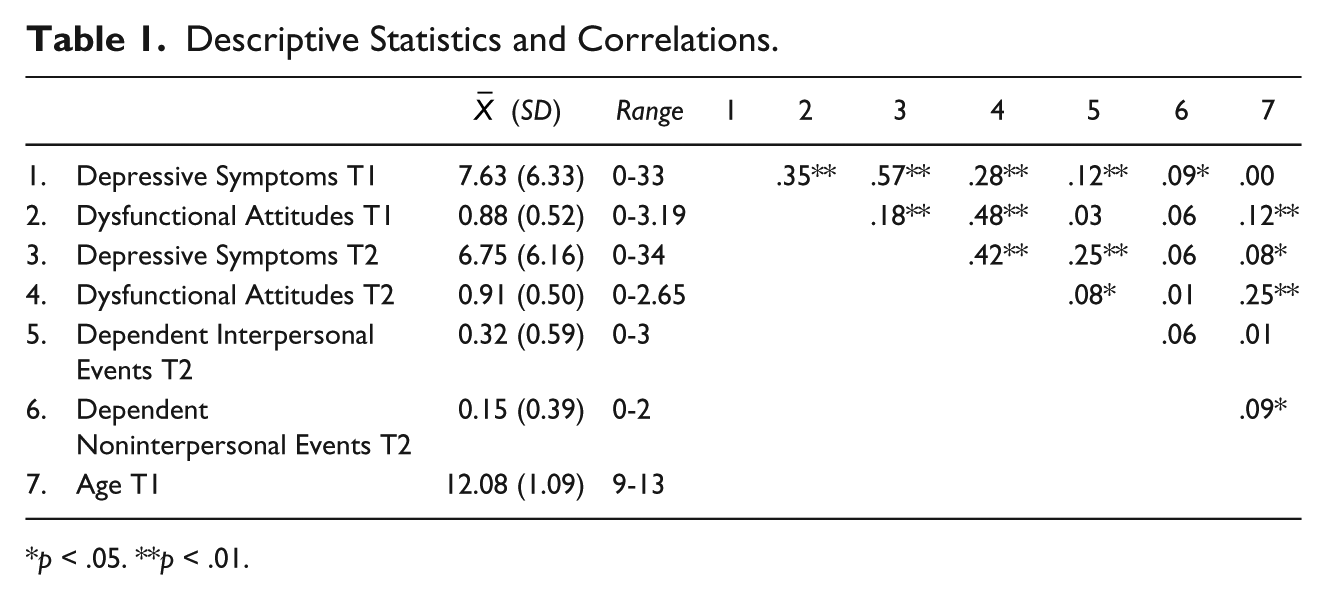
p < .05. **p < .01.
Descriptive statistics for boys and girls are displayed in Table 2. Gender comparisons were conducted via Mann-Whitney U tests, because the relevant variables were all nonnormally distributed with skewness ranging between 0.74 (T1 dysfunctional attitudes) and 2.43 (dependent noninterpersonal stress). Tests indicated that girls reported significantly more depressive symptoms at T1 and T2 (U = 89281.00, p < .01 and U = 50100.00, p < .01, respectively) and more dependent interpersonal events (U = 59618.00, p < .01). Boys, in turn, reported more dysfunctional attitudes at T1, but not at T2, (U = 93324.00, p < .01 and U = 70271.00, ns, respectively), and more dependent noninterpersonal events (U = 63565.50, p < .05).
Descriptive Statistics for Boys and Girls.

Note. Significant differences refer to gender differences in the variables indicated.
p < .05. **p < .01.
In order to rule out the possibility that prospective associations between depressive symptoms and dependent stress would merely reflect overreporting of events in more symptomatic participants, multiple regression analyses with independent stress measures as the dependent variables were conducted. Controlling for gender and age, neither depressive symptoms nor dysfunctional attitudes predicted independent interpersonal or noninterpersonal events (all ps > .10).
Reciprocal Relationships Between Depressive Symptoms, Dysfunctional Attitudes, and Dependent Stress
Reciprocal relationships between depressive symptoms, dysfunctional attitudes, and dependent interpersonal and noninterpersonal events in the whole sample were tested in a saturated manifest path model. Standardized path coefficients are displayed in Figure 1.
Depressive symptoms and dysfunctional attitudes showed significant and strong autoregressive paths between T1 and T2 and moderate concurrent associations at T1 and T2. Depressive symptoms at T1 predicted dysfunctional attitudes at T2, but not vice versa. Depressive symptoms at T1 significantly predicted dependent interpersonal and noninterpersonal events, while dysfunctional attitudes at T1 were not associated with either stress measure. Moreover, dependent interpersonal, but not noninterpersonal, stress predicted T2 depressive symptoms. Neither dependent interpersonal nor dependent noninterpersonal events were significantly related to T2 dysfunctional attitudes.
The mediating role of dependent interpersonal events 4 in the relationship between T1 and T2 depressive symptoms was examined by testing the indirect effect of T1 on T2 depressive symptoms. Significance of the indirect effect was determined using bias-corrected bootstrapping procedures with 10000 bootstrapped samples (MacKinnon, Lockwood, & Williams, 2004). The indirect effect of T1 on T2 depressive symptoms via dependent interpersonal stress was significant with Est = .02, SE = 0.01, Est/SE = 2.40, p < .05. The direct effect of T1 on T2 depressive symptoms remained significant with Est = .52, p < .001, thus indicating partial mediation. As recommended by Shrout and Bolger (2002), the strength of mediation was determined. Calculation of effect proportions indicated that approximately 3 % of the effect of T1 on T2 depressive symptoms was accounted for by dependent interpersonal stress.
Gender Comparisons Via Multigroup Analyses
Standardized path coefficients for boys and girls obtained in an unconstrained multigroup model, with gender as the grouping variable, are presented in Figure 2. To determine significant differences in strengths of associations, we also tested a constrained model in which all paths of interest 5 were constrained to be equal for boys and girls. Next, we sequentially unconstrained individual paths and tested for a significant improvement of model fit via χ2 difference tests.
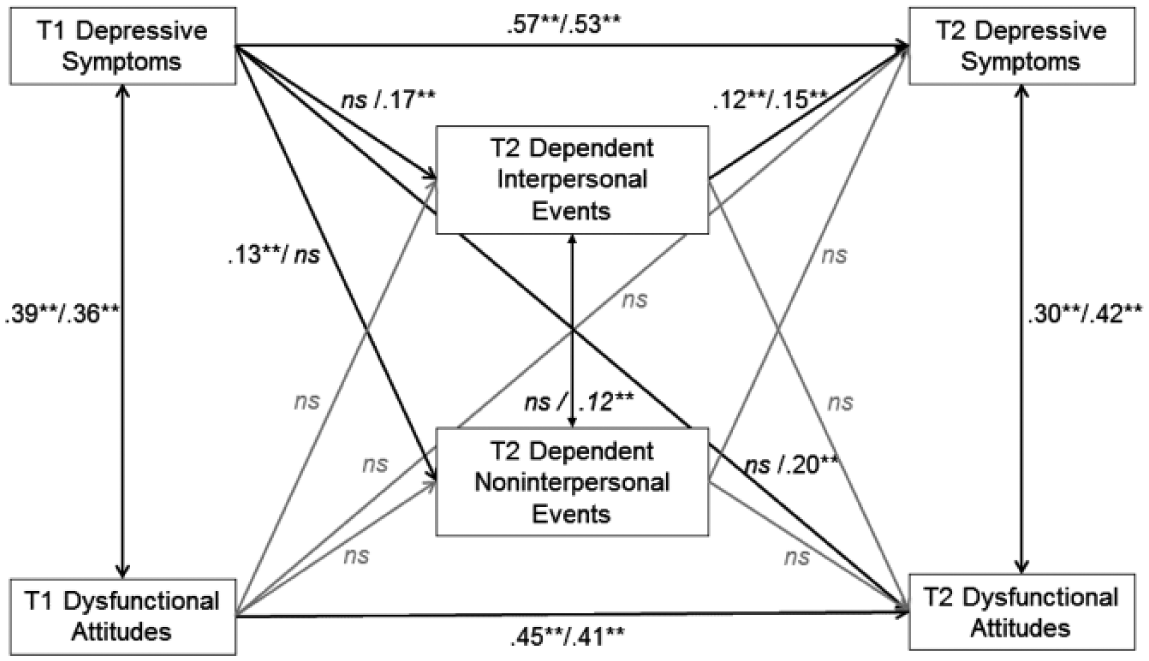
Multigroup structural equation model of reciprocal relations between depressive symptoms, dysfunctional attitudes, and dependent interpersonal/noninterpersonal stress.
This procedure revealed significantly different path coefficients for the T1 depressive symptoms → dependent interpersonal stress relationship (p < .05). Thus, T1 depressive symptoms predicted dependent interpersonal stress in girls, but not in boys.
Slightly higher coefficients emerged for girls than for boys regarding the dependent interpersonal stress → T2 depressive symptoms relationship, but this difference did not reach significance (p = .08). No significant gender differences emerged for effects of and on dependent noninterpersonal events, although on the descriptive level, depressive symptoms predicted dependent noninterpersonal stress in boys, but not in girls. However, a significant gender difference was found in the T1 depressive symptoms → T2 dysfunctional attitudes relationship (p < .05) indicating that T1 depressive symptoms predicted T2 dysfunctional attitudes in girls, but not in boys.
Mediational Analysis
In order to determine whether interpersonal stress generation would account for the gender difference in depression levels, an additional mediational analysis was conducted using a structural equation model including gender, dependent interpersonal stress, and T2 depressive symptoms. 6 Bias-corrected bootstrapping was used as described above. Gender predicted dependent interpersonal stress with Est = 0.13, SE = 0.04, p < .001. Dependent interpersonal stress predicted depressive symptoms with Est = .21, SE = 0.03, p < .001. The indirect effect of gender on depressive symptoms via dependent interpersonal stress was significant with Est = .03, SE = .01, p < .001, while the direct effect of gender on depressive symptoms also remained significant with Est = 0.25, SE = 0.03, p < .001. Thus, dependent interpersonal stress partially mediated the relationship between gender and depressive symptoms. Analysis of effect proportions revealed that approximately 10 % of the effect of gender on T2 depressive symptoms was accounted for by interpersonal dependent stress.
Discussion
In the present study, reciprocal relationships between depressive symptoms, dysfunctional attitudes, and dependent interpersonal and noninterpersonal stress in children and early adolescents were examined, as well as gender differences in the pattern of associations. It was found that overall, dependent interpersonal, but not noninterpersonal, stress partially mediated the relationship between initial and later depressive symptoms. However, multigroup comparisons between boys and girls showed that this pattern was largely accounted for by the group of girls, as initial depressive symptoms predicted dependent interpersonal stress in girls, but not in boys. Moreover, interpersonal stress generation partially mediated the effect of gender on depressive symptoms.
Initial depressive symptoms also predicted noninterpersonal stress generation. Gender comparisons revealed significant stress generation effects for noninterpersonal events in boys, but not in girls, but this difference did not reach statistical significance. Across gender, noninterpersonal stress was not related to subsequent depressive symptoms.
Finally, dysfunctional attitudes did not show any relations to interpersonal or noninterpersonal stress generation, but were predicted by T1 depressive symptoms. Again, gender comparisons revealed that this latter effect was accounted for by the group of girls.
Our findings underscore the role of interpersonal stress generation in the early development and consolidation of depressive symptomatology. This is in line with a large body of theoretical and empirical literature suggesting that depression and disturbances in social relationships are tightly interwoven (Hammen, 1991, 1999; Rudolph et al., 2000). However, the current findings enhance extant evidence by demonstrating that stress generation in the interpersonal context is not only a phenomenon of full-blown adult or adolescent depression, but already plays a significant role during the early development of depressive symptomatology.
The current study aimed at providing detailed insight into stress generation in children and early adolescents by specifically investigating effects of and on interpersonal stress generation, in contrast to noninterpersonal stress generation. Although (weak) stress generation effects could also be demonstrated for the noninterpersonal domain, this type of stress was not associated with subsequent depressive symptoms. In line with, for example, Flynn et al. (2010) or Flynn and Rudolph (2011), this pattern of findings suggests that stress generation in response to depressive symptoms is not limited to the interpersonal domain, but that this domain is particularly influential in the future development of depressive symptomatology. However, it should be noted that noninterpersonal stress generation might nonetheless affect future depression in older or at-risk samples, and that it might also show detrimental consequences regarding the development of other, namely, externalizing, disorders (Rudolph et al., 2000).
Gender comparisons revealed significant differences in stress generation patterns between boys and girls, as girls reported overall more dependent interpersonal events and were also more likely to react to the experience of depressive symptoms by generating interpersonal stress. As suggested by findings of, for example, Calvete (2011) or Hankin et al. (2010), girls’ increased likelihood of generating interpersonal stress might be accounted for by elevated levels of cognitive and/or interpersonal vulnerability in girls compared with boys, which may increase the likelihood of dysfunctional interpersonal behavior. Various vulnerability variables have been shown to both predict interpersonal stress generation and to be more pronounced in females than in males, for example, neediness (Bouchard & Shih, 2013), negative inferential style (Calvete, 2011), or interpersonal behaviors such as co-rumination (Hankin et al., 2010) or excessive reassurance-seeking (Shih et al., 2009; Shih & Auerbach, 2010). Detrimental effects of these factors may be exacerbated when girls experience depressive symptoms, resulting in an even further increase in interpersonal stress generation.
The current findings also point to the possibility that boys may show a greater tendency to generate noninterpersonal stress in response to depressive symptoms, although this gender difference could not be statistically substantiated. Therefore, future research would benefit from further investigation of gender differences in noninterpersonal stress generation, as it might emerge as a mechanism explaining boys’ greater risk of developing externalizing disorders (see, for example, Rudolph et al., 2000).
Taken together, the present study provides further evidence for interpersonal stress generation to play a significant role in the emerging gender difference in depression prevalence around the transition to adolescence. Mediational analyses confirmed that interpersonal stress generation partially mediated the effect of gender on depressive symptoms, and the structural equation model indicated that depressive symptoms relate more strongly to interpersonal stress generation in girls than in boys. It thus seems that girls generally exhibit a greater tendency for interpersonal stress generation, which is exacerbated in the face of depressive symptoms.
It should be noted, of course, that the obtained gender differences may also reflect differences in girls’ and boys’ the reporting behavior. For example, girls might tend to over-report interpersonal events and/or depressive symptoms. However, it seems unlikely that the obtained gender differences were merely due to reporting biases in girls and/or boys, because a gender difference was observed not only in concurrent associations but also in the prospective effect of depressive symptoms on dependent interpersonal stress. Thus, even taking possible reporting biases into account, the obtained findings still suggest that depressive symptoms and interpersonal stress generation are more closely associated in girls than in boys. Moreover, our results are in line with a number of findings from studies using more extensive interview techniques specifically aimed at reducing influences of possible reporting biases (Hankin et al., 2007; Rudolph & Hammen, 1999; Shih et al., 2006).
To the authors’ knowledge, the current study is the first one to examine prospective and reciprocal relations between dysfunctional attitudes and stress generation specifically during early adolescence. Contrary to expectations, dysfunctional attitudes did not show any relations to interpersonal stress generation above depressive symptoms, and neither were there significant associations to noninterpersonal stress generation. In line with the preliminary findings obtained by Simons et al. (1993) and Shapero et al. (2013), this suggests that dysfunctional attitudes, in contrast to other cognitive vulnerability variables such as negative inferential style or rumination, may indeed not contribute to the process of stress generation.
However, it has also been hypothesized that cognitive vulnerability variables, such as dysfunctional attitudes, may not come to unfold their detrimental effects until a certain age, when some cognitive maturity has been reached (Lakdawalla et al., 2007; Turner & Cole, 1994). Although only little support for this idea has been obtained so far (D’Alessandro & Burton, 2006; Hankin, Wetter, Cheely, & Oppenheimer, 2008), the possibility that different results would have emerged in an older sample should not be ruled out. Moreover, participants of the current sample overall reported relatively low levels of dysfunctional attitudes, which might have resulted in an underestimation of effects (Gibb, Alloy, Abramson, Beevers, & Miller, 2004; Meiser & Esser, 2017).
Somewhat surprisingly, dysfunctional attitudes were predicted by earlier depressive symptoms in girls, but not in boys. This finding demands further attention by cognitive vulnerability research, as it questions the role of dysfunctional attitudes as a vulnerability factor and also implies that relationships between dysfunctional attitudes and depression may vary between genders. Future research should thus be informed by the possibility of gender-specific associations between dysfunctional attitudes and depression.
Limitations
The current findings should be interpreted in light of some methodological limitations. First, due to constraints of the PIER study, in which stress was only one among many constructs of interest, extensive assessment of life events was not feasible, so that the checklist of the Munich Event List had to be omitted. Moreover, elaborate interview techniques such as the contextual threat interview method (Brown & Harris, 1978; Hammen, 1991) could not be drawn upon. Thus, as little contextual information on reported events was available, event counts, and not ratings of objective impact, were used as stress measures. We sought to reduce the influence of subjectivity in the definition of a “stressful event” by including in subsequent analyses only reports clearly defined as a negative, acute life event.
Second, with the concurrent assessment of depressive symptoms, dysfunctional attitudes, and life events at T2, causal interpretations of paths between these variables should be treated with caution. Thus, even though path directions were carefully derived from the theoretical and empirical literature, future research in the field of stress generation would certainly benefit from multiwave designs allowing complete tests of mediational hypotheses.
Third, effect sizes in the current study were small to moderate. The comparatively long T1 to T2 interval of approximately 20 months and the use of a healthy community sample might, at least in part, account for this outcome. With regard to the small mediational effect of dependent interpersonal stress, it should be noted that even very small effect sizes should not be considered trivial in longitudinal studies when previous levels of the outcome—in this case, depressive symptoms—are controlled for (Adachi & Willoughby, 2015). Nonetheless, the modesty of obtained effect sizes emphasizes that the model presented in the current article describes only one facet in a complex etiological chain ultimately resulting in the development or maintenance of depression. Furthermore, the clinical relevance of the presented findings remains to be established by future studies examining depression at the level of diagnoses.
Finally, only self-report data were available in the current study, which were collected in different environments. The vast majority of assessments took place in school, but some participants completed assessments at home. Although experimenters sought to ensure that participants could complete the assessments privately, it cannot be ruled out that the familial environment may have influenced participants’ reporting behavior.
Conclusion and Implications
The current study provides evidence for the important role of interpersonal stress generation in the early development of depressive symptomatology and in the emergence of the gender difference in depression prevalence during the transition to adolescence. Generation of noninterpersonal stress, in contrast, seems to play a rather subordinate role. Importantly, significant differences in stress generation patterns emerged between boys and girls, suggesting that stress generation research should not be too readily generalized across gender.
Several questions remain to be clarified by future research. First, noninterpersonal stress generation may show adverse outcomes regarding symptom domains other than depression (perhaps specifically for boys). Second, dysfunctional attitudes, which were completely unrelated to stress generation in the current study, may contribute to stress generation in older and/or at-risk samples. Finally, it remains to be established if the current findings are transferrable to the development of clinical depression in children and adolescents. At present, however, our findings imply that intervention efforts designed to treat or prevent depression in youth (particularly in girls) might benefit from promoting functional interpersonal behavior as an important determinant of the development and consolidation of depressive symptomatology.
Footnotes
Acknowledgements
We would like to thank the children and adolescents participating in the study as well as the schools and their staff from Potsdam and the area of Potsdam-Mittelmark for their willingness to cooperate and for their support of this research project. We further wish to thank Leonie Bethke, Nora Jana Schoendorfer, and Sophie Strauss for their dedicated work and valuable feedback on the life event rating.
Declaration of Conflicting Interests
The author(s) declared no potential conflicts of interest with respect to the research, authorship, and/or publication of this article.
Funding
The author(s) disclosed receipt of the following financial support for the research, authorship, and/or publication of this article: This study was funded by the German Research Foundation (“Deutsche Forschungsgemeinschaft”), Grant No. GRK 1668/1.