



Abstract
This two-wave study examined the cross-lagged relations between teacher-student relatedness (student-teacher communication, teacher trust, and teacher alienation) and reading achievement of academically at-risk secondary students (N = 787) in Singapore. Compared with the cohort, these students had lower aggregate scores in a national examination administered at Grade 6. The results of the study showed that teacher trust at T1 (Grade 7) served as a positive predictor while student-teacher communication at T1 served as a negative predictor of reading achievement at T2 (Grade 8), after controlling for reading achievement at T1, gender, and general cognitive ability. Reading achievement at T1 was found to be a negative predictor of all dimensions of teacher-student relatedness, except teacher trust, at T2, even after accounting for the effects of teacher-student relatedness at T1, gender, and general cognitive ability. The results of the study reflect the complexity of the relationship between students’ academic achievement and teacher-student relatedness.
Keywords
Introduction
Teachers are regarded as one of the most powerful social agents in the lives of students. A number of studies have shown how teachers’ positive relationship with their students is related to numerous school outcomes, such as classroom engagement (Baker, 2006; Quin, 2016) and pro-social behavior (Obsuth et al., 2017; Wentzel, 1997). The bulk of these studies indicate that caring and supportive teachers help students to develop adaptive dispositions (Deci & Ryan, 1985) and drive students to engage in behavior (Pianta, Hamre, & Allen, 2012; McCormick, Connor, Cappella, & McClowry, 2013; Wentzel, 1997) that can positively influence academic achievement (Chen, 2005; Goddard, 2003; Hamre & Pianta, 2001). The students’ perception of the quality of their relationship with teachers determine how such relationship affect their academic well-being. Many researchers who focused their analyses on students’ perception of teacher-student relationships highlighted some striking patterns: Students who perceive their connections with teachers as supportive in nature tend to have high school engagement, academic motivation, and academic competence beliefs (Brewster & Bowen, 2004; Hughes & Kwok, 2007; Hughes, Wu, Kwok, Villarreal, & Johnson, 2012), all of which serve as major predictors of adaptive academic outcomes (Finn & Rock, 1997; Hughes et al., 2012). Academically at-risk students especially benefit from positive relationships with their teachers through this mechanism (Caleon et al., 2017; Brewster & Bowen, 2004; Hughes et al., 2012).
Several researchers (Babad, Inbar, & Rosenthal, 1982; Knesting & Waldron, 2006; Ryan, Pintrich, & Midgley, 2001; Smey-Richman, 1989) proffered, but did not directly examine, the influence of students’ academic performance on teacher-student relationships. With few exceptions (Charalampous & Kokkinos, 2014; Kosir & Tement, 2014), researchers rarely investigated the reciprocal effects between these two variables that are key aspects of healthy school functioning. Furthermore, there is a scarcity of information about how teacher-student relationships are linked, be it unidirectionally or bidirectionally, with academic peformance when the samples involved are adolescents who are academically at risk, that is, those who begin secondary school with low initial achievement and, by virtue of this proximal risk, are likely to trace a trajectory of poor school outcomes and develop social and behavioral problems. There has been some evidence, albeit limited, suggesting that different aspects of teacher-student relationships may vary in quality and effects on students who are facing high and low risk of poor academic performance (Hamre & Pianta, 2005; Hughes et al., 2012). For example, within a group of academically at-risk adolescents, those facing higher academic risk tend to have lower perception of teacher trust, but higher levels of communication and emotional detachment (Caleon et al., 2017). Results of some studies indicate that students who tend to trace low achievement pathways tend to be more vulnerable to the negative effects of social alienation (see Finn, 1989, for a review). Compared with their low risk peers, students facing high risk of poor school outcomes are more likely to benefit from positive relationships with teachers but are also more likely to be adversely affected by negative interactions with their teacher (Decker, Dona, & Christenson, 2007; see also Hamre & Pianta, 2005, for a review).
The present study augments the existing literature by examining the reciprocal association between academic achievement and teacher-student relationship, with academically at-risk students as the focus. Although theoretically plausible (see review in the following section), this reciprocal association has been minimally explored empirically. To date, it has been examined in just two studies, both involving mainstream adolescent students, which applied research methods supporting a unidirectional but not a bidirectional model (Charalampous & Kokkinos, 2014) or including only limited dimensions (e.g., teacher acceptance or student-teacher communication) of teacher-student relationships (Charalampous & Kokkinos, 2014; Kosir & Tement, 2014). Extending these earlier works, the present study simultaneously examined three dimensions of teacher-student relationships. Thus, the present study can generate relatively more comprehensive findings on the reciprocal influences between achievement and teacher-student relationship, with a particular focus on academically at-risk students—a group that has received scant attention in the extant literature. Moreover, by examining the bidirectional relationship between teacher-student relatedness and achievement, we hope to contribute to the enrichment of academic conversations involving such group of students and to provide some insights for further reflection to better support these students in their educational journeys.
This study likewise extends our previous research, which provided only a unidirectional analysis of how students’ academic risk status predicted their relatedness with teachers in the areas of trust, communication, and alienation (Caleon et al., 2017). Our previous research revealed that academically at-risk students communicated more with their teachers, but reported lower perceived trust in and greater alienation from their teachers.
Relationship Between Teacher-Student Relatedness and Academic Achievement
This study draws upon attachment theory in examining the bidirectional influence of teacher-student relationship and students’ achievement. The theory underscores the innate tendency of children to form close emotional relationships with adults for the purposes of protection, comfort, and assistance (Bowlby, 1988). The trustworthy, accessible, and responsive adults serve as attachment figures who provide a “secure base” to the children (Bowlby, 1973, 1988). Having a secure base is essential for a child to explore his or her environment with confidence and courage, and achieve optimal functioning (Bowlby, 1973, 1988). Early attachment experiences shape children’s mental models of relationships that guide their actions and emotions in forming relationships with new social partners (Ramsdal, Bergvik, & Wynn, 2015); as children grow older, they either modify these mental models or generate new mental models of other forms of relationships (Berlin, Cassidy, & Appleyard, 2008). In schools, students’ mental model of teacher-student relationships influence their interaction with and responses to their teachers (Hughes et al., 2012); teachers, in turn, are also influenced by their own mental models in interacting with students (Spilt, Koomen, & Thijs, 2011).
Teacher-student relationship can be conceptualized as an extension of parent-child relationship (Birch & Ladd, 1998; Davis, 2003). Teachers, just like parents, can provide a secure base for students that can have a positive impact on students’ school outcomes (Birch & Ladd, 1998). However, teachers may also provide students with a form of relationship distinct from preexisting child-parent attachment, thereby offering alternative opportunities for students to experience secure relationships (see Davis, 2003, for a review).
Teacher-student relationships have positive and negative affective dimensions, namely, communication, trust, and alienation (Murray & Zvoch, 2011). Just like in the development of close child-parent attachments (Bowlby, 1988), establishing positive student-teacher relationships require quality communication, which is characterized by openness in expressing ideas, experiences, and feelings (Murray & Zvoch, 2011). Trust, which is a central element in attachment theory (Murray, Kosty, & Hauser-McLean, 2016), is another key aspect of teacher-student relationship. Teacher trust can be expressed and observed through actions showing respect (Bryk & Schneider, 2003), acceptance (Moran & Hoy, 2000), care, and belief in students’ capabilities to achieve (Goddard, Tschannen-Moran, & Hoy, 2001). Teacher alienation is experienced when students feel emotionally detached from their teachers (Murray & Zvoch, 2011); this could stem from perceptions that teachers are unsupportive and unresponsive to their needs.
The quality of relationship formed between teacher and students can bring about effects that either enhance or inhibit student’s functioning (Muller, 2001). The study of Davidson, Gest, and Welsh (2010) showed that positive teacher–student relationship plays a protective role for students’ adjustment in secondary education. Supportive relationships with teachers were found to positively predict students’ academic engagement and achievement (Hughes & Kwok, 2007). More specifically, experiencing a sense of connectedness, which is promoted by effective communication, can help students internalize social values, which can lead to the development of a greater sense of commitment to school (Deci & Ryan, 1985).
When a trusting relationship is facilitated, such as when students perceive that their teachers are accepting, respectful, and attentive to their needs, students can navigate the school learning environment more effectively (Hughes et al., 2012). Scholars noted that students’ perceived care from their teachers is related to their pursuit of pro-social (i.e., connecting with their classmates) and social responsibility (i.e., following classroom rules) goals (Pianta, Hamre & Allen, 2012; Wentzel, 1997). Students’ perception of teacher warmth was also identified as a key determinant of academic competence beliefs, which, in turn, predicts academic achievement (Hughes et al., 2012).
However, students’ school experiences characterized by negative relationships, such as disaffection and alienation, can lead to feelings of insecurity that may hamper their development and learning (Ladd & Burgess, 2001). In line with this assertion, student-perceived teacher conflict was found to negatively predict changes in students’ behavioral engagement and self-competence beliefs, which, in turn, predicted changes in achievement (Hughes et al., 2012).
A reasonable yet less examined perspective is that students’ academic achievement can be a determinant of teacher-student relationship. The formation of teacher-student relationship is influenced in part by students’ individual characteristics and behaviors, such as academic ability and performance, as well as teachers’ actions and beliefs. This point was upheld by the literature on teacher expectations (Good & Nichols, 2001) and students’ help-seeking behavior (Ryan et al., 2001). Several studies documented students’ perceptions of the differential behaviors accorded by teachers toward high-achieving and low-achieving students. Some students perceive their teachers as providing more choices (Weinstein, Marshall, Brattesani, & Middlestadt, 1982), challenging tasks and emotional support (Babad, 1990) for high-achieving than low-achieving students. Teachers are also perceived by some students as more interested in and more respectful toward the former group (Kuklinski & Weinstein, 2001). Other studies also described that some teachers provide more negative feedback (Weinstein et al., 1982), give less attention, and spend less interaction time with low–achieving students (Smey-Richman, 1989), and when they interact with low-achieving students, they do so in a less friendly manner, such as smiling less often (Babad et al., 1982) and speaking in less warm or more anxious voice (Blanck & Rosenthal, 1984). Students who often receive positive treatments from teachers, such as the high-achieving group, are likely to engage in positive behaviors, which include behaving well in class, participating in class activities (Rey, Smith, Yoon, Somers, & Barnett, 2007), or showing more respect and appreciation to teachers. These positive behaviors, which are usually associated with high-achieving students, form substantial portions of teachers’ positive experiences in the classroom. These positive experiences may render teachers to perceive working with and teaching high-achieving students as a rewarding endeavor, which can further improve the quality of teacher-student relationships.
When it comes to drawing links from students’ achievement to the quality of student-teacher communication, the extant literature suggests mixed perspectives. One group of studies (e.g., Gall, DeCooke, & Jones, 1989; Newman & Schwager, 1995) has shown that low-achieving students have the propensity to communicate more with their teachers to seek informational and emotional support. Another group of studies suggests that, when it comes to making decisions to interact with teachers, students consider various factors, including their perceptions of their own competence and teachers’ perception of their academic performance. Students may hesitate communicating with their teachers when they sense that their teachers have negative views of them due to their poor performance (Knesting & Waldron, 2006). Students who are doing poorly in class are also likely to have low perception of their capability to perform school tasks. These students, when compared with their peers with higher perceptions of self-competence, are more likely to feel help-seeking as threatening to their self-image and subsequently avoid doing it (Ryan et al., 2001).
The aforementioned studies support the plausibility of reciprocal associations between teacher-student relationships and academic achievement; however, to date, there are only two studies that examined such reciprocal associations. In particular, the study of Charalampous and Kokkinos (2014) revealed the unidirectional effect of student-teacher communication and perceived teacher acceptance on achievement, while the study of Kosir and Tement (2014) showed the bidirectional relationship between perceived teacher acceptance and academic achievement. The insights offered by these studies, however, are based only on limited dimensions of teacher-student relatedness. In addition, unlike our current research, the mentioned studies did not focus on low-achieving students.
Relationship Between Teacher-Student Relatedness and Academic Achievement of Academically At-Risk Adolescents
The nature of associations between teacher-student relationships and students’ academic achievement that has been identified or suggested in studies involving mostly mainstream students may diverge from that which can be surfaced from studies involving academically at-risk students in different stages of development. The results of Hughes et al.’s (2012) study, which involved academically at-risk elementary students, indicated that negative aspects of teacher-student relationship have stronger indirect effects on students’ academic outcomes than do positive aspects of such relationships. The very factors that place students at risk for continued poor performance may also serve as additional barriers for the development of a caring relationship between teachers and students in early adolescence (see, for example, Mihalas, Morse, Allsopp, & Alvarez McHatton, 2009; Morse, 1994). Many academically at-risk students experience insecure attachment with adult caregivers at home (Ramsdal et al., 2015), with some of them having limited exposure to productive relationships (Lowenthal, 2004; Mihalas et al., 2009). These students may find it difficult to internalize care received from other adults and to build productive relationships with such adults (Baker, 1999; Lowenthal, 2004). However, it has been shown in a number of studies (Baker, 1999; Decker et al., 2007; Hamre & Pianta, 2005; Hughes et al., 2012) that, with additional and sustained support from adults, such as teachers, these students are also able to form positive social connections and benefit from supportive and caring school environments.
The period of early adolescence, which is concurrent with the transition from elementary to secondary school, is a time of vulnerability for most individuals, and more so for academically at-risk students (Eccles et al., 1993). During this period, a decline in the quality in academic and social functioning (Barber & Olsen, 2004) and general self-esteem can be observed while depressive symptoms tend to increase (Reddy, Rhodes, & Mulhall, 2003); the quality of child-parent relationships also tends to deteriorate as children strive to gain greater control over their own lives and decisions (Fuligni & Eccles, 1993).
To compensate for deteriorating relationships with parents, adolescents turn to other key members of their social circle, such as teachers, for support. However, the structure and climate of secondary schools render it challenging to form positive and stable teacher-student relationships (Mihalas et al., 2009). Secondary students interact with multiple subject teachers and move from one classroom to another; for such reasons, they may have difficulty maintaining relationships with their teachers. Furthermore, students during this period have increased self-consciousness and sensitivity to social comparison; thus, their tendency to avoid seeking support or communicating with their teachers may be more pronounced (Ryan et al., 2001).
Examining the nature of teacher-student relationships and how they are linked with academically at-risk students’ academic outcomes during a critical juncture in their lives—the beginning of secondary school which coincides with early adolescence—is especially important.
The sample involved in this study, who started secondary school with low baseline achievement, offers a good opportunity to test this link. Relative to students who face lower levels of risk, academically at-risk students are the ones who are likely to gain more benefits when such relationships are supportive in nature (see Mihalas et al., 2009, for a review) and, conversely, they may experience relatively stronger adverse effects when such relationships falter (Decker et al., 2007; see also Hamre & Pianta, 2005, for a review).
The Current Study
The present study aimed to examine the specific influence of the different dimensions of teacher-student relationships in predicting students’ academic achievement and vice-versa, with the sample being academically at-risk secondary students in Singapore. In this study, reading achievement in English Language (EL) was chosen as the focal domain as it bears a substantial impact on students’ performance in other domains, both in the short and long term. Those with reading difficulties are more likely to repeat a grade or drop out of school (Connor, Alberto, Compton, & Connor, 2014). Specifically, for Singaporean students, postsecondary school options will be limited when they fail to get a passing grade in the national assessment for EL given at the end of secondary school. General cognitive ability and gender were considered as control variables noting their substantial correlations with achievement and teacher-student relationships, respectively, as reported in prior studies (Deary, Strand, Smith, & Fernandez, 2007; Murray & Zvoch, 2011).
In particular, the following research questions were addressed in this study:
On the basis of the literature reviewed, we anticipated that baseline student-teacher communication and teacher trust would be significant positive predictors and teacher alienation a significant negative predictor of subsequent reading achievement. The reverse association may be more complex. We hypothesized that reading achievement would be a positive predictor of teacher trust and a negative predictor of teacher alienation.
However, both negative and positive associations are plausible between achievement and student-teacher communication. Higher baseline achievement may predispose students to reduce communication with their teachers as there may be less of a need to do so. But it is also likely that higher baseline reading achievement may encourage students to be more open to communicate with their teachers to preserve the status quo. Greater communication with teachers may lead to greater achievement, but when met with lukewarm teacher response, it can precipitate lower achievement of students.
Method
Participants and Procedure
The analytical sample for this article was selected from a larger pool of secondary students attending 22 government schools in Singapore, of which 19 were selected via cluster random sampling and two were identified using convenience sampling. From each of the recruited schools, we selected, with the help of the school administrators, two to three classes attended by students, most of which were academically at risk. For the purposes of this study, we considered students as “academically at-risk” when they had low initial achievement as they enter secondary education: They had aggregate scores (i.e., total of T-scores in EL, Mother Tongue, Science, and Mathematics) lower than the mean aggregate score (i.e., 200) of their cohort in a national test, which was administered at the end of Grade 6. Initial low achievement, such as in relation to language competencies, can be considered as a proximal risk factor as it is predictive of continued low achievement in subsequent years (Sonnenschein, Stapleton, & Benson, 2010). The students and their parents were asked to sign assent and consent forms, respectively. After excluding 148 students who were not given consent by their parents or had low attendance rate, we identified 1,324 students to form our initial pool of participants.
The participants completed a survey on relatedness with teachers, as part of a suite of measures, and took standardized reading and general cognitive ability tests at the end of Secondary 1 (Grade 7, T1). The students’ demographic information, such as gender and ethnicity, were also collected. The administration of the survey and reading test was repeated at the end of Secondary 2 (Grade 8, T2).
Out of 1,324 students, we selected 835 eligible students who had the same EL teachers at T1 and T2 to control for the length of instructional interaction between students and teachers. The composition of the classes involved in this study remained generally the same over this 2-year period.
From the list of eligible students, 787 students with complete datasets in two waves of data collection formed the final analytical sample, of which 76% were 13 years old and 24% were 12 years old at T1. The final analytical sample comprised 65% males and 35% females; 18% had parents of different ethnic backgrounds; based on father’s ethnicity, 50% were Chinese, 31% were Malays, 9% were Indians, 7% were from other ethnic or racial backgrounds, and 3% with missing information. About 80% of this sample had aggregate T-scores below 160 in the national assessment given at the end of Grade 6.
Attrition and Missing Data Analyses
There were 48 out of the 835 eligible students who were not able to complete the test and survey at T2. The mean scores for the focal constructs at T1 of the attrition sample and the retained sample (i.e., final analytical sample) were compared using the independent-samples t test. The results were nonsignificant for all the Teacher-Student Relatedness subscale, t(833) < 1.93, p > .053, and reading achievement, t(799) = −1.10, p = .27. Thus, it appears that the attrition was not systematic.
For the final analytical sample, the missing responses for the focal variables were examined. The percentage of missing responses per variable ranged from 2.2% to 3.5%. Little’s missing completely at random (MCAR) test was found nonsignificant, χ2(519) = 548.87, p = .18, which suggests that the missing data were missing completely at random. In view of the stated information concerning missing data, the expectation-maximization algorithm was deemed as an appropriate imputation technique to replace the missing values (based on Hair, Black, Babin, & Anderson, 2010).
Measures
Reading achievement
The students’ reading achievements at T1 and T2 were measured using the Australian Council for Educational Research (ACER; 2014) Progressive Achievement Test in Reading (PAT-R) Level 5 and Level 6, respectively. PAT-R 5 comprised 34 items while PAT-R 6 comprised 35 items, which were all in multiple-choice format. The PAT-R 5 and 6 were developed as vertically scaled tests, that is, they allow comparison to track students’ reading achievement at two time points. 1
The student’ test raw scores were converted to scale scores using Rasch analysis, in such a way that the scores produced by the tests take into consideration the difficulty level of the test items and students’ ability level (i.e., a score of 21 in PAT-R 5 corresponds to a score of 124 while the same score in PAT-R 6 corresponds to a scale score of 121). The scale scores, which were used in this study, are measures on an interval scale which can track students’ development in skills over time (Stephanou, Anderson, & Urbach, 2008). Scale scores of 123, 132, and 140 are in the 25th, 50th, 75th percentiles, respectively, of the Australian norming population. Fogarty (2007) reported that the test had good predictive validity when administered to 805 Australian secondary students.
General cognitive ability
The students’ general cognitive ability, which was represented by their reasoning ability in three areas (i.e., abstract, numerical, and verbal), was assessed using the 45-item ACER General Ability Test (AGAT; ACER, 2014). AGAT was normed using Australian students of age similar to the current sample. The test was reported to have sound psychometric properties (Stephanou & ACER, 2008). Just like the PAT-R, the raw AGAT scores were converted to interval scale scores.
Teacher-student relatedness
The scale used is the Inventory of Teacher-Student Relatedness (ITSR, Murray & Zvoch, 2011) to assess the different dimensions of the students’ relationship with their teacher. ITSR was developed based on dimensions conceptualized to be consistent with attachment theory (Murray & Zvoch, 2011).
Noting that relatedness tends to be person-specific, all measures that were used in this study were focused on the EL teacher. The scale comprises three dimensions. First, student-teacher communication (four items) measured openness of students in communicating their feelings and ideas to their teachers (e.g., I tell my EL teacher about my problems and troubles). Second, teacher trust (five items) measured the students’ perceptions of their EL teachers’ acceptance, belief, and trust in their (students’) capabilities (e.g., My EL teacher believes in my capabilities). Finally, teacher alienation (four items) assessed students’ feeling of detachment toward their EL teachers (e.g., I don’t talk to my EL teacher). Each of the subscale was assessed using a 4-point rating scale ranging from almost never or never true to almost always or always true.
The ITSR was field-tested by Murray and Zvoch (2011) using a sample of fifth- and eighth-grade African American students. They reported, after conducting confirmatory factor analysis (CFA), good model fit for the hypothesized three-factor structure of the instrument. Convergent validity of the instrument was supported when scores on each of its three dimensions were found to be moderately correlated with scores on other existing measures of teacher-student relationship. The instrument was also found to demonstrate good criterion-related validity when students’ ratings of teacher alienation and teacher trust were found as significant predictors of students’ conduct problems and school engagement; student-teacher communication was found to be a positive predictor of delinquency and aggression. The internal consistency of scores on each factor were also found to be satisfactory (Cronbach’s α values = .72 to .89). For the present study, the Cronbach’s alpha reliability for each dimension was highly satisfactory at both T1 and T2: student-teacher communication (α at T1 = .89; α at T2 = .85), teacher trust (α at T1 and T2 = .88), and teacher alienation (α at T2 = .83; α at T2 = .81).
We recognized that measuring teacher-student relationship using multiple perspectives may yield richer perspectives; however, we deemed that examining teacher-student relationship from the students’ perspective suit the goals of the present study as it has been shown from earlier studies (Decker et al., 2007) that student-rated teacher-student relationship tends to have stronger links with students’ achievement than teacher-rated teacher-student relationship.
Data Analysis
We applied structural equation modeling (SEM) with maximum likelihood estimation in conducting cross-lagged analysis. SEM is a powerful statistical technique as it allows simultaneous analysis of relations between observed variables and corresponding latent factor, and relations among latent factors (Burkholder & Harlow, 2003). SEM offers a less-biased analysis of latent variables by accounting for measurement error (Burkholder & Harlow, 2003). SEM is suited for testing complex relations among variables typical in longitudinal data (Burkholder & Harlow, 2003). In this study, we conducted all SEM analyses using AMOS 23.0 (Arbuckle, 2013) while preliminary analyses were conducted using IBM SPSS 23.0.
Prior to conducting the SEM analyses, the dataset was examined in relation to pertinent assumptions. All variance inflation factor (VIF) values were found lower than .7 (and the tolerance values were above .43); thus, it can be assumed that multicollinearity is not a serious issue in the forthcoming analysis. The inspection of Q-Q plots, along with skewness (range = −0.48 to 1.27) and kurtosis (range = −0.80 to 3.92) values, suggests that the data were approximately normal. There were no extreme or consistent cases of univariate and multivariate outliers detected.
To assess model fit for both measurement and SEM models, we reported the following indices: the comparative fit index (CFI), the root mean square error of approximation (RMSEA), standardized root mean square residual (SRMR), and chi-square statistics. For a sample above 250 and observed variables between 12 and 30, Hair et al. (2010) suggested that evidence of good fit would be SRMR and RMSEA values less than .07, and CFI or Tucker–Lewis index (TLI) values above .92. For such a large sample size, however, the chi-square statistic is expected to be significant. Nevertheless, the difference in chi-square statistics and degrees of freedom were used to compare differences in the model fit of competing models.
We used CFA to examine the longitudinal factorial invariance of teacher-student relatedness. We followed the guideline set by Pitts, West, and Tein (1996). First, we assessed the fit of an unconstrained model (Model 1), which included six latent variables measuring student-teacher communication, teacher trust, and teacher alienation at T1 and T2. All latent variables were allowed to covary with each other. The measurement errors corresponding to the same indicator at T1 and T2 were also allowed to covary. Second, we assessed the fit of a similar model, but with the factor loadings of corresponding indicators constrained to be equal. Model 1 and Model 2 were used to assess “configural invariance” and “metric invariance” (based on Brown, 2015, p. 243).
We then conducted cross-lagged analysis, which is a technique that has been applied in many developmental studies that examined bidirectional influences between constructs measured in at least two time points (e.g., Kosir & Tement, 2014; Milioni et al., 2015; Perrino, Mason, Brown, Spokane, & Szapocznik, 2008). Cross-lagged analysis allows estimation of the influence of latent variable X measured at Time 1 (X1) on another latent variable Y at Time 2 (Y2), as well as the influence of Y at Time 1 (Y1) on X at Time 2 (X2), while controlling for the autoregressive effects of Y (i.e., effect of Y1 on Y2) and X (i.e., effect of X1 on X2) over time. Autoregressive effects account for the inter-individual change (i.e., change in relative rank order between students) but not within-individual change for two time points (Schlueter, Davidov, & Schmidt, 2007). Controlling for autoregressive effects means controlling each student’s prior or baseline standing on a particular variable (Burkholder & Harlow, 2003). As the effect X or Y variable on itself over time is controlled, what is generated is the “pure” effect of X1 on Y2 or Y1 on X2 (Schlueter et al., 2007, p. 319).
Following the approach of Milioni et al. (2015) and Perrino et al. (2008) in conducting cross-lagged analysis, we compared three alternative structural models with a full model. In Model 1 (full model), we estimated all the autoregressive paths (i.e., Teacher-Student Relatedness subscales at T1 and corresponding subscales at T2; reading achievement at T1 and reading achievement at T2) and across-time paths involving Achievement and Teacher-Student Relationship subscales. For Model 2, we modified Model 1 by constraining the cross-lagged path from reading achievement at T1 to Teacher-Student Relatedness subscales at T2 to zero. For Model 3, we constrained the path from teacher-student relatedness at T1 to reading achievement at T2 to be equal to zero. Model 4 contains only the autoregressive paths. All variables were allowed to correlate within time. In comparing Model 1 with the rest of the models, we used the chi-square difference test. For each model, we included general cognitive ability and gender as control variables.
Results
Descriptive Statistics
Means, standard deviations, and zero-order correlations between the focal variables are presented in Table 1. The results of paired-samples t test suggest that teacher trust did not change significantly, reading achievement dropped significantly, and student-teacher communication and teacher alienation increased significantly from T1 to T2, although both remained generally low over two time points. Teacher trust remained close to moderate level. The mean reading achievement scores of the students at T1 and T2 were in 7th and 5th percentile, respectively, of the Australian norming population. Despite the increasing mean scores, both student-teacher communication and teacher alienation remained low (below 2 in a response scale ranging from 1 to 4).
Descriptive Statistics, Paired t Test Results, and Bivariate Correlations Among Manifest Variables (N = 787).

Note. Numbers after the variables indicate time of data collection (1 for T1 and 1 for T2); athe rating scale used for teacher-student relatedness ranged from 1 (almost never or never true) to 4 (almost always or always true). RA = reading achievement; COM = student-teacher communication; TRUST = teacher trust; ALIEN = teacher alienation; GCA = general cognitive ability.
p < .05. **p < .01. ***p < .001.
The intercorrelations among the focal variables had mixed patterns. The correlations between reading achievement and teacher alienation were, as expected, negative. There was a significant negative correlation between student-teacher communication and reading achievement. The correlation between teacher trust and reading achievement was very weak and not statistically significant. Gender and cognitive ability significantly correlated with all variables involved in the study except for teacher trust; teacher trust, at least at T1, correlated significantly with cognitive ability.
The results presented in Table 1 also suggest that test–retest correlations in relation to the focal variables were all statistically significant and generally moderate (.32 to .50), according to the standards set by Cohen (1988). These results suggest that teacher-student relationships and students’ reading achievement have generally stable patterns over the two waves of data collection.
The moderate correlation between the standardized reading achievement scores at two time points may appear weaker than expected; however, this does not seem to be uncommon for reading achievement of early adolescents (see Malanchini et al., 2017).
Measurement Model
Both Models 1 and 2 had a good fit to the data (see Table 2). The reasonable values of the fit indices for Model 1 suggest that the factor structure of teacher-student relatedness has configural invariance over time. Models 1 and 2 did not differ significantly in fit (∆χ2 = 9.22, ∆df = 10, p = .51). This indicates that the Teacher-Student Relatedness scale has metric invariance over time. Based on this result, we retained the constraint on the factor loadings in conducting the cross-lagged analysis. All of the factor loadings at T1 and T2 for teacher-student communication (.72 to .86), teacher trust (.74 to .78), and teacher alienation (.66 to .77) were high (see Figure 1).
Goodness-of-Fit Indices for the Measurement Model.

Note. RMSEA = root mean square error of approximation; CI = confidence interval; SRMR = standardized root mean square residual; CFI = comparative fit index; TLI = Tucker–Lewis index.
p < .001.

Simplified final structural model (control variables, error terms, covariance paths, and paths with nonsignificant coefficients omitted).
Cross-Lagged Analysis
The fit indices of the structural models are shown in Table 3. These indices suggest that structural models have a good fit to the data. The chi-square difference test comparing the full model with the cross-time path from achievement to teacher-student relatedness (Model 2) was statistically significant. This implies that excluding the path from teacher-student relatedness to reading achievement resulted in a model with significantly poorer fit. Similar results were obtained when the models removing the path from achievement to teacher-student relatedness or retaining only the autoregressive paths were compared with the full model. All of these results indicate that the full model had the best fit to the data. The final structural model, with paths associated with nonsignificant path coefficients removed, is shown in Figure 1.
Goodness-of-Fit Indices for the Four Structural Models With Model Fit Comparisons.
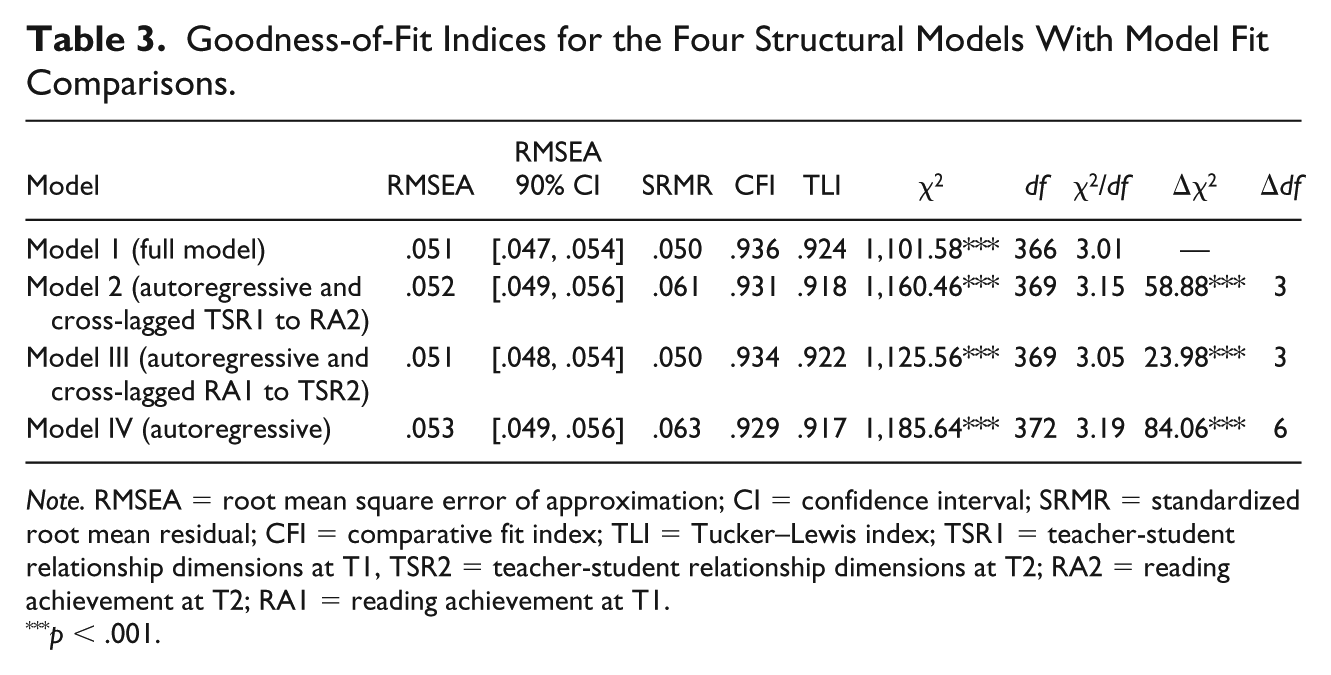
Note. RMSEA = root mean square error of approximation; CI = confidence interval; SRMR = standardized root mean residual; CFI = comparative fit index; TLI = Tucker–Lewis index; TSR1 = teacher-student relationship dimensions at T1, TSR2 = teacher-student relationship dimensions at T2; RA2 = reading achievement at T2; RA1 = reading achievement at T1.
p < .001.
The final model shows that all stability coefficients (β = .34 to .45, p < .001) were significant. These results show that reading achievement and teacher-student relatedness were generally stable over time, that is, there is a substantial influence of a particular focal variable at T1 on the corresponding variable at T2. These results are in line with the significant test–retest correlations for each of focal variables, which are presented in Table 1.
Further examination of the final model suggests that all path coefficients were statistically significant from all the dimensions of teacher-student relatedness, except from teacher alienation, at T1 to reading achievement at T2. Specifically, student-teacher communication and teacher trust at T1 served as negative (β = −.22, p < .001) and positive (β = −.12, p < .05) predictors, respectively, of reading achievement at T2, after controlling for the effects of gender, and reading achievement and general cognitive ability at T1.
The path coefficients from reading achievement at T1 to the two dimensions of teacher-student relatedness at T2 were found significant. Baseline reading achievement was found to be a negative predictor of student-teacher communication (β = −.20, p < .001) and teacher alienation (β = −.26, p < .001) in the following year, even after accounting for gender and the baseline values of the corresponding dimensions of teacher-student relatedness and general cognitive ability. However, reading achievement at T1 did not serve as a significant predictor of students’ perceived trust from their teachers at T2.
Discussion
The present study is grounded in the attachment theory, which emphasizes the importance of the presence of a caring adult who provides feeling of protection and security to a child to enable the latter to develop into a well-functioning individual. Although this study did not involve collection of data on students’ early attachment experiences, it examined how constructs pertinent to teacher-student relationships, which were drawn from the attachment theory, relate to student achievement. Our research specifically focused on the possible impact of students’ perceived relationship with teacher on their academic performance. It contributes to the existing literature base on teacher-student relatedness and students’ academic functioning by examining the reciprocal relationships between reading achievement and the three dimensions of teacher-student relatedness: student-teacher communication, teacher trust, and teacher alienation. The results of this study showed that although reading achievement had a significant positive relationship with teacher trust and a significant negative relationship with student-teacher communication and teacher alienation, only reading achievement and student-teacher communication showed a reciprocal relationship.
To unpack this reciprocal relationship, we noted that for the present sample of students, those with lower baseline reading achievement were found to communicate more with their teachers after a year, but the students who had initially better achievement scores tended to report less communication with their teachers in the following year. These findings concur with those presented in prior studies suggesting that students who perform lower than their peers tend to interact more with their teachers, usually to seek instrumental and informational support (e.g., Gall et al., 1989; Newman & Schwager, 1995); students who have higher initial achievement interact less with teachers probably because they need less assistance and are more likely to assert greater independence (Caleon et al., 2017). However, it is worth noting that for the present sample of academically at-risk students, although there were differences in the communicative efforts of initially high- and low-achieving groups (at least in relation to reading), both groups consistently reported low levels of communication with their teachers over 2 years. This finding again affirms earlier assertions (Knesting & Waldron, 2006) that students who have a history of low achievement may be reluctant to share their ideas and difficulties with their teachers. Although our study does not have the pertinent data to determine the cause of this self-reported communicative behavior of students, we speculate from the results of earlier studies that the present sample of students probably wanted to avoid being perceived as incapable or to prevent further worsening their perceived bad perceptions of their teachers about their poor performance (Knesting & Waldron, 2006; Ryan et al., 2001). This speculation, however, needs further investigation.
To further make sense of the reciprocal relationship that was surfaced in this study, we also noted from our results that the more the students communicate their ideas and feelings with their teachers at the end of their first year in secondary school, the lower their reading achievement turned out to be in the subsequent year, even after controlling for the initial level of reading achievement, general cognitive ability, and gender. The possible explanation for this unexpected finding can be drawn from the results of an earlier study suggesting that some teachers, when communicating with low-achieving students, have the tendency to express less positive affect and give more negative feedback (Weinstein et al., 1982). It is possible that a mismatch occurred between the students’ efforts to reach out and communicate their difficulties and ideas to their teachers, and the students’ actual or perceived response received from the teachers (Caleon et al., 2017). When there is a mismatch between students’ message and teachers’ response, the students who took time to reach out to their teachers but did not get the expected attention and response may end up feeling more alienated. Consistent with this assertion, we found a positive association between student-teacher communication and teacher alienation, and such a relationship became stronger in the following year. This positive communication-alienation relationship is surprising considering that communication has been regarded as a key ingredient in building relationships and reducing teacher alienation (Strom & Boster, 2007).
Compounding the patterns of relationship mentioned above is that initial reading achievement negatively predicted teacher alienation in the following year. This means that the students with relatively lower baseline reading achievement tended to feel more alienated from their teachers in the succeeding year; yet, as presented earlier, these students were also inclined to communicate more with their teachers in the school year that followed. Our findings paint the occurrence of a downward spiral for lower achieving students if nothing is done to alter the nature of the process linking students’ low academic performance with higher teacher-student communication and higher teacher alienation.
Moreover, teacher trust, as the students start their secondary year, was found to be a positive predictor of reading achievement the following year, but the reverse relationship (i.e., achievement predicting teacher trust) was not supported by our results. This finding leads to the conclusion that teacher trust is more of an antecedent rather than an outcome of reading achievement. Trust relationships with teachers that are established early in the students’ secondary school life may go a long way, particularly in relation to promoting students’ learning outcomes later on. The influence of teacher trust on students’ academic performance is consistent with the results of Goddard’s (2003) study, which indicated that teacher trust in students was positively correlated with students’ achievement (i.e., pass rates in state examinations). Our findings are consistent with the premise that when students perceive their teachers as believing in their capabilities, they tend to be more motivated and engaged in the learning process, and subsequently achieve better school outcomes.
Overall, the results of our study provide additional evidence upholding the perspective that has been widely articulated in the research literature about the importance of nurturing positive teacher-student relations in promoting students’ academic achievement (e.g., Chen, 2005; Goddard, 2003; Hamre & Pianta, 2001). In particular, the findings precipitated in the present study suggest that a classroom atmosphere where students experience care, respect, and acceptance from their teachers can positively influence students’ academic performance, such as in reading. A trusting classroom atmosphere is likely to generate stronger beneficial effects for academically at-risk students who usually come from homes with relational issues and experience greater challenges in forming positive relationships (Ramsdal et al., 2015) and accessing support (Baker, 1999; Lowenthal, 2004) outside of the home domain.
However, the results of our study also raise some concerns pertaining to the negative reciprocal relationship between student-teacher communication and academic achievement and the positive unidirectional relationship between student-teacher communication and teacher alienation, especially for the present sample of academically at-risk students, who were considered to be more vulnerable to the adverse effects of the negative facets of teacher-student relationship (Decker et al., 2007; Hamre & Pianta, 2005), such as teacher alienation. Further examination of the intermediary mechanisms that link academic achievement, teacher-student communication, and teacher alienation are needed to ascertain ways by which they can be altered toward more productive directions.
Limitations of the Study
In interpreting the findings of this study, we recommend the consideration of the limitations in our research design. First, because the study primarily used students’ self-reports, which involved information retrieval from the students’ long-term memory, there could be some inaccuracies in the retrieval process. However, our longitudinal design has reduced the risk associated with systematic error variance shared among variables associated with cross-sectional designs (Podsakoff, MacKenzie, Lee, & Podsakoff, 2003). Nevertheless, we recommend that future studies consider collection of additional data, such as observations of teacher-student interactions and teacher reports to better assess teacher-student relatedness. The collection of data on social desirability may also help ascertain how it may influence the reported findings.
Second, the present study utilized a two-wave longitudinal data that allow for the examination of relative predictive relationship between two variables over time, after controlling for the effects of the variables at previous time point. In doing this, the temporal precedence and correlational association, particularly in connection to teacher-student relatedness and achievement, which are required in making causal conclusions, can be examined (based on Perrino et al., 2008). However, we recognize that the use of a cross-lagged design cannot exclude the possibility that the identified causal relationships may be spurious and due to other unmeasured intervening factors. The potential effects of intervening variables, such as students’ motivational orientations and self-efficacy beliefs (Ryan et al., 2001) and teacher expectations (Good & Nichols, 2001), in the causal relations between academic achievement and teacher-student relationship would be worthy to explore in future studies. It would also be useful to complement the current study with follow-up studies that utilize the qualitative method of inquiry, such as those using in-depth interviews, to further probe how the quality of the teacher-student relationship operates, along with other student- and teacher-related variables, in influencing the academic path of at-risk students.
In this study, we have focused on the bidirectional relationship between students’ perceptions of their relationship with their teachers and their academic achievement. Given this bidirectional focus, we were unable to include another established determinant of students’ achievement—which is quality of teachers’ instruction or content delivery (Carbonaro & Gamoran, 2002). It would be worthy to examine the compounding or interaction effect of student-perceived quality of instruction and teacher-student relatedness on students’ achievement.
Furthermore, the absence of a cross-lagged effect between students’ academic achievement and some dimensions of teacher-student relationship does not rule out the possibility of a causal relation taking place on different time frame than that involved in the collection of our two-wave data (based on Perrino et al., 2008). It is also possible that the influence of a negative factor, such as teacher alienation, may take longer time to manifest itself in the students’ achievement, or the influence may have occurred early and then dissipated over time (based on Perrino et al., 2008). Furthermore, low variance in scores for the present sample may also be the reason for the nonsignificant findings; this is plausible considering that our sample of academically at-risk students is generally homogeneous in terms of academic ability. Thus, future studies that involve multiwave and multigroup (i.e., low risk and high risk groups) are potentially productive.
Conclusion
Notwithstanding the abovementioned limitations, the results of the present study contribute to the extant literature by advancing current understanding of the reciprocal association between teacher-student relationship and student achievement over time. In the context of educating academically at-risk students, the study provides empirical support to the view that teacher-student relatedness may influence students’ academic performance in complex ways; students’ academic achievement, in turn, also exert significant influence on the quality of subsequent teacher-student relationships. Creating supportive structures that can streamline the development of positive relational processes in the classrooms could provide a good head start for students in the early years of secondary education. The development of empirically tested interventions to enhance the quality of relationships between teachers and students, such as those emphasizing conscious efforts to provide equitable teacher treatment for both high- and low-achieving students, remains an important research agenda.
Footnotes
Declaration of Conflicting Interests
The author(s) declared no potential conflicts of interest with respect to the research, authorship, and/or publication of this article.
Funding
The author(s) disclosed receipt of the following financial support for the research, authorship, and/or publication of this article: This study was supported by the National Institute of Education Education Research Funding Programme (Project Grant Number OER 42/12 ISC).