




Abstract
Teacher expectations of students have been consistently linked with student academic achievement. What is less known is how students’ actual behaviors and performance shape teachers’ perceptions of them, particularly when considering student gender and race/ethnicity. A diverse dyadic sample of 1,653 seventh graders with 63 reporting teachers was used to examine how teaching experience, student behavioral citations, and grade point average were related to teachers’ perceptions of each student’s antisocial behavior, academic motivation, and likelihood of graduating high school. Results showed that more experienced teachers perceived students more positively, which in turn shaped more favorable perspectives of student graduation. Unsurprisingly, when students were cited for behavioral disruptions, they were perceived more negatively by teachers. Similarly, when students were more academically successful, teachers perceived them more positively. However, several nuances were found based on student gender and race/ethnicity that point to a potentially significant role of teacher expectations in student outcomes.
Keywords
Teacher perceptions of student abilities are predictive of students’ educational outcomes (Mistry, White, Benner, & Huynh, 2009; Ozdamli & Uzunboylu, 2015). However, few studies have examined teachers’ achievement expectations of students based on student characteristics as well as the experience level of educators. The present study seeks to examine whether teachers’ expectations of high school graduation vary among middle school students based on student academic and behavioral characteristics as well as teacher experience. In addition, results will be examined by student race and gender to explore differences, as past studies have found evidence to suggest that teachers incorporate demographic variables when evaluating student performance and capability (Gonzalez, Stein, Prandoni, Eades, & Magalhaes, 2015; Thomas, Caldwell, Faison, & Jackson, 2009). Of particular interest is how characteristics of students and teachers explain differing teacher perceptions of student behavior and academic performance. Furthermore, it is unknown how teachers’ subjective academic and behavioral perceptions of students compared to more objective measures of academic achievement and behavioral problems (i.e., grade point average [GPA] and behavioral citations), and how these are associated with teachers’ expectations that students will graduate from high school. The present study addresses these questions among a large, diverse, and urban population of middle school youth.
Research suggests the middle school environment, in particular, can be a critical turning point for many students. The transition to middle school can be overwhelming as students adjust to a larger set of peers, traditionally lower levels of student engagement, and encounter classroom teachers with less experience (Byrnes & Ruby, 2007). It is in the middle school environment that behaviors may emerge such as chronic absenteeism, failed courses, and school suspensions that can serve as robust indicators of subsequent high school dropout (Balfanz, MacIver, & Herzog, 2007). Given these challenges, middle school has been identified as an environment that may not adequately meet students’ needs and has been found uniquely difficult for educators, evidenced by high turnover rates among middle school teachers (Byrnes & Ruby, 2007; Clotfelter, Ladd, & Vigdor, 2007; Kiefer, Ellerbrock, & Alley, 2014; Marinell & Coca, 2013).
Teacher Expectations
Teachers’ perceptions and expectations of their students’ academic performance and future success contribute significantly not only to student academic outcomes (Boser, Wilhelm, & Hanna, 2014) but also to their academic self-esteem (Rosenberg, Schooler, Schoenbach, & Rosenberg, 1995). When teachers have low or negative expectations regarding student performance, students tend to expect less of themselves and perform more poorly (Jussim & Harber, 2005). It should be noted that the relationship between teacher expectations and student self-esteem may be cyclical in nature. In other words, teacher expectations may have an impact on students’ academic self-esteem, which in turn has an impact on the students’ outcomes, thus further affecting teacher expectations of those students (Jussim & Harber, 2005; Mistry et al., 2009).
Teachers have been found to communicate their expectations and preferences for students, whether high or low, through both implicit and explicit communication and opportunities for learning in the classroom (McKown & Weinstein, 2008; Rubie-Davies et al., 2014), and can also unwittingly communicate attitudes about students’ abilities and expectations through their classroom instructional practices (Graham, 1990; Peterson, Rubie-Davies, Osborne, & Sibley, 2016). Rubie-Davies (2006, 2007, 2010) found that teacher expectations of high or average performance were connected to higher student self-perception of ability. Students in the low expectation group of Rubie-Davies’ study were aware of and reported experiencing the teacher’s low expectation behaviors. Low teacher preference, as perceived by students, has been associated with lower GPA and higher school absenteeism (Gorman, Kim, & Schimmelbusch, 2002). Likewise, classroom behaviors, which are influenced by teachers’ perceptions of students, stimulate or deteriorate the learning environment. Often, the mechanisms enhancing or deteriorating classroom learning include direct promotion or harm to students’ academic motivation and achievement, potentially resulting in a lag in effort on the part of both teachers and students (Trouilloud, Sarrazin, Bressoux, & Bois, 2006; McGraw, Lubienski, & Strutchens, 2006).
High teacher expectations tend to correlate with high student achievement (Figlio & Lucas, 2000), but this association is complex, involving diverse and/or subjective bidirectional influences between teachers and students. Aside from student achievement, teacher expectations also contribute to adolescent psychosocial well-being and student academic motivation (Ikeda, Crawford, & Woodward-Lopez, 2006; Kiefer et al., 2014).
Antisocial Behaviors
Students who display behavioral and emotional problems in the classroom setting tend to experience more academic failures that impede their adolescent outcomes (Metsäpelto et al., 2015). Studies indicate that teachers exhibit preferences for students who display prosocial skills and low levels of antisocial/externalizing behavior (de Jong, Koomen, Jellesma, & Roorda, 2018). Students who may be perceived as dangerous or deviant by teachers are at risk of stigma and labeling, which get communicated to the students in myriad ways (Major & O’Brien, 2005; McKown & Weinstein, 2008; Thornicroft, Rose, Kassam, & Sartorious, 2007; Weinstein, Gregory, & Strambler, 2004). When teachers apply negative stereotypes and/or labels to students, an indirect measure of stigma can emerge that serves to lower educational expectations (Shifrer, 2013).
Teaching Experience
Teaching experience has been found to have nonlinear effects on student achievement, with teachers becoming more effective in the first 5 years of teaching and then experiencing a decrease in student achievement, as measured by student test scores (Goldhaber, 2008; Kane, Rockoff, & Staiger, 2006). However, other research examining the effects of middle school teachers indicates that they continue to increase their effectiveness over time, with some plateauing after 12 years (Ladd & Sorensen, 2017). Research has also shown that more years teaching has a positive association with students’ nontest outcomes such as absenteeism, suspensions, classroom disruptions, academic performance, and engagement in pleasure reading in ways that promote educational outcomes and progression toward graduation (K. Jackson, 2012; Ladd & Sorensen, 2017). The current study seeks to examine teaching experience as a key factor that might influence teacher perceptions of students related to predictions of their future academic outcomes and achievement.
Racial and Gender Considerations
Prior research has found that teachers may perceive student behavior and performance differently based on the race/ethnicity and gender of the student. Studies have consistently evidenced teachers rating minority students more harshly in terms of behavioral conduct and academic performance (Gonzalez et al., 2015; Thomas et al., 2009; Zimmerman, Khoury, Vega, Gil, & Warheit, 1995). Connectedness with academic education has been identified as an important, long-term protective factor for minority youth (Thompson & Gregory, 2011) and racial or ethnic bias in teachers’ perceptions of students may pose as a significant risk factor for student success. There is also evidence to suggest that the same student-teacher ethnic match results in more favorable perceptions for that student from their teachers of the same ethnicity (i.e., White teachers giving more favorable predictions to White students; Saft & Pianta, 2001). For example, Gershenson, Holt, and Papageorge (2016) investigated whether teacher expectations were systematically biased based on teacher-student race/ethnicity match. The results found that non-Black teacher expectations for Black students were significantly lower than those of Black teachers, particularly for Black male students. Similarly, Grissom, Rodriguez, and Kern (2017) found that schools with more Black teachers had more Black students enrolled in “gifted” student programs, although the relationship between racial diversity within specific schools and gifted enrollment programs is unclear. It is worthy to note that racial/ethnic considerations vary beyond an individual’s minority status, as studies have shown significant differences, both beneficially and detrimentally. Asian students, for example, have been shown to outperform other minority and majority racial/ethnic groups (Suinn, 2010), while another study revealed that Latino children had poorer emotion regulation skills at younger ages than Black children (Garner & Mahatmya, 2015). These results suggest the benefits of investigating minority status individually as opposed to aggregately.
Similar to race, Saft and Pianta (2001) found that gender and gender by ethnicity were significant predictors of teachers’ assessments of the student-teacher relationships. Teachers have been found to perceive males more negatively, particularly in a study focused on socioeconomic status where lower income boys were judged more harshly than lower income girls using a hypothetical academic scenario to compare groups (Auwater & Aruguete, 2008). There may also be gender biases regarding student behavior, as Veenstra et al.’s (2008) study found that teachers perceived teenage boys as more antisocial than girls. Furthermore, Rodkin, Farmer, Pearl, and Van Acker (2000) showed evidence that teachers and peers perceived antisocial behavior as more socially acceptable in boys than in girls. Conversely, girls have often been characterized as more well-behaved (Myhill & Jones, 2006), more interested in their studies, and overall more academically responsible, whereas boys were perceived to be more maladjusted (operationalized as more aggressive and excitable) than girls (Aluja-Fabregat, Ballesté-Almacellas, & Torrubia-Beltri, 1999).
It should be noted, however, that it is difficult to determine whether student behavior and achievement determine teacher perceptions or whether teacher perceptions promote student behavior and achievement. Regardless of the nature of this association, once a negative pattern of interaction begins between students and teachers, it tends to endure throughout students’ academic experiences in terms of both student-teacher relationships and the classroom environment (Jennings & Greenberg, 2008; Sutherland, Lewis-Palmer, Stichter, & Morgan, 2008).
Theoretical Foundation
While there is no specific theory that explicitly predicts student academic success from teachers’ experience, the ecological approach to person perception theory (McArthur & Baron, 1983) seems relevant. This theory proposes that an individual’s ability to make accurate predictions about future situations is based on certain individual traits developed within their specific niche as well as the specific attunements individuals acquire through their experience in a specific domains. In other words, experts in specific fields of study may be able to make predictions with greater accuracy because of such expertise. Because teachers have specific training and experience in dealing with students and academic success, they may be uniquely attuned for predicting the eventual success of their students above and beyond others who are not teachers. This relationship may be augmented over time, as greater experience may enhance teacher’s ability to foresee future achievement/failures. Evidence has shown positive correlations between teachers’ years of classroom experience and successful pedagogy (measured by student achievement in math scores; Rice, 2013). Thus, it can be assumed that an experienced teachers could quickly recognize patterns and indicators of their students (based on observations and interactions) to determine the likelihood of their students’ future academic achievements. In addition, experienced teachers have had more opportunities to develop a wider range of classroom skills than brand new teachers, which they can access and implement in their classrooms to support their students’ goals and achievements (Berliner, 2001, 2004). However, their predictions may only be valid to the students they instruct (as opposed to other students in different classes/schools) due to the key affordances that their own students display.
A key feature of the current study is the partitioning of models by demographic variables (male/female and White/Black/Latino) to assess whether gender or race moderated the model by subgroups. Thus, although the Ecological Approach to Person Perception theory explains the rationale for teachers being able to assess the future outcomes for their students, it does not adequately explain judgments that may detrimentally or beneficially influence a teacher’s prediction of certain subgroups (although, teachers in predominately racial/ethnic schools may have more accurate perceptions/predictions of academic success among minority groups). Social Identity theory (Tajfel, 1978, 1981) involves the process of constructing group labels and categories predicated on the various traits and behaviors of others. This is especially useful for analyses pertaining to intergroup comparisons and structures (Phenice & Griffore, 2000). When assessing a student’s potential for academic success, a teacher may impose their perceived stereotypes of the larger group that student belongs to, regardless of whether that student embodies those perceived stereotypical traits. Those perceived stereotypes may come from a teacher’s own identity (i.e., bilingual teachers forming opinions on bilingual students), or their experiences with other identities different from theirs (i.e., a Black teacher forming opinions on Latino students). Phenice and Griffore (2000) argue that favorable judgments are given to members of the same matched-identity group, although evidence suggests that this may not always apply to minority groups. For instance, minority groups may perceive negative stereotypes about others in their own group compared to the majority (see Clark & Clark’s, 1947, noteworthy experiment in which Black children preferred White dolls). This may play out regarding teachers’ expectations as minority teachers may also have negative stereotypes embedded in their predictions—a situation often termed “implicit bias.”
Summary
Based on previous literature linking teacher expectations and student achievement, the following four research questions and associated hypotheses were developed: First, do objective student variables (GPA and behavioral citations) predict teachers’ perceptions of subjective student variables (antisocial behavior and academic motivation)? We expect a positive significant relationship between behavioral citations and antisocial behavior, as well as GPA and academic motivation. Conversely, we expect negative statistical associations with antisocial behavior and GPA/academic motivation, as well as behavioral citations and GPA/academic motivation. Our second research question examines whether the student variables of GPA and behavioral citations and the teacher variable of teaching experience affect teacher’s perceptions of student behavior (antisocial behavior and academic motivation). Third, do the objective variables (GPA, citations, teaching experience) or subjective variables (teacher’s perceptions of antisocial behavior and academic motivation) adversely affect, either directly or indirectly, teachers’ expectations regarding high school graduation? To that extent, we expect that when teachers rate students negatively in terms of academic motivation and antisocial behaviors, they would also be more likely to rate the same students as less likely to graduate from high school. Analyses will also examine whether teacher experience plays a role in their perceptions of students and expectations of graduation. Our fourth research question examines whether the proposed model holds true when partitioned by gender and/or race/ethnicity. For this research question, our hypothesis posits that teachers will have more favorable graduation expectations for females than males, and more favorable graduation expectations for White students compared to Black or Latino students.
Method
Sample
All public middle schools within the school district of a large, Midwestern urban city participated in the current study. Each school received US$200, each student US$5 and each teacher US$40 for participation. The current study included all seventh-grade students and their homeroom teachers. The final student sample included 1,832 seventh graders throughout the district. A total of 63 teachers completed a questionnaire reporting on their personal characteristics as well as characteristics, perceptions, and expectations of participating students in their class. Complete dyadic teacher and student data were available for 1,653 students.
Data Collection Procedure
The research team administered surveys in teams of two or three during 40-minute class periods in the presence of the classroom teacher. At the beginning of each class period, the study’s purpose, procedure, risks, and benefits were given to the students. Subsequently, a researcher read the survey aloud to participants. Spanish-speaking ESL (English as a Second Language) students were administered the survey in Spanish. GPA and citation information were supplied by the school. All data were anonymized by ID number, and researchers had no way of linking IDs to student names. Surveys took approximately 35 minutes to complete. Using class attendance sheets, teachers reported on each student who was present in their class on the day of the survey by way of student ID (thus linking teacher and student data). It should be noted that all data were collected on a single day across schools.
Measures
Student demographic variables
Students were asked a single item to assess race/ethnicity: “With which race/ethnicity do you most closely identify?” Responses were coded into separate racial/ethnic minority groups (1) or otherwise (0). If multiple race/ethnicity categories were selected, “Hispanic/Latino” was given first priority and “Black” was given second priority (i.e., if a person marked “White” and “Hispanic/Latino,” they were coded as the latter). Race/ethnicity was then dummy coded to compare Black (1) and then Hispanic (1) students to the reference group, White (0). Gender was coded male (0) and female (1).
Teacher demographics
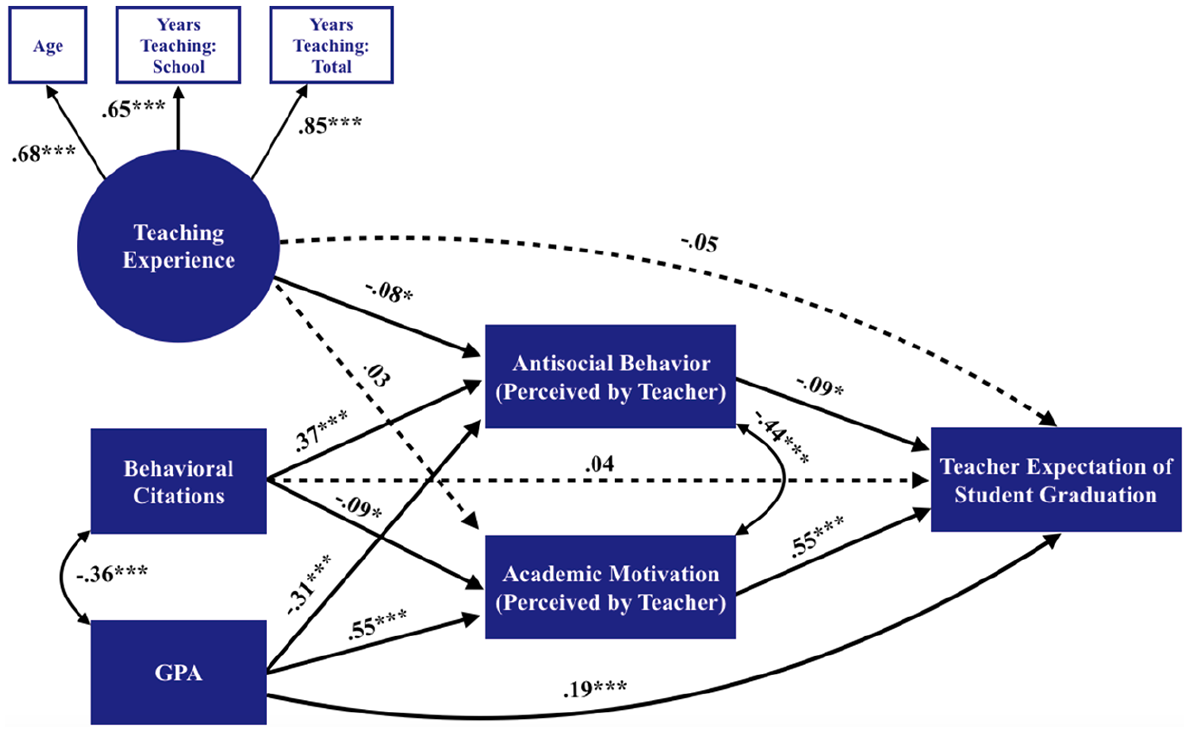
Teaching experience was reported by teachers as total years of teaching experience, and total years teaching in current school. Teachers also self-reported their age. Total teaching experience, experience at current school, and age were used in a confirmatory factor analyses to derive the final teaching experience variable. The factor loadings were .68, .85, and .65 for teacher age, years of total teaching experience, and year of teaching at the given school, respectively (χ2 = 32.03, df = 1, p = .001, comparative fit index [CFI] = .95). Student data were linked with their respective teacher and concomitant teacher data.
Teacher perceptions of students
Teachers responded to 21 items rating each student in terms of academic, social, and behavioral characteristics adapted from the Teacher Observation of Classroom Adaptation–Checklist (Koth, Bradshaw, & Leaf, 2009). These items were and separated into two subscales—academic motivation and antisocial behavior. Academic motivation (operationalized by Koth and others as “concentration problems”) was measured by nine statements which described typical student behavior in terms of academic motivation, to which teachers responded from 1 (never) to 4 (always). Total student motivation scores ranged from nine to 36, with a higher score indicating greater academic motivation (Cronbach’s α = .93). Antisocial behavior was assessed by combining “disruptive behavior” and “prosocial behavior” (reverse coded) from Koth and others’ study. It was measured by a 12-item scale answered by teachers regarding students’ social behaviors and experiences. Total student social behaviors scores ranged from 12 to 48, with higher scores reflecting more antisocial behavior on the part of the student as perceived by the teacher (Cronbach’s α = .64).
Teacher graduation expectations
The dependent variable in this study is teachers’ responses to the following question for each participating student: “What are the chances this student will graduate high school?” Responses ranged from 1 (very low) to 4 (very high).
Student GPA
In order to assess academic performance, schools provided GPAs for each participant, for each semester of the academic year. Used in the present analysis are students’ cumulative GPAs at the end of seventh grade (min. = 0.57, max. = 4.00,
Student behavioral citations
Schools reported the number of behavioral citations students had received during each academic semester of middle school. The total number of citations the student received during seventh grade was used in the analysis. The mean number of citations for the total sample was 1.02. Examined by demographics were 0.52 for Whites, 1.72 for Blacks, 0.86 for Latino, 1.27 for boys, and 0.76 for girls.
Analyses
To answer the first research question concerning variable relationships, we used the Statistical Package for the Social Sciences (IBM SPSS release 23.0) by conducting bivariate correlations. To answer the next three research questions concerning how these variables interface amongst each other, we utilized structural equation modeling (SEM) to assess associations among teacher perceptions and student performance predicting expected chances of student graduation from high school (reported by teachers). Because we believe that teachers may form their opinions from objective student measures (GPA and behavioral citations) and their teaching experience, we proposed the model starting with these variables predicting the teacher perception variables. This ultimately leads (both directly and indirectly) to teachers’ predictions of student graduation (see Figure 1). We also tested invariance between gender and race/ethnicity in a multigroup model (Byrne, 2013). This is assessed by fully constraining each model, then comparing the chi-square values by a difference test to investigate gender and race differences. All SEM analyses were conducted using Mplus software (version 8.0; Muthén, & Muthén, 2010), which tested both direct and indirect effects of the variables, as well as overall model fit.
Measurement and structural models are deemed to fit the data when the RMSEA estimate is less than .05, the RMSEA probability is above .05, the SRMR is below .08, and CFI is above .95 (Klein, 2011).
Multilevel frameworks
Because our data present students within classrooms and teacher ratings for students in their respective classroom only, the nesting of these data must be addressed. As with all nested data, multilevel analyses are helpful in investigating tiered groups of data on a “within” and “between” groups basis (e.g., Level 1 is a student-derived model, and Level 2 is students nested in classrooms). Essential to this process is examining the intraclass correlations (ICCs) to assess whether the data present true independence amongst one another, or if the data have nested qualities based on the grouping of those data (Musca et al., 2011). As such, we first ran our SEM within a multilevel framework. ICCs deemed the data to have a significant level of dependence within a teacher nested level (ICC for teacher predictions was .124) as well as having a “design effect” (quantification for the effect of independence violations on standard error estimates) being greater than 2—a common threshold for multilevel tests of independence (Muthén & Satorra, 1995). However, although the model presented suitable fit statistics, the Level 2 parameter estimates were negligible (e.g., only one pathway was significant on the teacher level), thus signifying that although our data are indeed nested, a multilevel modeling gives no added benefit by presenting null teacher-level effects.
Instead, we have opted to analyze the SEM through complex clustered modeling (Muthén & Muthén, 2007). Complex modeling gives a model for the entire population while taking into account the nested sampling scheme that causes nonindependence between the observations. Mplus allows for complex modeling (“TYPE=COMPLEX”) that uses a sandwich estimator in considering in the main substantive analyses that students are grouped in teacher classrooms. In essence, complex modeling accounts for the nested data when multilevel frameworks are not beneficial in presenting higher ordered, between groupings of data.
Results
About half of the students in the sample were female (49.0%), with the largest ethnic group reported as Latino (40.3%), followed by Black (26.4%), White (21.0%), Native American (4.4%), Asian/Pacific Islander (4.3%), and Other (3.6%). The mean GPA among students was 2.77 (SD = 0.70) and students had an average of one behavioral citation each. Half of the teachers in the sample were female (52.3%), with the majority of teachers being White (61.9%; 37.5% Black, 0.6% Latino). The mean age of teachers was 45 years (SD = 15.03) and on average they had been teaching for approximately 15 years (14.62) with about 6 years (5.85) spent at their present school.
Full Model
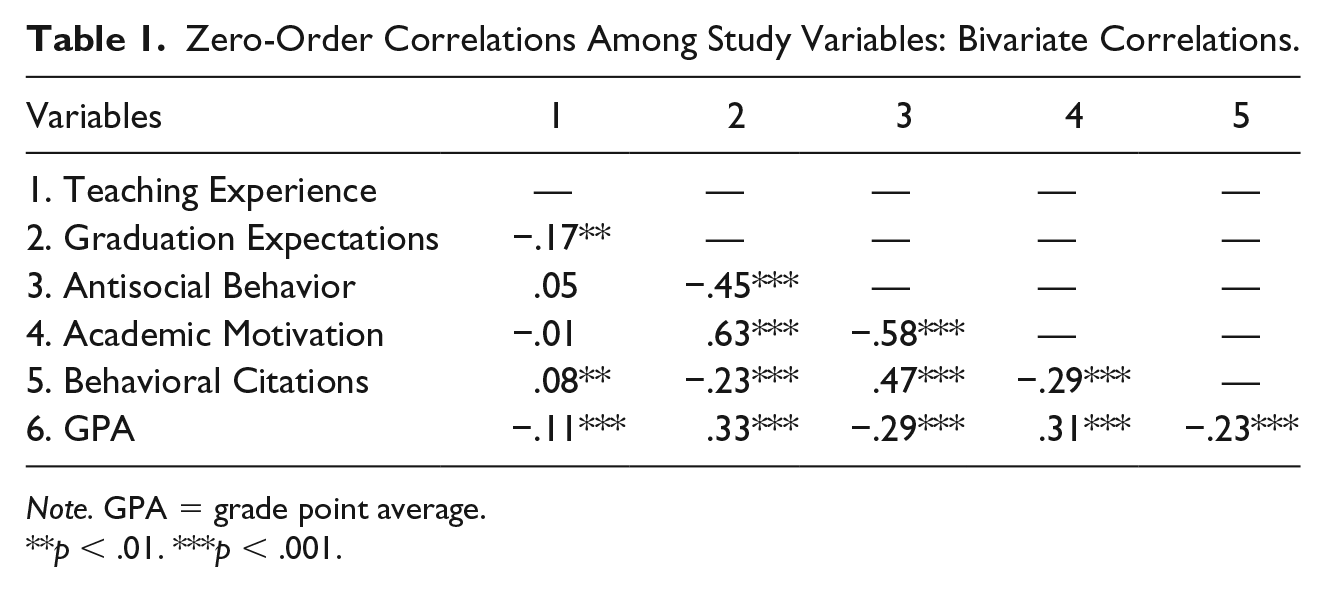
Correlations among the variables in the model were first examined to investigate whether objective student variables predict teachers’ perceptions of subjective student variables. With the exception of teacher-perceived antisocial behavior and teaching experience (p = .16), all study variables were significantly correlated (see Table 1). As expected, teacher’s predictions of students’ chances of graduation were positively and significantly associated with academic motivation and GPA, and negatively associated with antisocial behavior and behavioral citations (all at the p < .001 level). Antisocial behavior had negative associations with academic motivation and GPA, and positive associations with behavioral citations (also at the p < .001 level).
Zero-Order Correlations Among Study Variables: Bivariate Correlations.
Note. GPA = grade point average.
p < .01. ***p < .001.
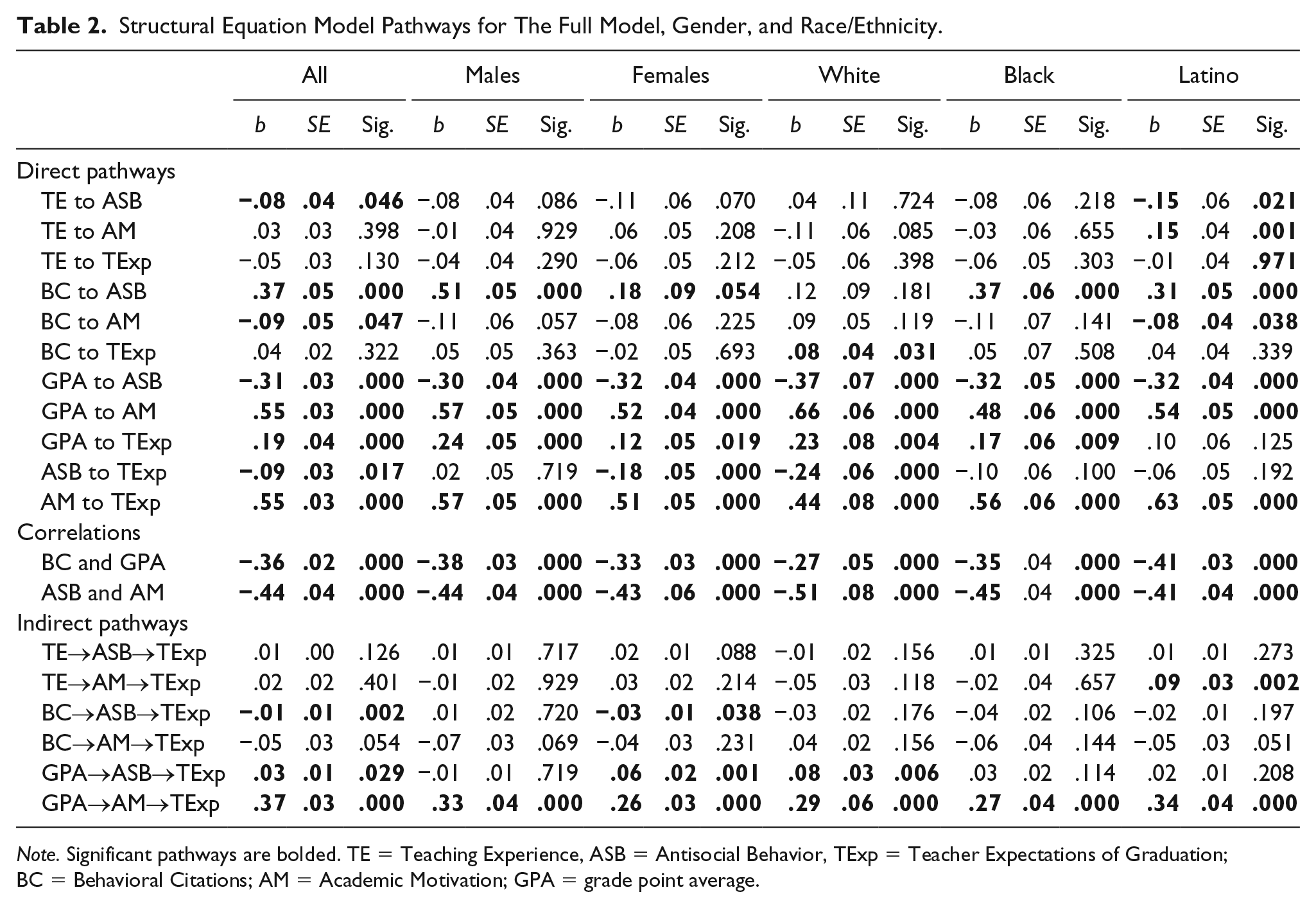
In examining our second and third research questions (the second being whether the objective measures of GPA/citations/teaching experience affect subjective teachers’ poorer perceptions of students through antisocial behavior and academic motivation, and the third of whether both objective and subjective variables adversely affect teachers’ expectations regarding high school graduation), an SEM model was constructed in order to test the direct and indirect associations. The full model was run to first test for good fit. Global fit statistics indicated good fit, χ2(20) = 70.640, p = .000, CFI = .98, root mean square error approximation (RMSEA) = .04, standardized root mean square residual (SRMR) = .04 (Klein, 2011) with student gender and race/ethnicity used as control variables. Figure 1 provides a visual representation of the full model, while Table 2 reports coefficients, standard errors, and p values for all direct and indirect models. Reporting more years of teaching experience was negatively and significantly related to teacher perceptions of antisocial behavior (b = −.08, p < .05), but was not significantly related to teacher-perceived academic motivation or teacher graduation expectations (b = .02, p = .398 and b = −.05, p = .130, respectively). Student behavioral citations predicted teacher-perceived antisocial behavior (b = .37, p < .000) and perceived academic motivation (b = −.09, p < .05), but were not directly associated with teacher graduation expectations (b = .04, p = .322). In other words, teachers were more likely to perceive higher levels of antisocial behavior and lower academic motivation of students who received more behavioral citations. GPA was negatively related with teacher-perceived antisocial behavior (b = −.31, p < .000), and positively related with both teacher-perceived academic motivation (b = .55, p < .000) and teacher graduation expectations (b = .19, p < .000). Teachers who rated students higher in antisocial behavior also reported lower expectations that the students would graduate (b = −.09, p < .05). Conversely, teachers who rated students higher in academic motivation had higher expectations of student graduation (b = .55, p < .000).
Structural Equation Model Pathways for The Full Model, Gender, and Race/Ethnicity.
Note. Significant pathways are bolded. TE = Teaching Experience, ASB = Antisocial Behavior, TExp = Teacher Expectations of Graduation; BC = Behavioral Citations; AM = Academic Motivation; GPA = grade point average.
The number of student behavioral citations was significantly associated with unfavorable teacher expectations of graduation through teacher-perceived antisocial behavior (b = −.01, 95% confidence interval [CI] = [−.02, −.00], p < .01). Students who received more behavioral citations were perceived as more antisocial by teachers, which decreased teachers’ expectations of graduation. Higher GPA had the opposite effect, contributing to significantly lower levels of teacher-perceived antisocial behavior (b = .03, 95% CI = [.01, .06], p < .05) and higher levels of teacher-perceived academic motivation (b = .37, 95% CI = [.31, .45], p < .000), which in turn both increased teachers’ expectation of graduation.
Gender
In investigating our fourth research question regarding whether the model holds true with respect to differences in demographics, multigroup models (Byrne, 2013) were examined to determine potential differences in results based on gender and race/ethnic subgroups. Models based on gender were compared where one model constrained parameters to be equal across males and females and one model was allowed to freely vary. The freely estimated model was significantly improved, χ2(16) = −56.193, p < .000, indicating gender was a significant moderator of the model. Most associations were similar for males and females with the exception of three pathways. Although behavioral citations were positively associated with teacher-perceived antisocial behavior for both males and females, the magnitude of the association was pronounced for adolescent boys (b = .51, p < .001 vs. b = .18, p ≤ .05 for girls). Behavioral citations were approaching significance in a negative relationship with teacher-perceived academic motivation in males (b = −.11, p = .057), but not significant for females (b = −.08, p = .225). Higher levels of teacher-perceived antisocial behavior among girls significantly reduced teachers’ expectations of graduation (b = −.18, p < .001); however, this association was not significant for adolescent boys (b = .02, p = .719).
There were several differences in indirect pathways based on gender. The indirect pathways linking student behavioral citations and GPA to teachers’ graduation expectations via antisocial behavior were also only significant for females and not for males (b = −.03, 95% CI = [−.06, −.01], p < .005 and b = .01, p = .720, respectively). This suggests that fewer behavioral citations and higher GPA among adolescent females significantly shaped teacher’s perceptions of antisocial behavior, which increased teacher expectations of female students graduating from high school. Behavioral citations and GPA did not yield similar expectations for male students. While higher GPAs generally improved teachers’ perceptions of students’ academic motivation for all students, behavioral citations were only perceived to decrease academic motivation, and ultimately lower expectations of graduation, for male students.
Race/Ethnicity
The three largest races/ethnicities were examined in separate models (all races/ethnicities were included in the full model). Other races/ethnicities were not separately examined due to low sample sizes. Like gender, constrained and unconstrained models based on student race/ethnicity were compared to detect group differences. The freely estimated model was significantly improved, χ2(80) = −194.345, p < .000. There were several key differences in the model, based on race/ethnicity. First, the negative association found between teaching experience and teacher-perceived antisocial behavior was only significant for Latino students (b = −.15, p < .005), but not White or Black students. Second, teaching experience was not significantly linked to teacher-perceived academic motivation for Black or White students; however, teaching experience was significantly related to teacher-perceived academic motivation for Latino students (b = .15, p < .01). Explained further, more experienced teachers characterized Latino students as more academically motivated while having no significant associations in White or Black students. Behavioral citations were associated with lower teacher-perceived academic motivation among Latino students (b = −.08, p < .05), and a higher graduation expectation among White students (b = .08, p < .05). Finally, when a teacher perceived a White student as antisocial, they also held lower expectations of them to graduate from high school (b = −.26, p < .001). This was not found for Black or Latino students.
When examining indirect pathways by race/ethnicity, there were two distinct group differences. More experienced teachers tended to expect students to graduate when they perceived students to have a higher academic motivation, but this indirect pathway was only significant for Latino students. The pathway linking higher GPA with lower perceived antisocial behavior and greater expectations of graduating was only significant for White students. Drilling deeper into these model differences using independent-samples t test, results show that, overall, teachers were significantly more likely to expect White students to graduate—
Discussion
The current study focused on teachers’ perceptions of seventh-grade students in terms of actual and perceived behavior problems and academics, as well as teacher expectations of whether students were likely to graduate from high school in the future. Results showed that, not surprisingly, when students were cited for actual behavioral disruptions, they were perceived more negatively by teachers. Similarly, when students were more academically successful, teachers perceived them more positively.
Teacher Perceptions of Adolescent Boys Versus Girls
While behavioral citations were linked with teachers’ perceptions of students as antisocial, this finding was double in magnitude for teenage boys. This mirrors Veenstra et al.’s (2008) findings that teachers perceived teenage boys as more antisocial than girls. Perceived antisocial behavior only decreased expectations of graduation for girls, suggesting that perhaps teachers may perceive some level of behavioral misconduct as normative from early adolescent boys and, therefore, expect that such behaviors will not prevent them from graduating. However, these same behaviors among girls were seen as obstacles to graduation. This aligns with the notion that the social value of antisocial behavior may be perceived as more acceptable for boys than girls, as Rodkin et al. (2000) also highlighted in a study of popularity among preadolescents. Rodkin et al. found that boys can be perceived as popular by their teachers and peers even when they display aggressive and/or antisocial behavior. Because of the significance of teacher expectations in shaping students’ classroom behavior and achievement (Figlio & Lucas, 2000), it is difficult to disentangle which comes first—teenage boys’ disruptive behaviors or teachers’ perceptions of boys as more likely to engage in antisocial behaviors. Because adolescent girls are assumed to be more well behaved (Myhill & Jones, 2006), teachers’ interactions with them over time may reinforce this positive view, which benefits female students. Longitudinal research examining this dynamic would help determine whether teachers’ expectations of teenage boys are actually a self-fulfilling prophecy contributing to a broader view that it is normal for boys to have behavior problems (i.e., “boys will be boys” mentality). Research on the self-fulfilling nature of teachers’ expectations regarding students’ academic abilities suggests this may be the case (Figlio & Lucas, 2000). The potential expectancy effects based on gender are concerning, particularly when considering that antisocial behavior connected with a person’s gender identity or sexual orientation is negatively linked with school connectedness (Collier, van Beusekom, Bos, & Sandfort, 2013).
Teaching Experience, Perceptions of Student Outcomes, and Race/Ethnicity
Teachers’ perceptions and expectations of students also varied based on student race/ethnicity. While years of teaching experience was unrelated to teacher perceptions or expectations of White or Black students, with more time and experience in the classroom, teachers viewed Latino students in a more favorable light. It is possible that teachers enter the teaching field with a somewhat implicit biased view of minority students, particularly Latino youth, based on the prevalence of data suggesting these students possess greater risk factors for behavior and academic problems (Gonzalez et al., 2015). However, after direct experience working with Latino students, teachers are able to have a more individualized view of students apart from population statistics they may have learned in a teacher preparation program. This is not to minimize challenges facing Latino populations in the United States that interfere with school success (Benner & Graham, 2011; Garcia-Joslin et al., 2016), but to point out that present study findings suggest that more experienced teachers are able to see past generalized risk factors to view students as well-behaved and capable individuals, regardless of race/ethnicity. In addition, previous research has found that, although new teachers may enter the field feeling well prepared (knowledge-wise), knowledge does not immediately translate to effective teaching practices (Ronfeldt, Matsko, Nolan, & Reininger, 2018).
Similarly, differences emerged based on students’ actual behavioral misconduct and teachers’ perceptions of them as being antisocial or delinquent. Actual behavioral disruptions were only linked with more negative teacher perceptions for students of color, and the magnitude of this association was similar among Black and Latino students. This finding suggests that when a White, Black, and Latino student each receive a citation for bad behavior, teachers perceived the minority students more negatively than the White student. This is consistent with findings throughout previous literature describing minority, particularly Black, youth as being perceived more negatively and receiving harsher punishments when engaging in the same behaviors as their White peers (Thomas et al., 2009; Zimmerman et al., 1995). Furthermore, the link between actual student behavior citations and teachers’ perceptions of academic motivation was only significant for Latino students. Because the majority of teachers in this study were White, and the majority of students were minorities, a possible explanation for the disparities in student perceptions could be explained by Social Identity Theory. In other words, although all students received behavioral citations, White teachers may perceive minority students with citations less favorably, White students with citations more favorably, or a combination of both.
Actual academic performance (measured by GPA) increased teachers’ expectations that students would graduate for all students except Latino youth. Perhaps there are other barriers unrelated to GPA that teachers believe are unique to Latino students and their families that will interfere with school completion. Given that the indirect effects of teacher experience through perceived academic motivation of Latino youth were related to higher expectations that Latino students would graduate, it may be that with time and experience, teachers find ways to work around contextual risk factors to support students’ academic motivation. Teacher investment in student academics and more positive expectations for success have consistently shown to contribute to actual student achievement (Figlio & Lucas, 2000). The role of experience and positive regard may be particularly important for Latino students, as research has shown that teacher support can be particularly beneficial for their school satisfaction, behavior, and academic success (i.e., time spent on homework and grades; Woolley, Kol, & Bowen, 2009).
Perceptions of students’ antisocial behavior only decreased graduation expectations for White students, which is a perception that is likely related to the fact that, overall, teachers had lower expectations of graduation for Black and Latino students. Indirect models offer some support for the assumption that “smart kids” (with higher GPAs) are also “good kids” (perceived as less antisocial) who are likely to graduate high school. However, only White students benefited from the indirect “smart kid-good kid” model in terms of teachers expecting students to graduate from high school—another explanation that could be explained by Social Identity Theory. The apparent gaps between teachers’ content-preparedness, classroom effectiveness, and internalized bias point to a need for enhanced applied or service-learning-oriented components to teacher preparation programs (beyond a single student-teaching internship; Ronfeldt et al., 2018).
Limitations
This study enhances our understanding of the ways teachers view student behaviors as precursors to academic success and graduation. However, the current findings should be considered with some limiting factors. One element not explored in this study, which may have generated meaningful results, is the examination of teacher ethnicity by student ethnicity, as discussed previously in the literature review of this article. It is unclear whether teacher-student ethnic (and gender) matching (as well as gender by ethnicity matching of the student) affects the perceptions differently than examining models of a homogeneous teacher group (the majority of our teachers were White, and the majority of the students were minorities). Next, direct observations in the classroom might have given indications of whether or not students with different backgrounds/subgroups are treated differently. With respect to teacher training, various studies have found forms of teacher preparation/training to be predictive of student success (Cheon & Reeve, 2013), and as such could have produced different results had this study included that variable in the original data collection. Nevertheless, having graduation data on those students would provide insights into true and false expectations of teachers. Finally, as previously discussed in this article, the reciprocal nature of teacher expectations and student success was not investigated in this study. The cyclical effect of teacher expectations affecting student performance (and vice versa) should be longitudinally considered when examining teacher predictions. It should be noted that these limitations may dually serve as future directions in the examination of teacher’s predictions of student success.
Conclusion
Results from this study demonstrate the important role teachers’ perceptions of students play in their overall expectations of student success. Teacher expectations are consistently linked with student achievement (Figlio & Lucas, 2000) and can affect student engagement with school (Thompson & Gregory, 2011). However, taking a step back from expectations to examine how teachers perceive individual students, and how that perception relates to their expectations of that student, sheds insight into how classroom dynamics and teacher-student relationships can potentially affect students’ academic success years down the road (Jennings & Greenberg, 2008).
Finally, responsive teaching practices could be measured and analyzed in future studies for their impact on teacher expectations and student motivation. Though this particular area was not explored in the present study, the accompanying review of literature suggests that successful middle school students are often the recipients of responsive teaching practices that engage them in active, purposeful learning and challenge them with high expectations. When there is a fit between students’ developmental needs and classroom opportunities, a responsive environment results. This responsive environment motivates student interest and engagement in new and varied ways as the students mature and their needs change (Eccles, 2004). Perhaps the connection between responsive teaching practices and teacher expectations of diverse student bodies warrants further consideration.
Footnotes
Declaration of Conflicting Interests
The author(s) declared no potential conflicts of interest with respect to the research, authorship, and/or publication of this article.
Funding
The author(s) received no financial support for the research, authorship, and/or publication of this article.
