




Abstract
The current study aimed to examine whether executive functioning (EF) moderates the expected association between poor parental supervision and emotional-behavioral problems among early adolescents with and without a migration background in Italy. In total, 97 Chinese immigrant and 165 Italian nonimmigrant early adolescents, aged 11 to 13 years (52% girls), completed a series of performance and computer-based tasks assessing their EFs, whereas primary caregivers rated their own parental supervision and their offspring’s emotional-behavioral problems. Regression analyses indicated that in both groups, a better working memory capacity was associated with fewer problems. Moreover, low levels of inhibitory control strengthened the association between poor parental supervision and emotional-behavioral problems. In addition, among Chinese immigrant youth, higher levels of cognitive flexibility enhanced the link between poor parental supervision and emotional-behavioral problems. Results underscore the importance of parental supervision and EF processes for Chinese immigrant youths’ psychological functioning.
Keywords
Early adolescence is a critical time for the onset and development of emotional-behavioral problems, especially among immigrant youth (Dimitrova, Chasiotis, & van de Vijver, 2016). Although Chinese immigrants are considered a “model minority” in terms of academic performance, researchers increasingly emphasize the need to focus on the overlooked emotional and behavioral adjustment outcomes in this population. For example, recent evidence reports more psychological difficulties in Chinese immigrant compared with other minorities (Cheah, 2016; Okamura et al., 2016). Thus, understanding both universal and specific individual and contextual factors linked to such difficulties is paramount to identify potential protective and/or risk factors which may guide the implementation of effective prevention and intervention programs with youth in multicultural settings (Zhou et al., 2012).
In this article, we draw on a recently proposed model by Zhou et al. (2012) to study Asian minorities’ emotional-behavioral adjustment. The authors selectively review theory and empirical evidence concerning asset and protective processes and variables linked to mental health in Asian minority youth. Their model proposes that proximal contextual factors (e.g., parenting) might interact with both cultural (e.g., ethnic background) and individual (e.g., executive functions [EFs]) variables to explain youths’ psychological adjustment. This model assumes that Chinese immigrants are embedded within layers of environmental systems and underscores the importance of interactive influences on the development of Asian immigrant youth.
In line with this theoretical framework, we examined whether distinct components of EFs (i.e., working memory, inhibitory control, and cognitive flexibility) moderate the expected association between poor parental supervision and emotional-behavioral problems in early adolescents with and without a migration background. Specifically, we compare Chinese immigrant and Italian nonimmigrant youth living in Italy in an effort to address cross-cultural specificities and commonalities underpinning Chinese immigrant youths’ psychological adjustment at this critical developmental stage.
Parental Supervision and Emotional-Behavioral Adjustment in Early Adolescence
To date, most research on parenting with adolescents has focused on parenting styles, highlighting the positive influence of authoritative parenting and the negative influence of an authoritarian style on youths’ socio-emotional adjustment (Piko & Balázs, 2012). However, these broad categories have been defined on the basis of Western values and may not apply to non-Western cultures, such as Asian populations (Bornstein, 2013; Kim, Wang, Shen, & Hou, 2015). Thus, when comparing family functioning across Western and Eastern families, the focus on broad parenting styles—rather than specific parental behaviors and practices—may be less informative about universal and culture-specific mechanisms linking parenting to psychological adjustment.
Here, we focus on one parental practice that has been shown to be most related to early adolescents’ emotional-behavioral problems, namely poor supervision/monitoring. Parental supervision has been defined as parental management of children’s activities and whereabouts (Frick, 1991; Miconi, Beeman, Robert, Beatson, & Ruiz-Casares, 2018) and represents one of the most common targets of intervention and prevention programs with parents (Chu, Bullen, Farruggia, Dittman, & Sanders, 2015). Parental supervision has a fundamental role particularly during early adolescence, when issues of autonomy and independence begin to arise (Kim et al., 2015). The rationale for focusing on this parental practice is twofold. First, extensive evidence reports that youth raised by parents who exhibit low levels of supervision are at increased risk of emotional and behavioral problems in both clinical and community adolescent samples (Hoeve et al., 2009; Menting, Van Lier, Koot, Pardini, & Loeber, 2016). Second, research suggests that this practice can be considered “universal” and has shown some similarities across Western and Asian cultures, although differences in the relevance of these associations may be found (Wang, Pomerantz, & Chen, 2007). Indeed, supervision can be easily compared in cross-cultural studies (see Lansford et al., 2016; Miconi et al., 2018; Wang et al., 2007), and similarities in the effects of parental supervision on children’s psychological well-being also emerged in studies comparing China and the United States (see Barber, Stolz, Olsen, Collins, & Burchinal, 2005; C. Chen, Greenberger, Lester, Dong, & Guo, 1998; Wang et al., 2007). Overall, the effect of an adequate parental supervision during adolescence seems to be associated with youths’ better psychological adjustment across cultures and countries, in line with Self-Determination Theory (SDT; Deci & Ryan, 2002) which posits that the need for autonomy is universal, and that it can be achieved via parents’ consistent guidance in terms of supervision. However, the relation between supervision and adolescents’ psychological adjustment may be stronger in countries were monitoring is a more culturally normative parental practice, such as in China (Kawabata, Alink, Tseng, Van Ijzendoorn, & Crick, 2011; Lansford et al., 2018; Wang et al., 2007).
The Role of EFs
Although prior findings support the idea of similar associations among poor supervision and emotional-behavioral problems across collectivistic and individualistic cultures, mounting evidence suggests that such associations may vary according to specific individual characteristics which are embedded in the wider sociocultural environment (Lansford et al., 2016; Lansford et al., 2018). Hence, it is important to examine potential specificities in relations among parenting, individual characteristics, and early adolescents’ socio-emotional adjustment across immigrant and nonimmigrant samples because the former are embedded in at least two different cultural worlds (Miconi, Moscardino, Ronconi, & Altoè, 2017).
In the current study, we focus on EFs as potential moderators of the relation between parental supervision and emotional-behavioral problems. EFs are adaptive, top-down brain processes governed by the prefrontal cortex region of the brain which enable individuals to override more automatic or established thoughts and responses as to implement goal-directed behaviors (Miyake & Friedman, 2012). EFs encompass three separate but related sub-domains: working memory, inhibitory control, and cognitive flexibility (Miyake & Friedman, 2012). Despite they have been assessed mostly in young children and toddlers as a general and unitary ability, increasing evidence suggests that they keep developing and differentiating through adolescence, making this phase particularly interesting and innovative for research (Shing, Lindenberger, Diamond, Li, & Davidson, 2010). Of importance, early adolescence is characterized by the maturation of neurocognitive competences that allow the individual to take different perspectives on the social environment (Piaget, 1970). Notably, this developmental stage is a time of change in brain development and EFs and of renewed brain plasticity (Dishion, 2016).
Beyond innate abilities linked to intelligence, EFs involve behavioral components that are susceptible to environmental influences, including parenting practices and poverty (see Jaramillo, Rendón, Muñoz, Weis, & Trommsdorff, 2017; Li-Grining, 2012). Indeed, previous studies indicate that EFs are amenable of intervention and may serve as potentially protective factors in the link between environmental-familial functioning and emotional and behavioral problems (Jaramillo et al., 2017; Menting et al., 2016). In other words, executive functioning is an important resource which may help individuals to better cope with the potentially negative impact of environmental-familial stressors on psychological adjustment. In separate lines of research, associations between each of the three EF subcomponents and family functioning as well as emotional-behavioral adjustment in children and adolescents have been reported (for a review, see Fay-Stammbach, Hawes, & Meredith, 2014; Jaramillo et al., 2017). Overall, these studies found that adolescents with better working memory capacity, increased inhibitory control, and more cognitive flexibility exhibit better psychological outcomes, especially in at-risk settings, whereas the opposite seems to be true in children and youth who lack such skills (Aronen, Vuontela, Steenari, Salmi, & Carlson, 2005; Menting et al., 2016; Rabinowitz, Drabick, Reynolds, Clark, & Olino, 2016; Suor, Sturge-Apple, & Skibo, 2017). Yet, the vast majority of studies to date have considered EF as a unitary construct, whereas much less is known about the role of separate components of EFs in links with family factors and psychological adjustment during early adolescence. Furthermore, current empirical evidence is mainly derived from US-based, nonimmigrant preschool samples, thus leaving open the question of generalizability of results to other receiving societies, migrant groups, and developmental periods. Understanding how each subcomponent of EFs interacts simultaneously with specific parental practices in links with immigrant and nonimmigrant early adolescents’ psychological adjustment is paramount to shed light on age- and culture-specific associations which may become targets of intervention.
The Importance of the Broader Cultural Context
EFs are socialized not just within the family environment, but also within the broader socio-cultural context (Jaramillo et al., 2017). Thus, different EF subcomponents may play different roles and have different functions across cultures. For example, cognitive flexibility has recently been theorized as a crucial aspect of immigrants’ socio-emotional adjustment due to the exposure to diverse social and cultural contexts and the subsequent need to adapt one’s behaviors according to social demands (Fuligni & Tsai, 2015; Miconi, Moscardino, Altoè, & Salcuni, 2019). In contrast, preliminary findings suggest that working memory may be more independent from contextual influences than other EFs (de Abreu, Baldassi, Puglisi, & Befi-Lopes, 2013; Miconi, Moscardino, Altoè, & Salcuni, 2019). Cross-cultural differences may be magnified when comparing youth with a collectivist Chinese background to nonimmigrant Italian youth with an individualistic orientation. For example, previous studies suggest that EFs are differently socialized across Asian and Western samples (e.g., Qu, Shan, Yip, Li, & Zelazo, 2012). In contrast to the traditionally Chinese interdependent family environment, Italian families share a more individualistic cultural background in which autonomy and independence are emphasized, especially in the northern regions of the country (Hofstede, 2001).
Our study compares Chinese immigrant and Italian nonimmigrant early adolescents in Italy, a country which currently hosts the largest Chinese community in Europe (Latham & Wu, 2013). The cultural distance between Chinese and Italian value orientations is relatively large, making the adaptation processes of Chinese immigrant parents and their children of particular interest. Also, given Chinese parents’ expectations of hard work, self-discipline, and obedience, the dimension of self-control has been found to be central among Chinese children (Qu et al., 2012), who tend to exhibit better inhibitory control compared with their North American peers (Lan, Legare, Ponitz, Li, & Morrison, 2011). However, only a handful of studies have investigated parenting practices as well as their associations with executive functioning in Chinese immigrants settling in individualistic cultures, who are exposed to both individualistic and collectivistic value orientations.
Differently from the North American context, the Italian context is considered to promote assimilation rather than integration of immigrants (Kosic, Mannetti, & Sam, 2005). Contrary to Chinese immigration to the United States, Chinese immigrants in Italy are not a “model minority” and do not report high academic performance. They often drop out of school, apparently because they are expected to help in the family business, and this confirms the strong influence of the family on Chinese immigrant youths’ choices and behaviors (Marsden, 2014). In the Italian context, Chinese immigration is a form of entrepreneurial investment, and running small family businesses is the ultimate goal of the migrant project (Laghi, Pallini, Baiocco, & Dimitrova, 2014). Chinese immigrant families in Italy are a highly mobile, close-knit community with its own structure and organization. Chinese immigrant parents have low intercultural contact with the Italian society but strongly encourage their children to learn the Italian language and to perform well at school, while also requiring them to maintain their heritage culture and traditions (Pedone, 2013).
In prior studies conducted in the North American context, adaptation was mostly assessed in terms of academic achievement rather than psychological difficulties (S. H. Chen et al., 2015; Liew, Kwok, Chang, Chang, & Yeh, 2014). Such studies showed a combined effect of parental influences and executive functioning on academic performance in Chinese American youth. Yet, the extent to which these results may be generalized to emotional and behavioral outcomes among Chinese immigrants in more recent European receiving societies such as Italy is still unclear.
The Present Study
The overall goal of this study was to investigate the association between poor parental supervision and emotional-behavioral problems in Chinese immigrant and Italian nonimmigrant early adolescents, postulating the moderating role of EFs (i.e., working memory, inhibitory control, and cognitive flexibility). Based on extant research, we anticipated that poor parental supervision would be related to more emotional-behavioral problems in both groups (Hoeve et al., 2009; Menting et al., 2016). Furthermore, we examined whether this link was moderated by levels of the three EF subcomponents. Despite the lack of studies considering the role of distinct EFs in links between parental supervision and emotional and behavioral problems, particularly among Chinese immigrant youth, it was reasonable to expect that in the context of poor parental supervision, early adolescents exhibiting good working memory skills, high levels of inhibitory control, and increased cognitive flexibility would be rated as less problematic by their parents, whereas the opposite pattern was anticipated for youth showing lower levels of performance on the EF tasks. Furthermore, we hypothesized that these associations would be stronger for Chinese immigrant compared with Italian nonimmigrant early adolescents (three-way interactions) because prior evidence suggests a stronger relation between parental supervision and children’s psychological adjustment among Chinese collectivist families in comparison with Western individualistic families (Kawabata et al., 2011; Lansford et al., 2018), as well as an increased emphasis on self-control and flexibility-related abilities for Chinese immigrant early adolescents (Fuligni & Tsai, 2015; Qu et al., 2012; Wang et al., 2007).
Method
Participants
Participants were recruited in the north and central regions of Italy and were part of a larger study on early adolescents’ socio-emotional adjustment. Overall, our sample included 262 parent-early adolescent dyads (i.e., 524 participants). Early adolescents were aged between 11 and 13 years (
More specifically, the sample included 97 Chinese immigrant (58.8% girls; 26.8% first-generation) and 165 nonimmigrant Italian early adolescents (48.5% girls) and their parents. The mean age for Chinese adolescents was 12.35 years (SD = 0.75 years). On average, first-generation Chinese youth had been residing in Italy for
As regards Italian nonimmigrant early adolescents, their mean age was 12.19 years (SD = 0.82 years). All nonimmigrant parents included in this study were born in Italy from Italian parents. Among these, 135 mothers (82%) participated in the study, whereas the remaining 30 parents (18%) were fathers. The majority of nonimmigrant youth (92%) were from two parent families, whereas 6% were from single-parent (including never married, divorced, or widowed) families. Four parents (2%) did not report on their marital status. On average, Italian nonimmigrant early adolescents reported a medium SES. The study protocol and procedures were approved by the Ethics Committee of the School of Psychology, University of Padova (protocol #1473-2014).
Procedure
Data were collected between January 2015 and April 2016. Participants were recruited by establishing partnerships with schools with large immigrant student populations. The project was described as a research study on socio-emotional adjustment in early adolescence in multicultural contexts. A signed informed consent was asked to the parents who expressed an interest in the study, and early adolescents were asked for additional verbal assent. Eligibility criteria were as follows: (a) the child was between 11 and 13 years old, (b) the child lived with at least one of her or his biological parents, (c) both parents were born in Italy (for national nonimmigrants), (d) the child was either first generation (born outside Italy) or second generation (born in Italy with both foreign-born parents; for immigrants). Data collection took place at school. Participants were assessed individually in a quiet room by trained research assistants, whereas parents were asked to complete a questionnaire packet at home. Response rates for the Chinese immigrant and Italian nonimmigrant samples were 61% and 85%, respectively.
Early adolescents were tested in two separate sessions of approximately 45 minutes each within a week-time distance. In the first session, adolescents completed a nonverbal intelligence and a receptive vocabulary test, followed by a set of self-report measures. Participants’ EFs were assessed during the second session on a laptop computer. All questionnaires and verbal instructions that had not been previously validated in one of the target languages were translated, back-translated, and piloted following the procedures outlined by van de Vijver and Leung (1997). Participants were informed that their involvement was voluntary and that their responses would be confidential. The investigator remained in the room while participants completed their surveys to monitor their activity and answer questions.
Measures
Parental supervision
The Alabama Parenting Questionnaire—Parent version (APQ; Frick, 1991) was used as a measure of parenting practices. It consists of 35 items assessing five parenting constructs: parental involvement, positive parenting, poor monitoring and supervision, inconsistent discipline, and parental use of corporal punishment. Parents rate the frequency of their behaviors on a 5-point Likert-type scale (1 = never to 5 = always). Consistent with our goals, in the present study, we focused on the poor supervision scale, with higher scores indicating inefficient supervision. The APQ has been translated in several languages, including Chinese and Italian, and has good psychometric properties (Benedetto & Ingrassia, 2012; Lau, Fung, Ho, Liu, & Gudiño, 2011). For Chinese immigrants, internal consistencies (Cronbach’s alpha and McDonald’s omega) were alpha = .72 and omega = .71. For nonimmigrant Italian parents, reliabilities were alpha = .70 and omega = .69.
EFs
As a measure of working memory, early adolescents completed the digit span subtest of the WISC-IV (Wechsler, 2003). Early adolescents were instructed to listen to and then repeat increasingly longer strings of digits (forward condition) presented at approximately 1 second intervals. Digit backward was administered in the same fashion, but participants were required to repeat the digits in the reverse order. If a participant could not answer correctly both trials of a string length, the test was ended; otherwise, the string length was increased by one. The Italian version of this subtest has been validated by Orsini, Pezzuti, and Picone (2012), showing good psychometric properties. The standard score was used, with higher scores indicating better performance.
The Hearts and Flowers version of the Dots Task (Davidson, Amso, Anderson, & Diamond, 2006) was used in the present study as a measure of inhibitory control and cognitive flexibility. The task consisted of three blocks of 20 trials each. Each of the first two blocks started with a block of four practice trials. Prior to the third block, no practice trials were presented. In the first block, a red heart was presented either at the left or right on the screen on each trial. The instructions were to press a key on the same side as the heart was shown as quickly and accurately as possible (congruent block, baseline). In the second block, a red flower was presented to the left or right. The instructions were to press the key on the opposite side to where the flower was shown (incongruent block, inhibitory control). The third block (mixed block, cognitive flexibility) included randomly presented hearts and flowers, to the left or right, with the instructions to press on the same side when a heart was shown and to press on the opposite side when a flower was shown (see Miconi, Moscardino, Altoè, & Salcuni, 2019, for a detailed description of the task). Performance on the task was assessed by both accuracy (% correct responses) and reaction times (RTs) on correct trials.
Inhibitory control
To control for baseline RTs, we created a difference score by subtracting the median RT on the congruent block from the median RT on the incongruent block, yielding a measure of RTs for inhibitory control. Next, we scaled both accuracy and RTs of the incongruent block in the same direction, with higher scores corresponding to better performance. Then, we performed the average of the z scores for the RT and accuracy variables, yielding a composite score for inhibitory control, where higher scores corresponded to better abilities.
Cognitive flexibility
To control for baseline RTs, we created a difference score by subtracting the median RT on the congruent block from the median RT on the mixed block, yielding a measure of RTs for cognitive flexibility. Next, we scaled both accuracy and RTs of the mixed block in the same direction, with higher scores corresponding to better performance. Then, we performed the average of the z scores for the RT and accuracy variables, yielding a composite score for cognitive flexibility, where higher scores corresponded to better abilities.
Emotional and behavioral problems
Early adolescents’ psychological difficulties were assessed by means of the parent version of the Strengths and Difficulties Questionnaire (SDQ; Goodman, 1997). The SDQ is a brief and widely used behavioral screening questionnaire. It consists of 25 items divided between five scales of five items each: Conduct Problems (e.g., “Often has temper tantrums or hot tempers”), Inattention-Hyperactivity (e.g., “Restless, overactive, cannot stay still for long”), Emotional Symptoms (e.g., “Many worries, often seems worried”), Peer Problems (e.g., “Picked on or bullied by other children”), and Prosocial Behavior (e.g., “Shares readily with other children-treats, toys, pencils etc.”; Goodman, 1997). Parents of children aged 4 to 16 years are asked to rate their children’s behaviors on a Likert-type scale ranging from 0 (not true) to 2 (absolutely true). All scales but one (i.e., Prosocial Behavior) are summed to generate a Total Difficulties score (20 items). The measure has been used and validated in many countries worldwide, including China and Italy, showing good psychometric properties (Di Riso et al., 2010; Du, Kou, & Coghill, 2008). In the present study, the Total Difficulties score was used as an index of emotional and behavioral problems. Indeed, recent recommendations have emphasized the cross-cultural validity of the total score, rather than of single subscale scores (Richter, Sagatun, Heyerdahl, Oppedal, & Røysamb, 2011). In our samples, Cronbach’s alphas were .77 and .73, whereas omegas were .78 and .74 for Chinese immigrant and nonimmigrant parents, respectively.
Control Variables
Age, gender, ethnicity, and nativity
Both parents and early adolescents provided information on their gender, age, and place of birth.
SES
SES was assessed via the FAS (Currie et al., 2008), a valid measure of socioeconomic position for children and adolescents. It includes four items concerning material affluence: “Does your family own a car?” (0, 1, 2 or more); “How many times did you travel away on holiday with your family during the past 12 months?” (0, 1, 2, 3 or more); “Do you have your own bedroom for yourself?” (no = 0, yes = 1); and “How many computers does your family own?” (0, 1, 2, 3 or more). The sum across items is computed to provide an overall SES score ranging from 0 to 9, in which scores from 0 to 2 indicate low affluence, 3 to 5 medium affluence, and 6 to 9 high affluence (see Ravens-Sieberer et al., 2007; Ravens-Sieberer et al., 2005). Cross-national studies have shown that the FAS has a good validity and reliability across countries, including the Italian context (Vieno, Santinello, Lenzi, Baldassari, & Mirandola, 2009).
Nonverbal intelligence
Raven Standard Progressive Matrices (SPM; Raven, 1938) were administered to early adolescents as a measure of nonverbal reasoning ability. It is the most known and widely used test of all culture-reduced tests. It consists of 60 puzzles, each with a missing part that the adolescent has to identify from six options. The 60 puzzles are divided into five sets (A, B, C, D, and E) of 12 items each. It showed good reliability and validity across many cultural groups (Raven, 2000). In the present study, the Italian standardization was used. Normative standard scores comprised between 70 and 130, with a mean of 100 (Giunti, 2008).
Italian receptive vocabulary
Early adolescents were administered the Peabody Picture Vocabulary Test—Revised (PPVT-R; Dunn & Dunn, 1981), one of the most commonly used standardized tests of vocabulary, which demonstrated good psychometric properties (Dunn & Dunn, 2007). This is an individually administered, untimed test of receptive vocabulary that uses a multiple-choice nonverbal response format. The participant must select one among four pictures that best represents an orally presented stimulus word. Approximately, the average time required for completion is 15 minutes. In the present research, the Italian standardized version was used (Stella, Pizzoli, & Tressoldi, 2000) to take the expected difference between immigrant and nonimmigrant youth in Italian language proficiency into account.
Data analysis
Analyses were performed using R software. Cases were eliminated when 20% or more of the items of one measure did not receive an answer. Thus, 12 cases (4.20%) were eliminated. Another 12 cases (4.20%) were eliminated because their performance on the Hearts and Flowers task was invalid (i.e., failed practice block or less than 75% of valid trials), resulting in a final sample of 262 early adolescents and their parents. The remaining missing values were imputed for each subject based upon each subject’s mean score rounded off to the closest integer to respect the metric of the considered measure. An investigation of the eliminated cases showed that they did not differ significantly from the valid cases in terms of age, SES, emotional-behavioral problems, executive functioning, or poor parental supervision (all ps > .08). Descriptive information for the sample was summarized using means and standard deviations for continuous variables and counts and proportions for categorical variables.
At the bivariate level, associations among parenting, EFs, and emotional and behavioral problems were assessed using Pearson’s correlations, separately for Chinese immigrant and Italian nonimmigrant samples.
At the multivariate level, a linear regression model was implemented. Specifically, we adopted a model selection approach starting from the hypothesized theoretical model (see appendix) based on Akaike Information Criterion (AIC; Akaike, 1973; McElreath, 2016; Wagenmakers & Farrell, 2004), using the step AIC function of the package MASS (Venables & Ripley, 2002). Given the exploratory nature of our study, this approach was deemed more suitable than a confirmatory model selection approach based on the assumption that emotional-behavioral difficulties are a very complex phenomenon that can hardly be captured in a single confirmatory model. Results were interpreted in terms of AIC, significance and size of coefficients, and explained variance.
Specifically, we defined an initial model with poor parental supervision, EFs (i.e., working memory, inhibitory control, and cognitive flexibility), and ethnicity as independent variables. Parental supervision was the predictor, ethnicity and EFs were moderators, and emotional-behavioral problems were the outcome variable. Given that we had two moderators (which also could interact with each other), we tested all two-way interactions (parental supervision × EFs; parental supervision × ethnicity; EFs × ethnicity) and three-way interactions (parental supervision × EFs × ethnicity). Gender, age, SES, nonverbal intelligence, and receptive vocabulary were included as control variables. Indeed, gender and age have been shown to impact on the manifestation of emotional-behavioral problems, also among immigrant samples (see Dimitrova et al., 2016). SES was controlled because it differed between our two samples. Nonverbal intelligence is known to be related to EF capacities and psychological adjustment in children and adolescents (Arffa, 2007; Hongwanishkul, Happaney, Lee, & Zelazo, 2005). Finally, receptive vocabulary was considered because mainstream language competence can be viewed as a proxy for generational status, which is an important variable to consider in migration research. Indeed, the PPVT score for the Chinese immigrant group was significantly and positively correlated with generational status (r = .50, p < .001). We subsequently selected the best model on the basis of the criteria specified above.
To explore interaction effects, we performed tests of the simple slopes and calculated Johnson-Neyman’s intervals as to identify the regions of significance for each moderated effect (Bauer & Curran, 2005; Johnson & Neyman, 1936) using the package jtools (Long, 2018) in R. To further explore the nature of the interactions, significant interactions were plotted at the mean level and at one standard deviation (SD) above and below the mean of the moderator. In addition, a graphical representation of the regions of significance for each interaction is provided.
Results
Means and SDs for study variables together with group differences in mean scores are reported in Table 1, whereas bivariate correlations are reported in Table 2, separately for Chinese immigrant and Italian nonimmigrant early adolescents. Correlations showed differences in patterns of associations among our variables of interest between the two groups (see Table 2), suggesting that at the bivariate level, poor parental supervision and EF subcomponents may be differently related to each other and to emotional-behavioral problems. First- and second-generation Chinese immigrant early adolescents did not differ in levels of emotional-behavioral difficulties, parental supervision, or cognitive flexibility (ps > .80). Second-generation Chinese immigrant early adolescents reported better working memory, F(1, 95) = 4.12, p = .045,
Descriptive Statistics of Study Variables for Chinese Immigrant (n = 97) and Italian Nonimmigrant (n = 165) Early Adolescents.
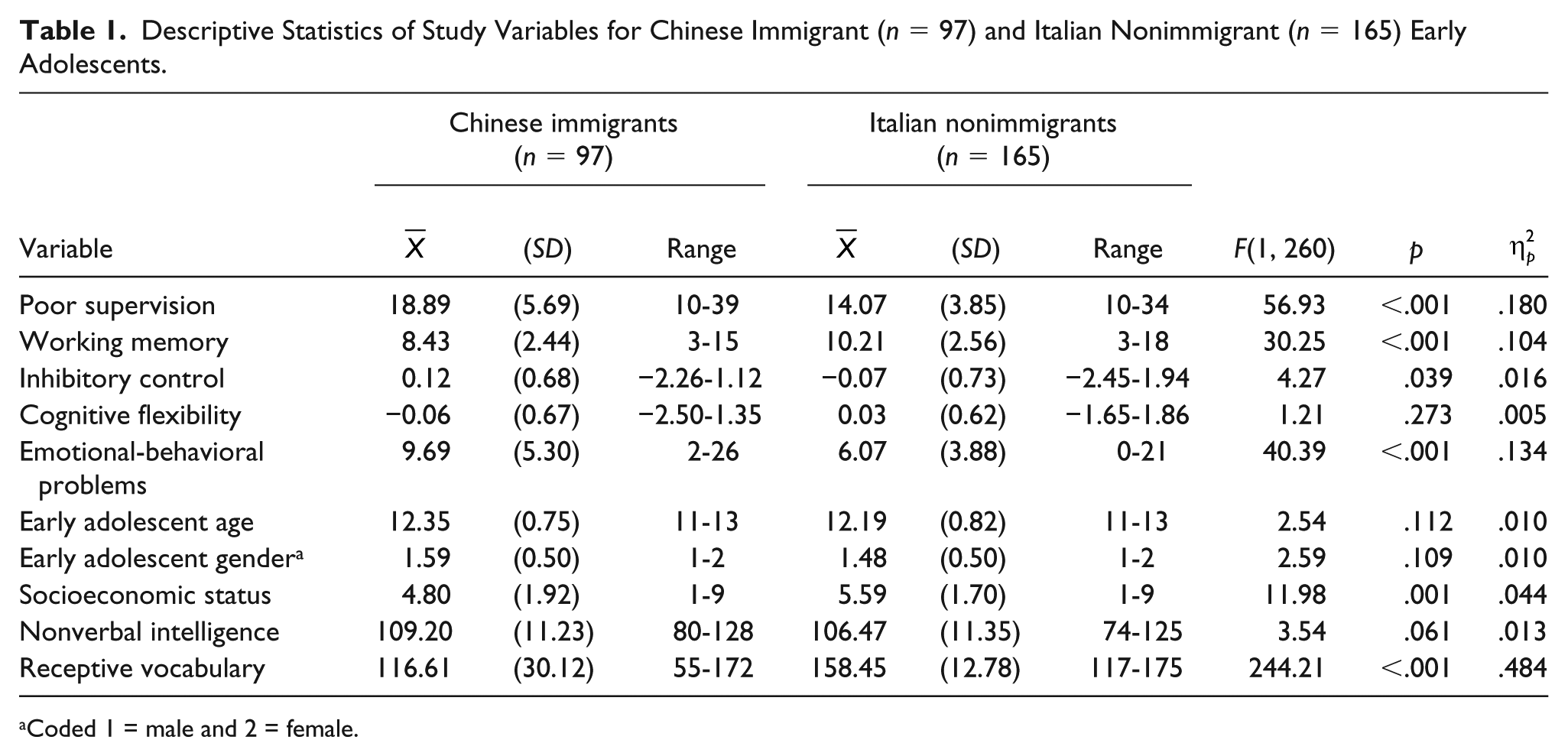
Coded 1 = male and 2 = female.
Bivariate Correlations Among Study Variables, Separately for Chinese Immigrant (n = 97) and Italian Nonimmigrant (n = 165) Early Adolescents.

Note. Correlation coefficients displayed above the diagonal are for Chinese immigrants and below are for Italian nonimmigrants.
Coded 1 = male and 2 = female.
p < .05. **p < .01. ***p < .001.
The AIC of all estimated models are presented in appendix. The most plausible model is the Model 12 (appendix). This model explained 27% of the variance. All main effects, two- and three-way interactions included in the final model are reported in Table 3. 1 At a multivariate level, results indicated that working memory was significantly and negatively related to emotional and behavioral difficulties. In addition, poor supervision was significantly and positively related to the outcome variable, but this association was moderated by inhibitory control (two-way interaction). As can be seen in Figure 1, simple slope analysis indicated that poorly supervised early adolescents with low (B = .32, SE = .09, p < .01) and average (B = .19, SE = .06, p < .01) inhibitory control capacity were significantly more vulnerable to emotional-behavioral difficulties, whereas the link between poor supervision and emotional and behavioral problems was not statistically significant at high levels of inhibitory control (B = .06, SE = .08, p = .43). Analyses of this interaction with the Johnson-Neyman technique identified that poor parental supervision had a significant effect on emotional-behavioral problems for values of inhibitory control lower than 0.57 and higher than 8.7, which, given our range of observed values of inhibitory control (see Table 1), confirms the significant effect of poor supervision on our outcome at low and average levels of inhibitory control (see Figure 2).
Final Linear Regression Model With Emotional and Behavioral Problems as Dependent Variable.
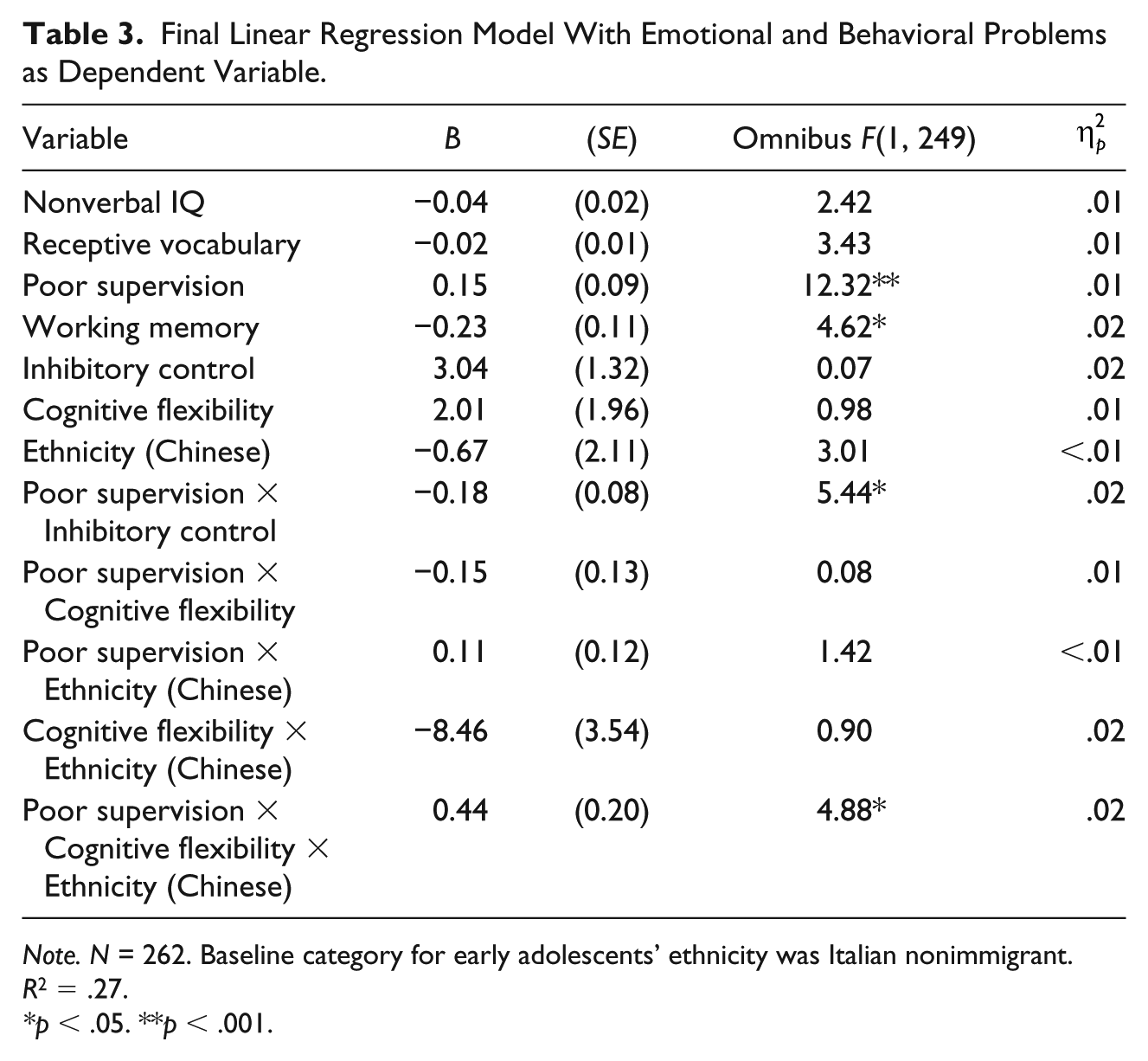
Note. N = 262. Baseline category for early adolescents’ ethnicity was Italian nonimmigrant. R2 = .27.
p < .05. **p < .001.

Interaction effect of poor parental supervision and inhibitory control on emotional-behavioral problems for Chinese immigrant and Italian nonimmigrant early adolescents (n = 262) at high, medium, and low levels of inhibitory control.

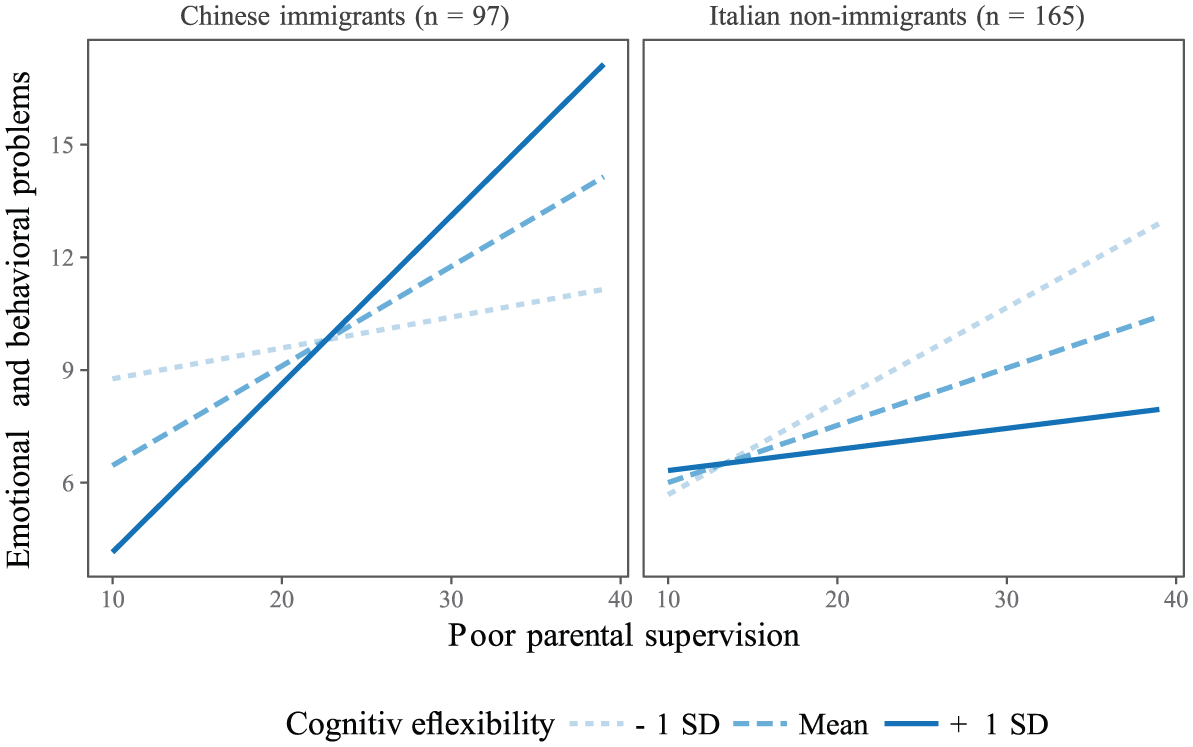
Interaction effect of poor parental supervision and cognitive flexibility on emotional-behavioral problems for (a) Chinese immigrant, and (b) Italian nonimmigrant early adolescents (n = 262).
We also found a significant three-way interaction among poor supervision, cognitive flexibility, and ethnicity (see Figure 3). Among Chinese immigrant early adolescents, poor parental supervision was significantly and positively associated with emotional and behavioral problems at high (B = .45, SE = .12, p < .01) and average (B = .26, SE = .08, p < .01) levels of cognitive flexibility, but not at low levels of flexibility (B = .08, SE = .13, p = .53). The region of significance of this effect, as calculated via the Johnson-Neyman technique, was comprised between the levels of flexibility −.57 and −.22 (see Figure 4). As regards Italian nonimmigrant early adolescents, poor parental supervision was only marginally significantly linked to our outcome variable at average (B = .15, SE = .09, p = .08) and low (B = .25, SE = .13, p = .05) levels of flexibility, and was not significantly linked to emotional-behavioral problems at high levels of flexibility (B = .06, SE = .11, p = .62). Analyses of this interaction with the Johnson-Neyman technique identified that poor parental supervision had a significant effect on emotional-behavioral problems for values of flexibility comprised between −0.29 and 12.61, which corresponds to a very restricted range of observed values of flexibility in our sample (see Figure 4).
Johnson-Neyman regions of significance and confidence bands for the conditional relation between poor parental supervision and emotional-behavioral problems as a function of inhibitory control (n = 262).

Johnson-Neyman regions of significance and confidence bands for the conditional relation between poor parental supervision and emotional-behavioral problems as a function of cognitive flexibility, separately for Chinese immigrant and Italian nonimmigrant early adolescents (n = 262).
Discussion
The present study aimed to examine the moderating role of separate components of EFs (i.e., working memory, inhibitory control, cognitive flexibility) in the association between poor supervision and emotional-behavioral problems among Chinese immigrant and nonimmigrant early adolescents in Italy. Overall, our findings support a bioecological model of human development to study Asian minorities’ emotional-behavioral adjustment by testing the interactions among cultural, proximal, and individual variables to explain Chinese immigrants’ psychological adjustment (Zhou et al., 2012). In particular, our data suggested the presence of both “universal” and group-specific mechanisms of emotional-behavioral adjustment. The inclusion of a sample of early adolescents without a migration background was fundamental to shed light on the specificities and commonalities of the conditions for Chinese immigrants’ emotional-behavioral adjustment, which are necessary as to inform culturally sensitive interventions in multicultural settings.
As expected, findings demonstrated a statistically significant and positive association of poor supervision with emotional-behavioral problems, but this effect was moderated by EFs and ethnicity. More specifically, inhibitory control moderated the association between poor supervision and emotional-behavioral problems, showing that inadequate parental supervision had a detrimental effect on psychological adjustment, but only at low levels of inhibitory control. Consistent with prior findings, low inhibitory control appears to be a risk factor for youth’s socio-emotional adjustment. Parents’ failure to provide external control may impact more on early adolescents with low inhibitory control capacities, as these youth cannot rely on internal regulatory competences to compensate for the lack of external supervision (Menting et al., 2016). Despite the importance attributed to self-control in Chinese socialization practices, this effect was similar across the two ethnic groups, confirming the results of previous studies which reported no cross-cultural differences in the relation between supervision and emotional-behavioral problems (Lansford et al., 2018). Thus, consistent with SDT (Deci & Ryan, 2002), the need for external guidance may be a common phenomenon during early adolescence when youth are struggling with issues of independence and autonomy outside their home environments (Kim et al., 2015).
In addition, poor parental supervision interacted with cognitive flexibility and ethnic background in predicting emotional-behavioral problems (three-way interaction). In line with our expectations, the moderating role of cognitive flexibility was significant for Chinese immigrants. This finding highlights the crucial role of flexibility among early adolescents of immigrant origin, who need to switch from one set of cultural values to another to adjust to everyday life requirements in different contexts (Fuligni & Tsai, 2015). More specifically, we found that poorly supervised Chinese early adolescents showed more emotional and behavioral problems at high levels of cognitive flexibility, whereas no association between these variables was found at low levels of flexibility. Albeit unexpected, this result may be interpreted in light of the specificities of Chinese culture. According to Confucian values, Chinese children are socialized to feel responsible and respectful toward their family. Especially in Italy, Chinese parents expect their offspring to be independent as not to interfere with their work and to be successful in school, but at the same time these adolescents need to help with the family business and at home, for example, by taking care of younger siblings (Laghi et al., 2014). We reasoned that early adolescents’ increased flexibility may be related to a facilitated switching between Chinese and Italian cultural values in their everyday environments. Thus, a more flexible Chinese immigrant child might easily shift between both sets of cultural codes, possibly resulting in an increased likelihood of endorsing Italian values and behaviors (e.g., assertiveness) at home with parents, which may lead to more conflicts with them. In contrast, a less flexible Chinese immigrant child might adhere more rigidly to family rules at home, therefore incurring less frequently in parent-child conflicts. A previous study of Asian college students in the United States reported similar findings, showing that higher levels of self-reported flexibility were linked to more conflicts with parents at home (Ahn, Kim, & Park, 2008; Tardif & Geva, 2006). Hence, parents would rate these flexible children as more problematic (i.e., parent report). This explanation should be contextualized to the Chinese immigrant community in Italy, a close-knit community where parents tend to be separated from the Italian culture and have high expectations of their children (Pedone, 2013). Future studies are warranted to explicitly address the role of parent-child conflict in immigrant families in explaining this association.
Last, a better working memory was significantly associated with fewer emotional-behavioral problems. This result confirms previous findings which highlighted the crucial role of working memory for psychological adjustment, representing a potential substrate for the use of other self-regulatory skills (Otto et al., 2016). However, this variable did not interact with parental supervision or ethnicity, suggesting that working memory processes are more independent from personal and cultural influences than other cognitive processes (de Abreu et al., 2013).
Of importance, although some culture-specific associations among variables emerged at the bivariate level, in most cases such associations were not confirmed at the multivariate level. This confirms the importance of taking into account multiple influences on early adolescents’ psychological adaptation, especially with multiethnic samples. Overall, our results support the usefulness of assessing the contribution of parental supervision and subcomponents of EFs to early adolescents’ emotional-behavioral difficulties because they may interact with cultural aspects in different ways.
Limitations and Directions for Future Research
Several limitations need to be considered when interpreting the results. First, the cross-sectional design prevents us from drawing conclusions about causality. Longitudinal studies are needed to shed light on the developmental trajectories of variables involved in immigrant early adolescents’ emotional-behavioral problems. Second, the relatively small sample size of the Chinese immigrant group in our study limits the generalizability of results. Future studies drawing on larger samples are needed to confirm these preliminary findings, as well as to test whether immigrant adjustment varies according to generational status (Dimitrova et al., 2016). Third, mothers and fathers may differ in their parenting practices and in the impact of such practices on children’s emotional-behavioral adjustment. Although this aspect was not the focus of the present work, future studies involving both parents would inform on the specific role of maternal and paternal parental supervision on psychological adjustment in immigrant and nonimmigrant early adolescents. Fourth, our study focused on a broad construct of emotional-behavioral problems as outcome, thus failing to inform on the differential links between parenting, EFs, and specific developmental issues (e.g., anxiety, depression, conduct problems). Future studies using more specific measures of mental health are recommended. Last, although interaction analyses are a commonly used method to test moderation, interaction effects tend to have small effect sizes (McClelland & Judd, 1993). Indeed, our exploratory intent was to test a complex and plausible model of reality able to provide new insights and hints for future research and discussion. However, the complex model considered with such an approach may increase the risk of Type 1 error. Therefore, interaction findings should be interpreted with caution and be replicated in future research.
In spite of these limitations, our study uniquely contributes to advancing research by providing evidence of similarities and differences in the moderating role of distinct EF components in the association between parental supervision and emotional-behavioral problems in Chinese immigrant early adolescents and their Italian nonimmigrant peers. The combined use of behavioral and parent-report measures is a strength of the present study, as it allows to overcome desirability and shared-method variance biases, thus increasing the validity of findings. More research is needed to better understand the impact of cognitive flexibility in links with negative parenting practices in Chinese immigrant early adolescents. Interventions aimed to improve parental supervision and enhance parents’ knowledge and interest in their children’s whereabouts may be useful to reduce the risk of emotional-behavioral difficulties for both Chinese and Italian families in Italy. Our findings also emphasize the relevance of targeting inhibitory control and working memory to reduce the negative impact of inadequate parental supervision on psychological adjustment. Furthermore, acknowledging cultural influences on the complex interplay between parenting and cognitive factors may guide practitioners to implement more effective and culturally sensitive interventions.
Footnotes
Appendix
Model 1 = Age + Gender + Socioeconomic status + Nonverbal IQ + Receptive vocabulary + Poor supervision + Working memory + Inhibitory control + Cognitive flexibility + Ethnicity + Working memory × Inhibitory control + Working memory × Cognitive flexibility + Inhibitory control × Cognitive flexibility + Poor supervision × Working memory + Poor supervision × Inhibitory control + Poor supervision × Cognitive flexibility + Poor supervision × Ethnicity + Working memory × Ethnicity + Inhibitory control × Ethnicity + Cognitive flexibility × Ethnicity + Poor supervision × Working memory × Ethnicity + Poor supervision × Inhibitory control × Ethnicity + Poor supervision × Cognitive flexibility × Ethnicity.
Model 2 = Age + Gender + Socioeconomic status + Nonverbal IQ + Receptive vocabulary + Poor supervision + Working memory + Inhibitory control + Cognitive flexibility + Ethnicity + Working memory × Inhibitory control + Working memory × Cognitive flexibility + Poor supervision × Working memory + Poor supervision × Inhibitory control + Poor supervision × Cognitive flexibility + Poor supervision × Ethnicity + Working memory × Ethnicity + Inhibitory control × Ethnicity + Cognitive flexibility × Ethnicity + Poor supervision × Working memory × Ethnicity + Poor supervision × Inhibitory control × Ethnicity + Poor supervision × Cognitive flexibility × Ethnicity.
Model 3 = Age + Gender + Socioeconomic status + Nonverbal IQ + Receptive vocabulary + Poor supervision + Working memory + Inhibitory control + Cognitive flexibility + Ethnicity + Working memory × Inhibitory control + Working memory × Cognitive flexibility + Poor supervision × Working memory + Poor supervision × Inhibitory control + Poor supervision × Cognitive flexibility + Poor supervision × Ethnicity + Working memory × Ethnicity + Inhibitory control × Ethnicity + Cognitive flexibility × Ethnicity + Poor supervision × Inhibitory control × Ethnicity + Poor supervision × Cognitive flexibility × Ethnicity.
Model 4 = Age + Gender + Socioeconomic status + Nonverbal IQ + Receptive vocabulary + Poor supervision + Working memory + Inhibitory control + Cognitive flexibility + Ethnicity + Working memory × Inhibitory control + Working memory × Cognitive flexibility + Poor supervision × Working memory + Poor supervision × Inhibitory control + Poor supervision × Cognitive flexibility + Poor supervision × Ethnicity + Working memory × Ethnicity + Inhibitory control × Ethnicity + Cognitive flexibility × Ethnicity + Poor supervision × Cognitive flexibility × Ethnicity.
Model 5 = Gender + Socioeconomic status + Nonverbal IQ + Receptive vocabulary + Poor supervision + Working memory + Inhibitory control + Cognitive flexibility + Ethnicity + Working memory × Inhibitory control + Working memory × Cognitive flexibility + Poor supervision × Working memory + Poor supervision × Inhibitory control + Poor supervision × Cognitive flexibility + Poor supervision × Ethnicity + Working memory × Ethnicity + Inhibitory control × Ethnicity + Cognitive flexibility × Ethnicity + Poor supervision × Cognitive flexibility × Ethnicity.
Model 6 = Gender + Socioeconomic status + Nonverbal IQ + Receptive vocabulary + Poor supervision + Working memory + Inhibitory control + Cognitive flexibility + Ethnicity + Working memory × Inhibitory control + Working memory × Cognitive flexibility + Poor supervision × Working memory + Poor supervision × Inhibitory control + Poor supervision × Cognitive flexibility + Poor supervision × Ethnicity + Working memory × Ethnicity + Cognitive flexibility × Ethnicity + Poor supervision × Cognitive flexibility × Ethnicity.
Model 7 = Gender + Socioeconomic status + Nonverbal IQ + Receptive vocabulary + Poor supervision + Working memory + Inhibitory control + Cognitive flexibility + Ethnicity + Working memory × Inhibitory control + Working memory × Cognitive flexibility + Poor supervision × Inhibitory control + Poor supervision × Cognitive flexibility + Poor supervision × Ethnicity + Working memory × Ethnicity + Cognitive flexibility × Ethnicity + Poor supervision × Cognitive flexibility × Ethnicity.
Model 8 = Gender + Socioeconomic status + Nonverbal IQ + Receptive vocabulary + Poor supervision + Working memory + Inhibitory control + Cognitive flexibility + Ethnicity + Working memory × Inhibitory control + Poor supervision × Inhibitory control + Poor supervision × Cognitive flexibility + Poor supervision × Ethnicity + Working memory × Ethnicity + Cognitive flexibility × Ethnicity + Poor supervision × Cognitive flexibility × Ethnicity.
Model 9 = Socioeconomic status + Nonverbal IQ + Receptive vocabulary + Poor supervision + Working memory + Inhibitory control + Cognitive flexibility + Ethnicity + Working memory × Inhibitory control + Poor supervision × Inhibitory control + Poor supervision × Cognitive flexibility + Poor supervision × Ethnicity + Working memory × Ethnicity + Cognitive flexibility × Ethnicity + Poor supervision × Cognitive flexibility × Ethnicity.
Model 10 = Socioeconomic status + Nonverbal IQ + Receptive vocabulary + Poor supervision + Working memory + Inhibitory control + Cognitive flexibility + Ethnicity + Working memory × Inhibitory control + Poor supervision × Inhibitory control + Poor supervision × Cognitive flexibility + Poor supervision × Ethnicity + Cognitive flexibility × Ethnicity + Poor supervision × Cognitive flexibility × Ethnicity.
Model 11 = Nonverbal IQ + Receptive vocabulary + Poor supervision + Working memory + Inhibitory control + Cognitive flexibility + Ethnicity + Working memory × Inhibitory control + Poor supervision × Inhibitory control + Poor supervision × Cognitive flexibility + Poor supervision × Ethnicity + Cognitive flexibility × Ethnicity + Poor supervision × Cognitive flexibility × Ethnicity.
Acknowledgements
The authors are grateful to the early adolescents and parents who participated in the study. We also thank Alice Boschiroli, Elisabetta Gori, Alessandro La Neve, Yajie Luan, and Sonia Pichetto for their help during data collection.
Authors’ Note
This study is based upon a dissertation (Miconi, 2016) submitted to the University of Padova in partial fulfillment of the requirements for the PhD degree.
Declaration of Conflicting Interests
The author(s) declared no potential conflicts of interest with respect to the research, authorship, and/or publication of this article.
Funding
The author(s) disclosed receipt of the following financial support for the research, authorship, and/or publication of this article: This work was supported by Grant CPDA147892 from the University of Padova to UM.
