



Abstract
In line with family systems theory, we examined patterns of hostile interactions within families and their associations with externalizing problems among early-adolescent children. Using hostility scores based on observational data of six dyadic interactions during a triadic interaction (n = 462; i.e., child-to-mother, mother-to-child, child-to-father, father-to-child, mother-to-father, father-to-mother)—latent profile analysis supported three distinct profiles of hostility. The low/moderate hostile profile included families with the lowest levels of hostility across dyads; families in the mutual parent-child hostile profile scored higher on parent-child hostility, but lower on interparental hostility; the hostile parent profile showed higher levels of parent-to-child and interparental hostility, but lower child-to-parent hostility. Concerning links to youth outcomes, youth in the mutual parent-child hostile profile reported the highest level of externalizing problems, both concurrently and longitudinally. These results point to the importance of examining larger family patterns of hostility to fully understand the association between family hostility and youth adjustment.
Keywords
Introduction
Interactions within the family constitute an important base for children’s development, especially during early adolescence, a time characterized by major developments in social relationships. Some families exhibit a hostile style of interaction, characterized by expressions of anger, frustration, and/or physical aggression, which has been linked to negative youth adjustment (e.g., Adams & Laursen, 2007; Davies et al., 2016; Steinberg, 2001). Earlier research has most often examined links between hostile interactions in one dyad in the family (e.g., parent-child) and youth adjustment. However, according to family systems theory (e.g., Cox & Paley, 1997; Minuchin, 1974), a family consists of several subsystems (e.g., parent-child, interparental), which together form a pattern of interactions that most likely will have implications for youth adjustment.
Adapting a broader family system approach, in this study, we perform person-oriented analyses to examine patterns of hostile interactions occurring within families across several dyads and their associations with negative youth adjustment—specifically externalizing problems—in children in early adolescence. In addition, as hostile interactions within dyads can be one way (e.g., one family member is hostile to the other, but not the reverse) or mutual (e.g., both family members are hostile toward each other; e.g., Trifan & Stattin, 2015), we examine the impact of direction of hostility for youth behavioral outcomes. Hence, in comparison with earlier research that has employed a general family conflict approach, we use an analytical approach that makes it possible to both separate different family members’ hostile interactions in specific dyads and examine how these dyadic interactions together form overall patterns of family hostility. This approach has the potential to uncover how broader patterns of hostility in the family system are linked to youth behaviors, and, thus, offer a deeper understanding of family relations, and the link between family system processes and youth development.
Parent-Child Hostility
In general, conflict and hostility between parents and youth is negative for youth development (e.g., Buist, Deković, & Gerris, 2011; Burt, Krueger, McGue, & Iacono, 2003; Lau, Jernewall, Zane, & Myers, 2002). Although these and other studies show that a hostile family context is linked to externalizing problems, they do not inform about direction of the hostility between family members or patterns of hostility in the family system, which might be differently linked to externalizing problems.
Concerning parent-to-child hostility, results from a large body of research are clear: Parental hostility/aggression is strongly linked to externalizing problems among youth (for reviews, see Khaleque, 2017; Weymouth, Buehler, Zhou, & Henson, 2016). The opposite direction—child-to-parent hostility—has seldom been examined separately from parent-to-child hostility. However, in two studies examining children in early adolescence, child-to-parent hostility (i.e., negative and hostile behaviors toward the parent within the home setting) was in fact a stronger predictor of externalizing problems (i.e., delinquent and aggressive acts in out-of-home settings) than was parent-to-child hostility (Fosco, Lippold, & Feinberg, 2014; Martínez-Ferrer & Stattin, 2017). These studies point to the need of examining the direction of hostility in parent-child interactions.
In addition to the literature on the effects of parental hostility on youth adjustment, some theories and studies emphasize the bidirectional nature of hostility, and its impact on youth adjustment. One example is the social interaction learning (SIL) model (Patterson, 1982, 2016), which describes the development of mutual aggressiveness in the parent-child relationship. At a microlevel, the SIL model describes coercive cycles of negative reinforcement, in which parents’ behaviors strengthen aggressive behaviors in children and children’s behaviors strengthen negative parenting practices. Hence, parents’ hostility toward their children and children’s hostility toward their parents might build on one another in a process over time. Furthermore, hostility in the family, especially mutual hostility, might increase the risk of externalizing problems more globally for youth. On a macrolevel, the SIL model hypothesizes that hostile interactions in the family teach children aggressive tactics that generalize to other social situations outside the home environment, such as interactions with peers (e.g., Ramsey, Patterson, & Walker, 1990). Supporting this theoretical model, studies of children and youth in families characterized by mutually hostile interactions are more likely to have high levels of externalizing problems (e.g., Eddy, Leve, & Fagot, 2001; Fosco et al., 2014; Richmond & Stocker, 2008; van Doorn, Branje, & Meeus, 2008) and engage in mutually hostile interactions with peers (Trifan & Stattin, 2015). Taken together, there is vast empirical support for the idea that hostility in the parent-child relationship is linked to negative outcomes in children.
Mothers’ and fathers’ hostility
Many studies have examined only mother-child interactions, excluding the importance of father-child interactions. Although both mothers and fathers have an influence on youth development, they might each exert influence on their youth in unique ways (for a review, see Collins & Russell, 1991). For example, maternal hostility toward their child and mutual hostility between mothers and children has shown significantly stronger links to children’s maladjustment (e.g., delinquency, aggression) than has paternal hostility (Ali, Khaleque, & Rohner, 2015; Khaleque, 2017; van Doorn et al., 2008). In fact, in some studies, fathers’ hostility has not shown significant links to youth externalizing problems (i.e., delinquency; van Doorn et al., 2008). Therefore, in examinations of family hostility, it is important to examine hostility in the maternal-child relationship and the paternal-child relationship. Specifically, some families might be characterized by high levels of father-child hostility and others by high mother-child hostility, which might, in turn, be differentially linked to youth externalizing problems.
Interparental Hostility
Theories and models argue that similarly to parent-child hostility, interparental hostility should be linked to youth externalizing problems. For example, according to a social learning approach, children might be socialized to act in a hostile manner by observing hostile interactions between parents (Bandura, 1977). In addition, interparental hostility might spill over to the parent-child relationship, producing hostile parent-child relationships or negative parenting, leading to youth maladjustment (for a review, see Krishnakumar & Buehler, 2000). In line with these theoretical ideas, empirical studies have been shown that hostility between parents (i.e., interparental hostility) is linked to more youth externalizing problems (e.g., Cummings & Davies, 2010; Sturge-Apple, Davies, Cicchetti, & Fittoria, 2014; for a review, see Buehler et al., 1997). Hence, models and research present evidence that interparental hostility has an influence on youth adjustment. However, they do not specify the potential difference in the impact of father versus mother hostility on youth externalizing problems, and more studies are needed to understand potential gender differences.
Need for a Holistic Approach
The models and research described above address conflict and hostility in families, but they do not capture more complex patterns of interactions in the family and their implications for youth development. Existing theories highlight the importance of taking a broader family systems approach (e.g., Cox & Paley, 1997; Minuchin, 1974), but most research has examined only part of the family process, yielding somewhat piecemeal examinations of family interactions. Specifically, there is a lack of studies examining patterns of hostile interactions in multiple subsystems in the family (e.g., interparental and parent-child), also taking into account directional patterns in hostility. The effect of patterns of interparental hostility and harsh parenting practices for younger children’s externalizing behaviors is established (Sturge-Apple et al., 2014; Sturge-Apple, Davies, & Cummings, 2010), but child-to-parent hostility has not been examined together with parent-to-child and interparental hostility. Examining youth hostility toward their parents would offer richer knowledge about patterns of family hostility and their effects on youth outcomes. For example, in some families, hostility might occur in all family subsystems (mother-child, father-child, mother-father). Yet, in other families, hostility might occur only in some subsystems (e.g., mother-child) but not in others (e.g., mother-father).
With few exceptions of studies on young children (e.g., Kopystynska, Paschall, Barnett, & Curran, 2017; Sturge-Apple et al., 2014; Sturge-Apple et al., 2010), researchers have relied heavily on variable-oriented approaches, examining the average sample effects of one family member’s hostility, or hostility in one subsystem, on an outcome. Person-oriented analyses, as an alternative, make it possible to examine previously unobserved subgroups of families that have distinct patterns of hostility across subsystems and explore how these different patterns are linked to youth outcomes (Bergman & Trost, 2006; Lippold, Greenberg, & Collins, 2013; Lippold, Greenberg, & Collins, 2014). Thus, person-oriented approaches can assess the effects of combinations, and direction of hostility among several family members on youth externalizing problems.
The Present Study
In this study, we examine hostile family interaction patterns, and their links to youth externalizing problems. We used a sample of youth in early adolescence, as this is a time with increased parent-child conflicts and negative affect (Laursen, Coy, & Collins, 1998), and has not typically been in focus of studies on hostile family interactions. We first identify patterns of family hostility by assessing hostility from each family member toward another using observational data from a triadic family interaction task and latent profile analysis (LPA). Next, we examined how these family-level patterns of hostility were associated with youth externalizing problems, both cross sectionally and longitudinally. We examined these associations both concurrently and longitudinally due to the possibility that some patterns of hostile interaction might have a short-term influence, whereas other patterns might have a long-term influence on youth adjustment.
Based on theory and earlier research, we expect to find patterns of families with varied hostile patterns: Some families will show a mutual hostile pattern between different family members (e.g., mother to father and father to mother), and in other families, there will be hostility expressed in one direction only (e.g., mother to father only). We expect youth in families with mutual hostility, especially between parents and children, to have higher levels of externalizing problems than those with hostility in one direction. In addition, we hypothesized that youth from families in which there are patterns of mutual hostile interactions in several subsystems (i.e., marital and parent-child) would report especially high levels of externalizing problems.
Method
Study Design and Participants
In this study, we used a sample of youth who participated in the in-home data collection as part of the Promoting School-Community-University Partnerships to Enhance Resilience (PROSPER) project (see Spoth, Greenberg, Bierman, & Redmond, 2004). PROSPER is a large-scale effectiveness trial of substance use–preventive interventions and their diffusion into rural communities. PROSPER was a community-level intervention, in which community teams were created and selected two interventions to implement in their community: a school-based substance use universal intervention (Life Skills, All Stars or Project Alert) and a family-based intervention (the Strengthening Families Program). The PROSPER focused on rural and semirural youth in 28 rural communities and small towns in Iowa and Pennsylvania (14 intervention, 14 control). Randomization occurred at the community level; pairs of communities were matched based on school district size and location and then randomly assigned to the PROSPER intervention or a control group. The control group did not receive any specific intervention and was a “usual programming” comparison (for more information, see Spoth, Clair, Greenberg, Redmond, & Shin, 2007). Families of students in the second cohort of PROSPER were randomly selected and recruited for participation in annual in-home assessments. Parents provided consent and youth assented for in-home data collection, which included videotaping of family interaction, and written questionnaires completed independently by the youth, mother, and, if present, father (N = 977 for full in-home subsample at baseline). All PROSPER protocol and materials were approved by the institutional review board.
Given our interest in family patterns of hostility, analyses were limited to families in which triadic observational data were available for all three family members (i.e., mother, father, and youth) when youth were in Grade 6. To facilitate family discussions, family members identified their top three topics of conflict in their family from a list of 29 topics. Topics ranged from broad topics such as dating, discipline, and transportation to specific behaviors such as children fighting and homework. The most common topics of conflict included children fighting (45%), chores (19%), attitudes (10%), and homework (7%). For the 12-minute triadic family task, parents and youth discussed these sources of conflict or disagreement in their family, along with a series of prompts with follow-up questions. For each of the three selected conflict topics, parents and youth were prompted to discuss when the conflict occurs, who is involved, what usually happens, and strategies to solve the problem. Families began by discussing the topic that they indicated was most commonly associated with conflict in their household and went on to discuss the second and third topic of conflict if additional time remained. Families were instructed to attempt to agree on a solution to the problem, and to progress through the topics until the end of the task. The triadic conflict discussion task was videotaped for data coding and analysis.
The analytic sample consisted of 462 youth (50% female) whose parents resided in Iowa (62%) and Pennsylvania (38%), and were, on average, 11.91 years old (SD = 0.43 years) at Time Point 1 (T1). T1 took place when youth were in the Spring of Grade 6 (2004) and Time Point 2 (T2) took place when youth were in the Spring of Grade 7 (2005). The mothers’ mean age was 40.03 years (SD = 6.01 years) and fathers’ was 42.44 years (SD = 6.70 years). Average household income in 2003 was US$65,033, and 77% of parents had some postsecondary education. Households had an average of three children (SD = 1.54). The majority of the youth (73%) were living with both biological parents. Sixteen percent of fathers were stepparents, and 2.8% of mothers were stepparents. Less than 4% were adoptive parents (2% of fathers, 1% of mothers). Youth identified as Caucasian (92.6%), Hispanic (2%), African American (1.5%), Asian (0.2%), and Other (2.4%).
Retention rate in this study was 96% (i.e., 22 families dropped out between T1 and T2). A t test comparing families with missing data at T2 with families with nonmissing data on the study variables and covariates (the hostility measure for each dyad, youth externalizing problems, intervention condition, youth gender, parental education, and whether youth lived with both biological parents or not) showed only one significant difference. Parental education was slightly higher among families with nonmissing data at T2 compared with families with missing data at T2 (t = −2.17, p = .03). Thus, there is little evidence of differential attrition in our sample.
Measures
Family hostility
Hostility was assessed using the Iowa Family Interaction Rating Scales, 5th Edition (IFIRS; Melby et al., 1998) gathered during Spring of Grade 6 (T1). Trained observers assessed behavior and the emotional tone of interactions between family members during the triadic family conflict task. Attention was paid to dyadic interactions to measure hostility between all members of the family. This resulted in six scores for each family representing the level of hostility among the family members: mother to child, mother to father, father to child, father to mother, child to mother, child to father. Scores ranged from 1 (not at all characteristic) to 9 (mainly characteristic). For more information on the IFIRS, see Melby and Conger (2001).
We conducted factor analysis to develop consistent measures of hostility. Prior studies (Williamson, Bradbury, Trail, & Karney, 2011) and our own analysis revealed that the full IFIRS measure contained two factors: one for positive and one for negative family interactions. Given our interest in family hostility, we limited our analysis to 10 items that assessed negative family interactions and that had an average intraclass correlation (ICC) across dyadic relationships in our sample above .50 (Duncan, Coatsworth, Gayles, Geier, & Greenberg, 2015). The average ICC for each code across dyadic hostile interactions ranged from .55 to .72, with an average of .62. Four of these items were removed (denial, avoidant, physical attack, and verbal) because the interitem correlation was very low for at least one of the dyadic interactions within the family triad, resulting in a low Cronbach’s alpha.
Our final measure of family hostility included both direct and indirect aspects of hostility, and was the average score of six items: hostility (treating the other person in a hostile, angry, disapproving, or rejecting manner), escalating hostility (increasing hostile behaviors through the course of the interaction), lecturing/moralizing (acting superior by telling another person how to think or feel), interrogation (questioning in a manner that does not ask for comment or feedback, but rather is focused on making a particular point), antisocial behaviors (defiant, resistant, insensitive behaviors toward others), and angry coercion (using hostile, threatening, and blaming behaviors to control another person’s behavior). Cronbach’s alpha ranged from .74 to .80.
Youth externalizing problems
Youth reports of externalizing problems were measured at both T1 and T2 using a 25-item scale from the Youth Self-Report of the Child Behavior Checklist (Achenbach & Rescorla, 2001). Items included behaviors such as stealing, getting into fights, destroying things, and lying. Responses ranged from 0 (not true) to 2 (very true/often true) and were averaged into an externalizing problems score (Cronbach’s α = .88).
Control variables
Four additional variables that were associated with other youth problematic outcomes in prior literature (Hawkins, Catalano, & Miller, 1992) were used as control variables: youth gender (0 = female, 1 = male), dual biological parent status (0 = not living with both biological parents, 1 = living with both biological parents), average parental education (years in school including secondary education,
Data Analysis Plan
Our analysis proceeded through three steps. First, LPA was used to identify patterns of hostility in the families (Hagenaars & McCutcheon, 2002), which has also been done in previous studies on interparental hostility (e.g., Sturge-Apple et al., 2014; Sturge-Apple et al., 2010). Hostility scores for each dyad in the larger family triad were used as observed indicators to identify latent profiles—capturing all possible directions of hostility (i.e., mother to child, child to mother, father to child, child to father, mother to father, father to mother). A series of models with varying numbers of specified latent profiles were tested to identify the best fitting model. Fit statistics, such as the Akaike information criterion (AIC; Akaike, 1987), the Bayesian information criterion (BIC; Schwarz, 1978), adjusted Bayesian information criterion (aBIC), and the Bootstrap Likelihood Ratio Test (BLRT; Nylund, Asparouhov, & Muthén, 2007), were used to assess the relative fit of model specifications. Lower AIC, BIC, and aBIC values indicate better relative fit, and significant BLRTs indicate that the k-profile solution is preferable to the k − 1 profile solution. We also examined entropy and mean posterior probability values, with values closer to 1 indicating greater levels of classification certainty. In addition, we considered the sample sizes of the latent profiles when evaluating model fit, and, as recommended in prior research, we chose a latent profile solution in which each latent profile contained at least 5% of the cases (e.g., Feldman, Masyn, & Conger, 2009).
Second, after selecting an optimal profile solution and determining an adequate level of profile separation or classification certainty (Asparouhov & Muthén, 2014), we used classify-analyze techniques to assign each family to an identified latent profile. In LPA, each family is given a conditional posterior probability, which is the probability of membership in each latent profile based on their responses to profile indicators. During the classify-analyze process, each family was assigned to the profile that corresponded with their highest conditional posterior probability (
Third, after classification, the associations between latent profile membership and youth externalizing problems were examined using cross-sectional and longitudinal regression models. In our cross-sectional model, youth externalizing problems at T1 were regressed on concurrent latent profile membership. In our longitudinal model, youth externalizing problems at T2 were regressed on latent profile membership at T1 (using youth externalizing problems at T1 as a covariate). Regression models included mean-centered demographic control variables (i.e., dual biological marital status, parent education, gender, and intervention condition). Latent profile membership was included as dummy-coded variables. The reference latent profile was rotated to exhaust comparisons between each profile (resulting in three models each for the cross-sectional and longitudinal analyses). All models were estimated in Mplus 7.4; regression models utilized a maximum likelihood estimator with robust standard errors. Missing data were handled using full information maximum likelihood.
Results
Descriptive Statistics
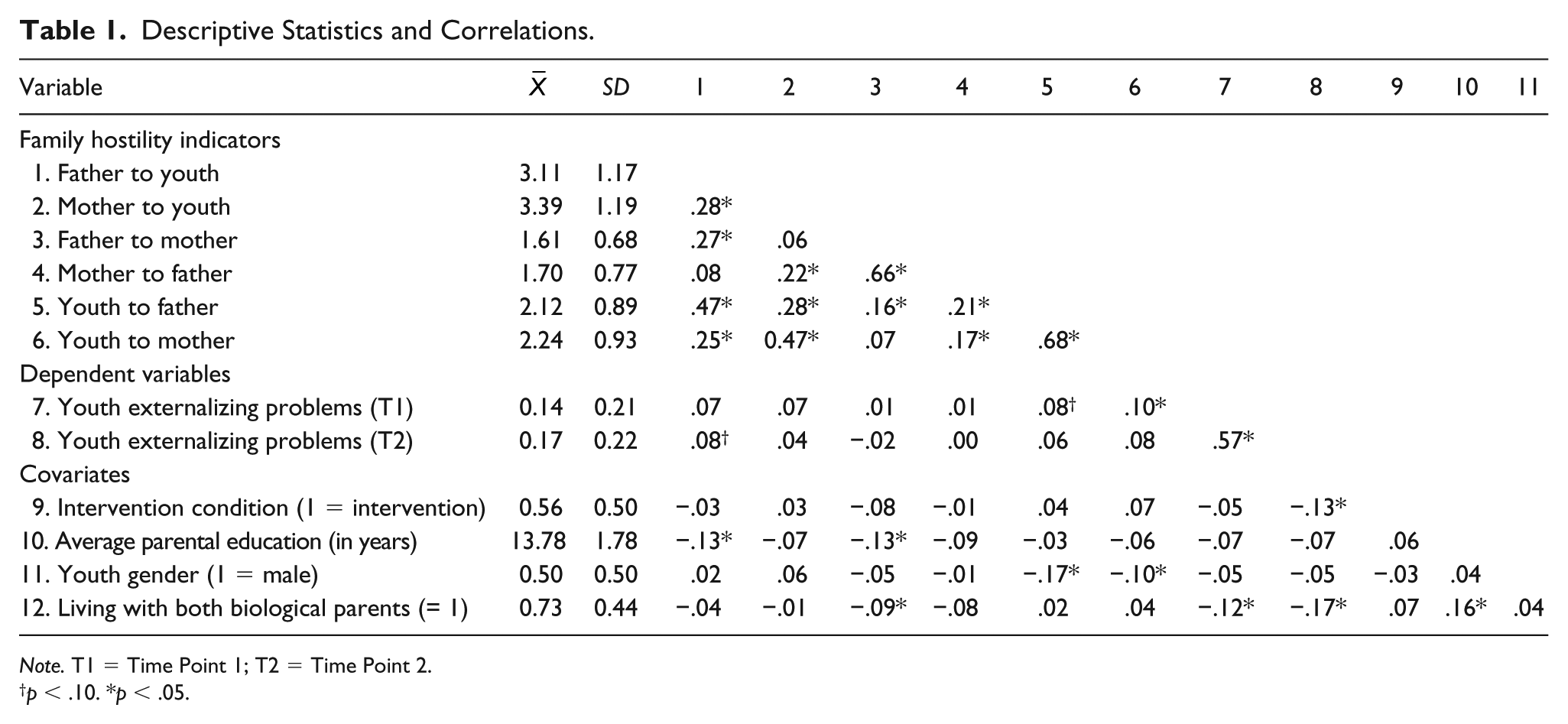
Descriptive statistics and correlations are shown in Table 1. Average rates of hostility were highest in parent-to-child interactions, followed by child-to-parent interactions, and the lowest levels were observed between parents. Most dyadic hostile interactions correlated significantly with each other (rs = .07-.68), suggesting that hostility was often mutual in nature. Concerning links to youth outcomes, only child-to-mother hostility was significantly correlated with youth externalizing problems at T1, and none of the correlations between hostility and youth externalizing problems at T2 was significant. Thus, there seems to be some evidence of mutual hostility in families, but the separate dyadic hostile interactions were not strongly related to youth externalizing problems. The weak correlations between youth hostile interactions and externalizing problems indicate a weak overlap between these constructs, suggesting that hostility within the home setting and externalizing problems outside the home tap into different youth behaviors.
Descriptive Statistics and Correlations.
Note. T1 = Time Point 1; T2 = Time Point 2.
p < .10. *p < .05.
A few correlations between the control variables on the one hand and the study variables on the other were significant. Higher parental education was linked to lower levels of father-to-youth and father-to-mother hostility. Furthermore, youth who lived with both biological parents reported lower levels of externalizing problems at both T1 and T2, and their fathers expressed lower levels of hostility toward their mothers.
Profile Enumeration and Final Model
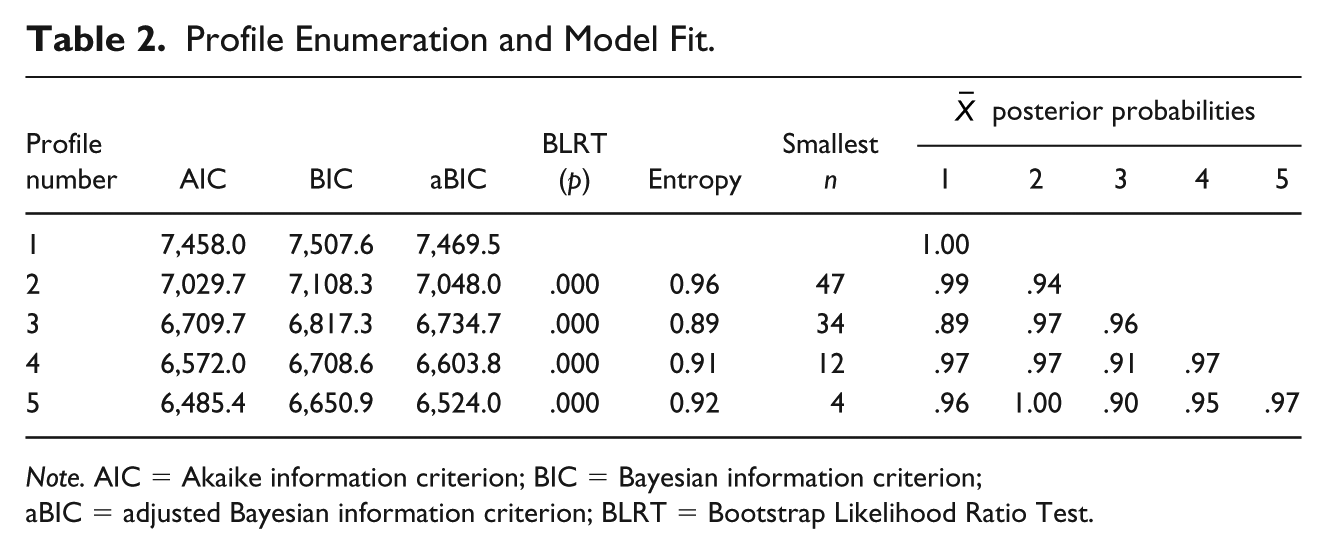
Table 2 displays model fit information associated with each iteration of the model, including specifications with up to five estimated latent profiles. AIC, BIC, and aBIC values decreased with each additional profile extracted, which suggested relative improvements in model fit as more profiles were specified. BLRT results also favored solutions with a greater number of profiles. However, beginning with the four-profile model, the solution yielded a very small profile, with only 2.5% of the total sample (n = 12), indicating that the solution might be an overextraction. Based on this, the three-profile solution was selected as optimal and the most parsimonious solution.
Profile Enumeration and Model Fit.
Note. AIC = Akaike information criterion; BIC = Bayesian information criterion; aBIC = adjusted Bayesian information criterion; BLRT = Bootstrap Likelihood Ratio Test.
The final three-profile solution is displayed in Figure 1, including the mean levels of hostility in each profile as well as the percentages of families in each profile. The solution yielded an entropy value of 0.89 and mean posterior probability values ranging from .89 to .97, signaling good profile separation and strong classification certainty (Asparouhov & Muthén, 2014). Profile 1 (n = 103, 22.2%), the mutual parent-child hostile profile, had the highest levels of parent-to-child and child-to-parent hostility. However, interparental hostility (father-to-mother and mother-to-father hostility) was relatively low in this profile. Profile 2 (n = 326, 70.4%), the low/moderate hostile profile, was marked by moderate levels of father-to-child and mother-to-child hostility, and low levels of hostility in the other dyadic interactions. Notably, levels of hostility were the lowest in all dyads among members of this profile. Profile 3 (n = 34, 7.4%), the hostile parent profile, was marked by relatively high levels of hostility across father-to-child, mother-to-child, father-to-mother, and mother-to-father dyadic interactions; levels of child-to-father and child-to-mother hostility were lower. 1
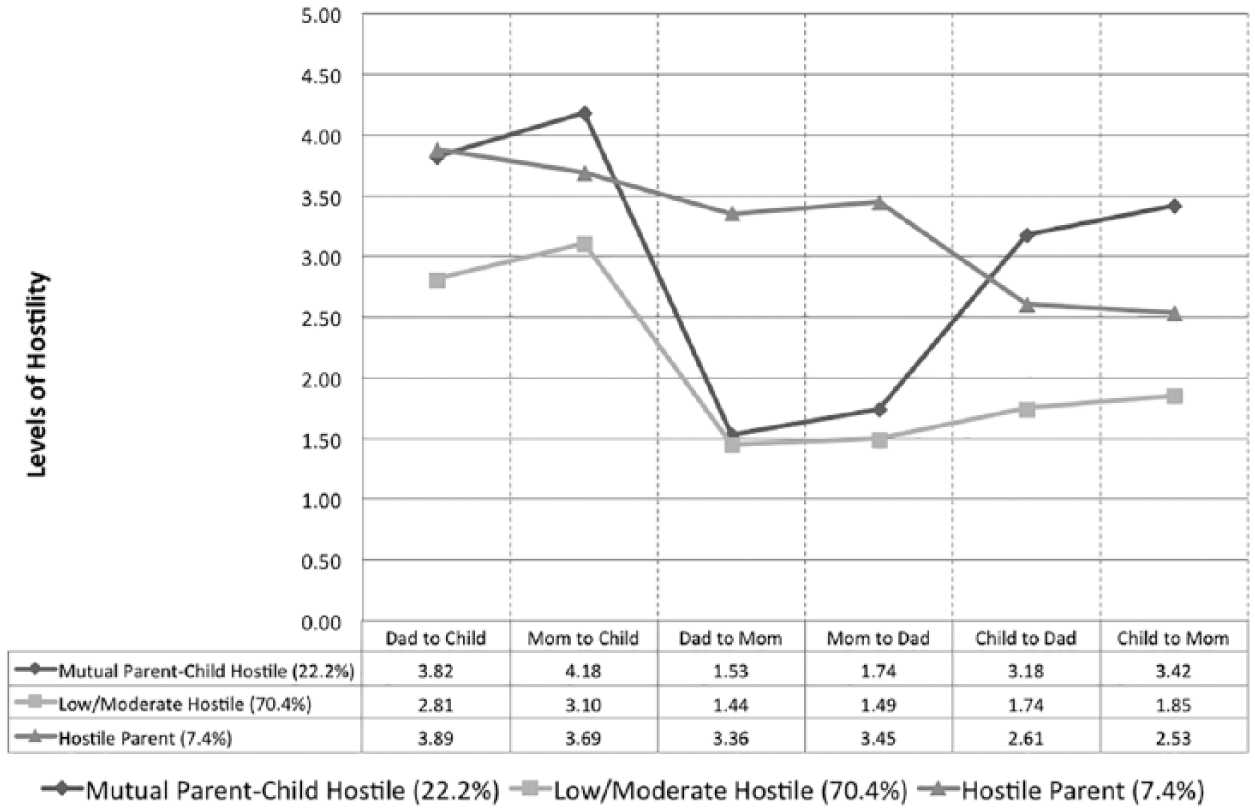
Latent profile solution with mean levels of dyadic hostility.
Profile Membership and Youth Externalizing Problems
Cross-sectional analysis
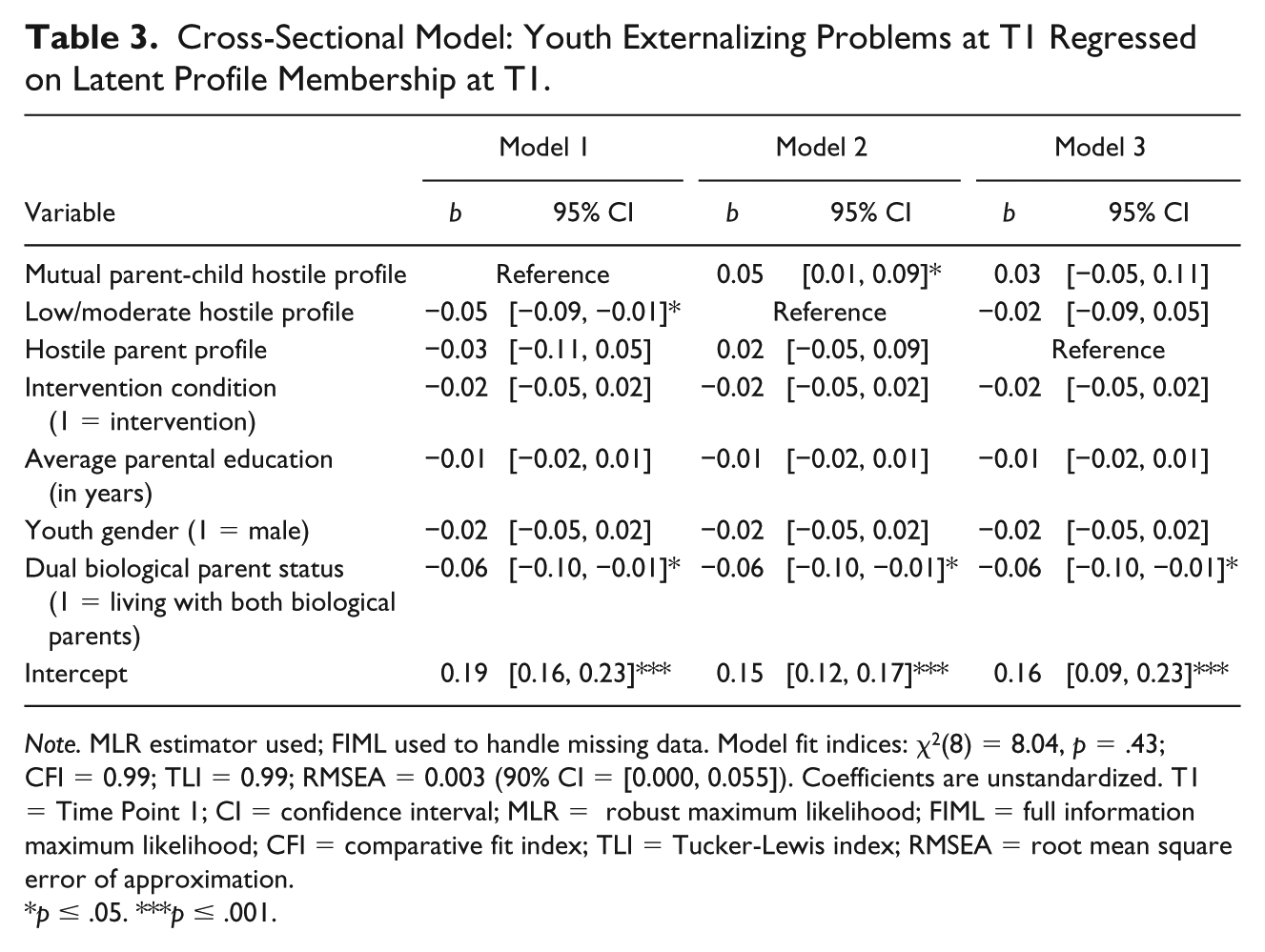
Table 3 displays results from our cross-sectional analysis, in which latent profile membership at T1 was associated with concurrent youth externalizing problems (controlling for covariates). Three models are displayed, each with a different reference latent profile (i.e., Model 1 specifies the mutual parent-child hostile profile as the reference group, Model 2 specifies the low/moderate hostile profile as the reference group, Model 3 specifies the hostile parent profile as the reference group). Because our covariates were mean centered, the model intercept values represent the average level of concurrent externalizing problems for the reference group in each model. The average levels of youth externalizing problems for each profile were 0.19 for mutual parent-child hostile, 0.16 for hostile parent profile, and 0.15 for low/moderate hostile. As shown in Models 1 and 2, levels of youth externalizing problems in the mutual parent-child hostile profile were significantly higher than levels of youth externalizing problems in the low/moderate hostile profile (b = 0.05). Hence, youth in families with mutual hostility between parents and youth (mutual parent-child hostile profile) showed more externalizing problems than youth in families in which there are lower levels of hostile interactions in general (low/moderate hostile profile).
Cross-Sectional Model: Youth Externalizing Problems at T1 Regressed on Latent Profile Membership at T1.
Note. MLR estimator used; FIML used to handle missing data. Model fit indices: χ2(8) = 8.04, p = .43; CFI = 0.99; TLI = 0.99; RMSEA = 0.003 (90% CI = [0.000, 0.055]). Coefficients are unstandardized. T1 = Time Point 1; CI = confidence interval; MLR = robust maximum likelihood; FIML = full information maximum likelihood; CFI = comparative fit index; TLI = Tucker-Lewis index; RMSEA = root mean square error of approximation.
p ≤ .05. ***p ≤ .001.
Longitudinal analysis
Table 4 displays results from our longitudinal analysis where latent profile membership at T1 predicted youth externalizing problems at T2 (controlling for levels of externalizing problems at T1 and other covariates). Similar to the cross-sectional analyses, three models are displayed, each with a different reference latent profile. Because we included prior levels of youth externalizing problems as a covariate, the model intercept values represent the adjusted means of youth externalizing problems for the reference group 1 year later. As the intervention and control groups differed on externalizing problems at T2 (see Table 1), we included intervention condition as a covariate in our longitudinal regression model to hold this group difference constant when we assessed the influence of latent profiles on externalizing at T2. The adjusted mean levels of youth externalizing problems for each profile were 0.21 for mutual parent-child hostile, 0.17 for low/moderate hostile, and 0.14 for hostile parent. As shown in Models 1 and 3 (see Table 4), the increase in youth externalizing problems in the mutual parent-child hostile profile was significantly higher than the increase in youth externalizing problems in the hostile parent profile (b = 0.07). Hence, youth in families with mutual hostile parent-youth interactions, but lower interparental hostility (mutual parent-child hostile profile), reported larger increases in externalizing problems than youth in families with hostility from parents toward their children and their partner, but lower hostility from the child toward their parents (hostile parent profile). 2
Longitudinal Model: Youth Externalizing Problems at T2 Regressed on Latent Profile Membership at T1.
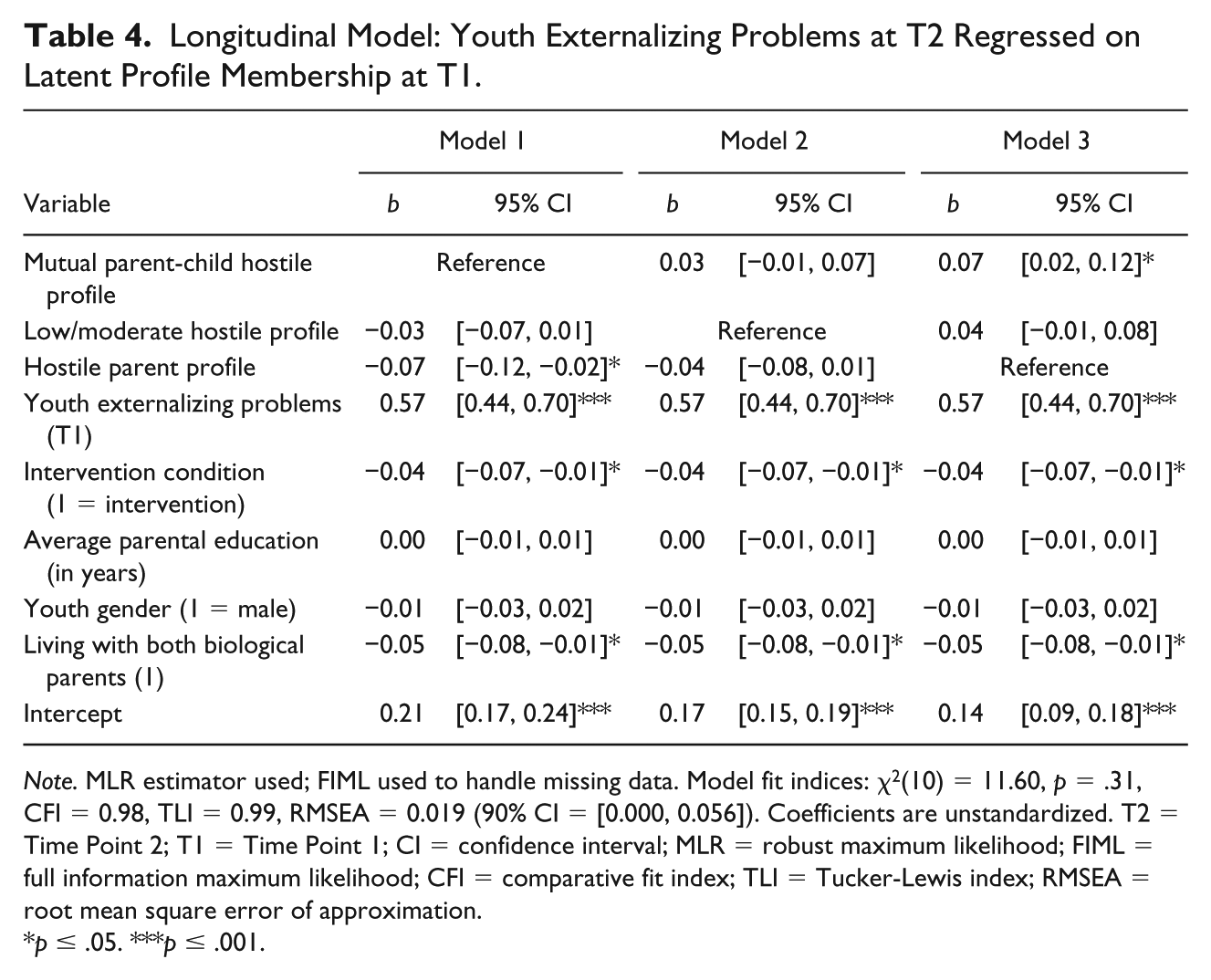
Note. MLR estimator used; FIML used to handle missing data. Model fit indices: χ2(10) = 11.60, p = .31, CFI = 0.98, TLI = 0.99, RMSEA = 0.019 (90% CI = [0.000, 0.056]). Coefficients are unstandardized. T2 = Time Point 2; T1 = Time Point 1; CI = confidence interval; MLR = robust maximum likelihood; FIML = full information maximum likelihood; CFI = comparative fit index; TLI = Tucker-Lewis index; RMSEA = root mean square error of approximation.
p ≤ .05. ***p ≤ .001.
Discussion
Building on prior research, we adopted a holistic family systems approach and examined patterns of hostile interactions, including the direction of hostility, between family members. The results showed that specific patterns of hostility, in which family members have different experiences of being exposed to or exhibiting hostility, were linked differently to youth externalizing problems. Hence, it is important to not only consider youth-driven hostility or parent-driven hostility in interactions, but the pattern of hostile interactions in the family as a whole in the development of youth externalizing problems.
Patterns of Hostility in Families
We found three distinct profiles with different patterns of levels and directions of hostility in the family. The low/moderate hostile profile (Profile 2) can be viewed as the most normative family profile, as it included most families (70.4%), and had the lowest levels of hostility across all dyads. The large size of this class suggests that most families have relatively low hostility and that for most families, low hostility occurs across all dyads in all directions.
The other two profiles were smaller, and both demonstrated hostile family interactions but had distinctly different patterns of hostility—especially in terms of the direction of this hostility. In the mutual parent-child hostile profile (22.2%), parents and youth were mutually hostile toward each other, but there was a lower level of hostility between parents. The third profile, the hostile parent profile, was the smallest and included 7.4% of the families. This profile was marked by high levels of parent-to-child and interparental hostility, but lower levels of child-to-parent hostility. Interestingly, we did not find a pattern where hostility was high across all dyads. Instead, our results suggest that in some families, parent hostility toward their youth is not accompanied by high levels of youth hostility, and in other families, high hostility occurs only between parents and their youth and not between parents. Hence, these profiles were both high on parent-to-child hostility, but there was a difference in whether this hostility co-occurred with youth hostility toward their parents, as well as interparental hostility.
Patterns of Hostility and Links to Youth Externalizing Problems
In general, the results showed that youth in the mutual parent-child hostile profile reported the highest level of externalizing problems concurrently and the greatest increases in externalizing problems longitudinally. Interestingly, the correlations between single dyadic hostile interactions and youth externalizing problems were weak in our sample, which might be somewhat surprising given earlier variable-oriented research on the link between family hostility and youth externalizing problems. However, our study used observational data, whereas many prior studies utilized self-reports of hostility. Correlations between observations of family hostility and youth behaviors have been shown to be weaker than questionnaire reports of family hostility and youth behaviors (Janssens, De Bruyn, Manders, & Scholte, 2005). Our results suggest that using a person-oriented approach may shed light on specific patterns of hostility in families, and that these patterns (rather than individual indicators) may have critical links to externalizing problems.
Concurrent links to youth externalizing problems
For the cross-sectional analysis, the mutual parent-child hostile profile differed significantly from the low/moderate hostile profile: Youth in the mutual parent-child hostile profile reported more externalizing problems than youth in the low/moderate hostile profile. This result is not surprising, as these family patterns offer very different socialization stimuli for youth. In the mutual parent-child hostile profile, youth are socialized into a hostile interaction style—by both being exposed to and exhibiting hostility—and the higher levels of externalizing problems suggest that this socialized interaction style might be carried to other social situations outside of the family (Fosco et al., 2014). Importantly though, these are cross-sectional results, and it is possible that youth externalizing problems drive these patterns of hostility and not the reverse. Hence, it is unclear whether hostile interaction patterns in the family are a result of externalizing problems that the youth have developed outside of the family environment.
Longitudinal links to youth externalizing problems
Results of the longitudinal analyses showed that youth in the mutual parent-child hostile profile reported a greater increase in externalizing problems than did youth in the hostile parent profile. This difference is somewhat surprising, as both these profiles can be described as hostile family environments, and contrasts earlier research showing that children who witness conflicts or violence between parents show various negative outcomes (e.g., Buehler et al., 1997; Cater, Miller, Howell, & Graham-Bermann, 2015). This contrasting finding might result from the fact that we did not isolate interparental hostility from other hostile interactions, but instead, we examined patterns of hostility within multiple dyads in the family simultaneously. However, there are at least two theoretically driven explanations for the steeper increase in externalizing problems among youth in the mutual parent-child hostile profile than among youth in the hostile parent profile.
A first explanation involves mutual parent-child hostility as an important influence on youth externalizing problems. Families in the mutual parent-child hostile profile demonstrated mutual hostility both from parents to youth and from youth to parents. In contrast, in the hostile parent profile, there was more hostility from parents to youth than from youth to parents. In line with the SIL model (Patterson, 1982) and earlier research (e.g., Eddy et al., 2001; Fosco et al., 2014; Richmond & Stocker, 2008; van Doorn et al., 2008), mutual parent-child hostility might exemplify a process in which the parent and the youth together develop and maintain hostile interactions in the family, which is later translated by the youth in other social situations. In fact, in line with earlier research (Fosco et al., 2014), when youth are actively involved in creating a hostile family environment, these behaviors are more likely to translate to hostile behaviors outside the family. Hence, high levels of mutual parent-child hostility is one potentially important feature that explains the steeper increase in externalizing problems in the mutual parent-child hostile profile.
A second explanation for the difference between the mutual parent-child hostile and the hostile parent profiles is that targeted hostility toward youth might be especially difficult for them to handle, leading to greater externalizing problems. In the mutual parent-child hostile profile, the parents were hostile toward the youth, but they were not particularly hostile toward each other. It is possible that youth in these families feel especially targeted, as parental hostility might be perceived as aimed at them specifically, rather than being a feature of the broader family environment. According to the parental acceptance-rejection theory (Rohner, 2004), children’s perception of parental rejection is important for their well-being and has been associated with various internalizing and externalizing problems (Khaleque, 2017). When youth perceive that they are the only targets of hostility, they may feel rejected, which might lead them to engage in more externalizing behaviors. This is not the case in the hostile parent profile, as parents were hostile not only toward the child but also toward each other. Hence, the fact that youth in the high parent-child hostile profile might feel especially targeted by hostility in the family can potentially explain their steeper increases in externalizing problems.
Parents’ Gender
In this study, we examined patterns of hostility that included measures from both mothers and fathers, as some earlier research has pointed to potential differences in the impact of hostility depending on parents’ gender (Ali et al., 2015; Khaleque, 2017; Miller, Cater, Howell, & Graham-Bermann, 2014; van Doorn et al., 2008). The results of the present study showed that mothers and fathers show similar patterns of hostility within each profile; mothers and fathers had similar levels of hostility toward each other and toward their children. Given that this is one of the first studies to include mothers and fathers in all dyadic interactions, this lack of difference suggests that hostile interaction patterns in the family, and their effects on youth, might not differ depending on the gender of the parent.
Strengths and Limitations
This study had some limitations that need to be discussed. Although we used a holistic approach to study hostile interactions in different subsystems, our analyses were limited to three family members: mothers, fathers, and one youth. Relationships with other family members, such as siblings, were not available to be included here, but, if included, might have shed additional light on patterns of hostility in families. For example, parents tend to differ in their parenting of children in the same family (e.g., Glatz, Cotter, & Buchanan, 2017; Glatz & Stattin, 2013; Whiteman, McHale, & Crouter, 2003), and it is possible that the interactions captured by the triadic family conflict task were not indicative of a general parental interaction style that would be the same across multiple children. In addition, sibling relationships are important for youth’s social and behavioral development, and hostile sibling interactions can spill over to hostility in peer relationships (e.g., Feinberg, Solmeyer, & McHale, 2012; Glatz, Källström, Hellfeldt, & Thunberg, in press; McHale, Whiteman, Kim, & Crouter, 2007; Patterson, DeBaryshe, & Ramsey, 1990). Therefore, sibling relationships should be considered in future studies of family interactions. Unfortunately, in this study, data were only available for one youth in each family.
In this study, we used observational data from a triadic data task, in which all members of the family were interacting with one another. It is possible that different family hostility patterns would have emerged if we had based our results on interactions between sets of only two family members in a dyadic setting (De Los Reyes, Henry, Tolan, & Wakschlag, 2009). Future research is needed to assess whether the patterns of hostile interactions in families are stable across different types of reporting methods (e.g., self-reports) and type of data. In addition, our patterns of family hostility were identified at one point in time, so our study does not shed light on longitudinal changes in patterns of family hostility and how these might be linked to youth adjustment. We did, however, examine the longitudinal links between these interaction patterns and youth externalizing problems. Although our study used autoregressive longitudinal methods, we did not explicitly test the direction of effects between our profiles of hostility and youth externalizing problems. It is possible that externalizing problems might influence family hostility patterns and there might be transactional and bidirectional relationships between the two. This was not examined in the present study but needs to be studied in future research. Furthermore, our study used data from an intervention study, but did not assess intervention effects. Because participation in the intervention condition was agreed upon by community (school district), there should not be an overall family self-selection bias in the study, making the general sample similar to other community-based studies. All families in a particular community were assigned to either the intervention or control condition. Given that PROSPER was a community-level intervention, intervention effects are best assessed at the community level using a multilevel modeling approach. Although we controlled for intervention condition in all analyses to provide a conservative test of our hypothesized relations among family profiles and externalizing problems, replication of these findings in a developmental sample would bolster confidence in the findings. Therefore, future studies using community-level approaches are needed to assess possible intervention effects on patterns of family hostility. Replication on other data sets is ideal.
Another limitation concerns the generalizability of the results. Our results may not be generalizable across diverse family types, as our analyses were based on two-parent families, which do not represent families in the United States that are headed by single parents. The type and impact of interaction patterns found in other family combinations might differ from our findings. Furthermore, our sample was comprised predominately of rural and semirural, Caucasian youth. Research has shown that the way parents interact with their youth might differ as a function of ethnicity. For example, an authoritative parenting style is more common among Caucasian parents than among African American parents (Steinberg, 2001), and it is possible that different patterns of hostility might emerge in a more ethnically diverse sample. A final limitation was that we used a community sample of adolescents with relatively low levels of externalizing problems. Different patterns of hostility and effects may be found with studies on clinical populations.
Despite these limitations, this study has important strengths. First, a person-oriented approach allowed us to discover complex patterns of hostility in families, including hostility between different family members (mothers, fathers, and youth) in multiple directions. For example, we could examine differences in externalizing problems between families with mutual parent-child hostility and families in which youth were not exhibiting hostility. These differences indicate that the overall family context is important and these nuances in hostility might have been masked if using variable-oriented approaches that focus on the effect of just one type of hostility on youth outcomes or if using a composite measure of parent-child hostility that did not differentiate the direction of hostility. A second strength in this study was the use of observational data, which is ideal for the study of hostility. Most studies have used questionnaire data in which parents and children have reported on their own and/or each other’s behaviors. Self-reports come with a potential bias, especially when measuring negative behaviors, as participants might underreport their own hostile behaviors toward each other (Bornstein et al., 2015). Although reports of another person’s behavior (e.g., through questionnaire) can mitigate self-report bias, these reports are naturally influenced by the prior history of interactions between the participants and might also be biased (Janssens et al., 2005). Observational data offer a more objective approach to the study of family hostility.
Implications for Theory and Practice
The results of this study have implications for theory and practice. They point to the notion that when examining family hostility, consideration of the larger family pattern might be essential, highlighting family systems’ principles that the whole-family interaction may be greater than the sum of its parts (Cox & Paley, 1997). According to the results, different patterns of family hostility have different impacts on youth externalizing problems. In line with traditional theories placing focus on the role of children in family processes and their own development (e.g., Bell, 1968; Patterson, 1982; Sameroff, 1975), the results illustrate that families in which the youth are expressing higher levels of hostility, and, thus, playing an active role in creating and maintaining a certain family interaction style (i.e., mutual parent-child hostile profile), are more likely to see a translation of these behaviors in externalizing problems.
In practice, families might need different kinds of support depending on the pattern of hostility and who is being exposed to or exhibiting hostility. In families where there is mutual parent-child hostility (i.e., mutual parent-child hostile profile), practitioners might need to work with youth and parents, both separately and together. In these families, there is likely a need for a change in interaction style, but youth might also need help to overcome feelings of being targets of their parents’ hostility. The results of this study map out existing patterns of hostility and identify important aspects that can be used in practical work with families.
Footnotes
Declaration of Conflicting Interests
The author(s) declared no potential conflicts of interest with respect to the research, authorship, and/or publication of this article.
Funding
The author(s) disclosed receipt of the following financial support for the research, authorship, and/or publication of this article: Work on this paper was supported by research grant R03 DA038685 and R01 DA013709 from the National Institute on Drug Abuse.