



Abstract
This short-term, longitudinal study examines evidence that the level of popularity among adolescents’ peer role models exacerbates the emotional impact of mistreatment by peers. We recruited 469 adolescents (255 boys, 214 girls;
Research on peer victimization during adolescence has begun to incorporate interactive models of risk that emphasize factors that mitigate or exacerbate pathways toward negative outcomes (Graham, Bellmore, Nishina, & Juvonen, 2009; Perren, Ettekal, & Ladd, 2013). In the current study, we build on the available findings by focusing on the popularity of adolescents’ peer role models as a moderator that may intensify links between peer victimization and depression. Our guiding assumption is that adolescents admire, respect, and want to be like peers whose attributes reflect their own underlying aspirations (Graham, Taylor, & Hudley, 1998; Taylor & Graham, 2007). From this perspective, adolescents who look up to peers who are high in popularity would presumably view high social status as a critical barometer of personal success. For those adolescents who are victimized within the peer group, these idealizations may increase risk for emotional maladjustment, given the incongruence between whom they aspire to be like and their real-world social experiences.
Peer Victimization and Depression
Early adolescence is a developmental period that is marked by shifting interpersonal demands (Connolly, Craig, Goldberg, & Pepler, 2004). Adolescents must effectively navigate a large peer group that presents new challenges, such as conforming to various contextual norms and establishing social status with their peers (LaFontana & Cillessen, 2010). During this critical transition period, adolescents may be especially sensitive to negative feedback from their peers.
One of the most powerful indicators that an adolescent has not achieved success in the school peer group is persistent physical, verbal, or relational mistreatment. Victimization in the peer group represents feedback that an adolescent occupies a low position in the social hierarchy. Indeed, research consistently indicates reciprocal links between peer victimization and unpopularity (Gorman, Schwartz, Nakamoto, & Mayeux, 2011; Xie, Li, Boucher, Hutchins, & Cairns, 2006). Adolescents who are unpopular may be victimized by their peers, because they are viewed as a social liability, which results in a lack of friendships that would buffer against mistreatment by peers (Schmidt & Bagwell, 2007). Unpopular youth also tend to be behaviorally submissive and withdrawn, which may make them easy targets for peer victimization. Notably, children and adolescents readily identify unpopular peers as being likely to be victimized within the peer group (Xie et al., 2006). The content of harassment by peers could also incorporate specific information about stable, undesirable attributes or salient vulnerabilities (e.g., Juvonen & Galván, 2009; Shapiro, Baumeister, & Kessler, 1991). Targeted youth could therefore come to view themselves through the lens of their victim reputation, resulting in feelings of loneliness (Graham & Juvonen, 1998), low self-worth (Grills & Ollendick, 2002), poor self-schemas (Cole et al., 2014), and negative evaluations of their social competence (Boulton & Smith, 1994). As these youth internalize the derision of their peers, the outcome could be a trajectory toward escalating emotional maladjustment, including depression.
We acknowledge that popular youth are also frequently the targets of peer victimization by other high status peers (Prinstein & Cillessen, 2003; Vaillancourt, Hymel, & McDougall, 2003). In these cases, peer aggression serves the function of asserting dominance and control over social resources. As such, popular youth may also be targets for victimization if they are perceived as threats to other high status adolescents’ position in the peer group hierarchy. However, given that this specific type of victimization likely occurs within popular groups, these adolescents are unlikely to be identified as having a global victim reputation within the broader peer context.
Although there are compelling reasons to expect a strong association between peer victimization and depressive symptoms, researchers who have relied on longitudinal designs have tended to report effect sizes that are of variable and modest magnitude (Prinstein, Boergers, & Vernberg, 2001; Schwartz, Gorman, Nakamoto, & Toblin, 2005; Stapinski, Araya, Heron, Montgomery, & Stallard, 2015). It may be the case that the experience of victimization in the peer group is more detrimental to some adolescents than to others. Partially as a reflection of these ambiguities, investigators have incorporated complex moderator effects into their explanatory models (Graham & Juvonen, 2001; Hodges, Boivin, Vitaro, & Bukowski, 1999; Perren et al., 2013).
Peer Role Models
Research that has sought to identify victimized youth who are either resilient or at risk has considered an array of interpersonal factors (e.g., protective or risk relationships; Hodges et al., 1999; Woods, Done, & Kalsi, 2008) and child attributes (e.g., specific coping styles; Kochenderfer-Ladd & Skinner, 2002). We propose that peer victimization evokes negative emotional outcomes when it indicates that an adolescent has failed to attain his or her desired peer group reputation and social experiences at school.
In the present study, we consider adolescents’ peer role models to be a powerful source of information about the social experiences to which they aspire. Within the realm of research on academic achievement in adolescents, Graham and Taylor (Graham et al., 1998; Taylor & Graham, 2007) developed an innovative measure of adolescents’ achievement-related values by examining the achievement levels of other students whom they endorsed admiring, respecting, and wanting to be like. Rather than relying on the self-reports of adolescents, this methodological approach indirectly assesses achievement values and may thus minimize potential influences of self-presentation biases and response expectancies (Graham et al., 1998). In the current study, we extend the application of this assessment method to evaluate the social personas that adolescents want to emulate. These desired social experiences and reputations in the peer context may be critical in shaping the outcomes associated with peer victimization.
Popularity of Peer Role Models
Adolescents may look up to their peers for a variety of reasons, including academic performance, athleticism, and social status (Becker & Luthar, 2007), and these attributes may provide key insight into adolescents’ personal barometers of success. When adolescents fail to be like their peer role models, the result may be a heightened vulnerability to negative self-evaluations and associated emotional maladjustment.
We focused specifically on levels of popularity among peer role models, as social status becomes increasingly salient during adolescence. Indeed, early adolescence marks youth’s peak level of preoccupation with social status (LaFontana & Cillessen, 2010), and social power is a key feature associated with popularity during adolescence (Vaillancourt & Hymel, 2006). Furthermore, adolescents typically view their popular peers as being physically attractive, fashionable, and athletic (de Bruyn & Cillessen, 2006). The admiration of peer role models high in popularity may thus reflect aspirations toward a preeminent position in the peer hierarchy and other desirable attributes. Some research suggests that the prioritization of popularity is linked with aggression (Cillessen, Mayeux, Ha, de Bruyn, & LaFontana, 2014; Dawes & Xie, 2014; Li & Wright, 2014) and popularity-driven behaviors (e.g., dressing to be popular; Dawes & Xie, 2014). We argue that adolescents’ aspirational role models will provide a lens through which they evaluate their own social experiences, competencies, and personal attributes. For those youth who experience peer victimization, we expect looking up to peer role models who are high in popularity to have distinct implications for emotional adjustment outcomes.
Related Theoretical Models
Insofar as we are aware, previous bullying and victimization researchers have not focused extensively on the attributes of peer role models as a marker of risk. Nonetheless, related theoretical perspectives can provide guidance for our hypotheses. For example, our focus on peer role models resonates, at least to a limited degree, with themes in investigations that explore adolescents’ social and achievement goals. Social goals are broadly defined as cognitive representations of desired outcomes in the peer context (Aarts, 2012). Our emphasis on peer role models hinges on the notion that an examination of these peers may provide insight into not only social objectives and desired outcomes, but also the social reputations, behaviors, and non-behavioral attributes that adolescents aspire to emulate.
The extant research on social goals consistently identifies goals related to popularity and conceptually overlapping constructs, such as dominance and demonstrating social competence (Jarvinen & Nicholls, 1996; Ryan & Shim, 2008). These types of goals are reflective of a desire to have high status, visibility, and social power in the broader peer group and have been found to be predictive of aggressive behaviors (Caravita & Cillessen, 2012; Ojanen & Findley-Van Nostrand, 2014; Ojanen, Grönroos, & Salmivalli, 2005; Ryan & Shim, 2008), as well as a lack of social satisfaction (Jarvinen & Nicholls, 1996). There is also evidence that demonstrates a failure to achieve social goals may be linked with maladaptive attributions that in turn contribute to negative self-judgments and internalizing difficulties (Erdley, Loomis, Cain, & Dumas-Hines, 1997). Furthermore, the endorsement of specific types of goals may be associated with different attributional responses to perceived social failures (Erdley et al., 1997). The peers whom an adolescent identifies as role models may provide some insight into his or her social goals. As such, an incongruence between the reputational attributes of these peer role models and the adolescent’s actual social reputation might be conceptualized, in part, as a failure to achieve desired social goals. We acknowledge that the attributes of peer role models and an adolescent’s social goals are not equivalent. However, research on youth’s social objectives is informative and relevant to the current study’s aims.
Related conceptualization can also be drawn from self-discrepancy theory (Higgins, 1987). This theoretical perspective frames emotional distress as being the result of discrepancies between the ideal self, which is a self-schema that encapsulates the attributes and experiences an adolescent would like to possess, and the actual self, which represents an adolescent’s real-world self-schema (Higgins, 1989). Indeed, research suggests that self-discrepancies are predictive of broad internalizing and externalizing problems (Higgins, Klein, & Strauman, 1985; Moretti & Wiebe, 1999), depressive symptoms (Hankin, Roberts, & Gotlib, 1997), and loneliness (Kupersmidt, Sigda, Sedikides, & Voegler, 1999) in adolescents. Peer role models may be associated with the construct of the ideal self, in that adolescents may develop their ideal selves based, in part, on the attributes of exemplars in their social worlds. As such, we carefully considered self-discrepancies as a relevant theory but acknowledge that the ideal self and peer role models are related but distinct constructs.
Gender as a Moderator
We complemented our primary research goals with analyses focusing on gender differences in the moderating role of looking up to peers high in popularity. Our expectation was that identifying peer role models high in popularity would have a stronger influence on the association between peer victimization and depressive tendencies for boys than for girls. We based this prediction on existing findings regarding broad patterns of gender differences in goal orientation and interpersonal styles. Although we do not see goal orientations and aspirational role model as equivalent concepts, the same underlying processes may be predictive of gender differences. Some research indicates that while boys tend to value social dominance objectives and the establishment of a wide network of peer affiliations, girls tend to emphasize close, long-lasting, dyadic relationships (Kiefer & Ryan, 2008; Ojanen et al., 2005; Rose & Rudolph, 2006). Other work, however, demonstrates no gender differences in popularity goals (Dawes & Xie, 2017; Li & Wright, 2014; Sijtsema, Veenstra, Lindenberg, & Salmivalli, 2009).
Despite the somewhat mixed extant literature on gender differences in social goals, there is some evidence that boys and girls have different interpretations of high status and tend to ascribe distinct attributes to their popular peers. More specifically, boys are more likely than girls to see popularity as an indicator of being cool and athletic, while girls tend to associate popularity with being attractive, snobby, and mean (Closson, 2009). That is, while boys tend to appraise popularity in primarily positive terms, girls may also associate some undesirable traits with high status. Furthermore, some research suggests that, for boys, having the reputation as being low on achievement-related status (i.e., not being known for being good at sports; Oldehinkel, Rosmalen, Veenstra, Dijkstra, & Ormel, 2007) may be more emotionally detrimental for boys than for girls. Conversely, depressive symptoms may be more strongly linked with affection-related status (i.e., not being liked; Oldehinkel et al., 2007) for girls than for boys. Given our assumption that peer role models will reflect adolescents’ idealized personas, these findings might indicate that the admiration of peer role models with high status will be particularly salient and impactful for victimized boys.
Ethnicity as a Moderator
We also conducted a series of exploratory analyses focusing on ethnic/racial background as a potential moderator. This investigation targeted a community that features large Asian American and Hispanic American subgroups as part of a larger series of studies focusing on urban minority youth. In these subcultures, self-image tends to be defined in terms of position in the larger social collective (Markus & Kitayama, 1991). As such, these youth may place a higher emphasis on successful relationships, and victimized youth who admire socially adept peers may be especially vulnerable to depression.
Although the ethnic groups that are well-represented in our sample tend to share an overall orientation toward collectivist values, there may be noteworthy differences with regard to the emotional impact of admiring popular peers. As a broad generalization, Asian Americans tend to emphasize academic achievement (e.g., Goyette & Xie, 1999). It is possible that Asian American adolescents would be less affected by social failures (i.e., victimization) and the admiration of their high status peers, as academic functioning is a higher priority. In addition, evidence suggests that Hispanic American youth tend to experience depressive symptoms at higher rates than youth of other ethnic backgrounds (Roberts, Roberts, & Chen, 1997; Roberts & Sobhan, 1992; Twenge & Nolen-Hoeksema, 2002). Although we did not have a priori hypotheses regarding the role of ethnicity as a moderator, we sought to carefully explore this possibility.
The Present Study
To summarize, the goal of the present study was to examine popularity of peer role models as a moderating factor in the relation between peer victimization and depressive symptoms. We speculated that youth would evaluate their own social difficulties (i.e., mistreatment by peers) in comparison to their peer role models. Accordingly, we predicted that associations between victimization and distress would be particularly strong for adolescents who look up to peers with high status. Given established gender differences in the assigned importance of popularity, we also expected these effects to be more pronounced for boys than for girls. We additionally explored the moderating role of ethnicity, in light of the diverse composition of our sample.
Method
Participants
The current investigation was completed within the context of a larger, longitudinal study that includes a diverse sample of adolescents who attended middle school in a semiurban area of Southern California. The surrounding neighborhoods included families that were predominately from low to middle socioeconomic status backgrounds (U.S. Census Bureau, 2010). This area is also home to large Asian American and Hispanic American populations.
At Time 1 (T1) of this study, all 921 adolescents in the school (sixth, seventh, and eighth graders) were invited to take part in the study. Of these, 79.3% (N = 730;
The 268 eighth-grade students (with the exception of 17 students who were left back for one school year) then graduated to high school and were no longer available for the current project. At Time 2 (T2), we collected data from 469 (255 boys, 214 girls) remaining students, who were then in the seventh and eighth grades. Attrited and retained participants did not differ significantly on any of the T1 measures.
Procedure
At each wave of data collection, participants completed self-report and peer-nomination measures in 70-minute, group-administered sessions by trained graduate and undergraduate researchers. The researchers read standardized instructions aloud to participants and provided assistance, as needed, to participants throughout data collection.
Measures
Peer victimization
Each student was provided with an alphabetized roster with the names of 50 randomly selected grademates and was asked to identify up to nine peers who fit a series of descriptors. Each participant’s name did not appear on his or her list, and each participant’s name appeared on 50 separate lists. Only those adolescents who consented were included on these lists. Random list approaches have emerged as a defacto standard in research with adolescents (e.g., Schwartz, Gorman, Nakamoto, & McKay, 2006). This general strategy is optimal for secondary school settings, where students interact with peers across several different classrooms.
Four peer-nomination items assessed victimization (α = .78). Items tapped both overt victimization (“students that get hit, pushed, or bullied by other students”; “students that get beat up by other students”) and relational victimization (“students that get mean things said about them”; “students that get left out of activities, get excluded, or get ignored when other students are trying to be mean to them”). Peer-nomination items were adapted from a peer-nomination scale developed for children (Schwartz, Gorman, Dodge, Pettit, & Bates, 2008). We calculated a summary peer victimization score from the mean nominations received across all victimization items. Scores were standardized so that the peer victimization variable had a
Popularity
Using the roster list described above, participants nominated peers who were high in status (“students who are popular”) and low in social status (“students who are unpopular”). We then calculated the total number of nominations received for each of the items and standardized the scores within list. Following the recommendations of Cillessen and Marks (2011), we calculated a popularity summary index from the standardized difference of the high and low status scores.
Popularity of peer role models
The peer-nomination inventory also included three items that assessed the admiration of grademates (“students that you want to be like”; “students that you admire”; “students that you respect”). Of the 469 students who participated in both waves of the project, 412 identified at least one peer role model. The mean number of peer role models identified by these youth was 6.1 (SD = 3.3). We then calculated popularity among peer role models scores based on the mean level of popularity among peers whom participants nominated for at least one of these three items. If a participant nominated a peer for more than one of these items, we included that peer in the calculation only once.
Depressive symptoms
Depressive symptoms were assessed using the Children’s Depression Inventory (CDI; Kovacs, 1985), a 27-item self-report measure that assesses the severity of depressive symptoms in children and adolescents. An item that asks about suicidal ideation was omitted from the study. The final measure administered included 26 items (at T1, α = .88; at T2, α = .89). Responses to items were scored 0, 1, or 2, with higher scores indicating greater symptom severity. A mean CDI score was calculated across all items.
Results
Descriptive Statistics and Bivariate Associations
Table 1 presents means and standard deviations for the transformed scores across the full sample and within gender and ethnicity. For these analyses, and all subsequent analyses, gender and ethnicity were treated as dichotomous variables (0 = Male, 1 = Female; 0 = Vietnamese American, 1 = Mexican American). Note that the ethnicity analyses were restricted to comparisons between the Vietnamese American and Mexican American students, because other groups were represented with cell sizes that were too small for analysis. Girls had higher victimization scores than boys in both years of the project, and boys had higher popularity scores in the first year of the project. However, there were no other significant group differences, including differences in popularity among peer role models.
Descriptive Statistics and Gender and Ethnicity Differences for All Study Variables.

Note. Depressive symptoms are a 0 to 2 rating. Gender and ethnicity comparisons were conducted with a series of independent samples t tests. T = time.
p < .05. **p < .01. ***p < .001.
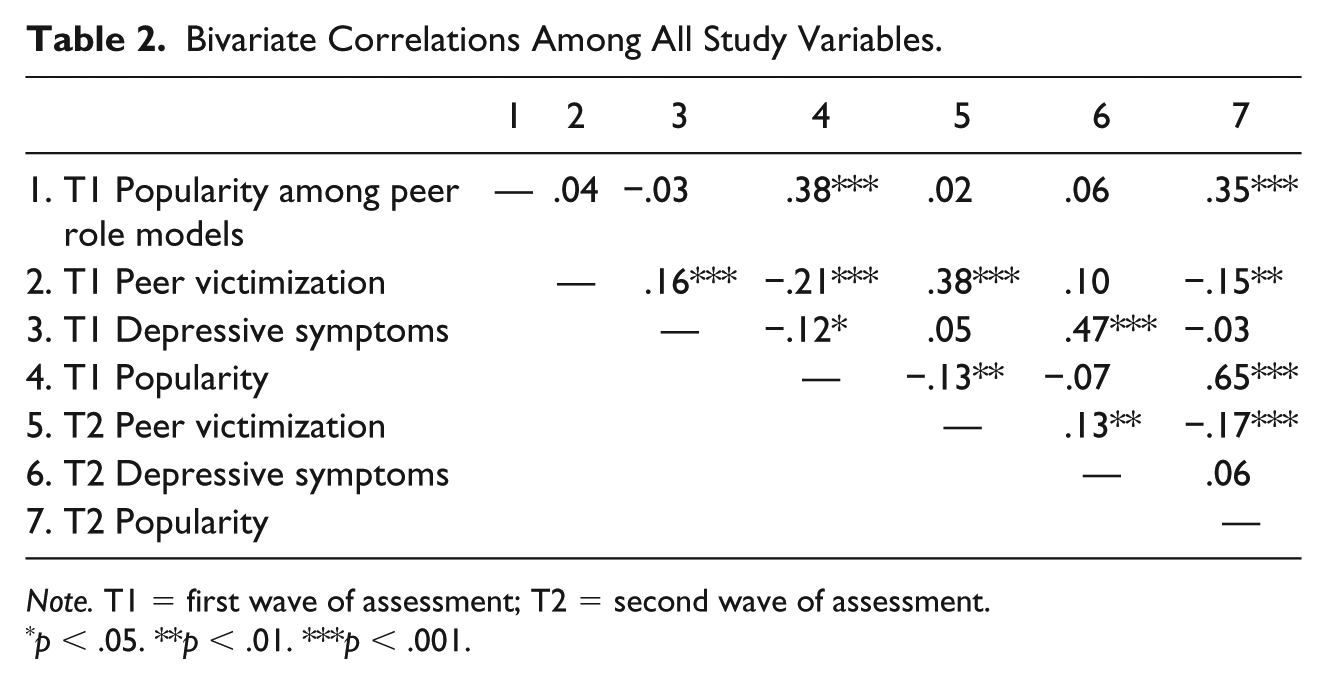
Bivariate correlations for the variables are summarized in Table 2. Depressive symptoms were moderately stable from T1 to T2. Main-effect associations between peer victimization and depressive symptoms were significant but small in magnitude. It is noteworthy that adolescents’ own level of popularity was negatively correlated with peer victimization at both time points, which may indicate that we are capturing the specific subset of victimized peers who do not hold high status in the peer group.
Bivariate Correlations Among All Study Variables.
Note. T1 = first wave of assessment; T2 = second wave of assessment.
p < .05. **p < .01. ***p < .001.
Popularity Among Peer Role Models and Gender as Moderators in the Association Between Peer Victimization and Depressive Symptoms
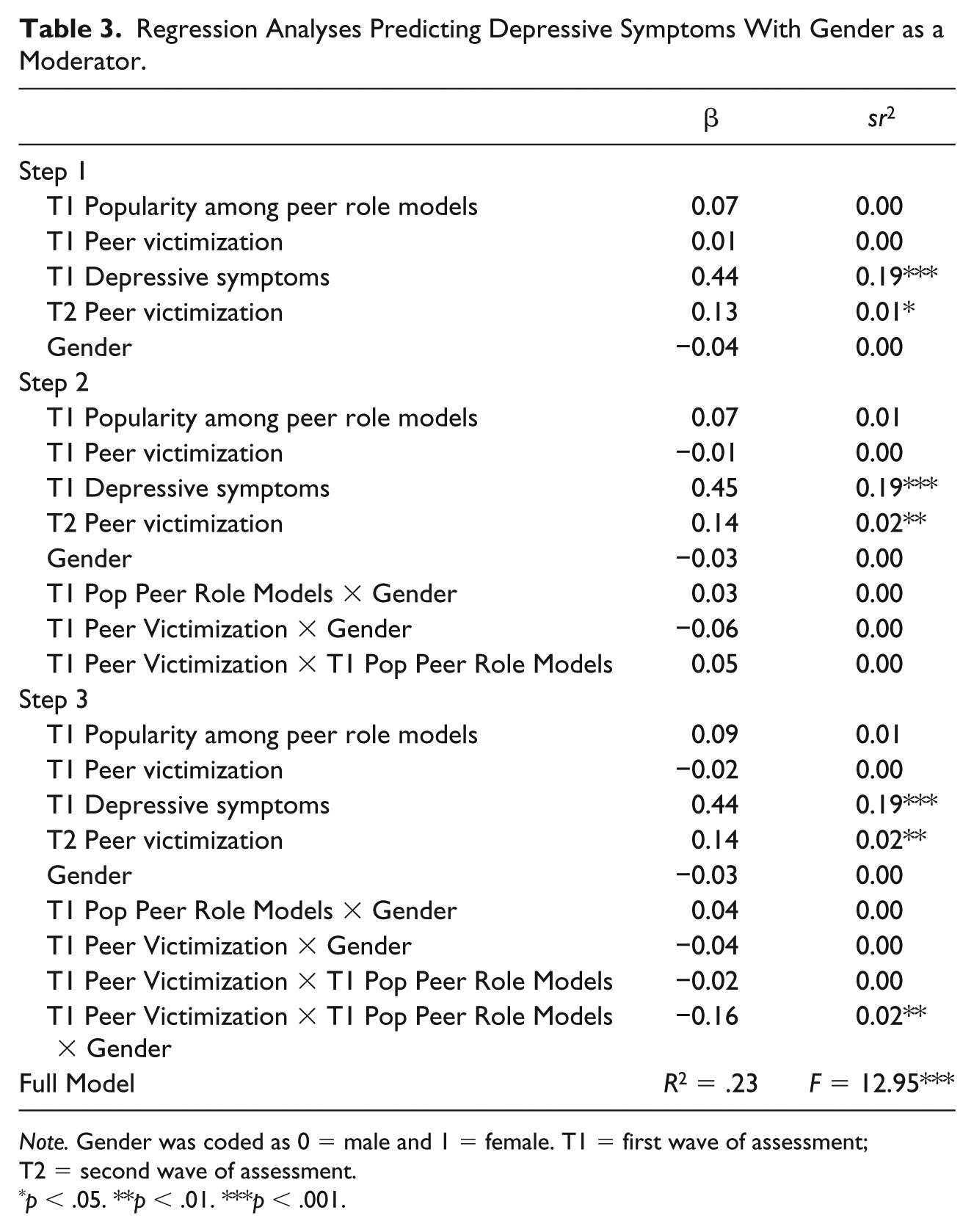
To examine the moderating roles of gender and popularity among peer role models in the association between peer victimization and depressive symptoms, we conducted a hierarchical regression analysis with T2 depressive symptoms as the outcome variable. The model included T1 peer victimization as the predictor, T1 popularity levels among peer role models as the moderator, and gender, T2 peer victimization and T1 depressive symptoms as covariates. On the first step of the model, we entered the main-effects for T1 popularity among peer role models, T1 peer victimization, T1 depressive symptoms, T2 peer victimization, and gender. On the second step, we entered the two-way interactions for T1 popularity among peer role models by gender, T1 peer victimization by gender, and T1 peer victimization by popularity among peer role models. On the final step, we entered the three-way interaction for T1 peer victimization by T1 popularity among peer role models by gender. All terms were entered simultaneously at each step, and steps were entered sequentially. Interactions terms were calculated based on mean-centered scores, as per Aiken and West’s (1991) recommendations.
There was a significant T1 peer victimization by T1 popularity among peer role models by gender interaction on Step 3 (see Table 3). That is, the moderating role of popularity among peer role models differed as a function of gender. To decompose this effect, we specified models examining the two-way T1 peer victimization by T1 popularity among peer role models interaction separately for boys and girls. In these models, T2 depressive symptoms was predicted from T1 depressive symptoms, T1 peer victimization, T2 peer victimization, T1 popularity among peer role models, and the interaction between T1 peer victimization and T1 popularity among peer role models. All terms were entered simultaneously, and interactions were computed based on mean-centered scores. There was a significant T1 peer victimization by T1 popularity among peer role models effect for boys (β = .17, p =.009) but not for girls, (β = −.12, n.s.).
Regression Analyses Predicting Depressive Symptoms With Gender as a Moderator.
Note. Gender was coded as 0 = male and 1 = female. T1 = first wave of assessment; T2 = second wave of assessment.
p < .05. **p < .01. ***p < .001.
To decompose the T1 peer victimization by T1 popularity among peer role models effect for boys, we again adhered to Aiken and West’s (1991) recommendations. We conducted a series of follow-up models that included only boys. We algebraically fixed T1 popularity among peer role models at high (one SD above the mean), medium (the mean), and low (one SD below the mean) cutoffs. We then examined associations between T1 peer victimization and T2 depressive symptoms (with T1 depressive symptoms and T2 peer victimization as covariates) at each level of the moderator. Consistent with our hypotheses, peer victimization was positively associated with T2 depressive symptoms at high levels of T1 popularity among peer role models (β = .14, p = .047), but the corresponding effects did not approach significance at medium (β = .01, n.s.) or low (β = −.13, n.s.) levels of T1 popularity among peer role models (Figure 1). For illustrative purposes, we then respecified the above models for girls only. Peer victimization was not significantly associated with T2 depressive symptoms at high (β = −.17, n.s.), medium (β = −.02, n.s.), or low (β = .14, n.s.) levels of T1 popularity among peer role models for girls (Figure 2).
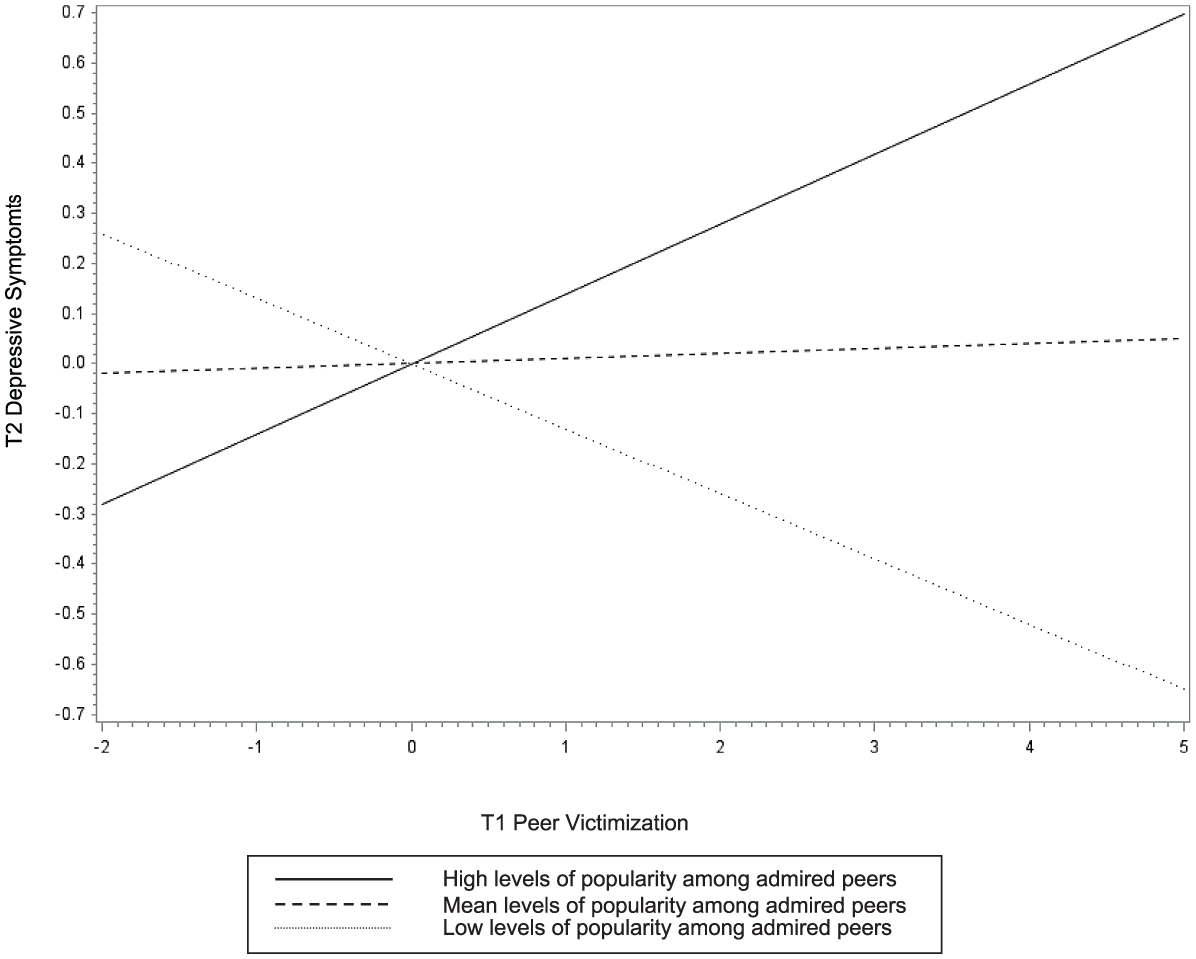
Interaction between popularity of peer role models and peer victimization in boys.

Interaction between popularity of peer role models and peer victimization in girls.
Popularity Among Peer Role Models and Ethnicity as Moderators in the Association Between Peer Victimization and Depressive Symptoms
Next, we considered potential ethnic group differences in the moderating role of popularity among peer role models. Models that simultaneously included a predictor and three potential moderators (i.e., ethnicity, gender, and popularity among peer role models) would be difficult to interpret given the complexity of the resulting interaction terms. Moreover, the analyses including ethnicity could only target a subset of the sample (i.e., Vietnamese American and Hispanic American students). Accordingly, we opted to examine the roles of gender and ethnicity in separate models.
We respecified the regression model described above by substituting ethnicity for gender as the moderator and with T2 depressive symptoms as the outcome variable in this model. Step 1 included the main-effects for T1 popularity among peer role models, T1 peer victimization, T1 depressive symptoms, T2 peer victimization, and ethnicity. Step 2 include the two-way interactions for T1 popularity among peer role models by ethnicity, T1 peer victimization by ethnicity, and T1 peer victimization by T1 popularity among peer role models. Step 3 included the three-way interaction term for T1 peer victimization by T1 popularity among peer role models by ethnicity. As shown in Table 4, this model did not yield any significant two-way or three-way interactions.
Regression Analyses Predicting Depressive Symptoms with Ethnicity as a Moderator.

Note. Ethnicity was coded as 0 = Vietnamese American and 1 = Mexican American. T1 = first wave of assessment; T2 = second wave of assessment; Pop peer role models = popularity among peer role models.
p < .05. **p < .01. ***p < .001.
Discussion
The evidence that peer victimization is concurrently and longitudinally linked with internalized distress is compelling (Hawker & Boulton, 2000; Kochenderfer-Ladd & Wardrop, 2001). Nonetheless, the effect sizes in past studies have been modest with some degree of variability across samples (Bond, Carlin, Thomas, Rubin, & Patton, 2001; Prinstein et al., 2001; Schwartz et al., 2005; Sweeting, Young, West, & Der, 2006). Perhaps as a result, researchers have begun to focus on moderators that might signal resilience or vulnerability for victimized youth (Graham & Juvonen, 2001; Hodges et al., 1999). In the current study, we drew from the perspective that adolescents’ idealized social experiences would be reflected in the attributes of the peer role models they admire (Graham et al., 1998). We hypothesized that the popularity levels of peer role models would help to identify youth who are particularly vulnerable to the negative impact of victimization by peers. Our findings were partially consistent with these predictions and highlight the significance of previously underexplored moderators.
Popularity of Peer Role Models as an Indicator of Risk
When considering why some victimized adolescents may be at an elevated risk for depressive outcomes, we turned our attention to the peers whom adolescents want to be like, respect, and admire. We utilized a method originally developed to assess students’ achievement-related values and extended the application of this methodology to the study of social aspirations. We additionally turned to theories and research on social goals and self-discrepancies as related frameworks in our examination of adolescents’ peer role models. Our assumption was that these peers would reflect a specific profile of idealized reputations and characteristics that adolescents wish to emulate. More specifically, we speculated that adolescents who seek to identify with their highly popular classmates likely desire social status, visibility, and social prestige in the peer group. These adolescents may also aspire to emulate certain characteristics embodied by their high status peers. Because adolescents tend to ascribe power, attractiveness, and athletic competence to their popular peers (de Bruyn & Cillessen, 2006), self-worth would be evaluated through comparisons to exemplars who are characterized by these features. For those adolescents whose own social experiences are misaligned with those of their peer role models, we expected distress to be intensified.
Consistent with our predictions, peer victimization was positively associated with depressive symptoms for boys whose peer role models were characterized by high status. These results support the notion that role models provide key insight into adolescents’ idealized social personas and may be a barometer by which adolescents evaluate themselves. For boys who look up to their popular classmates, frequent victimization by peers might represent concrete verification that they have not achieved this desired social position. Boys who are bullied may also infer that they possess undesirable attributes that are associated with being low in social power, such as submissiveness, physical unattractiveness, low athletic competence, and low social connectedness (Knack, Tsar, Vaillancourt, Hymel, & McDougall, 2012; Olweus, 1978; Rosen, Underwood, & Beron, 2011; Xie et al., 2006). The result is a painful contradiction to the social persona to which these adolescents aspire.
Our findings also resonate with theoretical perspectives that focus on social comparison processes (Festinger, 1954). Individuals tend to engage in social comparisons to evaluate their own abilities and validate distinct features of the self. Adolescents who compare themselves with peers whom they perceive to be more successful than they are may be at an elevated risk for highlighting their own perceived inadequacies (Swallow & Kuiper, 1988). We did not directly examine social comparisons as a mechanism in the current project. Still, one potential explanation for our findings might be that peer role models serve as a powerful stimulus for comparison. Under these conditions, victimized adolescent boys who admire peers with high social status would be likely to engage in painful upward social comparisons.
Interestingly, we did not find similar patterns of effects for boys who admire peers with low and moderate levels of popularity. Although popularity often serves as an organizing social objective during the adolescent years (LaFontana & Cillessen, 2010), admired role models may be identified based on dimensions other than peer group status. Some youth may even identify aspirational role models who are characterized by attributes that are not positively evaluated within the larger peer context. For example, some adolescents may look up to and aspire to be like their high-achieving peers (Graham et al., 1998). Adolescents who value academic achievement may be victimized or unpopular in settings where the peer group ethos dissuades studious dispositions (Schwartz, Kelly, & Duong, 2013). In these cases, however, peer victimization would not be expected to strongly predict subsequent internalized distress.
Our results add to a growing body of findings that highlight the complex pathways from victimization in the peer group to psychosocial adjustment. The impact of mistreatment by peers is likely to be shaped by a host of factors that include chronicity of the experience, behavioral features of the victim (e.g., submissiveness; Fox & Boulton, 2005), identity of the perpetrator, and resources in the peer group, including friendship or social support (Hodges et al., 1999). With specific regard to internalizing disorders, we would expect the comparative processes examined in this article to be particularly relevant. Over time, we expect that interactive and transactional models will bring increased explanatory power.
Gender as a Moderator
Although high popularity among peer role models appeared to intensify risk for boys, we did not find a similar moderating effect for girls. This gender interaction is congruent with the extant research examining differences in the social worlds of girls and boys. Compared with girls, adolescent boys tend to affiliate in larger peer groups, have more well-defined dominance hierarchies, and more heavily emphasize self-interest and dominance goals. Adolescent girls, on the other hand, tend to be involved in more extended dyadic interactions than boys and may emphasize connection-oriented goals to a greater extent than boys (for a review of gender differences in peer relationships, see Rose & Rudolph, 2006). These findings indicate that achieving popularity among peers may be a more salient social goal for adolescent boys than girls. Thus, for adolescent boys who endorse admiring peers who are high in popularity, the experience of victimization poses particularly negative emotional consequences.
Some evidence also suggests that popularity may hold different meaning for boys and girls (Rose, Click, Smith, Cillessen, Schwartz, & Mayeux, 2011). In studies of gender differences in characteristics associated with popularity, boys were more likely than girls to define popularity as being cool, athletic, funny, and defiant/risky, whereas girls were more likely than boys to define popularity as being fashionable, attractive, mean, snobby, rude, and sociable (Closson, 2009). While descriptors used by girls appeared to indicate both positive and negative attitudes toward popularity, boys seemed to associate relatively positive attributes with being popular. Failing to be like popular peers may therefore uniquely impact victimized boys, given the positive light in which boys view popularity.
Ethnicity as a Moderator
Our findings regarding the role of ethnicity were less conclusive. The ethnically diverse composition of the study sample provided a unique context in which to examine aspirational peer role models and depressive symptoms, but we did not find any evidence that the pattern differs across ethnic/racial groups. We acknowledge that these analyses were exploratory in nature, and our study design did not take within-group variability into account. Research on Hispanic American and Asian American adolescents indicates broad tendencies toward an emphasis on social relations, as well as elevated risk for depressive symptoms. Within ethnic groups, however, there tends to be heterogeneity in ethnic identity and level of acculturation across individuals (Roberts et al., 1999). These constructs may shape the ways that ethnicity moderates relations between peer victimization, the admiration of popular peers, and depressive symptoms. Future research incorporating a consideration of ethnic identity, acculturation, and adherence to cultural and ethnic values is recommended.
Limitations
Before we move on to our concluding comments, we will pause to acknowledge some potential limitations of this study. Our guiding assumption was that the attributes of peer role models may provide insight into an adolescent’s own schemas regarding desired profiles of social reputations, experiences, and nonbehavioral attributes. Although we believe that this basic approach has a strong theoretical foundation partially distinct from both social goals and self-discrepancies, future research would benefit from delineating links between peer role models and related constructs. We also calculated the popularity among admired peers variable based on three items (“students that you want to be like”; “students that you admire”; “students that you respect”), which may represent overlapping but distinct constructs. Future work differentiating among these constructs is thus warranted.
Our results provide support for the idea that admiring peer role models who are high in popularity may confer risk to victimized boys. We acknowledge, however, that adolescents may look up to their peers for a variety of reasons that we may not have captured in this study. As such, in further research on this topic, it may be prudent to include more direct assessments of the reasons adolescents view certain peers as role models.
Our focus on peer group victimization as a social stressor was also based on specific assumptions. We viewed mistreatment by peers as a direct form of feedback, providing information regarding position in the social hierarchy, social reputation with peers, and personal attributes or limitations. In future work, it may be worthwhile to examine a greater diversity of social indicators, as each dimension of the peer group experience can provide unique information guiding construction of the self.
We specifically examined levels of popularity among peer role models as a moderator, given the conceptual contrast between peer victimization and popularity. Our underlying assumption was that peer victimization provides concrete feedback that an adolescent has not attained a high position in the peer group hierarchy. This assumption is partially validated by the negative correlation between peer victimization and popularity in our sample. We acknowledge, however, that this correlation was modest in size, which indicates some popular youth may also be victimized. This would be consistent with research that suggests some victims may have high status (Andrews, Hanish, Updegraff, Martin, & Santos, 2016; Faris & Felmlee, 2014). Future work would benefit from direct attempts to distinguish global victimization from peer victimization that occurs exclusively between adolescents who are high in popularity.
Given the correlational nature of this study, we were not able to establish causal relations among our variables of interest. We also acknowledge that peer victimization and depressive symptoms are not unidirectionally linked. Indeed, a large body of research suggests that peer victimization and depressive symptoms transactionally influence each other over time (Hodges et al., 1999; Reijntjes, Kamphuis, Prinzie, & Telch, 2010). We were interested in specifically examining risks associated with peer victimization and are thus capturing only one segment of a complex cycle of influence. Longer term, longitudinal investigations that take into account the complex temporal relations between peer victimization and depressive symptoms are warranted.
Finally, we recognize that the context assessed in this project had unique features. We targeted a school district located in an ethnically diverse urban community. Our sample composition was consistent with much of the Southern California region, including large Asian American and Hispanic American subpopulations. We do not have a strong theoretical rationale to suggest that our findings would not replicate in other settings. However, our confidence in external validity would be enhanced by investigations conducted in a wider range of neighborhoods with diverse ethnic compositions.
Conclusion
During adolescence, success in the peer group is a critical component of development, and youth may view themselves largely through the lens of their social identities. This study examined peer role models to elucidate factors that intensify risk for emotional maladjustment in victimized adolescents. Our results provide evidence that being victimized by peers is especially detrimental to adolescent boys who aspire to be like their peers who are characterized by high levels of popularity. For these boys, peer victimization may uniquely signal a failure to attain desired social experiences, which may in turn increase risk for depressive symptoms and other negative emotional outcomes. This work contributes to a large body of research on factors that put victimized youth at a heightened risk for negative emotional consequences. A nuanced understanding of these risk factors and the underlying mechanisms may aid in the identification of at-risk youth at school as well as inform intervention efforts for victimized adolescents.
Footnotes
Authors’ Note
Tana Luo is now affiliated to University of California, San Diego, CA, USA, Alexandra C. Ross is affiliated to University of California San Francisco Benioff Children’s Hospital, CA, USA, and Daryaneh Badaly is now affiliated to Child Mind Institue, New York, NY, USA.
Declaration of Conflicting Interests
The author(s) declared no potential conflicts of interest with respect to the research, authorship, and/or publication of this article.
Funding
The author(s) received no financial support for the research, authorship, and/or publication of this article.
