



Abstract
The purpose of the current study was to explore the association between peer victimization and school engagement and the indirect effects of rumination and depressive symptoms in this association. Data on middle school students’ victimization experiences, school engagement, rumination, and depressive symptoms were collected from 887 sixth- through eighth-grade students utilizing self-report measures. Results indicated for both boys and girls a significant negative association between peer victimization and school engagement. Furthermore, a significant indirect effect of rumination and depression symptoms was evident for both boys and girls, but these effects were more robust for girls. Furthermore, the direct relation between depressive symptoms and school engagement was stronger for girls. Implications of these findings are discussed.
School engagement is a critical component to academic performance and school success. However, certain school experiences, such as being a target of bullying, can disrupt students’ ability to be engaged in school (Ripski & Gregory, 2009). Given the large number of youth who experience peer victimization—and the strong link between school engagement and positive adolescent development—it is important to identify factors that may help scholars understand the association between victimization and school engagement, such as rumination and depressive symptoms. Alarmingly, about 20% of middle and high school students experience traditional victimization (National Center for Educational Statistics, 2015), and about 16% of high school students experience cyber victimization in the United States (Centers for Disease Control and Prevention, 2016). Peer victimization is viewed as a stressful life event for youth and the negative outcomes associated with victimization can be framed via the diathesis-stress model (Swearer & Hymel, 2015). Although the relation among peer victimization and academic performance is well established (Nakamoto & Schwartz, 2010), less is known about the relation between peer victimization and school engagement and potential underlying mechanisms that may impact this relation. The current study aimed to test a single theoretical model investigating the roles of rumination and depressive symptoms together in the association between peer victimization and school engagement through the lens of the diathesis-stress perspective (see Figure 1).
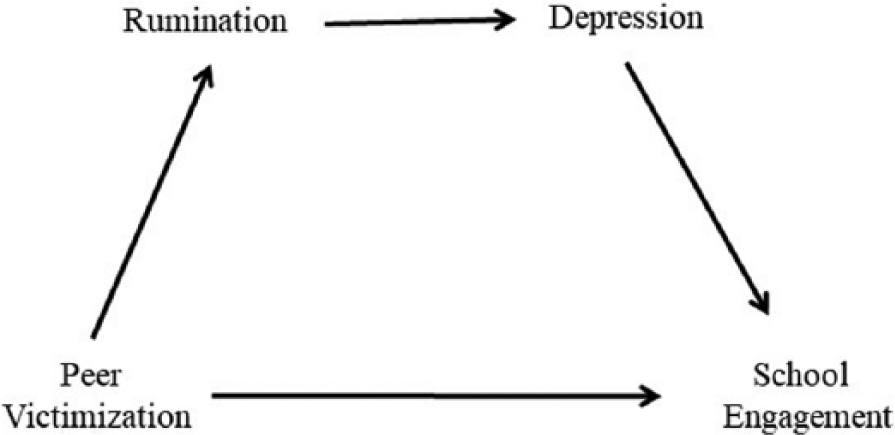
Conceptual model.
Peer Victimization and School Engagement
A student is a victim of bullying when a peer(s) with real or perceived power repeatedly targets them through aggressive and unwanted means, which results in social, physical, psychological, or educational harm (Gladden, Vivolo-Kantor, Hamburger, & Lumpkin, 2014). This definition includes cyberbullying, which are aggressive acts and behavior that occur through technology, typically via mobile phones and the Internet (Slonje & Smith, 2008). Typically, students report lower levels of cyberbullying than traditional bullying. A meta-analysis on prevalence rates of traditional and cyber victimization among adolescents ages 12 through 18 revealed the mean prevalence rate for traditional victimization was 36% and for cyberbullying about 15% of adolescents (Modecki, Minchin, Harbaugh, Guerra, & Runions, 2014). Most research on victimization has suggested boys report higher levels of peer victimization than girls (Povedano, Cava, Monreal, Varela, & Musitu, 2015; Sentse, Kretschmer, & Salmivalli, 2015), although a few studies have found girls were more likely than boys to be victims of bullying (Veenstra et al., 2005).
Peer victimization is associated with a host of negative outcomes, including internalizing behaviors, such as anxiety and depression, and poor academic achievement (Bottino, Bottino, Regina, Correia, & Ribeiro, 2015; Davidson & Demaray, 2007; Nakamoto & Schwartz, 2010). There has been a call to explore the relation among peer victimization and negative outcomes utilizing a diathesis-stress model (Swearer & Hymel, 2015). This model posits that negative outcomes occur as a result of the interplay between an individual’s cognitive or biological vulnerabilities and environmental stressors. Therefore, we were interested in examining the impact of peer victimization (i.e., an environmental stressor) and cognitive vulnerability factors (e.g., rumination) on levels of school engagement.
School engagement—students’ behaviors, feelings, and thoughts about school—is fundamental to academic success (Fredricks, Blumenfeld, & Paris, 2004). Poor school engagement is associated with both academic and nonacademic outcomes, including attendance, school dropout, delinquency, substance abuse, and academic achievement (Janosz, Archambault, Morizot, & Pagani, 2008; Li & Lerner, 2011; Loukas, Ripperger-Suhler, & Horton, 2009). School engagement has also been conceptualized as a protective factor, in that youth who are engaged at school are less likely to develop emotional problems (Loukas et al., 2009). Therefore, school engagement is crucial in understanding overall adolescent development. Fredricks et al. (2004) identified school engagement as a multifaceted construct with three components: behavioral, emotional, and cognitive. Behavioral engagement includes participation in academic, social, and extracurricular activities, such as work completion, participating in afterschool activities, and following school rules. Emotional engagement involves emotional responses to school staff, classmates, and the school and is associated with generating bonds with an institution. Cognitive engagement includes the thoughtfulness and willingness to invest effort to understand complex concepts and master challenging skills (Fredricks et al., 2004). Fredricks et al. (2014) advocated for considering all three components of school engagement in research rather than a single component because they are interrelated within the student and “are not isolated processes.”
Girls typically report higher levels of emotional and behavioral engagement than boys. A study conducted with middle school students from the United States found girls reported higher levels of behavioral and emotional engagement than boys, but not cognitive engagement (M. T. Wang, Willett, & Eccles, 2011). Similarly, a study that focused primarily on behavioral school engagement with middle and high school students from the United States found girls reported more engagement than boys (M. K. Johnson, Crosnoe, & Elder, 2001). In a longitudinal study conducted in Belgium that conceptualized school engagement as teacher relationships, interest in learning, and attitude to homework, latent growth curve models show a decrease in these engagement components for both boys and girls each year from seventh to 12th grade (Van de Gaer, Pustjens, Van Damme, & De Muter, 2009).
Peer victimization is often associated with academic performance, typically measured utilizing grades or standardized test scores. A meta-analysis investigating the relation between peer victimization and academic performance found a small, but significant, negative association between peer victimization and academic achievement for both boys and girls, r = −.12, p < .001, r = −.10, p < .001, for the random effects and fixed effects models, respectively (Nakamoto & Schwartz, 2010). The small association between these two variables is interesting—it has been suggested that there may be more robust factors that impact grades and test scores, such as socioeconomic status (SES), intelligence, and parent education (Ladd, Ettekal, & Kochenderfer-Ladd, 2017). Instead, Ladd and colleagues advocate for school engagement as a better indicator of academic success, particularly when examining school-related consequences of peer victimization. The literature on peer victimization and school engagement has received considerably less attention than that of academic performance.
When students are targets of bullying, they may become less engaged in school because they do not feel a connection to the school or they may be less invested to complete academic tasks (Ripski & Gregory, 2009). A study conducted with 10th-grade students found self-reported traditional victimization was negatively associated with teacher reported student engagement (Ripski & Gregory, 2009). Similarly, in elementary Latino/a students (third through fifth grade), peer-nominated traditional victimization was negatively associated with self-reported behavioral engagement (Nakamoto & Schwartz, 2010). Utilizing a longitudinal analysis that followed 393 children from kindergarten to 12th grade, Ladd et al. (2017) found peer victimization to be associated with decreases in school engagement, academic self-perceptions, and academic achievement. There is limited literature on gender effects in the association between peer victimization and school engagement. One study investigating the role of teacher conflict in the association between peer victimization and school engagement in third- through sixth-grade students, found that for boys only, teacher conflict moderated the association of peer victimization and behavioral engagement (Archambault, Kurdi, Olivier, & Goulet, 2016). Interestingly, in girls, the teacher conflicts had a direct effect on behavioral engagement, but victimization experiences did not. To date, no known study has investigated the relation between cyber victimization and school engagement. However, given the prevalence of cyber victimization and overlap with traditional victimization (Jose, Kljakovic, Scheib, & Notter, 2012), as well as its association with negative outcomes including depression and academic performance, we felt it was important to include both traditional and cyber victimization as indicators of peer victimization. Given the ample research to support a negative association between peer victimization and school engagement, the current study aimed to investigate the roles of rumination and depressive symptoms, specifically the role of rumination through depressive symptoms, in this association.
Indirect Effects of Depressive Symptoms
Depressive symptoms include depressed or irritable mood, reduced interest or pleasure in activities, significant changes in weight, changes in sleep patterns, feeling slow, fatigue, feeling worthless, reduced ability to concentrate, and recurrent thoughts of death and suicide (American Psychiatric Association, 2013). In 2015, 12.5% of adolescents between the ages of 12 and 17 experienced at least one major depression episode (Center for Behavioral Health Statistics and Quality, 2016). Gender differences in depression begin to emerge between the ages of 13 and 15 (Hankin et al., 1998; Nolen-Hoeksema & Girgus, 1994; Twenge & Nolen-Hoeksema, 2002) when depression rates continue to rise in girls but remain steady among boys (Hankin et al., 1998). Prior to age 13, typically no gender differences are found in depression levels (Twenge & Nolen-Hoeksema, 2002).
Depression has been found to be an important precursor to school engagement. Adolescents who report symptoms of depression tend to exhibit less motivation to participate in school activities (Garvik, Idsoe, & Bru, 2014), lower levels of school satisfaction and motivation, and less connection with teachers and school (Humensky et al., 2010; Li & Lerner, 2011). Chow, Tan, and Buhrmester (2015) found adolescent depressive symptoms were negatively related to school involvement, which was then associated with lower academic performance. In a study that conceptualized school engagement as school motivation, truancy, absence, and intentions to quit school in a Norwegian sample of adolescents ages 15 to 18, depression was associated with the measured school engagement/disengagement factors (Garvik et al., 2014). More specifically, depression was positively associated with intentions to quit and negatively associated with school motivation. Adolescents that report depressive symptoms may exhibit negative beliefs and helplessness in the context of school achievement and exhibit low motivation when met with academic challenges (Garvik et al., 2014). Some research has found that the relation between depression and school engagement may be more robust for girls (Fletcher, 2008), although further research is needed.
A considerable amount of research has found that students who are targets of bullying tend to report higher levels of depression (Barchia & Bussey, 2010; Becker, Mehari, Langberg, & Evans, 2016; Kaiser & Malik, 2015; Stapinski, Araya, Heron, Montgomery, & Stallard, 2015; Sweeting, Young, West, & Der, 2006; J. Wang, Nansel, & Iannotti, 2011). In a longitudinal study with students from Australia in seventh through 10th grade, victimization at Time 1 and Time 2 was moderately and positively associated with depression at Time 2 (T1 Victimization to T2 Victimization (β = .50, p < .01); T2 Victimization to T2 Depression (β = .26, p < .01; Barchia & Bussey, 2010)). However, not all students who are targets of bullying experience depression or poor school engagement. Swearer and Hymel (2015) suggest that a life stressor, such as peer victimization, can trigger cognitive, biological, or social vulnerabilities that contribute to the development of depression and other internalizing and externalizing problems. Given our understanding of peer victimization as a stressor, an individual’s response to stress such as rumination may contribute to the development of depression, which may explain a negative relation between peer victimization and school engagement.
The Role of Rumination
According to Nolen-Hoeksema’s Response Styles Theory, rumination is a method of responding to distress where the individual repeatedly focuses on their symptoms of distress, possible reasons they feel this way, and potential consequences for these symptoms (Nolen-Hoeksema, Wisco, & Lyubomirsky, 2008). Individuals who ruminate fixate on their problems and feelings related to their problems without trying to solve the problem or change their circumstances. Children and adolescent girls, as well as adult women, tend to report higher levels of rumination than children and adolescent boys and adult men (D. P. Johnson & Whisman, 2013; Rood, Roelofs, Bögels, Nolen-Hoeksema, & Schouten, 2009). Ample literature supports the importance of rumination in the association between cyber and traditional victimization and depression (Barchia & Bussey, 2010; Feinstein, Bhatia, & Davila, 2014; Monti, Rudolph, & Miernicki, 2017). In a sample of children (mean age = 9.46) from the Midwest, rumination mediated the association between peer victimization and depressive symptoms (Monti et al., 2017). Similarly, in a sample of Australian adolescents, rumination had a mediating effect in the association between victimization and depression (Barchia & Bussey, 2010). In a study of adolescents from three high schools in Turkey, rumination and victimization were positively correlated with depressive symptoms in adolescents, but interactions with gender were not significantly related to depressive symptoms (Erdur-Baker, 2009). Cyber victimization and depressive symptoms were also mediated by rumination in collaged aged women (Feinstein et al., 2014).
To date, no known study has examined the relation between rumination and school engagement. However, if a child or adolescent is ruminating or focusing on an environmental stressor (e.g., thinking about being bullied), it makes theoretical sense that they would be less engaged, especially if their stress is related to a school experience or involves their classmates (e.g., being bullied at school or online by a classmate). Given the evidence to support the role of rumination in the association between peer victimization and depression, and the association between peer victimization and school engagement, we were interested in exploring the role of rumination through depressive symptoms in the association between peer victimization and school engagement in a single theoretical model.
Research Questions and Hypotheses
Through the lens of the diathesis-stress model, Swearer and Hymel (2015) suggested that peer victimization (i.e., stressful life event) may activate cognitive vulnerabilities (e.g., rumination), leading to further negative outcomes. Therefore, influenced by the diathesis-stress perspective, the overarching goal of our investigation was to examine the process through which peer victimization may be related to school engagement. A considerable amount of scholarly work has focused on the link between peer victimization and academic achievement (Nakamoto & Schwartz, 2010). However, given the association between school engagement and positive adolescent development, we were interested in the impact of peer victimization on a variable that is indicative of adolescents’ overall school experience beyond test scores and grades. Furthermore, more research is needed to understand the underlying mechanisms in the relation between peer victimization (including cyber victimization) and school engagement. Not all students that are targets of bullying experience lower levels of school engagement. Therefore, we explored the role of rumination through depressive symptoms (i.e., cognitive vulnerability factors) in the association between peer victimization (both cyber and traditional) and school engagement (see Figure 1). Gender differences were also explored among these associations given that there is limited research on the effects of gender among these associations. The present study aimed to answer the following questions: (a) What is the relation between peer victimization and school engagement? Are there gender differences in this relation? (b) Is there an indirect effect of rumination through depressive symptoms in the relation between peer victimization and school engagement? (c) Are there gender differences among these relations? We predicted that peer victimization would be negatively associated with school engagement (Ladd et al., 2017; Ripski & Gregory, 2009) and there would be significant indirect effects of rumination and depressive symptoms in this relation (Barchia & Bussey, 2010; Garvik et al., 2014; Monti et al., 2017). Furthermore, we predicted that the relations investigated in this model would be more robust for girls than for boys (D. P. Johnson & Whisman, 2013; M. T. Wang et al., 2011).
Method
Participants
A total of 887 (53.7% male) sixth- through eighth-grade students from a middle school in northern Illinois completed the measures as part of a Fall all-school evaluation. Participants self-reported their race/ethnicity and identified as White (60.0%), Multiracial (16.6%), Hispanic/Latino (14.2%), African American (6.3%), Asian (1.7%), Native American (0.7%), and Pacific Islander (0.2%). Participants were comprised of 277 sixth graders (31.2%), 301 seventh graders (33.9%), and 307 eighth graders (34.6%). Of the total student population (N = 989), 89.7% of students participated. Approximately 30% of the student body were considered low income and received free or reduced price lunches.
Measures
The following measures were used to assess traditional victimization, cyber victimization, school engagement, depressive symptoms, and rumination.
Traditional victimization
The Bullying Participant Behaviors Questionnaire (BPBQ; Summers & Demaray, 2008) measures the frequency of behaviors associated with the different roles related to involvement in bullying. The BPBQ contains five subscales (Bully, Assistant, Victim, Defender, and Outsider) of 10 items each. Students use a Likert-type scale (0 = never to 4 = seven or more times) to report the frequency by which they participated in behaviors associated with each of the five bullying roles during the past 30 days. The present study utilized the Victim subscale only, scores were calculated by averaging the 10 Victim items. An example item is, “In the past 30 days, I have been called mean names.” In a validation study with sixth- through eighth-grade students, the BPBQ demonstrated adequate reliability and validity (Demaray, Summers, Jenkins, & Becker, 2016). The alpha coefficient of the Victim subscale was .94, demonstrating high internal consistency. Inter-item correlations ranged from .73 to .84 (p < .01) and the Victim subscale was significantly correlated (p < .01) with the Bully subscale (r = .32), the Assistant subscale (r = .19), the Outsider subscale (r = .25), and the Defender subscale (r = .41; Demaray et al., 2016). In the current study, the observed internal consistency for the Victimization subscale was α = .94.
Cyber victimization
The Cyber Victimization Survey (CVS; Brown, Demaray, & Secord, 2014) is a 17-item scale that measures the frequency of cyber victimization experiences. Students are asked to rate how often within the last 2 to 3 months they have experienced bullying on a 5-point Likert-type scale (1 = it hasn’t happened at all in the past couple of months to 5 = several times a week). An example item is “In the last 2 to 3 months, has something been written about you or posted online that made you feel upset?” A total score was calculated by averaging the 17 items. In a study with middle school students, the CVS demonstrated adequate reliability and validity (Brown et al., 2014). The alpha coefficient of the scale was .92, demonstrating high internal consistency. Validity was established by comparing the measure to other cyberbullying and aggression measures. The scale was positively correlated with the Cyberbullying and Online Aggression Survey Instrument (Hinduja & Patchin, 2007; r = .59, p < .01) and the Cyberbully Measure (Kowalski & Limber, 2007; r = .52, p < .01). In a high school sample, the internal consistency of the CVS was .94 and was positively associated with the Cyberbullying and Online Aggression Survey Instrument (Hinduja & Patchin, 2007; Brown, Demaray, Tennant, & Jenkins, 2017). In the current study, the observed internal consistency was α = .95.
School engagement
To measure behavioral and emotional engagement in school, items from the Engagement versus Disaffection with Learning measure (Skinner, Kindermann, & Furrer, 2009) were adapted to measure Behavioral and Emotional School Engagement in school. The Engagement versus Disaffection with Learning is a 24-item self-report measure that contains four subscales (Behavioral Engagement, Emotional Engagement, Behavioral Disaffection, and Emotional Disaffection). The Behavioral and Emotional Engagement subscales of five items each were utilized in the current study. The present study adapted the items by replacing the word class with the word school since the goal of the study was to understand overall school engagement. In addition, middle school students are likely to be in multiple classes; therefore, changing class to school may be a more accurate indication of their overall engagement. An example behavioral engagement item is “In school, I work as hard as I can,” and an example emotional engagement item is “When I’m in school, I feel good.” The Deep Learning measure (Senko & Miles, 2008) was utilized to measure cognitive engagement in school, which is a 4-item self-report scale. This scale was also adapted to reflect engagement in school, rather than to the classroom. For example, the item “When reading the textbook for this class, I try to connect the ideas I am reading about with what I already know” was changed to “When reading for school, I try to connect ideas I am reading with things I already know.” For all scales related to engagement, students were asked to rate on a Likert-type scale (1 = strongly disagree to 6 = strongly agree) to what extent they agreed with items related to behavioral, emotional, and cognitive engagement at school. A mean score was calculated for behavioral, emotional, and cognitive engagement.
In a longitudinal validation study with third through sixth graders, the original Engagement versus Disaffection with Learning measure demonstrated reliability and validity (Skinner et al., 2009). The alpha coefficients of the Behavioral Engagement and Emotional Engagement subscales were .61 and .76 in the fall, .72 and .82 in the spring, with cross-year coefficients of .53 and .64, respectively (p < .001). At the p < .001 level, the Behavioral Engagement subscale was significantly correlated with the Emotional Behavioral subscale (r = .53), Behavioral Disaffection scale (r = −.42), and the Emotional Disaffection scale (r = −.34). The Emotional Engagement subscale was also significantly correlated with the Behavioral Disaffection scale (r = −.52) and the Emotional Disaffection scale (r = −.51; Skinner et al., 2009). In the current study, the observed internal consistencies for the adapted subscales were .89 for Behavioral Engagement and .92 for Emotional Engagement. In a study that utilized the original Deep Learning scale, adequate reliability was established (α = .83) in a sample of undergraduate students from the United States (Senko & Miles, 2008). In the current study, the internal consistency for the adapted subscale was .91.
Depressive symptoms
The Center for Epidemiologic Studies Depression Scale—Revised (CESD-R; Eaton, Smith, Ybarra, Muntaner, & Tien, 2004) is a 20-item self-report measure of nine depressive symptoms: loss of interest, appetite, sleep, sadness, thinking/concentration, tired, movement, guilt, and suicidal ideation. The two questions related to suicide ideation were removed due to all-school evaluation procedures. Participants were asked to report how often they experienced the symptoms (e.g., “My sleep was restless”) using 5-point Likert-type scale (0 = not at all or less than 1 day last week to 4 = five to seven nearly every day for 2 weeks). A mean score of depressive symptoms was calculated by averaging the 18 items.
In a validation study, two samples completed the CESD-R as well as measures of affect, anxiety, and schizotypal personality. The first sample included individuals who were approximately 31 years old (
Rumination
The Children Response Style Questionnaire (CRSQ; Abela, Brozina, & Haigh, 2002) is a 25-item self-report scale used to measure responses to feeling sad in children. The measure includes three subscales: Problem-Solving, Distraction, and Rumination. The 13-item Rumination subscale was utilized in the current study. Participants were asked to what extent they ruminated when they felt sad using a 4-point scale (0 = almost never to 3 = almost always). An example rumination item is “When I feel sad, I go away by myself and think about why I feel this way.” A total score was calculated by averaging the 13 items. The CRSQ Rumination subscale has demonstrated adequate internal consistency in samples of students in third grade (Cronbach’s alphas ranging from .74 to .76) and seventh grade (Cronbach’s alphas ranging from .75 to .84; Abela et al., 2002; Abela, Vanderbilt, & Rochon, 2004). Test-retest reliability is also adequate (rs ranging from .51 to .72; Abela, Aydin, & Auerbach, 2007; Abela et al., 2004). For the current study, the observed internal consistency was α = .94.
Procedure
The measures were administered during an all-school evaluation completed in October of 2016 through Qualtrics, an online survey program. Participants were also asked a series of demographic questions. Passive consent procedures were utilized and students were asked to give their assent upon the start of the survey. Institutional Review Board (IRB) approval was obtained for extant data.
Data Analyses
Structural equation modeling using Mplus 8.0 (Muthén & Muthén, 1998/2017) was utilized for the current study. All preliminary analyses were conducted with IBM SPSS Statistics 24. Overall model fit was established prior to examining the structural components of each model. The models consisted of four latent variables: peer victimization, school engagement, rumination, and depressive symptoms. Peer victimization included the observed variables of traditional victimization (BPBQ Victim subscale) and cyber victimization (CVS scale). School engagement was measured via the Emotional Engagement, Cognitive Engagement, and Behavior Engagement subscales (utilizing the Engagement versus Disaffection with Learning—Skinner et al., 2009—and Deep Learning—Senko & Miles, 2008—measures). Both the rumination and depression scales are unidimensional measures; therefore, items were parceled for each scale and used as indicators. Item parceling is often utilized for scales with many items as parcels are more reliable and have more robust factor loadings than single items (Little, Rhemtulla, Gibson, & Schoemann, 2013; Matsunaga, 2008). Since we were not primarily interested in item-level analyses, item parceling was deemed appropriate for the current study (Little, 2013).
Model fit was evaluated by examining chi-square statistics, the root mean square error of approximation (RMSEA), the comparative fit index (CFI), and the Tucker-Lewis index (TLI). The chi-square is sensitive to large sample sizes; therefore, additional fit indices were considered (Hooper, Coughlan, & Mullen, 2008). Adequate model fit is considered with RMSEA values below .08 and CFI/TFI values above .90 (Hooper et al., 2008). For identification purposes, the scale was set by fixing the latent variances to one. Bootstrapping was utilized to test for direct and indirect effects, which allows the sample to be treated as the population where small samples are drawn from the larger sample, analyzed, and then replaced (10,000 times for the current study). Prior to examining gender differences, measurement invariance across gender groups was evaluated, which requires the use of increasingly restrictive equality constraints to evaluate model fit; this step is critical to make meaningful comparisons across groups (Pendergast, von der Embse, Kilgus, & Eklund, 2017). To explore gender differences, a series of multiple group analyses were conducted across groups and chi-square difference testing was utilized for model comparisons. Full information maximum likelihood (FIML) estimation was utilized to account for missing data. There was 2% of Traditional Victimization, 2% of Cyber Victimization, 9% of Depressive Symptoms, 8% of Rumination, 2% of Emotional Engagement, 2% of Cognitive Engagement, and 2% of Behavioral Engagement missing cases.
Results
Descriptive Statistics
Means, standard deviations, and correlations among all variables are presented in Tables 1 and 2. All squared multiple correlations among variables were less than .90; thus, collinearity was not detected (Kline, 2011). Tolerance was also assessed and all values were above the recommended value of .10 (Kline, 2011). Skewness values for outcome variables (i.e., School Engagement indicators, Rumination items, Depressive Symptoms) were within recommended ranges (values ranged from −.84 to 3.08).
Means and SDs for All Variables by Gender and Total Sample.

Intercorrelations by Gender.

Note. Correlations above diagonal are for boys (n = 476) and below diagonal are for girls (n = 408).
p < .05. **p < .01.
A series of one-way ANOVAs were conducted to investigate gender differences in each of the variables. Significant differences were found for Traditional Victimization, F(1, 872) = 9.74, p = .002, R2 = .01; Cognitive Engagement, F(1, 870) = 4.91, p = .027, R2 = .01; Behavioral Engagement, F(1, 868) = 9.45, p = .002, R2 = .01; and Rumination, F(1, 818) = 22.10, p < .001, R2 = .03. Girls reported significantly higher levels of Cognitive Engagement, Behavioral Engagement, and Rumination. Boys reported significantly higher levels of Traditional Victimization. Girls and boys reported similar levels of Cyber Victimization, Emotional Engagement, and Depressive Symptoms.
Item Parceling, Measurement Model, and Measurement Invariance
Item parceling was utilized for the Depressive Symptom and Rumination latent constructs to reduce the number of indicators and increase reliability (Little, 2013). Prior to parceling the items, a single-factor confirmatory factor analysis (CFA) was run with the 13 Rumination items, χ2(65) = 634.88, p < .001, RMSEA = .10, CFI = .92, TLI = .91. Factor loadings ranged from .61 to .81. Modification indices indicated a strong relation between two Rumination items (i.e., both items assessed going somewhere alone to think about feelings); due to their shared variance, these items were assigned to the same parcel. The balancing approach was then utilized—items with higher loadings were combined with items with lower loadings—to assign the remaining items to the parcels (Little et al., 2013; Yang, Nay, & Hoyle, 2010). This resulted in four items each in the first two parcels and five items in the third parcel. The same procedure was utilized with the 18 Depressive Symptom items, χ2(135) = 1,565.28, p < .001, RMSEA = .11, CFI = .86, TLI = .84. Factor loadings ranged from .50 to .81. Modification indices indicated a strong relation among three pairs of items—the first pair assessed feeling sad or depressed, the second pair assessed difficulty sleeping, and the third pair assessed difficulty focusing. Each pair of items was assigned to a parcel and the remaining items were assigned via the balancing approach. All three parcels contained six items.
Data were then fit to the measurement model depicted in Figure 2. The chi-square was significant, χ2(39) = 130.74, p < .001; however, fit indices (RMSEA = .05, CFI = .99, TLI = .98) were within their respective recommended ranges for acceptable model fit. All path coefficients between observed variables and their respective latent variable were significant and in the expected direction (see Figure 2). Next, multiple group analyses were used to test measurement invariance across gender, which involved comparing an unconstrained model that specified the same factor structure for each group (i.e., configural invariance) to a model that constrained factor loadings (i.e., weak invariance) and thresholds (i.e., strong invariance) across both groups. First, configural invariance was examined and the model indicated acceptable fit, χ2(79) = 180.34, p < .001, RMSEA = .05, CFI = .99, TLI = .98. Weak invariance was then evaluated by constraining the factor loadings across groups, χ2(84) = 186.71, p < .001, RMSEA = .05, CFI = .99, TLI = .98, and this model was compared to the configural model; the chi-square difference test was nonsignificant, ∆χ2(5) = 6.37, p = .27, ∆RMSEA = .001, ∆CFI = .000. Then, strong invariance was evaluated by constraining both the factor loadings and thresholds to be equal across groups, χ2(91) = 208.93, p < .001, RMSEA = .05, CFI = .98, TLI = .98. This model was compared to the weak invariance model. Although the chi-square difference test was significant, ∆χ2(7) = 22.27, p = .002, change in fit indices were nonsignificant (∆RMSEA = .001, ∆CFI = .003), which provided support for strong invariance across gender groups. 1
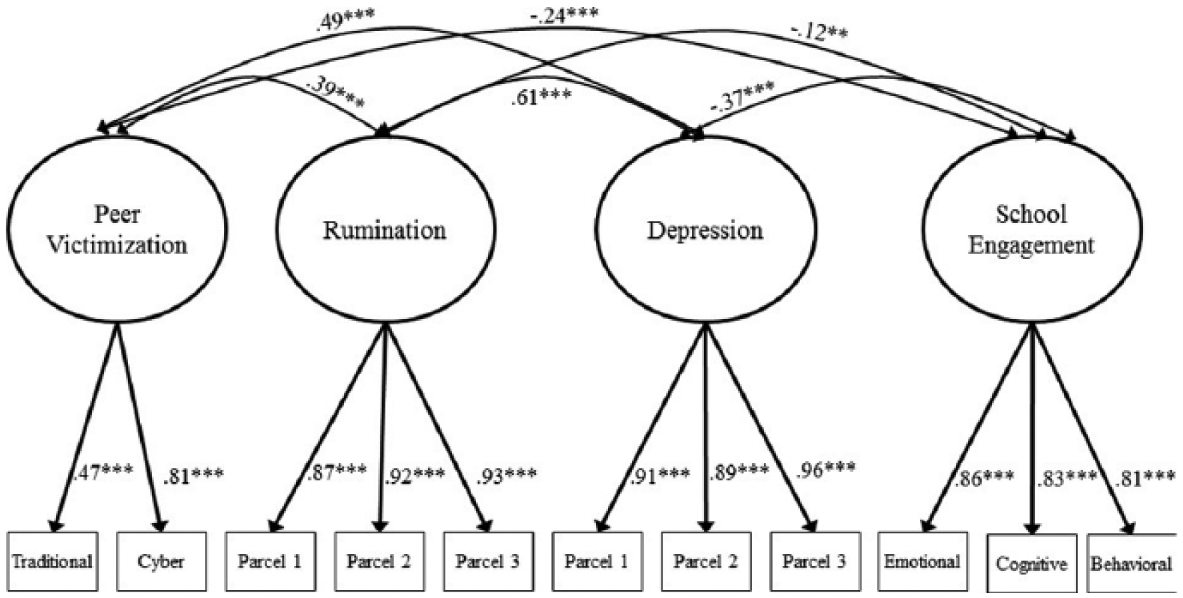
Measurement model for latent constructs.
Peer Victimization and School Engagement
To examine the first research question, data were fit to the model depicted in Figure 3. All fit indices were within their respective recommended ranges for acceptable model fit, χ2(5) = 11.28, p = .05, RMSEA = .04, CFI = .97, TLI = .99. As expected, path coefficients indicated that Peer Victimization was significantly and negatively associated with School Engagement, β = −.22, B = −.23, p < .001, 95% bias-corrected confidence interval (BC CI) [−.34, −.18]. The model explained 5% of the variance in School Engagement. To explore gender differences, multiple group analyses were conducted across gender groups. First, a crossgroup equality constraint was imposed on the direct path estimate between the Peer Victimization and School Engagement latent variables, which yielded the following fit indices: χ2(17) = 33.42, p = .01; RMSEA = .05, CFI = .99, TLI = 99. There was a significant and negative association between Peer Victimization and School Engagement for both boys and girls (B = −.28, p < .001). Next, the constraint was released and allowed to estimate freely across groups, χ2(16) = 32.63, p = .008; RMSEA = .05, CFI = .99, TLI = .99. The chi-square difference between the constrained and unconstrained model was nonsignificant, ∆χ2(1) = .79, p = .37, indicating that the freely estimated model did not fit significantly better than the constrained model. Therefore, Peer Victimization was negatively associated with School Engagement similarly for both boys and girls.

Standardized parameter estimates for the relation between peer victimization and school engagement for total sample and by gender.
Indirect Effects of Rumination and Depressive Symptoms
To examine the indirect effects of Rumination and Depressive Symptoms, data were fit to the model depicted in Figure 4. The chi-square was significant, χ2(41) = 204.64, p < .001; however, fit indices (RMSEA = .07, CFI = .98, TLI = .97) were within their respective recommended ranges for acceptable model fit. All factor loadings between observed variables and their respective latent variable were significant and in the expected direction. There was a significant positive association between Peer Victimization and Rumination (B = .41, p < .001) and Rumination and Depressive Symptoms (B = .72, p < .001), and a significant negative association between Depressive Symptoms and School Engagement (B = −.28, p < .001) and Peer Victimization and School Engagement (B = −.08, p = .024). As predicted, there was also a significant indirect effect of Rumination and Depressive Symptoms (B = −.08, SE = .02, p < .001, 95% BC CI [−.11, −.05]). Standardized and unstandardized path coefficients, standard errors, 95% BC CI, and p values of this model for direct effects are reported in Table 3. The model explained 13% of the variance in School Engagement, 14% of the variance in Rumination, and 38% of the variance in Depressive Symptoms.

Standardized parameters estimates for indirect effects of rumination and depressive symptoms for total sample.
Standardized and Unstandardized Coefficients, With 95% Bias-Corrected CIs, SEs, and p Values for Total Sample.

Note. BC CI = bias-corrected confidence interval; CFI = comparative fit index; RMSEA = root mean square error of approximation; SRMR = standardized root mean square residual.
p < .05. ***p < .001.
To explore gender differences, the Mplus Model Constraint option was utilized to test for statistically significant differences in the indirect effect for boys and girls. There was a significant indirect effect of Rumination and Depressive Symptoms for both girls (B = −.17, p < .001) and boys (B = −.07, p = .03). This difference was statistically significant from each other (z = −.11, p = .004), indicating that the effect was stronger for girls than for boys. To further explore gender differences, the indirect effect of Rumination in the relation between Peer Victimization and Depressive Symptoms was examined, but no differences were found between the groups (z = .11, p = .20). Then, the indirect effect of Depressive Symptoms in the relation between Rumination and School Engagement was examined; the indirect effect was significantly stronger (z = −.16, p = .003) for girls (B = −.27, p < .001) than for boys (B = −.13, p = .02).
Gender differences were then examined among the direct paths by individually testing each path for differences between groups utilizing crossgroup equality constraints. Results indicated a significant gender difference in the relation between Depressive Symptoms and School Engagement, ∆χ2(1) = 8.15, p = .004. Although this relation was significant for both boys and girls, the relation was stronger for girls (B = −.44, p < .001) than for boys (B = −.27, p < .001). The relations among Peer Victimization and School Engagement, ∆χ2(1) = 1.45, p = .229; Peer Victimization and Rumination, ∆χ2(1) = 1.12, p = .290; and Rumination and Depressive Symptoms, ∆χ2(1) = 2.04, p = .154, were not significantly different between boys and girls. See Figure 5 for standardized parameter estimates for both boys and girls.

Standardized parameter estimates for indirect effects of rumination and depressive symptoms by gender.
Discussion
School engagement is an important construct in the lives of students. Students who are less engaged in school are at risk for poorer social-emotional and academic outcomes (Janosz et al., 2008; Li & Lerner, 2011; Loukas et al., 2009). As a potential protective factor, it is important to understand variables that are related to low levels of school engagement. Given the impact of victimization on youth’s overall school experiences, the current study focused on the association of victimization and school engagement. Thus, we were interested in the direct association between victimization experiences and school engagement (Research Question 1). Furthermore, because the research literature has consistently documented an association between victimization and internalizing problems (Reijntjes, Kamphuis, Prinzie, & Telch, 2010), we were interested in the potential mediation role of internalizing issues such as rumination and depressive symptoms in the association between victimizing and school engagement (Research Question 2). Finally, because there are typically gender differences among the main constructs in the study and some gender effects among the studied associations, we were interested in studying gender differences in the associations among study variables (Research Question 3). The current study was influenced by the diathesis-stress perspective (Swearer & Hymel, 2015). That is, that poor school engagement may result from victimization experiences (i.e., an environmental school stressor) activating or triggering students’ levels of rumination and symptoms of depression (i.e., individual cognitive or biological vulnerabilities).
Peer Victimization and School Engagement
The current study found a significant negative association between experiences of victimization and school engagement for both boys and girls. School engagement, consisting of behavioral, emotional, and cognitive engagement in school, is critical to students’ broad success in school. Lower school engagement is associated with emotional and behavioral issues including lower school attendance, higher school dropout rates, and increased delinquency and substance abuse (Janosz et al., 2008; Li & Lerner, 2011; Loukas et al., 2009). Furthermore, lower school engagement is associated with poor academic achievement (Li & Lerner, 2011). It makes intuitive sense that students who are victimized may be less engaged in school, which may be the primary setting where they are experiencing victimization. It is important to note, however, that the direction of the association between victimization and engagement found in the study cannot be determined from the current methodology. It may be that being disengaged in school for various reasons (e.g., poor social skills, withdrawal) is associated with increased victimization.
The negative association between victimization and school engagement in the current study was expected because of the significant and negative associations documented in the literature between peer victimization and academic performance (Nakamoto & Schwartz, 2010). However, the current study investigated the broader factor of school engagement, which may more broadly capture academic success (Ladd et al., 2017). Although less research has investigated the associations between victimization and school engagement, some research has found significant negative associations of victimization with engagement (Ladd et al., 2017; Nakamoto & Schwartz, 2010; Ripski & Gregory, 2009). It is important to note that the amount of variance accounted for in the association between victimization and engagement was small (5%). Thus, other factors not included in the current study may additionally explain school engagement or lack thereof. Finally, the strength of the association between victimization and engagement was similar for both boys and girls in the current study. We predicted that this relation would be stronger for girls. However, the current study suggests that victimization was negatively associated with school engagement for both boys and girls equally.
Indirect Effects of Rumination and Depressive Symptoms
As predicted, we found there was a significant indirect effect of rumination and depressive symptoms in the relation between peer victimization and school engagement. Among the direct paths, there was a significant positive association between peer victimization and rumination and rumination and depressive symptoms, and a significant negative association between depressive symptoms and school engagement and peer victimization and school engagement. Thus, students’ levels of rumination and symptoms of depression (i.e., individual cognitive or biological vulnerabilities) partially explained the negative association between victimization and school engagement. This finding adds to the literature by identifying other factors that explain some of the variance in the association between victimization and school engagement. Specifically, the internalizing symptoms of rumination and depression contributed to our understanding of all of the factors that may be associated with school engagement.
Prior literature has documented the indirect effects of rumination in the association between both cyber and traditional victimization and depression (Barchia & Bussey, 2010; Feinstein et al., 2014; Monti et al., 2017). However, we believe the current study is the first to examine both rumination and depressive symptoms in the relation between victimization and the school engagement. More discussion of the findings of this model will be explored next with a focus on gender differences in these associations. Given several gender differences were found in the pathways, it is important to emphasize the gender-specific findings over the overall sample findings.
Gender differences in indirect and direct effects
Gender is an important consideration when investigating these constructs. Although we know there are gender differences among many of the overall levels of these constructs, it is important to understand how the associations among the variables may differ between genders. We found evidence of gender moderation at various parts of the model. First, we tested for gender differences in the indirect effects and found that the overall indirect effect of both rumination and depressive symptoms was significant for both boys and girls; however, the overall indirect effect was significantly stronger for girls. Since there were multiple indirect pathways in this model, we completed follow-up analyses to determine where this gender difference may be. We found that the indirect effect of depressive symptoms in the relation between rumination and school engagement was significantly more robust for girls than for boys. Thus, for both boys and girls, both rumination and depressive symptoms explained some of the association between victimization and school engagement; however, the role of depression in this relation seems to be more robust for girls. We were also interested in gender differences among the direct paths in the model. We found a gender difference in the direct path between depressive symptoms and school engagement. Although this relation was significant for both girls and boys, this relation was more robust for girls. This indicates that experiencing symptoms of depression may be more highly associated with lower school engagement for girls than boys. This may also be why the indirect effect of depressive symptoms in the relation between rumination and school engagement is stronger for girls than boys. It is important to note that the associations were significant for both boys and girls; thus, the findings should not be discounted for boys. For girls, it may be that symptoms of depression are more closely associated with disengagement from school. Boys and girls may cope with symptoms of depression differently. For example, a study of college students found that women were more likely to focus on their negative moods and ruminate; thus, leading to prolonged periods of depressed moods (Butler & Nolen-Hoeksema, 1994). The prolonged focus on their negative mood may result in girls being more likely to exhibit withdrawal from school.
Although there is limited previous research examining gender differences in the relation between depressive symptoms and school engagement, this finding is commensurate with previous studies that have found depression to impact educational outcomes for women, but not men. For example, Fletcher (2008) found that depression increased the chances of dropping out of high school for adolescent girls but not boys. Fletcher (2008) also found that women with depression were less likely to enroll in college than men with depression. Veldman et al. (2014) found internalizing problems at age 11 were associated with low educational attainment at age 19 for women. There was not a significant relation between internalizing problems and educational attainment over time for men. This is, unfortunately, an alarming finding that appears to have been replicated in the literature on educational outcomes for women. This is particularly interesting for our sample—although boys and girls reported similar levels of depressive symptoms in our study, depressive symptoms had a more negative impact on school engagement for girls. Future research is needed on why depressive symptoms may have a stronger impact on school disengagement for girls. This research is clearly needed, as longitudinal studies have shown that depression during adolescence can impact long-term educational attainment for women (Fletcher, 2008; Veldman et al., 2014).
Limitations, Implications, and Directions for Future Research
Although the current study added to the literature on the association between peer victimization and school engagement, it has several limitations. First, although approximately 90% of the entire school participated, the sample included just one school in the Midwest United States. A larger sample across other locations and demographics (e.g., regions of the United States, urban versus rural) would be ideal. In addition, although the sample was fairly diverse (60.0% White), there was an underrepresented number of African American youth in the study (6.3%). Studies including samples that include other locations, demographics, and more diversity may allow for better generalizability of the results. In addition, investigating racial differences in the associations among the study variables could be informative given that some racial minority students experience negative factors (e.g., racial discrimination) as well as protective factors (e.g., racial socialization and ethnic identity) that may influence their level of school engagement (Dotterer, McHale, & Crouter, 2009). Furthermore, studies including a wider age range will be important to understand how these variables are associated with older or younger youth as the associations may look different at different developmental levels. For example, these associations may be different in younger youth as experiencing depression is not as common. Depression in youth tends to increase during adolescence. In addition, all data were collected via student self-report measures; thus, associations could be inflated due to shared method variance.
The current study proposed a mediation model, although cross-sectional data were used; this is a major limitation in the current study because longitudinal analyses are ideal when examining mediation models. In addition, when using cross-sectional data, causality cannot be assumed. However, previous studies have found longitudinal associations among the variables in the study. For example, Ladd et al. (2017) followed students from kindergarten to 12th grade and found peer victimization to be related to decreases in school engagement over time. Peer victimization has also been found to be related to depression utilizing longitudinal analyses (e.g., Barchia & Bussey, 2010), and a plethora of studies have shown rumination as a precursor to depressive symptoms, especially in response to stressful events (e.g., Michl, McLaughlin, Shepherd, & Nolen-Hoeksema, 2013; Troop-Gordon, Rudolph, Sugimura, & Little, 2015). No known study has examined the model that we have proposed in the current study; thus, it was exploratory in nature. Future work should consist of longitudinal data to better answer the questions about causality in the associations among the variables as well as to test mediation analyses. Given the diathesis-stress perspective often emphasizes interactions among variables, future research should also consider investigating rumination and depression as potential moderators in the association between peer victimization and school engagement.
Despite these limitations, the current study adds to the growing literature on the association between peer victimization and school engagement. A particular strength was the use of statistically advanced methods (i.e., structural equation modeling). This allowed us to adequately measure and capture the multiple indicators of the constructs and remove measurement error. To study peer victimization, we included measures of both traditional and cyber victimization. In the extent literature, researchers have focused on traditional victimization when investigating victimization and school engagement (Jose et al., 2012; Ladd et al., 2017; Ripski & Gregory, 2009). In addition, this is the first known study to explore the roles of rumination and depressive symptoms in the association between peer victimization and school engagement. It is important to understand underlying mechanisms in this association because those could be points of intervention for students who may be targets of bullying and struggling to stay engaged at school.
The results of the current study are important for professionals who work with children and adolescents in school-based populations. As an important precursor to academic achievement—as well as other important outcomes including attendance, school dropout, and substance use—school engagement is essential to positive outcomes for adolescents. It is essential for teachers, administrators, and other school staff members (e.g., school social workers, counselors, school psychologists) to be aware of and understand that a student’s disengagement in school may be a result of factors beyond the student’s control (i.e., victimization) and not due to intrinsic factors. Therefore, school staff should monitor students who are displaying signs of school disengagement (e.g., poor attendance, lack of participation). This may be especially the case for students who are unexpectedly displaying school disengagement. For example, if a student previously had good attendance, seemed excited about school, and connected with classmates and staff but is suddenly disengaged, external factors should be considered for intervention.
Given our understanding of peer victimization as a stressor, preventing bullying is important for students that may be vulnerable to more negative outcomes. The results of this study suggest that school-based bullying prevention initiatives may not only help reduce the prevalence of bullying in schools but also prevent some students from experiencing depressive symptoms and school disengagement. Therefore, bullying prevention should be a primary focus for professionals working with children and adolescents. Although research indicates that bullying prevention programs are often successful in reducing levels of bullying (Ttofi & Farrington, 2011), it is idealistic to think that such programs will stop bullying completely. School engagement may be particularly disrupted for targets of bullying that have cognitive vulnerabilities, such ruminating over painful experiences. Victims of bullying who utilize more positive coping strategies may be less prone to negative outcomes (Troop-Gordon et al., 2015); therefore, professionals who work with victims of bullying may help them to identify and utilize adaptive problem-solving skills. A focus on reducing ruminative thoughts may help to prevent depressive symptoms and school disengagement. Providing intervention for adolescents struggling with depressive symptoms may also help to prevent school disengagement, particularly for girls. This could include cognitive behavioral strategies within school or clinical settings.
Conclusion
Peer victimization is a significant stressor in youth’s lives and may activate vulnerabilities among youth. The current study focused on the vulnerabilities of both rumination and depressive symptoms. Based on the diathesis-stress perspective, the stressor (i.e., peer victimization) and vulnerabilities (i.e., rumination and depressive symptoms) are thought to be related to negative outcomes for youth. Influenced by the diathesis-stress perspective, it was specifically hypothesized that the vulnerabilities would have indirect effects in the association between the stressor (i.e., peer victimization) and the negative outcome (i.e., low school engagement). The current study found that, for both boys and girls, the stressor of peer victimization was related to less school engagement. The vulnerability of both rumination and depressive symptoms explained the association between peer victimization and engagement for both boys and girls; however, this effect was more robust for girls. Furthermore, the association between depressive symptoms and school engagement, although negative and significant for both genders, was stronger for girls than for boys. Further research is needed examining factors that may impact school engagement through a diathesis-stress perspective, particularly for girls.
Footnotes
Declaration of Conflicting Interests
The author(s) declared no potential conflicts of interest with respect to the research, authorship, and/or publication of this article.
Funding
The author(s) received no financial support for the research, authorship, and/or publication of this article.
