



Abstract
Based on the temporal framework of transition experiences, this study tested time-graded patterns of family resource effects on children’s and early adolescents’ psychological adjustment during a time of multiple transitions. Using data of a longitudinal study including 2,020 German children covering the age span between 8 and 12 (nboys = 1,035, ngirls = 985), internalizing and externalizing problems were predicted by parent-child relationship and family’s educational background in a multi-group structural equation model, applying time-lagged autoregressive models. The results showed positive resource effects especially through parent-child relationship. The gender-specific effect patterns over time supported the assumption of stronger resource effects when early puberty onset and secondary school transition co-occurred. Thus, it is important to provide support for this vulnerable group during times of multiple transitions.
Keywords
From an ecological perspective, children’s and adolescents’ psychological adjustment is influenced by various sources and depends on multiple resources (Bronfenbrenner, 1979). In particular, parental social, educational, and economic background as well as parental support and behaviors have been shown to be important resources in this regard (Colarossi & Eccles, 2003; Reiss, 2013). Childhood and early adolescence are especially characterized by multiple transitions. Transitions typically affect child’s and adolescents’ psychological functioning negatively and call for resources to support post-transition adaptation. For instance, secondary school transition is often associated with negative outcomes due to various contextual changes (for review, see Madjar & Chohat, 2016; Ruble, 1994; Symonds & Galton, 2014). In addition, puberty, as another form of transition, is also linked to an increase in internalizing and externalizing symptoms due to biological, cognitive, and emotional changes (Dimler & Natsuaki, 2015). Resources, such as parental education and support, are argued to buffer against negative transition effects on psychological adjustment during this critical period of life.
This study investigates resource effects on the development of psychological adjustment across childhood and early adolescence between age 8 and 12. This age range is of particular interest, as it lays the foundation for further psychological development into adolescence and later adulthood (Kessler et al., 2010). The present study investigates three following broad questions: Can family resources buffer against negative transition effects? Are these resources equally relevant for girls’ and boys’ psychological development? When are these resources most important?
Psychological Adjustment Across Childhood and Adolescence
Psychological adjustment, in terms of low levels of problem behaviors, in children and early adolescents, has repeatedly been the topic of political, public, and research-related discussions over the past 30 years (Barkmann, Schulte-Markwort, 2010; World Health Organization, 2005). Psychological adjustment in this regard is typically qualified by two broader factors. Externalizing behaviors include problems with attention, self-regulation, and noncompliance, as well as antisocial and aggressive behaviors. Internalizing behaviors comprise depression, withdrawal, and anxiety, as well as feelings of inferiority and shyness (Fanti & Henrich, 2010; Gilliom & Shaw, 2004). The onset of psychological maladjustment is typically found early in people’s teenage years (Kessler et al., 2005) and tends to persist into adulthood (Kessler et al., 2010).
Longitudinal studies generally indicate differential developmental paths of girls’ and boys’ psychological adjustment during childhood and early adolescence. Comparing gender-specific trajectories, findings suggest that girls reported higher levels of internalizing problems, such as perceived distress and anxiety. Boys, however, reported higher levels of externalizing problems, such as anger and aggression. In contrast, most internalizing problems increased especially from childhood to adolescence, especially for girls (for review, see Costello, Copeland, & Angold, 2011; Klasen et al., 2016).
As illustrated, there are gender-specific developmental paths of girls’ and boys’ psychological adjustment across childhood and adolescence. However, such gender-specific trajectories of psychological adjustment have rarely been considered from an ecological perspective.
Psychological Adjustment Across Transitions
The period between late childhood and early adolescence is shaped by major transitions in the young peoples’ lives. Caspi and Moffitt (1993) argue that “transition situations arise from social and biological changes that require persons to organize their activities around new tasks” (p. 249). Transitions are characterized by a disturbance of the equilibrium of a persons’ intrapsychic state on the one hand, and the interpersonal relationships on the other hand (Ruble & Seidman, 1996; Schlossberg, 1981). Social roles, relationships with parents, peers, and teachers as well as (daily) routines and behavioral patterns may be no longer appropriate in the new situations or new contexts (Eccles et al., 1993). The intrapsychic shifts include a reorganization of one’s sense of self, a revision of one’s beliefs, and the regulation of one’s internal affective state, especially the ability to experience and control one’s emotions during periods of increased arousal levels (Cowan, 1991). Both, the interpersonal and intrapsychic states have to be re-adjusted to the new situation after transition in order to reestablish a stable and adaptive person-in-context configuration (Ruble & Seidman, 1996). In turn, this adjustment or coping is associated with individual costs and in the end may be even unsuccessful. This may be reflected by higher levels in internalizing and externalizing problems, unless there are resources that can buffer against these negative changes (Schlossberg, 1981).
Following the taxonomy of Connell and Furman (1984), this study focuses on an exogenous transition, namely, the secondary school transition as well as an endogenous transition, namely, puberty. Between childhood and early adolescence, these two major transitions are particularly relevant for girls’ and boys’ further psychological development, as research showed.
Secondary school transition is characterized by several changes: (a) on the individual level, for example, new expectations and new responsibilities/duties; (b) on the classroom level, for example, new structure of the peer group and building new teacher-student relationships; and (c) on the school level, for example, changing size of the school, much older students in the same school (Lohaus, Elben, Ball, Klein-Hessling, 2004). This complex new school situation requires individuals to adjust, leading to consequences for children’s psychological adjustment (Fleming et al., 2014; Rice, Frederickson, & Seymour, 2011). Findings suggest gender-specific differences as higher levels of stress experiences and internalizing problems are more likely for girls than for boys. In contrast, boys, as compared to girls, report higher externalizing problems during school transition (Lohaus et al., 2004).
Puberty is triggered by major neuroendocrine developments accompanied by emotional, cognitive, and behavioral changes (Crone & Dahl, 2012). In contrast to secondary school transition, puberty is a more gradual developmental transition process with no clear onset and end as well as large variation in timing and duration (Grossman, Foss, & Augelli, 2014). Nevertheless, the pubertal transition forces children to adjust to new person-in-context configurations, involving a new status, new roles, and new social relationships as well. Accompanying these changes, psychological adjustment is also likely to be affected but, as compared to school transition, rather gradually and across a longer period (Dimler & Natsuaki, 2015). Research findings point to gender-specific differences in timing and psychological adjustment: Considering various markers of puberty onset (e.g., menarche, ejacularche, pubic hair), girls peak under age 12, typically between age 10 and 14, whereas boys peak around age 13, typically between age 11 and 16 (Kahl, Schaffrath-Rosario, & Schlaud, 2007). During this period, girls’ adjustment is rather characterized by an increase in internalizing problems (e.g., depressive and anxiety symptoms) than in externalizing problems (e.g., aggressive behaviors), for boys it is vice versa (Mendle, 2014). The propensity of adjustment problems is increased in case of an early or late puberty onset according to the deviance hypothesis (Alsaker, 1995; Petersen & Crockett, 1985).
Although rarely investigated, the co-occurrence of puberty and secondary school transition is especially challenging for young adolescents (Seidman, Aber, & French, 2004). Thus, some young adolescents need to adjust to school-related and to pubertal changes, at the same time (Crone & Dahl, 2012). Studies showed that both transitions, the secondary school transition and, especially, an early puberty onset, negatively affected students’ psychological functioning (Schaffhuser, Allemand, & Schwarz, 2016). From a cumulative risk perspective (Evans, Li, & Whipple, 2013), this is a double jeopardy and adolescents are potentially more prone to negative developments if two or more risk factors coincide. The German school system provides an excellent opportunity to investigate the co-occurrence of both transitions, because of the early secondary school transitions. In this regard, gender-specific patterns are highly informative. For example, when girls’ puberty peaks between age 10 and 14 (Kahl et al., 2007), at least for some girls with an early puberty onset, this coincides with the German secondary school transition (typically at age 9/10 or 10/11). Boys’ secondary school transition is more likely to be separated because of their later puberty onset (at age 11-16). Therefore, negative transition effects on girls’ and boys’ psychological adjustment should not only differ in respect to internalizing versus externalizing problems but also with regard to the timing. According to the cumulative risk perspective and the deviance hypothesis, German girls with an early puberty onset may be particularly vulnerable, as they have to cope with endogenous (puberty onset) and exogeneous changes (secondary school transition) (a) simultaneously, but (b) earlier as compared to their agemates.
The Role of Family Resources in Times of Transition
From an ecological perspective (Bronfenbrenner, 1979; Schlossberg, 1981), major transitions, such as secondary school transition or puberty onset, are associated with an increased need for external resources to adapt to new person-in-context configurations. In this vein, research underlined the relevance of supportive social contexts and relationships (such as family, peers, or schools) during stressful life events (Garnefski & Diekstra, 1996; Zimmerman et al., 2013).
Two types of family resources, namely, parent-child relationship and parents’ educational background, are investigated as potential buffers against negative transition effects in this study. With regard to parent-child relationship, findings generally show the importance of maintaining a secure attachment to parents beyond early childhood and into adolescence. A positive parent-child relationship should continue to serve as a secure base from which children can cope with critical life events (multiple transitions) and from which they can successfully reestablish a new person-in-context configuration, typically associated with lower levels of internal and external problem behaviors. Research generally supports this buffering hypothesis (Lakey & Cohen, 2000). Studies showed that higher levels of perceived emotional support (e.g., feeling loved or cared) and supportive caring by one’s parents are related with lower levels in girls’ and boys’ emotional problems as well as depressive and antisocial behavioral symptoms during the transition from primary to secondary school (Pettit, Roberts, Lewinsohn, Seeley, & Yaroslavsky, 2011; West, Sweeting, & Young, 2010). Furthermore, positive parent-child relationship can serve as a protective factor in at-risk groups. Supportive parenting went along with higher levels of confidence and lower levels of disruptive behaviors as well as externalizing and internalizing problems in early maturing children. In contrast, harsh and unpredictable parenting practices increased the association between early maturation and externalizing (aggressive and risky behaviors) and internalizing (depressive symptoms) problems (for review, see Mendle, 2014). Especially for girls, parental support was shown to foster emotional adjustment, for example, by alleviating depressive symptoms (Colarossi & Eccles, 2003). This association was not clearly shown for boys (Demaray, Malecki, Davidson, Hodgson, & Rebus, 2005). One reason for that gender-specific effect pattern could be a stronger need for positive interpersonal interactions as well as a stronger vulnerability toward interpersonal stressors in girls than in boys (Hankin, Mermelstein, & Roesch, 2007).
Concerning the role of families’ educational background in children’s and adolescents’ psychological adjustment, large cross-sectional studies were conducted, comprising samples in various European countries. These studies consistently reported differences in children’s psychological functioning according to the degree of parental education (e.g., Rajmil, Herdman, Ravens-Sieberer, Erhart, & Alonso, 2014; Meyrose et al., 2018). Boys and girls who grew up in families with a higher level of parental education reported fewer internalizing problems, such as anxiety and depression, as well as externalizing problems, such as aggressiveness, opposition, and hyperactivity, as compared to those raised in less educated families (Zhou, Lin, & Lin, 2016). This relationship of parental education and their children’s psychological functioning remained even when further socioeconomic factors (e.g., income) were taken into account (e.g., Bøe, Øverland, Lundervold, & Hysing, 2012; Harper et al., 2002; Meyrose et al., 2018; Reiss, 2013). Interestingly, family’s education has a strong direct effect on the child’s internal and external problem behavior, especially in early childhood, before age 12 (Reiss, 2013). The positive effect of the family’s education for adolescents, after age 12, is rather mediated through the quality of the home environment, including higher parental investments and encouragements into their children, a healthier lifestyle, and a higher quality of family interactions (Conger, Conger, & Martin, 2010). In this vein, parental education can rather been seen as a proxy for socialization and learning environment in later childhood and adolescence. The family educational environment, thus, is one important context in which child’s and adolescent’s development takes place and which is linked to a wide range of risk and protection factors (e.g., knowledge of the school system, relevance of schooling, favorable support networks, information). This set of risk and protection factors, in turn, can affect child’s psychological development (Bøe et al., 2012).
The Present Study
The aim of the present study is to investigate the relevance of family resources for the psychological adjustment of girls and boys in the transitional period from childhood to adolescence (between age 8 and 12) in a German sample. In order to further the knowledge of the psychological adjustment in early adolescence, we argue that the multiple transitions taking place at the threshold into early adolescence have to be investigated together. The transitions and changes this study focuses on, in particular, school transition and puberty onset, usually start at the age of 10 years. For a better understanding of relevance of the individual’s resources and outcomes at and during these transition events, however, it is necessary to consider the developmental period before, during, and after the critical events of school transition and puberty. A very fruitful theoretical framework for the investigation of the processes taking place during transitions is the “temporal framework of transition” (Ruble & Seidman, 1996). It highlights the relevance of resources needed to (re-)establish a (re-)adjusted and stable person-in-context system, after the transition. Parental educational background and parent-child relationship were shown to be important resources to buffer against negative effects of various stressors (Zimmerman et al., 2013). Therefore, during transitions, these resources can be expected to be important as well.
We expect that resource effects should primarily be found during times when they are needed most, thus especially during transitions. Hence, negative changes during transitions should be more likely if resources are lacking or insufficient. This can be understood as interindividual differences in managing transitions being explained by resources. As outlined before, during secondary school transition, students’ psychological functioning is challenged. In the German school context, achievement-related and social criteria affect the transition to secondary school and students’ further academic careers. Generally, after 4 years of elementary education, formal achievement-based tracking characterizes the organization of secondary schools in Germany, offering three major school tracks, namely, a high track (“Gymnasium”), a middle track (“Realschule”), and a low track (“Hauptschule”). Thus, after passing through elementary school at the age of 9 or 10, children move on to different forms of secondary schooling. In contrast to other countries, this decision takes place at a relatively early age. Whether children and young people will be able to attend the higher education school track typically predetermines the possibilities for a university education. Consequently, German students and their parents experience the school transition as particularly challenging and stressful. Therefore, it is necessary to control for potential school track effects in the statistical analyses.
During this period, the puberty onset constitutes a second potential transition. As previously noted, the biopsychosocial transition comes along with an increase in adolescents’ internalizing and externalizing problem behaviors, especially in early and late maturing adolescents. For girls, pubertal changes start earlier as compared to boys (e.g., Alsaker, 1995; Grossman et al., 2014). Therefore, the need for resources to cope with that transition should increase earlier for girls than for boys. Thus, we expect family resources to be relevant for girls’ earlier (at around age 10) than for boys’ (at around age of 11) psychological adjustment.
As outlined above, the co-occurrence of both transitions can be understood as a phase of cumulative risk for some children. Due to differences in pubertal timing, girls are more likely to be at-risk in the German school system, because of the co-occurrence of two transitions and the increased need for resources. This is especially the case for early maturing girls. Therefore, gender-specific effect patterns can be expected. Thus, the increase in the resource effects during the time of secondary school transition can be expected to be stronger for girls with an early puberty onset.
Taken all aspects together, we aim to address two broader questions: Do resources affect girl’s and boy’s psychological adjustment positively? We suggest
Do resources affect girl’s and boy’s psychological adjustment positively, mostly when needed? Thus, expecting resources to be especially relevant during transitions (Ruble & Seidman, 1996), we assume second
However, in the investigation of interindividual differences in managing transitions, these three perspectives have rarely been considered together. Therefore, to specify this second question more in detail, this study focuses on gender-specific and time-related differences. Thus, three potential patterns of findings across gender and time can be expected, depending on the “type” of focused transition:
In case of the transition after age 9: If early maturing girls have to struggle with the co-occurrence of both transitions, the resource effects would increase between age 9 and 10 in girls but not in boys, because boys’ puberty onset is very unlikely at this time. There would be no increase in the resource effects for boys later on, because both transitions would not coincide. Because the double transition already happened, no later resource effects are expected for girls.
In case of the transition after age 10: There might be an increase in the resource effects for girls (later puberty onset in some girls coincides with the later transition) between age 10 and 11, if general puberty onset is critical and not the early onset. For boys, there should be the increase in resource effects between age 10 and 11, because their early puberty onset coincides with the (later) transition. No later resource effects are expected in both genders.
Unfortunately, we cannot distinguish who of the participants did the transition earlier or later. Nevertheless, the following effect pattern would support this expectation (Hypothesis 2c): (a) An increase in the resource effects in girls between age 9 and 10, but not for boys and (b) an increase in the resource effects in boys between age 10 and 11, but not for girls. No or smaller resource effects in both genders should be found at later time points in this data.
Following these considerations, the age range of this study was chosen. In order to investigate changes “into” the school transition phase, a measurement occasion before the earliest school transition is necessary, which is age 8. Since some hypotheses included assumptions on effects after the school transition in order to capture a wider range of puberty onset, age 12 was selected as latest time point, because starting with the age 12; in the German school system, early puberty onset and school transitions would not co-occur.
To summarize our research questions, we assume the following:
1. General resource effects of parental educational background and parent-child relation on girls and boys psychological adjustment;
2. Specific resource effects:
This study goes beyond previous research in several regards. Longitudinal studies on internalizing and externalizing problem behavior in this age span are rare, mostly focusing on a limited time-span, for instance, exclusively during secondary school transition. Moreover, little is known about psychological adjustment across multiple transition experiences during this developmental phase. Only some studies discussed the relevance of either a single transition experience (school transition or puberty) or the co-occurrence of multiple transitions, but mostly investigating school-related outcomes and using limited time intervals (e.g., Ng-Knight et al., 2016; Schaffhuser et al., 2016). Furthermore, bringing together the multi-transition perspective on the development of externalizing and internalizing problems can provide more fine-grained insights in the developmental mechanism underlying the re-adaptation processes during transitions on multiple domains. Adding the family resource perspective helps to understand the contextual conditions of these re-adaptation processes during transitions. Finally, in this field of contextual effect on transition-related adaptation processes, a gender-specific perceptive is rarely taken. Considering a differential timing of the needs for resources due to the different puberty onset helps to disentangle the relative importance of both transitions.
Method
Sample
The data of this study is part of a comprehensive project on “Panel Analysis of Intimate Relationships and Family Dynamics” (pairfam) in Germany (Huinink et al., 2011). Beginning in 2008, adult participants from three cohorts (Cohort 1: born 1991-1993, Cohort 2: born 1981-1983, Cohort 3: born 1971-1973, NTotal = 12,402) were surveyed annually over a period of 6 years. The target population is defined as all people living in Germany in private households who have sufficient competencies of the German language to follow the interview (Huinink et al., 2011). Participants were selected randomly from all German federal population registers. Thus, the mechanism of sample selection corresponds to a household sample based on person’s addresses of his/her primary place of residence. Furthermore, the underlying study design comprises—besides a longitudinal multi-cohort design—a multi-informant perspective. Consequently, in addition to the selected target person, the (actual) partner, children, and parents of each target person were interviewed. The initial sample comprised over 12,000 nationwide, randomly selected individuals and, additionally, their partners, parents, and children.
The data were collected through standardized computer-assisted interviews. If participants’ children were 8 years or older and the parents gave informed consent, they were included in the survey (Arránz-Becker et al., 2014). Based on this child data, the current study focuses on a subsample, comprising all children of participants from Cohort 2 and Cohort 3 (note, Cohort 1 was too young), who were at least 8 years old.
The subsample consists of 2,020 children, aged between 8 and 12 years (48.8% female) and predominantly from an ethnic German background (80.0%). Most children between age 8 and 9 attended the elementary school (elementary: 96.5%; else: 3.5%), at the age of 10, 51.6% attended elementary and 47.5% attended secondary school (low: 6.9%; middle: 19.0%; high: 21.6%). Further on, most children attended secondary school at the age of 11 (elementary: 13.0%; low: 13.7%; middle: 39.2%; high: 33.1%) and at the age of 12 (elementary: 4.0%; low: 14.8%; middle: 42.9%; high: 36.0%).
The children and adolescents completed a questionnaire on various topics, such as perceived quality of parent-child relation as well as children’s behavioral and emotional problems, which took approximately 60 minutes (Arránz-Becker et al., 2014).
Measures
Family resources were measured through parents’ education as well as child’s perceived child-parent relationship. Following Schneider (2008), a revised version of ISCED-97 (International Standard Classification of Education, United Nations Educational, Scientific and Cultural Organization [UNESCO], 2006), based on either fathers’ or mothers’ highest educational attainment, was used to measure families’ highest educational level (response format: 0 = currently enrolled to 8 = second stage of tertiary education).
Furthermore, the children’s perception of parent-child relation (PCR), as the subjectively experienced relationship quality, was measured by four items (Furman & Buhrmester, 1985), using a 5-point rating scale (1 = never; 5 = always). The higher children rated the aspects of intimacy and parental appreciation (e.g., “You share your secrets and private feelings with . . .”), the more supportive the parent-child relationship can be considered. The construct reliability (McDonald’s hierarchical omega; Zinbarg, Revelle, Yovel, & Li, 2005) was good (T1: .75 at age 8, T2: .73 at age 9, T3: .78 at age 10, T4: .79 at age 11, T5: .82 at age 12).
To capture children’s psychological adjustment, two scales from the Strength and Difficulties Questionnaire (SDQ; Woerner et al., 2002), a well-established screening instrument for children’s self-perceived problem behaviors, were used. Internalizing problems (IN) were assessed by five items, addressing emotional problems, such as symptoms of depression and anxiety (e.g., “I am often unhappy, depressed or tearful”). Children were asked to indicate their agreement on a 3-point rating scale (1 = not true; 3 = certainly true). Higher scores indicate higher levels of perceived internalizing problems and consequently, a poorer psychological adjustment. The construct reliabilities were good (T1: .75; T2: .79; T3: .81; T4: .69; T5: .67). Furthermore, using the same rating scale, four items were used to measure child’s externalizing problems (EX), reflecting difficulties in social interactions and integration within a social group (e.g., “I fight a lot; I can make other people what I want”). Again, higher values indicate more externalizing deficits and, in turn, a worse psychological adjustment. The construct reliabilities were acceptable to good as well (T1: .79; T2: .78; T3: .65; T4: .73; T5: .60).
Gender was considered as group (moderator) variable (1 = male, 2 = female). Finally, child’s migration status (1 = no migration, 2 = first generation, 3 = second generation) and educational status (1 = elementary school, 2 = lower school tracks, 3 = higher school tracks) served as control variables.
Analyses
All analyses were conducted using structural equation modeling techniques applying the R lavaan package (Rosseel, 2012). Missing data were handled by the full information maximum likelihood (FIML) approach. Thus, cases with missing data were not excluded, but all model parameters were estimated based on the cases with complete data and the (conditional) missing values under the missing at random assumption (MAR). As compared to listwise deletion, this procedure does not lead to the common disadvantages, such as losing statistical power or biased parameter estimation (Schafer & Graham, 2002). Even if the assumption of MAR may not apply, accounting for missing values still leads to less biased results as compared to the exclusion of all missing values (Schafer & Graham, 2002).
An advantage of structural equation models is that it can test several paths simultaneously. However, one problem that is rarely considered is the handling of the inflated probability of Type I errors when evaluating the statistical significance of multiple parameters within one model (e. g. Cribbie, 2007). Therefore, we applied adjusted p-values, following the Benjamini and Hochberg (1995) method to address the problem of Type I inflation. 1
In the first step, a descriptive model, grouped by gender, was specified. Here, three latent variables (IN, EX, and PCR) at each age and in both groups were estimated (no controls, no predictions) to obtain group-specific latent means and variances of the constructs. Therefore, all latent variables were estimated equivalently in both groups and for all five measurement occasions using two item parcels (including two and three items for the IN parcels as well as two items for each parcel of EX and PCR), which served as manifest indicators for the specific latent variable (see Little, Cunningham, Shahar, & Widaman, 2002). This model showed a good fit, χ2 (567, nboys = 1,035/ngirls = 985) = 693.58, p < .001, comparative fit index (CFI) = .98, Tucker-Lewis index (TLI) = .97, root mean square error approximation (RMSEA) = .02, standardized root mean square residual (SRMR) = .05. Means and variances are depicted in Table A1 in the appendix.
In addition, the measurement models of all latent constructs (IN, EX, and PCR) were tested on measurement invariance between gender groups and across time in a single model (Cheung & Rensvold, 2002). Strong invariance could be shown over time (Δχ2 = 4.04, Δdf = 12, p = .982) as well as across groups (Δχ2 = 15.87, Δdf = 15, p = .391), assuming equal manifest intercepts and loadings across time and gender groups.
In the second step, a multi-group latent model was tested, specifying the expected structural effect patterns between independent and dependent variables simultaneously across girls and boys. More precisely, within each group, the dependent constructs internalizing (IN) and externalizing (EX) problems were predicted by (a) two control variables, namely, children’s school track (1 = low track, 2 = middle track, 3 = high track) and migration background (1 = no, 2 = yes); (b) the pre-measurements within each construct (e.g., IN at age 8 predicts IN at age 9); and (c) two independent variables in a time-lagged pattern, that is, the parent-child relationship (e.g., PCR at age 8 predicts IN at age 9) and families’ highest educational level (e.g., ISCED at age 8 predicts IN at age 9). Due to the high stability of the family educational background, only the ISCED level at age 8 was used to predict psychological adjustment at each year across age 8 to 12. In addition, the contemporaneous correlations between IN, EX, PCR, and ISCED were specified (e.g., IN at age 8 correlates with EX at age 8; PCR at age 8 correlates with IN at age 8).
Finally, the gender differences with regard to the structural paths (regression coefficients) were statistically tested using a Z-test (Clogg, Petkova, & Haritou, 1995).
Results
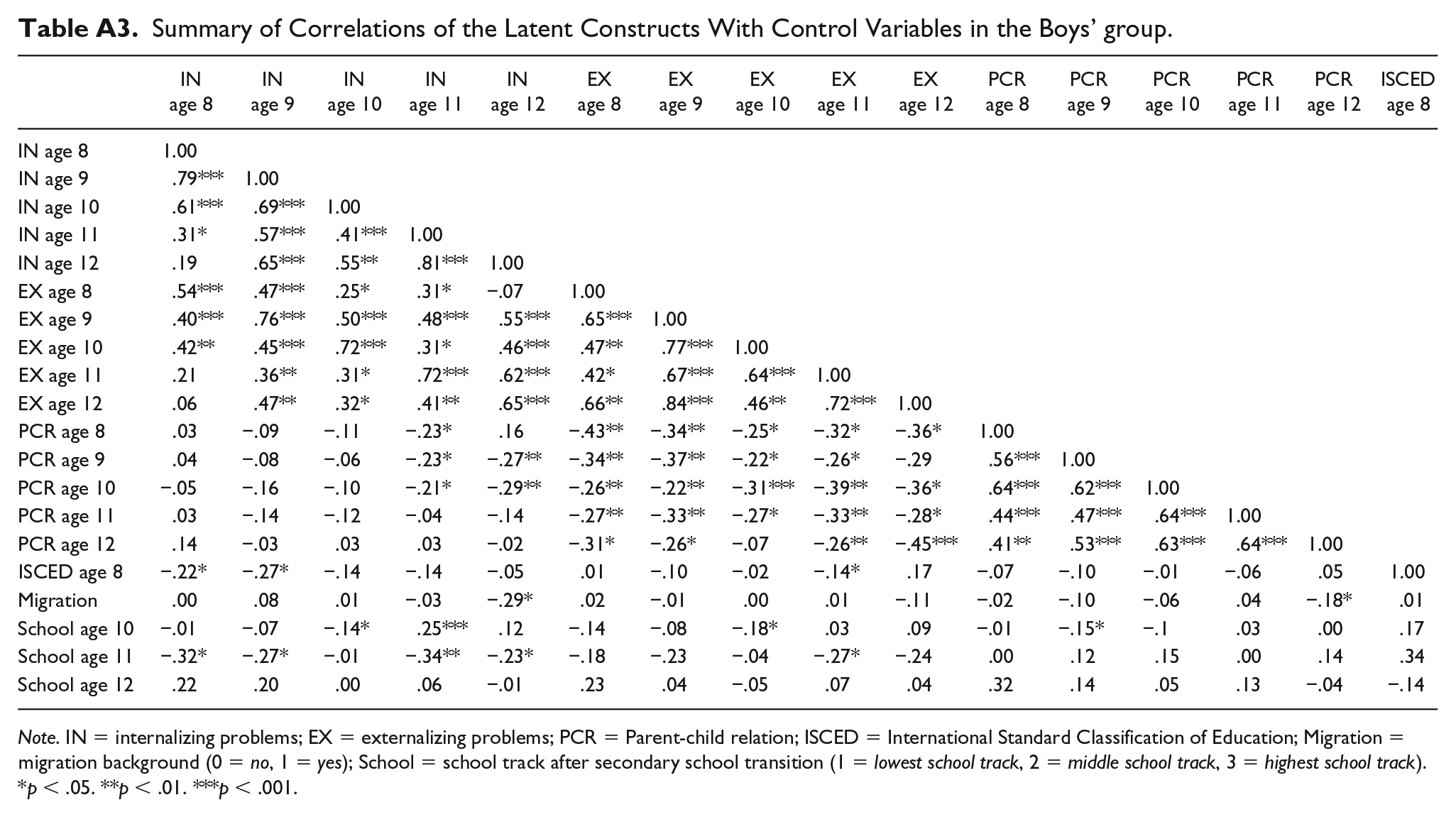
In the subsequent three paragraphs, the results will be organized by a short overview of the general model and then by the main predictors, that is, families’ educational level (ISCED) and child’s perceived relation to parents (PCR). The effects of the predictors on the dependent variables (IN and EX) are organized by age group (age 8, age 9, . . . , age 12). Correlations of the latent constructs and the controls as well as the stabilities and the intercorrelations between the latent constructs are shown in Tables A2 for girls and Table A3 for boys in the appendix.
First, the overall multi-group model fitted the data sufficiently, χ2 (979, 567, nboys = 1,035/ngirls = 985) = 1380.29, p < .001, CFI = .98, TLI = .98, RMSEA = .02, SRMR = .06. Due to the specification of a multi-group model, there are two regression coefficients for each path in the model. Thus, all regression coefficients obtained for girls and boys will be reported as follows: βgirls/βboys. The regression coefficients obtained through the structural equation models are shown in Tables 1 and 2. Furthermore, results presented in Figure 1 shows the paths between the predictor variables PCR and ISCED and the dependent variables IN and EX for girls (upper part of Figure 1) and boys (lower part Figure 1).
Results of the Multi-Group Structural Equation Model: Dependent Variables at Ages 9 and 10.
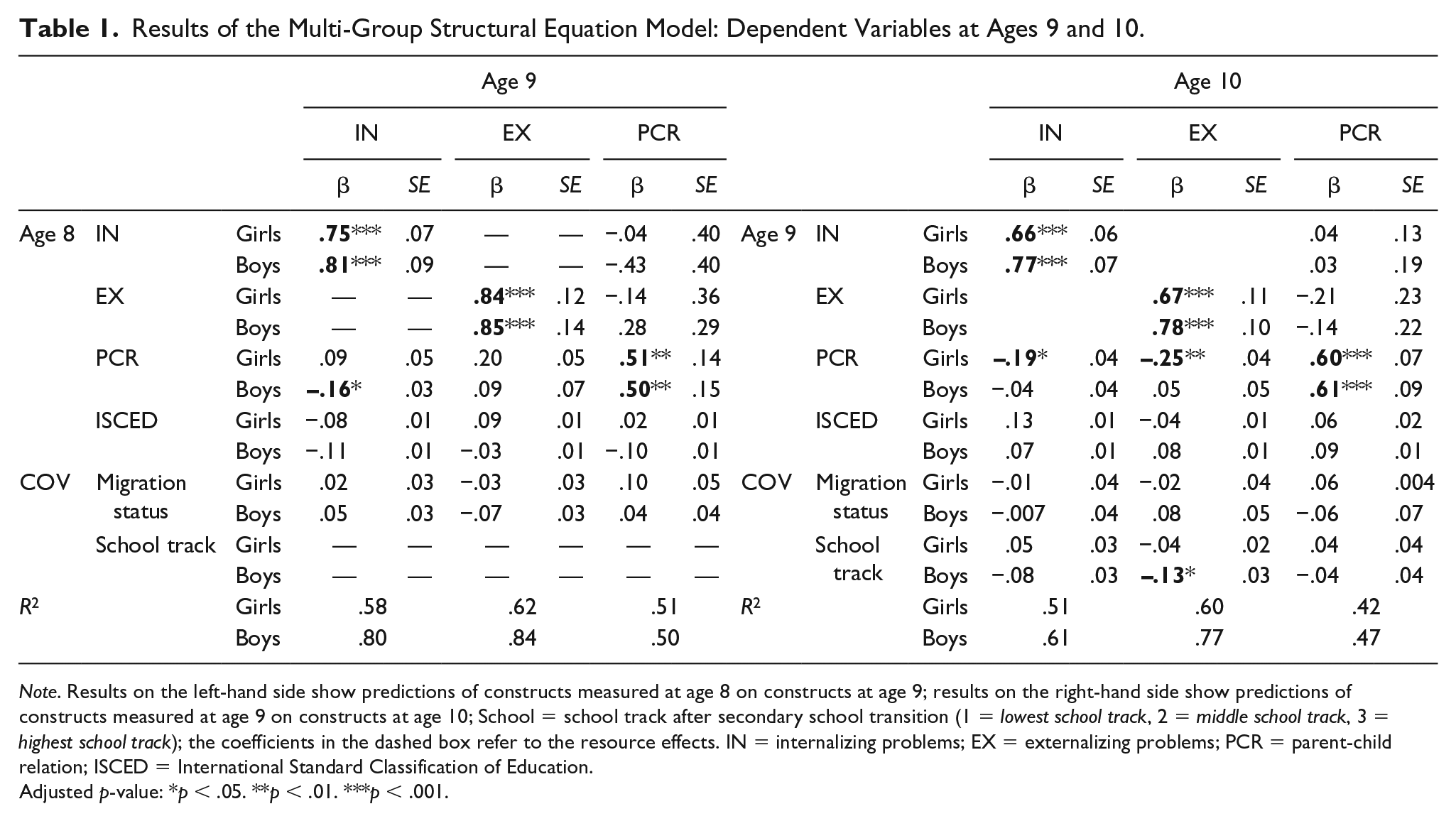
Note. Results on the left-hand side show predictions of constructs measured at age 8 on constructs at age 9; results on the right-hand side show predictions of constructs measured at age 9 on constructs at age 10; School = school track after secondary school transition (1 = lowest school track, 2 = middle school track, 3 = highest school track); the coefficients in the dashed box refer to the resource effects. IN = internalizing problems; EX = externalizing problems; PCR = parent-child relation; ISCED = International Standard Classification of Education.
p < .05. **p < .01. ***p < .001.
Results of the Multi-Group Structural Equation Model: Dependent Variables at Ages 11 and 12.
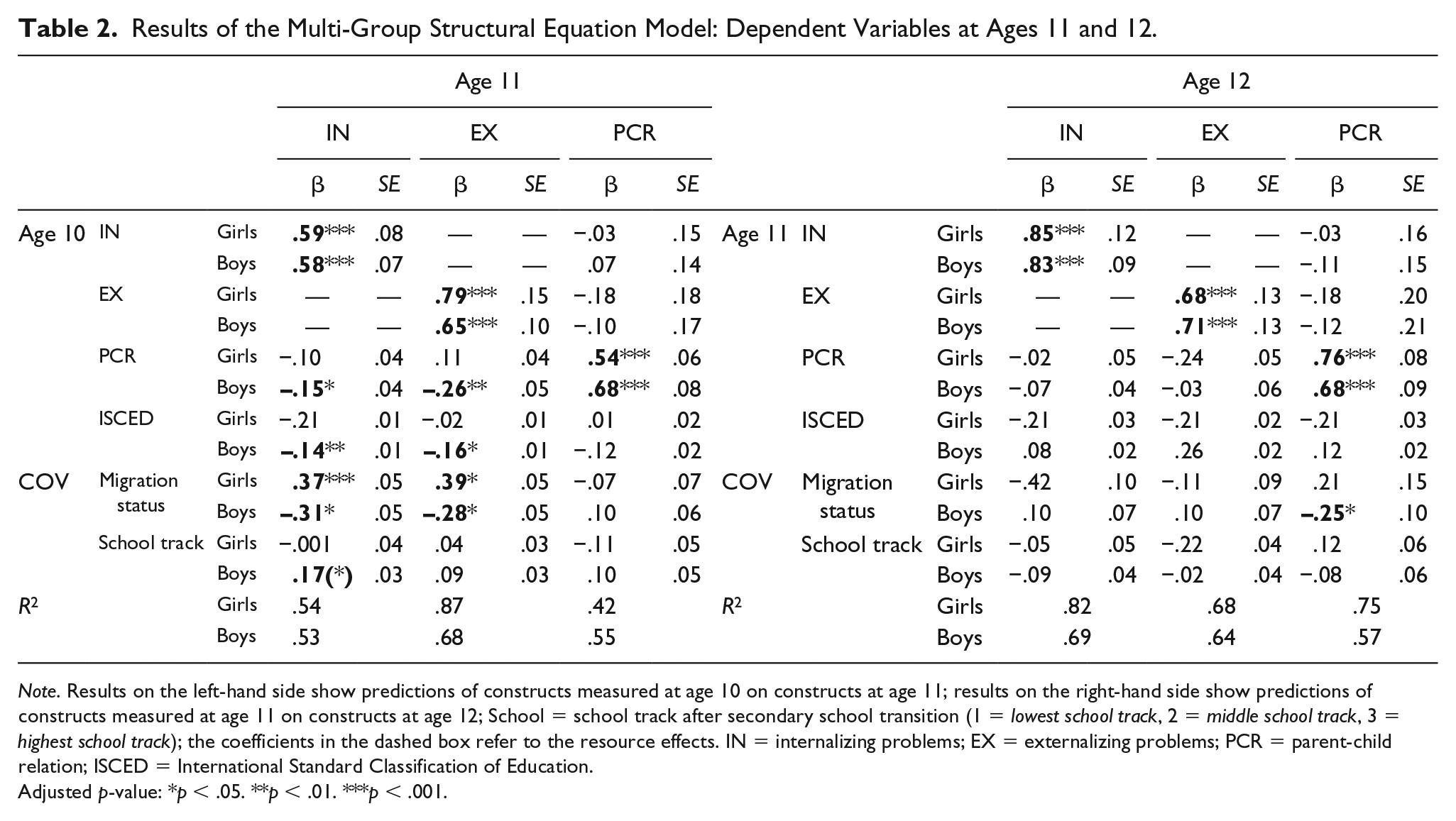
Note. Results on the left-hand side show predictions of constructs measured at age 10 on constructs at age 11; results on the right-hand side show predictions of constructs measured at age 11 on constructs at age 12; School = school track after secondary school transition (1 = lowest school track, 2 = middle school track, 3 = highest school track); the coefficients in the dashed box refer to the resource effects. IN = internalizing problems; EX = externalizing problems; PCR = parent-child relation; ISCED = International Standard Classification of Education.
p < .05. **p < .01. ***p < .001.
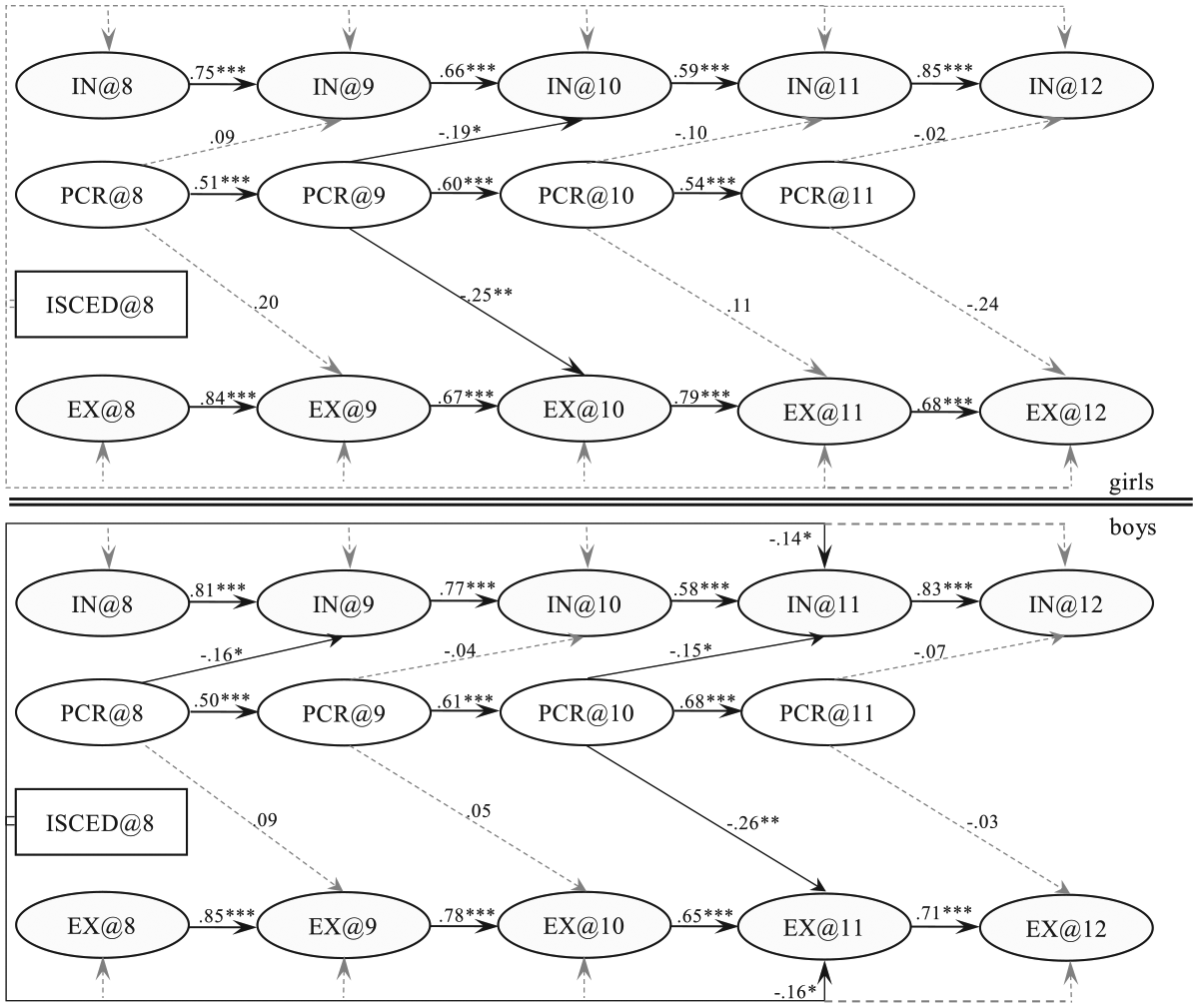
Summary of the multi-group model.
Second, regarding the parental educational background, no associations of ISCED and externalizing as well as internalizing problems at age 9 were found: ISCED → IN age 9: βgirls = −.08, SE = .01, p = .477 / βboys = −.11, SE= .01, p = .088; ISCED → EX age 9: βgirls = .09, SE = .01, p = .484 / βboys = −.03, SE = .01, p = .748 (Table 1, left-hand side). Parental educational background does not play any role for internalizing and externalizing problems before school transition. The same pattern was found for psychological adjustment at age 10: ISCED → IN age 10: βgirls = .13, SE = .01, p = .367 / βboys = .07, SE= .01, p = .630; ISCED → EX age 10: βgirls = −.04, SE = .01, p = .859 / βboys = .08, SE = .01, p = .633 (Table 1, right-hand side). However, a negative link of family education and the level of internalization and externalizing problems at age 11 was found, in the male subsample: ISCED → IN age 11: βgirls= −.21, SE = .03, p = .175 / βboys = −.14, SE = .01, p = .008; ISCED → EX age 11: βgirls = −.02, SE = .01, p = .939 / βboys = −.16, SE = .01, p = .015 (Table 2, left-hand side). Thus, a higher level of family educational background went along with lower levels of internalization and externalizing problems for boys. The difference between girls and boys was statistically significant for externalization (gender difference test ISCED → EX age 11: z = −.22, p = .002), but not for internalization (gender difference test ISCED → IN age 11: z = −.03, p = .611). For age 12, that is, after school transition, the associations between parental education and boys’ and girls’ problem behavior were not significant: ISCED → IN age 12: βgirls = −.21, SE = .03, p = .556 / βboys = .08, SE= .02, p = .748; ISCED → EX age 12: βgirls = −.21, SE = .02, p = .633 / βboys = .26, SE = .02, p = .320 (Table 2, right-hand side).
Taken together, for boys, family resources help to adjust in challenging situations. More precisely, parental education served as a protective factor in the development of internal and external problem behavior, supporting Hypothesis 1. Furthermore, parental education served as a resource only for boys and only during the time of their school transition and early puberty onset at age 11, supporting Hypothesis 2c for boys.
Third, with regard to the parent-child relationship, the results indicated gender-specific patterns of girls’ and boys’ internalizing and externalizing problem behaviors. However, the parent-child relationship only predicted internalizing problems at age 9 in the male subsample: PCR age 8 → IN age 9: βgirls = .09, SE = .05, p = .401 / βboys = −.16, SE = .03, p = .044; PCR age 8 → EX age 9: βgirls = .20, SE = .05, p = .206 / βboys = .09, SE = .07, p = .732 (Table 1, left-hand side). The gender difference in the coefficients was significant (PCR age 8 → IN age 9: z = −.16, p = .015). For boys, a positive relationship went along with lower levels of internalizing problems. Furthermore, the hypothesized transition-related time-shifted pattern was found. The predictions of girls’ internalizing and externalizing problems by the parent-child relation were found at an earlier age as compared to boys. Thus, at girls’ age of 10, the parent-child relationship predicted internalizing and externalizing problem behavior, but not for boys: PCR age 9 → IN age 10: βgirls = −.19, SE = .04, p = .026 / βboys = −.04, SE = .04, p = .742; PCR age 9 → EX age 10: βgirls = −.25, SE = .04, p = .014 / βboys = .05, SE = .05, p = .732 (Table 1, right-hand side). The tests on gender differences were significant, gender difference test PCR age 9 → IN age 10: z = −.15, p = .021; gender difference test PCR age 9 → EX age 10: z = −.16, p = .015. Moreover, parent-child relation predicted boys’ but not girls’ internalizing and externalizing problems 1 year later, that is, at age 11: PCR age 10 → IN age 11: βgirls = −.10, SE = .04, p = .304 / βboys = −.15, SE = .04, p = .041; PCR age 10 → EX age 11: βgirls = .11, SE = .04, p =.463 / βboys = −.26, SE = .05, p = .005 (Table 2, left-hand side). The gender difference was only significant for externalizing problems (gender difference test PCR age 10 → IN age 11: z = −.05, p = .061; gender difference test PCR age 10 → EX age 11: z = −.22, p = .002). Finally, no resource effects of parent-child relation was found for the time after the transitions for girls’ and boys’ age of 12: PCR age 11 → IN age 12: βgirls = −.02, SE = .05, p = .926 / βboys = −.07, SE = .04, p = .087; PCR age 11 → EX age 12: βgirls = −.24, SE = .05, p =.569 / βboys = −.03, SE = .06, p = .901 (Table 2, right-hand side).
Generally, we found support for Hypothesis 1: Parental resources negatively predicted externalizing and internalizing problems, showing that more parental support went along with higher psychological adjustment. The time- and gender-specific result pattern with regard to parent-child relationship supports Hypothesis 2c. For girls, the resource effects emerged earlier, between age 9 and 10, and showed no later effects. For boys, the negative resource effects were shown 1 year later, and no predictions were found later on. The result patterns are summarized in Figure 1.
Discussion
During the time between the age of 8 and 12, young people undergo multiple transitions, such as the change to secondary school and puberty onset, affecting individual’s internalizing and externalizing problem behaviors. In this study, we investigated the impact of family resources on the development of psychological functioning across their transition experiences. Based on Ruble and Seidman’s (1996) temporal transition perspective and Bronfenbrenner’s (1979) ecological model of human development, the study showed mostly positive resource effects on students’ psychological adjustment, supporting Hypothesis 1. Moreover, we expected and found differences in the effect patterns over time. The results rather supported the assumption of stronger resource effects when an early puberty onset and secondary school transition co-occurred (Hypothesis 2c), than specific school transition (Hypothesis 2a) or specific puberty onset (Hypothesis 2b) effects. With regard to the results pattern, no continuing resource effects can be found that exceed the age of 10 for girls and 11 for boys. Assuming that the average beginning of puberty is between age 10 and 14 for girls and between age 11 and 16 for boys, it can be expected that the timing of puberty onset and transition from primary to secondary school overlap mostly for early maturing girls and boys. For girls, this is the case if there is an early puberty onset with a change of school at the age of 10 (early school transition); for boys, the early beginning of puberty coincides with school transition at the age of 11 (later school transition). It is then those early maturing girls and boys, who—in the sense of cumulative risk factors and according to the deviance hypothesis—are particularly challenged to master biological, cognitive/emotional, and social changes simultaneously. Since no or smaller resource effects were found in both gender later, it cannot be the normative start of puberty that triggered the need for resources.
As the results showed, parental educational level and especially parent-child relation are relevant for girls’ and boys’ psychological adjustment (Hypothesis 1), especially during challenging times, such as during multiple transitions (Hypothesis 2c; Bronfenbrenner, 1979; Ruble & Seidman, 1996; Schlossberg, 1981). Stage-Environment Fit theory (Eccles et al., 1993) explicitly states that a context that meets the adolescents’ (changing) needs serves as a protective factor for young peoples’ psychological adjustment, especially during stressful experienced changing events. Our result pattern points to a particular challenging situation if early puberty onset and secondary school transition co-occur. In this very important period, external resources are needed. Adolescents who could rely on the parental resources showed a more positive development in their internalizing and externalizing problems than students with lower levels of resources. Thus, in order to prevent detrimental effects of this highly critical period, parental resources can serve as an essential protective factor.
However, the parent-child relationship, as a special form of intimate social interactions, proves to be a particularly important resource or protective factor during this time of multiple transitions. A possible explanation for this finding may be that a positive parent-child relationship is characterized by lower levels of conflict, which, in turn, can support the young people’s ability to regulate their emotional and behavioral reactions more adequately (Rueger, Malecki, & Demaray, 2010). Furthermore, as a positive parent-child relation may reflect a secure attachment between parents and children and, therefore, may serve as a secure base that helps children to master the challenges of transition in an unagitated way (Lakey & Cohen, 2000). This is especially supportive during this period of fundamental biological, emotional, cognitive, and behavioral changes that are associated with puberty onset.
In terms of parental education as resource, better educated parents can support the academic career of their offspring during school transition, for instance, more effectively in terms of providing homework help or having more financial resources, for example, hiring private tutors (Gniewosz & Eccles, 2013; Heckman, 2006). The ability of more educated parents to reduce the academic stressors can subsequently meliorate the psychosocial stressors of, for instance, school transitions that are linked to psychological adjustment. Thus, in contrast to the parent-child relation, the protective effect of parental education might be more closely linked to children’s school transition and later school careers.
However, the general effects pattern turns out to be more nuanced when considering the type of resource, the child’s gender, and the outcome (internalizing vs. externalizing behaviors) in combination. The hypothesized effects pattern concerning the parental education was only found for boys. For girls, the parental education does not seem to serve as a resource. A reason for this gender difference might be seen in boys’ poorer school grades, lower transition rates for higher schools-types (Gymnasium) as well as in a lower likelihood of successfully completing school in the German school system (Stanat, Bergann, & Taraszow, 2018). Especially in the context of the performance-orientated German school system, this may lead to higher levels of perceived school-related pressure for boys than for girls, as shown by Raufelder, Hoferichter, Ringeisen, Regner, and Jacke (2015). Therefore, the need for resources in that regard seems to be higher for boys than for girls. Since the parental educational background is supposed to serve as a resource for academic stressors, the gender difference could be observed, especially during the time of multiple transitions. This gender-specific difference could also help to explain the resource effects prior to school transition in boys. Given that the probability of entering the higher school track in Germany is lower for boys (Maaz, Baumert, Gresch, & McElvany, 2010; Neugebauer, 2011), the pressure to perform well before the school transition should be higher. The data indicate that boys eventually have a higher need for parental educational resources already before and especially during multiple transitions. But future research should address this post hoc interpretation more directly.
Moreover, the patterns differ between outcomes. Concerning the externalizing problems, we found the expected patterns for the co-occurrence hypothesis (parental education only for boys as previously discussed). For internalizing problems, however, the patterns are the same, but the difference tests of the regression parameters were not significant after age 10. A reason for that could be the increased levels of girl’s internalizing problem behaviors between early to late adolescence that usually stabilizes at a higher level (Costello et al., 2011; Klasen et al., 2016). That might be indicative of girls being more vulnerable toward external stressors after puberty for a longer period. Therefore, a more positive development after the multiple transitions could be expected if the parent-child relationship can serve as a protective factor or resource. However, the effects for girls after the critical period of multiple transitions were not significant, but comparable in size to the boys’ effects. A reason for that could be that there are subgroups of girls (e.g., late maturing girls) whose need for parental resources differs after the transition periods. But these post hoc interpretations should be tested in future research.
Limitations
Interpreting the results of the study, some limitations should be kept in mind. First, the psychometric properties of some constructs were only acceptable. This may be due to an age-related change in the answers regarding the indicators for psychological adjustment. Multi-informant ratings may provide more reliable measures, which is typically not possible in large longitudinal survey studies for economic reasons.
Second, we could not exactly specify who did the school transition earlier or later. Therefore, we had to rely on time-related effect patterns. By the same token, puberty onset as transition was indirectly operationalized through gender-specific time-related effects patterns, as no direct measure for students’ maturity level was available in this survey. In future research, direct measures of puberty onset and the information on the timing of the secondary school transition may increase the validity of our interpretations. However, the validity of our interpretation is supported by the study of Forrest, Bevans, Riley, Crespo, and Louis (2013), showing that both the secondary school transition and the puberty onset negatively influenced school outcomes, such as school engagement and performances.
Third, the study is limited to the development of internalizing and externalizing problems. Although the SDQ is a well-established measure of psychological adjustment, including more indicators for health, such as physical (e.g., blood pressure), behavioral (e.g., substance use), and psychological (e.g., satisfaction) indicators may help to get a more comprehensive picture of young people’s psychological adjustment across multiple transitions.
Fourth, our main aim was to investigate a link between the families’ educational background as well as parent-child relation on children’s psychological adjustment. Including additional aspects (e.g., family structure, amount of time spent together) may help to understand our findings or the role of additional resources within family in greater detail. Moreover, as non-parental contexts, such as peers and the school, become increasingly important during adolescence (Rubin, Root, & Bowker, 2010; Wentzel, McNamara-Barry, & Caldwell, 2004), it would be fruitful to investigate the relevance of family resources relatively to peer-related resources regarding girls’ and boys’ adjustment during both school- and puberty-related changes. In the same line of argument, the interactions of the child’s different contexts (e.g., parents × school), that is, the mesosystemic effects (Bronfenbrenner, 1987), should be investigated more thoroughly. For instance, recent research could show that the home-school relationships could predict students’ social, emotional, and academic outcomes in an at-risk sample (Brown, Mahatmya, & Vesely, 2016; Bronfenbrenner, 1979).
Finally, the study is restricted to a German sample, in order to draw broader conclusions. The interaction of multiple transitions should be investigated in more diverse samples, as well. By the same token, school systems differ a lot, especially in the organizations of secondary school transitions. The German system allowed for testing our specific set of hypotheses. However, the result pattern might be specific to the German system and should be replicated in comparable systems, as well.
Implications
Our findings are not only relevant for an understanding of gender-specific paths of psychological adjustment across late childhood and early adolescence, but also for enabling girls’ and boys’ environments (e.g., families and school-contexts) to support them during transition times. For instance, it seems necessary for girls’ and boys’ environments not to assume the same needs at the same time. Moreover, to fit girls’ needs and, thus, to support girls’ positive development, it seems necessary to provide adequate context support at an earlier point in life, as compared to boys. Furthermore, it seems to be the early maturing adolescents who need the resources most in order to buffer against negative transition effects, especially when they co-occur (Grossman et al., 2014). Finally, we think that this study showed that transition-related challenges do interact. Thus, during childhood and adolescence, it is important to keep multiple transitions in mind. Detecting and buffering against problem behaviors in girls and boys at this early state seems to be crucial to activate contextual systems to prevent a negative long-term development of problem behaviors.
Footnotes
Appendix
Summary of Correlations of the Latent Constructs With Control Variables in the Boys’ group.
| IN age 8 | IN age 9 | IN age 10 | IN age 11 | IN age 12 | EX age 8 | EX age 9 | EX age 10 | EX age 11 | EX age 12 | PCR age 8 | PCR age 9 | PCR age 10 | PCR age 11 | PCR age 12 | ISCED age 8 | |
|---|---|---|---|---|---|---|---|---|---|---|---|---|---|---|---|---|
| IN age 8 | 1.00 | |||||||||||||||
| IN age 9 | .79*** | 1.00 | ||||||||||||||
| IN age 10 | .61*** | .69*** | 1.00 | |||||||||||||
| IN age 11 | .31* | .57*** | .41*** | 1.00 | ||||||||||||
| IN age 12 | .19 | .65*** | .55** | .81*** | 1.00 | |||||||||||
| EX age 8 | .54*** | .47*** | .25* | .31* | −.07 | 1.00 | ||||||||||
| EX age 9 | .40*** | .76*** | .50*** | .48*** | .55*** | .65*** | 1.00 | |||||||||
| EX age 10 | .42** | .45*** | .72*** | .31* | .46*** | .47** | .77*** | 1.00 | ||||||||
| EX age 11 | .21 | .36** | .31* | .72*** | .62*** | .42* | .67*** | .64*** | 1.00 | |||||||
| EX age 12 | .06 | .47** | .32* | .41** | .65*** | .66** | .84*** | .46** | .72*** | 1.00 | ||||||
| PCR age 8 | .03 | −.09 | −.11 | −.23* | .16 | −.43** | −.34** | −.25* | −.32* | −.36* | 1.00 | |||||
| PCR age 9 | .04 | −.08 | −.06 | −.23* | −.27** | −.34** | −.37** | −.22* | −.26* | −.29 | .56*** | 1.00 | ||||
| PCR age 10 | −.05 | −.16 | −.10 | −.21* | −.29** | −.26** | −.22** | −.31*** | −.39** | −.36* | .64*** | .62*** | 1.00 | |||
| PCR age 11 | .03 | −.14 | −.12 | −.04 | −.14 | −.27** | −.33** | −.27* | −.33** | −.28* | .44*** | .47*** | .64*** | 1.00 | ||
| PCR age 12 | .14 | −.03 | .03 | .03 | −.02 | −.31* | −.26* | −.07 | −.26** | −.45*** | .41** | .53*** | .63*** | .64*** | 1.00 | |
| ISCED age 8 | −.22* | −.27* | −.14 | −.14 | −.05 | .01 | −.10 | −.02 | −.14* | .17 | −.07 | −.10 | −.01 | −.06 | .05 | 1.00 |
| Migration | .00 | .08 | .01 | −.03 | −.29* | .02 | −.01 | .00 | .01 | −.11 | −.02 | −.10 | −.06 | .04 | −.18* | .01 |
| School age 10 | −.01 | −.07 | −.14* | .25*** | .12 | −.14 | −.08 | −.18* | .03 | .09 | −.01 | −.15* | −.1 | .03 | .00 | .17 |
| School age 11 | −.32* | −.27* | −.01 | −.34** | −.23* | −.18 | −.23 | −.04 | −.27* | −.24 | .00 | .12 | .15 | .00 | .14 | .34 |
| School age 12 | .22 | .20 | .00 | .06 | −.01 | .23 | .04 | −.05 | .07 | .04 | .32 | .14 | .05 | .13 | −.04 | −.14 |
Note. IN = internalizing problems; EX = externalizing problems; PCR = Parent-child relation; ISCED = International Standard Classification of Education; Migration = migration background (0 = no, 1 = yes); School = school track after secondary school transition (1 = lowest school track, 2 = middle school track, 3 = highest school track).
p < .05. **p < .01. ***p < .001.
Authors’ Note
This paper uses data from the German Family Panel pairfam, coordinated by Josef Brüderl, Karsten Hank, Johannes Huinink, Bernhard Nauck, Franz Neyer, and Sabine Walper.
Declaration of Conflicting Interests
The author(s) declared no potential conflicts of interest with respect to the research, authorship, and/or publication of this article.
Funding
The author(s) disclosed receipt of the following financial support for the research, authorship, and/or publication of this article: Pairfam is funded as long-term project by the German Research Foundation (DFG; SPP 1161).
