



Abstract
Person-centered analyses were used to identify relationship profiles based on seventh graders’ perceptions of relationships with three of their teachers (homeroom teacher, teacher of the easiest subject, teacher of the hardest subject). Furthermore, we investigated whether students’ characteristics (gender and academic track) could explain relationship profile membership and how these relationship profiles were associated with students’ school engagement. Students (N = 899, 47.8% girls) reported about their relationships (closeness, conflict) with their teachers. Students and their homeroom teachers reported about students’ behavioral and emotional engagement. Four relationship profiles were found: a no risk profile (high closeness, low conflict with all three teachers), two single risk profiles (low closeness, high conflict with only one teacher), and one multiple risk profile (high conflict with all three teachers). Furthermore, boys were underrepresented in the no risk profile. Finally, students in the no risk profile tended to be more behaviorally and emotional engaged.
Keywords
Many studies indicate that the affective quality of student–teacher relationships is important for secondary students’ school adjustment, such as their engagement with schoolwork (see Roorda et al., 2011, 2017 for meta-analytic overviews). Until now, secondary school studies focused mainly on students’ relationships with teachers in general (Galand & Hospel, 2013; Lee, 2015; Smit et al., 2014), even though secondary students most likely will experience qualitative differences in their relationships with their different teachers (e.g., the English versus the math teacher; Wallace et al., 2012). It still remains unclear, however, whether all students experience such differences in relationship quality. As some students seem to be more at risk for developing negative relationships with teachers than other students (McGrath & van Bergen, 2015), certain subgroups of students may have an increased risk of sharing negative relationships with multiple teachers than others. That is, some students may have negative relationships with all their teachers, whereas other students share negative relationships with only one or two teachers, or none at all (cf., Bosman et al., 2018; Özdemir & Özdemir, 2020).
In the present study, we therefore used a person-centered approach to examine whether different relationship profiles exist for secondary school students based on their relationships with three different teachers. We focused on students in the first year of secondary school (i.e., seventh grade) because they are in a transitional period and may therefore be more dependent on positive relationships with teachers for optimal adjustment to their new school environment (Eccles et al., 1993; cf., Gehlbach et al., 2012). Furthermore, we investigated whether some seventh graders (i.e., boys and students from lower academic tracks) were more at risk for having unfavorable relationship profiles with multiple teachers than others. Finally, as cumulative risk factors (e.g., sharing negative relationships with more than one teacher) may have enlarged negative effects on students’ school adjustment (Ladd & Burgess, 2001; Solomon et al., 2016), we also investigated how the different student–teacher relationship profiles were associated with students’ school engagement.
Theoretical Framework
Studies in primary school focusing on affective student–teacher relationships have often been based on an extended attachment perspective (Pianta, 1999; Verschueren & Koomen, 2012). More recently, researchers have argued that this theory also applies to student–teacher relationships in secondary school (Verschueren, 2015) and hence studies targeting this age group have increasingly been inspired by the extended attachment theory as well (e.g., Gehlbach et al., 2012). According to the extended attachment theory, positive relationships with teachers provide students with feelings of security and, consequently, enable them to become engaged with the school environment. Negative relationships with teachers, in contrast, can form a threat to students’ emotional security and thus hinder their engagement with schoolwork (Verschueren & Koomen, 2012).
Studies based on the extended attachment theory often distinguish between the degree of closeness (i.e., the degree of warmth, support, and open communication) and conflict (i.e., the degree of coercion, negativity, and fights) in the student–teacher relationship (Pianta, 2001; Verschueren & Koomen, 2012). Closeness is considered as a positive relationship dimension, which promotes feelings of security in students and hence improves their engagement with schoolwork. Conflict, on the other hand, is a negative relationship dimension, which hampers students’ emotional security and, consequently, their school engagement (Verschueren & Koomen, 2012). Students’ engagement is a multidimensional concept that has been operationalized in different ways. In the present study, we followed the operationalization of Skinner et al. (2008, 2009) and distinguished between students’ behavioral and emotional engagement. Behavioral engagement refers to students’ engaged behaviors with schoolwork (e.g., showing effort, being persistent) and emotional engagement refers to students’ feelings and emotions toward schoolwork (e.g., enjoyment, satisfaction, boredom; Skinner et al., 2008, 2009). Several researchers have argued that it is important to distinguish between these two components of engagement, as they may be differently associated with their antecedents (e.g., student–teacher relationships) and consequences (e.g., achievement; Skinner et al., 2008; Wang & Eccles, 2013; Wang & Holcombe, 2010). In line with this idea, Roorda et al. (2019) found that student–teacher closeness was more strongly associated with students’ emotional engagement than with their behavioral engagement.
Even though the extended attachment theory has been increasingly applied to relationships between teachers and older students (Gehlbach et al., 2012; Verschueren, 2015), there are important differences in student–teacher relationships between primary and secondary school. For example, students in secondary school often see multiple teachers during the school day (possibly up to 15 teachers a week), with whom they have to connect, whereas students in primary school generally have only one or two teachers a year. This may have implications for student–teacher relationships in secondary school and the ways in which they impact students’ school adjustment (cf., Ladd & Burgess, 2001; Solomon et al., 2016). According to the cumulative risk hypothesis (Rutter, 1978; 1979; Solomon et al., 2016), it is the accumulation of risk factors (e.g., sharing negative relationships with multiple teachers) rather than risk factors in isolation that impact adjustment. Formulated differently, the impact of multiple risk factors in combination is more harmful than the sum of these risk factors. In addition, the additive model of adjustment (Ladd & Burgess, 1999, 2001) assumes that risk and protective factors have a combined impact on students’ adjustment. Following this hypothesis, sharing positive relationships with some teachers may compensate (partially) for having less positive relationships with other teachers. Therefore, identifying subgroups of secondary students that differ in the number of teachers with whom they share unfavorable relationships (i.e., generating relationship profiles) and investigating the impact of these relationships on students’ school adjustment, may provide additional insight in student–teacher relationships in the first year of secondary education.
Relationship Profiles in Secondary School
As far as we know, there are no studies in secondary school that have aimed to identify relationship profiles based on students’ relationships with multiple teachers at the same moment in time. There do exist, however, some studies that investigated relationship profiles based on students’ relationships with different teachers in consecutive school years in primary school. These studies found that most primary school students share favorable relationships with their teachers across multiple school years, that is, high-stable levels of closeness (63%–85%) and low-stable level of conflict (63%–88%; Bosman et al., 2018; O’Connor et al., 2012; Spilt et al., 2012a). The remaining students had less favorable relationship profiles that reflected either the deterioration of closeness or increasing levels of conflict (ranging from 2.5% to 20%). Taken together, these primary school studies indicate that different relationship profiles can be found when looking at relationships with subsequent teachers.
One study in secondary school also investigated relationship profiles based on relationships with teachers in consecutive school years (i.e., grade 7, 8, 9, and 10; Özdemir & Özdemir, 2020). Three relationship profiles could be distinguished: Most students (66%) had average-stable positive relationships with their teachers over time, 24% reported high-increasing levels of positivity, and the smallest group (10%) reported average-declining levels of positivity (Özdemir & Özdemir, 2020). Just as most other studies in secondary school (e.g., Galand & Hospel, 2013; Lee, 2015; Smit et al., 2014) this study also asked about students relationships with teachers in general. As such, this study ignored the fact that secondary school students have multiple teachers a day with whom they will most likely develop qualitatively different relationships. For instance, Wallace et al. (2012) showed that high school students felt somewhat more connected to their English than to their math teacher. Likewise, Roorda et al. (2019) revealed that secondary school students experienced higher levels of closeness in their relationships with their homeroom teacher, followed by the teacher of their easiest subject, and the lowest degree of closeness with the teacher of their hardest subject. With regard to conflict, students reported higher levels of conflict with the teacher of their hardest subject compared to their homeroom teacher and the teacher of their easiest subject.
The studies described above seem to indicate that secondary students do experience differences in their relationships with their different teachers. However, they do not provide information about which relationship profiles are most prevalent in the beginning of secondary school. In the present paper, we therefore aimed to identify subgroups of students with different relationship profiles based on their relationships with three different teachers. More specifically, we wanted to know whether there are subgroups of students who share highly conflictual relationships with multiple teachers at the same time or, in contrast, are protected by having close relationships with more than one teacher.
Student Characteristics and Relationship Profiles
It is well established that some students are more at risk for developing negative relationships with their teachers than other students (see the review study of McGrath & van Bergen, 2015). More specifically, boys and low achieving students usually share less close and more conflictual relationships with teachers than girls and high achieving students (e.g., Hughes et al., 2005; Jerome et al., 2009; Koomen & Jellesma, 2015; McGrath & van Bergen, 2015; Nurmi, 2012). Furthermore, some evidence has been found that these student characteristics may impact the distribution of students across relationship profiles with subsequent teachers as well. That is, Spilt et al. (2012a) found that 5% of the boys had high-stable levels of conflict across the school career, whereas none of the girls were in this profile. Furthermore, boys were underrepresented in the low-stable conflict profile compared to girls. For closeness, however, the distribution across profiles did not differ much for boys and girls (Spilt et al., 2012a). Likewise, Özdemir and Özdemir (2020) found that gender did not affect the distribution of students across the positive relationship profiles in secondary school. In contrast, Bosman et al. (2018) revealed that gender did impact the distribution across closeness profiles: Boys had a higher chance than girls of being in the least favorable closeness profile compared to the high-stable closeness profile. For conflict, boys were more likely than girls to be in non-normative profiles compared to the low-stable conflict profile (Bosman et al., 2018).
With respect to academic ability, Spilt et al. (2012a) showed that students with a lower IQ were more likely than students with a higher IQ to have a low-increasing closeness profile compared to a high closeness profile. Students with a lower IQ were also more often in the more problematic conflict profiles, whereas students with a higher IQ were overrepresented in the low-stable conflict profile (Spilt et al., 2012a). As students with a lower IQ tend to be in the lower academic tracks (Kaldenbach, 2017), students’ academic track may impact their distribution across student–teacher relationship profiles as well. The present study investigated whether students’ gender and academic track could explain students’ profile membership.
Relationship Profiles and School Adjustment
Convincing evidence has been found that student–teacher relationships impact secondary students’ school engagement, both within and across school years (see Roorda et al., 2011, 2017 for meta-analyses). For positive relationship dimensions (e.g., closeness, teacher support) and engagement, associations appeared to be even stronger in secondary than in primary school (Roorda et al., 2017). With respect to person-centered studies, Bosman et al. (2018) revealed that students with high-stable closeness profiles showed more task motivation at the end of elementary school than students with moderate-increasing levels of closeness. The conflict profiles, in contrast, were not associated with students’ degree of task motivation (Bosman et al., 2018). Likewise, secondary school students with high-increasing levels of relational positivity reported greater school satisfaction and higher achievement values than students with average-stable relationships, whereas students from the average-decreasing profile reported the lowest levels of school satisfaction and achievement values (Özdemir & Özdemir, 2020). In sum, more favorable relationship profiles seem to be associated with higher school engagement. In the present study, we therefore investigated whether profiles based on relationships with individual teachers at the same moment in time were also associated with secondary students’ school engagement.
The Present Study
In the present study, we examined student–teacher relationship profiles in seventh grade (usually students are 12 or 13 years old), which is the first year of secondary education in the Netherlands. In general, seventh graders have up to 10 to 15 teachers in total, one for each school subject, whom they see 1 hour (e.g., art teachers) to three or 4 hours a week (e.g., Dutch and math teachers; exact number of hours may differ across schools). In the present study, relationship profiles were based on students’ relationships with three of these teachers: the homeroom teacher, the teacher of students’ easiest subject, and the teacher of students’ hardest subject. The homeroom teacher was chosen because of the special role that these teachers fulfill for students in their homeroom class. In Dutch secondary schools, all seventh graders have a homeroom teacher, who teaches a general subject but also functions as a confidant for students, contact person for parents and students, and who monitors the general progress of students in his/her homeroom class. Usually, homeroom teachers have one homeroom hour per week with their homeroom class, in which more general aspects of school life are discussed (e.g., guidelines for effective learning). If necessary, homeroom teachers also have individual appointments with students. As such, homeroom teachers see students from their homeroom class more often than other teachers and are expected to be more personally involved with their homeroom students.
Furthermore, we focused on the teachers of students’ easiest and hardest subjects (as indicated by students themselves) to create some variation in relationship quality between teachers (cf., Roorda et al., 2019). Students with less optimal academic experiences (e.g., low self-concept, learning difficulties) tend to share less close and more conflictual relationships with teachers (McGrath & van Bergen, 2015; Raufelder et al., 2015; Zee et al., 2020). Extending this argumentation, the perceived difficulty of a subject might also influence the quality of student–teacher relationships. As such, students may share less close and more conflictual relationships with the teacher of their hardest subject and experience more closeness and less conflict with the teacher of their easiest subject (Roorda et al., 2019). We strived for such variation in relationship quality because we believed that it would make the chosen relationships more representative for the range in student–teacher relationships that students might encounter in seventh grade.
The following research aims and hypotheses were formulated: First, we investigated how many and which relationship profiles would be found based on the relationship with the three teachers and how many students would be found in each relationship profile. Based on previous person-centered studies with teachers from consecutive schoolyears (Bosman et al., 2018; O’Connor et al., 2012; Özdemir & Özdemir, 2020; Spilt et al., 2012a), we expected that several relationship profiles could be distinguished. One of these profiles would probably consist of students who share favorable relationships (high in closeness, low in conflict) with all three teachers, whereas students in the other profiles would share unfavorable relationships (low in closeness, high in conflict) with one or more teachers. The profile with favorable relationships with all teachers would most likely include the majority of students (63%–88%), whereas the remainder of the students would have less optimal relationship profiles (Bosman et al., 2018; O’Connor et al., 2012; Spilt et al., 2012a). Second, we examined whether students’ gender and academic track could explain their distribution across relationship profiles. We expected that boys and students from lower academic tracks would be underrepresented in the more favorable relationship profiles (Bosman et al., 2018; McGrath & van Bergen, 2015; Spilt et al., 2012a). Third, we investigated whether the student–teacher relationship profiles were differently associated with students’ school engagement. To prevent same-informant bias (cf., Roorda et al., 2011), both students and their homeroom teachers reported about students’ engagement. Based on previous studies (Al-Yagon, 2016; O’Connor et al., 2012; Özdemir & Özdemir, 2020; Roorda et al., 2017), we hypothesized that students with more favorable relationship profiles would display more behavioral and emotional engagement.
Methods
Participants
Our sample consisted of 899 seventh grade students (47.8% girls) from 38 classrooms from eight Dutch secondary schools. In the Dutch school system, seventh grade is the first year of secondary school and most students are 12 years old when they start secondary school. Before the start of the school year, students are assigned to different academic tracks, namely, lower vocational education (LVE), higher general secondary education (HGSE), pre-university education (PUE), or a combination of two of these tracks. Our sample included students from all three tracks (31.1% LVE, 19.0% combination of LVE and HGSE, 3.3% HGSE, 16.0% combination of HGSE and PUE, 30.5% PUE). Students were on average 12.43 years old (SD = 0.56; range = 11–14 years). Most students (90.4%) and their parents (73.6% of mothers, 70.6% of fathers) were born in the Netherlands.
Thirty-six homeroom teachers (75.0% women) also participated in our study. Homeroom teachers were on average 39.11 years old (SD = 11.82; range = 22–63 years) and had a mean teaching experience of 12.68 years (SD = 9.63, range = 2.5–36.0 years).
Procedure
Approval for the data collection was obtained from the ethical committee of the University of (blinded for review). The data collection took place in the second half of the school year (January and February). Students reported about their relationship with the three teachers (i.e., homeroom teacher, teacher of their easiest subject, teacher of their hardest subject), their engagement with schoolwork, their gender and academic track. Students completed the questions in the classroom and undergraduates were present to answer possible questions. As the questionnaire was rather long, it was distributed across two different school days (each part took approximately 20–30 minutes to complete).
Around the same time, students’ homeroom teachers completed a questionnaire about the school engagement of eight randomly selected students from their homeroom class. In total, homeroom teachers reported about 286 students (51.0% girls).
Measures
Student–teacher relationships
Students reported about the affective quality of their relationship with each teacher on the Closeness and Conflict subscales of the shortened version of the Student Perception of Affective Relationship with Teacher Scale (SPARTS; Koomen & Jellesma, 2015; Zee & de Bree, 2017). Closeness includes six items, such as “I tell this teacher things that are important to me.” Conflict also consists of six items, such as “I easily have quarrels with this teacher.” Items were answered on a 5-point Likert-type scale, ranging from 1 (no, that is not true) to 5 (yes, that is true).
Previous studies supported the reliability and validity of the shortened version of the SPARTS (Roorda et al., 2019; Roorda & Koomen, 2021; Zee & de Bree, 2017). In the present study, Cronbach’s alphas were .85, .85, and .86 for Closeness and .77, .80, and .83 for Conflict for respectively the homeroom teacher, the teacher of the easiest subject, and the teacher of the hardest subject.
Student-Reported Engagement
Students rated their school engagement on the Behavioral and Emotional Engagement subscales of the Engagement versus Disaffection with Learning Questionnaire (EvDLQ; Skinner et al., 2008; Dutch translation and adaptation by Zee & Koomen, 2019). Behavioral Engagement includes six items, such as “I try hard to do well at school.” Emotional Engagement consists of five items, like “I enjoy learning new things at school.” Students answered the items on a 5-point scale, varying from 1 (no, that is not true) to 5 (yes, that is true).
Support has been found for the reliability and validity of the EvDLQ (Roorda et al., 2019; Skinner et al., 2008; Zee & Koomen, 2019). In the present study, Cronbach’s alphas were .81 for Behavioral Engagement and .75 for Emotional Engagement.
Teacher-Reported Engagement
Students’ homeroom teachers reported about their students’ school engagement on the teacher version of the EvDLQ (Skinner et al., 2009; Dutch translation and adaptation by de Ruiter, 2021). The Behavioral Engagement (six items; e.g., “This student tries hard to do well at school”) and Emotional Engagement subscales (five items; e.g., “This student enjoys learning new things at school”) were similar to the subscales of the student version. Homeroom teachers rated each item on a 5-point Likert-type scale, varying from 1 (definitely does not apply) to 5 (definitely applies).
Previous research found evidence for the reliability and validity of the teacher version of the EvDLQ (de Ruiter, 2021; Skinner et al., 2009). In the present study, Cronbach’s alphas were .87 for Behavioral Engagement and .79 for Emotional Engagement.
Student Characteristics
Students’ Gender was measured by asking students whether they were a boy (coded as 0) or a girl (coded as 1). Furthermore, students indicated in which academic Track they were, with LVE being coded as low and HGSE and PUE being coded as high (0 = low, 1 = high).
Analyses
To identify relationship profiles (research question 1), we conducted finite mixture modeling in Mplus version 7 (Muthén & Muthén, 1998–2015), as indications have been found that this method is preferable over other cluster methods, such as k-means clustering (Magidson & Vermunt, 2002). Missing values for the relationship variables ranged from 13.6% to 15.7%. These missing values were partly due to absences during data collection and partly caused because students sometimes chose the subject of their homeroom teacher also as their hardest or easiest subject. In those cases, the answers for one of these teachers were deleted to prevent overlap between teachers. The full-information maximum likelihood algorithm (FIML) was used to incorporate all available information from incomplete cases (Jelicic et al., 2009). To take the nesting of students within classrooms into account, the “complex analysis” option was applied (Williams, 2000), which prevents the use of the Bootstrap Likelihood Ratio Test (BLRT) as a way to determine the number of classes. Therefore, we used other guidelines to decide about the number of classes: the sample size adjusted Bayesian information criterion (SSBIC) should be as small as possible, the posterior probabilities should be as high as possible (close to 1, not below .80), and there should be a reasonable number of students in each class (more than 5%; Jung & Wickrama, 2008; Nylund et al., 2007). Furthermore, we also took interpretability and model parsimony into account.
For further analyses, we used the saved distribution across relationship profiles. To examine whether students’ characteristics (i.e., Gender, Track) influenced their chances to belong to a certain relationship profile (research question 2), we performed chi-square difference tests. Finally, we performed analyses of variance with student-reported and teacher-reported Behavioral and Emotional Engagement as outcome variables, to examine whether there were differences between relationship profiles in students’ school engagement (research question 3). As a follow-up analysis, we conducted analyses of variance with interaction effects to examine whether gender and academic track influenced the associations between relationship profiles and students’ engagement (cf., Roorda et al., 2011). However, none of the interactions between gender and relationship profiles was significant: F (3) = 0.33, p = .807 for student-reported Behavioral Engagement, F (3) = 0.79, p = .503 for student-reported Emotional Engagement, F (3) = 0.36, p = .785 for teacher-reported Behavioral Engagement, and F (3) = 0.47, p = .704 for teacher-reported Emotional Engagement. The interaction effects of academic track and relationship profiles were also not significant: F (3) = 1.14, p = .333, F 6(3) = 1.82, p = .143, F (3) = 0.63, p = .597, and F (3) = 0.85, p = .467, respectively. These results suggest that gender and track do not impact the association between relationship profiles and both student-reported and teacher-reported engagement, and hence, these interaction effects were deleted from the final models.
Information about gender was missing for 1.6% of the students and there were 8.2% missing values for student-reported engagement. For academic Track, 19% of the cases had to be coded as missing, as these students had not yet chosen between the LVE and HGSE track, which is common practice for part of the seventh graders in the Netherlands. Listwise deletion was used to deal with missing values. To get some indication of the impact of missing values on the results for student-reported engagement, we also used imputation with the Expectation Maximization (EM) algorithm to deal with missing values in student-reported Behavioral and Emotional Engagement. Results were largely the same for the analyses with imputed values and the analyses with listwise deletion. The results of both analyses of variance can be found in Table 4. As teacher reports were only available for 286 students (31.8%), we deemed imputation of missing values undesirable for teacher-reported Behavioral and Emotional Engagement. Students were randomly selected for the teacher questionnaire and there were no significant differences in student-reported engagement and the quality of the relationship with the three teachers, ts = 0.18 to −1.90, ps > .050, between students for whom teacher reports were and were not available. This seems to indicate that the selected students were representative for the entire student sample.
Results
Relationship Profiles
Model Fit Indices for the Mixture Modeling Analyses for the Relationship Profiles.
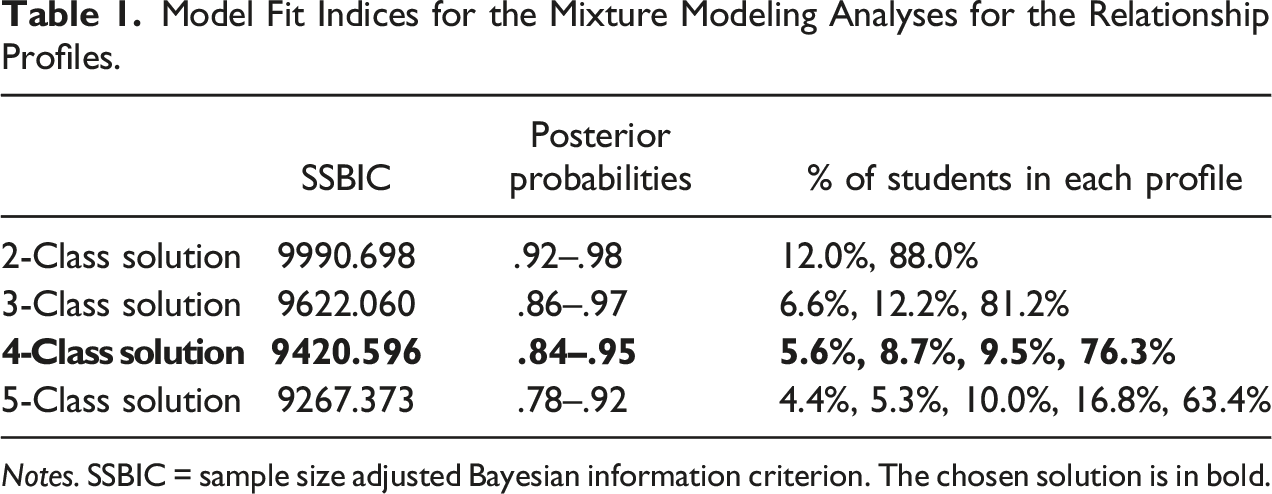
Notes. SSBIC = sample size adjusted Bayesian information criterion. The chosen solution is in bold.
Descriptive Statistics (Means, Standard Deviations) and Analyses of Variance for the Four-Class Solution.

Notes. ** p < .01 Class means in the same row that do not share subscripts (e.g., a, b, c, d) differ at p <.05. Homeroom = relationship with the homeroom teacher, easiest = relationship with the teacher of the easiest subject, hardest = relationship with the teacher of the hardest subject.
Student Characteristics and Relationship Profiles
Students’ Characteristics for each Relationship Profile.
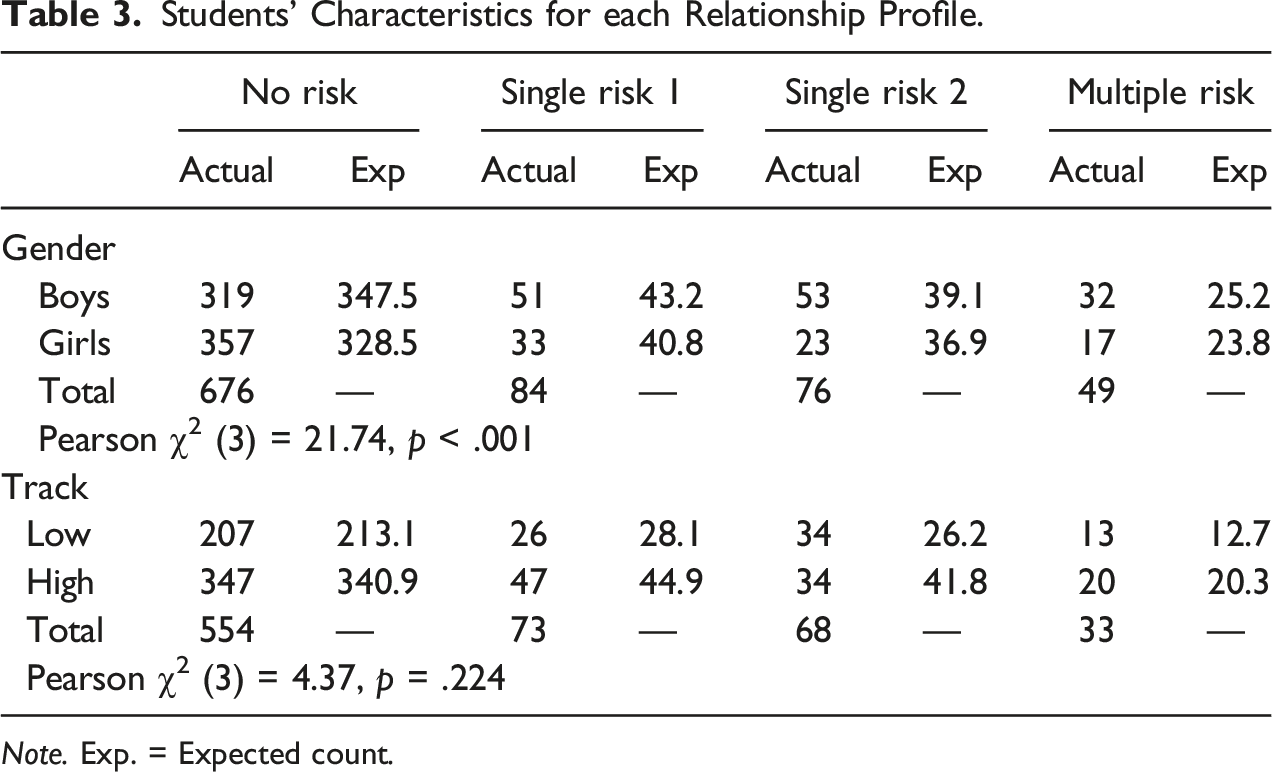
Note. Exp. = Expected count.
Relationship Profiles and Students’ School Adjustment
Means (Standard Deviations) and Analyses of Variance for Students’ Engagement across Relationship Profiles.
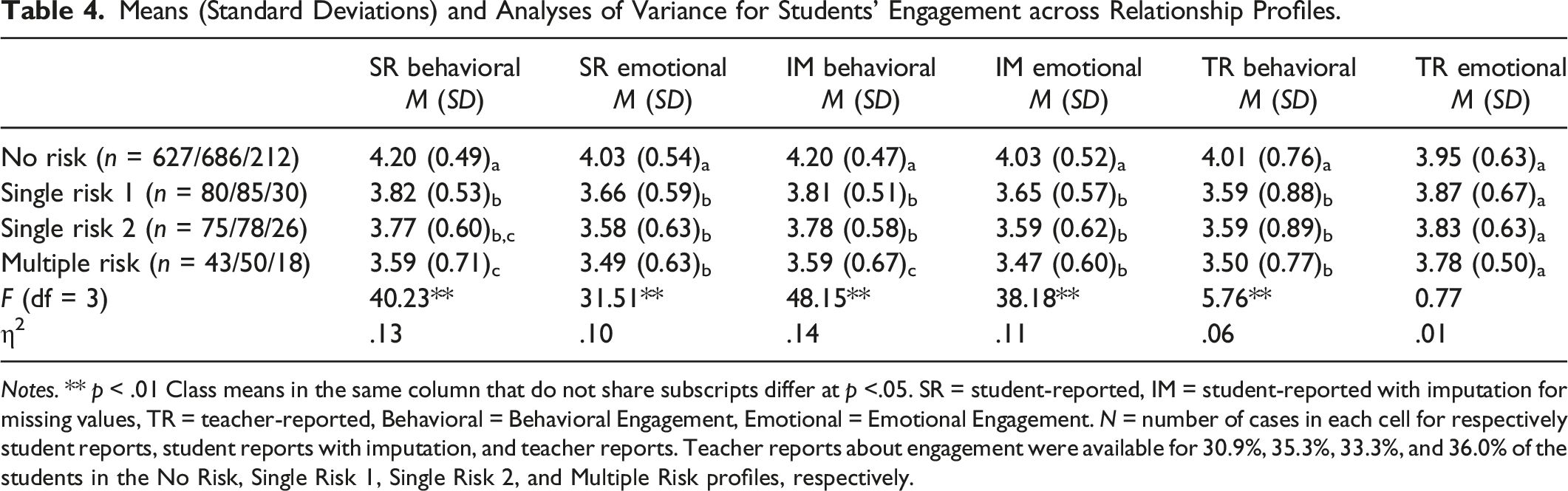
Notes. ** p < .01 Class means in the same column that do not share subscripts differ at p <.05. SR = student-reported, IM = student-reported with imputation for missing values, TR = teacher-reported, Behavioral = Behavioral Engagement, Emotional = Emotional Engagement. N = number of cases in each cell for respectively student reports, student reports with imputation, and teacher reports. Teacher reports about engagement were available for 30.9%, 35.3%, 33.3%, and 36.0% of the students in the No Risk, Single Risk 1, Single Risk 2, and Multiple Risk profiles, respectively.
Significant differences between relationship profiles were also found for teacher-reported Behavioral Engagement, F (3) = 5.76, p = .001, which was a medium effect (η2 = .06). Homeroom teachers also perceived students in the No Risk profile as being more behaviorally engaged than students in all other profiles, whereas they reported no differences among students from the Single Risk 1, Single Risk 2, and Multiple Risk profiles, see Table 4. No significant differences were found in teacher-reported Emotional Engagement, F (3) = 0.77, p = .510.
Discussion
In the present study, we aimed to identify relationship profiles for student–teacher closeness and conflict in the first year of secondary school (i.e., seventh grade). Different from previous secondary school studies that focused on relationships in general (e.g., Özdemir & Özdemir, 2020), we based these relationship profiles on students’ relationships with three individual teachers (i.e., the homeroom teacher, the teacher of their easiest subject, the teacher of their hardest subject). First, we examined how many and which relationship profiles could be found. Second, we investigated whether boys and students from the lower academic track were overrepresented in the unfavorable relationship profiles. Finally, we studied whether unfavorable relationship profiles were associated with lower levels of school engagement.
Relationship Profiles in Secondary School
As expected (Bosman et al., 2018; O’Connor et al., 2012; Özdemir & Özdemir, 2020; Spilt et al., 2012a), different relationship profiles could be distinguished based on seventh graders’ relationships with three of their teachers. Just as in previous person-centered studies based on relationships with teachers in consecutive school years in primary school (Bosman et al., 2018; O’Connor et al., 2012; Spilt et al., 2012a), most students appeared to be in the most favorable relationship profile (i.e., the no risk profile). These students shared relationships high in closeness and low in conflict with all three teachers. Considering the impact that student–teacher relationships have on multiple aspects of secondary students’ school adjustment (e.g., Al-Yagon, 2016; Longobardi et al., 2019; Roorda et al., 2017), this is a hopeful finding.
In contrast, however, there was also a substantial number of students that shared less favorable relationships with one or more of their teachers. One group of students (single risk 1 profile) experienced low closeness and high conflict with their homeroom teacher, whereas their relationships with the other two teachers were only somewhat less optimal (lower in closeness, higher in conflict) than for students in the no risk profile. This was an unexpected finding, as secondary school students usually tend to share the most optimal relationship with their homeroom teacher compared to other teachers (Roorda et al., 2019). Homeroom teachers need to be made aware of this finding, as it may hamper their special role of confidant and contact person for these students.
Another group of students (single risk 2 profile) experienced very low closeness and very high conflict in the relationship with the teacher of their hardest subject but equal levels of closeness with the other two teachers as the no risk profile and only somewhat higher levels of conflict. These students thus appear to be able to develop adequate relationships with most of their teachers but seem unable to do so in more challenging situations, for example, when they experience the teacher’s subject as especially difficult (cf., Davis, 2001; 2006). To prevent such relational problems, teachers might regularly investigate which students have difficulties with their subject and, subsequently, invest in forming a more optimal emotional bond with these students.
The last profile contained a small but substantial number of students who appeared to be at risk for forming unfavorable relationships with multiple teachers at the same time (multiple risk profile). More specifically, these students experienced high conflict with all three teachers in combination with low closeness with the teacher of the easiest subject. Considering the cumulative negative effects of multiple risk factors (Rutter, 1978; 1979; Solomon et al., 2016), this relationship profile would probably be most harmful for students’ school adjustment. More research is needed to find out which factors place these students at risk for developing such problematic relationships with their teachers.
Student Characteristics and Relationship Profiles
As expected based on primary school studies with consecutive teachers (e.g., Bosman et al., 2018; Spilt et al., 2012a), students’ characteristics appeared to impact their distribution across relationship profiles. More specifically, boys had less chance than girls to have high levels of closeness and low levels of conflict with all three teachers. These findings are in line with person-centered and variable-centered studies conducted in primary school that also frequently found that boys are at risk for developing less close and more conflictual relationships with teachers than girls (Bosman et al., 2018; Jerome et al., 2009; McGrath & van Bergen, 2015; Spilt et al., 2012a). Apparently, this trend of unfavorable student–teacher relationships continues after boys make the transition to secondary school and then generalizes to relationships with multiple teachers, which can be especially harmful for their school adjustment (e.g., Solomon et al., 2016). It seems important to make teachers aware of these findings, so that they can actively strive for more closeness and less conflict in their relationships with boys.
Academic track, however, did not impact students’ relationship profiles. Students’ academic ability and IQ thus seem to be more salient predictors of student–teacher relationship profiles (Spilt et al., 2012a). Another possibility might be that teachers in the low academic track are very well-equipped to form optimal relationships with their students. As such, these teachers may be able to compensate for the risk factors associated with being in the low academic track (e.g., lower IQ and academic ability; Kaldenbach, 2017) in such a way that no differences in relationship profiles were found. As this is the first person-centered study examining the possible role of academic track in student–teacher relationship profiles, more research is needed to explain this finding. Researchers would also do well to include students’ IQ and academic abilities in future studies to see whether these are more important predictors for relational profiles in secondary school (Spilt et al., 2012a).
Relationship Profiles and Students’ School Adjustment
In line with previous variable-centered studies (e.g., Roorda et al., 2017) and person-centered studies in both primary and secondary school (Bosman et al., 2018; Özdemir & Özdemir, 2020), the relationship profiles were differently associated with secondary students’ school engagement. Students who reported good quality relationships with all three teachers (no risk profile) reported more behavioral and emotional engagement than students from the single risk 1, single risk 2, and multiple risk profiles. Homeroom teachers also considered students from the no risk profile as being more behaviorally engaged, indicating that this finding cannot solely be due to same-informant bias (cf., Roorda et al., 2011). With regard to student-reported emotional engagement and teacher-reported behavioral engagement, no differences were found among students from the single risk 1, single risk 2, and multiple risk profiles. Students with favorable relationships with all three teachers thus were more engaged than all other students, whereas students with unfavorable relationships with only one teacher (the two single risk profiles) did not differ from students with high conflict with all three teachers (the multiple risk profile). As such, these findings do not confirm the cumulative risk hypothesis (Rutter, 1978; 1979; Solomon et al., 2016). Rather, having a non-close and conflictual relationship with only one teacher seems to be enough to place seventh graders at risk for experiencing less positive feelings and emotions towards schoolwork and for showing less visible effort and persistence with schoolwork. Teachers and school practitioners should be made aware of these findings, as they suggest that every individual teacher can play an important role in improving their students’ school engagement by striving for close and conflict-free relationships with their students.
For student-reported behavioral engagement, the findings were more in line with the cumulative risk hypothesis (Rutter, 1978; 1979; Solomon et al., 2016). That is, students from the multiple risk profile reported less behavioral engagement than students from the single risk 1 profile. Sharing unfavorable relationships with multiple teachers thus seems to have exaggerating effects on the degree of effort and persistence students put into their schoolwork compared to having unfavorable relationships with only one teacher. In the analysis with imputed values, students from the single risk 2 profile also reported more behavioral engagement than students from the multiple risk profile, which provides further support for the cumulative risk hypothesis (Rutter, 1978; 1979; Solomon et al., 2016). In the analysis with listwise deletion, however, students from the single risk 2 profile reported comparable levels of behavioral engagement as students from the multiple risk profile. More research with a larger sample is needed to find out whether differences between these two relationship profiles actually exist. The results of the analysis with listwise deletion seem to suggest that the degree of relational problems that students experience may also play a role in the association between relationship profiles and engagement. More specifically, students in the single risk 2 profile shared an unfavorable relationship with one teacher only but the level of closeness was extremely low (below 2) and conflict was very high (above 3) compared to the other profiles. Therefore, it may be that sharing extremely unfavorable relationships with only one teacher can be just as problematic for students’ behavioral engagement than sharing relatively unfavorable relationships with multiple teachers.
Limitations and Suggestions for Future Research
Some limitations should be taken into account when interpreting the findings of the present study. First, student–teacher relationships and students’ school engagement were measured at the same moment in time, which prevents conclusions about causality. Based on previous cross-lagged studies that revealed that student–teacher relationships impacted students’ engagement but not the other way around (Archambault et al., 2013; Engels et al., 2016), we treated the relationship as predictor and engagement as outcome variable. Still, some evidence exist that students’ engagement affects student–teacher relationship quality as well (Hughes et al., 2008; Skinner & Belmont, 1993). Therefore, longitudinal studies are needed to find out whether it is the distribution across relationship profiles that predicts students’ engagement or the other way around or both. Second, the present study solely focused on students in seventh grade, which is the first year of secondary school in the Netherlands. Future research should therefore include older students as well to see whether our findings apply to students’ in higher grades. Third, the current relationship profiles were based on students’ relationships with only three teachers. Due to time it took to complete the questionnaires, we were not able to ask students about their relationships with all their individual teachers. Future research may strive to find ways to ask students about their relationships with more teachers and see whether different profiles would be found if based on relationships with more teachers.
Implications for Research and School Practice
Our findings also have several implications for research and school practice. First, the found relationship profiles suggest that part of the seventh graders are able to develop optimal relationships with all teachers (no risk profile), whereas other students shared highly conflictual relationships with all teachers (multiple risk profile). For other seventh graders, however, relationship quality seems to differ across teachers (the two single risk profiles). These findings seem to suggest that for some students interventions targeting relationships with one specific teacher might be sufficient, whereas other students may need a more intensive intervention focusing on building more healthy relationships with teachers in general. Making this distinction may help to enhance the efficiency and cost-effectiveness of relationship-focused interventions in secondary school.
Second, the found relationship profiles indicate that there are differences in student–teacher relationships between primary and secondary school. To start with, the two single risk profiles indicate that students in secondary school share qualitatively different relationships with their different teachers (cf., Roorda et al., 2019; Wallace et al., 2012). Therefore, asking students about relationships with teachers in general is too simplistic. Furthermore, our findings suggest that building optimal relationships with teachers is an important but challenging task for students in secondary school, perhaps even more so than in primary school. That is, in primary school, students only need to build close, conflict-free relationships with one or two teachers each schoolyear to optimally support their school engagement. In contrast, students in secondary school need to form warm and conflict-free relationships with several different teachers at once, as sharing unfavorable relationships with only one teacher could already be enough to harm their engagement with schoolwork.
Third, the present findings suggest that a substantial number of seventh graders (more than 20% in the present study), especially boys, does not experience close, conflict-free relationships with all their teachers. Therefore, schools may opt to screen students’ relationships with individual teachers to identify students who share highly conflictual and less close relationships with one or more teachers, with extra attention being paid to boys. These students and teachers could then get help to improve their mutual relationships. Unfortunately, interventions specifically aiming at improving relationships between individual teachers and students (i.e., dyadic relationships) are scarce, especially for older students. Developing suitable interventions focusing on dyadic student–teacher relationships in secondary school therefore seems to be an important next step. This could be done, for example, by adapting existing programs (e.g., Check and Connect; Maynard et al., 2014; Sinclair et al., 2005) or by using principles from interventions for primary school teachers (e.g., Teacher Student Interaction Coaching; Bosman et al., 2021; Spilt, Koomen, et al., 2012).
Finally, relationship profiles appeared to be differently associated with students behavioral engagement compared to their emotional engagement, especially for teacher-reported engagement. More specifically, differences between relationship profiles were found for teacher-reported behavioral engagement but not for teacher-reported emotional engagement. As such, our findings further emphasize that it is important to distinguish between behavioral and emotional aspects of students’ engagement (cf., Skinner et al., 2008; Wang & Eccles, 2013; Wang & Holcombe, 2010).
Footnotes
Declaration of Conflicting Interests
The author(s) declared no potential conflicts of interest with respect to the research, authorship, and/or publication of this article.
Funding
The author(s) received no financial support for the research, authorship, and/or publication of this article.
