



Abstract
Emotion modulation is achieved through various strategies. We further validated a measure of emotion regulation (ER), the Negative Emotion Regulation Inventory (NERI), designed by Zimmermann and Iwanski (2014) to assess emotions and ER strategies in situations intended to induce sadness, fear, or anger. U.S. children 9–14 years old (n = 105) completed an adapted version of the NERI and measures of anxiety symptoms and attachment security. We replicated Zimmermann and Iwanski’s (2014) finding that ER strategies (adaptive regulation, social support seeking, dysfunctional rumination, expressive suppression) varied by emotion situation. We extended their study by showing that specific ER strategies were related to both anxiety symptoms and secure parent-child attachment. This cross-cultural replication and extension study provided some evidence for the reliability and validity of the adapted NERI in U.S. preadolescents.
Emotion regulation refers to intrinsic and extrinsic processes involved in monitoring, evaluating, and modulating emotion in relation to the environment and one’s goals (Thompson, 1994). By preadolescence, children have a greater understanding of norms for expressing emotion and can use ER strategies such as self-regulation and cognitive ER techniques rather than reflexive behaviors (such as crying) to achieve their goals (Saarni, 1999; Skinner & Zimmer-Gembeck, 2007; Zimmermann & Iwanski, 2014). Importantly, ER strategies affect how one manages stress (Skinner & Zimmer-Gembeck, 2007) and are related to multiple facets of children’s adjustment, including more secure parent-child attachments (Cooke et al., 2019) and lower levels of anxiety (Mathews et al., 2016).
There are changes in experienced emotion and ER in middle childhood and adolescence. From preadolescence to mid adolescence there is an increase in the intensity and variability of experienced negative emotions (Zimmermann & Iwanski, 2018), which highlights the importance of studying ER at these ages. Two models have been proposed to explain age related changes in ER (Cracco et al., 2017); the maturation model suggests that children use increasingly efficient and adaptive ER strategies as they get older, whereas the maladaptive shift model proposes that the constellation of social, cognitive, and biological changes in early adolescence lead to a decline in adaptive ER at this age. There is support for both models; for example, the decline in emotion suppression from preadolescence to early adolescence is consistent with the maturation model (Gullone et al., 2010), but other changes such as decreased problem solving and increased rumination in early adolescence are consistent with the maladaptive shift model (Cracco et al., 2017). Given changes in children’s experienced emotions and ER strategy use it is important to study ER processes within specific developmental periods and to develop measures that are appropriate for different ages.
Although different measurement approaches each have their own advantages and disadvantages, self-report questionnaires are useful for measuring ER given their ease of use and evidence that they show stronger associations with other constructs than do observational measures (e.g., Cooke et al., 2019). Some self-report measures of ER have been used only at specific ages, which can make it difficult to compare findings from studies conducted with participants from different developmental periods. Zimmermann and Iwanski (2014) addressed this issue by developing the Negative Emotion Regulation Inventory (NERI), a 186-item self-report questionnaire designed to record situation-specific emotions and emotion-specific ER strategies across a broad age range. The NERI presents six situations describing events that would likely provoke sadness, fear, or anger (two situations for each emotion), and then asks the participant to rate how strongly they would feel each emotion in each situation. Findings from their study of 11- to 50-year-old Germans showed that the expected emotion for each situation was reported more than any other emotion (Zimmermann & Iwanski, 2014). In addition, participants rate how much they would use seven ER strategies in that specific situation: social support seeking, adaptive regulation, passivity, avoidant regulation, expressive suppression, dysfunctional rumination, and dysregulation. Zimmermann and Iwanski reported use of some ER strategies varied depending on whether the situation primarily invoked sadness, fear, or anger.
The goal of the current study is to further validate the NERI while also adapting the measure to be used with children as young as 9 years of age. Although the original measure is appropriate for adolescents and adults, a briefer measure of ER is needed for younger children. Avoidant regulation and dysregulation are used more by adolescents and adults than by 11-year-olds (Zimmermann & Iwanski, 2014), so scales assessing these strategies (in addition to passivity) were removed from the measure. The strategies retained included adaptive regulation, social support seeking, dysfunctional rumination, and expressive suppression, all of which have been shown to be used commonly by children and to predict important aspects of children’s adjustment (Mathews et al., 2016; Zimmermann & Iwanski, 2014). We received a shortened version of the measure from Peter Zimmermann that focuses on these ER strategies, with three items per scale. In addition, we made minor modifications to the scenarios to ensure they would be relevant to our sample of U.S. children (e.g., compared to German children, U.S. children rarely ride public transportation to schools, they are driven or ride school buses).
We tested several hypotheses. The first three were focused on replicating findings reported by Zimmermann and Iwanski (2014). 1. We hypothesized that children would show the expected emotion in response to situations designed to elicit sadness, fear, and anger (e.g., with more sadness than any other emotion to losing a best friend suddenly). 2. We expected that ER strategy use would vary based on the emotion elicited by the situation. Consistent with Zimmermann and Iwanski (2014), we expected to find that children’s use of adaptive regulation would not vary with the type of emotion situation, but that children would use social support seeking most often in response to sadness-provoking situations, expressive suppression and dysfunctional rumination most often in response to fear-provoking situations, and dysfunctional rumination most often in response to anger-provoking situations. 3. We expected to find gender differences in ER strategies. When faced with a problem, girls are more likely to seek support, express emotions, and ruminate (Rose & Rudolph, 2006). Thus, we predicted that girls would use social support seeking and dysfunctional rumination more often than do boys. Based on previous findings regarding emotion expression (Rose & Rudolph, 2006) and the ER strategies used most often by boys (Zimmermann & Iwanski, 2014), we predicted that boys would use expressive suppression more often than do girls.
To extend further our knowledge regarding the validity of the NERI, we examine links between ER, anxiety symptoms and parent-child attachment security. 4. The use of negative ER strategies, such as dysfunctional rumination and expressive suppression, may foster the development of anxiety symptoms, whereas social support seeking is only weakly related to anxiety (Mathews et al., 2016, meta-analysis). We therefore hypothesized that increased anxiety would relate to greater use of dysfunctional rumination and expressive suppression. 5. Children with secure attachments use parent(s) as a secure base to explore new emotional situations and as a safe haven to return to for support and open communication if they are struggling to regulate their emotions (Cassidy, 1994). Cooke et al.’s (2019) meta-analysis demonstrated that more securely attached children use social support seeking and adaptive ER more often, and a study of adolescents with the NERI (Iwanski et al., 2021) found that more secure adolescents less often used dysregulated ER strategies. Thus, we expected securely attached children to use adaptive ER and support seeking strategies more often and expressive suppression and dysfunctional rumination less often.
Method
Participants
Participants (n = 105) were recruited from two U.S. sites, one in the Midwest (n = 58) and one in the Northeast (n = 47), by contacting families who participated in previous studies or through information distributed in local communities. Children were 9–14 years old (M = 11.8 years, SD = 1.4; 37% 9–11 year-olds) and were 79.8% White, and 50.5% female.
Procedures
Informed consent and assent were obtained from parents and children, respectively. Then, children completed questionnaires and other tasks in a single session in a university laboratory. The questionnaires relevant to the current study are measures of ER (NERI), anxiety symptoms, and attachment to parental figures. All participants were compensated for participating (US$25 or US$40 depending on site).
Measures
Negative Emotion Regulation Inventory
The NERI (Zimmermann & Iwanski, 2014) was used to assess experienced emotion and ER strategies in six emotion situations. There are two situations for each of the following emotions: sadness (e.g., Your best friend stopped meeting you and doesn’t call you anymore without telling you why, you are not best friends anymore), fear (e.g., You walk alone in a dark place or unknown neighborhood and have the feeling someone is following you), and anger (e.g., You are in a hurry to be on time for an important activity and your ride is late). Children are first asked to rate the degree to which they felt or would feel sadness, fear, anger, and joy in a situation on a seven-point scale, with 1 = absolutely not, and 7 = very strong. Reliabilities for sadness, fear, and anger ratings across all emotion situations were, for the total sample (and separately for 9–11 year-olds), respectively .75 (.76), .68 (.71), and .72 (.59), and reliability for the expected emotion in each situation (e.g., sadness in sad situations) ranged from .56 to .65 (.58–.70). We did not examine joy ratings in this study.
After rating their emotion, children reported how they would cope with each situation using three items for each of the four ER strategies: adaptive ER (e.g., I think about what went wrong so I can come up with possible solutions to the problem), social support seeking (e.g., I ask my friends for advice or help), expressive suppression (e.g., I don’t show how I feel), and dysfunctional rumination (e.g., I think it happened because I am unlucky). Each of the 72 items is scored on a seven-point scale from 1 = very unlike me, to 7 = very much like me). Reliability ranged from α = .90 to .95 (. 90–.95 for 9–11-year-olds) for ER strategies across all emotion situations and from α = .63 to .92 (.65–.93) for ER strategies in specific emotion situations.
Anxiety
Children completed the 41-item Screen for Anxiety and Related Disorders (SCARED; Birmaher et al., 1999). They rated each item on a scale of 0 = Not true or hardly ever true to 2 = Very true or often true, and then these ratings were summed to obtain a total anxiety symptom score (α = .93). The SCARED has been shown to have robust psychometric properties (e.g., see Hale et al., 2011 meta-analysis). A score of 25 is treated as a cutoff score for risk for anxiety problems, and 46% of our sample scored in the at-risk range.
Parent-Child Attachment
Children completed the Security Scale (Kerns et al., 2015), assessing attachment security with their parental figures. For each of the 24 items, children decided between two opposing descriptions of their relationships with their parental figure which one is more like them (e.g., Some kids find it easy to trust their mom/dad BUT other kids are not sure if they can trust their mom/dad), then stated how true the statement is for them. Items are scored on a four-point scale, with a greater score indicating a more secure relationship, and then averaged (α′s = .89 for security with mother, .93 for security with father). Means for security in the current sample—mother-child attachment, 3.32, father-child attachment, 3.25—were similar to another U.S. sample that used the 24-item version of the Security Scale (Koehn & Kerns, 2021). The Security Scale is related to other measures of attachment, parenting and child adjustment (Brumariu et al., 2018, meta-analysis).
Results
Analytic Plan
Data were analyzed in four steps. First, we conducted a series of one-way repeated measures ANOVA to examine the emotions (sadness; fear; anger) children report experiencing across the three types of situations that are designed to elicit such emotions. Next, we conducted one-way repeated measures ANOVAs to test which of the four ER strategies (adaptive regulation; social support seeking; dysfunctional rumination; expressive suppression) participants use most in each of the three types of emotion situations (Sad, Fear, Anger), and follow up tests (Bonferroni correction) to identify the source of a significant ANOVA results. We also conducted Pearson’s correlations to examine whether the affective intensity in the respective emotion situation correlated with greater use of specific ER strategies. Then, we conducted independent samples t-tests to test whether gender was related to ER strategies.
Finally, we conducted a series of Pearson’s correlation analyses to examine how the four ER strategies were related to children’s anxiety symptoms and to parent-child attachment.
Emotions Experienced Across Emotion Situation
Sadness
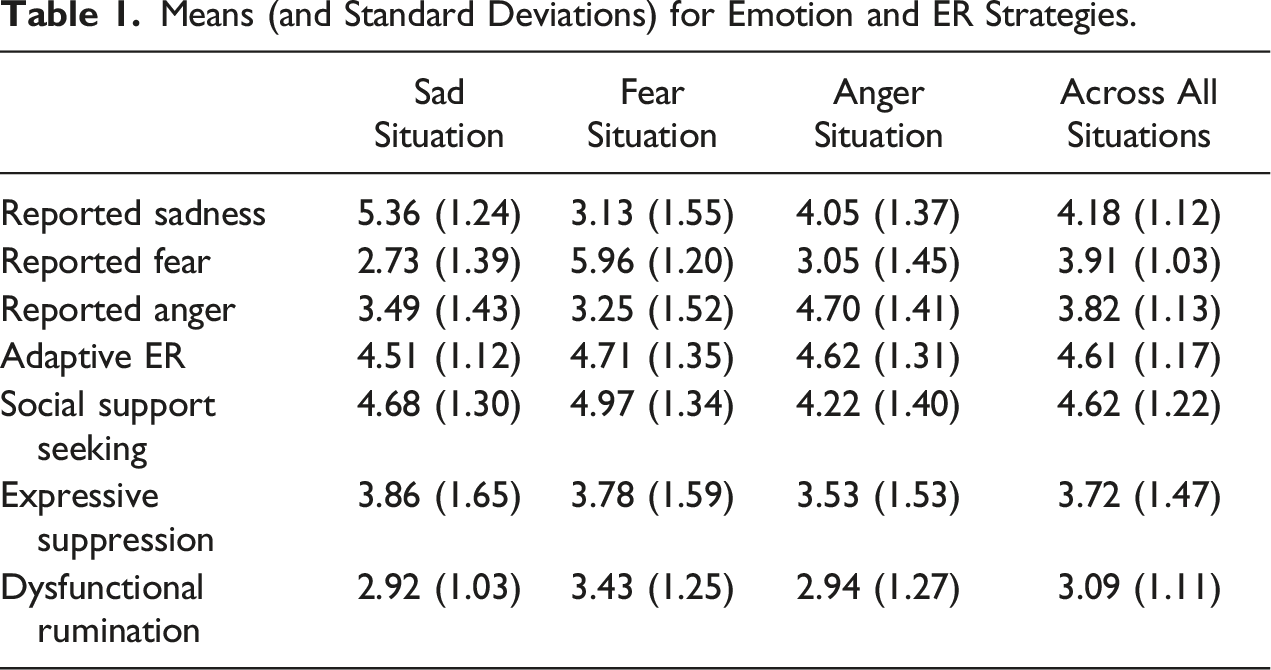
Means (and Standard Deviations) for Emotion and ER Strategies.
Fear
As expected, fear was significantly affected by the type of emotion situation, F (2, 198) = 278.66, p < .001. Post hoc tests revealed that participants reported more fear in fear situations than in sad situations or in anger situations (see Table 1). Fear was not significantly different in sad situations compared to anger situations.
Anger
As expected, anger was significantly affected by the type of emotion situation, F (2, 168.99) = 47.63, p < .001. Post hoc tests revealed that participants reported significantly more anger in anger situations than in sad situations or in fear situations (see Table 1). Anger was not significantly different in sad situations compared to fear situations.
ER Strategy Use Across Emotion Situation
Adaptive ER
The use of adaptive ER was significantly affected by the type of emotion situation, F (2, 198) = 3.09, p = .048. Children used significantly more adaptive ER in fear situations than in sad situations (MD = .21, p = .043). The difference between participants’ use of adaptive ER was not significant when comparing fear situations to anger situations (MD = .09, p > .05) or anger situations to sad situations (MD = .12, p > .05).
Social Support Seeking
The use of social support seeking was significantly affected by the type of emotion situation, F (2, 198) = 29.34, p < .001. As shown in Table 1, participants used more social support seeking in fear situations than in sad situations (MD = .30, p = .009) or in anger situations (MD = .75, p < .001). Preadolescents also used significantly more social support seeking in sad situations than anger situations (MD = .46, p < .001).
Expressive Suppression
The use of expressive suppression was significantly affected by the type of emotion situation, F (2, 198) = 5.72, p = .004; children used more expressive suppression in sad situations than in anger situations (MD = .34, p = .004), but the difference between participants’ use of expressive suppression was not significant when comparing sad situations to fear situations (MD = .08, p > .05). Children also used significantly more expressive suppression in fear situations than anger situations (MD = .25, p = .046).
Dysfunctional Rumination
A one-way repeated measures ANOVA showed that the use of dysfunctional rumination was significantly affected by the type of emotion situation, F (2, 198) = 30.78, p < .001. As shown in Table 1, children used more dysfunctional rumination in fear situations than in sad situations (MD = .51, p < .001) or in anger situations (MD = .49, p < .001). Children’s use of dysfunctional rumination was not significantly different in sad situations compared to anger situations, MD = .02, p > .05.
Associations Between Experienced Emotions and ER Strategy Use
Bivariate Correlations Between Reported Emotion (Intensity) and ER Strategies.
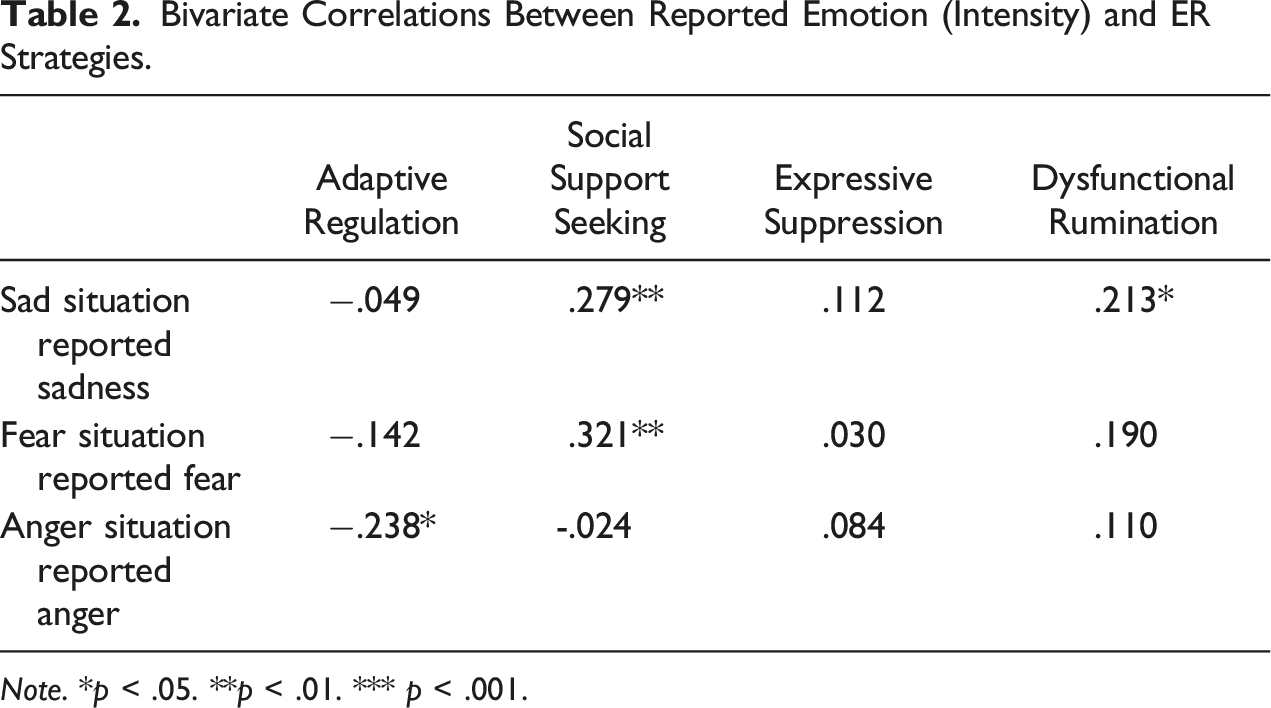
Note. *p < .05. **p < .01. *** p < .001.
ER Strategy Use by Gender
Gender (boys, girls) was not significantly related to use of adaptive ER, t (98) = −1.68, p = .10, social support seeking, t (98) = −1.89, p = .06, expressive suppression, t (98) = −.57, p = .57, or dysfunctional rumination, t (98) = −.53, p = .59.
ER Strategies: Associations With Anxiety and Parent-Child Attachment
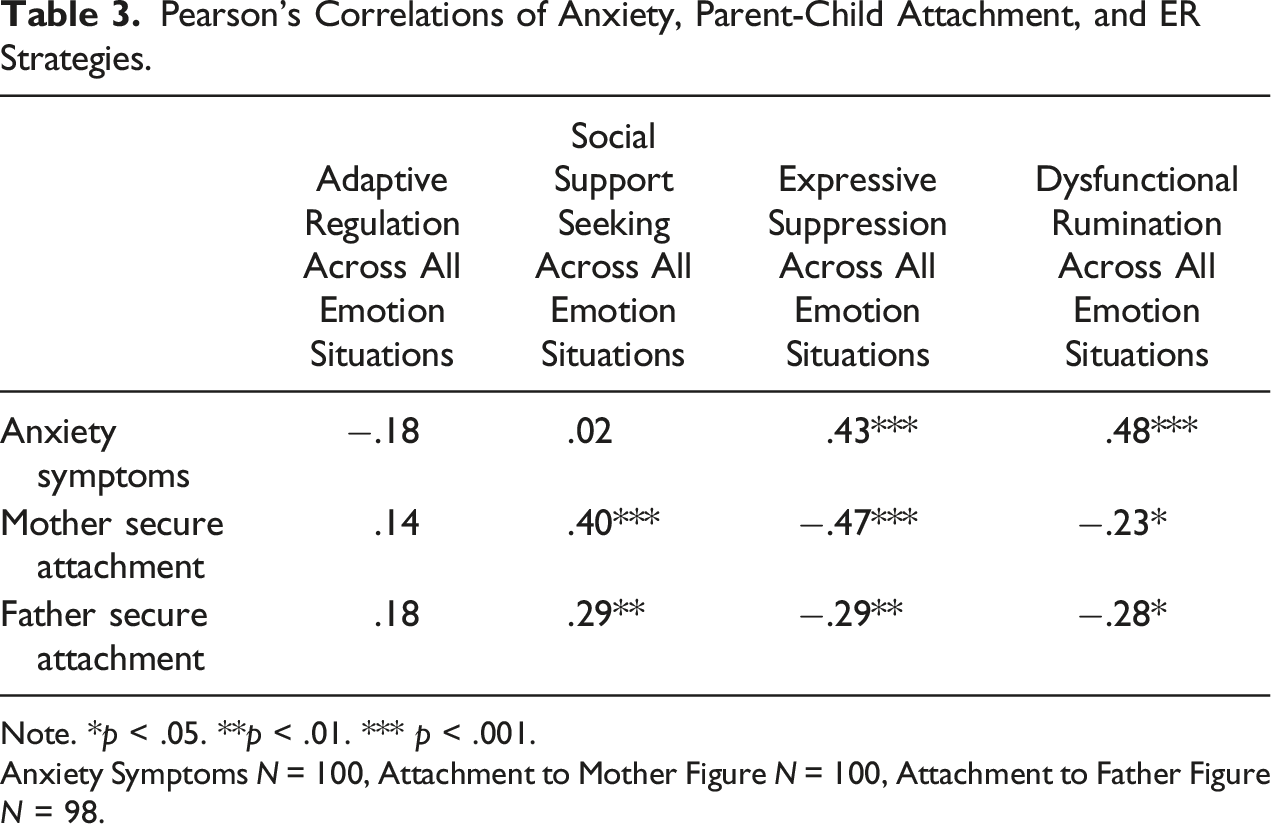
Pearson’s Correlations of Anxiety, Parent-Child Attachment, and ER Strategies.
Note. *p < .05. **p < .01. *** p < .001.
Anxiety Symptoms N = 100, Attachment to Mother Figure N = 100, Attachment to Father Figure N = 98.
As predicted, children more securely attached to their mothers reported less use of dysfunctional rumination and expressive suppression and greater reliance on social support seeking (Table 3). Unexpectedly, there was not a significant association between mother-child attachment and adaptive ER.
The results were similar for father-child attachment, in that children more securely attached to their fathers reported less use of dysfunctional rumination and expressive suppression and greater use of social support seeking. Father-child attachment was not related to adaptive ER.
Because we obtained a similar pattern of results regarding relations between ER strategies and attachment to parental figures, we conducted partial correlations to examine unique effects of maternal and paternal attachment while controlling for security to the other parent. In two cases, we found that maternal attachment was uniquely related to ER strategies. Specifically, a significant negative correlation remained between mother-child attachment and expressive suppression when controlling for father-child attachment, r (95) = −.40, p < .001, and a positive correlation between mother-child attachment and social support seeking also remained significant when controlling for father-child attachment, r (95) = −.32, p = .001.
Finally, because the intensity of experienced emotions was related to ER strategy use, we tested whether the associations between ER and anxiety or attachment (findings in Table 3) changed after controlling for the intensity of experienced emotion. The results of these partial correlation analyses revealed the results did not change when controlling for emotion intensity.
Discussion
The purpose of our study was to test the reliability and validity of an adapted version of Zimmermann and Iwanski’s (2014) measure of ER strategy use in a sample of U.S. preadolescents. Overall, our results provided some evidence for the adapted measure’s reliability and validity. Specifically, scale reliabilities were, for the most part, acceptable, for both the total sample as well as the subsample of 9- to 11- year-olds. Also, the scenarios did elicit the intended emotions. These findings suggest that the situations may have relevance in different Western contexts, although we did modify some details (e.g., use of public transportation) to ensure the scenarios would reflect the common experiences of U.S. children. In addition, our hypothesis about ER strategy use varying depending on the emotion experienced was supported, and for the most part matched previous findings in the literature (Zimmermann & Iwanski, 2014). However, as discussed below, we did find that fear was a stronger elicitor of ER compared to Zimmermann and Iwanski’s findings. We also extended earlier work by showing that the specific ER strategies were associated in expected ways with anxiety and parent-child attachment security.
Our results showed that the use of specific ER strategies varied by emotion situation, supporting the notion that children have different goals based on the perceived emotions in a situation and achieve these goals through use of different ER methods (Thompson, 1994). Our study differed from Zimmermann and Iwanski’s (2014) study by finding differences in the use of adaptive regulation by emotion context; adaptive ER was used more often in fear situations than in sad situations. Additionally, while we replicated Zimmermann and Iwanski’s findings that social support seeking was used more often in sad situations than in anger situations, we also found that social support seeking was used even more often in fear situations than in sad situations. We replicated findings from Zimmermann and Iwanski’s study that children are less likely to engage in expressive suppression when angry, although we found no difference between suppression of emotion in fear and sad situations. We also replicated findings that dysfunctional rumination is used more often in fear situations than in sad situations, but we did not find that dysfunctional rumination was also used more often in anger situations than sad situations.
Fear was particularly distinguishing for ER strategy use in this younger sample; all four ER strategies were used most often in fear situations. Fear may be a more potent trigger for ER strategy use in our sample due to the inclusion of younger children in our study. In contrast, adolescents may want to present themselves as unafraid (e.g., not seek social support) and suppress feelings of fear (Zimmermann & Iwanski, 2018). Although preadolescents are more equipped to engage in ER in comparison to younger children (Saarni, 1999), they may nevertheless become overwhelmed in fearful contexts, and thus, feel a need to actively manage this emotion. Future studies could directly test our suggestion that fear may affect preadolescents’ use of specific ER strategies more than it does at older ages. More generally, the findings also point to the importance of considering context in future research when assessing ER strategies.
Contrary to our expectations, our results showed that ER strategy use did not vary significantly based on gender, although there was a trend for girls to report greater use of social support seeking than did boys (p < .06). It is important to note that in Zimmermann and Iwanski’s (2014) study, 1131 out of 1305 participants were over the age of 11. Gender differences may become stronger with age as individuals gain more exposure to societal norms and gender expectations. This could be explored in future studies that directly measure children’s adherence to gender norms and its relation to ER strategy use. Alternatively, effect sizes for gender may be small, and only reliably detected in larger samples.
We extended tests of the validity of the NERI by evaluating whether ER was associated with two developmental markers, anxiety symptoms and parent-child attachment, as both have been shown to be related to children’s use of ER strategies (see meta-analyses, Cooke et al., 2019; Mathews et al., 2016). Consistent with previous literature (Aldao, 2013; Mathews et al., 2016), we found that children with more anxiety symptoms made greater use of dysfunctional rumination and expressive suppression. These ER strategies could be considered “poor” regulation, as they either prolong the experience of the emotion or do not focus on resolving the issue at hand. Social support seeking and adaptive ER are less strongly related to anxiety symptoms (Mathews et al., 2016), and our sample size was modest, which may be why we did not find significant associations between these strategies and anxiety symptoms in our study. Successful interventions for children experiencing anxiety teach children to identify and recognize when they are feeling anxious, rather than suppress emotion, identify when they are having thoughts that prolong their anxiety (e.g., dysfunctional rumination), and address these thoughts with behavioral techniques encouraging the use of adaptive regulation or social support seeking (Suveg et al., 2009). The NERI could be used in intervention studies to test the extent to which children acquired adaptive ER skills.
As expected, we found that children who were more securely attached to their parental figures made greater use of social support seeking and less use of expressive suppression and dysfunctional rumination. Unexpectedly, more secure attachments to parental figures were not related to adaptive ER. Our findings are similar to those of Iwanski et al. (2021) who assessed attachment and ER in sad situations using the NERI with 9- to 17-year-olds. Although Iwanski et al. (2021) evaluated higher order dimensions of ER rather than the specific NERI ER scales, their findings showed that more secure attachment was associated with greater use of adaptive rather than maladaptive ER. Interestingly, when assessing unique associations of maternal and paternal attachment and ER, only maternal attachment was related to ER, suggesting that mothers might play an especially important role in socializing ER strategies. Overall, our findings are consistent with the notion that children with secure parent-child attachments are also able to use the parent as a secure base from which they can explore new emotional experiences, practice effective ER strategies, and openly express and discuss emotions (Cassidy, 1994; Cooke et al., 2019). Thus, they provide support for the idea that enhancing the quality of parent-child relationships in early adolescence promotes healthy adjustment, including adaptive ER skills such as social support seeking. Our study could be extended by examining how parent emotion socialization practices, particularly those of mothers, foster the development of ER strategies as assessed with the NERI.
Some limitations of our study should be noted. Our sample was primarily composed of White preadolescents, preventing generalization of findings to children of other ethnicities and races. The sample size was modest, and although we had power to detect medium and large effects, we did not have the power to detect small effects. Reliabilities were acceptable when looking at emotions across all situations but were lower when looking at emotions for specific emotion situations which could be due to a smaller number of responses for these items (six responses across all situations compared to two responses for specific situations). This could be addressed in a future study by adding another situation for each emotion. We focused on how children’s reports of their ER strategies were related to their self-perceptions of well-being and parent-child relationship quality. To ensure findings are not due solely to self-report bias, it will be important to examine individual differences in ER as assessed with the NERI in relation to outcomes reported by different observers using multiple methods (e.g., teacher report, behavior observation).
In conclusion, we showed that ER strategy use varied based on emotion, and we replicated previous findings regarding association of ER with anxiety and parent-child attachment. Fear contexts seemed especially likely to trigger ER efforts in this early adolescent sample. Further evaluation of the validity of the NERI in non-Western cultures is needed. Finally, preventive efforts aiming to enhance preadolescents’ healthy adjustment and skill building might need to target emotion regulation by emotion context, with particular attention to fear situations as they seem especially salient at this developmental stage.
Footnotes
Declaration of Conflicting Interests
The author(s) declared no potential conflicts of interest with respect to the research, authorship, and/or publication of this article.
Funding
The author(s) disclosed receipt of the following financial support for the research, authorship, and/or publication of this article: This work was supported by the Kent State University Department of Psychological Sciences, Kent State University Graduate Student Senate and the Adelphi University.
Ethical approval
Procedures were approved by the Kent State University Institutional Review Board (Protocol # 399-18) and the Adelphi Institutional Review Board (# 110,818).
