




Abstract
Previous evidence has revealed that mindful individuals tend to pay more attention to specific tasks and demonstrate better work engagement. However, prior investigations commonly used cross-sectional designs to examinine the link of mindfulness to engagement in Western societies. This research explores the association of mindfulness with cognitive reappraisal and academic engagement via a two-wave longitudinal design in 381 Filipino high school students from Quezon City, Philippines joined this research. Cross-lagged panel structural equation modeling demonstrated that mindfulness had positive concurrent associations with cognitive reappraisal and engagement. Academic engagement was linked to increased subsequent cognitive reappraisal. Mindfulness is linked to increased concurrent cognitive reappraisal and academic engagement. This research contributes to existing evidence regarding the inconclusive links of mindfulness to learning outcomes.
Introduction
Mindfulness plays a vital role in the emotion regulation and psychological well-being of healthy and clinical populations (Brown & Ryan, 2003; Creswell et al., 2019; Prakash et al., 2017; Vujanovic et al., 2010). Existing studies have adopted diverse definitions of this construct, with some model conceptualizing it as a trait (Deng et al., 2020; Liu et al., 2020; Sun et al., 2020) while others operationalizing it as a state-like characteristic (Brown & Ryan, 2003; Cox et al., 2020; Du et al., 2019; Lester & Murrell, 2019). In this study, mindfulness was conceptualized as a psychological state that encompasses individuals’ deliberate concentration to ‘here and now experiences’ (Brown & Ryan, 2003; Brown et al., 2011). Previous evidence has revealed that mindful individuals tend to pay more attention to specific tasks with increased task engagement (Leroy et al., 2013). Mindfulness training may promote individuals’ work engagement by enhancing their attention monitoring and positive reappraisal (Coo & Salanova, 2018). However, prior investigations commonly used cross-sectional designs to examine the link of mindfulness to engagement in Western societies. Thus, this study explores the association of mindfulness with academic engagement via a two-wave cross-lagged panel design in Filipino high school students.
Mindfulness, Well-being and Academic Outcomes
There is evidence linking mindfulness to desirable psychological outcomes such as increased attention (Cheyne et al., 2006), self-awareness and positive emotions (Brown & Ryan, 2003), happiness (Hollis-Walker & Colosimo, 2011), work adjustment (Hülsheger et al., 2015; Liu et al., 2020), and self-esteem (Bajaj et al., 2019; Brown et al., 2011).
In addition, prior studies have demonstrated the academic benefits of mindfulness in school contexts. For example, Thiery et al. (2016) have shown that mindfulness training enhanced executive function skills among preschoolers in the United States. Mindfulness intervention has also boosted academic self-efficacy and achievement of selected undergraduate students in Austria (Sampl et al., 2017). The positive impacts of mindfulness on academic outcomes have been observed not only in the United States (Caballero et al., 2019; Thiery et al., 2016) but also in Turkey (Tekel & Karadag, 2020) and Taiwan (Lin & Mai, 2018).
Given the beneficial role of mindfulness in academic functioning, studies have also paid attention to the association of mindfulness with academic engagement and other key learning outcomes. On one hand, there is evidence showing how mindfulness was linked to increased school engagement among adolescents (Elphinstone et al., 2019; Frank et al., 2017; Miralles-Armenteros et al., 2019). On the other hand, other investigations have demonstrated that mindfulness had no significant effects on learning outcomes such as course-related performance (Miller et al., 2017) and reading fluency (Meyer & Eklund, 2020). Zenner et al.’s (2014) meta-analysis reveals the positive effect of mindfulness-based interventions on students’ cognitive performance (Hedge’s g = 0.80, large effect). Klingbeil et al.’s (2017) comprehensive meta-analysis of mindfulness-based interventions, however, shows that the treatment effects on school students’ academic achievement range from Hedge’s g = 0.32 to 0.39 (small effect). As there seems to be inconclusive evidence regarding the link of mindfulness to academic outcomes, more research is warranted to explore the complex pattern of association between mindfulness and academic functioning.
Moreover, studies documenting the positive relationship of mindfulness to academic engagement were carried out in Western societies such as the United States (Frank et al., 2017), Australia (Elphinstone et al., 2019), and Spain (Miralles-Armenteros et al., 2019); thus, the findings may not be applicable to students in non-Western cultural contexts. If prior literature indicates cultural variations in emotional experiences, cognitions, and behaviors among individuals in Western and non-Western contexts (Markus & Kitayama, 1991; 2004; Vignoles et al., 2016), it is premature to generalize the benefits of mindfulness on emotion regulation and academic engagement in non-Western and collectivist societies. For example, research has shown that the link of mindfulness to passion and perseverance for long-term goals was stronger in New Zealand than in Thailand (Raphiphatthana et al., 2018). Further, cognitive reappraisal has distinct pattern of associations with expressive suppression —a maladaptive form of emotion regulation that prohibits the expression of current emotional states (Gross & John, 2003)— in diverse cultural contexts (Matsumoto et al., 2008; Teuber et al., 2022). For example, while cognitive reappraisal was positively associated with expressive suppression among adolescents in mainland China, both were negatively correlated in Germany (Teuber et al., 2022). Indeed, it is crucial to explore the role of mindfulness in cognitive reappraisal and academic engagement especially in non-Western contexts that are under-represented in mindfulness literature (e.g., Philippines).
Research Objectives and Hypotheses
This study explores the association of mindfulness with academic engagement via a two-wave cross-lagged panel design in Filipino high school students. Academic engagement which refers to the extent of students’ active involvement in different academic tasks (Fredricks et al., 2004; Macey & Schneider, 2008; Rich et al., 2010), is an important educational outcome given its impacts on objective measures of school success such as academic achievement (Dotterer & Lowe, 2011) and academic dropout (Fall & Roberts, 2012). The hypothesized positive association of mindfulness with academic engagement corroborates existing evidence about the beneficial role of mindfulness in school engagement (Elphinstone et al., 2019; Frank et al., 2017; Miralles-Armenteros et al., 2019). It is reasonable to anticipate that mindfulness may relate to engagement as previous studies have shown that mindful individuals tend to pay more attention to specific tasks which promotes increased task engagement (Leroy et al., 2013). There is also meta-analytic evidence showcasing the positive association of mindfulness with intrinsic motivation (Donald et al., 2019). Drawing from the self-determination theory (Ryan & Deci, 2000; 2017), it is logical to argue that mindfulness may be linked to increased academic engagement as contextual and psychological factors that optimize intrinsic motivation for learning can promote achievement outcomes. Given that mindfulness may operate as a psychological factor that can improve students’ attention and focus on specific tasks, this resource can increase the likelihood that students may experience greater enjoyment when carrying out diverse academic activities, which in turn, may relate to effective learning.
Furthermore, this research explores the link of mindfulness to cognitive reappraisal. Cognitive reappraisal is an adaptive emotion regulation approach that involves re-interpreting the meaning of a specific situation to change its corresponding emotional consequences (Gross, 1998; Gross & John, 2003). Prior studies indicate the benefits of this emotion regulation approach and other effective emotion regulation strategies for learning outcomes such as academic achievement (Davis & Levine, 2013; Ivcevic & Brackett, 2014) and engagement (Spann et al., 2019; Strain & D’Mello, 2015). However, another study has shown a non-significant relationship between emotion regulation and academic performance (Seibert et al., 2017).
It is logical to argue that mindfulness may relate to cognitive reappraisal for a few reasons. Studies have demonstrated that mindfulness had positive impacts on cognitive reappraisal (Garland et al. 2015a, 2015b; Troy et al., 2013). For example, Garland et al. (2015b) demonstrated that engaging in mindfulness practice for 1-week improved state mindfulness and cognitive reappraisal. Mindfulness training enhances both attention monitoring and positive reappraisal, which in turn, facilitates higher work engagement (Coo & Salanova, 2018). Mindfulness training is also found to boost executive functioning (Tang et al., 2012), academic self-efficacy (Caldwell et al., 2010), and academic achievement (Maynard et al., 2017). For these reasons, this study anticipates that mindfulness may relate to concurrent and longitudinal increases in cognitive reappraisal.
Specifically, we tested the following hypotheses in this research:
Given the sparse evidence on the bi-directional relationship between mindfulness and academic engagement, we did not propose any hypotheses on how mindfulness may be reciprocally linked to engagement and cognitive reappraisal.
Methods
Participant and Procedures
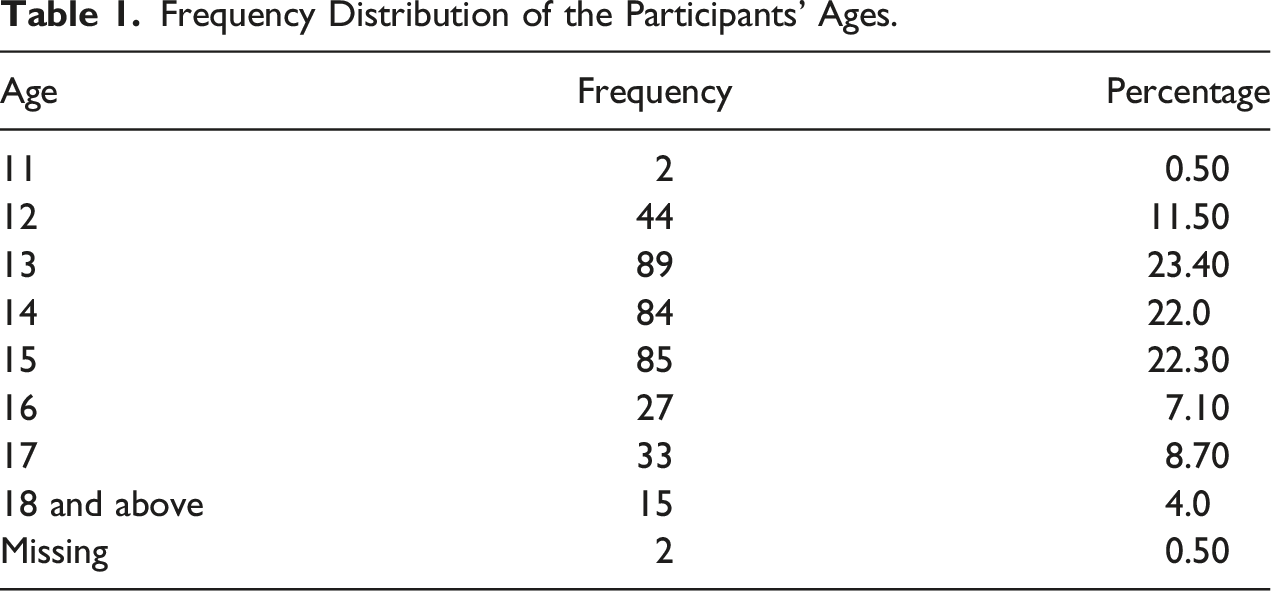
Frequency Distribution of the Participants’ Ages.
Measures
Mindfulness
We used the 14-item Mindfulness Attention Awareness Scale – Adolescent (Brown et al., 2011) to assess the participants’ perceived levels of mindfulness. Here are sample items in the scale: “I could be experiencing some emotion and not be conscious of it until some time later”, and “I find myself doing things without paying attention”. Items were rated on a 6-point Likert scale with 1 indicating “Almost always” and 6 suggesting “Almost never”. A composite score was created by getting the mean score of all items of this mindfulness scale. The Cronbach’s alpha coefficients of this subscales at Time 1 and Time 2 were .84 and .87, respectively.
Cognitive Reappraisal
The 6-item cognitive reappraisal subscale of the Emotion Regulation Scale (Gross & John, 2003) was used to assess this emotion management approach. Items were rated on a 7-point Likert scale with 1 indicating “Strongly disagree” and 7 suggesting “Strongly agree”. Sample items in the scale include: “When I want to feel more positive emotion (such as joy or amusement), I change what I’m thinking about.”, and “When I’m faced by a stressful situation, I make myself think about it in a way that helps me stay calm”. Composite score on cognitive reappraisal was formed by computing the average score of all items of this subscale. The Cronbach’s alpha coefficients of the scale at Time 1 and Time 2 were .80 and .84, respectively.
Academic Engagement
To assess perceived overall academic engagement, we used the 22-item Academic Engagement Scale (Reeve & Tseng, 2011) which measures agentic, behavioral, cognitive, and emotional aspects of involvement in school-related activities. Sample items in this questionnaire include: “I offer suggestions about how to make the class better”, “I listen carefully in class.”, “I enjoy learning new things in class.”, and “As I study, I keep track of how much I understand., not just if I am getting the right answers.”. Items were marked on a 5-point Likert scale with 1 suggesting “Strongly disagree”, and 5 indicating “Strongly agree”. Composite score was created by calculating the average score of all items of this scale. The Cronbach’s alpha coefficients of this scale at Time 1 and Time 2 were .87 and .89, respectively.
Data Analyses
Before conducting descriptive and inferential analyses, we performed analyses (e.g., Little’s missing completely at random test and expectation-maximization imputation approach; Little, 1988) to examine the pattern of missing responses and identify appropriate methodological remedy to deal with such issues. Then, we performed descriptive statistical, reliability, and correlational analyses using the 25th version of the Statistical Package for the Social Sciences (SPSS). Given that latent constructs with too many indicators normally result in models with poor parameter estimates and fit indices (Matsunaga, 2008), we constructed parcels which involve randomly assigning item indicators to specific parcels in each latent construct. These parcels were used in evaluating the fit of the subsequent cross-sectional and longitudinal measurement models, and cross-lagged panel structural equation models. Specifically, 18 parcel indicators were created, which served as indicators of mindfulness (3 parcels at each time point), cognitive reappraisal (3 parcels at each time point), and academic engagement (3 parcels at each time point). Confirmatory factor analyses (CFA) were conducted via the 25th version Analysis of Moment Structures (AMOS) in a measurement model composed of mindfulness, cognitive reappraisal, and academic engagement latent constructs along with their respective indicators and errors at each time point to provide evidence about the model’s cross-sectional validity within each wave of data collection. Further, we performed longitudinal CFA or test of longitudinal measurement invariance to determine whether the meanings of the latent constructs were comparable over time. As Koomen et al. (2012) have suggested the use of multiple criteria in evaluating invariance, we judged that invariances at different levels were satisfied if the differences in CFI and RMSEA were less than .01.
Then, structural equation modeling was performed via AMOS to examine the concurrent and longitudinal associations among mindfulness, cognitive reappraisal, and academic engagement. The final structural model comprised 6 latent constructs (i.e., Time 1 mindfulness, Time 2 mindfulness, Time 1 cognitive reappraisal, Time 2 cognitive reappraisal, Time 1 academic engagement, and Time 2 academic engagement), 18 parcel indicators (i.e., 3 parcel indicator for each latent constructs), and 18 error terms. Consistent with the methodologically recommended strategies on how to control for the impacts of measurement errors associated with each time point in longitudinal structural models (Marsh & Yeung, 1998), we correlated the uniquenesses or error terms of indicators within and across time of each latent construct (e.g., error terms of Time 1 mindfulness were correlated with error terms of Time 2 mindfulness). To judge the fit of our hypothesized measurement and cross-lagged panel structural equation models, we referred to the recommended cut-off values of Lance et al. (2006): (a) comparative fit index (CFI) and goodness of fit index (GFI) should be higher than .90; and (b) root mean square error of approximation (RMSEA) and standardized root mean square residual (SRMR) should be lower than .08.
Results
Preliminary, Descriptive, Reliability, and Correlational Analyses
Given that around 2.40% of the dataset was missing, Little’s missing completely at random (MCAR) test (Little, 1988) was performed to evaluate whether these missing data could affect the findings of this research. Results showed that these missing responses were missing completely at random: χ 2 = 2377.22, df = 1995, p < .001. Consistent with recommended approach in dealing with missing data in prior research (Schlomer et al., 2010), we used the expectation-maximization imputation approach in addressing this methodological issue, and used the imputed dataset in succeeding analyses.
Descriptive Statistics, Cronbach’s Alpha Coefficients, and Correlational Analyses Among Mindfulness, Cognitive Reappraisal, and Academic Engagement.
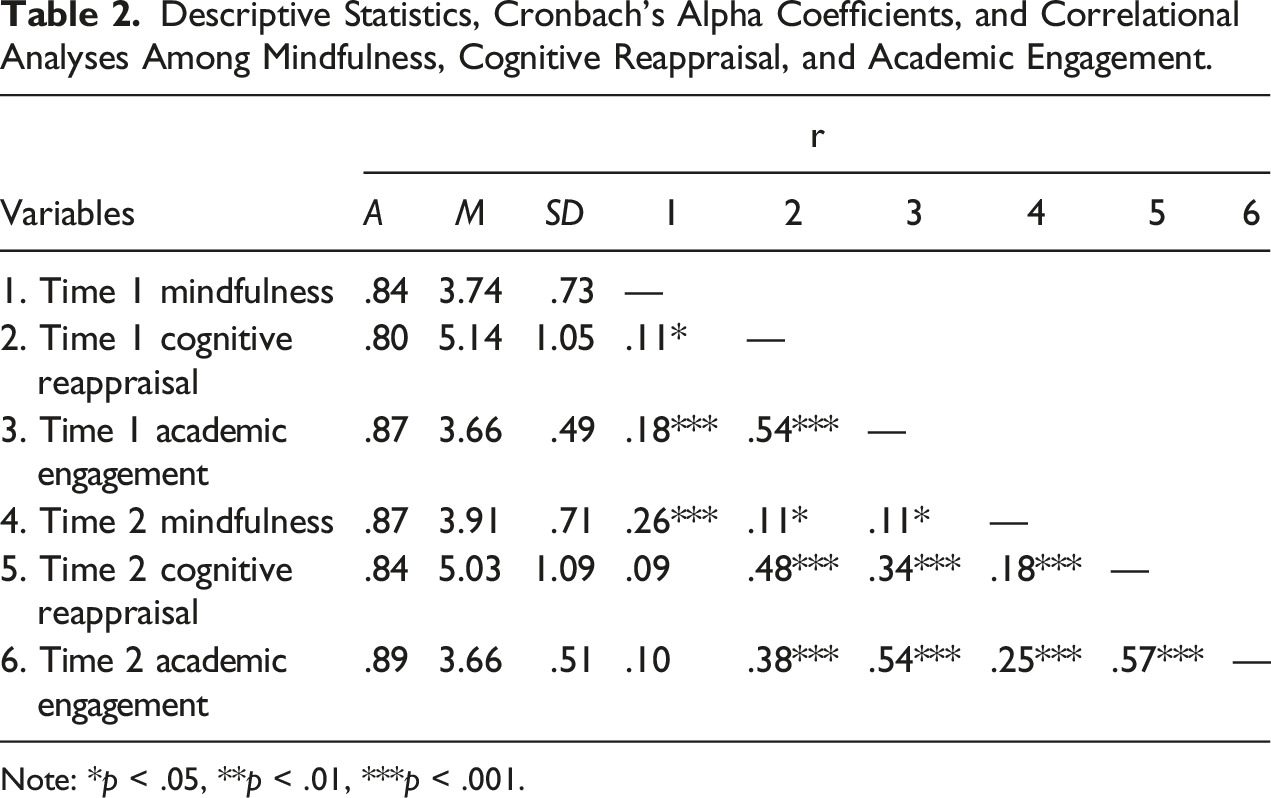
Note: *p < .05, **p < .01, ***p < .001.
Cross-Sectional Measurement Models and Longitudinal Measurement Invariance Test
Cross-Sectional CFA for Time 1 and Time 2.
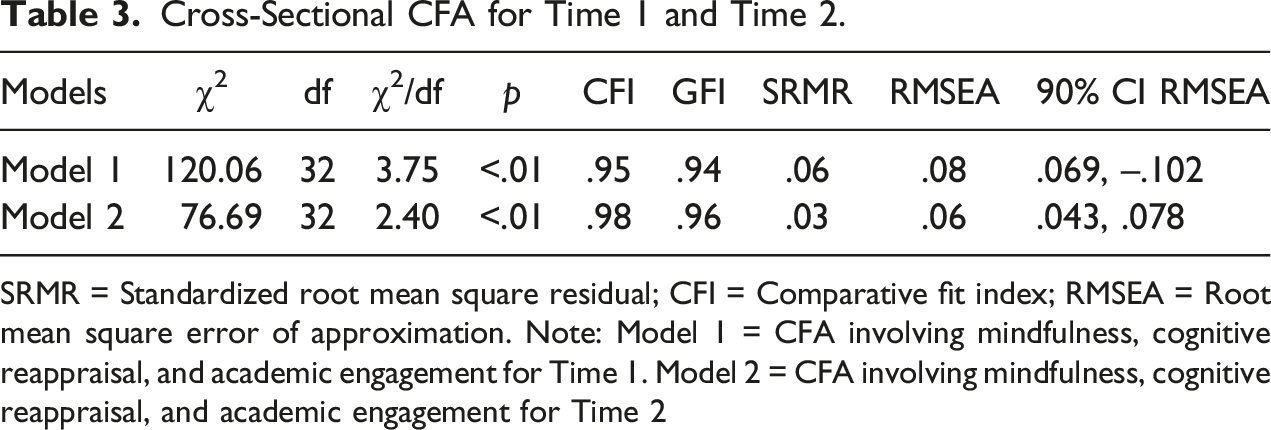
SRMR = Standardized root mean square residual; CFI = Comparative fit index; RMSEA = Root mean square error of approximation. Note: Model 1 = CFA involving mindfulness, cognitive reappraisal, and academic engagement for Time 1. Model 2 = CFA involving mindfulness, cognitive reappraisal, and academic engagement for Time 2
Longitudinal Measurement Invariance of Measurement Models of All Explanatory and Outcome Variables.

GFI = Goodness of fit index; SRMR = Standardized root mean square residual; CFI = Comparative fit index; RMSEA = Root mean square error of approximation.
Cross-Lagged Panel Structural Equation Modeling
The result of cross-lagged panel SEM showed that our hypothesized model had good fit: χ
2
= 296.48, df = 145, CFI = .96, GFI = .93, SRMR = .047, and RMSEA = .05 (.044, .061). Hypothesis 1 was not supported as Time 1 mindfulness did not predict Time 2 cognitive reappraisal after controlling for auto-regressor effects. Time 1 mindfulness did not predict Time 2 academic engagement after controlling for Time 1 engagement which did not corroborate Hypothesis 2. Hypothesis 3 was also not confirmed as Time 1 cognitive reappraisal did not predict Time 2 academic engagement after adding Time 1 engagement as a covariate. Except for the link between prior engagement and subsequent cognitive reappraisal which was confirmed as Time 1 academic engagement positively predicted Time 2 cognitive reappraisal, there was no evidence of reciprocal associations between: (a) academic engagement and mindfulness; and (b) cognitive reappraisal and mindfulness. Results showed that Time 1 mindfulness was associated with increased Time 1 cognitive reappraisal and Time 1 academic engagement Figure 1. Cross-lagged associations between mindfulness, cognitive reappraisal, and academic engagement. Note: ***p < .001, **p < .01, *p < .05; All indicators and errors were omitted in this model to enhance clarity of the schematic diagram.
Discussion
The psychological and physical benefits of mindfulness are documented in prior studies (Anastasiades et al., 2017; Black et al., 2012; Gallego et al., 2014; Vorontsova-Wenger et al., 2021). There is also evidence showcasing how mindfulness predicts increased engagement at work (Coo & Salanova, 2018; Malinowski & Lim, 2015; Petchsawang & McLean, 2017). However, little is known about the role of mindfulness in students’ engagement, especially in non-Western societies. This research addresses this issue by exploring the associations of mindfulness with cognitive reappraisal and academic engagement via a two-wave cross-lagged panel design among Filipino high school students.
Hypothesis 1 was not supported as mindfulness did not significantly predict subsequent cognitive reappraisal. The non-significant association of self-reported mindfulness to self-reported cognitive reappraisal indicated that students’ self-report of mindful disposition might not relate to their self-reported capacity to engage in adaptive emotion regulation strategy over time. The short-term nature of this longitudinal study, however, might account for this non-significant finding. However, Time 1 mindfulness was associated with increased Time 1 cognitive reappraisal which corroborated previous research findings on how mindfulness matters for effective emotion regulation strategies such as reappraisal (Garland et al., 2015a; 2015b; Troy et al., 2013). It is reasonable to believe that mindfulness may be linked to higher levels of cognitive reappraisal as mindfulness promotes self-awareness (Brown & Ryan, 2003) and sustained attention (Cheyne et al., 2006).
Time 1 mindfulness was not linked to Time 2 academic engagement after controlling for auto-regressor effects (i.e., Time 1 engagement) which did not support Hypothesis 2. This finding indicates a lack of longitudinal association between mindfulness and academic engagement. Although our results were not consistent with previous studies (Elphinstone et al., 2019; Miralles-Armenteros et al., 2019) on the positive correlation of mindfulness with students; engagement, the use of a more rigorous methodological approach (i.e., cross-lagged panel structural equation modeling) compared to previous studies, increases the validity of our findings. However, it is also possible that the relatively short interval of data collection (i.e., 2-month interval) might have affected the results of our study.
Nonetheless, our result showed that Time 1 mindfulness was associated with higher levels of Time 1 academic engagement, supporting previous research on the cross-sectional associations between mindfulness and school-based engagement outcomes (Elphinstone et al., 2019; Miralles-Armenteros et al., 2019). It is likely that mindfulness is linked to increased concurrent academic engagement as practicing conscious attention to momentary situations has been linked to fulfilment of basic psychological needs (Brown & Ryan, 2003; Ryan & Deci, 2017), and intrinsic motivation (Donald et al., 2019).
Further, our study demonstrated that Time 1 cognitive reappraisal did not predict Time 2 academic engagement, which failed to support Hypothesis 3. This emotion management technique may not be linked to engagement outcomes as cognitive reappraisal may have more proximal links to psychological well-being outcomes and mental health functioning. In other words, it is likely that there might be other intermediate variables accounting for the possible link of cognitive reappraisal to academic engagement. For example, can autonomous motivation or approach types of motivational states mediate the link of emotion regulation techniques and academic behaviors? These speculations, however, require further research as the present study did not focus on assessing the association of emotion regulation strategy with academic motivational processes.
There is also evidence showing that Time 1 academic engagement positively predicted Time 2 cognitive reappraisal over time. This result aligns with previous research that showcases the role of academic engagement in promoting resilience (Torsney & Symonds, 2019) and well-being outcomes (Upadyaya & Salmela-Aro, 2013). It is likely for engagement to predict cognitive reappraisal, as prior evidence suggests that engagement can facilitate effective coping skills in school contexts (Skinner et al., 2016). Indeed, this research emphasizes the importance of exploring the consequences of students’ engagement on resilience and well-being outcomes.
In general, this research contributes to existing mindfulness literature in a number of ways. Although prior studies (Elphinstone et al., 2019; Miralles-Armenteros et al., 2019) demonstrated that mindfulness is related to increased academic engagement in Western societies, these findings hold limited implications for understanding the role of mindfulness in non-Western contexts. Through showing a lack of longitudinal association between mindfulness and academic engagement, this research contributes to inconclusive evidence about the learning-related benefits of mindfulness in various cultural contexts (Meyer & Eklund, 2020; Miller et al., 2017). This mixed evidence underscores the importance of exploring whether the impacts of mindfulness on learning outcomes are generalizable in Western and non-Western societies.
Further, whereas prior studies demonstrated that mindfulness was associated with higher school engagement (Elphinstone et al., 2019; Miralles-Armenteros et al., 2019), these investigations relied mostly on cross-sectional design which does not provide insights about temporal precedence between mindfulness and engagement outcomes. As our research used a two-wave cross-lagged panel design among a sample (i.e., Filipino high school students), our results can provide more rigorous evidence regarding the link between mindfulness and school engagement. This research also coheres with prior evidence about positive link of mindfulness to cognitive reappraisal in Western societies (Garland et al., 2015a, 2015b; Troy et al., 2013).
Limitations and Future Research Directions
There are several limitations in the current study. First, although we used a cross-lagged panel modeling approach to explore the link of mindfulness to academic engagement, it is not possible to draw causal inferences due to the correlational nature of the study. In future research, experimental and intervention designs are needed to provide evidence about the ability of mindfulness to boost engagement and other learning outcomes. Second, as we used self-reported mindfulness, cognitive reappraisal, and engagement, results might be prone to common method variance. Future research can address this shortcoming by utilizing alternative techniques in measuring these explanatory and outcome variables. For example, researchers may consider augmenting self-report measures with teacher- or parent-report format of mindfulness measures to generate a more rigorous estimate of mindfulness. Third, the short interval (i.e., two months) between the first and second waves of data collection precludes insights into the long-term associations of mindfulness with cognitive reappraisal and engagement, so future studies may adopt longitudinal studies with longer interval and more waves of measurement. Choosing an optimal interval of data collection might matter to demonstrate the long-term benefits of mindfulness as past studies with longer lags of survey administration (e.g., at least 6 months) yielded evidence on how mindfulness relates to positive psychological outcomes over time (Calvete et al., 2017; Royuela-Colomer et al., 2021; Yuan & Liu, 2021).
Practical Implications
This study carries a few practical implications. The concurrent associations of mindfulness with cognitive reappraisal and overall academic engagement imply that fostering mindfulness might be beneficial for temporarily improving students’ emotion management and active participation in school-related activities. The positive relationship of academic engagement to subsequent cognitive reappraisal alludes to psychological benefits of school-based initiatives that advocate for strengthening students’ academic engagement. Echoing previous research recommendations (Salmela-Aro et al., 2021), it is important to explore how academic engagement facilitates resilience in adolescents. Indeed, more research is needed to clearly identify the academic-related benefits of mindfulness in school contexts.
Conclusion
Prior studies that relied on cross-sectional designs have shown that mindful individuals tend to experience higher levels of engagement at school (Elphinstone et al., 2019; Miralles-Armenteros et al., 2019). By contrast, this short-term longitudinal research demonstrates that mindfulness only correlates with concurrent academic engagement, indicating a lack of links between mindful disposition, cognitive reappraisal, and engagement over time. This study, therefore, contributes to mixed evidence regarding the academic payoffs linked to mindfulness by showing that mindfulness may not relate to longitudinal changes in adaptive emotion regulation and academic engagement. Indeed, the inconclusive findings on how mindfulness predicts positive academic functioning underscores the importance of investigating whether cultivating mindfulness might be an effective strategy to bolster learning and well-being in younger adolescents.
Footnotes
Declaration of Conflicting Interests
The author(s) declared no potential conflicts of interest with respect to the research, authorship, and/or publication of this article.
Funding
The author(s) disclosed receipt of the following financial support for the research, authorship, and/or publication of this article: This research was funded by the Start-Up Research Grant 2017-2018 (RG 74/2017-2018R) from The Education University of Hong Kong awarded to the corresponding author.
Ethical Approval
All procedures performed in studies involving human participants were in accordance with the ethical standards of the institutional and/or national research committee and with the 1964 Helsinki declaration and its later amendments or comparable ethical standards.
Informed Consent
Informed consent was also obtained from all participants.
