



Abstract
This study explored the effect of parental emotion socialization behavior (ESB) on depressive symptoms with a focus on the mediating effect of emotion regulation and the moderating role of family cohesion. A total of 236 Chinese adolescents were surveyed and reported on parental ESB, family cohesion, emotion dysregulation, and depressive symptoms. The results indicated that parental ESB toward negative emotions was associated with adolescents’ depressive symptoms, as mediated by emotion dysregulation. Moreover, higher levels of family cohesion both enhanced the negative relationships between supportive ESB toward anger/sadness and emotion dysregulation and strengthened the positive relationship between non-supportive parental ESB toward sadness and emotion dysregulation. These findings clarify the interactive effects of multiple components of emotional parenting, reveal the double-edged effects of family cohesion in the association between parental ESB and depressive symptoms in adolescents, and highlight the importance of evaluating the family emotional context in research and clinical interventions.
Keywords
Depression is among the most common psychological problems experienced by adolescents (Liu & Merritt, 2018) and is associated with a range of deleterious consequences, including poor school performance (Liu et al., 2018), social withdrawal (Hamasaki et al., 2020), self-harm, and even suicidality (Parker & Ricciardi, 2019). Emotion dysregulation is an important predictor of depression and is considered a transdiagnostic factor (Hoglund & Chisholm, 2014; Jiang et al., 2022). For children and adolescents, promoting emotion regulation development is vital to prevent psychological problems such as depression.
Family plays a critical role in the development of emotion regulation during childhood and adolescence. According to the tripartite model of familial influence (Morris et al., 2007), there are three important familial factors that shape the emotion regulation abilities of a child and, in turn, influence their psychological adjustment. First, children learn and internalize emotion regulation through observing/modeling emotion regulation of their parents. Second, emotion-related parenting practices directly influence children’s attitudes toward emotions and emotion regulation. Third, the familial emotional climate provides an important context for children to understand emotions and develop emotion regulation abilities. The effects of these three factors have been well researched, while the interaction effects remain less examined. Because these familial factors simultaneously influence children’s development of emotion regulation, it is necessary to examine their combined effects. In the present study, we focused on the effects of parental emotion socialization behaviors and familial emotional climate.
Parental Emotion Socialization Behaviors and Mental Health in Adolescence
Parental emotional socialization behavior (ESB) is a main component of the tripartite model of familial influence on emotion regulation and psychological adjustment. It refers to the overall reactions parents have to the emotions of their children and the practices they use to effectively regulate and display emotions in socially appropriate ways (Eisenberg et al., 1998; Hajal & Paley, 2020). Parental ESBs are been broadly classified as supportive and non-supportive responses. Parents’ efforts to help children recognize their emotions, foster positive attitudes toward emotions, and internalize adaptive emotion regulation strategies are defined as supportive ESB. Comforting, rewarding, and empathic behaviors are examples of supportive ESB (O’Neal & Magal, 2005). By contrast, when parents ignore, deny, or punish their children for expressing emotions, children are likely to experience greater distress and internalize negative attitudes toward emotions. These parental responses are defined as non-supportive ESB (Eisenberg, Spinrad, & Cumberland, 1998; Gottman et al., 1996).
Positive association of supportive ESB and negative association of non-supportive ESB with children’s socioemotional adjustment have been well established in previous researches (Chronis-Tuscano et al., 2021; Hajal & Paley, 2020). Furthermore, children’s emotion regulation is considered as an important mediator in the relationship between parental ESB and children’s mental health (Eisenberg, Spinrad, & Cumberland, 1998). As found in some previous studies, supportive parental ESB is indirectly associated with lower levels of depressive symptoms by increasing children’s emotion regulation ability (Fainsilber Katz et al., 2016). In contrast, non-supportive parental ESB is indirectly associated with higher levels of depressive symptoms by increasing children’s levels of emotion dysregulation (Raval et al., 2019).
Although the development of emotion regulation begins in early childhood, it is equally important in adolescence (Brenning et al., 2021). Compared to that in childhood, emotional experiences during adolescence have greater fluctuations (Maciejewski et al., 2015) and increased intensity (Morris et al., 2007), which requires more regulation effort. Adolescents have greater potential to regulate their emotions because the maturation of the prefrontal cortex allows the development of more refined regulation strategies such as cognitive reappraisal (McRae et al., 2012). In addition, because adolescents have a greater need for autonomy, the characteristics of the parent-child relationship in adolescence change (Chronis-Tuscano et al., 2021). Under these conditions, the effects of parental ESB may differ from those seen in early childhood and thus warrant more research attention. Preliminary evidence suggests that parental ESB continues to influence the development of emotion regulation during adolescence. Specifically, non-supportive parental ESB is associated with emotion dysregulation, while supportive parental ESB promotes the development of emotion regulation (McNeil & Zeman, 2020; Shi & Wang, 2021). Although the effects of parental ESB on adolescents’ socioemotional development have been examined in some previous studies, the present study extended the existing literature by addressing three issues. First, we focused on the effects of parental ESB in adolescence in a non-Western cultural context which have been less examined. Second, we examined differences in effects of parental ESB toward different types of negative emotions. Third, we explored effects of ESB in different family emotional climates.
Culture and the Effects of Parental ESB Toward Different Emotions
Culture shapes emotional attitude and display rules, influences parents’ emotion socialization behaviors, and affects effects of specific parental ESB. In a typical collectivistic society such as China, self-expression is less emphasized than in individualistic societies. The expression of negative emotions is generally discouraged because they are personal experiences and might pose a potential threat to relationship harmony. Negative dominant emotions such as anger are particularly discouraged because they threaten authority and interpersonal relationships. However, sadness and fear, which are less aggressive and destructive, are more acceptable in collectivistic cultures (Safdar et al., 2009). Impacted by cultural norms and values, the goal of Chinese parents’ emotional socialization is to contribute to family relationships and maintain social harmony; therefore, unlike parents in Western individualistic culture, Chinese parents are more likely to have non-supportive responses (e.g., minimization, punishment, or override) to children’s expression of negative emotions, particularly anger (Keller et al., 2006; Wang, 2001). Culture also influences children’s understanding of parental ESB. As found in some empirical studies, adolescents living in collectivistic societies experience parental override reactions more often and tend to interpret parental override as supportive (Lugo-Candelas et al., 2015; Rapp et al., 2021). Therefore, cultural context and emotion type should be considered when examining the effects of parental ESB.
Family Emotional Climate in the Association Between Parental ESB and Adolescents’ Psychological Adjustment
The moderating role of family emotional climate in the association between parental behaviors and adolescent outcomes has been examined in some previous empirical studies. For example, parental social coaching is effective to improve adolescents’ social adjustment (Gregson et al., 2017; Su et al., 2016). The higher quality of parental social coaching is associated with greater receptivity in the context of a more positive parenting climate (Gregson et al., 2016). In addition, Kapetanovic et al. (2020) also found that parental behavioral control and solicitation of information from their adolescent had greater protective effects on adolescent psychosocial functioning under a positive family emotional climate. These findings suggest that a positive emotional climate could enhance the positive effects of parenting behaviors. However, in the field of emotional parenting, the potential moderating effect of family emotional climate has been less examined. This study aimed to examine the interaction of parental ESB and family cohesion (which serves as an indicator of the family emotional climate) on emotion regulation and depression during adolescence.
According to Morris et al. (2007), (2017), family emotional climate refers to the quality of family relations as a whole and includes the parent-child relationship and emotionality in the home. Adolescents’ perception of family cohesion reflects the quality of family relationships and was, therefore, selected as an indicator of family emotional climate in the present study.
Family cohesion refers to the emotional bond between family members (Olsen & Kenny, 2006). High family cohesion entails mutual emotional support and enables members to utilize resources when coping with adverse events (Daniels & Bryan, 2021). A cohesive family context provides an accepting environment for emotional expression, wherein children can freely express their emotions because they know that their emotional needs can be fulfilled (Morris et al., 2007). According to previous studies, family cohesion is negatively associated with adolescents’ psychological distress (Rivera et al., 2008) and depressive symptoms (Cano et al., 2020). Therefore, family cohesion is considered a protective factor for emotional adjustment and development in adolescence (Cano et al., 2020; Park et al., 2010).
Moreover, based on the integrative model (Darling & Steinberg, 1993) and the existing studies focusing on the interactions between parental behaviors and emotional climate (Gregson et al., 2016; Kapetanovic et al., 2020; LaFleur et al., 2016), adolescents from cohesive families might be more open to parents’ input and have greater receptivity to parental guidance. In line with this rationale, the protective effect of supportive ESB might be strengthened in cohesive families. In addition, adolescents from cohesive families are more likely to interpret parental behaviors from a positive perspective. Thus, they might have a more favorable understanding of parental non-supportive ESB. It is particularly so when the non-supportive ESBs (e.g., minimization and override) are compatible with Chinese cultural norms. From this perspective, family cohesion might buffer the negative effects of non-supportive ESB.
Study Overview
The present study aimed to investigate the effects of parental emotion socialization behavior (ESB) toward different negative emotions (anger, sadness, and fear) on emotion dysregulation and depressive symptoms in Chinese adolescents, and to examine the potential moderating effect of family cohesion (an indicator of family emotional climate). Based on the tripartite model of familial influence (Morris et al., 2007) and previous research findings, we hypothesized that parental ESBs are generally associated with adolescents’ emotion dysregulation and depressive symptoms. Considering the influence of collectivistic cultural values, we hypothesized that non-supportive ESB toward a negative dominant emotion (i.e., anger) would be less harmful for Chinese adolescents compared with non-supportive ESB toward sadness and fear. As a transdiagnostic factor, emotional dysfunction was hypothesized to mediate the link between parental ESB and depressive symptoms. Moreover, according to the integrative model proposed by Darling and Steinberg (1993) and previous research findings, family cohesion influences children’s interpretation of parenting behaviors and thereby moderates the effects of specific parenting behaviors. Therefore, we hypothesized family cohesion would enhance the beneficial effects of supportive parental ESB and buffer the deleterious effects of non-supportive ESB on emotion regulation and depressive symptoms. The hypothesized model is displayed in Figure 1. The hypothesized model of the present study.
Methods
Participants
We collected data from a sample of students enrolled at a county middle school in North China (N = 236). Among the participants, 54.7% (n = 129) were girls, and 45.3% (n = 107) were boys. The age of the participants ranged from 12 to 14 years (M = 14.51, SD = 1.04). Seventy-seven of them (32.6%) were in Grade Seven, 77 (32.6%) were in Grade Eight, and 82 (34.7%) were in Grade Nine. Thirty-eight participants (16.1%) were only children in their families, and 198 (83.9%) had siblings. Only one (.4%) participant reported that family income was high, 159 (67.4%) reported that their family income was above average, 55 (23.3%) reported that their family income was below average, and 21 (8.9%) reported that they came from low-income families.
Procedures
All procedures were approved by the institutional review board at our university. After providing students’ and the primary caregivers’ informed consent, the students completed the online battery of self-report questionnaires discussed in the Measures section.
Measures
Emotion Regulation
The 36-item Difficulties in Emotion Regulation Scale (DERS, Gratz & Roemer, 2003) measures emotion dysregulation from six dimensions: (a) nonacceptance of emotional responses (e.g., “When I’m upset, I feel like I am weak.”), (b) difficulties engaging in goal-directed behavior (e.g., “When I’m upset, I have difficulty getting work done.”), (c) impulse control difficulties (e.g., “When I’m upset, I feel out of control.”), (d) lack of emotional awareness (e.g., “I pay attention to how I feel.”), (e) limited access to emotion regulation strategies (e.g., “When I’m upset, it takes me a long time to feel better.”), and (f) lack of emotional clarity (e.g., “I have no idea how I am feeling.”). All items are rated on a 5-point Likert scale (1 = almost never, 5 = almost always), with higher total scores indicating more emotion dysregulation (low emotion regulation ability). In this study, we implemented the Chinese version of the DERS (hereafter, C-DERS), which is reliable and valid (Ding et al., 2014). The internal consistency of the C-DERS was satisfactory in the present study (α = .90).
Adolescent Depressive Symptoms
The 18-item Depression Self-Rating Scale for Children (DSRSC, Birleson, 1981) assesses depression levels in children aged 8–16 years in a recent e week (e.g., “I feel like crying”, “I feel very lonely.”). All items are rated on a 3-point scale (0 = never, 1 = sometimes, 2 = often), with higher scores indicating higher levels of depressive symptoms. The Chinese version of the DSRSC (hereafter, C-DSRSC) has been validated (Su et al., 2003) and was used in the present study. We also confirmed that the scale was of good internal consistency (α = .89).
Parental Socialization of Emotion
The 36-item Chinese version of Emotions as a Child Scale (original version of EAC, O’Neal & Magal, 2005; Chinese version of EAC, Luo et al., 2020) assesses parental ESB toward three negative emotions (i.e., anger, fear, and sadness) across the two dimensions: (a) supportive (e.g., “Helped me deal with the issue.”), and (b) non-supportive response (e.g., “Told me that I was acting younger.”). All items are rated on a 5-point Likert scale (1 = almost never, 5 = almost always), with higher scores on supportive response dimension indicating that parents conduct more supportive ESBs, higher scores on non-supportive response dimension indicating that parents conduct more non-supportive ESBs. The psychometric properties of the Chinese version of the EAC (hereafter, C-EAC) have been examined. The two-factor structure of the C-EAC (supportive and non-supportive responses for each emotion) has been confirmed, and the reliability is acceptable (Luo et al., 2020). We also confirmed that all the subscales were of good internal consistencies (αs range of .78 to. 96) in this study.
Family Cohesion
The 16-item Cohesion subscale from the Family Adaptation and Cohesion Evaluation Scales II-Family version (FACES-II) (Olson, 1985) was used to measure family cohesion in this study (e.g., “Our family does things together.”, “Family members feel very close to each other.”). All items are rated on a 5-point Likert scale (1 = almost never, 5 = almost always), with higher scores indicating higher levels of family cohesion. In this study, we used the Chinese version of the FACES-II (hereafter, the C-FACES-II), which is of acceptable reliability and validity (Shen, 1991). The internal consistency of the cohesion subscale of the C-FACES-II was good (α = .83).
Statistical Analyses
Descriptive analyses were done to describe demographic characteristics of participants. Pearson correlations were conducted to examine the correlations of main variables. T-tests or ANOVAs were performed to examine demographic differences in emotion dysregulation and depression. Considering that the source of data collection in this study was all self-reported data, we examined the common method bias using Harman’s single-factor test. Then the hypothesized moderated mediation model was examined using the Process 3.0 program (Model 8). To explore the effects of parental responses to different emotions, we separately tested six models with different independent variables (i.e., parental supportive/non-supportive ESB toward anger/sadness/fear). We included demographic variables that were significantly associated with the dependent variable as covariates. All the variables were standardized for analyses.
A bootstrap method using 5000 bootstrap samples was used to examine the mediating effect of emotion dysregulation in the association between parental ESB and adolescents’ depressive symptoms (Hayes, 2013). The regression coefficient of the interaction term (ESB × family cohesion) on depressive symptoms was used to evaluate the moderating effect of family cohesion in the direct pathway, and the regression coefficient of the interaction term (ESB × family cohesion) on emotion dysregulation was used to evaluate the moderating effect of family cohesion in the first half pathway of the mediation model (Hayes, 2013). Simple slope tests were conducted to specify the relationship between parental ESB and emotion dysregulation/depressive symptoms under different levels of family cohesion. All the analyses were conducted using SPSS 24.0.
Results
Preliminary Analyses
The result of Harman’s single-factor test showed that the first unrotated factor explained 24.17% of the total variance, indicating that there was no obvious common method bias in the current study.
Descriptive Statistics and Correlations Among the Main Variables.
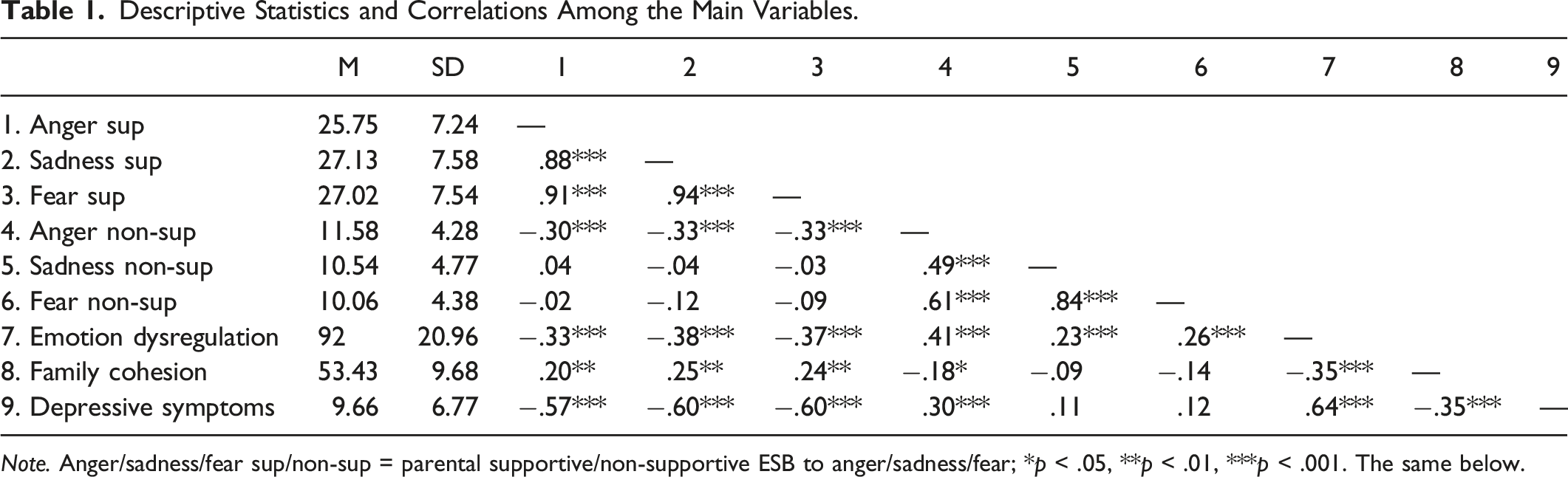
Note. Anger/sadness/fear sup/non-sup = parental supportive/non-supportive ESB to anger/sadness/fear; *p < .05, **p < .01, ***p < .001. The same below.
Demographic differences in emotion dysregulation and depressive symptoms were examined. As results of correlation revealed, adolescents’ age was not significantly associated with their emotion dysregulation (r = .08, p = .179) and depressive symptoms (r = .02, p = .784). Female adolescents reported significantly higher levels of emotion dysregulation (for girls, M = 94.47, SD = 21.12; for boys, M = 89.02, SD = 220.46; t (234) = −2.00, p = .046) and depressive symptoms (for girls, M = 10.93, SD = 7.17; for boys, M = 8.12, SD = 5.93; t (234) = −3.24, p = .001) than male adolescents. Adolescents with at least one sibling reported higher levels of depressive symptoms than those without siblings (for adolescents having at least one sibling, M = 10.20, SD = 6.81; for adolescents having no siblings, M = 6.84, SD = 6.81; t (234) = −2.84, p = .005), while emotion dysregulation between these two groups were not significantly different (t (234) = −.75, p = .453). Adolescents reporting different socioeconomic statuses did not differ in emotion dysregulation (F (3, 232) = 2.02, p = .112) or depressive symptoms (F (3, 232) = 1.18, p = .318). Based on these significant results, we added gender and only child status as covariates in subsequent model testing.
Model Testing
We used the PROCESS macro (Model 8) to examine the moderated mediation model, with gender and only child status as control variables. Figures 2 and 3 show the standardized coefficients. Coefficients of the mediated moderate models with parental supportive ESB as the independent variable. Note. Coefficients of models for supportive ESB to anger are displayed outside the brackets and those of models for supportive ESB to sadness/fear are displayed in brackets. Standard solution (N = 236). Estimates are standardized coefficients. *p < .05, **p < .01, ***p < .001. The same below. Coefficients of the mediated moderate models with parental non-supportive ESB as the independent variable.

Testing the Parental Supportive ESB Models
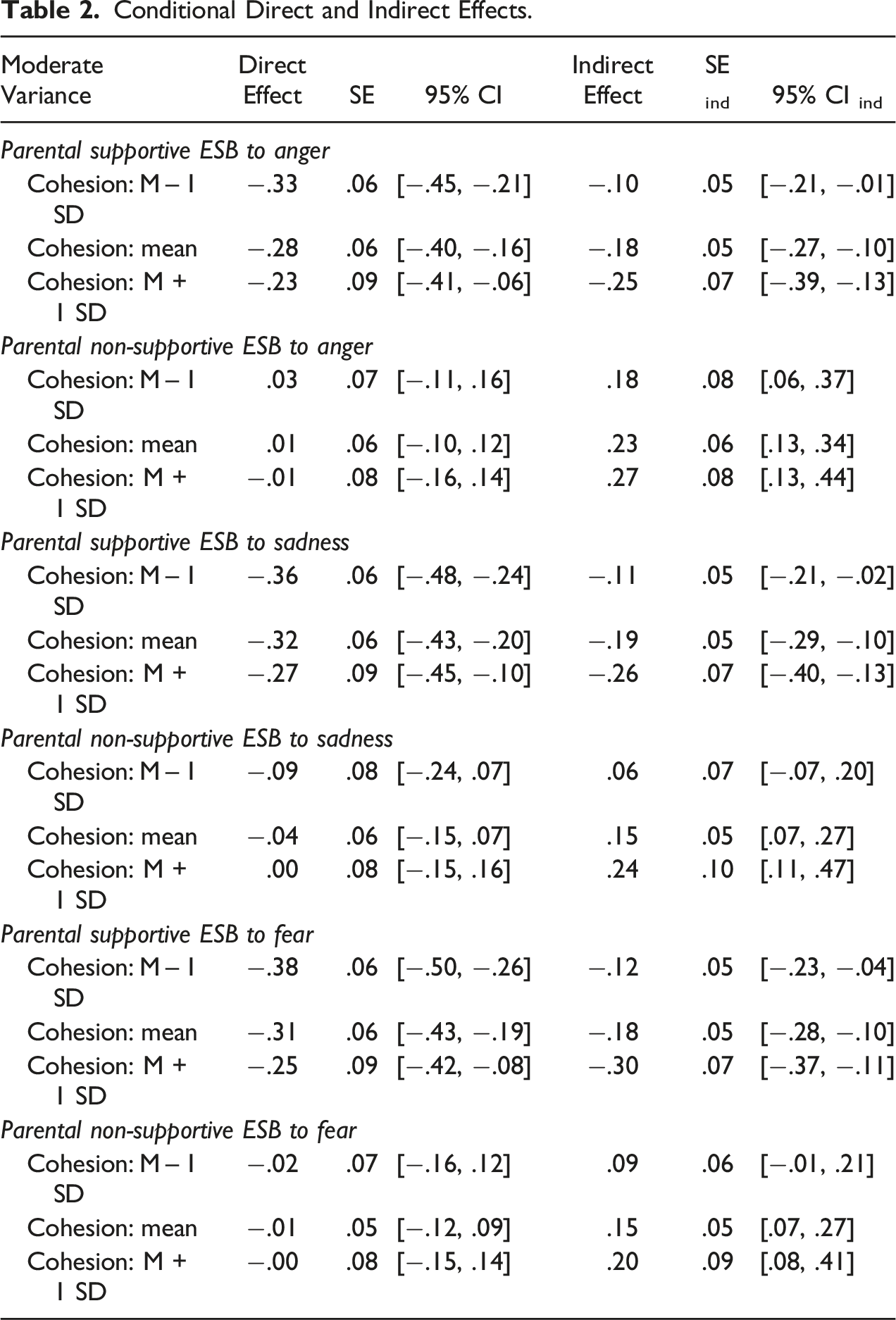
Conditional Direct and Indirect Effects.
Furthermore, we found that the interaction effects of family cohesion and parental supportive ESBs toward anger and sadness on emotion dysregulation were significant (βanger = −.14, βsadness = −.15, ps < .05), while the interaction effect of family cohesion and the supportive socialization of fear on emotion dysregulation was not significant (βfear = −.11, p = .70). In addition, the moderating effects of family cohesion on the relationship between supportive socialization of the three emotions and depressive symptoms were not statistically significant.
We conducted simple slope tests to examine the effects of parental supportive ESBs toward anger and sadness on emotion dysregulation under different levels of family cohesion. As illustrated in Figures 4 and 5, the negative relationships were of greater magnitude among adolescents from families with higher levels of family cohesion. Accordingly, the conditional indirect effect analysis (Table 2) showed that the mediating effects of emotion dysregulation in parental supportive ESBs toward anger and sadness were smaller for adolescents from families with a lower level of family cohesion (effect size = −.10, SE = .05, 95% CI [−.21, −.01]), while the indirect effect was larger for adolescents from families with a lower level of family cohesion (effect size = −.25, SE = .07, 95% CI [−.39, −.13]). Moderating effect of family cohesion between supportive ESB to anger and emotion dysregulation. Moderating effect of family cohesion between supportive ESB to sadness and emotion dysregulation.

Testing the Parental Non-Supportive ESB Models
The three models with parental non-supportive ESB to anger/sadness/fear as the independent variable explained 49%–56% of the variance in emotion dysregulation (R2 = .56/.49/.49) and 71%–72% of the variance in depressive symptoms (R2 = .71/.72/.71). The standardized pathway coefficients are shown in Figure 3. The direct effects of parental non-supportive ESB toward anger, sadness, and fear were not significant, while non-supportive ESB was positively related to emotion dysregulation and in turn linked with depressive symptoms. The results of the bootstrap analysis indicated that the indirect effects of emotion dysregulation in all three models were significant. Parental non-supportive ESBs toward anger, sadness, and fear were positively associated with depressive symptoms via the mediation of increased emotion dysregulation. The effect sizes of the indirect and direct effects are displayed in Table 2.
Regarding the moderation effect of family cohesion, the interaction effect of family cohesion and non-supportive sadness socialization on emotion dysregulation was significant (βsadness = .14, p < .05), but the interaction terms of family cohesion and parental non-supportive ESB toward anger and fear on emotion dysregulation were not significant (βanger = .07, βfear = .09, ps > .05). The interactive effects of family cohesion and parental non-supportive ESB toward the three negative emotions on depressive symptoms were also not significant. Thus, family cohesion only moderated the association between parental non-supportive ESB toward sadness and emotion dysregulation.
As shown in Figure 6, the negative effect of parental non-supportive ESB toward sadness on emotion dysregulation was amplified among adolescents from families with a higher level of family cohesion, although family cohesion still demonstrated a protective effect on emotion regulation. The mediating effect of emotion dysregulation in the relationship between parental non-supportive ESB toward sadness and adolescents’ depressive symptoms was not significant when family cohesion was low (effect size = −.06, SE = .07, 95% CI = [−.07, .20]), while the indirect effect was significant when family cohesion was high (effect size = −.24, SE = .10, 95% CI = [.11, .47]) (Table 2). Moderating effect of family cohesion between non-supportive ESB of sadness and emotion dysregulation.
Discussion
Emotion regulation ability is crucial to prevent depression during adolescence (Schäfer et al., 2016). Revealing the effects of familial factors on emotion regulation and depression is informative for the development of prevention programs for adolescents at risk. The present study extended previous literature by (1) examining the interaction effects of parental ESB and family emotional climate on adolescents’ emotion dysregulation and depressive symptoms, and (2) clarifying the effects of parental ESB toward three different negative emotions in a sample of adolescents living in China—a typical collectivistic society.
The hypothesized moderated mediation model was generally supported. Our results indicated that emotion dysregulation significantly mediated the relationship between parental ESB (including all supportive/non-supportive responses to anger/sadness/fear) and depressive symptoms. Meanwhile, family cohesion (an indicator of family climate) moderated the relationship between parental ESB and emotion dysregulation. However, this moderating effect was double-edged: family cohesion enhanced the benefits of parental supportive ESB toward anger and sadness and strengthened the negative effects of non-supportive ESB toward sadness.
Parental ESB, Emotion Regulation, and Adolescent Depressive Symptoms
Aligned with the theoretical model, our results indicated that parental supportive ESBs toward anger, sadness, and fear were associated with lower depressive symptoms in adolescents through lower emotion regulation ability. In contrast, parental non-supportive ESBs toward these emotions were related to more depressive symptoms via increased emotion dysregulation (Morris et al., 2007; 2017). The results are in line with the tripartite model of familial influence on emotion regulation and consistent with previous research findings (Cui et al., 2020; Miller-Slough & Dunsmore, 2019; Wang et al., 2019). Thus, this study enriches the literature by suggesting an association between parental ESB and psychological adjustment in adolescence (Chronis-Tuscano et al., 2021).
Contrary to our hypothesis, parental responses such as overriding, neglect, and magnifying toward adolescents’ anger were associated with higher levels of emotion dysregulation and depressive symptoms, and the effect size was similar to the effects of non-supportive ESB toward sadness and fear. This pattern is in line with studies conducted in Western countries (Perry et al., 2017). It has been observed that middle-class families from societies with an interdependent cultural heritage tend to integrate the encouragement of autonomy with maintaining harmony in their parental socialization strategies (Keller et al., 2004, 2006). Although our sample consisted of families in a small town rather than middle-class families in large cities, the results were consistent with this argument.
The Moderating Effect of Family Cohesion
As an indicator of the family emotional climate, we also examined the moderating effect of family cohesion on the relationship between parental ESB and emotion dysregulation/depressive symptoms in adolescents. Consistent with our hypothesis, we found that family cohesion enhanced the association between parental supportive ESBs toward anger and sadness and emotion dysregulation. A similar result pattern was found in previous study focusing on parental social coaching. As found by Gregson et al. (2016), high-quality parental coaching, a protective factor of adolescents’ adaptive socio-emotional development (Gregson et al., 2017; Su et al., 2016), was associated with higher level of receptivity in adolescents (i.e., perceiving parent’s guidance as helpful) who perceived high family warmth and low hostility. The current result can be explained using the theory proposed by Darling and Steinberg (1993), wherein family climate substantially influences how children interpret parental behaviors. For adolescents from less cohesive families, children tend to perceive parental supportive responses as intrusive or nonessential (Hawk et al., 2008). In such instances, they may have less trust in parental emotional coaching, which can limit the effects of parental supportive ESB. In contrast, adolescents who perceive their family climate as cohesive, warm, and intimate tend to interpret parental emotion socialization as caring and loving; in turn, they are more likely to value parental coaching in emotion regulation and accept parental supportive socialization toward their emotions. Thus, the positive effect of supportive parental socialization is more pronounced.
Contrary to our hypothesis, although family cohesion imposed a generally negative effect on emotion dysregulation, it amplified the effects of parental non-supportive ESB toward sadness on emotion dysregulation rather than mitigating the link. The interaction of non-supportive ESBs with cohesion showed a similar pattern to that of supportive ESBs, that is, a higher level of family cohesion amplified the effects of ESBs, whether supportive or non-supportive. It might be because those adolescents tend to have greater receptivity to parental instructions in families with strong emotional ties (Gregson et al., 2016). Adolescents from cohesive families are more likely to agree with and internalize their parents’ attitude of emotions. If parents have non-supportive ESB to sadness, these adolescents are more likely to develop a negative attitude towards sadness and fail to learn adaptive strategies to regulate their sadness. In addition, adolescents in families with high cohesion tend to rely more on family members (in most situations, their parents) to regulate emotions (Olson, 1985). Thus, their emotion dysregulation is more closely related to parental non-supportive ESBs. Finally, interpersonal regulation of sadness usually conveys caring and love. Adolescents in cohesive families are more likely to have greater positive expectations for parental ESB toward sadness and may therefore experience disappointment or distress when this does not occur.
Notably, the moderating effects of family cohesion in the association between parental supportive/non-supportive ESBs toward fear and emotion dysregulation were not significant, although the data did reveal a similar tendency as was found for anger and sadness. One possible explanation is that the expression of fear in front of parents is a typical attachment-seeking behavior. Because children have innate sensitivity to parental responses (i.e., the parental supportive socialization of fear), the family context does not influence their interpretation of parental ESB toward fear.
The moderating effect of family cohesion on the relationship between parental non-supportive ESBs toward anger and emotion dysregulation were also not significant. Regardless of the family cohesion level, parental non-supportive ESB toward anger had a significant negative effect on emotion regulation. This may be because parental non-supportive socialization is usually accompanied by an intensive parent-child conflict, which might disturb the mentalizing process of adolescents and fail to take family cohesion into consideration and reappraise parental responses in a positive way (Tollenaar & Overgaauw, 2020).
Implications for Research and Practice
With regard to theory, this study enriched empirical evidence of the tripartite model of familial influence on emotion regulation during adolescence and deepened our understanding of the interaction effects of multiple components within the tripartite model by examining the effects of parental emotional socialization behaviors and family cohesion simultaneously. Revealing the interaction effects of parental ESB and family cohesion helped us gain a more comprehensive understanding of emotional parenting. In addition, we extended previous research by examining the effects of parental ESB and family cohesion in response to different negative emotions in the Chinese cultural context. We found the effects of parental ESB toward anger, sadness, and fear on adolescents’ emotion dysregulation and depressive symptoms were similar in magnitude, but the moderating effects of family cohesion varied depending on the nature of emotions.
From a practical standpoint, we found that parental ESB effectively facilitated emotion regulation and may therefore constitute an important target in prevention and intervention programs aiming to improve adolescents’ psychological adjustment. Furthermore, the role of family cohesion should be evaluated and targeted in such programs, because a cohesive family climate is a protective factor of adolescents’ emotion regulation and may influence the effectiveness of parental ESB promotion programs.
Study Limitations and Future Research Directions
There were some limitations in this study. First, only self-reported data from the adolescents were collected, but parents of the adolescents were not surveyed. Because parents may have different perceptions of parental ESB and the family emotional climate, it may be more informative to collect data from both the parents and their children. Furthermore, it would be better to involve both parents (the father and the mother) and the adolescents in the study to compare the effects of paternal ESB and maternal ESB. At the same time, it may be beneficial to use multiple methods, such as interviews and observations, to improve the validity of measurement. Second, we employed a cross-sectional design, which limited the ability to examine possible bidirectional or causal relationships with parental ESB, adolescents’ emotion regulation, and depressive symptoms over time. Third, we focused on a community sample of adolescents who exhibited only mild symptoms of depression. Therefore, the generalizability of the results to clinical samples is limited. These relationships need to be examined in clinical samples in future studies.
Conclusion
Our findings expand on the literature by emphasizing how the combined and interactive effects of two components in the tripartite model of familial influence on emotion regulation (i.e., parental emotion socialization behavior and family cohesion) may contribute to emotional functioning during adolescence. First, parental emotion socialization behavior is related to adolescent mental health, which is mediated by emotion dysregulation. Second, family cohesion (an indicator of the family emotional climate) has a protective effect on their socioemotional development and moderates the relationship between parental emotion socialization behavior and emotion regulation.
Footnotes
Author Contributions
Ting Zhou and Zheng Huang contributed to the study conception and design. Material preparation and data collection were completed by Zheng Huang and Ting Zhou. Data analysis was performed by Jennifer Hu and Ting Zhou. The first draft of the manuscript was written by Jennifer Hu, and all authors commented on previous versions of the manuscript. All authors read and approved the final manuscript.
Declaration of Conflicting Interests
The author(s) declared no potential conflicts of interest with respect to the research, authorship, and/or publication of this article.
Funding
The author(s) disclosed receipt of the following financial support for the research, authorship, and/or publication of this article: The present study was supported by Beijing Education Sciences Planning Project (Grant Number: BECA22128), the “Star Wish” Fund of mental health promotion program for students in rural China established by the corporation of Mercedes-benz and Chen Zhong-geng Foundation for the Professional Development of Clinical and Counseling Psychology (Grant Number: 2021YJ002(JT)).
Ethical Approval
Research involving human participants: This study was performed in line with the principles of the Declaration of Helsinki. Approval was granted by the Ethics Committee of Institute of Psychology, Chinese Academy of Sciences (IRB: H21032).
Informed Consent
All participants provided informed consent prior to participation in the study.
