



Abstract
Introduction
Identifying conditions among all cause hospitalizations that could be prevented at the primary care level would allow the development of strategies to reduce the range of diseases treated in hospital and promote a more efficient utilization of resources.
Objective
We sought to evaluate hospitalizations for clinical conditions that are sensitive to primary care in adults.
Methods
Cross-sectional study with data captured in hospital electronic health records using the diagnosis related groups classification system.
Results
Primary care-sensitive conditions were associated with longer duration of hospitalization, older age, higher prevalence of female patients, higher complexity at admission and during hospitalization, and a higher risk of mortality as compared with other conditions not sensitive to primary care.
Conclusion
A significant proportion of hospitalizations are due to causes sensitive to primary care. Hospitalizations due to primary care-sensitive conditions are associated with longer hospital stay, greater complexity and severity, and a higher risk of mortality.
Since the implementation of the Unified Health System (SUS) in Brazil, several measures have been introduced to consolidate the system’s essential principles and guidelines. The Ministry of Health (MS) has sought to expand and consolidate primary health care (PHC) through programs aimed at disease prevention and health promotion. 1 It has also been recognized that Primary Care (PC) should include treatment strategies and technologies that promote the better management of the most important population health care needs. 2
Additionally, any reduction in hospitalization rates due to PCSC would suggest improvements in primary care treatment, 2 as the number of hospitalizations due to PCSC has been internationally established as a quality indicator of primary care based on the assumption that adequate access to effective outpatient care can prevent the need for hospitalization in some conditions. 3 There are few studies of temporal trends of the economic impact of hospitalizations for PCSC and resource utilization in the Unified Health System. 4 The debate on health expenditure and the search for efficiency in the allocation of scarce resources plays an important role for public policy discussions on the financing of health services. 5
One quality indicator used to assess hospitalized patients is diagnosis related groups (DRG), a classification system developed in the USA in the 1970s. This system classifies hospitalized patients according to their clinical condition and is used to estimate treatment costs. The DRG was incorporated into Medicare, the U.S. government health insurance scheme, as the basis for a payment system for hospital services. Since then, the DRG has been the subject of interest to both academic studies and health system evaluation in several countries.6,7
DRG is defined as a model of the classification of patients that makes possible to relate the types of patients treated by the hospital, to the set of goods and services consumed during their hospitalization, resulting in a viable instrument for defining the hospital product in terms of the use of resources. Therefore, DRG has been used to support cost management, improvements in the efficiency of hospital expenditure and a reduction in the time of hospitalization of patients.8,9
Additional studies on the use of DRGs are needed, along with data on costs or treatment outcomes to provide a new dimension in relation to the assessment of hospital performance. Hospitals can better understand the types of patients who meet the costs incurred in their treatment, offering new subsidies for the planning of their services.
There are few studies investigating the potential of primary care services in Brazil associated with the control of chronic conditions and the provision of preventive services; however, there is an indication that they would be able to provide better care management of chronic conditions and potentially reduce the number of unnecessary hospitalizations. 10
Primary care-sensitive conditions are health problems whose morbidity and mortality profile can be reduced or modified by efficient primary care management. By using a standardized list of PCSC, it is possible to estimate rates of hospitalization due to these conditions. This also acts as a performance indicator of the Primary Health Care services, in addition to verifying the effectiveness of public policies. Rates of hospitalization due to PCSC are also used to assess the resolution, quality and accessibility of PHC. 11
The objective of the current study was to identify and evaluate hospitalizations due to PCSC and their impact on hospital care, through an analysis of the data provided by the DRG system in a teaching hospital in São Paulo city, Brazil.
Methods
Study Design, Setting and Sampling
The research strategy used was a cross-sectional study (data regarding hospitalizations from October 2018 through March 2019). The study was conducted at the Grajaú General Hospital, which was inaugurated in October 23, 1998 as a result of a series of struggles of the population and social movements in defense of public health in the 1990s. 9 It is a public teaching hospital located in the Southern area of São Paulo city, the largest city in Brazil. The study sample comprised adult patients (≥18 years old) of both sexes, admitted to the hospital between October 2018 and March 2019, when the DRG system was updated.
Measurements
The following measurements were conducted: severity of the disease, prognosis, difficulty of treatment, and need for intervention. The severity of the disease was defined by the relative level of loss of function and mortality that can be experienced by patients with a particular disease. Prognosis refers to the probability of improvement or deterioration of disease severity, probability of recurrence and probable life expectancy. The difficulty of treatment refers to the degree of difficulty in managing problems determined by a specific disease or to the problems of patient management that a particular disease presents to the health care provider. The need for intervention is related to the consequences of having a disease and its possible severity that would arise without immediate or continuous care.
The purpose of the DRG system, used to collect information in this study, is to correlate a set of cases in a hospital to the demands on resources and the associated costs presented by the hospital. Therefore, a hospital that has a more complex set of cases from the DRG classification perspective implies that the hospital treats patients who need more hospital resources, but it does not necessarily mean that the hospital treats patient with a higher severity of the disease, a higher risk of dying, a greater difficulty of treatment, or a greater need for intervention.
Statistical Analysis
Comparisons between two groups were assessed using the Mann-Whitney test for quantitative variables, and the Fisher exact test for categorical variables. Quantitative variables were presented as median with interquartile range (IQR). Normality was assessed by visual inspection of histograms, normality Q–Q plots and the Shapiro-Wilk and D'Agostino-Pearson omnibus normality tests. All p-values were two-sided. Results were considered significant if p < 0.05. Statistical analyses were performed using SAS version 9.4 (SAS Institute Inc, Cary, NC).12–14
Results
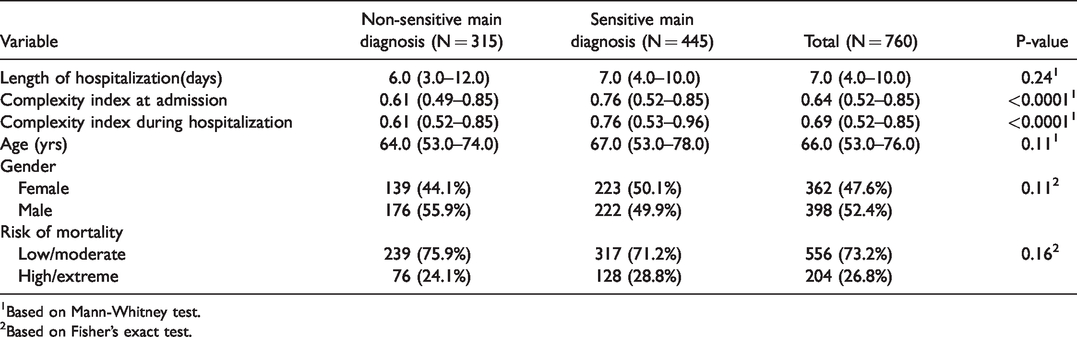
Over a six-month period (October 2018 to March 2019), there were 818 hospital admissions. We identified 760 cases with complete information for the statistical analysis. When PCSC were analyzed as the primary diagnosis of hospitalization, the median length of hospitalization was 7 (4 – 10) days, the median complexity index at admission was 0.76 (0.52 – 0.85), median age of 67 (53–78) years, 50.1% were female and the high/extreme mortality risk was 28.8%. When patients with PCSC were compared with patients hospitalized for non-sensitive causes, overall complexity (high complexity at admission and during hospitalization) was statistically different, whereas age and risk of mortality were not different (Table 1).
Comparison of Demographic Characteristics, Length of Hospitalization, Complexity and Risk of Mortality Among Groups According to the Primary Diagnosis—Non-Sensitive or Sensitive to Primary Care.
1Based on Mann-Whitney test.
2Based on Fisher’s exact test.
Quantitative variables denoted as median (IQR) and categorical variables as n (%).
When causes sensitive to primary care were included as a secondary diagnosis of hospitalization, the median length of hospitalization was 7 (4–11) days, median complexity rate at admission was 0.69 (0.52–0.85), median age was 67 (57–78) years, 47.8% were female and high/extreme mortality risk was 29.5%.
In comparison to patients hospitalized for non-sensitive causes, patients with PCSC were more likely to be older, in a more severe clinical status both at admission and during hospitalization, at a high/extreme mortality risk, and with longer length of hospitalization (Table 2).
Comparison of Demographic Characteristics, Length of Hospitalization, Complexity and Risk of Mortality Among Groups According to Secondary Diagnosis—Non-Sensitive and Sensitive to Primary Care.

1Based on Mann-Whitney test.
2Based on Fisher’s exact test.
Quantitative variables denoted as median (IQR) and categorical variables as n (%).
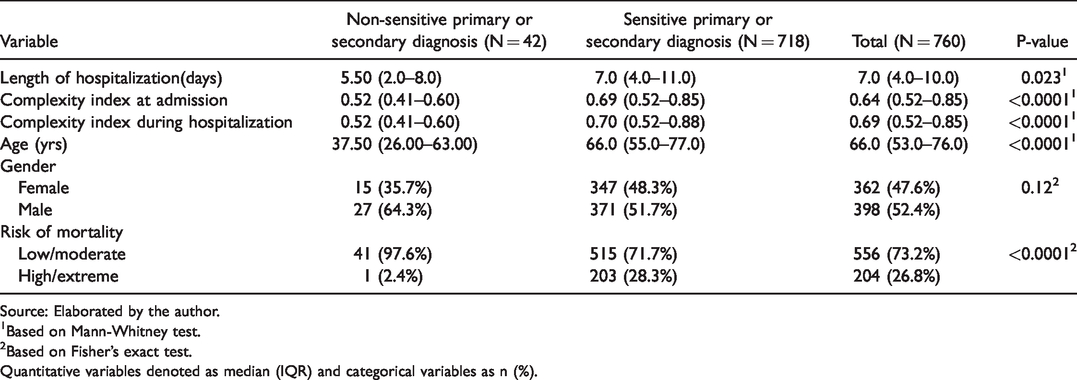
When PCSC were included as the primary diagnosis or secondary diagnosis of hospitalization, the median length of hospitalization was 7 (4–11) days, complexity index at admission was 0.69 (0.52–0.85), median age was 66 (55–77) years, 48.3% were female and the high/extreme mortality risk was 28.3%. In comparison to patients hospitalized for non-sensitive causes, patients with PCSC were more likely to be older, in a more severe clinical status at admission and during hospitalization, at a high/extreme mortality risk, and with longer length of hospitalization (Table 3).
Comparison of Demographic Characteristics, Length of Hospitalization, Complexity and Risk of Mortality Among Groups According to the Primary or Secondary Diagnosis—Non-Sensitive and Sensitive to Primary Care.
Source: Elaborated by the author.
1Based on Mann-Whitney test.
2Based on Fisher’s exact test.
Quantitative variables denoted as median (IQR) and categorical variables as n (%).
Discussion
To the best of our knowledge, this is the first study conducted at the public health system level in Brazil by using the DRG system to assess all-cause hospitalizations with a focus on key factors such as the demographic profile, length of hospital stay, severity index, and mortality risk. Moreover, we focused our primary objective on hospitalizations due to primary care-sensitive conditions, which have been established as a quality indicator of primary care, indeed a very relevant feature of the public health system that provides universal coverage for the population in Brazil. This study has particular significance once in 2006 PCSC comprised 28.5% of all national hospitalizations, which corresponds to a rate of 150 hospitalizations/10,000 inhabitants. In Italy, the rate was 26.1/10,000 inhabitants, 15 and in Switzerland, the rate was 10/10,000 inhabitants, 16 taking methodological, temporal and population parameters of each study into consideration. 17
Based on the results, in relation to the complexity of the patient upon admission, we observed a higher risk of worse outcomes during hospitalization. Appropriate clinical assessment at admission is, therefore, paramount for the establishment of adequate diagnostic and therapeutic strategies. Networking is fundamental for improving patient treatment, so that most patients hospitalized for PCSC receive appropriate therapies. 18
Professional training is an important factor for the follow-up of therapeutic plans, as well as for the completeness of the data added to the patient health records. This feature has a direct impact on the correct ascertainment of the key diagnosis. 19
Once patients are admitted to the hospital, their therapeutic plans are directed toward clinical stabilization, proper treatment as recommended by current clinical evidence and hospital discharge. As a patient remains in hospital, costs increase and the expectation of significant improvement decreases, especially for elderly patients and young children. 19
Patients that stay in hospital longer than expected tend to have worse outcomes. Patients with a diagnosis (primary or secondary) of PCSC remain in hospital for 4 to 11 days, and there are clinical factors that might add risk of life-threatening events. For instance, patients who stay longer than needed for the management of the initial condition might suffer from depression, immobility, and possibly poor hydration, thus being at higher risk of venous thromboembolic events and/or infections such as pneumonia. Moreover, a better reallocation of resources due to faster hospital bed turnover may improve care for these patients.20,21
The level of difficulty to proceed with patient discharge is usually increased when the clinical condition requires specific and continuous care. Health conditions that require constant monitoring and follow-up after hospital discharge lead to greater difficulty when compared to other conditions for which a close follow-up is not clinically indicated. 22
The longer the hospital length of stay, the higher the financial burden to the SUS. 23
The occurrence of “bed turnover” is also important to mention, as the PCSC represent a significant proportion of the admissions to the hospital's emergency department. 21
Primary care represents one essential portion of health care, and should provide broad coverage of care for individuals, families and the community, and ideally at a cost that the community and the country can sustain at each stage of its development. 24
Conclusion
A significant proportion of patients were hospitalized due to PCSC and these patients tended to have a longer hospital length of stay, greater complexity and, possibly, greater severity, in relation to non-sensitive causes. Moreover, the risk of mortality is higher in patients with a primary or secondary diagnosis involving PCSC compared to non-sensitive conditions.
Better primary care could potentially reduce hospital admissions and the associated costs.
Footnotes
Conflict of Interest
The authors declare that they have no conflict of interest.
Declaration of Conflicting Interests
The author(s) declared no potential conflicts of interest with respect to the research, authorship, and/or publication of this article.
Funding
The author(s) received no financial support for the research, authorship, and/or publication of this article.
