




Abstract
The Journal of Marketing Education (JME) was launched almost 35 years ago. In this invited article, we review JME’s long and distinguished history. For historical perspective, we will lean heavily on the words of JME editors (including special issue editors); this focus adds context for the past and helps project the future. As a descriptive tool, we highlight key trends as they emerged over the years, and we offer a categorization rubric for simplifying cross-era comparisons. We also spotlight the most active authors over the years, note JME outstanding articles of the year, and highlight the most frequently cited articles. In presenting this historical review, we first discuss the methodology used for creating categorical areas and then present the findings for each of the four eras. We then provide an overview of each area and cross-era trend assessment. And finally, we conclude with future research directions.
Keywords
Introduction
Almost 35 years ago, scholars acknowledged the need for a new journal focused exclusively on advancing marketing education research and application in the classroom, and the Journal of Marketing Education (JME) was born. Since its inception, JME has had seven editors who together have published more than 800 articles.
JME’s first issue was published in 1979 under the guidance of Steven H. Achtenhagen (1979-1980). In JME’s first “Editor’s Corner” (then called “Letter from the Editor”), Achtenhagen writes This is the first issue of Journal of Marketing Education. It has been conceived to fill a market niche: Providing a medium for the exchange and dissemination of information about the teaching of marketing by and for marketing educators. You are invited to submit your ideas; ideas which will have the impact of enhancing the effectiveness of teaching marketing. These ideas should not be limited to “techniques” in a mechanical sense. Instead, and in addition to techniques, manuscripts would be welcome that are concerned with course content, innovations in ways of presenting old ideas, interactive computerized models of the real world, bibliographies, and presentation plans. (1979, p. 2)
Since that time, JME has been under the editorial leadership of Phillip Cateora (1981-1992), Robert Collins (1992-1995), Bruce Stern (1995-1998), Craig Kelley (1998-2001), and Douglas Lincoln (2001-2011). In 2012, JME editorial responsibilities were passed to Donald Bacon from the University of Denver. With the ending of Lincoln’s 11 years of service and to honor past editors, this transition marks an appropriate moment to assess JME’s evolution from its humble beginnings in 1979 to today, where JME is recognized as a leader in business education and is the highest-ranked marketing education journal (Hofacker, Gleim, & Lawson, 2009; Polonsky & Whitelaw, 2006; Steward & Lewis, 2010; Touzani & Moussa, 2010). Although the marketing education landscape certainly has changed since 1979 and content has evolved, the core principles expounded by Achtenhagen still ring true today. As Lincoln wrote in 2011, “We only want to publish articles that our readers can use to improve their role as marketing educators” (p. 3). This is an exciting time for marketing educators as we strive to meet the needs of students (and employers) through the use of emerging technologies and pedagogies.
In this invited article, we review JME’s long and distinguished history, examining its 34 years across four eras: 1979-1989, 1990-1999, 2000-2009, and 2010-2012 (through Issue 1, April). For historical perspective, we lean heavily on the words of JME editors (including special issue editors); this focus adds context for the past and helps project the future. As a descriptive tool, we highlight key trends as they emerged over the years, and we offer a categorization rubric for simplifying cross-era comparisons. We also spotlight the most active authors over the years, note JME outstanding articles of the year, and highlight the most frequently cited articles. In presenting this historical review, we first discuss the methodology used for creating categorical areas and then present the findings for each of the four eras. We then provide an overview of each area and cross-era trend assessment. And finally, we conclude with future research directions.
Method
It was a considerable challenge to develop a rubric for documenting and categorizing JME articles across the four eras. Since the marketing education field has evolved dramatically over the years, it was important to create a mechanism for comparing the conceptual and applied orientations within and across the four eras. With this in mind, we used the following process to derive our categorization rubric:
Prepared data files: All articles published in JME from 1979 to 2012 were placed in one of the four aforementioned eras: 1979-1989, 1990-1999, 2000-2009, and 2010-2012. Articles were coded into a database to include the volume, issue, author(s), title, and abstract. Software reviews, introductions to special issues, and editor notes were excluded.
Examined past review articles to identify potential categories: We then examined the review articles by McIntyre and Tanner (2004) and Abernethy and Padgett (2011) that cataloged marketing education and authorship in JME and Marketing Education Review for the years 1990-1999 and 2000-2009, respectively. The review’s purpose was to reduce their topical areas to a more manageable set of potential categories that could then be compared across eras.
Conducted initial cross-era categorization: Using our initial categorization rubric, each of the three authors independently reviewed JME’s articles from 1979 to 2012 and identified the primary, secondary, and tertiary topics. The initial coding scheme was purposely “loose” and served as a starting point for identifying common content patterns in the articles.
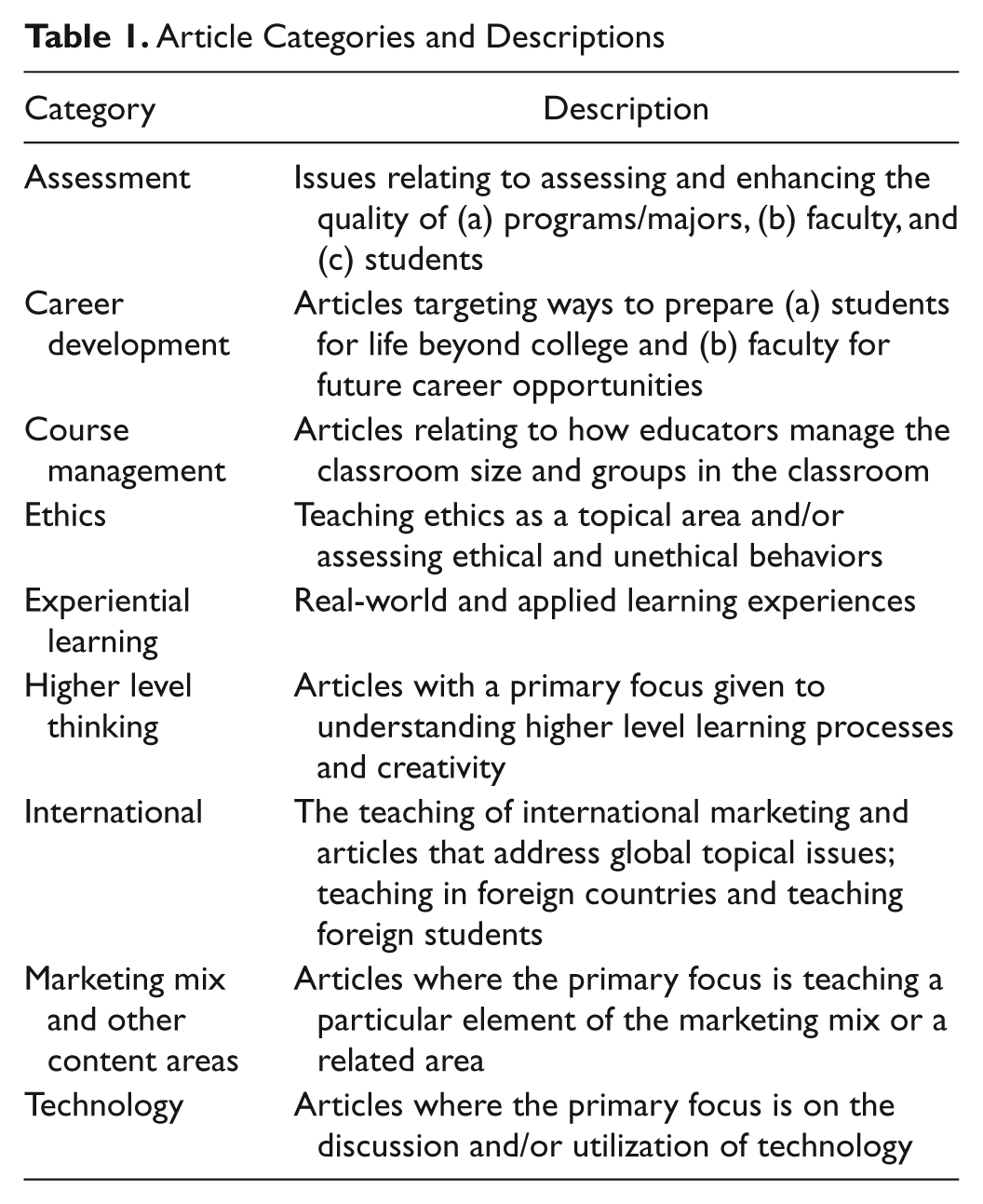
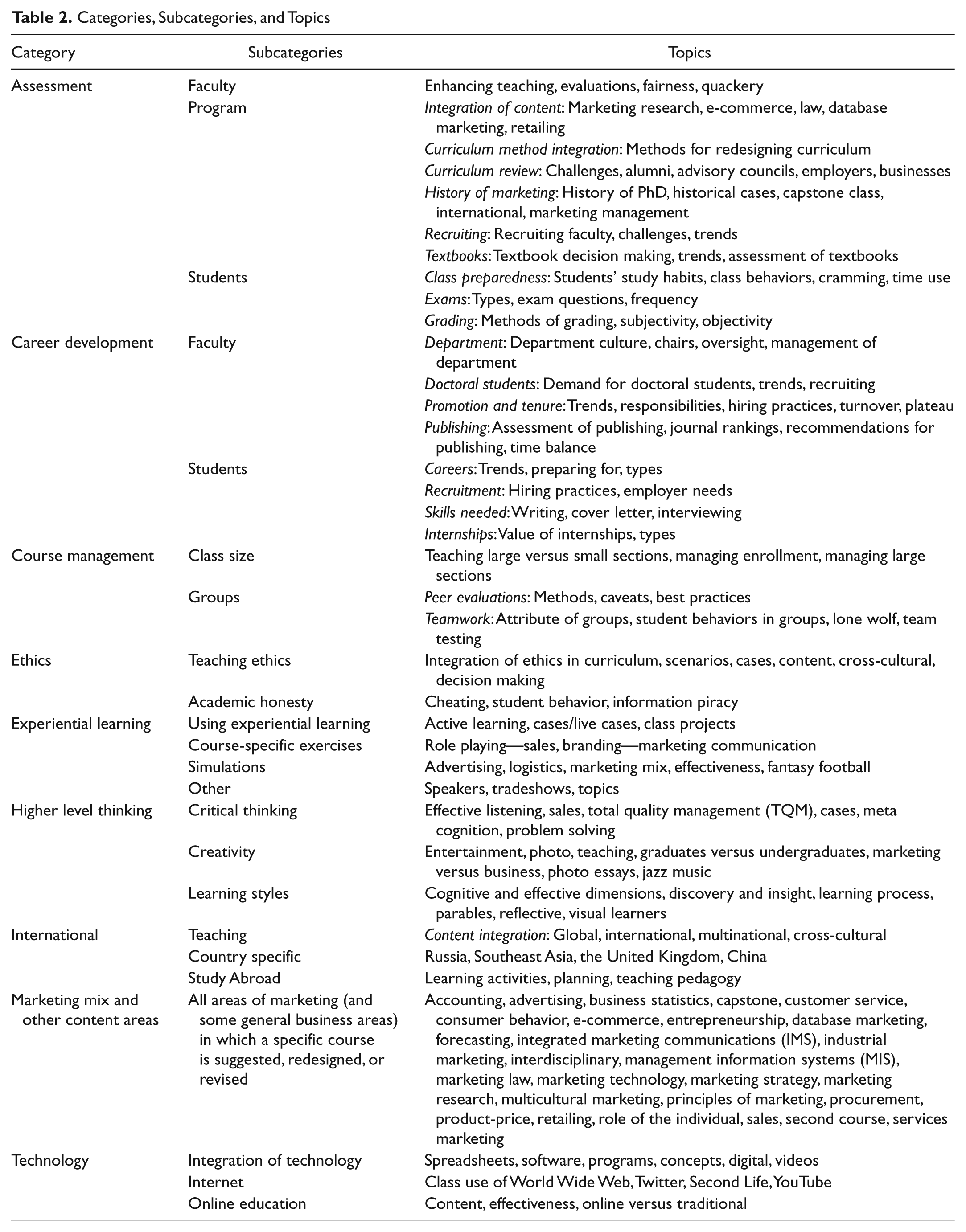
Discussed and refined coding rubric: Once the 1979-2012 articles were categorized by each author, several teleconferences took place to compare these initial categorizations and to discuss rubric modification. As would be expected with only loose guidelines provided for the initial coding process, approximately 20% of articles had some disagreement among the authors with regard to the primary topic versus secondary topic. During these discussions, better categorical names were established, broader categories were developed, and a more refined categorization process was created across a tighter set of categories. After approximately 10 discussion sessions, we refined our topical areas into the final categories, noting the complexity of the process. The final categories are shown in Table 1 along with a description of each category. Table 2 identifies subcategories and provides exemplars for each one. While we fully acknowledge that others might choose a different categorization scheme, we believe that it is useful for the purpose at hand and incorporates insights offered by McIntyre and Tanner (2004) and Abernethy and Padgett (2011).
Conducted final coding of papers: Lastly, we used the final coding rubric to again categorize all of the articles from 1979 to 2012 into primary, secondary, and tertiary topics. Although we do not report secondary and tertiary topics here, they were useful for generating agreement across the authors. In 100% of the cases, at least two of the three authors agreed on the primary and secondary topic; about 5% had to be resolved through discussion. In most cases, discrepancy stemmed from initial disagreement concerning the primary versus secondary topic (i.e., advertising simulation vs. advertising course).
Article Categories and Descriptions
Categories, Subcategories, and Topics
Discussion of Results
In presenting the results, we first provide an overview of the frequency of categorical coverage from 1979 to 2012. We then discuss each individual era and conclude with a discussion on the evolution of topics across JME’s 34 years in existence.
Overall Summary of Publications by Category 1979-2012
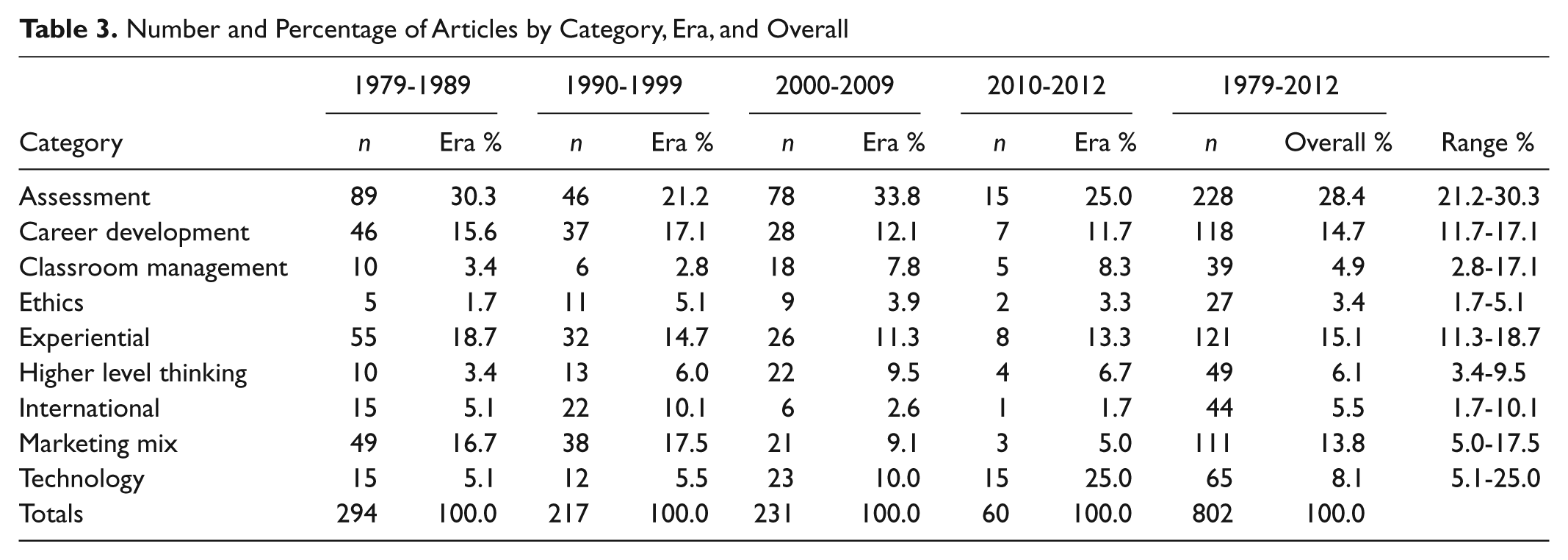
Table 3 provides the number and percentage of articles by category, era, and overall frequency/percentage of categorical coverage within each of the four eras and as a total percentage of coverage from 1979 to 2012. The categories are sorted in terms of the overall percentage of articles from 1979 to 2012. Because the number of articles varied by era, percentage of articles per era was used so that direct comparisons of topical coverage could be made across the eras. Table 4 contains a detailed breakdown of subtopics within and across eras.
Number and Percentage of Articles by Category, Era, and Overall
Categories and Subcategories, Percentage and Number of Articles by Era

Assessment was the most popular area in terms of article counts (n = 228) and overall percentage (28.4%). As noted in Table 1, Assessment focuses on issues relating to evaluating and enhancing the quality of (a) programs/majors, (b) faculty, and (c) students. As Table 4 shows, within the Assessment category, program-related assessment accounted for 14.7% of all articles published from 1979 to 2012. Faculty assessment (10%) and student assessment (3.7%) completed the Assessment publication hierarchy.
Articles focusing on Experiential Learning had the second greatest number and percentage of articles published from 1979 to 2012 (n = 121, 15.1%); Career Development (n = 118, 14.7%), and Marketing Mix articles (n = 111, 13.8%) were close behind. Specific to Experiential Learning, course-specific exercises had the greatest overall article counts (n = 24, 3%), followed by articles examining cases (n = 23, 2.9%) and simulations (n = 18, 2.2%). For Career Development, there were more articles focusing on faculty (n = 80, 10%) than on student (n = 30, 3.7%) needs. Regarding the Marketing Mix category, principles of marketing received the most attention (n = 33, 4.1%), followed by sales (n = 15, 1.9%) and marketing research (n = 13, 1.6%). These top four categories together made up 72% (n = 578) of the articles published in JME from 1979 to 2012 (assessment, experiential learning, career development, and marketing mix).
The remaining five categories accounted for 28% (n = 224) of the 802 articles published since JME’s inception, and each of the remaining five categories represented well under 10% of all articles published overall. Technology (n = 65, 8.1%) and Higher Level Thinking (n = 49, 6.1%) were fifth and sixth, respectively. Integration of technology into the classroom accounted for the majority of Technology articles (n = 32, 4.0%), whereas articles about Higher Level Thinking were fairly evenly distributed across the subcategories (critical thinking, creativity, and learning styles).
International (n = 44, 5.5%), Classroom Management (n = 39, 4.9%), and Ethics (n = 27, 3.4%) constituted the bottom three categories in terms of number of published articles. The majority in the International category concerned integrating international content into the classroom (n = 25, 3.1%), and the majority of Ethics articles were about integrating ethics into the classroom (n = 13, 1.6%). The majority of Classroom Management articles were about working with groups (n = 28, 3.5%).
Outstanding Articles, Research Productivity, and Top-Cited Articles
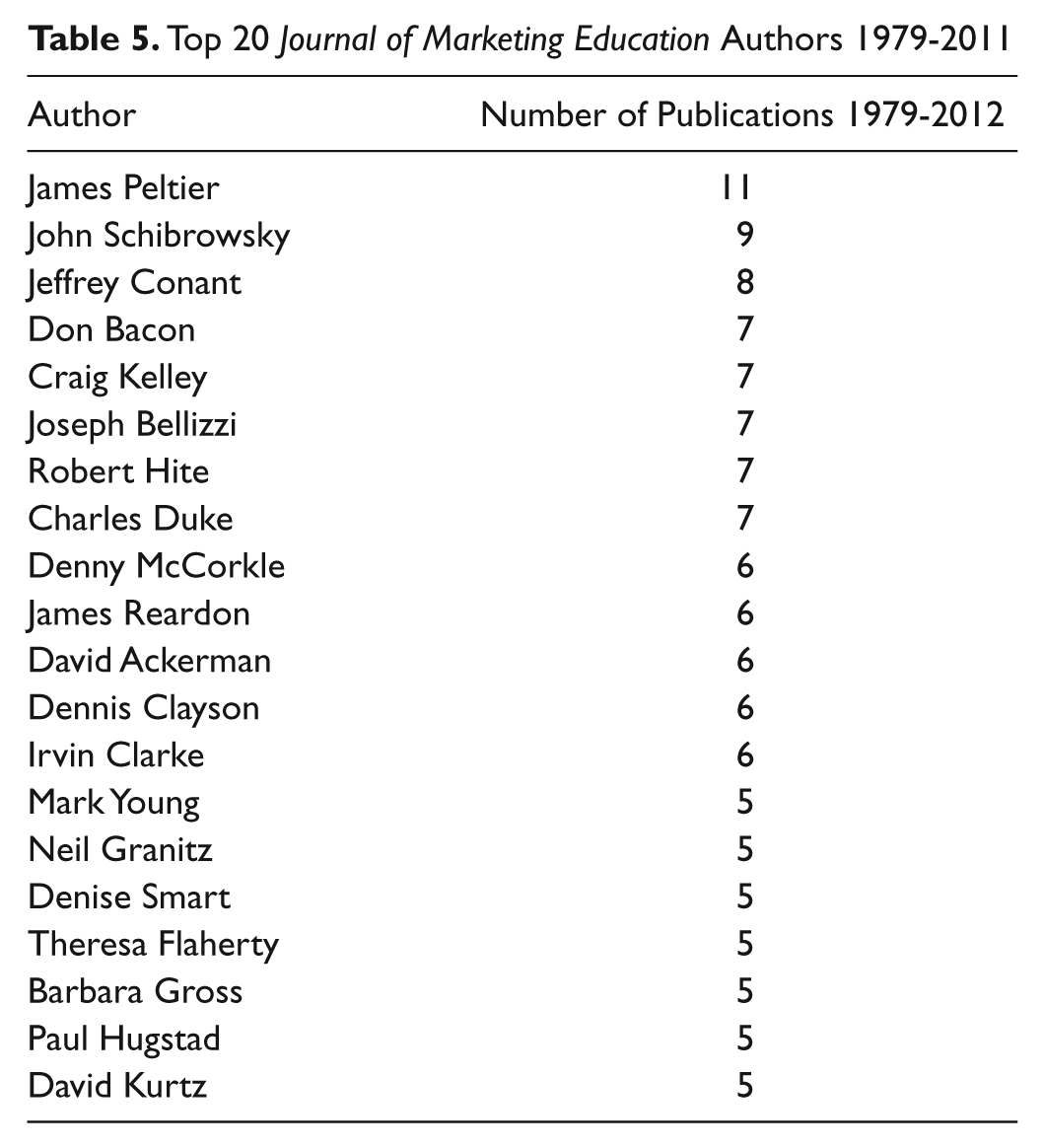
Before leaving this section, we would like to acknowledge those authors who won the JME outstanding article of the year and who have been the most productive in terms of article count and citations. The selection of the outstanding article of the year began in 1983 and was awarded to Michael Houston and Shelby D. Hunt for their article titled “The BBA-MBA Combination: Pierson, Gordon and Howell Revisited.” For this article, we combed through the JME archives to identify the award winning articles for 1983-2011. The list we generated is now posted on the JME website (under Editor’s Choice Collections). Note that for some years the award was presented for the calendar year, whereas some have overlapping issues across two separate years. There are also several years when no award was given. Special recognition goes to Jeffrey Conant, Denise Smart, and Craig Kelley, who won the outstanding article of the year three times, and to Stephen Koernig, William Lundstrom, Katrin Harich, and Steven White, who won it twice. Table 5 presents the top 20 authors, each of whom had at least five articles published from 1979 to 2012. James Peltier (11), John Schibrowsky (9), Jeffrey Conant (8), Don Bacon (7), Craig Kelley (7), Joseph Bellizzi (7), Robert Hite (7), and Charles Duke (7) head this list. We also note most of the top 50 via era-by-era analyses, based on citation counts on June 1, 2012. JME and SAGE update the citation counts on a monthly basis (http://jmd.sagepub.com/reports/most-cited). As would be expected, articles after 2005 have not yet made the top 50 citations. Thus, we encourage readers to access the SAGE citation index on a regular basis to see how rankings are evolving over time.
Top 20 Journal of Marketing Education Authors 1979-2011
Comparing Categories Across Eras
Although it is difficult to present a clean synopsis of categorical coverage trends across the eras, some key generalizations may be drawn from Table 3 and Figure 1. First, Assessment had the greatest percentage of articles regardless of era (tied by Technology for 2010-2012), with a range between 21.2% and 33.8%. As such, assessing programs, faculty, and students has been a high priority by JME and its authors since the journal’s inception. Along these same lines, Experiential Learning (11.3% to 18.7%) and Career Development (11.7% to 17.1%) never dropped below 10% of the articles published in any of the four eras. Combined, the percentage of Assessment, Experiential Learning, and Career Development never dipped below 50% of the articles in any era, ranging from 64.6% in 1979-1989 to 50% for 2010-2012.
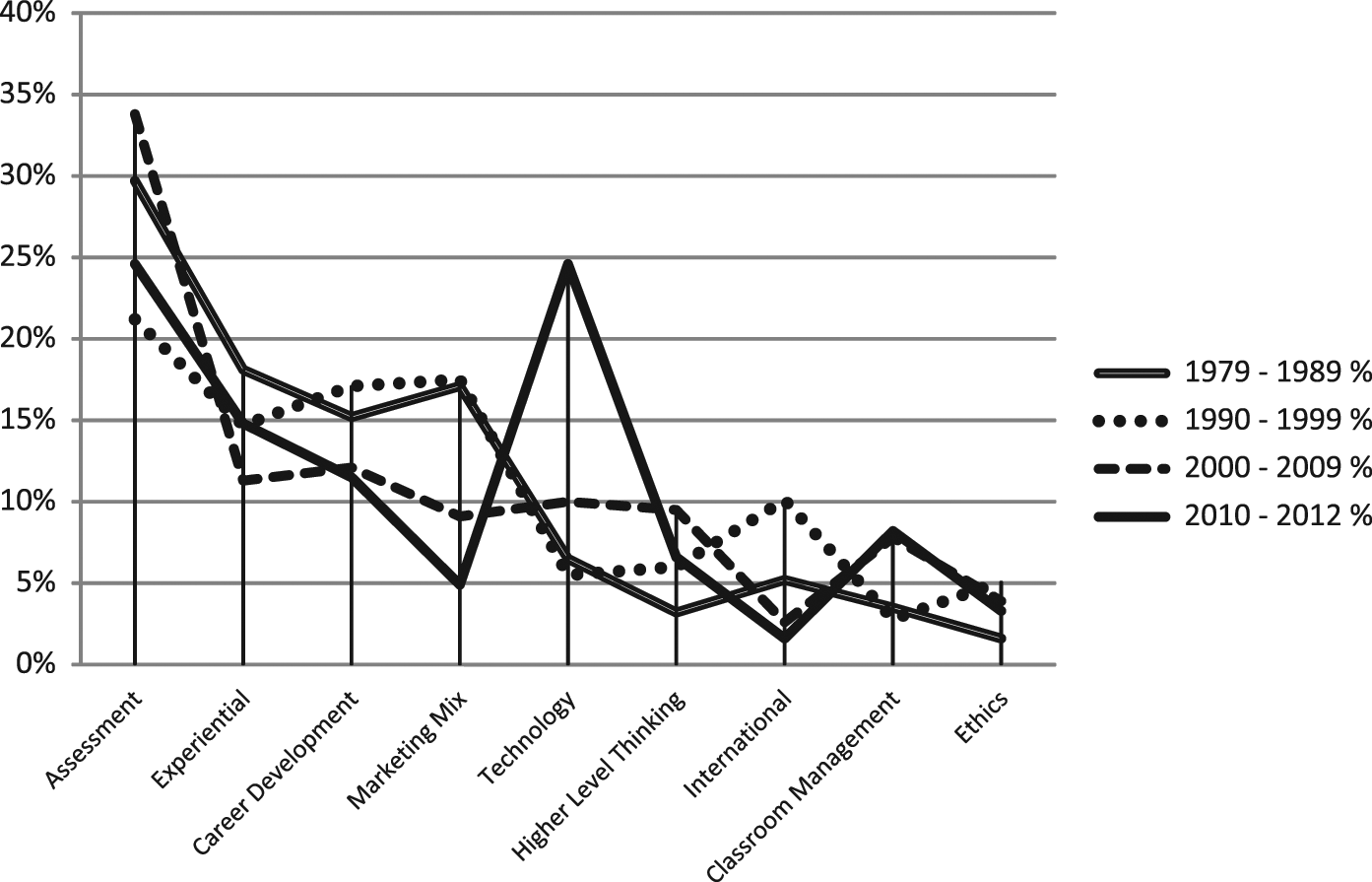
Categorical trend lines by era
Second, there was substantial variation in terms of the categorical coverage across the eras. Technology had the greatest variation (5.1% to 25%), growing to 10% of JME articles in 2000-2009 and then exploding to 25% for 2010-2012. As we note in the era-by-era discussion, technology subtopics were also varied, specifically concerning how technology was defined and used in the classroom over the years. The Marketing Mix category also witnessed considerable variation over the years (5% to 17.5%). Marketing Mix content represented nearly 17% of the articles for 1979-1989 and 1990-1999, before dropping to 5% for 2000-2012. As a relatively new journal at that time, enhancing the educational experience in traditional marketing classes was thus a research priority. Marketing Mix issues have seen a resurgence with the addition of new types of classes, and this category represented 13.8% of the articles for 2010-2012. In terms of variation, the International category as a percentage of JME coverage is relatively small compared with other categories although this topic has fluctuated dramatically over the years. International coverage was highest in 1990-1999 (10.1%) as universities were starting to think more globally, but this category has dropped to 1.7% thus far for 2010-2012.
Analysis of Content by Era
We next turn to a discussion of categorical and subtopical coverage within the individual eras. For each of the eras, we first provide introductory comments, followed by a detailed evaluation of the content published in each era, including the most-cited articles.
1979-1989: The Birth of JME
Era introduction
The Journal of Marketing Education was officially launched in April 1979 under the editorial leadership of Achtenhagen and the publishing arm of the Western Marketing Educator Association. At this time, JME was the only journal focusing exclusively on marketing education. Two issues were published each year during this era (Volumes 1-4). The journal’s frequency increased to three issues per year starting in 1983, which has continued through 2012. Also in 1983, the University of Colorado Boulder’s marketing division and business research division became the cosponsor of JME. As shown in Table 3, the 1979-1989 period had the greatest number of publications with 294 (36.6%) overall. Phillip Cateora assumed editorial control
1
in 1981, and he oversaw JME for the era’s remaining years (Cateora remained the editor until 1992). During his early years as editor, Cateora (1981) noted that … the environment of business education is in a state of change is not a revelation to the readers of the Journal of Marketing Education. Students’ academic preparation, goal orientation, attitudes, and needs are certainly different from just five years ago… . In short, our world is changing and we are changing with it. (p. 2)
Volume 1, Issue 1, published in 1979, provides a clear snapshot of what JME was to become over the next decade. Three articles in the issue kick-started the need for program assessment: “Matching the Marketing Curriculum to Market Needs” (Done, 1979), “Toward a Professional Marketing Education” (Berdine & Hopkins, 1979), and “Planning and Developing an Effective Teaching Strategy for Adult Marketing Education in Academic Courses, Continuing Education or Management Development Programs” (Weinrauch, 1979). Wynn and Crawford (1979; “The Basic Marketing Course Utilizing an Emergent Simulation Approach”) and Marcus (1979; “Experiential Learning in Marketing: Synthesis and Action for a Capstone Course”) spotlighted attention on the need to expose students to experiential learning from entry level to capstone courses. Griksheit (1979; “Teaching Personal Selling: Macro and Micro Perspectives”), Pride and Ferrel (1979; “Are Marketing Academicians’ Preferences for Frameworks and Topics in Introductory Marketing Texts Changing?”), and Reed (1979; “A Competency-Based Method of Grading for the Marketing Principles Course”) provided initial coverage of marketing mix and related courses. Lastly, Grimm, Skinner, and Ferrell (1979) published the first JME article on technology (“Computer-Assisted Instruction for the Basic Marketing Course: A Student Evaluation”).
Content discussion
Publications from JME’s beginning stage suggest that authors and reviewers followed the direction set forth by JME’s first editor, Achtenhagen. Thus, articles in this decade focused on building better programs and becoming better faculty. In this regard, the launch era set the tone and foundation for decades to come. Table 3 shows Assessment (n = 89, 30.3%), Experiential Learning (n = 55, 18.7%), Marketing Mix (n = 49, 16.7%), and Career Development (n = 46, 15.6%) were the hottest topics, accounting for 81.2% (n = 239) of all articles published during the 1979-1989 period and almost one third (29.8%) of all articles published in JME’s 34-year history. Together, these 239 articles are the foundation on which JME was built.
The 1979-1989 era was different from others in that it had the highest percentage of Program Assessment articles compared with future decades (n = 55, 18.7% of all articles within the decade). The first JME outstanding article of the year by Houston and Hunt (1983) titled “The BBA-MBA Combination: Pierson, Gordon and Howell Revisited” helped jump-start interest in Program Assessment. Interest was further sparked by Cateora’s (1985) editorial queries: … time to be serious about reviewing marketing curricula? … Is our curriculum, whose basic structure was established in the 50’s and has been “resoled every five years or so with cosmetic adjustments, capable of surviving the next 20 years of change that our economy will undergo? Or, do we need new shoes? (p. 1).
Not surprisingly, an article titled “The Marketing Curriculum: A Decade of Change” appeared in the next issue (McDaniel & Hise, 1984). Two years later, William Stanton’s article “It’s Time to Restructure Marketing in Academia” won the 1988 JME outstanding article of the year. From this era, Schleede Jr. and Lepisto’s 1984 article titled “Marketing Curriculum Development: Model and Application” remains one of JME’s most-cited articles.
The interest in Faculty Assessment in the form of teaching enhancement emerged in this era with the article “Master Teaching: Pursuing Excellence in Marketing Education” (Conant, Smart, & Kelley, 1988). In addition to being a top 50 cited article, this article won the outstanding article of the year for 1988. Many of the JME’s later articles on Faculty Assessment were motivated by this work, including a second outstanding article of the year for Conant, Smart, and Kelley in 2003.
Experiential Learning was an important focus in this first decade (n = 55, 18.7%). In fact, 45.4% of all articles published byJME on experiential learning were published between 1979 and 1989. Of the top 50 cited JME articles, three were on Experiential Learning from this era. de los Santos and Jensen (1985) introduced “Client-Sponsored Projects: Bridging the Gap Between Theory and Practice,” Wynd (1989) provided a broad framework in “An Experiential Approach to Marketing Education,” and Curt J. Dommeyer (1986) addressed live cases in “A Comparison of the Individual Proposal and the Team Project in the Marketing Research Course,” which remains the most-cited article of the introductory era. All these articles laid the framework for future research in providing students with real-world marketing experience.
Career Development focused more on faculty (n = 31, 10.5%) than on students (n = 15, 5.1%) and primarily emphasized the promotion and tenure and publishing categories (combined, n = 23, 7.8%). One article suggested that academics could be cowards (English, 1984), whereas another proposed strategies for career success (Burnett, Amason, & Cunningham, 1989). Authors pondered opportunities for publishing (Wynd, 1989) and lamented about painful manuscript writing (Sawyer, 1988) and about how difficult it can be to read our own articles (Clark & Geisler, 1986). Later research on student career development owes much of its interest to the top 50 cited article by Boatwright and Stamps (1988) titled “Employers’ Importance Ratings of Student Characteristics: A Conjoint Analysis Approach.”
Marketing Mix articles (n = 49, 16.7%) focused primarily on principles of marketing (n = 16, 5.4%) and marketing research (n = 11, 3.7%); the remaining 22 articles were mostly spread across advertising, consumer behavior, retailing, and sales. Jack Gifford’s article titled “Teaching Retail Financial Management to Marketing Majors” won the best paper award for 1986, while “A Quick-Reference Guide to Text-Based Systems for the Basic Marketing Course” (Bertsch, 1984) remains one of JME’s most-cited articles.
Although Technology was only the fifth most-published content issue, a mini-special issue on microcomputers in the classroom was published in 1983. When introducing the three articles on computer technology, Cateora (1983) noted, “The microcomputer ‘revolution’ is here. Are we ready for it? … Has ‘state of the art’ reached marketing education? Are we providing students with the necessary tools to use micros in their marketing careers?” (p. 1). The article by McKinnon, Smith, and Smith titled “The Diffusion of Personal Computers Among Business School Faculty: A Longitudinal Study of Attitudes, Expectations, and Uses” won the outstanding article award for 1985.
Most cited articles of era
Among the 50 most-cited JME articles as of June 2012, 7 were published during this era (none from 1979-1983) and focused on Assessment, Experiential, Marketing Mix, and Technology issues. These articles consisted of “A Comparison of the Individual Proposal and the Team Project in the Marketing Research Course” (Dommeyer, 1986), “Bringing Reality to the Introductory Marketing Student” (Henke, 1985), “Client-Sponsored Projects: Bridging the Gap Between Theory and Practice” (de los Santos & Jensen, 1985), “Master Teaching: Pursuing Excellence in Marketing Education” (Conant et al., 1988), “An Experiential Approach to Marketing Education” (Wynd, 1989), “A Quick-Reference Guide to Text-Based Systems for the Basic Marketing Course”(Bertsch, 1984), and “Marketing Curriculum Development: Model and Application” (Schleede & Lepisto,1984).
1990-1999: The Teen Years, JME Is Growing Up
Era introduction
The 1990s were a time of growth, transition, and reputation building. During this time period, JME transitioned through the leadership of four editors, the evolution of e-mail communication, the process of adding its first of four special issues, and the launch of a competing marketing education journal in 1991 (Marketing Education Review). Cateora began preparing writers and readers that change was indeed inevitable in his status report, which appeared in December 1989. Cateora (1989) indicated that journal submissions had increased by 50% in 1988 and 1989 and that new priorities would need to be implemented for the new decade: Since we are limited to three issues per year, the increased flow of articles means that, as Editor, I have a larger field from which to choose. It also means that I must be more selective about the types of articles accepted. (p. 1)
Cateora (1989) also noted, “Since we are dedicated to our craft of teaching, first priority goes to articles that focus on ways to improve teaching marketing” (p. 1), and all other articles would receive second priority. For the first time in JME history, the journal would encourage writers to consider submitting to other journals if their manuscripts were not a good fit. Growing pains also taxed reviewers who were increasingly reviewing more articles. For this challenge, Cateora encouraged new reviewers to send résumés and announced that the more seasoned reviewers would be added to an expanded editorial review board.
In the summer of 1992, Cateora passed the editorial baton to Robert Collins of the University of Nevada, Las Vegas. Though unknown to Cateora at the time, Collins’s leadership and priorities set the stage for JME’s growth into a premier-quality marketing education journal.
Collins (1992-1995) began his tenure as editor of JME in the fall of 1992. In his first issue as editor he indicated that “the journal was ‘capacity constrained’ and good quality manuscripts were being turned away” (Collins, 1992, p. 1). Under Collins’ leadership, there were several notable firsts: JME obtained its first e-mail address and had its first special edition on services marketing education, as well as its first senior guest editor (Terri Swartz of California Polytechnic University), a guest-Europe editor (Hans Kasper of University of Limburg), and a guest-Pacific editor (Paul Patterson of University of Wollongong). Collins (1993) explained, “Interest in the marketing of services is growing rapidly and services is one of several areas in marketing education where the business community has taken the lead from us” (p. 1). Collins announced a second special issue on personal selling and sales management to be published in fall 1995. This was his last issue as editor, and he subsequently passed JME editorial responsibilities to Bruce Stern (1995-1998).
Stern (1996) wrote in the first “Editors Corner” (previously “Letter from the Editor”), “… I very much believe that (JME) needs to focus on original contributions that aid marketing educators in the areas of pedagogy, curriculum, and innovation and faculty issues” (p. 1). Stern also reiterated, “As a result, the structure of the journal will not be changed and you will not find book and software reviews, reader comments, rejoinders, or advertising here” (p. 1). Under his tenure, there were two more special issues, each focusing on what he promised—aiding educators. Special issues were published on the future of education (fall 1997) and global marketing education (summer 1998). Stern was the first editor to provide highlights of the contents for each edition he published. In his final edition, he continued this personal signature saying, “I hope you will take the opportunity to pause and review this issue of the Journal of Marketing Education as it provides a number of ideas that you might find useful in your teaching and other faculty related activities” (Stern, 1998, p. 1).
Kelley’s role as the last editor in the 1990s began with the spring 1999 issue in which he stated the following: The goal of the journal is to provide quality articles that serve as a valuable resource for marketing educators. It is my belief that a rigorous review process is necessary to make good manuscripts better and that the role of the editor is to help authors improve their contribution to the literature. (1998, p. 1)
Very worthy concerning Kelley’s leadership and contribution to JME is that he coauthored two of the top 10 cited articles in the 1990s and four of the top 50 most-cited articles, more than any other author. Kelley is likewise one of the top producers, contributing seven articles to JME.
Content discussion
There were 217 articles published in JME’s second decade, and 80.6% (n = 175) of these came from five categories, including Assessment (n = 46, 21.2%), Career Development (n = 37, 17.1%), Marketing Mix (n = 38, 17.5%), Experiential Learning (n = 32, 14.7%), and International (n = 22, 10.1%). Though Assessment again ranked first among categories, a fewer number of assessment articles were published in the 1990s than in other eras (excluding the shortened 2010 era). Three of the eight annual outstanding JME article awards in this decade were in the assessment category. These include “Meeting the Challenges of Undergraduate Marketing Education” (Lamont & Friedman, 1997), which is ranked seventh most-cited (1997 outstanding article); “Marketing Student Perceptions of Learning Activities: Structure, Preference and Effectiveness,” (Karns, 1993); and “Marketing Education in the Year 2000: Challenges Observed and Challenges Anticipated” (Smart, Kelley, & Conant, 1999), which is currently the top-cited article in JME.
Career Development had the highest number of articles focusing on promotion and tenure across all four decades (n = 11, 5.1%), with nearly 50% of JME’s promotion and tenure articles appearing in this decade. “Marketing Madness, or How Marketing Departments Think They’re in Two Places at Once When They’re Not Anywhere at All” (Chonko & Caballero, 1991) won the ninth annual outstanding JME article award.
The Marketing Mix category continued growing and topped out in the 1990s with 38 articles (17.5%). The continued growth in this decade can be attributed to the special issues that focused on services marketing education and personal selling and sales management (combined, these two issues accounted for 13 of the 38 articles in this category). Interestingly, this decade accounted for 6 of the 7 articles categorized in services marketing and 7 of 15 articles in sales. One of the articles published in the services education special edition is the 38th most-cited JME journal article (Wright, Bitner, & Zeithaml, 1994), whereas none of the articles featured in the sales special issue made the top 50 cited list. Nearly 7 years earlier, the Journal of Services Marketing was first published (1987), which may account for the low number of articles focusing on services marketing education.
Well more than one third of the Experiential Learning articles consisted of course-specific exercises, and the 13 articles accounted for 6% of all articles for the decade and 54.1% of all course-specific articles. “An Experiential Approach for Integrating Ethical Analysis Into Marketing Coursework” was named the outstanding JME article in 1990 (Gaidis & Andrews, 1990).
The International category exploded in the 1990s, and there was more emphasis on articles on programs in other countries (n = 4, 1.8%) and teaching foreign students (n = 4, 1.8%). Both these subcategories accounted for nearly all articles in these subcategories across the eras. Notable articles in this era include discussions about programs in the People’s Republic of China (Smith & Fu, 1995; Zhou, 1995) and in Russia (Kerr, 1996). Penaloza and Gilly (1995) wrote an article about recruiting Hispanic students to graduate business programs, whereas Nevett, Nimran, and Viboonsanti (1995) focused on the needs of teaching Southeast Asian students. Thirteen of the 22 articles published offered ideas for integrating international content into the marketing curriculum, including the 1995, 1996, and 1997 outstanding JME articles titled “Student Journal Writing in an International Setting” (Moncrief, Shipp, & Lamb, 1995); “Internationalizing the Marketing Curriculum: The Professional Markets’ Perspective” (Lundstrom, White, & Schuster, 1996); and “A Gap Analysis of Professional and Academic Perceptions on the Importance of International Marketing Curriculum Content and Research Areas” (Lundstrom & White, 1997).
Most-cited articles
Exactly like the decade to follow, 21 of the 50 most-cited JME articles were published in the 1990s (8 in the 1980s and 21 in the 2000s). Notably, 6 of the top 10 cited articles in JME were published in the 1990s, including the top two articles: “Marketing Education in the Year 2000: Changes Observed and Challenges Anticipated” (Smart et al., 1999), which was featured in the third special issue on the future of marketing education, and “Team Projects: Achieving Their Full Potential” (Williams, Beard, & Rymer, 1991). The fourth most-cited article was “What Skills Are Most Important? A Comparison of Employer, Student, and Staff Perceptions” (Floyd & Gordon, 1998). The sixth through eighth most-cited articles were, respectively, “Student and Employer Evaluation of Hiring Criteria for Entry-Level Marketing Positions” (Kelley & Gaedeke, 1990), “Meeting the Challenges to Undergraduate Marketing Education” (Lamont & Friedman, 1997), and “Integrating Skills and Content Knowledge in the Marketing Curriculum” (Lamb, Shipp, & Moncrief, 1995).
2000-2009: The New Millennium—The Quality Improvement Decade
Era introduction
In June 2000, the Western Marketing Educators’ Association members decided to broaden the organization to a national scope. That included a name change to the Marketing Educators’ Association. With this change in the sponsoring organization’s name came a push to increase article quality, and five specific strategies were implemented to accomplish this goal.
First, while SAGE suggested that JME move to four issues per year, it was decided to remain at three issues. This decision allowed the editor to be more discriminating regarding the acceptance of articles. Craig Kelley reported that in 1999 the acceptance rate for JME was 25% (p. 3). For the years 2004-2009, the acceptance rate was 14.8%. This dramatic decrease in acceptance rates suggests that the editor was even more selective in an attempt to improve article quality.
Second, the journal continued its practice of promoting special issues. During the quality-improvement era, eight special issues were proposed. Calls for special issue topics included the following: experiential learning (April 2000), integrating technology and distance learning in marketing education (April 2001), innovations in marketing education (December 2001), teaching the principles of marketing course (August 2004), understanding what marketing practitioners want from our students (scheduled for 2005), best practices in teaching marketing abroad (December 2007), assurance of learning (August 2009), and marketing education in Australia and New Zealand (December 2009). Although only seven of the eight special issues came to fruition, this strategy enabled the journal to have a concentration of articles on important topics, and it generated additional manuscripts. The strategy also effectively reduced the number of “nonspecial issue” articles published. These special issues positively affected the overall quality of the journal in the 2000s. Two of the articles went on to become JME articles of the year: “Integrating Marketing Courses to Enhance Team-Based Experiential Learning” (Bobbitt, Inks, Kemp, & Mayo, 2000), and “Integrating Information Technology Into the Marketing Curriculum: A Pragmatic Paradigm” (Benbunan-Fich, Lozada, Pirog, Wisenblit, & Priluck, 2001). Additionally, seven of the special issues articles are among the top 50 most-cited JME articles. These include articles by Gremler, Hoffman, Keaveney, and Wright (2000), Hamer (2000), Daly (2001), Petkus (2000), and Clarke, Flaherty, and Mottner (2001). Such results demonstrate the importance of well-chosen special issues.
The April 2000 special issue on experiential learning contained the 2000 article of the year, along with four of the top 25 most-cited JME articles. Obviously, experiential learning is a key topic for marketing educators and perhaps even JME’s “signature” pedagogy. Selecting universal topics such as experiential learning is one obvious way to enhance the impact of special issues and the overall value of the journal.
Editor Lincoln (2003) noted the importance of including more articles by international authors: I would like to share with you our journal’s desire for more manuscripts that have been developed by authors residing outside of the United States. The JME thinks of itself as the international journal of marketing education. And while many of our past articles have dealt with the general topic of global or international marketing, a very small percentage are written by, or coauthored with, non-U.S. faculty. I would like to see a shift in this balance and encourage you to consider opportunities in this area as well as help out in spreading the word about the JME as you attend international conferences, teach abroad, or just correspond with colleagues around the globe. (p. 3)
A number of initiatives were implemented to encourage more non-U.S. submissions. For example, the December 2009 JME issue was devoted to marketing education in Australia and New Zealand.
Finally, during this era, there was an increased focus on encouraging empirical pieces. During the 2000-2009 era, 72% of the articles published were empirical, compared with only 44% in the introduction era and 54% in the 1990-1999 era. This focus on data-driven articles resulted in a mix of data- and non-data-driven journal articles that is consistent with other high-quality marketing journals.
The success of these efforts to improve the journal’s quality was verified in the 2003 study of journal influence conducted by Baumgartner and Pieters. They reported that JME is the single most influential journal in the field of marketing education (Lincoln, 2003). For the second half of the 2000s, the acceptance rate was well under 15%. While not the only indicator of quality improvement, the lower acceptance rate suggests that there was more competition for publishing in JME than during any previous era.
Content discussion
As JME entered the new millennium, Lincoln (2005, 2009) reiterated the goal of providing articles to improve our roles as marketing educators—whether one’s focus is on teaching, research, and/or service. As was the case in previous eras, Assessment continued to be the priority topic with 33.8% (n = 78) of all articles in this category. One of the primary reasons for this increased interest was the Association to Advance Collegiate Schools of Business’s (AACSB’s) shift in assessment. According to AACSB White Paper No. 3 issued by the AACSB International Accreditation Coordinating Committee, In 2003, AACSB standards were changed to reflect the maturity of the “outcomes assessment” movement and need for improved accountability measures. The 2003 standards place emphasis on direct assessments of student learning. In mandating direct assessment, AACSB expects accredited institutions to formulate specific learning goals and conduct appropriate direct assessments of learning for purposes of improving curricula when deficiencies or opportunities for improvement are found. (AACSB, 2007, p. 2)
This shift in assessment resulted in a renewed interest by business schools with a focus on direct assessment of specific learning goals. This interest in marketing education led to the August 2009 special issue on assurance of learning. Other areas that saw increased activity during the 2000-2009 era were Classroom Management (n = 18, 7.8%), Higher Level Learning (n = 22, 9.5%), and Technology (n = 23, 10%). These aspects of marketing education are at least in part related to the new assessment principles. Areas that demonstrated less activity during the era included career development topics, international marketing, and the marketing mix.
In the 2000-2009 era, Program Assessment articles (n = 29, 12.6%) focused on assessments of learning and on enhancing teaching and instructor effectiveness. For example, this era included Smart, Kelley, and Conant’s (2003) oft-cited article titled “Mastering the Art of Teaching: Pursuing Excellence in a New Millennium.” In addition, articles on teacher portfolios (Babin, Shaffer, & Tomas, 2002), social styles of students and professors (Schlee, 2005), and teaching philosophies (Chonko, 2007) focused on enhancing teaching. A number of student evaluation articles were published on issues such as personality factors (Clayson & Sheffet, 2006), grading leniency (Bacon & Novotny, 2002), and response styles (Dolnicar & Grün, 2009). Program-related topics such as integrating communications skills into the curriculum (Bacon, Paul, Johnson, & Conley, 2008; Young & Murphy, 2003), and service learning (Hagenbuch, 2006) are examples of articles in this category.
The second most popular area for this era was Career Development (n = 28, 12.1%). Faculty career development topics included publishing issues (Brown, Chan, & Lai, 2006; Polonsky & Whitelaw, 2005; Vitell & Rose, 2000) and promotion and tenure (Polonsky, Juric, & Mankelow, 2003; Rapert, Kurtz, & Smith, 2002). The decade started with a special issue on Experiential Learning (April 2000), and the category accounted for 11.3% (n = 26) of all articles. The most popular experiential area was course-specific exercises (n = 6, 2.6%), such as verbal (West, 2006) and nonverbal communication skills in professional selling (Peterson, 2005).
During the 2000s, Technology increased to 10% (n = 23) of the articles. The major areas were Internet marketing, including topics such as the Google Challenge (Neale et al., 2009), and online learning issues, such as integrating interactive technology into the marketing curriculum (Ueltschy, 2001).
Higher Level Learning experienced significant growth with nearly the same number of articles in the 2000-2009 era as the previous two eras combined. Areas included creativity (McCorkle, Payan, Reardon, & Kling, 2007; McIntyre, Hite, & Rickard, 2003; Titus, 2000), critical thinking (Paladino, 2008; Titus, 2007), and learning styles (Karns, 2006; Morrison, Sweeney, & Heffernan, 2006). Marketing Mix articles accounted for 9.1% (n = 21) of the articles in this era and focused primarily on principles of marketing (n = 11, 4.8%) in part because of the August 2004 special issue on teaching principles of marketing, edited by Pride and Ferrell.
Most cited articles of era
Of the 50 most-cited JME articles as of July 2012, 21 were published between 2000 and 2009. In addition, 10 of the top 20 articles were published in this era. The three most-cited articles from this era included the third most-cited article titled “Experiential Learning Exercises in Services Marketing Courses” (Gremler et al., 2000); the fifth most-cited article titled “The Additive Effects of Semistructured Classroom Activities on Student Learning: An Application of Classroom-Based Experiential Learning Techniques” (Hamer, 2000); and the ninth most-cited article titled “An Update of Marketing Student Perceptions of Learning Activities: Structure, Preferences, and Effectiveness” (Karns, 2005). Clearly, the era of 2000-2009 was quite influential in improving the perceived quality of JME.
2010-2012: The Next Generation
Era introduction
A number of significant events have occurred during the opening years of the 2010-2019 decade of JME. The most notable event is the retirement of Editor Doug Lincoln at the end of 2011, ending an 11-year term as journal steward. Recognizing the global nature of marketing education, Lincoln (2010) reiterated, “JME’s desire to expand the number of articles published that are authored or coauthored by those at academic institutions outside the United States” (p. 3). To this end, 20 of the 54 articles (39.3%) published from 2010 to 2012 had one or more authors from universities outside the United States. Second, given the rapidly changing state of information technologies inside and outside the classroom, Granitz and Pitt (2011), coeditors of JME’s special issue on technology, stated that Rather than academic disciplines or practices shape their tools, it is the tools that mold academic disciplines and their practices… . Thus, new technologies are affecting marketing educators across two dimensions: teaching about new technology used for marketing and using new technology to teach about marketing. (p. 127).
Lastly, reaffirming JME’s role as a source for increasing the quality of marketing education, Lincoln (2011) indicated that offering recommendations to our journal’s readers is a major expectation of our reviewers. We only want to publish articles that our readers can use to improve their role as marketing educators. This requires you to identify and clearly communicate the implications of your work. (p. 3)
Content discussion
At this point, the 2010-2019 decade is undefined. However, a number of content issues are worth mentioning. First, Assessment continues to be an important topic (n = 15, 25%). Second, to date, 2010-2012 is clearly an era in which Technology (n = 15, 25%) and particularly Internet-based technologies (n = 10, 16.7%) have received increased focus, due no doubt to the special issue on teaching technologies and innovation. Experiential Learning (n = 8, 13.3%) and Classroom Management (n = 7, 11.7%) remain prominent topical areas. In contrast, Marketing Mix articles continue to decline in importance (n = 3, 5%), particularly when compared with the first two eras where many articles focused on ways to enhance existing courses. Surprisingly, although only three articles (5%) on career development for students have been published since 2010, two have earned the outstanding article award: “Knowledge and Skill Requirements for Marketing Jobs in the 21st Century” (Schlee & Harich, 2010) and “Educating Students to Give Them a Sustainable Competitive Advantage” (Hopkins, Raymond, & Carlson, 2011).
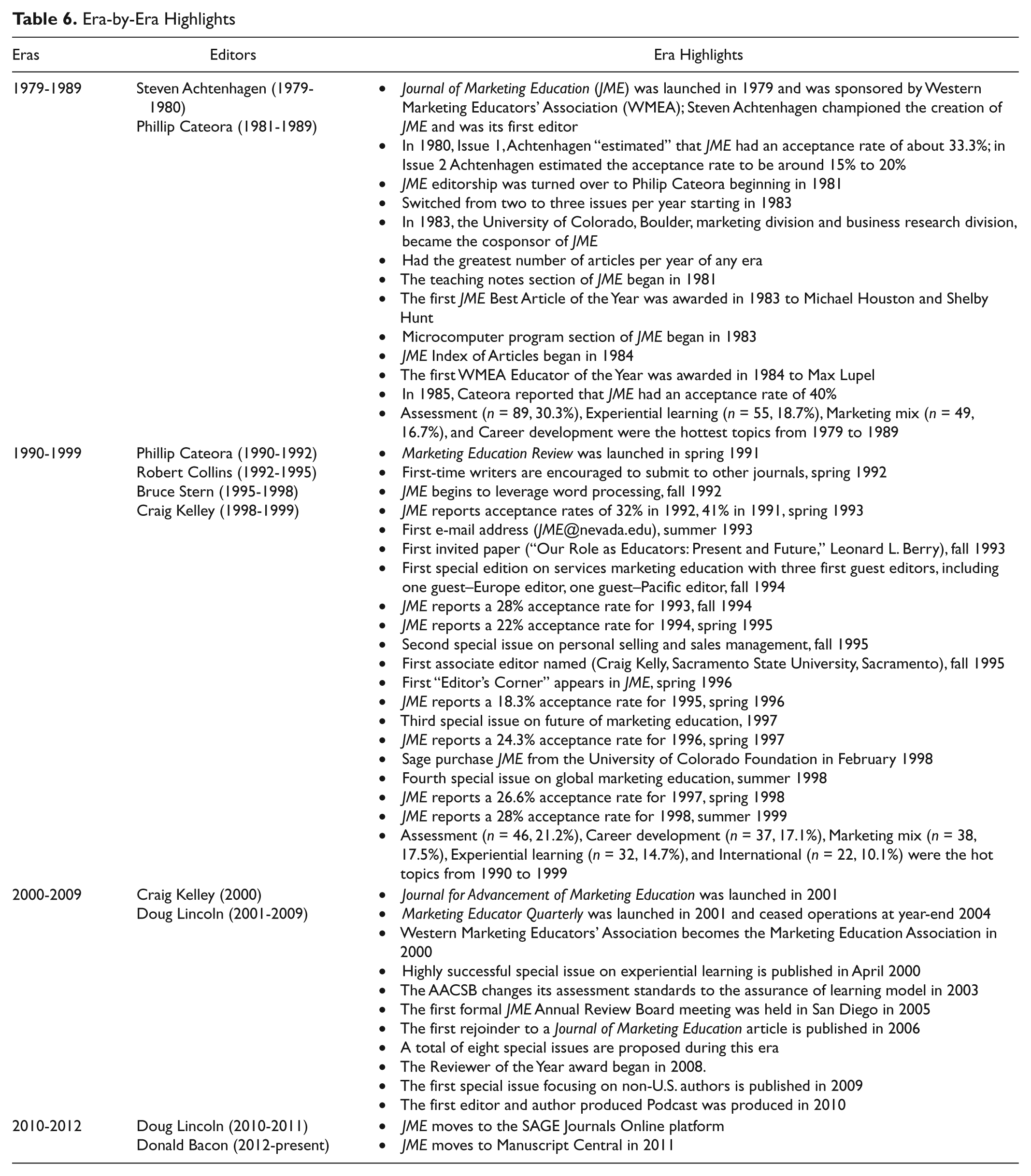
Given the short time frame and publication cycles, no articles from 2010-2012 are as yet in the top 50 cited JME articles. However, several pieces foreshadow important future research streams. For example, Rundle-Thiele and Wymer’s (2010) article titled “Stand-Alone Ethics, Social Responsibility, and Sustainability Course Requirements” predated JME’s call for papers for a special issue on ethics, corporate social responsibility, and sustainability in marketing education (2013). Similarly, JME’s 2011 special issue on technology was spawned in part by Kaplan, Piskin, and Bol’s (2010) article on blogging, Sprague and Dahl’s (2010) work on clicker technology, and Granitz and Koernig’s (2011) article on Web 2.0 and marketing education. Lastly, the current article documenting JME’s history was motivated in part by two articles: “Historical Perspectives in Marketing Education: Justification and Implementation” (Petkus, 2010) and “A Decade of Scholarship in Marketing Education” (Abernethy & Padgett, 2011). The highlights of each era are shown in Table 6.
Era-by-Era Highlights
Data Collection and Data Analysis Methods
All the published JME articles from 1979 to 2012 were categorized based on whether they included relevant data (Table 7), and if so, how the data were analyzed (Table 8). Fifty-eight percent of the articles included an analysis of data; however, over this time period, these percentages have changed significantly. Table 7 displays the percentages of articles that included each of a variety of data. For the first 2 years of its existence (1979-1980), only one of four articles included data. For the entire introduction era, 46% of all articles included an analysis of data; this percentage increased to 56% during the 1990s and to 72% for the 2000-2009 quality improvement era. Today, three of four articles contain a data analysis, a percentage that is consistent with other top marketing journals. The area of greatest growth is student survey data, doubling from 19% in the introduction era to 38% in the 2010-2012 era. In many cases, experiential, learning, and student professional development articles that previously lacked data included data collected at the end of the activity to determine student attitudes, opinions, and satisfaction with the activity.
Journal of Marketing Education Data Collection Methods

Journal of Marketing Education Data Analysis Methods

A second area with significant growth is the collection and analysis of qualitative data in the form of in-depth interviews, reflective diaries, and ethnographic data, with all but one study published since 2000. For example, Faranda and Clarke’s (2004) article titled “Student Observations of Outstanding Teaching” and Granitz, Koernig, and Harich’s (2009) article titled “Rapport Between Business Faculty and Their Students” used in-depth interviews with students. This is consistent with other top marketing journals, where qualitative data have become more accepted and prevalent. Moving forward, we anticipate this form of data to be even more prevalent, given the need for in-depth data about the ways students learn.
The third type of data with a significant increase in collection are direct measures of program/experiential activity success, including test scores, grades, and other data reflecting changes in knowledge or skills. The first instance of using direct measures of success in the second issue was the article titles “An Experimental Study of the Effectiveness of Learning Objectives and Exercises in Marketing” (Dwyer & Klebba, 1980). Occurrence continued throughout the next two decades with articles such as “The Additive Effects of Semistructured Classroom Activities on Student Learning: An Application of Classroom-Based Experiential Learning Techniques” (Hamer, 2000) and the 2006 article by Bacon and Stewart about the speed with which students forget what they have learned using direct measures of test scores to determine the amount of information retained. The largest percentage of this type of data surfaced in the second half of the 2000s. This increase is likely due in large part to the 2003 change in AACSB standards reflecting the need for improved accountability measures by placing an emphasis on direct assessments of student learning. As business schools began to revamp their assessment approach, marketing educators were working at the cutting edge, employing these direct measures of success as part of their studies. As these direct measures continue to be the standard required by AACSB, we anticipate an increase in use in marketing education studies.
The use of faculty survey data, various forms of secondary data, and students’ faculty and peer evaluation data has remained relatively constant. Finally, department chair and dean survey data are the only types of data that have seen significant reductions in usage.
As the type of data collected changed over the past three decades, so have the statistical tools used to analyze data. During the 1979-1989 era, nearly half of the data were analyzed by simply providing descriptive statistics, such as cell counts, means, medians, and modes (see Table 8). By the 2000-2009 era, this type of analysis dropped to 19% and in the 2010-2012 era, usage is only 7%. Conversely, comparing means or cell counts has shown the largest increase rising from an average of 36% of the data analyses in 1979-1989 and 1990-1999 to 46% of the articles in the 2000-2009 and 2010-2012 eras. Other areas of increased data analysis methods are regression analysis, structural equation modeling, and qualitative content analysis.
The increase in regression and correlation analysis is somewhat predictable given the large increase in the collection of survey data. This type of data is often analyzed with association-testing statistical tools. The same can be said for structural equation modeling. The increase in the use of structural equation modeling is as similar for JME as it has been for almost all other top marketing journals, becoming popular in the mid- to late 1980s and continuing to increase throughout the 2000s. Once thought of as sophisticated, structural equation modeling has become a rather standard statistical analysis tool often used when trying to establish causality. Examples of this usage include “Determinants of Student Evaluations of Global Measures of Instructor and Course Values” (Marks, 2000) and “Studying the Motivational Effects of the Classroom Environment on Self-Regulated Learning” (Young, 2005).
Finally, the increased use of content analysis obviously corresponds to the increased collection of qualitative data. In fact, both of the last two JME articles of the year used qualitative analysis—Hopkins et al.’s (2011) article on giving students a “sustainable competitive advantage” and Schlee and Harich’s (2010) study titled “Knowledge and Skill Requirements for Marketing Jobs in the 21st Century.”
In summary, JME has shifted from a journal that was originally a balance of data-driven and non-data-driven articles to a journal that is primarily populated with data-driven pieces. The types of analyses that are used in JME are comparable to those used in other top marketing journals.
Conclusion and Future Research Needs
After 11 years as JME editor, Doug Lincoln passed stewardship of the journal to Don Bacon in 2012. This transition serves as a unique moment in time to assess JME’s historical progress and topical coverage over the years. Since the spring and summer issues of JME comprised articles accepted by Professor Lincoln, the December 2012 issue is the first in which Professor Bacon is primarily responsible for its content. As with many editorial transitions, new leadership sparks new ideas. Yet, as our review of JME’s history underscores, although the specifics have changed, JME’s goal for educators to “submit your ideas; ideas that will have the impact of enhancing the effectiveness of teaching marketing” (Achtenhagen, 1979, p. 2) is as important today as it was at the journal’s birth. As Professor Bacon commented for this article, Just as the entire discipline of marketing has matured, so too has the discipline of marketing education. We thus need to consider how this maturation process has impacted marketing education, and importantly, moving ahead, what issues are most important for creating an educational environment that best prepares students for life beyond college.
The historical perspective reported here hopefully provides a conceptual and empirical direction for future marketing education research. Based on this review and our interpretation of the findings, we conclude this treatise with research recommendations for marketing educators.
The big three remain as important marketing education targets: Regardless of era, Assessment, Experiential Learning, and Career Development continue to be key theoretical and empirical foci. Regarding Assessment, advancing communication technologies have affected both what is taught and where it is taught. As Professor Bacon noted for this article: We are seeing a growing number of papers using state-of-the-art research methods. In particular, direct assessment measures of learning, such as exams or projects are increasingly used in marketing education research, while in years past only indirect measures, such as student surveys, filled the journal. Recent research has shown that direct measures of learning offer important information beyond self-reports of learning. Further, the AACSB has required member schools to use direct measures of learning in their assessment efforts. While manuscripts describing novel ideas for improving the effectiveness of marketing faculty and pedagogy are always welcome at JME, we are particularly excited by manuscripts that include direct measures of learning.
Program Assessment will continue to be an important research topic. We particularly encourage articles that offer ways to integrate marketing content within and across the curriculum (Internet and social media, mobile marketing, etc.). Along these same lines, scholars need to ask questions about what our marketing curriculum should look like as we move deeper into the information age.
In our view, Faculty Assessment and Student Assessment should remain as important areas of inquiry. As course content and information delivery are evolving at a rapid rate, helping faculty become better “teachers” is as equally important today as when the journal was launched. Likewise, as the educational delivery system has evolved, so too are the mechanisms we use to assess how students learn best and how we evaluate what they have learned.
Experiential Learning is a cornerstone of marketing education and a signature pedagogy for the discipline. Although experiential learning exercises have changed over time, offering real-world educational experiences are vital for preparing students to compete in an ever-changing and increasingly competitive job market. Papers are needed that focus on how to bring the real world into the classroom in new and exciting ways. Lastly, student and faculty Career Development needs continue to be important areas for marketing scholars. The business world is changing, and as such, articles that provide meaningful insight for business preparedness and lifelong learning are imperative. Specific research needs include skill sets demanded by employers, writing and communication capabilities, and a host of other issues useful for assisting students seek out and obtain employment opportunities. Likewise, because the educational environment for faculty is also changing, articles that help faculty prepare for and navigate a career in academia should continue to spark considerable interest.
Technology, technology, technology: Technology has surfaced as one of our most pressing research needs. Our understanding is in its infancy concerning how technology may enhance the learning experience within and outside the classroom. Complicating our understanding of technology’s role is that as soon as we start to get a handle on the parameters of a certain technology (e.g., online education), new technological advances expand the just-reached learning boundaries. Consequently, articles are much needed that focus on hardware and software for enhancing learning in the form of mobile devices (including apps), tablets, Podcasts, YouTube, and related media, wikis, social media, video gaming, video-conferencing, cloud computing, clickers, and the like. Such research will help us to keep up with these technologies, and look ahead as well for the next wave of communication devices.
Articles are also needed that use direct measures of learning to study the design and delivery of hybrid or blended course formats. These formats combine both face-to-face and online formats. From a content perspective, technological advances have also placed a focus on Marketing Mix articles designed to inform educators about how to integrate new marketing media into their current courses (search engine optimization, blogs, etc.) and in developing new stand-alone courses.
Critical thinking: Educators and the business community continue to place great emphasis on the need to develop students’ Critical Thinking abilities. For JME, critical thinking articles began to flourish in the 2000s as contributors examined problem solving skills, creativity, and reflective learning practices. Research is thus needed that helps students become independent thinkers and problem solvers, such as articles that focus on exercises and tools that help students solve the business problems they will encounter. Especially important are articles that force students to think outside of the box and challenge their assumptions, and that lead to changes in how they see the world.
Don’t forget the other areas: We agree with Professor Lincoln that JME needs a greater focus on generating more International articles from educators outside the United States, and as a consequence, on marketing education practices from around the world. Although Ethics has been a niche area for JME, emerging issues such as information privacy, academic dishonesty across divergent course content delivery systems, and content integration across the curriculum are particularly relevant today. Likewise, given the importance of group work and evolving course content and delivery systems, Course Management research is warranted that advances our understanding of ways to improve how groups work together. We also need research that examines course management issues relevant to in class and online learning environments.
Data collection and analysis: We have signaled the need for articles that use direct measures of learning. However, our review over the past 34 years also indicates the need for other data collection and analysis. First, “data is (sic) king.” Data-driven articles are increasingly more common place in JME, and we expect this trend to continue. Although conceptual work is vital for setting up theoretical boundaries, data are needed to provide empirical validation. Of interest, qualitative data collection should also be considered that offer alternative mechanisms for testing theory (e.g., journals, interviews, online forums, chat rooms, and observation). Second, with the emergence of more data-driven articles, more advanced forms of data analytic procedures are essential that coincide with this growth such as structural equation modeling, higher level regression analyses, multivariate analysis, and text coding.
In closing, on behalf of JME readers we would again like to thank Phillip Cateora, Robert Collins, Bruce Stern, Craig Kelley, Douglas Lincoln, and Don Bacon for their editorial service to JME. The Journal of Marketing Education has come a long way over the past 34 years. Here’s to the future!
Footnotes
Declaration of Conflicting Interests
The author(s) declared no potential conflicts of interest with respect to the research, authorship, and/or publication of this article.
Funding
The author(s) received no financial support for the research, authorship, and/or publication of this article.