



Abstract
More universities are incorporating sales content into their curriculums, and although the introductory courses in professional sales have much common ground and guidance from numerous professional selling texts, instructors teaching the advanced selling course lack the guidance provided by common academic tools and materials. The resulting potential variance in content and pedagogy in advanced selling courses makes comparing programs or assessing the relative preparedness of students coming from different universities challenging for recruiters, faculty, and students. A review of the syllabi of the instructors currently teaching the advanced selling course reveals common themes, content, and pedagogy that are helpful to instructors desiring to develop an advanced selling course or those currently teaching the course. A review of the common content of the advanced selling course and an argument for the need of the advanced selling course are provided, along with suggestions for developing the course with examples of various projects and pedagogy.
Keywords
Introduction
The U.S. Bureau of Labor Statistics (2012) reported that there will be more than 980,000 sales and sales-related positions that need to be filled annually through the year 2020. The sales representative position is historically one of the most difficult positions to fill for industry and, according to the 2012 Manpower Survey (ManpowerGroup, 2012), still remains one of the top 10 hardest jobs to fill. Traditionally, organizations recruiting to fill entry-level professional selling positions (i.e., those requiring a college degree) recruit business school graduates and, in particular, those graduates majoring in marketing. More recently, these organizations are turning to business schools offering more robust sales education and training, and with good reason. Results of a recent survey of business managers indicate that graduates from these schools are 30% less likely to turn over and are productive 50% faster than their non-sales-educated counterparts (Sales Education Foundation Survey, 2007). In addition, the top sales universities in North America (Stevens & Sales Education Foundation, 2013) report a 92.14% (on average) placement of their graduates, and those who signify a specialty in sales or are a member or past member of the University Sales Center Alliance (USCA) report slightly higher average placement rates of 92.75% (specialty) and 94.96% (USCA member or past member), respectively. Given that recent studies of college graduate placement rates indicate that more than 50% of recent college graduates are either unemployed or underemployed (Lederman, 2013; Weissmann, 2012), graduates from schools with sales programs are doing very well. This suggests that understanding what and how sales is taught in these programs is warranted for all faculty wishing to better prepare their students for careers in, or started in, professional sales.
Despite these statistics and those reported by Deeter-Schmelz and Kennedy (2011), universities have been relatively slow to respond. Although many business schools offer a single salesor sales management course, relatively few schools offer multiple courses in sales. Given that business school students, and in particular marketing majors, are likely to begin their professional careers in a sales role, it seems that completing a single course (or, worse, no course at all) in sales represents inadequate preparation. Comparatively, it seems unlikely that students completing one course in operations management would be adequately prepared for an entry-level operations management position.
Based on the above statistics and more than 40 years of combined experience in sales education (research, teaching, advising, and program administration), working with recruiters, and consulting, we propose that an additional course beyond the basic introductory sales course is essential to best prepare college students for careers in sales. Specifically, business schools currently offering a single sales course should consider adding an advanced selling course to the curriculum to better position students (interested in sales positions) for success. In addition, although instructors teaching introductory sales courses have access to numerous sales texts and materials that include common content and pedagogical methods to guide them in preparing for these courses, none of these support tools exist for an advanced sales course.
Purpose
Cummins, Peltier, Erffmeyer, and Whalen (2013) called for research that reports successful pedagogy for sales education. Yet there are few published articles, beyond a handful of conference proceedings (Avila, Chapman, & Inks, 1999; Eckert, 2005; Henderson, Hance, & Schleeter, 2005), examining the pedagogy and content of the advanced selling course. The primary contribution of these articles is the presentation of various approaches to projects, cases, and experiential exercises associated with a particular course. None of the research, however, reflects an examination of advanced selling course content among multiple universities that may establish common content, methods, and purpose. Because of the overwhelming demand for entry-level sales professionals and the growth in the number of schools offering sales and advanced selling courses, the purpose of this article is to (a) provide an overview of the content currently being included in the advanced selling courses, (b) identify a number of current practices by leading (according to Sales Education Foundation reports) sales universities and faculty who currently offer the advanced selling course, and (c) offer guidance for how to develop an advanced sales course for faculty contemplating creating one.
The discussion is broken down into (a) background, (b) the argument for the advanced selling course, (c) recommendations for creating the advanced course, (d) a review of suggested course content, (e) a review of sample class projects, and finally (f) conclusions regarding the advanced course in professional selling.
Background
As evidenced in DePaul University’s 2012 Sales Education Landscape reports and the 2013 Sales Education Annual Review (Stevens & Sales Education Foundation, 2013), there has been growth in interest in sales and sales-related curriculum in universities throughout the United States, and there is evidence that sales education is moving in the direction of other traditional professions (e.g., law, medicine, and accountancy) as demonstrated by growing university inclusion of standardized sales curriculum, sales courses, and content and materials in the sales discipline. Our review of the 2013 Bloomberg BusinessWeek Top 40 Business Schools (Bloomberg BusinessWeek, n.d.; http://www.businessweek.com) found that 20 (25%) of those schools listed offered an introductory sales course, 4 (10%) offered a hybrid sales–sales management course, 21 (53%) offered a sales management course, and 1 (0.25%) offered an advanced sales course. The increase in the number of Top 40 schools offering sales courses notwithstanding, the number of universities identified as having sales programs (multiple-level courses, or introductory and advanced courses) has more than doubled (from fewer than 30 in 2004 to 68 in 2013) in the past decade (Stevens & Sales Education Foundation, 2013), and there is continued interest by colleges and universities to expand sales course offerings (Deeter-Schmelz & Kennedy, 2011). With slightly more than 100 colleges and universities out of the more than 1,400 teaching sales or having any notable sales program (Sales Education Foundation, 2013), the demand to fill sales positions with qualified candidates far outstrips the supply of university graduates prepared to enter the sales profession.
Research indicates that sales courses were taught in colleges in the mid-1940s (Kellerman & Hekmat, 1989), with one of the earliest courses in sales reported as early as 1914 (Weilbaker & Williams, 2006). Today, sales courses are much more common among business schools, with many offering at least one course dedicated to professional selling (Stevens & Sales Education Foundation, 2013). For purposes of this article, we consider single course offerings at universities and colleges to be introductory in nature and refer to them as introductory sales courses.
A significant amount of academic research is devoted to sales and published in premier academic journals (e.g., Journal of Marketing, Journal of Marketing Research, Harvard Business Review, Industrial Marketing Management, Journal of Business & Industrial Marketing, and Journal of Personal Selling and Sales Management). In addition, much academic sales education research is included in the top education journals (e.g., Journal of Marketing Education and Education Marketing Review). Cummins et al. (2013) identified nine different areas from the sales education literature in which researchers have examined sales education. This research may fall into the area of assessment, but there is no research that is specific to the overall content of the advanced selling course. In the area of sales education, many researchers have identified and examined the core content areas of the introductory personal selling course (e.g., Johnson, 1990; Leisen, Tippins, & Lilly, 2004; Marshall & Michaels, 2001; Parker, Pettijohn, & Luke, 1996; Shaw, 2007; Sojka & Fish, 2008; Weilbaker & West, 1992). The introductory sales course is included in all of the sales programs identified in the current research, and it is popular enough to warrant a number of introductory sales textbooks (e.g., SELL [Ingram, LaForge, Avila, Schwepker, & Williams, 2012, 3rd ed.]; Selling Today, 12th ed. [Manning, Ahearne, & Reece, 2012]; ABC’s of Relationship Selling Through Service, 12th ed. [Futrell, 2012a]; Fundamentals of Selling, 13th ed. [Futrell, 2012b]; and Selling, Building Partnerships, 8th ed. [Castleberry & Tanner, 2011]). These texts also offer a number of instructor materials, including but not limited to sample syllabi, case studies, lecture notes, PowerPoint slides, and test questions.
There are still, however, relatively few universities that offer an advanced course in professional selling, and, perhaps because the market is currently small, there are no textbooks dedicated to the advanced selling course. Most instructors of the advanced selling courses use many different popular-literature sales books rather than traditional textbooks.
Textbooks published in a particular discipline may play a critical role in the maturity of that discipline because they can serve to help define the domain of the area, broadcast common topics for inclusion, provide guidance regarding common methods, and offer suggestions for approaches to teaching a given course. A list of topics covered in many of the introductory sales texts, identified previously, include (a) an overview of the sales profession, (b) the sales process, (c) relationship and communication skills, (d) sales ethics, and (e) time management and organizational skills. Because there are no academic textbooks positioned as advanced selling texts, faculty members define individually the content covered in their respective advanced selling courses. The resulting potential variance in the content and pedagogy in advanced selling courses makes comparing programs or assessing the relative preparedness of students graduating from different universities challenging for recruiters, faculty, and students. Because the number of advanced selling course offerings is growing, providing insight regarding appropriate, or at least common, content (as determined by the most experienced instructors) seems increasingly appropriate. Such guidance will help both experienced and inexperienced faculty develop and teach advanced selling courses, and, accordingly, make comparisons easier for recruiters, faculty, and students. Although the scope of this article is necessarily prescriptive, it should not be considered a comprehensive assessment of what should be currently included in the advanced course; such an assessment is warranted in future research.
Rationale for the Advanced Selling Course
Principles (or Survey) of Marketing courses introduce students to the domain of marketing, including the marketing mix, branding, positioning, research, ethics, and so forth. To address most, if not all, of the topical areas covered in a Principles of Marketing course, instructors sacrifice depth for breadth. To address the issue of depth, most universities with marketing degree programs offer additional courses devoted to areas of marketing introduced in the Principles of Marketing course. Sales is an area of marketing to which a growing number of universities dedicate a course. The complexities associated with preparing students to both understand and be successful in professional sales positions, including both cognitive and behavioral components, are, however, difficult to adequately address in a single course. In addition, the process of persuading others, and the confidence gained through the application of selling skills through experiential learning and, most significantly, exposure to the field and industry settings, is transferable to any career and career progression.
Unlike most professions, sales carries a heavy stigma of being manipulative, a last-resort job, and generally unprofessional. It is not uncommon for instructors to use the introductory sales course as a tool for combatting these negative associations, enlightening students regarding the appropriate role of salespeople and the sales force in business. Doing so requires instructors to provide students with an overview of professional selling, including helping students understand that the most successful salespeople (in the long run) are ethical, caring, and focused on improving the lives of their customers (e.g., improving revenues and/or lowering costs to make their businesses more profitable).
In addition to changing students’ perceptions of professional selling, the introductory sales course should introduce the sales process, teach basic sales methods, and develop and/or reinforce in students the basic skills and behaviors used by professional salespeople. Finally, the introductory sales course should include opportunities (e.g., role-plays) for students to practice and demonstrate for evaluation the basic skills and behaviors covered in class (there is a tremendous difference between talking about how to engage in a particular skill or behavior and performing the particular skill or behavior).
Empirical evidence (e.g., Selling Education Foundation, 2007) indicates that entry-level salespeople who, while in college, successfully completed at least one sales course (e.g., an introductory sales course) will outperform (in terms of lower turnover, shorter ramp-up, and greater productivity) than those who have not. Although completing an introductory sales course provides graduates with some minimal preparation for an entry-level sales position, the advanced sales course offers students the opportunity to deepen their cognitive understanding of sales, hone their selling skills, and otherwise distinguish themselves as being among the best prepared for success in sales.
Role-playing sales calls (face-to-face meetings) is instrumental in learning the skills and behaviors necessary for success in professional selling. In addition, role-playing reinforces the sales process and provides some measure of the stress and pressure associated with the sales profession. Role-playing in the introductory sales course offers students the first attempt to practice what they have learned and to do so in a relatively safe environment (e.g., the prospect always agrees to a meeting, and no one gets fired for making a poor sales call). Advanced sales courses provide instructors with the opportunity to offer students more complex role-plays to further develop the skills and behaviors that students learned in the introductory course. The advanced sales course also offers students the opportunity to engage in real-world or field (real customers, real products, and real money) sales calls. Although the risk is still relatively low (no one gets fired for poor performance), the assurance of actually identifying and connecting with a qualified prospect is greatly reduced.
Although face-to-face interaction is central to success in sales, this is most often not what separates the high performers from the average or poor performers. We argue that participating in real-world field sales calls, including the day-to-day activity of researching, prospecting, and qualifying prospects, provides students with essential experiential-based insight into the nature of the business-to-business (b2b) sales job and the requisite perseverance for success. Research, prospecting, and qualifying are important skills to learn because regardless of how well a salesperson conducts the sales interview, if he or she is unable to actually get in front of qualified prospects on a consistent and regular basis, that individual will perform poorly. This approach is strongly supported by Gray, Peltier, and Schibrowsky (2012) in their review of marketing education in general, but we believe this is especially appropriate in the sales discipline.
An advanced sales course also provides instructors with the opportunity to explore other topics not normally covered in-depth in the introductory course, including negotiation, team selling, and the use of technology. These sorts of topics provide greater depth to advanced sales concepts (while reinforcing the basic concepts), greatly enhancing the students’ preparedness for a career in professional sales.
After completing the introductory and advanced sales courses, graduates of those courses should view sales as a true or credible profession (vs. the stereotypical view), thoroughly understand and be able to implement the sales process necessary for a successful sales call that leads to sales, have greater confidence that they will be successful, and have much more accurate expectations of the challenges that a career in professional sales entails. Also, introducing advanced topics such as account maintenance, the use of technology in the sales process, negotiations, and team selling, to name a few, should position graduates for success, lower turnover rates, and shorten ramp-up time to productivity. These conclusions are well supported by the studies offered previously that present the lower levels of turnover and higher levels of earlier productivity by entry-level salespeople from the sales programs from which this study draws data.
Recommendations for Creating an Advanced Selling Course
To better inform the recommendations put forth for the advanced selling course, we examined what current faculty offer in their advanced selling courses and examined how well those courses are aligned, which leads to assertions regarding what content an advanced sales course should include. To accomplish this objective, we collected and analyzed syllabi from faculty teaching advanced sales courses. For purposes of the present study, an advanced selling course is defined as a course in which sales is the primary focus, in which the content and concepts presented go beyond those of an introductory course, and for which an introductory sales course (in which sales is the primary focus vs. one including sales management) is a prerequisite. This course is an upper-division sales course and often carries the word advanced in the course title (e.g., Advanced Sales, Advanced Selling, or Advanced Professional Selling). Not included in this definition are courses in sales management, or hybrid courses of sales and sales management.
Syllabi were requested via email and phone contact with 87 instructors drawn from (a) faculty members of the University Sales Center Alliance (USCA; 32 faculty), an internationally recognized body of established university sales institutes and centers; and (b) faculty attending the National Collegiate Sales Competition (55 faculty different from those from the USCA), a national sales role-play competition that has included 80 different universities. Because of their participation in a national sales-based competition, these faculty members were identified as those most likely to teach or have a colleague who teaches an advanced selling course. A number of the members of the USCA also participate in this competition, and, therefore, there is some overlap of instructors from whom syllabi were requested. Of the 87 instructors contacted, 14 indicated they teach or have taught an advanced selling course, or they referred an instructor from their institution. These faculty or their colleagues submitted syllabi for their advanced selling course, including two syllabi from the authors of this article. An additional search of university websites for sales faculty and advanced selling revealed one additional course in advanced professional selling. We were able to download from the university’s website a copy of the syllabus, bringing the total number of syllabi collected for review to 15. The response rate (17%) appeared low, so we examined the course catalogs of the targeted schools, along with those of schools listed in the 2013 BusinessWeek Top 40 schools (Bloomberg BusinessWeek, n.d.), in an effort to determine how many offered an advanced sales course. Of the schools approached for syllabi, and based on their published course catalogs, only 25 appeared to offer an advanced sales course. All but one of the schools offering an advanced selling course is a member of the USCA. Of the BusinessWeek Top 40 Business Schools, only one offered an advanced sales course, and we did acquire the course syllabus from that school. So, we did receive 15 (or 60%) of the 25 known syllabi from the USCA and the BusinessWeek Top 40 schools. The more than 300% growth in the membership in the USCA suggests that the number of schools teaching advanced sales courses is likely to grow significantly in the future.
Course Objectives
Fourteen of the 15 (93%) syllabi included course objective or purpose statements. Of those syllabi that included an objective or purpose statement, 50% indicated that the course was a continuation of the basic sales course, or otherwise it included words like advanced and further enhance in reference to sales skills, account management topics, and skill development normally introduced in a basic sales course. (Note: The introductory sales course is listed as a prerequisite for the advanced sales course at each university.) Although the course purpose and/or objective statements varied in breadth and depth, nine (60%) indicated that the purpose or objective was to better prepare students for sales careers and positions.
Course Textbooks and Readings
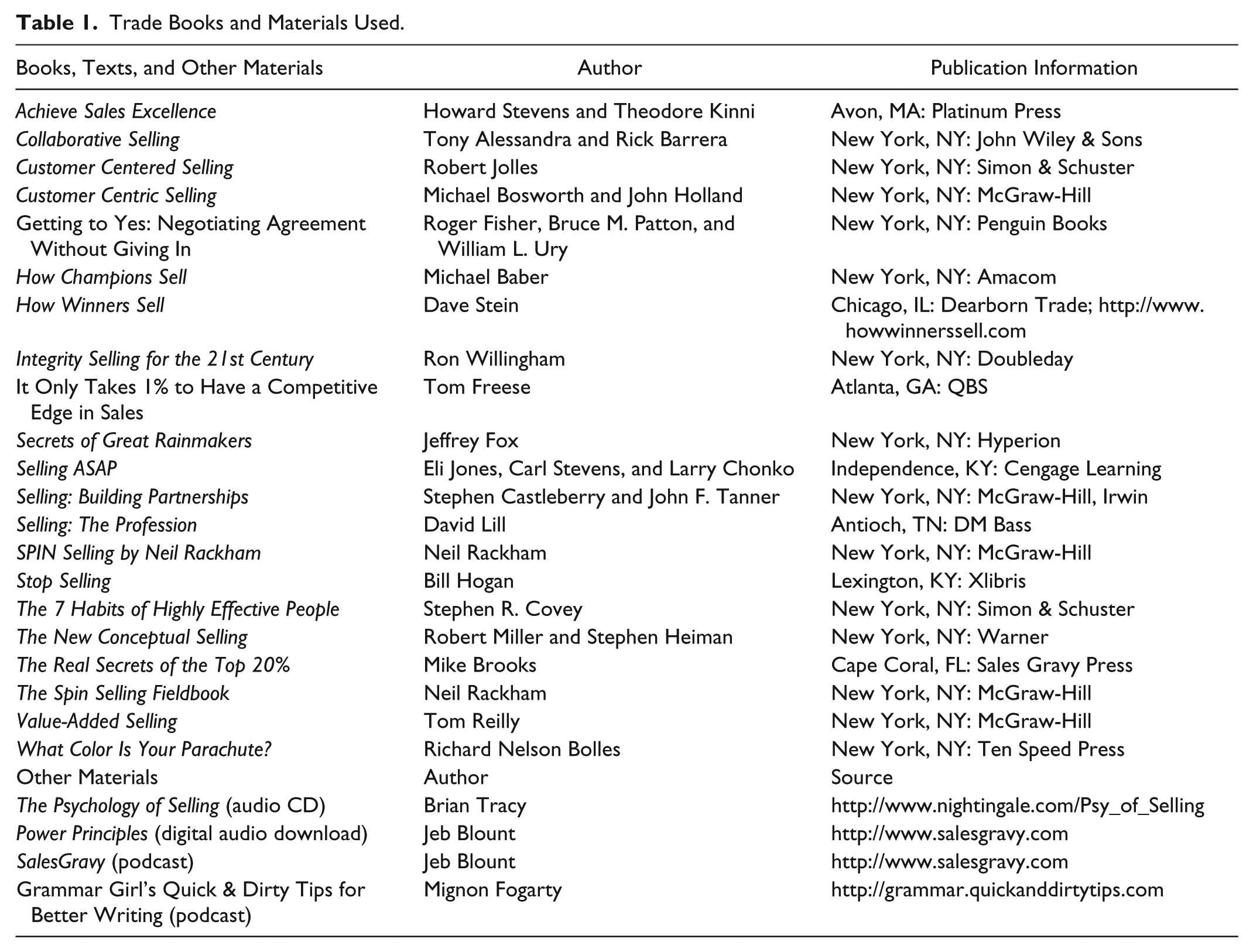
As discussed previously, because there are no advanced selling textbooks, instructors must develop their own sets of reading materials for the course. If and until academic texts are published that provide curriculum and content for an advanced selling course, these readings may serve as a useful resource for use in the course. Table 1 contains a listing of the different books and materials used in the advanced selling course as reported in the collected syllabi.
Trade Books and Materials Used.
Course Content
This section identifies those topics and concepts that we propose are within the domain of an advanced selling course. We selected these topics and concepts based on our review of the syllabi collected as well as our 30-plus years of experience with introductory and advanced sales courses, the sharing of pedagogical ideas with sales instructors and faculty from around the world, and our extensive work with other instructors and organizations recruiting students to fill b2b sales positions. The discussion in this section is not presented as exhaustive of all of the concepts and areas that may be included in the advanced course, but as one that should be helpful to experienced and first-time instructors in teaching the advanced course.
Sales Process: Get Back Into the Swing, and Go Deep With Application and Field Sales Activity
The sales process (prospecting, approach, need identification, presentation and solutions, gaining commitment, handling objections, and negotiation) is introduced in the introductory sales course. Moreover, each of the introductory sales textbooks has entire chapters devoted to each of the steps of the sales process (with the possible exception of negotiation). Although topics are similar, the advanced course will build on the principles introduced in the introductory sales course. Application of these principles along with an introduction and application of new advanced concepts set the advanced course apart from the introductory course.
Students take the introductory and advanced courses in sequential order, but they are sometimes unable to take the advanced course in the academic term immediately following the intro course. For those students especially, a review of the sales process is essential to helping students recall what they learned in the introductory class and prepare for and apply what they learn in the advanced class. Each of the syllabi that we examined included a review of the sales process early in the term.
A review of the sales process is a good tool for cognition but not necessarily for behavior. We have found that, in addition to reviewing the sales process, engaging the students in sales role-plays at the beginning of the term is essential to helping students get back into the swing of b2b sales. The role-playing gives students the opportunity to practice their selling skills and behaviors, enhance their understanding of the sales process, and gain confidence before engaging in real-world field sales calls. Just more than half of the syllabi we reviewed included sales call role-plays at or near the beginning of their respective terms.
The advanced course also lends itself to more comprehensive field projects and exercises. The sales process becomes relevant when students have to apply the skills they have learned in the introductory course in a less controlled setting (i.e., the field or the real world). Therefore, the use of projects that put students in live or near-to-live sales situations is recommended. Beyond requiring the students to engage in field sales activities, many of the instructors also use representatives from industry as prospects and/or buyers during the class role-plays. This takes the role-play experience to a higher level of difficulty and is a good next step before requiring the students to engage in field sales calls.
Prospecting
Prospecting, or the ability to prospect, has been identified as one of the most critical success factors in sales performance (Dwyer, Hill, & Martin, 2000; Verbeke & Bagozzi, 2000) and arguably one of the more highly demanded skills that industry communicates to sales instructors. Although many of our students become proficient in the skills required to conduct a sales call (and many do very well in the various national, regional, and local sales role-play competitions in which they compete), unless they as sales professionals are able to get in front of a sufficiently large number of the right prospects, they will fail.
Introductory courses typically offer a simple introduction to the purpose and methods of prospecting and are insufficient for providing students with an appreciation of the rigors and stress of actual prospecting activity. The advanced course offers instructors the opportunity to provide students with deeper insight into how to prospect effectively and the opportunity to engage in prospecting as part of field projects.
Our recommendation is to begin discussing prospecting strategies and tactics early in the term, including field projects and other class exercises that allow students the opportunity to experience the challenges of prospecting. These assignments should continue throughout the semester while the instructor (and mentors and coaches) helps students refine their prospecting skills. Although not all professional sales positions require extensive prospecting, all do require identifying and approaching current and/or potential customers in some form. We doom many of our students to frustration and failure if they are not exposed to this important skill and pushed to engage in field prospecting experiences. An exercise related to prospecting is provided in the “Suggested Exercises” section.
Negotiation
Negotiation is a topic to which entire courses are devoted, and it enjoys an abundance of material to use. This area is included by more than half of the instructors. No projects were identified, however, that are dedicated to negotiation. If the instructor chooses to include this area in the advanced course, role-play exercises are probably the most effective means of engaging and preparing the students after class discussion of the topic.
Materials for negotiation exercises and materials are available on several websites that provide many exercises for free, but some include a fee. Examples include http://www.gobookee.org/negotiation-classroom-exercises/, http://www.dalecarnegie.com, and http://www.hbsp.harvard.edu/list/role-plays. Although many of these are not specific to sales negotiation, Safari Books Online (https://ssl.safaribooksonline.com) offers several sales-related exercises; however, this site charges monthly fees.
Communication
Networking
Highly integrated with prospecting, networking is the lifeblood of sales. Information from the collected syllabi indicates that advanced selling instructors engage in a variety of activities designed to promote networking activity. These activities include voluntary and mandatory events such as career fairs, golf outings, professional development seminars, and networking workshops held on campus or at conferences. Some instructors require their students to keep networking journals in which they keep up with and report on the number of new contacts they make. We offer two to three networking events a month as well as have class speakers discuss the topic of networking during class. We also invite industry professionals to internal sales role-play competitions, asking them to serve as judges, prospects and buyers. In and around these events, students are encouraged to develop relationships. In general, the instructors teaching the advanced selling course are creative with respect to the different projects and events assigned to students to create networking opportunities.
Phone Skills
Phone skills are included in many of the introductory course texts as telemarketing and phone appointments. And although the sales role-plays are effective in putting into practice other components of the sales process, they do not lend themselves easily from a time standpoint to including the use of the telephone. The advanced course allows incorporation of field sales telephone exercises and experience, and it can be implemented in conjunction with the field sales experience (setting appointments), sales shadow (again, contacting prospective salespeople to arrange the appointment), or prospecting exercises. Instructors often have students practice phone sales by calling the instructor to set an appointment, or they have them call sales program industry partners. The instructor can evaluate the call by completing a call evaluation form or having the industry contact do so.
Presentation Skills
Typically, the introductory course requires students to engage in a role-play or presentation to the class. This is done individually or in teams. The advanced sales class offers instructors the opportunity to help students hone their presentations skills, including how to develop effective visual aids (appearance, content, and impact), address audiences of different sizes (including one-on-one), and manage the overall flow of the presentation (including recovering from mishaps). Honing these skills is especially important for students participating in field exercises because those presentations are made to external audiences and have consequences beyond simply earning a grade. Instructors should vet any student-created visual aids or other forms of presentation content prior to sending the students out into the field.
Business Acumen
Business acumen refers to an ability to quickly understand business situations, discern the relevant from the irrelevant, and react in a way that brings about positive results. The primary objective of our efforts to teach students sales knowledge is to improve their business acumen. Knowledge and skills are developed through exposure to guest speakers, sales shadow experiences, live field sales experiences and research projects specifically targeted to build general business acumen and the acumen required of different industries, organizations within industries, and trends within industries. These experiences and projects also dovetail well with helping students identify industries and organizations they wish to pursue for employment.
A useful resource for faculty wishing to improve the business acumen of their students is Paradigm Learning (http://www.paradigmlearning.com). This website offers white papers, articles, videos, and podcasts, as well as other resources that can be incorporated into the advanced course curriculum. Instructors should initially preview the white paper “Why Business Acumen Wins More Sales: Achieving the Next Level of Sales Success” (Green, n.d.).
The Financial Scorecard
Salespeople involved in complex and/or consultative selling need to understand how to read, interpret, and use the “financial scorecard” of their prospects and customers if they expect to be involved at the strategic level. At the very least, salespeople involved in b2b sales need to understand and be able to communicate to their customers the financial implications of their solutions. Resources listed later in this section are available to expose students in the advanced course to understanding financial statements, balance sheets, and income statements and how to incorporate them into the sales process. Although business school students take the finance and accounting courses, many are exposed to only the principles or introductory courses. Students in the advanced selling course need to make application of those principles in the selling context. Instructors should solicit assistance from colleagues in the finance and accounting departments for a simple guide to understanding these reports. Several sales-related websites provide help, and some offer simple exercises and cases to be used in training and classes. One helpful website is http://www.roi4sales.com. An example of an effective and easy-to-understand download from the website is “Understanding How to Read and Use a Financial Statement in the Sales Process” (ROI4sales.com, n.d.; registration required). The booklet explains financials, provides examples, and also offers exercises.
Planning and Account Maintenance, and Major Account Management
Syllabi from six of the schools included a reference to planning and account maintenance and/or major account management. This is an area that may be introduced in the introductory class but, due to the intricacies of this concept, requires a much deeper engagement and is suitable for the advanced class. We ask students to develop account plans pertaining to “live” accounts (current sales program partners) and prospects (developed based on the product or service being offered for the field assignment or exercise) as part of field exercises to support the conceptual underpinnings of account maintenance and major account management. The account plans include developing and executing an account classification strategy (prioritization of accounts into A-, B-, and C-level accounts based on the potential size of the sale and the probability of realizing a sale or sales; see Figure 1), and developing an account map (of contacts within the account organization, current or ongoing needs, and the current or potential products used to meet those needs; see Figure 2). Students are encouraged to develop relationships with three different people across three levels of each client organization. Developing the account map first helps students understand that they need to develop interpersonal relationships within existing and prospective client organizations beyond just their initial contact and their primary contact. This exercise helps students understand how to guard against losing the account if their primary contact leaves the company or is moved from their current position. Students also need to create a profile of their accounts. The profiles include the account contact, the potential for the account, and then plans for a specific call (objectives of the call, current competing products used, account needs and goals, and the required resources for the call, i.e., marketing materials, and human resources). This is used with the field sales calls (i.e., not role plays, although this may be useful for case studies).
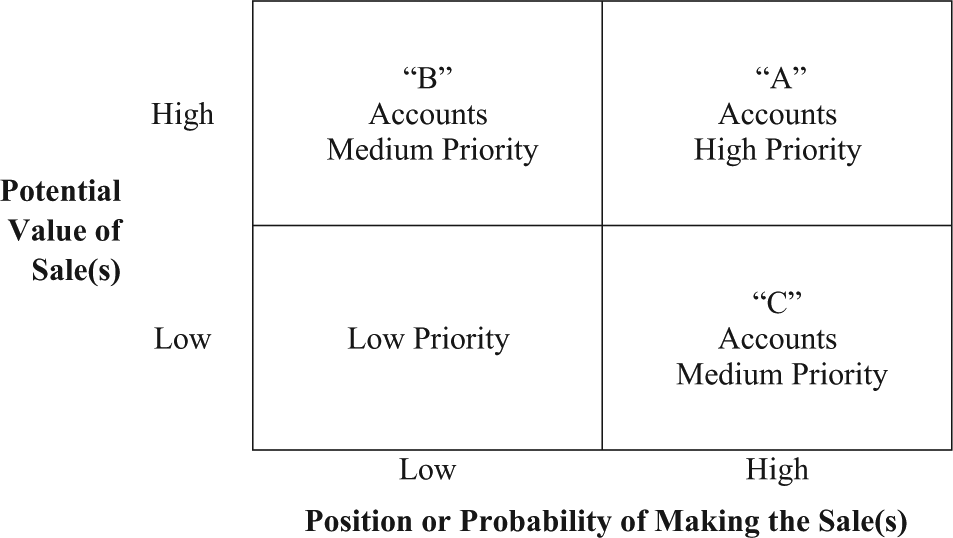
Account classification.
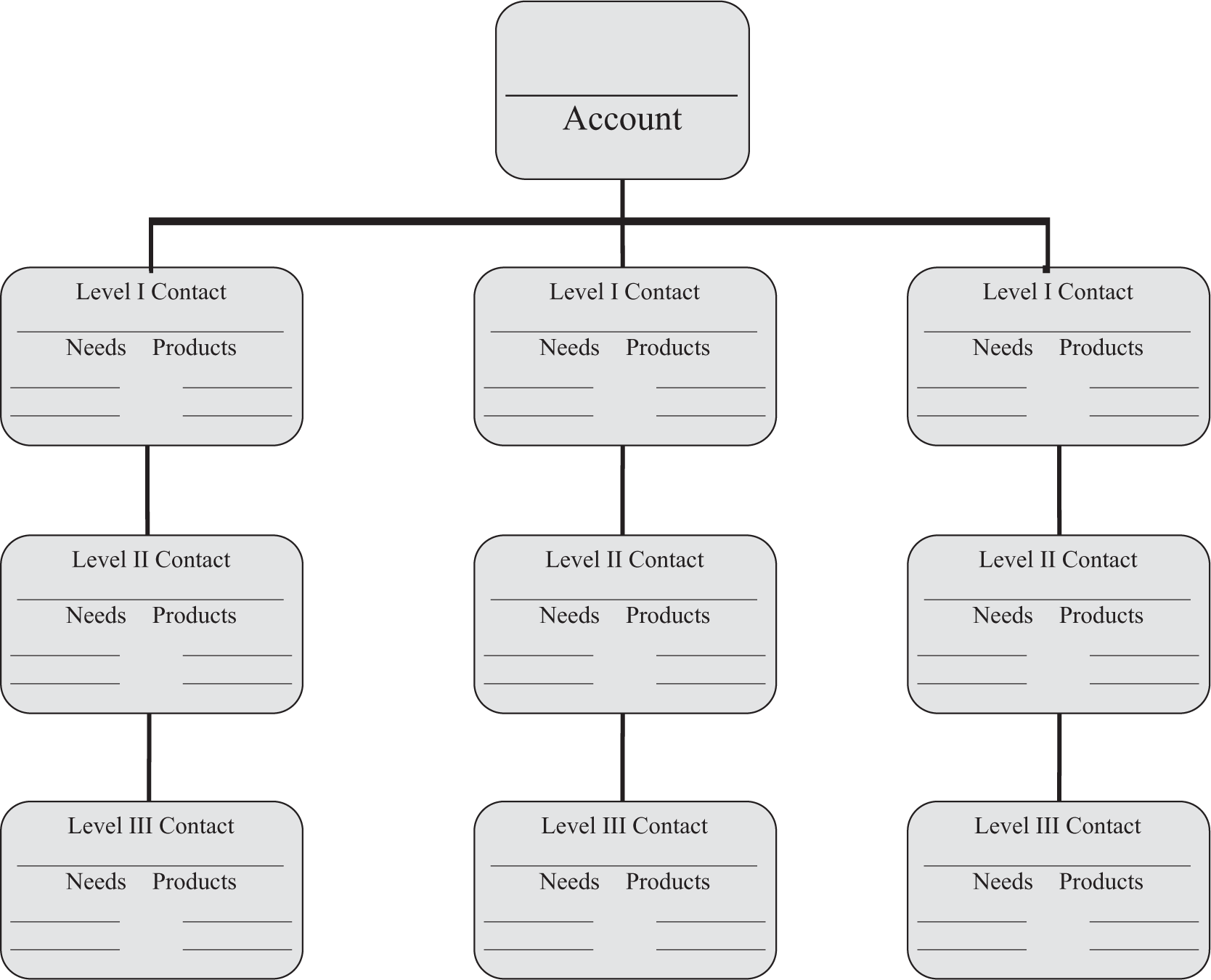
Account map.
Product Knowledge
Product knowledge as a concept is introduced in most introductory sales courses. When it is used as a topic in an advanced sales course, instructors help students learn how to learn about a product, developing their ability to discern the more relevant from the less relevant. In several of the syllabi we reviewed, gaining product knowledge as a skill is practiced while students prepare for, or otherwise participate in, live field sales call projects or regional and national sales role-play competitions. The competition hosts often partner with an organization that serves as the official product sponsor of the event. In more than one of the competitions, the product sponsor provides product knowledge training. In these cases, however, the focus is on learning about a product rather than learning how to learn about a product. Nevertheless, instructors can use the product sponsor training resources as a platform for teaching students how to gain product knowledge.
Technology
Computer, web, and communication technology use in sales is as common now as use of the pencil or pen. The types of technology that salespeople use include computers, tablets, pads (e.g., iPad and Surface), smartphones, social media, customer relationship management (CRM) (Salesforce.com and NetSuite have programs for providing educational institutions with site licenses for significantly reduced rates or for free), sales force automation (SFA), apps, and desktop or cloud-based office productivity software (e.g., Word, PowerPoint, Excel, Access, Outlook, Google Docs, etc.). At the very least, students should be introduced to these various (and any emerging) technologies so that they are familiar with their respective uses and capabilities. One approach is to require students to engage these types of technology as they complete course assignments (e.g., projects and homework) as much as possible during the course. We also recommend providing students with a list of resources that are useful for learning (out of class) about existing and emerging sales technologies. Google, YouTube, and Lynda are excellent resources for students to find training and educational material related to sales technology. Finally, most sales technology tool providers (software and hardware) offer web-based tutorials or reading materials to help users learn how to use their products. An exercise related to emerging technology is provided in the “Suggested Exercises” section.
Analytics
Technology tools such as CRM, social media, and other web-based sales and marketing information tools produce a substantial amount of data that can be useful to salespeople. The advanced sales class offers instructors the opportunity to introduce students to basic sales analytics and help them understand the value of devoting at least some time to analyzing the numbers. Topics for discussion include qualified lead ratios, closing ratios, lead conversion ratios, sales by product, sales by lead source, pipeline analysis (including pipeline forecasting) revenue per customer, revenue per call, sales cycle time, customer retention (or customer churn), customer satisfaction, and customer lifetime value.
Analytics lends itself to use in field projects, case projects, and test questions, and it enforces the critical thinking skills that have become common and necessary in sales but that students often do not associate with the sales profession. Again, a review of analytics is possible in the introductory sales course, but in-depth exposure to this concept is problematic in the introductory setting and suitable for the advanced course. An exercise related to analytics is provided in the “Suggested Exercises” section.
Professional Development
Professional development is accomplished through the use of class speakers and voluntary or mandatory lunch-and-learns, as well as throughout the typical projects presented in Table 2 and described here.
Advanced Selling Projects.

Career Development and Information
Career development and information provide students with the opportunity to research industries and organizations, and to engage professionals within those industries and corporations to learn more about the activities, benefits, and struggles of salespeople in those fields. Similar and closely related to networking events, but specific to education about organizations and industries, the career development and information assignments include class speakers and can include an “industry day.” We invite two to three organizations from the same industry to class or to an out-of-class lunch to discuss their industry and the opportunities provided with each of their organizations. The discussion focuses primarily on education about the industry, however, rather than the specific companies participating.
Several of the sample projects described next and in Table 2 lend themselves well to students gaining greater knowledge about potential careers and exploring different industries, including the account maintenance and management activity, the sales shadow activity, mentor reports, the sixth sense scrapbook, the industry research and industry report, as well as the professional development activity.
Dress
Dress is often discussed in the introductory class and the advanced class. Along with materials regarding business dress included in several of the introductory and other texts, we suggest having industry experts provide in-class discussions and a show-and-tell as well as out-of-class workshops. Some companies that currently partner with the various sales role-play competitions and university sales programs are open to providing dress-for-success sessions. We also recommend contacting any executive clothier organizations for guidelines and speakers.
Mental Approach, Attitude, Motivation, and the Sales Role
Mental approach, attitude, motivation, and the sales role can be summarized by the question “What do salespeople think about their job?” The sales profession is a very challenging profession mentally. The large and overwhelming majority of salespeople fail more than they succeed (prospects approached vs. closed sales). Individuals entering the sales profession with unreal expectations regarding initial success face tremendous disappointment, and those with an unrealistic understanding commonly drop out. Dedicating class time and projects to helping students understand the mental toughness needed for success is extremely important to our future sales leaders’ education. Although this is important for the introductory course, it is paramount in the advanced selling course, and often two courses reinforcing this concept are necessary for students to come to an understanding of its importance. In addition, overcoming negative perceptions of the sales profession is an ongoing undertaking. When salespeople believe they are taking advantage of people, manipulating organizations, or only attempting to “make more sales,” they tend to develop a negative and destructive attitude toward their career and job. In contrast, salespeople who have approached their careers with an understanding of their “purpose”—or, in other words, the right mental attitude—have longer and more successful careers (McLeod, 2013).
Therefore, we suggest that throughout the course, students should be continually reminded of the true purpose of sales: helping businesses improve their revenues and lower their costs (improve profit), and helping individuals improve the quality of their lives. At the beginning of each class, one of the researchers includes quotes by great sales leaders and successful salespeople. One in particular is that by the old sales guru, Zig Ziglar: “You can have everything in life you want if you help enough other people get what they want out of life.” We feel that continual reminders during PowerPoint lectures and discussions of the purpose of the sales profession make a positive difference in how salespeople approach their careers and their level of success. Although many of the syllabi did not include specifics regarding how individual instructors integrate the mental toughness aspect of sales, this is a topic that is discussed often among leading sales instructors. In addition, guest speakers are coached to include their thoughts regarding the mental approach to sales. Screening guest speakers to make sure they are philosophically on the same page is also important to making sure that our students are not just hearing “old war stories” and negative attitudes and reinforcing the stereotype.
Goal Setting and Time Management
Goal setting and time management are especially important to salespeople. Exercises that require students to set their individual goals around their academic, career, and/or their personal goals help them understand this concept, but holding them accountable for engaging in tasks each week related to each of their goals helps them understand the benefit. One of the researchers has the students write out their goals at the beginning of the semester using specific, measureable, attainable, result-oriented, and time frame (SMART) criteria. They are then required to turn in a weekly report that includes their stated goals in each area and details the tasks in which they will engage in the coming week specific to each of their stated goals. They are then asked to detail what they accomplished the previous week regarding each of the tasks they indicated they would perform.
At least one discussion on time management is included near the beginning of the semester, and it usually coincides closely with the goal-setting assignment that covers the common time management techniques. Guest speakers during this time period are also asked to relate how they set goals and manage their time, along with any tools that they use personally or that are provided by their organization.
Suggested Exercises
Each of the syllabi we collected contained descriptions of exercises used in the respective courses. These exercises include a variety of creative activities designed to help students deepen their understanding of, and ability to engage in, professional selling activities. Below is a selected sample of the exercises, and additional potential projects are presented in Table 2.
Prospecting
This project requires students to identify a certain number of qualified prospects (a minimum of 10) for a good or service used in a role-play or for a real-world field sales experience. Students submit for evaluation their list of contacts along with a rationale for why those prospects are qualified. Another example, used by schools we reviewed in this study, is having students engage in prospecting for the purposes of raising funds for the sales program, including selling partnerships, sales career fairs registrations, and other types of sponsorships. Completing these assignments requires students to write weekly (or periodic) reports identifying the targeted prospects, goals of the call, result of the call, and action items as a result of the call. Instructors can require students to use a CRM or SFA tool (e.g., Salesforce.com or NetSuite) to record their prospecting activity, or the instructor may create a customized paper-based form for the students to use. One of the benefits of using Salesforce.com or NetSuite is that the instructor has instant access to reports that provide feedback regarding the students’ activity.
Using selling technology software, especially SFA or CRM software or programs that are cloud based, during sales call role-plays allows the students to understand the benefits of using the programs in sales. We often provide a set of existing accounts from the sales program or prospects for the sales program, and require the students to input the account information. As students engage in live sales activities, they begin to better understand the different functions and benefits of the use of SFA. Instructors may require students to use the different reporting functions to report their activities and provide forecasting for their expected performance during their live sales exercises.
Team Selling
Team selling is an advanced concept in which entry-level salespeople are seldom engaged, although rookie salespeople find themselves often sharing accounts with experienced salespeople and conducting sales calls with one or more people. Instructors may assign groups of two or more students to work in sales teams, conduct in-class sales role-plays as teams, and also go on field sales calls as a team. Teams of two or more may be assigned the different roles of sales team leader (coordinate the team, develop a strategy for assigned accounts, and assign roles), product specialist, or technical specialist. The instructor might also assign two or more students to the buying team or buying center. As they work together during the sales call, the students begin to understand the dynamics of planning and making calls when there are two or more people on the sales and/or buying teams.
Account Management
Students are asked to engage in account management of live accounts or, at the very least, case accounts. We assign current corporate partner accounts for class members to “manage” and/or have the students prospect for new accounts that may be associated, for example, with the sale of sponsorships for a golf tournament or a sales career fair to raise funds for the sales program. The students, whether in teams or individually, turn in an account plan for at least one of the accounts and turn in on a regular (weekly) basis a report of their account activities (name of the account, goals for the call, result of the call, and future action for the account).
Emerging Sales Technology
Students are divided into teams of three to five people, and they are asked to evaluate and subsequently present to the class a (relatively) new technology tool that salespeople may use (e.g., sales apps, travel-related apps, analytics tools, or Salesforce.com add-ins). The teams are responsible for evaluating the tool in terms of value proposition, features and benefits, price, fit, learning curve, available platforms (e.g., Windows, Mac, iOS, or Android), and potential for producing a positive return on investment. In addition to making a formal presentation to the class, each team is required to produce a 3- to 5-minute executive summary video targeted at salespeople. The trick to this exercise is to get students to think critically (from a salesperson’s perspective) when evaluating the tools and not simply produce a “report” derived from the product website and/or related promotional pieces.
Sales Analytics
Students are given an Excel spreadsheet containing a fictional salesperson’s sales data for four products throughout a defined time frame. The data include, for each lead or account, the lead generation method, cost of goods sold, commission rate, pipeline stage (and associated probability for forecasting), and cycle time. Students are asked to analyze the data to determine profitability (overall, by product, and by lead generation method), closing ratios, conversion ratios, commission, and revenue per call. In addition, the students are asked to analyze the data and determine “the story” it tells about the salesperson’s performance (e.g., the effectiveness of lead generation methods, pipeline management, and so forth). This exercise improves students’ Excel skills and gives them a greater appreciation for the value of analyzing sales data.
Table 3 provides a skeletal comparison of the differences between a typical Introductory Sales Course and Advanced Sales Course, as discussed throughout this article.
Introductory Sales Course Versus Advanced Selling Course.

Conclusions
The responsibility for preparing professionals to embark successfully in a given field has often fallen on universities. Scholars and academia generally deem disciplines such as marketing, accounting, finance, management, and others as requiring in-depth and comprehensive curricula to prepare students for their respective fields. As the study of professional selling has grown in acceptance in higher education and gained incremental levels of credibility as a profession to pursue, a more comprehensive curriculum is needed to attract and prepare future professionals, and to attract high-quality companies to campus to recruit for their sales forces.
There are certain limitations in attempting to present a comprehensive guide to teaching a course. In fact, entire papers and research projects are dedicated to presenting and outlining individual aspects of sales courses and projects included in courses. One goal of this effort is to begin the discussion regarding current and accepted content and pedagogy in sales courses, specifically the advanced selling course. Much more discussion and research into the exact scope of an advanced selling course still remain. We encourage others to fill in the gaps of the current research and expand on the pedagogy explored here. Although the current effort attempts to provide some guidance as well as report what many or most current advanced selling instructors include, a delineation of individual projects and approaches will contribute to furthering the sales discipline in higher education and, ultimately, the sales profession. We further encourage researchers to share the ideas and pedagogy they use in the advanced selling course. In the absence of any advanced selling texts, building a repository of concepts and materials from which current and aspiring advanced selling instructors may draw is imperative to establishing accepted standardization and practices as many of the other disciplines and professions have done. That each of the instructors from our study has drawn on their own experience in sales, other faculty, and industry experts as well as extant sales research is a given and also commendable. Research and discussion that gain some level of consensus regarding the scope and depth of sales education required to prepare future sales professionals and leaders are necessary to establish the sales profession alongside other professions. Establishing acceptable variance levels of preparedness among graduates of sales programs is important to assisting potential students in understanding the appropriate practice of sales and greatly enhances the ability of industry in their efforts to recruit quality candidates to entry-level sales positions.
The name advanced sales course calls for objectives that go beyond merely reintroducing concepts from the introductory class, although going into more depth and providing more practical experiential instruction and exercises associated with those concepts are common practices. This article offers faculty insight into how advanced sales courses are currently being taught and serves as a resource for creating or modifying advanced sales courses.
Footnotes
Declaration of Conflicting Interests
The authors declared no potential conflicts of interest with respect to the research, authorship, and/or publication of this article.
Funding
The authors received no financial support for the research, authorship, and/or publication of this article.