



Abstract
This article proposes a theory-based contagious motivation model focusing on enhancing student perceptions of group projects and ultimately course satisfaction. Moreover, drawing from both pedagogical and organizational behavior literatures, a model is presented that ties together intrinsic motivation theory with social contagion and contextualizes these within the conceptual methodology of group projects in a classroom. The structural equation model is tested with an undergraduate student sample of 215 students and found to have adequate fit. The key implication of the model is that individual student motivation can be increased by fostering an active learning environment, and more importantly, group projects can create and foster positive motivation when properly implemented by educators.
Keywords
Introduction
For the best educators, a classroom full of motivated students creates a consistently gratifying teaching experience. This is due to the fact that motivated students tend to be active learners in the classroom, that is, they are more involved in learning, more inquisitive, and more participative (Wright, Bitner, & Zeithaml, 1994). In fact, pedagogical research shows that by increasing active learning in the classroom, students tend to be more engaged and empowered and hence perform better (Rassuli & Manzer, 2005). Not only does active learning foster a healthier classroom environment but it also allows students to experience reflective or higher-order learning, that is, critical thinking, questioning, and the expression of doubt or difference of opinion (Peltier, Hay, & Drago, 2005). Yet marketing professors often find themselves faced with several simultaneous requirements: (a) build contextual knowledge, (b) augment the classroom by providing more experiential learning, and (c) create a business setting within which students must solve cases or problems. The combination of these needs gives rise to project-based teaching, which is most often done in teams or groups. However, academic research finds conflicting results vis-à-vis group projects. This article presents a contagious motivation model that centers on promoting positive attitudes toward group projects and ultimately improving classroom satisfaction.
Whereas some scholars argue that group projects can facilitate student motivation (Denton, 1994), prepare students to work well with others (Pfaff & Huddleston, 2003), and increase deeper thinking (Deeter-Schmelz, Kennedy, & Ramsey, 2002), others find that they can lead to lesser learning (Bacon, 2005), to being dysfunctional (Chapman, Mueter, Toy, & Wright, 2010), and to being hindered by social loafing (Aggarwal & O’Brien, 2008). Thus, the core context of the present research lies in the intersection of these two tandem ideas—increasing student motivation and providing experiential learning through group projects.
One important aspect of the theory base and model presented in this article is that it combines marketing education literature with organizational behavior literature by drawing parallels between student groups and employee teams. There are several justifications for this cross-disciplinary theoretical link. First of all, both student group projects and employee teams are goal-oriented and managed by a third party entity (a professor or a manager) that will provide an incentive to complete the task at hand. Bacon (2005) delineates between peer-learning groups and business student project groups and compares both of those to traditional real-world project groups; findings show that both follow very similar processes and are goal-oriented but do not necessarily have the same goals. Another reason that an organizational behavior view of team dynamics is appropriate in the case of project groups is that business schools are challenged to teach team work and team building with real-world projects whenever possible (Wright et al., 1994). Clearly, the students function in a microcosm classroom environment but represent teams similar to organizational ones. Last, the social aspects of group behaviors and their consequences for overall project satisfaction can be paralleled to similar social environments in organizational teams. When groups work well together, much like when employee teams have common goals and implement knowledge sharing, they tend to derive positive project outcomes (Chapman et al., 2010).
The article is organized as follows. First, two core conceptual frameworks are presented: social contagion of motivation and help-seeking behavior. In the context of these theories, hypotheses are rationalized by reviewing relevant multidisciplinary literature. Following this, an empirical descriptive quantitative study conducted on more than 200 students is presented in the form of a structural equation model (SEM). Finally, conclusions, future research ideas, implications, and limitations are offered.
Theoretical Framework and Hypotheses
The goal of this article is to further understand how student motivation ultimately affects course satisfaction. However, as existing pedagogical research does not draw from organizational behavior theory, we introduce a different construct called help-seeking behavior and weave it into a pedagogical framework. Given that the model is hybrid in nature, it cannot draw from one theory base, and therefore what follows is a building of hypotheses from various theory bases, which leads to a proposed model.
Social Contagion of Motivation
Self-determination theory posits that various reasons or goals drive actions and discusses the differences between motivation types (Deci & Ryan, 1985). This theory distinguishes predominantly between two types of motivation: (a) intrinsic, which means that a person is doing something due to the interesting or enjoyable nature of the activity; and (b) extrinsic, that is, driven by some sort of potential reward or outcome (Ryan & Deci, 2000). In the case of intrinsic motivation, extant pedagogical research shows that that it can be increased or decreased by external forces such as parents or teachers (Ryan & Stiller, 1991). As part of a subtheory of self-determination theory, cognitive evaluation theory argues that interpersonal events, which increase feelings of competence, enhance intrinsic motivation (Ryan & Deci, 2000). The fact that intrinsic motivation, although not driven by outside rewards or consequences, can be increased from social interactions is a very important tenet of the contagious motivation model in the present research. More specifically, the model presented in this article starts with student motivation as an independent variable and relies on its contagion through group projects and shared goals. To be clear, student motivation in this article concerns an individual’s internal drive to perform well in all course assignments, including group ones. The model posits that the ability to increase intrinsic motivation can create and foster positive motivation, and as can be seen in the model (see Figure 1), this motivation can then lead to a better attitude toward the project and the class and eventually increase overall course satisfaction.
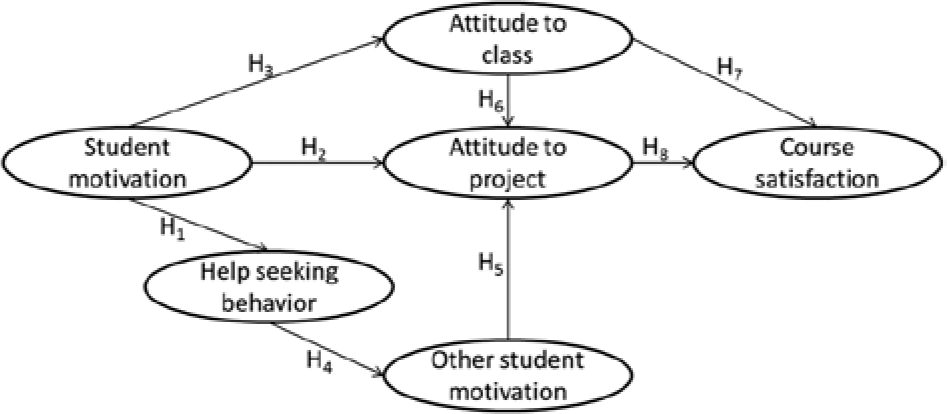
Conceptual model.
The ability to alter intrinsic motivation, especially as it relates to pedagogy, is especially important when one considers group projects and shared goals and outcomes in the classroom. More specifically, if one student has lower intrinsic motivation than the other ones in a classroom group project assignment, cognitive evaluation theory claims that certain events can trigger increased motivation for that student. In fact, in a series of experiments, Wild, Enzle, Nix, and Deci (1997) argue that intrinsic motivation theory can be extended to include a social contagion effect of motivation. These authors show that people socially engage in perceptions of others as they form their own intrinsic motivation levels (and this is an ongoing process), which in turn stimulates them to increase or decrease their quality of engagement in an activity or class. From the educational perspective, this engagement in a class can have immediate consequences for college students; not attending class, for example, represents the highest level of disengagement. On the other end of the spectrum, attending and participating in class can have positive consequences and increase intrinsic motivation in a ripple effect fashion. Thus, the social contagion of intrinsic motivation can have intense consequences in a classroom setting. Indeed, perceptions of another student in the class or even the instructor (Radel, Sarrazin, Legrain, & Wild, 2010) can greatly alter the intrinsic motivation of a student during a group project experience. Radel and colleagues show that students experience higher intrinsic motivation and rate their peers as also possessing such motivation when instruction style is altered.
Of particular interest to the present research is the impact of the contagious effect of the intrinsic motivation on a student’s class project experience and consequently his or her course satisfaction. In the model given in this article, student motivation, also called intrinsic motivation, measures the student’s commitment to doing his or her best in the course and being well prepared for each class meeting. The intrinsic motivation principle, although it also deals with creativity, encompasses the idea that intrinsic motivation increases engagement in a process, which would include searching and browsing behaviors (Amabile, 1996; Mueller & Kamdar, 2011). Intuitively, one can also infer that if a student is highly motivated, he or she will tend to be more of an active learner in the classroom and hence tend to ask more questions and pursue help when required. Defined as an activity between individuals, wherein they purposely seek help from others who they believe have better skills, capabilities, or resources than they do, help-seeking behavior has been studied extensively in the organizational behavior literature (Bamberger, 2009). Therefore,
Student motivation as a construct dealing with a classroom experience is also measured as student perceptions of self-commitment (Curran & Rosen, 2006). These scholars suggest that, along with several other perceptual measures (such as instructor perception and course execution), student motivation has a positive impact on student attitude toward the course. Active learning is another component of student motivation in the classroom, which deals with learner development as part of the cooperative process in the classroom (Young, 2005). This active participation in the classroom essentially means that students are highly engaged in the classroom and in the learning process, which is linked to the ideas behind intrinsic motivation. Rassuli and Manzer (2005) note that this motivation increases the overall success of team learning in the classroom. In addition to the positive impact of active learning, research shows that by increasing student motivation, feedback processes tend to occur more in the classroom, which then give rise to more open communication and suggestions (Lilly & Tippins, 2002), creating a more open learning environment and ultimately better attitudes. It is therefore suggested that
Help-Seeking Behavior
Much like employee teams work as a parcel of any organization, group projects rely on functional communication structures and appropriate classroom dynamics. However, one of the most important aspects of group projects is the learning that occurs between and within groups and the fact that this learning happens for different individuals at varied paces. In other words, not every group member can fully understand new material at the exact same pace. To counteract this problem, group members often rely on the ability to seek help from other group members, as they share a common goal throughout their course (Bacon, 2005). Newer research shows that help-seeking behavior does not always lead to better performance, in particular for the seeker (Geller & Bamberger, 2012).
Literature shows that there are broadly two categories of activities that occur in team assignments, namely, task-related and relational ones. Help seeking is a relational activity, since it helps build relationships within groups, whereas task-related activities consist of activities such as setting up meeting times (Mueller, 2012). In an organizational context, Perlow and Weeks (2002) suggest that relational activities are often not formally rewarded and thus are more likely to be avoided or lessened in scope when possible. In line with the organizational perspective of help seeking, strong affective relationships, whether in dyads or in teams, can eventually encourage reciprocity (Dirks & Ferrin, 2002). Whereas help seeking can be seen as a social cost, these authors suggest that such costs can be offset when individuals trust that giving help or sharing knowledge will eventually be reciprocated. Added to this, higher quality working relationships are predictive of help-seeking behavior in an employee context (Settoon & Mossholder, 2002). Thus, help seeking can be viewed as positive for a classroom environment; better relationships increase the likelihood of help seeking and help seeking tends to improve relational trust.
Another perspective of group projects and group work lies in the conceptualization of them from a network perspective. In particular, organizations can be seen as networks of units connected through relational ties, much as a classroom consists of multiple groups sharing in a learning environment (Brass, Galaskiewicz, Greve, & Tsai, 2004). Help seeking is one form of knowledge sharing, and existing research shows that it can be associated with negative social costs, such as admitted incompetence and lack of self-image on the part of the help seeker (Bamberger, 2009); on the other hand, Reinholt, Pedersen, and Foss (2011) indicate that such negative consequences of help seeking and knowledge sharing can be reduced if individuals are autonomously motivated to engage in it. In essence, when individuals are autonomously motivated to share knowledge and seek help, they do so because such behavior is consistent with their beliefs and self-worth (Ryan, 1995), and therefore, they usually have less of a tendency to worry about how they might appear to others in their team. That said, high achievement motivated individuals are less likely to seek help because they would rather trudge through and be able to overcome their difficulties on their own (Cleavenger, Gardner, & Mhatre, 2007). In fact, those who are high achievers are more likely to be the ones on a team who function as helpers rather than seekers. Thus, if an individual is seeking help from someone else on a team, the seeker must believe that the helper is willing and able to share knowledge. The belief that a team member is more knowledgeable would also indicate that the other student is more motivated, and thus I hypothesize that
Since classrooms are a social environment, the interaction between students and their perceptions of each other can have a large influence on their overall attitudes toward a project and, in turn, the course. For example, social loafing, also known as free riding, occurs when a student does not do a fair share of the work toward a group project (Aggarwal & O’Brien, 2008). These authors show that social loafing leads to overall decreases in student perceptions of other student contribution satisfaction. On the other hand, when students believe that other students did contribute a fair share of work to a project, they should have a better attitude regarding a group project. In line with this notion, Dommeyer (2007) uses a diary method to find that when students feel that other group members contributed equally to the project, they tend to have better views of those members. Furthermore, more recent research creates an attitude measure and shows that student attitudes toward group projects and members are higher when work is fairly divided among team members (Dommeyer, 2012). In the current study, similar items are used; students connect their perceptions of other students with their overall learning in multiple classes. Since previous research shows that group projects can lead to less learning than individual ones (Bacon, 2005), these items are important indicators to provide a mitigating impact on negative outcomes from group projects. Even though the present research does not measure learning outcomes, student satisfaction with a course and with a project serve as the outcome variables of interest. Deeter-Schmelz et al. (2002) demonstrate that although team size, team cohesion, and team diversity were all tested as possible predictors of team performance, only cohesion surfaced as a significant one; cohesion in teams requires team members to achieve consensus as they make decisions. The ability to build consensus as a group would require members to believe that other group members have shared goals and are equally motivated. Furthermore, when students have a positive attitude toward a task, they tend to make the best decisions and perform better on the task (Chapman & van Auken, 2001; Glazer, Steckel, & Winer, 1987). As such, a positive attitude toward a class would mean that a student would have a positive attitude toward tasks within that class. Hence,
In addition to positive attitudes toward a course and project, pedagogical research shows that positive group project experiences lead to more perceived learning, both in terms of course material and teamwork (Bacon, Stewart, & Silver, 1999). Also, Bacon and colleagues find that beneficial team experiences engender perceptions of an overall more enjoyable course. In a recent comprehensive study of student groups and group activities, Chapman et al. (2010) suggest that whereas faculty may not believe that student groups are effective in terms of their communication, students themselves often have a positive experience in group projects. In fact, faculty pessimism about group projects appears to be stagnating. This research also highlights the impact of attitudes toward groups on overall course satisfaction. The nature of a project can also have an impact on student attitude; for instance, Bobbitt, Inks, Kemp, and Mayo (2000) suggest that the experiential learning that occurs in a well-designed project can enhance student overall course satisfaction and learning. Thus, I propose the following hypotheses:
The conceptual model given in Figure 1 graphically depicts the hypotheses described previously.
Method
Participants and Procedure
To test the hypotheses and overall model depicted in Figure 1, a total of 215 (119 females and 96 males, median age = 24) undergraduate students from a large state-supported university in the western part of the United States who were enrolled in multiple marketing courses voluntarily completed the survey for course credit. Specifically, those courses included three sections of marketing research and two sections of Internet marketing classes, for a total of five different courses. In all courses in which the survey was administered, the procedure was identical, and the instructor was the same. In addition, the instructor did not assign students to teams; instead, students were allowed to self-select into groups. Previous research shows that self-selected teams tend to have better experiences with projects, in general (Bacon et al., 1999). The survey was administered just prior to the end of the semester during class time and included all of the measures given in the model. Students were not aware of the purpose of the survey or research questions.
Measures
The study uses a structured survey questionnaire, designed with previously validated constructs, as detailed in Table 1. For consistency, all constructs were presented with 9-point scales with anchors of 1 = strongly disagree and 9 = strongly agree.
CFA Statistics.

Note. Model fit: χ2(215) = 430.52, p = .000; confirmatory fit index = .946; Tucker–Lewis index = .938; root mean square error approximation = .073. AVE = average variance extracted.
Student motivation (SM) measures the perception that a student has with respect to the motivation of the other students in his or her classroom with a two-item Likert-type scale. This scale is adapted from the student perceptions of self-commitment scale given in Curran and Rosen (2006).
Help-seeking behavior (HSB) measures the amount of help a student asks for from his or her teammates during a course for solving tasks, often of a creative nature using a 4-item Likert-type scale. The original scale was six items; however, two of them did not fit the context of the study (since they were more aimed at solving a problem, not approaching a task) and were therefore not included (Anderson & Williams, 1996; Mueller & Kamdar, 2011).
Other student motivation (OSM) measures the perception that a student has toward other students in the class, emphasizing the impact that those other students have on his or her learning, using a 4-item Likert-type scale (Curran & Rosen, 2006).
Attitude to the project (AP) measures the attitude a student has toward his or her project in a class; Attitude to the class (AC) measures student attitudes toward a class. Both scales are adapted from attitude scales given in previous research (Day & Stafford, 1997; Homer, 1995; Krishen & Homer, 2012). To add reliability, two items were added into the AP scale, useful/not useful and fair/not fair. Both of these constructs use semantic differential scales; AP has five items and AC has three items.
Course satisfaction (CS) measures student satisfaction with a course with a 4-item semantic differential scale and is adapted from a satisfaction scale given in Spreng, MacKenzie, and Olshavsky (1996).
Results
Refinement of Scales and Measurement Model
The SEM, as shown in Figure 2, includes six variables: HSB, OSM, SM, AP, AC, and CS. To verify the validity of the model across class sections, an initial ANOVA was performed to check for differences across the six constructs of interest. Results show no significant differences between groups for marketing research (MR) versus Internet marketing (IM) undergraduate class sections for any of the six constructs of interest for MR (n = 177) versus IM ( = 38) classes: (a) HSB (M = 6.48 vs. M = 6.24; F[1, 213] = 0.57, ns); (b) OSM (M = 6.43 vs. M = 6.62; F[1, 213] = 0.33, ns); (c) SM (M = 7.54 vs. M = 7.46; F[1, 213] = 0.14, ns); (d) AP (M = 7.00 vs. M = 7.33; F[1, 213] = 1.52, ns); (e) AC (M = 7.50 vs. M = 7.87; F[1, 213] = 1.91, ns); and (f) CS (M = 7.43 vs. M = 7.53; F[1, 213] = 0.18, ns).
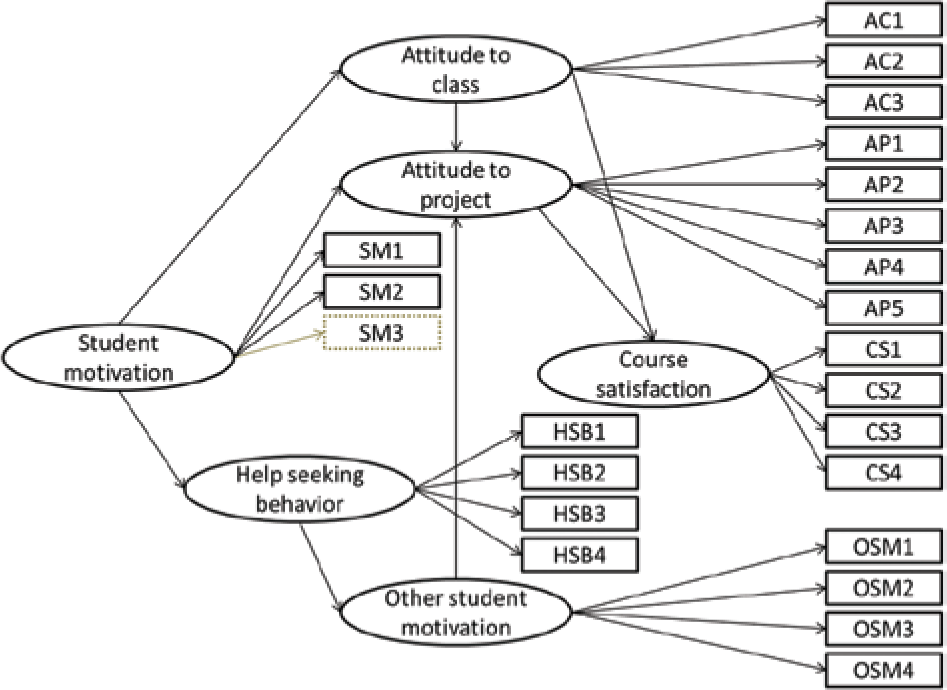
Structural model.
All constructs in the model were first examined simultaneously to assess model fit. As such, the standard residual covariance matrix, squared multiple correlations, and modification indices were referenced so as to determine appropriate measurement model fit. In total, one item was deleted from the full model before an acceptable model fit was attained. In particular, the third item was eliminated and on further inspection, the wording of that item (“I attended all class meetings”) does not appear to be consistent with the first two, which centered more on commitment and performance in the course.
The full structural model (see Figure 2) indicates adequate fit considering χ2 = 474.14, root mean square error of approximation (RMSEA) = .073, Tucker–Lewis index (TLI) = .933, normed fit index (NFI) = .894, and comparative fit index (CFI) = .941; however, examination of the average variance extracted (AVE) for each construct shows poor loading for SM3 (squared multiple correlation of .045), indicating that SM3 explains the least amount of variance. The AVE for student motivation with all three items is .478, and an acceptable AVE should be greater than .50 (Barclay, Thompson, & Higgins, 1995). So, from the student motivation scale, one item, Question SM3, was deleted, leaving an acceptable AVE for that construct of .71. With the exception of student motivation, all constructs have at least three associated measurement items. This is in agreement with the Hulland (1999) suggestion that researchers include multiple measures for each construct when using SEM. AMOS 20.0 was used to test the proposed hypotheses for the model.
Structural Model and Hypothesis Testing
Table 1 displays loadings for each construct item as well as composite scores and AVE, so as to ascertain the model validity and reliability. All items are significant at .05 levels with high loadings (all are above .70), showing convergent validity. All constructs demonstrate acceptable levels of reliability with composite reliability measure of .70 or higher (Nunnally, 1978). As seen in Table 1, each construct has a high level of reliability for alpha values with levels ranging from as low as .82 to as high as .94. AVE indicates the variance captured by the indicators in relation to measurement error (Fornell & Larcker, 1981). At a minimum, to use a construct in a model, its AVE should be greater than .50 (Barclay et al., 1995). This cutoff AVE value is sufficiently surpassed by all six of the constructs in the model (ranging from .67 to .81) shown in Figure 1 (see Table 1).
In Table 2, the discriminant validity statistics along with the means and standard deviations of each construct are given. In this table, diagonal values represent the square root of the AVE. As a test of discriminant validity, these diagonal values should be greater than their corresponding nondiagonal ones. The table shows that this is the case, and therefore discriminant validity is displayed. Table 3 presents cross-factor loadings of construct items; as shown in the table, all items loaded higher on their respective constructs than on others, which provides further support for discriminant validity. Given all of the above information, the model indicates both discriminant and convergent validity, such that measures of the constructs are distinct and the indicators load on the appropriate construct satisfactorily.
Mean, Standard Deviation, and Correlations.
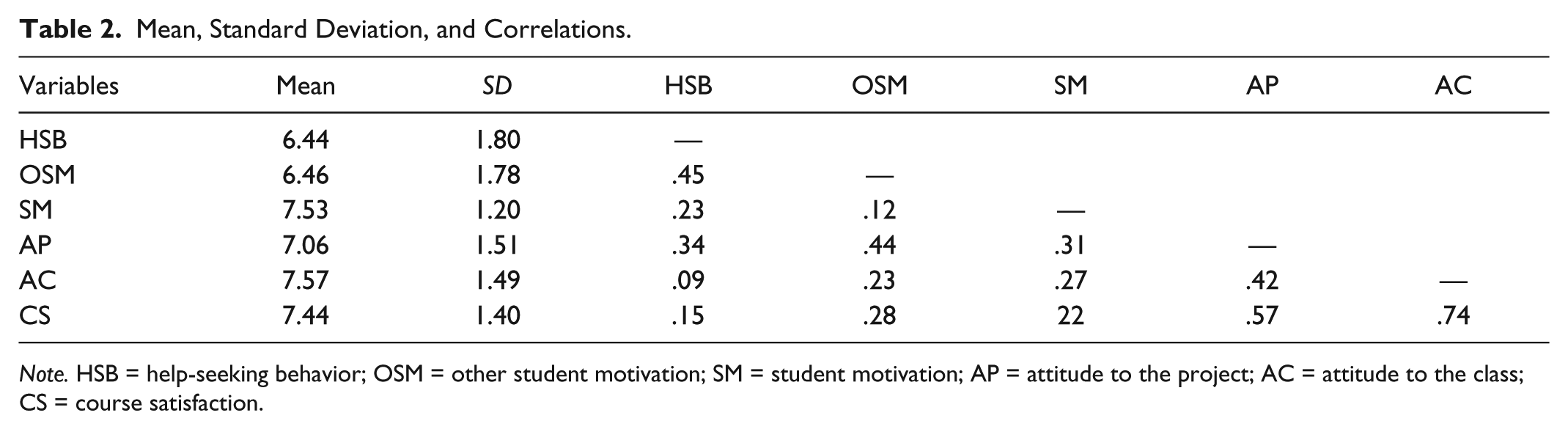
Note. HSB = help-seeking behavior; OSM = other student motivation; SM = student motivation; AP = attitude to the project; AC = attitude to the class; CS = course satisfaction.
Cross Factor Loadings.

Note. HSB = help-seeking behavior; OSM = other student motivation; SM = student motivation; AP = attitude to the project; AC = attitude to the class; CS = course satisfaction.
Italicized and bolded values indicate higher loadings for the items pertaining to their respective constructs, which indicates discriminant validity.
Table 4 and Figure 3 both show the path model results for the complete model. The fit statistics for the final model show that it has an acceptable fit: χ2 = 430.52, RMSEA = .073, TLI = .938, NFI = .903, and CFI = .946 (Bagozzi & Yi, 2012; Barr, Dixon, & Gassenheimer, 2005; Lee & Sargeant, 2011). Also given are the findings for the hypothesized results (Hypotheses 1 to 8). As depicted in the highly significant critical ratios, all hypotheses are fully supported, and all paths are significant at the p < .05 level.
AMOS Path Model Results.

Note. HSB = help-seeking behavior; H = hypothesis; OSM = other student motivation; SM = student motivation; AP = attitude to the project; AC = attitude to the class; CS = course satisfaction. β is a standardized coefficient.
Significant at p < .005 (two-tailed).

Hypotheses testing results.
The strength of the relationships between the constructs can be noted from the path coefficient values. In the model, per Hypotheses 1, 2, and 3, student motivation significantly predicts help-seeking behavior, attitude to the project, and attitude to the class, with path coefficients of .28, .24, and .30, respectively. Help-seeking behavior has a significant impact on other student motivation (Hypothesis 4), with a β value of .50. In turn, as suggested by Hypothesis 5, with a path coefficient of .35, other student motivation positively affects attitude to the project. In addition, attitude to the class significantly influences attitude to the project (Hypothesis 6) with a path coefficient of .31. Importantly and as stated in Hypothesis 7, attitude to the class, with a path coefficient of .64, is a strong predictor of course satisfaction. Attitude to the project also has a significant predictive relationship with course satisfaction, with a β value of .28, as hypothesized in Hypothesis 8.
To ascertain the extent to which variances in the constructs can be explained by the model, R2 values of the dependent constructs were calculated and found to be significant (Hulland, 1999). Findings show that R2 values were as follows: course satisfaction is .64, attitude to the project is .36, and other student motivation is .25. The model shows a smaller percentage of variance accounted for with regards to help-seeking behavior (.08) and attitude to the class (.09).
Discussion
Pedagogical Implications
Drawing from both pedagogical and organizational behavior literatures, the contagious motivation model brings in help seeking as an important construct to further the understanding of group project behavior. In particular, the model highlights how motivated students can contagiously motivate other students during group project work and ultimately improve their attitudes to the class and project. The model further shows that when attitudes to the class and project improve, students will also experience higher course satisfaction. Moreover, this article proposes a pedagogical model by tying together intrinsic motivation theory with social contagion of intrinsic motivation and putting these into the conceptual methodology of group projects in a classroom. Then, using a sample of 215 students in self-selected group projects, the model is shown to have adequate fit.
Previous research shows that student intrinsic motivation can be increased by changing the way that professors teach their courses. For example, Young (2005) indicates that highly interactive faculty can increase student intrinsic motivation by employing active learning in the classroom and increasing classroom dialogue. Still other research argues that professors and students should share responsibility for the student learning experience, as an important agenda throughout the course, and that such shared learning will lead to increases in student motivation (Sierra, 2010). Likewise, recent research by Taylor, Hunter, Melton, and Goodwin (2011) suggests that by setting expectations of cocreation in the learning process and emphasizing the importance of learning as a joint student–professor goal, students are more likely to increase classroom motivation and learn actively. The current article augments such research with a model that shows how other students can affect student motivation during group projects. As an important part of the learning process in business school courses, student projects are often the bane of a professor’s classroom experience, and likewise for students. Methods of achieving benefits from group projects are thus sorely needed for both students and professors.
There are multiple implications of the contagious motivation model for educators. First and foremost, educators should empower students in the classroom by providing an active learning environment and maximizing reflective learning abilities in students. In essence, an active learning environment can facilitate motivation in the students and also improve help-seeking behaviors. These goals can be accomplished by charting out exercises and facilitating lively classroom discussions throughout the semester. Second, whereas literature shows that group projects can yield mixed results in terms of learning outcomes, the majority of research favors the idea of creating a realistic “business-like” environment in the classroom, which projects provide (King & Behnke, 2005). By introducing an analogy of a firm with its employee teams to a classroom with its student groups, this article contends that help seeking is an important variable to establish group cohesion. As shown in the organizational behavior literature, help seeking plays a significant role in building relationship capital within teams, by fostering reciprocity and encouraging knowledge sharing. In effect, help-seeking behavior serves as an important antecedent to the perception of other student motivation, which then leads to increases in attitude to the project, class, and satisfaction with the class. The model begins with motivated students, meaning that, as Taylor et al. (2011) find, the professor’s role in the classroom of increasing student engagement is still critical. Without motivated students, the ability to increase student-to-student knowledge sharing and help seeking during group projects is at risk. Therefore, the current model builds on previous educational research that argues for fostering an active learning environment in the classroom. The biggest benefit of contagious motivation for group projects is that, as the theory shows, intrinsic motivation in students can be increased, which will then lead to enhancement of attitudes for all team members.
Conclusions
Future research can address several important aspects of the contagious motivation model. One possible venue would be the ethical implications of the model, for example, the impact of unethical group member behavior on student projects and course satisfaction (Nill & Schibrowsky, 2005). Cross-cultural implications would also be an interesting area to pursue, in particular the impact of self-construal theory and interdependent versus independent thinkers (Payan, Reardon, & McCorkle, 2010). Since motivation is a very well established area of pedagogical research, several other constructs could have been employed, and future research can address those. For example, Bacon and Novotny (2002) present an achievement motivation seven-item scale, and Young (2005) provides two four-item scales for intrinsic and extrinsic motivation. Additionally, future research can test the model or similar models through a multigroup analytic perspective, to identify possible moderators to the model such as student grade point average, work experience, or personality characteristics. The knowledge of the impact of such moderators could be useful to professors as well as students as they form project groups.
The introduction of help-seeking behavior into a pedagogical context can increase cross-disciplinary richness by bringing in organizational behavior ideas where they are appropriate, just as marketing researchers often apply psychological principles and theories. Whereas help-seeking behavior can lead to positive outcomes such as the building of trust and reciprocity and motivation benefits, future research can also expand on the idea of help seeking in the pedagogical context by exploring differences in learning that occur when help-seeking behavior is higher in certain groups versus others. Also, in the context of group cohesion and individual personality types, Freeman and Greenacre (2011) identify social loafers versus strugglers. Help-seeking behavior can be tested in the context of those two types of group members; many help seekers could actually be strugglers and be seen as such in terms of group dynamics. Professors would then need to identify ways to make sure that helpers do not suffer in terms of their learning experience while trying to share their knowledge. Additionally, the help-seeking behavior variable should be further explored in combination with other important group project variables such as group size, group grade percentage, and other group-related variables.
A professor’s role in the classroom dynamics, even as pertaining to group projects, cannot be underestimated. The ability to improve group motivation by fostering trust and help seeking within groups can clearly provide better group and classroom experiences but not without a professor who encourages such behavior. Ample research stresses the importance of a professor’s attitude toward a group project versus the student team attitudes, finding that there are large disparities. To that end, Chapman et al. (2010) document much more negative professor attitudes and suggest important measures to correct and improve them. Future research can explore professor attitudes toward student motivation and help-seeking behavior and measure those against outcome performance variables within group projects.
Given the plethora of social media tools at the disposal of most students and the growing prevalence of digital technology employment in pedagogy (Buzzard, Crittenden, Crittenden, & McCarty, 2011), project groups have another simple method to increase communication and trust. For example, professors can encourage students, if they so desire, to create Facebook groups or Google docs repositories for their project communications. Such digital techniques can often reduce the redundancy in knowledge-sharing communications, since students can offer up solutions one time, and the entire group becomes privy to the information. These forums also allow for ample “helping credit” to be given to the helper while the seeker is able to gain the required information without having to make face-to-face inquiries and may thus experience lower social costs.
Limitations
As with all research, there are limitations in the present research and ways that it could have been strengthened. First, additional institutions could have been tested to make sure that the model fits under various circumstances, and adding to its ecological validity. Second, the focus of the present research was undergraduate marketing students but future research could test the model across a larger range of students, including graduate ones. In addition, an experimental paradigm could also be an effective way of increasing the validity of this model, for example, manipulating help-seeking behavior to test the contagion effect. Since it is possible that indirect hypotheses can exist, we could have tested for them, and this is something that can be addressed in future research. Course satisfaction as the key dependent variable in our model can be seen as a limitation in that it is a perceptual measure and does not necessarily correlate with student performance measures. Thus, we suggest that our model is a starting point for furthering the concept of contagious motivation in group work but future research, rather than focusing on subjective variables such as student perceptions and attitudes, should address a second model that incorporates behavioral measures as well. More specifically, future pedagogical research should study actual learning and performance measures as important outcome variables in the model. Finally, we do not address individual differences such as student learning styles and help-seeking behaviors using trait measures, and such personality measures might be useful to extend this model and provide additional moderators.
Thus, the contagious motivation model presented in this article provides a framework for enhancing the classroom satisfaction experience while still providing students with group projects and experiential learning. The key contribution of this article is that it provides a SEM for group project outcomes that synthesizes pedagogical, psychological, and organizational behavior theories and tests it in an empirical framework.
Footnotes
Declaration of Conflicting Interests
The author declared no potential conflicts of interest with respect to the research, authorship, and/or publication of this article.
Funding
The author received no financial support for the research, authorship, and/or publication of this article.