



Abstract
Creativity is not just a catch phrase for the new decade—it is a way of life. While technology-driven innovation can promote efforts to produce optimal solutions, individually driven creativity is necessary to launch and drive cutting-edge, trailblazing ideas. The goal of this study is to examine relationships between creative divergent thinking (CDT) and motivation situated within course projects as antecedents to the overall course experience. The synthesis of transformational leadership, context-dependent fixation hypothesis, strength of weak ties perspective, contagious motivation, and constructivist learning frameworks form the interdisciplinary foundation for the proposed contagious motivation and creative experience model (CMCEM). The proposed marketing classroom model is tested using a structural equation model of N = 540 marketing undergraduate students. Findings indicate that CDT is an important individual characteristic that affects classroom dynamics. Importantly, when students exhibit higher levels of CDT, they perceive higher project uniqueness, higher levels of motivation, higher other student motivation, and more positive course experiences. In addition to other findings, the CMCEM emphasizes the powerful combination of CDT, individual student motivation, the contagious nature of that motivation on other students through well-structured group projects, and the importance of instructors as transformational teachers.
Keywords
We begin with a true story about motivation and creativity. Ultramarathons are defined as any race distance above 26.2 miles. Most ultramarathon race directors allow runners to fall back on shorter distances in case of an injury or bad day. The ability to fall back on a shorter distance looms in a runner’s mind and overcoming this “fallback” requires continuous motivation. One particular runner at her first ever ultramarathon was grossly ill-prepared for the race with one sweatshirt, inadequate clothing, and blistered feet. This runner entered into a deep mental space to rewrite the script of the race and struggled to complete the full 100 miles. What thoughts occupied that mental space? How did what seemed impossible become a reality?
Viewing the race through a different lens, or reframing the problem (i.e., finishing the race), required the runner to deconstruct the context and find a unique approach. To recontextualize the circumstances of the race, the runner needed to employ both creativity and motivation. The context-dependent fixation hypothesis argues that because individuals often become fixated on thoughts that are associated with the inability to solve a problem (i.e., fixation), new contexts that are not directly linked to the fixated thoughts can trigger creative problem solving (Smith & Beda, 2020). For the runner, fixation on lack of warm clothing and blisters could lead to the inability to find creative solutions to these problems (such as asking for an extra piece of clothing or having the on-staff medical expert treat the blisters). Conversely, viewing the race though a different context (i.e., as a social event where other runners and race directors are on hand to help when needed) led to a creative solution.
Creativity is not just a catch phrase for the new decade—it is a way of living. In fact, according to LinkedIn, companies cite creativity as the most valuable skill in potential hires. While technology-driven innovation can drive efforts to find efficient and optimal solutions, individually driven creativity is needed to launch, invent, and lead cutting-edge and trailblazing ideas (Petrone, 2019). Both LinkedIn and the World Economic Forum highlight the importance of creativity to differentiate between individuals when competing with artificial intelligence (Belsky, 2020). Forbes claims that creativity is one of the top five skills most required for employees in 2020 (Marr, 2019). The World Economic Forum reports that while creativity, originality, and initiative were the fifth most important skillset in demand for employers in 2018, they are expected to rise to third most important in 2022 (Leopold et al., 2018).
Students value creativity in the classroom and active learning environments that foster creative thinking (Carpenter, 2016; Fan & Cai, 2020). When pressed to discuss what they learned in any given class, they most often talk about a creative project or an experience interfacing with the outside community, such as creating a campaign for SafeNest, a domestic violence shelter (Krishen & Kirkendall, 2016). For professors, the biggest pedagogical challenge often lies in incorporating creativity while preparing courses, just as what is expected from students when they exemplify learning. Creativity is considered an essential component of the marketing curriculum and a core competency of marketing students (Jaskari, 2013). Without creative pedagogy, courses can suffer from the “same old, same old” philosophy and lack engagement and excitement from students.
Empowered and transformational leaders ultimately increase the psychological empowerment of their subordinates, which positively influences creative process engagement, intrinsic motivation, and creativity (Zhang & Bartol, 2010). In every course experience, professors encourage creativity and motivation from their students and help them become empowered leaders (He et al., 2020). Recent research supports the connection between creativity and motivation and the important role played by lecturers through a cross-cultural lens (Zhang et al., 2020).
Therefore, the goal of this study is to examine the relationships between creative, divergent thinking, and motivation, situated within the context of course projects as antecedents to the overall course experience. To develop the proposed hypotheses, three sets of literature are reviewed: (a) the context-dependent fixation hypothesis as it relates to teamwork and group projects, (b) creativity and contagious motivation in relation to transformational leadership, and (c) the classroom as an immersive experiential learning community, tying in constructivist learning theory and the strength of weak ties perspective. Next, the study replicates an existing contagious motivation model with help-seeking behavior as an important component (Krishen, 2013). Following this, a proposed creative divergent thinking (CDT) structural equation model of the marketing classroom is tested using a survey-based study of N = 540 marketing undergraduate students. After discussing our empirical findings, we summarize our research and draw appropriate conclusions. Last, the article explores the implications of the proposed model for marketing pedagogy.
Theoretical Framework and Hypotheses
Multiple pedagogical studies apply managerial theories on teamwork in organizations to project work in classrooms, such as the input-process-output (I-P-O) framework (c.f., Deeter-Schmelz et al., 2002), the affect theory of social exchange (c.f., Kutlubay & Uslay, 2019), and models of creativity and innovation (c.f., Rodríguez-Sánchez et al., 2017). As an overarching framework, the I-P-O model identifies inputs such as group features, connected to processes such as group tasks, and linked to outputs such as team performance (Hackman, 1987; Ilgen et al., 2005). The leader-target-outcome model designates leader characteristics as inputs, team behaviors as mediators, and satisfaction, performance, and commitment as outcomes (Fischer et al., 2016). Andressen et al. (2012) indicate that transformational leaders are inputs to the I-P-O model and directly influence motivation and performance. To propose a model linking creativity to motivation and ultimately to student course experience, the following sections discuss the course project as a contextual queue for learning, the professor as a transformational leader, and the classroom as an experiential learning community.
Context, Teamwork, and Projects
Student group projects are often the most difficult component of a course experience. However, since group projects immerse students in a social framework and increase peer-to-peer communication, they provide an opportunity for instructors to foster a sense of community and collectivity in the classroom. Experiential projects allow students to engage more fully with the learning process, enhance their understanding of subject material (Elam & Spotts, 2004), and increase their motivation to work hard (Kemp et al., 2018). During the completion of a group project, student teams often deliberate and brainstorm to generate new ideas.
In relation to creative idea generation, the use of inappropriate knowledge from implicit cognitive systems, or fixation, occurs when cognitive operations are blocked by something in memory (Smith & Linsey, 2011). There are many forms of fixation effects, often termed cognitive fixations, which range from adherence, to incorrect solutions or responses (i.e., blockers), to the inability to reach the goal of a creative problem task (Smith et al., 2011). An incubation effect as it relates to creative problem solving is characterized by letting a problem remain unsolved rather than continuous efforts to solve the problem (Kohn & Smith, 2009).
The forgetting fixation theory argues that an incubation interval allows an individual to mitigate blockers from memory (Smith & Blankenship, 1991). Two potential ways that wrongful retrieval of solutions can occur are repetition (having previously solved the same problem with the same solution multiple times) and context (memory of the situation surrounding the previous problem; Beda & Smith, 2018; Smith et al., 2018). Contextual fluctuation, or changes in context over time can mitigate context-dependent fixation (Smith & Beda, 2020).
Consistent with the context-dependent fixation hypothesis, uniquely designed course projects can increase creative problem solving by stimulating students in unexpected ways and removing them from previously contextualized tasks. Unique course projects are perceived as valuable, meaningful, and transformative learning experiences for students (Burgess, 2012). In addition, research suggests that unique projects enhance both objective learning measures like subject matter meaning and marketing concept connection, and subjective student perceptions like confidence and enjoyment (Craciun & Corrigan, 2010).
Therefore, we present the following hypotheses:
Creativity and Contagious Motivation: Transformational Leadership as Teaching
Transformational leadership involves a style of inspiring and motivating followers to prioritize the collective good and elevate their performance to exceed their own self-expectations (Avolio et al., 1999). Known as the 4I’s, this type of leadership is characterized by (a) idealized influence—leaders are inspiring role models who enact what they expect, (b) inspiration motivation—leaders envision collective goals, (c) intellectual stimulation—leaders challenge the status quo and look for creative solutions, and (d) individualized consideration—leaders adapt to followers as unique individuals (Bai et al., 2016). Transformational leadership in the organizational behavior literature is normally considered a contextual stimulus that pertains to group dynamics (Kark et al., 2003).
One prominent contextual factor for enhancing or inhibiting creativity is the leadership within a unit (Zhou & Hoever, 2014). For example, transformational leadership enables cognitively diverse teams to increase their intrinsic motivation which ultimately leads to higher team creativity (Wang et al., 2016). Applied to the classroom environment, Slavich and Zimbardo (2012) argue that transformational teachers increase students’ mastery of key course concepts while also transforming their attitudes and beliefs about learning. In the present model, perceived project uniqueness (PPU) comes from instructor creativity and is a signal for transformational teaching.
CDT is considered a relatively stable predisposition of an individual’s ability to generate novel ideas (Kilgour & Koslow, 2009). In conjunction with a diversity of information, divergent thinking positively influences business idea generation (Gielnik et al., 2012). Even though CDT is normally measured as a trait, scholars argue that various types of tasks and environmental, cultural, and contextual queues can enhance this type of thinking (Hennessey, 2015). A meta-analytic review of creativity suggests that intrinsic, prosocial, and extrinsic motivation are all directly related to creativity (Liu et al., 2016). Individual-level dispositions such as motivation and openness to experience enhance team-level performance, information processing patterns, and creativity (Hoever et al., 2012). When individuals become inspired by content (i.e., it conjures motivation, transcendence, revelation, etc.), they are induced to be more creative (An & Youn, 2018). The componential theory of creativity incorporates the social environment, creative process, and individual intrinsic motivation, as integral to fostering creativity within teams and organizations (Amabile, 2012). CDT in combination with unique tasks and a conducive environment can enhance how actors or individual students perceive projects and their novelty, as argued by the interactionist account of creativity in organizations (Woodman et al., 1993) and the dynamic componential model of creativity and innovation (Amabile & Pratt, 2016).
In line with an environmental view of the effects of creativity on student perceptions and performance, Ma and Corter (2019) indicate that explicit creative instruction creates a team creativity climate. Serving as a creativity catalyst, divergent thinking can enhance motivation and novelty in group project work. The following hypothesis is founded by transformational leadership as a proxy for explicit creative instruction and PPU, the interactionist account of creativity in organizations, and the dynamic componential model of creativity and innovation:
Hill and McGinnis (2007) identify creativity as one of three types of thinking, the other two being critical and reflective. When confronted with a challenge, individuals consider three key elements that are known as the “creative intersection”: domain expertise, intrinsic or task motivation, and creative/problem-solving skills (Amabile, 1982). Creative problem solving involves both the generation and evaluation of new ideas, but most definitions focus on the generation of them (Berg, 2016). During the production of new ideas, often called brainstorming, individuals must persist through moments of blankness and sustain motivation rather than accepting defeat (Steele et al., 2018).
Consistent with the context-dependent fixation hypothesis, unfamiliar creative provocations or inventive marketing structures are more likely to lead to divergent ideation, which is linked to individual creative performance (Titus, 2018). When students perceive that there are benefits to working in groups (Chapman & van Auken, 2001) or have perceptions of other students fostering interpersonal relationships in the course (Curran & Rosen, 2006), they tend to have positive attitudes toward group projects. Thus, the following hypotheses are proposed:
The Course as an Experiential Learning Community
In its earliest conception, social learning theory combined social cognition with human developmental learning processes, arguing that humans are social creatures who are affected by observation, emotional connection, and cultural spaces (Bandura & Walters, 1977; Grusec, 1992). Discovery learning is a facet of the constructivist approach and involves allowing individuals to learn from doing (Bruner, 1961). The theory of active learning otherwise known as the constructivist learning theory argues that during the learning process existing knowledge structures are fundamentally altered to construct new meaning and incorporate new knowledge (Zahorik, 1997). One of the components of action learning requires a group project to have no known solution and therefore require both creativity and innovation, leading to higher levels of student motivation and engagement (Young, 2010). Novel forms of value-driven innovation during the pedagogical process, such as unique project assignments, can increase student engagement (Taylor et al., 2011). For example, Chen et al. (2018) show that a unique design-thinking project can prompt students to work together and produce more creative innovations.
Delivering a satisfactory course to students leads to higher levels of engagement, involvement, and trust, which ultimately leads to more learning (Chang & Smith, 2008). Discussion outside of the classroom can also have a positive influence on learning (Hollenbeck et al., 2011), and such discussion is more likely to occur when students engage in team projects. Through an exploratory study of student definitions of creativity, Krishen and Kirkendall (2016) indicate that active learning and social construction of knowledge provide avenues to enhance creativity in course assignments. Research also finds that student motivation is contagious in the classroom, a phenomenon amplified by group projects (Krishen, 2013).
The strength of weak ties perspective suggests that relationships between individuals with less previous social interaction (i.e., weak ties to each other) facilitate the creation of new ideas and knowledge (Granovetter, 1973). In an organizational setting, Baer (2010) applies this perspective to creativity and finds that a combination of two factors lead to higher creativity: (a) when idea networks are sized appropriately and weak in strength (i.e., diverse) and (b) when individuals have a high level of openness to experience. Thus, when students perceive projects to be novel and work in teams to complete projects (strength of weak ties), they should have more positive course experiences. Courses are experienced as a holistic embodiment of the instructor, the students, and the culture of sharing created in the classroom. Hence, the following hypotheses are proposed:
The current research therefore tests the conceptual model shown in Figure 1.
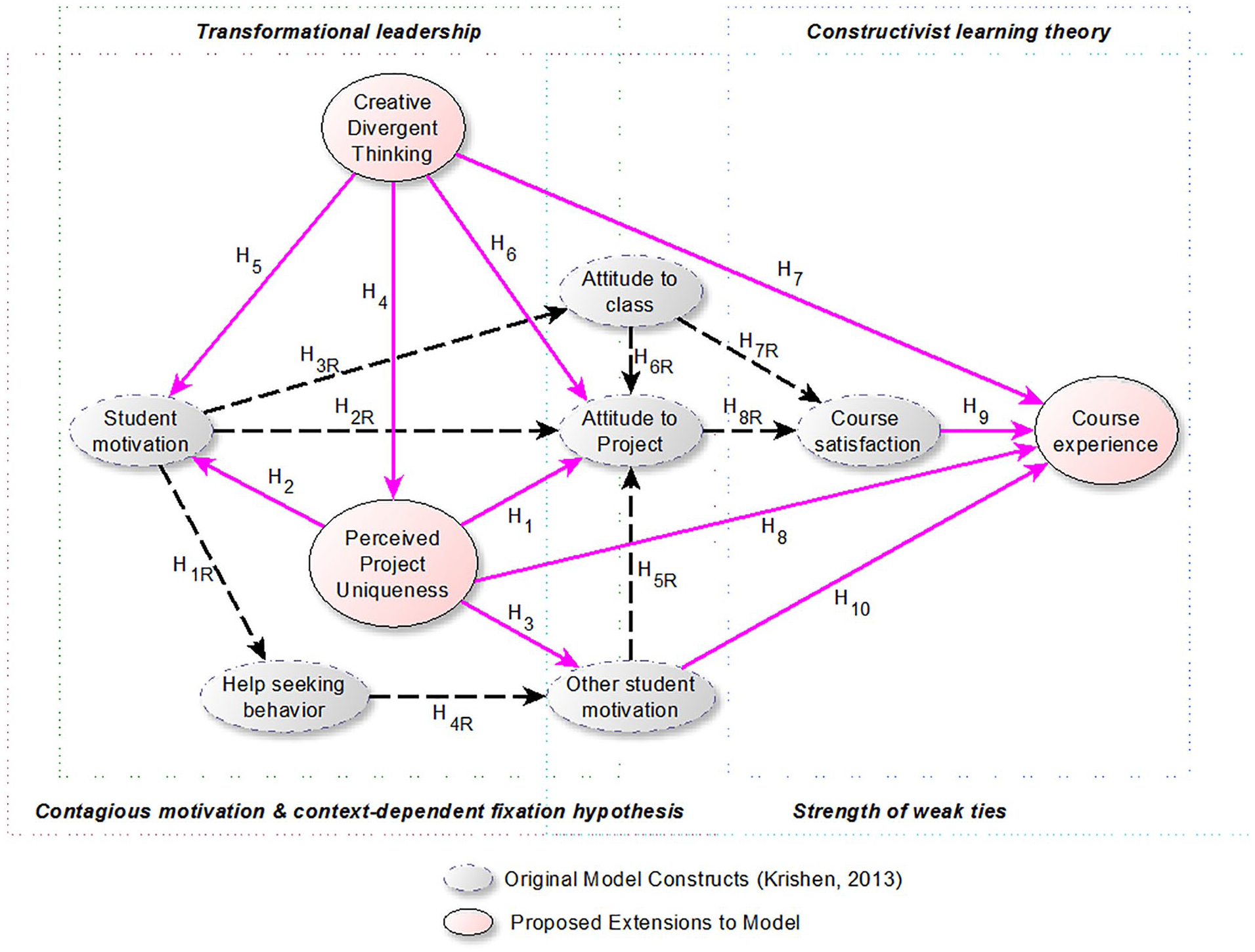
Conceptual model.
Empirical Study
Participants and Procedure, and Measures
The sample consisted of a total of 540 (276 females, 263 males, 1 unreported gender; median age = 26; mean age = 27.2) undergraduate students from a large state-supported university in the Western part of the United States. Every student voluntarily completed the survey once for course credit and the full data set consists of marketing research course sections (c.f., Jaramillo & Spector, 2004). The survey was administered in courses using an identical procedural approach and instructor. The instructor did not assign teams in any of the courses and the team size was consistent across all sections. Bacon et al. (2001) find that self-selected teams can lead to better project experiences. For the course culminating group project, each student had to bring at least one magazine advertisement to class and teams worked together to choose their favorite to use for a simple advertising study. After analyzing data from a standardized survey provided by the professor, each team wrote a paper with data analysis and a literature review designed to understand consumer perceptions of their favorite advertisement and brand.
Measures as Self-Perceptions
Ample multidisciplinary scholarship examines the psychometric properties of creativity measures and includes research that interrogates: (a) whether creativity should be measured globally versus within specific domains (e.g., Cropley, 2000); (b) the relationship between divergent thinking processes and creativity measures (e.g., Runco & Acar, 2012; Titus, 2000); (c) the meaning and importance of measuring creativity in a pedagogical environment (e.g., Krishen & Kirkendall, 2016; McCorkle et al., 2007); and (d) the issue of whether creativity should be measured as a self-perceptive (creative metacognition) versus objective performance (e.g., Pretz & McCollum, 2014). Some of the latest research on creativity supports the use of domain-specific measures and finds that creative metacognitions and self-assessments of creativity appear consistent with standardized creativity tests (Kaufman, 2019). Self-report measures of creativity have been utilized in university settings across a variety of disciplines (Snyder et al., 2020), especially when targeted within a domain (e.g., marketing research) and task (e.g., a project). Thus, the present study utilizes self-report measures for all constructs. Students were provided with the option to complete the survey during class time toward the end of the semester. The purpose of the study and research questions were not provided to the students. In addition to PPU, CDT, course experience, student motivation, other student motivation, attitude to project, and course satisfaction, this study tests a previously established model with two additional constructs: help-seeking behavior and attitude to class. All measures utilized previously validated Likert-type scales anchored by 1 = strongly disagree and 9 = strongly agree, as shown in Table 1.
CFA Statistics.

Note. CFA = confirmatory factor analysis; CR = composite reliability; AVE = average variance extracted.
Results
Common Method Bias (CMB) Testing
Several methods are utilized to test for CMB. First, filler questions and multiple scaling formats were included in the survey design (MacKenzie & Podsakaff, 2012). Next, Harmon’s single-factor test was conducted to analyze the unrotated solution of the exploratory factor analysis. Findings of this test show that a multiple factor solution and a first factor variance provide a value of 35.9%, which is sufficient according to the recommended limit of 50% or less (Baumgartner & Steenkamp, 2001; Craighead et al., 2011; MacKenzie & Podsakaff, 2012). Given our testing and design measures, we can conclude that CMB is not present in our model.
Structural Model
Table 1 provides construct references and item details including item loadings, composite reliability, and average variance extracted (AVE) per construct. Item loadings for all items are 0.4 or higher with significance levels of 0.05 or lower, therefore convergent validity is adequate (Fornell & Bookstein, 1982). Reliability is appropriate for all model constructs given that the composite reliabilities are between 0.74 and 0.97 (Nunnally, 1978). Convergent and discriminant validity are determined based on a set of criteria by Fornell and Larcker (1981). Convergent validity is determined by the AVE values per construct and should be 0.50 or higher. In the proposed model, AVE values range from 0.56 to 0.88, thus the cutoff value is exceeded for all nine constructs. During the scale purification process, a few items were dropped from the final model due to low factor loadings or low item-to-total correlation coefficients. Table 2 includes the means, standard deviations, correlations between constructs, and the square root of AVE values in diagonal positions. Because the diagonal values are greater than their corresponding nondiagonal ones, the model has discriminant validity.
Mean, Standard Deviation, Correlations, and Square Root of AVE.

Note. Diagonal values represent the square root of the average variance extracted. SM = student motivation; HSB = help-seeking behavior; CDT = creative divergent thinking; PPU = perceived project uniqueness; AC = attitude to class; AP = attitude to project; OSM = other student motivation; CS = course satisfaction; CE = course experience.
p < .01 (2-tailed).
Hypothesis Testing
Similar to previous research replicating and extending a model (e.g., Seyedghorban et al., 2016), the present study tests both the original hypotheses and the proposed ones. AMOS 23.0.0 was used to test both the replicated Krishen (2013) contagious motivation model as well as the extended structural model. The replicated model, as provided in Figure 2 and Table 3, confirmed all of the original hypotheses H1R to H8R with an acceptable fit χ2/degrees of freedom (df) = 649.56, root mean square error of approximation (RMSEA) = 0.060, comparative fit index (CFI) = 0.968, and Tucker–Lewis index (TLI) = 0.964. The final extended model also displays acceptable fit with χ2/df = 1633.00, RMSEA = 0.064, CFI = 0.941, and TLI = 0.935 (Bagozzi & Yi, 2012). The full final model is shown in Figure 3.
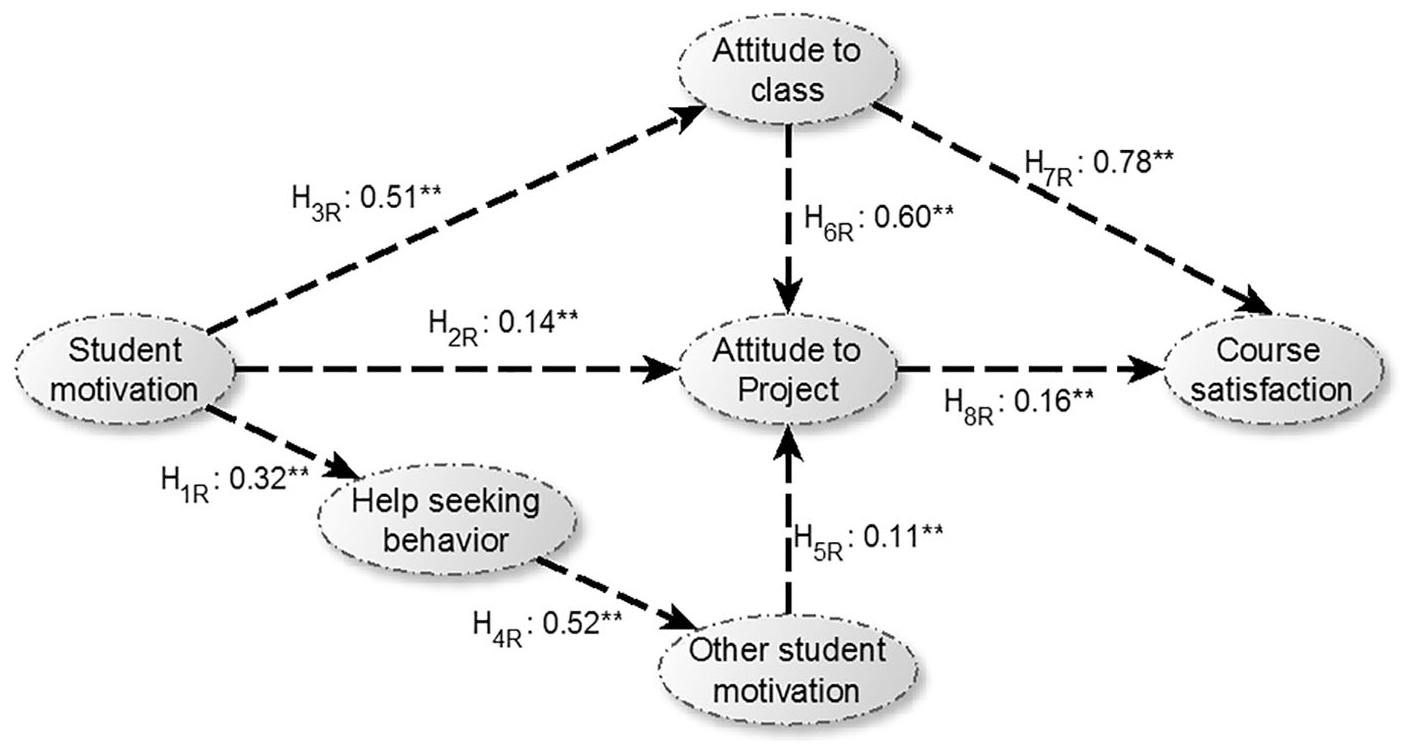
Replicated model.
Replicated Model: AMOS Path Model Results.

Note. β is a standardized coefficient.
p < .005 (2-tailed).
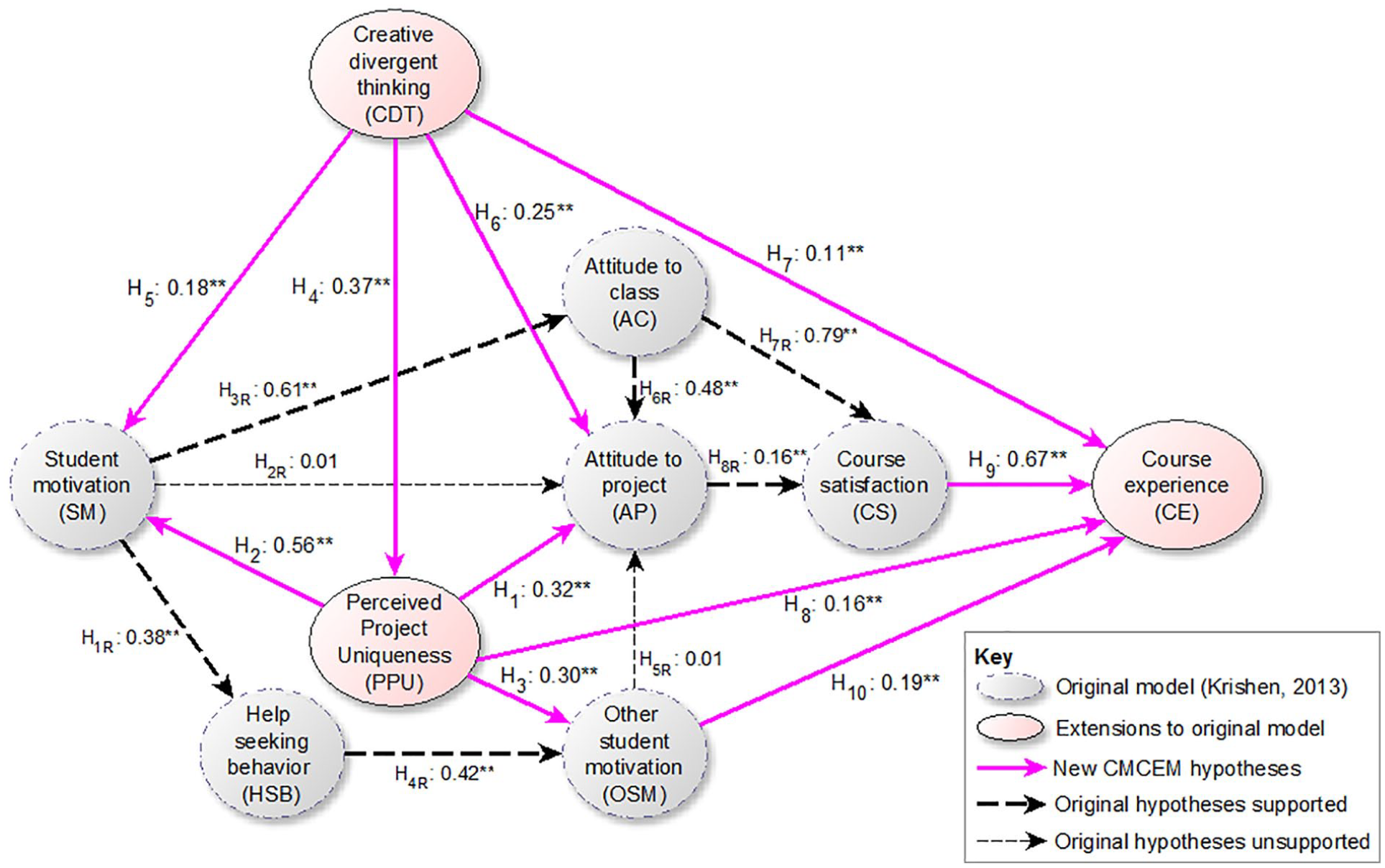
Contagious motivation and creative experience model (CMCEM).
As shown in Table 4, Hypothesis 1 to Hypothesis 10 are all confirmed in the final path model results. Perceived project uniqueness has a significant positive effect on attitude to project (Hypothesis 1: β = .32, p < .001), student motivation (Hypothesis 2: β = .56, p < .001), other student motivation (Hypothesis 3: β = .30, p < .001), and overall class experience (Hypothesis 8: β = .16, p < .001). CDT has a significant positive effect on PPU (Hypothesis 4: β = .37, p < .001), student motivation (Hypothesis 5: β = .18, p < .001), attitude to project (Hypothesis 6: β = .17, p < .001), and overall class experience (Hypothesis 7: β = .11, p < .001). Finally, course satisfaction and other student motivation are both positively related to overall course experience (Hypothesis 9: β = .67, p < .001, and Hypothesis 10: β = .19, p < .001, respectively). The eight original hypotheses are also tested in the extended model of creativity with motivation. The extended model does not support two of the eight original hypotheses. Specifically, the relationships between student motivation and attitude to projects (Hypothesis 2R: β = .014, p = n.s.) and other student motivation and attitude to projects (Hypothesis 5R: β = .005, p = n.s.) are not confirmed. All other original hypotheses are confirmed in the new model.
Final Extended Model: AMOS Path Model Results.

Note. β is a standardized coefficient.
p < .005 (two-tailed).
Discussion
The relationship between CDT and student motivation underscores the importance of the classroom environment and transformational leadership as catalysts to positive course experiences. Additionally, when students exhibit higher levels of CDT, they perceive projects as more novel, are more motivated, and have more positive attitudes towards projects. These findings emphasize the powerful combination of CDT, individual student motivation, the contagious nature of that motivation on other students, and the importance of student perceptions of project novelty. CDT in combination with a newer context (such as a unique project perception) can enhance the course experience. A combination of several theories serve as explanatory models for the relationships in the conceptual model including contagious motivation (Krishen, 2013), context-dependent fixation hypothesis (Smith & Beda, 2020), transformational leadership (Avolio et al., 1999), constructivist learning theory (Zahorik, 1997), and strength of weak ties (Granovetter, 1973). Note that the classroom experience can be enhanced either directly through individuals with high divergent thinking capability or indirectly through contagious motivation.
Two hypotheses regarding attitude toward projects from the replicated contagious motivation model were not confirmed. We surmise that the addition of CDT and project uniqueness as alternate pathways to attitude to projects may explain the lack of confirmation of these two hypotheses. As such, the pathway from CDT and student motivation leading to course experience demonstrates a different and important path to enhancing the overall project experience. In terms of other student motivation, a new pathway to course experience highlights the importance of contagious motivation as an essential element of creativity and pedagogy.
Conclusions, Limitations, and Future Research
This study has several limitations which provide avenues for future research. First, additional research across multiple pedagogical media sources (e.g., online vs. hybrid vs. face-to-face teaching) and cross-culturally (e.g., high vs. low social capital countries) may elucidate the relative importance of context versus community. For example, Hanna et al. (2013) relate cross-cultural differences in individual ethical behaviors to varied social learning environments. Second, qualitative studies like student focus groups or in-depth interviews may lend further insights, especially in terms of course experience. Third, studying these constructs from a dyadic perspective could also clarify the role of instructors in administering unique projects, namely by comparing instructors with students using a nested design. Fourth, as our model explores relationships between individual outcomes and creativity, follow-up studies may expand on the framework using a nested design (i.e., individuals within teams) to understand how team structures influence the course experience. Specifically, relationships between motivation, creativity, and course experience should be explored for teams with higher levels of cognitive and/or ethnic diversity (Hoever et al., 2012; Perry-Smith & Shalley, 2003; Phillips, 2014) and within classrooms where instructors foster an inclusive teaching environment (Grier, 2019). Given the present model and existing research on creativity, diversity, and innovation, instructors should design ways to diversify project teams even if groups are self-selected (Nathan & Lee, 2013; Neu, 2018). Future research can expand creativity measures and include actual learning measures in addition to subjective student-based ones to augment the proposed model and findings. The proposed contagious motivation and creative experience model (CMCEM) can also be expanded to incorporate additional psychographic and demographic characteristics and actual performance measures (e.g., GPA) to better understand their relation to the model. A final limitation of our study is the methodology itself. A controlled experiment with multiple instructors, multiple formats, varying group assignment formats, or multiple project types might enable a moderation or mediation-based model.
The combination of the context-dependent fixation hypothesis, transformational leadership, strength of weak ties perspective, contagious motivation, and constructivist learning theory form the interdisciplinary foundation for the proposed CMCEM. Although creativity and motivation have been researched in the context of higher education, this study contributes to the extant literature base by addressing certain gaps. First, the proposed interdisciplinary CMCEM is a novel, theory-driven empirical framework which views the marketing classroom as an experiential learning community. Second, the combination of the constructivist approach to learning with the context-dependent fixation hypothesis has not yet been duly investigated in the marketing classroom. Whereas existing research highlights the importance of both individual characteristics and situational factors, the present model incorporates student divergent thinking as a precursor to student perceptions of instructor-driven creative and unique contexts. Third, the present research replicates and extends an existing model of contagious motivation, bringing in and emphasizing course experience from a holistic view of pedagogy. Fourth, the CMCEM incorporates research from several disciplines including organizational behavior and teams (e.g., Liu et al., 2016), marketing pedagogy (e.g., Jaskari, 2013), creativity (e.g., Kohn & Smith, 2009), psychology (e.g., Smith et al., 2018), and higher education (e.g., Chang & Smith, 2008). Our results imply that professors can foster creativity in several ways. First, they can induce incubation periods for students using tools like whiteboards (both online and offline) and by assigning students to conduct multiple brainstorming sessions. Second, they can crowdsource project ideas and tweak them by varying substantive domains (e.g., brands, topics, etc.) but keeping assignments consistent. These unique approaches serve as ballasts against context-dependent fixation for students and enable higher levels of creativity during projects and throughout the course. The present model considers CDT the main exogenous variable, however, the underlying data indicates that CDT is a pathway to motivation and other student motivation. Students with a high level of CDT can potentially stimulate peers through the contagious motivation aspect of the model. Another important implication of our proposed model is that divergent thinking can serve as a catalyst to improve attitudes to projects, so any attempts to enhance those skills can result in more positive learning experiences.
Experiential learning rooted in constructivist learning theory argues that knowledge is created (Kolb, 1984) by combining passive lecture-based teaching with active process-based experiences. Constructivist learning theory provides a basis for the CMCEM which views every course as an immersive social experience. Most models of motivation and creativity do not yet incorporate perceptions of uniqueness in course assignments. The connection between CDT and perceptions of uniqueness illustrates the importance of innovation in teaching methodology and course preparation. This article shows that when students engage in CDT, they perceive more novelty in projects, are more motivated, and maintain more positive attitudes. These aspects alongside important contextual considerations enhance the course experience for students.
Footnotes
Acknowledgements
The author would like to thank Sheen Kachen, for her insightful feedback and suggestions on earlier versions of this article. The author gratefully acknowledges the Harold and Muriel Berkman Charitable Foundation, Inc., and University of Nevada, Las Vegas for their financial support.
Declaration of Conflicting Interests
The author declared no potential conflicts of interest with respect to the research, authorship, and/or publication of this article.
Funding
The author disclosed receipt of the following financial support for the research, authorship, and/or publication of this article: Financial support was done by Harold and Muriel Berkman Charitable Foundation, Inc., and University of Nevada, Las Vegas.
