




Abstract
Marketing instructors using simulation games as a way of inducing some realism into a marketing course are faced with many dilemmas. Two important quandaries are the optimal size of groups and how much of the students’ time should ideally be devoted to the game. Using evidence from a very large sample of teams playing a simulation game, the study described here seeks to answer two fundamental questions: What effects on performance does group size have? And, is it possible for groups to spend too much time on decision making? The results indicate that performance increases in line with group size until teams have five members, and then tapers off. Furthermore, performance is shown to rise as time spent on decision making increases, up to a point, after which additional time spent on the game is shown to detract from performance. Implications for marketing instructors are discussed.
Introduction
In most sports, both the size of the group or team and the length of the game are predetermined by rules. Soccer and football teams have 11 players on the field, there can only be six players per team on the ice in a hockey game, and a basketball team has five players on the court. These games last for 90 minutes, 80 minutes, 60 minutes, and 48 minutes respectively, excluding injury time, penalty shootouts, and overtime periods. A marketing professor using a simulation game in a marketing class is not always availed of such hard and fast rules. Determining the number of students in a group to play the simulation is often more a matter of serendipity and convenience than hard and fast rules, and marketing simulations mainly leave these decisions up to the discretion of the instructor. The time required to play the game is dictated by two unrelated factors: How much time in the course the instructor can allocate to the game, and how much time the players in a team are willing and able to devote to their decision making.
From a pedagogical marketing perspective, group size and the time groups are able to allocate to game decision making are important considerations in making simulation games useful and integral components of course design and execution. If groups are too small, the burdens placed on players can be significant and there is less opportunity for interaction, whereas in large groups problems such as free-riding and lack of coordination often result. Too little time spent on a game means that groups are not able to give the simulation the attention it deserves, while too much time spent on the game might be unproductive and also distract students from other important learning activities. So, two simple but fundamental questions that face marketing instructors in using simulation games in a course are the following: Is there an ideal group size that will maximize performance and learning on a marketing simulation game? Also, is there an optimal amount of time that a group should spend working on a simulation game in order to maximize performance? These are the issues that we address in this article that have not yet been conclusively addressed but that have strong implications for learning in the classroom.
We proceed as follows: First, we review two streams of literature. We consider the use of simulations in the marketing classroom over time and give broad attention to some of the evidence on the influence of group size and time spent during group decision making. Then we describe an analysis of a sample of more than 2,000 groups of various sizes playing a marketing decision simulation game and the impact that group size had on performance in the simulation. We also explore the impacts that total time spent on decision making by the group had on group performance, as well as the interaction between group size and time spent. We conclude by noting the limitations of the study, the implications of the study for instructors who use or might use simulations in the marketing classroom in the future, and identifying avenues for research in the future.
Simulations in Marketing Education
The use of games to simulate real-world decision making and outcomes dates back to the use of games to simulate strategy in military situations more than 5,000 years ago (Ju & Wagner, 1997). These analog recreations used chessboard-like devices to simulate battle situations and allowed players to explore a range of strategic options and their possible outcomes and consequences. The advent of computers facilitated the rapid calculations needed if players were to be able to fully explore the possible financial consequences of business decisions, in which they played the role of executives faced with a range of managerial decisions and dilemmas. Naylor (1971) mentions the development of the “Top Management Decision Game” by the American Management Association in 1956 as the first computerized game specifically designed to simulate business decision making. Teams made quarterly decisions about price, production volumes, research and development, advertising, and sales force expenditures, and could request certain marketing research information to assist them in making subsequent decisions. Performance was primarily measured by a calculation of cumulative net profit, or a return on investment (Naylor, 1971).
The late 1970s saw the advent of games specifically designed to simulate marketing decision making. For example, MARKSTRAT, still widely used today, was developed between the years 1974 and 1977 (see http://web.stratxsimulations.com/simulation/strategic-marketing-simulation/) as a mainframe computer simulation.
Marketing decision simulation games require players to make a wide range of decisions typically made by marketers in real-world situations, including target marketing and positioning, sales forecasting, product design, pricing, advertising design and spend, salesforce management and distribution. Groups compete against other teams within the same industry with the objective of achieving some measure of financial well-being.
The advent of personal computers in the early 1980s saw a number of simulations appear on this new kind of device, which greatly facilitated both the playing of the game for students and its administration by instructors. One successful and easy-to-use marketing decision simulation game is “Marketing Peanut Butter” (Lewis, Lewis, & Boyle, 1985), which requires teams, operating as competing peanut butter marketers to make decisions on their production volumes, product mixes mix, prices, advertising and promotional spend, research and development investment, as well as the marketing research information to purchase. This occurs in a dynamic environment in which a major opportunity or threat emerges in each round. Teams are then judged by the cumulative net profit achieved over the seven rounds of the game. Nowadays, and driven by Internet technologies, especially cloud computing, marketing decision simulations have moved online. Instructors set up games online, and student teams can then log on, make decisions, and get subsequent feedback from the simulation website. Among the leading marketing decision simulations are MARKSTRAT, the LINKS simulation series (http://www.links-simulations.com) and Marketplace® (http://www.marketplace-simulation.com). The use of simulations in the marketing classroom has received considerable attention by scholars in the marketing education literature.
In an attempt to examine the external validity of simulations and in order to answer the question of whether performance by a group on a simulation was due to decision-making ability rather than sheer luck, Wellington and Faria (1996), in a rigorously controlled experiment, concluded that simulation performance is relatively stable over time and due more to the participants’ marketing decision-making skills than luck. Brooks, Burson, and Rudd (2006) contend that much of the research on simulations fails to offer marketing professors much advice on how best to incorporate simulations into marketing courses in order to achieve learning objectives.
The marketing instructor who chooses to use a simulation is faced with a number of dilemmas including the initial selection of the game, how to allocate marks or grades to the game as a component of the course, and how to ensure that groups are familiar with the simulation and are able to participate (Gentry, Burns, & Fritzsche, 1993). However, the instructor is also faced with more sensitive issues such as dealing with groups who submit decisions late, ensuring that learning takes place during and after the game, and, most important, group dynamics. The latter includes ensuring that groups function well, and adopting stances on dealing with group conflict. Two fundamental decisions are the size and composition of groups.
First, team size is constrained by the number of students in a class. In a small class, the instructor may be forced to have smaller teams in order to have enough teams to make the game competitive and more interesting. In a large class the team size might have to be increased in order to avoid games and teams being too cumbersome to manage. Additionally, it may be in the interests of the instructor to have larger group sizes, as fewer groups with larger numbers may take less time and effort to manage. Second, different simulations impose limits on the number of teams that can play in a single game, and this also has implications for team size. If, for example, the maximum number of teams in a game is eight, and there are 40 students in a class, the instructor can easily have eight teams of five students each. However, if the class were larger, and not perfectly divisible by eight—for example, 61 students—the instructor faces more of a dilemma. Should she/he have eight teams, all larger, with some larger than others, or should she/he run two separate simulations each with fewer teams, and smaller team size? Third, the instructor knows that smaller teams probably result in a more tightly knit group and potentially less free-riding. Some games, however, might require more work than a smaller team is easily able to cope. Larger teams make it easier to spread the workload, but are more susceptible to free riding, and can also result in smaller factions forming within the larger team.
Prior Studies
Early evidence of the impact of group size in business simulation games on performance is mixed. Yetton and Bolger (1983) using the NASA Moon Survival task found no significant increase in performance in teams beyond between four and five members in a study involving a sample of 87 groups of two to six members.
Wolfe and Chacko (1982) played Jensen and Cherrington’s (1977) Business Management Laboratory business strategy game. Using teams varying between one and four members they found that three-member teams performed best, and single-member teams worst. As the study only included analysis for up to four-person teams, there is little information from this study about what would occur in teams larger than four members. Unfortunately, this study also does not enlighten us as to the total number of groups or the number of groups of each size that were used. However, we are informed that this was over four sections of a course, and even if one assumes that these were large sections, say 100 students, the final sample of groups would still be relatively small. Without this information, it is difficult to understand the full implications of the study and how it relates or goes against previous and subsequent studies.
Stoneman and Dickinson (1989), in a sample of only 28 students performing an assembly task, used teams of two, four, five, or nine members in their study. They found no effects of team size on performance; however, the small number of students were recycled across the different group sizes, and it is very possible that learning took place as repetition occurred.
In a study using 24 teams consisting of two-, three-, or four-members playing Mason and Perreault’s (1987) The Marketing Game!, Cosse, Ashworth, and Weisenberger (1999) found that four-person teams performed significantly better than three-person teams, who in turn performed significantly better than two-person teams. However, only 66 students took part in this exercise, and the study also did not consider the effect of a group size larger than four. It is clear from examining prior studies that a limitation of them is that they were conducted on small, convenience samples, and many of them did not look at the impact of groups larger than four members. This limits the generalizability of the studies and likely accounts for much of the variance in the findings.
In none of the aforementioned studies was the time taken by a group to reach decisions considered as a variable that might affect performance. The time that a group spends on making decisions on any task will also likely affect that group’s performance. Spending too little time may have an adverse impact on performance, but it is also likely that a group can spend too much time, with little added benefit, and perhaps even a negative effect. Researching the impact that the time a group spends on making decisions has received less attention from those who study group performance in simulation games. One of the reasons for this is that measuring the time a group actually spends on decisions presents operational difficulties—how can the instructor accurately monitor and measure the time spent?
The study presented here overcomes some of the limitations encountered in previous research. First, it uses a very large sample of groups from many different courses, which overcomes the limitations of small groups samples taken from one class, as we witnessed in prior studies. Second, it uses a large variety of different group sizes, including single-member groups, and with groups consisting of as many as eight members. Third, the simulation mechanism automatically tracks when group members are logged on and engaged in decision making, so the total time spent on decision making by the group is recorded. Fourth, many of the simulations studied in the past have used some form of cumulative profit over the duration of the game as a measure of performance. This is problematic as it usually leads to “end-game” tactics by firms. For example, when a game is played over eight decision periods, in taking the eighth decision, teams only do things that will maximize the profit for that period, knowing that these actions will not affect them from then on. One example of this is if they cut investments in R&D and advertising, and do not spend anything on marketing research. This does not reflect a real-world situation, where it is assumed that a business is an ongoing concern, and where managers would not typical make decisions in this way. The performance measure in the game used in this study, Marketplace (http://www.marketplace-simulation.com), is the Cumulative Balanced Scorecard (CBS). The CBS is an index comprising cumulative financial performance, cumulative market performance, cumulative marketing effectiveness, cumulative investment in the future, and cumulative wealth. It is of course possible for a team to perform so poorly that their CBS score can be negative. In the data we analyzed here, however, negative scores were transformed to zero.
The Study
The objectives of the study were to determine the impact of group size and the total time taken on decisions by a group on the group’s performance in the Strategic Marketing version of the simulation game, Marketplace® (http://www.marketplace-simulation.com). There are a number of different versions of the Marketplace suite of games that enable the instructor to vary both the level of complexity of the game (e.g., introductory undergraduate course, MBA course, executive course) and the degree of specialization (e.g., broad marketing decisions vs. supply chain management or e-commerce). The Strategic Marketing version of the game makes it of reasonable complexity, and it is suitable for capstone undergraduate courses, MBA courses where the game is not the major component of the course, or executive courses where there is some time restriction.
The Marketplace Simulation
Marketplace is played in an online environment. The instructor sets up the game by choosing the game level, the number of teams, the number of members per team, and assigning the processing schedule that the decision deadlines will follow. Students then receive their individual license number, and their team assignment by e-mail, and are then required to log on to the game’s website and register. All the information students need to play the game is available to them on the website, and teams make decisions on the website and submit these decisions. Students are reminded for deadlines for submission by e-mail. When the deadline is reached, all submissions are processed, and the teams and the instructor are informed of the results very quickly.
Some examples of the decisions that students make include the following:
The number of brands to market and the features that the products will have
The number of products to produce each quarter
The target markets in host cities where products will be sold
The prices that brands will sell for in each market
The amount to spend on research and development
The design of advertisements and what to feature in these advertisements
In which media the advertisements will be placed
The number of salespersons that will be deployed in each target city, and how these will be trained and remunerated
Whether to purchase market research data that will inform students of the shifting needs and desires of customers, as well as the relative performance of their competitors
Innovative Learning Solutions, the firm that markets Marketplace, supplied the data set for this study. It contains data for all the teams that have ever played the simulation since its inception in the online environment and consists of the number of members in the team, the total time a team took to make decisions over the duration of the game, and the CBS score for each team. In total, 2,633 teams played the game and were used in our analysis.
The Findings
Summary statistics are presented in Table 1. Teams ranged in size from one to eight members, with median and mode values of four members. The total time spent on decisions by a team ranged from 27 minutes to 92 hours and 55 minutes, with an average (median) time spent just under 35 (34) hours. This measure of time spent represents the amount of time that teams spent actively making decisions because after 15 minutes of inactivity, the software logs users out of the game. The performance measure (the CBS score) ranged from 0 to 833.50, but there was a large difference between the mean and median values (indicating a negative skewness) with approximately 10% of the teams scoring 0. In our regression analysis, we used a logarithmic transformation for the performance measure (performance = ln(1 + CBS)) as we wanted this variable to be approximately normal in distribution and because we could not assume a linearity in our model.
Descriptive Statistics.
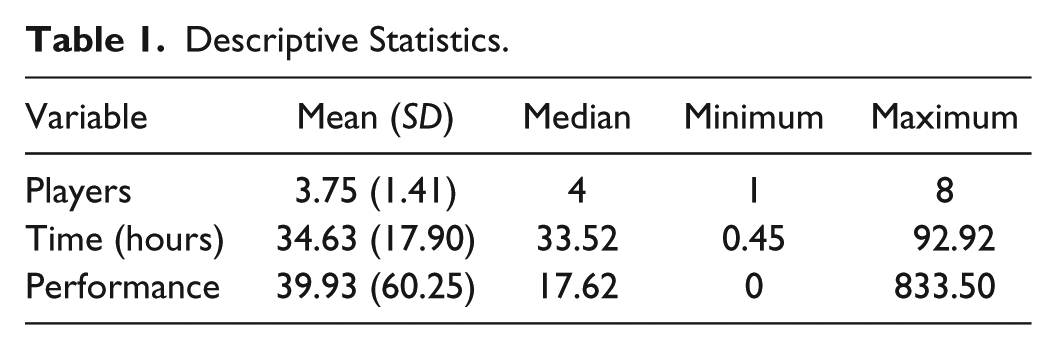
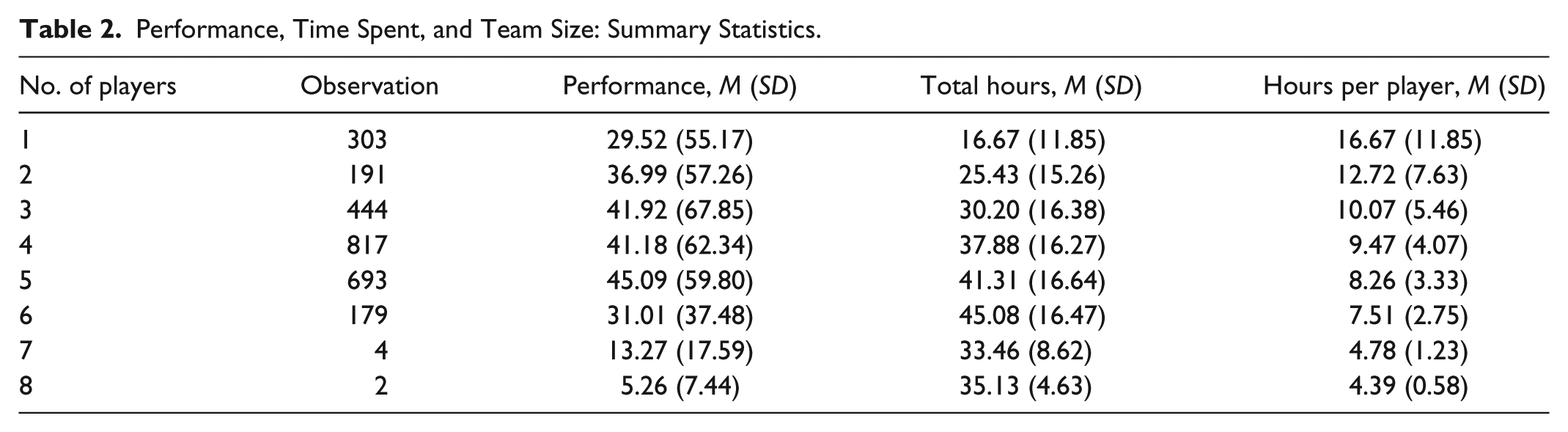
Table 2 illustrates the main idea of our article in a simple way. It presents the summary statistics for performance and time spent playing the game for teams with different numbers of players (from the minimum of one to the maximum of eight players). Table 2 shows that the average performance score increases as the number of players increases from one to five. Increasing the number of players to six or more results in a significant decrease in the average performance score. Also, as would be expected, the total number of hours spent playing the game increases with the number of players (for six or fewer players) but the number of hours per player decreases as team size increases. Figure 1 illustrates the nonlinear relationship between group size and performance. As can be seen, after five members, the performance of teams tends to decline.
Performance, Time Spent, and Team Size: Summary Statistics.

Group size and team performance.
Table 3 presents our regression results. The dependent variable is the performance measure, CBS. From Specification (1), adding one more player to the group increases performance by 16%. Next, we consider the nonlinear effect of group size as documented in Table 2. We define groups of six or more players as large groups and include a dummy variable equal to one if the group is large and zero otherwise. In order to show marginal increase versus decrease of additional members, we split the data into these two categories that each possess the same pattern—one where marginal improvement occurs, the other where marginal decline occurs.
Performance, Time Spent, and Team Size: Regression Analysis.

p < .01.
Up until groups with five members, there is an average improvement of 19% in group performance with each additional member. Conversely, adding another member to groups of six or more, on average, decreases performance by 27%. However, it must be noted that these marginal changes are not linear but are averages across the group sizes. Also, it should be noted that the number of groups that are being analyzed in the six or more category is much smaller than the total number of groups across the one- to five-member category. This has likely contributed to the large decrease in performance that is seen between six-, seven-, and eight-member groups. However, it is the transition between the upward and downward trend that occurs at the five-member group level that is important to note, and we do not expect the trend to reverse after six-, seven-, or eight-member groups. The estimation results in Specification (2) show this. The results show that adding one more player to a small group improves performance by 19%; however, adding another player to a large group decreases performance 27%. This effect remains large and statistically significant when we control for the time spent playing the game (number of hours per group member).
In Specification (3), an additional hour spent playing the game increases performance by about 10%. The R2 for this specification is 15%, with 8% of the variance in performance being explained by changes in the amount of time spent on decisions, and 7% being explained by variance in the number of players.
This study illustrates the impact of team size and decision-making time on overall performance in the Marketplace simulation. We found that overall performance increased with each player added to a team from one to five members but decreased for teams of six or more players. We also found that the number of hours spent making decisions increased as group size increases until group sizes of six members, and then it decreases.
Limitations
This study is limited in a number of ways. First, the simulation recommends to students that they should delegate responsibility for various functional roles, such as advertising, brand management, product development, and so forth. However, the instructor cannot control whether students actually do this or whether everyone participates in all decisions. As a result, we did not determine whether role responsibility allocation occurred or not in this study, and we also have no information on the ability of individual students that has in previous studies been found to impact group performance (e.g., Bacon, Stewart, & Stewart-Belle, 1998). Second, the findings are only pertinent to the simulation game Marketplace, and then specifically, to the Strategic Marketing version of the game. So the findings with regard to group size and time spent on making decisions might only be specific to this simulation, and might not hold in other simulations, or indeed other variations of Marketplace. Third, all groups were treated as equal, whereas in reality there might be considerable heterogeneity among the groups. We did not control for whether the groups were at the same educational level (e.g., undergraduate students, MBA students, Executive MBA students, or managers on an executive development program). Therefore, we do not have information that can tell us about how individual background and abilities can influence the success of a group (Bacon et al., 1998). Fourth, we did not have any information on the nature of the motivation for participants to play the simulation. Conceivably participants might be more motivated to take the simulation seriously when it constitutes a large part, or indeed all, of their final grade, and less so when it only accounts for a small portion. Finally, our samples of seven- and eight-member groups are small, with only four and two groups, respectively. However, after five groups, we see the trend of the decrease in performance begin, and the sample size of six-player teams is large enough to strongly support this trend. It is unlikely that the downward trend in performance after group size of five members would reverse after group size of six, and have included the seven- and eight-member groups in our study as a result to show the extent of the observed decrease.
Implications for Marketing Instructors
The findings of this study do provide some insights for marketing instructors who wish to incorporate a simulation into their courses. Implications arise in consideration of group size and time spent working on decisions in the game. Group size does appear to have an influence on performance. Although the findings of this study are specific to the Marketing Strategy version of Marketplace, instructors using any computerized marketing decision simulation would do well to consider group size very seriously in designing their courses by considering some of the following points. The evidence from this study indicates that small groups do not perform the best in the simulation. As well, small groups can also place inordinate demands on individuals’ time, which might be better spent in other learning activities. However, if a small team performs poorly in the game, this may not indicate that students are not learning the material but rather may be a result of their decreased manpower. As Bacon (2005) points out, it may be the case that teams with fewer members in fact learn the most from the game, as they must perform the greatest breadth of decision making and are not able to rely as heavily on other members of the group to make up for their weaknesses.
Large groups also appear to not perform as well in the simulation and there may be several reasons for this. The data showed that the average amount of time spent per individual on decision making in large groups is lower than in smaller groups. As a result, individual group members may not be spending as much time working and making decisions in large groups, and this may detract from performance. This might be the case for a number of reasons. There will be a greater opportunity to free-ride in larger groups that individuals would be less likely to get away with in smaller teams. Also, team coordination, collaboration, and overall teamwork may suffer as groups become oversaturated.
Larger teams may also inhibit student learning because teams with more students will be more likely to engage in some level of collaborative loafing (Bacon et al., 1998), whereby students do not gain holistic understanding of the game because they do not challenge themselves but practice the skills that they already possess. There may also be less for players in larger groups to do, and as a result they might specialize in activities (e.g., one student focuses on advertising, another on product design) to the extent that they are not exposed to the holistic overview of strategic marketing decision making that is the game’s premise.
Student learning should be of greater concern to instructors than overall performance in a simulation. As a result, we recommend that instructors consider a dual approach to allocating grades, which involves considering simulation performance as well as assessing individual understanding. For example, in addition to the group component of the simulation, students could also be required to submit a strategic evaluation of performance so that they can demonstrate why they performed well or poorly. This should place an emphasis on learning materials from the game, rather than only trying to achieve the best performance in the game and sacrificing learning in the process.
It should be noted as well that when instructors do choose the size of the groups to participate in the game, other considerations should come to mind that were not addressed in our study. Games of various complexities may require a different number of players per team. For example, a simulation that is not complex may have an optimal group size of only two players. It is also possible that games of great complexity may require a greater number of players per team to complete. However, the diminishing returns of additional players on performance that were exemplified in our study would likely still surface, as the increase in the number of players in a group makes coordination, collaboration, delegation, and role responsibility harder to manage. Five-member teams should not necessarily be considered the magic number across the board, but rather, instructors must also consider that games of different complexity may require fewer or more students per team.
As Bacon and his colleagues point out (Bacon, Stewart, & Silver, 1999), it is important to consider the pedagogical goals of a simulation when determining the number of players to assign to a group. Team performance in the simulation should be considered a goal, as well as overall student learning. These and other objectives of individual instructors should be assessed when determining group size. However, for simulations of this complexity and nature, these results provide a good benchmark as well.
Instructor resources are often considered when deciding how many groups to have in a single game and the number of players per group, and this will partly depend on the number of students in the class. In a class of 32 students, the amount of work that will go into managing eight teams of four, for example, will be more for the instructor than six teams of five and six players. However, when choosing group size, instructors should keep in mind that students will likely not benefit from adding players to teams, unless group size is low, and their team’s results and individual learning will likely suffer as a result. This is a consideration that should be balanced with available resources.
Ultimately, if the decision arises to choose between groups that are too large or too small, we recommend choosing smaller groups. This is because, as mentioned, smaller groups may present a greater opportunity for learning even if performance in the game suffers. Whereas in larger groups, good performance may be the result of a few strong players and some free loaders, or of team members playing only on their own strengths and not challenging themselves. Also, as mentioned, with large groups there may be a greater likelihood of adverse group situations such as difficulties with coordination and delegation in larger numbers.
In addition to group size, the instructor may also choose to communicate to groups that the amount of time spent on decisions will likely only increase performance in the game to a point. There may be an upper limit to the benefit of more time spent on decisions on performance and incremental benefit will likely become less impactful after a certain amount of time and effort. However, even if it does not have a profound impact on performance, additional time spent in the game can be beneficial for individual learning, so instructors and students should consider where students’ time is best spent in the interests of learning. Including a part of the assignment that assesses how much individuals have learned from the experience should motivate individuals to not allocate time solely based on the end goal of performance but rather to spend the necessary time effectively learning from the game and using this knowledge to drive results in the game.
Future Research
A number of avenues for future research arise from the present study, some of which could be carried out by further exploitation of our current data set, and some which might require additional empirical investigation. First, it is possible that the number of teams in a particular simulation game might affect individual group performance. Would a simulation containing only three groups result in a different aggregate performance to one in which eight groups participated? The intensity of competition might affect results, and it would be possible in future to investigate this using our current data set. Second, and also from our current data set, does variation in time spent by group members on decision making affect group performance? The current study looked at group total time as a function of the time that all group members were logged on in playing the game. However, it is obvious that some members will spend far more time playing the game than others, and it is possible to determine this from the game records. Some groups may exhibit low variation between members in time spent, but in other groups it is possible that one or two members will do most of the work while other members do far less. This is akin to issues raised by Bacon (2011) and his colleagues (Bacon et al., 1998) who consider variation in team member ability as a predictor of group performance. In this case, we would use team member time spent as a surrogate for ability. Third, research that could be conducted by an instructor at a simulation’s conclusion would entail qualitative investigation of variation in team performance. So, for example, both successful and unsuccessful teams could be asked about their strategy with regard to task allocation, and the roles of individual team members.
Simulations in marketing classes bring more reality to marketing courses and are mostly enjoyed by the students who play them. They also provide excellent laboratories for the study of group size and time spent on decisions and their impact on group performance. It might not be stretching things too far to suggest that these kinds of findings can also provide insight into real-world group decision making.
Footnotes
Declaration of Conflicting Interests
The author(s) declared no potential conflicts of interest with respect to the research, authorship, and/or publication of this article.
Funding
The author(s) received no financial support for the research, authorship, and/or publication of this article.