



Abstract
In a replication of a classic article by Hunt, Chonko, and Wood, regression analysis was conducted using data from a sample of 864 marketing professionals. In contrast to Hunt, Chonko, and Wood, an undergraduate degree in marketing was positively related to income in marketing jobs, but surprisingly, respondents with some nonmarketing majors earned about the same as marketing majors in marketing jobs. Satisfaction with a marketing career was not significantly related to academic major. The income regression model explained 30% of the variance in marketing income, which is an improvement over the earlier study, but also indicates that most of the variance in marketing success is not explained by education. Implications are discussed.
Keywords
Much has been written about how to improve marketing education, but few studies have examined the economic value of a marketing education. The most recent and frequently cited article on this topic is by Hunt, Chonko, and Wood (1986, HCW herein) who conducted a survey of 1,076 marketing professionals from the American Marketing Association membership list. Applying linear regression analysis, they found that neither college GPA nor a marketing degree had a significant correlation with income in a marketing career. This finding strikes at the heart of the value of a marketing education, and yet little follow-up research has been published. Marketing education has likely improved since 1986, and research methods and insights now exist that were not available in the 1980s. The importance of this topic merits a replication.
There is some reason to believe that a marketing education is not strongly related to career success; however, there are other reasons to believe that there should be a relationship. Studies of the characteristics that employers seek in marketing graduates often find that specific marketing knowledge is not as important as other skills such as problem solving, ability to adapt to change, or communication skills (e.g., Finch, Nadeau, & O’Reilly 2012; McDaniel & White, 1993). However, the finding that none of the majors studied in HCW were significantly correlated with career success contradicts subsequent research (e.g., Thomas, 2000, 2003; Thomas & Zhang, 2005) as does the finding that GPA was not significantly related to career success (Roth & Clarke, 1998).
Importantly, the HCW study’s findings are compromised by three particular shortcomings. First, nearly all of the respondents (97%) had college degrees, which reduced the statistical power of the college/no college comparisons. Second, the statistical methodology assumed a linear model in the regression analyses. Today, a log-linear model, as in the classic Mincer (1958) wage regression model, is considered more appropriate for theoretical and empirical reasons in studies of the effects of education on income (cf. Blau & Kahn, 2016; Thomas, 2000). Finally, HCW included fairly few variables in their regression model which limited the statistical power and may have biased the parameter estimates.
While the HCW findings are disheartening to marketing educators, it may well be that a contemporary replication with a respecified model will obtain different results. Although some may argue that marketing knowledge taught in school is of limited usefulness to employers, marketing education and the needs of the marketplace have changed in the past 30 years, and thus, the relationship between a marketing education and success in a marketing career may have changed. The purpose of the present research is to reexamine the relationship between marketing education and income in a marketing job using a contemporary sample and improved research methods.
Of course, it is possible that a marketing education does not lead to higher income, but it enables graduates to achieve positions that they personally find more satisfying. It is difficult to fully quantify the value of any education, and income is certainly not the only measure of the value of an education. To more broadly examine the value of a marketing education, we follow HCW and include a measure of extrinsic value (income) and intrinsic value (career satisfaction). We note that HCW used other measures of value as well, but the predictability of these measures was as good or better than any other measure that HCW studied in each category.
The causal relationship between mastering the concepts taught in a marketing course and success in a marketing career may be taken on faith by many marketing faculty, but it could well be that this relationship is not as strong as most educators believe. A review of several different perspectives on the value of a marketing education is provided before describing the methodology used to address the research questions.
Literature Review
Three perspectives merit consideration when examining the relationship between marketing education and success in a marketing career. One perspective posits that the specific content of a marketing education leads to higher performance in marketing jobs and therefore higher compensation. The second perspective proposes that a general set of cognitive, attitudinal, and behavioral skills matter more than specific marketing knowledge, and these skills are developed through the entire college experience, both inside and outside the classroom. The third perspective holds that college itself does not develop new skills as much as it helps employers identify graduates who already possess innate potential and a substantial capability for performing white-collar work, and thus, college graduates see more demand in the marketplace and perform better in marketing jobs. Each of these perspectives will be reviewed further below.
College Builds Specific Skills That Are Useful in the Market Place
The theory that higher education provides value because the knowledge that students acquire makes them more productive employees is widely referred to as human capital theory in the economics literature (Becker, 1964/2009). Some studies in the marketing education literature adopted this theory as it specifically applies to marketing knowledge. For example, in their study of preparing students for marketing careers, Finch et al. (2013) used a 46-item survey, and 33 of the items related to specific marketing skills and competencies (e.g., public relations). Schlee and Harich (2010) used a more exploratory approach in analyzing the knowledge and skills listed in job postings on Monster.com. They found that 36 different skills were mentioned in marketing job postings and of these, 27 directly related to specific marketing skills (e.g., public relations) or technical marketing skills (e.g., Internet marketing tools). In these studies, we see the implicit suggestion that the purpose of a marketing education is to teach students specific marketing knowledge and skills because graduates will be more successful if they possess these specific skills.
As appealing as this perspective is to marketing educators, the value of a marketing education may not be strictly limited to the marketing knowledge learned in school. We note that although Finch et al. (2013) and Schlee and Harich (2010) found support for employer interest in specific marketing skills, they generally found that employers more highly valued broader skills such as the ability to solve problems, communication skills, or interpersonal skills (see also Kelly & Gaedeke, 1990). One reason why marketing education may not be highly valued in the marketplace is the evidence that the marketing knowledge taught in school may not be that useful in marketing jobs. Armstrong and Schultz (1993)conducted a provocative study wherein they counted normative marketing principles from nine marketing textbooks. Armstrong and Schultz define a normative principle as one that specifies a condition followed by a recommended action. To be valuable, such principles should be meaningful and well supported by evidence. Thus, a normative principle is not just a descriptive word or phrase that applies to a situation; instead, a normative principle can lead directly to better decisions. Of the 566 principles identified, four raters agreed on only 20 as providing meaningful principles, and Armstrong and Schultz reported that many of these 20 principles were not surprising, useful, or well-supported. Thus, marketing students may be learning vocabulary terms but not the skills that improve their ability to make decisions in a marketing role. In a related study, Armstrong (1991) found that experts in consumer behavior (100 academics who were members of the Association for Consumer Research) were no better at predicting the outcomes of consumer behavior experiments than were nonexperts (high school students). Thus again, a consumer behavior course may facilitate learning many interesting models, but even if these models were mastered, a student may be no better at predicting consumer behavior than a novice.
One challenge in delivering relevant content in marketing is the wide variety of marketing careers, making it difficult to align the marketing curriculum with the specific skills that particular careers require. Logically, it is highly likely that the required knowledge and skills differ across careers in advertising, marketing research, and supply chain management. Bolander, Bonney, and Satornino (2014) found evidence that sales training is associated with higher performance in a sales job, but many marketing programs do not require sales courses, and not all students know that they will go into sales. In their regression of advertising income on advertising major, HCW (1987) found a significant coefficient for advertising major, but they did not conduct statistical tests to determine whether the coefficient was significantly larger than the coefficient for a humanities major or a technical major. Thus, there are likely benefits from specific training for a particular career; however, identifying the appropriate training for each student is challenging.
Even if we could identify the most useful knowledge and skills for each specific career where students eventually find their calling, they may have forgotten much of the most relevant knowledge by the time they arrive in that job. Strong evidence exists that the retention of specific learned knowledge is quite limited. Bahrick (1984) observed that individuals with a low level of training in Spanish in college (e.g., a single course) forgot most of that Spanish within 3 years of graduation. In their longitudinal study, Bacon and Stewart (2006) found that students forgot well more than half of what they learned in a consumer behavior course in approximately 2 years. At that rate, students taking the course in their sophomore year would be unable to recall much at all by the time they graduate. McIntyre and Munson (2008) extended this finding, studying the retention of material learned in a principles of marketing class. They found that on average, students retained only about half of what they learned after 3 years; students who crammed for exams retained even less material. The basic knowledge covered in a principles of marketing course may be reinforced in subsequent marketing courses which may explain why the retention of knowledge gained in a principles of marketing course exceeds retained knowledge of consumer behavior or Spanish material. Repeated exposure and reinforcement of earlier material likely explains why Bahrick (1984) also observed that Spanish majors, who completed many Spanish courses, retained some Spanish knowledge for as long as 50 years. At many schools, marketing knowledge may be taught in a cafeteria style rather than a program of learning, and the knowledge may not be strongly integrated with other courses in the business curriculum. Thus, there may be limited opportunity for students’ repeat exposure to many marketing tools and skills.
Therefore, as appealing as the perspective may be that a marketing education is valuable because the specific marketing knowledge learned in school leads to higher performing marketing graduates, empirical and conceptual support for this perspective is not strong. The challenge of maximizing the value of a marketing education can be thought of as an expected value problem. We must consider the value or usefulness of the knowledge itself, times the probability that the student will need that knowledge in a particular job, times the probability that the student will recall the knowledge at the right moment. In this regard, the expected value of any specific marketing knowledge does not appear to be substantial. Instead, the benefits of a college education may be broader than specific marketing knowledge.
College Builds Skills That Extend Beyond the Specific Major
If the retention of specific knowledge learned in the major is limited, then perhaps the strongest benefits of a college education are gains in more generalizable skills, such as metacognitive or communication skills. These skills are likely retained longer than marketing knowledge of specific definitions or theories because they are practiced repeatedly in a variety of college courses and in other college experiences (e.g., extracurricular activities). The strongest evidence for this perspective is contained in Pascarella and Terenzini’s (2005) classic review of the education literature (an update of Terenzini & Pascarella, 1991). This review spans three decades of research and includes over 2,500 studies on how college affects students. One reported important finding is that the largest impact (75% or more) of college on basic academic skills such as reading, writing, and math occur in the first 2 years of college (Pascarella & Terenzini, 2005). Thus, these gains may be realized before a student majoring in marketing has taken much more than a single marketing course.
In a related summary, Terenzini and Pascarella (1994) state that the impact of the specific major tends to be smaller than the overall net effect of attending college. Furthermore, they note that students spend at least 85% of their waking hours outside of the classroom, and these outside activities likely contribute to gains on a variety of dimensions. Thus, student learning outcomes, including increases in intellectual orientation, curiosity, interpersonal skills, autonomy, and cognitive complexity all likely stem from the entire college experience, including curricular experiences, nonclassroom interactions with faculty, peer interactions, and the overall college academic environment.
Some of the most important gains achieved in college, while not related to the content of a specific major, may be related to academic engagement in that major and college engagement in general. For example, Terenzini, Springer, Pascarella, and Nora (1995) conducted a pretest–posttest analysis of critical-thinking skills and report that hours studying per week had a positive association with gains in critical thinking (standardized beta = .14), even though they did not control for the specific content studied. Carini, Kuh, and Klein (2006) obtained related results in a cross-sectional study. They found that critical-thinking scores were related to measures of campus environment, including supportive campus environment, quality of relationships, and level of academic challenge, with partial correlations in the .10 to .14 range after controlling for several background variables including SAT scores. The findings that engagement leads to greater learning is consistent with results about the correlation between GPA and career success (Roth & Clarke, 1998; Thomas & Zhang, 2005). GPA may correlate with success because GPA reflects engagement in college, and this engagement leads to long-term gains in a variety of abilities.
The evidence that college enhances many valuable skills, even when the specific major content is less valuable, must be interpreted with caution because most of the findings are from nonexperimental research studies. For example, students were not randomly assigned to the high-GPA group or the low-GPA group, or the high-involvement-in-campus-life group or the low-involvement group. Students self-select most facets of the college experience, and this selection may be related to unmeasured characteristics that affect both involvement in college and success in a career. Although some carefully designed studies have controlled for a variety of important background variables, such as gender, parents’ level of education, and hours worked off campus (e.g., Carini et al., 2006), other important variables remain uncontrolled. For example, Judge, Higgins, Thoresen, and Barrick (1999) conducted an analysis of the five primary personality traits, and found that the conscientiousness trait was positively related and neuroticism negatively related to extrinsic career success even after controlling for general mental ability. (Their index measure of extrinsic success correlated at the .82 level with income.) In other research, Poropat (2014) found that conscientiousness, especially when other-rated (not self-rated), correlated more highly with GPA (.38) than did general intelligence (.24). Thus, personality may confound some of the findings related to how college affects students. Greater college engagement may not increase broad learning and subsequently the degree of career success. Instead, conscientiousness or innate curiosity may drive GPA and career success directly (cf. Nie & Golde, 2008).
College Does Not Build Skills as Much as It Signals, Sorts, and Screens
Just as studies of the effect of college engagement do not use experimental designs, research on the effect of college itself (vs. not attending college) is not experimental. Thus, some researchers suspect that at least some of the benefits of a college degree are not related to learning at all. We know that only some high school students choose to apply to college, only some of those applicants will be admitted to college, and only some of those admitted students will finish their college degrees. Thus, individuals with and without college degrees have not been randomly assigned to conditions and likely differed substantially in some skills before any of them attended college (Murray, 2008). In the economics literature, models of educational benefits that ignore learning-related variables and instead focus on signals to the market that an individual has valuable skills are broadly referred to as signaling models (Weiss, 1995). Signaling models and closely related models often assume that some learning may occur, but college has additional effects on wages beyond learning effects. Because it is nearly impossible to completely disentangle the education and signaling benefits of education, estimates of the relative effect sizes differ. Weiss reports estimates that measurable learning in high school explains at most one quarter of the increase in income associated with a high school diploma. Fang (2006) is more optimistic, concluding that college learning explains two thirds of the increase in income associated with a college degree.
Within the family of signaling models, we follow Weiss’s (1995) excellent review and describe at least three more specific models which can be viewed as the three Ss: signaling, sorting, and screening. The more specific signaling model posits that a college diploma identifies the graduate as a person with desirable, unobserved skills, which can include conscientiousness, achievement orientation, a desire to learn, and a high degree of comfort with knowledge-based work. Savvy high school graduates may seek out the college degree to signal to employers that they have these skills. The signaling model implies that a student need not be interested in learning or retain any content learned. The student simply must be so financially motivated that he or she is willing to tolerate the challenges, burdens, and short-term sacrifices of getting a college degree in order to receive the anticipated wage premium. The selection of major can be seen as part of the signal. A student interested in appealing to a certain employer might seek a degree with a major which that employer would like (e.g., marketing) or a degree that signals high analytical skills (e.g., engineering), even when the student is not that interested in studying that discipline.
The sorting model proposes that colleges sort students, somewhat like the grading process in marketing, which is a facilitating function that an intermediary performs that involves “inspecting, testing, or judging products and assigning them quality grades” (Kerin & Hartley, p. 409). In the admission process, schools examine student standardized test scores (e.g., SAT), high school GPA, extracurricular activities, and other evidence to grade students, often giving students admission scores. Schools then accept the students who have acceptable scores. Admission to a top-quality school implies a very high admissions score which should be attractive to employers. Thus, a college degree behaves like a brand for college graduates, and some college graduates have a more prestigious brand than others.
Iacobucci (2013) provides some evidence of the grading or sorting benefit in MBA education. She found that student characteristics on entering the program, such as GMAT scores, undergraduate GPA, and the program acceptance rates, explain close to 80% of the variance in the starting salaries of the students graduating from the program. Only 5% to 10% of the remaining variance is explained by school rank which might be more directly related to the quality of the education delivered.
The third S, the screening model, posits that completing a college degree demonstrates skills and abilities greater than those of simply being accepted into a program. Not only was the graduate willing to take on the challenges of college but the graduate was able to successfully overcome those challenges. Graduates have survived their trial by fire, and emerge, diploma in hand, with compelling evidence that they are able to work long hours, follow directions carefully, delay gratification, work independently, and work within an organization. Murray (2008) estimates that no more than 20% of the general population has the academic ability to achieve a solid GPA in college. This college screen can be particularly difficult for employers to replicate themselves because of the time required for the screen. Weiss (1995) notes that students who attain more education are less likely to quit or be absent from work, and they are healthier and less likely to have substance abuse problems. In their survey of college dropouts (attendance stopped within the past 5 years), Gruttadaro and Crudo found that 64% of the respondents attributed their lack of completion to a mental-health-related situation. Legally, employers may be prohibited from using much health-related information in hiring decisions, but a college degree may be a surrogate indicator of the ability to endure the physical and mental demands of office work. It is worth noting that few employers require “nearly finishing a college degree,” but many require having a college degree, and few would pay more for graduates with a few extra credits (cf. Altonji, 1995). Finishing those last few courses (or that one freshman calculus class) may have little effect on learning, but it has a strong effect in demonstrating successful completion of the college screen.
In summary, there are at least three perspectives on the value of a marketing education. One perspective assumes that marketing content is most important, the second perspective assumes that the overall college experience is more important than the academic major, and the third assumes that the degree itself is more important than any educational value that college provides. By reexamining the relationship between marketing education and success in a marketing career, some light will be shed on the relative validity of these perspectives. If a strong marketing major–marketing success connection is found, the first perspective will be supported. However, if the marketing major is not more strongly related to marketing success but college degrees in general are so related, the second two perspectives will be supported. If a college education is not associated with success in marketing, all three perspectives will be undermined. As the theoretical and empirical evidence to date is mixed, we state our research foci in terms of the following research questions:
Methodology
Data were collected online using Qualtrics survey software and an online panel purchased through Qualtrics. Respondents were screened by an initial question that asked, “Were you employed full time in a marketing position for the entire year in 2015?” A no more detailed definition of what is meant by a marketing position was offered. A total of 1,003 responses were collected. Later in the survey, respondents provided the total number of hours worked per week and their income. Respondents were retained if they reported working more than 30 hours per week and earning at least $20,000 in annual income. This screening reduced the usable sample to 864 respondents. Most questions required responses, leading to very little missing data.
Measures
Although most measures were collected directly from the survey, others (i.e., state cost of living) were appended based on survey responses. A variety of scales were used to assess the measures.
Income
Using a drop-down response format, respondents reported their income to the nearest $1,000.
Career Satisfaction
HCW used one item to capture career satisfaction, “If I had it to over again, I would choose a career outside the marketing area” (see HCW, p. 5). Career satisfaction is measured here using the Greenhaus, Parasuraman, and Wormley (1990) five-item career satisfaction scale, which has been commonly used in other studies of predictors of career satisfaction (e.g., Seibert, Kraimer, & Crant, 2001, Seibert, Kraimer, & Liden, 2001). All items are measured on a 5-point Likert-type scale, and the reliability of the scale average was found to be .92. An average of these five items was used to measure career satisfaction. The five items used are listed below.
I am satisfied with the success I have achieved in my career.
I am satisfied with the progress I have made toward meeting my overall career goals.
I am satisfied with the progress I have made toward meeting my goals for income.
I am satisfied with the progress I have made toward meeting my goals for advancement.
I am satisfied with the progress I have made toward meeting my goals for the development of new skills.
Years of Work Experience
A drop-down box was used to capture the exact years of experience, ranging from 1 to 50. A variation of HCW’s coding was retained for fourreasons: (1) HCW used only five categories (1-5, 6-10, 11-15, 16-20, and over 20 years). (2) Other researchers have found a flattening of income after achieving some level of experience (e.g., Bacon & Stewart, 2016; Lee, 2011 [see especially final figure from PayScale]; Thomas & Zhang, 2005) (3) A scatter plot of salary versus experience in the present study suggested a leveling off of the relationships after 20 years. (4) A polynomial model (experience, experience squared, experience cubed regressed on income) did not fit as well as HCW’s original coding. Less than 20 years of experience was coded as exact years of experience; more than 20 years of experience was coded as 21.
GPA
Using a drop-down box, respondents were asked to report their GPA to the nearest 10th if they reported having a 4-year degree. Cassady (2001) found that current students report their GPA with remarkable accuracy (.97 correlation between actual and self-reported). Graduates may not recall their GPA with such great accuracy, but this limitation exists with most of the literature on GPA (Roth & Clarke, 1998). GPA was mean-centered for the regression analysis to avoiding confounding GPA with the presence of a college degree. This adjustment may not have been necessary in previous studies (e.g., Thomas, 2000) because all respondents had college degrees.
Major
Respondents with a college degree indicated their major. Categories included marketing, other business (e.g., finance or management), STEM (science, technology, engineering, or math), social science, humanities, journalism or mass communication, and other. Majors were generally scored as 0 to 1 dummy variables, but responses of multiple majors were divided by the number of majors. For example, for a combined other business and marketing major, the two major variables were each coded as .5. This coding was used to avoid instances of double counting college majors and thus, double counting undergraduate degrees as 20% of all college graduates listed more than one major.
MBA
Respondents were asked if they had any graduate degrees, and they were asked about the MBA in particular. Variable MBA (0, 1) was created to capture MBA degrees.
Other Graduate Degree
Some respondents reported having another graduate degree(s) (e.g., other master of science, master of arts, JD, MD, PhD, etc.), but specific categories within these degrees were considered to be too small to break out for further analysis. This variable captures the presence of any graduate degree that is not an MBA.
Female
Gender was collected from the survey and coded as 1 for female and 0 for male.
Percentage Time in Management
Different organizations use titles such as manager, director, or vice president differently, making these titles of limited effectiveness as measures of management responsibility. To capture management level, this study uses percentage time in management instead of title. Respondents were asked, “What percentage of your time do you spend managing people in your organization as opposed to working on projects yourself?” (imitating Bacon & Stewart, 2016). Eleven response options were presented in 10% increments from 0% to 100% (0 to 1.00).
State Cost of Living
Region can play a key role in salary surveys, although eight regions of the United States may be too coarse a measure to capture substantial differences in income (Thomas, 2003). Bacon and Stewart (2016) found that compensation was related to the cost of living in different states. Respondents identified the state in which they worked, and cost of living data by state were downloaded from the Missouri Economic Research and Information Center (https://www.missourieconomy.org/indicators/cost_of_living/index.stm). The Missouri Economic Research and Information Center computes state-level estimates of cost of living by aggregating indices of cities and metropolitan areas participating in a Council for Community and Economic Research survey. Note that using state cost of living in a salary model requires the addition of only a single explanatory variable to the model, while including region could require many additional dummy variables and thus increase the risk of overfitting.
Model
The model used here is a log-linear regression model (Mincer, 1958), rather than the linear model used by HCW. A log-linear model regresses the log of income, not income itself, on the predictor variables. The log-linear model is appropriate in this case because the effect of many variables on marketing salaries is likely a percentage difference relative to base salary and not a fixed difference for any salary. The log-linear model also yields residuals that more closely conform to the assumptions behind least squares regression; thus, the log-linear regression increases the validity of statistical tests.
Statistical validity and power can be further increased by including additional variables that have been found to be significant in other salary regressions. The additional variables included here are gender, geographic location, the percentage time spent in management, and the presence of other graduate degrees (Bacon & Stewart, 2016; Blau & Kahn, 2016; Thomas, 2003; Thomas & Zhang, 2005). Although we believe that gender should not be a factor in compensation, several empirical studies have found a strong relationship (see especially Blau & Kahn, 2016). While some gender-related differences in compensation may be related to differing levels of education, experience, and other variables, the remaining unexplained difference may simply be related to a bias against women. Blau and Kahn (2016) estimate the unexplained wage gap to be 8% to 18% of income.
Geographic location is also important to consider because the cost of living varies substantially across regions and states within the United States. If compensation were equal in all areas, employees would tend to move to the least expensive locations as long as there was suitable employment. Employers likely recognize a need to offer greater compensation in some areas to attract top talent.
Managers influence the productivity of their subordinates and therefore are likely to be more highly compensated than nonmanagerial employees. The percentage time spent in management (as opposed to time working on one’s own projects) on a regular basis is a particularly attractive variable for the present study because different organizations use titles such as marketing manager, director, or vice president differently, limiting the effectiveness of title as a surrogate for management level. We also include the presence of other graduate degrees in the present study because of a consistent pattern of increased income with increased education (U.S. Department of Labor, Bureau of Labor Statistics, 2016). An advanced degree in law may be advantageous for marketing roles in particularly litigious environments or a degree in medicine may be advantageous in the medical products industry. Furthermore, advanced degrees generally reflect a level of academic aptitude and grit that exceeds that of a typical undergraduate degree. Adding all of these variables to the regression model should substantially improve statistical power, control extraneous variance, and thus enable the accurate detection of more effects, if such effects exist.
Two models are examined here: the first model replicates the HCW model and the second model includes the additional explanatory variables. In HCW’s analysis, income was the dependent variable and experience, GPA, college major, and having an MBA degree were the only independent variables. The expanded model adds gender, geography (state-level cost of living), percentage of time spent in management, and the presence of other graduate degrees.
Results
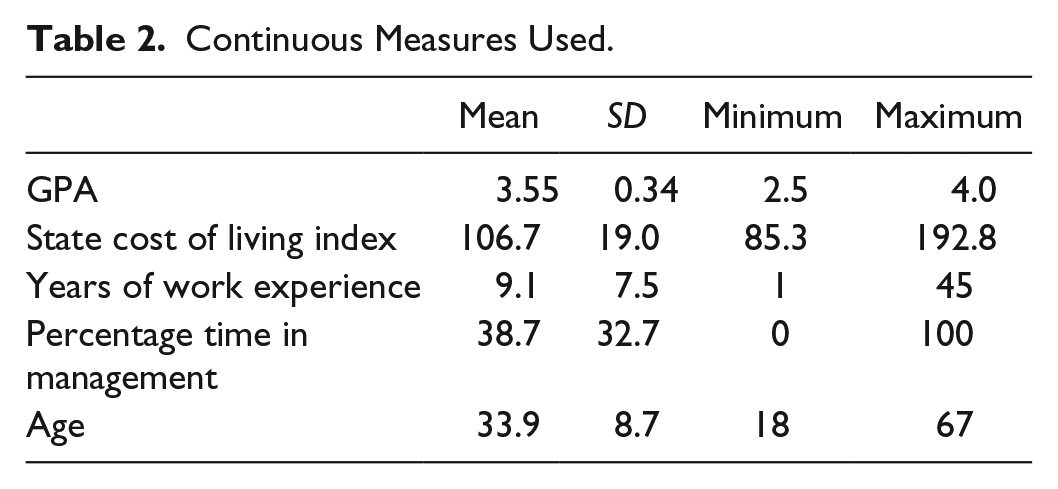
Before addressing the two research questions, a description of the sample is provided, including the means, percentages, and counts of the variables studied (see Tables 1, 2, and 3). The correlations among all variables used in this study are shown in Table 4. Several important differences between the current online panel sample and HCW’s American Marketing Association member sample (described in HCW’s Table 1) should be noted beyond the expected increase in incomes over this 30-year period. Direct comparisons are somewhat tenuous due to differences in question wording and response categories.
Dependent Variables Used.

Continuous Measures Used.
Dummy Variables Used.
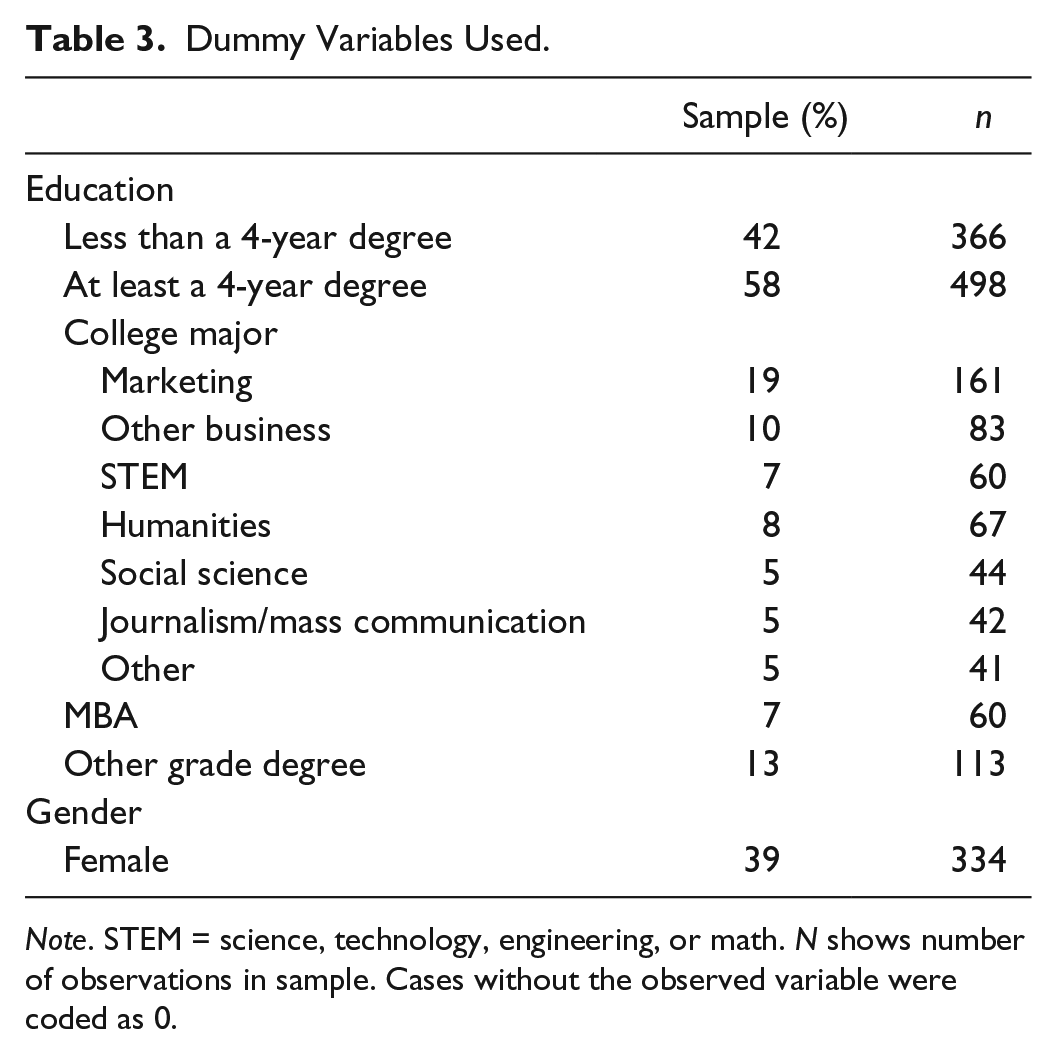
Note. STEM = science, technology, engineering, or math. N shows number of observations in sample. Cases without the observed variable were coded as 0.
Correlations Among Variables Used.
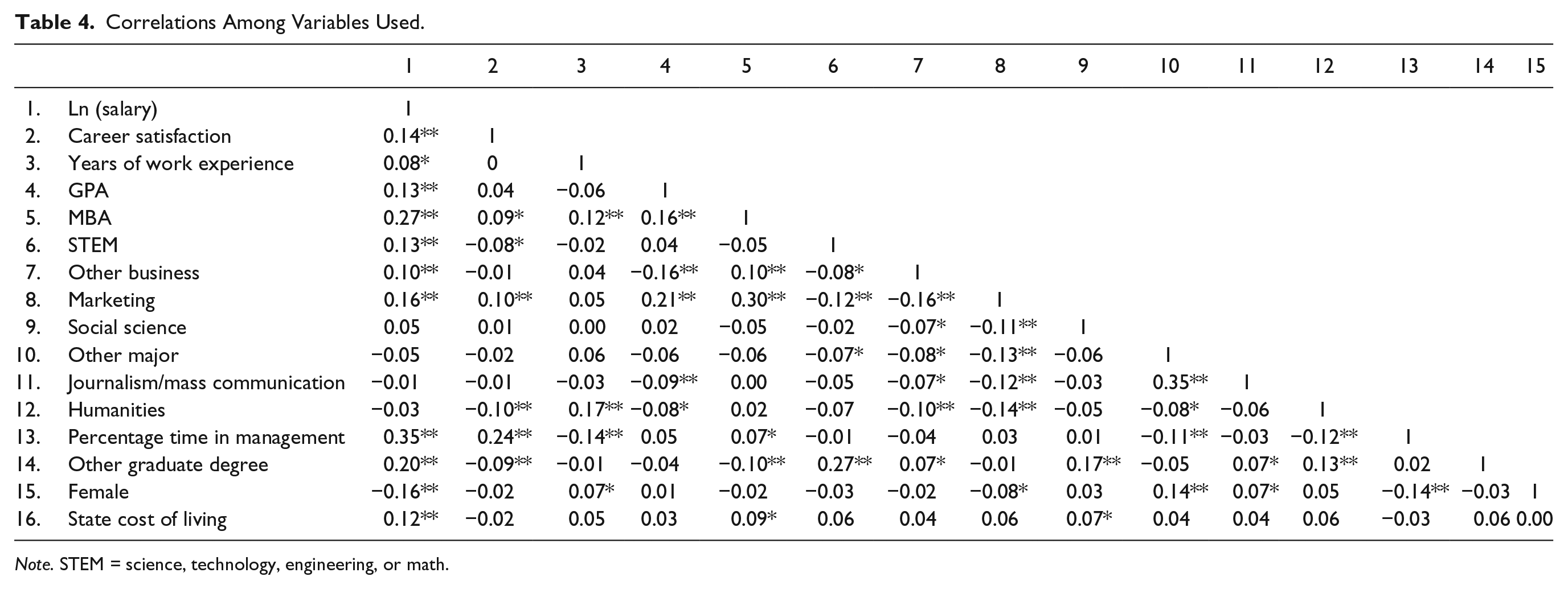
Note. STEM = science, technology, engineering, or math.
One clear difference is that only 3% of the HCW sample did not have at least a 4-year degree, compared with 42% of the current sample. Thus, the current sample should provide much more statistical power concerning the income difference between having and not having at least a 4-year degree. The HCW sample was generally better educated than the present sample (59% vs. 20% with a master’s degree, respectively), but a similar percentage had an undergraduate major in marketing (24% vs. 19%, respectively). The HCW sample is slightly older than the current sample (median age 37 vs. 32 [mean 33.9], respectively) and has commensurately more years of work experience. Both samples had likely been out of college for a decade or so which affected recall of college experiences and thus limits the validity of these observations. However, the memory effect should not be substantially different across the two samples. The HCW sample was 70% male, and the current sample is 61% male, likely reflecting a difference in the marketing workplace over the past 30 years.
Research Question 1: Marketing Education and Marketing Income
The first research question involved the relationship between marketing income and marketing education. To reexamine HCW’s research findings on this question, the log of income was regressed on the same variables used by HCW: experience, GPA, academic major, and MBA. As shown in Table 5, the new findings differ substantially from the HCW study. In contrast to HCW, having a marketing major and GPA are each significantly related to higher income in a marketing career. In an additional contrast, years of work experience are not significantly related to income (p < .01 in HCW). The only result that is consistent with HCW’s findings is that having an MBA is related to higher income (p < .01 in HCW). In a surprising turn, other majors including STEM and other business majors appear to be more strongly related to income in a marketing career than is a marketing major. The R2 of the current model (.132) is lower than the R2 reported by HCW (.20).
HCW Replication Regression on Income.
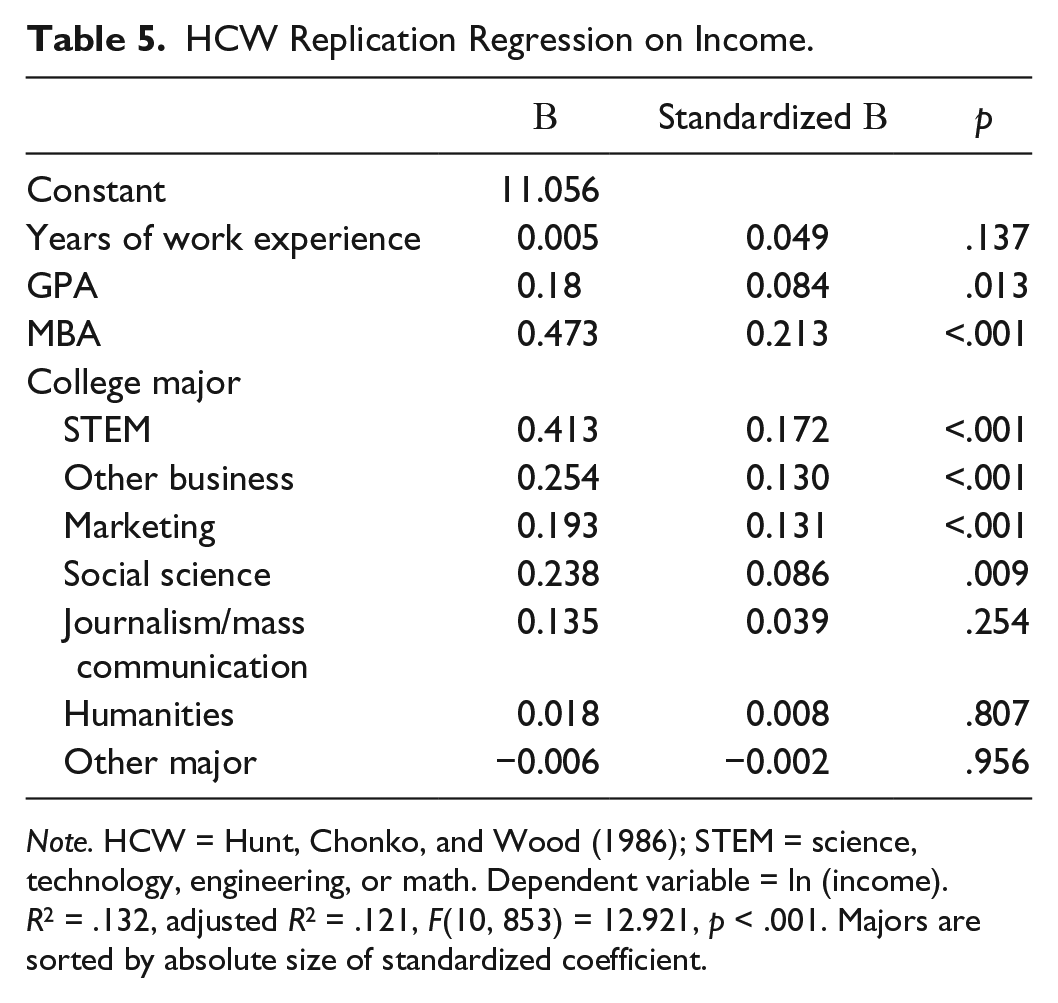
Note. HCW = Hunt, Chonko, and Wood (1986); STEM = science, technology, engineering, or math. Dependent variable = ln (income). R2 = .132, adjusted R2 = .121, F(10, 853) = 12.921, p < .001. Majors are sorted by absolute size of standardized coefficient.
Expanded Regression on Income
The finding that years of experience is not substantially or significantly related to income in a marketing career implies that new graduates should expect the same compensation as those who have worked in the field 20 years. Such a finding runs counter to common wisdom and counter to prior research (e.g., HCW, Thomas & Zhang, 2005). This unexpected result raises questions about the model’s validity, specifically the concern that the omission of important predictor variables may have biased the model estimates. To obtain more meaningful results, the expanded model was estimated including the original variables plus percentage time in management, state cost of living, gender, and the presence of other graduate degrees. To avoid a possible bias in addressing Research Question 2, the expanded model is examined for Research Question 1 before proceeding to examine the relationship between marketing education and career satisfaction.
The expanded model shown in Table 6 makes more intuitive sense. Years of work experience is now significant and most of the other variables remain significantly related to income. In this sample, years of experience has a slight negative correlation with percentage time in management (r = −.142, p < .001) which is likely due to a number of young managers in the sample and/or a number of seasoned professionals who are still individual contributors in the sample. A clearer picture of the relationship between experience and salary emerges when percentage time in management is included. Also, all point estimates for college degrees are positive which is consistent with U.S. government data showing that on average, college graduates see higher incomes than nongraduates (U.S. Department of Labor, Bureau of Labor Statistics, 2016), and the observation that STEM majors and business majors are among the best-compensated majors is consistent with Thomas (2000). The four added variables are all significant and of the expected sign. The percentage of time spent in management shows the largest standardized coefficient in the entire model, at .342, supporting the concern that the model was misspecified without it. The finding of a gender pay gap of 12.9% is disturbing but consistent with other research (Blau & Kahn, 2016; Thomas & Zhang, 2005). The revised model has a substantially higher R2 (.296) than the initial model (.132), and is higher than the R2 reported by HCW (.20).
Expanded Regression on Income.

Note. HCW = Hunt, Chonko, and Wood (1986); STEM = science, technology, engineering, or math. Dependent variable = ln (income). R2 = .296, adjusted R2 = .284, F(14, 849) = 25.448, p < .001. Majors and new variables are sorted by the absolute size of each standardized coefficient.
As in the HCW study, having an MBA is associated with higher marketing incomes. The expanded model indicates that MBAs earn 43.6% more than do individuals without an MBA, and this difference is statistically significant. Interestingly, having any graduate degree is also related to a wage premium (29.7%). The difference between the coefficient for an MBA and the coefficient for another graduate degree was tested statistically by considering the standard deviation of the coefficient estimates and the covariance among the estimates (Kmenta, 1971), and this difference was not significant, t(849) = 1.651, p = .099. We note that the current sample was too small to meaningfully study break outs of specific degrees, but a study examining the MS degree in marketing in particular would be an important area for future research.
Recall that the majors in this study were coded in such a way that having two majors was not counted as two degrees. In this model, a college graduate with two undergraduate majors is estimated to have an increase in salary equal to the average coefficient of the two majors. However, it could be argued that having two majors involves many more credit hours, resulting in much more education, and therefore the double major should receive more compensation. To examine any additional benefit of a double major, a new variable was created that took on a value of 1 for all respondents who had two or more majors and 0 for all others. In this sample, 10.4% of the respondents report two majors and 1.4% report more than two majors. When entered in the model with the variables shown in Table 6, the coefficient for this variable was positive but was not significant, b = .093, F(14, 863) = 1.893, change in R2 = .002, p = .169. Thus, consistent with Altonji (1995), we do not find a benefit to incremental undergraduate college coursework beyond a single major, although the value of additional majors likely depends on which majors are combined. The present sample contains relatively few double majors; thus, a full exploration of the benefits of double majors is left to future research. Notably, the coefficients for having an MBA or some other graduate degree are substantial (.436 and .297, respectively), indicating that an undergraduate degree with a single major combined with a graduate degree is associated with substantially more income than a double major undergraduate degree.
To check the validity of the model in Table 6, the results can be compared with those reported in Berry’s (2016) study at Glassdoor. Berry reports the median salary of students from highest earning 50 majors within 5 years after graduation. All majors have at least 400 observations in the Glassdoor sample which included resumes on file as of October 3, 2016. Marketing majors and advertising majors were both found to earn a median income of $45,000. Approximate demographics can be entered into the model shown in Table 6, including 2.5 years of work experience, an average GPA, having a marketing major, and as a rough approximation, 50% female. For this estimation, the typical recent graduate is not assumed to have an MBA yet nor to have management responsibilities, but some subjects in the Glassdoor sample may have both. The mean state cost of living in the sample was assumed (106.7, Table 2). We then recognized that the regression model will predict a mean salary, but Berry reports a median salary. An adjustment factor of .856 was used to estimate the median from the mean (from $76,000 median/$88,830 mean, Table 1). The estimated median income from the model with these parameters is $48,118 (.856 * e[10.608 + .010 * 2.5 + .155 - .129 * .50+ .002 * 106.7], where e = 2.718), which is close to the $45,000 reported by Berry. One reason the present estimate exceeds Berry’s estimate is that all of our respondents work full time in marketing careers; Berry’s sample includes only those respondents who had a marketing or advertising major, regardless of employment role. Some of those respondents in Berry’s sample may be underemployed and/or working in areas outside of marketing. Importantly, this result supports the validity of the revised model.
Table 7 was created to summarize the findings to this point across three models: (1) HCW’s original model with income as the dependent variable, (2) the replication of this model with the current data, and (3) the extended model with the current data. As shown in the table, only two variables were significant in HCW’s original model—years of work experience and having an MBA. The relatively low number of significant results may be due to the relatively homogeneous sample used where 97% of the sample are college graduates. In the replication conducted here, GPA and MBA are significant along with several specific undergraduate majors. We note that HCW did not specifically break out journalism and mass communications so that comparison is not shown. In the extended model, many more variables are significant, including years of work experience, GPA, having an MBA, three different majors, and all of the added variables.
Model Comparison Summary.
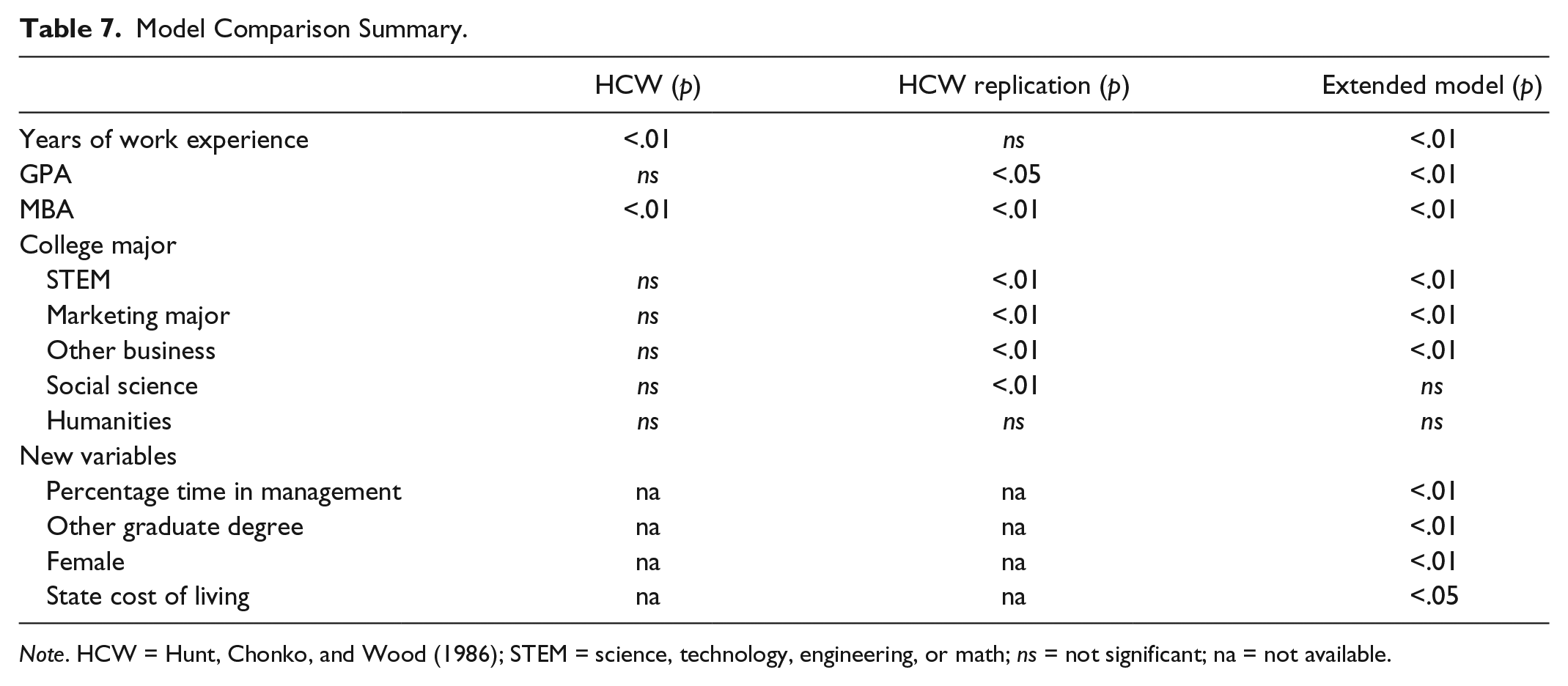
Note. HCW = Hunt, Chonko, and Wood (1986); STEM = science, technology, engineering, or math; ns = not significant; na = not available.
To examine Research Question 1 in more depth, tests of the differences among the various college major coefficients were conducted (again following Kmenta, 1971). While the difference between the largest (STEM) and smallest (Humanities) major coefficients was significant, t(849) = 2.819, p = .005, the difference between the marketing coefficient and the STEM coefficient did not reach significance, t(849) = 1.696, p = .090, and nor did the difference between the marketing coefficient and the humanities coefficient, t(849) = 1.654, p = .098. Thus, while there is evidence that STEM majors are better compensated in marketing careers than humanities majors, there is not conclusive evidence that STEM majors or humanities majors are compensated any differently in marketing careers than are marketing majors. The observation that the STEM, other business, and marketing major coefficients are all significantly different than zero indicates that employees with these majors do receive more compensation in marketing careers than noncollege graduates. HCW’s results regarding majors may have differed from the current results because their sample included mostly college graduates. Thus, if all majors had the same relationship with income, none of the majors would be significant. In the current study, with enhanced statistical power and more valid statistical tests, we do see differences among some majors but not all majors.
HCW also compared results for marketing professionals early in their careers (<10 years of experience) and later in their careers. We estimated the model shown in Table 5 separately for those early and late in their careers and compared the models using Kmenta’s (1971) test of equality of two regressions. The models were not found to be significantly different, F(15, 834) = 1.035, p = .416. It is possible that any benefits to a marketing major may be related to the ease of assimilation in their new roles. If so, this effect may be fairly transitory, perhaps affecting the first year or two of employment. The present sample did not contain sufficient observations of such very recent graduates, and therefore an exploration of this benefit is left to future research.
An interesting question is whether college GPA in marketing is more strongly associated with earnings than college GPA in some other field. To test this hypothesis, a model was estimated with an interaction term, marketing major × GPA. Adding the interaction term led to a slight decrease in adjusted R2 (.284 to .283), and the incremental F test was not statistically significant, F(1, 848) = 0.144, p = .704. Thus, the strength of association between GPA and marketing income was not related to having a marketing major.
Research Question 2: Marketing Education and Marketing Career Satisfaction
To examine HCW’s findings related to career satisfaction, the same variables that were used in the expanded regression model on income were regressed on career satisfaction. To add statistical power and control for an important relevant variable, salary was also entered in this equation. Salary is known to have a small but positive association with job satisfaction (r = .15, Judge, Piccolo, Podsakoff, Shaw, & Rich, 2010). As in the compensation regression, the log of salary was used in the satisfaction regression because of theoretical and empirical support for a nonlinear relationship between salary and satisfaction. Herzberg, Mausner, and Snyderman (1959; see also Herzberg, 1968, Exhibit 1) created a two-factor theory of job satisfaction that includes hygiene and motivator factors. They suggested that compensation is one type of hygiene factor so a low salary may lead to dissatisfaction, but a high salary does not contribute substantially to higher satisfaction. Responsibility and the work itself are examples of motivators so an increase in motivators are thought to increase satisfaction. Card, Mas, Moretti, and Saez (2012) found evidence of a nonlinear relationship between job satisfaction and salary, where earning below one’s peers led to dissatisfaction but earning more than one’s peers did not lead to higher satisfaction.
The results of the satisfaction model, shown in Table 8, indicate that having a marketing major did not quite reach significance in its association with satisfaction in a marketing career (B = 0.154, p = .093), although among all the majors studied, having a marketing major had the largest positive point estimate. Surprisingly, majoring in STEM, while associated with higher income, had the lowest point estimate in relation to career satisfaction but the coefficient was not significant (B = −0.217, p = .120). Those who majored in humanities also had a low-point estimate for career satisfaction coefficient, but again the coefficient was not significant (B = −0.213, p = .097).
Career Satisfaction Regression.
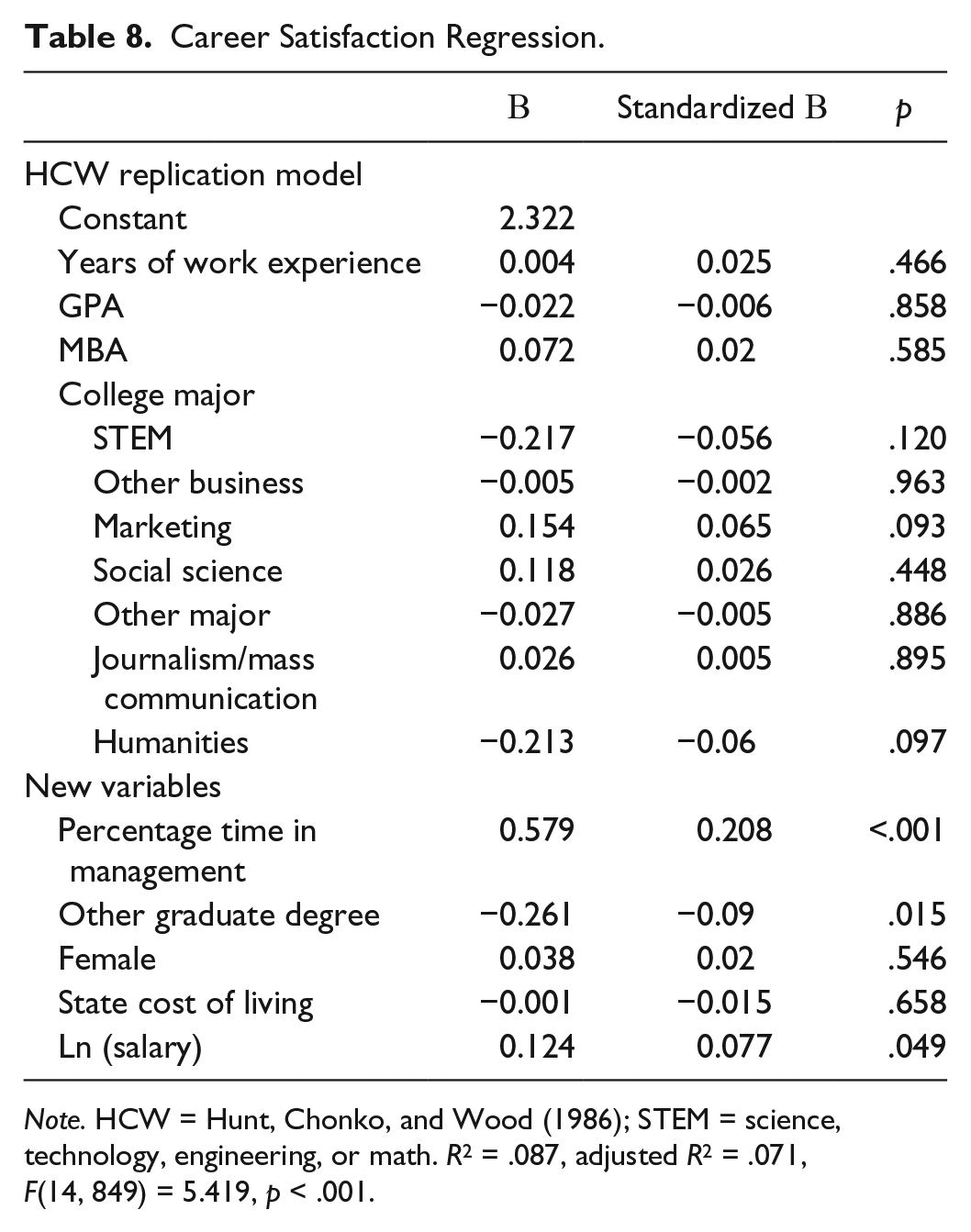
Note. HCW = Hunt, Chonko, and Wood (1986); STEM = science, technology, engineering, or math. R2 = .087, adjusted R2 = .071, F(14, 849) = 5.419, p < .001.
There were three significant variables in the career satisfaction model. Percentage time in management had the largest point estimate (B = 0.579, p < .001). Thus, those who spend more time on management tasks are more satisfied in their marketing careers. Interestingly, percentage time in management led to the largest standardized coefficient in both the income and satisfaction models. This finding is consistent with the idea that being in management is more satisfying and that being passed over for management is dissatisfying; the present sample does not enable us to determine the relative strength of these effects. Possessing a graduate degree other than an MBA had a large negative coefficient (B = −0.261, p < .015). Thus, those with advanced education in other fields appear to be less satisfied with their careers in marketing. The log of income was found to be significantly associated with satisfaction, but at a low level (B = 0.124, p < .049). (In a linear model with salary or in a model with salary and salary squared, none of these coefficients achieved significance at p < .05). It is important to note that the R2 in this model was quite low, similar to the findings of HCW (R2 = .087 here vs. .03 in HCW), indicating that career satisfaction is not strongly related to the variables studied here. One of the reasons many coefficients were not significant may be the modest variance in career satisfaction in the current sample (.91 on a 5-point scale, see Table 1). Another explanation for so many null results is that marketing tasks are diverse, and marketing professionals gravitate toward those tasks they enjoy the most, regardless of their major.
Discussion
The results presented here provide evidence that an education in marketing is related to success in a marketing career as measured by income, but the wage premium associated with the marketing major, at 15.5% (.155, Table 6), is not significantly different than the wage premiums associated with other majors. Furthermore, the marketing major × GPA interaction was not significant. Therefore, if GPA captures knowledge learned in school as suggested by Bacon and Bean (2006), we find no evidence that the marketing knowledge learned in school contributes to increased performance in a marketing career. This result undermines the first perspective described in this article—the specific content of a marketing major creates economic value for marketing graduates. Perhaps because marketing knowledge is not useful, or not enough knowledge is related to the particular careers where students eventually settle, or simply because students forget most of their specific marketing knowledge, an undergraduate marketing education is not uniquely associated with success in a marketing career. Instead, the other two perspectives are supported. The marketing major may benefit students by building broader skills, and it may benefit students through some type of signaling.
At this point, it would be tempting to press marketing educators to work with practitioners to make their programs more relevant to the real world. However, the challenge of relevance may lie substantially in not knowing what careers our students may eventually enter. Many students will not discover which aspect of marketing best suits them until years after graduation. Furthermore, we suspect that just as only a small percentage of marketing professionals have marketing degrees (19% of our sample, Table 3), many of those with marketing degrees do not enter marketing careers. Thus, rather than speculate about what careers our students will enter and attempt to offer all the specific content for those possible futures, marketing educators may be able to offer more value by focusing on broad skills that could be used in any career. Perhaps marketing in higher education should focus on higher education, and once students land in careers with specific needs, they can seek the specific job training they need from other vendors, perhaps at lower cost.
One could argue that students interested in a marketing career should study engineering, because STEM has the highest point estimate for a wage premium in Table 6. However, this advice ignores the likelihood that most marketing students would not enjoy studying engineering. Slogging through a disliked major will likely lead to a lower GPA. In Table 6, a 1.0 drop in GPA (e.g., from 3.7 to 2.7) is associated with an 18.6% decline in salary, which exceeds what the marketing major hoped to gain by studying engineering (from .291 to .155 = .136 = 13.6%). A similar argument could be made for the student who loves journalism but feels pressured to major in marketing. Assuming that GPA causes income because the increased academic engagement leads to broad learning gains, being engaged and successful in a personally preferred major may be more important than having a major that the market seems to prefer. If the relationship between GPA and later compensation is causal, this finding provides additional incentive for faculty to motivate students to achieve high GPAs and not minimize their engagement as they pursue their degrees.
Similarly, one might argue that colleges should not offer marketing majors at all because anyone interested in marketing might achieve more financial success majoring in general business. However, if college does offer broad learning outcomes, and these outcomes are proportional to engagement (Carini et al., 2006; Terenzini et al., 1995), perhaps students should major in whatever they are passionate about. In this regard, college learning is somewhat like cardiovascular fitness. Some people may prefer running, some may prefer a rowing machine, and others may prefer swimming. To achieve cardiovascular fitness, the best choice is the method that the individual is likely to fully engage with and use on a regular basis. Similarly, the best major for a student may be the one that the student is most likely to fully engage with. This thinking parallels the perspective that some aspects of thinking skills may not be domain specific (Abrami et al., 2015).
Given that marketing majors may not be the most gifted students (Aggarwal, Vaidyanathan, & Rochford, 2007), it may be particularly important to offer an engaging program to marketing majors. A challenge for marketing faculty is to ignite the passion for learning in our students. As Plutarch has said, “The correct analogy for the mind is not a vessel that needs filling, but wood that needs igniting . . . ” Thus, like successful personal trainers (Franz, 1998), our task is not only to provide access to beneficial experiences but to create the motivation for learning both during college and lifelong.
In terms of curriculum design and recommendations for marketing faculty, the results presented here support the recommendation that the learning process may be more important than the content. Keeping courses up-to-date with the latest theories may be less important than developing pedagogies that engage students, challenge their thinking, and inspire them to improve their communication and interpersonal skills. Being academically current may not be as important as being pedagogically current. Note that the conclusions here are not substantially different whether signaling plays a minor or major role. Offering an academically and personally challenging curriculum may provide as good an education as it does a screen for job skills.
A quite important observation from the current findings is that considerable variance in marketing income is not explained in the expanded model. The expanded model in Table 6 explains 29.6% of the variance in the log of income, leaving 70% of the variance unexplained (HCW’s model explained 20% of the variance in income). Given the studies of employer needs in marketing graduates (e.g., Finch et al., 2013; Kelly & Gaedeke, 1990; McDaniel & White, 1993; Schlee & Harich, 2010), employers may be most interested in traits such as enthusiasm/motivation, initiative, ambition, assertiveness, interpersonal skills, or leadership skills because these together more substantially affect marketing success than does a marketing education. Thus, our findings are consistent with these earlier findings, and the results create an additional call for marketing educators to explore how these other skills and abilities might be improved by higher education.
In conclusion, the current research finds a positive relationship between having an education in marketing and success in a marketing career; however, this positive relationship is no larger than for some other majors. Rather than the marketing content itself, a college education may impart to all students, regardless of major, some higher order thinking skills and abilities that are valuable in marketing careers. A college degree also selects students with greater ambition and aptitude, which also sends a signal to the marketplace. This study should motivate additional research into the nature of the skills and abilities not measured in the present study as these abilities may be more valuable in the marketplace than imparting the marketing knowledge that we marketing faculty hold so dear.
Footnotes
Acknowledgements
Expert editing from Dr. Kim Stewart is gratefully acknowledged, as is the time and effort from guest editors Luke Greenacre, Lynne Freeman, Minna-Maarit Jaskari, and Susan Cadwallader in managing the review process for this article.
Declaration of Conflicting Interests
The author(s) declared no potential conflicts of interest with respect to the research, authorship, and/or publication of this article.
Funding
The author(s) disclosed receipt of the following financial support for the research and/or authorship of this article: The author gratefully acknowledges the research funding from the Daniels College of Business that made this project possible.