



Abstract
Marketers and designers are likely to work together on innovation teams as they both have customer satisfaction as their end goals. Collaboration between these disciplines in innovation teams is often impaired due to the different thought-worlds that drive decision making: intuitive versus rational. To facilitate collaboration between design and marketing it is valuable to teach marketers about designers’ ways of thinking. Approaches to teaching design thinking to marketing students often focus on students becoming more creative, intuitive, and innovative themselves. However, the integration of the two disciplines does not require that marketers become designers, and vice versa, as both bring unique skills necessary for successful innovation. An educational framework is presented that aims to teach marketing students an understanding of the thought-world of design thinking rather than to become design thinkers themselves. The focus is on recognizing how the others’ approach to the same goals are complementary to their own approaches instead of being different or “wrong.” This framework is unique in aligning design thinking phases with critical thinking phases—marketing students’ dominant thinking style—through specifically chosen activities to scaffold the understanding of an intuitive, divergent, and creative thinking approach to the development of innovative marketing ideas.
Keywords
Educating Marketing Students to Understand Designers’ Thought-Worlds
While design thinking has gained significant traction in the business literature and organizations around the world have adopted it into their company strategy, the adoption process still proves to be difficult (Carlgren et al., 2016). This difficulty is partly due to the different thought-worlds that drive decision making in design and business domains (Dougherty, 1992). Managers are more rationally inclined, while designers are more creatively inclined (Calabretta et al., 2017; Cross, 2011). The combined use of rational and intuitive thinking can lead to tensions (Calabretta et al., 2017; Hodgkinson & Clarke, 2007).
Within an organization, marketers and designers are likely to work together on innovation teams as they both have customer satisfaction as their end goals (Bruce & Cooper, 1997). They interface in the areas of products, packages, corporate identity, advertising, and retail environment (Bruce & Cooper, 1997), and recently, we have seen designers transition from being executioners of briefs to constructing them at a strategic level (Calabretta et al., 2016). Tensions due to different thought-worlds have been described to commonly occur between marketers and designers. As Holm and Johansson (2005) iterate, collaboration between the two disciplines is often impaired due to “poor communication and lack of knowledge of the other’s processes and ways of doing and viewing market research” (p. 37). For example, designers will make decisions based on intuition with the intent to shape the future, while marketers prefer to see a fit with the current market using measurable objective data (Beverland & Farrelly, 2011; Blijlevens & Ranscombe, 2016).
The prevalence of a rational thought-world in the management field in general (Cabantous & Gond, 2011) and, of marketers specifically, is not surprising as most business students are taught courses designed according to Bloom’s (1956) critical thinking taxonomy and first-year hurdle courses in marketing include courses such as market research, business statistics, and macroeconomics. Critical thinking, in its definition (“The objective analysis and evaluation of an issue in order to form a judgment” Oxford Dictionary), seems to exclude creative and intuitive thinking (Pithers & Soden, 2000). For example, a course such as market research teaches students a positivistic approach to understanding consumers and the market (e.g., surveys), while designers will take a constructivist approach to reach an understanding of the consumers and the market (e.g., ethnography). Hence, throughout their education, marketing students’ thinking has become methodical, rational, and linear, while designers’ thinking tends to be divergent, iterative, and intuitive (Calabretta et al., 2017; Cross, 2011).
Successful collaboration between marketers and designers is acknowledged as essential for innovation (Beverland, 2005; Beverland & Farrelly, 2011). One way to facilitate collaboration of design and business teams within an organization and to reduce the outright dismissal of each other’s ideas is through teaching both disciplines about the others’ processes and ways of thinking (Beverland & Farrelly, 2011; Dougherty, 1992). Recognizing this, business schools have started to implement design thinking into their curricula (e.g., Stanford University, INSEAD) and educational frameworks have surfaced in the literature on how to teach design thinking to business students, often in MBA programs or the management discipline specifically (see, e.g., Çeviker-Çınar et al., 2017; Dunne & Martin, 2006; Glen et al., 2014; Glen et al., 2015; Matthews et al., 2011). Recently literature in marketing is also surfacing on the implementation of design thinking into marketing courses (see, e.g., Chen et al., 2018; Schiele & Chen, 2018; Zarzosa, 2018), which is a positive trend as the marketing and design disciplines are highly likely to work together in innovation due to their common goals (Bruce & Cooper, 1997). However, often design thinking is taught with the aim of students acquiring the knowledge and skills to become more creative, intuitive, and innovative themselves, essentially to become design thinkers. Literature on the integration of the two disciplines of design and business, and marketing more specifically, in innovation teams does not suggest that marketers need to become designers, and vice versa, as both bring unique skills to the table necessary for innovation to occur successfully (Dougherty, 1992; Holm & Johansson, 2005). Indeed, it is through combining rational and intuitive approaches to decision making that innovative decision making occurs (Hodgkinson et al., 2009).
Hence, for a design thinking course to facilitate future collaboration of marketers with designers, without dismissing their own skills and thinking, the course could instead aim to teach an understanding of the thought-world of design thinking rather than to become intuitively inclined design thinkers themselves. Understanding, here, refers to the acknowledgment and acceptance of how the others’ approach to the same goals are complementary and an extension to their own approaches rather than just being different or “wrong.” This approach is in line with the strategy that Calabretta et al. (2017) suggest should be adopted within organizations: rather than trying to resolve the two approaches to innovation or dismiss one or the other, the focus is on accepting both as valuable for innovation. Accordingly, an educational framework is presented here that helps teach marketing students to understand design thinking. The unique contribution of this framework is that it aligns the design thinking phases with the critical thinking phases, marketing students’ dominant thinking style, through specifically chosen activities so as to scaffold and structure the understanding of a more intuitive, divergent, and creative thinking approach to the development of marketing ideas/strategy. This framework is specifically suitable to teaching marketing students as they share common goals with designers but adopt different approaches to attain these goals through their more rational thought-world.
This article will discuss the state of design thinking education in marketing first, after which the educational framework and course are outlined in detail. The design of the educational framework is driven by prior scholarly work that provides insights on how we might best teach an understanding of a different thought-world and informs the learning goals set for the course. The general principles that guide the learning goals are discussed, after which the specific activities and structure are discussed that aim to achieve these learning goals. Finally, students’ perceived learning (Bacon, 2016) in the course is assessed as a preliminary evaluation of whether the educational framework is successful in achieving the learning goals.
Design Thinking in Marketing Education
Extant research has provided insights into how collaboration between designers and marketers can be facilitated in organizations (e.g., Beverland, 2005; Blijlevens & Ranscombe, 2016; Holm & Johansson, 2005; Leenders & Wierenga, 2002; Sääksjärvi & Hellén, 2013; Zhang et al., 2011). Another strategy to facilitate this collaboration has been through education at universities (Dunne & Martin, 2006; Glen et al., 2014).
When looking at the inclusion of design thinking into business school curricula, we can identify a distinctive approach where the focus seems to be to teach marketers to become more creative and innovative themselves. For example, multiple approaches have been outlined on how one might approach this feat in a single marketing course (e.g., Chen et al., 2018; Lee & Benza, 2015; Schiele & Chen, 2018; Zarzosa, 2018). However, most universities are often only able to fit one or two courses on design thinking in their business curricula, while design students will have experienced years of continuous and extensive design education to develop a design thinker’s thought-world and become design thinkers. Indeed, research shows that a piecemeal approach to introducing design thinking to the curriculum is not providing the intended outcomes. Educators feel that their efforts lead to surface learning of a plethora of design thinking tools rather than that they feel they succeed in teaching a specific mind-set (Goldman et al., 2012; Retna, 2016). The pioneers in teaching a thought-world of design thinking within the business disciplines (e.g., d.school at Stanford University and Rotman School of Management; Goldman et al., 2012) have embedded design thinking not only throughout the entire curriculum but also in industry connections, speakers, and clubs (Çeviker-Çınar et al., 2017). Indeed, Çeviker-Çınar et al. (2017) advocate that to achieve an adoption of a thought-world or mind-set, business schools “should embrace a philosophy that pervades all aspects of business education, rather than offering it as a fast-track through credit courses” (p. S984).
In reality, marketing programs at most universities will not have the opportunity to integrate the design thinking philosophy into every aspect of the learning experience and will therefore only scratch the surface of teaching marketers this different way of thinking. However, we have to ask ourselves, as educators, whether we want marketers to learn to think differently and adopt a thought-world that is not theirs.
To facilitate integration of design and marketing in innovation the aim does not need to be to teach marketers to become design thinkers and adopt that thought-world, and vice versa (Holm & Johansson, 2005). As a matter of fact, they each can bring unique thinking skills to the table that facilitate innovation (Holm & Johansson, 2005) such that products and services are desirable to consumers, yet are viable and feasible at the same time; this combination is what makes the integration of design thinking in business successful (Brown, 2009). For example, a positivistic approach to gaining consumer insights (e.g., through a survey) allows for an understanding of how prevalent a certain consumer need or issue is, while a constructivist approach (e.g., observation) allows for a deep understanding of why the need or issue needs to be addressed in that specific context and how one might go about doing that. Similarly, a marketing idea justified using objective data allows for alignment with financial data such as revenue (Blijlevens & Ranscombe, 2016) or provides predictive brand exposure data and therefore indicates that this idea is viable and feasible. A marketing idea justified using a storyboard allows for someone to experience what this idea might look like and how it works to fulfil a specific consumer concern or need and therefore indicates that this innovation will likely lead to uptake by consumers. Both positivist and constructivist approaches bring benefits that in combination allow for a better grounded and justified innovation and better chances of uptake and implementation to satisfy customer needs. Indeed, issues that impair collaboration between these two disciplines are about failing to understand each others’ thought-worlds and approaches to innovation (Beverland & Farrelly, 2011; Bruce & Cooper, 1997; Dougherty, 1992), not the lack of adopting each other’s thought-worlds. Hence, since a business school curriculum often only allows for the integration of one or two design thinking courses, it may be better to focus on helping marketing students understand the thought-worlds of designers better, rather than attempt to become proficient design thinkers themselves. Understanding refers to the acknowledgment and acceptance of how the others’ approach to the same goals are complementary and an extension to their own approaches.
Departing from the assumption that marketing students should learn to acknowledge and accept that a different approach can lead to valuable outcomes for innovation, rather than to become intuitive and creative thinkers themselves, an educational framework for a single course is outlined with the ultimate aim to prepare them for successful future collaborations with designers in innovation teams. In this course, students are to come up with an innovative marketing idea/strategy to tackle a marketing problem (e.g., consumers are hesitant to adopt autonomous vehicle technology and avoid buying self-driving cars) by applying design thinking with a human-centered lens. The human-centered lens to design thinking is defined as a group of methods and principles aimed at supporting the design of useful, usable, pleasurable and meaningful products or services for people. The main principle of these methods is that they describe how to gain and apply knowledge about human beings and their interaction with the environment, to design products or services that meet their needs and aspirations. (Van der Bijl-Brouwer & Dorst, 2017, p. 2)
This lens resonates well with the main aim of marketing: “satisfying the needs of the customer by means of the product and the cluster of things associated with creating, delivering, and finally consuming it” (Levitt, 2004).
To attain the aim of teaching marketing students to understand the design thinker’s thought-world, the educational framework has been informed by three main principles. First, marketing students apply the design thinking process with educational activities chosen such that they are aligned with their own dominant thinking style, that is, critical thinking, to scaffold the understanding of a new thought-world (Retna, 2016). Specifically, each phase that the student is familiar with in critical thinking is linked to a specific design thinking phase through one educational activity that has been chosen to help them to experience the lateral and divergent thinking associated with design thinking (Cross, 2011; Leifer & Steinert, 2011). The outcomes of each design thinking phase meet the same goal as aimed for in the aligned critical thinking phase (e.g., gain consumer insights, convincing justification of ideas); however, the experience of these specifically chosen activities help in acknowledging the complementary benefits of this approach to what the typical marketing “critical thinking” approach would have resulted in.
Second, an active learning approach is adopted (Bonwell & Eison, 1991; Çeviker-Çınar et al., 2017) by choosing one activity per phase, rather than a content-driven approach that only allows for surface learning of a plethora of tools and methods that could be utilized in each phase. An active learning approach facilitates learning of higher level thinking skills and synthesis of understanding (Blevis, 2010; Bonwell & Eison, 1991). The one activity chosen for each phase specifically focuses on experiencing the intuitive approach to innovation, but is appropriate for the marketing context (e.g., developing a marketing strategy for consumer adoption of autonomous vehicle technology) facilitating the understanding of how this different approach is valuable to attaining the goals set for that phase.
Finally, the framework provides opportunities for constructive learning and alignment to assessment tasks (Biggs & Tang, 2011) through teaching a different way in which marketing ideas can be justified without the need for objective and measurable market data, namely, through argumentation theory (Toulmin et al., 1984). The course is constructively aligned such that the different activities generate the facets of a strong and sound argument, which allows students to recognize the benefit of the more intuitive approaches at different phases to justify their marketing ideas. These three principles directly inform the learning goals and activities in the course, the structural sequence of the course, and the assessment and feedback design.
Course Design
First, the underlying principles of the educational framework are described based on prior scholarly literature that specifically focuses on describing common issues that educators have found in their teaching of design thinking. These issues, and subsequently synthesized solutions, guide the learning goals set for this marketing course. These main principles and learning goals subsequently drive the choices for specific activities and structure of the course, which will be described more in depth after that.
Underlying Educational Principles and Learning Goals
Aligning Critical Thinking and Design Thinking to Scaffold Learning
As previously outlined, the divide in thought-worlds between marketers and designers is partly the result of the education provided in the respective disciplines where marketing courses seem to mainly align with developing students’ critical thinking skills. Indeed, design thinking educators see teaching a different mind-set from the more traditional mind-set as the biggest challenge (Retna, 2016). As Retna outlines, educators meet resistance from students indicating the process was a waste of time, and they preferred the “normal” way of learning. Learning design thinking is often referred to as a “black-box” experience where learning emerges through experience and one where eventually a mind-shift occurs (Goldman et al., 2012). Indeed, educators notice that the design process is often perceived as chaotic and unstructured by students, leading to initial dismissal of the approach (Glen et al., 2015), very much like marketers would dismiss designers’ approaches in organizations (Beverland & Farrelly, 2011; Brown, 2009).
To overcome this challenge, in this framework, the different design thinking phases are aligned with the critical thinking phases proposed in Bloom’s (1956) Taxonomy of Educational Objectives to inform activities and assessments designed to obtain the learning outcomes (see Figure 1) and scaffold the learning. A recent article in Journal of Marketing Education by Dahl et al. (2018) provides a historical account of how educators in marketing have defined and operationalized the critical thinking construct and provide an integrative framework for this purpose. They note that critical thinking merits greater attention and emphasis especially in the area of management and marketing (Lovelace et al., 2016) as this is a core competency needed by marketing professionals (Walker et al., 2009). The AACSB (Association to Advance Collegiate Schools of Business International) has even established development of students’ critical thinking as a key accreditation objective. Notably, in their review of marketing education literature that describes how critical thinking is successfully taught and measured, they conclude that critical thinking has strong foundations in Bloom’s taxonomy of learning due to its applicability in a problem solving and project-based discipline. Similarly, many business schools base their curriculum around Bloom’s taxonomy (Lakhal & Sévigny, 2015). Hence, we conclude that, especially for marketing students, education in marketing will teach critical thinking through the use of Bloom’s taxonomy and therefore that Bloom’s taxonomy best reflects marketing students’ thinking. The approach of aligning the design thinking phases to those of Bloom’s taxonomy provides a recognizable structure to students as well as educators, as they are used to going through the critical thinking phases in their previous courses. In Bloom’s (1956) taxonomy of educational objectives critical thinking is divided into the following six phases: knowledge (remember), comprehension (understand), analysis, synthesis, application, and evaluation. Knowledge refers to the attainment of terminology, facts, conventions, principles, theories, and structures. Comprehension is about translating, comparing, and interpreting all knowledge attained. Analysis refers to breaking down all knowledge into its component parts and identifying relationships among them. Synthesis uses all parts identified and related during analyses to generate new insights. Application refers to the use of acquired and synthesized insights in new situations. Finally, evaluation refers to the presentation and defence of synthesized and applied insights.
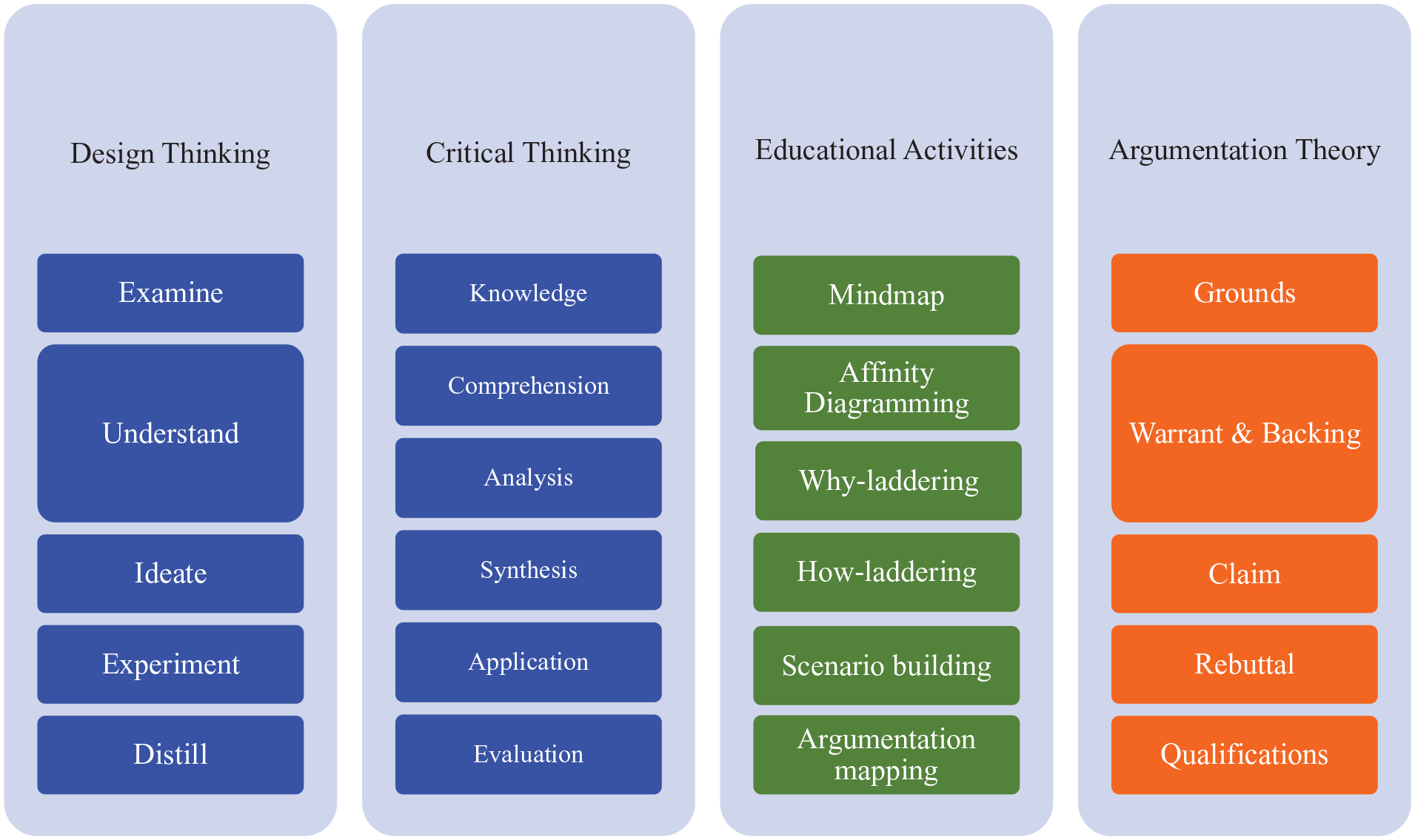
Educational framework for teaching marketing students to understand designers’ thought-world.
The design thinking process is typically divided in three to six phases. Stanford’s d.school outlines the following phases: empathize, define, ideate, prototype, test, and implement (Plattner, 2010), while Brown (2009) at IDEO names the phases as follows: inspiration, ideation, and implementation. When design thinking is specifically applied to business problems aimed at coming up with innovative marketing ideas rather than the design of a product or service, the labels for phases used by Stillman (2012) at The Design Gym seem most appropriate and are therefore adopted in this course: examine, understand, ideate, experiment, and distil. The “examine” phase focuses on broadening the knowledge about the problem at hand and getting to know the context, history, objects, and people involved. The “understand” phase involves finding patterns and relationships within the knowledge obtained and aims to highlight deep insights into certain phenomena (e.g., needs, concerns, motivations that drive consumers’ behaviors in that context). The “ideate” phase focuses on generation of ideas and solutions based on the insights formed in the previous phase. The “experiment” phase focuses on concretizing solutions informed in iterative feedback loops. The “distil” phase is about stripping down the solution to its essentials and communicating it to others convincingly. Notably, the difference between Stillman’s phases and those of Stanford d.school is that Stillman has divided the first phase into two. While The Design Gym also has “empathy” front of mind in their approach, the “examine” phase focuses on broad and divergent thinking, whereas the “understand” phase focuses on deeper intuitive thinking. Since we want students to experience the thought-world of designers—that of creative, intuitive, and divergent thinking—adopting these two phases in our framework provides the opportunity for students to experience divergent and intuitive thinking separately. This physical delineation between the two types of thinking will make experiencing a different type of thinking within separate activities more gradual and supported.
When examining the aims of the different design thinking phases it becomes evident that the design thinking phases map well onto the critical thinking phases (see Figure 1). For example, the knowledge phase in critical thinking and the examine phase in design thinking both aim to gather information and knowledge. Similarly, the comprehension phase in critical thinking and the first part of the understand phase in design thinking both aim to highlight patterns and relationships of the information gathered. However, in an innovation project, marketers would approach these goals differently, as influenced by their critical thinking thought-world, compared with designers who are influenced by their design thinking thought-world. For example, a marketer will employ surveys or interviews to gather information and answer a research question that allows them to gain measurable and generalizable data on what consumers say they want and need to subsequently help them justify any innovative ideas (Beverland & Farrelly, 2011). Designers, on the other hand, will choose an empathetic approach, like embedding themselves into a certain situation to experience consumers’ experiences first hand, to intuitively gain deep insights into what consumers want and need in that specific context (Leifer & Steinert, 2011). While both approaches provide information and highlight patterns into consumer behavior and the market, they result in different types of information. However, both these types of information are highly valuable in innovation contexts; hence, the importance of both sides valuing the thought-worlds of the other.
In this educational framework, activities are designed such that a student progresses through the design thinking phases as they normally would through the critical thinking phases in other marketing courses, but the thinking that is encouraged and experienced is that of a design thinker (divergent, intuitive, generative). Hence, alignment of design thinking with critical thinking phases helps students to understand how a design thinking approach allows for valuable outcomes during the innovation process that are complementary to what they are typically used to. This way we attain the following learning goal: Students will learn to understand how designers think within the safe confines of the structure that defines their own thought-worlds. The specific activities will be outlined after the main principles and learning goals have been fully discussed.
Active Learning of Design Thinking
To understand a “way of thinking” it is pivotal that one experiences it actively. Indeed, as Çeviker-Çınar et al. (2017) outline, “design thinking cannot be taught through traditional lecturing pedagogy (p. S985).” They argue that one can only learn design thinking through actively experiencing the tools used during the process. Active learning is defined as a method of learning in which students are actively involved in the learning process and not just passively listen: “doing things and thinking about what they are doing” (Bonwell & Eison, 1991, p. 5). In particular, active learning allows students to engage in higher order thinking tasks such as analysis, synthesis, and evaluation (Bonwell & Eison, 1991; Stearns, 1994). When teaching an understanding of a thought-world, the student will need to experience the thinking for themselves.
As such, in this educational framework, one activity is chosen per phase that particularly enables a student to experience divergent, nonlinear, empathetic, intuitive thinking associated with design thinking, rather than convergent, linear, rational, and objective thinking associated with critical thinking. The active learning aspect allows for the insights to occur that highlight how taking a design thinking approach results in valuable outcomes for innovation in marketing strategy that are complementary to outcomes one would get to when having taken the marketing approach driven by a critical thinking thought-world. Without active learning the student would only be able to acknowledge a different outcome but not appreciate the approach that led there, which would increase chances of dismissal of these outcomes as valuable due to an inability to justify the outcome as coming from a valid process. The above described approach allows us to attain the following learning goal: through active learning experiences, students will gain a deep understanding of a different way of thinking: The designer’s thought-world.
Argumentation Theory to Justify Innovative Ideas
The method of learning design thinking is often misaligned with how academic achievement is typically measured (Dalsgaard et al., 2013; Goldman et al., 2012; Retna, 2016). The more traditional outcome focused assessment frameworks are less easily aligned with creative, practice based, or active learning based, design course activities (Dalsgaard et al., 2013; Goldman et al., 2012). In essence, it is easier to mark an exam than a return design brief. Similarly, it is easier to create a marking rubric for a marketing strategy that includes a SWOT (Strengths, Weaknesses, Opportunities, and Threats) analyses and objectives that are measurable (e.g., a 30% increase in conversion rates, 50% retention rates; see, e.g., Westwood, 2013) than to create rubric for a marketing strategy in the form of a return brief containing a visualization of a scenario based on empathy, intuition, and divergent thinking (see, e.g., Feast & Blijlevens, 2014). Indeed, Norman (2010) called for a change in design education to deal with the fact that many design students are left to justify their designs (innovations) on claims without providing a strong and sound argument that support those claims. Hence, we can conclude that constructive alignment (Biggs & Tang, 2011) is deemed more difficult for design courses that are based on an active learning approach (Dalsgaard et al., 2013), especially if they take on a human-centered design approach.
“Constructive” comes from the constructivist theory that learners use their own activity to construct their knowledge as interpreted through their own existing schemata. “Alignment” is a principle in curriculum theory that assessment tasks should be aligned to what it is intended to be learned, as in criterion-referenced assessment. . . . The intended outcomes specify the activity that students should engage if they are to achieve the intended outcome as well as the content the activity refers to. (Biggs & Tang, 2011, p. 1)
Marketing students’ existing schemata through which the activity constructs their knowledge is framed by critical thinking, and thus for constructive learning to occur, the course’s activities need to align with the goals that would normally be reached through applying critical thinking approaches. Furthermore, for constructive alignment to occur assessment needs to not only be aligned with their existing schemata but also to naturally flow from their activities in the classroom.
In this course, argumentation theory is introduced to help students justify their final marketing idea in a written report. Research suggests that teaching argumentation theory to students in creative thinking courses to justify their design ideas allows for integration into traditional outcome-based university education and subsequent constructive alignment to common academic evaluation criteria and formats (Dalsgaard et al., 2013). A way to convince someone to employ a proposed innovative solution is by providing a sound and strong argument (Dalsgaard et al., 2013; Feast & Blijlevens, 2014). A sound and strong argument contains the following elements: (1) A claim, what you want your audience to believe, (2) Grounds, the reasons and evidence why they should believe it, (3) A warrant, a general principle that explains why your evidence is relevant to your claim, (4) Backing, the body of accepted knowledge of a field or the values of a culture that provide the foundations that authorize the reliability of the warrant, (5) Rebuttal, counter arguments to limitations, and (6) Qualifications that make your claim and evidence more precise (Toulmin et al., 1984).
The educational activities (discussed in detail in the next section) in this framework generates all elements that are needed for the construction of a sound and strong argument and are, therefore, easy to assess and mark by the educator, but are different in nature than what would be expected if a marketing plan was presented: The claim is the solution/marketing idea identified in the “ideation” phase, the grounds are the evidence/research found in the “examine” phase that explains why this solution is needed, the warrant is a principle that explains how the solution fulfils/leverages a need/concern/motivation as uncovered in the “ideation” phase, the backing is the theory or accepted cultural realities behind the general need/concern/motivation identified in the “understand” phase, the rebuttal is the result of the iterative process in the “experiment” phase through refining the solution using a scenario, and qualifiers are obtained while actively mapping the argument in an argument map.
Hence in this course introducing argumentation theory allows for learning activities and assessments to be constructively aligned in line with Biggs and Tang’s (2011) constructive alignment approach. Furthermore, it provides a higher level synthesis from the activities needed (Blevis, 2010) to provide an understanding of the thought-world of designers. We achieve the following learning goal: Student’s learning process is constructive and aligned with assessment criteria.
Activities in the Course
Examine Versus Knowledge Phase
The knowledge phase in critical thinking and the examine phase in design thinking are both aimed at gathering knowledge and doing research into the problem at hand; however, what differentiates the two are the latent ways of thinking. While both disciplines may start with desk research or a literature search, their approaches will be different. In critical thinking, we encourage analytic, convergent, and vertical thinking. Indeed, marketers start their research broadly, but soon will funnel down their research endeavors to a specific claim or hypotheses. Indeed, marketers are encouraged to be guided by a research question and a good research question is focused, is specific, and is answerable (i.e., measurable). In design thinking, however, methods are aimed at encouraging generative, divergent, and lateral thinking (Leifer & Steinert, 2011). Specifically, mind-mapping (see, e.g., Figure 2) is a tool that allows students to structure their research to expose all possible avenues, contexts, and directions and is related to divergent thinking (Leeds et al., 2019). A mind-map is a visual representation of all the knowledge generated. It provides a feedback loop informing a student whether all avenues have been explored fully (are all branches fully developed/researched?) and provides an indication of where more research is needed. In this phase of design thinking other tools available to designers to gather information are ethnographic observation, and video journaling; however, these tools are time consuming and less applicable to the desk research approach that marketing students are used to. Mind-mapping can be combined with desk and literature search. Students are within a comfortable learning environment, while still achieving the same aims as required in the knowledge phase of critical thinking (i.e., gathering information about the market, customers, and problem/opportunity at hand). The tool allows the student to approach this aim from a design thinking thought-world and see that this approach is equally valuable in obtaining knowledge to their usual approach. This is why this specific tool is chosen to create an understanding of the first phase of design thinking, examine.
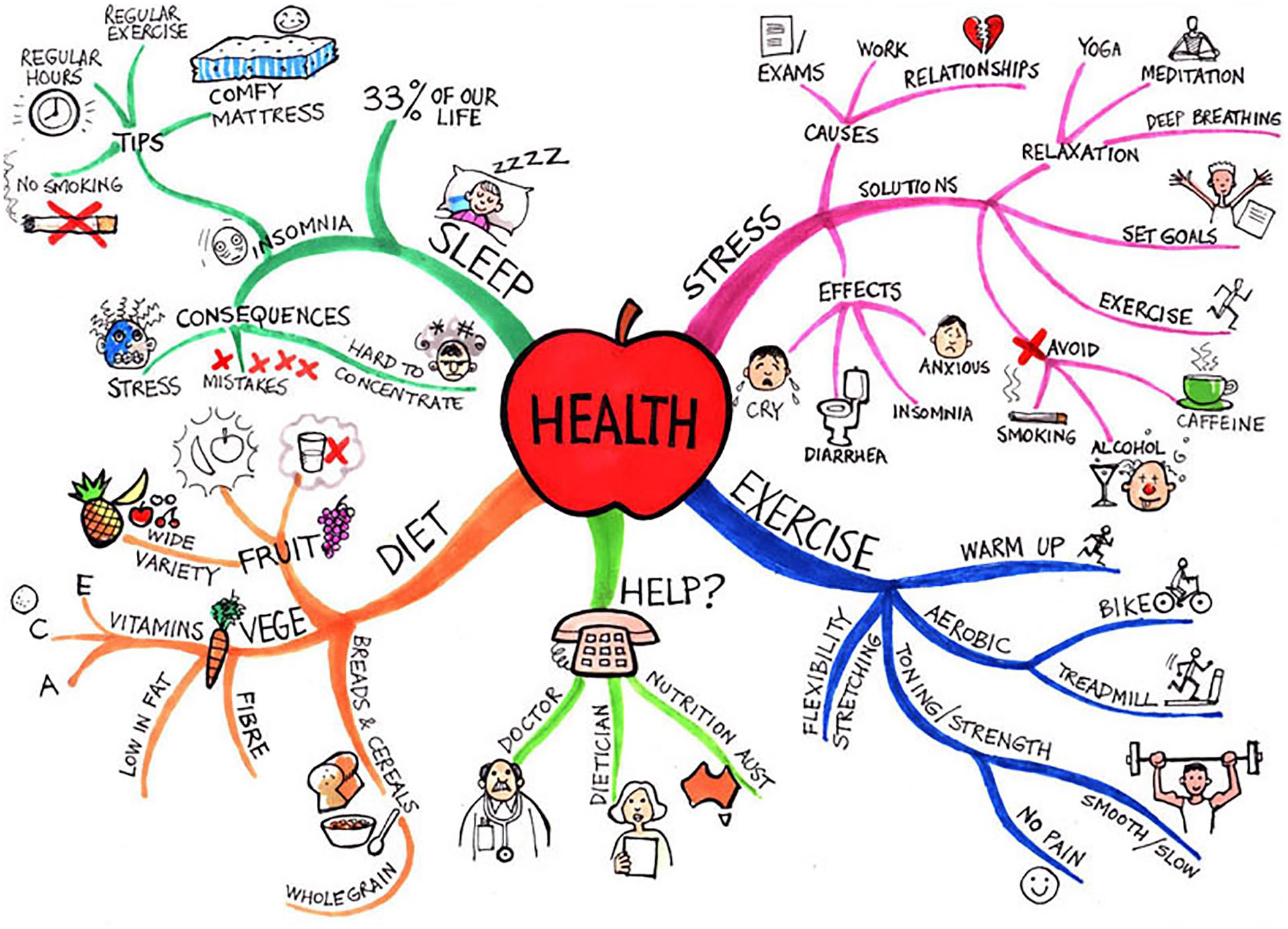
Example of a mind-map by Dr. Jane Genovese at https://www.learningfundamentals.com.au.
Understand Versus Comprehension and Analysis Phases
The understand phase of design thinking is clearly aligned with the two phases of comprehension and analysis of critical thinking. The first component of the understand phase is focused on finding patterns and relationships, which is well aligned with the analysis phase in critical thinking wherein focus is on breaking down knowledge into its component parts and identifying relationships. The understand phase of design thinking also includes the aim to uncover deep insights into phenomena that help explain and interpret relationships or themes uncovered in research, and the comprehension phase of critical thinking does just that. However, the difference lies in the type of thinking that drives these phases and the subsequently chosen approach to obtaining the aims of these phases. In critical thinking, the phases of analysis and comprehension are characterized by claims of cause-and-effect and hypothesis testing, whereas in design thinking the idea is to suspend judgment, form multiple hypotheses, and thinking is associative rather than linear (Casakin, 2011; Coyne, 1990; Leifer & Steinert, 2011).
Indeed, in the analysis phase, a marketer may test for probabilities and run correlational analyses after having run a customer survey in the knowledge phase, whereas designers will more intuitively induct conceptual themes that highlight relationships or patterns that were uncovered during their observational research. A design thinking tool that specifically allows a student to experience the latter type of thinking within the “analysis” phase is that of affinity diagramming (see, e.g., Figure 3). Affinity diagramming is a tool used to organise information into natural relationships or themes (Kawakita, 1991; Otto & Wood, 2001; Scupin, 1997). In affinity diagramming one starts by writing each piece of information gathered on a sticky note. These sticky notes are then spread out on a wall or table and one then starts to group sticky notes together that seem to belong together intuitively/thematically. In the first round, one may have come up with multiple quite specific categories, and a second round then encourages you to cluster these initial groups together on higher level order categories. This process is repeated until approximately four to five general themes are identified.
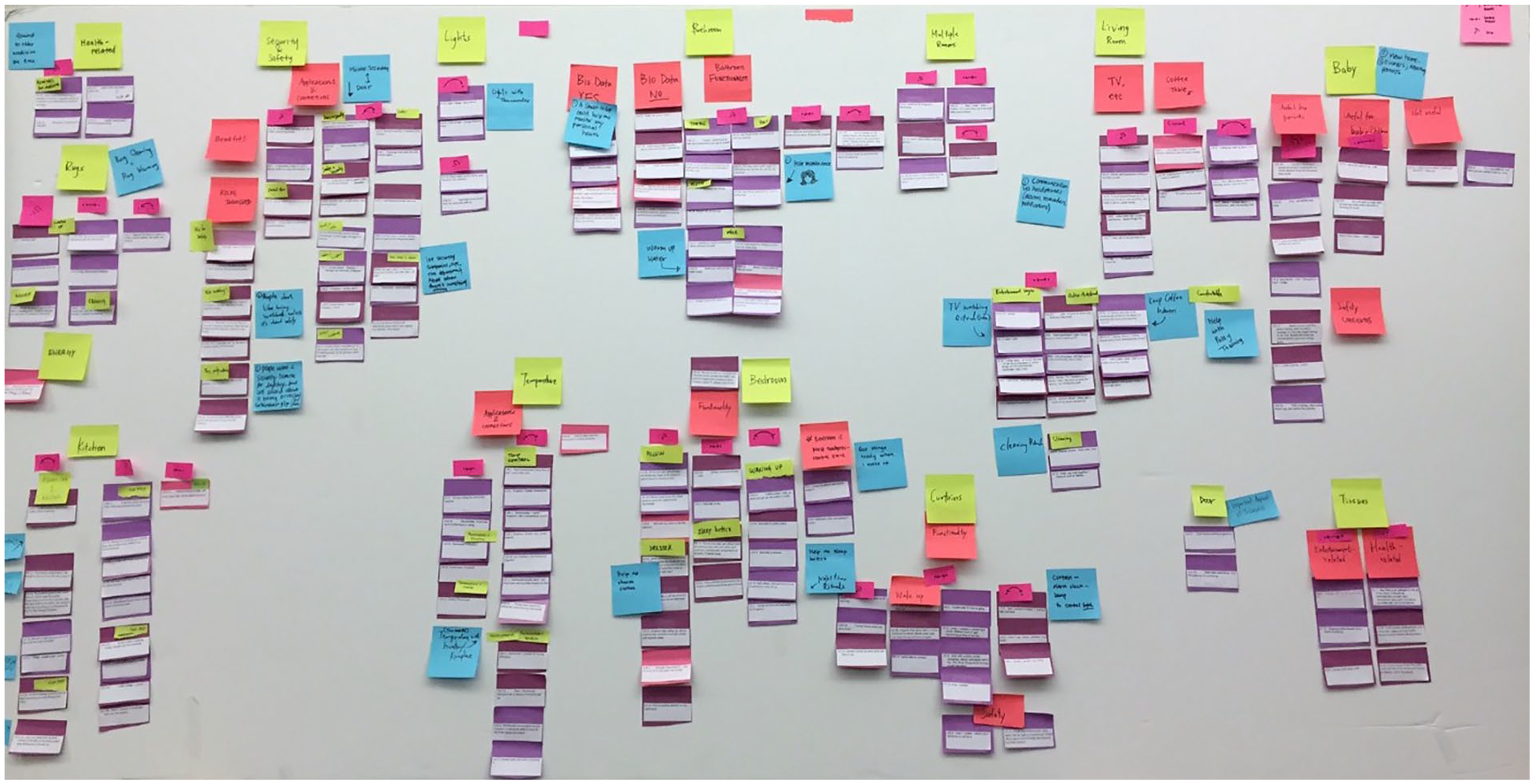
An example of an affinity diagram taken from Weprin (2016).
Similarly, in the comprehension phase a marketer may segment their customers based on demographics, psychographic, or behavioral data, whereas a designer will create a persona that highlights a deep understanding of the needs, concerns, and wishes of a typical consumer. A design thinking tool that allows students to experience “design thinking” in the comprehension phase is that of why-laddering (amended from the why-how laddering tool designed by d.school Stanford University). In why-laddering, the student intuitively and through empathy uncovers the underlying general phenomenon, principle, concern, motivation, or need that provides deep insights into who the consumer is and what motivates their behaviors. During why-laddering one starts with the problem statement and formulates that as a why question (e.g., Why are people hesitant to adopt self-driving car technology?) and answers the why-question (because they do not trust the technology). The answer is then translated into a new why-question (e.g., Why do consumers mistrust the technology?). One continues on asking why until they reach an understanding of a deeper need, concern, or motivation that underlies the problem (see Figure 4).
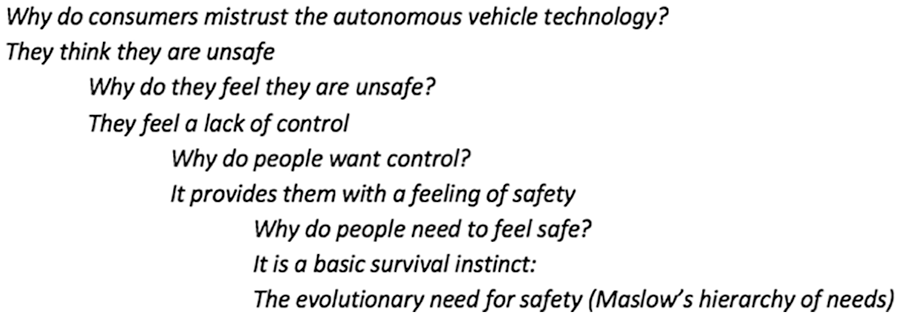
An example of a why-ladder to understand a consumers’ lack of adoption of autonomous vehicle technology.
Another tool that might be used by designers in the understand phase is empathy mapping. This tool is specifically useful after an ethnographical approach has been taken in the examine phase and maps out what a consumer said and did (analysis) and the designer’s intuitive interpretation of what consumers thought and felt (comprehend). Since why-laddering guides a student through their intuitive and empathetic thinking in a structured way and is useful even if one has not done ethnographic research but instead relies on desk-research, this tool is chosen in this course to create an understanding of design thinking in the phase where the aim is to gain an understanding of the consumer.
Ideate Versus Synthesis Phase
The ideate phase of design thinking is aligned with the synthesis phase of critical thinking in that the generation of ideas and solutions are synthesized from the understanding of the information gathered during analysis. However, in design thinking ideation is characterized by speculative, open thinking where solutions are an answer and multiple possibilities may arise, while in critical thinking, synthesis is characterized by closed reasoning, finding the answer, and is based on probabilities, not possibilities (Leifer & Steinert, 2011). For example, a marketer will be focused on attaining their measurable objectives (e.g., 30% increase in customer conversion rates) as a result of their chosen strategy (using an Instragram influencer) and will brainstorm on possible strategies with those objectives in mind (see, e.g., Westwood, 2013). How-laddering is a tool designed by d.school Stanford University that allows students to experience design thinking in the “synthesis” phase (see Figure 5). How-laddering is an ideation tool aimed at generating ideas that specifically leverage the general principles, concerns, or needs that were identified from the why-laddering in the understand phase. It starts very broadly by asking how, in general, these concerns are addressed, principles work, or needs are fulfilled, but gradually the context is brought in to be able to come up with ideas that leverage those needs/concerns/motivations to address the specific problem at hand.
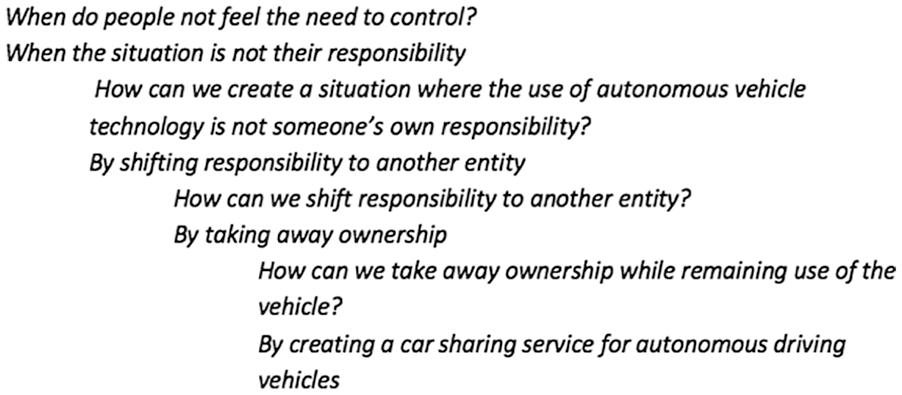
Example of a how-ladder to ideate how one might help consumers adopt autonomous vehicle technology.
A how-ladder starts void of a specific problem context or measurable objective, thereby opening up avenues for solutions that one would otherwise not have considered. Other brainstorming tools can be applied in this phase (e.g., sketching, mash-up), but this tool provides a guided and structured approach to utilizing intuition that aligns better with the linear thinking that marketers might be used to. This allows for the experience of intuitive thinking scaffolded by what students are used to, and an ability to subsequently recognize the value of the more intuitive approach used here. While both approaches are valuable and fulfil the aims of that phase, the outcomes are different, due to the thought-world that is applied.
Experiment Versus Application Phase
The experiment phase in design thinking is about concretizing solutions informed by iterative feedback loops while the application phase in critical thinking is the use of acquired and synthesized insights in new situations. Again, these phases have similar aims but the type of thinking that characterizes this phase is different. Ultimately, the aim is to work out the details of the solution/innovation in such a way that it is implementable. In design thinking we think laterally, are more subjective and rely on intuition in our choices, whereas in critical thinking our decision making is more vertical, analytical, and logical. A marketer would generate a budget, a distribution plan, and outline the different stakeholders involved in the implementation of a strategy (Westwood, 2013) or would run a focus group to discuss and compare a selection of proposed products or services with customers. While a designer may also go back to the consumer to see if their idea works using a prototype, another approach that designers can take that is more lateral and intuitive is creating a scenario or storyboard (see, e.g., Figure 6). A scenario or storyboard is a visual and/or narrative representation that outlines the experience of a solution by the targeted consumer (often represented as a persona). By going through this mental exercise, a student can refine and tweak the solution based on the “experiences” of the consumer. While other tools can be adopted in this phase of design thinking (e.g., user testing of prototypes), scenarios in this phase of the design thinking process allow one to test and experiment with ideas that you cannot pick up (Brown, 2009; Gabrysiak et al., 2011), which is the case in a situation that no physical prototype can be tested (e.g., student will not physically be able to test a car-sharing service for autonomous vehicles). Students in this course are asked to come up with a marketing idea and do not user-test prototypes. Instead, they use intuition and empathy to experiment with their ideas.

Example of persona and scenario for the adoption of autonomous vehicle technology by consumers used in class.
Distil Versus Evaluation Phase
The final phase, the distil phase in design thinking, and the evaluation phase in critical thinking are aimed at stripping down insights and communicating these convincingly. Teaching students argumentation theory by utilizing an argument map (Karbach, 1987; Toulmin et al., 1984) allows students to synthesize all learning in the activities into an understanding that creative ideas achieved through design thinking, the lateral, convergent, and intuitive way can still be justified with a strong and sound argument (see, e.g., Figure 7). As already outlined earlier, designers may utilize their storyboard or scenario to communicate their ideas to stakeholders to convince them to implement the solution; however, this may not always provide a sound and strong argument for their ideas (Norman, 2010). Argumentation mapping will allow students to formulate a strong and sound argument for why their ideas should be implemented that is easily identifiable by an educator and informs a marking rubric directly.
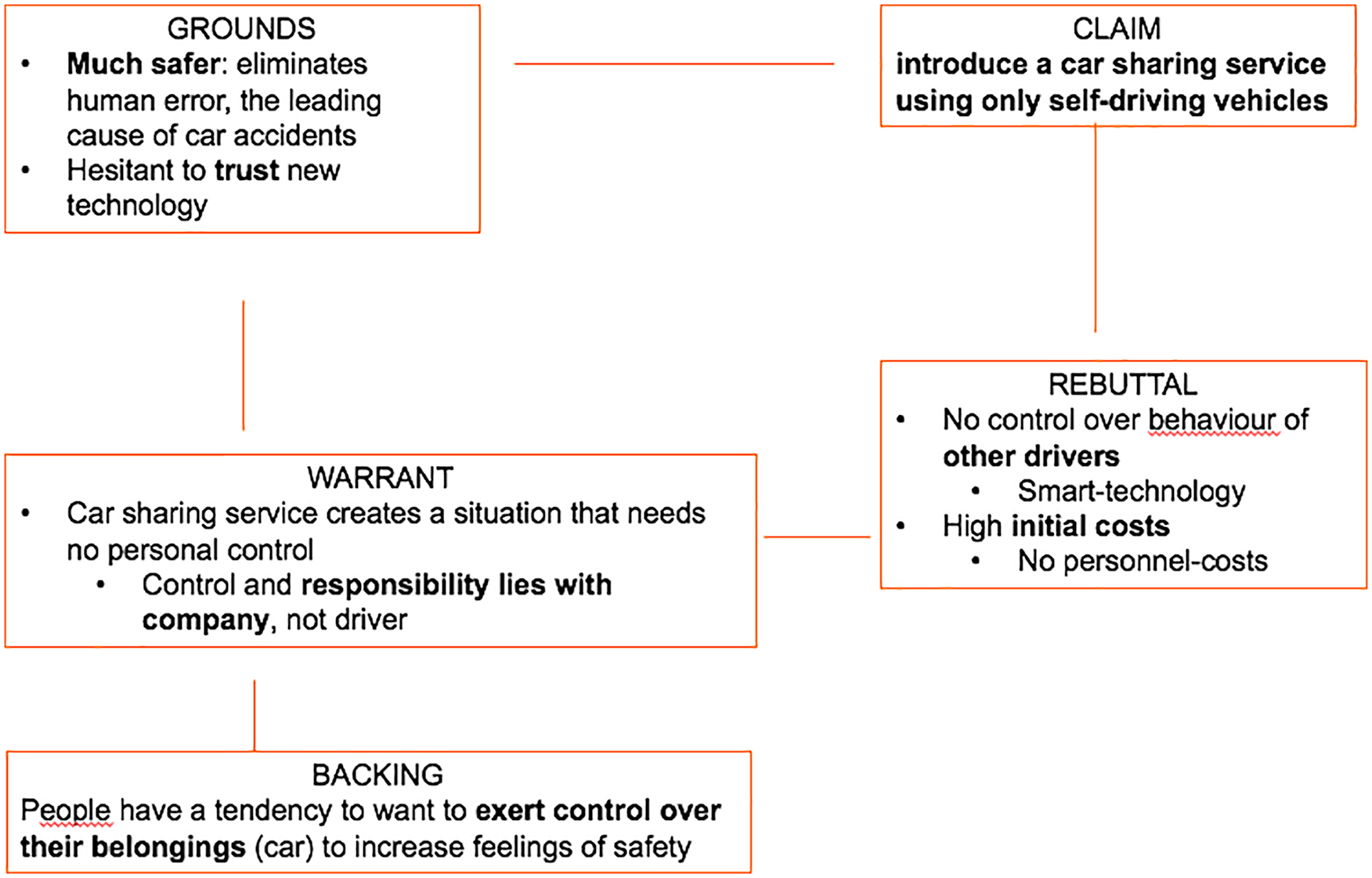
Example of an argument map for the idea to facilitate the adoption of autonomous vehicle technology by consumers used in class.
Structure of the Course
The alignment of the design thinking phases to the critical thinking phases informs the structural sequence of the course; however, in reality a student may iterate between phases based on feedback received. Furthermore, research suggests that active learning best occurs in four stages, moving from being more aided and structured to becoming more autonomous as knowledge and skills become proceduralized (Anderson & Bower, 2014; Anderson et al., 1997; Renkl et al., 2002). The course is structured such that it provides multiple levels of active learning. First, a flipped classroom approach is adopted wherein short 10- to 15-minute online lectures on theoretical concepts are outlined utilizing specific examples for each phase and activity (Renkl et al., 2002) several days prior to class. These theoretical concepts are prompted by an in-class poll and followed by a discussion on these topics. Then the specific activities related to the phases are worked through with the aim of solving a specific marketing or societal problem that students have chosen themselves to solve as an individual component. Next, these activities are also worked through with the aim of solving a marketing problem provided by an industry partner for them to solve in groups. The set-up of the course is such that in Week 1 they will learn the theory of the first phase (e.g., understand) and apply the activity to their own project for the first phase, then in Week 2, they will apply the same activity to the industry group project for the first phase. Then in Week 3 they will learn the theory and apply the activity to their own project for the second phase (e.g., ideate), then in Week 4, they will apply the same activity to the industry group project for the second phase, and so on. This set-up is specifically chosen to allow students to apply their learned skills and knowledge in a different real-world setting (their own chosen topic vs. an industry partners’ problem) and to benefit from peer-learning. These are important facets of active learning that allow for deeper learning and understanding (Bonwell & Eison, 1991).
Assessments and Feedback
In the first assignment (20%, individual), students are asked to discuss their generated ideas on how these are related to their initial problem statement (Does it solve the problem?), how it fulfils or leverage the consumers’ general concern, need, or motivation, and to reflect on their thinking process that generated these ideas. The activities done in the examine, understand and ideate phase generate all material and understanding needed for the students to successfully pass this assignment. This assignment also allows the educator to provide guided feedback on the progress toward their final assignment and where the student needs to improve to successfully pass the final assignment. The second assignment (30%, group) is the company pitch wherein they have to convince the industry partner to implement their generated idea through presenting a convincing argument in a verbal presentation. Third, the final assignment (50%, individual) is a report in the form of a project return brief wherein the overall goal is to convince a relevant marketing audience (CEO, Head of Marketing) of the value of investing in the solution to the problem identified, for their individual component. The combination of all activities done in class sets the students up with all that is necessary to pass these assignments. All activities in the course generate the different facets of an argument needed to help them justify the idea that they decided to take forward in the experiment and distil phases of design thinking. All feedback is rubric based and focuses on meaningful and useful feedback (Vardi, 2013). The rubrics provide grade related descriptors that “describe holistic quality measures of performance” (Vardi, 2013, p. 603) aligned with each grade level (fail 0% to 49%; pass 50% to 59%; credit 60% to 69%; distinction 70% to 79%; and high distinction 80% to 100%).
Next to assessment-based feedback, the active learning structure of this course allows for continuous individual feedback in class by the educator specifically as to how the students are progressing through each of the activities. Since students are not familiar with these activities, this one-on-one feedback from the educator and the peer-feedback from the group project are important.
Course Evaluation
We assess perceived learning (Bacon, 2016) in two different ways. First, we run a postquestionnaire with ex-students who participated in the course 2 years prior to administering the questionnaire. This questionnaire allows us to directly assess whether, as perceived by the students, the course was able to attain the aim of teaching marketing students an understanding of the design thinker’s thought-world and whether the three underpinnings of this course helped attain this goal (1) aligning the critical thinking to the design thinking phases through specifically chosen activities that help them to experience the lateral, divergent, and intuitive thinking associated with design thinking; (2) active learning approach to facilitate an understanding of a different thought-world; and (3) constructive learning and alignment to assessments through argumentation theory. Furthermore, it allows us to assess whether their learning indeed prepared them for successful collaboration with designers in their work.
Second, we assess the success of the course in more general terms using Course Experience Survey (CSE) data across the years 2015 to 2019. Since the new framework was introduced in 2016, this data provides us insights into the framework’s success by comparing data from before introduction of the framework and after, using the formal course evaluation criteria that universities use to assess quality of courses.
Postquestionnaire
Sample
A total of 36 students were enrolled and finished the course in Semester 2 of 2019. Of these 36, the author was able to approach and invite 22 ex-students to participate in the questionnaire. Of the 22 ex-students, a total of 16 participated in the questionnaire. Ex-students were approached via LinkedIn. Some of the participants were already connected to the author, while others were approached to connect for the purpose of inviting them to participate in the questionnaire. Approval from the University’s ethics board was obtained for the sampling method and use of data as reported below. Participation in the questionnaire itself was entirely anonymous.
Questionnaire
This questionnaire specifically aimed to assess whether marketing students understand the thought-worlds of designers better after this course. Understanding refers to the acknowledgment and acceptance of how the others’ approach to the same goals are complementary and an extension to their own approaches. Furthermore, we assessed whether the alignment of critical thinking with design thinking phases through specifically chosen activities scaffolded the understanding of a new thought-world and helped them experience a different type of thinking; the lateral (indirect and creative approach, viewing problems in new and unusual light), divergent (many lines of thought generating new and original solutions), and intuitive thinking associated with design thinking. We assess whether the active learning approach—choosing one activity per phase in-depth rather than a superficial multitool approach that only allows for surface learning of a plethora of tools and methods—facilitated the understanding and experience of design thinking and design thinkers’ thought-worlds. Whether the course was successful in constructive learning and alignment to assessment tasks was assessed through asking if the activities and the consecutive assessments allowed them to construct a strong and sound argument for their ideated marketing solution. In addition, we asked the ex-students to indicate to what level they used critical thinking approaches (rational, objective, methodical, analytical) versus design thinking approaches (intuitive, creative, iterative) to solve marketing problems before this course, and to what extent they appreciate these approaches after having taken the course. All these questions were posed in the form of 7-point Likert-type scales (see questions in Tables 1 and 2). Furthermore, they were asked if they use their learnings from this course in their current work environment, and, if they work with designers, whether this course has helped them understand designers’ ways of working.
Results of a Wilcoxon-Signed Ranked Test to Assess Whether the Course Framework Helped Students Understand Desigers’ Thought-Worlds. Medians Were Tested Against a Median of 6.
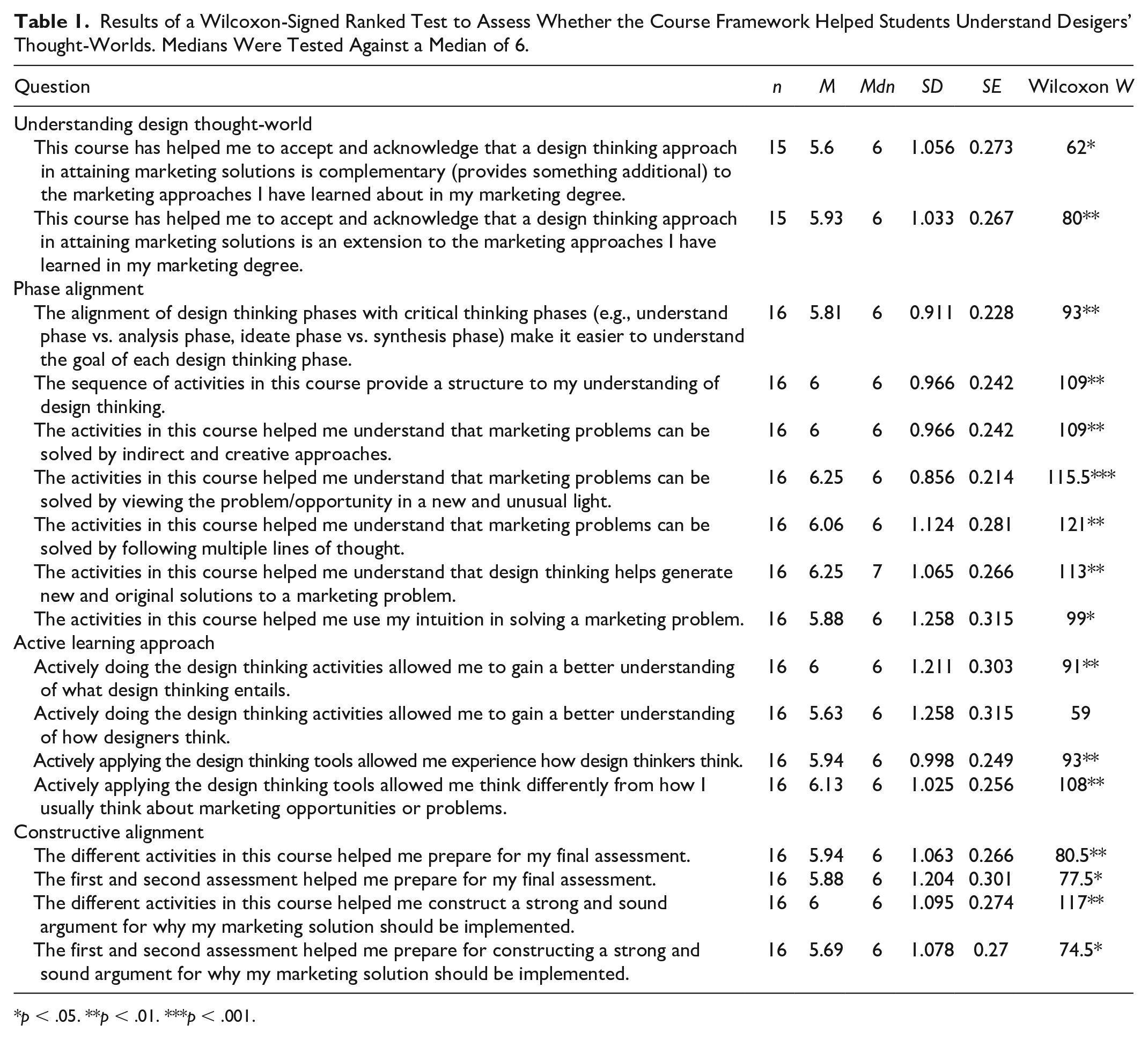
p < .05. **p < .01. ***p < .001.
Results of Paired Wilcoxon-Signed Ranked Tests to Assess Whether Students Appreciated the Use of Design Thinking Approaches to Solving Marketing Problems More After the Course. The Questions Compared Are “Before this Course, Typically, I Would Use a [. . .] Approach to Solve a Marketing Problem” and “After This Course, I Appreciate That an [. . .] Approach can be Used to Solve a Marketing Problem.”
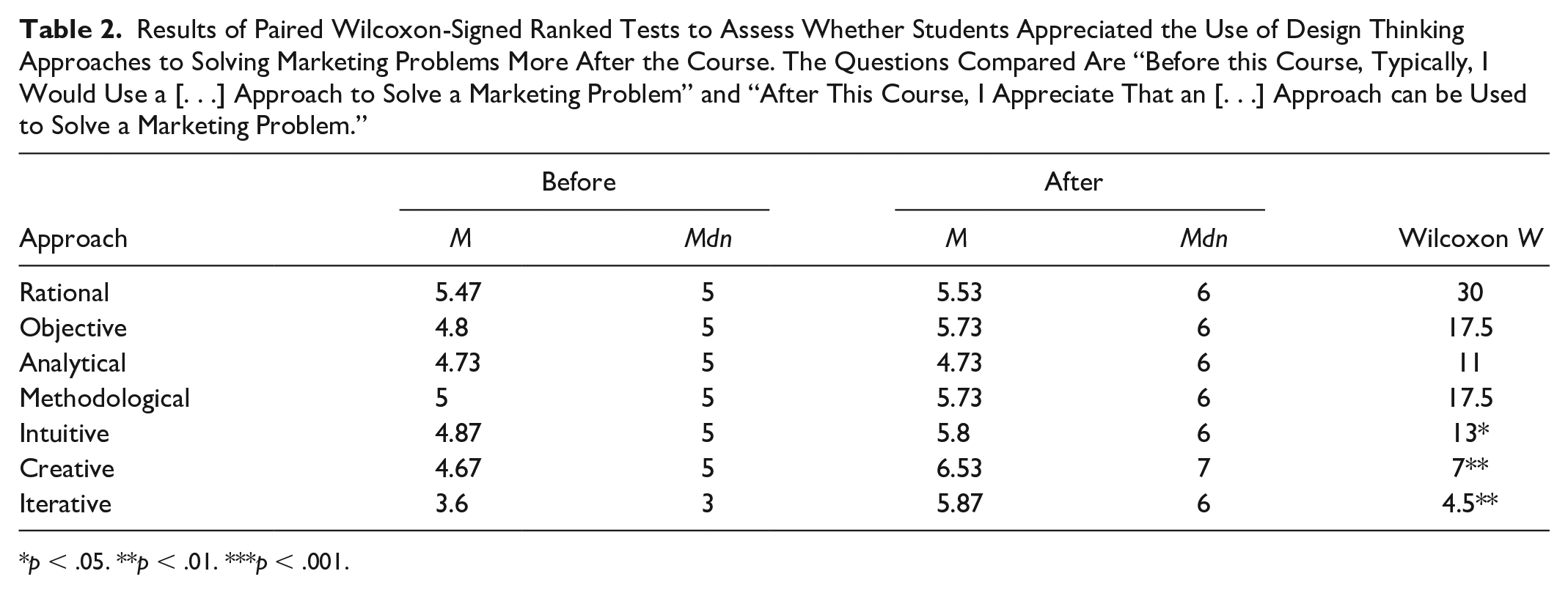
p < .05. **p < .01. ***p < .001.
Results
One-sample Wilcoxon-signed rank tests were conducted to test if the median was higher than the hypothesized median of 5 (highly agree on Likert-type scale) for all questions assessing the overall aim of the course, and the three underlying principles. If the median is higher than 5 we can conclude high agreement with the statements. All questions scored significantly above the median of 5 (see Table 1), except for “actively doing the design thinking activities allowed me to gain a better understanding of how designers think,” which scored significantly above a median of 4, indicating participants somewhat agreed with that statement (M = 5.63, Mdn = 6, Wilcoxon W = 129, p < .01).
To assess if students have grown an appreciation of the use of design thinking approaches in terms of intuitive, creative, and iterative thinking to solving marketing problems after the course, we compare how students rated these approaches (vs. methodical, rational, objective, and analytical approaches) in terms of their use before the course and appreciation after the course. Descriptively, the means show that while students used rational, objective, and analytical approaches to solving marketing problems prior to the course and appreciate these approaches approximately equally after the course, we see that compared with the use of design thinking approaches before the course the appreciation of these approaches is higher after the course. While the questions measure different constructs (applying vs. appreciation), nonparametric pair-wise comparisons performed for illustrative purposes indeed show a significant increase in medians from use of design thinking approaches before the course to appreciation of these approaches after the course, whereas we do not see such a difference for the critical thinking approaches (see Table 2). Thus, the results indicate that for design thinking approaches, while they were not widely used before the course, afterward, they were greatly appreciated. For marketing approaches, which were already widely used before the course, we see no such rise in further appreciation.
Furthermore, out of 16 ex-students, seven indicated that they have used the design thinking approaches that were taught in this course in their work. Out of the seven ex-students who indicated that they work with designers now, six indicated that the course has helped them understand these designers’ ways of working.
Finally, five ex-students took the opportunity for a free-text addition when prompted, “If you have anything you would like to share about the course or would like to add, please do so below. I would particularly welcome a description of your experience in the course.” These comments were positive only and some specifically pointed out the structure helping them apply and appreciate a different way of thinking: “The coursework structure allowed me to easily process the concepts as they flowed seamlessly and became the ‘thread’ that tied it all together,” “The course was excellent and very well structured. . . . It really broadens the way you think approach problem solving and has allowed me to take a step back when approaching a problem,” “Great way to challenge students in their thinking as an extension to what they would normally apply.”
Based on these results, we can conclude that the educational framework underpinning this course is successful in obtaining its main goal, through the underlying principles that were applied. Students report that they experience a greater understanding of designers’ thought-world and design thinking and that they see it as complementary and an extension to the approaches they have been taught in their marketing degree. Furthermore, students indicated that they did not only use the more creative, intuitive, and divergent thinking approaches in their careers now but also have a greater understanding of the work that the designers they work with do. The latter indicates that, indeed, a course that helps students understand designers’ thought-worlds facilitates collaboration between design and marketing teams.
Course Experience Survey
In line with, for example, Rhee (2018) and Young (2014), we assess the course’s success and utilize CES data to evaluate the course on whether it has been able to attain the learning goals that guided the development of the educational framework and design of the course. The CES consists of Good Teaching Score (GTS) data, and qualitative comments (see in more detail described below). CES survey is distributed to students by the university’s Learning Analytics team (not by the course coordinators) near the end of the semester to voluntarily complete in an online format. Course coordinators are asked to encourage students to fill in the CES and provide class-time for them to fill this in. The course coordinator left the class-room when this approach was adopted. The students provide consent to participation to the Learning Analytics team through completion of the survey. They are not obligated to fill in the survey and are offered the option to enter a prize draw to win a AUD$250 electronics store voucher as incentive for completion. Students are told the following prior to filling in the survey: “De-identified information will be used for internal improvement processes and may also be used for published academic research, including selected comments where they do not identify individuals.” Furthermore, specific approval from the university’s Learning Analytics team, the Deputy Dean of Learning and Teaching of the School in question, and the university’s ethics board was obtained for the use of the data described and analyzed below.
This educational framework was implemented in Semester 1 of 2016. CES data were available and analyzed is for Semesters 1 and 2 in 2015, and subsequently Semesters 1 of 2017, 2018, and 2019. Data for 2016 are missing as none of the students filled in the CES that time. Hence, we are able to compare CES from before implementation of the educational framework and after implementation. The included data pertains to the same course coordinator who also taught this course throughout. Semesters 2 in 2017, 2018, and 2019 were taught by different staff members and thus data were only included for semesters wherein the course coordinator taught the course, and data from other semesters that were taught by other instructors were excluded from analysis to reduce the possible influence of confounds as well as for research ethics reasons. In total, we had a sample of 25 students over the different semesters. The CES data of Semesters 1 of 2015 had four respondents out of a Class of 6, and Semester 2 of 2015 had four respondents out of a Class of 19, 2017 had six responses out of a Class of 7, 2018 had seven responses out of a Class of seven, and 2019 had four responses out of Class of 9.
The course assessed in this CES data focused on the last part of the “understand” phase (why-laddering), “ideation,” “experiment,” and “distill” phases of the design thinking process (see Figure 1). The phase “examine” and the first phase of “understand” are addressed in a prerequisite design thinking course. Also important to note is that the CES data of Semesters 1 and 2 of 2015 and Semester 1 of 2019, had lower response rates (4:6, 4:19, 4:9) than 2017 and 2018 (6:7, 7:7) and thus GTS as course evaluation indicators should be interpreted qualitatively.
GTS Scores
In total, six standard questions (see Table 3) are asked for students to rate on Likert-type scales ranging from 1 = strongly disagree to 5 = strongly agree. Overall, we see an increase in GTS scores from before to after implementation of the new educational framework of 1.12. A Kruskal–Wallis test was performed to assess whether GTS scores for each question significantly increased with the introduction of the new educational framework. A nonparametric equivalent of a multivariate analysis of variance (MANOVA) was chosen as assumption tests for MANOVA were violated due to the total N being 25, for each question. Furthermore, a MANOVA approach reduces the chances of making Type I errors, by estimating multiple dependent variables in one model. Results show that, for all questions, scores significantly or marginally significantly increased after implementation of the new framework (see Table 3). Notably, the questions “The teaching staff work hard to make this course interesting” and “The teaching staff in this course motivate me to do my best work” showed the biggest increase in GTS scores. These questions resonate with what can be expected from an active learning experience, which has shown to elicit interest and motivation (Bonwell & Eison, 1991).
Results of a One-Tailed Kruskal–Wallis Test to Assess Changes in Perceived Learning Scores Before the New Framework Was Implemented and After the New Framework Was Implemented in the Course.

p < .10. **p < .05.
In 2018, extra questions (yet chosen from a standard set) were introduced to the CES survey by the course coordinator to more specifically assess the goals of the educational framework and continued in 2019. Because we cannot compare across cohorts (before and after implementation of new framework), we assessed the course against a high benchmark (4 out of 5). A Wilcoxon-signed rank test is used to test against a hypothesized median of 4 (N = 11). All questions scored at or above the hypothesized median, except for “I came prepared for each session by reading of texts, journals and articles in advance” where the test statistic was negative, indicating a significantly lower median than hypothesized (see Table 4). Notably, students admitted to not coming prepared to class with regard to readings provided, yet indicated they worked hard in class and showed high engagement. This shows that in this course, students benefited most from the active learning experience offered through activities. Furthermore, they indicated the course activities to be beneficial for assessment as well as preparing them for the work force. In this course, we hoped to prepare students for collaboration with designers in innovation teams in the future and these results are an indication that we may have succeeded. Finally, students indicated that the course taught them to think differently about research. The latter is an indication that we were successful in teaching students an understanding of a different thought-world, namely, that of designers.
Results of a Wilcoxon-Signed Rank Test Used to Assess Whether Perceived Learning Scores Were at or Above the Hypothesized Median of 4.

p < .05. **p < .01.
Qualitative Comments
In the CES, students are asked to discuss “What are the best aspects of this course” and “What aspects of this course is/are in most need for improvement.” The students’ comments are described to help interpret the GTS data qualitatively.
In 2015, before the implementation of the framework, students liked “the creative thinking that is encouraged by the design thinking process” and students indicated they thought working on their own chosen topics was interesting (“the freedom to research topics that you find interesting”). Notably, they were quite vocal about how the course did not prepare them for the future and how it was not industry relevant: “[University] are misguided when they claim that this course will give their students an edge. The skills learned in this class are not applicable to industry and the course is of very little value.” Indeed, another student suggested outside speakers coming to class to speak about their view of the subject in question. This indicates that students were struggling to understand what they were supposed to learn from this course and that they dismissed any value that this different approach could bring in the “real-world.”
In the years after implementation of the new framework, students felt much more confident in this course preparing them for the workplace (e.g., “I enjoyed the creative aspects of the course and the ‘real world’ or industry related type projects we did. I think those are most relevant in terms of preparation for the workplace.”). Similarly, they indicated how the specific activities aided in that feat (e.g., “Learning about Why and How ladders was really interesting, and I have definitely been able to apply these to real life situations”). Furthermore, they indicate that these activities helped them in their assignments and particularly noting the structure of the course (“The structure has been very helpful in taking an overwhelming task like innovation and making it manageable and achievable”). Finally, they specifically learned to appreciate a different style of thinking: “The design thinking activities were a way to broaden thought processes and do something different” and “Really liked how it teaches a different way of problem-solving and also gave some engaging and challenging activities that I felt I learnt a lot from.”
Naturally, students also had some suggested improvements to the course. These mainly centered on the volume and pace of work and class-times (3-hour evening classes, with most students working full time; e.g., “I know I would be less fatigued and much more engaged if this class was earlier”), and the preparedness of industry partners (we mainly worked with start-ups; for example, “One aspect that could be improved is ensuring the group case study is delivered slightly differently, maybe reviewing the company case, or ensuring that the company is more prepared for our questions. Although the other side of this, is that in the real world, we won’t always encounter prepared people either.”).
Overall, these qualitative comments in combination with the GTS scores suggest that we may have been successful in teaching an appreciation of a different thought-world through the specific activities that were chosen and that students have been able to recognize this learning and how it will benefit them in their future careers.
Discussion
In this article, an educational framework and course design are proposed that aims to teach marketing students to understand and appreciate designers’ thought-worlds, rather than to become design thinkers themselves, with the ultimate aim being to prepare them for successful future collaborations with designers in innovation teams. In line with Fink’s (2003) framework for developing a course, three main learning goals were chosen to guide the development of the educational framework and design of the course: (1) for students to learn to understand how designers think within the safe confines of the structure that defines their own (marketing) thought-worlds, (2) for students to gain a deep understanding of a different way of thinking; the designers thought-world, through active learning experiences, (3) for students’ learning process to be constructive and aligned with assessment criteria. Both the questionnaire and course evaluation results seem to provide an indication that these goals were successfully attained.
As Retna (2016) discussed, the biggest challenge of teaching design thinking is that it does not align with the students’ dominant type of thinking or with the assessment criteria that are most widely used in current educational systems. By aligning critical thinking to the design thinking phases and introducing argumentation theory to guide justification of the generated ideas, this challenge was overcome. Furthermore, this paired with the fact that the students found the course, and in particular the activities, inspiring, interesting, and motivating aligns with Çeviker-Çınar et al.’s (2017) contention that active learning is required in design thinking courses. It further indicates that higher order learning was achieved in line with what Bonwell and Eison (1991) would suggest. Most important, the aim of this course was that alignment of phases through specifically chosen activities that promote intuitive, lateral, and divergent thinking helps marketing students acknowledge and accept that a different approach, embedded in a different thought-world, is complementary and valuable, rather than just different or wrong.
This course was designed with marketing students in mind. The literature shows that integration of the design and marketing (business) disciplines and facilitating collaboration between these disciplines in innovation teams is highly beneficial (Beverland & Farrelly, 2011; Dougherty, 1992). However, difficulties in collaboration between designers and other business disciplines has also been outlined in the literature (Dougherty, 1992; Glen et al., 2014). A similar educational approach may be adopted as outlined in this framework, as the other business disciplines would suffer the same challenges as outlined for marketing students when it comes to approaching decision making from a rational thought-world. On the other hand, this course was specifically designed for marketing students such that it relied on achieving the same goals in each phase of the process as designers, which may not always be the case other disciplines (they are not all customer centric) and therefore this educational framework may be most suitable to marketing students.
This course clearly assumed that students had been taught a specific thought-world throughout their studies - that of critical thinking - and uses that as the basis for teaching an understanding of a new thought-world. For students that are at the beginning of their studies, or prior to starting university education, this framework may not be suitable, as critical thinking may not dominate their thinking processes yet. On the other hand, secondary education in many Western and Asian countries do seem to teach a “traditional” thinking style (Retna, 2016), which design thinking educators deemed the biggest challenge when trying to teach a different style of thinking. This could also explain why many design educators would argue that to become a “designer” it requires many years of specific design education and subsequent experience.
The course evaluation was based on low numbers of responses to the CES and was based on “natural” experiment results, rather than controlled class experiment results. Due to ethics reasons a controlled class experiment was not feasible, but it would be advisable to replicate these findings within cohorts that have received similar learning experiences prior to taking part in this particular design course as this would reduce the possibility for confounding factors explaining the results. Similarly, the postquestionnaire asked ex-students to reflect on their learning experience. A prequestionnaire–postquestionnaire would have allowed us to test whether the framework saw a shift in appreciation and acceptance of the designers’ way of thinking, and this can be a valuable avenue for future research.
Moreover, this educational framework should be tested within a larger cohort of students. While this course seemed successful within a smaller class size, this may not be easily adapted to a larger class size. Indeed, the course did require the educator to provide a lot of individual feedback throughout, which was time-consuming. Hence, one of the issues that Retna (2016) outlines, the fact that teaching design thinking is time and resource intensive, has not been resolved. This is also what students experienced, as can be seen in the “for improvement” comments provided by them.
Conclusion
An educational framework was developed that aims to overcome common challenges experienced by educators in the successful teaching of design thinking to marketing students. This educational framework is different from many educational frameworks for teaching design thinking to marketing students in the sense that it does not aim to turn marketers into design thinkers or innovators themselves. This research shows preliminary evidence for the success of a course designed to teach an understanding of designers’ thought-worlds to marketing students and to prepare them for future collaboration with designers in innovation teams in the work-force.
Overall, the educational framework aims to teach marketing students to understand and accept designer’s thought-worlds, rather than to become designer thinkers themselves, with the ultimate aim being to prepare them for successful future collaborations with designers in innovation teams. In particular, the main contribution lies in the alignment of the design thinking and critical thinking phases through specific activities to enhance the understanding of a different thought-world.
Footnotes
Acknowledgements
The author would like to acknowledge and thank Professor Gerda Gemser, Professor Francis Farrelly, and Dr Clementine Thurgood for their friendly reviews of previous drafts of this article. She would also thank the editor as well as two anonymous reviewers for their thoughtful comments in finalising this article for publication.
Declaration of Conflicting Interests
The author(s) declared no potential conflicts of interest with respect to the research, authorship, and/or publication of this article.
Funding
The author(s) received no financial support for the research, authorship, and/or publication of this article.
