



Abstract
Given the recent proliferation in sales programs, business colleges face a new set of challenges. Sales competencies are changing rapidly, and firms struggle with identifying and attracting sales candidates on campus. Therefore, it is important that we understand needed competencies and how the content of job advertisements may differentially appeal to various student populations. To do so, we develop a conceptual model, based on signaling theory, that focuses on how students formulate their intention to pursue a given sales position. Our research utilizes a two-study approach. First, we explore the desired entry-level sales skills communicated by employers through job advertisements. Next, we examine both student and advertisement characteristics and their distinct relationships with the satisfaction with the job ad and the intention to apply for a sales position. Our study is unique, as we examine distinct undergraduate groups’ (sales, marketing, other business, and nonbusiness students) responses to sales job advertisements. Our findings demonstrate that differences in job ad clusters and student group characteristics influence the intention to pursue a sales position. Specifically, different student majors perceive job characteristics communicated within job ads differently. As such, our research provides insight into academic programs as well as corporate sales recruiters.
Keywords
Today’s salesperson faces new challenges and an altered business landscape. For instance, technology affects manufacturing and distribution (Jones, Brown, Zoltners, & Weitz, 2005) and yields more options (Toman, Adamson, & Gomez, 2017). Larger customers require more and varied expertise and knowledge (Rapp, Bachrach, Panagopoulos, & Ogilvie, 2014; Schmidt, Adamson, & Bird, 2015); and firms are focusing increasingly on their retention initiatives due to the challenges in new customer acquisition (Ahearne, Jelinek, & Jones, 2007).
For the newly minted salesperson, the profession demands a breadth of skills including a greater understanding of the customer’s business model and the ability to create solutions (Dixon & Tanner, 2012). The salesperson must also possess a skill set that is increasingly consultative and knowledge-based (Rapp et al., 2014). In addition, the expectation for new salespeople to generate sales for their firm has hastened due to increasing levels of retirements within many firms’ sales forces (Fogel, Hoffmeister, Rocco, & Strunk, 2012). Not surprisingly, organizations are struggling to fill sales positions (Manpower, 2018).
The need for new graduates with sales skills combined with an ongoing demand to fill existing and newly opened sales positions has led to a proliferation of university sales programs (Fogel et al., 2012). Still, the need for entry-level sales candidates far exceeds the supply provided by universities delivering sales education. Agnihotri et al. (2014) note that “the competition among organizations to hire talent directly from today’s university and college campuses is intense” and that such ‘hyper-competition’ for sales students has created a ‘noisy’ recruiting environment” (p. 75).
To meet this demand, firms broadened their search efforts across an array of university majors. Studies show that approximately 80% of marketing majors accept a sales position on graduation (Georgetown University Center on Education and the Workforce, 2011). During a time of limited job opportunities, Gurvis (2000) estimated that 60% to 90% of business graduates would engage in sales during their career. In the more growth-oriented current economy, with jobs outpacing potential employees, the number of business graduates taking a position in sales is reported as approximately 30% (Georgetown University Center on Education and the Workforce, 2017).
Given this high demand, sales positions represent attractive opportunities for many graduating students. It is incumbent on the business educator to prepare students for and expose them to these opportunities. Peltier, Cummins, Pomirleanu, Cross, and Simon (2014) and Cummins, Peltier, Pomirleanu, Cross, and Simon (2015) argue that the shortage of trained salespeople necessitates an understanding of students’ intent to pursue a sales career. Yet previous research demonstrates that the intent to pursue a sales career among business students is low. In fact, Karakaya, Quigley, and Bingham (2011) found that 58% of the business students in their sample “felt that going into selling would be a complete waste of their education” (p. 24). Thus, the need to understand students’ responses to firms’ search efforts is even more imperative.
With these dynamics, our research focuses on whether firms are strategically considering their recruitment communication for entry-level sales positions. Recruitment communication, primarily job advertisements with position listings, creates organizational awareness, facilitates job inquiries, and populates the candidate pool. Our purpose is to better understand the type and effectiveness of job advertisements to attract various university audiences and affect intent to pursue. First, it is important to understand job advertisements in terms of how they may differ in communicating key skill sets to entry-level sales candidates. We are interested in determining if there are different categories of sales job recruitment advertisements that affect student perceptions differently. Second, it is essential to understand how the information conveyed in job advertisements affects candidates’ intentions to apply. Finally, due to the broad collegiate audience targeted for recruitment, we need to understand how student groups vary in their perceptions and responses to job advertisements. Without an understanding of the differences across students studying sales, marketing, other business areas, or nonbusiness majors, neither academia nor practitioners understand whether job advertisements for entry-level sales positions are effective or need to be modified to attract different majors.
To identify the approaches used in sales recruitment and the responses to these communications, we designed a research initiative utilizing a two-study approach. In Study 1, we collected an extensive dataset of advertisements targeting entry-level sales candidates to determine if there are different categories of sales job recruitment advertisements that affect student perceptions differently and to identify the most common sales skill sets demanded by employers in job advertisements. A key goal is to explore differences in job advertisement type and recruiting source. Earlier research (Marshall, Moncrief, & Lassk, 1999; Moncrief, 1986; Moncrief, Marshall, & Lassk, 2006) categorized the evolution of sales activities in industrial sales situations into a series of taxonomies. However, no parallel work on sales job advertisement taxonomies has been published in the literature. More recent work explores the knowledge, skills, and personal attributes for entry-level marketing positions in Australia (McArthur, Kubacki, Pang, & Alcaraz, 2017) and the United States (Schlee & Karns, 2017). Both studies examined job advertisements focused on marketing, not sales, positions. Consequently, little is published that addresses sales job advertisement taxonomies or sales activities required by entry-level salespeople in both the industrial sector and the service sector, where most firms operate in today’s economy. From our analysis, we detected the sales activities identified across these ads and integrated the results from Study 1 into our conceptual model (i.e., Study 2).
In Study 2, we developed a conceptual model, grounded in signaling theory, to explore how students formulate the intention to pursue a specific sales position. To provide more generalizable results, we surveyed students from six universities located in five U.S. states and tested their reactions to these entry-level sales job advertisements. Furthermore, we examined whether these sales job advertisements appealed differentially among candidates with different academic preparation.
Study 1: Research Questions
As sales jobs become increasingly difficult for employers to fill (Manpower, 2018), and more universities offer sales programs designed to meet employer needs (Fogel et al., 2012), academicians are incumbent to understand the skills desired in entry-level sales roles (Leisen, Tippins, & Lilly, 2004). Yet the sales skills that employers value in new sales hires have received little research attention. To address this gap in the literature, we conducted a content analysis of sales job advertisements.
Schlee and Karns (2017) content analyzed 210 job listings for marketing graduates using a sample of job listings from Indeed.com and LinkedIn. However, such listings may or may not reflect the characteristics desired when hiring recent college graduates. Consequently, we identified 378 entry-level sales position advertisements from six university career services centers, six university sales programs, and three popular online career search engines (LinkedIn, Career Builder, and Monster.com) for a 1-year timeframe. We focused our search on entry-level relation-based or consultative sales jobs in the business-to-business or business-to-consumers contexts.
While the sales skill sets advertised is an important knowledge gap, none of the literature on job advertisements examines whether or not there are different categories of sales job recruitment advertisements being used by employers. Likewise, we do not know if different types of sales job advertisements affect student perceptions differently. Consequently, we analyzed a random sample of 245 advertisements selected from the initial sampling pool of 378 job advertisements to address our research questions.
Study 1: Research Methodology and Results
To facilitate the analysis, we reviewed each job advertisement, placing the text in a table according to 12 characteristics: (1) advertisement source, for example, university, LinkedIn, etc.; (2) firm ownership, that is, public or private; (3) firm scope, that is, global, national, or local; (4) industry; (5) job location; (6) required degrees/skills/characteristics; (7) desired degrees/skills/characteristics; (8) job description; (9) compensation amount (if noted); (10) compensation plan components (salary and incentives); (11) benefits; and (12) nonmonetary rewards. Although not all job ads contained all characteristics, the assignment of job ad content to advertisement characteristics facilitated comparison across ads. Next, two principal investigators (PIs) developed a comprehensive coding list using a random sample of 30% of the advertisements. A third PI piloted the coding schema on 15% of the advertisements for clarification, duplications, and omissions, with additional codes added as they emerged from the data. This process resulted in a list of 164 sales job elements (i.e., knowledge, skills, and personal attributes).
After randomly selecting 100 job advertisements from the sample of 245, we trained a graduate student (blind to the study’s purposes) on the binary coding protocol (0 = absent; 1 = present), and he coded all 100 job advertisements. Three PIs independently coded 67 of 100 advertisements, which ensured that each of the 100 advertisements was coded by three people (at least two were PIs). The three people who coded a specific set of advertisements met to review 50% of the coded documents in order to review the accuracy of the coding. Two of the three PIs discussed discrepancies among the coding, and the third PI acted as a tiebreaker. This coding alignment process occurred as each set of advertisements was completed and informed decisions about remaining coding work. The graduate student coded the remaining 145 advertisements. A calculation of interreliability revealed 97%, which suggests high levels of agreement among the judges. Our work includes the recommended triangulation in coding process (cf., McArthur et al., 2017; Schlee & Karns, 2017).
Next, we grouped the codes into construct categories to create continuous variables for each category. This step is an important part of the emergent coding process as it ensures that all granular-level variables are captured and that data are transformed from binary to continuous variables for data analysis. The same three PIs consolidated the codes into the construct categories and counted the instances observed in each job advertisement. For instance, one job advertisement contained 23 sales characteristics that were coded in the construct personality, so the personality construct column for that ad contained “23.”
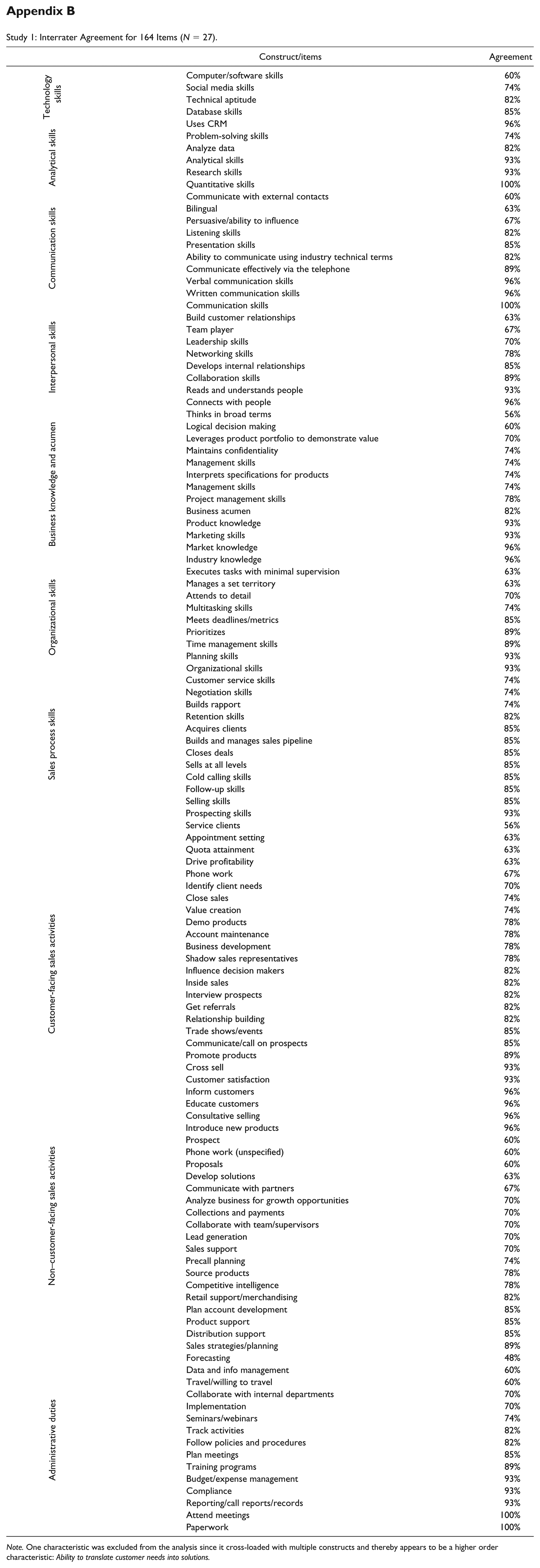
To create greater confidence in the second-level coding (higher order grouping), we engaged 24 other sales scholars in the higher order coding exercise. As a result, 27 sales scholars identified how they would group 164 sales characteristics into 11 higher order constructs: technology skills, analytical skills, communication skills, interpersonal skills, business knowledge and acumen, organizational skills, sales process skills, customer-facing sales activities, non–customer-facing sales activities, administrative duties, and personality/temperament. Interrater agreement for the 164 sales characteristics was 60% or higher for 97.6% of the characteristics. Only four characteristics failed to achieve the 60% agreement level (and one characteristic appears to operate as an even higher order construct). Table 1 contains a listing of the 11 constructs, the characteristic-level components, and the frequency with which they were observed across the sales job advertisements. Appendix B provides the detailed interrater agreement results.
Study 1: Constructs and Elements Identified in Sales Job Advertisements.
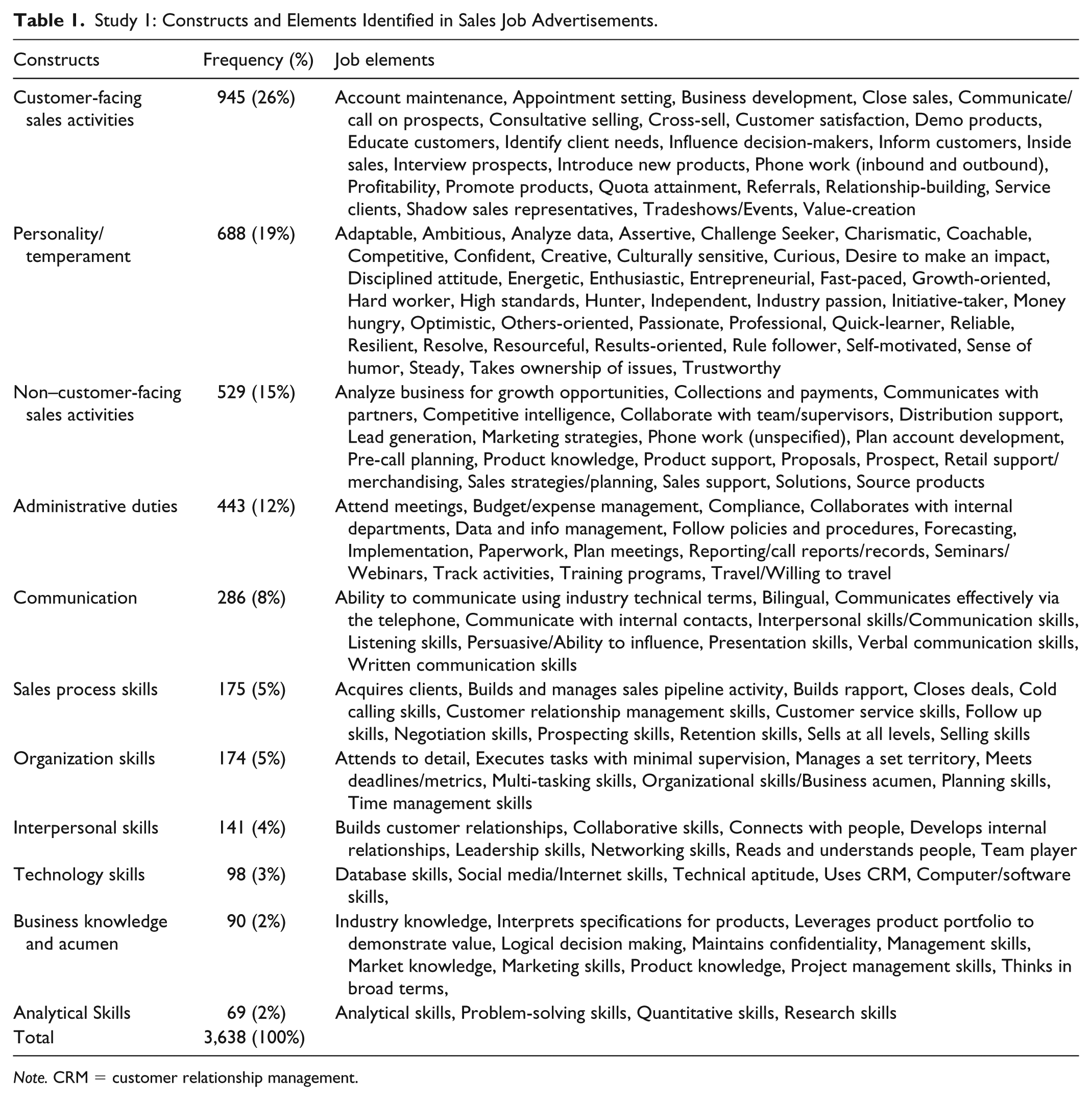
Note. CRM = customer relationship management.
Research Question 1: Analysis of Job Advertisements to Determine What Employers Are Seeking
Based on 245 job advertisements, we identified 3,638 job elements classified into the 11 constructs. Among the 11 constructs, job elements related to customer-facing sales activities appeared in the highest proportion, accounting for 26% of job elements, followed by personality accounting for 19%, and noncustomer–facing sales activities accounting for 15%.
We analyzed the 245 job advertisements to address Research Question 1 and the frequency with which the constructs were included in these entry-level sales job ads. Those frequencies are as follows: customer-facing sales activities (82%), personality/temperament (80%), administrative activities (77%), non–customer-facing activities (69%), communication-related skills (60%), organizational skills (43%), interpersonal skills (43%), sales skills (40%), technological skills (30%), business knowledge and acumen areas (25%), and analytical skills (23%).
We analyzed the frequencies across data sources (i.e., university or online sources) by conducting a series of chi-square difference tests (see Table 2). Job positions advertised via a university are more likely to list three sales process elements (customer-facing sales, non–customer-facing sales, and administration duties) and four required skill sets (communication, sales process skills, organizational skills and analytical skills) than job advertisements distributed through an online recruiting website. Consequently, the source of the advertisement introduces systematic differences in job ad content.
Chi-square Differences Across Data Sources and Cluster Means.
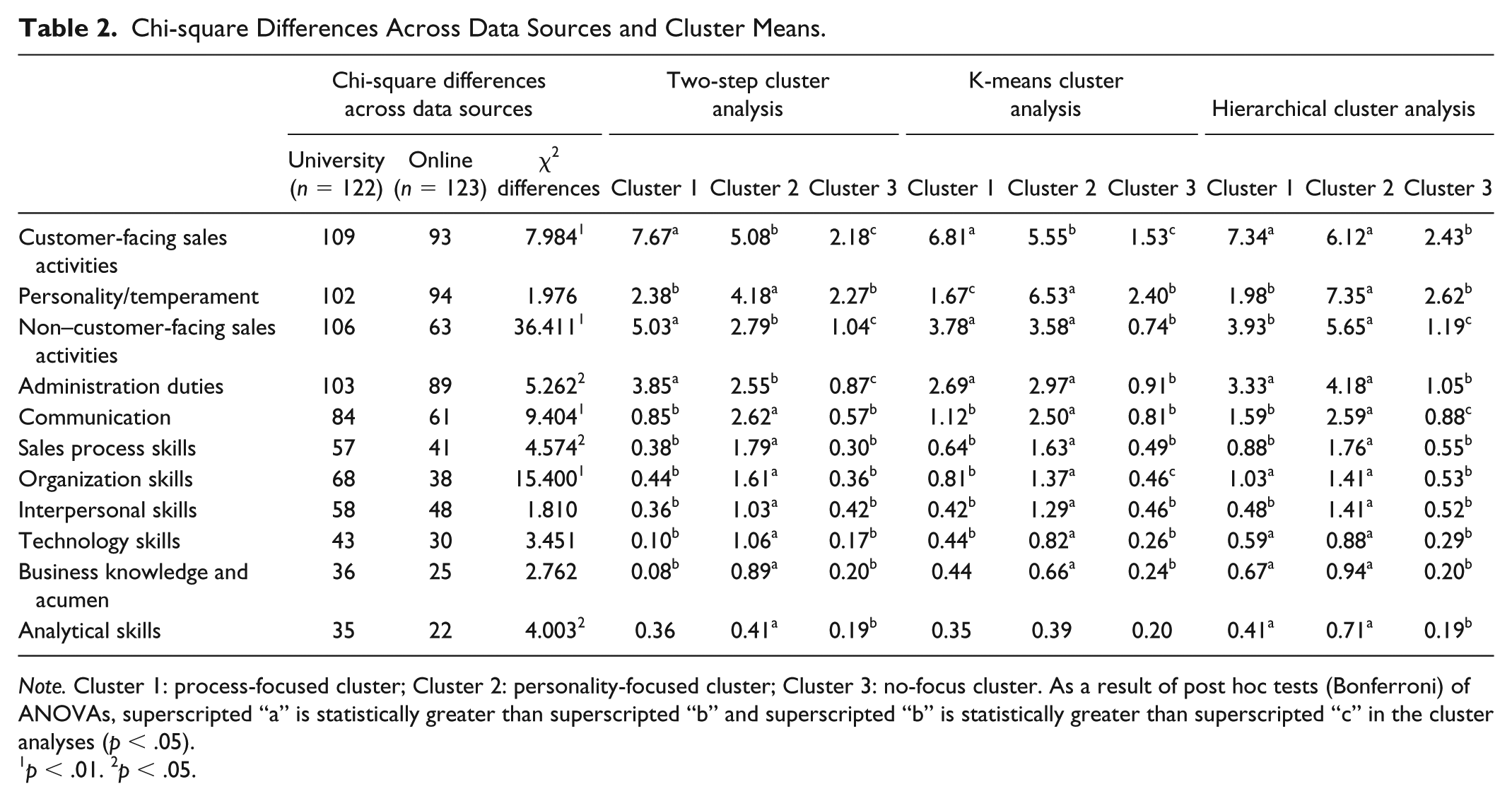
Note. Cluster 1: process-focused cluster; Cluster 2: personality-focused cluster; Cluster 3: no-focus cluster. As a result of post hoc tests (Bonferroni) of ANOVAs, superscripted “a” is statistically greater than superscripted “b” and superscripted “b” is statistically greater than superscripted “c” in the cluster analyses (p < .05).
p < .01. 2p < .05.
Research Question 2: Cluster Analysis of Job Advertisements to Determine Groupings of Advertisements
We conducted a two-step cluster analysis, useful when a predetermined number of groups (i.e., clusters) is not obvious. The initial analysis identified three clusters. To validate the structure and pattern of the clusters, we conducted K-means and hierarchical cluster analyses using between-groups linkages and squared Euclidean distance algorithms. Both cluster methods resulted in the three-cluster structure of job advertisements. Addressing Research Question 2, we find that the three types of sales job advertisement clusters are the following:
Cluster 1–Process-focused: These job advertisements include a preponderance of items concerning the sales process (e.g., customer-facing sales activities; non–customer-facing sales activities, and administrative duties).
Cluster 2–Personality-focused: These job advertisements comprise a preponderance of items concerning one’s personality and communication-related skills.
Cluster 3–No focus: These job advertisements include activities and skills with no particular emphasis. Relative to Clusters 1 and 2, Cluster 3 scores low across all elements. Sample ads for each cluster are reproduced in Appendix A.
To determine if the cluster patterns were consistent across the two data sources, we split the job advertisements into two groups: (1) university career services centers or sales programs and (2) online career search engines. We found three types of job advertisements regardless of the data source and clustering method.
Study 2: Research Hypotheses
With Study 1 identifying the skills and attributes sought for entry-level sales hires and three types of sales job advertisement clusters, we embarked on Study 2 to examine student reactions to entry-level sales job advertisements. Guiding the development of our framework, signaling theory presupposes a lack of information equilibrium between two actors or parties, the signaler and the receiver (Spence, 2002). The receiver (a party not employed by the firm) is interested in information about the firm but does not have access to it (Spence, 1974). The sender (i.e., the firm) signals or communicates some element of the firm to generate certain perceptions and prompt action. Hence, the goal of the signal is to communicate firm qualities and effectively influence the perception of those outside the firm (Spence, 2002).
Research applies signaling theory through the perspective of the job candidate, who utilizes the firm’s signals to develop an understanding of the firm (Rynes, Bretz, & Gerhart, 1991). Predominantly, candidates use job communication (i.e., job advertisements) to better understand the firm’s environment and culture (Turban, 2001). Such information assists candidates in understanding the organization because the candidates face difficulty in obtaining job- and organizational-based information without working within the firm (Rynes et al., 1991).
Because attracting qualified candidates for sales positions has been challenging (Davidson, 2013; Madigan, 2015; Manpower, 2018), understanding how the job ad affects entry-level candidates’ intent to apply is important. We argue that satisfaction with a job advertisement is an important link between perceived job ad credibility, as signaled by the employer, and job pursuit intentions. In the next section, we discuss the perceived job ad credibility construct in detail and present our hypotheses. Our conceptual model (Figure 1) incorporates management research (Branzei, Ursacki-Bryant, Vertinsky, & Zhang, 2004) that finds the characteristics of the individual(s) receiving the signal determine, to some extent, the signal’s efficacy. We also compare multiple segments of job candidates, primarily various groupings of undergraduate academic majors.
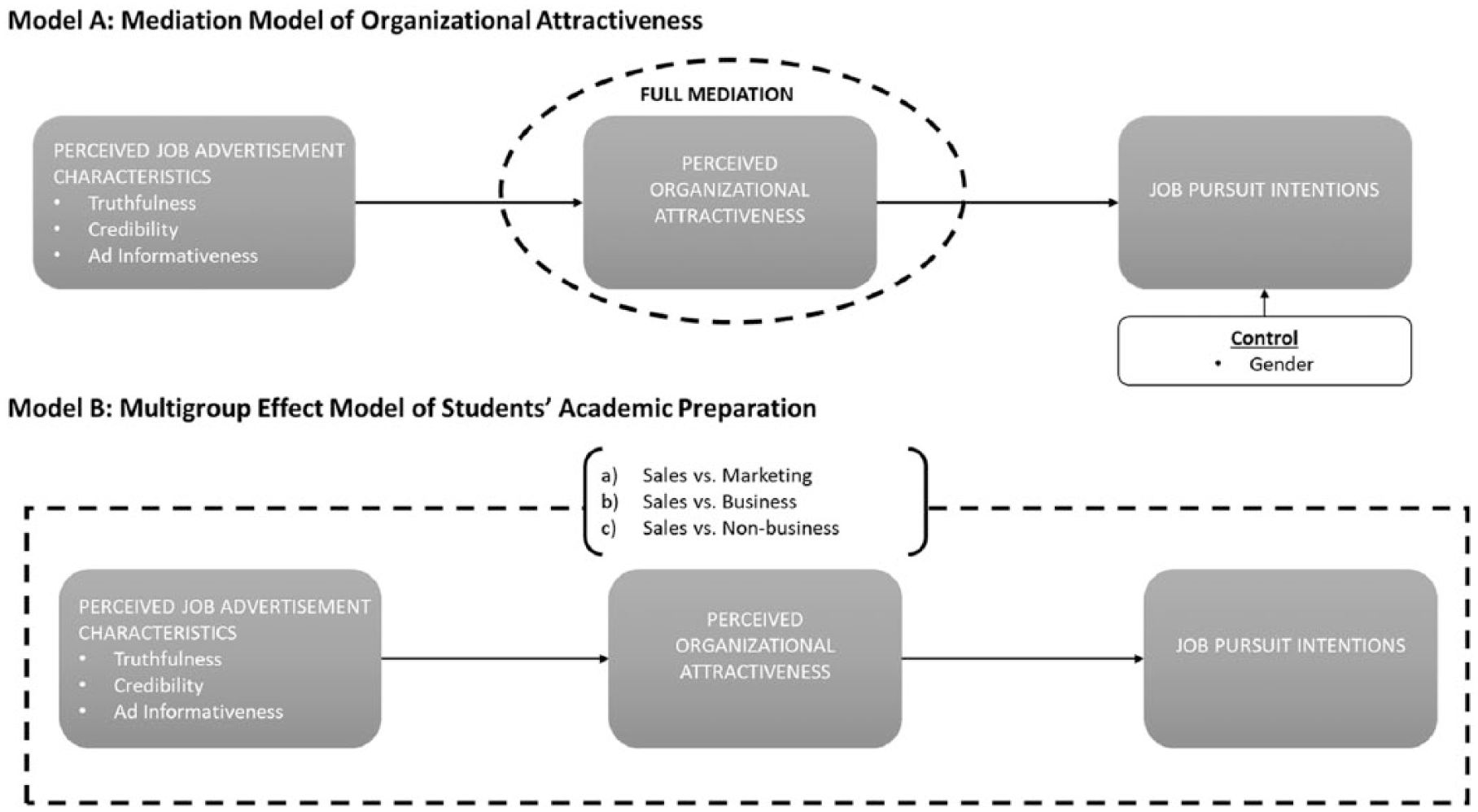
Conceptual framework.
Perceived Job Ad Credibility
Credibility perceptions are important cognitive responses to job advertisements and refer to “perceptions of the accuracy, appropriateness, and believability of the information source” (Allen, Van Scotter, & Otondo, 2004, p. 150). In the recruitment context, credibility is essential for applicants’ attitude development as it plays a role in enabling a relationship between recruiting activities and key outcomes (Breaugh & Starke, 2000).
Researchers define and operationalize credibility in many ways. In a meta-analytic study, Wilson and Sherrell (1993) define credibility as “a global evaluation of the believability of the message source” (p. 102), whereas MacKenzie and Lutz (1989) define ad credibility as the “extent to which the consumer perceives claims made about the brand in the ad to be truthful and believable” (p. 51). Similarly, scholars have recognized several components of credibility including perceived expertise, fairness, truthfulness, bias, accuracy, depth of information, prior knowledge, and message quality among others (Eastin, 2001; Gaziano & McGrath, 1986; Meyer, 1988). Notably, selection of the dimensions and associated items when measuring credibility for a given study depends on the context (e.g., specific vs. general), focus (e.g., source vs. stimuli), and response mechanism (receiver’s perspective vs. sources’ attributes; Acarlar & Bilgiç, 2013; Eastin, 2001).
The current study identifies dimensions in a sales-specific context, where the content’s credibility is captured from the receiver’s perspective. We align with previous research (Acarlar & Bilgiç, 2013; Barber & Roehling, 1993) and examine the text included within job advertisements. We argue that for selling-related job advertisements to affect satisfaction with a job advertisement, the job advertisement should convey information that reflects truthfulness, expertise, depth, and informativeness. We find support for our approach from related literature (i.e., Feldman, Bearden, & Hardesty, 2006; Hong, 2006). Specifically, in the original scale used by Hong (2006), the credibility of websites was conceptualized using five dimensions: fairness, depth, trustworthiness, goodwill, and expertise. However, the author found empirical support only for expertise and depth and, thus, considered these dimensions as the most critical. Keeping in mind that Hong’s exploration was in the context of websites, we further relied on a job advertisement study by Feldman et al. (2006) that measures truthfulness and informativeness as key aspects of job advertisements. Therefore, building on the marketing (Feldman et al., 2006) and recruitment (Hong, 2006) literature, we define job ad credibility as the extent to which the student perceives that claims made in the job ad reflect truthfulness, expertise, depth, and informativeness.
The perception of job advertisement truthfulness captures the degree to which the applicant believes that the information given in the advertisement is candid and sincere (Chan & McNeal, 2004). Under some circumstances, potential applicants perceive job advertisements as untruthful (Lee, Hwang, & Yeh, 2013) and, in turn, develop a negative perception regarding its credibility. The expertise aspect in the job advertisement captures whether the candidates perceive the company’s expertise and ethicalness from the ad (Wilson & Sherrell, 1993). Candidates’ positive perceptions regarding job advertisements’ portrayal of an expert organization strengthens the overall beliefs about the ad’s credibility.
The dimension of depth, in general, relates to the amount of information content in the job ad, and candidates’ positive perceptions of ad comprehensiveness contribute toward the overall credibility of the ad (Hong, 2006). Applicants are more likely to find a job advertisement credible if it contains a greater amount of information (Gatewood, Gowan, & Lautenschlager, 1993).
Finally, informativeness is defined as the extent to which the candidate perceives the ad as useful and helpful (Xu, Oh, & Teo, 2009). In the recruitment context, applicants interpret unfitting information in job ads as negligence on the part of the organization (Yüce & Highhouse, 1998). Therefore, to shape positive attitudes toward the credibility of job advertisement, contents should be perceived as informative (Feldman et al., 2006).
Satisfaction With a Job Advertisement: Mediating the Relationship Between Perceived Job Credibility and Job Pursuit Intentions
We define satisfaction with a job advertisement as an affective reaction to the job ad and the information provided in the ad. We argue that job ad credibility—as represented by the dimensions of truthfulness, expertise, depth, and informativeness—will affect potential applicants’ satisfaction with a job advertisement. In turn, we expect satisfaction with a job advertisement to affect job pursuit intentions, thereby proposing a mediating role for satisfaction with a job advertisement.
Previous research supports satisfaction with a job advertisement as mediating a relationship between job ad credibility and job pursuit intentions. First, consider the relationship between job ad credibility and satisfaction. In a study of recruitment communication media and the effects of different media types, Allen et al. (2004) found that more information provided in recruitment communication (e.g., depth) was linked with greater satisfaction with that communication. As noted by Acarlar and Bilgiç (2013), additional information provides richness to the job advertisement, increasing cues about the advertised role and firm. Similarly, in a verbal protocol analysis of job postings, Barber and Roehling (1993) learned that the amount of information provided on location and compensation generated more responses from study participants.
In a study exploring help wanted ads, Yüce and Highhouse (1998) found that the addition of information on relevant job attributes increased respondents’ positive perceptions regarding advertisements. Maurer, Howe, and Lee (1992) found that satisfaction with the recruitment process is related significantly to two things: interpersonal skills of the recruiter and the information provided on the role (compensation/benefits, job/career, and security/success). Feldman et al. (2006) highlight the importance of both informativeness and truthfulness in recruiting ads, and Lee et al. (2013) found that perceived truthfulness affected reactions to the job ad. Given these findings, we expect that a job ad demonstrating truthfulness, expertise, depth, and informativeness (job ad credibility) will affect satisfaction with a job advertisement significantly and positively.
We propose a link between satisfaction with a job advertisement and job pursuit intentions. Research demonstrates that the information provided in recruitment communication influences potential applicants’ attitudes toward a firm (e.g., satisfaction), as well as the likelihood of becoming an employee of that firm (e.g., job pursuit intentions; Allen et al., 2004; Popovich & Wanous, 1982). Other research found that satisfaction affected attraction to the organization, which, according to the authors, was expected to result in job applications (Acarlar & Bilgiç, 2013). In a study of publicity and recruitment ads, Lee et al. (2013) found that reaction to a job advertisement ultimately affected job pursuit intention. Thus, we expect a significant and positive relationship between satisfaction with a job advertisement and job pursuit intentions.
Since companies target broad audiences for recruitment, we explore whether student groups vary in their perceptions and responses to job advertisements. Obviously, students choosing to pursue a sales major are likely to view sales job advertisements more favorably than students pursuing other majors. Given the familial nature of sales and marketing, we propose that students choosing to pursue a marketing major are likely to view sales job advertisements more favorably than students pursuing other business majors or nonbusiness majors. Consequently, we propose the following:
Study 2: Methodology
In Study 2, we used an online survey to (1) test our conceptual model and (2) identify differences in responses across undergraduate majors to job advertisements. Our two-study method facilitates exploration of the chain of effects from both student and advertisement characteristics on intention to apply for a sales position.
We collected data at six universities (different locations and types) using a between-subjects design to examine whether job advertisements appeal differentially among candidates. This approach allows us to identify differences across undergraduate groups (sales students, marketing students, other business students, and nonbusiness students) in their assessments of job advertisements.
Survey Instrument
The survey comprised previously published scales using a 7-point Likert-type response format. Recall that we defined job ad credibility as consisting of four dimensions: truthfulness, expertise, depth, and informativeness. We adapted two existing scales (Feldman et al., 2006; Lee et al., 2013) to measure the truthfulness (α = .89). An adaptation of Acarlar and Bilgiç’s (2013) credibility of information measure, derived from Hong’s (2006) measure of website credibility, comprised three items for expertise (α = .71) and two items for depth (α = .74).
Our instrument included a four-item scale to measure ad informativeness (Feldman et al., 2006; α = .83). We adapted a five-item satisfaction scale (Allen et al., 2004; Downs & Hazen, 1977) to address satisfaction with a job advertisement (α = .93). Finally, we used a five-item scale to measure job pursuit intention (Feldman et al., 2006; α = .93). Tables 3 and 4 show scale items, sources, reliability estimates, correlations, means, and standard deviations.
Scale Items and Reliability Analysis.
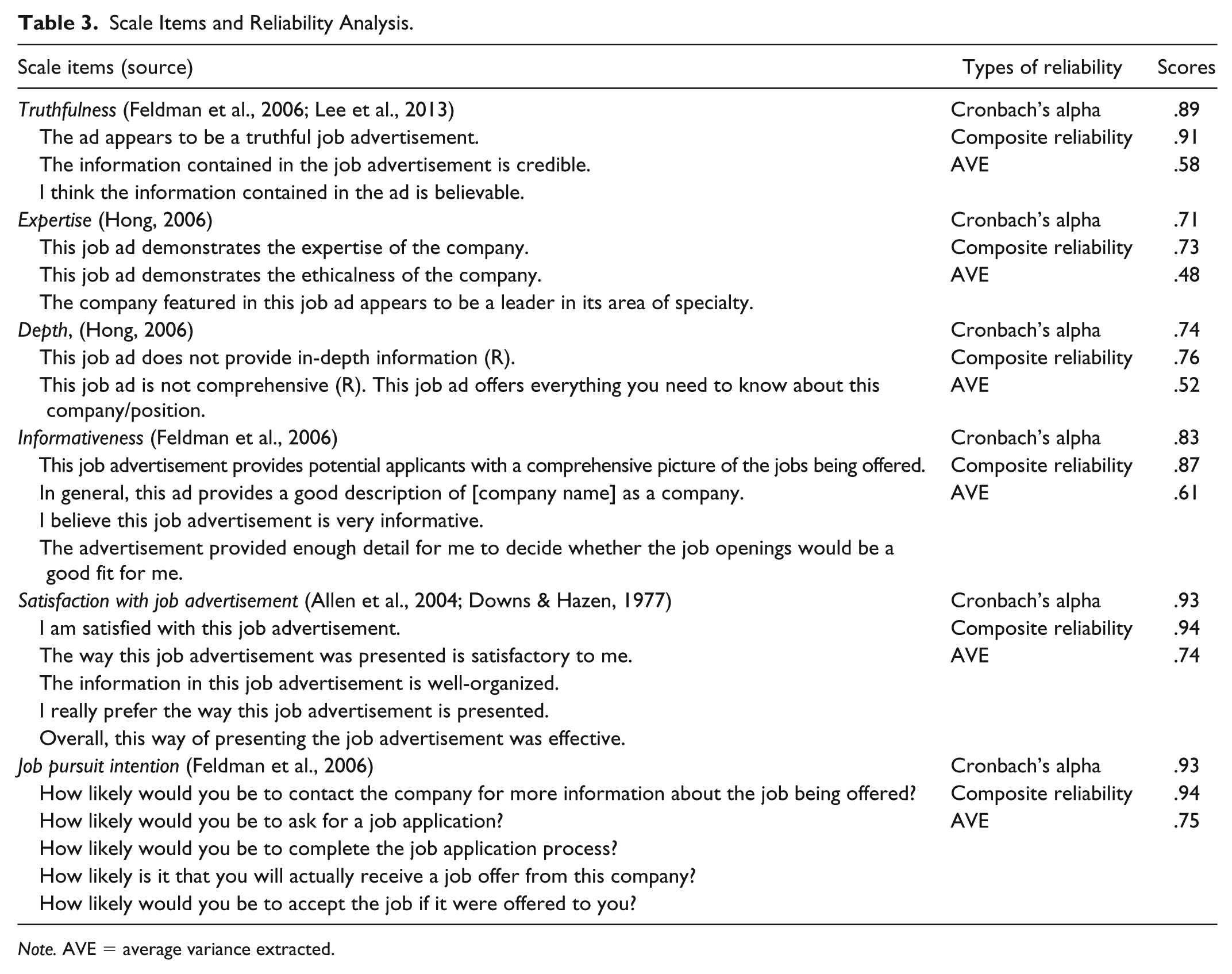
Note. AVE = average variance extracted.
Correlations, Means, and Standard Deviations.
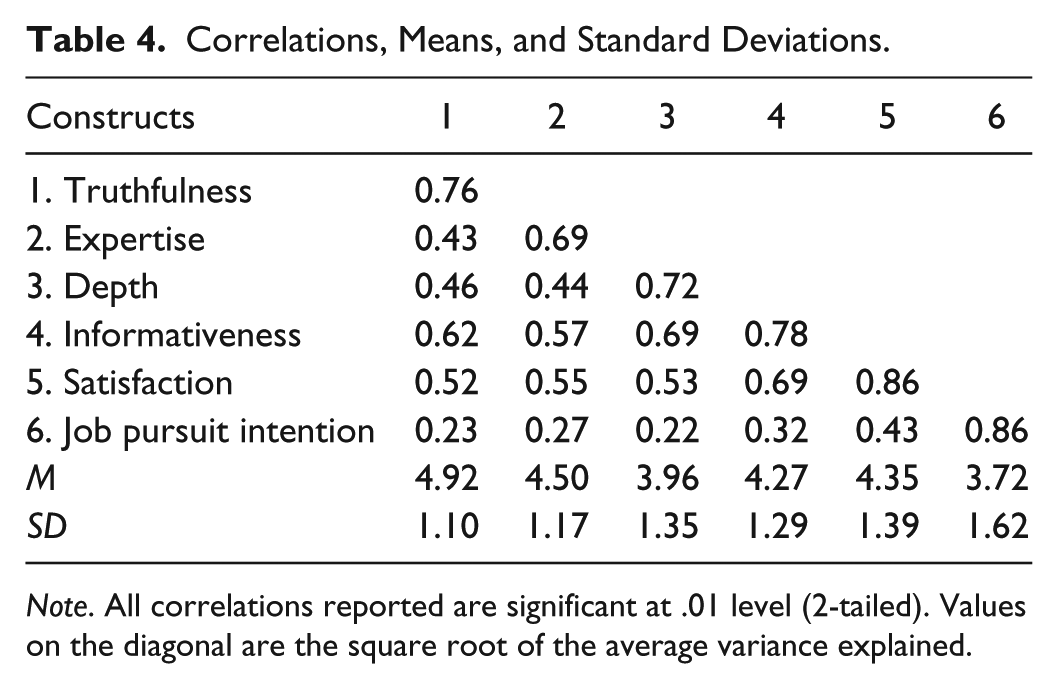
Note. All correlations reported are significant at .01 level (2-tailed). Values on the diagonal are the square root of the average variance explained.
Data Collection
To examine how job ad characteristics may influence differentially, we selected nine advertisements from our random sample of 100 advertisements: three process-focused, three personality-focused, and three no-focus advertisements. Each ad showed the most similar pattern to the means of the 11 constructs for each cluster. We conducted a pretest with a sample of 33 undergraduate students to ensure content validity and question clarity; feedback suggested that all items were clear and well understood. Next, we randomized the advertising stimuli allowing each respondent to review one advertisement while completing the survey.
Across six universities located in five states within the United States, we distributed the survey among four groups of undergraduate students who completed a minimum of 60 credit hours. The four groups included the following: (1) sales, (2) marketing (non-sales), (3) business (non-sales and non-marketing), and (4) non-business students. We collected a total of 912 responses: 50.9% males and 25.2% sales, 18.9% marketing, 38.3% business (non-sales and non-marketing), and 17.7% non-business students. Age ranges included 72.2% age 21 or under, 21.4% age 22 to 23, and 6.5% age 24+.
Measurement Quality
To assess construct validity, we utilized a two-step analytical approach (Gerbing & Anderson, 1988). First, we conducted a confirmatory factor analysis (CFA) to assess the measures using Mplus V7.4. The CFA results suggested an adequate model fit: chi square (χ2) = 1253.886, degrees of freedom (df) = 225, nonnormed fit index (NNFI) = 0.924, comparative fit index (CFI; Bentler, 1990) = 0.932.
We assessed discriminant validity in several ways. First, we developed CFA models in which covariance coefficients of every possible construct pair were allowed to vary. We ran a second model in which pairs of constructs were fixed at unity (Anderson & Gerbing, 1988). The results show that the unitary model demonstrates significantly lower level of model fit than the freely covarying model, providing evidence of discriminant validity. Second, we computed the average variance extracted (AVE) and composite reliability (CR) for each construct. Examining the AVE with the squared factor intercorrelations, we found that the construct AVEs were greater than the squared factor correlations (Fornell & Larcker, 1981) for all intercorrelations. Based on the multiple analyses, there is adequate evidence of discriminant validity for these already validated scales.
Common Method Variance
To examine whether common method variance influenced the constructs, we added a marker variable (Williams, Hartman, & Cavazotte, 2010), which is a construct not theoretically related to the study questions (Lindell & Whitney, 2001). We included the brand consciousness scale (Shim & Gehrt, 1996) in the structural model and related it to the endogenous constructs. We followed Williams et al.’s (2010) Comprehensive CFA Marker Technique approach and concluded that our structural model was not influenced by common method bias. Measurement details are found in Appendix C.
Study 2: Results
Main Mediation Model (Model A)
Testing our conceptual model via a structural equation modeling suggests good model fit (χ2/df = 1271.122/246, NNFI = 0.924, CFI = 0.932). We present the analytical results of our model tests in Table 5. For Hypothesis 1, we posited that perceived job ad credibility (truthfulness, expertise, depth, and informativeness) positively relates to satisfaction with a job advertisement (β = 0.832, p < .01), supporting Hypothesis 1. For Hypothesis 2, we have a statistically significant coefficient between satisfaction with a job advertisement and job pursuit intention, supporting Hypothesis 2 (β = 0.447, p < .01). In terms of a control variable, we found gender to be statistically significant in its relationship to job pursuit intention (β = −0.097, p < .01), but not to satisfaction with a job advertisement (β = −0.032, p > .05), suggesting that male students have higher job pursuit intention (than their female counterparts) but they do not report significantly different satisfaction with a job advertisement.
Results of Main Model Analysis. a

Model fit: χ2 = 1271.122; df = 246; nonnormed fit index = 0.924; comparative fit index = 0.932; root mean square error of approximation = 0.068; 90% confidence interval [0.064-0.071].
We conducted a bootstrapping method (Zhao, Lynch, & Chen, 2010) to test the mediating role of satisfaction with a job advertisement, specifically testing for the indirect effect from perceived job ad credibility to job pursuit intention through satisfaction with a job advertisement. After drawing 10,000 samples, a bias-corrected bootstrapping test (Hayes & Scharkow, 2013) revealed that the effect of perceived job ad credibility on job pursuit intention was fully mediated by satisfaction with a job advertisement (standardized indirect effect = 0.372). The 95% confidence interval between 0.255 and 0.502 does not include 0. Regardless of the student’s area of study or major, we found consistent results.
Multigroup Effect Model of Students’ Academic Majors (Model B)
To test whether student groups respond differently to job advertisements, we used a three-step process of multigroup analysis (Steenkamp & Baumgartner, 1998). Before testing for latent mean differences by student major, we tested for measurement invariance by student major. Our test for configural invariance holds, indicating that different major groups have the same factor structure (χ2 = 840.050, df = 386, NNFI = 0.953, CFI =0.957). Regardless of student major, students perceive the constructs in the same way. Second, our test for metric invariance shows that factor loadings are equal across groups (χ2 = 980.758, df = 422, NNFI = 0.948, CFI = 0.947). Third, scalar invariance tests show that the different major groups have the same item intercepts as well as the same factor loadings (χ2 = 933.111, df = 412, NNFI = 0.950, CFI = 0.951; see Table 6).
Fit Statistics for Measurement Invariance.

Note. NNFI = nonnormed fit index; CFI = comparative fit index; RMSEA = root mean square error of approximation.
p < .01.
The chi-square difference between the nested configural (M1) and metric (M2) models and between the nested configural (M1) and the scalar (M3) models are both significant, but the chi-square difference tests have limitations due to large samples, such that a very trivial difference can yield significant test results (Bentler & Bonett, 1980; Milfont & Fischer, 2010). To address these issues, Cheung and Rensvold (2002) and Chen (2007) suggest comparing the models by using fit statistics, proposing ΔCFI ⩽ 0.01 and ΔRMSEA < 0.015 as the cut points for measurement invariances. In the results of our model, the difference in CFI between M1 and M2 is −0.010, and the difference in RMSEA between M1 and M2 is 0.005; and the difference in CFI between M1 and M3 is −0.006, and the difference in RMSEA between M1 and M3 is 0.003. Thus, measurement invariance holds, allowing for meaningful comparisons across groups.
To determine whether student groups have different perceptions of job advertisement credibility, satisfaction with a job advertisement, and job pursuit intentions, we compared the latent means across academic majors holding scalar invariance. We estimated the latent means as the difference from the baseline group, so the pair of two groups show slightly different estimated latent means depending on which group is the baseline. To obtain all possible pairs of two groups, we obtained the estimated latent means using each major as a baseline. As presented in Table 7, marketing students register lower levels of job ad credibility and satisfaction with a job advertisement than sales and other business students (indicating lack of support for Hypotheses 3b and 3c). And, not surprisingly, sales students showed the highest job pursuit intention (support for Hypothesis 3a), followed by marketing and other business students; nonbusiness students reported lowest job pursuit intentions (support for Hypothesis 3b and partial support for Hypothesis 3c).
Estimated Latent Mean Differences Across Academic Preparations.

p < .01. bp < .05.
To compare the standardized construct path coefficients across four majors, we conducted a series of chi-square difference tests finding insignificant results in most comparisons (except for a couple). These results indicate that—regardless of major—perceived job ad credibility positively influences job pursuit intentions, and the relationship is fully mediated by satisfaction with a job advertisement for all four major groups (see Table 8).
Result of Multigroup Analyses Across Academic Preparations a .
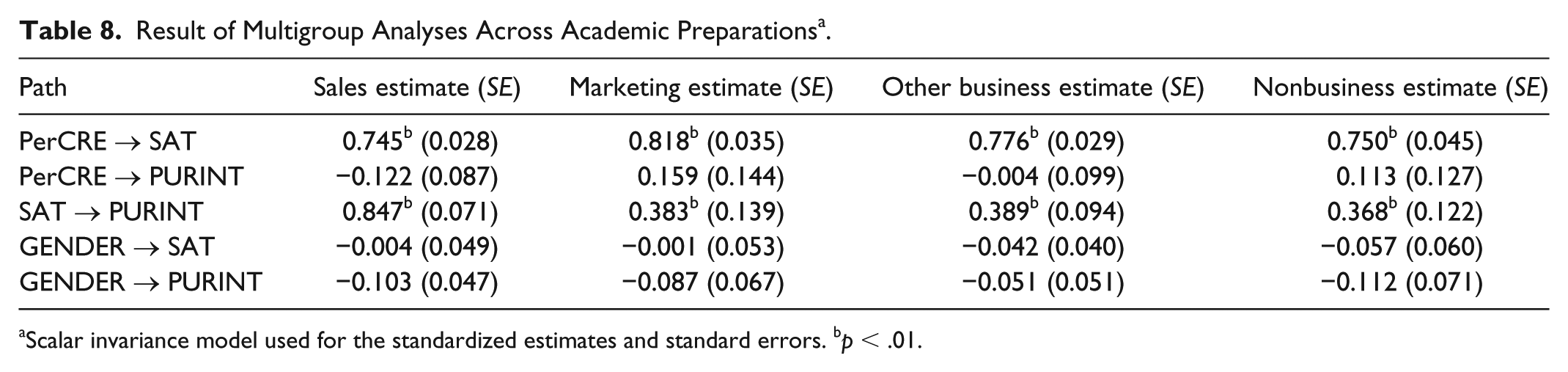
Scalar invariance model used for the standardized estimates and standard errors. bp < .01.
Post Hoc Test-Multigroup Effect Model: Job Ad Cluster (Model C)
Figure 2 presents the modeling framework for the Models C and D that we developed for the post hoc tests. To investigate whether the latent means of constructs vary across job ad clusters, we compared the configural (M1) and metric (M2) models, and the metric (M2) and scalar (M3) models. We conclude that measurement invariance holds, as shown in Table 6. To determine if latent means differed across job advertisement clusters, we estimated the latent means of the constructs using each job ad cluster as a baseline. As shown in Table 9, the job ad clusters present different levels of perceived job ad credibility. Respondents perceive the no-focus cluster of advertisements as having the lowest job ad credibility—least truthful, least expert, least in-depth, and least informative than a focus cluster of advertisements (process-focused or personality-focused). Ads in the personality-focused cluster were perceived as having the highest satisfaction with a job advertisement among three job ad clusters, followed by process-focused cluster and the no-focus cluster. Interestingly, we find no statistically significant difference in the levels of job pursuit intention across the job advertisement clusters. This finding encouraged us to further our post hoc analysis involving majors across job ad clusters. Aligning with the notion that students may respond differently to entry-level sales job advertisements based on their major and job advertisement type, next, we take both into consideration.

Model framework for post hoc test.
Estimated Latent Mean Differences Across Job Ad Clusters.
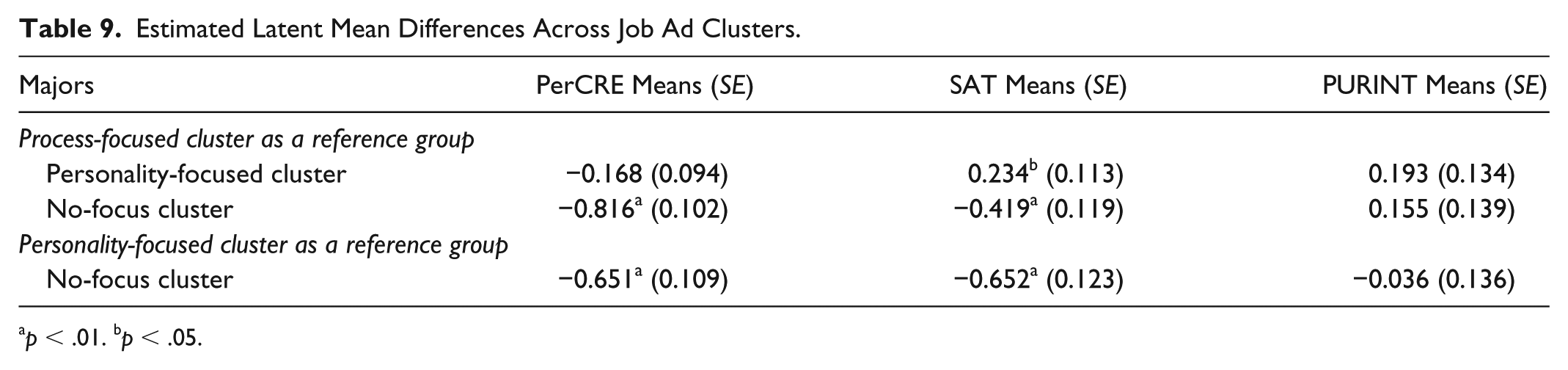
p < .01. bp < .05.
Post Hoc Test-Multigroup Effect Model: Major Across Job Ad Clusters (Model D)
To investigate whether the latent construct means among job ad clusters may be statistically different across the academic majors, we split the data into academic majors. For each cluster, we conducted a measurement invariance test and concluded that the measurement invariance holds (see Table 10). To determine whether latent construct means across job ad clusters are consistent across majors, we estimated latent means using each job ad cluster as a baseline (see Table 11). All majors perceive the no-focus cluster of advertisements as having the lower job ad credibility–less truthful, less expert, less in-depth, and less informative than a focus cluster of advertisements (process-focused or personality-focused). Except marketing students, other majors’ perceptions of job advertisement credibility for process-focused job advertisements are not statistically different from the ones for personality-focused job advertisements. For marketing students, they perceive process-focused job advertisements as having the highest job ad credibility—most truthful, most expert, most in-depth, and most informative among the three clusters of job advertisements. In terms of satisfaction with job advertisement, students (except nonbusiness students) show the same level of satisfaction between process- and personality-focused. Nonbusiness students report higher satisfaction for personality- over process-focused job advertisements.
Fit Statistics for Measurement Invariance for Four Academic Preparations.
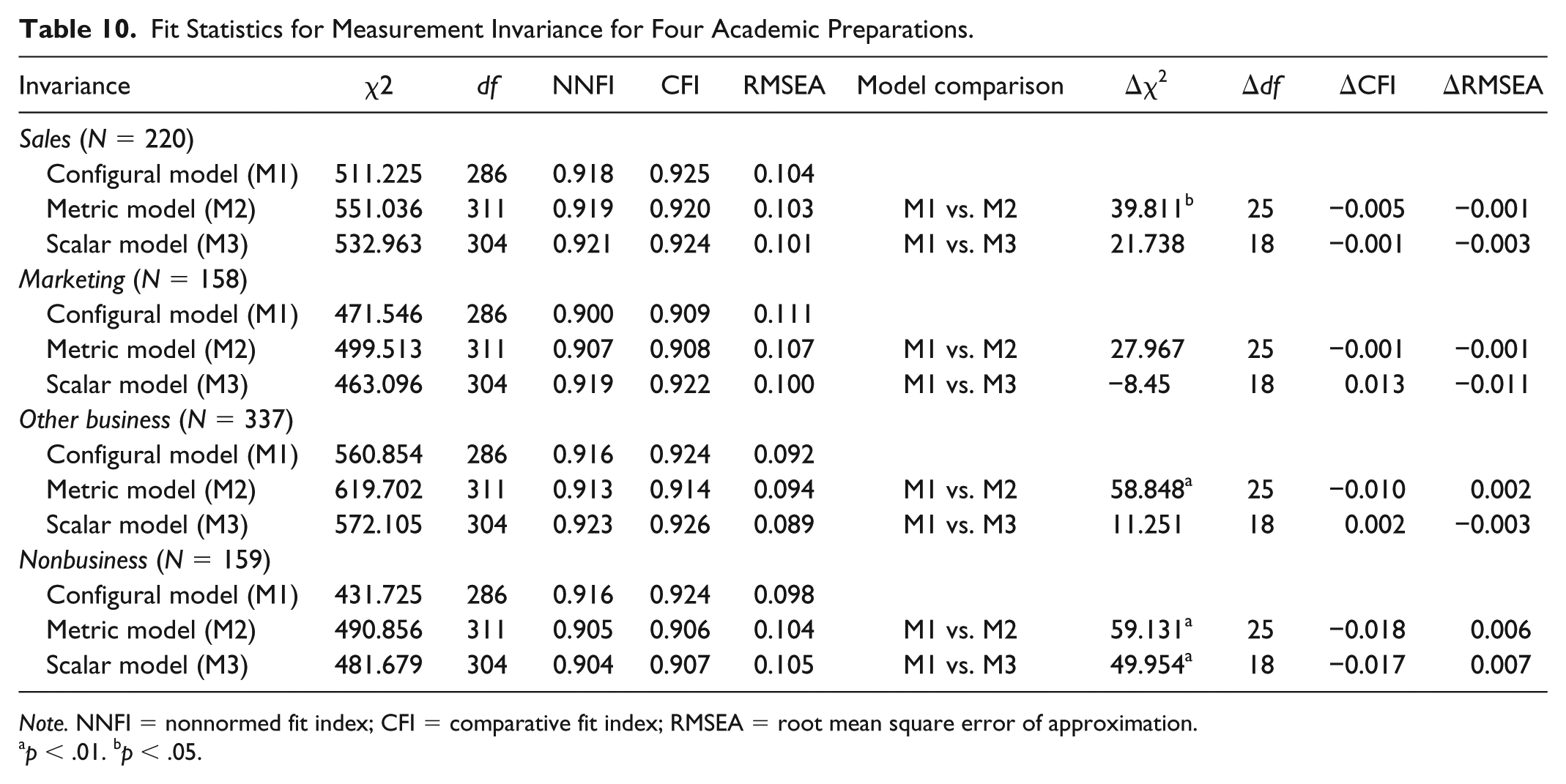
Note. NNFI = nonnormed fit index; CFI = comparative fit index; RMSEA = root mean square error of approximation.
p < .01. bp < .05.
Estimated Latent Mean Differences (SE) Across Academic Preparations.
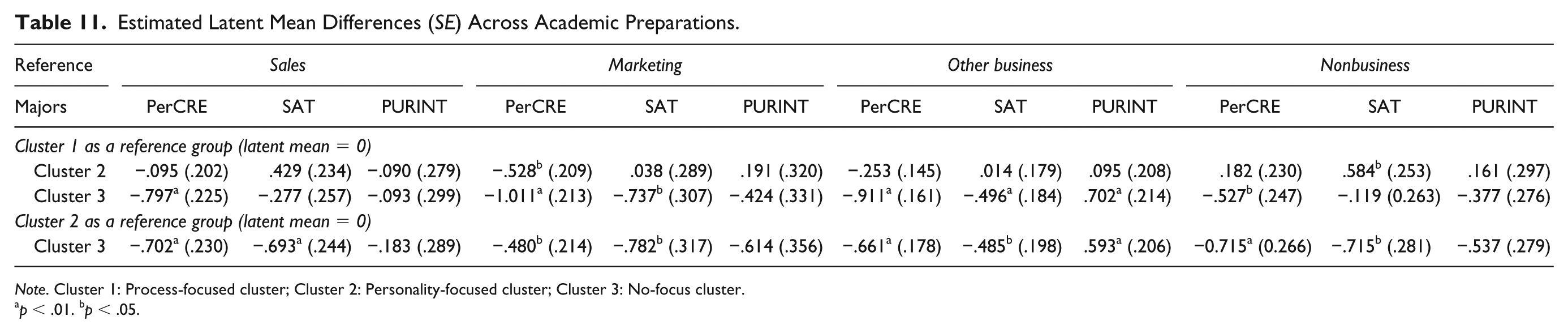
Note. Cluster 1: Process-focused cluster; Cluster 2: Personality-focused cluster; Cluster 3: No-focus cluster.
p < .01. bp < .05.
General Discussion
Recruiting and retaining high-quality salespeople is an important issue among sales practitioners and academic researchers. Academics must prepare students with these skill sets and help facilitate successful placement. Our study contributes to the literature by identifying key skill sets demanded by sales employers and in understanding student perceptions of sales job advertisements. For the first goal, we used a randomly selected sample of 245 sales job advertisements from secondary data sources, which allowed us to identify 164 sales characteristics, which we mapped into 11 constructs. We identified the frequency of required behaviors included in the job advertisements and classified the advertisements into three clusters: process-focused, personality-focused, and no-focus.
In the second study, we drew on signaling theory to understand how job candidates perceive signals communicated through job advertisements. We proposed the hypotheses that the four dimensions of job ad credibility (truthfulness, expertise, depth, and informativeness) positively influence satisfaction with a job advertisement, which, in turn, results in higher intention to apply for the job. We found support for both hypotheses. It is also important to understand which student populations will be most open to these opportunities, and how educators can help expose students to them. To explore if the effects are different across majors and types of job ad clusters, we conducted a series of multigroup analyses. We found a full mediating effect of satisfaction with a job advertisement in the link between perceived job ad credibility and job pursuit intention regardless of majors and types of job ad clusters; however, the latent means of the constructs are different across majors and ad clusters, arguing that students respond differently to entry-level sales job advertisements based on student major and job advertisement type.
Not surprisingly, sales students showed the highest job pursuit intention, followed by marketing and other business students, with nonbusiness students showing the lowest job pursuit intention. Again, not surprisingly, students reported higher level of job advertisement credibility when they saw a focused job advertisement (process-focused or personality-focused) than a no-focus advertisement. An interesting difference is that marketing students perceive job advertisement credibility higher for process-focused advertisements than for personality-focused job advertisements, suggesting that marketing majors identify more with the sales process than what might be deemed a sales personality. If employers are seeking to broaden their talent pool beyond the students in a sales major, the next most likely target is marketing majors. Our research shows that employers will be more productive in targeting both sales and marketing majors by employing job recruitment advertisements that are process- rather than personality-focused.
Academic Contributions
Our work contributes to academic thought in several ways. First, we identify the skills employers are seeking from entry-level sales candidates as they telegraph their needs via job recruitment advertising. While earlier research addressed behaviors that current sales job holders engaged in, no other work has identified the behaviors in demand by employers seeking sales hires. These skills formed the basis of the ad clusters we identified—process-focus, personality-focus, and no-focus—which provide insight into three approaches used by firms to attract entry-level candidates to sales positions. Identification of these advertising approaches enriches our understanding of which behaviors are most in demand by employers and how they are conveyed in sales job advertisements.
Second, our research provides empirical insight into a relevant sales quandary: attracting entry-level sales candidates. Our findings argue that job advertisement credibility shapes candidate satisfaction with a job advertisement. In turn, satisfaction with the job ad affects candidates’ intentions to pursue a position, suggesting that the credibility of the job advertisement itself does not directly affect intention to pursue a position. Instead, the ad credibility influences satisfaction with a job advertisement. This contribution provides insight into the chain of effects from advertisement credibility to the intention to apply for a sales position and supports the use of signaling theory in the sales recruitment context.
Third, our research appears to be the first to examine whether job advertisements appeal differentially to students, depending on their major. We found that process-focused and personality-focused job advertisements tend to enhance the perception of the sales process and personality-related characteristics of the job. The process-focused job advertisements appear to be an effective approach to enhance credibility perceptions among marketing students. It appears that marketing majors identify more with the sales process than what might be deemed a sales personality. Considering that marketing students perceive sales job advertisements as having less credibility than do sales students, this nuanced understanding is important because firms often recruit across many majors within a university (Bristow, Gulati, & Amyx, 2006; Gurvis, 2000), and marketing majors are often one of the highly targeted majors for sales positions. Yet despite the broad audience targeted for sales recruitment, no work has considered how academic major groups vary in their response to job advertisements. We introduce an important variable in understanding how job ads affect recruiting success.
Our results provide greater understanding regarding entry-level sales roles. By analyzing the skills and traits valued by firms and communicated to potential job candidates in both manufacturing and service sectors, we provide greater insight into entry-level sales positions. To the best of our knowledge, no one has undertaken research that identifies whether sales skills or personality traits are valued in new sales hires. Furthermore, most existing taxonomies are grounded in the industrial sector. The most recent taxonomy (Moncrief et al., 2006) is based solely on sales roles held by existing and experienced sales representatives in a manufacturing environment. Hence, our research provides insight into the sales roles for entry-level candidates by examining job advertisements directed at them in both service and industrial contexts.
Finally, our study provides an important contribution toward academic preparation and curriculum development. Sales education is growing within the higher education landscape (see the 2014 special issue of the Journal of Marketing Education), and a greater understanding of entry-level positions is critical toward ensuring sales education prepares students for the marketplace. First and foremost, sales educators need to understand required competencies. Educators can learn much, particularly, from the advertisements that provide process-focused job descriptions. Curriculum should align with what sales recruiters seek. Educators must provide full process understanding to sales and non-sales students to facilitate a better understanding of the sales position. By examining job advertisements and the skills communicated, we provide academicians with guidance regarding the skills deemed valuable by employers. Furthermore, by understanding how different student groups react to the various type of marketing advertisements regarding sales positions, we are facilitating student-employer relationship development and perhaps beginning to open up the opportunities to student groups beyond those explicitly seeking sales majors. This article helps provide guidance to educators across a variety of disciplines in how to talk about and direct students to attractive selling opportunities.
Managerial Contribution
Our findings demonstrate that perceived job advertisement credibility (i.e., perceptions of truthfulness, expertise, depth, and informativeness) affect job pursuit intentions indirectly through satisfaction with a job advertisement. Recruiting firms should consider perceptions of the advertisement’s truthfulness, expertise, depth, and informativeness when developing copy. In general, students perceive higher credibility and satisfaction with a job advertisement when they see a focused job advertisement (process-focused or personality-focused) than no-focus job advertisement. Job duties, skill sets, and personality traits should be prioritized and communicated clearly. Importantly, the human resources and sales functions may be required to collaborate in order to ensure that the job advertisements reinforce key elements and skills that increase the desirability of the firm and the positioning of the job to potential candidates.
Our results provide insight into how four important groups perceive job advertisements for sales positions and suggest that students from different majors perceive sales job ads differently. As such, the job ads currently used by some firms may not be attracting the desired candidates. Firms recruiting entry-level salespeople on college campuses should carefully consider the desired audience when developing job advertisements. Our research suggests that a targeted approach is warranted.
Organizations seeking to improve response rates of marketing students to job advertisements should consider using a sales process–focused approach to improve perceived job ad credibility and improve job pursuit intentions. However, if the goal is to attract nonbusiness students, firms are better off focusing on personality-related than sales process–related content.
Not surprisingly, students enrolled in university sales programs have the highest intent to pursue a position in sales. This finding argues that companies should pursue avenues to reach sales students. Most sales programs offer opportunities for partnerships that include recruiting benefits. Sales career fairs attended by sales students might be a more efficient and effective recruiting opportunity, as opposed to all-university career fairs targeting the masses. Regional and national university sales competitions include opportunities for students to interact with recruiting firms. Interested organizations can look to two organizations for more information. The University Sales Center Alliance (www.universitysalescenteralliance.org) comprises member universities devoted to preparing students for careers in sales (Deeter-Schmelz & Loe, 2016). The Sales Education Foundation (2017; www.salesfoundation.org) publishes an annual directory on the top universities in sales. Both organizations provide contact information on individual sales programs useful for recruiters seeking to connect with sales students.
Conclusions and Future Research
The purpose of this study was to understand the type and effectiveness of job advertisements across university student groups. Our findings add to the academic literature and offer clear direction for recruiters seeking to hire entry-level sales talent. Although this study is an important first step, more research is required to build on our base of knowledge. Future research should examine the types of job advertisements identified in this research—process-focused, personality-focused, and no-focus—to provide confirmation and additional tests of their effectiveness. Additionally, future research should investigate the perceptions of student groups. Do other related variables play a role in job pursuit intention? Future research should also investigate whether student perceptions vary as they progress toward graduation and employment. Finally, we have explored entry-level job advertisements, but recruiting occurs at all levels. How do our findings change when recruiting experienced salespeople? This additional research will further enhance our understanding of sales talent recruitment.
Footnotes
Appendix C
Appendix A
Sample Sales Job Advertisements.

| Job ad details | Sample ad 1: Process-focused | Sample ad 2: Personality-focused | Sample ad 3: No focus |
|---|---|---|---|
| Advertisement source | University sales program | Monster.com | Careerbuilder.com |
| Industry | Software development | Business services | Telecommunications |
| Job location | Texas | New York | Pennsylvania |
| Required degrees/skills/characteristics | • Ability to work in a corporate setting • Experience with Microsoft Office Suite—Word, Excel, and Outlook • Ability to learn quickly |
• Must be a self-starter with good time management skills • Ability to build strong customer relationships • Enjoys being around people and displays a positive attitude • Must be a hard worker who is motivated by success • Excellent oral and written communication skills |
• 4-Year degree • Individuals from service industries (food service or hospitality) looking for career growth • Individuals with a sports or military background • Individuals looking for performance-based growth instead of seniority • Graduates with a BS in business management, marketing, or communications |
| Desired degrees/skills/characteristics | We are looking for dynamic individuals for this Inside Sales Manager Trainee position who are driven to be successful and looking for a career in sales. We are primarily seeking college graduates, people seeking new opportunities, and people looking to gain experience. | ||
| Job description | • Develop and execute a cold calling strategy to target prospects |
As an Inside Sales Manager Trainee, you will participate in in-person sales with customers. Sales management trainees will be cross-trained in promotional sales events, direct sales techniques, customer service, leadership skills, and in classroom training of products. Inside sales management trainees will have travel and networking opportunities. All inside sales management trainees receive a full, hands-on training with the top leaders in our company. | If you are looking to begin your first career in sales and marketing or transition from another industry into the sales and marketing field, our entry-level account representative position is the perfect fit. All of our sales and marketing representatives receive full training in their new position. This training includes, but is not limited to, in-house classroom-style training, hands-on field training, and continued support and coaching from peers and management throughout their career. As [Company] continues to expand its sales and marketing division, new account management positions have been created. |
| Compensation/benefits | [Company] offers outstanding earning potential and excellent benefits, which include the following: |
• Performance-based promotions |
Appendix B
Study 1: Interrater Agreement for 164 Items (N = 27).
| Construct/items | Agreement | |
|---|---|---|
| Technology skills | Computer/software skills | 60% |
| Social media skills | 74% | |
| Technical aptitude | 82% | |
| Database skills | 85% | |
| Uses CRM | 96% | |
| Analytical skills | Problem-solving skills | 74% |
| Analyze data | 82% | |
| Analytical skills | 93% | |
| Research skills | 93% | |
| Quantitative skills | 100% | |
| Communication skills | Communicate with external contacts | 60% |
| Bilingual | 63% | |
| Persuasive/ability to influence | 67% | |
| Listening skills | 82% | |
| Presentation skills | 85% | |
| Ability to communicate using industry technical terms | 82% | |
| Communicate effectively via the telephone | 89% | |
| Verbal communication skills | 96% | |
| Written communication skills | 96% | |
| Communication skills | 100% | |
| Interpersonal skills | Build customer relationships | 63% |
| Team player | 67% | |
| Leadership skills | 70% | |
| Networking skills | 78% | |
| Develops internal relationships | 85% | |
| Collaboration skills | 89% | |
| Reads and understands people | 93% | |
| Connects with people | 96% | |
| Business knowledge and acumen | Thinks in broad terms | 56% |
| Logical decision making | 60% | |
| Leverages product portfolio to demonstrate value | 70% | |
| Maintains confidentiality | 74% | |
| Management skills | 74% | |
| Interprets specifications for products | 74% | |
| Management skills | 74% | |
| Project management skills | 78% | |
| Business acumen | 82% | |
| Product knowledge | 93% | |
| Marketing skills | 93% | |
| Market knowledge | 96% | |
| Industry knowledge | 96% | |
| Organizational skills | Executes tasks with minimal supervision | 63% |
| Manages a set territory | 63% | |
| Attends to detail | 70% | |
| Multitasking skills | 74% | |
| Meets deadlines/metrics | 85% | |
| Prioritizes | 89% | |
| Time management skills | 89% | |
| Planning skills | 93% | |
| Organizational skills | 93% | |
| Sales process skills | Customer service skills | 74% |
| Negotiation skills | 74% | |
| Builds rapport | 74% | |
| Retention skills | 82% | |
| Acquires clients | 85% | |
| Builds and manages sales pipeline | 85% | |
| Closes deals | 85% | |
| Sells at all levels | 85% | |
| Cold calling skills | 85% | |
| Follow-up skills | 85% | |
| Selling skills | 85% | |
| Prospecting skills | 93% | |
| Customer-facing sales activities | Service clients | 56% |
| Appointment setting | 63% | |
| Quota attainment | 63% | |
| Drive profitability | 63% | |
| Phone work | 67% | |
| Identify client needs | 70% | |
| Close sales | 74% | |
| Value creation | 74% | |
| Demo products | 78% | |
| Account maintenance | 78% | |
| Business development | 78% | |
| Shadow sales representatives | 78% | |
| Influence decision makers | 82% | |
| Inside sales | 82% | |
| Interview prospects | 82% | |
| Get referrals | 82% | |
| Relationship building | 82% | |
| Trade shows/events | 85% | |
| Communicate/call on prospects | 85% | |
| Promote products | 89% | |
| Cross sell | 93% | |
| Customer satisfaction | 93% | |
| Inform customers | 96% | |
| Educate customers | 96% | |
| Consultative selling | 96% | |
| Introduce new products | 96% | |
| Non–customer-facing sales activities | Prospect | 60% |
| Phone work (unspecified) | 60% | |
| Proposals | 60% | |
| Develop solutions | 63% | |
| Communicate with partners | 67% | |
| Analyze business for growth opportunities | 70% | |
| Collections and payments | 70% | |
| Collaborate with team/supervisors | 70% | |
| Lead generation | 70% | |
| Sales support | 70% | |
| Precall planning | 74% | |
| Source products | 78% | |
| Competitive intelligence | 78% | |
| Retail support/merchandising | 82% | |
| Plan account development | 85% | |
| Product support | 85% | |
| Distribution support | 85% | |
| Sales strategies/planning | 89% | |
| Administrative duties | Forecasting | 48% |
| Data and info management | 60% | |
| Travel/willing to travel | 60% | |
| Collaborate with internal departments | 70% | |
| Implementation | 70% | |
| Seminars/webinars | 74% | |
| Track activities | 82% | |
| Follow policies and procedures | 82% | |
| Plan meetings | 85% | |
| Training programs | 89% | |
| Budget/expense management | 93% | |
| Compliance | 93% | |
| Reporting/call reports/records | 93% | |
| Attend meetings | 100% | |
| Paperwork | 100% |
Note. One characteristic was excluded from the analysis since it cross-loaded with multiple constructs and thereby appears to be a higher order characteristic: Ability to translate customer needs into solutions.
Acknowledgements
The authors would like to thank Erick Huntley for assistance with scoring the job advertisements and Earl Honeycutt, PhD, for suggestions that improved the article.
Declaration of Conflicting Interests
The author(s) declared no potential conflicts of interest with respect to the research, authorship, and/or publication of this article.
Funding
The author(s) received no financial support for the research, authorship, and/or publication of this article.