



Abstract
Customer experience is the latest battleground for business. Not only is customer experience management (CXM) one of the most promising approaches to marketing, but some observers also contend it is the future of marketing. While practitioners have embraced CXM for its considerable promise, marketing academicians have lagged in developing and disseminating CXM knowledge. Indeed, considerable evidence suggests that customer experiences are falling far short of company aspirations and customer expectations. To further CXM understanding, we conducted a three-credit undergraduate marketing course on CXM. Given the inherent experiential nature of CXM, we enhanced student learning by including a field immersion component. Specifically, on-campus class sessions were supplemented with a weeklong field immersion at Walt Disney World Resort. Empirical and qualitative evidence indicates that our approach fosters CXM understanding. We conclude by offering potential adaptations to our approach, including teaching CXM within existing coursework, curtailing the field immersion component, and making modifications for a graduate-level course.
Keywords
Customer experience (CX) is considered the new competitive battleground for business. According to a recent study, four out of five companies expect to compete mostly or completely on CX within 2 years (Gartner, 2017). The economic benefits of competing on CX are compelling. Companies with superior CX grow revenue five times faster on average than companies with inferior CX (Forrester, 2017). With more than 80% of consumers willing to pay more for a better experience (Capgemini, 2017), effective CX can also bolster margins significantly. In terms of costs, effectively managing CX can save a company millions to hundreds of millions of dollars. Sprint, for example, saved $1.7 billion per year by eliminating problems that annoyed customers (Forrester, 2017).
While the lure of customer experience management (CXM) is considerable, evidence indicates that it is often not done well or falls far short of company aspirations and customer expectations. For example, 90% of companies believe that having a customer-centric culture is important, but only 15% consider themselves very effective in delivering CX (Harvard Business Review, 2017). A similar gap extends to customers; three quarters of organizations believe they are customer-centric, but only 30% of customers share the same belief (Capgemini, 2017).
Improving CX is largely the responsibility of marketers, as marketing accounts for a majority of companies’ budgets geared toward bettering CXM (Gartner, 2018). Some marketing academics believe CXM is so central to marketing that it not only is one of the most promising marketing approaches for the future (Homburg, Jozić, & Kuehnl, 2017) but is also the future of marketing (Newman, 2015). Steve Cannon, CEO at Mercedes Benz USA, goes so far as to state that “customer experience is the new marketing” (Tierney, 2014).
While practitioners appear to fully embrace the potential of CXM, marketing academics have lagged in developing and disseminating CXM knowledge (Lemon & Verhoef, 2016). Only recently have academic attempts formed a clearer understanding, generalization, and demarcation of CXM (see Homburg et al., 2017; Lemon & Verhoef, 2016). Even sparser is literature devoted to disseminating CXM knowledge to marketing students. The lack of pedagogy on CXM will clearly do little to address the aforementioned CX performance gaps. Failing to promptly address the need for CXM pedagogy also runs the risk that another field (e.g., management, IT, design thinking) will further usurp CXM from marketing’s domain. In many ways, marketing has already missed out on CXM opportunities, which are now being advanced by other fields (e.g., IT with big data and customer analytics; Lemon & Verhoef, 2016).
The purpose of this article is to delineate how we conducted a three-credit undergraduate, elective marketing course on CXM. Given the nature of the topic, we enhanced the course by including a field immersion component so that students could directly experience and examine CXM practices. Namely, we supplemented on-campus class sessions with a weeklong field immersion to Walt Disney World Resort in Orlando, Florida. We chose Disney as a live case because of its reputation in practicing CXM (Gilliland, 2017; Lemon & Verhoef, 2016, Pine & Gilmore, 1998). Furthermore, the scope of Disney World operations (e.g., rides, shows, restaurants, hoteling, transportation) provides an extensive CXM ecosystem to study.
This article proceeds as follows: We begin by defining CX and then discuss how we designed the CXM course, including the field immersion component. We provide quantitative and qualitative support for our approach. We conclude with ideas on how to adapt our approach to other courses and present key success factors for successful implementation.
Customer Experience Defined
In providing initial insight into the importance of CX, Abbott (1955) stated, “What people really desire are not products but satisfying experiences” (p. 40). Subsequently, Hirschman and Holbrook (1982) noted the relevance of experiential aspects in consumer decision making. In 1998, Pine and Gilmore’s seminal article on the experience economy elevated interest in CXM as an importance source of competitive advantage and customer loyalty. Since then, a growing body of research has advanced the construct.
Despite this increased attention, a commonly accepted definition of CX is still developing. Prior studies in various areas including, for example, customer satisfaction and loyalty (e.g., Zeithaml, 1988), service quality (e.g., Parasuraman, Zeithaml, & Berry, 1988), CRM (e.g., Bolton, Lemon, & Verhoef, 2004), customer centricity (e.g., Sheth, Sisodia, & Sharma, 2000), experience economy (e.g., Pine & Gilmore, 1998), and customer engagement (e.g., Kumar, Peterson, & Leone, 2010), all contribute to the conceptualization of CX. For instance, Pine and Gilmore (1998) defined CX as “events that engage individuals in a personal way” (p. 12). Schmitt (1999) proposed a multidimensional view of the construct and identified five types of experiences: sensory (sense), affective (feel), cognitive (think), physical (act), and social identity (relate). Kandampully and Solnet (2015) built on this perspective and regarded CX as a reflection of a customer’s holistic experiences through all interactions with the firm (i.e., preconsumption, consumption, and postconsumption). Detailed historical context and review of relevant studies are available in Lemon and Verhoef (2016; Table 1) and Homburg et al. (2017; Table 1).
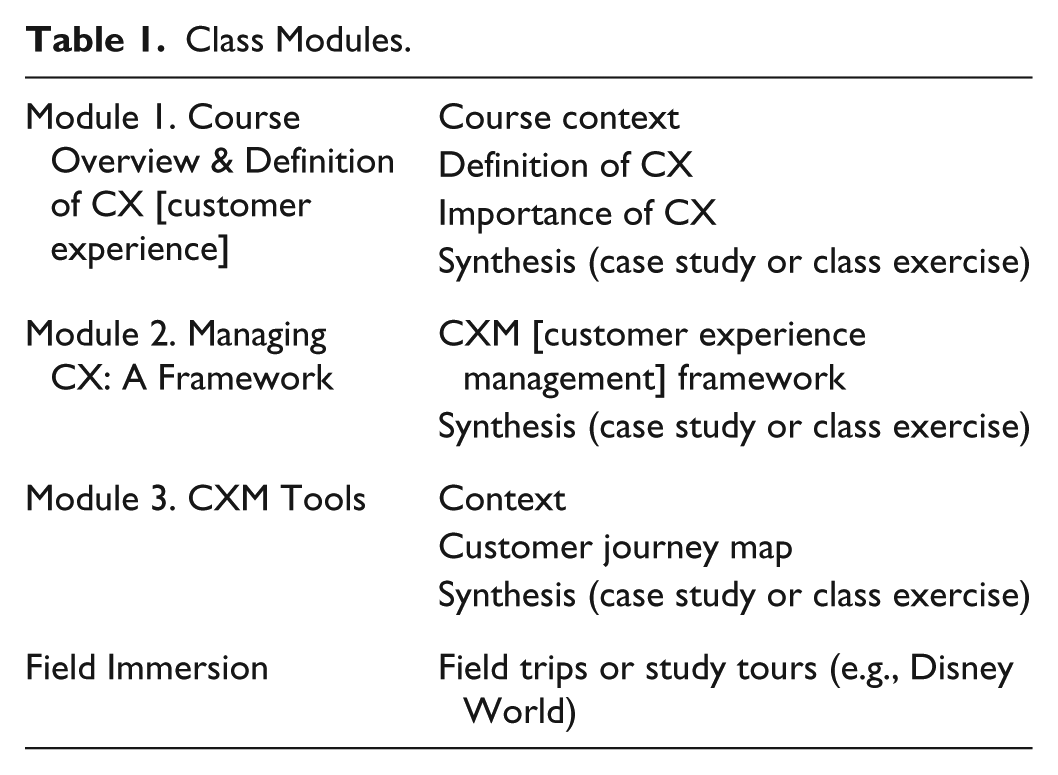
Class Modules.
Of particular interest, we spotlight the difference between CXM and services marketing for CXM instructors. Beginning with Pine and Gilmore (1998), the prevailing view is that services precede experiences in the progression of economic value. Services and its constituent elements can be considered components or antecedents of CX (e.g., Hwang & Seo, 2016; Kandampully, Zhang, & Jaakkola, 2018; Lemon & Verhoef, 2016). Meyer and Schwager (2007) illustrated this distinction by considering CX as “encompassing every aspect of a company’s offering—the quality of customer care, of course, but also advertising, packaging, product and service features, ease of use, and reliability” (p. 2).
For the purposes of this course, we followed Lemon and Verhoef (2016) and defined CX as a customer’s journey with a firm/brand over time during the purchase cycle—that is, the totality of a customer’s experience with a firm/brand across multiple touchpoints. Furthermore, CX is a dynamic process that is iterative. Below, we elaborate on three key components of our CX definition: customer journey, touchpoints, and dynamic process.
Customer Journey
Lemon and Verhoef (2016) noted that CX encompasses the entire customer journey; that is, it involves a holistic, end-to-end process that customers go through. From a managerial standpoint, it is helpful to regard this journey as comprised of the prepurchase, purchase, and postpurchase phases. For example, the prepurchase stage builds emotional attachments to the brand from need recognition to purchase consideration. The purchase phase includes attending to store atmospherics and digital environments to facilitate purchase. Finally, the postpurchase stage encompasses careful design of service recovery and product service experiences to generate customer loyalty.
Touchpoints
Touchpoints are customer interactions with a firm/brand during the journey. Lemon and Verhoef (2016) distinguish touchpoints into those controlled by the firm (e.g., advertising), its partners (e.g., multivendor loyalty programs), customers themselves (e.g., choice of payment method), or others (e.g., peer influences). Homburg et al. (2017) found that firms that had a “touchpoint journey orientation” emphasized managing or influencing all touchpoints in the marketplace. Furthermore, touchpoints can provide a useful strategic direction for designing CX (e.g., emphasizing cohesion and consistency of touchpoints). Finally, touchpoint design, prioritization, monitoring, and adaptation can help firms develop their capabilities to continually refine CX.
Dynamic Process
CX is a dynamic process because past experiences influence current experiences (Lemon & Verhoef, 2016). While past experiences frame expectations of current experiences (Lervik-Olsen, van Oest, & Verhoef, 2015), the passage of time can change attitudes toward a past experience (Palmer, 2010). For example, customers may rationalize poor past experiences to avoid cognitive dissonance. Furthermore, a stream of experiences with a product/brand over time can result in a relationship with the brand, which affects a customer’s self-identity; over time, CX can lead to changes within customers.
In summary, we adopted a definition of CX that emphasized a dynamic process involving customer–firm interactions (i.e., touchpoints over the entire purchase journey). CXM, in turn, involves overseeing CX.
Design and Implementation
Given that CXM is a relatively nascent field of marketing, there is no singular way to design and implement a CXM undergraduate course. We offer the following as a starting point for CXM instructors to adapt their own course that accounts for the learning aims of the institution, student capabilities, and the instructor’s pedagogical style and preferences.
As context, we designed our course as a marketing elective with the introductory marketing course serving as the prerequisite. The introductory marketing course prepares students by exposing them to various components of CX (e.g., advertising, branding, service, retailing). Consistent with university and accrediting body requirements, the three-credit course incorporated 37.5 contact hours; 5 on-campus class sessions of 2.75 hours each accounted for 13.25 hours, while the remaining 24.25 hours were fulfilled via field immersion. We initially capped course enrollment at 16 but because of demand (>80 students expressed written interest), we doubled the enrollment to 32.
As noted previously, the field immersion consisted of a 7-day experiential learning component at Walt Disney World Resort. Given that experience facilitates learning (Kolb, 1984), marketing educators have long called for experiential learning and continue to emphasize it (Klink & Athaide, 2004; Mills & Treen, 2016). Such experiences are rewarding (Berry & Robinson, 2012) because they can enhance learning outcomes. For example, Jiusto and DiBiasio (2006) found that experiential activities enhanced their students’ writing, critical thinking, and research skills, while Howard and Gulawani (2014) noted that faculty assessments demonstrated that students engaged in experiential learning were better able to achieve course learning outcomes. In addition, students perceive that such experiences promote active learning (Valdez & Valdez Cervantes, 2018), facilitate greater understanding of course materials (Gremler, Hoffman, Keaveney, & Wright, 2000), and enhance their abilities to transfer classroom knowledge to the workplace (Van Doren & Corrigan, 2008).
Experiential learning may work particularly well for certain marketing topics, such as CXM or services marketing, because students can often draw on their own experiential encounters as both a consumer and a provider (Gremler et al., 2000). In addition, in service encounters, buyers and sellers cannot be separated (referred to as “inseparability” in the literature), as they co-create the experience (Zeithaml, Parasuraman, & Berry, 1985). As the co-creators of CX, students learn about CXM firsthand from field immersion. As mentioned, we chose Disney World for field immersion because of its reputation in practicing CXM and extensive CXM ecosystem. The expansive ecosystem provided a broad context to study areas of excellence as well as opportunities for improvement—for example, how Disney mitigates poor CX when a park reaches capacity and guests are denied access. Furthermore, Disney CXM can be studied from a variety of angles—from its mission (“create happiness by providing the finest in entertainment for people of all ages, everywhere”), to touchpoint design, to massive initiatives such as its more than $1 billion investment in Magic Band technology to deliver seamless CXs (Kuang, 2015). Our initial course design efforts focused on the course learning objectives, which in turn guided the development of course content and assignments.
Course Learning Objectives
To guide course development, we consulted several managers from local businesses that are familiar with CX/CXM. These conversations revealed that organizations would value potential employees who have CXM instruction in these areas: (a) what are CX and CXM, including best CXM practices; (2) why are CX and CXM important; and (3) how can CX be managed and improved (e.g., through knowledge and skills such as customer journey mapping, CX monitoring). This led us to the following course learning objectives:
To understand CXM and its importance.
To know the strategic framework of CXM and essential tools to enhance CX.
To discern how organizations manage CX efforts and resources across a broad range of settings, including nonprofits.
To learn and experience how Disney creates and manages CX.
To develop effective communication and presentation skills.
Required Readings
We required students to read articles, many of which are cited in the following sections and are in the reading list of the appendix. We also required reading of Be Our Guest: Perfecting the Art of Customer Service, by the Disney Institute (2011).
Learning Modules
The course content was divided into three modules. Refer to Table 1 for an overview.
Module 1. Course Overview and Definition of CX (Class Session 1)
Module 1 included four components:
Course Context. The course began with an overview (e.g., personal introductions, syllabus highlights, online learning system details). Given the field immersion component, time was also devoted to logistical details (e.g., tickets, behavioral expectations).
Definition of CX. A case study on Starbucks and articles by Richardson (2010b) and Rawson, Duncan, and Jones (2013) introduced the concept of CX. Probing questions such as “What does Starbucks sell?” and “What do consumers buy?” were used to help students recognize that Starbucks is not just in the business of selling coffee (a commodity) or a service; it also creates experiences valued by customers. In addition, a discussion centered on Starbucks products in grocery stores, homes, offices, and the like, illustrated the concept of “touchpoints”—some of which occur beyond the typical “within-store experience”—and how they contribute to CX. In addition, to offer an example outside of services, we also discussed a case of CX in physical goods—the iPhone. We pointed out that CX with an iPhone would involve iPhone’s package design to create an unboxing experience, iPhone’s physical appearance to create a sensory response, and Apple’s promotional emails to stimulate excitement about new features. Again, each touchpoint contributes to CX.
Following the case studies, we presented students with our CX definition, which emphasized three major components: journey, touchpoints, and the dynamic process. Drawing from both academic and practitioners’ literature (e.g., Lemon & Verhoef, 2016; Richardson, 2015), we elaborated how CX differs from related concepts such as user experience, customer service, and service quality. In particular, user experience and customer service tend to focus on direct customer–product/provider interactions that constitute only a portion of the customer journey. CX considers the entire journey that stitches together all touchpoints (e.g., promotional emails, frontline or third-party staffs, and even customer word-of-mouth). In this sense, CX is broadening the concepts of user experience, customer service, and service quality, leading to a richer view (Lemon & Verhoef, 2016).
Importance of CX. We provided an extensive discussion of CXM outcomes: for the customer, firm, and industry. For example, we discussed how CX contributes to firms’ financial performance (Kriss, 2014). We also shared KPMG’s (2016) view that in the near future, most firms will compete primarily on the basis of CX and that this perspective on CX’s strategic importance is shared among leading firms/think tanks in the industry, including the Boston Consulting Group (2016a) and McKinsey & Company (2016).
Synthesis. A case study on Apple served to synthesize major takeaways from the module. For example, customers’ trial (prepurchase), purchase, and postpurchase experiences with Apple products helped reinforce how customer touchpoints occur before, during, and after product consumption. We also indicated the importance of Apple retail stores in creating CX before and after purchase to emphasize that CX strategy needs ecosystem thinking. Finally, we discussed Apple’s recent publicity crisis of slowing down iPhones in iOS upgrades and how the firm handled the crisis by offering battery replacements to highlight how CX matters throughout the customer journey (Apple, 2018).
Module 2. Managing CX: A Framework (Class Sessions 2 and 3)
Having defined CX and its importance, we turned our attention to CXM in this module. Spanning two class sessions, this module included three components.
Context. As in Module 1, we started Module 2 with two case studies to provide context and arouse student interest. We compared the CXM philosophies of two successful companies, Amazon.com and Zappos (a fully owned subsidiary of Amazon), to show that there is more than one way to successfully manage CX. Initially, students were asked to reflect on their experiences with the two companies. An illustrative framing question was, “Does good CX mean doing everything for customers?” After class reflections, we showed interviews in which the CEOs of Amazon and Zappos discussed their philosophies or visions of CX. Amazon’s CEO noted the firm’s focus on “selection, delivery speed, efficiency” to create desirable CX (CNN, 2013), whereas Zappos’ CEO emphasized “personal touch and happiness” (ABC News, 2012). While Amazon’s philosophy tends to downplay person-to-person interactions, Zappos’ philosophy is just the opposite. These sharply contrasting mind-sets motivated class discussion on what it means to have a customer-centric vision—the first component of our CXM framework.
CXM Framework. Drawing on research from CXM (e.g., Homburg et al., 2017), services management (e.g., Parasuraman et al., 1988; Zeithaml, Parasuraman, & Berry, 1990), and multichannel management (e.g., Neslin et al., 2006), we presented students with a process-based framework to manage CX (Figure 1). This framework includes three steps: (a) establishing a common purpose, (b) selecting standards, and (c) designing delivery. We used examples from Harvard Business Review (2006) to have students reflect on the core benefits of an organization and the experience it was selling. This context set the stage for the “common purpose” component of the framework. More specifically, we defined a customer-focused common purpose or cultural mind-set as an organization-wide orientation that outlines what aspects of CX matter to the organization, its employees, and collaborators in the value network (Homburg et al., 2017). This common purpose empowers the employees involved in providing CX and has implications for resource allocation. Furthermore, it can be based on functional experience (e.g., “efficiency” in the culture of Amazon) or emotional experience (e.g., “happiness” in the culture of Zappos; Berry, Carbone, & Haeckel, 2002).
CX standards are strategic directions or criteria that are necessary to deliver/support the common purpose. Beyond supporting the common purpose, these standards are also guided by customer research (Zeithaml, Berry, & Parasuraman, 1993). As a case in point, Disney uses the term “guestology” to describe how customer research informs its CX strategy. Disney outlines four standards based on customer research that encompass all operations at the theme parks: safety, courtesy, show, and efficiency. We explained that CX standards will clearly vary from one context to another and that the key is to listen to customers closely. Marketing literature offers broader and more generic quality standards that are likely to be relevant across a wide range of companies. As one example, SERVQUAL model (Parasuraman et al., 1988) highlights five dimensions contributing to service quality (i.e., reliability, assurance, tangibles, empathy, and responsiveness). As another example, Homburg et al., (2017) suggests that the design of CX should follow the guidelines of being thematic, consistent, context-specific, and connective. The emphasis of our instruction was placed on the need for strategic directions, instead of intricate details of any given strategic frameworks. Students desiring a deep-dive are encouraged to consider other marketing elective courses such as services marketing and new product development (NPD).
The delivery process involves CX operations—their design and delivery—that create CX. Drawing on prior research on service operations (Bitner, 1990, 1992; Booms & Bitner, 1981), we considered three delivery venues: People, Processes, and Physical design (or the 3Ps). More specifically, people are human participants involved in employee–customer interactions. Both employees and customers need to be managed for CX. Processes are the procedures and mechanisms of activities through which service or experience is delivered (e.g., the check-in process at a hotel as in services; the steps to take, store, edit, and share a photo using a smart phone as in physical goods). Physical design involves the tangible elements that facilitate the delivery of experience (e.g., facilities, physical environment, artifacts). We used Disney as a live case study to illustrate the 3Ps. Disney relies on three channels to deliver CX: cast members (i.e., People), processes (same terminology as we use here), and setting (i.e., Physical design). The success of CX operations depends on the integration of the 3Ps, thus setting the stage for Module 3, which introduced a tool to integrate the 3Ps.
Synthesis. We concluded this module with a case study of Best Buy. We began with students’ reflections on in-store versus online shopping behaviors. We then introduced the concept of “showrooming,” in which consumers shop in store but buy online (Jakab, 2014). Because many brick-and-mortar retailers face this challenge, we broke the students into teams and had each team present proposed solutions to address showrooming. Although students’ suggestions varied, most typically fell into one of two categories: enhancing CX or extracting value/charging for the enhanced experience (e.g., exclusive technology products showcased only at Best Buy). To enhance CX, student discussions often involved how the 3Ps enhance the showrooming experience. For example, Best Buy’s employees are no longer commissioned, but salaried, to provide unbiased product/service advice (People). Best Buy now uses a multichannel strategy to cover the expanded customer journey (e.g., web → store → delivery & installation → postpurchase services with Geek Squad; Processes). Best Buy’s store design also features store-within-store layouts such as Apple’s product center (Physical design). All these changes helped reinvigorate CX in Best Buy’s “Renew Blue” turnaround plan (Safdar, 2017).
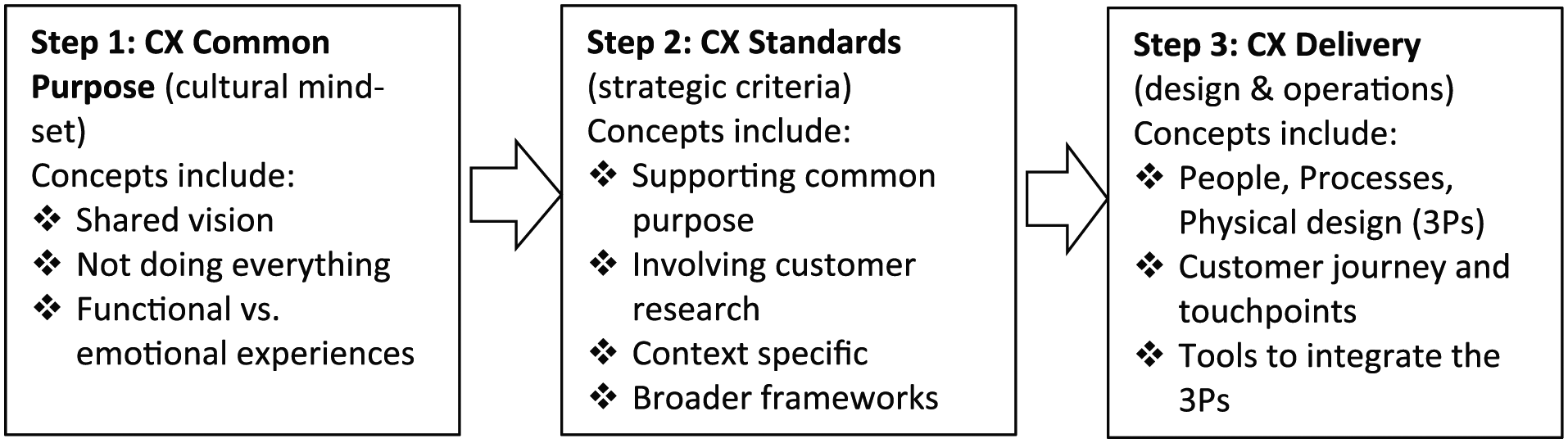
A framework for CXM.
Module 3. CXM Tools (Class Sessions 4 and 5)
After presentation of the three-step framework of CXM that concludes with how CX is delivered via the 3Ps, Module 3 focused on CXM tools with an emphasis on one that is particularly useful in integrating the 3Ps—the customer journey map. This module has three components.
Context. As in the previous modules, we used a case to help students understand how a customer’s interactions with an organization form a journey. Specifically, we showed a digital banking video (Boston Consulting Group, 2016b) and had students reflect on their experiences with a financial service provider. We encouraged students to think about the steps they had to take to receive the desired financial service. We also highlighted the roles of People, Processes, and Physical design in these steps. Students were challenged to think about improvements—helping them recognize the need for a tool that could help with this undertaking.
Customer Journey Map. We used two articles (i.e., Richardson, 2010a, 2010c) to explain the purpose and structure of customer journey maps. A customer journey map is a visual illustration of the steps the customer takes to engage with an organization/brand. The map can be applied to a service, a good, or a combination of the two. The customer journey map is informed by the service blueprint but goes beyond by emphasizing the perspective of the customer and incorporating multichannel analyses (Lemon & Verhoef, 2016). Thus, journey map focuses on “stitching” together all the touchpoints including product/service encounters before and after purchase. Such encounters may be owned/controlled by other businesses. This holistic view represents a philosophical difference between journey map and service blueprint (Voorhees et al., 2017). At the technical level, journey map prioritizes customers’ perspective, while service blueprint—being “internally oriented”—emphasizes providers’ perspective (e.g., mapping out provider’s back-office operations; Lemon & Verhoef, 2016).
The exercise of journey mapping can be done at a high level (e.g., one’s various experiences with a bank) or a low/specific level (e.g., opening a checking account). Similar to defining CX, there are many approaches to journey mapping. We highlighted three staples: (a) personas, (b) customer steps, and (c) touchpoints.
Personas are customer descriptions and triggers for engagement. Customer descriptions may include conventional marketing variables such as demographic, psychographic, behavioral, and geographic characteristics. Different descriptions may lead to different journeys (e.g., international vs. domestic customers). Customer triggers are specific incidents that lead customers to the engagement (e.g., buying a home → bank; broken toilet → home improvement store). Different triggers may also cue different journeys (e.g., fixing a broken toilet vs. upgrading a bathroom).
Customer steps are customer actions throughout the engagement. As customer actions can occur before, during, and after purchase or consumption, it is important to define the scope of journey mapping—the start and end points. Within the defined scope, customer steps need to be observed from the customer’s point of view, including his or her emotions, pain points, and/or satisfaction. Customer steps usually entail the most common steps customers take in a particular journey. Idiosyncratic or micro steps add unnecessary complications to the map and thus should be avoided or considered separately.
Touchpoints are the interactions through which the organization supports CX. Although interactions, by definition, involve both the customers and the organization, the focus here is on the organization’s actions to support CX. More specifically, within each touchpoint, the emphasis is on what the organization can do with People, Processes, and Physical design to support or deliver CX. Here, organizational actions that are not customer-facing are not considered (e.g., back-office operations). Students who need additional information in operations are directed to more specific content areas such as services marketing.
It is important that students understand these three building blocks before attempting a journey map. After that, we provided the common steps in journey mapping using examples of a high-end hotel (Swissotel): Identify the journey to be mapped (i.e., scope). Identify customer persona and what triggers customer engagement. Map the steps from the customer’s point of view. Map the touchpoints where the firm supports CX. Link delivery venues (3Ps) to touchpoints and assess via CX standards. Identify problems in CX and generate ideas for improvement.
Synthesis. To synthesize learning, we concluded this module using an in-class exercise in which students journey map a college visit. Students had to identify personas, customer steps, delivery systems to support touchpoints, and problems and make recommendations for CX enhancement. A college visit provides a familiar setting for students to map out customer steps from personal experience. They can also bring in different perspectives (e.g., journey for students with disabilities) and touchpoints, and any students who work for the admissions office can offer insider perspectives on what design elements are deliberately put in place (i.e., 3Ps) to enhance CX.
Field Immersion
As mentioned, a field immersion experience is particularly well suited for studying CXM. Students participated in a 7-day (6-night) study tour at Walt Disney World Resort during their spring break in early March. The study tour price per student was approximately $1,700 and included a 5-day ticket for admission to any of Disney’s theme parks (Magic Kingdom, EPCOT, Animal Kingdom, and Hollywood Studios), Disney hotel accommodations (double-occupancy at Port Orleans Riverside), all meals, and educational programming. We purposefully did not include airfare so that students could book their own flights for two reasons. First, booking their own flights should save students money because many airlines service Orlando and offer promotions that are often cheaper than group airfare. Second, it provides flexibility by allowing students to depart from the airport of their choice and to arrive early or extend their stay (at an additional cost).
While cheaper hotel accommodations may exist, we preferred staying within Walt Disney World Resort so that students could experience and examine a broad scope of Disney CX. Another advantage to staying on Disney property is that Disney provides complimentary travel between the Orlando airport and hotel. Note that the park tickets are essential as the location for educational programming was frequently in the parks.
Our programming at Disney reinforced key elements of our CXM framework. In doing so, we used Disney tours and speakers organized with the aid of Disney’s group events and youth programming. Much of our face-to-face contact hours with students ranged daily from 3.5 to 7 hours.
Day 1: Travel day and orientation session. Students arrived by mid-afternoon. An orientation session that included a group dinner was held in the evening.
Day 2: Overview of Disney operations and emphasis on CX standards (e.g., relating the standard of “show” to theme park design). We incorporated the Keys to the Kingdom tour to gain access to backstage areas of Magic Kingdom. Other group tour options are available to examine other Disney theme park operations.
Day 3: CX common purpose and the importance of Disney leadership and vision. The program setting was EPCOT, and speakers ranged from frontline employees to upper management. Students particularly appreciated hearing managers expound on the keys to employee success.
Day 4: In-the-park assignment day. A group dinner was held at EPCOT before a show (Illuminations). Joining our students were CX frontline employees who spoke about their employment experiences (including CXM-related training) at Disney. Several of these employees went through Disney’s College Program, which is a sizable Disney internship program.
Day 5: CX delivery. This program took place at the Grand Floridian Hotel and emphasized managing employee–customer interactions and how they may be elaborated, simplified, or eliminated. For example, Disney may eliminate a touchpoint through an expedited check-in process whereby guests can avoid the front desk and go straight to their room. Speakers included the concierge and front desk managers.
Day 6: CX culture and a wrap-up session. The setting was the Magic Kingdom and emphasized how Disney culture is created and maintained through People (e.g., “cast member” training), Processes (e.g., costuming procedures), and Physical design (e.g., sightlines of the castle). We emphasized how culture affects CX and how CX may, in turn, reinforce culture (e.g., children wearing Cinderella dresses in the Magic Kingdom). We concluded the official programming with a group dinner to further synthesize learnings from the week.
Day 7: Travel day. Return home.
Student Assignments
The final grade for students was determined by a pretrip assignment; participation, which included a during-trip assignment; and a posttrip assignment. Each component was equally weighted in determining their final grade.
Pretrip Assignment
This entailed a group project in which students developed a customer journey map and recommendations paper. Students formed groups of four and, with instructor approval, chose their organization to journey map. Organizations included restaurants (e.g., Panera) and retailers (e.g., Apple). Each group presented the journey map and recommendations to the class in approximately 20 minutes. To foster creativity, we had few stipulations regarding appearance; however, all maps were required to include personas, customer steps, and touchpoints.
During-Trip Assignment
As part of their participation grade, students individually posted and shared examples of key course concepts using social media (GroupMe). These concepts focused on CX standards (safety, courtesy, show, and efficiency) and how CX is tailored to segments (e.g., international, smaller children, guests with disabilities). For each post, students were required to include either a picture or a video with a brief description explaining its contribution to CX. We chose this assignment because it reinforced key course concepts, required only a smartphone with an app (not a cumbersome laptop), allowed instantaneous sharing, and facilitated students’ own discoverability. The postings served as a starting point for group discussions. Students were required to do a minimum of five posts, though many students went beyond this threshold. As noted, this assignment factored into each student’s participation grade. Having the participation grade account for a significant portion of the final grade is critical for courses with a study tour, as it incents and rewards good student conduct (e.g., arriving on time for sessions, engaging with speakers; Koernig, 2007).
Posttrip Assignment
This assignment required students to write two single-spaced pages on how a concept, model, or methodology covered in the course could be applied to and benefit an organization. For their organization, students were asked to select a potential, future employer that differed from the organization selected in the pretrip assignment. Students were prompted with the question, “Imagine you were in a job interview and the interviewer asked you: what did you learn in your CXM course and how might it benefit us?” In addition to reinforcing key learnings, this assignment helped prepare students for future job interviews.
Student Outcomes and Evaluation
Student performance in all three areas of evaluation allowed us to assess learning. We also evaluated their perceptions of learning. Specifically, at the conclusion of the course, we distributed our university’s standard course evaluation form (11 items) and supplemented it with four additional items directly related to CXM. All 15 items are on a 4-point scale, with 4 being the highest or strongest level of agreement. An average of the 11 standard items across all students scored a 3.90. The four supplementary items regarding CXM (means appear in parentheses) are as follows:
“I learned a lot about CXM in this course.” (3.90)
“This course helped me understand how to implement CXM in an organization.” (3.90)
“After taking this course, I believe CXM is an important source of competitive advantage.” (4.00)
“Integrating class sessions with a field study (e.g., Disney World) was effective in helping me understand CXM.” (3.97)
Qualitative comments from students further reflected their perceptions of a positive learning experience (e.g., “an amazing experience and opportunity”) and reiterated the value of field immersion in studying CXM (e.g., “The Disney trip really helps exemplify the principles taught in the classroom” and “It was a great experience to learn about things in the classroom and then see them in action throughout the parks.”). Only a few comments were suggestive in nature. One student recommended including “more backstage of rides” (though Disney’s safety restrictions prevent this implementation). Another student suggested that we devote more of the pre-immersion class sessions to Disney itself. On reflection, however, we argue that class time is better used illuminating CXM in other organizations, so that students can better generalize their learnings beyond Disney.
Unsolicited feedback further supports course effectiveness. Many former students have commented that the course was a differentiator on resumes and in job interviews. While it appears that employers value CX understanding and training in their new hires, future research should investigate the relative importance of CXM skills to employers in hiring and advancement decisions. Such research may prove critical to the adoption and advancement of CXM pedagogy.
Discussion
CXM is an important and growing source of competitive advantage. However, many executives and customers believe that companies are falling short in delivering CX. While there has been heavy interest in CXM from practitioners, marketing academics have lagged in developing and disseminating CXM knowledge. This article offers one approach to address the void in CXM pedagogy. Specifically, we describe how to educate undergraduate business students with a CXM marketing elective incorporating field immersion.
Because the need for CXM education is critical, it is important to show how our approach can be adapted. For example, marketing departments may not be able to offer a new elective, may not want to include a major field immersion component, or may want to offer this course at the graduate level.
A starting point for integrating CXM into the curriculum is to incorporate it in an existing undergraduate course, such as the (mandatory) introductory marketing course or (elective) course on NPD. In an introductory marketing course, the module on services marketing can be modified to include CXM. For example, students’ interactions with service providers can form the basis for a class discussion comparing good and bad CXs. These discussions, in turn, can help derive a conceptual framework for CXM and describe current best practices. In an NPD course, CXM can be the genesis for innovation. In reflecting on the customer journey, students can be asked to apply design thinking principles to develop innovations that transform bad experiences into good ones.
Another adaptation is to alter the field immersion component. Extensive field immersion opportunities, beyond Disney, might include family campgrounds, local amusement parks, cruises, hotels, and resorts. These options may be attractive because they have a broad CX ecosystem to study (e.g., accommodations, entertainment, dining). The instructor may attempt to contact such organizations directly (through the organization’s marketing, group sales, and/or public relations departments) or seek the assistance of a study tour travel company that specializes in putting together custom study tours. Such companies can arrange travel as well as secure guest speakers and tours.
Some schools or faculty may be uncomfortable overseeing student travel because of the inherent risks involved. We note that the level of risk associated with domestic travel may be considerably less than international study tours, which have long been popular (Johnson & Madder, 1992; Koernig, 2007). Nevertheless, field immersion can be accomplished with little or no travel (e.g., visits to a local hotel, restaurant, sporting event, or hospital). Field immersion can even occur on campus (e.g., analysis of the school cafeteria, open houses, admissions process, or library).
If the field immersion component is shortened, classroom contact hours should increase. Potential areas of additional classroom instruction include (a) the evolution and future implications of an experience economy (Pine & Gilmore, 1998), (b) the CX management orientation (Homburg et al., 2017), (c) the impact of social media on CX, (d) customer research to inform CX standards (e.g., marketing research methods relevant to CXM), (e) metrics for CX success (e.g., customer loyalty metrics, customer lifetime value), (f) design thinking and additional CXM tools (e.g., empathy map, benefits-difficulty matrix), (g) CXM-related internal communication, (h) employee engagement and its contribution to CX, (i) overcoming challenges in implementing CX (e.g., resources, organizational structures), and (j), the future of CX (e.g., latest technologies). Peppers and Rogers’s (2017) textbook on CXM also contain ideas for additional topics.
Finally, given the level of interest in CXM by managers and executives, marketing departments should expand CXM teaching to serve graduate students. Such an audience would require adaptations to our approach, such as emphasizing more strategic and less operational considerations. The CXM conceptualization proposed by Homburg et al. (2017) may be particularly informative as it identifies CXM as comprising (a) cultural mind-sets, (b) strategic directions, and (c) firm capabilities. In addition, graduate-level coursework might use more in-depth cases, including Harvard Business School cases—for example, Wells and Ellsworth (2017) provide a timely option to explore how Best Buy is reinventing itself around CX. Until CXM pedagogical tools advance, instructors may need to highlight CXM concepts with less contemporary cases. For example, they could use the work of Moon and Quelch (2003) to examine CX standards at Starbucks or Hallowell and Heskett (2004) to study CX delivery and operations at a hospital.
Also, a course enrolling working professionals may provide for a richer journey mapping assignment, as students may access the “backstage” of their own employer to analyze CX delivery mechanisms. Such an assignment would be particularly suited to a graduate NPD course because it can help guide an organization’s innovation efforts. Indeed, an important challenge confronting NPD managers is where to devote their innovation resources (Chao & Kavadias, 2008).
Because CXM and innovation are key sources of competitive advantage, integrating the two skill sets would provide students with cutting-edge capabilities to enhance organizational competitiveness. To elaborate, students can be required to map a customer journey of their choosing with PowerPoint. Given the NPD context, students should next be asked to highlight pain points in their maps which can serve as a starting point for innovating the customer experience. Following a discussion of their pain points, students can form teams to solve a pain point that all team members are impassioned to solve. Innovation development can then follow the typical NPD process—that is, teams research solutions that currently exist to solve their pain point, brainstorm an innovation that they believe provides greater “value” relative to existing solutions, obtain feedback from potential customers on their innovation, and so on.
Challenges and Key Success Factors for Designing a CXM Course
We identify challenges and key success factors for developing an effective CXM course. As CXM is a nascent field, school administration may need to be apprised of its considerable potential, which may include CXM courses serving as a differentiator for schools and marketing departments. Its nascence may necessitate instructors to expend efforts to develop their own expertise. The appendix contains a list of useful CXM-related books, articles, and cases. In particular, we highlight the works of Pine and Gilmore (1998), Homburg et al. (2017), and Lemon and Verhoef (2016) as being particularly informative.
If including a major field immersion component, we advise planning early. We began planning the Disney field immersion 1 year before travel. The first steps included gauging student interest through focus groups, developing a budget, and obtaining university permission to add a course with domestic travel. After that, we secured hotel accommodations, guest speakers, and group dinners. Allowing sufficient lead time provides a better chance of securing “first choice” in booking these options. In addition, the instructor should plan to promote the course to recruit students through fliers, websites, information sessions, classroom visits, and so forth.
A reason to first promote a class with a major field component is that cost may be prohibitive to some students. For students looking for an immersive, experiential course, a course with a domestic study tour should be considerably cheaper than one with an international study tour component. Nevertheless, there are ways to reduce costs, including reducing the number of hotel nights or hotel quality. We stayed at a moderate-level hotel (Port Orleans Riverside), but Disney also has lower-cost options (e.g., All-Sports and Pop Century). Our overall cost to students included all meals using food vouchers and group dinners. Reducing these obviously lowers the advertised cost. Consideration should also be given to the time of year, due to elevated prices during peak travel seasons. For example, hotels are cheaper in early March than later in the month or April, due to spring break travel. Faculty can also save costs by forgoing a study tour travel agency and making reservations directly, as we did. Nonprofit institutions, such as the university itself, may also qualify for tax exemptions by booking directly.
Finally, a critical success factor in running a field immersion experience to a desirable destination such as Disney is managing students’ expectations and conduct. Given the “fun factor” of Disney, it is important to stress from the beginning (e.g., recruitment) that this is a for-credit academic course comprising readings, assignments, lectures, and so on. The pretrip assignment also helps set the tone that this is an academic course. The during-trip assignment keeps students focused on learning academic content within an exciting environment. Finally, the posttrip assignment helps students synthesize learnings between the academic content and the field immersion through reflection. Communicating directions and expectations for all three assignments early on sets the academic tone for the course.
Conclusion
We offer one approach for designing an undergraduate CXM course. We expect that our approach will be adapted and will evolve over time, especially as CXM pedagogical resources advance in this emerging field. While developing an entire course in a nascent field may be daunting, it is still critical for marketing to begin disseminating CXM knowledge (e.g., perhaps by incorporating CXM learnings into existing coursework). Failing to do so runs the risk that the opportunity to develop and disseminate knowledge in such a promising field may pass marketing by.
Footnotes
Appendix
Declaration of Conflicting Interests
The author(s) declared no potential conflicts of interest with respect to the research, authorship, and/or publication of this article.
Funding
The author(s) disclosed receipt of the following financial support for the research, authorship, and/or publication of this article: This research was supported in part by the FJ DeFrancis Scholar Fund through the Sellinger School of Business and Management at Loyola University Maryland.