



Abstract
Understanding sustainability requires a system-wide perspective to guide the interpretation of problems and conceptualization of solutions. A lake sustainability Trust provided an opportunity for students to gain this perspective by examining societal, commercial, and environmental policy perspectives associated with a local endangered lake and surrounding wetlands. This was an ideal project to bring sustainability issues to life for students but was too complex for a single class to attack. This article describes a multicourse initiative that sought to heighten students’ awareness of sustainability issues using a design thinking problem-solving approach. Interviews conducted revealed concerns that educators may have in considering similar projects. The authors respond to these perceived obstacles with recommendations and a discussion of mitigation strategies. In addition to the Trust gaining direction, the design and implementation of this cross-course experiential learning initiative allowed Marketing Research and Product Design students to develop an appreciation for macrolevel sustainability issues, and environmental policy students to appreciate the value of marketing research in the development of land use plans.
Keywords
A “big picture” view of marketing is increasingly important given the potential for the marketing system to harm or enhance other systems. Macromarketing examines the interaction of the marketing system with social and environmental systems (Layton, 2007). From a macromarketing perspective, success can be defined by the contribution of the marketing system to the quality of life of relevant communities while preserving ecological balance. A macroperspective of micromarketing recognizes that marketing decisions are made within a system that, ideally, achieves economic gains while supporting ethical norms, environmental stewardship, social justice, and the common good (Klein & Laczniak, 2021).
Marketing continues to evolve in both thought and practice (Hunt et al., 2021). Shultz (2007) pushes beyond Hunt and Burnett’s (1982) view that macro- and micromarketing should be viewed as “two halves of a whole” by suggesting that the very definition of marketing should be macro-oriented as micromarketing activities derive their essential meaning from how they align within a larger, macro, marketing system. In a time of climate change, natural resource depletion, compromised air and water quality, and threatened ecological health due to land use changes and development, awareness of the macro-effects of marketing on environmental systems is increasingly important (Sheth & Parvatiyar, 2021). Moral marketing managers will be mindful of macrolevel implications when formulating microlevel plans.
Future marketers need to be equipped with a sense of moral awareness (Rest & Narvaez, 1994) to anchor their decisions. Business curricula’s focus on profit may overshadow opportunities to build moral awareness through integrating sustainability perspectives into the marketing curriculum (Weber, 2013). The use of experiential learning models (Radford et al., 2015) is one way to integrate systems research by connecting “planet” and “people” awareness to “profit” (Schlegelmilch, 2020; Wooliscroft, 2021). Faculty can serve as agents of change by transforming the learning process, encouraging critical thinking, and providing opportunities for students to appreciate sustainability through involvement with a wider community (Kemper et al., 2019). If students can develop an appreciation of macrolevel issues, such as those associated with sustainability, the hope is this awareness will shape their future decision-making (Bascoul et al., 2013) and thus achieve educators’ objectives to help students become world-class marketing practitioners (Munoz & Huser, 2016; Shapiro et al., 2021).
Positive change is possible, more from what is learned than what is taught. Accordingly, education is moving from a traditional, theoretical, passive, knowledge-transfer approach to an experiential, interactive method of learning (Frontczak, 1998). This paper describes how a design thinking approach was used to develop a learning experience placing sustainability at the center of our students’ active learning process; Product Design students accounted for sustainability issues when developing product concepts; Environmental Policy students reflected upon a range of previously unforeseen innovative uses that a natural environment could have; and Marketing Research students designed and undertook a data analysis scheme bridging these worlds.
This paper offers background on design thinking before describing its use in developing a sustainability-based project to help build student awareness of the relationship between marketing, social, and environmental systems. We then present a synopsis of perceived and experienced challenges of this approach and recommendations for mitigation strategies before discussing the limitations of this article and future directions. This project was undertaken for a community-based “client” sitting at the intersection of a fragile wetland ecosystem shaped by both political and economic interests. The real-world project context highlights the social value that educational initiatives like this can provide while potentially motivating student engagement (Bobbitt et al., 2000; House, 2002). It is hoped that by providing a roadmap of what was done, the time commitment of others could be mitigated and, consequentially, more marketing educators may commit to “hacking” current educational system norms that often put sustainability issues on the “too hard list” of curriculum development.
Design Thinking as a Pedagogical Framework
As opposed to a traditional lecture-based teaching approach where students are relatively passive recipients of knowledge, experiential learning approaches involve students learning by doing (Brennan, 2014; Catterall et al., 2002; Razzouk et al., 2003). Experiential learning may be a particularly helpful pedagogical approach for educators wanting to build systems-level perspectives into their students’ decision-making capacities (Radford et al., 2015) through the technique’s strength in encouraging high-order and independent thinking (Heinrich et al., 2015) and building problem-solving skills (Diamond et al., 2008). A design thinking process is inherently experiential.
Adapting design thinking into a pedagogical framework for this project was challenging. We sought to mirror the types of complexity found within a small system by having multiple stakeholders, representing different pillars of sustainability, interacting (Reynolds et al., 2018). Beginning with the “fuzzy front end” of the project, we wanted the students themselves to define and redefine their perceptions of what problem aspects to focus on. In this way, all students worked on the same “wicked problem,” but variations in the way problems were framed placed students on paths toward different outcomes (Brown, 2008; Chen et al., 2018). With these goals in mind, we chose to explore how design thinking could be used as a pedagogical framework for teaching sustainability.
Design thinking can be a useful approach to expand students’ ability to think critically about complex “wicked” problems (Melles et al., 2012), including those of sustainability (Geissdoerfer et al., 2016). Design thinking is an empathetic, user-centric approach to problem-solving, involving multidisciplinary teams engaging in a holistic, contextual thought process; collaborating, integrating perspectives and iteratively experimenting with possible solutions to indeterminate problems (Dell’Era et al., 2020; Meinel & Leifer, 2010; Schallmo & Lang, 2020; Von Thienen et al., 2011). The most widely applied approach to design thinking comes from the Hasso-Plattner Institute of Design (d.school) at Stanford University (Cummings & Yur-Austin, 2021; Kwon et al., 2021; Matthews & Wrigley, 2017; Schallmo et al., 2018).
The d.school model has four fundamental “rules” (Meinel & Leifer, 2010):
1. The Human Rule: All design activity is ultimately social
The design thinking process constructs a social system of teams, solution users, and other stakeholders. In a way, solution users are virtual members of design teams in that their needs shape the innovation process; design teams are challenged to see problems through users’ eyes. Facilitators familiar with the design thinking process help teams to understand the general design challenge, set goals, and practice techniques. Inclusive teamwork and creativity are supported. Techniques used are adapted to how familiar team members are with the design thinking process. Different learning preferences within the team are accommodated. This rule complements Laverie’s (2006) highlights on the importance of team-based, cooperative learning in building both marketing knowledge and workplace skills.
2. The Ambiguity Rule: Design thinkers must preserve ambiguity
Brainstorming happens at different points in the process motivating the team to reconsider prior assumptions and decisions. Experimentation is viewed as necessary; iteration (repetition and learning from mistakes) is encouraged.
3. The Re-design Rule: All design is re-design
External knowledge of how human needs have been satisfied in the past is integrated with the different experiences, expertise, and knowledge of diverse, multidisciplinary teams.
4. The Tangibility Rule: Making ideas tangible always facilitates communication
A bias toward action in problem-forming, problem-solving, and design is more important than holding planning meetings. Visualization is used to communicate ideas.
These four central tenants are further defined within the five phases of the d.school model: Empathize, Define, Ideate, Prototype, and Test (Plattner et al., 2012, 2015). The next section addresses each of these phases.
The first phase of the design thinking process, Empathize, requires design thinking teams to understand the problem they intend to solve and the users of that solution. A user-centric perspective is facilitated through research helping teams understand how users feel; their motivations, needs, and wants (Cummings & Yur-Austin, 2021; Köppen & Meindel, 2015). Diverse multidisciplinary teams are useful to accomplish this task (Seidel & Fixson, 2013; Von Thienen et al., 2011).
In the second phase, Define, the design thinking team analyzes and synthesizes information collected in the first phase, further defining any problems identified and distilling them into concrete user needs (Sutton & Hoyt, 2016). The Define stage also allows for gathering ideas, including product attributes, functions, features, or other aspects that could solve the problems identified (Meinel & Von Thienen, 2016; Plattner et al., 2012, 2015).
In the third phase of the design thinking process, Ideation, the design thinking team has a solid understanding of users’ problems and needs, and has created a user-centric problem statement (Schallmo et al., 2018). Amid this background, the design thinking team now identifies new solutions to the problem statement created. When employing Ideation techniques, such as brainstorming, all ideas are encouraged and collected; a lack of dismissal or other judgment helps facilitate the process. Such techniques stimulate the type of free-thinking necessary to generate as many potential problem solutions as possible. These possibilities are then narrowed down to ideas evaluated most suitable to solve the problem as framed (Pierce et al., 2019).
In the fourth phase, the design thinking team creates Prototypes of the problem solutions generated. Prototypes can be preliminary scaled-down versions of the products used to test the design thinking team’s ideas (Cummings & Yur-Austin, 2021), for example, models for physical products, videos or role-plays for services, or interactive digital applications (Brown, 2008; Thoring & Müller, 2011). Solutions evaluated can be rejected, accepted, and/or improved. The prototyping stage serves to identify constraints and limitations inherent in the proposed solution and to project end-user attitudes and behaviors toward the final product (Thoring & Müller, 2011).
In the final phase, the end-product is tested using the best solutions identified during the prototyping phase. Alterations and refinements are made to reduce potential problems and obtain the best possible fit between the end-user and product (Andrews, 2019).
While this discussion outlined the process in a linear fashion, in practice, phases may blend into each other, or be recursive, especially if different subgroups of the design thinking team are assigned to different phases or tasks (Pierce et al., 2019).
While Design Thinking is increasingly taught as an approach to students understanding innovation (Wrigley & Straker, 2017), there is limited research on applying design thinking to curriculum development (Chen et al., 2018; Schallmo et al., 2018). The following discussion maps the process used and highlights the interactions between cross-course teams at different phases of the design thinking process. While the academic literature espouses the benefits of high involvement learning approaches, and marketing practitioners concur (Stern & Tseng, 2002), faculty may hesitate to use them because of the perceived difficulty in developing these types of projects (Bobbitt et al., 2000). The authors hope that this paper serves to lessen that perception of difficulty so faculty can be the agents of change that marketing needs them to be.
The Teaching and Learning Method
Context
The context for the projects was a local wetland area that students could explore for themselves to appreciate the complex relationship between the “people, planet, and profit” cornerstones of sustainability. Lake Ellesmere/Te Waihora is a 20,000-hectare (49,421 acre) lake surrounded by farmland in the South Island of New Zealand. It possesses natural bird habitats, fisheries, and cultural values recognized as nationally outstanding through a protective National Water Conservation Order. Despite its proximity to Christchurch and the values it holds for recreational users, the Lake has few easy access points and has a remote, wild character. The muddy appearance and hyper-eutrophic quality of the water, primarily due to farming activities in its catchment, has resulted in the Lake being described as the “most polluted lake in New Zealand” and “technically dead” (Norris, 2005, p. A5).
National, regional, district, and community efforts have attempted to halt and redress the damage done to water quality. Complex governance and community relationships (see Lomax, 2015), and negative perceptions of the Lake and its environs as a destination, make developing a coherent tourist engagement strategy problematic (Espiner et al., 2017). Ornithological activities, recreational fishing, and hunting opportunities, as well as a historic railroad converted to a cycle trail, provide the primary existing tourist attractions but offer little financial return to Lake-side landowners or communities. Meanwhile, local landowners have had increased costs by being compelled to adopt land use practices reducing their impacts on the Lake’s water quality. In the last 10 years, two district reserves have become popular with freedom campers, adding maintenance and security costs to local ratepayers who see limited economic benefit to the district or region from such tourists.
Taken together, the Lake and its environs present opportunities for students to appreciate social forces (such as regulatory constraints and the need for stakeholder buy-in), economic motivations (to allow the local community to derive value from a resource they are paying for), and environmental complexity.
At the intersection of these systems sits a charitable Trust that provided the genesis for the University project. The Waihora Ellesmere Trust (a local community organization) wants to promote tourism for the Lake and its environs, partly as a means to capture more of its value within the local and regional community, thereby generating more positive and protective attitudes toward the Lake. Members of the Trust and involved faculty envisioned that an assortment of events, physical goods, and services in addition to community-based tourism could be explored as ways to improve the local communities’ quality of life while respecting the constraint of non-harm to the natural environment.
The Courses
Examining the Lake’s environment from societal, commercial, and policy perspectives was an ideal project to bring sustainability issues to life for students, but was too complex for a single class to attack. Three third-year courses took part in this initiative, two within a marketing program (Marketing Research and Product Design) and one within an environmental management program (Environmental Planning).
The project for Environmental Planning students was to develop plans identifying and addressing potential environmental impacts of products potentially connected to the Lake and its environs (e.g., tourism events, services and/or facilities around the Lake). Background information on the Lake developed by the Environmental Planning course examiner was used in designing the client brief for the Marketing Research students and the proof-of-concept background report for the Product Design students.
The goal of our Marketing Research course for the last 20+ years has been for students to develop their analytical capabilities by engaging in a “real world,” client-relevant, team-based Marketing Research project. Past projects have involved organic fruit and vegetable producers, supermarkets, wineries, and the Christchurch rebuild after a series of earthquakes. While the specific problems and clients change from year to year, the problems chosen are consistently at a level of complexity warranting a team-based structure, thus allowing investigation of multiple facets of the problem. The Marketing Research class received a brief to design and execute consumer attitude research allowing the voice of the customer to be represented in the Product Design process.
The Product Design students were charged with developing product concepts that reflected this voice while protecting the fragile ecosystem around the Lake. Aligned with calls to infuse a design thinking approach into marketing curricula (Chen et al., 2018), these students were presented with the challenge question of “How can we design products that connect people with the Ellesmere/Te Waihora region of New Zealand?” Students considered product concepts that might be sold to tourists or visitors by locals to diversify their incomes and enhance an appreciation of the Lake and the need to care for it. The products answering the challenge could be physical goods (e.g., board games), services (e.g., to mitigate the negative impact of freedom campers in the area), or experiences (e.g., events or tourism).
We now describe the design thinking process of bringing these courses together to design a solution for the client organization.
A Design Thinking Roadmap for Teaching Sustainability
The first step involved choosing a sustainability-related problem (the context) and courses representing the pillars of sustainability. The following roadmap (Figure 1) highlights the subsequent application of the design thinking process to project development. Managerial challenges encountered during implementation are presented in a later section.
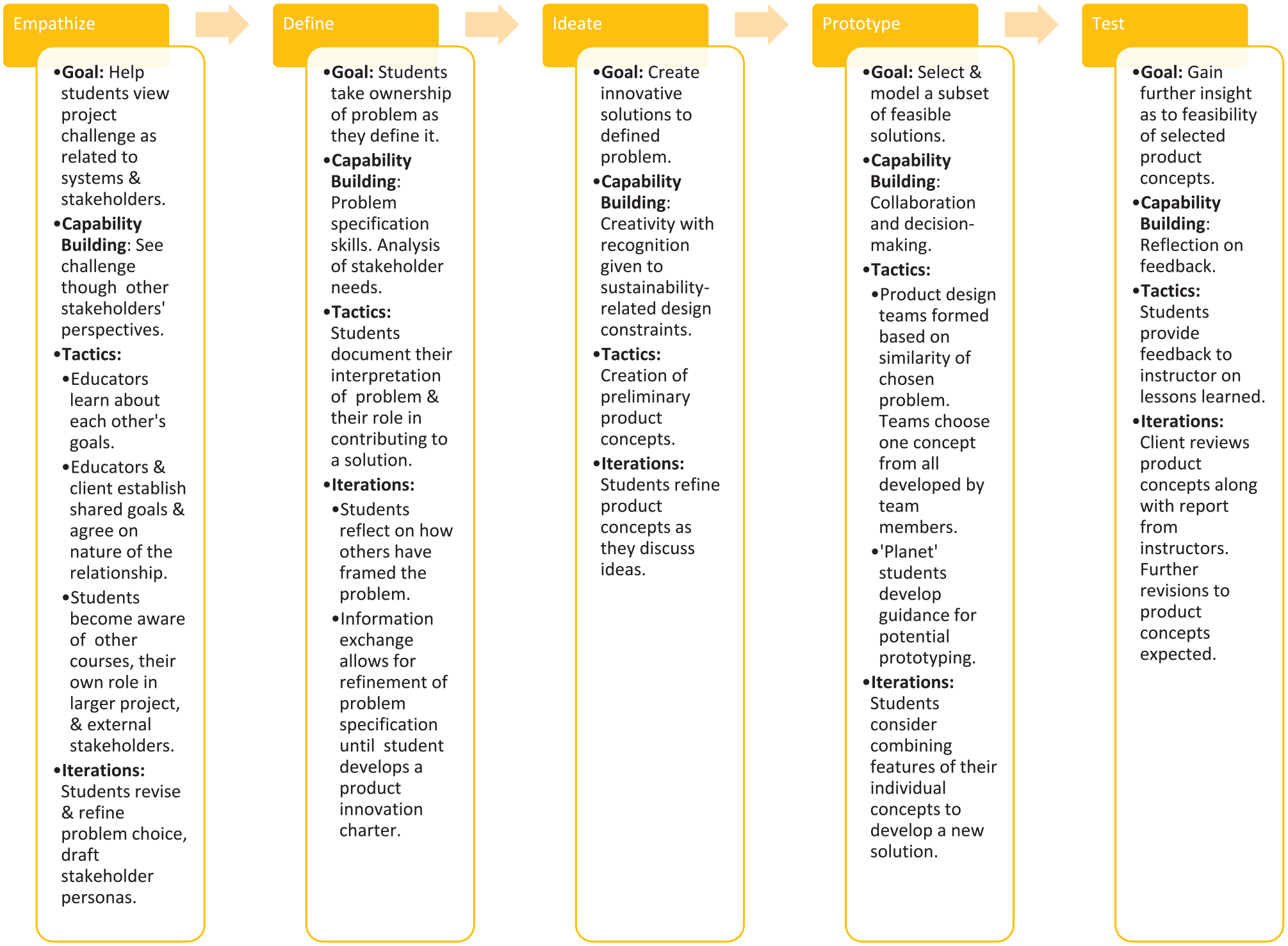
Design Thinking Roadmap
Empathize
This step’s goal is to build a common starting point for all stakeholders. Capability building is undertaken to help each major stakeholder group (representing people, planet, and profit) to view the sustainability-related problem from other stakeholders’ perspectives.
For educators to encourage empathy in the students, we must first develop it in ourselves. This was the first contact that Environmental Planning and Marketing faculty members had, instigated by the University’s support for greater interfaculty research. The educators needed to learn how each other’s course objectives related to sustainability. Sharing stories laid the basis for a positive working relationship and a greater appreciation of each other’s areas of expertise and what the students might be able to bring to the work. Each course structure was altered to facilitate the project, including adjustments in assignments and course interactions.
As part of an inclusive design thinking process (Källström & Siljeklint, 2021), the client (the Trust) and the educators needed to come to a shared understanding of what might be possible through working together (Otinpong, 2021). Part of the initiative behind the project lay in the lengthy historical involvement of the University with both the Lake and the Trust. The strength of this positive relationship meant that there were no formal arrangements required to enable the project to proceed once the Trust’s management committee generated the idea. In client-centered, real-life projects, educators often serve as relationship facilitators between students and other stakeholders (Bove & Davies, 2009; Frontczak, 1998).
In this phase, students became aware of how their course work related to the work of students in the other two courses. Each lecturer had a voice in the development of the project descriptions used by the other courses and embedded references to these other projects in their own tutorials and lectures. In addition, students could physically meet in a combined class at both the project kick-off and during a mid-project real-time data analysis session. Instructors for all three courses and a Trust representative gave a presentation for the Marketing Research course, briefly outlining the current environmental challenges of the Lake. With this presentation in mind, teams in this course were encouraged to discuss possible directions for their research before deciding which topics were most critical to know more about to service the needs of Product Design students and the Trust.
A preliminary understanding of the overall challenge and each course’s specific role in it was gained during the kick-off class. Marketing Research students were charged with taking a baseline assessment of whether and when local and regional residents in areas of close proximity to the Lake accessed the Lake or its environs, their needs (recreational, educational, consumptive) that might fit with the Lake’s resources, why they might not be using it, and what might encourage them to use it. These students were made aware that their statistically valid quantitative research findings could inform the development of goods, services, and events benefiting the communities around the Lake and its potential visitors.
Product Design students became aware of their need to account for the Lake’s unique environmental resource and governance issues as social dimensions of their decisions. Later, these students investigated the agendas and concerns of relevant stakeholders of the Lake, including recognizing how decisions about the Lake were governed and how gaining (or not gaining) stakeholder support could affect a product concept’s probability of success. Throughout the semester, design students were encouraged to visit the Lake to become more attuned to the area’s unique nature. Students were asked to develop their awareness of environmental constraints by reading previous research commissioned by the Trust, including estimates of financial returns to local landowners and communities associated with current use of the Lake, the lack of awareness of lake-related recreational opportunities, recreational and agricultural impact on water quality, and impact on the Lake of local communities’ lifestyles.
Using these resources as a starting point, Product Design students were also expected to conduct independent research to broaden their understanding of the environmental system relevant to wetlands. Additional resources provided student support in gaining a “big picture” worldview fostering recognition of the wider impacts of their decisions. These included current reports on New Zealand agri-tourism, megatrends shaping the future of travel, and information on the SLOW LIFE philosophy: Sustainable, Local, Organic, Wellness, Learning, Inspiring, Fun, Experiences. This body of research helped students draft persona profiles—fictional representations of key stakeholders’ characteristics, needs, and goals to keep in mind during the design process.
Define
Information gathered in the Empathize stage is synthesized in the Define stage. “Wicked” problems have no definitive formulation; the way they are described put the design team on a path toward possible solutions (Rittel & Webber, 1973). Therefore, the transition between Empathize and Define encouraged students to revise and refine their choice of what aspect of the sustainability challenge they wanted to focus on. Problem framing changed as design teams assessed each new layer of information provided or gathered. The Define phase also involved the client, faculty, and students engaging with each other in the quest to define the problem to the point where action could flow from that definition.
Each Marketing Research team recorded and explained their decisions about which potential topics were critical for the overall project in the form of Executive Summaries. These Summaries were then given to and assessed by the Product Design student teams who, by this time, had developed product innovation charters based on the background research undertaken. Executive Summaries judged as best meeting the needs of the Product Design students were chosen for further development. These highest-ranked Summaries and feedback from both course instructors and the Product Design students were made available to all Marketing Research teams. This feedback approach approximated the numerous meetings that marketing researchers have with clients as they define their scopes of work. The public nature of the feedback allowed teams to learn from others evaluated as following “best practice” and adjust their problem choice accordingly (i.e., Marketing Research teams moved their focus to a topic covered in one of the Executive Summaries that the Product Design students rated highly). The Marketing Research teams each designed research questions, hypotheses, and justifications for these questions based on their interpretation of the Executive Summaries ranked as “best.” The teams then designed interview questions to measure the constructs associated with their research questions and an analytical framework for testing their hypotheses. The questions from all of the Marketing Research groups were compiled into one list that was subsequently condensed into one questionnaire. The best questions and standardized responses were retained, streamlined, and appropriately formatted.
Google Maps was used to facilitate the development of the sample frame (address lists and maps) of households within 20 km of the Lake, which were then assigned to Marketing Research teams. After a training session, teams completed 10 door-to-door interviews over a weekend and three weekdays with residents from their assigned address list. They then entered the data into SPSS, compiled descriptive data for the sample, and tested their hypotheses.
The Product Design students were invited to attend a Marketing Research class where real-time analysis of student hypotheses was carried out by the instructor. The choice of which hypotheses were tested was based on student requests. In this way, the inquiry was both dynamic and fun, with the goal of motivating Product Design students to work with the research results in developing their product concepts.
By the end of this phase, students drafted “How might we . . .?” statements that translated the larger design challenge into a unique design direction. For example, one student highlighted a problem frame of “How might we avoid conflict between locals and tourists?” which then guided his concept generation efforts.
Ideate
Product Design students interpreted the overall challenge as a meaningful problem to solve in the Define phase, taking into consideration the Marketing Research students’ preliminary findings and environmental constraints. As the Define stage transitioned to the Ideate phase, students identified patterns of consumer needs related to the problem as framed for the persona profile developed. In Ideation, innovative solutions to the defined problem are created.
In-class exercises were used to familiarize students with a range of concept generation techniques, including designing for low-impact use or materials, concept classification trees, creative matrices, and storyboarding (LUMA Institute, 2012; Ulrich et al., 2019). This practice allowed students choice in how they developed potential solutions to the problem as framed. While the work was individual at this point, students regularly discussed their ideas with other students and, sometimes, those with insight on stakeholders (e.g., potential users).
Concepts ranged from events (e.g., an eel festival) to government services (e.g., a dynamic pricing model for allocating public camping spots) to community services (e.g., an “Enviroground” playground allowing children to learn about the ecology of the area from how their playground experiences were designed) to consumer products (e.g., a children’s book incorporating tactile elements connected to the Lake environment) (see Tables 1 and 2).
Project Examples.
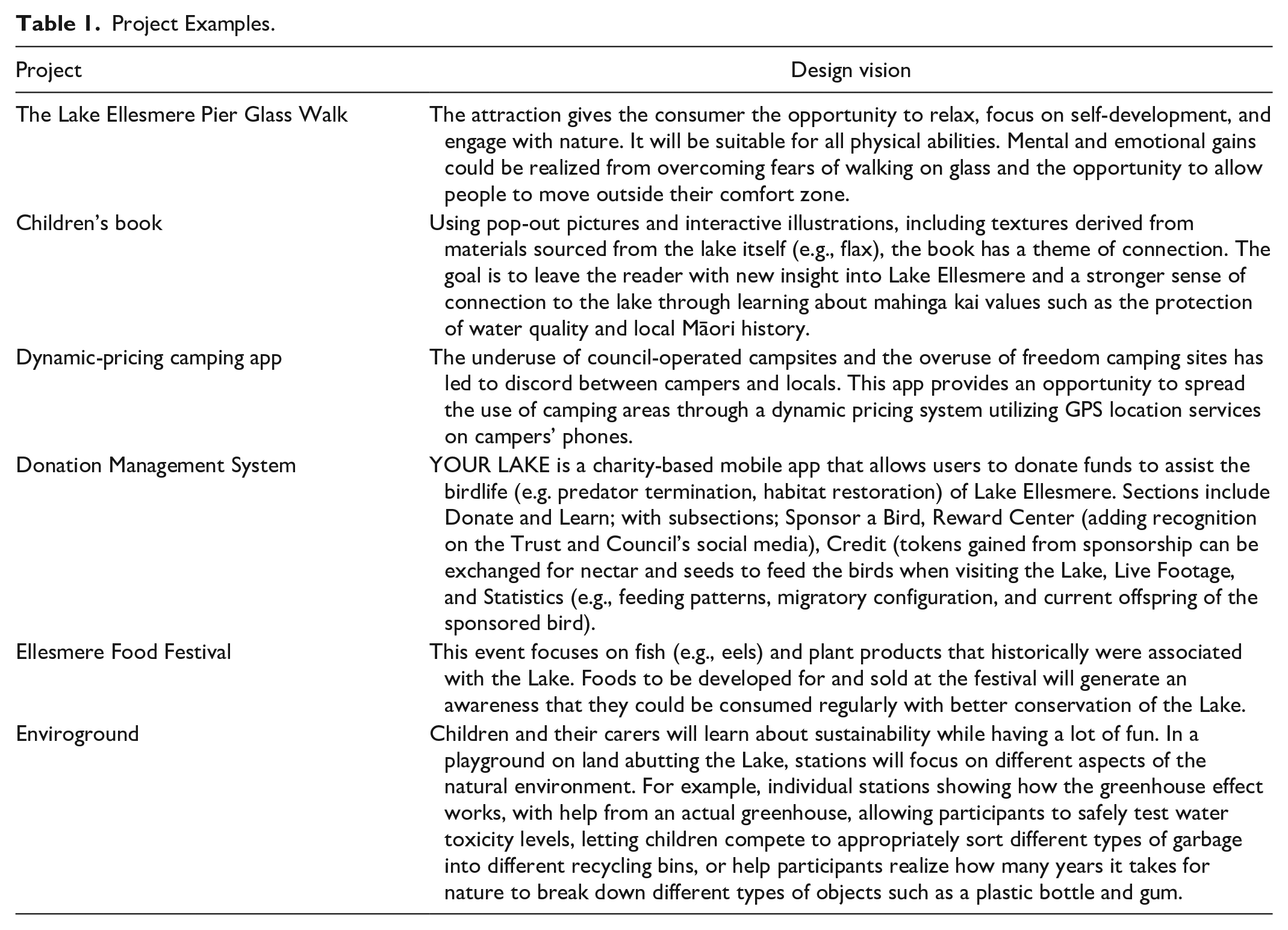
This phase was summarized with students reporting about their work leading to, and including, the product concept. Service flow diagrams, storyboards, and user interfaces are some ways that product concepts were visually represented in these reports.
Prototype
The aim of the Prototype stage of Stanford’s Design Thinking model is to identify and model a subset of possible feasible solutions.
After the Product Design students submitted their individual proof-of-concept reports, students working on similar consumer needs were placed into teams. Moving from working on an individual basis to working in a team was chosen to both deepen and broaden each student’s perspective on market opportunities and environmental constraints. Each student introduced their product concept to the team who then brainstormed ways each product concept could be improved (e.g., by combining features of other product concepts or through industrial design enhancements). In this way, each product concept was in its “best” form before the start of the subsequent concept selection process. Teams then chose one product concept from all of those designed by the individual team members that they could justify as best meeting the design challenge.
Each team was allocated 15 min to present their agreed-upon concept and describe their concept selection process. Part of this selection process was a careful consideration of potential environmental constraints or repercussions should their product concept then move to the development stage. Models such as dioramas, functional mock-ups, and videos representing the product concepts in use were used to visually represent the chosen product concept.
For this phase, Environmental Planning students received details of the product concepts chosen by the Product Design students and developed guidance for potential prototyping. For instance, a visitor center and triathlon event were investigated in terms of potential impacts on the Lake and relevant environmental regulations that product designers would need to be aware of before developing actual pilot projects or prototypes. Unfortunately, there was insufficient time for this guidance to come back to the Product Design teams in time for consideration within their concept selection process.
Test
In the Test phase of Design Thinking, prototypes are analyzed, refined, and piloted. The Product Design instructor reviewed and provided feedback on all student submissions. The faculty team then discussed the range of product concepts and forwarded to the client all of the reports along with comments about which product concepts appeared to show the most merit.
The management committee of the Trust was kept informed of progress by the Environmental Planning lecturer. The project occurred at a time when the Trust was reconsidering its strategy. Many initial projects toward its long-term community plan for the Lake had been about addressing biophysical problems, complex governance arrangements, and better water and land use management to reduce pollution. Its members, predominantly local residents, farmers, hunters, fishers, birdwatchers, aquatic sports enthusiasts, and environmentalists, had skills and knowledge that reflected the early thrust of the Trust’s work.
Now that substantial progress had been made to address biophysical and governance issues, Trust members felt a need to turn their attention to the rapidly growing suburban population’s (the district has one of the fastest growth rates in New Zealand) orientation toward urban Christchurch. How to connect this new population to the Lake and how to engage them with it was something recognized but largely outside the Trust’s previous experience and expertise. The new ideas (e.g., the eel festival) and the data collected from the surveys (especially the more positive attitudes toward the Lake recorded by those who had used it for recreational activity) gave the Trustees much increased confidence in their new strategic direction. As of January 2020, the Trust started pushing forward with the first of these ideas and found that the new ideas have attracted new, younger interest in the Trust and involvement with it.
Stakeholder Experience and Managerial Challenges
Outcomes include student reflections, Trust member responses to the projects, appraisals of the educators involved in this project, and a convenience sample of other educators with an interest in teaching sustainability.
In the words of one student, these projects helped develop awareness that there is a great opportunity to “see Lake Ellesmere become more recognisable for the right reasons and ultimately provide a return to the locals.” Another was pleased to work on a project that could potentially prevent the social problem where “biological diversity is often overlooked.” In addition to being more sensitive to sustainability from environmental and profit perspectives, students can strengthen their cultural intelligence through experiential learning (Kurpis & Hunter, 2017). One student visited the local marae (a meeting house where Māori cultural values are reaffirmed) as part of her research. She was inspired to fill the need of the “people who have lived in Selwyn their whole life, yet have little understanding around the historic values and ties people have to the land in and around Lake Ellesmere.” An exchange student suggests the potential for cultural ripple effects of the experience in saying “Even though I spent the most time on your course, it’s the one I appreciated the most and I will take everything I learned with me back to Sweden!” Course evaluation comments from Environmental Planning students included “how much there is to learn in a simple small site,” and how challenging they found it to plan to protect the environment if product concepts benefiting the community and potentially benefiting the Lake in the long term were implemented.
In addition to the experiences of the Trust described in the Test phase, interviews with trust members provided further feedback on their experience with the project: Because so few people have been there, the more people we can engage, the more likely it is they will begin valuing the lake and supporting policies, or making sacrifices, to improve the lake. I wonder if it is worth doing exhibitions for four-wheel drive and off-road motorcycle enthusiasts on where (and when) they can use trails around the lake without harming local ecology. If people are concerned about water quality, could we engage them through riparian planting exercises that are designed to improve lake water quality?
Both statements suggested that for Trust members the value of this project was not primarily related to the economic incentives that locals would benefit from, but, rather, in generating potentially pro-social behaviors toward the Lake itself. The second quote reflects an idea voiced during our interviews with other educators about the potential benefits of student projects serving as an idea generation starting point for the larger community.
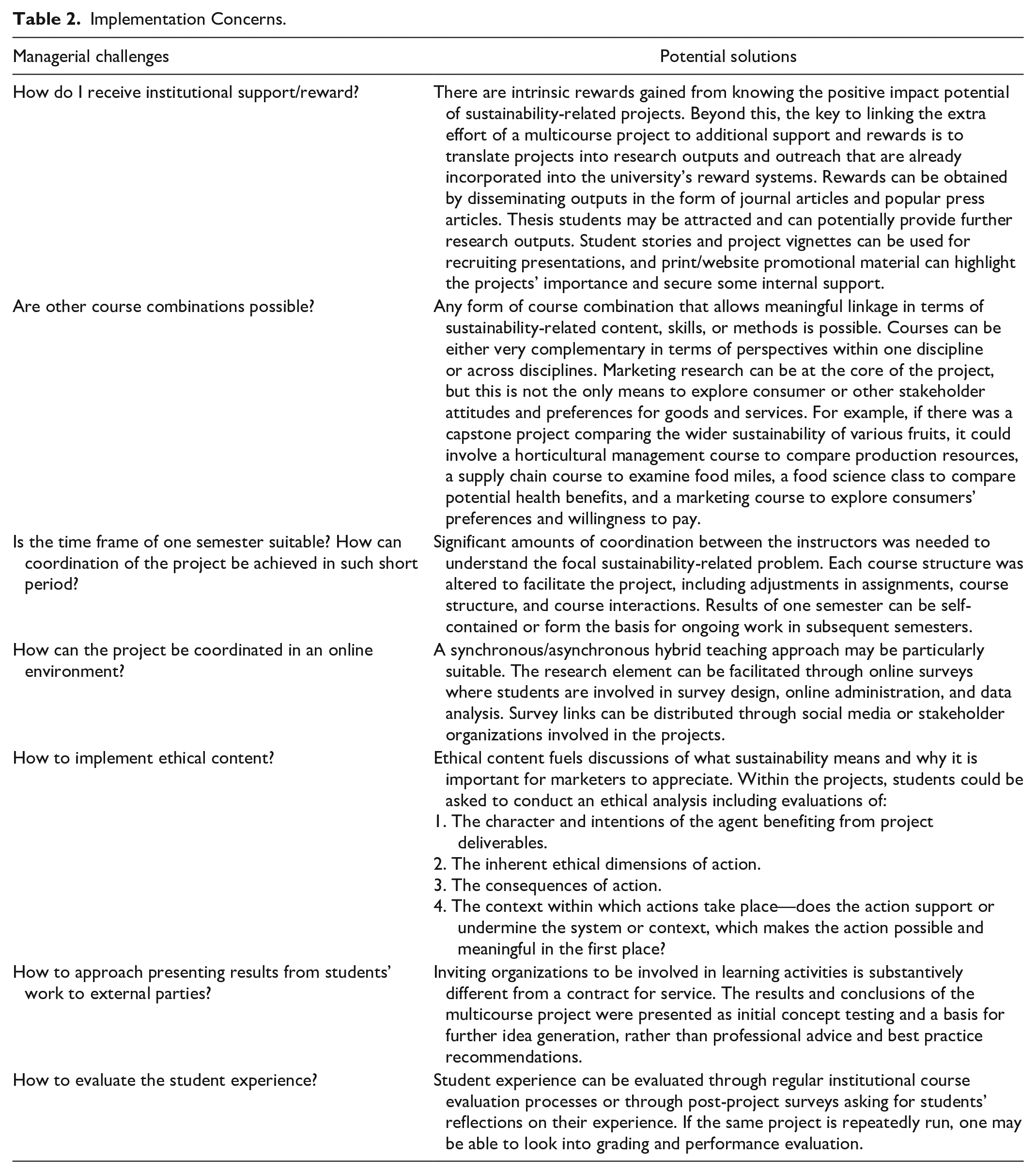
To encourage other educators to consider “hacking the system,” academics from the disciplines of marketing, business and management, and applied sciences, such as horticulture and agriculture, were asked to comment on the project and potential challenges in implementing similar projects for themselves. These disciplines were deemed appropriate as they complemented each other’s knowledge and skills related to collaborative projects dedicated to sustainability and the use of land and resources (Margerum, 2011; Velten et al., 2021). The sample comprised eight academics who were interviewed via phone, Zoom, and email. The interviews took place using German and English according to interviewee preference and were translated by one of the authors, a native German speaker. Each interview lasted 10 to 20 min. The sampling approach used was non-random, involving members of the researchers’ communities who were accessible, available in a short time frame, and willing to be interviewed (Etikan et al., 2016). The academics had a minimum of 5 years of teaching experience and some form of experience with educational design and collaboration.
Implementation Concerns.
Discussion
The goal of enhancing a community’s quality of life may conflict with the concomitant goal of not harming the environmental system. A goal of this project was to explore how well students could harmonize these potential conflicts. From the educator and Trust’s evaluation of the projects delivered, the majority of participant students thoughtfully considered system-level implications of the products designed.
By acting as both consumers and providers of information, students gained an appreciation for the interdependencies of client/consultant relationships to a level unlikely reached by lecture material alone. Students worked through the “fuzzy front end” of the project overall and their course’s role in it. Their individual projects helped ready them to participate in employment where marketing managers are not often given tightly specified project descriptions, but rather ones that emerge from active engagement with clients.
The iterative process involved in moving from initial views of the problem (e.g., the Marketing Research students’ Executive Summaries) to working with the amended problem definition (e.g., resulting from the Product Design students’ ranking exercise) builds the ability to flexibly respond to the changing expectations many marketing managers experience. For Marketing Research students, designing the survey instrument and using face-to-face data gathering allowed them to appreciate their role as conduits of the voice of the consumer in a way that using existing datasets was unlikely to accomplish. The creativity of the Product Design students was shaped by their newly acquired awareness of environmental and social systems. Environmental Planning students gained an appreciation of the range of possible innovative uses that an environment might have. The innovative nature of the proposals meant that there were no models or guidelines to draw on. This increased the need for these students to think more for themselves and realize the extent of the issues they needed to come to grips with.
In one instance, Environmental Planning students, on an impromptu site visit to an “open to the public” recreational reserve, were accosted by local hut owners. It emerged that hut owners who have licenses to live on the reserve had that week become embroiled in a major environmental planning conflict with the local council. This resulted in a quick phone call to the instructor who drove to the huts to allay concerns that the students were secretly working for the council. This added a much-enhanced understanding of the sensitivities around planning issues to the students in a way that could not have been simulated.
Limitations and Future Direction
Hindsight and reflection provide us with direction for the future. The following section discusses the limitations of the project and makes recommendations for improvements.
We consider whether centering the research on the same topic but using a logistically easier data gathering approach would affect data quality. Using an experiential team-based learning approach is difficult logistically and considerably more work than a traditional lecture- and test-based course. The Marketing Research instructor, for example, would have more control by using a pre-developed dataset with guided analytical steps. While logically this would be more efficient than having students gather their own data, it is worthy of examination to see if a change to a pre-developed dataset might lessen the ability of these students to really connect to the voice of the customer.
Considering moving toward a pre-developed data set is but one way to make the implementation of a similar project more efficient. Sending students to collect data door-to-door is stressful. This part of the process requires a significant investment in planning, including notifying the local police that students will be conducting surveys in certain neighborhoods should they receive any concerned calls. Answering Crittenden and Peterson’s (2019) call to provide educational experiences incorporating digital technologies, door-to-door visits may be better replaced by online data collection. Online surveys have the advantage of speedy completion rates and can be distributed through community pages on social media or through community organizations. Students would still be involved in survey design, administration, and data analysis.
While we focused on outputs (the projects), we would focus more on outcome measurements if we were to repeat this project, where we would measure changes in students’ awareness of sustainability issues before and after project engagement. Findings could shed light on if and how student perception of a macro-/micro-marketing dichotomy changed over the semester. In addition, we would test whether students felt that they gained anything especially valuable from the integration of experiential learning (Li et al., 2007) or this project’s multicourse structure compared to years when each course ran more self-contained projects. If possible, a longitudinal study of participant decision-making after entering the workforce would be desirable. Yet, we are cognizant that organizational culture and other influences could far outweigh the potential effect of one University project on students.
While class timetables precluded arranging joint face-to-face sessions, more opportunities for interactions between our “planet,” “people,” and “profit” students could be facilitated using digital technologies (Crittenden & Peterson, 2019). The timetabling for the major assignment components in courses also meant it was not always possible to feed material from one course assignment to the others in a time frame to enable the new information to be readily taken on board. Wiese and Sherman (2011) describe a funded, interdisciplinary project with a 2-year time frame where environmental studies students identified waste stream problems that social marketing students subsequently developed mitigation strategies and plans for. In future iterations of this project, one semester’s results can remain self-contained or could form the basis of ongoing work in subsequent semesters. For example, we could seek funding for resources to facilitate greater integration between the courses in one semester, have Product Design students use Marketing Research conducted in the previous year, or adopt a longer time frame than the current one used.
A synchronous/asynchronous hybrid structure could serve a multicourse project such as this. The synchronous part will allow knowledge and experiences to be shared between students and the instructor within one course and, depending on scheduling, between students in the three courses as well as external stakeholders. This can include discussing project progress and perspectives on the desired project outcomes. Some course elements, such as conceptually simple lectures, can be recorded for students to study in their own time. Online forums and shared drives storing work-in-progress may be other ways to encourage interaction asynchronously.
Different sustainability projects and courses could work with similar exercises. The authors suggest including a research course (Marketing Research as we used or an alternative such as a social research course), a course focused on the sustainable use of natural resources (in our case, the Environmental Planning course or we could have used a sustainability-themed course), and a strategic or tactical commerce course (e.g., while we used Product Design, students in a social marketing course could develop strategies and tactics for encouraging pro-sustainability behaviors). An initially unexpected extension of this project arose from the combined results of the project described here being fed into a postgraduate environmental law course the following semester. Integrating required courses that marketing students would take before the third-year Marketing Research or Product Design course (such as our 200-level required social marketing course) may provide a deeper and richer learning experience (Craciun & Bober Corrigan, 2010). Alternatively, students in an event planning course could examine the tactical side of bringing these projects to life. Ideally, we could design this as a single capstone course with breakout sessions based on what part of the overall project a student was contributing to, and more collaborative sessions.
Conclusion
In summary, infusing sustainability and a systems perspective into the student mind-set is no longer “nice”; it is critical. Here, we presented a multicourse project intending to accomplish this particular challenge with the all-too-often ignored connection of macro- and micro-marketing at its very core. Product concepts developed throughout the project gave preliminary evidence that our goal was accomplished.
Even though this first iteration of the collaboration was challenging, the need to transform the practice of marketing and the education of future marketers is too important to not continue. Educators considering “hacking the system” by putting sustainability issues in the center of students’ development may be helped along their own learning curves by the roadmap contained in this paper. The essential basis of this roadmap is the application of design thinking as a means to multicourse project design. This is particularly suitable as design thinking allows educators to execute fundamental learning theory. In a design thinking-based course, students experience the most basic as well as the highest forms of learning (Bloom, 1956) given that the process of iteration leads from elementary understanding to creation.
The authors believe that the value potentially realized from delivering the type of learning opportunity described in this paper made the effort worthwhile. It is time for educators designing marketing curricula to prioritize the development of “big picture” critical thinking skills that marketing needs, particularly in these times of global uncertainty.
Footnotes
Declaration of Conflicting Interests
The author(s) declared no potential conflicts of interest with respect to the research, authorship, and/or publication of this article.
Funding
The author(s) disclosed receipt of the following financial support for the research, authorship, and/or publication of this article: This work was supported by the Centre of Excellence, Sustainable Tourism for Regions, Landscapes and Communities (grant number KS3).
