



Abstract
Design thinking refers to the implementation of a firm’s design philosophy into design processes and outputs. This article introduces two design thinking approaches—user-centered design and design-driven innovation—that frame product design activities and show how these approaches can be incorporated into marketing curricula. The aim of this article is to show how marketing educators can help students appreciate and understand the processes and consequences of developing new products using different design thinking approaches. First, an experiment is conducted to examine the effect of design thinking approaches (user-centered design, design-driven innovation) on design and marketing outcomes (perceived originality, perceived usefulness, and perceived value). Second, based on the results of the study, the article develops a step-by-step guide on how to execute a design thinking module in a product-oriented marketing course.
Keywords
Contrary to Apple’s reputation as a design leader in the contemporary marketplace, this was not always the case. Through the 1980s and most of the 1990s, Apple was a minor player, operating in the shadows of a PC-dominated world. In fact, with too many product lines that were underperforming, the company was struggling to stay in business. The company initiated a turnaround in 1998, when Steve Jobs announced the launch of the Apple iMac G3, a computer that leveraged heavily on its product design as a selling point (the computer’s specifications were iterative improvements over previous iMacs and less powerful than contemporaneous PCs). The iMac G3 was initially met with negative reviews that its emphasis on form over function, such as the odd looking hockey puck mouse or lack of a floppy disk drive, will lead to yet another failure for the company. However, when the iMac hit the market, consumer sales spiked and it became an important turning point for Apple. The success of the iMac G3 proved that the computer’s colorful, translucent shell, and unorthodox curves were welcome injections of personality in a sea of utilitarian, standard, beige-colored PC boxes. The success story of the iMac G3 also speaks to the power of integrating product design and marketing strategy.
Product design refers to “the process and result of determining the physical execution and arrangement of the characteristics of a product offering” (Creusen, 2011, p. 405) and it is significant from both managerial and consumer standpoints. For the firm, product design is a means of differentiation and visual recognition which can provide competitive advantages (Homburg, Schwemmle, & Kuehnl, 2015; Jindal, Sarangee, Echambadi, & Lee, 2016; Noble & Kumar, 2010). For consumers, product design plays a major factor in product purchase (Bloch, 1995; Creusen & Schoormans, 2005; Kumar & Noble, 2016; Landwehr, McGill, & Herrmann, 2011), brand attitude formation (Franzak, Makarem, & Jae, 2014; Kumar, Townsend, & Vorhies, 2015), and identity formation (Bloch, Brunel, & Arnold, 2003). In these ways, product design is closely tied to firms’ marketing strategies (Bloch, 1995).
In recent years, product design discourses have intersected with “design thinking,” which refers to the implementation of an organization’s design philosophy into product development processes and outputs (Brown, 2008; Chen & Venkatesh, 2013). Design thinking is the “state of mind” (Venkatesh, Digerfeldt-Månsson, Brunel, & Chen, 2012) in which processes are organized and steered toward different outcomes. For instance, a firm might proselytize a user-centered design (UCD) approach that emphasizes end-user needs, and as a result, incorporate more user-oriented design processes (Dahl, Chattopadhyay, & Gorn, 1999; Veryzer & Borja de Mozota, 2005). Meanwhile, another firm might reject a strict end-user focus and articulate a “design-driven innovation” (DDI) philosophy, which promotes the development of radical product aesthetics (Verganti, 2008), and steer design processes and outputs in different trajectories. By understanding the different design approaches, firms can select the best one that helps them achieve their marketing objectives.
The aim of this article is to show how marketing educators can help students understand the processes and consequences of developing new products using different design thinking approaches. Specifically, the purpose of the article is to (a) show how two product design techniques (UCD and DDI) produce different marketing outcomes and how these outcomes can be taught to students to increase their awareness of how design plays into marketing strategy and (b) outline a marketing course module that introduces UCD and DDI product design approaches to marketing educators and students. The module can be deployed in various product-oriented marketing courses, such as New Product Development, Product Management, and Marketing Research.
The results of this article extend marketing education’s foray into product design and design thinking spaces. For example, scholars discuss the need to integrate design thinking to enhance business students’ creative outcomes, but fall short of providing pedagogical frameworks for design thinking (Glen, Suciu, & Baughn, 2014; also see Dunne & Martin, 2006). Marketing education scholars seem to fill this gap by outlining creativity exercises, which seek to enhance the quality of student ideas (Eriksson & Hauer, 2004; McCorkle, Payan, Reardon, & Kling, 2007; McIntyre, Hite, & Rickard, 2003; Titus, 2007). Yet these papers develop bespoke approaches that are (a) different than design thinking approaches and (b) not commonly used in practice. Meanwhile, scholars that do provide design thinking exercises focus on only one style of design thinking (Love, Stone, & Wilton, 2011). In short, extant studies do not recognize that different design thinking approaches result in different outcomes, a point that this article will seek to remedy by juxtaposing two practitioner-based approaches—UCD and DDI—in a product design setting.
The rest of the article has the following organization. First, we articulate design thinking’s relevance to marketing education. Then, we provide a conceptual background of the UCD and DDI design thinking approaches. Next, we share the results from an experimental study that demonstrates the differential impact of UCD and DDI approaches. Following that, we outline procedures for implementing a course module on design thinking that focuses on UCD and DDI approaches. Finally, we discuss how the study contributes to the marketing education and practice.
Design Thinking in Current Marketing Education
Ideally, marketers should play the dual roles of product manager and product designer. Although product managers’ core function is to strategically manage the marketing mix, being well-versed in design functions can create significant competitive advantages in terms of facilitating communications with designers and organizing activities that crossover with the design process (e.g., integrating design ethnography into marketing research) to produce unique and useful product attributes and benefits. According to Bloch (1995), an effective manager is “aware of the design process and how the various constraints interact with the process so that he or she can make successful decisions regarding these trade-offs” (p. 19). The point is that managers can improve their firm’s marketing strategy by focusing on design outcomes.
Yet in many product-oriented courses, a new product idea/prototype is evaluated based on the innovativeness of the product, without considering how it serves the firm’s strategic purpose. For instance, an online review of product-oriented courses reveal that courses offered by industrial/mechanical engineering departments or specialized product design programs emphasize the technical aspects of product design, while courses offered by marketing departments emphasize the product research or management process of new products. In product-oriented courses that include a new product idea/prototype development activity, the value of the new product idea/prototype is measured by inviting industry experts as judges to evaluate the idea/prototype or having students submit their idea/prototype to competitions at the end of the semester.
Additionally, product development courses are likely to employ creativity frameworks, as opposed to design thinking methodologies, to enhance student creative outcomes. Examples of creativity frameworks include the creative marketing breakthrough model (Titus, 2007), mind map marketing (Eriksson & Hauer, 2004), and the Torrance Test of Creative Thinking (McIntyre et al., 2003). While creativity exercises are successful in increasing the quality of student ideas, the exercises are different than design thinking methods, which are more commonly adopted in practice.
In recent years, pedagogical scholars have begun the process of formally integrating popular design thinking into business education (Dunne & Martin, 2006; Glen et al., 2014). Scholars have often adopted design thinking methods informed by a user-centered approach (Love et al., 2011; also see Beckman & Barry, 2007). Yet these studies focus on one style of design thinking, and as a result, do not implicitly recognize that differential outcomes that may arise out of the adoption of different design thinking approaches. This article seeks to address this specific limitation of the marketing education literature.
Design Thinking Approaches
At the onset of new product development, firms can implement a number of different design thinking approaches to develop products and services (Chen & Venkatesh, 2013). Two approaches to which scholars have devoted substantial attention are UCD and DDI. Both design thinking approaches are philosophically distinct and the strict adoption of either approach can result in very different design and marketing outcomes.
User-Centered Design
UCD refers to a design thinking approach where designers get close to consumers to better understand their needs and wants (Veryzer & Borja de Mozota, 2005). UCD considers consumers as a source of product innovation (Rosenthal & Capper, 2006) and involves thinking about the consumer during design processes (Dahl et al., 1999). Proponents of UCD argue that products, services, and interfaces should work around consumers’ needs and wants as opposed to forcing consumers to change and accommodate new system changes (Park, 2011; Veryzer & Borja de Mozota, 2005). Thus, a key UCD activity is problem discovery, where marketers and designers conduct in-depth research to uncover unarticulated problems which consumers face in their everyday lives (Rosenthal & Capper, 2006). The solutions to these problems are the basis of product innovation.
Theoretically, UCD intersects with job mapping innovation discourses. Job mapping is a customer-centered, product innovation approach, which involves breaking down a job a customer wants done into discrete steps (Bettencourt & Ulwick, 2008). By analyzing these steps, scholars can identify problem areas and devise solutions, which serve as the basis for product innovation (Bettencourt, Brown, & Sirianni, 2013). The concept of job mapping stems from a service-oriented approach to value creation, which shifts the focus in marketing from a product-centered perspective to one that emphasize how a service helps customers get a job done (Bettencourt, Lusch, & Vargo, 2014). Bettencourt et al.’s work suggests that job mapping can help firms overcome incremental innovation, which some scholars believe to be a limitation of customer-centered approaches (Norman & Verganti, 2014).
UCD informs the product design processes of organizations such as the global design firm IDEO, which uses consumer information to stimulate product ideas (Hargadon & Sutton, 1997; Kelley & Littman, 2006). Another example is Perkins Solutions. In developing the SMART Brailler, Perkins designers examined the core writing issues that confronted blind consumers. For the blind, personal computers and typewriters are functionally useless writing solutions; blind users have to adapt to a user interface that favors sighted consumers (e.g., QWERTY keyboard) and standard computers cannot generate haptic, braille type. Based on their observations, Perkins designers developed a typewriter where the user can combine a limited set of Braille symbols to generate a full range of braille vocabulary. As the user brailles on paper, the SMART Brailler voices out letters for the user and their sighted compatriots. Sighted consumers can see what is being brailled through a video screen that translates the words being typed. In short, the SMART Brailler is one of the first writing solutions inspired by and designed around the needs and wants of blind consumers.
Design-Driven Innovation
On the other hand, DDI mitigates the appeal to consumers’ needs in favor of pushing the “firm’s vision about possible new product meanings and languages” (Verganti, 2008, p. 436). With DDI, breakthrough innovation is achieved through the radical reinterpretation of product meanings, language, and form (Dell’Era & Verganti, 2009; Verganti, 2011). DDI is premised on the idea that consumers cannot always provide feedback that lead to innovation (Christensen & Bower, 1996). Rather, by focusing on radical product aesthetics, firms can gain differentiation and competitive advantage (Acklin, 2010). Consequently, proponents of DDI recommend firms to “push their vision about possible breakthrough meanings and product languages that could emerge in the future” (Verganti, 2008, p. 438).
DDI emerges from the theory of radical innovation. Scholars generally recognize two categories of product and service innovations. The first category is incremental innovation, which represents an iterative improvement to extant solutions; and the second category is radical innovation, which represents a totally new solution never before considered (McDermott & O’Connor, 2002). Firms, especially those in rapidly evolving industries, need to invest in radical innovation processes to better match or predicate changing customer needs (Slater, Mohr, & Sengupta, 2014). Scholars have demonstrated that UCD approaches are well suited for achieving incremental innovation, while other approaches are needed to achieve radical innovation (Norman & Verganti, 2014). Consequently, scholars have outlined various models to help firms reach radical innovation capacity, of which DDI is one (Slater et al., 2014; Verganti, 2008).
An example of DDI implementation is Alessi’s “family follows fiction” line of kitchenware (Verganti, 2008). Produced with colorful plastics, Alessi’s “family follows fiction” products are as much toys as they are tools. Their playful form factors render them distinct relative to competitors’ product offerings. By focusing on radical product aesthetics, Alessi successfully transformed kitchenware from functional tools to affectionate objects that touch on human emotions. Alessi’s R&D team conducted little to no user research during product development.
Using Design Thinking to Achieve Marketing Outcomes
The effectiveness of UCD and DDI approaches can be assessed relative to their impact on design and marketing outcomes. Scholars who study product design have identified several prominent outcomes. Perceived usefulness and perceived originality comprise the innovation construct and are commonly used by scholars to assess product design outcomes (Burroughs, Dahl, Chattopadhyay, & Gorn, 2011; Dahl et al., 1999). A product’s usefulness addresses the functionality, practicality, and the extent to which a product solves a problem and addresses consumers’ performance expectations (Besemer & O’Quin, 1986; Davis, 1989). A product’s originality is synonymous with its perceived newness or uniqueness (Kristensson, Gustafsson, & Archer, 2004; Moldovan, Goldenberg, & Chattopadhyay, 2011) and is often linked to its shape (Veryzer & Hutchinson, 1998) or features (Dahl & Moreau, 2002; Kristensson et al., 2004). Additionally, perceived value is a marketing outcome that can be used to measure product design success (Franke, Keinz, & Schreier, 2008).
Strategic Use of Design Thinking Approaches
In order for new product development to be successful, the firm’s product design and firm strategy need to be tightly intertwined (Bloch, 2011). In other words, product managers must be able to understand the synergistic relationship between design, strategy, and the brand identity (Borja de Mozota, 2003). The ultimate goal for all firms is to make profit, but how firms choose to achieve this goal will differ based on their brand identity. For example, Apple strives to be the market innovator, while IKEA strives to offer products at a lower cost than its competitors. These brand identities determine the design thinking approach adopted by each firm, where Apple is known to design its products without considering the costs or manufacturing practicality of the materials, while IKEA focuses on designing products for people with limited income and limited living spaces and “scrutinize every product idea with regard to the best use of raw materials and manufacturing opportunities” (ikea.com).
If strategically used, different design thinking approaches can enable firms to achieve their specific marketing goals. UCD is philosophically oriented around problem discovery and solution generation (Veryzer & Borja de Mozota, 2005). Many of these problems are practical in nature and their solutions provide touch points for making products that consumers value. Scholars suggest that adopting a UCD approach will yield product outcomes with more perceived usefulness (than adopting a DDI approach). For example, Dahl et al.’s (1999) study suggests that merely thinking about the end user during the design process will get designers to include features that enhances a product’s usefulness. If merely thinking about the end user increases perceived usefulness, then more rigorous methods associated with UCD, such as design ethnography, which involves prolonged observations of end users, would magnify a product’s usefulness (Rosenthal & Capper, 2006).
On the other hand, adopting a DDI approach will yield designs that are more original (than adopting the UCD approach), since DDI focuses on the reinterpretation of product meanings (Verganti, 2008). Additionally, the DDI approach may also enhance consumers’ perceived value of the product. Scholars have linked perceived value to product aesthetics (Bloch et al., 2003) in which consumers tend to place more value on products that they find more attractive. Since DDI, relative to UCD, is focused on product aesthetics, DDI may be the better design thinking approach if charging a price premium is the main marketing objective of the firm.
Product Type
The performance of UCD or DDI in new product development may also depend the product type. Marketing scholarship classifies products into two types: utilitarian and hedonic. Each type of product generates different consumption experiences (Bloch, 2011; Chitturi, Raghunathan, & Mahajan, 2007; Chitturi, Raghunathan, & Mahajan, 2008) and consumers expect to fulfill different goals with utilitarian products and hedonic products (Chernev, 2004). Specifically, utilitarian products have “functional, instrumental and practical benefits,” whereas hedonic products have “aesthetic, experiential and enjoyment benefits” (Chitturi et al., 2008, p. 49). While most products have both utilitarian and hedonic characteristics, generally utilitarian (hedonic) products refer to those that are relatively superior in utilitarian (hedonic) qualities (Dhar & Wertenbroch, 2000; Okada, 2005).
Consumers expect utilitarian products to provide practical and functional benefits (Dahl et al., 1999), while hedonic products are designed to appeal to consumers’ senses with more emphasis on the products’ form factors as opposed to user benefits (Bloch, 2011). Since UCD focuses more on addressing consumers’ practical or functional needs, while DDI focuses on addressing the emotional, hedonic aspects of product design, adopting the UCD approach to develop utilitarian products could maximize the usefulness of the product.
Alternatively, adopting the DDI approach to develop utilitarian products could enhance the perceived originality of the product. The theory of “moderate incongruity” sheds some light on this counterintuitive, “crossover” effect. The theory states that consumers positively evaluate product forms that are slightly different than prototypical forms within a product class (Campbell & Goodstein, 2001). Utilitarian products designed with a nonfunctional design are more likely to be perceived as more original than the typical utilitarian products designed with a functional focus (Veryzer & Hutchinson, 1998). For example, Alessi’s Juicy Salif is essentially just a citrus squeezer (i.e., a utilitarian product), but Alessi designers adopted a DDI approach to create its unorthodox, tripod shape, and were successful in positively shifting consumers’ perceived originality of the product. As such, adopting the DDI approach can boost the perceived originality for functional products by adding unexpected value through novel product form (Verganti, 2008).
Finally, using DDI to develop utilitarian products could result in higher perceived value for product designs than other combinations of design thinking approach and product type. As previously stated, scholars have shown that consumers hold more value for radical form factors (Bloch et al., 2003). Yet research has also shown that consumers may value utilitarian products that provide functional benefits (Chitturi et al., 2008). Therefore, the combination of DDI approach and utilitarian products may provide the highest level of perceived benefits by allowing consumers to enjoy both novelty and function at the same time (i.e., offering moderately incongruous benefits), and consequently elicit the highest perceived value from consumers.
The literature review suggests that the adoption of UCD and DDI may have differential impact on design outcomes. Based on this assessment, we posit that students can be “purposely” guided to design products that match specific strategic goals of the firm. Specifically, we hypothesize the following relationship between design thinking approaches and design and marketing outcomes.
To test the hypotheses, we conduct an experimental study to see if students can be guided to strategically use different design thinking approaches (UCD or DDI) to achieve specific design and marketing outcomes (perceived usability, perceived originality, and perceived value). Then, based on the results of the experiment, we outline a step-by-step product design module that can be incorporated into various product-oriented marketing courses.
Design Thinking: Experiment
Study Design and Procedure
The objective of this study is to empirically test whether purposely focusing on different design thinking approaches and product type when designing a product can lead to desired design and marketing outcomes (perceived usability, perceived originality, and perceived value). Dahl and Moreau’s (2007) methodological framework was adapted in a 2 (design thinking approach: UCD vs. DDI) × 2 (product type: utilitarian vs. hedonic) between-subjects experiment.
Ninety undergraduate business students from a large public university in the Western United States participated in the study for course credit. Students were recruited from a Principles of Marketing class, which is a required course for all business majors. Most of the participants were juniors (47%), followed by sophomores (44%), seniors (7%), and freshmen (2%), with a balanced split in gender (male = 54%). Age ranged from 19 to 50 years, with a median age of 22 years.
When participants arrived at the lab, they were randomly assigned to one of four conditions. Then, participants were seated at a table and were instructed to complete a product design activity of designing a doorknob. Doorknobs were selected as the design context for several reasons. First, opening doors is a mundane experience that most people encounter in everyday life. Second, door-opening solutions are easy to conceptualize and design, which is important for participants without an engineering or design background. Finally, the door-opening context affords opportunities for both utilitarian (i.e., mundane and functional) and hedonic (i.e., ornamental) solutions.
Design thinking approach was manipulated by providing a 10-minute tutorial of the UCD (or DDI) design thinking approach. After receiving the tutorial, participants in the UCD condition were instructed to design a doorknob that is “ergonomic and user-friendly,” while “considering the end-user and how they will interact with the doorknob.” Participants in the DDI condition were instructed to “focus on reinterpretation of product meanings” and to achieve a design that “pushes the boundaries of what a doorknob could be.” These instructions aligned with the information provided to participants during the tutorial. Product type was manipulated through the use-context of the doorknob, where participants in the utilitarian condition were instructed to design a doorknob for a public restroom setting and participants in the hedonic condition were instructed to design a doorknob for a kid’s playhouse. All participants were told to disregard economic, material, and regulatory constraints in their product design.
As part of the product design activity, participants were asked to (a) sketch a picture of their product design and (b) write a description of their product design. To emphasize “purposeful intent,” participants were asked to clearly indicate their design intent in their product sketch and product description. For example, participants were asked to address how the product design is user-friendly, ergonomic, and benefits the end-user (UCD condition) or how the design reinterprets product meaning and radically pushes the boundaries (DDI condition). Including the 10-minute tutorial of the UCD (or DDI) design thinking approach, participants spent an average of 30 minutes on the design task. On completion of the task, participants completed a short demographic questionnaire, were debriefed, and received course credit for participation.
Dependent Measures
Six judges, who were blind to the participants’ identities and the purpose of the study, were recruited to evaluate the three dependent measures. The judges were marketing managers with an average age of 27.3 years and an average of 6.5 years fulltime working experience. Five of the six judges were male. In terms of ethnic breakdown, two judges were White American, two were African American, and two were Hispanic American. Two judges were randomly assigned to evaluate one of the three dependent measures and received a binder containing participants’ product design ideas. To account for order effects, the order of product ideas was rotated in each binder. Judges were instructed to independently evaluate the designs with a 2-week turnaround deadline. Judges were asked to evaluate the design idea, as opposed to the draftsmanship quality of the product sketch.
The first set of two judges evaluated the perceived usefulness of the product designs. Judges completed three 7-point rating scales that measured usefulness (not at all useful/very useful, not at all practical/very practical, and not at all effective/very effective) for each of the designs. The coefficient alpha for the usefulness scale was fairly high for each judge (α = .94 and α = .74) and the interrater reliability of the scale between the two judges was .59. The second set of two judges evaluated the perceived originality of the product designs. Judges completed three 7-point rating scales that measured originality (not at all original/very original, not at all innovative/very innovative, and not at all creative/very creative) for each of the designs. The coefficient alpha for the originality scale was also high for each judge (α = .92 and α = .97) and the interrater reliability of the scale between the two judges was .78. To assess the perceived value of each design, a third set of two judges indicated the perceived value for each design on a scale anchored by $10 and increasing by $5 increments to an upper limit of $150. The interrater reliability of perceived value between the two judges was .76. All measures used in the study were drawn from previous research (e.g., Dahl et al., 1999; Dahl & Moreau, 2002). Perceived usefulness (1-7 scale), perceived originality (1-7 scale), and perceived value ($10-$150) of the two judges were averaged to create the dependent measures.
Analysis and Results
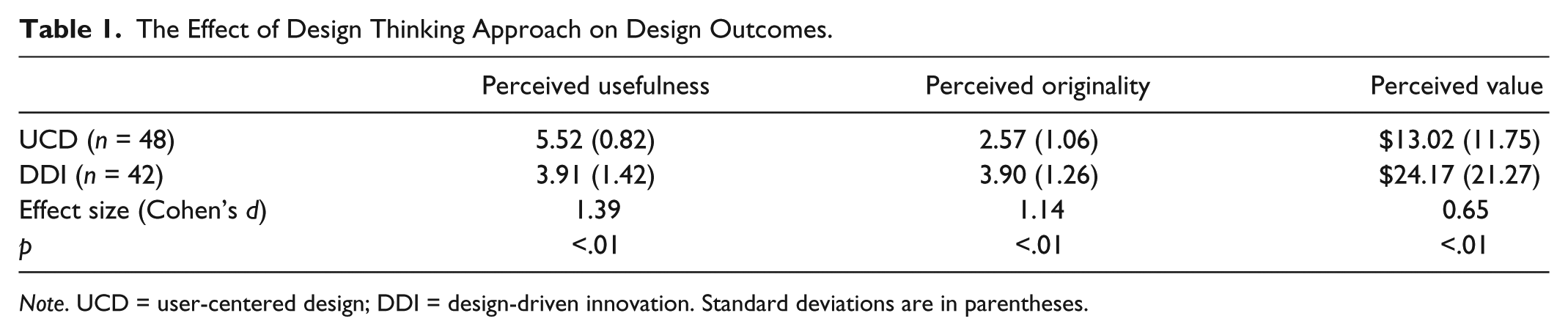
A series of analysis of variance with perceived usefulness, perceived originality, and perceived value as dependent variables and design thinking approach and product type as predictor variables were conducted (Tables 1 and 2). The results show that when participants adopt UCD, the design outcomes are perceived as more useful than if they adopt DDI, F(1, 88) = 44.57, p < .0001; MUCD = 5.52, MDDI = 3.91. On the other hand, when participants adopt DDI, the design outcomes are perceived as more original than if they adopt UCD, F(1, 88) = 29.54, p < .0001; MDDI = 3.90, MUCD = 2.57.
The Effect of Design Thinking Approach on Design Outcomes.
Note. UCD = user-centered design; DDI = design-driven innovation. Standard deviations are in parentheses.
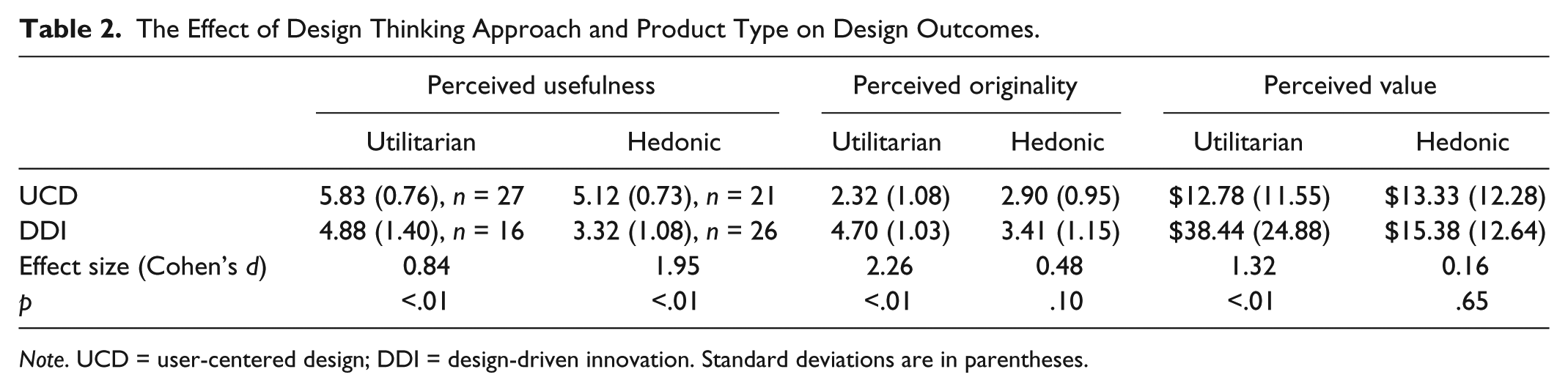
The Effect of Design Thinking Approach and Product Type on Design Outcomes.
Note. UCD = user-centered design; DDI = design-driven innovation. Standard deviations are in parentheses.
There was a significant interaction effect between design thinking approach and product type for all three dependent measures (Figures 1, 2, and 3). Specifically, for utilitarian products, product designs using UCD (vs. DDI) were perceived to be more useful, MUCD = 5.83, MDDI = 4.88; F(1, 86) = 9.40, p < .01, while product designs using DDI (vs. UCD) were perceived to be more original, MDDI = 4.70, MUCD = 2.32; F(1, 86) = 50.16, p < .001, with higher perceived value, MDDI = $38.44, MUCD = $12.78; F(1, 86) = 28.78, p < .001. Therefore, as hypothesized, the results show that purposely and intentionally focusing on different design thinking approaches (UCD or DDI) can lead to different design and marketing outcomes.

Experiment results: Effect of design approach and product type on perceived usefulness.
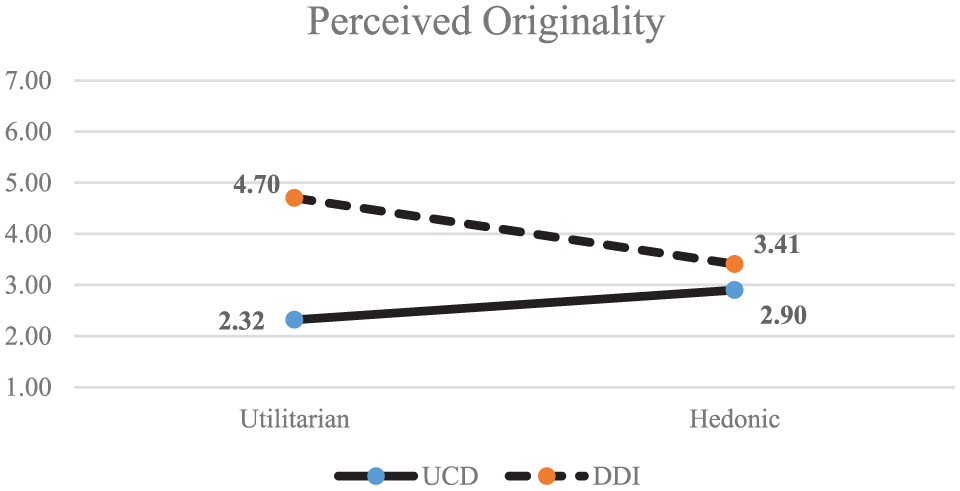
Experiment results: Effect of design approach and product type on perceived originality.
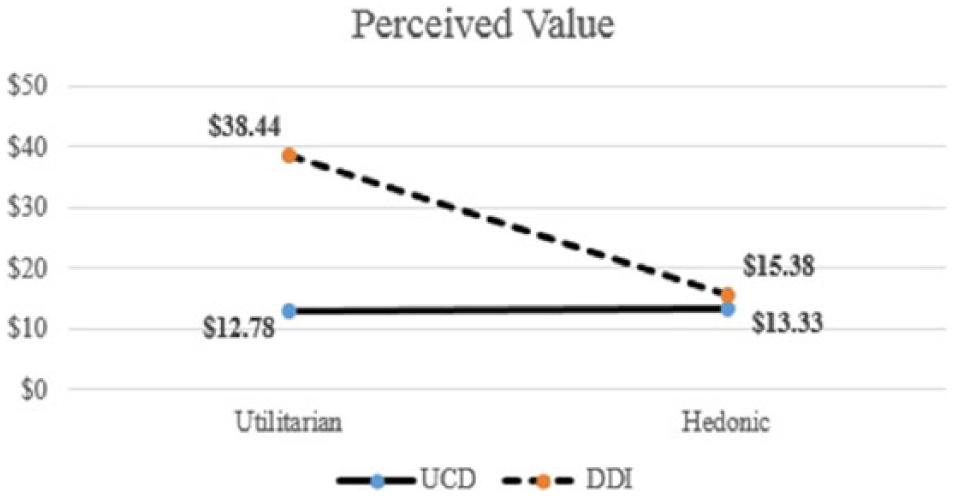
Experiment results: Effect of design approach and product type on perceived value.
In other words, if a firm has a specific marketing outcome that it seeks to achieve, it can strategically select the appropriate design thinking approach to develop new products. For instance, if a firm’s ultimate goal is to create highly useful product concepts, then it may encourage its product development team to adopt a UCD approach. Alternately, if a company’s end goal is to maximize the likelihood of highly original concepts, then it may want to encourage a DDI approach. Additionally, the findings imply that the use of DDI to develop utilitarian products results in the highest levels of originality and perceived value. Consequently, the firm could play up the utilitarian aspects (e.g., features and benefits, practicality) of a product in the marketing of the concept to enhance customers’ perceived originality and value.
Design Thinking: Teaching Module
The results of the empirical study show that students can be guided to play the dual role of product designer and product manager and develop new products that are valuable to both consumers and firms. Now, we outline how this process can be incorporated into a product-oriented course. Design thinking and the intricacies of UCD and DDI design thinking approaches can be communicated to marketing students under the auspices of a product design module. The objectives of this design thinking module are twofold: (a) to introduce students to the topic of design thinking and (b) show the differential impact on design and marketing outcomes of a strict adoption of UCD or DDI through an interactive design task. The passages below provide step-by-step instructions for a 90-minute module with suggested times for each step.
Context
The context and target markets of the design task can vary depending on instructor. The context of the door-opening solution can be used or the instructor may provide a different context as long as it (a) is easy for students to conceptualize and design products and (b) affords opportunities for both utilitarian (i.e., mundane and functional) and hedonic (i.e., ornamental) solutions.
Step 1: Preparation
Meeting Room
The ideal space for this design module is a large classroom with modular tables that can accommodate student teams.
Supplies
The instructor supplies each team with a design kit that includes objects for the design task. For example, objects may include a large flip chart, permanent markers, Post-It notes, and colored pens/pencils.
Documents
The instructor provides each team with a document that provides the instructions for the design task. Since this design module is organized around a 2 (design thinking approach: UCD vs. DDI) × 2 (product type: utilitarian vs. hedonic) experimental design, the instructor could create four variations of the instructional document. Figure 4 provides a sample of the four variations of the instructional document.
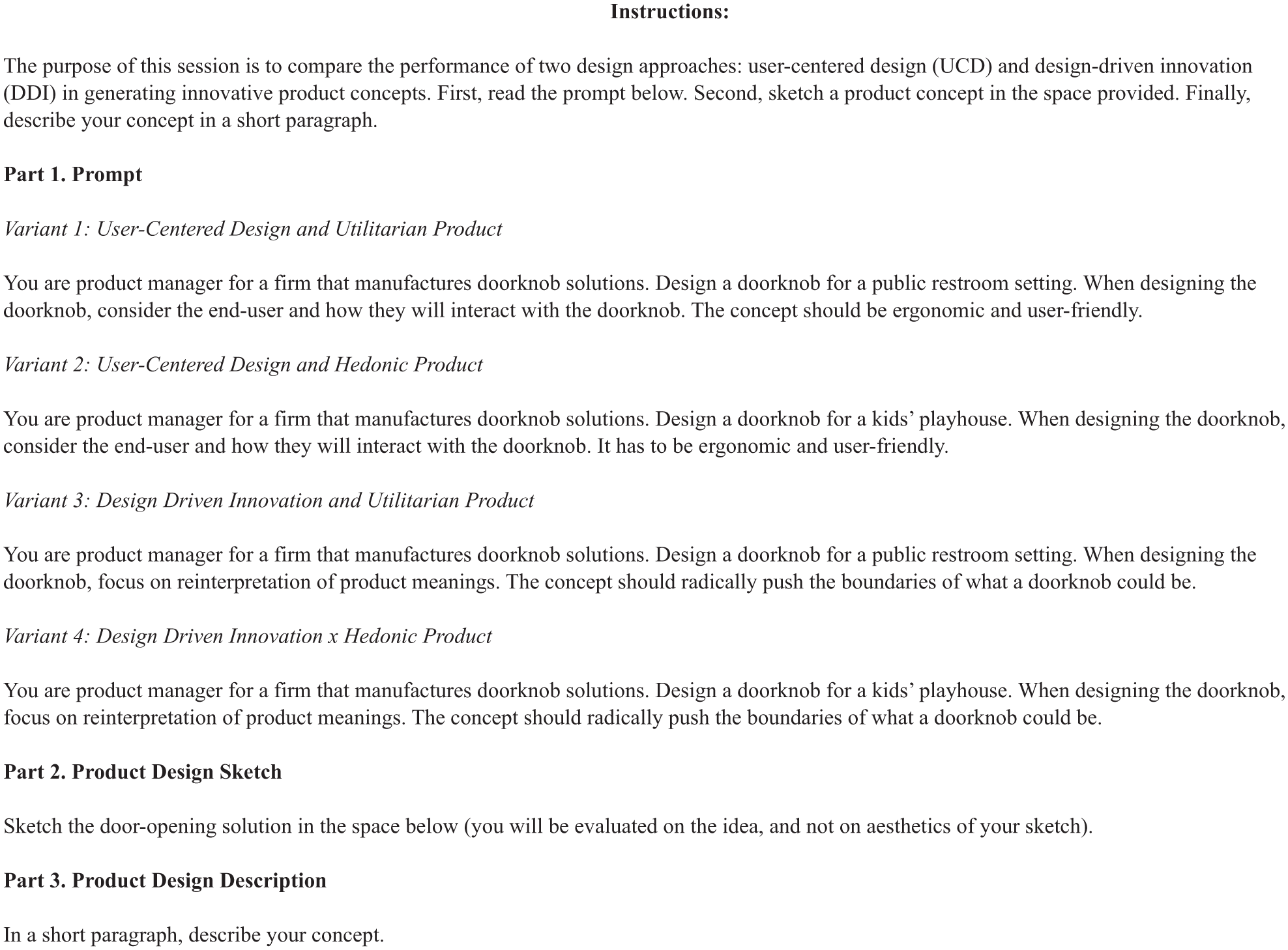
Example of instructional document for design thinking module.
Step 2: Introduction to UCD and DDI (Approximately 20 Minutes)
The instructor can formally begin the design module with an introductory lecture that explains the relevance of design thinking and introduces the UCD and DDI design thinking approaches to students. Instructors may use information from the literature review from this article for their lectures. After the introductory lecture, instructors may choose to informally quiz students to see if they were able to understand the differences between UCD and DDI approaches.
Step 3: Group Assignment (Approximately 5 Minutes)
The instructor could prompt the class to break-up into teams of four to five people and provide each group one version of the instructional document. Students will be assigned to one of the four design conditions: (a) using UCD to design a door-opening solution for a public restroom, (b) using DDI to design a door-opening solution for a public restroom, (c) using DDI to design a door-opening solution for a kid’s playhouse, and (d) using DDI to design a door-opening solution for a kid’s playhouse (Figure 4). A class of 40 students would generate about eight groups, where two groups may tackle one variation of the design task.
Step 4: Group-Based Design Task (Approximately 30 Minutes)
Students can work with their groups to design a door-opening solution within the parameters of their assigned condition. The design task involves three steps: (a) reading the instructional prompt, (b) sketching a product design, and (c) composing a short, text description of their product design.
Step 5: Break and Evaluation of Designs (Approximately 15 Minutes)
After the design task, the instructor could provide students a 15-minute break. The break gives students an opportunity to recompose their attention after the design task. More important, the break provides the instructor time to prepare for the next activity. At the beginning of break, the instructor could collect students’ design sketches and put them up on a board. When students return from the break, the instructor and students rate each sketch based on three outcomes (perceived usefulness, perceived originality, and perceived value).
Once all sketches have been rated, the instructor can divide the student sketches into two piles: (a) concepts designed with UCD and (b) concepts designed with DDI and lead students to observe and discuss the relationship between design thinking approaches and design and marketing outcomes. Next, the instructor can divide the student sketches into four piles (i.e., variations of the design task based on design thinking approach and product type): (a) utilitarian products designed with UCD, (b) hedonic concepts designed with UCD, (c) utilitarian products designed with DDI, and (d) hedonic products designed with DDI. This time, students could be instructed to discuss how the prior relationship is affected when product type is considered.
Instructors can expect the student designs to exhibit a high level of variance, ranging from simple doorknobs to digital solutions. In our class, the concept that was perceived as most useful was a foot-pedal activated door-opening solution (MUCD-utilitarian = 6.89 of 7.00). The concept that generated the highest perceived originality rating was a touch-free sensor that opens the door with a wave of the hand (MDDI-utilitarian = 6.00 of 7.00). Finally, the concept that elicited the highest perceived value was a digital, password-enabled door system (MDDI-utilitarian = $117.50 of $150.00). These class results match the results from the experimental study.
Step 6: Debrief (Approximately 20 Minutes)
After the break, the instructor could spend about 20 minutes to debrief students. The instructor can start by presenting the sketches to the entire class. Discussion questions that can be posed to students could include the following:
Which concept do you think is the best, and why?
Which design thinking approach (UCD or DDI) do you feel is more effective?
Why would product managers use different design thinking approaches?
At this point, the instructor could reveal the assessment results. Ideally, the results would match the results prescribed by the literature. If the results diverge from the literature, the instructor could then ask the class to identify extraneous variables that may explain the deviations (e.g., skill/talent level, group composition, and group dynamics).
Discussion
Implications for Marketing Education
This article rests on the idea that design thinking is a valuable skill for marketing students and marketing firms (Glen et al., 2014). Specifically, by hiring marketing graduates who have design skills, firms can enhance their firm performance by developing products and services that are original and useful (Burroughs et al., 2011). One method to harvest creative outcomes is through design thinking (Brown, 2008; Chen & Venkatesh, 2013). This article explicates the UCD and DDI design thinking approaches, which can serve as alternates to other creativity approaches developed by marketing education scholars (Eriksson & Hauer, 2004; Titus, 2007).
In traditional marketing courses, such as Principles of Marketing and Marketing Research, students encounter product design issues when they complete coursework that requires them to develop new products and services. Yet students may not be exposed to design thinking techniques, such as UCD and DDI. Save for a few exceptions (e.g., Love et al., 2011), research on design thinking in marketing education is limited, and studies do not recognize the differential impact of different design thinking approaches. Marketing educators can easily substitute the interactive, 90-minute design thinking module as a single class on product design. By experiencing the module, marketing students can be exposed to two-structured design approaches that are commonly implemented in practice. UCD and DDI design thinking approaches encourage students to follow specific constraints and parameters, which could increase the quality and creativity of design outputs (Dahl & Moreau, 2007). Furthermore, having a background in creativity and design thinking may provide marketing students with a competitive advantage, when it comes time for them to seek jobs after graduating (Florida & Goodnight, 2005). Specifically, the design thinking module can help marketing students achieve the balance between product manager and product design. This is important since product managers who understand design processes can better communicate with product designers (Bloch, 1995).
Implications for Marketing Theory and Practice
Two design thinking approaches that have received significant attention by product innovation scholarship are UCD (Veryzer & Borja de Mozota, 2005) and DDI (Verganti, 2008). Yet scholarly work in this domain tends to be conceptual in nature with limited empirical research that investigates the differential impact of UCD and DDI on design outcomes (Rosenthal & Capper, 2006; Verganti, 2008). Thus, one of the main contributions of this study is the empirical testing of the relationship between design approach (UCD, DDI), product type (utilitarian, hedonic), and design outcomes (perceived usefulness, perceived originality, and perceived value).
The results indicate that adopting UCD will lead to more useful product designs, where the perceived usefulness can be further enhanced by adopting UCD to design utilitarian products. The findings support extant research, which suggest that incorporating consumer needs lead to more useful products (Bettencourt & Ulwick, 2008; Kristensson et al., 2004). Specifically, the results intimate that merely thinking about consumer needs can augment the usefulness of product designs (Dahl et al., 1999). Thus, directing product designers to think about consumers may represent a suitable substitute for costly and time intensive design methods such as design ethnography (Meyer, 2008; Rosenthal & Capper, 2006).
Our findings also validate DDI’s claim to original design outcomes. Verganti (2008) introduced the DDI approach, and subsequent studies provide case examples of DDI implementation (Dell’Era, Marchesi, & Verganti, 2010; Dell’Era & Verganti, 2009). Extending this work, the current study empirically verifies DDI’s ability to produce original designs. Specifically, our results indicate that adopting DDI will lead to more original product designs, where the perceived originality can be further enhanced by adopting DDI to design utilitarian products. Adopting DDI to design utilitarian products will increase perceived originality by introducing an element of moderate incongruity, or unexpected benefits, to the product.
Limitations and Future Research Directions
This study has several limitations that can be addressed by future research. First, the experiment forced participants to adopt either a UCD or DDI design thinking approach. This method allowed us to leverage the controlled experiment setting and effectively examine the theoretical impact of a strict UCD or DDI approach on design outcomes. In a natural setting, managers and designers may blend different design thinking approaches, as opposed to adopting discrete design approaches (Chen & Venkatesh, 2013). Additionally, UCD and DDI design thinking approaches can complement one another, and may not necessarily be oppositional approaches (Norman & Verganti, 2014). Therefore, it may be interesting for future research to examine the performance of hybrid design approaches on design outcomes.
Second, future research could address methodological limitations of this study. The participants for the experiment were drawn from a large business college in the western United States, and the judges were likewise located in the western United States. Future studies should examine if the results can be replicated using a different sets of participants and judges with more variation. Additionally, the experimental task asked participants to design doorknobs using the UCD and DDI design thinking approaches. Future research can test the differential effect of the design thinking approaches on other product categories.
Finally, Bloch (1995) suggests that firms can benefit when marketing managers understand the balance between design and marketing mix. This balance enhances their strategic decision making, and facilitates communication with their product designers. Yet the experimental task, which focused on examining differential impacts of design thinking approaches, did not measure whether participants achieved a better understanding of the design-marketing interface after completing the product design activity.
Summary
To summarize, the design thinking module introduced in this article offers several key points. First, using an experiment, we empirically show that purposefully and intentionally focusing on a design thinking approach can lead to desired design and marketing outcomes. Firms can use these insights to structure their new product development process. Second, based on the results from the study, we develop a design thinking teaching module that can be incorporated into marketing curricula. Design thinking, or more broadly creativity, are important skill sets for students’ career enhancement (Dunne & Martin, 2006; Glen et al., 2014; McCorkle et al., 2007). Marketing educators can use our study and teaching module to introduce students to product design and design thinking. As outlined in our discussion of future research, there are great opportunities for further research in this area and we hope this article inspires more interest on design thinking within marketing pedagogy.
Footnotes
Declaration of Conflicting Interests
The author(s) declared no potential conflicts of interest with respect to the research, authorship, and/or publication of this article.
Funding
The author(s) received no financial support for the research, authorship, and/or publication of this article.
