




Abstract
The principles of marketing course usually includes coverage of marketing ethics and social responsibility. This study attempts to gain an understanding of students’ perceptions of the importance of marketing ethics and social responsibility and to see if these perceptions can be enhanced. Students were provided one class period lecture on the topics with prelecture and postlecture evaluation. The study addressed marketing ethics and social responsibility as distinct constructs. Postlecture there was an improvement in marketing ethics perceptions for all majors, with nonmarketing business majors showing the most improvement. Postlecture perceptions of the importance of social responsibility increased significantly with nonbusiness majors showing the lowest level of improvement. Changing perceptions of importance can motivate long-term engagement in beliefs about the significance and value of business ethics and social responsibility.
Keywords
Overview
The principles of marketing course is required of all business majors and many other majors in most institutions of higher education. One component of this course is some content on ethics and social responsibility. The Association to Advance Collegiate Schools of Business (AACSB) requires programs to provide “tools for recognizing and responding to ethical issues both personally and organizationally” (AACSB Ethics Education Task Force, 2004, p. 9). AACSB defines ethical issues as (1) responsibility of business in society, (2) ethical decision making, (3) ethical leadership, and (4) corporate governance. There have been investigations into teaching marketing ethics and social responsibility in principles courses reported in marketing education journals, with a concern about influencing students’ overall attitudes toward marketing and the pursuit of marketing as a career (Camey & Williams, 2004). The opportunity exists to advance the knowledge and skills of students by efficiently providing effective coverage of these marketing topics. If students view that these are more important, then they will be more significant, valued, and necessary in decision making.
The teaching of ethics and social responsibility in principles of marketing has the potential to change attitudes toward marketing and could possibly be helpful in recruiting marketing majors. An important question is whether it is possible to change students’ perceptions in one class period (2 days/week schedule). Most principles courses survey the field and often have 15 to 20 chapters in a textbook. Often, there is only one class period dedicated to discuss ethics and social responsibility. AACSB has provided student–faculty interaction principles as well as other content related to what is important in addressing ethics in the context of accreditation. This research relates to AACSB principles that require faculty members to have in-depth expertise on the topic and provide feedback on student performance related to ethics education.
This study is designed to determine how the perceptions of marketing ethics and social responsibility can change after one class period lecture on the topics across the various majors in principles of marketing classes. In addition, the research identifies how to change perceptions. The research uses a presurvey instrument administered before a lecture and a postsurvey after the lecture was delivered at a large southern public university. Specific objectives of this research include the following: (1) to assess existing negative perceptions of business ethics and social responsibility, (2) to determine what topics can be used to elicit perceptual change, (3) to discover if negative perceptions can be improved, (4) to find if perceptions differ based on majors, and (5) to examine instructional factors that could influence change in perceptions. The overall contribution of this research is to improve the instruction of marketing ethics and social responsibility. Specific topics and issues were discovered to enhance instruction. In using a prelecture/postlecture survey and a control group, the research provides the empirical evidence currently lacking in improving instruction.
The focus is measuring and changing attitudes towards the importance of marketing ethics and social responsibility. If there is a significant increase in importance, then the lecture will be considered successful. Importance will be considered an effect that increases the values, attention and influence of marketing ethics and social responsibility. Human intelligence is shaped by what is most important causing intense emotions (Waltz, 1999). Determining what is important from what is unimportant facilitates attention, focus and potential outcome assessment. Perception of greater importance is tightly linked with goals and actions. Research provides support that important attitudes change less over time than unimportant attitudes. In other words, attitudes considered to be important are more stable over long periods of time (Kronick, 1988). Marketing ethics relates to important judgments and choices that have a profound impact on success. Research in psychology has found that when something is novel or a surprise, it will be remembered (Waltz, 1999). The lecture was designed to be novel and include the surprise element in presenting content and examples. Some examples included familiar firms involved in major misconduct. Differentiating marketing ethics from social responsibility was a new concept for many students. The lecture was successful in engaging students based on classroom observation, polling and questions.
The intent of this research is to study how perceptions can be changed through structured content development and instructional factors. Marketing ethics and social responsibility are viewed as two distinct constructs illustrated through examples and clarification of the definitions and differences between the two. Therefore, developing topics and instructional factors to elicit the change in perception of ethics and social responsibility is the aim of this research.
Review of Literature
A meta-analytic review indicated there has been little progress in guidelines as to how, what and where business ethics should be taught (Medeiros et al., 2017). In addition, this analysis found that there are benefits for improving ethical decision making, ethical behavior and moral reasoning. On the other hand, there has been limited progress made in the past 10 years in outcomes from business ethics education. In addition, the results showed that ethical education has an immediate effect on student decision making and reasoning, but some of this is lost in a short time. If marketing ethics increases in importance, this decline on effects should be less (Waltz, 1999). Most business education is focused on teaching the student to be more ethical. The use of cases, debates and problem situations does recognize the organizational context of decision making. The approach in this research is to change perceptions of the importance of marketing ethics and social responsibility. If these topics are considered more important, then students should be more engaged in acquiring knowledge and skills to improve decision making in the long run (Kronick, 1988). Ethics training occurs in most organizations, and if students increase attitudes of importance of this topic, they will be more engaged in continuous learning.
In a benchmark study on integrating ethics, social responsibility and sustainability into the marketing undergraduate and graduate curricula, ethics had the greatest level of integration into the curriculum (Nicholls et al., 2013). It was found that ethics was incorporated into more than 50% of marketing courses at both the undergraduate and graduate levels, although social responsibility was considered part of ethics. None of the students in this research had taken any other marketing courses. Therefore, the students responding represent a diversity of backgrounds and career interests with limited academic marketing knowledge.
A review of seven leading principles of marketing textbooks by the authors found that the ethics chapters focused mainly on social responsibility. Two of the books had sustainable marketing in the title and focused more on sustainability than ethics. While ethical decision making is involved in internal daily decisions, it is often covered with external marketing environment issues. The coverage of marketing ethics included ethical issues, social responsibility issues, codes of ethics, ethical decision making and ethical values in most cases. Only one book addressed moral philosophy as a framework for ethical decision making in marketing. Also, one of the books had ethics in the title of the chapter but had little coverage of the topic. It focused on social responsibility almost exclusively. Therefore, there is much diversity in what textbook authors believe should be taught.
There is often an assumption that marketing ethics and social responsibility are essentially the same; however, they are two distinct constructs. This investigation is unique in that marketing ethics and social responsibility were measured as such. Most scales measuring attitudes toward ethics include social responsibility items (Brunk, 2012). This research adapted scales that have been found to measure attitudes toward ethics and social responsibility as two different constructs (Ferrell, Harrison, et al., 2019). This is important in teaching principles of marketing classes because there needs to be a balance in the coverage of these two important topics. Assuming ethics is just doing good and not damaging others falls short of understanding how these concepts should be viewed by students. Discovering the concepts and issues associated with each construct will help professors target content to advance learning and possibly change attitudes toward responsible behavior in marketing practice.
The artifacts of marketing ethics and social responsibility constructs are developed from a communities of practice perspective. Weller (2017) found that senior managers viewed the two constructs as different. Often the management of ethics and social responsibility do not communicate or overlap. Social responsibility is defined as an organization’s obligation to maximize positive impact on stakeholders and minimize the negative impact. Social responsibility issues relate to employee well-being, sustainability, philanthropy, consumer protection, legal responsibilities, social issues and corporate governance (Ferrell, Fraedrich, et al., 2019). Marketing ethics relates to principles, values and norms that are embedded in decisions that are considered right or wrong. Ethics is often reflected in organizational culture with policies, rules, codes, and compliance requirements both formal and informal. Every employee is subject to ethical decision making while not all employees play a role in the firm’s social responsibility initiatives.
While consumers may view marketing ethics and social responsibility to be interchangeable, it has been empirically determined that they can identify the artifacts of these two constructs (Harrison et al., 2019). Marketing ethics and social responsibility do overlap in the decision-making process as ethical decisions can be made about social responsibility issues. However, marketing ethics relates more to individual and group decisions that are judged as acceptable or unacceptable. Additionally, it relates to required behavior by individuals and groups based on formally and informally imposed boundaries of conduct or external requirements of self-regulation and societal expectations. Many social responsibility decisions, on the other hand, are voluntary.
The approach used in the class lecture in this research was to use themes related to the applied nature of decisions in marketing. Managerial marketing ethics coverage focuses on the practice and applied nature of making ethical decisions in marketing. There are three recurring themes in course objectives and content in exploring marketing ethics from a managerial perspective (Ferrell & Keig, 2013). First, students need to understand and be able to recognize ethical issues in marketing. Issues related to bribery, data privacy, marketing research, product safety, consumer protection, personal selling, and supply chain need to be addressed.
Second, students need to be engaged in the real-world application of marketing ethics. Students need hands-on involvement with the artifacts of ethical conduct in organizations—including positive and negative consequences. A lecture can include examples and artifacts of ethical decision making to illustrate the importance of marketing ethics. Decision-making frameworks such as stakeholder analysis could be integrated into active learning methods to illustrate the importance of social responsibility.
The third recurring theme is the impact of ethics on the profession of marketing. Often students, especially nonmarketing majors, have low regard for marketing as a profession. One study found that just 3% of students think marketing offers the best career opportunities (Bullock, 2018). Marketing has grown into a profession with requirements of a common body of knowledge and a set of skills, often requiring a college degree. As a profession, there are codes of ethics and standards that are socially enforced for acceptable conduct. There are legal and regulatory requirements that are enforced by both state and federal agencies. Studies show students place more effort in learning if they believe the subject matter is relevant to their careers (Malenee & Chee, 2015). These three themes were incorporated into the lecture used in this research. Recognizing ethical issues, real-world applications and ethics in the marketing profession were covered.
The role of the principles of marketing class should be to improve the attitudes on the professionalism of marketing for marketing majors, nonmarketing business majors and nonbusiness majors. With only one chapter—or at most two lectures—on ethics and social responsibility, it is doubtful if students’ moral compass can be changed. Therefore, it is not the purpose of the lecture used in this study to make students more ethical. The goal is to improve their perceptions of importance. Improving the importance can signal that this topic is valuable, influential and vital to career success. There is adequate research to show improving perceptions of importance has a lasting effect (Kronick, 1988).
Building a capacity to create the ability to effectively and sustainably integrate an ethics and social responsibility perspective into principles of marketing requires integration into marketing as a profession (McAlister, 2004). In addition, while it is imperative to address unethical conduct, it is equally important to address positive examples of ethical conduct (McAlister, 2004). Students need to recognize ethical decision making often involves grey areas, and it may take years of experience to know what is acceptable. This research is limited to the purpose and scope of teaching this topic in a principles of marketing course to improve perceptions of importance. Developing ethics and social responsibility coverage across the business curriculum is beyond the scope of this research.
Research Questions
This investigation is how students’ perceptions of marketing ethics and social responsibility can change. It is also important to identify the content areas that elicit change. A review of the literature of principles of marketing textbooks provided evidence that there is limited consistency as to how marketing ethics and social responsibility are addressed in the principles of marketing class. Once the problem was identified, the first methodological step was to develop research questions.
In this study, we describe, compare and address underlying causal factors that may affect perceptions about the importance of marketing ethics and social responsibility to students. The first question deals with the possibility of changing the perception of the importance of marketing ethics and social responsibility as dependent constructs across all students in the principles of marketing class. If the importance is changed, then the interest and concern about the usefulness of this topic in one’s career should increase (Waltz, 1999). Marketing ethics and social responsibility are measured as separate constructs. A control group was established to determine if students that did not receive the lecture had any effects.
The principles of marketing class is required of all business majors, and many nonbusiness majors are required to or elect to take the course. An important question is perceptions of importance comparing the three majors: marketing major, business nonmarketing major, and nonbusiness major. This question is interesting from both a descriptive and comparative perspective. First, is there a significant difference in the perceptions of importance prelecture? Second, are there significant differences for each major postlecture? Third, which major has the most change in perceptions of importance?
An important problem is the determination of the topics to include in the marketing ethics and social responsibility lecture in the principles of marketing class. Topics to include were based on scales that were developed to assess consumer perceptions of business ethics and social responsibility (Harrison et al., 2019). The exploratory test of the scales developed indicated that the artifact items in the scales could be used to determine the effect on brand attitudes. Scale items provided the foundation for ethics and social responsibility lectures to reflect the definitions of these two constructs. The lecture used was based on core concepts and examples associated with the marketing ethics and social responsibility scales developed by Harrison et al. (2019).
After the postlecture, it was important to access the scale items used to develop concepts and topics for the lecture. This was an important question based on the desire to address marketing ethics and social responsibility as separate constructs. Four instructional factors were identified as customer concerns, employee concerns, environmental concerns, and societal concerns. Customer concerns and employee concerns were associated with marketing ethics. Environmental concerns and societal concerns were associated with social responsibility.
Research Methodology
Sample and Instrument
To address the forwarded research questions, a dyadic-oriented research design was incorporated across multiple studies. Herein, four studies are undertaken to address the six research questions. The sample for each of the four studies is comprised of undergraduate students enrolled in three, auditorium-sized principles of marketing courses at a large, southern university. Specifically, three separate sections comprised the sampling frame; two sections, each 487 and 410 students, respectively, and an additional section with 110 students were solicited for participation as a control group. The principles course is a prerequisite for all other marketing courses at the given institution; thus, the exposure to marketing ethics discussion is likely not dissimilar between marketing and nonmarketing majors within the sample. First, students in each of the three sections were asked to complete a digital survey instrument (Qualtrics), administered via email with an embedded link, assessing their thoughts concerning the degree to which they feel that companies engage in ethical marketing tactics and the extent to which they feel firms engage in socially responsible practices (61% response rate).
Within a week of completing the survey, students were then exposed to a class lecture on the topics of marketing ethics and social responsibility. The lecture outlined in detail the efforts and strides companies have made relative to marketing ethics and social responsibility. Because of the sizes of the sections, it was not feasible to incorporate any hands-on or group-oriented exercises. Straight lecture was utilized with a heavy emphasis on providing real-world examples that illustrate the concepts under discussion.
Students were then given another survey which again assessed their thoughts concerning firm marketing ethics and social responsibility. Students were not notified in advance that an additional survey would be orchestrated until after they had been exposed to the lecture. This was undertaken in order to alleviate any extraneous variation that could have been attributed to knowledge that the second survey was forthcoming. The instrument included additional items assessing specific factors discussed in the lecture (65% response rate). The additional class was not exposed to the lecture and thus served as an experimental control.
The useable student respondents were not notified that a follow-up study would be undertaken. The sample consisted of 50% males, 65% from the state where the university is located, 23% from other southern states, and 12% being from northern and northwestern states. Of the total, 25% were classified as non-Caucasian (African American, Asian, and Hispanic).
Both survey instruments included scales to assess marketing ethics (cf. Reidenbach et al., 1991) and social responsibility (cf. Harrison et al., 2019). Each construct was measured with an existing scale appearing in the extant literature whereby reliability and validity had been established. These scales proved reliable and valid across both the prelecture/postlecture conditions and demonstrated sufficient convergent and discriminant validity based on guidelines established by Bagozzi (1980), Fornell and Larcker (1981), and Gerbing and Anderson (1988). A detailed assessment of the scales’ psychometric properties is presented in the appendix Table A1. The postlecture instrument also included items assessing specific aspects potentially affecting perceptions of ethics and social responsibility (see Study 3). Additional information included in the instrument consisted of student major (marketing, nonmarketing business, and nonbusiness), which course section they were enrolled in, their gender and their academic classification.
Common Method Variance and Nonresponse Bias
An advantage of multiple data sources is the mitigation of any effects associated with common method variance (CMV). Furthermore, in accordance with Podsakoff et al.’s (2003) recommendations, common method bias was also mitigated through counterbalancing of question order when administered to different respondents. CMV was assessed via two tests, these included the Harman single-factor test and examination of variance inflation factors scores. The findings of both tests demonstrated that CMV did not appear to be an issue as results were consistent with the recommendations of Babin et al. (2016) and Kock (2015).
Nonresponse bias assessment was undertaken based on recommendations from Armstrong and Overton (1977). Herein, the responses from each data set were placed into quartile ranges based on time of survey completion, and then differences in means across each focal construct were undertaken for the first and fourth quartiles. These tests were done for the data set in its entirety and within each of the data sources. No significant differences were found based on any of these tests; thus, nonresponse bias did not appear to be a factor.
Study 1
The purpose of Study 1 was to address Research Question 1 and Research Question 2, namely, what are student’s perceptions of the importance of marketing ethics and social responsibility and can perceptions be changed based on lecture exposure. To address these, a pretest/posttest control group, within-subjects experimental design was undertaken. In this case, mean scores on each criterion variable were calculated and differences assessed based on the prelecture and postlecture conditions and compared with a control group not being exposed to the experimental treatment (lecture). Mean differences were assessed via multivariate analysis of covariance (MANCOVA), with the omnibus model being significant, Wilks’ Λ = 0.921 (f4 = 9.395; p = .000); η2 = 0.079. MANCOVA was appropriate in this case as respondent gender and ethnicity were included as control variables and were modeled as covariates.
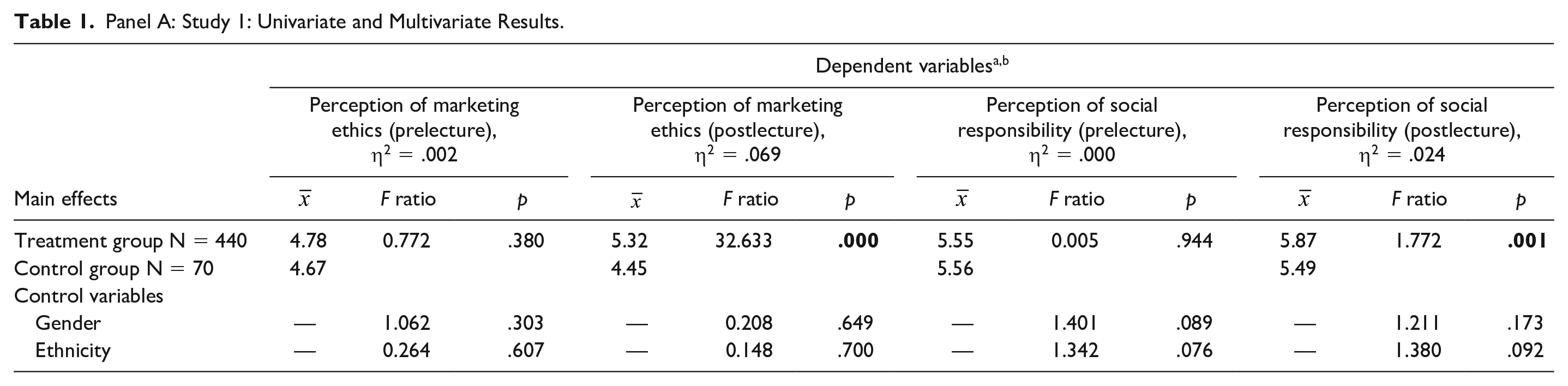
Table 1, Panel A provides the results of this test. Reporting demonstrates that there exists no difference in the treatment and control group mean scores for either criterion variable in the prelecture condition (p value for marketing ethics equaling .380 and .944 for social responsibility). Neither of the control variables proved significant for either dependent measure. Noting the results for the postlecture conditions, a significant difference (p ≤ .05), exists between the treatment and control groups with the treatment means being larger. A multivariate analysis of variance model was then run without the control variables for the purpose of performing additional post hoc, planned contrast tests. These tests demonstrate that both ethics (p ≤ .05) and social responsibility (p = .01) are significantly greater when comparing the pre/post means for the groups exposed to the treatment. No such difference exists for the control group.
Panel A: Study 1: Univariate and Multivariate Results.
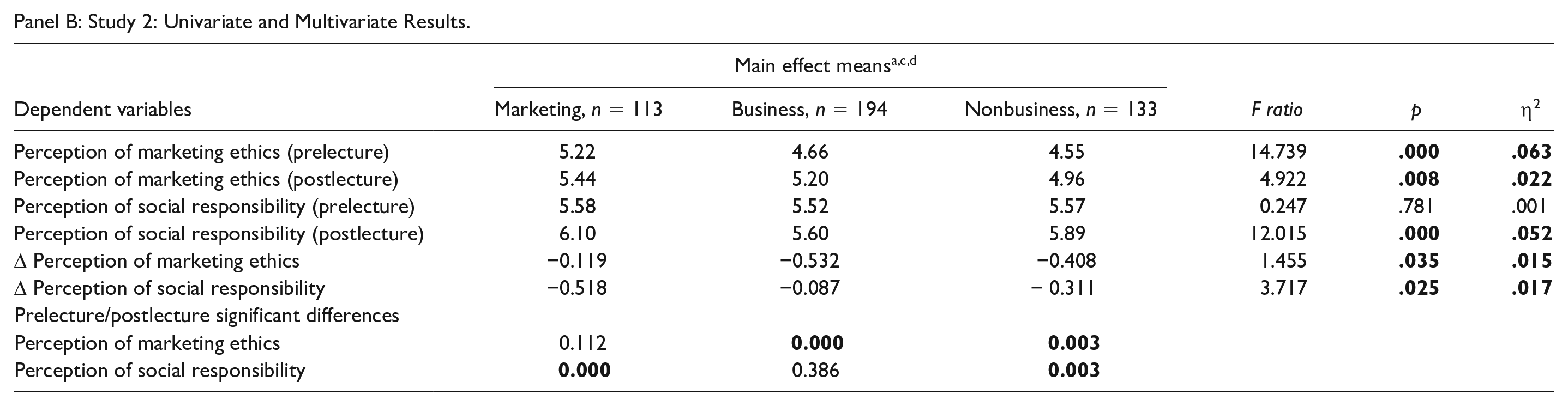
Panel B: Study 2: Univariate and Multivariate Results.
Panel C: Study 2: Post Hoc Multiple Comparison Tests.

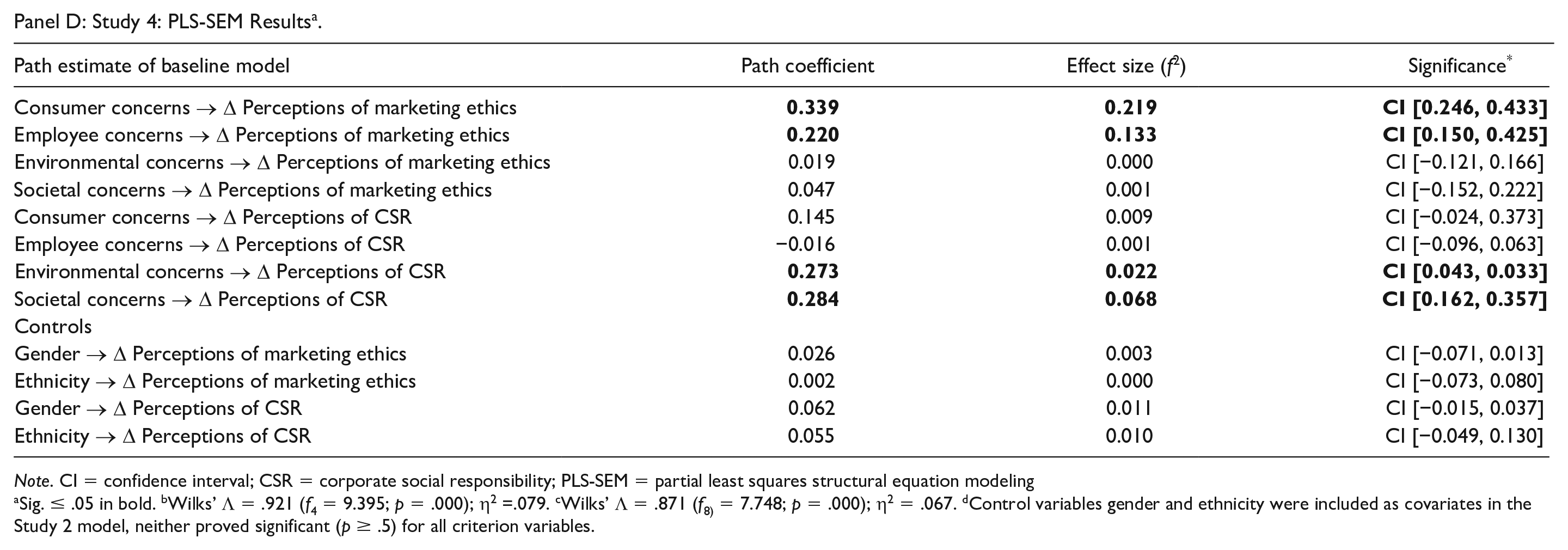
Panel D: Study 4: PLS-SEM Results a .
Note. CI = confidence interval; CSR = corporate social responsibility; PLS-SEM = partial least squares structural equation modeling
Sig. ≤ .05 in bold. bWilks’ Λ = .921 (f4 = 9.395; p = .000); η2 =.079. cWilks’ Λ = .871 (f8) = 7.748; p = .000); η2 = .067. dControl variables gender and ethnicity were included as covariates in the Study 2 model, neither proved significant (p ≥ .5) for all criterion variables.
Discussion
The results herein suggest that students come into a principles of marketing course with importance perceptions placed on marketing ethics and social responsibility at about the median of the standardized scale score for each measure. This implies a “no strong feeling either way” perception. Yet, when exposed to a lecture and active class interaction that details the efforts that firms make in ensuring ethical marketing and social responsibility, the importance placed on each concept increases. The change in the level of importance placed is significantly different, and higher as compared with student’s perceptions who have not been exposed to the information presented in the lecture. This finding supports the notion that student’s importance perceptions can be improved based on content provided in classroom instruction. This means students’ attention and concern for this topic should increase based on the effect.
Study 2
As demonstrated in Study 1, the importance placed on marketing ethics and social responsibility can be changed (improved) based on course lecture content. The purpose of Study 2 was to assess Research Question 3 and Research Question 4 with the purpose of determining if student major plays any role in understanding the importance students’ place on each issue. Data consisted of a matched (dyadic) sample of students whose attendance at the lecture could be confirmed (through Top Hat), and who had completed both the presurveys and postsurveys. The matched and confirmed sample consisted of 440 responses with 113 being marketing majors, 194 being nonmarketing business majors, and nonbusiness majors accounting for 133 responses. The response rate equaled 75.0% (of the 583 completing the postlecture survey, 440 could be matched to having also completed the Study 1 instrument), the 110 students comprising the control group were not included in this sample as they were not exposed to the lecture.
Insights regarding each research question were gleaned based on results presented in Table 1, Panels B and C whereby MANCOVA and multivariate analysis of variance tests were undertaken with major as the single main effect and premeasure and post measure for marketing ethics and social responsibility serving as dependents and gender and ethnicity serving as covariates in the MANCOVA model. Two variance (change) scores were also included as criterion variables. The change perceptions scores consisted of the difference score between premeasures and postmeasures for each of the two focal dependent measures. As expected, these scores are negative (see Panel 2) given that the post score was subtracted from the prescore, thus implying an increase in importance perceptions for both variables. Neither covariate proved significant for any criterion variable test.
First, relative to marketing ethics, as shown in Panel B, a significant difference exists based on major (p ≤ .05) for the prelecture condition. Post Hoc, multiple comparison (Tukey) tests (Panel C) reveal that the mean for marketing majors is significantly different from both nonmarketing and nonbusiness (p ≤ .05), yet the latter two are not significantly different. For the postlecture condition, significant differences exist across major as well (p ≤ .05), with significant differences, identified based on post hoc testing, existing between marketing and nonbusiness majors. Panel B shows that pretesting/posttesting revealed that both nonmarketing business and nonbusiness perceptions of marketing ethics were significantly different, with directionality demonstrating an increase in importance for both groups. The change perceptions score was also significant across major (p = .035), and that magnitude of change was significantly different (p = .041) for marketing and nonbusiness majors (see Panel C).
With regard to social responsibility, there did not exist any significant difference across major for the prelecture condition (p = .781), yet a significant difference did exist in the postlecture condition (p ≤ .05) with nonmarketing business majors having the lowest mean score. As noted in Panel C, this difference was significant as compared with marketing (p ≤ .05) and nonbusiness majors (p = .012). In terms of the effect of the lecture on changing importance perceptions, a significant difference was found for marketing (p ≤ .05) and nonbusiness majors (p = .003). Degree of change based on the difference score between pre/post conditions was significantly different across majors (p = .025) with said change being significantly different between marketing and nonmarketing business majors (p = .020).
Discussion
The findings of Study 2 reveal that importance perceptions of marketing ethics do in fact differ based on major. While marketing majors appear to place the most importance; with said importance remaining unchanged, it is the nonmarketing business majors who were most significantly affected by the lecture’s content. Regarding social responsibility, students do not differ coming into a class, regardless of major. Yet a similar pattern to marketing ethics exists relative to the postcondition. Rather than marketing majors, it appears that it is the nonmarketing business majors who were unaffected by the lecture content, whereas significant improvements were identified for both marketing and nonbusiness majors. This finding relates to the diversity of attitudes across different majors and the need to address why nonmarketing business majors have a different perspective on this topic.
Study 3
Having demonstrated that change is possible in importance perceptions of marketing ethics and social responsibility, and that said change differs based on student major, Research Question 5 asks what topics covered in class lecture will elicit change in importance perceptions. Via content analysis of lecture information, two expert reviewers were charged with identifying common and recurring underlying themes. Applying steps for qualitative content analysis recommended by Neuendorf (2017), review of the lecture slides, notes taken, and transcripts resulted in the identification of four recurring themes. These themes included both internal and external aspects of the competitive landscape consisting of employee, consumer, environmental, and societal concerns.
Given these themes, the goal was to assess what role these themes played in influencing importance perceptions. To this end, it was necessary to develop measures that would capture each. Churchill (1979) proposed a widely accepted general paradigm for the development of marketing scale measures. We proceed with an archetype consistent with this paradigm as well as incorporating procedures applied in more recent scale development efforts (cf. Sharma, 2010). Having identified the themes through content analysis, the next step consisted of developing an item pool to tap each dimension. Starting with a review of items existing within the extant literature, followed by brainstorming sessions with four experts in the field of university-level instruction and marketing ethics, the procedure yielded eighteen, 7-point Likert-type items anchored strongly agree/strongly disagree (see the appendix Table A2).
On completion of the item pool generation stage, a series of face validity assessments were undertaken to incorporate the ratings of two additional experts with knowledge of the construct’s understudy. Applying procedures prescribed by Hardesty and Bearden (2004), each judge was asked to rate each item as to the degree to which it reflected the general domain, defined as employee, consumer, environmental, and societal concerns. Specifically, each dimension is conceptualized based on steps firms undertake that are beneficial to their consumers and employees, the environment and society as a whole. Experts were asked to make two considerations. First was how well the items matched the given theme and also how well item wording assessed the degree to which the lecture had influenced the respondent’s perceptions of the firm’s practices and tactics. This face validity assessment resulted in the retention of all eighteen items.
To further refine the measures, a scale purification process was undertaken. Using the two class sections that received the experimental treatment (postlecture responses) described in Study 1, exploratory factor analysis was undertaken on the first section (n = 297), and then confirmatory factor analysis was applied to data from the second section (n = 286). Table A2 presents the results of both tests. The exploratory factor analysis consisted of applying principle components factor analysis with Promax rotation; this method is appropriate when identified factors are expected to correlate with one another (Sharma, 2010). Initially, a four-factor solution was uncovered. Of the 18 items, three cross-loaded on multiple factors and thus were removed from the analysis. Removal of these items resulted in a clean, rotated four-factor solution with eigenvalues ranging from 3.43 to 2.55 and total variance explained of 77.92%. These results were deemed acceptable to proceed further with the confirmatory assessment.
Utilizing the second course section as the sample, confirmatory factor analysis with AMOS 25 was applied to establish reliability and discriminant and convergent validity. The model consisted of the remaining fifteen items assessing the areas of employee, consumer, environmental, and societal concerns. This model resulted in acceptable fit with χ2 = 201.424, degrees of freedom = 84, p ≤ .05, goodness-of-fit index = 0.933, adjusted goodness-of-fit index = 0.903, root mean square error of approximation = 0.072, normed fit index = 0.953, relative fit index = 0.940, incremental fit index = 0.972, comparative fit index = 0.971, all consistent with guidelines set forth by Hu and Bentler (1999).
Internal consistency reliability for each dimension was supported as the coefficient alpha and composite reliability scores were above the limit of .70 (Hair et al., 2017). All four of the concerns’ scales proved to exhibit both convergent and discriminant validity. The t values associated with the ratio of factor loadings to standard error for each item are all greater than 2.00 (Segars, 1996), thus providing support for convergent validity. Discriminant validity is supported as the average variance extracted scores exceeded the 0.50 threshold, and the confidence interval for the heterotrait–monotrait ratio of correlations between the constructs did not exceed .85, and no heterotrait–monotrait ratio confidence interval contained a value of 1.0 (Hair et al., 2017). Three additional tests were incorporated for the assessment of discriminant validity. These included (1) the off-diagonal phi correlation among dimensions being less than one (Bagozzi, 1980); (2) the confidence interval estimates around the phi correlations not including a value of one (Gerbing & Anderson, 1988); and (3) the average variance extracted estimates are greater than the square of the correlation between the two dimensions (Fornell & Larcker, 1981).
Results herein demonstrated sufficient construct validity for each of the four measures. Tests incorporated and discussed previously for CMV and nonresponse bias (see “Common Method Variance and Non-Response Bias” section), demonstrated that neither posed any problem relative to the exploratory nor confirmatory models. The findings of this study provide useful information in determining what topics can be used to elicit perceptive change. Study 4 empirically tests these effects and thus provides insights relative to Research Question 6.
Study 4
The goal of study 4 was to determine which factors presented in class influence change in student’s importance of the firm’s attempts to implement both ethical marketing tactics and engage in socially responsible behaviors (Research Question 6). Herein, a partial least squares structural equation modeling model was created with the four concern factors presented in class and validated in Study 3 being modeled as predictors, first on the change in perceptive importance of marketing ethics and then on change in perceptions of social responsibility. Partial least squares was deemed appropriate based on the minimal demands it places on measurement scales and sample size and its ability to handle single-item (formative) measures (Hair et al., 2017). Based on recommendations from Hair et al. (2017), each of the controls were modeled as predictors of each of the endogenous variables within the model. All Noting Panel D, the bootstrapping confidence interval estimates associated with each of the control variable paths demonstrate that, neither had a significant effect on either criterion variable. Further adherence to Hair et al. (2017) recommendations supported the reliability and validity of each scale and overall fit of the structural model. Panel D presents the specific path results as well; findings suggest that change in perceptions of ethical marketing tactics are influenced by consumer and employee factors, whereas change in perceptions of social responsibility are affected by social and environmental factors; discussion follows.
Discussion
Study 4 supplied the answer to Research Question 6. The findings imply that concerns that are more internal to the firm (consumer and employee) significantly influence change in perspectives of marketing ethics, while it appears that change in perceptions of firms’ importance placed on social responsibility is more readily influenced by more externally oriented factors (environmental and societal concerns). Noting the standardized slope coefficients for each model, they are negative given that the dependent variable values (change in perceptions) are negative. By interpreting the absolute value of each, it would appear that consumer concerns and the firm’s abilities and motivations to engage in ethical tactics relative to their consumers are the driving force in eliciting change. Conversely, issues associated with the environment appear to be most salient in terms of social responsibility. This provides directions for presenting topics in a class lecture or textbook to increase perceptions of the importance of both topics. The implications of findings from each of the four studies and recommendations for classroom instruction follow.
General Discussion
The principles of marketing course is a core course in colleges of business and also reaches many nonbusiness students across universities. One component of the course is the coverage of marketing ethics and social responsibility. A review of the literature and leading principles of marketing textbooks indicated a lack of consistency in approaches and content for coverage of this important topic. This research provides answers to the question of how marketing ethics and social responsibility can be effectively taught in one class period lecture.
A class lecture was conducted based on using scales that identified business ethics and social responsibility as different constructs. The scale items were based on real-world artifacts of the two constructs (Harrison et al., 2019). The lecture included the issues, decision making, and examples associated with the artifact items in the scales. There were significant efforts to ensure that positive examples of marketing ethics and social responsibility were shared as well as the negative outcomes of poor performance. An active classroom environment provided the opportunity for questions, polling, and interaction.
Prelecture/postlecture conditions provided the opportunity to discover if the lecture could influence perceptions of the importance of marketing ethics and social responsibility in marketing. The result was that significant differences were found postlecture with a positive change in perceptions of both constructs. The lecture was successful in achieving the objective of improving perceptions of the importance of the topic. Importance has been linked to emotions, goals, and actions (Waltz, 1999).
The perceptions of all majors were examined prior to hearing the lecture. There was a significant difference in perceptions before the lecture among marketing, nonmarketing business majors, and nonbusiness majors. Marketing majors came into the lecture significantly more positively predisposed toward marketing ethics, yet there was no significant difference in perceptions of social responsibility between the majors prior to hearing the lecture.
Postlecture for marketing ethics there was an improvement in the perceptions of all majors, with marketing and nonmarketing business majors not being significantly different. Nonbusiness majors, while showing improvement, had less positive perceptions as compared with marketing majors. All three majors’ perceptions improve when looking at the negative directionality (premean, postmean) of the mean change scores. Interestingly, the greatest improvement in perceptions of importance were nonmarketing business majors. This finding means that the lecture had a major effect on business students that were not marketing majors and possibly improved their perceptions of marketing as a discipline. This should be a major objective of a principles of marketing course since most of the students will need to interface or be involved with marketing activities in their careers.
While for social responsibility there was no significant difference between majors before hearing the lecture, there were differences postlecture. While marketing majors had the highest level of change, the lowest level of change was nonbusiness majors. This could mean that nonbusiness majors are more skeptical, not easily convinced, or have doubts about marketing’s role in improving social responsibility. This may reflect general attitudes toward business and its role in society.
For nonmarketing business and nonbusiness majors, perceptions of marketing ethics improved significantly. Marketing majors had the highest perceptions of both marketing ethics and social responsibility both prelecture and postlecture. Marketing majors possibly identify or associate more closely with the integrity of marketing as a discipline. When they learn more about how marketing ethics and social responsibility can be a positive force, they identify with even more positive perceptions.
On the other hand, while marketing and nonbusiness majors’ perceptions of social responsibility improved, nonmarketing business majors did not improve significantly postlecture. This may mean that nonmarketing business majors may be more skeptical about marketing’s role in improving social responsibility. That could be because they view their functional area of business as more involved in social responsibility or the issue covered in the lecture did not resonate, evoke, or suggest the feelings of perceptual influence.
This study addressed the type of content or topics that can elicit perceptual change. Four factors were addressed and two were shown to influence marketing ethics. The items in these factors relate to internal decisions related to consumer care and employee concerns. The items represent decisions that could be considered right or wrong. Many of the items addressed ethics directly such as “failure to do the right thing can destroy customer trust” or “knowing firms have internal mechanisms to provide the ethical treatment of employees.” These items relate directly to the ethical culture. Ethical treatment of employees possibly resonates with students because they can identify with the role of experiencing that treatment as an employee.
The two factors influencing social responsibility include environmental concerns and societal concerns. These items related more to external activities that can have an impact on stakeholders. Most of the social responsibility items related to activities that are important but more voluntary. Marketing ethics items related more to required behavior. Social responsibility items included “efforts heavily engaged in the green movement,” “working collaboratively to solve social problems,” or “investing in the local community.” These four factors demonstrate sufficient reliability and construct validity. Overall, marketing ethics related to internal organizational decisions that can be evaluated as right or wrong and social responsibility related more to external positive decisions.
This research has provided insights that can improve the coverage of marketing ethics and social responsibility in the principles of marketing class. The content that can improve the perceptions of the role of marketing ethics and social responsibility has been identified. Perceptions can be changed across majors in one class period. The findings of this study should provide the foundation for improving lectures on this topic. In addition, textbook authors have an opportunity to use these findings to shape the coverage of the subject. Usually, one chapter is devoted to marketing ethics and social responsibility, and this study suggests the coverage can have a positive impact on students that may be future business leaders.
While the different majors students are pursuing separates them into groups, based on their experiences with different coursework and career development activities, the fact that they are all consumers is a common ground. So, whether a class is comprised of students who come from different majors, only from the business school or only marketing majors, this approach may provide a unifying factor. The following are suggestions for what instructors can do to effectively convey the concepts of ethics and social responsibility in the principles of marketing course:
Assess the class composition and the baseline points of view of students. In this study, marketing students came to the class with higher existing perceptions of the importance of marketing ethics, and nonmarketing business majors and students from nonbusiness majors had lower existing perceptions. Through class discussions or a short quiz or survey, instructors can assess the starting point for students in their classes and craft their lectures and assignments accordingly.
Prepare the lecture on marketing ethics and social responsibility in a way that addresses the factors identified in this research that can change perceptions. With the understanding that when multiple majors comprise the class, examples that are relevant to the students as consumers will be most effective. Employee concerns, consumer concerns, environmental concerns, and societal concerns should be the foundation for the lecture. For social responsibility, emphasize environmental and societal examples. For marketing ethics, emphasize consumer and employee examples. Environmental examples had the greatest impact on social responsibility perceptions, and consumer concerns had the greatest impact on marketing ethics in this study.
The results of this research indicate perceptions can be changed based on a lecture structured around the identified themes. There are several approaches to this research that are unique. This is the first study on student perceptions that used scales that examined marketing ethics and social responsibility as distinct constructs. This resulted in the discovery of the content themes that increased the perceptions of each construct. A review of the literature indicated that previous research considered marketing ethics and social responsibility as one construct. This is a significant contribution because it provides guidance on how to develop lectures and construct textbook content on these topics.
Another major contribution is that the scales adopted for this study appear in Table A2 and provide not only the themes but also topics and issues that could be covered to improve the perceptions of marketing ethics and social responsibility. The scales could also be used as a brief survey to prime students on important issues and then move into a more in-depth presentation on both topics. Teaching students that marketing ethics and social responsibility are two separate concepts would be important as it relates to their careers. Therefore, this research provides exact topics to engage and improve their understanding of marketing ethics and social responsibility. These themes significantly improved how students view the importance of these topics.
Limitations and Future Research
This study was undertaken with two large lecture sections of principles of marketing at a major public university. A smaller section was used as a control group. The classes were comprised of marketing majors, other business majors, and nonbusiness majors. Some institutions divide sections of principles of marketing according to majors and, in some instances, consider principles of marketing for nonmarketing or nonbusiness majors to be a completely different course. These different student compositions provide opportunities to explore changes in perceptions.
Over time, perceptions among student groups can change, so it is important to continue to assess the starting point for perceptions of students coming into the course. With the shift in generation categorization among traditional-aged college students from millennials to Generation Z, the shared experiences of the generations may influence perceptions of marketing ethics and social responsibility. Exploring differences in perceptions could clarify differences in generations’ views and reactions in the preassessment/postassessment of lecture content.
Principles of marketing textbooks have, in recent years, included more content relative to marketing ethics and social responsibility. While most have a chapter or chapters devoted to these topics, some also have ethics and social responsibility boxes or mini-cases contained within the chapters covering other topics (e.g., promotion, distribution, product development). It would be of value to discover if these instructional tools cover the factors found in this study that influence perceptions of the importance of marketing ethics and social responsibility.
While this study focuses on a single classroom lecture as the vehicle for learning the concepts, what other vehicles might have a similar impact? Further studies of the use of in-class debates or exercises may provide insights into the most effective ways to incorporate these concepts into curricula. The study was also undertaken at a single university and was cross-sectional in nature. By investigating the lecture’s impact at different universities in different geographic locations, greater generalizability of findings could be supported. Assessing longitudinal changes over time in perceptions could also be meaningful. This study did not assess specific differences in variance related to instructional and student variables (i.e., level of engagement). Additional study herein could potentially lead to useful insights. As a final research extension, given the disruption of classroom lectures created by the COVID-19 pandemic, research may be needed to determine if the lecture and content provided herein are as effective in a virtual environment or if adjustments will need to be instituted in order to remain effective.
Conclusions
The important question addressed in this research is whether a lecture on marketing ethics and social responsibility can change perceptions about the importance of these concepts based on a prelecture and postlecture comparison. The lecture was effective in that a comparison of prelecture/postlecture conditions found a significant difference with perceptions of marketing ethics and social responsibility improved, although the effect across majors varied. Postlecture analysis of marketing ethics resulted in an improvement of the perceptions of all majors.
Increasing importance is associated with attribute changes that become more stable over long periods of time (Kronick, 1988). Determining what is important is a part of human intelligence that facilitates emotions that enhance attention, focus, goals, and actions (Waltz, 1999). Making marketing ethics and social responsibility more important to students should make them more thoughtful of choices and judgments. It should make them more open to lifelong continuous learning about these topics.
The factors in the lectures that improved perceptual change were identified. For marketing ethics, the topics included customer care and employee concerns. For social responsibility, external factors related to environmental concerns and societal concerns. These areas provide directions for topics to cover in lectures or textbooks to improve perceptions of importance. Specific issues and topics are included in the scales used to measure perceptions of marketing ethics and social responsibility. Differentiating these topics as separate constructs was a major contribution to designing course materials. Improving perceptions assists in focus, critical thinking, and outcome assessment. More research needs to be conducted in other instructional environments using alternative teaching methods. Most important, this research not only found that perceptions can be improved but it also provided the content and topics that can elicit perceptional change. The opportunity to improve instruction of marketing ethics and social responsibility in the principles of marketing course is compelling.
Footnotes
Appendix
Study 3: Scale Development.

| Panel A: Scale items and loadings | ||||||
|---|---|---|---|---|---|---|
| Constructs/item | Factor loadings a | |||||
| EFA b | CFA c | |||||
| Customer care | ||||||
| It has changed my attitude toward marketing given that I now know that firms realize that failure to “do the right thing” can destroy customer trust. | 0.807 |
|
||||
| Knowing that firms engage in ethical behavior in order to meet stakeholder demands has had a positive effect on my view of marketing. | 0.751 |
|
||||
| I have a more positive attitude toward marketing because I now know that ethics is important for satisfying customer’s needs. | 0.611 |
|
||||
| Knowing that there are laws that protect consumers makes me have more trust in firm’s marketing efforts. | 0.542 |
|
||||
| Given that marketing ethics results in increased customer loyalty and satisfaction makes me believe that firms really want to be ethical. d | — | — | ||||
| Eigenvalue | 2.55 | — | ||||
| % Variance explained | 17.01 | — | ||||
| Employee concerns | ||||||
| Knowing that firms have internal mechanisms for providing ethical treatment of their employees is comforting to me. | 0.657 |
|
||||
| I am encouraged to know that firms are including ethics as part of their corporate training programs. | 0.805 |
|
||||
| Given that marketing ethics results in reduced employee turnover makes me believe that firms really want to be ethical. | 0.767 |
|
||||
| Eigenvalue | 2.56 | — | ||||
| % Variance explained | 17.09% | — | ||||
| Environmental concerns | ||||||
| Given that firms engage in sustainability initiatives such as waste reduction and recycling has improved my attitude toward marketing. | 0.771 |
|
||||
| My attitude toward marketing has improved given that I now know that firms care about the environment. | 0.830 |
|
||||
| I have greater trust in marketing now that I know marketing efforts are heavily engaged in the green movement. | 0.801 |
|
||||
| I now believe that marketing is ethical given that external certifications of environmental management systems exist. | 0.699 |
|
||||
| Seeing actual examples of real firms (i.e., Estée Lauder, Texas Instruments), who are leaders in environmental management has a large impact on my perceptions of marketing. d | — | — | ||||
| Eigenvalue | 3.43 | — | ||||
| % Variance explained | 22.89% | — | ||||
| Societal concerns | ||||||
| Strategically incorporating sustainability initiatives | 0.786 |
|
||||
| Working collaboratively to solve social problems | 0.833 |
|
||||
| Supporting and investing in all types of diversity | 0.801 |
|
||||
| Taking an interest and investing in the local community | 0.700 |
|
||||
| The fact that firms are obligated to maximize their positive impact on society has changed my view of marketing. d | ||||||
| Eigenvalue | 3.18 | — | ||||
| % Variance explained | 20.92% | — | ||||
| Panel B: Reliability, validity, and correlations | ||||||
| Construct | AVE | α | Customer concerns | Employee concerns | Environmental concerns | Societal concerns |
| Customer concerns | 0.64 | 0.90 | 1.00 | |||
| Employee concerns | 0.72 | 0.92 | 0.605 | 1.00 | ||
| Environmental concerns | 0.75 | 0.89 | 0.628 | 0.766 | 1.00 | |
| Societal concerns | 0.64 | 0.87 | 0.498 | 0.608 | 0.633 | 1.00 |
Note. EFA = exploratory factor analysis; CFA = confirmatory factor analysis; GFI = goodness of fit index; AGFI = adjusted goodness of fit index; df = degrees of freedom; RMSEA = root mean square error of approximation; NFI = normed fit index; RFI = relative fit index; IFI = incremental fit index; CFI = comparative fit index; AVE = average variance extracted.
Sig. ≤ 0.05 in bold. bTotal Variance explained = 77.92%. cχ2 = 201.424, df = 84, p ≤ .05, GFI = 0.933, AGFI = 0.903, RMSEA = 0.072, NFI = 0.953, RFI = 0.940, IFI = 0.972, CFI = 0.9711. dItem inclusion resulted in significant cross loadings across multiple constructs and was thus were removed during the scale purification stage.
Declaration of Conflicting Interests
The author(s) declared no potential conflicts of interest with respect to the research, authorship, and/or publication of this article.
Funding
The author(s) received no financial support for the research, authorship, and/or publication of this article.
