



Abstract
Ethics education has recently garnered a great deal of attention; it has been viewed as a remedy against a plague of diverse forms of immoral practices carried out by businesses and consumers. Markedly, ethics education has proved its effectiveness in influencing students’ moral cognition and behavior as future business practitioners. However, the effect of being exposed to ethics courses on students as consumers has not been investigated yet. Thus, a post-only quasi-experimental design was conducted to examine such an influence on the dimensions of moral attentiveness and consumer wisdom; as cognitive and behavioral constructs respectively. Results revealed that ethics education had a positive influence on students’ reflective moral attentiveness as well as two dimensions of consumer wisdom, which are purpose and perspective. Finally, the research provides theoretical and practical implications as well as directions of the available research avenues for future researchers.
Introduction
Ethics is defined as the moral standards, values, and beliefs that govern one's decision-making and behaviors (Freestone and McGoldrick 2008; Sihem 2013). Across the years, the scale of ethical malpractices has been rising among business leaders (Crittenden, Hanna, and Peterson 2009; Schwartz 2017; Soltani 2014; Whipple and Wolf 1991), marketing practitioners (Ayuba 2019; Crittenden, Crittenden, and Hawes 2014; Ukaegbu 2020; Yoo and Donthu 2002), and even consumers (Agnihotri and Bhattacharya 2019; Bai, Wu, and Cheung 2019; Leischnig and Woodside 2019; Lui, Tong, and Wong 2012). That is why the responsibility cannot fall on the shoulders of a sole party, both businesses, and consumers have to embrace moral and responsible courses of action (Heiskanen and Pantzar 1997; Pereira Heath and Chatzidakis 2012). Therefore, more research has been directed toward the implications of unethical conduct and the establishment of moral decision-making frameworks (Chowdhury 2020; Crittenden, Crittenden, and Hawes 2014; Hanna, Crittenden, and Crittenden 2013; Schwartz 2017; Taylor et al. 2011).
Furthermore, ethics education is considered the protagonist of this domain where it proved its effectiveness in influencing students’ moral cognition and behavior across multiple studies (e.g., Baden 2014; Hunt and Vitell 2006; Lau 2010; Neesham and Gu 2015; Sturm 2017; Vasquez 2022; Wurthmann 2013; Yoo and Donthu 2002). Roca 2008 emphasized that business schools tend to encourage their students to deal with ethical issues virtuously through a series of critical thinking and practical decision-making. This elevates their level of wisdom and mindfulness. She also stressed that one's practical wisdom naturally assumes ethical conduct. Notably, literature on consumer ethics has also been in significant growth (Casais and Faria 2022; Chowdhury 2023, 2020, 2018). Luchs and Mick (2018) introduced a new construct called “consumer wisdom” arguing that consumers’ wise consumption patterns are based on the ethical values they follow (Luchs, Mick, and Haws 2021).
It is important to note that most of the existing studies investigate the effect of ethics education on students as future managers and business practitioners (Floyd et al. 2013; Yoo and Donthu 2002). However, there is a lack of research that examines such an influence on students as consumers; this relationship was only vaguely scrutinized by a limited number of studies (e.g., El-Sherbiny, El-Bassiouny, and Hammad 2023; El-Bassiouny, Taher, and Abou-Aish 2011, 2008; Stanszus et al. 2017). Accordingly, the current study aims to fill this gap through an empirical investigation of the influence of ethics education on undergraduate business students’ cognition represented in moral attentiveness as well as wise consumption patterns represented in consumer wisdom.
Ethics Education
Education is a crucial cornerstone in any community; notably, it grabbed the attention of numerous institutions and organizations across the globe. For example, one of the United Nation's Sustainable Development Goals (SDGs) is dedicated to “Quality Education”. Consequently, countries are taking the necessary measures and adopting various policies to achieve higher education reform. Evidently, according to the UNESCO Institute for Statistics (UIS) (2022), global students’ participation in tertiary education has doubled from 19% to 40% between 2000 and 2020 as measured by the Gross Enrolment Ratio (GER). Hence, educators are gradually becoming aware and empowered to enforce ethics education in Higher Education Institutions (HEIs) as a means to promote responsible and sustainable behavioral patterns among generations of students (Brocato et al. 2022; Elmassah, Biltagy, and Gamal 2022). Ethics education refers to the process of integrating ethical virtues and standards into various fields of education. It aims to boost students’ cognitive abilities to identify the ethical dimensions of different problems they face in their lives and be able to virtuously deal with them (Avci 2017; Melé 2005).
Marketing is one of the fields of business that received several ethical accusations. Therefore, marketing ethics education plays a significant role in the development of business ethics in general (Bush, Smith, and Bush 2013; Ferrell and Keig 2013). Hence, researchers started to deeply examine this domain and develop different theories to investigate the effect of ethics education on students’ decision-making. This is evident in their examination of its influence on constructs like moral attentiveness (Wurthmann 2013), moral reasoning and awareness (Lau 2010), ethical judgment (Neesham and Gu 2015), moral meaningfulness (May and Luth 2013), moral intentions and ethical behaviors (Baden 2014), etc.
Research scholars have applied various theories to examine the impact of ethics education. One prominent theory is the cognitive moral development theory, developed by Kohlberg in 1969. It suggests that ethics education leads to ethical behavior and increases one's ability to face and solve ethical dilemmas as their level of cognitive moral development improves. Another widely used theory in the field is the Hunt-Vitell theory in marketing ethics education (Hunt and Vitell 1986). This theory aims to create a model that formulates an ethical decision-making process and provides a foundation for marketing ethics education (Hunt and Vitell 2006, 1986). It has been extensively studied and developed over time, primarily using two ethical philosophies-deontological and teleological. While deontologists focus on ethical norms, teleologists concentrate on the consequences of individuals’ actions (Hunt 2019; Hunt and Laverie 2004; Hunt and Vitell 2006; Lui, Tong, and Wong 2012; Vasquez 2022). Hence, the Hunt-Vitell model has been mostly employed in ethics education to promote students’ virtuous decision-making and ethical behavior based on different orientations (Hunt and Laverie 2004).
Furthermore, questions have been raised regarding the most effective approach to teaching ethics in HEIs (Ferrell and Keig 2013). Researchers have been debating between ethics as an integrated concept in existing curricula, and as a stand-alone course in terms of delivery. However, research results in this area have been inconclusive (Jonson, McGuire, and O’Neill 2015). Researchers are divided into two schools of thought regarding the matter. The first group argues that integrating ethical concepts within the existing curriculum leads to marginalizing their significance and diminishing the students’ attentiveness and academic commitment to them (Jonson, McGuire, and O’Neill 2015). Consequently, they call for developing separate stand-alone courses that mainly revolve around ethics. Accordingly, students’ attention would be regarded toward the potential ethical issues from different perspectives. Additionally, they will learn the needed moral codes and standards to properly address such issues (Rundle-Thiele and Wymer 2010).
The other group of researchers emphasized that including ethics as an integrative topic in the existing curricula would affect how students view and deal with ethical situations. It would stress the importance of corporate social responsibility and dealing with ethical dilemmas. Furthermore, it also influences students’ perspectives and behaviors as individuals and their ability to judge and act upon ethically questionable issues. That is why there is an increase in the marketing courses that cover ethical and sustainability concepts within their curricula (Weber 2013). Such integration was noted to be highly influential, as students would receive diverse doses of course-specific ethical concepts. Accordingly, they would be aware of ethical standards in different areas of business (Paul 2019).
Moral Attentiveness
Moral Attentiveness was developed by Reynolds (2008), it refers to the degree to which individuals pay attention and reflect on the ethical aspects of various dilemmas they encounter in their daily life experiences. It is categorized into two dimensions, namely perceptual and reflective moral attentiveness. Perceptual moral attentiveness refers to individuals’ ability to rapidly, and automatically distinguish moral cues in the situations they encounter based on the chronically accessible moral framework that they developed (Reynolds 2008; Wurthmann 2013). It is also defined as an individual's automatic recollection of moral content and considerations within the environment (Miao et al. 2020). For example, witnessing someone littering a public place would trigger an individual with high levels of perceptual moral attentiveness, and he/she would automatically recognize the moral content of such a behavior.
It was emphasized that although perceptually morally attentive individuals would recognize such actions in different situations, this does not necessarily mean that they would initiate any kind of behavior (Miao et al. 2020; Sturm 2017). Hence, perceptual moral attentiveness focuses on the mere coding of information. That is why; such individuals have a higher rapid recollection of ethically related actions and moral cues (Reynolds 2008; Sturm 2017; Van Gils et al. 2015). Therefore, researchers referred to perceptual moral attentiveness as a reflex or an automatic response that leads individuals to develop rapid recollection of moral content (Ames et al. 2020; Miao et al. 2020; Reynolds, Owens, and Rubenstein 2012; Sturm 2017).
Reflective moral attentiveness refers to individuals’ considerations and deep reflections upon ethical aspects of their experiences, which enables them to reflect on their decisions and behaviors (Reynolds 2008; Wurthmann 2013). Similarly, Miao et al. (2020) also defined this dimension as the extent to which moral deeds are reflected in one's daily decision-making process and conduct. Reflective moral attentiveness might be similar to perceptual moral attentiveness, but only in a cognitive sense (Ames et al. 2020; Sturm 2017). Reynolds (2008) emphasized that reflective moral attentiveness leads toward moral actions and behaviors. Since it is not limited to moral recognition and can extend to an initiated behavior, it is considered intentional (Ames et al. 2020; Miao et al. 2020; Reynolds, Owens, and Rubenstein 2012; Sturm 2017).
Reflecting on previous literature, Wurthmann (2013) confirmed the positive relationship between ethics education and both dimensions of moral attentiveness among undergraduate business students. Additionally, Wurthmann (2013) also suggested that ethics education develops students’ moral cognition, which extends beyond their curriculum; as students tend to use it in the long term to process moral information in their daily lives. An additional study by Miao et al. (2020) acknowledged that moral guidance and exposure to ethics education through different pedagogical approaches nurtures the ability of individuals to critically view the moral aspect of various situations and contexts, which in turn elevates their levels of moral attentiveness. This also conforms with Kohlberg's theory of cognitive moral development (1969) as well as Hunt-Vitell's theory in marketing ethics education (Hunt and Vitell 1986). Thus, based on this reasoning, we propose the first hypothesis below:
Consumer Wisdom: A Multidimensional Mindful Consumption
Consumer wisdom reflects the mindful consumption patterns adopted by individuals to achieve a responsible lifestyle (Luchs, Mick, and Haws 2021). It refers to how consumers make mindful consumption decisions while taking into consideration their long-term influence as well as maintaining the well-being of others. Consumer wisdom consists of six dimensions, namely responsibility, purpose, flexibility, perspective, reasoning, and sustainability. These dimensions constitute a set of consumption behaviors that lead consumers toward the adoption of a responsible lifestyle. For example, they demonstrate managing finances and resources, sustainable consumption, taking on substitute alternatives that do not harm the environment and do not exhaust the natural resources, mindful reasoning, and managing a balanced lifestyle while considering the personal as well as the collective wellbeing (Luchs and Mick 2018; Luchs, Mick, and Haws 2021; Ozanne et al. 2021). Luchs, Mick, and Haws (2021) constructed the consumer wisdom scale (CWS) that is “specific to consumer behavior” using these dimensions (Luchs, Mick, and Haws 2021, p. 590).
Responsibility
Responsibility sheds light on the extent to which consumers are able to lead a rational lifestyle by balancing their resources and expenditures. Consumers who are high on this dimension tend to rationally manage their resources. They also recognize and bypass any consumption behavior that might lead to dissonance or any kind of negative emotions. Thus, they would be able to preserve the lifestyle that best fits their aspirations (Luchs, Mick, and Haws 2021; Ozanne et al. 2021). This is evident in Luchs, Mick, and Haws’ CWS (2021) which measures this dimension with items such as “I spend my money responsibly” and “I am able to resist temptation in order to achieve my budget and lifestyle goals”.
Purpose
The Purpose dimension prioritizes expenditures that elevate personal growth. To elaborate, Consumers form their consumption preferences by seeking positive emotions and experiences that develop their growth and relationship with others. They tend to control their spending and direct it toward boosting their health qualities, competencies, and capabilities (Luchs, Mick, and Haws 2021; Ozanne et al. 2021). That is why in the CWS, it was measured using items like: “I prioritize spending some money on unique experiences that help me develop my full potential”.
Flexibility
Multiple researchers referred to flexibility as one's ability to keep an open mind when it comes to consumption (Luchs, Mick, and Haws 2021; Ozanne et al. 2021). They argued that wise consumers would not abide by the norms of consumption. They would rather embrace untraditional consumption behaviors as long as they boost individual and collective well-being. Flexible consumers would be open to numerous consumption styles and alternatives. For instance, they would not restrict themselves to attaining brand-new items; they would rather rent or even buy second-hand products. They are also open to sharing products with others. Thus, they would not restrict themselves to material acquisitions. Accordingly, the behavior of flexible consumers is measured in the CWS with items like: “I borrow or rent products to try them out before deciding if I want to buy them”.
Perspective
Perspective represents the outcome of consumers’ former experiences of a certain consumption; leading them to exert effort in estimating future repercussions of a similar consumption decision. In other words, when wise consumers are purchasing a new product, they tend to recall the last time they purchased the same or a similar product. Accordingly, they refer to analyzing their past behavior and its associated experience to make a purchase decision. Another aspect of this dimension emphasizes how consumers look at their perceived value and cost through time as a result of their purchases. This would substantially contribute to their decision-making process (Luchs, Mick, and Haws 2021; Ozanne et al. 2021). Thus, these behaviors are measured in the CWS using items such as: “Before I buy something, I consider my previous experiences with similar purchases”, and “Before spending money on something, I visualize what the experience of owning and using it is likely to be”.
Reasoning
Reasoning refers to how consumers pursue gathering and evaluating all the relevant information to construct the insights and preferences that guide their consumption decisions. Consumers construct their decision process based on perception and reasoning (Luchs, Mick, and Haws 2021; Ozanne et al. 2021). Accordingly, they evaluate the available alternatives to form their attitudes so that they would be able to build their reasoning. This increases their ability to make a robust decision on which good is best consumed sensibly (Luchs and Mick 2018). Accordingly, this dimension is measured in the CWS by items such as “Before buying something, I know how to get the information that I need to make great choices”.
Sustainability
Sustainability is one of the key dimensions that determine consumers’ wise and mindful consumption (Sheth, Sethia, and Srinivas 2011). One of the SDGs that eventually leads toward sustainable development revolves around “sustainable consumption and production; it calls for preserving the right for future generations to meet their needs as well (United Nations 2023). Additionally, consumers under this dimension strive to maintain personal well-being along with the well-being of their collective peers and surrounding environment. They tend to be more cautious about reading the labels of the products they purchase.
They also seek to purchase sustainable and cruelty-free products. Wise consumers are inclined to responsible consumption and are concerned about the responsible disposal of their used products. They tend to recycle and reuse them again (Connolly and Prothero 2008; Figueroa-García, García-Machado, and Perez-Bustamante Yabar 2018; Luchs, Mick, and Haws 2021; Lui, Tong, and Wong 2012; Ozanne et al. 2021). Thus, sustainable consumption is measured in the CWS using items like: “I buy products from companies that demonstrate that they share my ethical values” and “I buy products from companies that promote environmental responsibility, even when they cost more”.
A previous study highlighted that individuals’ ability to act wisely and responsively can be fueled up based on their ethical nature rather than systems of reward and punishment (Blok, 2022). In the same fashion, McKenna (2005) mentioned that to achieve wisdom, it is crucial to understand the epistemic and ethical basis of one's conduct. Building on this, individuals need to boost their level of ethical awareness and education. This aligns with Kohlberg's cognitive moral development (1969) and the Hunt-Vitell model for marketing ethics education (1986) which emphasizes how ethics education induces individuals’ ethical behavior. Similarly, Mayhew and Murphy 2009 reported that ethics education has a positive impact on individuals’ ethical behavior. That is why ethics educators tend to teach their students using various pedagogies to ensure that they have theoretical and practical knowledge regarding their mindful practices (Kassam 2010).
Freestone and McGoldrick 2008 emphasized that ethical behavior is precedented by one's values and beliefs. Similarly, Luchs and Mick (2018) emphasized in their research that ethical virtues provide a solid foundation for building wise behavior. Additionally, in their research, they also confirmed that ethical virtues comprise a significantly important building block for one's level of wise consumption. They emphasized that consumers with high levels of consumer wisdom tend to place a significant emphasis on their ethical beliefs and values and therefore use them to fuel their wise behaviors (Luchs and Mick 2018; Luchs, Mick, and Haws 2021). That is why, according to Luchs, Mick, and Haws (2021) ethical values also played a substantial role in the development of the CWS. Thus, the second hypothesis suggests a positive association between ethics education and the consumer wisdom dimensions as presented below:
A conceptual framework providing a visual representation of all the research hypotheses is displayed in Figure 1.

Conceptual Framework.
Method
Participants and Setting
This study follows conclusive causal research by implementing a post-test-only control group experimental design. This design includes an experimental group that is exposed to treatment and a control group that is not, and pre-measurement is not taken from either group (Malhotra, Nunan, and Birks 2020). The current study compared a treatment group that was exposed to ethics education in two forms simultaneously (a stand-alone business ethics course as well as integrated ethical concepts in a marketing course) and a control group that was not exposed to any form of ethics education. The target population was Egyptian undergraduate business students at the German University in Cairo (GUC), one of the major private universities in Egypt.
The researchers worked on receiving the university approval for collecting data and then approached the sample using a non-probability convenience sampling technique. An attempt was made to apply probability sampling by using the mailing lists of students enrolled in the university. However, access to such lists was not feasible for confidentiality and privacy reasons. The adoption of non-probability sampling in non-intensive research countries such as Egypt was supported by Rice (2006) due to the complexity of conducting research and implementing random sampling. Hence, non-probability sampling was employed to reach the respondents. The data collection process started with pilot testing using a debriefing approach among 40 participants. The results of the pilot testing showed that all scales were clear for them and achieved good reliability. Then, the researchers approached the sample in their natural class setting at the end of their classes to avoid any disruption. The students voluntarily accessed the survey by scanning a QR code reaching a final sample of 680.
Ethics Education Treatment Group
The ethics education treatment group consisted of 330 students in their third year. They were exposed to a separate business ethics course and integrated ethical concepts into an existing marketing course. The treatment group received both courses simultaneously as mandatory courses. The courses deliver content to students that not only focus on corporate ethics but also personal ethics that could relate to the wise and responsible behavior of individuals in their daily lives. They employed the same teaching pedagogies, which are case studies, assignments, group projects, role-playing, presentations, and experiential learning techniques.
First, the business ethics course aimed to elevate students’ skills to (1) develop a profound knowledge of global sustainability, social responsibility, and social marketing concerns as related to the interface between business and society; (2) understand the concept of code of ethics and the different ways to develop it; (3) identify the value of functional ethics, especially marketing ethics. Additionally, the course helps students to (4) understand the requirements of developing an industry and corporate code of ethics, especially with relevance to the business environment in Egypt. The marketing function is also given an emphasis. Finally, students are encouraged to (5) identify the different career opportunities in corporate social responsibility. Second, the learning objectives of integrating ethical concepts into the marketing course included (1) recognizing new contemporary trends in modern marketing such as social marketing; (2) defining social marketing based on the marketing ethics module integrated into the course; (3) practicing ethical reasoning skills; and (4) analyzing ethical dilemmas in modern marketing such as consumerism and its pitfalls.
Control Group
The control group consisted of 350 s year students. It included business students who were assigned to general business courses such as accounting, economics, management, and HR courses. They also studied marketing. These courses implemented similar teaching pedagogies including case studies, group presentations, practical assignments, and group projects. However, none of the courses included any ethical concepts in their curricula. Accordingly, the control group was not yet exposed to any kind of ethics education.
Measures
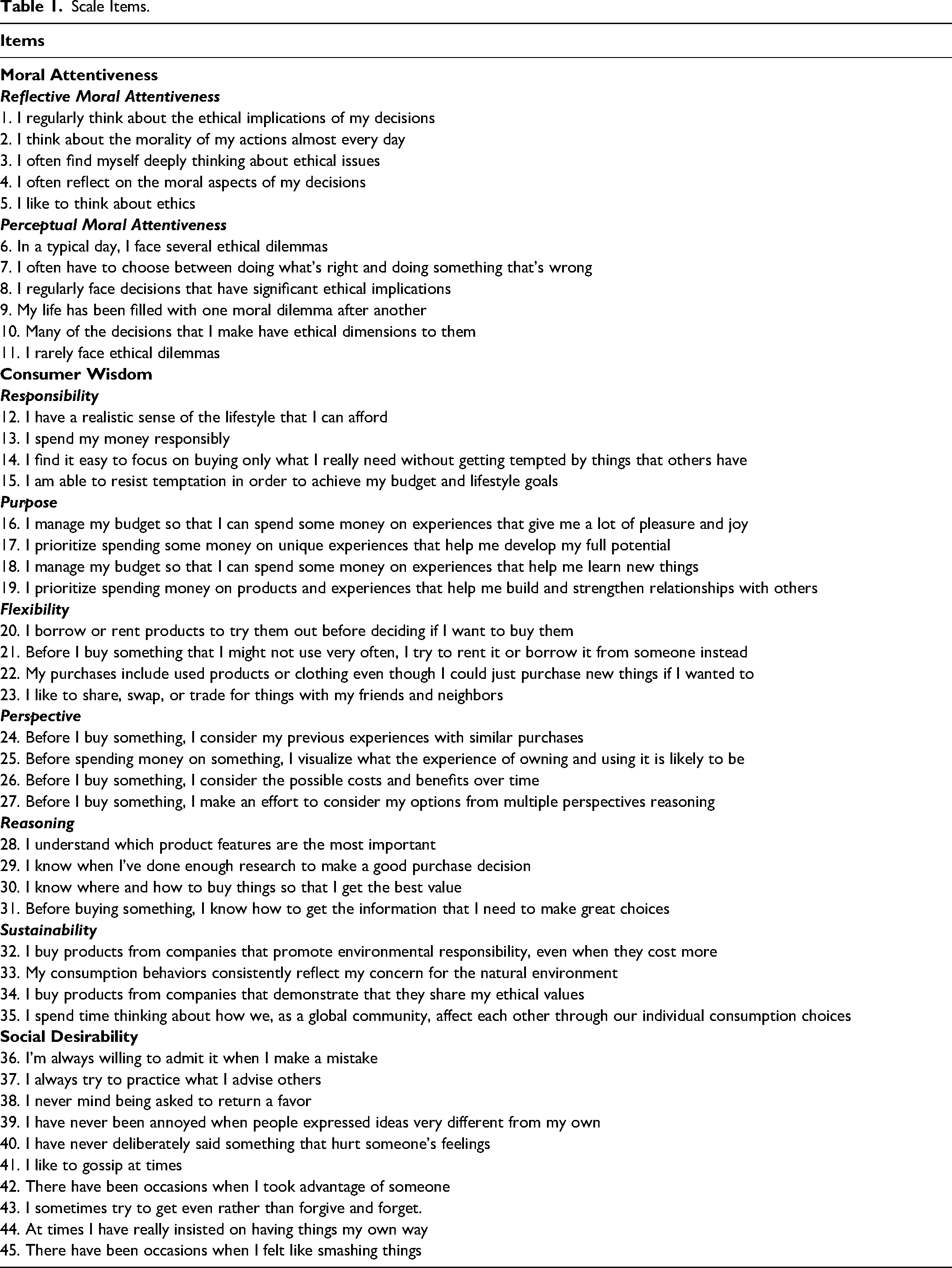
This study treats ethics education as a dichotomous variable to separate the control group from the treatment group (the control group was assigned a code of zero and the treatment group was assigned a code of one). Furthermore, all study variables were measured through scales adopted from past literature. Perceptual and reflective moral attentiveness were measured using Reynolds’ (2008) five-point Likert scale. As for consumer wisdom, it was measured using a five-point Likert scale adapted from Luchs, Mick, and Haws (2021). Each dimension of the construct was measured by four items in the CWS.
Control Variables
This study included two control variables that may influence the effect of ethics education on the variables of the study. It was mentioned by several studies that social desirability can cause overlap in results which is why it was included as a control variable to account for its influence on the dependent variables (Brugman and Aleva 2004; King and Bruner 2000; Tan et al. 2021; Wurthmann 2013). It was measured using a shorter version of the Marlowe-Crowne Social Desirability Scale as recommended by Strahan and Gerbasi (1972). It was repeatedly mentioned in previous research within the field of ethics education that males and females might differ in their results regarding ethics constructs (Cole and Smith 1996; Luthar and Karri 2005; Wang and Calvano 2015). Hence, the influence of gender difference was accounted for by including it as a second control variable. All scale items of the above-mentioned constructs are displayed in Table 1.
Scale Items.
Results
Sample Profile
The data analysis was conducted using SPSS version 25. The sample was categorized into a control group constituting 51.5% of the total sample, and a treatment group, which accounted for the remaining 48.5%. The majority of participants were females constituting 65.1% whereas the males only accounted for 34.9% of the total sample. The mean age of the participants was 19.67.
Common Method Bias
Because all the variables in the study were measured using the same tool (survey), the researchers conducted Herman's Single Factor to test for common method bias. The results showed that one factor accounted for 21.35 percent of the total variance in the items which is below 50 percent, indicating that common method variance does not explain the majority of covariance among the scales (MacKenzie and Podsakoff 2012).
Reliability and Correlation Analyses
All the measures showed Cronbach's Alpha scores above the required threshold indicating good reliability namely, perceptual moral attentiveness (.779), reflective moral attentiveness (.789), responsibility (.743), purpose (.799), flexibility (.742), perspective (.826), reasoning (.828), and sustainability (.775). Furthermore, a correlation matrix presented in Table 2 was conducted to display the Means, SDs, and intercorrelations among all variables included in the study.
Descriptive Statistics and Intercorrelations.

Note: Control group means, standard deviations and correlations (N = 350) are below the diagonal; treatment group means, standard deviations and correlations (N = 330) are above the diagonal.
**. Correlation is significant at the 0.01 level (2-tailed).
*. Correlation is significant at the 0.05 level (2-tailed).
Hypotheses Testing: Role of Ethics Education
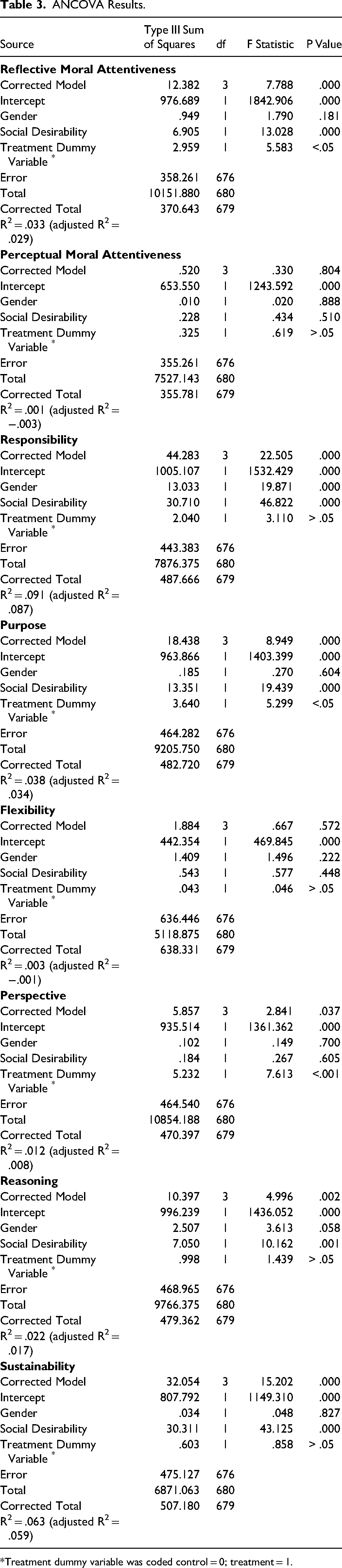
The influence of ethics education on each of the variables of the study is tested using a one-way analysis of covariance (ANCOVA) while controlling for the impact of covariates, which are gender differences and social desirability. H1.a proposes that students exposed to ethics education would demonstrate higher levels of reflective moral attentiveness. As displayed in Table 3, the treatment dummy variable is significantly associated with reflective moral attentiveness, F(1,680) = 11.05; p < .05, and the covariate-adjusted means were in the anticipated direction (Mcontrol = 3.728; Mtreatment = 3.861). Thus, the findings support H1.a.
ANCOVA Results.
Treatment dummy variable was coded control = 0; treatment = 1.
H1.b proposes that students exposed to ethics education would have higher levels of perceptual moral attentiveness. As shown in Table 3, the treatment dummy variable is not significantly associated with perceptual moral attentiveness, F(1,680) = .619; p > .05. Thus, the H1.b is not supported. Furthermore, H2.a proposes that students exposed to ethics education would demonstrate higher levels of responsibility. As shown in Table 3, the treatment dummy variable is not significantly associated with responsibility, F(1,680) = 3.110; p > .05. Thus, the H2.a is not supported. As for H2.b, it proposes that students exposed to ethics education would demonstrate higher levels of purpose. As displayed in Table 3, the treatment dummy variable is significantly associated with purpose, F(1,680) = 5.299; p < .05, and the covariate-adjusted means were in the anticipated direction (Mcontrol = 3.510; Mtreatment = 3.657). Thus, the findings support H2.b.
It is predicted by H2.c that students exposed to ethics education demonstrate higher levels of flexibility. As shown in Table 3, the treatment dummy variable is not significantly associated with flexibility, F(1,680) = .046; p > .05. Thus, the H2.c is not supported. H2.d suggests that students exposed to ethics education would demonstrate higher levels of perspective. As displayed in Table 3, the treatment dummy variable is significantly associated with perspective, F(1,680) = 7.613; p < .001, and the covariate-adjusted means were in the anticipated direction (Mcontrol = 3.822; Mtreatment = 3.999). Thus, the findings support H2.d. As for H2.e, it predicts that students exposed to ethics education would demonstrate higher levels of reasoning. As displayed in Table 3, the treatment dummy variable is not significantly associated with reasoning, F(1,680) = 1.439; p > .05. Thus, the H2.e is not supported. Finally, H2.f proposes that students exposed to ethics education would demonstrate higher levels of sustainability. As shown in Table 3, the treatment dummy variable is not significantly associated with sustainability, F(1,680) = .858; p > .05. Thus, the H2.f is not supported. Figure 2 illustrates the control and treatment means for the dependent variables, adjusted for covariates. Finally, Table 4 presents a summary table for all the hypotheses findings.
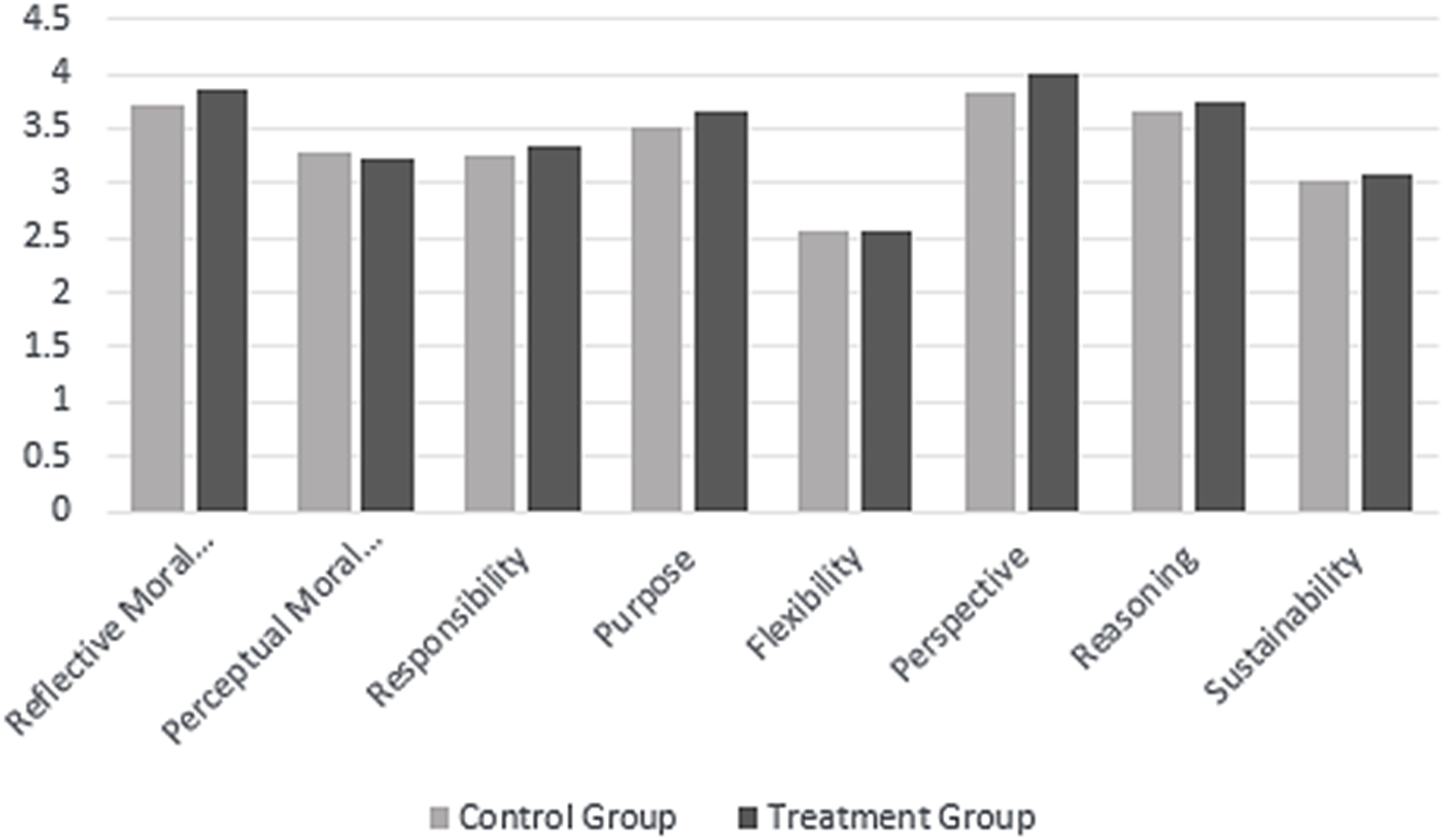
Group Means Adjusted for Covariates.
Summary Table.

Discussion
In the current paper, the researchers attempted to investigate the influence ethics education has on students’ levels of moral attentiveness and consumer wisdom. Starting with the findings of H1.a that associate ethics education with reflective moral attentiveness –deep reflections upon one's ethical aspects of their life experiences-. They show that being exposed to ethics education has a positive influence on students’ reflective moral attentiveness. This is consistent with a previous study by Wurthmann (2013). Thus, it is evident that ethics education can influence students’ tendency to self-reflect on the moral cues of their own experiences. On the other hand, the results of H1.b indicate that ethics education did not influence the students’ perceptual moral attentiveness –the ability to automatically recollect the moral content relevant to daily life situations-, which is a surprising result; given that, Wurthmann's study provided contradicting results.
Looking at the results of H2.a, they show that there is no association between ethics education and responsibility. This indicates that being exposed to ethics courses did not influence students’ ability to consume in a way that best suits their resources and lifestyles. This could be explained by the negative effects that globalization and social media have on the behaviors of young consumers (Kowalska 2012). Relating to Festinger's (1954) social comparison theory, individuals tend to engage in self-reference comparisons with others. Their behaviors are thereby affected to be more inclined toward what is deemed acceptable among their social group. A study conducted by Islam et al. (2018) elaborated that the intensive use of social media by young consumers increased their social comparison tendencies and their need for the material acquisition of goods that might be beyond their available resources and capabilities. Thus, social media users are racing to showcase their conspicuous consumption patterns that might not fit the normal lifestyle of the majority of individuals (Pellegrino, Abe, and Shannon 2022).
This was evident in Kamal, Chu, and Pedram's (2013) study comparing between American and Arab social media users. The results showed that the Arab sample has higher levels of materialism, and social media usage, and is more influenced by social media advertising. Recent research studies provided evidence supporting that Arab consumers have high levels of materialism and conspicuous consumption (e.g., Arthur et al. 2020; Jameel et al. 2024; Shammout et al. 2022). Another possible explanation of the result might be the lack of spending controls among consumers, evident in forms of impulsive buying for instance (Baumeister 2002; Fenton-O'Creevy, Dibb, and Furnham 2018; Wertenbroch 1998). As for the results of
The results of H2.c show that there is no association between ethics education and flexibility. A possible reason for such a result might be that the concept of collective consumption is not popular in the Middle Eastern culture represented in the sharing economy, swapping of products, borrowing, and bartering for instance (Alraeeini, Zhong, and Antarciuc 2019). This is evident in the covariate-adjusted mean value of this variable, as it has the lowest mean value among the other variables. Further, the results of H2.d indicate that ethics education had a positive effect on students’ perspectives while consuming. As mentioned above in the results of H1.a, ethics education elevates students’ ability to ponder on their past experiences. Thus, ethics education enabled them to critically think about the consequences of their consumption from different perspectives and revisit their experiences as the basis for their consumption decisions.
The results of H2.e indicate that there is no association between ethics education and reasoning. One potential explanation could be that ethics education did not sufficiently tap into their tendency to gather and evaluate all needed information to guide their sensible consumption patterns. It is also important to note that young consumers might lack practical life experiences to which they could apply their ethical frameworks. Finally, H2.f indicated that there is no significant association between ethics education and sustainable consumption. One possible explanation could be the young age of the research sample, as they are in a stage of shaping their cognition and behavior with relevance to ethical and sustainable consumption.
However, in a similar context, the findings of multiple studies on sustainable consumption indicated that Egyptian consumers have high levels of sustainable consciousness and behaviors (Attia and Farrag 2017; Tantawi et al. 2009). More specifically, a recent study by Khalil, Ismail, and Ghalwash (2021) generated analogous results among Egyptian Generation Z. Evidently, contradictory results emerged in previous literature on how age affects ethical and sustainable consumption as asserted by Biresselioglu et al. (2023), which warrants further investigation in the future. To elaborate, Panzone et al. (2016) demonstrated that older consumers are more likely to adopt sustainable consumption patterns. On the other hand, Azzurra, Massimiliano, and Angela (2019) argued that younger consumers are more prone to organic and sustainable consumption.
Theoretical Implications
Our findings bring intriguing theoretical contributions to the fields of marketing ethics education and consumer ethics, offering new insights that build on existing theories and add more depth to the ongoing conversation around marketing ethics. There is a lack of empirical studies exploring the impact of ethics education on students’ ethical consumption behavior. Hence, this study presents a starting point for investigating the influence of ethics education on students as consumers. This brodens the scope of the potential impact of ethics education and suggests a more comprehensive influence on consumers’ lives. This warrants diverse research opportunities for future researchers and contributes to the extant literature; especially with relevance to the raised academic discussions in the Journal of Macromarketing (e.g., Casais and Faria 2022; Chowdhury 2023, 2020, 2018).
The current study supports and extends Kohlberg's cognitive moral development theory and Hunt-Vitell's theory of marketing ethics education (1986) by examining consumer wisdom as a novel construct in the domain of ethics education to investigate students’ ethical consumption behavior. To the authors’ knowledge, this is the first study to answer Luchs and Mick's (2018) call for an experimental investigation of the construct in addition to Luchs, Mick, and Haws's (2021) call for using it in a different context to provide deeper insights regarding its employment.
Our findings deepen the theoretical understanding within the existing literature. They provide deeper insights into the role of ethics education in strengthening the alignment between consumers’ moral values and their consumption behaviors. This enriches the understanding of the mechanism through which ethics education shapes wise consumption decisions. This also invites future research to explore how personal values influence specific mindful consumption choices such as supporting fair trade, reducing environmental harm, or avoiding exploitation. In addition, this study enhances the understanding of how ethics education fosters wise consumption patterns that extend beyond immediate gratification, emphasizing the importance of considering the consequences of one's behaviors. This, in turn, opens avenues for investigating the role of future-oriented thinking in shaping such behaviors. By integrating these findings into the larger body of literature, the study contirbutes to advancing the field, paving the way for future exploration of how ethics education infleunces students’ cognition and mindful consumption patterns.
Practical Implications
The positive impact of ethics education on consumer wisdom suggests that ethical considerations should be integrated into various subjects within the curriculum. This can foster more responsible and sustainable consumer behavior among students. The findings of the current research imply that ethics education is still in need of further development, especially with the ongoing trends that might blur students’ judgment of ethical cues or even alter their behavior. Policymakers should consider mandating ethics education as a standard component of the curriculum at various educational levels. This can help in nurturing reposnible consumer behavior that aligns with broader societal and enviromental goals. HEIs can play a pivotal role by incorporating enactive ethics education techniques into their curricula. Enactive learning would help students develop a consistent and accessible ethical framwork that they can rely on in various life stituations to enhance their moral cognitive and behavioral competencies. The applied teaching pedagogies should tap into students’ ethical reasoning skills and self-reflection to elevate their emotional (e.g., compassion and sympathy) and cognitive (e.g., situational consciousness and awareness) traits. This would improve the students’ ability to identify the ethical cues and understand real-life situations from different perspectives
In light of the study results indicating that ethics education had the most impact on the purpose and perspective dimensions of consumer wisdom, it is highly recommended to integrate both dimensions more intensively into the curricula. Marketing educators should play a crucial role in guiding young students with limited life experience to build a strong cognitive foundation. By doing so, they can help students recognize the long-term consequences of their consumption choices and develop consumer wisdom. To tap into the purpose dimension, instructors should create a safe and supportive environment for students to encourage self-reflection on their accepted values and beliefs. By prioritizing long-term rewards over short-term gains, students can learn the concept of delayed gratification and be encouraged to allocate resources to experiences and investments that promote personal growth and fulfillment, such as travel, education, and skill development. Also, financial literacy and expenditure management should be incorporated into the curricula to elevate students’ ability in managing their finances effectively.
Regarding the perspective dimension, self-reflection activities are important in elevating this dimension as well. Experiential learning pedagogies, such as case studies and role-playing exercises, can play an essential role in reflecting on meaningful insights from various experiences and help students make better purchase decisions. Overall, by integrating purpose and perspective dimensions into the curriculum, marketing educators can guide students in building a foundation that supports wise and responsible consumption choices in their lives.
Educators also need to implement constant assessments to evaluate the effectiveness and the long-term impact of ethics education programs. This would enable HEIs to refine and enhance the programs over time. Additonally, it is important for HEIs to encourage the integration of ethics education and practices to students’ extraxurricular activities (i.e., student organizations and clubs). This would help in promoting wise and responsible behavior among students.
Finally, this study also provides implications for non-governmental organizations (NGOs) to promote consumer wisdom. NGOs can reach a broader population through lauching public awareness campaigns that encourage the adoption of ethical and wise consumption patterns. Promoting various wise behaviors could help in achieving multiple SDGs, and therefore, contirbute to personal and collective well-being. Running social marketing efforts can also highlight the importance of consumer role in undertaking positive actions against enviromental and social problems. This, hence, can foster a culture of ethical and responsible consumption.
Limitations and Directions for Future Research
Limitations are put forth and explained to understand the scope of the current research and to provide directions for future research. In this study, one limitation is pertinent to the confounds of the cross-sectional research design. The current study employed a posttest-only experimental design. It is thus recommended for future research to conduct a longitudinal study that examines the variations of the influence of ethics education over time. Future research could implement pre-test and post-test experimental designs to assess the change that occurs in the research constructs within the same treatment group. One limitation in this study is that ethics education intervention was introduced to the treatment group based on their study year. As a result, while the intervention was mandatory and not subject to self-selection bias, the timing of the introduction could create a potential confounding factor. Future studies could address this by using a sample of students from the same study cohort. It is also recommended for future research to include samples from the same cohort in multiple universities such as public and private ones. To further extend the research findings, future research could conduct cross-cultural studies across different countries.
Furthermore, this study does not focus on a certain teaching approach or the intensity of ethics education. Thus, it is recommended to implement comparative studies to investigate the effects of different teaching approaches in addition to identifying whether students’ exposure to a separate course is more effective or the embedded moral concepts within their existing curricula. As for the sampling technique, the paper employed a non-probability sampling technique, which poses a challenge against the generalization of results (Malhotra and Birks 2007). That is why it is recommended to employ probability-sampling techniques in future studies. Additionally, the young age of the sample might have posed some limitations to the applicability of some consumer wisdom dimensions that could require more practical experience from individuals. Thus, it is recommended for future researchers to extend the current study to a different age group. Future research could also implement an experimental design to investigate the differential effect of ethics education on the ethical consumption of various age groups. Finally, it is recommended that future researchers extend the findings by exploring possible moderators that might explain the differential effect of ethics education on the dimensions of moral attentiveness and consumer wisdom.
Footnotes
Associate Editor
Alexander Nill
Declaration of Conflicting Interests
The authors declared no potential conflicts of interest with respect to the research, authorship, and/or publication of this article.
Funding
The authors received no financial support for the research, authorship, and/or publication of this article.
