



Abstract
Journal of Marketing Education (JMED) is an important academic source for the progression of innovative research and experiential wisdom, both of which enhance the knowledge of marketing educators. The primary objective of this study is to provide a retrospection on the emergence and growth of JMED using scientometrics—in simple terms, is the quantification of science. Applying bibliometric methods, the top articles, authors, and topics in JMED titles are identified. A thematic analysis groups JMED articles into 10 semantic clusters: team environment, innovative teaching techniques, students’ evaluation of teaching, qualitative assessment of marketing outlets, technological diffusion in marketing education, experiential learning, marketing values and ethics, self-regulated learning, objective exams, and multiple experiential techniques and student learning. Among these, technological diffusion in marketing education, marketing values and ethics, and multiple experiential techniques and student learning are the most popular and evolving. Apart from informing JMED readers about possible future avenues of the journal, this study may provide valuable information to its editorial board.
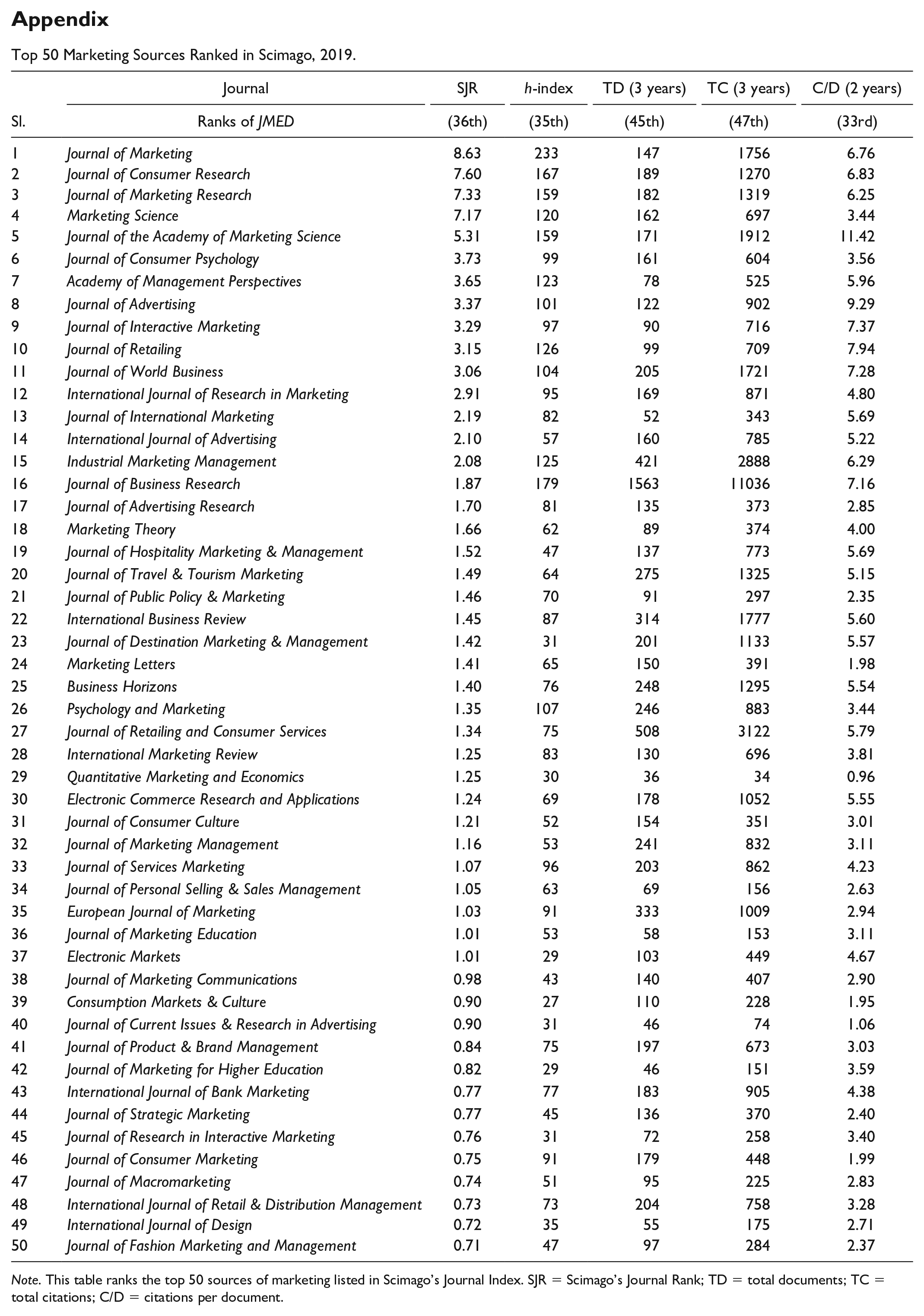
Journal of Marketing Education (JMED) is a platform for the progression of innovative ideas, research outcomes, and experiential wisdom that primarily enhance the knowledge of marketing educators. It is one of the leading peer-reviewed academic sources in the field of marketing education, internationally acclaimed for publishing teaching methodologies, learning strategies and managerially relevant articles. Victoria L. Crittenden at Babson College is the current editor of the journal. JMED is indexed in Scopus, ProQuest, EBSCO, and other similar databases. According to Scimago’s Scientific Journal Ranking, JMED’s 2 years’ cites-per-document of 3.107 indicates that its number of citations in 2019 was 3.107 times the number of publications in 2017 and 2018. The Scimago’s Journal Rank (SJR), a prestige indicator for the journal, is 1.010 (see the appendix) and the journal features among the top 25% resources in Marketing. JMED ranks “B” on a scale from A*, A, B, C, and unranked journals in the Australian Business Deans Council and it bears a rating of “2” in the Chartered Association of Business Schools Academic Journal Guide. Such rankings affirm that the journal meets the international standards of peer review and publishing original, impactful research.
JMED commenced publishing in 1979 and has developed a repository of 970 original articles on marketing education since then. Despite its enriching academic significance, it is surprising to observe the gap for a retrospective review of the journal. Applying scientometrics, we provide an overview of the 41 years of JMED. Such analyses are common in extant literature as a qualitative systematic review in such situation is practically difficult without involving the risk of biased research (Mallett et al., 2012). The goal of this endeavor is to first uncover and explicate historical trends in the content and context of research published in JMED since its inception and second, subsequently, to examine the implications of these trends for marketing education scholarship looking forward.
Given the limitations of qualitative assessment in summarizing voluminous literal content, quantitative studies of this nature have burgeoned in recent years. For example, Donthu, Kumar, and Pattnaik (2020) provided a bibliometric overview of the 5,131 articles covered in Journal of Business Research between 1973 and 2017. Baker et al. (2020a) examined 1,400 articles published in the first 25 years of Journal of Corporate Finance, and Donthu, Kumar, Pattnaik, and Campagna (2020) provided a retrospective analysis of 382 publications in the 15 years of Journal of Marketing Theory and Practice.
Scientometrics—or its more broader term, bibliometrics—is the quantitative assessment of science (Hess, 1997). Applying statistics and mathematics, the study method quantifies large volumes of bibliographic data (Broadus, 1987; Pritchard, 1969). Such study technique is highly relevant in the modern context where research is being produced at an exponential rate with heightened global submissions (Baker et al., 2020b). Bibliometrics offer multiple advantages over classical, more manual qualitative analysis (Glänzel, 2003) and is a well-accepted study technique in management research (Zupic & Čater, 2015). Its strength consolidates its ability to formulate comprehensive overviews of academic disciplines, academic sources and/or academicians (Blanco-Mesa et al., 2017; Merigó et al., 2018; Pattnaik, Hasan, et al., 2020; Pattnaik, Kumar, et al., 2020). Simultaneously, through mapping analyses, it can unveil the social and intellectual nexus among the authors that contribute to academic growth and impact (Cisneros et al., 2018; Koseoglu, 2016; Nerur et al., 2008). Hence, application of such a technique is useful in summarizing the historic trends of JMED when considering four decades of publication. The research questions addressed in this endeavor include the following:
By addressing the research questions, we make some interesting contributions. First, we summarize the academic trends covered in the 41 years of the journal. Second, we elucidate the quantitative growth in JMED’s authorship thereby showing its popularity among academics. Third, we rank the most influential publications which may be useful for JMED readers to get a one-glance view of the journal’s most influential content. Fourth, we quantify the influence, impact, activity and productivity of the journal achieved in its 41 years. Fifth, we uncover the type of studies and themes the journal has historically published, and identify patterns of growth and atrophy among them. Sixth, we show the intellectual association among the published research. Seventh, we demarcate the (dis)similarities among the documents, affiliations, themes, titles and the like. Eighth, we identify the areas that are dormant or evolving, thus educating aspiring contributors on the appropriate areas to target in the future. In addition, such rich retrospection may guide JMED’s future strategy formulation.
The remainder of this essay proceeds as follows: First, we briefly discuss the applied methods and provide the descriptive results. Second, we summarize the bibliographic networks of JMED articles and then visualize the bibliographic networks. Finally, we provide a key summary of the study and conclude.
A Scientometrics Analysis: The Story History Tells
Bibliographic data for this study come from Scopus, which has been frequently accessed in similar studies. Examples include, Baker et al. (2020a, 2020b), Donthu, Kumar, and Pattnaik (2020; Donthu, Kumar, Pattnaik, & Campagna, 2020). According to Valtakoski (2019), Scopus provides broader coverage of resources than the Web of Science. However, data obtained from Scopus are prone to errors of the multiple representations in author names and affiliations (Baker et al., 2020a). Thus, following extraction of the data from Scopus, we followed a series of manual processes for cleaning the raw data to obtain more refined and sound results.
The term “Journal of Marketing Education” searched among the listed academic outlets in Scopus resulted in 1,085 documents. After we filtered out the editorials, errata, letters, notes and articles without author information, the final number was reduced to 970 documents, which include 950 articles and 20 reviews. We included all for analyses.
Bibliometric Analysis of JMED Articles
This part of the study predominately projects the performance and graphical analyses of JMED (Glänzel, 2003). The performance analyses are depicted through various quantitative indicators (Pattnaik, Hasan, et al., 2020). The following descriptive variables for the study highlight the academic contributions and influence of JMED and its authors. Total publications (TP) denotes the academic contributions of JMED and its key players; the authorship patterns highlight the number of contributing authors (NCA), growth in authorship (GA), collaboration index (CI), and the number of sole-authored (SA) and coauthored articles (CA). The citation structure in JMED articles is presented in the forms of total citations (TC), average citations per cited publication (C/CP), citations per contributing author (C/CA), and (or) citations per affiliated author (C/AA). The scientific influence, impact, activity, and productivity of JMED, its authors, and their affiliations are projected as h-index, g-index, NAY (the number of active years) and PAY (the productivity per active year), respectively.
Along with the series of descriptive indicators, our study also highlights the thematic bibliographic clustering of JMED articles. Precisely, the network analyses depict the bibliographic couplings of JMED articles and its prolific authors (Donthu, Kumar, and Pattnaik, 2020; Donthu, Kumar, Pattnaik, & Campagna, 2020; Thijs et al., 2015). The core of such analysis is rooted in the foundational idea of Kessler (1963), according to whom scientific articles resemble their patterns of referencing.
Publication Trend, Authorship Pattern, and Citation Structure in JMED
Table 1 reports the publication trend; the author and citation structure; and the influence, impact, activity, and productivity of JMED between 1979 and 2019. Figure 1 distributes JMED articles by the NCA and also indicates citations depicting the level of coauthorship and its academic influence over JMED. Precisely, 66.9% of JMED articles are by two or more authors which accounts for 74.8% of its citations.
State of the Art of JMED.
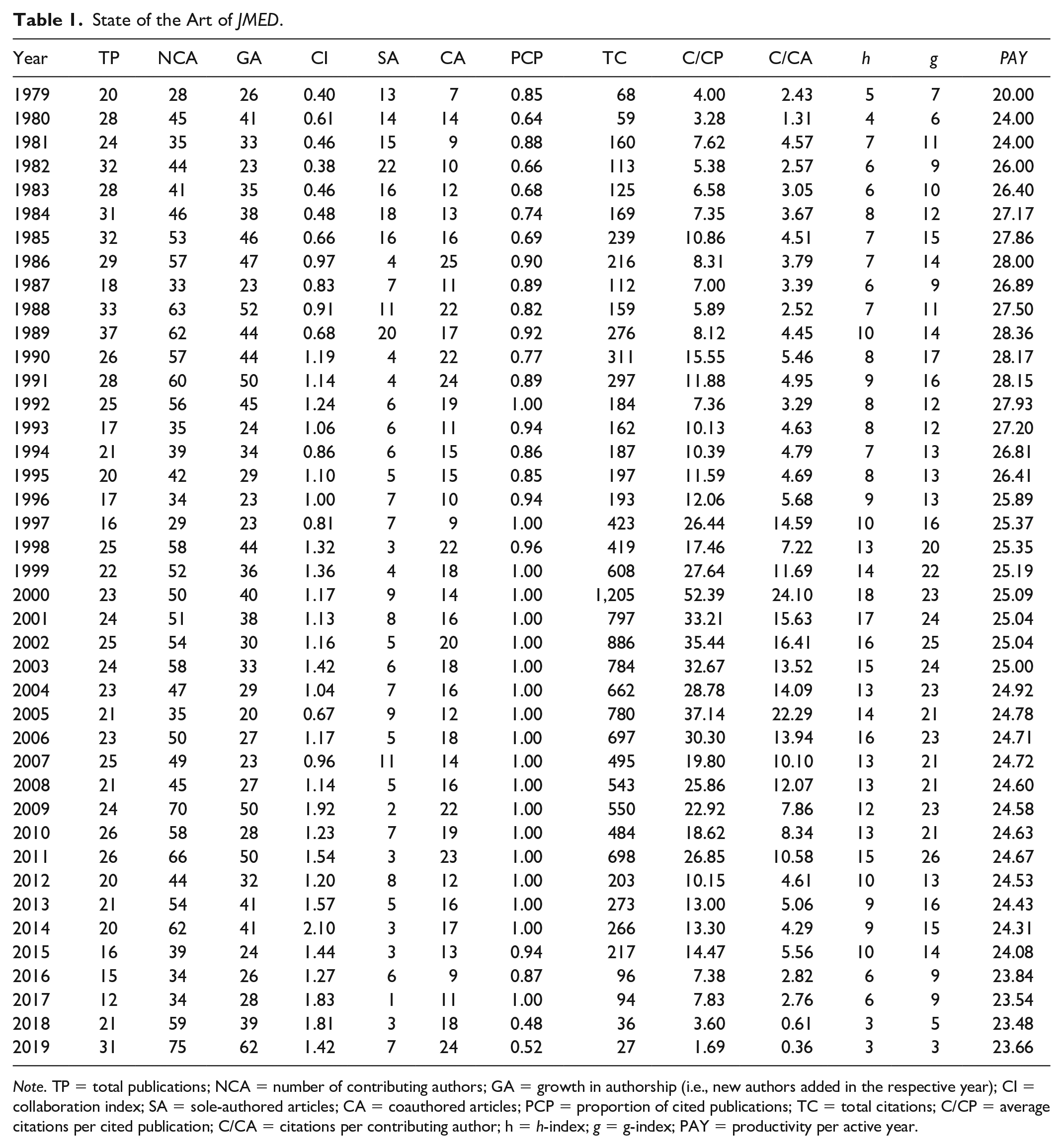
Note. TP = total publications; NCA = number of contributing authors; GA = growth in authorship (i.e., new authors added in the respective year); CI = collaboration index; SA = sole-authored articles; CA = coauthored articles; PCP = proportion of cited publications; TC = total citations; C/CP = average citations per cited publication; C/CA = citations per contributing author; h = h-index; g = g-index; PAY = productivity per active year.
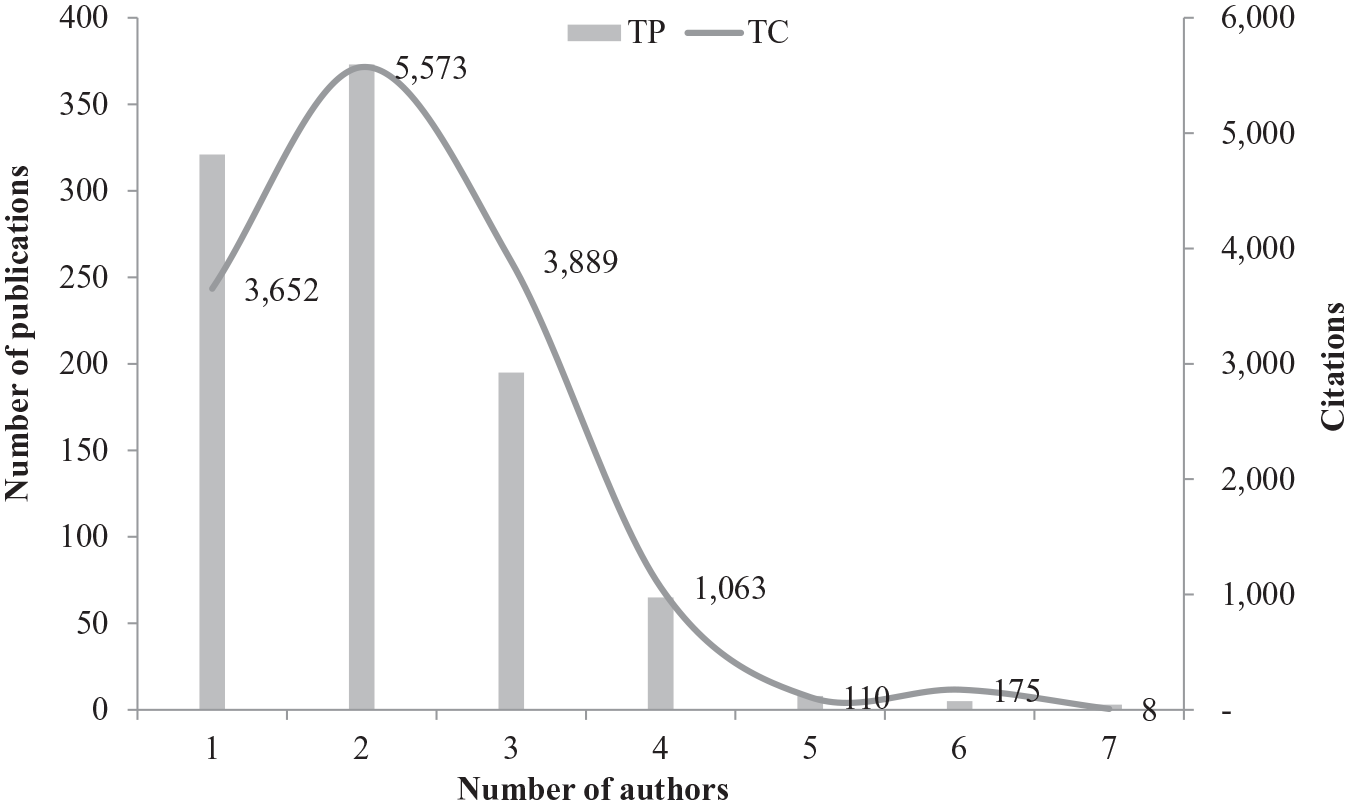
Author distribution of JMED articles.
Between 1979 and 2019, JMED published 970 articles contributed by 1,448 different authors. Among these 970 articles, 321 were sole-authored and 649 coauthored. Accounting for multiple submissions from those 1,448 authors, the total number of contributing unique authors is 2003. Approximately 88% of the cited JMED articles received 14,470 citations, and each cited article received an average of 16.92 citations.
As highlighted in the appendix, the h-index of JMED is ranked 35th among the top 50 international marketing journals ranked in Scimago. The influence of JMED extends to its 53 articles being cited at least 53 times (h: 53), while its impact extends to 74 articles receiving at least 518 citations (g: 74). Alternatively, simultaneously, in terms of its 2 years citations per document, it ranks 34th in the top 50. Such figures suggest the emergence and recognition of JMED as an important outlet in global marketing thought, let alone within the field of education.
As Table 1 shows, JMED published its highest number of articles in 1989 (TP: 37). On average, JMED added roughly 35 new authors every year. Its highest collaboration among authors occurred in 2014, with each lead contributor collaborating with 2.10 other scholars to contribute a JMED article (CI: 2.10). We observe a declining trend in SA articles offset by the rising number of coauthored works, a trend also common in most other academic sources (see Baker et al., 2020a, 2020b; Donthu, Kumar, & Pattnaik, 2020; Donthu, Kumar, Pattnaik, & Campagna, 2020). Figure 1 shows that the majority of JMED articles have more than one author.
The implications of this trend away from solo-authored pieces and more toward collaborative works are quite promising to current and prospective marketing educational researchers. The trend of coauthorship suggests that more academics overall have become participants in and contributors to pedagogical scholarship. This is supported my JMED’s ranking among noneducational marketing journals. Encouraging more marketing academics to turn their research skills to the science of their own tradecraft is of critical importance to the longevity and durability of the field of marketing education, particularly considering the expeditious pace of change in marketing. We may also infer that technology has enabled extremely efficient networking and communications, particularly across geographic boundaries. While this is certainly not a revolutionary insight on its own, what it highlights is the opportunity for multiregion research collaboration in the marketing education field, which is extremely limited at present.
In terms of citations, JMED articles published in 2000 received the maximum citations (TC: 1,205). In addition, its citations per publication (C/P: 52.39) replicate the citations per cited publication (C/CP: 52.39). On further exploration, we find that among the 23 articles published in 2000, 20 are cited between 1 and 99 times (CT1: 20) while the other three received more than 100 citations (CT2: 3) in Scopus. Thus, 2000 was the most influential year of the journal (h: 18) to date, while 2011 is noted as the year with the greatest impact (g: 26). However, in terms of productivity, 1989 was the most productive year for the journal, with the average number of publications reaching 28 (PAY: 28.36). Thus, in general, we observe an increasing trend in JMED publications, author collaborations, citations, and productivity, which collectively suggests a uniform progress of the journal between 1979 and 2019. Compounding this is the consideration that overall submissions to the journal have increased consistently year-on-year since inception. When considering the consistency of output, this leads us to conclude that the overall academic quality and scientific rigor of published articles have been increasing consistently as JMED matures.
Top JMED Articles Between 1979 and 2019
Table 2 lists the influential JMED articles cited at least 75 times, which is considered in bibliometric analysis to be a minimum threshold for the “influence” of a single article over a 40-year time horizon (Donthu, Kumar, & Pattnaik, 2020; Donthu, Kumar, Pattnaik, & Campagna, 2020). Gault et al.’s (2000) article, titled “Undergraduate business internships and career success: Are they related?” is the most cited article in JMED (TC: 184), followed by Hult et al.’s (1997) article, titled “Faculty perceptions of marketing journals,” cited 164 times. Gault et al. (2000) empirically confirmed that field internships of marketing students lead to their early career success, and Hult et al. (1997) suggest that qualitative appraisal of academic sources of marketing plays a pivotal role in recognition, academic discourse, and promotion. A close examination reveals that the influential themes of JMED include student learning (Clayson, 2009; Hamer, 2000; Lowe & Laffey, 2011), student evaluation (Clayson, 2009; Marks, 2000; Simpson & Siguaw, 2000), student satisfaction (Aggarwal & O’Brien, 2008; Appleton-Knapp & Krentler, 2006), group projects (Aggarwal & O’Brien, 2008; McCorkle et al., 1999; Strong & Anderson, 1990), teamwork (McCorkle et al., 1999; Pfaff & Huddleston, 2003), marketing education (Smart et al., 1999; Yoo & Donthu, 2002), business internships and career success (Gault et al., 2000), social media as a learning tool (Rinaldo et al., 2011), and classroom environment (Young, 2005).
Top Articles Published in JMED During 1979 and 2019.
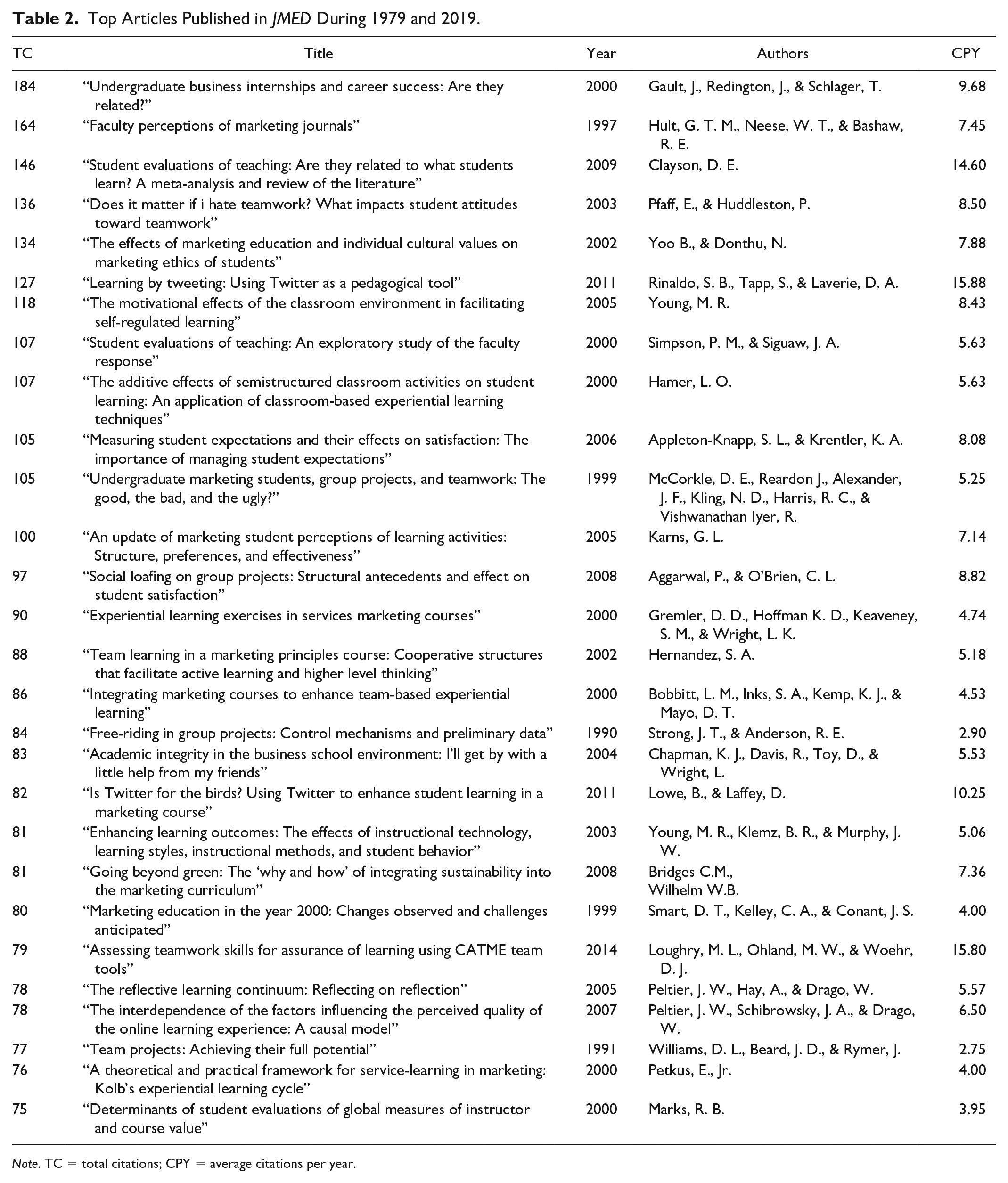
Note. TC = total citations; CPY = average citations per year.
The implications of these findings are extremely provocative, looking forward. It makes intuitive sense that the majority of the top-rated JMED articles are student-focused in nature—learning outcomes, career placement, skills training, and so on—but on closer inspection, this is fairly limited with respect to the overall scope of possibility afforded by the Journal and is very heavily skewed to undergraduate education and career skills training in particular. Although two of the 10 most-cited papers over the last four decades deal with teaching evaluations, these are isolated papers rather than part of a topical trend. There are also no papers at all in the top-cited works addressing graduate-level education. What this suggests is that marketing education researchers have only deeply explored one of many rich avenues of scientific inquiry available in this space. Most notably, there is a perplexing dearth of research on teaching and educating as a skillset. Although the field to date has been appropriately preoccupied with student learning outcomes, there is much room to grow the scope of research and subsequent impact on the field in the study of teaching skills, techniques, approaches, styles, and methods. There is also what appears to be a wide and unexplored gulf of opportunity with respect to the study of graduate and doctoral-level education, both woefully underrepresented in the marketing education research to present.
Another observation in examining the most highly cited publications in JMED is that only three of the top 28 most-cited publications were written in the last decade and had double-digit citations per year. Interestingly, all three of these papers focus specifically on the use of web-based technologies in the classroom. Of course, research takes time to propagate. But in the field of marketing education, so specifically focused on functional-level educational techniques and student experiences, it is simultaneously perplexing and motivating that JMED papers seem to pick up steam rather slowly. This leads to the inference that research in the Journal has room to become more tangibly and immediately impactful to the practice of marketing education. The audience of JMED comprises marketing educators who read the publication improve the practice of educating their students. So it seems incumbent on submitting authors to ensure that their research has tangible application in the marketing classroom and has an immediately resonant meaning to readers.
Top JMED Authors Between 1979 and 2019
Table 3 lists the top authors who have contributed at least five articles to JMED until the end of 2019, and Figure 2 and Figure 3 depicts the temporal trend of the contributors. J. W. Peltier tops the list for contributing the highest number of articles (TP: 15), all of which are coauthored (CA: 15). On average, Peltier collaborates with 2.33 other scholars on JMED articles (CI: 2.33). However, J. Reardon, J. F. Alexander, and L. K. Wright are the most collaborative researchers in the journal (CI: 3.00), while C. R. Duke, M. R. Young, and S. P. Ramocki contribute the highest number of sole-authored publications (SA: 5).
Top Authors Contributing to JMED Between 1979 and 2019.
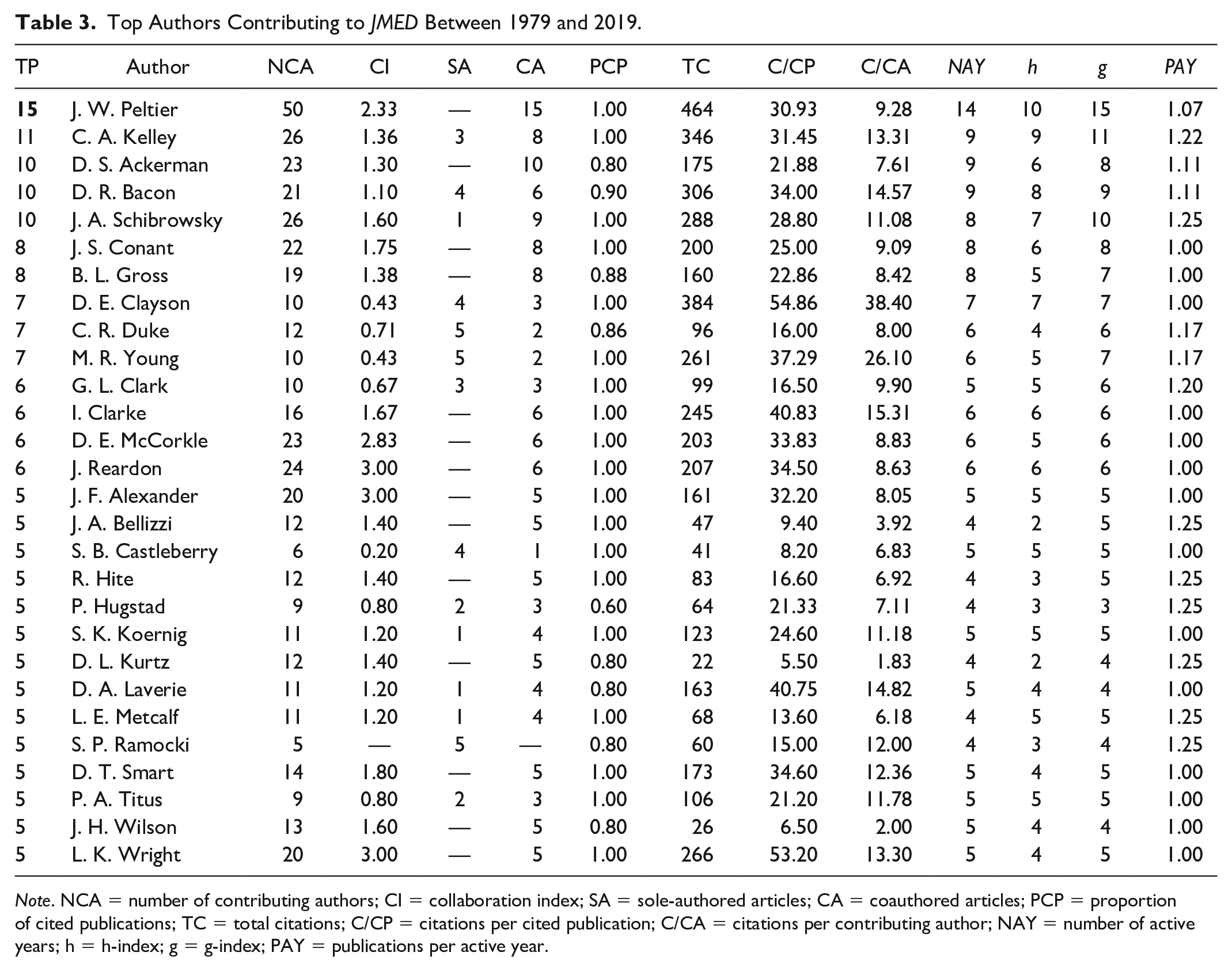
Note. NCA = number of contributing authors; CI = collaboration index; SA = sole-authored articles; CA = coauthored articles; PCP = proportion of cited publications; TC = total citations; C/CP = citations per cited publication; C/CA = citations per contributing author; NAY = number of active years; h = h-index; g = g-index; PAY = publications per active year.
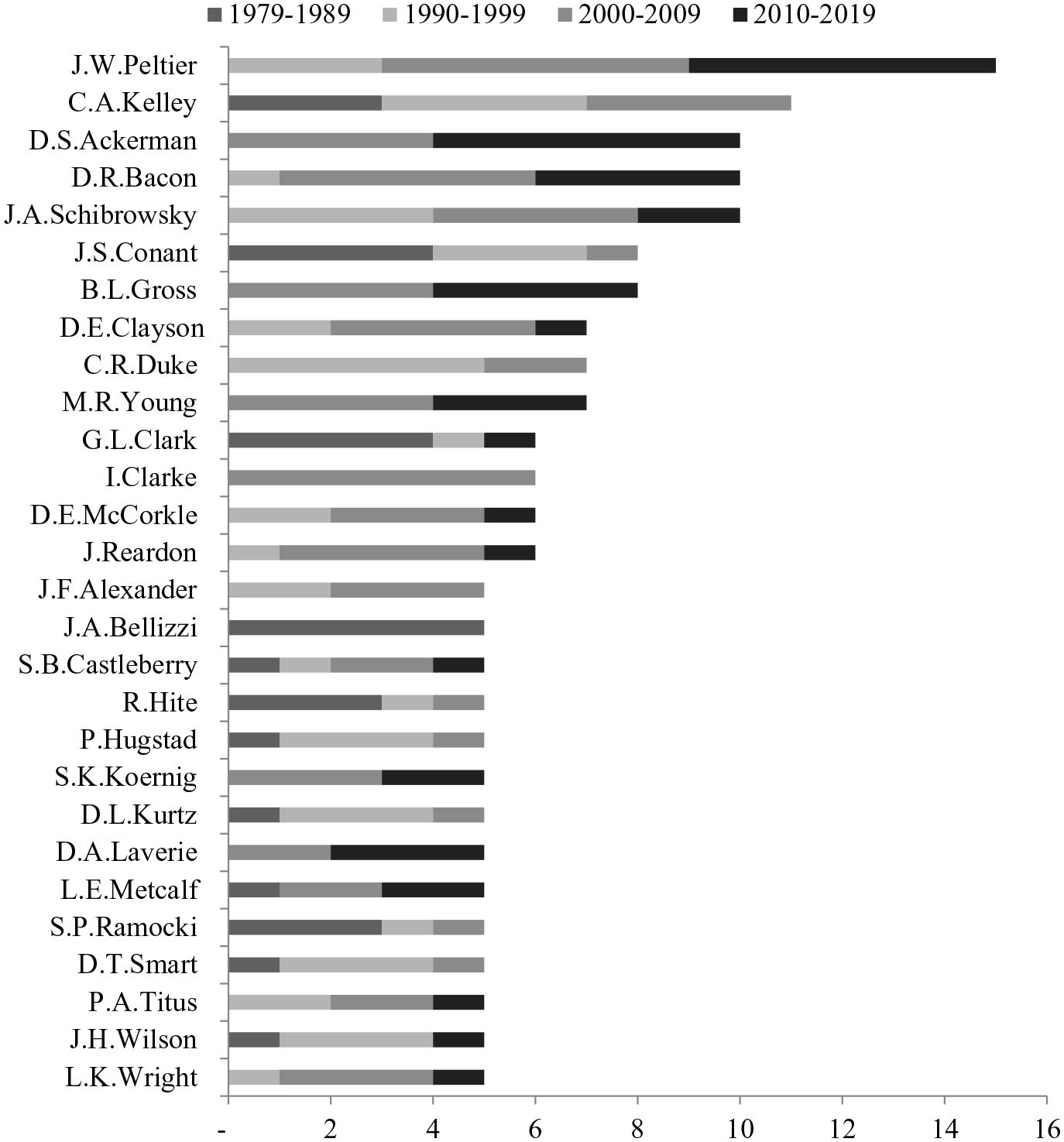
Temporal evolution of the top JMED authors.
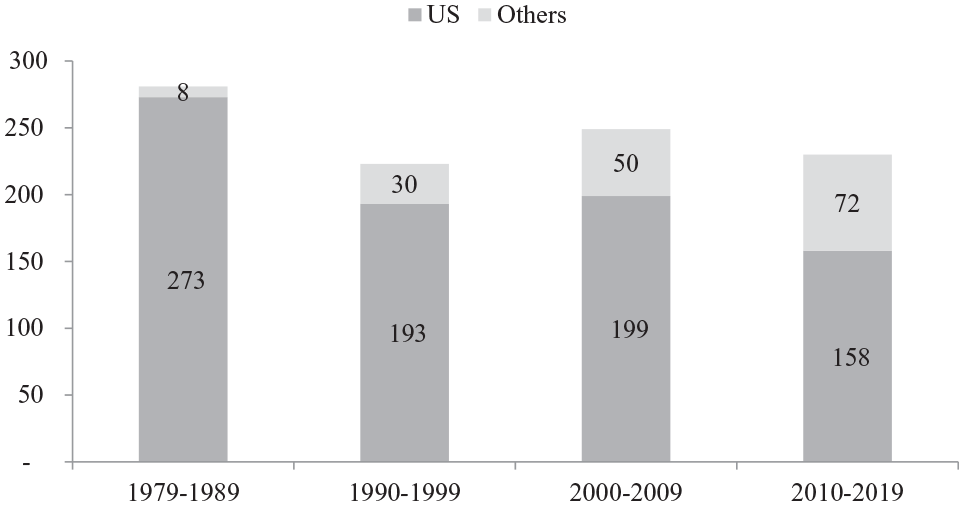
Temporal evolution of the countries affiliated with JMED authors.
In terms of total citations, J. W. Peltier is the most popular JMED author (TC: 464). He is also the most active (NAY: 14) and influential (h: 10) JMED contributor and has the most impact (g: 15). However, in terms of average citations, L. K. Wright leads, with each article cited approximately 53 times (C/CP: 53.20). Similarly, we find that J. A. Schibrowsky, J. A. Bellizzi, R. Hite, P. Hugstad, D. L. Kurtz, L. E. Metcalf, and S. P. Ramocki are the most productive researchers, contributing more than one article in each of JMED’s 41 active years (PAY: 1.25 each).
In terms of the temporal trend depicted in Figure 2, along with J.W. Peltier, D.S. Ackerman has contributed the highest number of articles between 2010 and 2019. Of note, both authors have contributed six articles each to JMED. The premise that there is a very well-established core contingent of authors in the marketing education space is not unique to the discipline but is promising here as it is in parallel across disciplines. Further to the above point of increasing collaboration in pedagogical research, we might also take the liberty of inferring that there is an opportunity for scholarly mentorship in the area as well. There is also room for such established authors to assume advisory and editorial roles for the Journal to serve as arbiters of scholarly quality and academic standards as JMED moves forward.
Top Countries Affiliated With JMED Authors
Table 4 lists the countries frequently affiliated with JMED authors, and Figure 4 is a comparison between U.S.-affiliated authors and non-U.S. authors. Of note, authors from 38 countries have contributed at least one article to JMED between 1979 and 2019. However, as the table shows, the United States dominates in most of the parameters (TP: 823; NCA: 1.714; SA: 262; CA: 561; TC: 12,600; NAY: 41; h: 51; g: 73; PAY: 20.07). Indonesia is the most collaborative JMED author-affiliated country, with each of its authors collaborating with four other scholars to contribute a JMED article (CI: 4). Similarly, in terms of the average indicators of citations, authors affiliated with Norway have received the highest citations (C/CP: 28.00; C/AA: 28.00).
Top Countries Contributing to JMED.
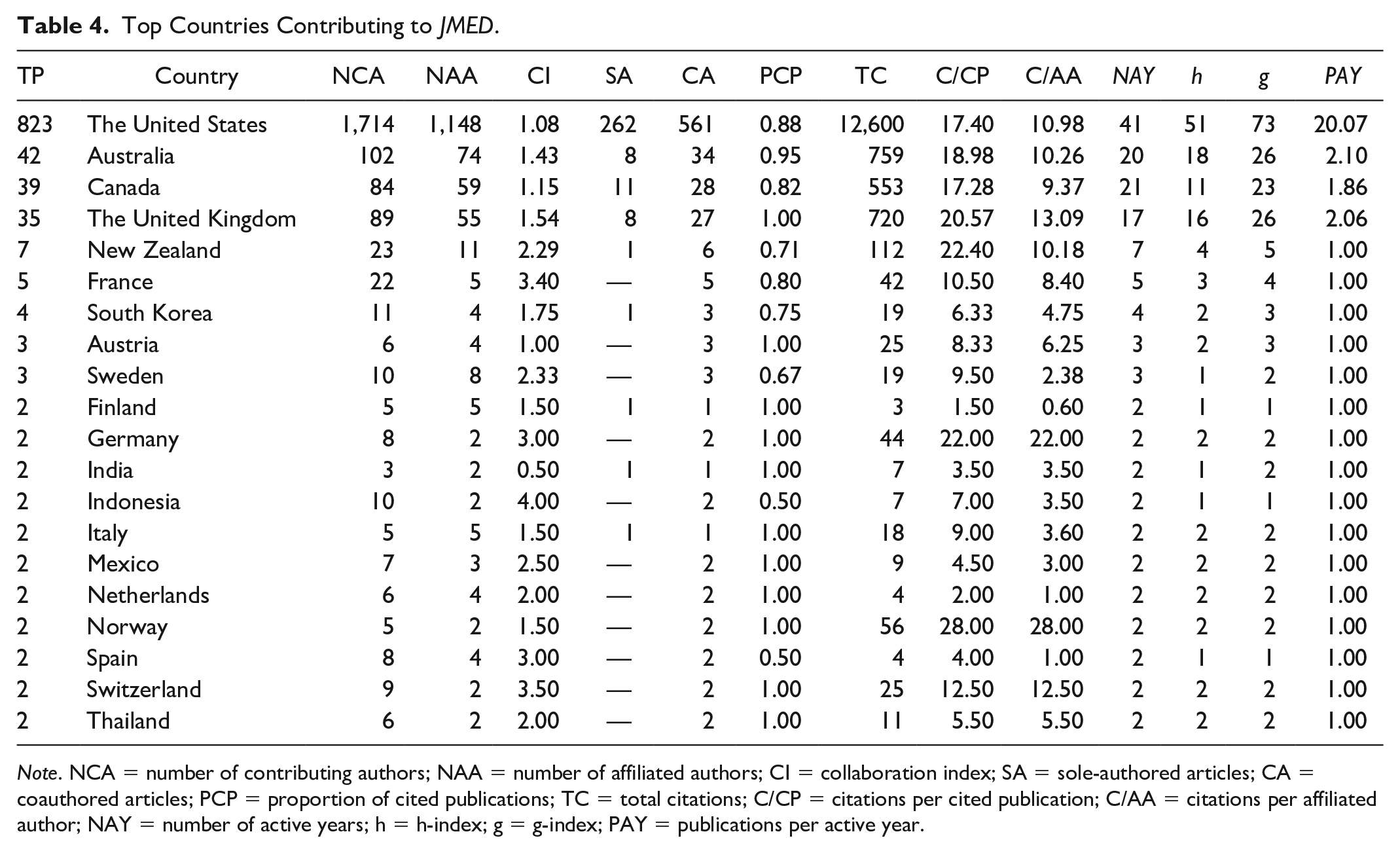
Note. NCA = number of contributing authors; NAA = number of affiliated authors; CI = collaboration index; SA = sole-authored articles; CA = coauthored articles; PCP = proportion of cited publications; TC = total citations; C/CP = citations per cited publication; C/AA = citations per affiliated author; NAY = number of active years; h = h-index; g = g-index; PAY = publications per active year.
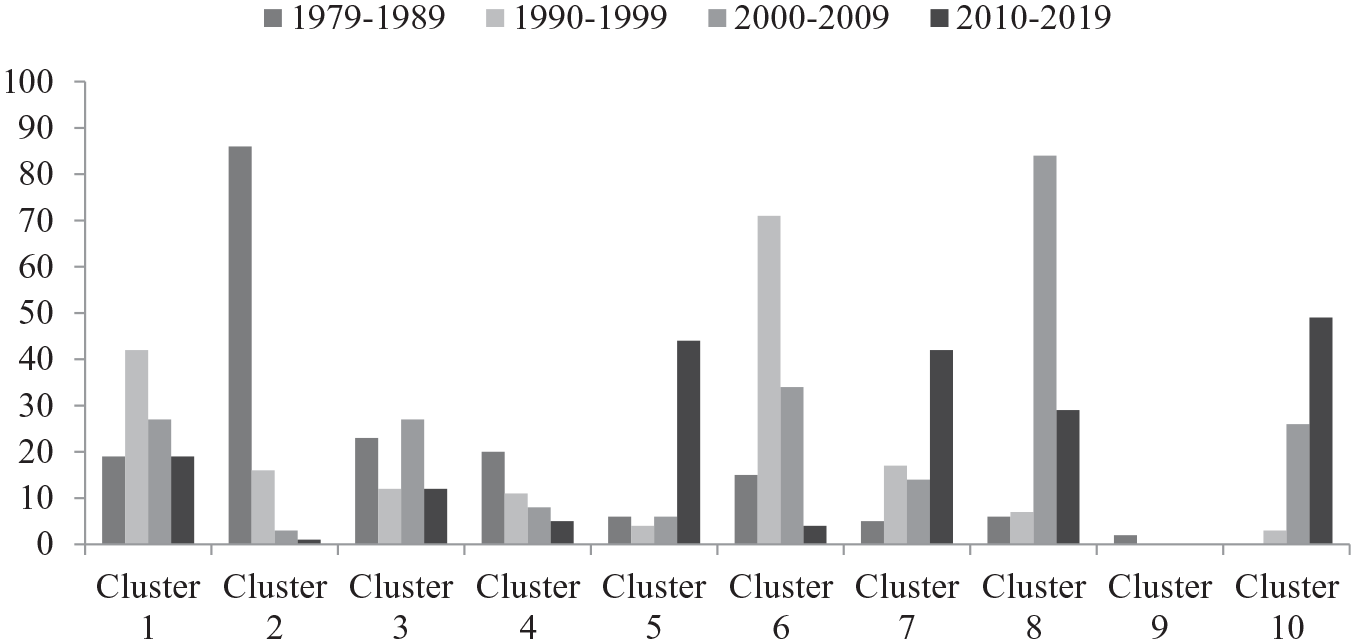
Temporal evolution of the JMED clusters.
As Figure 4 shows, in almost all periods, the United States dominates, making JMED a U.S.-centric publishing hub. However, progressive growth among other countries represented in the figure is a positive indication on the move of JMED toward globalization. Of particular note is that the top five submitting countries, comprising the overwhelming majority of submissions, are all primarily English-speaking countries in North America, the United Kingdom, and Oceania. Although JMED is published in English, as are the majority of marketing and education journals, there is an unquestionably rich world of educational practice and scholarship in Europe, Asia, India, and Africa that appear to be untapped in this outlet.
Top Sources and Countries Citing JMED
Table 5 lists the academic outlets and countries in which JMED publications are most frequently cited. Apart from JMED citing itself (TC: 648), Journal of Education for Business and Journal of Teaching in International Business often cite the articles published in JMED. Among the citing countries, the United States tops the list by a wide margin, followed by Australia, the United Kingdom, and Canada. Such indications imply that JMED is widely popular among the academic sources published in the United States and that its influence is also growing in other countries.
Top Citing Sources and Countries.
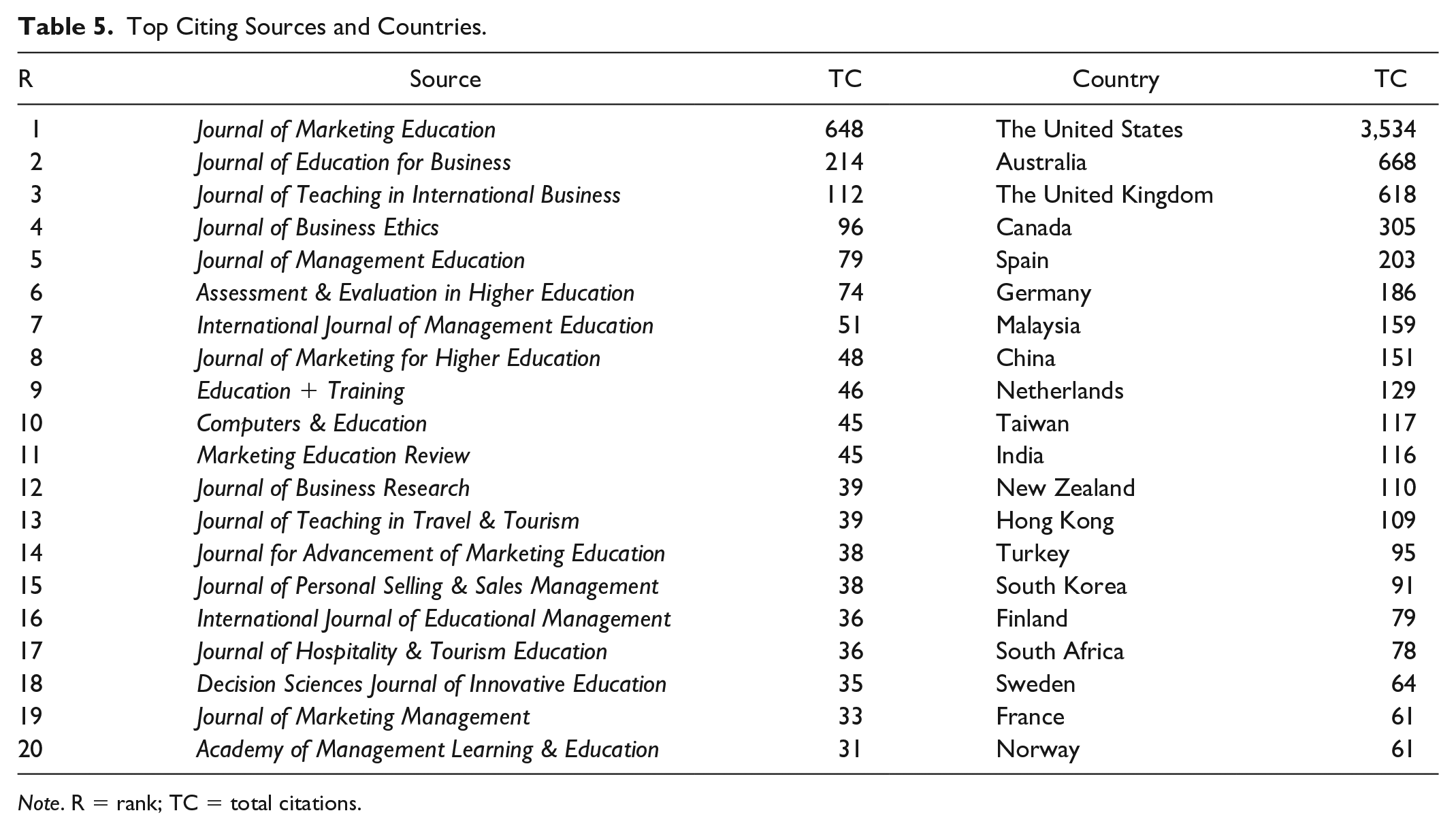
Note. R = rank; TC = total citations.
Looking to the future, JMED would be unquestionably enriched by encouraging submissions from across the globe, where both local and global nuances in pedagogical theory and practice may be explored. When considering the ratio of submitting countries to citing countries, there appears to be a somewhat one-way flow of scholarship in areas like Scandinavia, Asia, and Europe. High citation counts, but low submission counts, lead to the broad inference that scholars in these regions look to JMED for theory and research but submit their own research elsewhere. With industry-wide trends toward collaborative authorship and global communications, there are rich opportunities for international partnerships in future works, particularly as online learning has rendered physical “place” less relevant than it once was, and undergraduate students increasingly participating in “study abroad” programs.
JMED articles are most often cited in journals affiliated with the United States (TC: 6,725), followed by the United Kingdom (TC: 2,947). As indicated, JMED articles are most often cited in JMED itself (TC: 864), followed by the Journal of Business Research (TC: 515). Approximately 37% of the top citations to JMED flow from journals that have a rating of 3, 4, and 4* in the Chartered Association of Business Schools Academic Journal Guide, 2018. Moreover, 91% of the top citations to JMED are from journals having a quality rank of A and A* in Australian Business Deans Council 2019 Journal Quality List. Such indicators confirm the qualitative inputs of JMED articles.
Although there is, as always, a proportion of self-citing from the journal, there is an interesting pattern in the data which suggest a declining trend ratio of self-citation to external citations. In concert with the increase in TC year-on-year, these patterns suggest that the journal is becoming less insular and more impactful over time. Based on the self-citation data available in Scimago (1999-2019), we find a 42.5% self-citation rate over the previous 20-year period overall, but with this rate dropping to 30% factoring only the previous 10 years, and further down to 24.1% factoring only the previous five years. A contrasting implication, however, and when also considering the notably low ratio of citations from Marketing Education Review and Journal for Advancement of Marketing Education, is that submitting authors should take care to stay abreast of current research in the field of marketing education. Although this seems fairly straightforward to the casual observer, what may be inferred from these citation patterns is that submitting authors are building theory from outside the discipline of marketing education, which is a constructive activity insofar as it does not create the potential to overlook the existing research conversations submitting authors seek to join.
Network Analysis of JMED Articles
In this section, we present network analyses to unravel the intellectual nexus contributing to the academic progress of JMED, highlighting the (dis)similarities of JMED articles based on their referencing patterns. Network analyses explicate the intellectual association among the top JMED contributors and unveils the orientation of influential JMED articles around a number of prominent themes (Baker et al., 2020b; Callon et al., 1983; Donthu, Kumar, and Pattnaik, 2020; Koseoglu, 2016; Nerur et al., 2008). Themes are topical clusters of closely related or associated subject matter. The subjects of articles, usually denoted by the authors’ specified keywords (Callon et al., 1983; Marrone, 2020), are analyzed based on both frequency and similarity, and groupings of two to three prominent and closely related keywords become a theme. We use the Visualization of Similarities (VOS) viewer software and the Gephi applications for the coding, theming, and graphical analyses. It is common practice for authors of articles to project their key findings by linking it to some key terms denoted by the keywords which enhance the reachability of the articles in a search. Unfortunately, since a majority of JMED articles do not have specified keywords, we applied the natural language processing algorithm using VOSviewer to denote the key terms presented in JMED titles (van Eck & Waltman, 2010) and visualize the co-occurrence of the most frequently used terms in JMED titles (Callon et al., 1983; Baker et al., 2020b).
Bibliometrics also enables the reverse-engineering of topical similarity through “bibliographic coupling” (Kessler, 1963) which, while not perfectly diagnostic, allows for a working assumption that articles citing the same sources most likely deliberate on similar topics (Donthu, Kumar, & Pattnaik, 2020; Donthu, Kumar, Pattnaik, & Campagna, 2020). Table 6 presents the descriptive statistics of the bibliographic clusters formed by the bibliographic coupling of JMED articles. The clusters represent about 82% of the JMED works with similar referencing patterns. Figure 5 showcases their temporal trend and Table 7 summarizes JMED’s bibliographic clusters. The naming of the clusters is exclusively based on our subjective assessment (Baker et al., 2020a) and the clusters are ordered chronologically.
Descriptives of the Bibliographic Clusters of JMED Articles.
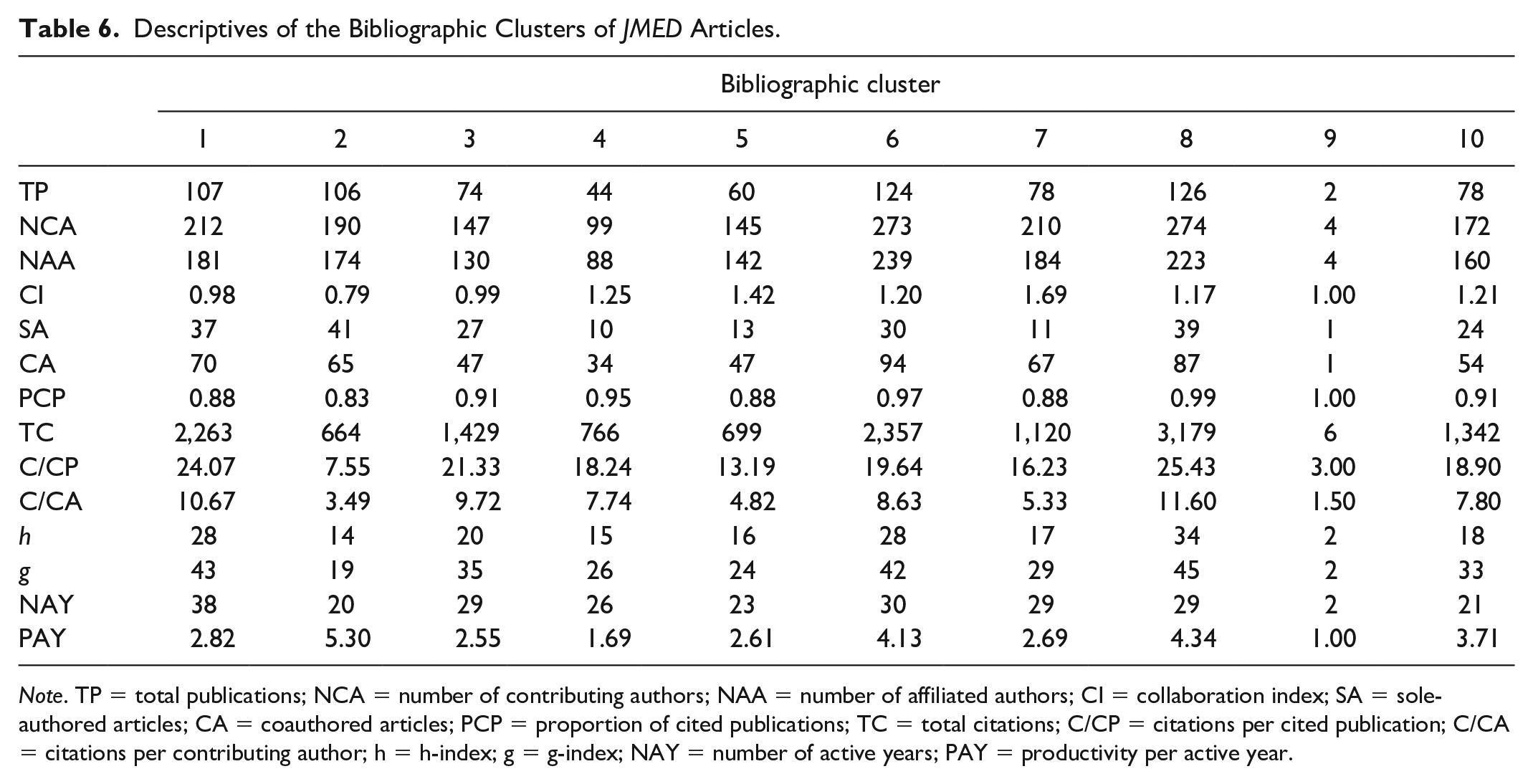
Note. TP = total publications; NCA = number of contributing authors; NAA = number of affiliated authors; CI = collaboration index; SA = sole-authored articles; CA = coauthored articles; PCP = proportion of cited publications; TC = total citations; C/CP = citations per cited publication; C/CA = citations per contributing author; h = h-index; g = g-index; NAY = number of active years; PAY = productivity per active year.
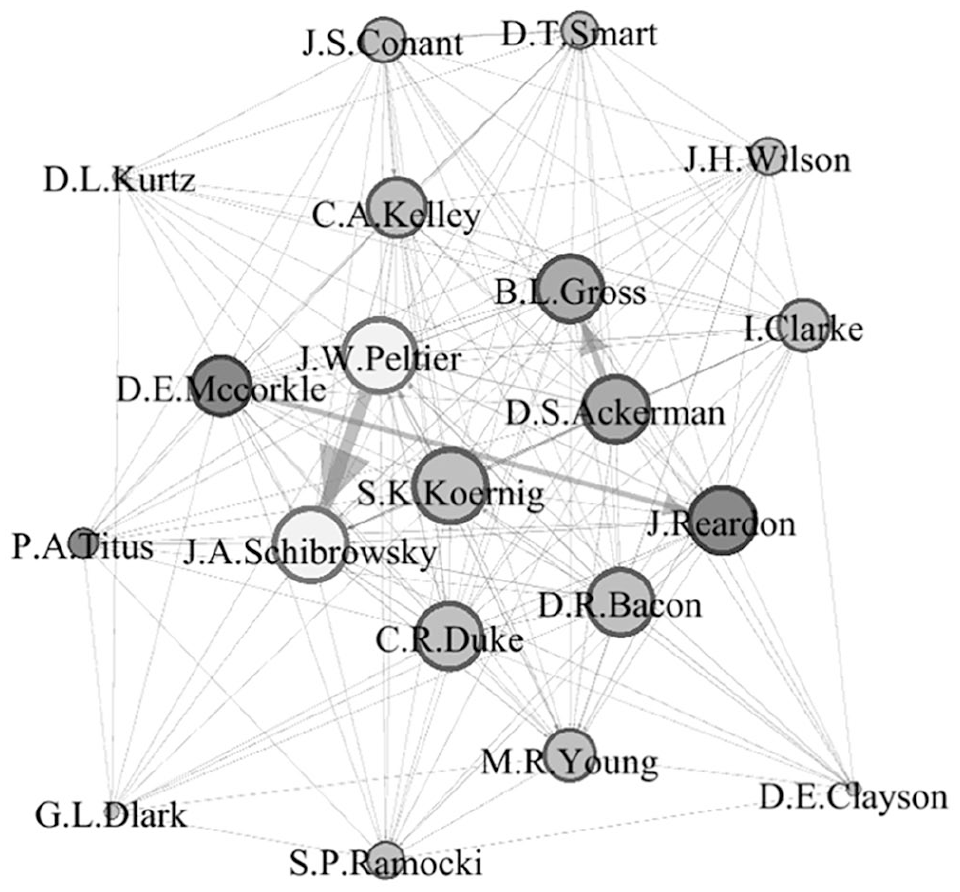
Bibliographic coupling of the top JMED authors.
Overview of the Bibliographic Clusters of JMED Articles.
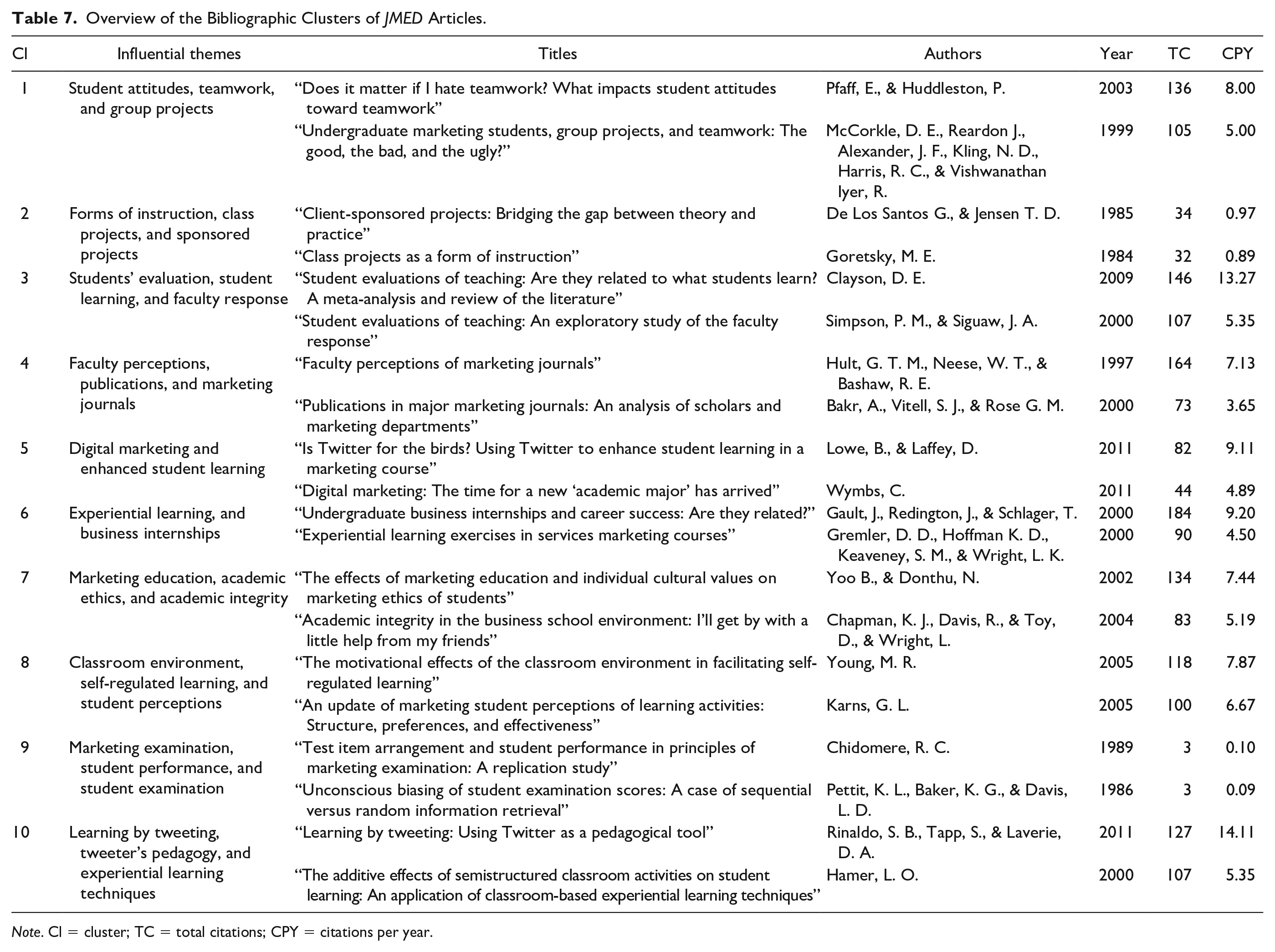
Note. Cl = cluster; TC = total citations; CPY = citations per year.
Cluster 1: Team Environment
The first cluster, team environment, consists of 107 JMED articles contributed by 212 authors (TP: 107; NCA: 212). When we exclude repeating authors, 181 scholars contribute to this cluster (NAA: 181). On average, each of the lead authors collaborates with another scholar to contribute research to JMED (CI: 0.98). Approximately 35% of the articles are sole-authored (SA: 37; TP: 107), while the remaining 65% are coauthored (CA: 70; TP: 107).
The cluster is important to JMED in terms of citations (TC: 2,263; C/CP: 24.07; C/CA: 10.67). As indicated, the influence and impact of the cluster are quantified by 28 articles receiving at least 28 citations (h: 28) and 43 articles being cited at least 1,849 times (g: 43), showing this cluster’s high influence and impact. Furthermore, the cluster has been active in 38 of the 41 years of JMED, contributing at least 2.82 articles per active year (NAY: 38; PAY: 2.82).
This cluster’s top two articles are by Pfaff and Huddleston (2003) and McCorkle et al. (1999), and some of its influential themes include student attitudes, teamwork, and projects. Note that though this cluster is important to JMED in terms of articles and citations, Figure 4 depicts a steady declining trend since 1990. What this suggests is likely not that marketing educational research in the area of team dynamics is less important or resonant than it once was, but more plausibly that it has simply matured and reached a saturation point as an area of theoretical development.
Cluster 2: Innovative Teaching Techniques
The second cluster named as innovative teaching techniques, comprises 106 JMED articles contributed by 190 authors (TP: 106; NCA: 190). When we exclude author repetition, 174 unique authors have contributed articles (NAA: 174). The cluster contributes with the highest number of sole-authored works (SA: 41), with coauthored publications at 65 (CA: 65).
Unlike Cluster 1, Cluster 2 is not as popular in terms of citations (TC: 664; C/CP: 7.55; C/CA: 3.49). Consequently, its influence is limited to 14 articles cited at least 14 times, and its impact comes from 19 top-cited articles receiving 361 citations. Its activity and productivity indicators show that the cluster has been active in 20 of the 41 years of JMED, contributing at least 5.30 articles per active year.
De Los Santos and Jensen (1985) and Goretsky (1984) are the top-cited publications of the cluster. De Los Santos and Jensen (1985) elucidated on how client-sponsored projects enhance students’ learning appetites, and Goretsky (1984) deliberated on the significance of case-based study methods to marketing students. Some of the influential themes emerging from the cluster include forms of instruction, class projects, and sponsored projects.
As Figure 4 shows, the cluster experienced its highest growth of articles between 1979 and 1989 but has declined since 1990. This cluster is particularly noteworthy for submitting authors, looking forward, because the inference to be drawn here is not that innovations in teaching techniques are less popular but rather that the acceptance rate of such papers is decreasing. As JMED matured as a journal and saw submission numbers grow exponentially, its standards for theoretical rigor have risen in concert, and, thus, purely descriptive papers of what an marketing educator has done in the classroom are less and less appropriate. When considering the low self-citation rate of the journal, as noted above, we may further infer that these types of submissions might be less citable than more theory-driven contributions. Thus, aspiring contributors working in the area of innovative or renovative teaching methods may have a high chance of their work being accepted in the journal, as long as the focus of their work is theoretically grounded and their papers focus on prescription as much as description.
Cluster 3: Students’ Evaluation of Teaching
The third cluster, named students’ evaluation of teaching, consists of 74 articles contributed by 147 authors (TP: 74; NCA: 147), 36% of which are sole-authored (SA: 27; TP: 74) and 74% coauthored (CA: 47; TP: 74). When we exclude author repetition, approximately 130 unique authors contributed to this cluster (NAA: 130), with a collaboration index of 0.99 (CI: 0.99).
The cluster is important to JMED in terms of citations (TC: 1,429; C/CP: 21.33; C/CA: 9.72). Its influence and impact extend to 20 and 35, respectively (h: 20; g: 35). In addition, the cluster has been active in 28 of the 41 years of JMED, contributing at least 2.55 articles in each of its active years (NAY: 28; PAY: 2.55).
Clayson (2009) and Simpson and Siguaw (2000) are the top-two cited articles of the cluster. Clayson (2009) found a weak relationship between students’ learning and their evaluation of teaching, whereas Simpson and Siguaw argued on the positive influence of Twitter-based learning. This cluster’s most influential themes include student evaluations, student learning, and faculty response. However, as Figure 4 shows, the cluster had a declining trend between 2010 and 2019. This is a provocative area of opportunity for the journal, moving forward, at least within the arena of exploring the plethora of confounding influences on, and subsequent concerns with, student evaluations of teaching. As noted earlier, TP in JMED are overwhelmingly weighted to undergraduate students and teaching content rather than the marketing educators themselves and teaching style. There are wide open and unexplored pastures for research in the arenas of teaching skills, ability, technique and style, faculty training, course delivery methods, student–teacher interactions and dynamics, course design, and faculty evaluation, to name only a small handful of potential opportunities. In this unique circumstance, the marketing researchers themselves may become the researched.
Cluster 4: Qualitative Assessment of Marketing Outlets
The fourth cluster named as qualitative assessment of marketing outlets, consists of 44 articles contributed by 99 authors, though the number of unique authors contributing to the cluster is only 88 (TP: 44; NCA: 99; NAA: 88). The number of sole-authored and coauthored articles of the cluster are 10 and 34, respectively (SA: 10; CA: 34). The collaboration index of the cluster suggests that each of the lead authors collaborates with 1.25 other scholars to contribute an article to this cluster (CI: 1.25).
The TC accredited to the articles of this cluster are 766 (TC: 766), while each of its cited articles receives 18.24 citations on average (C/CP: 18.24), and the same per contributing author is 7.74 (C/CA: 7.74). Consequently, the influence of the cluster’s articles is quantified to 15 (h: 15), while its impact extends to 26 (g: 26). This cluster has been active in 26 of the 41 years of JMED, publishing at least 1.69 articles in each of its active years (NAY: 26; PAY: 1.69).
Hult et al. (1997) and Bakr et al. (2000) are the top-two cited articles representing the cluster. Whereas Hult et al. (1997) evaluated marketing outlets, Bakr et al. (2000) examined the scholarly productivity of marketing scholars. Some of this cluster’s influential themes include faculty perceptions, publications, and marketing journals. However, as Figure 4 shows, this cluster has declined since 1990, suggesting a lack of research attention to qualitative assessments in marketing education. Across academia, qualitative research has struggled to keep pace with quantitative work for a host of compounding reasons, and major marketing journals tend to publish primarily experimental research. This has an upstream effect of including less qualitative methods in doctoral programs and, subsequently, fewer qualitative methods in undergraduate research courses. In the field of marketing education, there are opportunities for JMED to give specific attention to qualitative inquiry in recruiting submissions, particularly given the impact of these types of papers on the citable output and impact of the journal.
Cluster 5: Technological Diffusion in Marketing Education
The fifth cluster named technological diffusion in marketing education consists of 60 articles contributed by 145 JMED authors (TP: 60; NCA: 145). Of note, 142 unique authors have contributed to the cluster (NAA: 142), while the majority of articles are coauthored, with a collaboration index of 1.42. This suggests that each of the lead contributors collaborates with 1.42 other scholars to contribute an article to the cluster (SA: 13; CA: 47; CI: 1.42).
The articles representing the cluster are cited 699 times (TC: 699), averaging 13.19 per cited publication (C/CP: 13.19) and 4.82 per contributing author (C/CA: 4.82). The influence of the articles is shown by 16 articles cited at least 16 times (h: 16), while 24 of its highly cited works demonstrate the impact of the cluster (g: 24). The cluster has been active for 23 years, contributing 2.61 articles per active year (NAY: 23; PAY: 2.61).
Figure 4 shows an evolving trend of the cluster between 2010 and 2019, which suggests that technological diffusion in marketing education is a robust avenue for future research. As Table 7 shows, this cluster’s top-cited articles are Lowe and Laffey (2011) and Wymbs (2011), and some of its influential themes include digital marketing and enhanced student learning. There are a few critical takeaways from this cluster. First, as related to the above discussion in the Bibliometric analysis section about the lack of immediately impactful research in the journal, there are abundant opportunities—now more than ever—to publish research on the cutting edge of technological diffusion in marketing education. Again, considering the implications from Cluster 2, what would seem critical here for long-term influence is a strong theoretical foundation for works of this nature. Research that is overly context-dependent (e.g., tied to a specific software or social media platform) is likely planned obsolescence and inherently limited in contribution.
Cluster 6: Experiential Learning
This sixth cluster, experiential learning, is an extension of the second cluster on innovative teaching techniques. However, the primary concern of this cluster is the delivery of experiential learning to marketing graduates to ensure success in their careers. The cluster comprises 124 articles contributed by 272 authors (TP: 124; NCA: 272). Approximately 239 unique authors have contributed 30 sole-authored and 94 coauthored articles (NAA: 239; SA: 30; CA: 94).
The articles in this cluster have attracted 2,357 citations (the second-highest figure among the 10 clusters), averaging 19.64 per cited publication and 8.63 per contributing author (TC: 2,357; C/CP: 19.64; C/CA: 8.63). Furthermore, the influence of the cluster is demonstrated by its 28 articles cited 28 times (h: 28), while its impact is shown by its 42 top-cited articles receiving at least 1,764 citations (g: 42). The cluster has been active in 30 of the 41 years of JMED, contributing 4.13 articles on average (NAY: 30; PAY: 4.13). The most cited works of the cluster are Gault et al. (2000) and Gremler et al. (2000).
However, as Figure 4 shows, the cluster has declined since 2000. While at first blush this may seem counterintuitive, this trend does seem to make sense when considering the theoretical rigor of the journal. Experiential learning theory is now three decades into its lifecycle (cf. Kolb, 1984) and, much like team dynamics in Cluster 1, it has likely simply reached maturity as a theory. So, while papers may speak to, invoke, and cite experiential learning theory, the focus of research itself is likely less and less on extending that theory itself. While this trend makes sense in parallel with the trend of declining descriptive teaching techniques above, what is thought-provoking is the diverting trajectories of experiential learning and technological diffusion in education. If the inference to be drawn here is that education researchers do not see technology as adding to the experience of education—that we have separated the how from the why—this is an extremely promising research gap and likely one of immediate need.
Cluster 7: Marketing Values and Ethics
The seventh cluster, named marketing values and ethics, consists of 78 articles contributed by 210 authors (TP: 28; NCA: 210). In addition, 184 unique authors (NAA: 184) have contributed 11 sole-authored and 67 coauthored articles (SA: 11; CA: 67). The cluster is highly collaborative, with each of its lead contributors teaming up with 1.69 other scholars to contribute an article (CI: 1.69).
TC to the cluster are 1,120, averaging 16.23 per cited article and 5.33 per contributing author (TC: 1,120; C/CP: 16.23; C/CA: 5.33). The influence of the cluster is shown by its 17 articles cited at least 17 times, while its impact extends to 29 highly cited articles receiving at least 841 citations (h: 17; g: 29). This cluster has been active for 29 of the 41 years of JMED, publishing at least 2.69 articles in each of its active years (NAY: 29; PAY: 2.69).
As Table 7 shows, Yoo and Donthu (2002) and Chapman et al. (2004) are the top-two cited articles. According to Figure 4, the cluster is an emerging and important avenue for future research. Marketing ethics is a subject area in education, and subsequently in education research, that is underdeveloped and inconsistent across academia (Paul, 2019). Although education scholars have been drawing attention to the pressing need for theoretical and practical development in the area of teaching ethics for more than two decades (see Shannon & Berl, 1997) these calls have gone, in large part, unanswered. Thus, there appears to remain a pressing need for research in this area.
Cluster 8: Self-Regulated Learning
The eighth cluster named self-regulated learning comprises 126 articles contributed by 274 authors (TP: 126; NCA: 274). When we exclude author repetition, the cluster encompasses the views of 223 unique authors contributing 39 sole-authored and 87 coauthored articles (NAA: 223; SA: 39; CA: 87). The collaboration index of the cluster suggests that each of its lead authors collaborates with 1.17 other scholars to contribute an article to this cluster (CI: 1.17).
Almost 100% of the articles are cited (PCP: 0.99). The TC of the cluster are the highest among all the other clusters (TC: 3,179), averaging 25.43 per cited article and 11.60 per contributing author (C/CP: 25.43; C/CA: 11.60). The cluster has high influence (h: 34) and impact (g: 45) and has been active for 29 of the 41 years of JMED, publishing approximately 4.34 articles per active year (NAY: 29; PAY: 4.34).
As Table 7 shows, Young (2005) and Karns (2005) are the most influential articles. The cluster’s influential themes include classroom environment, self-regulated learning, and student perceptions. According to Figure 4, the cluster rapidly evolved between 2000 and 2009 but declined between 2010 and 2019. Given this cluster’s importance to JMED, we propose that it should be revived. Perhaps a special issue would be a fruitful strategic move at this stage, particularly considering the increasingly relevant nature of self-regulated learning in online education and remote course delivery. In addition, aspiring contributors working in the area of self-regulated learning likely have a high chance of their work being accepted for publication in future issues of the journal.
Cluster 9: Objective Exams
The ninth cluster, objective exams, has only two articles contributed by four authors. One is a sole-authored article, and the other is contributed by three authors. The articles have received only six citations, while their influence, impact, and activity are quantified at 2 each. As Table 7 shows, both Chidomere (1989) and Pettit et al. (1986) discussed objective exams, with no reported works since these publications. What this suggests is, of course, not that objective examinations have disappeared from marketing education but rather simply that there is little theoretical exploration left, if at all, in this area for JMED.
Cluster 10: Multiple Experiential Techniques and Student Learning
The tenth cluster, named as multiple experiential techniques and student learning, consists of 78 articles contributed by 172 authors (TP: 78; NCA: 172). The number of unique authors is 160 (NAA: 160), contributing 24 sole-authored and 54 coauthored articles (SA: 24; CA: 54). The collaboration index of the cluster suggests that each of the lead contributors teams up with 1.21 other scholars to contribute an article. In terms of citations, the cluster received 1,342 citations, averaging 18.90 per cited publication and 7.80 per contributing author (TC: 1,342; C/CP: 18.90; C/CA: 7.80). The influence, impact, activity, and productivity of the cluster are 18, 33, 21, and 3.71, respectively.
As Table 7 shows, the top-two cited articles of the cluster are Rinaldo et al. (2011) and Hamer (2000). The cluster’s most influential themes include learning by tweeting, tweeter’s pedagogy, and experiential learning techniques. As encouragement to aspiring contributors, Figure 4 shows an increasing trend in this area of research in recent years of JMED. This cluster is effectively an extension of Clusters 5 and 6 above but with an additional layer of complexity. What this cluster suggests is that both the practice and recipients of marketing education are evolving to be more demanding and sophisticated as a field. This consideration forces marketing education scholars to focus less on discrete in-class activities (note the declining trends in Cluster 2) and more on the overall design of a marketing course as an integrated schematic of various learning tools, techniques and methodologies. Although research might suggest otherwise, the student journey in practice cannot be fragmented into discrete elements and may be considered much like an extended and immersive service encounter comprising a host of touchpoints, technologies, individual and team dynamics, intellectual ebbs and flows, highs and lows, and a nexus of student experiences. This is perhaps the most provocative consideration for JMED looking to the future, and one which the title of the journal itself foreshadows: the future of research in this field may well be less about educating and more about education.
In conclusion, except for Clusters 5, 7, and 10, all the other clusters are declining in popularity in JMED. Therefore, aspiring contributors working in the active areas of JMED have a high chance of having their work accepted, while those working in the declining areas might consider some innovative and updated research modalities to attain acceptance in JMED.
Bibliographic Networks of JMED: Visualization
In this section, we briefly discuss the bibliographic networks of JMED’s prolific authors and key terms appearing in JMED titles. Figure 5 presents the bibliographic network among the most prolific JMED authors, and Figure 6 depicts the co-occurrence of the most frequently used terms in the titles of JMED articles.
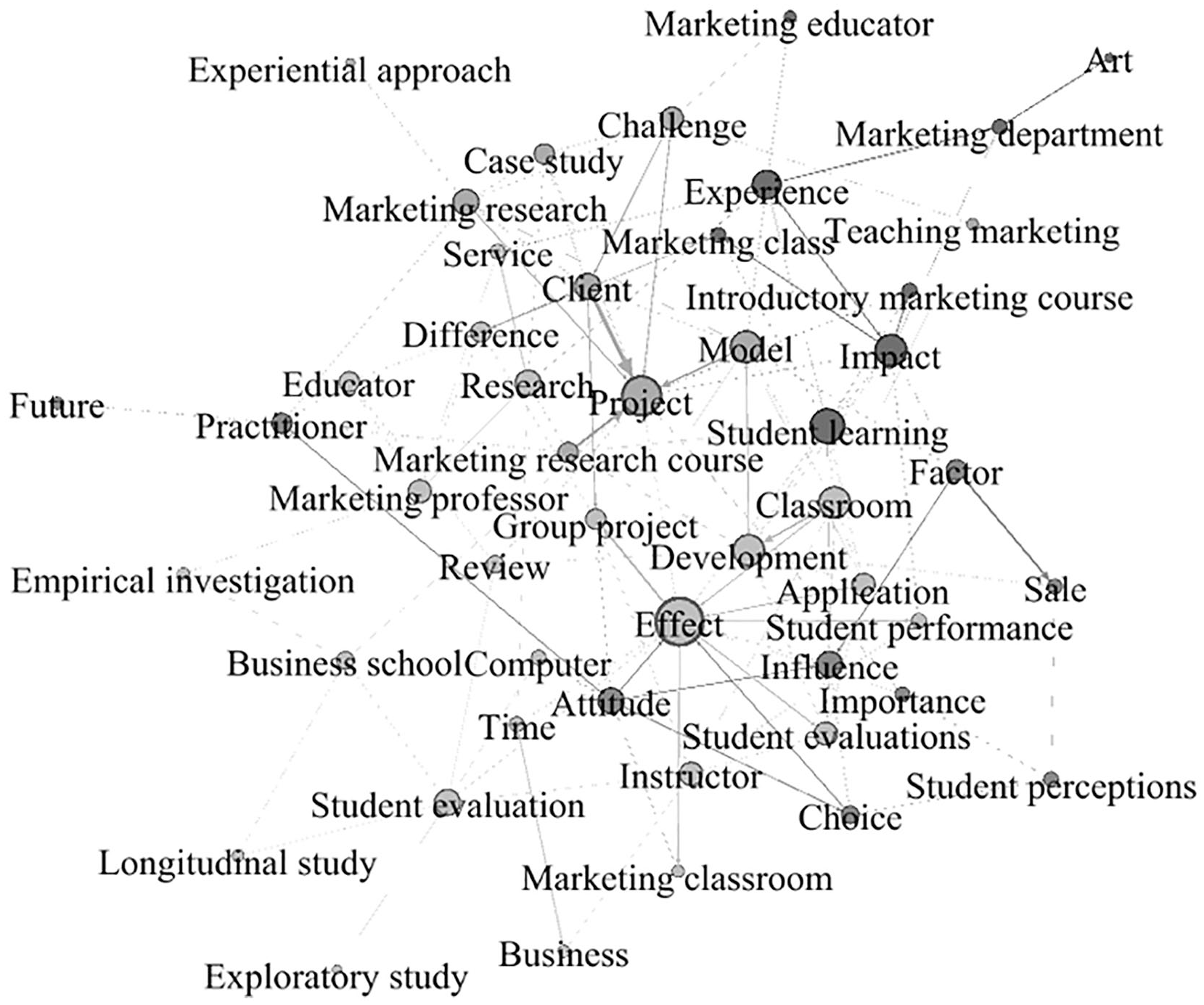
Co-occurrence of top key terms appear in JMED titles.
The gray shades in the figures represent the modularity class or, in other words, the intellectual communities of the prolific authors and the key subject terms of the articles. The interlinking lines and arrows represent the connection(s) among them. When two authors or title words appear together, such incidences are captured by links in the figures. The width of the lines or arrows reveals the strength of the association, while the spatial distance reveals the (dis)similarities (Baker et al., 2020a, 2020b).
As Figure 5 shows, the most prolific contributors of JMED diverge into five bibliographic clusters. J. W. Peltier and J. A. Schibrowsky have the strongest association. A closer examination reveals that both scholars have coauthored eight articles in JMED, the highest of all other authors. It indicates that frequent collaborations lead to the unification of intellectual thought, making the collaborators noted experts in their respective domains.
Figure 6 reveals five broad communities among the terms appearing in the titles of JMED articles. On further investigation, we find that approximately 51 of these terms appear in at least five JMED titles. However, some of the most prolific terms are “business” (69), “research” (63), “effect” (59), “project” (59), “art” (45), “classroom” (37), “marketing research” (37), “sale” (37), “service” (34), and “development” (31).
Summary and Conclusions
We analyzed 970 JMED articles contributed by 1,448 unique authors between 1979 and 2019. Approximately 88% of the JMED articles cited received 14,470 citations, averaging roughly 17 citations per article. JMED articles published in 2000 received the highest number of citations (TC: 1205). The influence and impact of JMED extend to 54 and 74 articles, respectively. However, 2000 is the most influential year of the journal (h: 18), while 2011 has the most impact (g: 26). JMED published its highest number of articles in 1989 (TP: 37) and added an average of 35 new authors every year. The collaboration index of the journal peaked at 2.10 in 2014. Both TC and citations per article have been steadily increasing over the past 20 years, while self-citation rates have been declining. Thus, in general, we observe an increasing trend in publications, author collaborations, citations and productivity of JMED between 1979 and 2019.
Some of the themes of the most influential research in the journal are student learning, student evaluation, student satisfaction, group projects, teamwork, marketing education, business internships and career success, and social media as a learning tool. Among the top submitting authors, James W. Peltier is the most active, influential (h: 10; TC: 464) and impactful (g: 15) contributor. Most contributions come from scholars in the United States, followed by Australia and the United Kingdom.
In addition to carrying out descriptive analysis, we conducted a thorough network analysis to unpack the semantic similarities among influential JMED articles, authors, and subject areas. Cluster analysis revealed 10 JMED clusters, seven of which are declining; only three show evidence of growth in recent decades. For each of the 10 clusters, we attempt to diagnose the cause and circumstance of the growth or decline trajectories for each subject area, and subsequently propose areas of theoretical opportunity for research development for marketing education researchers looking forward.
A limitation of the study arises from its exclusive reliance on Scopus data. Inclusion of data from other sources may alter the results, indicating the need for another similar or advanced study in the future. We also acknowledge that, particularly with respect to the citation analysis, that papers cite sources for different purposes; large-scale bibliometric analysis of this nature does not allow for the nuances of isolating the context in which sources are cited within individual articles. Furthermore, in congruence to our research objectives, as the majority of the analysis are reported in isolation, future endeavors could be more comparative in analyzing the competitive position of JMED versus its peers. Finally, there is always an element of human subjectivity in exercises like thematic clustering of large data; as with the use of any computer assisted qualitative data analysis software, there is a degree of methodological expertise required of the researcher in designing and guiding the boundaries of thematic clustering to guide the automated analysis without exerting influence on it.
In conclusion, what the bibliometric analysis of four decades of research in JMED ultimately suggests is that there are abundant research opportunities at hand in marketing education. Publications to date come overwhelmingly from English-speaking countries (North America, the United Kingdom, and Oceania). Globalization and technology have enabled collaborative research from around the world, which creates more accessible opportunities to explore, research, and share the nuances of marketing education in different cultures, economies, and languages. Publications to date have also been very heavily focused on undergraduate student learning experiences, suggesting incredible opportunities for research on student learning at the graduate and doctoral levels, but also research on the art and craft of teaching marketing. There also appears to be significant, and necessary, room for research that looks beyond pedagogical activities and teaching tactics toward marketing education as an extended and multifaceted educational experience.
The purpose of this article is to move forward by looking backward. By examining and reflecting on the trends and patterns evident in the past four decades of scholarship in JMED via retrospective scientometric analysis, our objectives in this research are to highlight trends in marketing education scholarship that may guide the direction of the Journal, and highlight areas of opportunity for aspiring contributors, in the future.
Footnotes
Appendix
Top 50 Marketing Sources Ranked in Scimago, 2019.
| Sl. | Journal | SJR | h-index | TD (3 years) | TC (3 years) | C/D (2 years) |
|---|---|---|---|---|---|---|
| Ranks of JMED | (36th) | (35th) | (45th) | (47th) | (33rd) | |
| 1 | Journal of Marketing | 8.63 | 233 | 147 | 1756 | 6.76 |
| 2 | Journal of Consumer Research | 7.60 | 167 | 189 | 1270 | 6.83 |
| 3 | Journal of Marketing Research | 7.33 | 159 | 182 | 1319 | 6.25 |
| 4 | Marketing Science | 7.17 | 120 | 162 | 697 | 3.44 |
| 5 | Journal of the Academy of Marketing Science | 5.31 | 159 | 171 | 1912 | 11.42 |
| 6 | Journal of Consumer Psychology | 3.73 | 99 | 161 | 604 | 3.56 |
| 7 | Academy of Management Perspectives | 3.65 | 123 | 78 | 525 | 5.96 |
| 8 | Journal of Advertising | 3.37 | 101 | 122 | 902 | 9.29 |
| 9 | Journal of Interactive Marketing | 3.29 | 97 | 90 | 716 | 7.37 |
| 10 | Journal of Retailing | 3.15 | 126 | 99 | 709 | 7.94 |
| 11 | Journal of World Business | 3.06 | 104 | 205 | 1721 | 7.28 |
| 12 | International Journal of Research in Marketing | 2.91 | 95 | 169 | 871 | 4.80 |
| 13 | Journal of International Marketing | 2.19 | 82 | 52 | 343 | 5.69 |
| 14 | International Journal of Advertising | 2.10 | 57 | 160 | 785 | 5.22 |
| 15 | Industrial Marketing Management | 2.08 | 125 | 421 | 2888 | 6.29 |
| 16 | Journal of Business Research | 1.87 | 179 | 1563 | 11036 | 7.16 |
| 17 | Journal of Advertising Research | 1.70 | 81 | 135 | 373 | 2.85 |
| 18 | Marketing Theory | 1.66 | 62 | 89 | 374 | 4.00 |
| 19 | Journal of Hospitality Marketing & Management | 1.52 | 47 | 137 | 773 | 5.69 |
| 20 | Journal of Travel & Tourism Marketing | 1.49 | 64 | 275 | 1325 | 5.15 |
| 21 | Journal of Public Policy & Marketing | 1.46 | 70 | 91 | 297 | 2.35 |
| 22 | International Business Review | 1.45 | 87 | 314 | 1777 | 5.60 |
| 23 | Journal of Destination Marketing & Management | 1.42 | 31 | 201 | 1133 | 5.57 |
| 24 | Marketing Letters | 1.41 | 65 | 150 | 391 | 1.98 |
| 25 | Business Horizons | 1.40 | 76 | 248 | 1295 | 5.54 |
| 26 | Psychology and Marketing | 1.35 | 107 | 246 | 883 | 3.44 |
| 27 | Journal of Retailing and Consumer Services | 1.34 | 75 | 508 | 3122 | 5.79 |
| 28 | International Marketing Review | 1.25 | 83 | 130 | 696 | 3.81 |
| 29 | Quantitative Marketing and Economics | 1.25 | 30 | 36 | 34 | 0.96 |
| 30 | Electronic Commerce Research and Applications | 1.24 | 69 | 178 | 1052 | 5.55 |
| 31 | Journal of Consumer Culture | 1.21 | 52 | 154 | 351 | 3.01 |
| 32 | Journal of Marketing Management | 1.16 | 53 | 241 | 832 | 3.11 |
| 33 | Journal of Services Marketing | 1.07 | 96 | 203 | 862 | 4.23 |
| 34 | Journal of Personal Selling & Sales Management | 1.05 | 63 | 69 | 156 | 2.63 |
| 35 | European Journal of Marketing | 1.03 | 91 | 333 | 1009 | 2.94 |
| 36 | Journal of Marketing Education | 1.01 | 53 | 58 | 153 | 3.11 |
| 37 | Electronic Markets | 1.01 | 29 | 103 | 449 | 4.67 |
| 38 | Journal of Marketing Communications | 0.98 | 43 | 140 | 407 | 2.90 |
| 39 | Consumption Markets & Culture | 0.90 | 27 | 110 | 228 | 1.95 |
| 40 | Journal of Current Issues & Research in Advertising | 0.90 | 31 | 46 | 74 | 1.06 |
| 41 | Journal of Product & Brand Management | 0.84 | 75 | 197 | 673 | 3.03 |
| 42 | Journal of Marketing for Higher Education | 0.82 | 29 | 46 | 151 | 3.59 |
| 43 | International Journal of Bank Marketing | 0.77 | 77 | 183 | 905 | 4.38 |
| 44 | Journal of Strategic Marketing | 0.77 | 45 | 136 | 370 | 2.40 |
| 45 | Journal of Research in Interactive Marketing | 0.76 | 31 | 72 | 258 | 3.40 |
| 46 | Journal of Consumer Marketing | 0.75 | 91 | 179 | 448 | 1.99 |
| 47 | Journal of Macromarketing | 0.74 | 51 | 95 | 225 | 2.83 |
| 48 | International Journal of Retail & Distribution Management | 0.73 | 73 | 204 | 758 | 3.28 |
| 49 | International Journal of Design | 0.72 | 35 | 55 | 175 | 2.71 |
| 50 | Journal of Fashion Marketing and Management | 0.71 | 47 | 97 | 284 | 2.37 |
Note. This table ranks the top 50 sources of marketing listed in Scimago’s Journal Index. SJR = Scimago’s Journal Rank; TD = total documents; TC = total citations; C/D = citations per document.
Declaration of Conflicting Interests
The author(s) declared no potential conflicts of interest with respect to the research, authorship, and/or publication of this article.
Funding
The author(s) received no financial support for the research, authorship, and/or publication of this article.
