



Abstract
This study presents a bibliometric review of creative tourism literature aimed at understanding the main research topics and approaches, theoretical foundations, and the most recent areas of investigation. Sixty-four articles on creative tourism were selected and analyzed using co-citation analysis, content analysis, and bibliographic coupling. Findings reveal that creative tourism is a well-defined field of studies with three main research topics; namely, Tourist Experience and Co-Creation, Creativity in Tourism, and Cultural Tourism and Events. Furthermore, several theoretical approaches can be applied to a different set of empirical contexts, among which co-creation and experience economy play a major role. An analysis of the most recent publications identifies five promising research trends and allows some conclusions about the opportunities for future research to be drawn.
Keywords
Introduction
This article deals with the topic of creative tourism “which offers visitors the opportunity to develop their creative potential through active participation in courses and learning experiences which are characteristic of the holiday destination where they are undertaken” (Richards & Raymond, 2000, p. 18). The value of creative tourism lies in the integration between tourist experience and creative content which allow new market segments to be reached. Tourists search for unique and interesting activities, in order to have fun and at the same time broaden their horizons by delving into the local life and culture of the places visited. Creative tourism is a subset of cultural tourism. In addition to the tangible resources of the destination, such as museums and sites of historical interest, it exploits intangible resources, for example, traditions and customs of the local population, promoting the involvement of tourists in creating their experience.
The growing demand for creative experiences that stimulate the active involvement of tourists calls for a renewal of existing offers, making creativity a key feature for tourist attraction and destination development. At the same time, interest in creative tourism is rapidly growing within the field of tourism, although it has not yet been thoroughly investigated due to its recent development (Bakas, Duxbury, & de Castro, 2018; Chen & Chou, 2019; Remoaldo & Cadima-Ribeiro, 2019; Zhang & Xie, 2018).
The literature on creative tourism focuses on two main topics. The first emphasizes aspects related to the production of tourism services and highlights the need for firms and destinations to act creatively to offer memorable experiences to tourists (Calver & Page, 2013; Marques & Borba, 2017; Zatori, 2016). The second underlines the tourists’ need to co-create their unique and authentic experiences within the visited destinations (Mossberg, 2007; Tan, Kung, & Luh, 2013; Tan, Luh, & Kung, 2014). While the relevance of creative tourism cannot be disputed, there is still the need to achieve a consensus on its main theoretical constituents, as well as to develop appropriate research (Chen & Chou, 2019).
Drawing on such premises, our research proposes a bibliometric review of the literature on creative tourism aimed at understanding the main research topics and approaches, theoretical foundations as well as the most recent areas of investigation, proposing potential future directions for research. Although extensive reviews on creative tourism have been carried out over time by scholars such as Richards and Wilson (2006) and Richards (2010, 2011, 2014), this article is complementary to those studies. The adopted bibliometric approach allows the level of subjectivity inherent in the traditional qualitative reviews to be reduced, since it is based on a statistical analysis of bibliographic data produced by other scholars. In this respect, this article also responds to the assertion made by Koseoglu, Rahimi, Okumus, and Liu (2016), who claimed that “more research studies conducting relational bibliometric studies are needed” (p. 190) in the tourism field and makes several contributions to the literature. First, it enriches the knowledge base on creative tourism and stimulates the debate among scholars, providing theoretical insights for those who wish to deepen the study of this topic. Moreover, it gives operational inputs for those involved, at different levels, in the management of tourism business. Specifically, the article, through co-citation and content analysis, uncovers the polycentric structure of the literature on creative tourism, and identifies its main research areas. Second, it provides insights into the value of creativity applied to tourism to improve the competitiveness of a destination, building on a bottom-up approach based on the active participation of tourists and on interaction with the local community. Last, by applying the bibliographic coupling analysis, the article explains how studies are evolving toward an integration of different theoretical approaches and recognizes several future research directions for creative tourism.
The rest of the article is organized in four sections following on from this introduction. The second section clarifies the concept of creative tourism and proposes an overview of the current literature. The third section describes the bibliographic methodology used, while the fourth section explains the application of such methodology to the analysis and a discussion of the results obtained. Finally, the last section proposes contributions and limitations.
Current Understanding on Creative Tourism
The evolution of consumer models has shown a tendency for tourists to go beyond the traditional role of spectators typical of cultural tourism, toward more authentic participative experiences. Tourists nowadays seek unique experiences that bring them closer to the local residents’ way of life and develop empathic relationships with them (Prentice & Andersen, 2007; Richards & Wilson, 2006). In this direction, some destinations are differentiating their offer, giving visitors the opportunity to develop their creative potential through active participation in courses and learning experiences typical of the destination (Richards & Raymond, 2000). Through active participation in experiences that reflect habits and traditions of the destination, tourists can fully understand the local culture and integrate into the daily life of the resident population (Richards, 2011).
Despite culture still being an important means to develop a tourist destination, creative and participatory experiences represent a way to create value. Culture is therefore seen as a source of creativity and creativity as a means to enjoy and develop cultural resources.
The idea implied by the term “creative” assigned to tourism refers to the active participation of both tourists and the local community, encouraged to share their traditions and customs with visitors (Hwang, Chi, & Lee, 2016; Woosnam & Aleshinloye, 2018). According to Krajnovic and Gortan-Carlin (2007), the experience gained in creative tourism represents a sort of “mental souvenir” for tourists, usable in everyday life, and as a way of building their identity.
The first studies linking creativity to tourism were published at the end of the last century (Creighton, 1995; Daniel, 1996). In 1993, a special issue was dedicated to the production of artifacts and artistic experiences (local crafts, cultural festivals, and theatrical performances) in the sphere of tourism activities, especially in developing countries (Cohen, 1993; Horner, 1993; Swain, 1993). Gibson and Cornell (2005) studied the role of tourists in the development of musical performances around the world, while Buchmann, Moore, and Fisher (2010) focused their attention on tourism experiences related to film productions, such as “Harry Potter” in the United Kingdom or “Lord of the Rings” in Australia (Hudson & Ritchie, 2006; Jones & Smith, 2005). More recent research investigated the role of co-creation in tourism-related activities (Binkhorst & Den Dekker, 2009; Chathoth, Ungson, Harrington, & Chan, 2016; Ross, Saxena, Correia, & Deutz, 2017; Zatori, 2016). These processes of experience co-creation are also embodied in some of the most common tourist activities such as consumption of local food products or participation in activities that are typical of the destination (Morgan, Watson, & Hemmington, 2008; Ottenbacher & Harrington, 2013; Prebensen & Foss, 2011).
To summarize, creative tourism experiences are characterized by the following features (Prentice & Andersen, 2007; Richards, 2011; Richards & Raymond, 2000; Richards & Wilson, 2006): social dimension, appreciated by tourists looking for vibrant experiences; qualified consumption, through experiences offering tourists the opportunity to learn new skills; tourist involvement, through active participation and interaction with the local context and communities, which make tourists co-creators of their experience; tourist self-realization, through creative activities that offer tourists the chance to feel good, learn something about themselves, and transform their identity; and last, context specificity, due to experiences which are rooted in local everyday life.
Methodology
To review the literature on creative tourism, this research uses the bibliometric methodology, which assumes that the structure of a science can be empirically detected by the connection among documents. Citations analysis, co-citation analysis, and bibliographic coupling are the main bibliometric methods.
Citation analysis employs the number of citations of a document to assess its influence (Garfield, 1970). This method is based on the idea that scholars cite articles they consider important to their research. Therefore, the most cited articles are probably those that have exerted a greater influence on a certain research topic in comparison with the others. As a result, citation analysis delivers information on the relative influence of a group of articles, although it does not allow the relationships among them to be identified (Zupic & Cater, 2015). On the other hand, the co-citation analysis considers the number of times two articles are jointly cited in the references of other publications to infer similarity between them (McCain, 1990; Small, 1973). Thus, if two documents are co-cited by a third document, the latter makes a connection between the first two, and the number of co-citations could be considered a measure of their similarity. The basic assumption is that two documents frequently co-cited are related because they probably deal with the same topic, adopt the same theoretical framework or address the same research question. It is possible to state that the analysis of co-citations over a sufficiently broad period of time provides accurate indications on the knowledge structure of a literature field and identifies the most influential ideas and schools of thought as well as the interrelationships among them.
Last, bibliographic coupling, which is considered the mirror image of the co-citation method, measures the similarity among documents by counting the number of references they share (Kessler, 1963). The basic assumption is that articles citing the same documents are related, although they are not citing directly each other.
The main difference between co-citation analysis and bibliographic coupling is that the first is dynamic, whereas the second is static. In fact, while the number of citations of two articles is likely to change over time, the number of references shared by them remains unchanged. For this reason, co-citation analysis depends on the time when it is performed and can only be applied to publications that have a minimum citation threshold, while bibliographic coupling can also be applied to recent articles with a few or no citations (Boyack & Klavans, 2010).
Against this background, the choice of the most appropriate technique to be used in a bibliometric study depends on the objectives of the analysis. According to Zupic and Cater (2015), if the intent is to reconstruct the main approaches and the theoretical basis of a set of old publications, co-citation analysis is more suitable. However, if the aim is to identify the most recent research frontier in a specific field of study, bibliographic coupling could be more appropriate. In the present article, both the co-citation analysis and the bibliographic coupling on samples of different documents will be used.
Nevertheless, bibliometric methods have some limitations. The first is related to the criterion for selecting bibliographic data, which is not completely neutral, since it is based on specific keywords chosen by authors. A second limitation is due to the fact that almost all bibliographic databases exclude whole books or book chapters. Finally, it is worth noting that citation measures could be distorted by individual or group self-citations, thus representing inappropriate manipulations.
Despite these limitations, bibliometric studies have proven to be reliable (Archambault, Campbell, Gingras, & Larivière, 2009) and have been adopted in many marketing and management studies, for example, business strategy (González, Castro, Bueno, & González, 2001), consumer behavior (Hoffman & Holbrook, 1993), marketing (Galvagno & Dalli, 2014), and tourism (Benckendorff & Zehrer, 2013; Cheng, Edwards, Darcy, & Redfern, 2018; Koseoglu, Sehitoglu, & Craft, 2015; Ye, Li, & Law, 2013). Koseoglu et al. (2016) should be consulted for an exhaustive review on bibliometric studies in tourism.
The most widely used technique is that of co-citations (Benckendorff & Zehrer, 2013; Koseoglu et al., 2015), but there are also some examples of bibliographic coupling (Yuan, Gretzel, & Tseng, 2015; Yuan, Tseng, & Chang, 2014). Cases of the joint use of the two techniques are not widespread.
In our research, a four-step analysis was used: (a) data gathering, citation analysis, and sample selection; (b) documents co-citation analysis and clusters identification; (c) content analysis and the description of each cluster; and (d) bibliographic coupling of the articles published on creative tourism between 2015 and 2017. Each step in the analysis and results are presented in Figure 1 and described in the following section.

Flowchart Illustrating Each Step of the Analysis
Analysis and Results
Step1: Data Gathering, Citation Analysis, and Sample Selection
Data were extracted from the social sciences citation index and the emerging sources citation index databases of Web of Science of Clarivate Analytics®, by searching for documents published over the 15-year period from 2003 to 2017 whose title, abstract, or keywords contained the following keywords: “creative tourism” or both “creativ*” and “touris*.” 1 The search generated 453 documents, which were then filtered in order to limit the analysis only to articles and reviews (excluding book reviews, editorial comments, and conference proceedings), published in English in journals listed in the following research categories: Hospitality, Leisure, Sport, and Tourism; Management; and Business.
This process resulted in a set of 197 articles. In order to ensure that no documents were left out, a second search was carried out—with the same filters—to identify those articles that cited together the contributions of Richards and Wilson (2006) and Richards (2011). The search thus identified three more documents, so that the final set included 200 articles. Finally, all these references and the related bibliographic data, as well as the citations, were downloaded and checked to avoid double entries and mistakes. Moreover, they were analyzed by reading title and abstract, to leave out substantially irrelevant articles by excluding those that did not contain both the keywords touris* and creativ*.
This process reduced the set to 157 articles. Subsequently the title, abstract, and conclusions of each article were read by all the authors in order to remove those which, while addressing the issue of creativity in tourism, focused on aspects considered irrelevant to the research (such as creativity in the human resources management in tourism firms, creativity in teaching related to tourism, creativity in the construction of tourism infrastructure, creative destruction approach, or creative development of touristic ads and logos). This final selection made it possible to identify an ultimate set of 64 articles published on creative tourism between 2003 and 2017.
A preliminary analysis was carried out on the number of citations. It allowed the most relevant scientific papers among those considered, and several descriptive elements, such as the source of publication and their temporal evolution, to be identified. In the following pages some data from the analysis of the citations of the 64 previously mentioned articles are shown.
In particular, Figure 2 shows that the number of articles published on creative tourism has steadily increased since 2003, undergoing a huge increase since 2012. Citations have also grown in recent years, and in particular from 2012 onward (Figure 3).
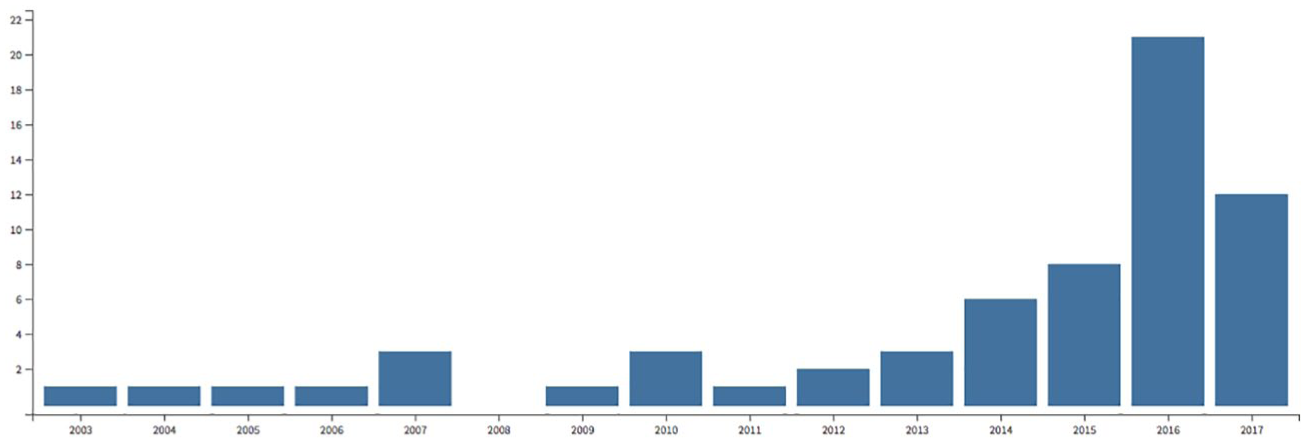
Papers Published on Creative Tourism (Per Year), Within Tourism, Management and Business Categories of Web of Science (2003-2017)
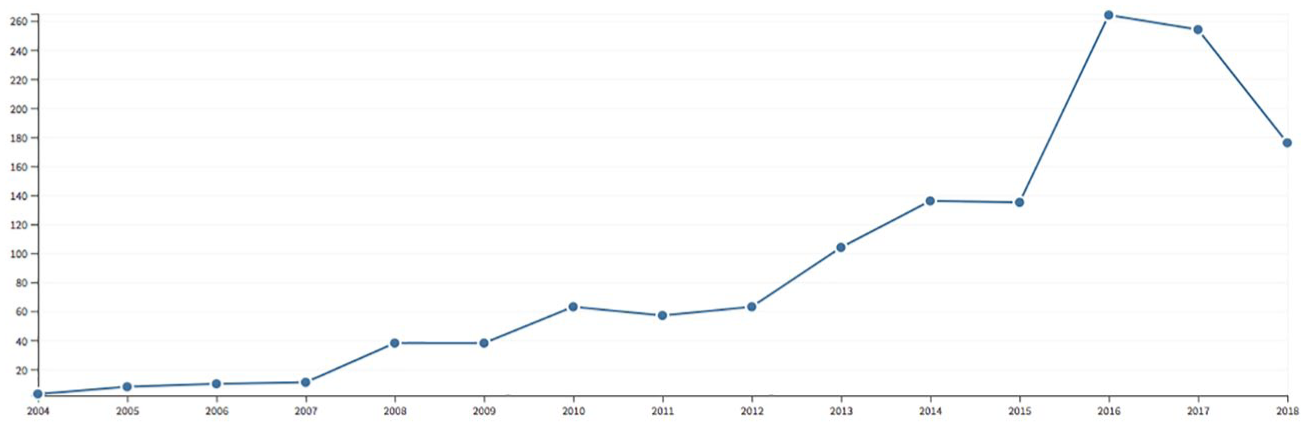
Number of Citations by Year of Creative Tourism Articles Published in the Tourism, Management, and Business Categories of Web of Science (2003-2017)
A subsequent analysis of the articles revealed some interesting elements (Table 1). There are four main journals in the field of creative tourism: Annals of Tourism Research, Tourism Management, Current Issues in Tourism, and Scandinavian Journal of Hospitality and Tourism. More than 40% of the articles on creative tourism were published in these four journals and received 85.4% of the total citations.
Scientific Journals Where the 64 Articles on Creative Tourism Were Published Between 2003 and 2017 (Ordered by No. of Publications)

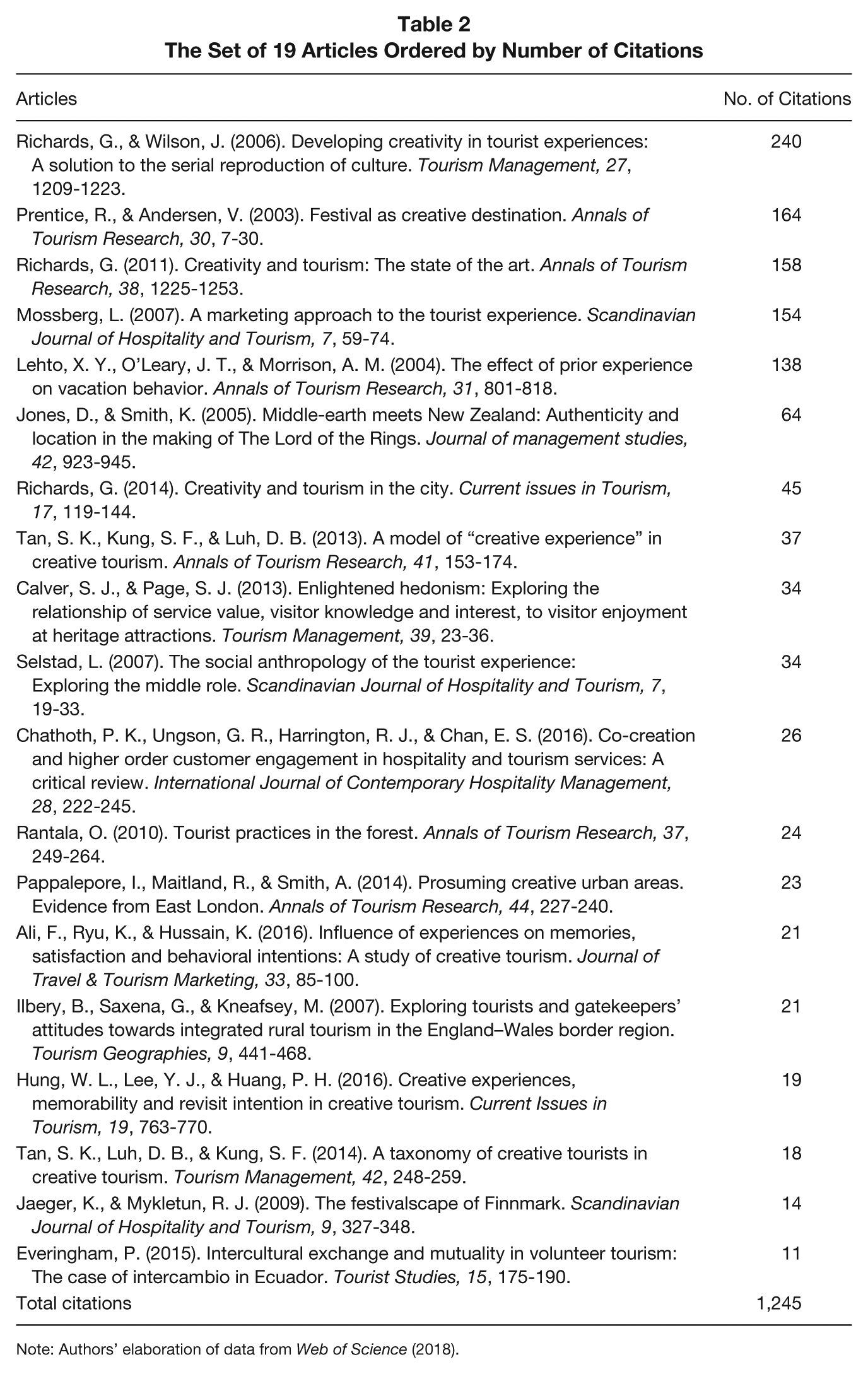
Consistently with the methodological prescriptions (Zupic & Cater, 2015), the most cited articles were selected, in order to identify the sample to be analyzed. Specifically, those articles which had been cited at least 10 times were chosen. This threshold was chosen to obtain a sample that was numerically consistent and, at the same time, relevant to the field. The filtered sample consisted of 19 articles, which represented the intellectual core of creative tourism literature. Table 2 shows the list of 19 articles used for the analysis of co-citations.
The Set of 19 Articles Ordered by Number of Citations
Note: Authors’ elaboration of data from Web of Science (2018).
Although the 19 items included in the sample represent only 29.7% of all the articles on creative tourism in numerical terms, they received the 91.5% of all citations: this makes the sample highly representative of the literature analyzed.
Step 2: Documents Co-Citation Analysis and Clusters Identification
The second step of the research was to identify the leading topics in the creative tourism field. A mixed procedure was used: a document co-citation analysis on the references of the 1,361 articles citing at least one article of the sample representing the core, in order to detect the clusters; a qualitative examination of the identified clusters—through a content analysis—aimed to classify the main topics and their theoretical roots.
VOSviewer 1.6.6 was used to collect, map, and analyze the co-citation network of creative tourism literature (van Eck & Waltman, 2010). VOSviewer combines, in a single approach, both the clustering and the mapping techniques by implementing a weighted multidimensional scaling (MDS). This has the advantage of overcoming the MDS tendency to arrange the most important items in the middle and the least important at the borders (van Eck & Waltman, 2010). VOSviewer requires a co-citation matrix as input. The co-citation matrix is obtained by computing the co-citation frequency of each pair of articles, that is, the number of times two articles are jointly cited within the references of any other publication included in Web of Science. Then, the co-citation matrix is converted into a similarity matrix by calculating the so-called association strength (van Eck, Waltman, Dekker, & van den Berg, 2010). Finally, VOSviewer builds a two-dimensional map, where the articles are located in such a way that the distance between any pair of them reflects their association strength. In this way, articles are located at various distances: very close to each other when they are strongly related; far away from each other when they are weakly related (Figure 4). It should be noted that one of the 19 articles analyzed is not shown on the map, since it was never co-cited with any other article.

Map of Literature on Creative Tourism
Each point on the map represents an article in the sample that is co-cited by at least two other articles on the entire Web of Science database. The size of each circle indicates the number of co-citations received from that article. Not surprisingly, Richards and Wilson (2006) is the most co-cited (15 co-citations). Articles close to each other share a similar co-citation value, therefore the map represents the co-citational structure of the creative tourism literature, as perceived by other scholars through the practice of citations. In particular, articles close to the edges of the map are generally associated with fewer other articles. On the contrary, articles that are in a more central position on the map are connected to many other articles and can be considered fundamental in the study of creative tourism. Although the position of the axes is arbitrary, the articles’ content and their position on the map suggest that the intellectual core of the field is structured on two main dimensions. One dimension (the horizontal axis) denotes the object of analysis. Consequently, articles located in the right quadrants primarily focus on experiences; while those located in the left quadrants concentrate on creativity. The other dimension (the vertical axis) represents the level of analysis; with articles located at the top of the map having a micro-perspective, dealing with tourist demand and behavior, conversely articles located at the bottom have a macro-perspective, studying destinations, cities, and tourist firms.
The VOSviewer mapping technique identified three clusters, each including a set of articles with a similar co-citation profile, indicating the probability of sharing the same topic or knowledge base, and that are labelled as follows:
Cluster 1: Tourist Experience and Co-Creation
Cluster 2: Creativity in Tourism
Cluster 3: Cultural Tourism and Events
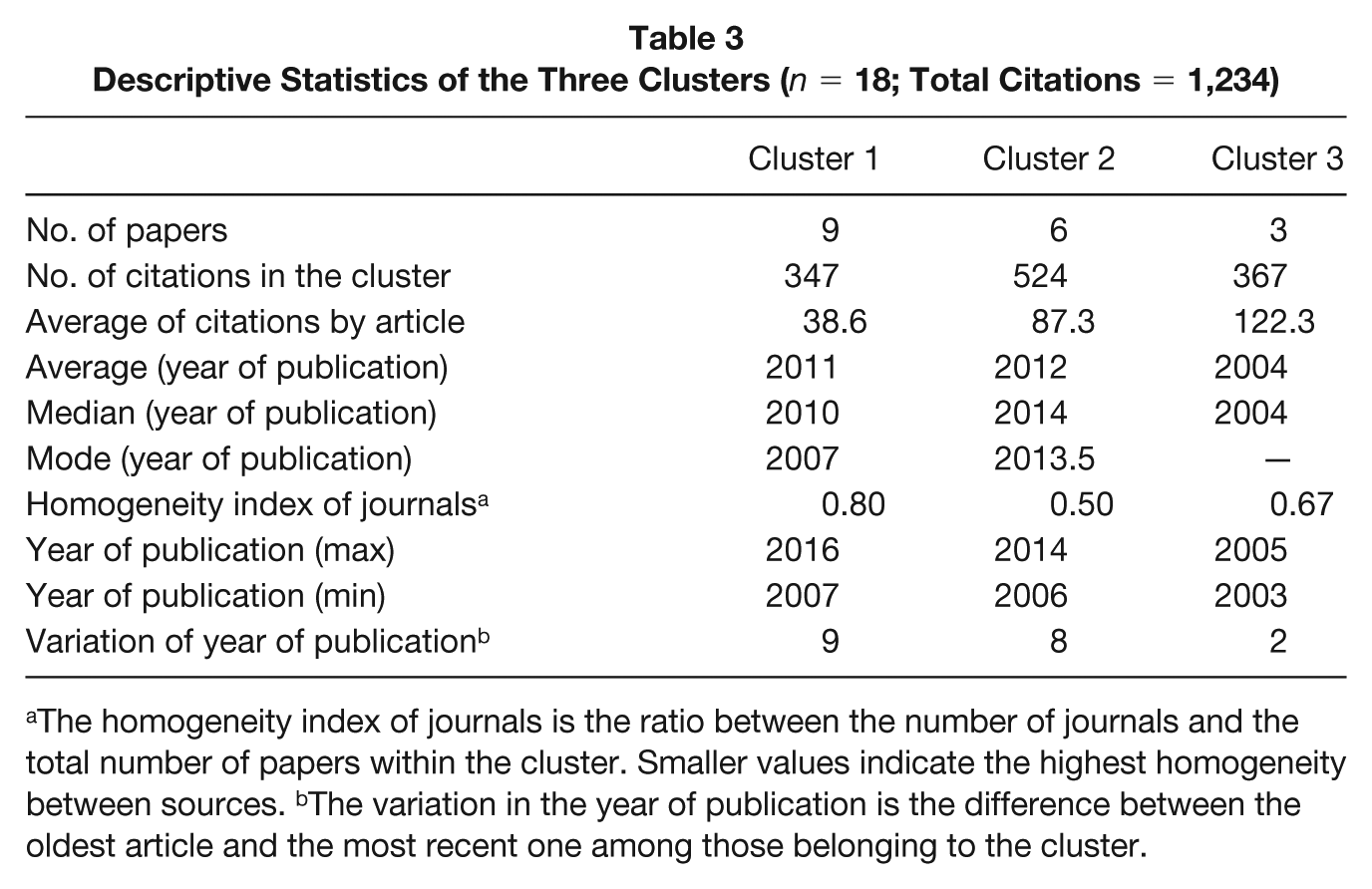
Table 3 shows some descriptive statistics of each cluster. Observations concerning the configuration of each cluster follow.
Descriptive Statistics of the Three Clusters (n = 18; Total Citations = 1,234)
The homogeneity index of journals is the ratio between the number of journals and the total number of papers within the cluster. Smaller values indicate the highest homogeneity between sources. bThe variation in the year of publication is the difference between the oldest article and the most recent one among those belonging to the cluster.
The descriptive statistics show that Cluster 1 on Tourist Experience and Co-Creation is the least homogeneous in terms of the date of publication, mainly due to the fact that it originates outside the creative tourism field. The most cited is Cluster 2 on Creativity in Tourism, which also appears to be the most homogeneous in terms of content. Cluster 3 on Cultural Tourism and Events is the oldest, in terms of year of publication, thus emphasizing that the creative tourism field originated from cultural tourism studies.
Step 3: Content Analysis and Description of Each Cluster
The third step of the research was to describe each cluster by reading all the papers and by analyzing the content of their titles, abstracts, and keywords with the text-mining routine of VOSviewer, which is based on an Apache Open Natural Language Processing library (van Eck & Waltman, 2011). The text-mining routine of VOSviewer uses the number of co-occurrences of terms in documents to filter and visually presents them in a map based on their relevance and relatedness (Figure 5). As a rule, the shorter the distance between two concepts, the stronger their connection; the thicker the circle, the greater its importance. From the analysis of each cluster, it is possible to make some further considerations.
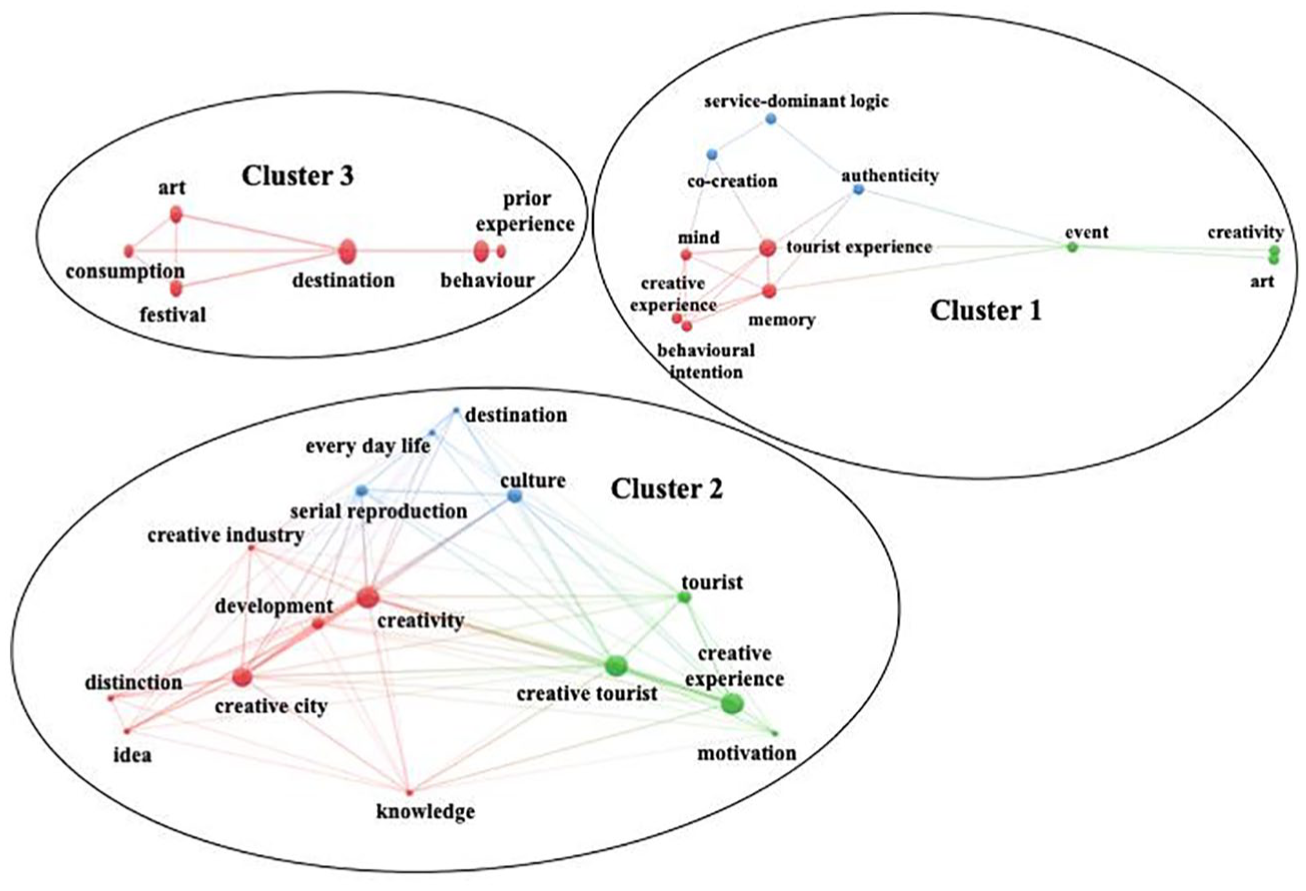
Map of the Main Terms Within Clusters
Cluster 1: Tourist Experience and Co-Creation
It includes nine articles, published between 2007 and 2016, dealing with the topic of tourist experience (Hung, Lee, & Huang, 2016, Mossberg, 2007; Rantala, 2010) and implementing a co-creation approach (Calver & Page, 2013; Chathoth et al., 2016; Mossberg, 2007). A strong focus is devoted to the management of the creative tourist experience and the tourist behavior, and in particular on the effect of satisfaction and memory in a context of creative events. The articles define the tourist experience, describe the production processes of tourist offer, and share the active role of tourists in shaping their experience. The main theoretical approaches which these contributions are based on are the experience economy of Pine and Gilmore (1998), the co-creation of Prahalad and Ramaswamy (2004) and the Service-Dominant Logic of Vargo and Lusch (2004). Some articles also highlight the role of memorable experience as an antecedent of destination image and of the intention to return (Calver & Page, 2013; Hung et al., 2016). The cluster is characterized by a significant usage of quantitative research, particularly the structural equation model.
Cluster 2: Creativity in Tourism
All the articles within this cluster were published between 2006 and 2014. They highlight the concept of the creative experience related to tourism, in particular within a context of cultural destination and creative industries. This cluster contains six articles that define and develop the study of creative tourism, such as the works of Richards and Wilson (2006) and Richards (2014). Cluster 2 is central to the analyzed literature, and its articles are among the most cited of the entire sample. Specifically, Richards and Wilson (2006) is well connected with all the other clusters, thus highlighting both its founding and bridging role. The other articles in the cluster are also widely co-cited. Precisely, Tan et al. (2013) and Tan et al. (2014) define the peculiar characteristics of the creative tourism experience from the tourist’s point of view and highlight the role of the experience as a fundamental driver for the development of a creative tourist offer. Pappalepore, Maitland, and Smith (2014) analyze creativity as a basic element in the development of a destination and describe the key factors of creative tourist experiences. In some articles, the role of cities as contexts to root and develop creative tourism activities is emphasized (Pappalepore et al., 2014; Richards, 2014). This cluster has many connections with Cluster 1, thus showing the close link between creative tourism and the concepts of tourist experience and co-creation.
Cluster 3: Cultural Tourism and Events
This cluster includes three articles, published between 2003 and 2005, dealing with cultural tourism issues and in particular the role of creative activities such as art events and festivals to involve and stimulate the tourist (Jones & Smith, 2005; Prentice & Andersen, 2003). The main concept is destination. It contains the first references of literature to the role of creativity in tourism, although the works of Richards and colleagues could not be cited as they are too recent. From some of these articles, the search for authenticity emerges as an element that increases the involvement of tourists and the overall satisfaction of their experience (Jones & Smith, 2005; Lehto, O’Leary, & Morrison, 2004).
The analysis allowed the intellectual structure of the literature on creative tourism between 2003 and 2017 to be explored. It can be affirmed that the literature on creative tourism has a polycentric structure with three specific areas that tackle the topic from different perspectives: first, the tourist experience, which must be memorable and possibly co-created by tourists, as a central element of tourist services; second, the role of creativity in making the tourist experience memorable; and third, the evolution of cultural tourism in creative tourism.
The analysis also showed that studies on creative tourism lie at the intersection of theories of experience and creativity applied to tourism services. Besides, it is the tourist who, by co-creating their own experience, plays a decisive role.
Step 4: Bibliographic Coupling of Recent Articles Published on Creative Tourism
The fourth step in the research was to identify the most recent research fronts on creative tourism, by implementing a bibliographic coupling on the articles published in the period between 2015 and 2017. The bibliographic coupling routine of VOSviewer made it possible to cluster and map articles by their similarity, based on the number of references they share.
Within the sample of the 64 articles on creative tourism, the 40 published between 2015 and 2017 are listed in Table 4.
Recent Articles on Creative Tourism (2015-2017)
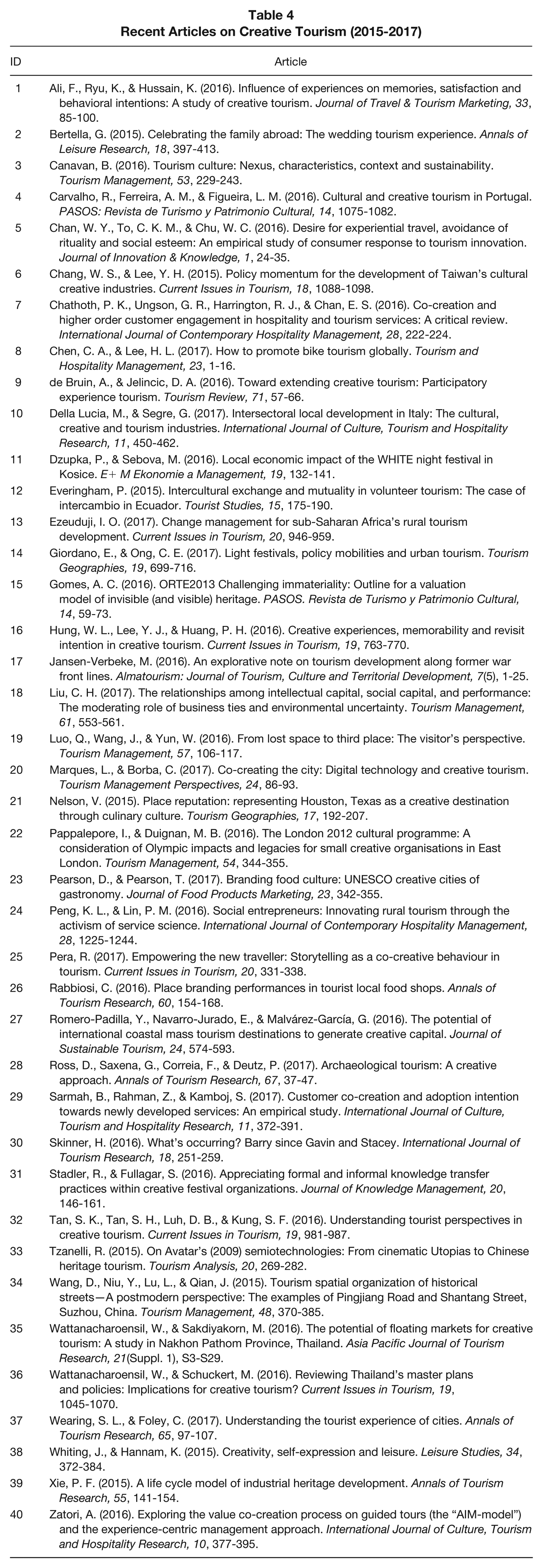
From the analysis, only 32 articles were extracted and shown on the map (see Figure 6). Each point on the map symbolizes one of the most recent articles on creative tourism that shares at least one reference with another article from the same set. The dimension of each circle represents the total number of shared references of that article with the others.

Recent Research Areas of Creative Tourism (2015-2017)
The VOSviewer algorithm identified five clusters, which correspond to the five most recent research trends in creative tourism:
Cluster A: Creativity and cultural tourism
Cluster B: Creativity and local development
Cluster C: Creativity and urban tourism
Cluster D: Creative tourist experience
Cluster E: Co-creation of tourist experience
Overlapping areas—as in the example of Cluster B and Cluster C—reveal a strong link between the two research streams. Articles in those clusters deal with the effects of creative tourism on the management of destinations and cities and the related culture-led development. The main difference among them is the theoretical base which they build on; Cluster B is mainly based on destination management literature, while Cluster C on urban studies. Moreover, articles in Cluster C, dealing with the role of local actors in defining creative activities, have some links to articles in Cluster B, highlighting the essential role of organizations for local development through creative tourism. Clusters D and E are intertwined and connected too. Articles within those clusters study the same topic of creative tourist experience from two different perspectives: the organizational and the tourists’ point of view.
By taking into consideration the year of publication and the strength of the links among articles, a central position is occupied by Ross et al. (2017), Giordano and Ong (2017), and Marques and Borba (2017). These articles conceptualize the role of tourism firms in creative tourism by underlining the relevance of local tourist providers and stakeholders in facilitating creative tourism experiences.
Based on the low density of some areas on the map, several issues appear to be underresearched or in an embryonic phase, namely the role of co-creation between organizations and tourists inside Cluster E (Ross et al., 2017; Zatori, 2016), the identification of a concrete way which creative tourism activities can improve urban tourism within Cluster C (Carvalho, Ferreira, & Figueira, 2016; Marques & Borba, 2017; Wattanacharoensil & Schuckert, 2016) and the new concept of the participatory tourism experience in Cluster B (de Bruin & Jelincic, 2016; Everingham, 2015). The results allow some opportunities for future research on creative tourism to be identified. First, the research field of creative tourism is gradually acquiring independence from the parent field of cultural tourism, which will increasingly center on the development and management of cultural capital of a destination. The specific features of creative tourism (e.g., the role of co-creation between tourists and local actors; the possibility to develop a destination without material and heritage attractions) support such a theoretical autonomy. In fact, Cluster A, which uses a cultural tourism approach, is relatively disconnected from the other clusters, revealing that researchers perceive its knowledge domain as being quite different from the remaining domains. Scholars of the creative tourism field could consequently explore research questions dealing with strategies that tourist organizations and/or policy makers should pursue to enhance the co-creation between local actors and tourists in a network perspective.
Second, the existence of a strong connection among clusters B and C envisages that future studies will focus on the contribution that a creative tourism approach offers to the development of a destination. Although some studies have already emphasized this aspect (Carvalho et al., 2016; Marques & Borba, 2017), it is believed that future studies should center more on a bottom-up perspective and on a more participative strategy that involves both tourists and local community.
Finally, future research on creative tourism could lessen the macro-approach based on creative economy and cultural-led development, to embrace a more micro-approach based on people. While the economic aspects of creativity have been fundamental in conveying the interest of scholars toward creative tourism, the theoretical foundations of such perspective have now become common knowledge. On the contrary, once the importance of creative experiences has been accepted, it becomes important to understand the individual’s point of view, by studying motivations, activities and value creation in creative tourism experiences. Thus, further studies could focus on aspects such as the “existential” dimension of creativity (Tan et al., 2013), for tourists and between tourists and local community.
Conclusions
The study shows the intellectual structure of the creative tourism field. In an innovative way—compared with the literature reviews carried out so far in previous studies—64 articles on creative tourism were selected and analyzed by co-citation analysis, content analysis, and bibliographic coupling. The results identified
two objects of analysis: creativity and experience;
two levels of analysis: the supply-side and the demand-side;
three main research topics: tourist experience and co-creation, creativity in tourism, and cultural tourism and events;
two main theoretical approaches: co-creation and experience economy;
some recent developments and research trends: creativity and cultural tourism; creativity and local development; creativity and urban tourism; creative tourist experience; co-creation of tourist experience.
The study expands the knowledge base of the creative tourism field and stimulates the debate among scholars, by offering three main contributions.
First, it proposes a comprehensive view of the existing literature on the topic, by identifying three main strands of study: one dealing with the construct of tourist experience, describing its causes, effects, and processes to develop tourist offer; another defining creative tourism and examining the creative experience from the point of view of the tourist; the last dealing with topics closer to cultural tourism, and in particular exploring the role of events. Moreover, it highlights that creative tourism is a developing and promising research field in which a series of theoretical frameworks—the experiential perspective, the theories of creativity and co-creation—can be applied to a variety of different empirical contexts.
Second, the article provides useful insights into the role of creativity in the development of places and destinations, thus providing an incentive for tourism organizations and policy makers involved in the formulation of destination management policies to enhance local specificities. Creativity is emerging as a key element to differentiate the tourist offer of destinations and increase their competitiveness, yet despite fueling the most recent studies, it still calls for further theoretical and empirical research.
Third, bibliographic coupling applied to articles published between 2015 and 2017 has allowed several paths for future research in creative tourism to be identified; namely, the exploration of the tourist experience, the process of participatory experience co-creation, the way of exploiting creativity to enhance urban tourism, and destination competitiveness. Future research could also empirically investigate how to manage relationships between local actors and tourists, within creative tourism experiences.
In addition to the contributions aforementioned, the value of this article lies in some practical implications concerning research, higher educational, and decision-making activities. First, this research could be useful for scholars working on tourism, but who do not have a sufficient awareness of the topics and the approaches reviewed. Second, academics could use this study to exemplify the general structure and development of creative tourism studies by identifying their most important features or to explain how to carry out a literature review by applying a bibliometric methodology. Third, managers and policy makers should acknowledge that creative tourist experiences are the result of a co-creation process, based on creativity, in which collaboration among all the actors is needed. Therefore, creativity becomes a key issue at different levels. It is not only a feature of the tourists’ and the tourism experience itself. It is also a feature of tourism organizations which design experiences, as well as of the local people who interact with tourists. Policy makers involved in this process should try to build a creative local environment and plan initiatives able to develop the creative skills of local people and of local firms operating in the tourism field, by engaging them in activities like creativity development workshops, training course, and “hackathons” among others.
However, the main limitation of this study lies in the small number of articles analyzed, as a greater number of documents would have been more suitable for a bibliometric analysis. Nevertheless, since the concept of creativity has been addressed in many different ways within tourism studies, the choice to limit the analysis to those documents which explicitly mentioned the term “creative tourism” was motivated by the desire to discover the inner intellectual structure of creative tourism literature.
