




Abstract
Often considered an enhancement to the learning experience, technology can also stifle creativity and higher levels of thinking. This study repositions students away from technology and back to the basics to stimulate engagement and higher levels of learning. It investigates the relationship between learning outcomes and the reflective journaling process in the context of an undergraduate marketing class in the United States. In addition, this study investigates a technique in which students are introduced to topics that are sensitive in nature, yet relevant to the real world. Although reflective journaling has been utilized in courses in areas such as educational psychology and social work, it has not been widely practiced in business courses such as marketing. Through the lens of Bloom’s Taxonomy, we qualitatively analyze handwritten reflective journaling assignments about loneliness and social media to determine how the process highlights higher levels of learning. The opportunity to use handwritten journals provided a unique learning experience and a hands-on approach to allow marketing students to experience learning in a new light.
Education is one of the primary tenants of civil society, but how can it be better employed to support the dynamic challenges individuals face in both their personal and professional lives? While technological skills are often considered a gateway to employment (Combs, 2021), focus cannot be averted from the critical thinking abilities students can only acquire through higher levels of learning. Publishers promote interactive online content and other technology as silver bullets to make the learning experience more engaging for students; however, there is still some uncertainty regarding their effectiveness in enhancing the learning process. Although technology (e.g., digital devices) can potentially augment the learning experience, research on children indicates that it can also hamper creativity (Ruder, 2019) and thereby restrict higher levels of learning. Rapid tech innovation renders individuals at risk of entering a constant state of digital and/or information overload at work, at home, at play, and at school, with students completing assignments on laptops and mobile devices (Asamoah, 2020; Hu & Krishen, 2019). Recent experimental work finds that digital (screen/technology) versus nondigital (paper/print) modalities prime lower level concrete versus higher level abstract cognition and comprehension differences, respectively (Kaufman & Flanagan, 2016). When utilizing digital devices or modalities, individuals experience a higher cognitive load while attempting to avoid distractions and multitask; thus, paper-and-pencil processing requires a lower cognitive load and gives way to higher levels of abstract thinking (Shibata & Omura, 2020).
Marketing students are aware of the value that creative thinking can bring to their careers and often prioritize it above nonmarketing students. However, this awareness does not necessarily translate to higher creative ability (McCorkle et al., 2007). Marketing curriculum is typically taught using traditional course material. This leaves little room for exploration of sensitive, self-relevant, or real-world topics that might deeply engage students and help develop their creativity, motivation, and critical thinking skills (Krishen, 2013, 2021). In fact, important and relevant topics such as ethics and diversity are often treated as an afterthought or footnote in marketing curriculum. How can we make substantive topics more self-relevant for students and increase their academic and real-world engagement and success? This qualitative study suggests that going back to the basics in marketing courses is actually innovative. By utilizing the traditional teaching method of handwritten journaling to explore nontraditional topics through reflection and reaction, we set the stage for deeper learning and higher engagement.
This study explores the impact of reflection and sensory processes on students’ abilities to reach higher levels of learning through the lens of Bloom’s Revised Taxonomy (Anderson & Krathwohl, 2001). Bloom’s Taxonomy has been used to develop curriculum and evaluate student learning; however, the present application of this theory through a sensory journaling exercise is unique. Handwritten reflective journaling assignments about loneliness and social media are analyzed according to Bloom’s Taxonomy to determine whether higher levels of learning are reached. Finally, open-ended student feedback is explored to better understand their perceptions of their overall learning experience.
Literature Review
Reflective Learning
Reflection is a process of deeper engagement with knowledge that surpasses comprehension and reaches interpretation of material. Seen as a process, reflection consists of three stages: (a) awareness is when the individual experiences feelings based on a learning environment thus triggering reflection; (b) critical analysis includes locating prior knowledge, questioning assumptions, and probing alternatives; and (c) perspective transformation wherein individuals arrive at a new perspective by assessing an experience (Atkins & Murphy, 1993). Reflective learning implicitly requires a combination of cognitive and affective skills: self-awareness (separating the individual from the situation and interrogating feelings), description (recognizing and recollecting features of an experience), critical analysis (defined previously), synthesis (integrating new and existing knowledge), and evaluation (judging the value of something with standard criteria; Atkins & Murphy, 1993). The four contextual components required to stimulate the reflective learning process are course design, course content, student interaction, and the role of the lecturer (Hay et al., 2004). The nonreflection–reflection continuum describes a continuum of reflective learning consisting of habitual action, understanding, reflection, and intensive reflection (Peltier et al., 2005). Extending the continuum, Peltier et al. (2006) conceptualize the reflection hierarchy as part of a learning outcomes model with the following steps: habitual action, basic understanding, deep processing, deep understanding, reflection, and intensive reflection. Key components for the model of reflective learning include interactions by all participants in the learning community involving students, instructors, and members (Peltier et al., 2005). Critical reflection engages students to construct knowledge in a continuous learning fashion, encouraging meta-cognition (Dreyer, 2015). One effective technique for stimulating critical reflection is reflective journaling, which involves utilizing assignments wherein students keep a learning journal. While using the journal to reflect on written assignments, the students gain a deeper understanding of the material and immerse themselves into the knowledge (Boden et al., 2006). Unlike a diary in which students share their personal feelings and experiences, a reflective journal is a pedagogical tool that can be applied to classroom assignments. Although there are multiple types of journals, according to Liuolienė and Metiūnienė (2009), a reflective journal has many benefits including (a) producing intellectual space for thinking, (b) encouraging independent learning, (c) providing a focal point and system for gathering information, and (d) enhancing information synthesis learning skills. In addition to providing these benefits, reflective journaling allows students to separate facts/experiences from attitudes/emotional responses, which can be differentially beneficial, especially when the topics of interest are sensitive in nature (Torino, 2015). Although many disciplines, such as educational psychology (Dreyer, 2015) and social work (Sage & Sele, 2015), have utilized reflective journaling to enhance learning outcomes and student participation, this technique is less practiced in marketing courses. In addition to the learning benefits of reflective journaling, Stanton and Stanton (2017) find that students engage more with the content and perform better on objective measures (e.g., exam grades). Muncy (2014) utilizes online blogs as a journaling mechanism and shows that this activity results in immersive reflective learning. Both Muncy (2014) and Stanton and Stanton (2017) employ online submissions as the mechanism for writing, submitting, and evaluating journal entries.
Sensory Processes and Learning
In multiple studies, Ren et al. (2018) find that handwritten notes generate higher warmth for the reader in comparison to digital; perceived effort and psychological closeness mediate this effect. In the realm of developmental psychology, research indicates that handwriting facilitates category learning, letter knowledge, and symbolic learning and reading through neural systems (Li & James, 2016).
As revealed from a meta-analysis of extensive neuroimaging experiments, handwriting is a cognitive process that involves multiple regions of the brain (Planton et al., 2013) and correlates with reading ability (Gimenez et al., 2014). Studies of young children indicate that handwriting (versus typing) letters affects regions of the brain associated with developmental reading skills (James & Engelhardt, 2012). Further edifying studies on reading development in young children, recent research indicates that notetaking with laptops versus longhand is suboptimal. Specifically, when typing notes instead of handwriting them, students process less information, resulting in shallower learning with less conceptual rigor (Mueller & Oppenheimer, 2014) and a higher likelihood of “zoning out” during class (Ravizza et al., 2017). To achieve higher cognitive engagement, exam grades, and course performance, a recent meta-analysis by Allen et al. (2020) suggests that students write or sketch notes in class, regardless of whether they do so on paper or digital notebooks.
In an effort to stimulate critical thinking, instructors can assign online reflective reporting (e.g., Bisman, 2011; Mladenovic et al., 2019) or offline handwritten journaling (e.g., Carrington & Selva, 2010; Pavlovich, 2007). Utilizing handwriting as the modality of reflective/learning journals provides multiple potential benefits to students. First, the spontaneous nature of a written journal allows students to write in a piecemeal fashion as thoughts enter their minds, rather than having to set up or open a document on a computer screen to update. The difficulty in sharing handwritten journaling is also an advantage and can build trust and team performance, which are important precursors to successful reflective journaling (Kobert, 1995; Loo & Thorpe, 2002).
Bloom’s Taxonomy
In its primary iteration, Bloom’s Taxonomy identified three domains of educational objectives or goals: cognitive (development of intellectual skills in terms of recall and recognition of knowledge), affective (changes in attitudes, values, and interests along with the development of appreciation), and psychomotor (learning of motor skills; Bloom et al., 1956). In this original taxonomy, the cognitive domain is ordered as a hierarchical set of steps from simple to complex: knowledge, comprehension, application, analysis, synthesis, and evaluation. More recently, Krathwohl (2002) revised the cognitive domain steps from the original taxonomy to identify six cognitive process dimensions: remember, understand, apply, analyze, evaluate, and create. Remembering entails knowledge retrieval, understanding involves constructing meaning, applying requires implementation or execution of a procedure, analyzing comprises deriving a bigger picture by ordering parts and structuring, evaluating means making objective criteria-based judgments, and creating involves connecting elements to form a functional whole and then forming a new combination. In the context of achieving certifications for various software programs, Spiller and Tuten (2019) show that certain certifications reach higher levels of the revised taxonomy than others do.
Study Method
The sample consisted of a total of 17 students (11 females and 6 males; median age = 23; mean age =23.1) in an honors-level undergraduate Marketing class at a large university on the West Coast of the United States. To stimulate reflective learning per Hay et al. (2004): (a) students were required to complete multiple journaling assignments, (b) the course content included deep-thinking-related consumer behavior chapters, (c) students interacted during discussions, and (d) the instructor facilitated the discussions and the journaling entries. The course objective stated in the syllabus is as follows: To help students develop their research, inquiry, and communication skills while providing opportunities for discourse and dialogue regarding the role of marketing within the broader context of humanity.
The syllabus describes the course learning outcome: The course will provide students with critical thinking opportunities centered around the acquisition of a broad range of marketing knowledge. Rather than focusing on the normative marketing topics and traditional methodologies, students will explore new and diverse substantive domains, and analyze them from a holistic, intersectional, and interdisciplinary perspective. As knowledge can be gathered by developing research skills, they will learn to creatively synthesize extant literature into a branding framework. After doing so, they will publish and present their emergent findings.
The course therefore enables students the opportunity to learn at different levels according to their willingness and ability to engage with the material. Challenges for instructors involve encouraging students to engage with the content through journaling and evaluating students’ ability to meet learning objectives for desired higher levels of learning, as described by Bloom’s Taxonomy. Weekly journal entries based on chapter readings from Marketing & Humanity: Discourses in the Real World (Krishen & Berezan, 2019) were assigned as a way for students to connect with the material. Although journaling is a common learning tool used in many areas of study, it is not typically used in business courses. Journaling encourages reaction and reflection and helps students separate what they learn from how they feel about what they learn—essentially separating their attitudes about the material from the material itself. This study focuses on journaling assignments to evaluate each student’s learning experience through the lens of Bloom’s Taxonomy. In an effort to fully engage students and encourage authentic reflection, the assessment was limited to a pass/fail scale; the conflicting goals of measuring and assessing critical thinking skills versus allowing and encouraging free-form reflection means a path has to be chosen (Dahl et al., 2018). In the present research, reflective journals provide an avenue for self-realization and critical thinking as it relates to the course material.
Study: Journaling Assignment
The data for this research are drawn from a class journaling assignment (Appendix) based on the book chapter “Loneliness and Social Media: The Interplay of Physical and Virtual Social Space” (Berezan et al., 2019), which was presented in hardcopy to the students. The reading presents an exploration of loneliness and social media in terms of how social media can have both a positive and negative influence on one’s sense of well-being depending on perceived loneliness. Students were each provided with their own journaling notebook and set of colored pens to complete assignments. They were given 1 week to read the chapter and craft a hand-written response to a series of questions about reading in four different categories (Peltier et al., 2005), each with their own learning objective:
The key concepts section is intended to gauge the knowledge acquired from the assignment. This section of the assignment is rational and knowledge-based.
The section for key responses asks students to explore any emotional connection or attitude they may have with the knowledge they have just acquired. This portion of this assignment is emotional and attitude-based.
Key reactions questions are intended to unveil any potential changes that may have occurred from reading the chapter such as rethinking how students view themselves and the world around them.
The key reflections portion of the assignment asks students to explore any areas of their life where learning from the assigned reading could make an improvement.
Each student completed their journal in handwriting on paper, scanned it, and finally submitted it via the course LMS assignment link. Journal entries were then transcribed by a student research assistant into a document suitable for analysis.
Analysis
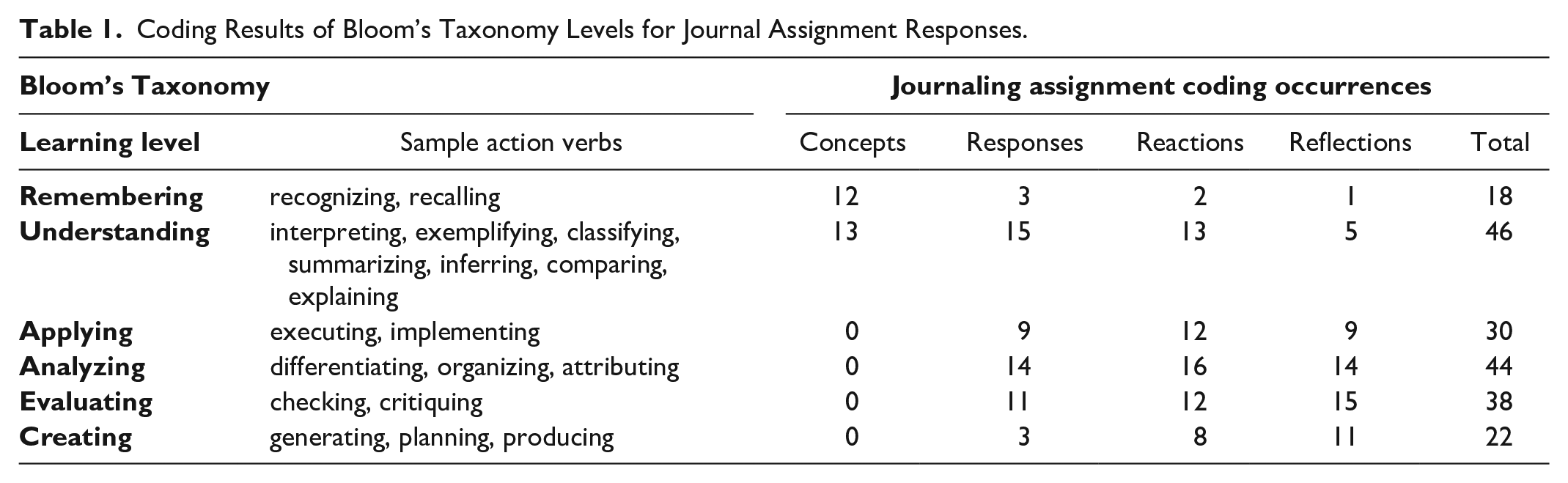
The journal transcripts were analyzed using qualitative content analysis (Weber, 1990). We used a priori coding by searching for Bloom’s Revised Taxonomy categories and their respective action verbs to maintain a clear connection with the study framework (see Table 1). As shown in Figure 1, We analyzed journal entries line-by-line for semantic evidence reflecting the underlying action verbs for each level of the taxonomy: remembering, understanding, analyzing, evaluating, and creating. Each code was used a maximum of 1 time per question per student. For example, for each student, the remembering code (basic level of Bloom’s Revised Taxonomy) could be used up to one time for each of the concepts, responses, reactions, and reflections sections of the journal assignment. With six taxonomy levels and four sections in the assignment, a maximum of 24 codes per student could potentially be identified. To support interrater reliability (Morse et al., 2002), this analysis was first performed separately by each of the three research team members resulting in a final, collective analysis that considers the respective input of each researcher.
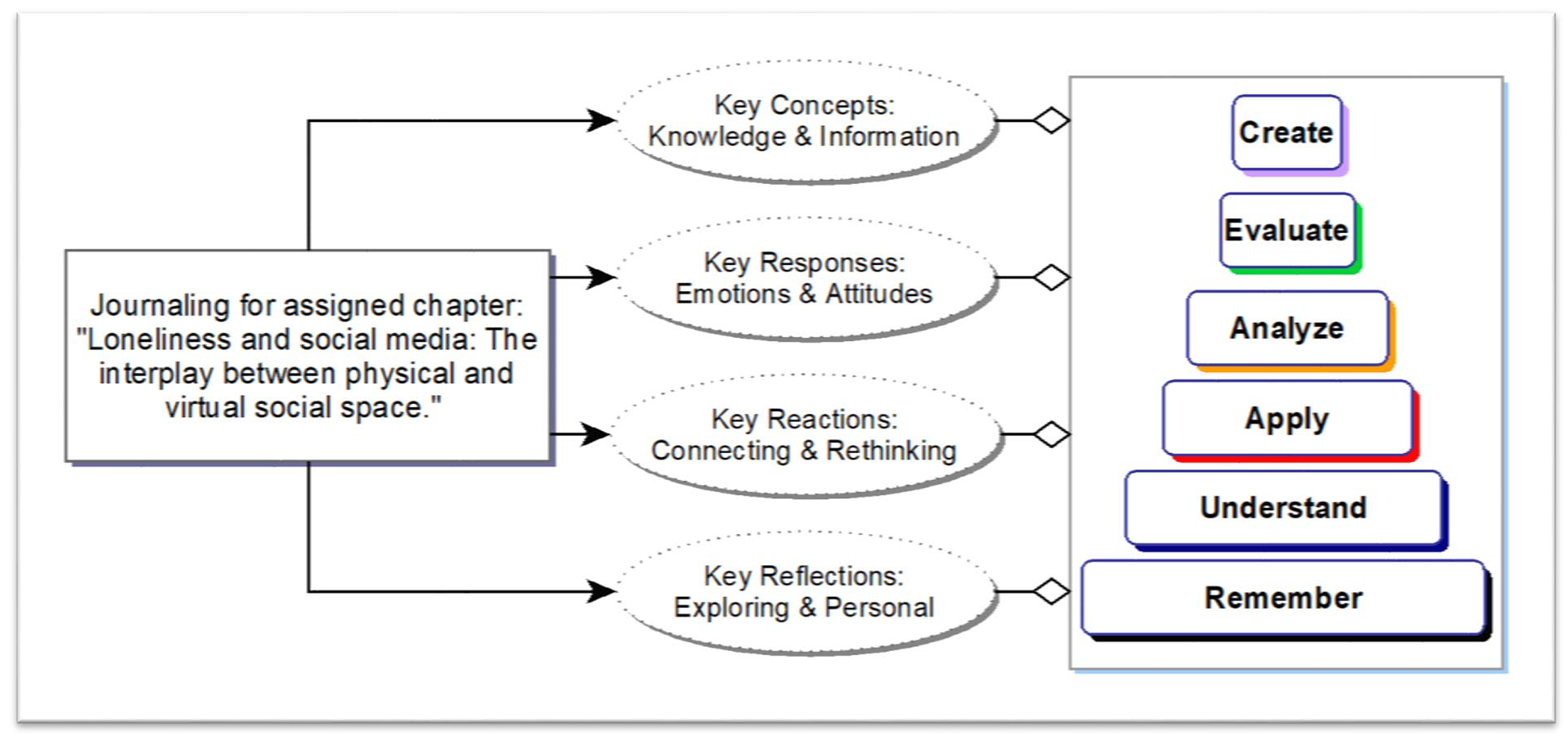
Journaling Assignment Coding Process.
Coding Results of Bloom’s Taxonomy Levels for Journal Assignment Responses.
Results
The average number of words written per student for each portion of the assignment is as follows: key concepts: 72; key responses: 149; key reactions: 143; key reflections: 121. Table 1 depicts the number of occurrences where different levels of Bloom’s Taxonomy emerged from the content analysis overall and according to each portion of the assignment (concepts, responses, reactions, and reflections). One occurrence equates to a particular level of Bloom’s Taxonomy being reached by a specific student in one section of the assignment. Therefore, a student who may have included multiple examples of evaluating in response would only realize a count of 1 occurrence for evaluating in that section of the journal entry. Aspects of Bloom’s Taxonomy appear in all sections of the students’ work, with each section including at least one level of Bloom’s Taxonomy. Evidence of the levels applying, analyzing, evaluating, and creating was not found in the concepts section, whereas all levels of Bloom’s were discovered to some degree in responses, reactions, and reflections. Figure 2 shows sample comments as evidence of students reaching different levels of Bloom’s Taxonomy pyramid.

Journaling Comments in the Bloom’s Taxonomy Framework.
Remembering
According to Bloom’s Taxonomy, remembering is the initial or foundational level of learning. At this stage, students recognize and recall knowledge; as such, the concepts section was expected to have more instances of this level of learning. This lowest level of learning had the least number of appearances in the data (18). The section on concepts included 12 occurrences in the remembering stage, such as the following example of information recall: Approximately 54% of 20,000 survey respondents (ages 18 and over) report that they sometimes feel alone or left and, suggesting that loneliness in the U.S. is now at epidemic levels.
The responses portion of the assignment includes three examples of the remembering level of the taxonomy, such as the following: As stated in the chapter, social media is great for connecting with the old, new, and far.
Reactions have only two examples of the most basic level of Bloom’s Taxonomy, such as the following response recalling the scale (SELSA) used in the study: I found it significant that they labeled emotional loneliness as a lack of profundity in relationships.
Reflections had only one instance of the remembering level, where the student recalled what was discussed in class as an introduction to their reflection piece. This low count is not surprising as a reflection calls on students to do far more than to just recall or recognize information. As such, many students may not display remembering in writing although it is occurring in their mind while formulating their written response. In addition, the overall low instances of remembering could be attributed to the fact that the study was conducted on an honors class where students may have been more accustomed to performing at higher levels.
Understanding
In the next level of learning, understanding, students find meaning from content and are able to interpret, explain, or summarize it in their own words. Reaching this level of Bloom’s Taxonomy is vital to providing a foundation for higher levels of learning and is expected to be prevalent in the concepts and responses portions of the data. Evidence of understanding emerged from the analysis more than any other stage, at 46 times, far more often than the lower level of remembering. The sections on concepts, responses, reactions, and reflections had 13, 15, 13, and 5 examples of this level of the taxonomy, respectively, with evidence of explaining, interpreting, relating, contrasting, summarizing, rephrasing, inferring, comparing, explaining, illustrating, and extending emerging in their journals. An example of Bloom’s understanding level emerging from the concepts section illustrates the ability to summarize and paraphrase: Social media is a double-edged sword, with its ability to influence our lives in both positive and negative ways.
The following excerpt from Responses is an example of a student showing understanding by summarizing and rephrasing: There are positive and negative aspects of being both unidimensional and multidimensional when regarding one’s loneliness prospective. Positively, unidimensional people do not worry about the number of friends or relationships they have, while multidimensional people will work to build quality relationships. Negatively, unidimensional people could be unstable, meaning if one relationship goes wrong or does not work out then they could project that on other relationships.
The following quote from the Reactions portion of the assignment exemplifies understanding through interpreting and contrasting positive and negative notions of social media: “I’ve changed my firmly held idea that social media was no impact on how lonely people feel. I used to think loneliness was not heightened by social media and that people blamed their loneliness unreasonably on social media. But now I understand that social media does have an impact on people’s loneliness and that it can be a mixture of positive and negative.
A quote from the reflections portion of the journal illustrates students reaching understanding through their ability to relate to the material: We were talking about impostor syndrome in our first class, and I related a lot to what (the professor) was saying about how people with impostor syndrome feel the need to be liked. Now that I keep a small group of high-quality friends, I feel like I’m not as concerned with my online image anymore though I still have a lot to work on.
Applying
In the third level of Bloom’s Taxonomy, applying, students consider how the knowledge they acquired can be used in scenarios they might encounter in their daily life. The nature of the questions led us to expect that this level would appear more in the Key Reactions and Key Reflections sections where students are asked to directly consider their own lives. Examples of this level appeared less frequently than the previous, at 30 appearances among the students. The sections on concepts, responses, reactions, and reflections had 0, 9, 12, and 9 examples of this level of the taxonomy, respectively. Journal excerpts for applying in the responses section show evidence of applying by the connection made between happiness and social connections: Thinking about it, when I make new, close connections and when I get involved in the community I instantly feel happy. Continuously doing this and building connections can ultimately make me happier.
In addition, students shared that they made use of the chapter content by applying the material to their own lives: I can definitely relate to this. I lived away by myself from family for the past three years and because of my busy work and school schedule, I am a lot more isolated than before and try to subconsciously compensate lost relationships by being “more connected” on social media.
In the reactions portion of the journal assignment many of the emergences evidenced applying by solving a problem based on chapter content, as in the following examples: When reading this, I wouldn’t help but think about the effects we have on each other. If there is someone with HL we change their levels of loneliness quite easily. In a world where we were all aware of each other and each other’s feelings. We would be able to eliminate loneliness one person at a time. In the future, I’ll occasionally reevaluate whether social media is augmenting, compensating for, invading, or disconnecting me from my physical social life so that I can change my habits accordingly.
Students also showed the ability to apply knowledge in the reflections portion of the assignment through solving, planning, making use of the content, and making choices based on the content as in the following comments: After reading this chapter, I should change my bad habits that I like staying at home when I have leisure time. I should going out maybe to a gym or park to play ball games with other people. When spending time with others, I will make some friends, and feel less loneliness. The chapter says that real life relationships lead to a happier life, so maybe I should look into getting some.
Students also exhibited making use of and applying the content, as in the following excerpt: After reading this chapter, I think I will try and use this new approach I have to the virtual world in my everyday life in the physical world as well.
Finally, choosing and applying is evident in the work of many students such as the following example of a student applying the content directly to their lives: I have spent too much time on social media so now I will take my time on it more carefully.
Analyzing
When analyzing, students draw connections between ideas and a greater meaning or purpose. The sections on concepts, responses, reactions, and reflections had 0, 14, 16, and 14 examples of this level of the taxonomy, respectively, slightly below the understanding level with a total of 44 occurrences among all students. Students reaching the analyzing level of Bloom’s Taxonomy in the responses portion of the journals are expected to examine their lives and dissect information, as shown in the following examples: I’ve taken notice of my own mindless scrolling + tendencies to turn to social media for fulfillment when other parts/aspects of my life aren’t going as planned + catch myself deep in web of social comparisons. It’s dangerous + I think it’s important that we all (my generation + younger especially) take note + change that. I do wish that the study would’ve mentioned the amount or mean of friends that the 399 participants had/have to see if that had/has any correlation with the degrees of loneliness.
The excerpts from the reactions portion of the assignment illustrating analyzing exhibit discovery behavior: It also helped me realize just how a business like Facebook can take hold of a person’s life to such a degree.
Analyzing in the reactions section is also characterized by examining/dissecting one’s life: Reading the chapter made me look into my own relationships. More specifically, how they work in the world, and especially with the statistics in the chapter.
The thoroughness of many of the answers in the reactions portion also illustrates ability to analyze: It got me thinking a lot about the breakdowns of how it compensates, augments, invades, or disconnects people from their physical social space + how like every other tool, it can either help or harm based on self-control.
Finally, the following excerpts illustrate students applying knowledge in the reflections portion of the assignment by examining and categorizing their own lives: Looking back, I can make some changes for the future on how I spend my time. All of the short amounts of time throughout the day I spend on social media add up. After the breakdown of the research results in the chapter, I immediately started thinking of my social media use + which category applied the most to me.
Evaluating
Students are able to make an educated judgment about what they learned in the evaluating stage. Instances of evaluating emerged a total of 38 times among all students, with concepts, responses, reactions, and reflections having 0, 11, 12, and 15 occurrences, respectively. The following offers evidence of agreeing, deducting, and evaluating from the responses portion of the journal: I completely agree because if someone is not happy with their personal relationships or the relationships that they have, it feels like you are alone and essentially have no one there for you.
Sharing opinions, concluding, and explaining all illustrate the ability to evaluate as in the following excerpt from the responses section: At the end of the chapter, you mention the idea of giving the consumer the ability to have more control over their experience on social media by selecting a “role” + filtering out the other aspects of the site which I think would be super helpful + beneficial.
Evaluating is also evidenced through students’ ability to conclude, assess, interpret, and recommend, as in the following from the responses section: Multidimensional people value the quantity of their relationships, this could lead to the neglect of some relationship if one has too many.
Examples of evaluating emerging from the reactions section include
This helped me reevaluate me loneliness and the many reasons behind it. This chapter made me realize that I have a predominantly negative outlook on social media.
The majority of evaluating examples appear in the reflections portion of the journal, largely illustrating deducing and concluding behavior: My main takeaway from the chapter was that we need to monitor our own online experiences in order to make them positive. It doesn’t matter how you interact (via physical interaction or virtual) all that matters is how connected you feel after the interaction.
Creating
In the highest level of the taxonomy, creating, students have a full understanding of the material and are able to build upon it by generating ideas, planning, and producing. The highest level of Bloom’s Taxonomy appeared 22 times; none of it occurred during the discussion of concepts, and most of it appeared in reflections. Evidence of creating was demonstrated 3 times in the responses section, such as the following example showing idea generation: Can the internet/social media eventually be harassed for the express purpose of supporting people with depression or loneliness?
Examples of creating appear 8 times in the reactions portion. Discussion and planning are activities at the creating level and are evident in some responses, such as the following: I should start rebuilding my connection to people in the physical world before jumping into the virtual one to avoid any further life implications.
In addition, some students show evidence of the formulating and imagining aspects of creating, such as
Farther in the future I plan on having kids and this chapter has given me a less opinionated view and more of a rational view of social media that I feel will allow me to properly educate my children, and others, about using such technology.
Examples of creating emerged 11 times from the reflections portion of the assignment. For example, the following comment is evidence of the student planning and formulating their journal: After realizing this I feel I need to practice trust and try and build my relationships more.
Finally, the following comment is a sample quote illustrating the planning, finding solutions, designing, and proposing aspects of creating.
I think I should set up a specific window of time I would allow myself to go on social media (If I want to) rather than doing it sporadically though the day.
Student Feedback
Student evaluations of a course overall and perceived instructor effectiveness are commonly used metrics by which to evaluate the perceived learning experience and broadly, whether or not course learning objectives were met. Course evaluations were submitted consisting of open-ended responses to the following: (a) What helped you learn in this course? (b) What changes would improve your learning? and (c) Please add any other comments on specific aspects of this instructor’s teaching that you think are relevant and constructive. Student feedback was solicited to evaluate the course and instructor overall and was not concerned only with the journaling assignment. Utilizing the Marks (2000) taxonomy, students’ perspectives of their learning experience are now presented as follows: organization, workload/difficulty, expected/fairness of grading, liking/concern, and perceived learning. The comments were analyzed and are discussed below according to whether they are positive and met student expectations, or negative and require some improvement.
Organization
Organization refers to the clarity and orderliness of the material presented. Students mentioned that the professor was prepared, knowledgeable, used various methods of instruction, and brought relevant guest speakers to class. Regarding the reactions and reflections portions of the journaling assignments, one student shared that the last two sets of questions were somewhat repetitive and included overlapping questions. The student suggested that fewer, more thoughtful questions be utilized. Other suggestions included consistent deadlines and starting the course project earlier in the semester.
Workload and Difficulty
Workload/difficulty evaluates the difficulty of the course, that is, whether it is too demanding for students and how it compares to other courses. Some students felt that they lacked adequate time to complete coursework. Their comments also suggest that, although the project was challenging, it was manageable and encouraged them to perform their best. While a few students appreciated the opportunity to think deeply, others reported feeling pressured and found the project stressful.
Expected/Fairness of Grading
Expected/fairness of grading reflects student perceptions of the relative fairness and reasonableness of tests and whether they feel that the grade they received was expected based on their investment in the course. Multiple students mentioned that they would have appreciated more clarity in instructions and expectations in terms of the timeline for major deliverables, the large semester-long project, and assignment descriptions.
Liking and Concern
Liking/concern focuses on the likeability, fairness, and helpfulness of the instructor. Several comments addressed the professor’s teaching style, knowledge, and personality as having a positive impact on the learning experience. Comments mentioned the professor’s engagement with the course, passion for work and excitement while teaching, and wanting to take more classes with the professor.
Perceived Learning
Finally, perceived learning reflects the student perceptions of how much they learned and the course’s impact on their attitude toward the field. Most students offered positive feedback regarding their learning experience mentioning (a) the relevance and helpfulness of the course chapters and materials, (b) course engagement through the journaling assignment, (c) participation in group and class discussions that were stimulating and allowed for an understanding of others’ points of view, (d) a safe learning environment for those that are not normally outspoken, (e) learning new and different material, and (f) the relatability of the course material. Students suggested offering more immersion with the material utilizing other teaching methods and offering more foundational marketing knowledge as potential improvements to the course.
Discussion
Engaging students through both process and content, two main aspects of the learning experience, has been widely discussed in the literature. The present study expands extant research by exploring a unique way of learning in the marketing classroom—digesting real and relevant topics through handwritten reflective journaling. Specifically, we analyze handwritten critical reflections about a unique and substantive topic for the marketing pedagogy (loneliness and social media). We also consider the students’ perspective of their learning experience by analyzing anonymous student feedback on both the course and the instructor. The results of this study support the literature on handwritten journaling in the classroom and its ability to support deeper exploration and learning through the technique. Both the content analysis and the student feedback suggest that this type of assignment effectively engages students and brings them to higher levels of learning according to Bloom’s Taxonomy.
Overall, as students’ progress to more demanding portions of the assignment (concepts being the least demanding and reflections being the most demanding), they display more evidence of higher levels of learning and fewer instances of lower levels. This is especially notable when considering the lowest level of Bloom’s Taxonomy, with instances of remembering lowering from 12 (concepts) to 3 (responses) to 2 (reactions) and finally 1 (reflections). In addition, there were fewer occurrences of remembering in the overall assignment (18) compared with higher levels of Bloom’s Taxonomy: understanding (46), applying (30), analyzing (44), evaluating (38), and creating (22).
Reflective journaling, as a critical thinking assignment in an honors course, may have inspired students to focus on levels higher than remembering or understanding, allowing them to process the material at deeper levels. This is particularly evident in the reflections portion of the assignments, with the lowest occurrences of remembering and the highest instances of evaluating (second to highest level before creating). The coded findings demonstrate this trend, specifically remembering (1), understanding (5), applying (9), analyzing (14), evaluating (15), and then a slight drop at the highest level of the taxonomy creating (11).
While this study focused mainly on content analysis of the journals through the lens of Bloom’s Taxonomy, creativity emerged beyond just the content analysis. All sections of the assignment included numerous instances of creativity in terms of handwriting styles, formatting, use of colored pens, and doodling, suggesting the involvement of both cognitive and affective components. In contrast to journaling methodologies from previous business courses, our handwritten method allowed students to engage their haptic and sight sensory functions with multicolored handwritten journal entries. Students surpassing requirements and learning objectives for certain portions of the assignment (by reaching higher levels of Bloom’s Revised Taxonomy than expected for some questions) suggests that handwritten journaling is indeed an effective means of increasing engagement and encouraging higher levels of thinking and learning in business courses.
The overall analysis of student feedback according to Marks (2000) suggests that the journaling assignment (considering process and content) did indeed contribute to student engagement as evidenced in the following excerpts from student course evaluations: Our journaling assignment helped me make sure I took the time necessary to engage with the content of our text and apply the ideas in new contexts. I really enjoyed the material from the chapters, I felt like it had a lot of really relevant + helpful material. [Professor] asks us to have thoughts and makes us to have deeper thoughts. This is the greatest thing in this course.
The words engage, enjoy, relevant, helpful, and deeper thoughts are illustrative of the impact that the assignment had on the learning experience.
However, not all students shared glowing feedback on the assignment with comments centered around the need for “clearer assignment instructions” and “having more guidance,” While many students were more engaged with the open-ended assignment as shown by their ability to reach higher levels of the taxonomy, others wanted more direction. The challenge for instructors is to recognize the diverse needs and abilities of their students, guiding them to reach higher levels of Bloom’s (creativity).
Limitations
Although this study provided students with flexibility and an open space for discussion and reflection, the directions in the assignment could have been more positive. In future courses, we would recommend removing “do not ramble” from the journaling instructions. In addition, due to the nature and size of the course, an experimental design with a control group and various treatments would not have been statistically viable (due to smaller numbers of students per team). Future research can include an experimental study to determine the importance of various factors in comparison to each other, such as handwriting versus typing, face-to-face versus online courses, and multiple substantive topics. In terms of presenting our findings, we also limited our analysis to the content of the journaling entries and did not differentiate our codes based on stylistic differences such as color-coding or formatting. Future research can also analyze how stylistic differences affect learning and reflection.
Another pedagogical limitation of the present study stems from a missed opportunity in terms of developing writing skills, which the journaling assignments did not prioritize. Although the content of the journal responses exhibited higher levels of learning, many responses did not necessarily include a high quality of written communication. To ramify this limitation, additional instructor feedback can augment the learning experience by developing student writing skills. Instructors could encourage students to use low-cost grammar correction software (e.g., Grammarly) to improve their written communication skills. To avoid stifling creativity, instructors may wish to have students submit a grammatically corrected version of their assignments after submitting their original journal entries. However, students should understand that the original journal assignment grading will not consider grammar. Finally, the study does not consider students who need alternative accommodations, so those should be offered.
Conclusions and Implications for Theory and Pedagogy
Analysis of the journaling assignments indicates that in the process of reflecting on course material, students can reach high levels of learning and enjoy their learning experience. Table 2 provides a summary of research contributions and pedagogical suggestions.
Key Contributions and Pedagogical Suggestions.
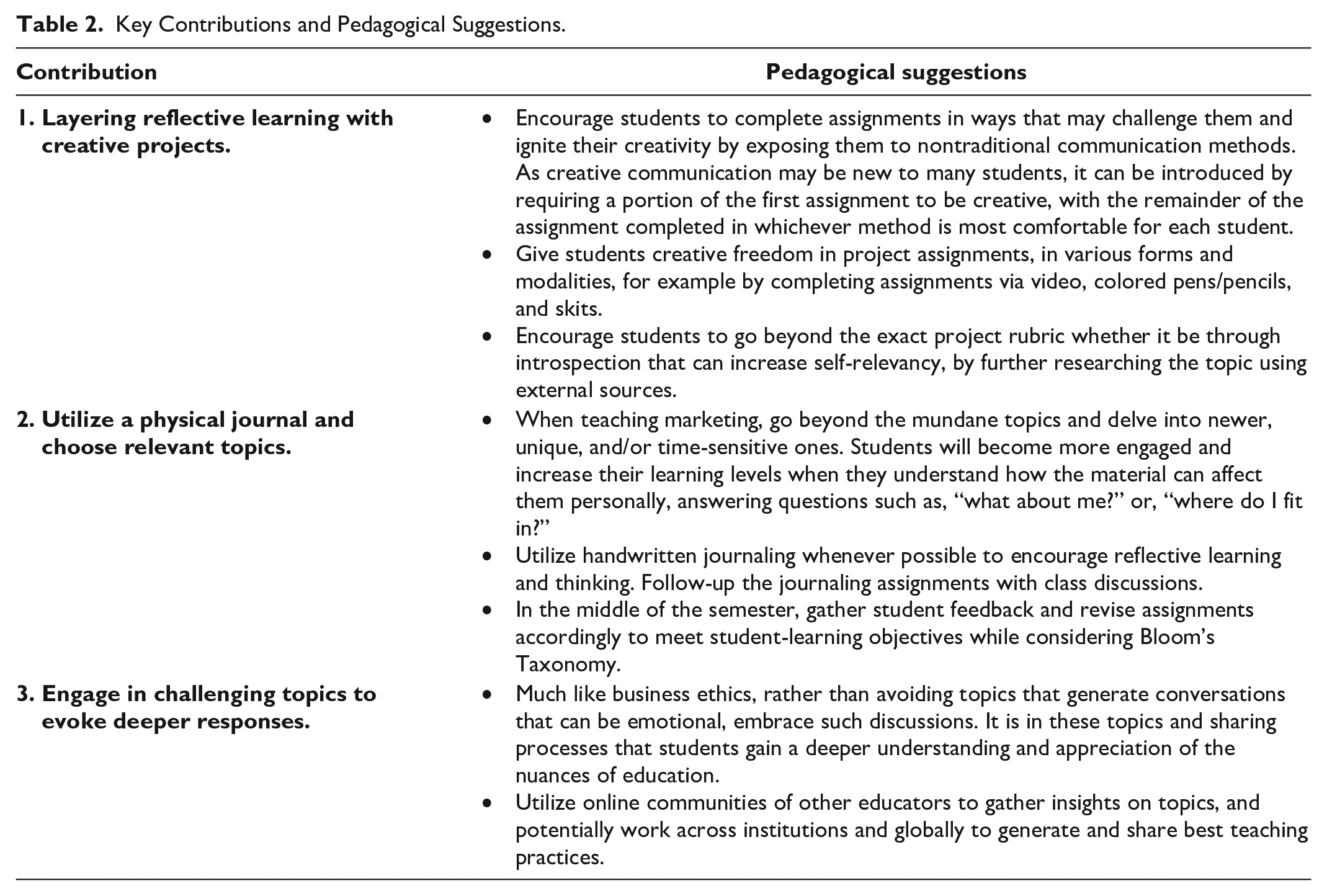
The first contribution of our study is characterized by pedagogical theory motivating creative projects, the idea of implementing reflective learning with handwritten journaling. By layering the concept of reflective learning with a sensory learning process involving handwriting and color, our article shows that students can achieve multiple levels and types of learning in business courses. Journaling was originally designed to be implemented with paper and analogue writing instruments. While online systems can somewhat successfully imitate the writing process, they do not facilitate the neural and haptic benefits derived from handwriting. By asking students to scan and upload their handwritten journals, our assignment provided a flexible approach that can be implemented in fully online, hybrid, or face-to-face classrooms. A secondary contribution of our research is the idea that utilizing a physical journal and handwritten entries allows students to engage in deeper thoughts about difficult topics. In this particular instance, students were provided with an important yet potentially uncomfortable topic, that is, loneliness and social media. By having them work on journaling as an individual assignment followed by a discussion of their responses in the classroom setting, they were able to engage in higher levels of learning (analyzing, evaluating, and creating) as they did their journaling assignments and again during course discussions.
Curriculum developers should consider that within each class there are multiple learning styles, motivation levels, and personal/societal factors that can affect student learning. Instructors should pay close attention to their students’ situations and apply methodologies to help them succeed (within teams and as individuals) during course progression. A flexible curriculum with opportunities for students to learn and share via multiple modalities, activities, and evaluation methods will better support higher levels of learning. For example, some students may have a better learning experience when handwriting their journals, whereas others may benefit more from fully online typed assignments; such flexibility in assignment modalities can also increase engagement, creativity, and motivation.
Reflective learning through journaling not only enhances the learning experience but it also teaches students a valuable skill that they can take with them to other classes and in their professional and personal lives. It allows the instructor to be effective at teaching the fundamentals of the course while also showing students how to be independent, strategic, and reflective in all aspects of their lives. A final contribution of our study emphasizes the benefits of engaging students in topics that evoke deeper responses and reflections on the personal struggle. For example, recent business, consumer behavior, and digital marketing research address vulnerable consumers (e.g., Michaelidou et al., 2021), privacy and social media usage (e.g., Acquisti et al., 2020), fear of missing out (e.g., Berezan et al., 2020), and other important topics relevant to marketing students. Marketing textbooks are often bereft of these substantive topics, even though they are widely researched in consumer behavior and marketing academic literature, and extremely relevant to society. Typical marketing course curriculum defaults to traditional cases and examples of marketing in the global marketplace. Instead, our research demonstrates the importance of introducing topics that students can connect with while learning at higher levels. Deeper engagement requires students to go beyond memorization and toward content comprehension, allowing them to engage with, interpret, apply, and create content.
Footnotes
Appendix
Acknowledgements
The authors would like to thank the editor, reviewers, and Sheen Kachen, for their insightful feedback and suggestions on earlier versions of this manuscript.
Declaration of Conflicting Interests
The author(s) declared no potential conflicts of interest with respect to the research, authorship, and/or publication of this article.
Funding
The author(s) disclosed receipt of the following financial support for the research, authorship, and/or publication of this article: The authors gratefully acknowledge the California State University RSCA Grant, the Harold & Muriel Berkman Charitable Foundation, Inc., and the University of Nevada, Las Vegas for their financial support.
