



Abstract
As governments rapidly adopt information and communication technologies to improve their service delivery, the study of e-government has emerged as an important area of research in public administration. Researchers have studied various aspects of e-government, including the factors associated with its adoption at state and municipals levels. Literature provides limited information related specifically to counties’ adoption of e-government in the United States, and although some researchers have studied the effect of institutional and contextual factors in particular states, none have studied their influence on counties nationwide. Based on a survey of county administrators primarily responsible for e-government services and a content analysis of counties’ official websites, this research examines the role of institutional, contextual, and socioeconomic factors on e-government adoption at the county level in the United States.
Keywords
Introduction
Governments are increasingly relying on the Internet to provide public services, and administrators are implementing various strategies to enable this transformation. This phenomenon, broadly referred to as e-government, began in the early 1990s and was slowly adopted by public agencies at all levels of government.
E-government, the application of ICT within public administration to optimise its internal and external functions, provides government and business with a set of tools that can potentially transform the way in which interactions take place, services are delivered, and citizens participate in governance. (United Nations Department of Economic and Social Affairs, 2003, p. 1)
According to Norris, Fletcher, and Holden (2001), e-government is “the delivery of services and information, electronically, to businesses and residents, 24 hours a day, seven days a week” (p. 5). This transformation is characterized by a continuous optimization of service delivery, constituency participation, and governance by transforming internal and external relationships through technology (Gartner Group, 2000). E-government has the potential not only to transform the relationship of government with both citizens and businesses but also to impact the efficiency of internal processes (Siew & Leng, 2003). E-government literature, however, provides little information related specifically to county government’s adoption of websites in the United States. This research contributes to the literature by examining the role played by institutional, contextual, and socioeconomic factors on e-government adoption at the county level all over the United States.
Literature Review
Carter and Belanger (2005) identified three main benefits of e-government: increased government accountability, greater public access to information, and a more efficient, cost-effective government. According to Garson (2004), e-government in the United States promises four major developments: First, there will be a major transformation in the way government conducts business. Second, improved and transformed governmental processes will cut transaction costs, resulting in substantial government savings. Third, in the future, the long-term loss of social capital in the United States will be reversed through increased electronic networking. Fourth, these changes will enhance the freedom of the general public. Ho (2002) argued that the Internet facilitates a transformation from the traditional bureaucratic paradigm—highlighted by standardization, and departmentalization—to an e-government paradigm that emphasizes coordinated network building and external collaboration. The knowledge and understanding of the factors related to e-government would help public administrators make maximum use of technology in the most appropriate manner. Accordingly, the factors associated with the adoption of e-government, both in the United States and globally, have been the subject of various research studies. Siau and Long (2006) identified income level and development status as key determinants of e-government at the national level.
In the United States, all 50 states as well as almost half of all cities with a population over 100,000 developed official websites by the spring of 1997 (Stowers, 1999). According to Reddick (2004a), information technology (IT) management capacity and social services IT capacity are significant factors affecting the adoption of e-government technology at state level. Alternatively, McNeal, Tolbert, Mossberger, and Dotterweich (2003) found states’ e-government to be strongly associated with political affiliation, legislative professionalism, and state professional networks but unrelated to state revenue per capita, income per capita, and education. Moon’s (2002) study on municipal e-government concluded that cities with larger populations and council–manager forms of government tend to exhibit higher levels of e-government adoption. In a later study, Norris and Moon (2005) identified orientation toward managerial innovativeness and city size as important determinants of municipal e-government adoption. Municipalities with advanced e-government practices also tend to allocate a greater percentage of their overall budget to IT functions (Carrizales, 2008).
In addition, even though county governments have been catching up technologically, such studies continue to focus on federal, state, and municipal governments. Most studies of local government have either considered cities and counties together or have specifically studied municipal e-government, even though there are more than 3000 counties in the United States providing an increasing range of services. An understanding of the status of e-government at the county level and the factors that influence its adoption is therefore essential.
U.S. Counties E-Government
American county governments were always the “forgotten governments” within the local government family; however, they have been recently rediscovered from both a practical and academic perspective (Menzel et al., 1992). Traditionally, county governments were seen as administrative arms of the state, providing state-level services like health and hospitals, roads and highways, welfare, police, corrections, and tax collection. More recently, however, counties have begun to provide municipal-level services such as fire protection, utilities, libraries, planning and zoning, as well as regional-level services like sanitation, parks and recreation, mass transit and parking, housing and urban development, and airports. Nowadays, counties play an increasing role in regional economic development, promote regional competitiveness, and reduce interjurisdictional competition among their cities (Benton, 2005). Therefore, scholars and academicians need to recognize this increasing role and focus more attention on county governments in their research, especially with regard to e-government.
Research on county e-government has tended to focus primarily on socioeconomic variables, compared with organizational, institutional, and contextual variables. Wilkinson and Cappel (2005) determined that both income and population were important determinants of e-government among counties in Michigan. According to Huang (2007), e-government is positively correlated with population size, population growth, racial diversity, income, employment, and education levels. Yet there is widespread agreement in the extensive research on internal factors at state and municipal levels that institutional and contextual factors are major determinants of e-government adoption (Brudney & Selden, 1995; Carrizales, 2008; Holden, Norris, & Fletcher, 2003; Moon, 2002; Norris & Kraemer, 1996; Norris & Moon, 2005; Tolbert et al., 2008). Although some researchers have studied the influence of these internal factors in county e-government in particular states (Ho & Ni, 2004; Wilkinson & Cappel, 2005), none have determined their influence across the United States. This research attempts to capture the role played by institutional, contextual, and socioeconomic variables on county e-government in the United States. In addition, the socioeconomic factors that distinguish counties with official websites from those without were extrapolated by comparing the means of the two groups using independent t tests. The following section discusses the hypotheses developed based on the effect of the independent variables on e-government.
Institutional Variables
Governments that are orientated toward a management form of administration are more receptive to innovative adoption of technology. Municipalities with council–manager forms of government tend to exhibit higher levels of e-government than those with mayor–council forms of governments (Moon, 2002). The cooperative environment in a council–administrator form of government results in more acceptance of innovation (Chen, 2010; Svara, 1990). Also, the implementation of e-government can be directly influenced by the perception of the chief administrative officer (Carrizales, 2008). Accordingly, this research assumes that counties with council–administrator form of government will be more receptive toward e-government.
Hypothesis 1: A county with a council–administrator form of government will have more advanced e-government practices than a county without a council–administrator form of government.
The research also assumes that counties with greater political support will have better e-government practices, particularly because organizations with tight fiscal budgets can still be innovative if the leadership (e.g., elected officials, top executive officers) is committed to pursuing innovative solutions as an organizational goal. This positive observation paints elected officials as institutional catalysts capable of ensuring that government organizations continue evolving with technological changes that keep pace with changing public demands (Ho & Ni, 2004). Moreover, elected officials often hesitate to support innovation changes when they perceive it as a bureaucratic strategy to “technicalize” and overcome legislative scrutiny (Berman & Wang, 2000; Kettl, 1994). In addition, the support of top management and non-IT employees is essential for the successful implementation of e-government (Berman & Wang, 2000).
Hypothesis 2: A county with greater stakeholder support will have more advanced e-government practices than a county with lesser stakeholder support.
Municipalities with advanced forms of e-government tend to allocate a greater percentage of their overall budget to IT functions (Carrizales, 2008). The implementation of e-government requires significant financial resources, and for county governments, the budget being almost the only source of revenue is closely related to their capabilities to develop IT programs and projects. In addition, IT management capacity is found to significantly influence the adoption of e-government technology at state level (Reddick, 2004a). So, along with higher budget, this study assumes that counties with higher technical capacity will exhibit higher levels of e-government. The term capacity refers to an organization’s ability to reach its goals; and specifically, technical capacity is measured by the number of IT employees in the county government.
Hypothesis 3: A county with higher technical capacity will have more advanced e-government practices than a county with lower technical capacity.
Hypothesis 4: A county with higher budget will have more advanced e-government practices than a county with lower budget.
Larger organizations tend to be more complex and provide more functions, which in turn results in advanced technical innovation (Norris & Moon, 2005). This research measures organizational size by the number of functions provided, as counties that provide greater degree of functions will tend to adopt innovative technologies to integrate these functions across various departments. Previous research also suggests that certain individuals with high levels of motivation have the capacity to bring out innovative changes in organizations (Hannah, 1995). Such innovation champions tend to actively participate in professional networks, and often take the initiative in demonstrating leadership among their peers (Rogers, 1995). Overall, these IT champions actively promote their personal vision for IT use, pushing the project over implementation hurdles and often risking their own reputations to ensure the innovation’s success.
Hypothesis 5: A county that provides greater number of functions will have more advanced e-government practices than a county providing lesser number of functions.
Hypothesis 6: A county with the presence of an IT champion will have more advanced e-government practices than a county without an IT Champion.
Recently, county governments have begun contracting their functions and services to private contractors. Normally, such contracting enables government organizations to access the expertise and skills of professionals outside the public sector free of financial obstacles (Chen & Perry, 2003). So, when technology uncertainty is high, governments can avoid the large overhead and start-up costs by transferring some of the risk of system development to private vendors. In addition, this research also considers website longevity, measured in years, as a determinant of website sophistication.
Hypothesis 7: A county with greater levels of IT contracting will have more advanced e-government practices than a county with lesser levels of IT contracting.
Hypothesis 8: A county that has a website for more number of years will have more advanced e-government practices than a county that has a website for lesser number of years.
Contextual Variables
Peer influence and regional pressure among counties significantly affect the adoption of technology. Owing to their similar political and socioeconomic backgrounds, neighboring counties tend to influence each other to adopt new innovative strategies. In addition, frequent mobility and information exchanges lead to regional comparison and competition, a phenomenon that also extends to the adoption of e-government technologies (Berry, 1994). The transformation to e-government also promises a paradigm shift in governance toward greater external collaboration and networking with citizens, nonprofits, advocacy groups as well as businesses (Ho, 2002). Accordingly, county governments that emphasize greater external collaborations will tend to view e-government as an important tool in strengthening such relationships.
Hypothesis 9: A county that is subjected to greater pressure from neighboring counties’ e-government diffusion will have more advanced e-government practices than a county with lesser pressure from neighboring counties’ e-government diffusion.
Hypothesis 10: A county involved in greater external collaboration will tend to have more advanced e-government practices than a county that involved in less external collaboration.
Based on a study conducted by Reddick (2004a) that examined e-government as a two-stage model of cataloging and transaction, most cities were in the first stage from the G2C (government to citizen) perspective, but from the G2B (government to business), and G2G (government to government) perspectives, most cities had advanced to the second stage. So, the research assumes that counties initially tend to be more responsive to the demand from business units, such as online permits, online registrations, and so forth.
Hypothesis 11: A county with greater number of business units will tend to have more advanced e-government practices than a county with lesser number of business units.
Socioeconomic Variables
The socioeconomic conditions of residents positively affect the adoption of innovation at the local government level. The education and income level of the county residents generally tend to set a level of expectation for the county government in developing their website. In addition, land area in square miles, population, population density, income per capita, and geographical location are also considered in the research. Larger populations involve complex, diverse issues that would be already accounted for in the initial stages of e-government implementation.
Hypothesis 12: A county with a larger population will have more advanced e-government practices than a county with a smaller population.
Hypothesis 13: A county with a higher population density will have more advanced e-government practices than a county with a lower population density.
Hypothesis 14: A county whose residents have higher levels of education will have more advanced e-government practices than a county whose residents have lower levels of education.
Hypothesis 15: A county whose residents have higher levels of income will have more advanced e-government practices than a county whose residents have lower levels of income.
Hypothesis 16: A county with a larger land area will have more advanced e-government practices than a county with a smaller land area.
Data and Method
Independent Variables
This research uses three blocks of independent variables: (a) institutional, (b) contextual, and (c) socioeconomic variables. The institutional variables consist of the county’s form of government, website longevity, organizational size, budget capacity, technical capacity, stakeholder support, IT contracting, and presence of an IT champion. The contextual variables consist of a measure of the county government’s external collaboration, regional pressure, and number of private nonfarm business units in the county. Socioeconomic variables include land area, population, population density, bachelor education, income per capita, and geographical location.
The data for the independent variables were obtained through a web survey (see Appendix A) of administrators who are primarily responsible for e-government services in the selected counties (those with websites), such as chief information officer (CIO), IT department head, or IT manager. The counties with official websites were identified by accessing their corresponding links on the website of National Association of Counties (NACO). The absence of an official website from counties without links on the NACO website was then confirmed through a query on the Google search engine. Overall, 2,376 counties were found to have official websites, and survey questionnaires were emailed to these counties during March-April 2009. The web survey provides an advantage of time and cost savings, compared with the mail survey (Cobanoglu, Warde, & Moreo, 2001), and enables the possibility of multiple contacts with respondents that results in stronger response rates (Dillman, 2000). Among the potential respondents, some had no functioning e-mail addresses, whereas some administrators opted out of the survey, resulting in a sample of 1,751 counties and response rate of 17.8%. Geographically, the most responses, about 20%, came from counties in the West, followed by a 17.8% response rate from the Northeast, and 13.8% and 12.4% from the Midwest and South, respectively. The distribution of the responding counties based on states, and population are provided in Appendixes B and C, respectively. The survey focused on institutional and contextual variables and was pretested with county officials familiar with IT functions. Additional data on the socioeconomic variables were collected from the U.S. Census Bureau.
Dependent Variables
The data for the dependent variables were collected based on a content analysis of websites of selected counties responding to the survey. Overall, 343 counties responded to the survey, and the websites of these counties were evaluated using an e-government instrument consisting of 24 measures (see Appendix D). The measures were coded on a scale of 0, 1 or 3 where 0 indicates the absence of each feature, and a score of 1 or 3 indicates the presence of each feature in basic or more advanced form, respectively. The highest possible e-government score for any one county website is 72 points. The 24 measures were adopted from the National Center of Public Performance’s (NCPP) 98-point e-government scale and then validated by an expert review panel consisting of faculty and research associates specializing in e-government.
Findings and Discussion
Socioeconomic Determinants of Official County Websites
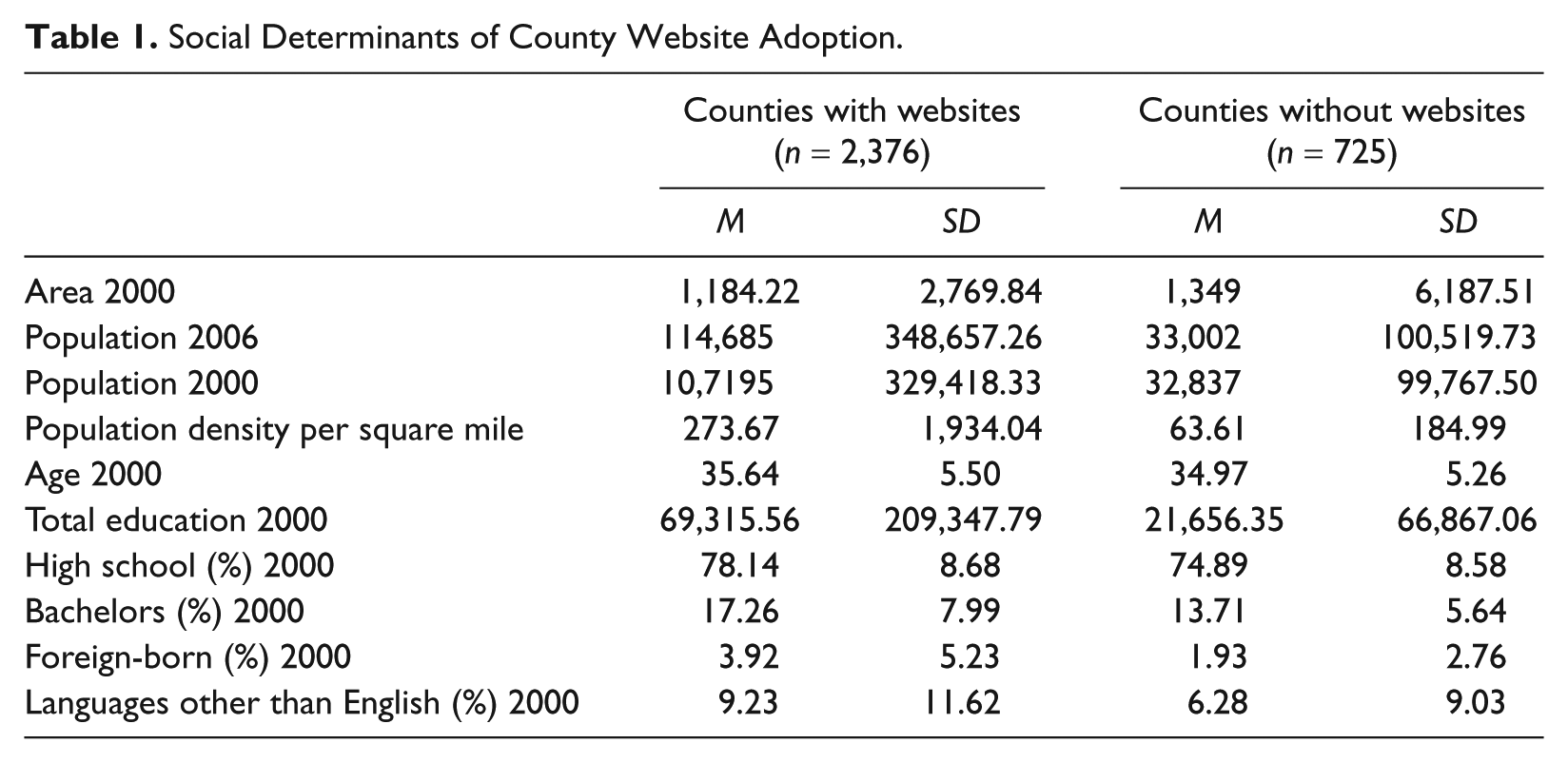
The socioeconomic factors that distinguish counties with official websites from those without were extrapolated by comparing the means of the two groups using independent t tests. The results indicate marked demographic differences between the two (see Table 1). The counties with official websites tend to have larger populations than those that do not (114,685 vs. 33,002). They also had higher population growth from 2000 to 2006 (6.99%) and both groups of counties also differ significantly in terms of population density (274 vs. 64 per sq. mile). Counties in which a higher percentage of the population have a bachelor’s degree have a higher probability of developing websites than those having a lower percentage of the population with a bachelor’s degree (17.26% vs. 13.71%). With regard to high school education, counties with websites have a slightly higher percentage of high school graduates than counties without websites (78.14% vs. 74.89%). Likewise, the counties with official websites have a higher percentage of households with income above US$75,000 than those without websites.
Social Determinants of County Website Adoption.
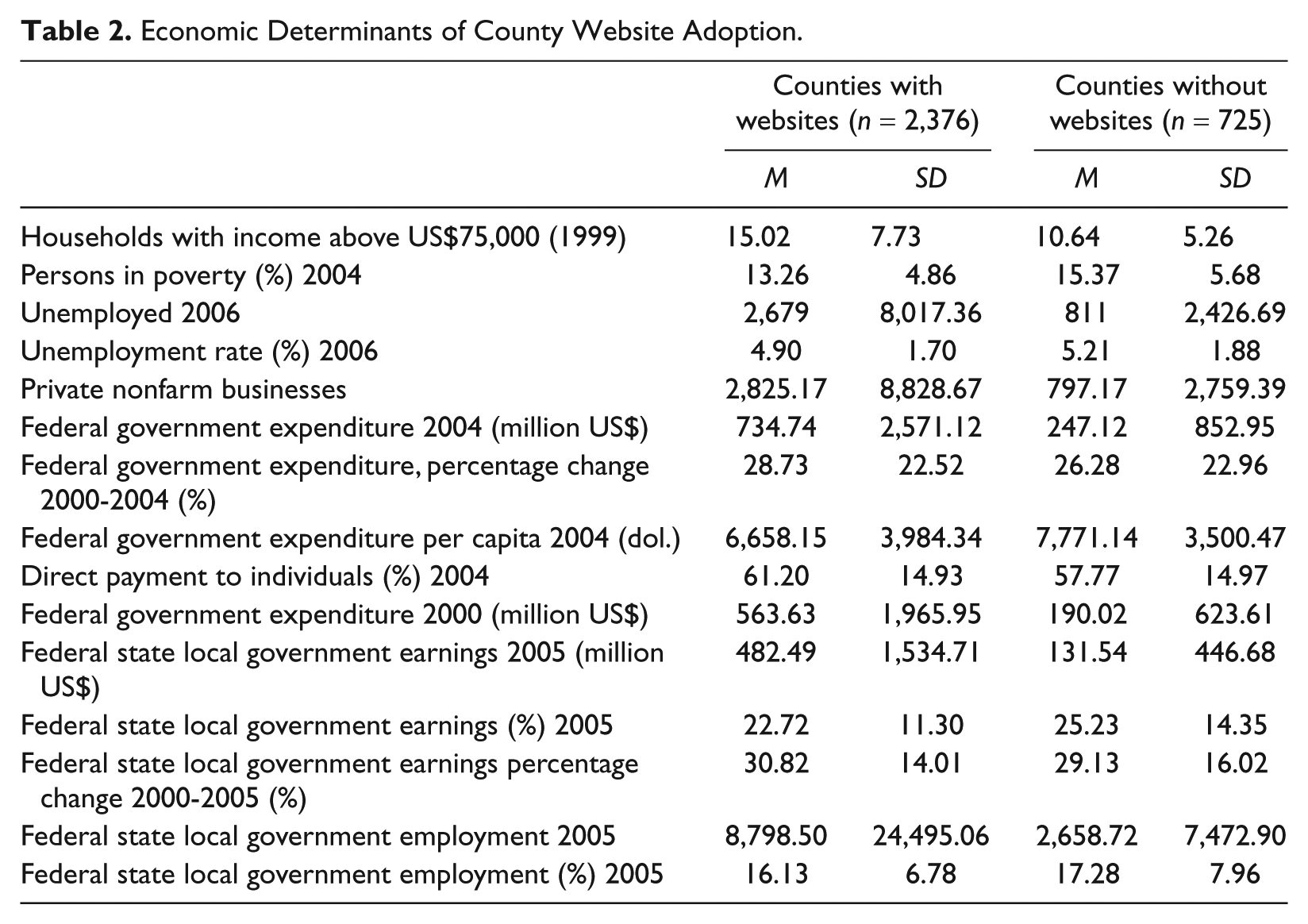
The economic conditions in the counties also contributed to the levels of county website adoption (see Table 2). Those with websites had more private nonfarm businesses (2,825 vs. 797), as well as a lower unemployment rate (4.9% vs. 5.21%). However, the counties with websites had a higher growth in unemployment from 2000 to 2006 (14.5% vs. 13.2%). Nonetheless, overall, the counties with websites had stronger economic variables for almost all values than those without websites, although the outcomes were not always statistically significant. With regard to federal government expenditure, counties with official websites received more federal funding than those without websites (US$734.74 vs. US$247.12 million). However, the increase in federal funding for counties with websites over 2000-2004 was only slightly higher than those without websites (28.73% vs. 26.28%). In addition, the federal expenditure per capita in 2004 was higher for those counties without websites (US$6,658.15 vs. US$7,771.14). In terms of government earnings, the counties with official websites had higher earnings than those without (US$482.49 vs. US$131.54 million). Although counties without websites had higher government earnings as a percentage of the total (22.72% vs. 25.23%) and those counties with websites had a higher percentage of change in earnings from 2000 to 2005 (30.82% vs. 29.13%), these two variables were not found to be significant. Finally, in counties with official websites, there was a higher level of employment in government compared with those without websites (8,799 vs. 2,659). Likewise, although counties without websites had higher government employment as a percentage of the total employment (16.13% vs. 17.28%), and those with websites had a higher percentage of change in government employment from 2000 to 2005 (3.43% vs. 1.35%), these two variables were not significant in differentiating the counties.
Economic Determinants of County Website Adoption.
Results of the Website Content Analysis
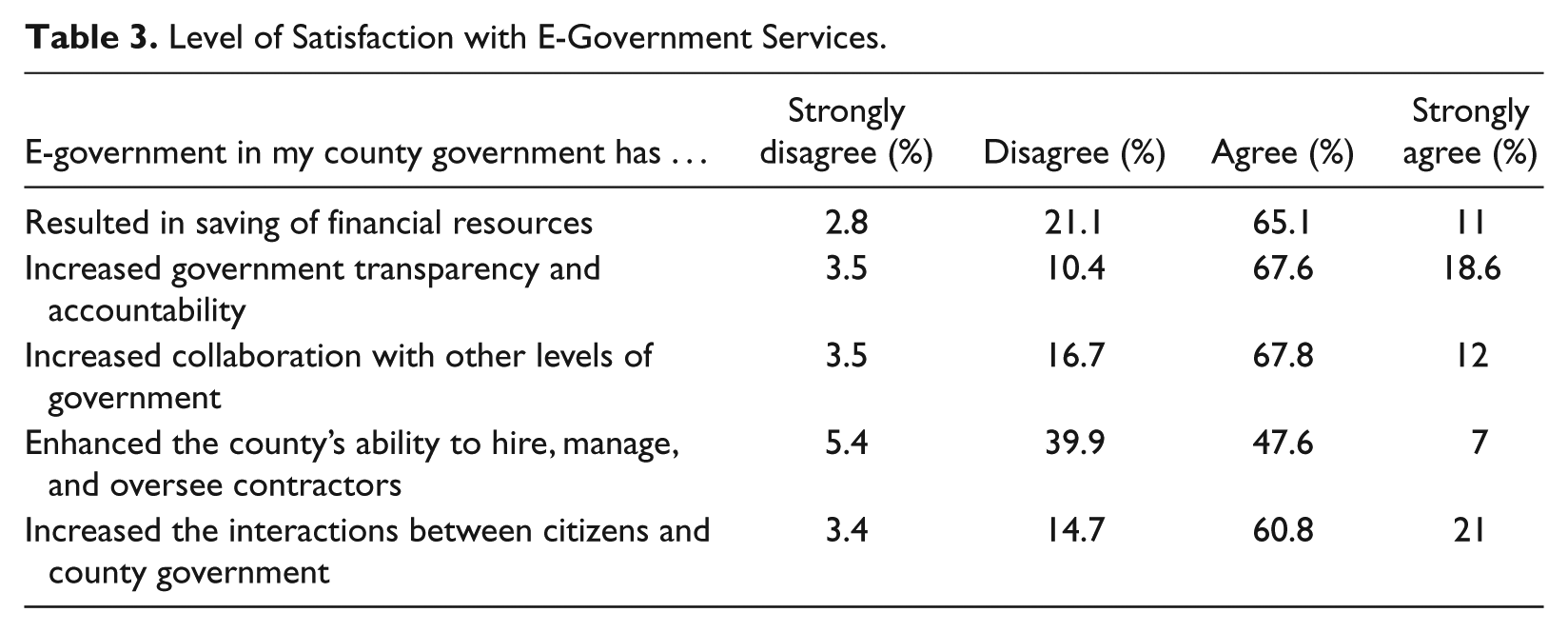
On the basis of the survey, about 13% of the responding counties had established official websites in the last 1 to 2 years, whereas about 29% have had a website between 3 and 5 years. More than 60% of the responding counties have created an IT department, while the board of commissioners’ form of government governed a majority of the counties. With regard to stakeholder support, the top county administration was supportive in about 70% of counties followed by elected county officials in about 60% of the counties. Only half the counties reported having the support of their residents for e-government services, and this observation could be attributed to the lack of awareness among citizens on the potential of e-government. As one respondent commented in the survey, citizens who use the online services think they are very beneficial, whereas those who have not used them consider it a waste of tax money. Increasing citizens’ trust and acceptance of e-government projects are essential for its successful implementation (Akkaya, Wolf, & Krcmar, 2010). Counties need to make their residents more aware of its potential benefits as well as include citizen stakeholders in the planning process. In addition, two thirds of the counties surveyed reported the presence of an IT champion to facilitate e-government implementation. With regard to the budget allocated to IT implementation, 47% reported an approximate IT budget below US$100,000, and 18% of the counties’ IT budget was above US$1,000,000. About 70% of the counties had outsourced IT work to private contractors and the functions mostly contracted were website design (49%), website development (41%), website hosting (44%), and website maintenance (42%). Among functions provided, the most commonly reported were election and voting services (92% of respondents), followed by emergency services (86%), court services (84%), police (81%), economic development (78%), road construction (76%), public health (75%), and corrections (74%). More than 50% of the responding counties offered parks and recreation, animal control, library, code enforcement, welfare services, and building permits, along with fire protection (48%), public transportation (32%), and sanitation (30%). These indicate that counties are increasingly providing municipal-level and regional-level services (Benton, 2005). Finally, with regard to the level of satisfaction with e-government services, 76% of the respondents agreed that implementation of e-government has resulted in savings of financial resources, whereas 86% credit e-government with increased government transparency and accountability (Table 3). Many counties also reported increased collaboration with other levels of government as well as increased interactions with citizens through e-government. However, only about half the counties agreed that e-government enhanced their ability to hire, manage and oversee contractors. One rural county expressed its frustration with being unable to convince a vendor to provide affordable citizen-centric online services.
Level of Satisfaction with E-Government Services.
Overall, the counties in the West ranked highest in the website content analysis with an average score of 23.76, followed by those in the Midwest (21.98), South (21.44), and Northeast (18.65). These high rankings of e-government in the West reflect previous research findings and can be attributed to the influence of Silicon Valley and the city of Seattle in the diffusion of Internet innovations (Holden et al., 2003; Reddick, 2004b).
Regression Analysis
Standard multiple regressions using SPSS was used to evaluate four models in determining the predictors of e-government. Each model included the independent variables that fell into one of the categories: institutional, contextual, and socioeconomic factors. In addition, all independent variables were entered to form a fourth model. The analysis also includes counties nested within the four census regions (Northeast, Midwest, South, West) using West as the base variable. Prior to the analysis, certain independent variables were recoded to best fit the study—form of government, IT champion, IT budget, neighboring websites and IT contracting. Also, some independent variables had some missing values, which were replaced by the median of the variable. The socioeconomic variables were converted into their natural log form to reduce the skewness level. The results of the regression analysis (Table 4) are discussed below.
Regression Analysis of Determinants of E-Government.
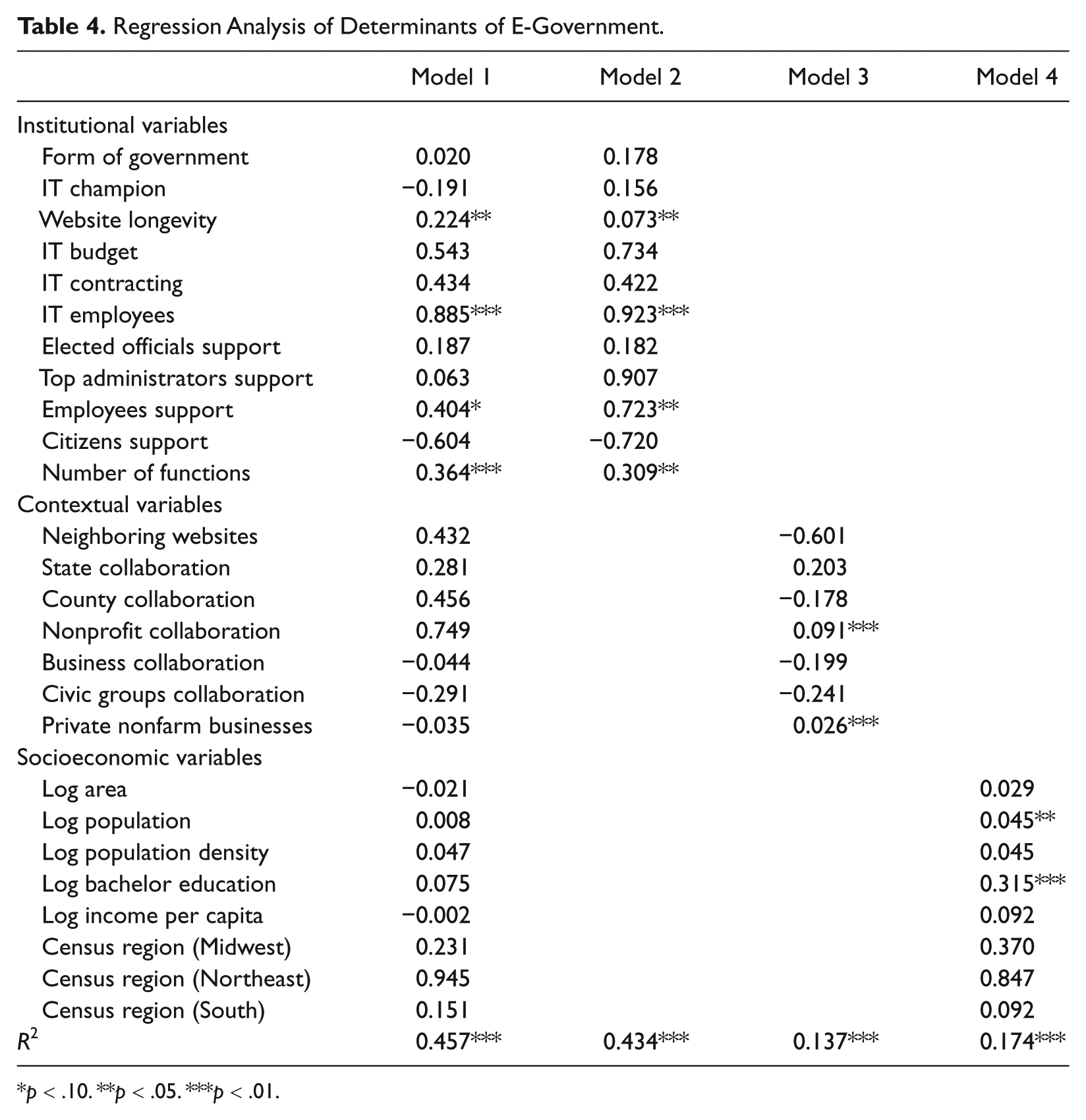
p < .10. **p < .05. ***p < .01.
Model 1 (all variables) explained a substantial amount of variance (45.7%) in the dependent variable, with R2 = .457, p < .01. The significant independent variables were website longevity (b = .224, p < .05), IT employees (b = .885, p < .01), employee support (b = .404, p < .10), and number of functions (b = .364, p < .01). Model 2 (institutional) predicted about 43.4% of variance in the dependent variable and was statistically significant (R2 = .434, p < .01). The significant independent variables were website longevity (b = .073, p < .05), IT employees (b = .923, p < .01), employee support (b = .723, p < .05), and number of functions (b = .309, p < .05). In Model 3 (contextual), the external variables predicted moderate, but statistically significant amount of variance (13.7%), with R2 = .137, p < .01. Only two independent variables, nonprofit collaboration (b = .091, p < .01) and private nonfarm businesses (b = .026, p < .01), made a significant contribution. Model 4 (socioeconomic) explained about 17.4% of variance, with R2 = .17, p < .01, and population (b = .045, p < .05) and education (b = .315, p < .01) being the significant predictors of e-government.
Institutional Determinants of E-Government
The form of government is an important determinant of municipal e-government; however, this is not significant among counties and thus, Hypothesis 1 is rejected. The uncertainty of the effect of form of government among counties affirms previous research findings related to management reforms. Counties are primarily governed by the board of commissioners’ form of government with elected officials having a greater autonomy in the decision to implement reforms but may lack the necessary technical capacity (Berman & Wang, 2000). Alternatively, other council–administrators may have the capacity and desire for reforms but not the necessary political capacity. Hypothesis 2 is accepted with regard to employees support, but none of the other variables relating to stakeholder support were found to be significant. Counties with greater number of IT employees tend to provide more advanced practices, so Hypothesis 3 (technical capacity) is accepted, similar to previous e-government findings among municipalities. Increasing the number of employees with IT expertise will have a significant effect on the number of online applications provided by local governments (Schwester, 2009). County IT budget does not seem to affect e-government practices, unlike among municipalities. Also the presence of an IT champion does not predict any variance in e-government practices. Thus, Hypotheses 4 (budget) and 6 (IT champion) are rejected. Counties that provide greater number of functions tend to offer more advanced e-government practices. So, Hypothesis 5 (organizational size) is accepted, while Hypothesis 7 is rejected, as IT contracting among counties was not found to have any significant effect. This reflects the difference in research opinion on the causes and impact of local government outsourcing. The decision to outsource is primarily based on attaining cost-efficiency, one of the goals of e-government (Donahue, 1989; Savas, 2000). However, counties often outsource their functions based on their affordability, thus labeling outsourcing as a luxury for those counties in better economic positions (Boyne 1998; Ni & Bretschneider, 2007). Finally, Hypothesis 8 is accepted indicating that the length of time a county website has been in existence is a significant determinant of website sophistication.
Contextual Determinants of E-Government
Regional pressure (neighboring counties’ websites) among counties does not seem to influence counties’ decision to provide more advanced practices, so Hypothesis 9 is rejected. Counties that collaborate with nonprofit agencies were found to provide more advanced e-government services, whereas other collaboration variables were not found to be significant. Counties are yet to realize the potential of websites in integrating with other counties and the states, so intergovernmental collaboration does not seem to be a major factor influencing counties to advance their websites. Hypothesis 10 is therefore accepted with regard to external collaboration of counties with nonprofits. In addition, Hypothesis 11 is accepted as counties with greater number of private nonfarm business units tend to provide more advanced e-government practices.
Socioeconomic Determinants of E-Government
Among socioeconomic variables, counties with larger populations were found to provide more advanced e-government services, confirming earlier e-government findings (Huang, 2007; Moon, 2002; Wilkinson & Cappel, 2005). Similar to cities, highly populated counties tend to have better websites as they have more slack resources and more population enables the possibility of an integrated citizen service and information system (Chen, 2010). Also, counties that serve a more educated population tend to provide better e-government services (Weare, Musso, & Hale, 1999). The variables of land area, population density, income per capita, and geographical location were not significant. More than the socioeconomic factors, counties’ websites seem to be more responsive to the number of business units in their jurisdiction.
Research and Policy Implications
The study provides significant theoretical implications for future research, as well as policy implications for e-government and county governments. The research finds the following as determinants of county e-government—technical capacity (IT employees), website longevity, employee support, organizational size (number of functions), external collaboration with nonprofits, private nonfarm business units, population, and education. Counties with higher technical capacity have a higher probability of providing more advanced e-government practices, similar to previous e-government findings (Reddick, 2004a). Along with adopting new technology, counties need to involve their employees in IT training and development, to update their skills with current trends. This would also enable employees to be more supportive of e-government, which was found to be a significant predictor in this research. Apart from county officials, citizens need to be educated to the appropriate levels of digital literacy to enable them to use the e-government services and ensure its success (Badri & Alshare, 2008; Gil-García & Pardo, 2005). The presence of an IT department with adequate IT employees will help counties adopt and implement e-government successfully (Norris & Kraemer, 1996). Interestingly, about a third of the county governments with official websites did not have IT departments. Future research on e-government, especially those dealing with institutional factors should focus more on the IT department, its functions, and capacity. In addition, the number of functions influenced the level of e-government services, as counties that provided greater degree of functions tend to adopt innovative e-government technologies to integrate these functions across various departments (Norris & Moon, 2005). Previous research has also found e-government websites to be more business oriented (Reddick, 2004a; Stowers, 1999), this research adds to the findings by identifying private nonfarm business units to be a significant predictor of e-government among counties. This finding also strengthens the relationship between e-government and local business innovation. Specifically, the search facility of e-government is positively associated with new business development, which can lead to economic growth and employment opportunities in the counties (Thompson, Rust, & Rhoda, 2005). Previous studies have also reported cost savings, improved service quality, and shorter turnaround times for businesses, particularly start-ups due to the implementation of e-government (Badri & Alshare, 2008). The research also shows that the length of time a county website has been in existence is a significant determinant of website sophistication. As the age of the websites increase, they tend to be more integrated and provide more sophisticated/advanced features (Kowtha & Choon, 2001).
Overall, counties have a positive outlook toward e-government, with majority of them responding that e-government is beneficial to their county in a variety of ways. As one respondent claimed, their online jury impaneling process created in 2 weeks saved the county about US$300,000 per year. Another respondent from a geographically large county noted that as their county seat is far from a main population hub, they began broadcasting public meetings online and also implemented an online two-way video link for public comment at council meetings. These initiatives have been well received by its residents and have improved citizen participation online. Some counties, however, are skeptical of e-government facilities especially those which stand to suffer loss in business due to online government. According to one respondent from a rural county, the loss of county government as a physical entity would be hard on their economy because websites would reduce the number of people coming to town, which in turn reduces the commerce in their community. According to the 2010 census, 16% of the U.S. population resides in the rural areas that are completely serviced by county governments. By focusing exclusively on counties, the research captures the specific concerns of government entities serving rural populations such as smaller tax base, lack of IT expertise and affordability. As one rural county respondent noted, “Additional broadband access to the rural areas of our county is critical to the continued success of e-government,” whereas another rural county expressed their frustration in not being able to satisfy its citizens:
our very rural county, with our small population and low tax base, does not have either the resources or the expertise to offer anything other than “brochure-ware” on our website. It is very difficult for us to meet the e-government expectations of new and younger people.
These represent the specific concerns of rural counties with e-government projects and should be addressed in future research.
The research identifies the presence of private nonfarm businesses, higher population, and higher levels of education as significant predictors for more advanced e-government practices among counties. Such features are more characteristic of urban regions, providing them an edge over predominantly rural counties in attracting investments in e-government technology. Rural counties cannot provide such markets and as shown by Khatiwada and Pigg (2010), in the absence of substantial demand, it is futile to depend on private sector investments to develop the necessary technology infrastructure. To overcome such barriers, states need to develop appropriate legislations to promote broadband use among their rural communities. When state and federal governments identify the objectives to be implemented at the county level, they do not always provide the necessary financial support (Cigler, 1998; Coppa, 2000; Dufner, Holley, & Reed, 2003). As counties are beginning to take a more active role, they feel restricted by the inaction and lack of support from the states. As one respondent noted, “The cost for small counties can be unaffordable, so if the state legislation forces all counties to comply, the state should provide the funding.” In the absence of such responses from states, some local governments have initiated broadband access independently, as in the case of West Virginia. These initiatives by counties across the United States to develop their own broadband infrastructures largely depend on their states’ adherence to either the Dillon’s Rule or Home-Rule in granting authority to their local governments (Casto, 2008). Specifically, counties’ ability to initiate such infrastructure developments depends on whether they possess their own charters and the extent of authority provided by the states. Although states are beginning to permit counties to adopt charters, the transformation levels are still less and the authority provided is often limited (Svara, 2008). Apart from autonomy, charters also clarify the structure and functions among counties, which have been criticized as being too fragmented by the Winter Commission of 1993 (Svara, 2008). Although board of commissioners and council–manager forms of government are more prevalent, many counties are also governed by various other forms of government that are specific to each state. This need for more clarity on county forms and structures is a significant barrier to research on county leadership (Benton, 2005). Also, unlike cities, there is a lack of sufficient information on how county commissioners are selected and the degree of powers and control that they yield (Streib et al., 2007). Along with frequent changes in political leadership and the presence of multiple elected officials, the elected officials in some counties may “exert powers beyond the office occupied” (Svara, 1996, p. 110). This ambiguity, however, provides a more feasible environment for collaboration and coordination among counties (Streib et al., 2007; Waugh, 1994). Moreover, the significance of nonprofit collaboration in this research raises possibilities for cross-sector collaboration for counties. This relationship between e-government and collaboration should be further investigated to understand its implications for data and information sharing, an emerging area of IT research (Gil-Garcia, Chengalur-Smith, & Duchessi, 2007). Rather than focusing on the form and structure of government, there needs to be more emphasis on the counties’ capacity to manage and implement e-government. Previous research has suggested that high capacity is a necessary condition for the successful implementation of performance measurement among counties (Berman & Wang, 2000), and the same goes for e-government as well.
Conclusion
American county governments were always the “forgotten governments” within the local government family (Menzel et al., 1992), and they have often been perceived negatively as the “sleeping giant,” “backward institution,” or “plague spot of American politics” (Streib et al., 2007). Recently, however, academic interest in county governments is being rekindled, resulting from their increasing role in providing state and municipal-level services (Benton, 2005). In 1992, Mendel et al. provided an 8-point agenda that identified 8 areas related to county government needing scholarly attention. Later in 2007, researchers expanded this agenda to 11 distinct research areas, one of which is IT (Streib et al., 2007). Previous studies also suggest that e-government success at the local level is important for national level success (Sarikas & Weerakkody, 2007). This research makes a significant contribution to e-government literature, which currently provides limited information on county e-government. Based on a combination of survey method and website content analysis, the research examines the effect of institutional, contextual and socioeconomic factors on counties’ adoption of e-government in the United States.
The specific factors that contributed to predicting e-government were technical capacity (IT employees), website longevity, employee support, organizational size (number of functions), external collaboration with nonprofits, private nonfarm business units, population, and education. Overall, the study found institutional factors to be the best predictor of county e-government adoption, reaffirming previous research emphasizing the importance of institutional and organizational factors (Brudney & Selden, 1995; Carrizales, 2008; Holden et al., 2003; Moon, 2002; Norris & Kraemer, 1996; Norris & Moon, 2005; Tolbert et al., 2008). However, some of the proven determinants of municipal e-government do not exhibit similar characteristics among counties such as form of government, stakeholder support, and IT contracting, and these need further investigation. County governments need to adopt a strategic approach to implementing e-government technologies, with an emphasis on aligning e-government goals to agency mission and performance. Previous research has shown that e-government has a strong tendency to reinforce existing structure of control when adopted without a significant emphasis on reform and performance (Kraemer & King, 2003). Such possibilities make it all the more necessary for county governments to implement e-government with a strategic framework. The framework should incorporate and prioritize those perspectives of e-government that are particularly pertinent to local governments such as reform, collaboration, consolidation of services, and online citizen participation.
The results reported in this article confirm previous e-government findings on the positive influence of technical capacity, employee support, organizational size, population, education levels, and opens up possibilities for future research on the effect of nonprofit collaboration and presence of business units. On the basis of the survey responses, we can conclude that e-government is viewed positively within most counties and has lived up to its promises in terms of enhancing efficiency and effectiveness. A majority of the respondents agreed that the implementation of e-government has resulted in financial savings, increased government transparency, and accountability as well as external collaboration. These results reaffirm previous findings on the potential of IT in governments (Carter & Belanger, 2005; Dawes et al., 1999; Siew & Leng, 2003). Counties also agreed that e-government has had a positive influence on increasing interactions between citizens and government. However, this reflects the perspectives from the supply side, and future research should capture the demand-side perspectives, especially trust and satisfaction levels of citizen users. There is tremendous potential for e-government research among county governments; this article provides directions for future research as well as recommendations for county e-government policy and practice.
Footnotes
Appendix
E-Government Instrument (Dependent Variables)
|
Are targeted audience links available on the home page? (e.g., residents, youth, the old, women, family, businesses, public employees, etc.) Does the website provide a FAQ section to guide citizens in county administration? Does the website provide information on the location (direction, address) of offices? Does the website offer contact information for public departments and officials? Does the website offer job listings or position vacancies in the county government? Does the website provide minutes of public meetings? Does the website offer a calendar of events? Does the website have GIS capabilities? Does the website allow users to pay public utilities? Does the website allow users to file or pay taxes? Does the website allow users to pay fines or tickets? Does the website allow e-procurement? Does the website allow users to apply for permits (or register)? Does the website allow users to apply for licenses? Does the website allow users to register or purchase tickets to events in county/municipal halls, arenas, or facilities of the county? Does the website allow users to purchase or order documents, reports, or books? Does the website offer online survey/polls for specific issues? Does the website offer a newsletter or community updates linked to the home page? Does the website have e-bulletin board for gathering citizen input on public issues? Does the website offer online discussion forum on policy issues? Does the website allow users to report crimes, law violations, or corruption? Does the website allow users to provide comments or feedback to individual departments/agencies through online forms? Does the website allow users to file complaints? Does the website offer tools for online decision making? (e-petition, e-referenda) |
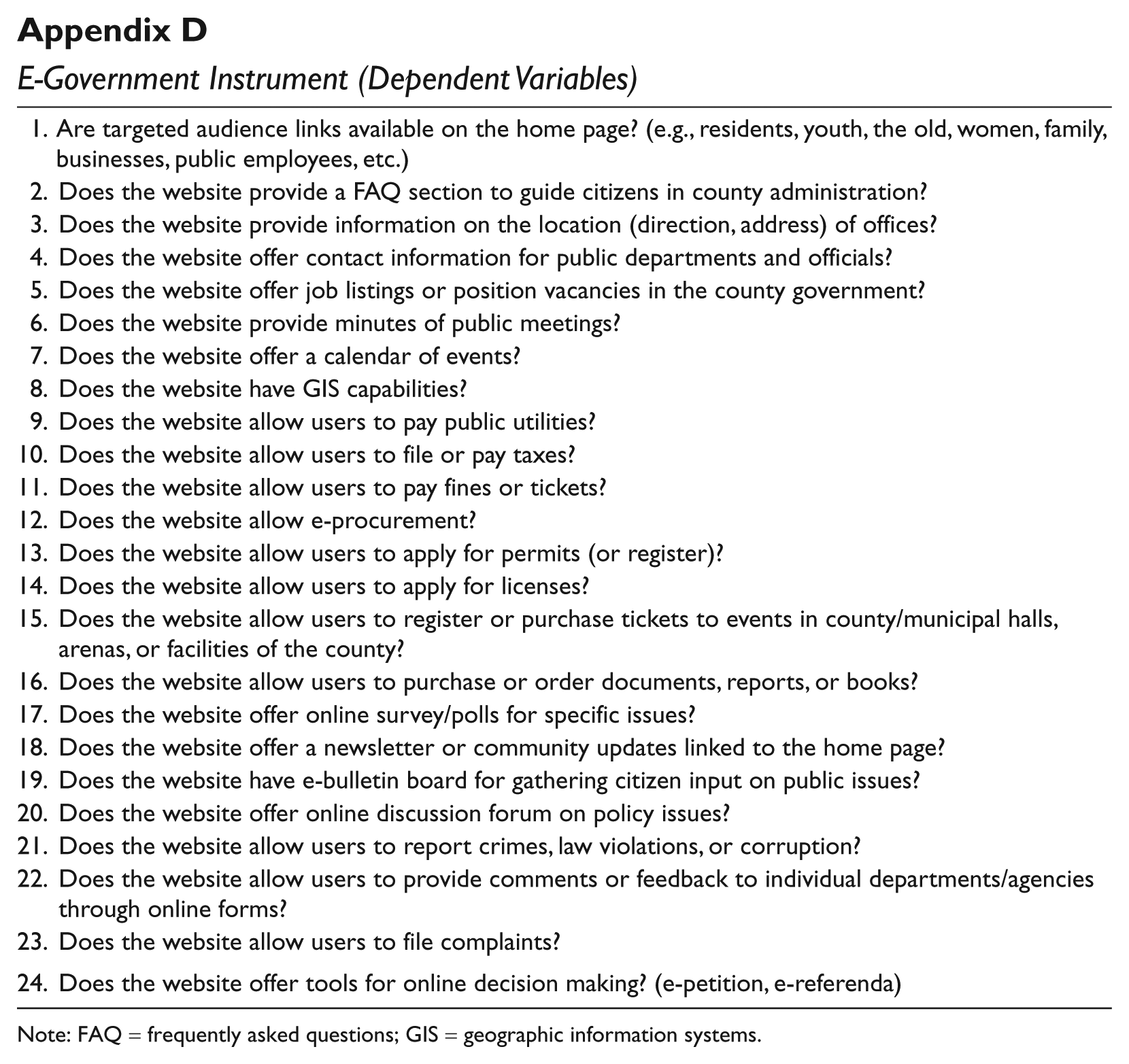
Note: FAQ = frequently asked questions; GIS = geographic information systems.
Declaration of Conflicting Interests
The author declared no potential conflicts of interest with respect to the research, authorship, and/or publication of this article.
Funding
The author received no financial support for the research, authorship, and/or publication of this article.