



Abstract
The networked governance performance in emergency management is dependent on structural, spatial, and temporal issues embedded into interorganizational relationships. Network sustainability is one of such issues that requires due attention by scholars and practitioners in the field. This article examines how network sustainability, namely, the extent to which network relationships are maintained and nurtured over time, is affected by interdependent network relationships, network complexity, and information-communication technology (ICT) utilization at the local level. Based on 118 responses from a self-administered survey distributed to four county-based metropolitan regions in the state of Florida, this study provides a multiple linear regression analysis. Using UCINET social network analysis software, additional analysis of the network structure and relationships in the four counties is provided for further insight. The findings suggest positive and statistically significant relationships between network relationships and information-communication technology utilization and that there is no statistically significant impact of network complexity as well as control variables such as sector type, number of full-time employees, and yearly budget. The network analysis suggests different patterns between friendship and advice networks during the preparedness and response phases of an emergency. This study contributes to the literature on networked governance applied to the field of emergency management.
Keywords
Introduction
Emergency management is one of the fields under the realm of public policy and management that has extensively utilized networks to deal with public issues over the past decades. The complex nature and substantive impacts of emergency management issues proved to be an inability for single organizations to tackle on their own, leading them to accept a collaborative approach (Kapucu, Arslan, & Demiroz, 2010; Kapucu & Garayev, 2011) as the main solution to the problem. Focusing on an all-hazard approach as the primary strategy used to deal with disasters, organizations responsible for emergency management find themselves, quite often, involved in the midst of networked governance that envisions shared goals and responsibilities as well as coordinated and unified action to produce a commonly owned result (Klijn & Koppenjan, 2000).
Networked governance, on the other hand, is a combination of interorganizational interactions spread across a timeline, the nature of which depends on the network structure and relationships, and the contextual factors and issues to be addressed. Disasters are events requiring immediate response before and after they strike (Birkland, 1997). Major disasters over the past few years show that having organizations ready to respond is not enough to provide for effective emergency response. One of the issues to be addressed in this regard is network sustainability—the extent to which interorganizational relationships are maintained, especially in the absence of disasters when it is deemed unnecessary. Focusing on four metropolitan regions in the state of Florida, this study analyzes how organizations responsible for emergency management, in their respective counties, understand the network relationships they are involved in. This study specifically looks at how network sustainability is affected by interorganizational relationships, network complexity, and information-communication technology (ICT) utilization as perceived by the organizations involved in those networks. The study seeks to find answers to the following questions: Is there any relationship between interorganizational relationships, network complexity, and ICT utilization as predictor variables on one side, and network sustainability as an outcome variable on the other? What are the structural and relational aspects of interorganizational networks involved in disaster preparedness, mitigation, response, and recovery?
To answer these research questions, a self-administered survey was electronically mailed to 312 organizations responsible for emergency management as specified in the respective counties’ Comprehensive Emergency Management Plans (CEMP). Based on the 118 responses received, a multiple linear regression analysis was conducted to identify statistical relationships among the dependent and independent variables. The results of the regression analysis were further discussed in light of the predetermined network structures as specified in the CEMPs and network structures derived from responses to network-related questions in the survey. Responses to open-ended questions were also included to provide additional insight. Along with contributions to the literature on network theory, this study intends to provide managerial and policy implications with the purpose of improving emergency response and recovery. Directions for further research are also discussed.
Context of the Study
The fact that emergency management relies on collaborative approaches today is no longer a novelty. This field has adapted itself to emerging disaster threats of increasing scope and severity as well as to the need for reforms in light of the failures to effectively respond to disasters experienced over past decades. One of the most dramatic changes has been the acknowledgment by governments, at all levels, of the urgency to design a more effective emergency response system that would address previous failures. The desired systems would bring more flexibility and horizontality, in terms of intra-organizational and inter-organizational relationships, as well as a strong emphasis on coordination, collaboration, and communication. The establishment of the Federal Emergency Management Agency (FEMA) in 1978 was the basis for such evolution (Schroeder, Wamsley, & Ward, 2001). At this time, FEMA absorbed several agencies aiming for a provision of unified and coordinated national response. Natural disasters and the noninclusive civil defense approach, used until the end of the Cold War in the late 1980s, signaled for additional reforms, one of the most important of which was the Robert T. Stafford Disaster Relief and Emergency Assistance Act of 1988 (Sylves, 2007).
The Stafford Act embodied the principles and mechanisms needed to assist state and local communities in times of disasters. These features were supposed to be implemented through the Federal Response Plan (FRP), which was created along with the act. The FRP established an all-hazards and functions-based approach to emergency management that aimed for a coordinated and efficient use of resources during disasters. The plan enlisted 12 emergency support functions (ESF)—a measure to group organizations based on their responsibilities, capabilities, capacity, and expertise. This approach established not only the framework for coordination but also collaboration among agencies representing different sectors and levels of government. The FRP proved ineffective during disasters of the late 1980s and 1990s, namely, due to its failure during Hurricane Hugo, the Loma Prieta Earthquake, and Hurricane Andrew (Bullock, Haddow, & Coppola, 2005; Kapucu & Ozerdem, 2013), and especially in response to the terrorist attacks of September 11, 2001. Subsequent reforms were of paradigmatic and consequential nature. In 2003 the Department of Homeland Security (DHS) was created absorbing 22 federal agencies, which put FEMA in the peripheral role of managing natural disasters with lessened authority and budget over emergency management policies.
Focusing more on the notion of homeland security, DHS created the National Response Plan (NRP), which was based on existing plans with an emphasis on all-hazard, all-discipline, and collaborative approaches to emergency management (Bullock et al., 2005; Kapucu & Garayev, 2011). The plan envisioned better communication as well as increased partnerships among all stakeholders in emergency management. The 12-function framework of the FRP was expanded with 3 additional ESFs to equal 15, thus providing a more inclusive and comprehensive approach to tackle disasters. The years following 2003, and specifically disasters like Hurricane Katrina of 2005, revealed the deficiencies of the existing system, urging for additional changes and reforms (Kamarck, 2003). The federal government took relevant steps to recognize the value of FEMA’s previous role and capacity, which resulted in the creation of the National Response Framework (NRF) in 2008. Having similarly 15 ESFs, the NRF asserted the need for enhanced collaboration, coordination, and communication among emergency management stakeholders and emphasized the importance of disaster-resilient communities structured around the all-hazard and interdisciplinary approach to prevention/mitigation, preparedness, response, and recovery (Kapucu, 2009).
This historical evolution at the national level was similarly applied to and adopted at the state and local levels over time. The NRP came in conjunction with the National Incident Management System (NIMS), which proposed a nationwide template to address disasters. NIMS also introduced the Incident Command System (ICS), which described the mechanism for emergency response and recovery. Local governments across the United States are expected to adopt and implement similar structures. County governments, which are the focus of this study, are commissioned to design their emergency management systems accordingly, with slight variations due to regional, geographic, demographic, financial, and administrative issues. This study specifically analyzes four counties in the state of Florida that have emergency management systems adjusted to national-level expectations.
The collaborative and coordinative approach at the federal level is similarly practiced at the county level, with counties having CEMP with a number of ESFs ranging from 15 to 20 in most instances (Kapucu & Ozerdem, 2013). Some examples of the commonly accepted and codified ESFs are as follows: ESF#1—Transportation, mainly executed by the respective local transportation authority; ESF#4—Firefighting, mainly executed by respective local public firefighting agencies; ESF#6—Mass Care, mainly headed and executed by the nonprofit American Red Cross; and ESF#12—Energy, mainly tackled by the respective local agency, a private agency in most instances. The nature of the support agencies that are mobilized in accordance with the level of emergency, in turn, may vary in terms of the sector, level of government, organizational size, and so on. American Red Cross, for example, may contact such nonprofits as United Way or Second Harvest Food Bank when its own resources are exhausted or the emergency situation is overwhelming. Likewise, the local firefighting agencies may contact a state-level firefighting association when additional support is required. Most of the CEMPs provide a list of all ESFs and respective primary and support agencies the local emergency management agency collaborates with in times of emergency situations.
This study specifically focuses on four metropolitan areas in the state of Florida (Orange, Hillsborough, Duval, and Miami-Dade). The four counties were chosen based on their size and the population they serve, all of which are also major metropolitan regions in the state of Florida. As is the case of many counties within the state, those chosen have independent Emergency Operation Centers (EOC) and are relatively larger in size with 5 to 10 employees. Each of these counties collaborates with 60 to 90 public, for-profit, and nonprofit organizations in times of disasters. These organizations constitute an informal network of collaborators who come together based on the scope and severity of emergencies, with significant disasters resulting in full activation of the network. The following section explains the methodology of the study.
Literature Review and Conceptual Framework
The nature of emergencies and disasters today forces emergency response and recovery organizations to collaborate in order to be effective (Bryson, Crosby, & Stone, 2006; Callahan & Holzer, 1994; Vangen & Huxham, 2003). Organizations with limited capacity and capabilities tend to create partnerships sharing resources, information, personnel, finances, and expertise (McDonald, 2008). These aspects have been reflected in the literature as collaborative governance (Bingham, Nabatchi, & O’Leary, 2005), which is defined as a “governing arrangement where one or more public agencies directly engage nonstate stakeholders in a collective decision-making process that is formal, consensus-oriented, and deliberative and that aims to make or implement public policy or manage public programs or assets” (Ansell & Gash, 2007, p. 2). These partnerships are often multiorganizational and cross-jurisdictional, resulting in a collaborative network approach to emergency management (Weber, 2003).
It is important to clarify at this stage why emergency management networks are considered collaborative by nature. Kamensky et al. (Kamensky, Burlin, & Abramson, 2004) defines collaboration as the process during which “people from different organizations produce something together through joint effort, resources, and decision making, and share ownership of the final product or service” (p. 8). In other words, there is a high level of commitment by organizations involved in collaborative practices in terms of several aspects ranging from communicating information to engagement in common activities and operations. This approach is similar to Jankowski and Nyerges’ (2001) view on interorganizational arrangements. The authors argue that there are four possible options for interorganizational arrangement: communication, cooperation, coordination, and collaboration. According to the authors, organizations commitment increases as interorganizational arrangements move on the spectrum from communication to collaboration. In this regard, the last option, collaborative networks are the best tool to deal with emergencies (Ward & Wamsley, 2007), since emergency management requires outmost commitment by pooling and use of resources, personnel, and information through a commonly established framework of collaborative approach—at this level, the commitment of organizations is the highest.
Collaborative networks have been widely utilized in the emergency management field, though excellence in networked and collaborative management has not been achieved yet (Kapucu & Van Wart, 2006). Networks are dynamic structures comprising multiple organizations often located in geographically different sites (Snow, Lipnack, & Stamps, 1999). They are multisite groups of organizations with different preferences, norms, and values coming together for a common goal and relying mainly on ICT for their operations and communication (Grabowski & Roberts, 1999). They might be informal and established on a voluntary basis (or emergent; Isett, Mergel, LeRoux, & Mischen, 2011) or mandated by legal and/or regulatory arrangements (Bryson et al., 2006). Networks are generally characterized by a flexible and nonrigid administrative structure and a nonhierarchical mode of governance, which could be considered as positive attributes. They are often criticized, however, on the grounds of slow decision making and issues pertaining to leadership, trust, accountability, and performance measurement (Ward & Wamsley, 2007).
Nevertheless, interorganizational and intergovernmental policy making is useful especially in the field of emergency management where tackling emergency incidents is almost impossible without the involvement of other parties, including nonprofit and for-profit sectors and communities and individuals (Mushkatel & Weschler, 1985). Such governance networks today, as Sorensen and Torfing (2011) pose it, serve as tools of innovative practices because of different perspectives, ideas, and practices pooled to produce a unified action. Emergency management networks are generally emergent by nature, especially in times of relatively huge disasters, due to the fact that they are not governed by a formal agreement but rather by ad hoc informal arrangements of relationships created to tackle common complex problems. The way networks are utilized, however, is a crucial factor that will affect their ultimate performance (Trotter, Briody, Sengir, & Meerwarth, 2008). More specifically, networks in emergency management are more effective, if maintained and sustained, namely, when network relationships are stable over time (Ansell & Gash, 2007; Milward & Provan, 2000). This article defines network sustainability as the continuation and/or evolution of network relationships in the absence of triggering factors for network collaboration.
There is extensive literature on factors affecting the nature and specificities of emergency and disaster management in general and emergency management network sustainability in particular. Some of them focus on leadership competencies (Van Wart & Kapucu, 2011), and others focus on the political, cultural, or structural context (Noordegraaf & Newman, 2011). Such studies mainly emphasize intraorganizational characteristics; in essence, though, network sustainability is a matter of interorganizational characteristics and relationships. Starkey, Barnatt, and Tempest (2000) argue that network sustainability is possible only with the existence of what they call latent organizations that maintain certain levels of interorganizational interaction even in the absence of necessity to come together. Their main role is to preserve network characteristics for future “projects,” as Sydow and Staber (2002) call them. Hence, project networks are those networks that are ad hoc in nature and require appropriate means to maintain network relationships, tools, and overall characteristics. Gillespie et al. (Gillespie, Colignon, Banerjee, Murty, & Rogge, 1993) state that network sustainability can be achieved through continuous professional and personal relationships and interactions that address a continuously present and active problem. Whereas the literature abounds on the factors affecting network sustainability, this study focuses on three of them, namely, network relationships, network complexity, and ICT utilization.
As a group of several actors working together to achieve a common goal in the broadest sense (Provan, Fish, & Sydow, 2007), networks are highly dependent on interorganizational relationships and interactions (Vangen & Huxham, 2003). Accordingly, network sustainability is dependent on the interdependency of organizational goals (DeSanctis, Staudenmayer, & Wong, 1999). In a sense, it is what brings those actors together—their main and common goal for collaboration as emergency management agencies—which ultimately determines the scope and the nature of the network collaboration. It is also an organization’s interdependency, in terms of resources and assets (Gulati & Gargiulo, 1999), which are shared to minimize cost and increase organizational performance and productivity (Ansell & Gash, 2007; Fiszben & Lowden, 1999). Network relationships are characterized by specific asset interdependencies, which are the cornerstones of networks. Once this multiagency perspective (Davies, 2003) is dissolved, it is needless as well as impossible for a group of organizations to sustain their relationships in the long run. Emergency management is a specific case, in which the organizations’ limited capabilities and capacities often force them to collaborate with others (Jordan, 2010) in order to deal with disasters of an unexpected nature, scope, and severity (Thurmaier & Wood, 2002). Therefore, emergency management extensively relies on a multiagency collaborative approach (Drabek, Tamminga, Kilijanek, & Adams, 1981), which is very much influenced by the nature and level of interdependency among the network actors. In light of the literature, thus, the first hypothesis to be tested in this article is as follows:
Hypothesis 1: Interdependent network relationships are positively associated with network sustainability.
One factor closely related to interdependent network relationships is the concept of network complexity. Broadly speaking and for the purposes of this article, network complexity is defined as increased, multifaceted, and multidirectional relationships in complex settings and times of emergencies (Kapucu, 2009). In other words, the more interorganizational relationships exist between different actors, the more complexity there is in that specific network. Thus, for example, a network in which all actors interact with each other would result in more complexity when compared with the same network of less active and collaborative actors. The literature also emphasizes network complexity as a factor that affects network sustainability. Jassawalla and Sashittal (1999) argue that network complexity is a natural phenomenon pertaining to collaborative practices. Accordingly, complexity is characterized by interactions among multiple actors with different goals and expectations and is a factor that might negatively affect network performance and, thus, sustainability (DeSanctis et al., 1999). If mismanaged, network complexity might result in a chaotic environment and disorderly relationships. It is imperative that network actors understand the advantages and disadvantages of network complexity and utilize it beneficially. This article assumes that network complexity, if not managed properly, especially in the context of emergencies and disasters, would result in decreased network sustainability. In other words, if organizations consider the multiplicity of actors, interactions, and goals as an opportunity for more effective network results, network sustainability has higher chance; otherwise, network complexity is a hindrance that should be managed wisely. The hypothesis to be tested in regard to network complexity is as follows:
Hypothesis 2: Network complexity is negatively associated with network sustainability.
The literature also links network sustainability to technical and structural factors. One of the most commonly cited factors to affect network sustainability is the utilization of ICT. Technological innovations, social media, and electronic opportunities today are inevitable parts of creating, developing, and maintaining networks (Mowshowitz, 1997). The utilization of ICT, especially for communication and information exchange, is of practical benefit in the network context (Dawes & Eglene, 2004). ICT utilized for network purposes generally minimizes transaction costs, saves time, increases network efficiency, and speeds up the overall process of decision making and implementation (den Hengst & Sol, 2001). Though not a completely sufficient factor, ICT, thus, contributes to the overall effectiveness of collaborative networks (Cohen & Mankin, 1999). The main contribution of ICT is engendered in fastened, enhanced, facilitated, coordinated, and streamlined network operations (Kelly & Stark, 2002). Among the latest research on the importance of ICT and social media is Jaeger et al.’s (2007) work with specific application focus in the emergency management field. The authors emphasize the use of ICT, internet, and social media to coordinate community emergency response with all possible stakeholders that may be included. Hughes and Palen (2009) also exemplify how such social media instruments as Twitter can be utilized for emergency situations on large scales. In sum, network sustainability is far from seamless in the absence of the technological tools that make networks viable in today’s conditions. The third and last hypothesis of this article, therefore, is as follows:
Hypothesis 3: Utilization of information-communication technologies (ICT) is positively associated with network sustainability.
Although many other structural and relational factors contribute to network sustainability, this study takes a modest approach by testing the impact of three factors, namely, interdependent network relationships, network complexity, and ICT utilization on network sustainability. These factors are being tested in the context of the emergency management field, which is further explained in the following section.
In addition to the main constructs of the study, three control variables were included in the model for testing. These variables are the agency sector (SEC), the number of full-time employees in the agency (EMP), and the budget allocated for the specific agency in the respective fiscal year (BDG). The main intent for adding these control variables to the model is to test whether these attributes of the organizations, in this or another way, affect their relationships with their network of agencies. They were chosen with the main assumption that these factors might in this or another way affect the level, volume, and density of interorganizational relationships and collaborative practices. The variables were added for exploratory purposes in line with what emergency managers have reported in responses to open-ended questions in different contexts and research conducted by the authors. The overall conceptual model of the study is shown below in Figure 1.

Conceptual map of the study.
According to Figure 1, interdependent network relationships (NET), network complexity (COM), and ICT are independent variables whose relationship is tested in regard to the dependent variable of network sustainability (SUS). These relationships are tested while controlling for the type of agency or its sector (SEC), the number of full-time employees in the agency (EMP), and the overall yearly budget of the agency (BDG). The overall conceptual framework, thus, exemplifies a model in which relational (interdependent network relationships), structural (network complexity), and technical (ICT utilization) factors are combined to explain the sustainability of a network—all being tested through the three major hypotheses. These intervariable relationships are believed and assumed by the authors to influence the intensity and frequency of interactor interactions, namely, the main tenet of any network.
Method
This study employs data derived from responses to a self-administered survey that was electronically mailed to all agencies responsible for emergency response and recovery in 4 metropolitan areas in the state of Florida, totaling 312 agencies. The data were collected between October and December of 2010. The agencies comprise primary and support agencies from public, for-profit, and nonprofit sectors in four counties (Orange County, Hillsborough County, Duval County, and Miami-Dade County). The list of agencies was obtained from the respective counties’ CEMP that specifies which agencies are responsible for which ESFs during emergency response and recovery. The process of data collection took approximately 3 to 4 months due to the difficulty of reaching the agencies for survey completion. A total of 150 responses were collected, among which only 118 were eligible for analysis after data clearance. A total of 93, 69, 66, and 84 (312 total) organizations were identified to be contacted and 40, 35, 23, and 20 responses (118 total) were received for Orange County, Hillsborough County, Duval County, and Miami-Dade County, respectively.
The survey consisted of blocks of questions regarding the main variables of this study that were measured on a 5-point Likert-type scale, with response options ranging from strongly disagree to strongly agree with neither agree/nor disagree at the midpoint, in addition to open-ended questions with the aim of obtaining additional qualitative insight about the responses provided. The blocks of questions were combined into index variables and utilized for multiple regression analysis. The ultimate index constructs utilized in the study have the following Cronbach’s alpha reliability values: interdependent network relationships (NET) = .880 (6 items), network complexity (COM) = .801 (5 items), ICT = .708 (5 items), and network sustainability (SUS) = .742 (4 items; see Appendix A for index items of each construct).
In addition to regression analysis, this study also utilized a network approach to analyze the structures of networks as specified by the respondents of the survey. The analysis presents an overview of networks as perceived by the respondents to the survey questions, targeting interorganizational relationships. These analyses are utilized to understand and interpret findings from the regression analysis. Specifically for the purposes of the network analysis, all of the respondents were identifiable in terms of the agency type and name. Additional insight on the benefits of sustainable network relationships for the field of emergency management is derived from qualitative responses through open-ended questions in the survey. The next section presents the findings of the multiple regression analysis, in light of the network analysis, to support regression results.
Findings
Despite the relatively small sample, normality assumptions for the multiple regression analysis were mostly met. Results of the analysis on the impact of interdependent network relationships, network complexity, and ICT utilization on network sustainability specify an R2 value of .197 (r = .443), accounting for about 20% of the variation found in the network sustainability dependent variable. The model is also statistically significant at the level of .001, namely, there is less than a 0.1% probability that the calculated F value of 4.526 would happen by chance.
In addition, it was found that the control variables do not have any statistically significant explanation for the variance in dependent variables caused by independent variables. In other words, the control variables of sector, number of employees, and budget do not provide any additional explanation in the model beyond independent variables. Neither in the first model designed to test only control variables, nor in the second model with all variables combined, were the coefficients of the control variables found to be statistically significant.
The coefficients of the combined model with control variables included, namely, the impacts of the independent and control variables in the model, are shown below in Table 1. According to the table, interdependent network relationships and utilization of ICT are statistically significant contributors to network sustainability. Network complexity does not seem to contribute to network sustainability based on the data obtained for this study.
Coefficients of Regression Model a .
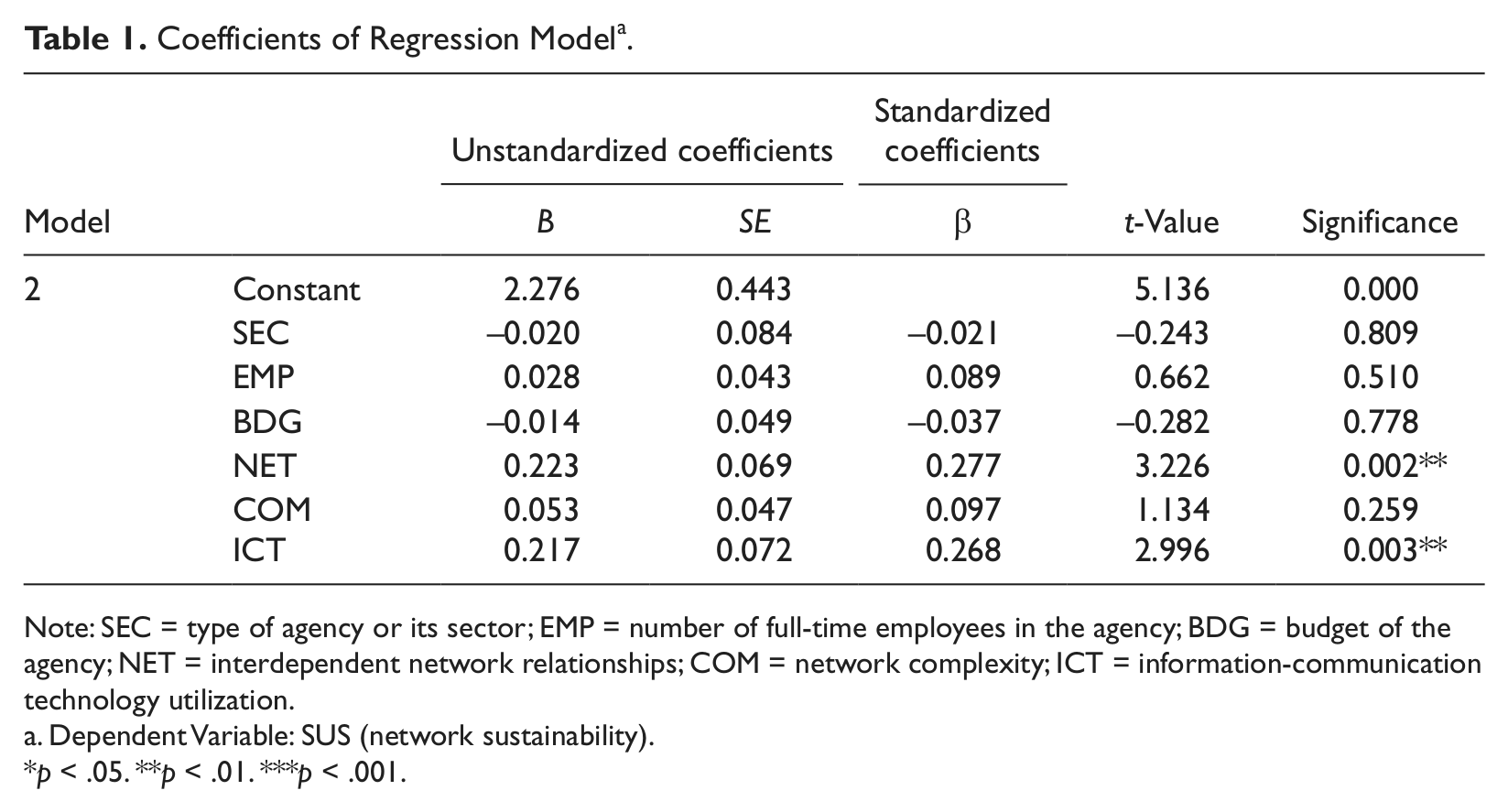
Note: SEC = type of agency or its sector; EMP = number of full-time employees in the agency; BDG = budget of the agency; NET = interdependent network relationships; COM = network complexity; ICT = information-communication technology utilization.
Dependent Variable: SUS (network sustainability).
p < .05. **p < .01. ***p < .001.
The regression analysis results are not surprising, especially in terms of the network relationships and ICT affecting network sustainability. These assumptions were strongly supported by different scholars in the literature. Figure 2 displays network relationships at the network level of each county studied. The figure helps to shed light on two factors in the regression model, namely, network relationships interdependence and network complexity. The figure shows that in terms of friendship networks—who knows whom—counties seem to be comparatively complete, meaning that countywide every agency has a sense of what other agencies are responsible for in the whole emergency management network, and this might not be a surprise. The friendship networks, in turn, are transmitted to lower-density collaborative preparedness (advice during preparedness) and collaborative response (advice during response) networks, with some isolated nodes especially in the case of Miami-Dade. This county had the lowest response rate, which may be a possible explanation. In other words, the network sustainability in each county’s case is fostered through these highly connected nodes before and after emergencies. The literature likewise emphasizes the importance of pre- and post-disaster collaborations, which help to create long-term and more productive relationships leading to sustainable networks. The regression results pointing to the importance of network relationships and ICT were also supported by the qualitative comments of the respondents. One of the respondents emphasizes that “[collaboration] improves response time which results from proactively planning for rather than reacting to them. [It] ensures that necessary resources are available from multiple agencies when a disaster strikes.” Another respondent highlighted the importance of ICT utilization in his comments by stating that “it would allow us to obtain the necessary resources and personnel, keep us updated on the disaster response, and provide the convenience of one centralized communication portal.”

Friendship, advice preparedness, and advice response networks of the four counties.
The surprising factor is related to network complexity, which has been found to be statistically insignificant to have an impact on network sustainability. This result poses questions about the perception of network complexity by emergency management practitioners. They may or may not view multiplicity of network relationships and interactions among organizations from different sectors and levels of government and, thus, having different goals, as hindrance to network sustainability. Again, as in the case of network relationships interdependence, the network complexity characterized by multiplicity of interactions among actors representing diverse backgrounds and organizational goals seems to have been supported by visual diagrams; statistical results, however, lead to rejection of the assumption. This might be due to the fact that different organizations interpret network complexity in different ways; some see it as an advantage and some as disadvantage.
Last, in terms of ICT utilization, the network analysis presents highly connected networks; this is possible because of the sophisticated technical capacity of organizations involved in the network. Although the high level of network connectedness can be attributed to several other factors, it is the strong belief of the authors that ICT is the main factor making it possible. In other words, ICT is a mandatory but not sufficient factor used to explain the density and multiplicity of interactions and relationships in the networks in Figure 2. This is especially true for the collaborative preparedness and response networks that are highly dependent on ICT in today’s complex environment of emergencies.
Figure 2 can be interpreted in several ways, especially from the emergency management practitioner perspective. First of all, it is clear that the friendship network presents the best possible scenario for collaborative networks in emergency management (but this does not always happen). In other words, not all organizations consider themselves as friends and are collaboratively involved in emergency preparedness and response networks. Diversity in terms of the disaster size would inevitably result in various degrees of commitment and involvement by collaborative network actors. This is a reality as well as normality, since not all disasters are characterized by the same degree of risk or scope and severity. The chief factor crucial to the functionality of networks is their key actors. The role of these actors is to become coordinators for each respective ESF as well as taking on the role of assisting organizations regarding each ESF needed for support and/or duplication of services. The uncertainty inherent in disasters makes it imperative to employ or keep ready a comparatively larger number of emergency response actors when compared to the actual response network.
Although Figure 2 does not distinguish between the types of commitment represented through ties between the network actors and, thus, represents a generic network structure as described in the CEMP, it is also important to note that the complexity of network relationships would also be affected by those attributes. This itself, in turn, is a function of disaster scope and severity. More precisely, a disaster of less severity and smaller scope would result in a less complex network characterized mainly by communication and cooperation, whereas larger events would have more severe consequences leading to complexity characterized by coordination and collaboration among actors.
Table 2 provides a list of the top three agencies with their degree, closeness, and betweenness centralities for friendship, advice-during-preparedness, and advice-during-response networks in the four counties. The table presents an opportunity to evaluate the relative role of the organizations from different sectors. Accordingly, it is primarily the public sector, and specifically county governments’ respective departments such as emergency management, sheriff’s office, fire rescue, medical/health, and utilities, that have prevalence in terms of degree centrality across the four counties. These organizations are frequently mentioned by others for the purpose of disaster preparedness and response as well as simply due to the friendship network.
Centrality of Actors in Terms of Friendship, Advice During Preparedness, and Advice During Response Networks in Four Counties.

Note: FEMA = Federal Emergency Management Agency.
In terms of closeness centrality, organizations mainly rely on sheriff’s offices and police departments as well as nonprofit sectors. Since closeness centrality is especially important in such time-sensitive environments as disasters, it is not a surprise that organizations tend to have immediate or closer relationships with law enforcement and/or nonprofits that are specialized in provision of immediate services when compared to other agencies or departments.
Last, in terms of betweenness centrality, the table shows that network actors are relying or dependent largely on county emergency management agencies. This is an especially valid point because of the county emergency management departments’ role in the brokerage and coordination of emergency management activities. In other words, the table reinforces the counties’ role in the coordination of overall preparedness and response networks. The role of such nonprofits as the American Red Cross, which is the coordinator of the nonprofit sector according to most county CEMPs, should also be taken into consideration as seen from the table.
The survey for this study also included two open-ended questions pertaining to how sustainable emergency management network partnerships/collaborations (1) would help enhance, and (2) would not benefit the emergency management field. Responses to the former questions can be summarized in the form of emphasis on the importance of emergency management partnerships for time efficiency, better distribution of resources, better coordination of operations, clearer and better communication, and for the best ultimate results with the least damages to human lives and property. Specifically, most of the responses concentrate around an enhanced coordination of emergency operations that relieves the overall burden on functionally interrelated actors. A sample answer to the first question is as follows: “Setting up a common framework helps people from disparate organizations better understand what their roles are and how they fit towards the overall objectives.”
Responses to the latter question, on the other hand, can be summarized in the form of agreement on the collaborative partnerships’ seamlessness with minor concerns. For example, a respondent says that “partnerships ‘for the sake of’ partnerships would waste time and funding,” whereas another respondent argues that conflicting priorities might be a hindrance for effective collaborations. Yet another argues that organizations that are not equally trained or aware of the NIMS-based structure, guidelines, and operations system may lead to inefficient and ineffective collaboration. A sample answer to the second question is as follows: “It’s beneficial if both know their roles, perform them, and not try to either take command or fail to support the event.”
Discussion and Implications
This study presents several theoretical contributions. First of all, it is an example of research bringing together three distinctive factors to explain network sustainability with the specific context of emergency management. The first aspect is relational (network relationships), the second aspect is structural (complexity), and the third aspect is technical. In other words, network sustainability is explained as a function of these three factors. These characteristics are analyzed in terms of temporal aspects, namely, sustainability. Future research repeating such framework or with additional factors would enrich the related literature. In addition, this study confirms several theoretical arguments from the previous literature. Specifically, this study confirms the importance of network relationships that inherently enhance trust—an important aspect of maintained and continued relationships. Moreover, the importance of technology and social media was clearly shown, which is also a contribution to the communication literature.
Although emergency management organizations do practice collaborative networks in today’s conditions, not all of them are aware of the benefits of sustaining those collaborative relationships across time, especially in the absence of disasters. What is more, not all organizations are equipped with the tools and information needed to enhance the network they are part of. This study presents several lessons to enhance collaborative networks for better and more effective results in the emergency management field.
Emergency management networks are effective to the extent that interactor relationships are enhanced for more sustainable relationships.
The actors involved in emergency management collaborative networks should take partnerships seriously. It is not the one-way request of information or provision of services in collaborative networks that makes networks work; rather, it is the constantly nurtured, enhanced, and increased two-way interactions (Vangen & Huxham, 2003) among functionally interrelated actors that increase organizational capacity and preparedness for disasters (Drabek et al., 1981). Network actors that are isolated and disconnected from the whole might be ineffective, insufficiently prepared, unhelpful, and even detrimental to the whole network, especially during the response stage. Thus, network relationships among actors responsible for emergency management, including mitigation, preparedness, response, and recovery stages, should be constantly increased and enhanced through sustained contact and interaction for the purposes of synchronization of information, capacity, and expectations.
Emergency management networks should be cautious about the nature of relationships, specifically against complexity that would damage, rather than contribute to, overall emergency preparedness and response operations.
This recommendation is specifically based on the qualitative insight from the responses of emergency managers, despite the statistically nonsignificant contribution of the complexity variable in the network sustainability formula. Due to the fact that collaboration involves multiple actors from different sectors and levels of government, collaborative network relationships in emergency management are prone to be diverse and multifaceted. This diversity may be reflected in the strength, quality, and nature of the relationships, bringing complexity arising from the need to compromise multiple goals and expectations (Jassawalla & Sashittal, 1999). Network actors, thus, face a burden of constantly monitoring their relationships to bring balance between internal organizational goals and network goals. On the other hand, the assumption that network complexity, characterized by multiplicity of organizational goals and interactions, affects network sustainability is to be retested across other types of networks.
Emergency management collaborative networks should invest in information-communication technologies (ICT) to increase network sustainability.
Whereas the types and nature of disasters decades ago were simplistic, the increased severity and scope of emergencies today call upon more sophisticated and coordinated emergency preparedness and response. The multifaceted and complex collaborative network relationships in today’s conditions are manageable and sustainable only through clear and enhanced communication channels and information sharing systems for the purpose of coordinated and unified efforts and decision making (Jaeger et al., 2007). A lack of decision support systems as well as communication technologies that make cooperation and partnership of geographically distributed actors possible may be detrimental in time-sensitive and quickly evolving emergency preparedness and response networks.
This study contributes to the literature and knowledge on networks in emergency management. With the specific context of emergency management in the United States, and more specifically in the state of Florida, this study explains how interdependent network relationships, network complexity, and ICT affect network relationships sustainability. The findings assert the importance of network relationships in order to build stronger relationships that turn into sustained relationships along with the positive impact of technology. Complexity, on the other hand, is not a factor that affects network sustainability; a more organized and formal framework of relationships would be a better alternative in this regard. Overall, the study shows that network sustainability is the function of how network actors are positioned within a collaborative arrangement and how effectively they use technology to enhance their relationships.
The study has several limitations, the most important of which is the probable bias in terms of data, because not all counties were represented fairly. The authors were forced to suffice with the responses received, which should be taken into consideration. In addition, the study is based on the perception of agency representatives, which in this or another way would affect the results.
Conclusion
This study analyzed the factors affecting network sustainability in the emergency management context. The main contribution of the study is the statistically confirmed relationships between network relationships interdependency and ICT utilization and network sustainability. The hypothesized relationship between network complexity and network sustainability was not supported by the study findings. Emergency management practitioners should consider the development of network relationships and investment into ICT as important factors that increase network sustainability, which in turn would result in effective emergency preparedness and response. The need for increased network relationships should not be compromised by caution against possible network complexity issues.
Network sustainability is positively associated with interdependent network relationships and ICT utilization. Thus, to achieve sustainable networks, organizations need to invest in the development of dense relationships and technical capacity. The structure and relationships of organizations do matter when interorganizational networks are considered. Accordingly, interorganizational networks in disaster preparedness and response are characterized by the density of relationships structured in accordance with the phases of emergency management respectively. The network structure and, specifically, the network relationships as well as the technical capacity of organizations do contribute to the sustainability and, thus, effectiveness/efficiency of emergency preparedness, response, and recovery. The research contributes to the emerging network sciences in public administration. It especially contributes to the research on network structure and performance using emergency management networks as examples. Future research will need to focus on different network structures, horizontal and vertical for example, and their impact on network performance.
Footnotes
Appendix
Index Items for Dependent and Independent Variables
| Construct | Items | α value |
|---|---|---|
| Network relationships (independent) | Our organization develops long-run relationships with other organizations | .880 |
| Our organization exchanges resources with other organizations | ||
| Our organization exchanges information with other organizations | ||
| Our organization works toward a common goal as other responsible organizations | ||
| Our organization is involved in partnership practices with other organizations | ||
| Our organization is involved in collective/shared making decisions for disaster response | ||
| Complexity (independent) | Disaster response is challenging because it requires working with other organizations | .801 |
| Disaster response is challenging because it requires working under other functions (i.e., emergency support functions [ESFs]) | ||
| Disaster response is challenging because different agencies often have different goals | ||
| Disaster response is challenging because different agencies often work against each other | ||
| Disaster response is challenging because organizations involved are so different from one another | ||
| Information-communication technologies—ICT (independent) | Our organization relies on the use of information technology in communication and coordination Our organization’s operations are streamlined by technological tools of communication and coordination | .708 |
| Our organization has sufficient technical and technological capacity to deal with disasters | ||
| The use of ICT facilitates/enhances the operations of our organization | ||
| Our operations are supported by a disaster information management system (WebEOC, E-Team, etc.) | ||
| Network sustainability (dependent) | Our organization maintains relationships with other organizations with role in disaster preparedness and response | .742 |
| In the absence of disasters, our organization sustains relationships with other organizations | ||
| In the absence of disasters, our organization is involved in collaborative practices (such as exercises and meetings) with organizations we collaborate with during disaster response | ||
| Critical relationships among disaster response agencies become formalized so that they are sustainable over time |

Declaration of Conflicting Interests
The author(s) declared no potential conflicts of interest with respect to the research, authorship, and/or publication of this article.
Funding
The author(s) disclosed receipt of the following financial support for the research, authorship, and/or publication of this article: This research was funded by National Science Foundation (NSF VOSS; Award No. 0943208; Title: Creating Functionally Collaborative Infrastructure in Virtual Organizations).