



Abstract
Scholars have suggested that the delineation of a field’s “big” questions is critical for its cohesive and practical intellectual growth. Instilling a habitual practice of focusing inquiries on fundamental questions is particularly warranted for fledgling areas of research. Currently, while there is already a rich body of literature that addresses administrative, computer, information, and cyber ethics, only a limited number of writings discuss ethical problems specifically within the e-government context. It can be argued that the e-government condition introduces a distinctive type of ethical problems; questions regarding which have yet to be properly framed. This article suggests five critical questions of e-government ethics at the organizational level that justify notable academic attention.
The daily effort to fill meaning vacuums created by the search to serve “the public interest” is an unavoidable experience of the work of public administrators. By regularly taking decisions within the discretionary realm of everyday public administration and within the context of a multitude of accountability obligations, public servants are often faced with ethical challenges (Waldo, 1988). Some moral decisions become routinized or ritualized, while others remain emotion-based constructions of identities and personal relationships (Maynard-Moody & Musheno, 2006).
Textbook ethical templates, that attempt to guide through the moral implications of administrative behavior, often underestimate the consequential nature of their theoretical empowerment of the individual. In theory, individuals might have the ability to make a certain ethical choice; in practice, however, more often than not, people are trapped in organizational and social habits over which they have trivial influence. In regards to deceit, for instance, Bok (1978/1999) writes, The social incentives to deceit are at present very powerful; the controls, often weak. Many individuals feel caught up in practices they cannot change. It would be wishful thinking, therefore, to expect individuals to bring about major changes in the collective practices of deceit by themselves. (p. 244)
Multipurpose guidelines of administrative ethics are an unquestionable need. Yet, an adequate scholarly prudence against an oversimplification tendency is in order when suggesting ethical principles of conduct. Such caution is especially defensible when dealing with complex systems such as e-government, which are replete with ambiguity and conflicting interests. Organizational routines can consume the individual to the point where one’s ethical autonomy becomes almost nonexistent. Chambliss (1996) argues that individuals who have the power to make system changing decisions have the luxury of facing ethical “dilemmas”; all other organizational members, all the same, consistently face ethical “problems,” which most of time they cannot influence nor solve. Furthermore, “we must conclude that the power of the individual’s conscience is very weak relative to that of legitimated authority in modern organizations and social structures more generally, and that current ethical standards do too little to limit the potential for evil in modern organizations” (Adams & Balfour, 2004, p. 151). For considering that cyberspace is more controlling than we are currently willing or able to admit (Lessig, 2006), the danger and possibility of administrative evil is indeed shaping to be very real.
Technology, routinely outlined as a mere mechanical aid to our life, is far from the neutral instrument that it is made out to be; it actively and profoundly shapes our interactions, perspectives, decisions, moral valuations, and imagery (Verbeek, 2011). The recent turn to a heavy reliance on information communication technologies (ICTs) for purposes of governance has the potential to motivate fundamental, perhaps even disruptive, changes at the organizational, and policy levels (Bovens & Zouridis, 2002; Dunleavy, Margetts, Bastow, & Tinkler, 2006; Milakovich, 2012).
Just as much as laws, the design of IT systems can have strong effects in embodying and freezing a particular set of administrative capabilities—literally “embodying” since in “legacy” systems a given set of procedures will be written up in millions of lines of programming or code, which then becomes expensive to change or modify at a later stage. (Dunleavy et al., 2006, p. 25)
Such shifts are bound to come with significant ethical problems, especially for an individual’s organizational habitus; yet, these implications are seldom explored by public administration scholars. Extant literature provides a rich choice of works that address in part administrative ethics or e-government, but only a limited body of scholarly writings that specifically discuss the ethical problems associated with the redesign of public organizations under the tenets of e-government (Mullen & Horner, 2004). Technology does have important objective capacities, but it is also subjected to organizational structures, social interactions, and meaning creation processes (Orlikowski, 1992, 2000). In this sense, there is a sensible gap in our understandings of the ethical problems that might arise as public organizations are transformed within the context of e-governance. Although information, computer and cyber ethics can provide a useful foundation for generating such understandings, neither of the three, in part nor in aggregate, provides an entirely satisfactory framework.
In this analytical article I argue that research on e-government ethics should attend to enquiries that are sensibly different from the questions addressed by information, computer or cyber ethics. E-government is surely more than the infrastructure and mechanisms provided by technology, it is ultimately about people, power, and meanings that are routinely constructed by social and organizational interactions. In e-government, ideology and technology hang together.
Drawing directly and heavily on Chambliss’ (1996) structural theory of ethical problems in organizations, I suggest five critical questions that current and future research on e-government ethics should carefully examine and perhaps focus on:
What are the powerful interest(s) (groups) in e-government?
What are the fundamental dynamics behind the conflicts that are casually labeled as moral conflicts in e-governance?
What are the moral agendas of e-government interest groups?
How are groups’ statuses shifting in the milieu of e-government?
How can e-government ethics keep pace with the evolving and dynamic ethical problems of e-governance?
At this point, it is necessary to note that the scope of this article is limited in several ways. First, the article cannot and does not solve the issue of what e-government “is.” The primary concern is to convince that the idea of e-government is value-burdened and ideologically driven. Second, this is not an in vivo observation and does not target, hence, cannot claim, a comprehensive overview of all the disruptive implications associated with the use of technology in the organizational setting. In the discussion of e-governance, defining organizational habitus is in itself a trying task. Third, it is beyond the scope of this article to explore all the values and interests associated with all conceptual framings of e-government. There are obviously many fascinating insights to be learned from a systematic review of the game of interests; not the least intriguing being that such game is covert and private sector defined. Fourth, the discussion is constrained to the organizational level. Finally, the article is principally captivated with delineating the questions of e-government ethics research and not with the identification or provision of exacting answers or solutions. In many ways, then, this article can be interpreted as an extension and application of the structural theory of ethical problems in organizations to the context of e-government. The writing’s modest ambition doesn’t substantially extend beyond that of an exploratory essay, and the analysis should be understood as such.
Beyond this introduction, the following discussion is constructed within three broad sections. The first section will provide a brief overview of e-government and administrative ethics literature. The second section will analyze and discuss the ethical questions of e-government through the framework provided by Chambliss (1996). In the concluding section, I will suggest a set of broader inferences that warrant future academic attention.
The Silence of E-government Ethics
Although the idea of electronic government has entered the mainstream American academic literature in 1993, within the context of National Performance Review (NPR; Heeks & Bailur, 2007; Lenk & Traunmüller, 2002), the concept has yet to cement a consensus around a specific definition (Dawes, 2008; Hardy & Williams, 2011). It has been suggested that e-government is nothing more than a new label for processes that have been part of governance for decades (Gil-Garcia, 2012). Depending on the research contexts, scholars’ backgrounds, assumptions or the function being emphasized—what e-government “is” will be governed by the context.
In broad terms, e-government is commonly defined as the use ICTs in governance (Dawes, 2008; Fountain, 2001; Maureen Brown, 2007). Some scholars make a clear delineation between e-government and e-governance (Calista & Melitski, 2007; D’agostino, Schwester, Carrizales, & Melitski, 2011); others discern between e-government and e-democracy (Backus, 2001; Lee, Chang & Berry, 2011; Lenihan, 2005; Stahl, 2005); while on other occasions e-government is merely broken down into functions such as e-service, e-organization, e-democracy, and e-partnering (Carrizales, 2008). The difficulty in reaching a consensus over the definition of e-government reflects, among others, the deeper underlying struggle for affirmation and indemnification within the field of study. For the scope of this discussion, e-government is defined as the use of ICTs for purposes of governance, while e-governance can be broadly delineated as the art of governance that emphasizes ICTs (Roman, 2013).
E-government research, “viewed as the offspring of information systems and public administration . . . the child of two parents that are themselves perceived as intellectual weaklings” (Heeks & Bailur, 2007, p. 261), is often criticized for the lack of methodological and theoretical rigor (Coursey & Norris, 2008; Grönlund, 2005; Grönlund & Andersson, 2006; Hardy & Williams, 2011). Although part of the criticisms, particularly in the case of failures to rely on established theories, is undoubtedly justified, one would perhaps have to acknowledge that this might be an inevitable dynamic for any set of literature that is still in its early stages of development. In the last decade, however, the area has grown considerably (Scholl, 2009) and now provides research of noticeably improved quality.
Ultimately, the academic difference regarding the nature of e-government is rooted in the tussle over values and the failure to accept politics as a dominant variable. There is an inherent and troubling disagreement between e-government discourse and its policy design. The force behind the e-government push was highly political in character and was originally driven by the New Public Management (NPM)-inspired ideological belief that government was failing its customers (Milakovich, 2012). The NPM-enthused language of NPR and subsequent policy formulations were predominantly instrumental and targeted primarily organizational process flows (Fountain, 2001); the “characteristic impetus of this ‘reform’ [NPM] movement was toward fragmenting government organizational systems and strengthening the role of corporate sector actors (including the IT industry) in providing government services” (Dunleavy et al., 2006, p. 84). The latter is in sharp contrast with the claims of transformation and democracy normally made in the political discourse and often taken for granted in the literature. The refusal to acknowledge the inexorable ideological nuances of the concept, and the conceivably naïve faith in technology’s supposedly deterministic nature, have made progress in the conceptualization and operationalization of the concept rather difficult and slow.
The literature on administrative ethics, unlike the literature on e-government, is well established and relies on a rich array of cross-disciplinary research. Philosophical inquiries and frameworks about right and wrong have been omnipresent in the historical intellectual development of humanity. Public administration scholars, in particular, have generated an extensive body of quality literature on ethical considerations. While, according to T. L. Cooper (2001), administrative ethics did not emerge as a significant field of study until 1970s, since then, the area has developed with great determination. Rohr’s (1978/1989) discussion of public administrators within the context of constitutional-driven values; Harmon’s (1974) examination of social equity; Frederickson’s (1982) analysis on the administrator–citizen nexus; Hart’s (1984) support for virtue as a core dimensions of public administration; and T. L. Cooper’s (2006) responsible administrator decision-making framework—are just a few examples of the seminal works available for researchers to draw upon. In practice, administrative ethics is also heavily and effectively emphasized. Institutions such as the Organisation for Economic Co-operation and Development, United Nations, the American Society for Public Administration, International City/County Management Association, and National Institute of Governmental Purchasing regularly advocate and support the development and acceptance of codes of ethics.
There is, nevertheless, a somewhat more limited academic attention to administrative ethics within the context of e-government; some have even argued that there is a significant gap in the extant literature (Mullen & Horner, 2004). Yet, despite that fact that neither established ethics scholars nor e-government scholars dedicate regular attention to the topic, there is still a rather adequate starting point for molding understandings and future research. For instance, Johnson (1997) provides an encompassing discussion of possible ethical implications of computer-mediated environments. Anderson’s (2004) suggests ethical codes as foundation for developing an e-government ethics discourse (even given the codes’ intrinsic shortcomings). Berman and Mulligan (1999) and Kapucu (2007) discuss privacy and confidentiality concerns associated with e-government and the usages of automatically collected data. Mullen and Horner (2004), based on van den Hoven (2000), delineate categories of ethical issues associated with e-government (related, dependent, determined, and specific). Stahl (2005) warns about the ethical dangers of framing e-government with a reliance on e-commerce perspectives. Finally, Ramadhan, Sensuse, and Arymurthy (2011) support framing e-government ethics as a combination of computer, information, and cyber ethics.
Overall, still, few writings discuss the ethical problems arising at the organizational level as a result of e-government-driven transformation. The majority of scholarly literature either discusses ethics as one dimension of a broader set of implications from technology-induced shifts, or treats the concept solely within the context of transparency, accountability, and security. Here, it is of the essence to observe a vital nuance that differentiates the idea of e-government from the mere adoption of ICTs. The concept of e-government is satiated with philosophical and ideological connotations; e-government is, in a certain sense, a state of mind induced by belief that government should be improved within the transformational capacity provided by ICTs (Milakovich, 2012; Roman, 2013). Technological determinism is currently one central but untested assumption that at times seamlessly operates throughout the majority of writings and practices in e-government. The latter regularly leads to unfounded beliefs that the introduction of ICTs on its own will guarantee improvements in administration. Technology is by no means insusceptible to ideological manipulations. Hence, within this context, examining the ethics of digital governance would call for a discussion of the broader assumptions behind e-government frameworks, with a particular focus on political discourse. The fields of computer, information, and cyber ethics provide avenues that public administration scholars can draw upon, but, given that e-government is much more than “just technology,” this literature is obviously not sufficient.
Somewhat curiously, the debate in popular press about e-government ethics has been just as quiet as the one in academia. There have been relatively few major news releases that discuss ethics within the e-government context (Table 1). 1 Even fewer of these releases approach the discussion on ethics in a manner that would fit the perspective suggested here.
Number of News Releases Discussing Ethics Within E-Government.
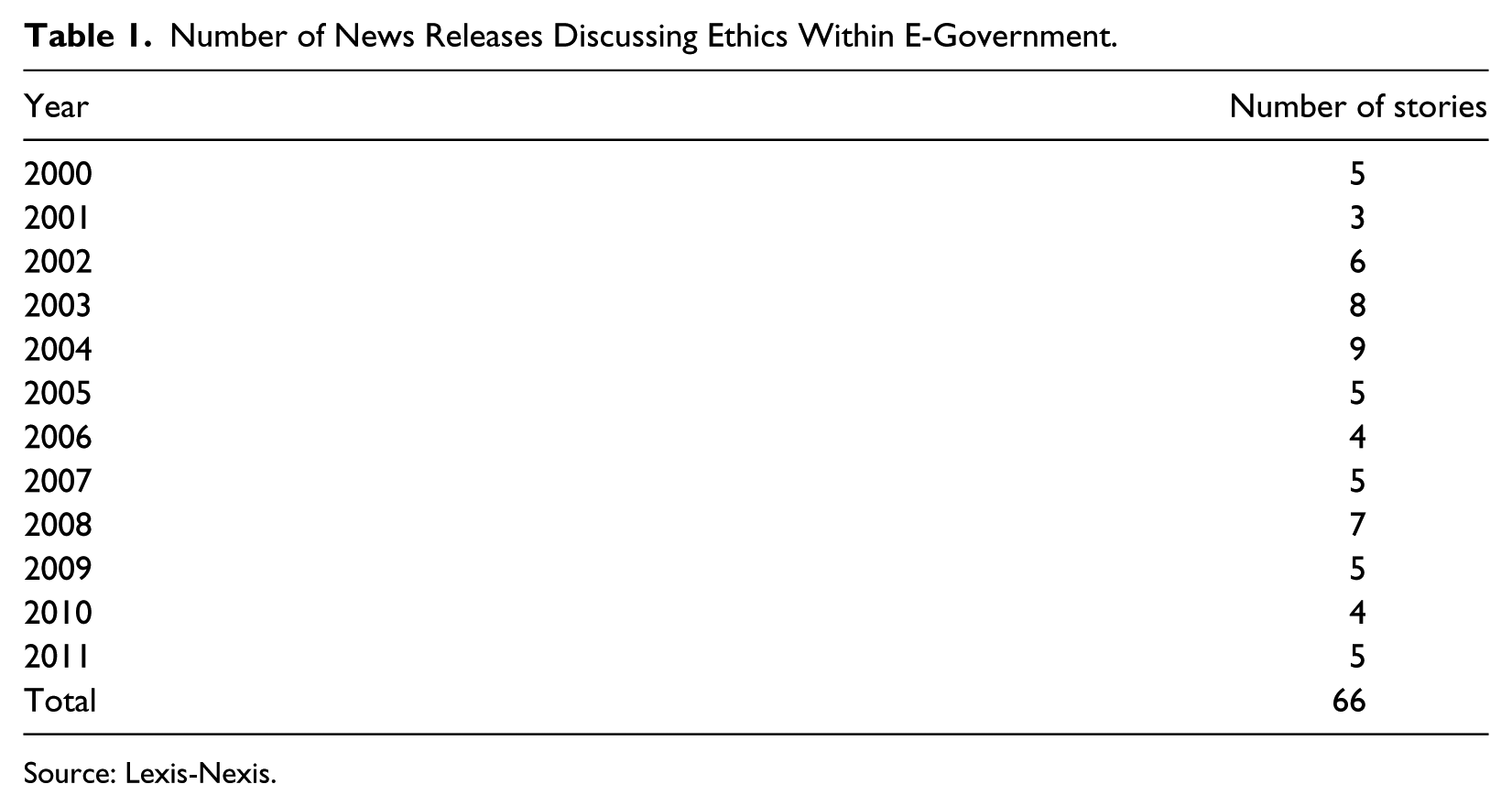
Source: Lexis-Nexis.
Although in practice it is questionable whether e-government has yet to motivate any genuine transformation and the evolution has been rather incremental (Milakovich, 2012; Norris & Moon, 2005; West, 2005); it is still perhaps merited to expect that it would eventually lead to authentic shifts in governance and remapping of the public sphere. “The social and political dimensions of communications innovations have always matured more slowly than the technology itself” (Hindman, 2009, p. 129). If ICTs do indeed become the preferred tool of governance, then, I argue that it is critical that we understand the nature of the ethical implications associated with such developments; with those at the organizational level being of distinct interest.
The Critical Questions
Due to the complexity of the topic addressed here, it is suitable to place the discussion within a specific frame. The structural theory of ethical problems in organizations (Chambliss, 1996), was found appropriate for the purposes of this article. While, interpretations such as the one offered by T. L. Cooper (2006) or Mullen and Horner (2004; the former focuses on decision making while the latter specifically targets e-government ethical problems), would have been fitting as well, Chambliss’s (1996) lens was chosen for several reasons:
It specifically deals with ethical problems at the organizational level.
The framework accounts for the behavioral bounds of the individual within the structures imposed by organizational routines, norms, and roles.
The lens’ philosophical construct is based on conflict (for instance conflicts between interests, images, or meanings advocated by different groups).
The framework is flexible and was generated based on the study of a complex administrative environment. The methodological approach employed by Chambliss (1996) allows important levels of generalizability.
The framework deals with and explains decision-making dynamics within the psychological nexus created by, at times contradictory, personal and organizational values.
The structural theory of ethical problems in organization is constructed around five basic principles of emergence of moral issues. It is within the frame provided by the five dimensions that I will suggest the five critical questions.
Ethical Problems Reflect the Conflict of Powerful Interest Groups
What Are the Powerful Interest(s) (Groups) in E-Government?
The ramifications of this question might appear at first misleadingly petty. In e-government, interest groups are neither easily identifiable nor does there appear to be any genuine examination of their games, which might erroneously lead one to believe that they might not matter. There is a subtle assumption in formulating the question in this manner. As Chambliss (1996) argues, For the most part, ethical problems in organizations do not spring full-blown from the independent mind of a single practitioner, struggling with her lone conscience. They tend, rather, to be specific manifestations of well-articulated disputes between interest groups—typically, between rival professions or constituencies. (pp. 94-95)
At the organizational level, within the framework of e-government, there are at least six broad interest groups that easily come to mind: frontline public servants, public managers, political appointees, consultants, contractors, and IT professionals. A variety of other interest groups populate the organization’s external environment. It is now common for private IT companies, for instance, to build, develop and manage entire sets of governmental IT functions (Dunleavy et al., 2006), hence, giving them intimate proximity to the organizational space. Moreover, given the intrusive character of ICTs as well recent administrative developments, it becomes somewhat difficult to argue that any interest or interest group finds itself completely isolated from the immediate organizational milieu.
Each group has its own interpretations, culture, preferred moral obligations, and understandings of what public service is; and it is highly likely to attempt to enforce those views in shaping the e-governance discourse and implementation. Depending on available resources or commonalities in trained groups’ perspectives, interests can align in support of a specific expectation of e-government. For instance, managers might emphasize efficiency and standardization as the core directions in the adoption of e-government (Fountain, 2001; Milakovich, 2012); while street-level public servants might prefer responsiveness and flexibility. It is quite possible that the outcomes of these conflicts would fit within a power law pattern—the dominant groups will shape the bulk of the terms. The nature of e-government could dramatically change the underlining dynamics that make an interest group powerful within its medium (Hindman, 2009), so there is much left to be learned here. Thus far, it would appear that an elite few of private sector players such as IBM, EDS, Cap Gemeni, and Lockheed Martin hold the edge in terms of knowledge, expertise and ability to frame and define the operationalization of e-government platforms (Dunleavy et al., 2006).
It should be noted that it is unclear whether users (consumers) of e-government services could be considered an interest group. Do the users make an interest group or are they simply individuals separated by the successful fulfillment or automation of a onetime need? With few exceptions, there is little to suggest that the drive for e-government has been motivated by a demand side push. Moreover, scholars have not been able to provide conclusive answers in terms of who are the most active participants within the e-government context (Brainard, 2003; Elwood, 2006; McCall, 2003; Schlossberg & Shuford, 2005) or how digital participation affects broader democratic constructs. Genuine democratic decision making and accountability might have to rely heavily on authentic deliberation (Gutmann & Thompson, 2004); yet, there are many who would openly question whether e-government can realistically nurture meaningful deliberation. In terms of political engagement, Prior (2007), for instance, finds that Internet use increases political knowledge among the already active individuals, while apathy levels rise among the rest. Those with strong party affiliations are more likely to visit web political portals and engage in digital dialogue (Foot & Schneider, 2006). As Hindman (2009) perceptively notes, Paradoxically, the extreme “openness” of the Internet has fueled the creation of new political elites. The Internet’s successes at democratizing politics are real. Yet the medium’s failures in this regard are less acknowledged and ultimately just as profound. (p. 4)
En masse, then, a question that appeared trifling at first, uncovers issues that are rarely addressed by e-government ethics research or by studies of e-governance in general. Politics is an open secret of e-government that should not be ignored as many instrumental-rational perspectives would otherwise suggest. Leaving politics and conflict out of e-government guarantees that any understandings, which are eventually constructed, will be quixotic in character and of little use to the concerns of practice. Clearly delineating the powerful interests and interest groups and the dynamics that make them powerful becomes indispensable for generating non-naive understandings of the ethical implications of e-government. Making an allowance for the fact that “old” interest groups can be much more adroit at exploiting technology for their goals (Kakabadse, Kakabadse, & Kouzmin, 2003) it becomes difficult to imagine “new” interests finding wiggle room on the front stage of organizational power structures and policy making.
Indeed, the Internet may be better suited to furthering organized and organizational interests rather than the citizens in unorganized or informal sectors that many Internet optimists wish to empower . . . The Internet appears to foster and intensify closed, corporatized policy networks. (Rethemeyer, 2007, p. 199)
Fundamental Conflicts Between Groups Become Labeled as Moral Conflicts
What Are the Fundamental Dynamics Behind the Conflicts That Are Casually Labeled as Moral Conflicts in E-Government?
Technology advancements create policy vacuums (Moor, 1998). Certain organizational interactions, which are now common under the increased reliance on technology, might not have occurred before.
Initially, there may be no clear policies on such matters. They never arose before. There are policy vacuums in such situations. Sometimes it may be simply a matter of establishing some policy but often one must analyze the situation further . . . One often finds oneself in a conceptual muddle . . . The evaluation of a policy will usually require a close examination and perhaps refinement of one’s values . . . Of course, with the discovery of new consequences and the application of new technology to the situation, the cycle of conceptual clarification and policy formulation and evaluating may have to be repeated on an ongoing basis. (Moor, 1998, pp. 16-17)
The issue of the digital divide is a case in point. One of the overarching scopes of e-government was to improve democratic outcomes by harmonization of the relationship between agencies and its constituencies through increased access and participation in decision making of other previously marginalized groups. Yet, active and consequential participation in governance, one that goes beyond downloading a form or paying taxes, requires time, financial investments, but above all—suitable levels of education. Availability and access alone do not secure the outcomes expected by design (Colleste & Holmqvist, 2004; Tapia & Ortiz, 2010). Some have even suggested that the skills needed for meaningful use of the Internet are more constraining than access (Dijk, 2005; DiMaggio, Hargittai, Ceste, & Shafer, 2004; Mossberger, Tolbert, & Stansbury, 2003). There are hopes that rapid expansion of broadband access via mobile phones will ameliorate the condition; yet, increased mobile access does not modify the underlying construction of the issue, which remains one of knowledge.
Furthermore, new ethical challenges are guaranteed to arise with the increased use of new digital approaches. For instance, the use of Twitter or Facebook 2 to communicate and interact with citizens might often overlook the reality that the assumption that the addressees will actually read the message cannot readily be upheld. Ironically, without appropriate support mechanisms, by its nature, e-governance might offer the least amount of benefits to those the most in need of them and in its unpredictable evolutions could become increasingly dividing and disconnected from citizens.
At the other end of the spectrum, it has been argued that “public participation which is automatic, unrestrained, or ill-considered can be dangerously dysfunctional to political and administrative systems” (Cupps, 1977, p. 478). As an example, Kerwin and Furlong (2011) have suggested that e-rulemaking might threaten public agencies’ ability to perform effectively. Contradictory to the telos of e-rulemaking, the combination of administrative constraints and increased ability of interest groups to access rulemaking might create the perverse incentive for agencies to become less concerned with public input and shop, implicitly and explicitly, for supportive stakeholders. Hence, framing the issues associated with e-rulemaking or the digital divide within technical connotations, cannot hide the fact that the question is still a political interpretation of who and how “should” participate. At heart, the design and implementation of e-government is a political exercise of shaping definitions, values, and worthiness. “What could be described as political arguments or turf battles are translated into moral terms and become ‘ethical problems’” (Chambliss, 1996, p. 95). Deconstructing the ethical problem of the digital divide and active participation into political components helps us see that its answer does not entirely rest on ethics, but significantly so on policy.
Internet politics seems to nurture some democratic values at the expense of others. If our primary concern is the commercial biases of traditional media organizations, or the need for a strong corps of citizen watchdogs, then online politics may indeed promote positive change. Yet it is crucial to remember that democratic politics has other goals, too. No democratic theorist expects citizens’ voices to be considered exactly equally, but all would agree that pluralism fails whenever vast swaths of public are systematically unheard in civic debate. The mechanisms of exclusion may be different online, but . . . they are no less effective. (Hindman, 2009, p. 12)
This second critical question, too then, veils an intricate set of consequences that is often, somewhat curiously, overlooked in e-government ethics research. E-governance is a heavily value-laden construct. As it is the case with the ethical implications of citizens’ participation in governance, what might appear at first to be a technological issue, is undeniably a reflection of the fundamental conflict in interpretations of the normative nature of 21st century governance. In describing the ethical challenges of ICTs in governance in technical terms, we are, as it were, attempting to answer political questions with programing codes. E-government ethics are inextricably bound to competing interests. Constructing ethical suggestions outside the latter realization, would probably lead to overoptimistic and marginalizing views, mechanisms, and frameworks.
Ethical Issues Reflect Conflicts of Groups’ Moral Agenda
What Are the Moral Agendas of E-Government Interest Groups?
Organizational groups differ significantly in their moral agendas. Each group will attempt to force “their ethics” in making ethical decision in e-government. Clashes between their competing and at variance sets of values and moral agendas can lead to challenging ethical issues. Frontline public servants often have sensibly different professional moral agendas (Chambliss, 1996; Maynard-Moody & Musheno, 2006; O’Leary, 2006) than those of managers or political appointees. Most importantly, however, is that the culture and professional moral agendas of IT developers, most of whom are employed by the private sector, can be dramatically at odds with the values of public services.
Professional groups have their own languages, their own ways of doing things, and their own understanding of the world-what is generally called a ‘culture.’ Bureaucratic culture can sit uncomfortably with the individualistic, heroic culture of the programmer and the faddish culture of the management consultant and New Public Management-influenced managers. (Goldfinch, 2007, p. 923)
Public servants are morally committed to serve the “public interest” and might resist or sabotage anything (e.g., technology) that interferes with their goals and beliefs (O’Leary, 2006). Managers are largely morally committed to balancing organizational needs and upholding broader management and administrative values (T. L. Cooper, 2006); which might motivate them to embrace e-government in terms of efficiency and productivity, rather than accountability and responsiveness. Political appointees are morally committed to political constructs and are highly likely to try to shape e-government implementation with intent of controlling bureaucratic activity and discretion. In contrast, Dunleavy et al. (2006) suggest that the IT profession cannot be characterized as having strong rules on ethics or responsibilities to the client (p. 37). As such, information systems (IS) developers might fail to be morally committed to any public service dimension and only care about the performance and profits.
The profession of ISD [information systems development] is characterized by specialized training and circumscribed theorizing. Since the dawn of business computing, training in IS has meant ‘computer training’, and IS professionals remain technologists at heart. (Lyytinen & Robey, 1999, p. 94)
Yet, These system-level bureaucrats have the discretionary power to convert legal frameworks into concrete algorithms, decision trees, and modules. They are constantly making choices-which definitions should be used, how should vague terms be defined, how are processes to be designed and interlinked? Therefore, just as the street-level bureaucrats were not in their time docile policy implementation robots, but policy makers them-selves . . . Who checks the developers and their systems? To whom are they accountable for the manner in which they have converted analogue legislation into digital decision trees, scripts, and algorithms? (Bovens & Zouridis, 2002, pp. 181-182)
The complexity of the condition dangerously extends beyond the conflicting moral agendas. Technology has been shown to have dehumanizing and deskilling effects. Systems that are built to support decision making can turn into data dumping grounds with the end user’s job reduced to data collection, devoid of a meaningful understanding of the process or the sense associated with such data (Fountain, 2001). Scholars have previously suggested that individual decision making in cyberspace might employ different moral constructs (Johnson, 1997; Johnson & Miller, 2009; Mullen & Horner, 2004). Similar actions can be undertaken in both environments; yet, as a rule, the moral character of those actions will differ in important ways (Johnson & Miller, 2009). Furthermore, Roman and Miller (2013) caution that a more detailed evaluation of the design of e-government might uncover a refined attempt to reinforce technical-rationality in public administration. In terms of public organizations, the substitutions of person-to-person interactions with ICT-based technical-rational interfaces might lead to unintended shifts in moral agendas. The implications are incremental and might not become immediately obvious, yet in aggregate, and in the long run, they could become quite dramatic. With possibly diluted levels of personal accountability, due to adoption of digitally supported decision-making systems, the dilemma of “dirty hands” might become a dilemma no more, since the moral guilt could be shifted to the “system.” In this context, due to psychological distance and process ambiguousness using Thompson’s (1987) logic, neither democratic responsibility nor accountability develops into a predominant ideal. The implications are indeed serious with a potential for the disastrous. After all, if one would accept Adams and Balfour’s (2004) controversial argument in its entirety, then, moral vacuity is the price to be paid for worshiping of technical-rationality. “Within a culture of technical rationality, a model of professionalism that drives out ethics and moral reasoning offers all too fertile soil for administrative evil to emerge” (Adams & Balfour, 2004, p. 41).
Recall Philippa Foot and Judith Jarvis Thomson’s classical runaway trolley moral dilemma. For the first scenario assume the role of an onlooker standing on a bridge. You see a trolley car with no brakes racing down the track on which five unaware workers are standing. Unless you do something, they will die. Next to you there is, however, a button that you can press (click) to divert the trolley car onto a side track on which only one worker is standing. It is up to you to decide to press the button to save the lives of five workers by condemning the one standing of the side track. In the second scenario, assume no side track and replace the button with a heavy individual. You still can save the five workers. This time, though, you would have to push the individual onto the path of the trolley, thus blocking it from reaching the workers.
The decision-making dynamics involved in the first scenario appear reasonably simple, sacrifice one innocent life to save five. Nonetheless, the same principles feel out of place under the second setup. Notwithstanding the usual debate regarding the responses and difference between these two settings, there is one important technology–decision-making nexus that should be addressed here. There is something inherently different about moral decision making under the two scenarios. Under the first one, pressing (clicking) the button is somewhat less personal than pushing the individual off the bridge; there is a psychological distance between the actor and the immediate core of the developments. Intimate contact with the action, actors, and consequences appears to trigger a more complex set of reactions. According to the dual-process morality theory (Green, 2003, 2009; Green, Morelli, Lowenber, Nystrom, & Cohen, 2008; Green, Nystrom, Engell, Darley, & Cohen, 2004; Green, Sommerville, Nystrom, Darley, & Cohen, 2001) deontological moral judgments are based on automatic emotional responses while consequential moral judgments (utilitarian) are based on more detailed and controlled cognitive processes. As per dual-process morality theory, the reason for such a significant difference in reaction under the apparently similar scenarios is due to the involvement of two distinct psychological/neural systems; one more emotional (associated with the anterior cingulated cortex) and another more controlled and less emotional (associated with anterior regions of the dorsolateral prefrontal cortex). When the emotional system is engaged (second scenario) it regularly dominates consequential reasoning. The conditions would have to be made sufficiently attractive in order for consequential reasoning to overtake the emotional response.
In simple terms, when the decision maker is undertaking the action through an emotional filter (e.g., button, web link, ICTs), thus becoming emotionally detached and psychologically distant from the action, he or she is more likely to employ utilitarian logic. The transformation is subtle and happens at the neural level. It is most likely uncontrolled and could perhaps even go unnoticed by the individual; yet, en masse the accumulation of these seemingly minor alterations in moral reasoning is crucially consequential. Traditionally for changes to be acknowledged as historical, they had to be accompanied by falling walls and overthrown governments. ICTs might be changing that by making scale transformation almost unremarkable and dull. The slope in this evolution could become very slippery; ICTs might indeed seamlessly motivate major modifications in the normative nature of public administration. The implications of the possible dehumanization of public administration are legion; not the most trifling being that it “often masks administrative evil” (Adams & Balfour, 2004, p. 19).
When Group Statuses Shift, Ethical Problems Increase
How Are Groups’ Statuses Shifting in the Milieu of E-Government?
It has been suggested that digital governance requires a “new” organizational culture, one that supports and aligns with the tenets behind e-government (Torres, Pina, & Royo, 2005). With the context of the invasion of the organizational space IT systems, “The Weberian concept of government organization as a self-contained, socio-technical system where agencies are defined by their in-house operations and technology no longer seems adequate” (Dunleavy et al., 2006, p. 15).
Every technology also requires the inculcation of a form of life, the reshaping of various roles for humans, the little body techniques required to use the devices, new inscription practices, the mental techniques required to think in terms of certain practices of communication, the practices of the self oriented around the mobile telephone, the word processor, the Word Wide Web and so forth. Even in its conventional sense, then, technologies require, for their completion, a certain shaping of conduct, and are dependent upon the assembling together of lines of connection amongst a diversity of types of knowledge, forces, capacities, skills, dispositions and types of judgment. (Rose, 1999, p. 52)
The ability and skills associated with the use of Internet based digital platforms have been shown to be critical for contemporary policy making. Johnson & Miller (2009) argues that ICTs can lead to an “instrumentation of human action”; while Fountain (2011) expects a rationalization and bureaucratization of public governance as a result of e-government adoption.
In sum, the use of Internet in bureaucracy is likely to lead to greater rationalization, standardization, and use of rule-based systems. The rules, may not be visible because most of them will be hidden in software and hardware. But they will remain and may increase in power. (Fountain, 2001, p. 62)
Although public administration scholars have addressed the possible changes in organizational cultures and expectations as a result of e-governance; how group statuses shift receives noticeably less attention. With the increased use of ICTs for purposes of governance the status of frontline public servants is expected to be transformed and perhaps significantly diminished.
The sheer dynamism caused by the introduction of computers affected both the organization of the street-level bureaucracy and the under-lying legal setup. In a relatively short period of time, the street-level bureaucracy has changed into what we could call a screen-level bureaucracy . . . Many decisions are no longer made at the street level by the worker handling the case; rather, they have been programmed into the computer in the design of the software . . . a number of major executive organizations have progressed even further and are rapidly developing into what could be termed system-level bureaucracies. (Bovens & Zouridis, 2002, p. 177)
Technology has the potential to transform a sector in a matter of months making one’s process knowledge and learned skills almost obsolete. Im (2011) suggests that some job types might disappear (e.g., data collectors) while others might come in higher demand (e.g., managers). More critically, ICTs might have deskilling and dehumanizing effects on users (Fountain, 2001). It has also been suggested that as a result of e-government, public servants could experience increased pressures and work demands, but also shifts in job roles (Norris & Moon, 2005). “Today, a more true-to-life vision of the term “bureaucracy” would be a room filled with softly humming servers, dotted here and there with a system manager behind a screen” ( Bovens & Zouridis, 2002, p. 175).
Public administrators often develop personal and emotional ties with the citizens that they serve (Lipsky, 1980; Maynard-Moody & Musheno, 2006) or with certain missions or ideals (O’Leary, 2006). Knowledge and regular direct involvement in interpreting public values and public needs, empower public servants and provide them with the basis to question the moral preeminence of otherwise taken for granted organizational practices. Yet, within the context of a decreasing status, it is highly likely that accountability and moral responsibility will be delegated to the realm of technology. Automation and standardization at one level of decision-making process will most likely lead to formalization in the following steps (Bovens & Zouridis, 2002).
Limited discretion, while theoretically desirable in a principal-agent model, might lead to disinterested and morally detached agents. For instance, as frontline public servants take upon less decision-making responsibility they could minimize or even stop their typical challenges of interpretations that come from “the top.” Furthermore, failure to ethically connect with administrative decision making might lead to a moral collapse, an inability to diagnose or understand the real implications of one’s actions. Ethical deliberation is a dynamic process that demands personal involvement; yet, human judgment is often found to be normatively objectionable under the design of e-government infrastructures as it is believed to muddle the process.
Chambliss (1996, p. 97) argued that “‘professionalization’ in part describes a shift from a technical to a moral orientation to one’s work. As power goes up, so does responsibility. Hence, the increase of ethical conflicts.” In the case of ICTs, however, the trend might direct changes toward deprofessionalization. A weakening of public administrators’ voices in governance could make frontline public servants, even managers, less willing to embrace moral responsibility and make them susceptible to administrative apathy. “[D]igital rigidity . . . reduces the responsiveness of public administration and hence, undermines the legitimacy of governance” (Bovens & Zouridis, 2002, p. 182).
Perhaps more critically, within the context of shifting statuses, the presence of technology could stimulate what Milgram (1974) calls an “agentic shift,” where the public servant renounces personal and social responsibility for the substance and implications of one’s decisions. “It’s on the web” or “I don’t make the decisions” can easily become habitual and acceptable answers to citizens’ inquiries. Scholars have already noted cases when the digitalization of administrative processes led to decreased accountability levels on the part of public administrators (Romzek & Johnston, 2005). “The ethical framework within a technical-rational system posits the primacy of an abstract, utility-maximizing individual while biding professionals to organizations in ways that make them into reliable conduits for the dictates of legitimate authority, which is no less legitimate when it happens to be pursuing an evil policy” (Adams & Balfour, 2004, p. 153).
The decreasing role of in-house design and implementation of government ICT systems has led to the fact that “the capability for defining and developing these critical systems now lies outside the competence of public officials” (Dunleavy et al., 2006, p. 5). Private IT firms and IT developers now have access to and control the flow of a large part of knowledge that was previously the sole domain of government. “These firms often seem to monopolize (or are allowed even encouraged to monopolize) the necessary expertise and organizational capacities to service and develop the very large-scaled government systems of big nations states” (Dunleavy et al., 2006, p. 5). Holistically, then, the private sector, through the assumptions built into the design of the digital platforms, becomes the invisible architect with control over nature of e-government. With decreasing levels of IT expertise and limited ability to act as “intelligent customers” it is difficult to envision how public agencies would be able to monitor the ethical discipline of IT contractors and imported digital platforms. In practical terms, the impacts of the shifting of power toward IT contractors should not be underestimated. In their excellent analysis of the Netherlands, Canada, United States of America, New Zealand, Japan, Australia, and United Kingdom, Dunleavy et al. (2006) conclude that “industrial power for IT corporations is a more important negative influence on government IT performance than the public management influences” (pp. 130-131). “How do we,” then, “protect liberty when the architectures of control are managed as much by the government as by the private sector?” (Lessig, 2006, p. xv).
The decreased sensitivity of e-government design to political will, due to private sector monopoly over knowledge, will undoubtedly lead to lower levels of publicness. The importance of questions such as how it works or what are the nonmonetary costs—will surely soon be drowned by the noise from the fact that it works. The automatization of any process, regardless of its importance and complexity, will doom the process to the backend of organizational structures and will starve it of any meaningful attention (Dunleavy et al., 2006). The estrangement between individual responsibility and organizational conduct, which is now expressively determined by routine failures to fully understand informational systems, can eventually lead to what Thompson (1980) names the problem of the many hands. Because many different parties, both public and private, partake in varying ways in the decisions related to e-governance processes, but with few of them clearly grasping the impact of own inputs, it becomes difficult, if not impossible, to identify who is morally responsible for a given outcome.
Here, it should be considered that within the e-government context, the shifts in groups’ statuses are acerbated by several important social dynamics. First, the antigovernment rhetoric of the last four decades as well as a continuous supply of public and private scandals have led to historically low levels of trust in government (P. J. Cooper, 2009; Sachs, 2011). If in 1960s Americans would have been shocked by the idea that public servants or government might have lied to them (Bok, 1978/1999); currently, such revelations would have a hard time triggering anything more than a belabored fake surprise. Second, as a result of the privatization/reinvention/outsourcing/transformation type efforts, current governance exhibits high levels of devolution, which constraints the power of any specific group, but also makes accountability difficult to trace (Kettl, 2002, 2009). Third, easy access to information (regardless of it quality or relevance) has made challenging the legitimacy and professionalism associated with administrative decision much easier, but also fashionable. Finally, in the mist of historically unprecedented budget constraints and within the context of a newly coined mentality of “where is my bailout?” public administration will again be expected to deliver more with much, much less (Milakovich, 2012). In reality, however, the only thing that government can credibly do with less—is less (Bozeman, 2007).
Ethical Problems Change Over Time
How Can E-Government Ethics Keep Pace With the Evolving and Dynamic Moral Problems of E-Governance?
Caught up in today’s technological swirl, it is easy, and maybe even tempting, to forget that until 1993, the ability to reach global audiences was in the realm of a privileged few. In many ways, technology no longer constrains our imagination; it is our imagination that might be falling behind.
Computers are logically malleable. This is the feature that makes computers so revolutionary. They are logically malleable in that they can be manipulated to do any activity that can be characterized in terms of inputs, outputs, and connecting logical operations. Computers can be manipulated syntactically and semantically. Syntactically, a computer’s performance can be changed through alterations in its program. And semantically the states of a computer may represent anything one chooses from the sales of a stock market to the trajectory of a spacecraft. Computers are general purpose machines like no others. (Moor, 1998, p. 15)
Castells (2000) suggest that a virtual enterprise, within a network society, develops its own culture; one that it is not new in the traditional sense, but one that is constantly changing. Therefore, it is change and not stability that dominates the interpretation and meaning of e-government related ethical problems. According to Moor (1985), technology innovation will continue to outpace the understanding provided by extant ethical frameworks; as such, in some sense, ethics might always be a step behind technology. Continuous and remorseless organizational change, however, might cause high levels of anxiety and a struggle to uphold even a minimum level of ethical integrity (Sennett, 1998).
In just two decades the rate of use of ICTs in governance has reached great proportions. In many developed and developing countries it is now almost impossible to imagine certain services outside e-government frameworks (Milakovich, 2012). Efficiency, financial and political pressures would lead agencies to commit or transition from one digital platform to the next before the benefits or implications of such transformations could be satisfactorily understood. Unlike some other areas of applied ethics, e-government ethics does not have the luxury of relying on own-established structures, and it seldom, if ever, can afford being reactive.
Notwithstanding the apparent unpretentiousness, this last question may turn out to be the most acute. Due to its normative connotation and broader professional consequences, establishing ethical frameworks is critically difficult and time consuming. For instance, until recently, there was no code of ethics in economics, nor was there necessarily a genuine intention to develop one (Casselman, 2012). Within e-government adoption, the developments sometimes happen much faster and they are probably more difficult to predict than in economics. There are few lagging or leading indicators, while most of the consequences are in real time. E-government, as a construct, is sufficiently complex and often misunderstood, which would make certain substantive and tangible changes in administration “go unnoticed” for decades. Thus, it is crucial to identify the approach that would allow e-government ethics become a practical “in-time” consideration to accompany all future developments in e-governance. Although the actual nature of an arising ethical problem might be difficult to foresee; delineating the organizational origin of such conflicts might be more manageable.
Chambliss (1996) argues ethical problems faced by professional groups are neither random occurrence, nor are they individual dilemmas faced by particular individuals.
They are, rather, structurally created and occur in bulk. They arise when the goals of two professions clash, or when occupational groups have different motives, or when “the system”—probably at some point definable as a field of interest groups—thwarts the efforts of certain people to do what they see as their jobs. (pp. 116-117)
Certainly, not all ethical conflicts happen at the group or organizational levels. Administrators will continue to struggle between the manifold obligations imposed by professional, administrative and social contexts. What I argue here, then, is that the nature of e-governance raises ethical conflicts that are constantly changing and routinely fall outside the decision-making power of the individual public servant.
Ethical issues are not a mere competition of ideas; they are a competition of people, who have their various goals and methods. They represent real problems in organizational action, constrained by legal, economic, social, and personal peculiarities. Education, sensitivity, and awareness may marginally affect political alignments, but ethical problems are not solvable by changing people’s thoughts. The problems are not inside people’s heads. (Chambliss, 1996, p. 118, emphasis added)
Conclusions
Public administration scholars have suggested that delineation of the “big” questions is critical for cohesive and practical knowledge creation within any discipline (Behn, 1995; T. L. Cooper, 2004; Denhardt, 2001; Kirlin 1996, 2001; Neumann, 1996). According to Behn (1995) research inquiry should not start with methodology or data; it should start with questions. In the spirit of such calls, this article suggested five critical questions that future research on e-government ethics can build upon. I am not arguing that these are the only possible questions or that this is the most appropriate manner of framing them. I expect them to be challenged on the basis that they are at the mercy of the theoretical lens that I chose to employ to guide my narrative. Framing critical questions, like anything else, can be done badly. My failures are nothing but a confession of the limits of my knowledge, training, and resourcefulness. If it accomplishes nothing else, this discussion is valuable if it pushes other scholars to critique it and attempt to refute what has been argued. What is of import here, is for the posed questions to stimulate reexaminations and scrutiny of perspectives and taken for granted assumptions. Above all, this writing seeks to motivate future research.
One of the great challenges of e-government ethics is that we often identify technology as being deterministically positive in nature and immune to politics or rhetoric. This is very much not the case. Let’s not forget that cyberspace (cybernetics and space) first emerged within the science fiction literature and, contrary to today’s broad positive connotation, was used by Gibson (1984) to relay the concern for the dehumanizing effect of permeating and intrusive technology. Some might even argue that there is more “1984” in technology than there is liberty (Lessig, 2006). Research is starting to show that the original claims that equated digitalization of governance with democracy, liberty and equality sound particularly hollow when examined in practice. There is a familiar interdependence between political narratives and the use of ICTs for purposes of governance. With the digital space, “who speaks and who gets heard . . . [are] . . . two separate questions. On the Internet, the link between the two is weaker than it is in almost any other area of political life” (Hindman, 2009, p. 17). Moreover, technology impacts moral decision making at the organizational level in ways that we have yet to adequately understand. Extreme digitalization leaves little valuable room for contextual sensitivity and can sustain unreasonable degradation to moral responsibility (van den Hooven, 1998).
There is a definite link between moral judgment and intuition or “gut feelings” about right or wrong (Green, 2003; Haidt, 2001; Maynard-Moody & Musheno, 2006), but how technology impacts our “gut feelings” remains to be understood. The association between intuition and the use of ICTs, both in terms of its social construction and neural dimensions becomes critical. Moral dilemmas in which the participant is actively involved trigger greater activity in brain areas that are associated with social cognition and emotions (Green et al., 2001; Green, 2003). Whether pushing the individual of the bridge is more “personal” (Green et al., 2001), it is intentional, direct (Moore, Clark, & Kane, 2008) or it involves physical contact (Cushman, Young, & Hauser, 2006)—what should be considered here is that—detachment from the “victim” leads to a more consequential moral reasoning. If indeed technology affects individuals on a neural level and creates a more detached public administrator, this could set the grounds for a number of moral and responsibility vacuums, which warrants significant attention. Sandel (2009) argues that “moral reflection is not a solitary pursuit but a public endeavor. It requires an interlocutor—a friend, a neighbor, a comrade, a fellow citizen” (p. 29). Whether ICTs can be successfully shaped into an interlocutor for purposes of moral decision making remains to be seen. Research, unfortunately, has shown an increasing and constant disengagement from politics among citizens, especially within the youth, (Macedo et al., 2005). Thus far, ICTs appear to have failed to make a difference. “Scholars, public officials, and journalist have paid a great deal of attention to online politics. Citizens themselves, though, have directed their attention elsewhere” (Hindman, 2009, p. 81).
The discussion in this article does not pretend to encompass the emergence of all possible ethical issues within e-government-shifting organizational contexts; but, it does suggest what I believe to be some major ones. There is surely more to e-government ethics than a lesson on trivial organizational group conflicts; it is certainly much more than that. The primary weakness of this article, then, is that, while it explores, it does not fully answer any of the questions that it raises. Even so, in congruence with its exploratory telos, the article might provide an original perspective within which to construct an understanding of the ethical challenges raised by e-government diffusion. Specifically, it is suggested that there is an abundance of “unmasked interests” in the infrastructures of e-government. Also, ICTs affect administrators at the psychological level by inducing different patterns of moral reasoning; an idea that has been greatly underexplored by public administration literature. Furthermore, it has been argued that e-government might motivate fundamental shifts in power alignments within organizational interest(s) (groups). Although, it is still premature to clearly determine the specific nature of the power remapping, it is certain that this would lead to an increased number of ethical problems. To minimize the ramifications of such dynamics it becomes imperative to generate a framework to deal with the potential rise of this new set of ethical challenges. Developing a code of e-government ethics, although necessary, will not suffice. “[C]odes of ethics function all too often as shields; their abstraction allows many to adhere to them while continuing their ordinary practices . . . .The codes must be but the starting point for a broad inquiry into the ethical quandaries encountered at work” (Bok, 1978/1999, p. 246).
On the whole, the questions suggested here are not necessarily critical because they are somehow inherently unique, but rather because we often, perhaps conveniently or even by design, forget to ask them of e-government. Simply put, useful understandings cannot be constructed without posing the appropriate questions. Each of the five questions is researchable and would provide many insights that would be of high utility to practice. In each case researchers can draw on established literature from other areas, with the one related to the technology-induced psychological changes being of greatest research appeal. Collectively these questions place conflict, interest groups, politics, and power of organizational structures in the discussion of the ethical problems of e-government. They undoubtedly might have multiple answers and these answers might be diachronic or contextually dependent. Yet, this does not mean that these questions are not worth asking. The omnipresent complexity of e-government adoptions cannot serve as an excuse for leaving the ethical implications of e-government design open to naïve claims of technological determinism. Ironically, continuously posing critical questions, thus motivating a dialectical awareness, is probably as important as answering them.
When dedication to ethics is more in rhetoric than in action, what purports to be a genuine effort for transformation may mask contempt with status quo and an unsupported faith in technological determinism. There is a dangerous fallacy in thinking that administrative decisions are ethically autonomous from the structures of ICTs. The vital part, sought in this article, is to get practitioners and scholars thinking about the nontriviality of interests and moral agendas within the e-government-ethics nexus. By design, the “e” in e-government does not, I submit, ineludibly stand for ethics, 3 although considerable thought should be given to it. There is, no doubt for many reasons, nothing glorious about routine functions, hence, their logical digitalization; yet, the routine blurs the serious implications of the long term amassed consequences. When decisions cease to absorb moral engagement and operate in a predetermined and predictable manner, such as automated decision making, concerns about ethics will perhaps move downward the organization’s priority list. If e-government is to eventually become the governance medium of choice, ethics cannot be treated as a passing fancy, it needs a genuinely unremitting vigilance.
Footnotes
Declaration of Conflicting Interests
The author declared no potential conflicts of interest with respect to the research, authorship, and/or publication of this article.
Funding
The author received no financial support for the research, authorship, and/or publication of this article.