



Abstract
An integration of the research reported in the American Review of Public Administration symposium on public administration scholarship in East and Southeast Asia is offered. The overview finds that the extent of the English language research published in public administration journals as listed in the Social Science Citation Index (SSCI) is limited and largely focused on East Asia. However, a review of studies published in the native languages of Hong Kong, Macau, Mainland China, South Korea, and Taiwan points to a robust and healthy community that actively publishes on topics of administration and policy. The topics studied reflect international trends in research on management reform and social policy but show distinct differences at the country level, where local debates are more of an influence on academic writing. The scholarship tends toward the descriptive, and much needs to be done to improve the methodology. There is evidence that approaches to research are changing, and a shift in focus toward explanatory work and theory testing is occurring.
In this American Review of Public Administration symposium, public administration scholarship in East and Southeast Asia has been comprehensively reviewed to examine the topics studied, the methods used, and the institutional author arrangements in place. The examination of the discipline of public administration in East and Southeast Asia is in keeping with longstanding traditions in the United States and a more recent foray into other regions of the world reflecting the impact of globalization (Gulrajani & Moloney, 2012; Perry & Kraemer, 1986; Vogel, 2010; White & Adams, 1994). This article seeks to integrate the findings from these reviews to provide a number of conclusions that can inform future public administration research on the region.
The articles in the piece penned by Walker, Brewer, and Choi (2014), which opened this symposium, covered studies published in English—the prevailing language of social science scholarship. Given the regional focus on East Asia in the English language studies, reviews of the public administration literature published in native languages in Hong Kong, Macau, South Korea, and Taiwan were also conducted (Gao, 2014; Moon, Kim, & Lee, 2014; Sun & Lin, 2014; Walker et al., 2014). The main finding of these reviews is that the public administration academic communities in these countries are active. There is some commonality in the topics discussed and the methodologies employed in the studies published in English in the Social Sciences Citation Index (SSCI) and those written in native languages, and the quality of scholarship across the region is similar. There are, however, important variations reflecting differing contexts and public administration academic traditions. While much of the scholarship in the region is descriptive, there is evidence of a shift toward more analytical research in the field, particularly in the work of junior scholars and faculty in South Korea.
Regional Coverage
Walker et al.’s (2014) English language review, drawing its data from the SSCI, identified just over 300 articles representing 0.005% of all scholarship published between 1999 and 2009 from the countries of East and Southeast Asia. This relatively small number of English language articles listed in the public administration section of the SSCI suggests that few public administration scholars have focused on the region. An additional analysis of these articles indicated that over 50% were concerned with East Asian countries, with much less attention given to those in Southeast Asia. The first conclusion suggested is that scholars working and publishing in the field of public administration need to direct their attention more toward East Asia and, in particular, Southeast Asia.
The focus of the English language review on East Asia led to more detailed examinations of Hong Kong and Macau, South Korea, and Taiwan in the symposium. These reviews of native language studies point to the second conclusion: that public administration research in the region is clearly healthy, if not thriving. This somewhat belies the evidence found in the public administration section of the SSCI. The country studies offer a different interpretation and suggest that the extent and scope of research is considerable: Moon et al. (2014) in South Korea and Sun and Lin (2014) in Taiwan identify over 1,000 articles in each country respectively, while research examining Chinese public administration scholarship in three journals identifies over 2,500 publications between 1998 and 2008 (Wu, He, & Sun, 2013).
Topics
The third conclusion is that although the topics and subjects explored resonate with and have connections to global themes, they are also sensitive to country-specific issues. This suggests that a somewhat different agenda is being pursued in the region. Management reform and social policy, both of which have international relevance, have been the predominant research strands in the region (Berman, Moon, & Choi, 2009; Midgely & Livermore, 2009; Pollitt & Bouckaert, 2011). However, there is evidence of strong local agendas influencing other topics addressed by public administration academics.
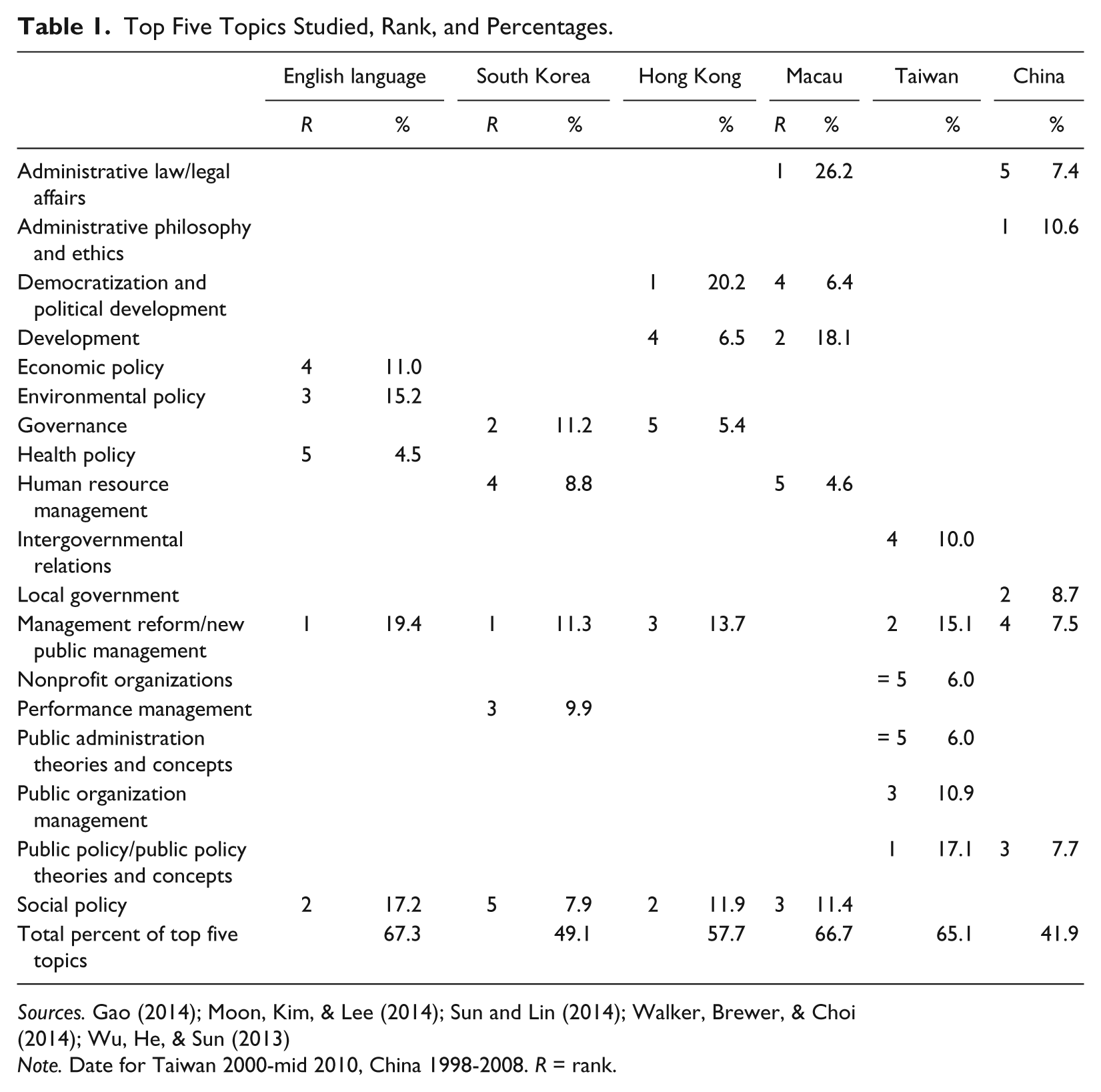
Table 1 provides an overview of the top five topics studied in the articles reviewed, with additional information included from Wu et al.’s (2013) study of academic articles from Mainland China. The table shows that these topics accounted for nearly two thirds of the English language, Macau and Taiwan studies, six out of ten studies from Hong Kong, and around half from Korea. The exception was China, where the five subjects made up just over 40% of studies, suggesting that a wider range of topics are pursued there.
Top Five Topics Studied, Rank, and Percentages.
Sources. Gao (2014); Moon, Kim, & Lee (2014); Sun and Lin (2014); Walker, Brewer, & Choi (2014); Wu, He, & Sun (2013)
Note. Date for Taiwan 2000-mid 2010, China 1998-2008. R = rank.
In the articles examined, the most frequently studied topics were management reforms/New Public Management (NPM; all countries bar Macau), followed by social policy (bar Mainland China and Taiwan, but note the interest there in public policy; Table 1). Management reforms and NPM have been important themes across East Asia as governments have sought to adjust the state to two major economic upheavals: the Asian financial crisis of the late 20th century and the global recession following the financial collapse of the early 21st century (Berman et al., 2009). Scholars have worked to understand the nature of these reforms and their implications for public administration and the delivery of services. Social policy has also been an important recent topic, as the economies of East Asia have grown apace. Governments in the region have needed to balance social development and the funding and provision of good-quality services in education, health, housing, and income maintenance with economic development, which has often been given more importance (Ramesh, 2004).
Beyond these themes of management reform and social policy, there is a divergence between the English language articles found in the SSCI and those written in native languages. Of the 18 topics listed in Table 1, just over half are only examined on one occasion. Of the top five topics studied in Taiwan, four are unique to the country, which suggests that academics there pursue their own local agendas, such as intergovernmental relations following a substantial reorganization of local government (Sun & Lin, 2014). Two topics are pursued solely in Mainland China, and academics writing in English have a stronger interest in policy issues. 1
Interest in some topics does span more than one country. There is a strong orientation toward legal issues in China and Macau, for example, and toward public policy in China and Taiwan. A similar focus would also be expected in Japan (which was not reviewed in this symposium), where public administration is also dominated by a legal tradition (Berman et al., 2009). The transitional nature of Hong Kong and Macau and their decolonization are reflected in their interest in development and political change.
These observations concerning studies written in local languages reinforce the preliminary conclusion reached in the English language overview (Walker et al., 2014): that is, academic studies in East and Southeast Asia focus on different topics to those in the West, particularly in the United States. For example, the review by Pitts and Fernandez (2009) indicates that the top five areas of public management examined at the Public Management Research Association meeting, taking into account nearly 50% of all papers, were (1) networks, privatization, contract, and “Hollow State”; (2) organizational change and innovation, (3) public management reform; (4) diversity management and representative bureaucracy; and (5) research methods and epistemology. Future studies could track the trajectories of these topics.
Method
The fourth conclusion reached about academic work in the region is somewhat negative: that more systematic and rigorous methods are required in the study of public administration, and that they need to be comprehensively documented in the articles written.
The articles in the review examined whether the studies were descriptive, exploratory, or explanatory. 2 The balance of work tipped toward descriptive in Hong Kong and Macau, Mainland China, and Taiwan (Gao, 2014; Sun & Lin, 2014; Wu et al., 2013) and toward exploratory in the English language studies (Walker et al., 2014). Research in South Korea, which sought to test theories, was predominantly explanatory (Moon et al., 2014). This may reflect the tradition of the U.S. training in South Korea, whereas some of the top five topics studied (Table 1) lend themselves to theory testing. Sun and Lin (2014) note that many Taiwanese scholars are also trained in America; however, they have not adopted the same approach to research.
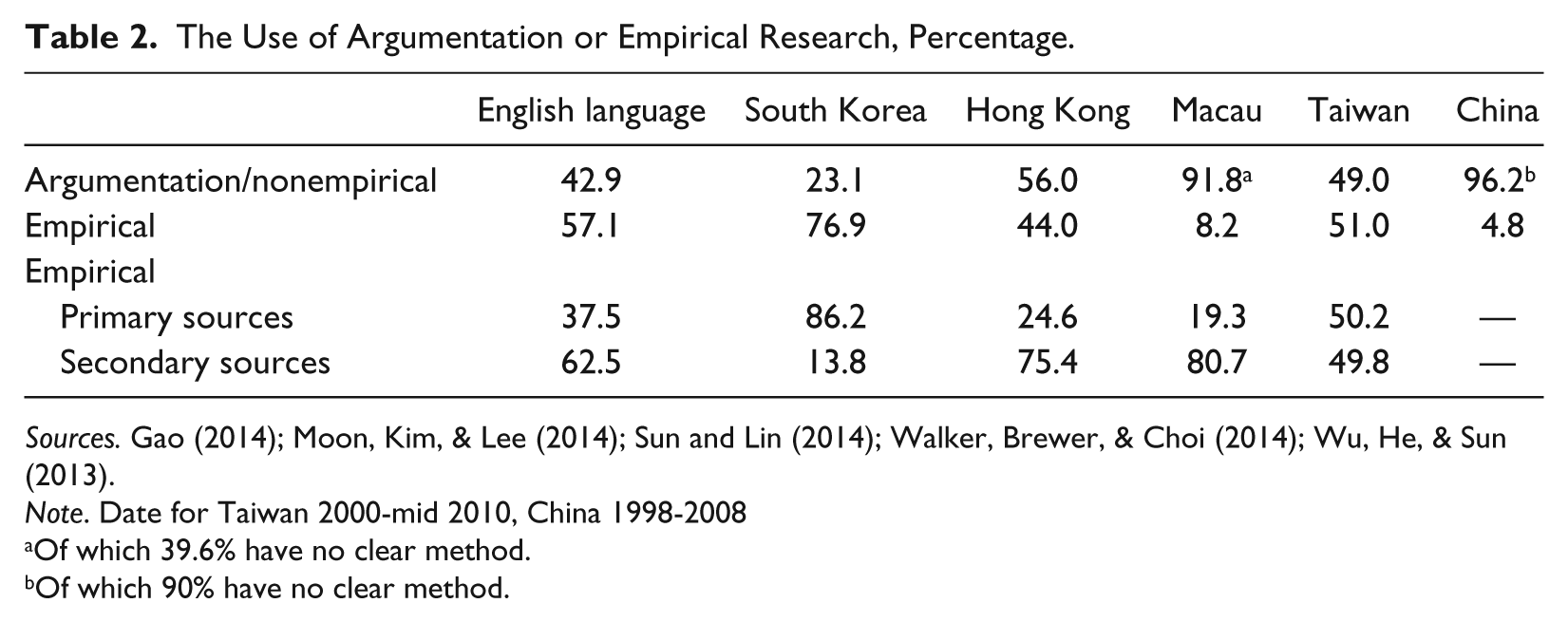
Table 2 summarizes the findings on the methodological approach the studies took: argumentation or empirical (qualitative or quantitative). The table reinforces the emphasis on descriptive work noted above—argumentation is an important approach to academic study in the region, particularly in Hong Kong, Macau, and Mainland China. In South Korea, where studies were more likely to be explanatory, they exhibited an empirical orientation and were more likely to collect primary data. The English language studies of East and Southeast Asia, which had a tendency toward the explanatory, were also empirical in their approach but were more reliant on secondary data. Secondary data collection was also prevalent in Hong Kong and Macau, with Taiwan almost equally divided between the two approaches to data collection.
The Use of Argumentation or Empirical Research, Percentage.
Sources. Gao (2014); Moon, Kim, & Lee (2014); Sun and Lin (2014); Walker, Brewer, & Choi (2014); Wu, He, & Sun (2013).
Note. Date for Taiwan 2000-mid 2010, China 1998-2008
Of which 39.6% have no clear method.
Of which 90% have no clear method.
In Mainland China and Macau, Gao (2014) and Wu et al., (2013) note that many of the studies have no method. In contrast, Sun and Lin’s (2014) analysis shows evidence of change: from 1990-1999 to 2000-2010 the proportion of empirical work using primary data grew from 34.9% to 50.2% of the empirical studies published. Though using data from only one country, this changing approach to academic study offers some optimism that scholars are beginning to engage in more robust approaches to their research designs.
These concerns over methodological approaches to research reflect those of others who have examined the comparative nature of public administration research in different parts of the world from an English language perspective (Gulrajani & Moloney, 2012; Van Wart & Cayer, 1990). The challenge to the academic public administration community is to move away from descriptive and exploratory research toward systematic theory testing. However, there are problems with this in some parts of East and Southeast Asia. Of the countries identified in Table 2, empirical research is possible in South Korea and Taiwan because social science research methods can be implemented in a manner that conforms to the standards of SSCI journals. However, this is not necessarily the case in Mainland China and Macau. A number of recent studies have highlighted the challenges of implementing robust research methods, notably the complexity resulting from the convergence of politics and administration in Mainland China (see, for example, Su, Walker, & Xue 2013).
Institutional Context
The institutional context is important in driving the nature of academic research: In South Korea, for instance, research more akin to that of the North American mainstream is produced and articles are explanatory, whereas in Macau the context has a more legal focus with a large number of practitioners contributing articles. This perhaps reflects the city-state’s European colonial history and its subsequent reunification with China.
The review of the SSCI English language journals found that just over half of the articles were sole authored (54.7%), with the balance joint authored (46.3%), of which many were comparative. Sole authorship predominated in Taiwan (78.9%) and China (67.4%). In contrast, much of the work in Korea was joint-authored and likely to be explanatory. Wu et al. (2013) also note that explanatory work was more likely to be undertaken by junior academics, and Sun and Lin noted a shift over time toward more theory testing. Whereas it is suggested that much of the research in the region is descriptive, these morsels of evidence indicate that there is a general shift toward more analytical work. It is possible that this trend will continue over time as the expectations of universities in the region rise and they engage in internationalization programs in the field of public administration (Walker, 2011).
Limitations
Reviews that seek to provide an overview of a broad topic, such as public administration research in a region, suffer from a number of limitations. In this symposium, limitations have included variations in the depth and variety of research articles reviewed by study. Furthermore, given our aim of reviewing and contrasting the English language and native language material, the basis for our investigation had to vary by study. As the field of public administration develops in East and Southeast Asia and additional material becomes available for review, it will become possible to undertake more systematic investigations that can address in more depth the nature of knowledge in the region, how research affects policy and practice, and how public administration scholarship has evolved and changed over time. Similar endeavors to build a more comprehensive picture could also be directed at public administration education.
Footnotes
Declaration of Conflicting Interests
The author(s) declared no potential conflicts of interest with respect to the research, authorship, and/or publication of this article.
Funding
The author(s) disclosed receipt of the following financial support for the research, authorship, and/or publication of this article: This study was supported by the National Research Foundation of Korea Grant funded by the Korean Government (NRF-2011-330-B00194).