



Abstract
Public servants are expected to be good stewards of resources, including the energy and environmental resources consumed in a public organization’s day-to-day operations. Many government organizations have enacted policies to mitigate the environmental impact of their operations. Even in the absence of formal policies, however, individual public employees might engage in a number of discretionary, pro-environmental behaviors known as eco-initiatives. What motivational factors cause a public employee to exhibit eco-initiative? To answer this question, we draw on a theoretical framework based on connectedness to nature, organizational commitment, public service motivation (PSM), and organizational citizenship behavior (OCB). We use employee-level data from a large city in the southeast United States to examine employee participation in individual eco-initiatives. We contextualize these discretionary initiatives as interesting forms of OCB, which are directed toward the environment (OCB-E). Our findings suggest that connectedness to nature, organizational commitment, and PSM are significant predictors of eco-initiative in the public workplace. In addition, we find that PSM conditions the impact of organizational commitment on eco-initiatives for certain types of employees. We conclude with a discussion that underscores the importance of individual employee motivation in discretionary efforts that advance OCB-E and effective public stewardship generally.
Keywords
In the United States, government institutions play prominent roles in environmental policy. From federal to local agencies, public organizations have become increasingly responsible for the formulation and implementation of environmental policies (Mazmanian & Kraft, 2009; Rabe, 2006). The problems that these institutions seek to address are equally prominent. Air and water quality, biodiversity, population and climate change, and resource conservation are but a few examples of the problems society often looks to public institutions to address (Kraft, 2010). To this end, many public organizations have taken steps to initiate environmental protection policies that govern their own internal operations. A number of scholars have examined the “self-regulation” of government agencies with respect to the environment (e.g., Durant, Fitzgerald, & Thomas, 1983; Paehlke, 1991; Wilson & Rachal, 1977). 1
Less studied, however, are the discretionary pro-environmental behaviors of government employees within public organizations. To date, there are no studies that examine public employee participation in pro-environmental behaviors, even though the general management and vocational psychology literatures have started to explore the question in other contexts (Daily, Bishop, & Govindarajulu, 2009; Ramus & Steger, 2000; Robertson & Barling, 2013; Scherbaum, Popovich, & Finlinson, 2008). We will draw on this research, integrating public service motivation’s (PSM) sensitivity to public institutions (Perry & Wise, 1990), to better illuminate individual employee participation in discretionary pro-environmental behaviors in public organizations.
According to the U.S. Census Bureau (2007), there are approximately 3 million federal civilian employees and 15 million state and local government employees in the United States. Within their respective public organizations, these millions of employees may personally choose to take steps to act as stewards of the environment. Employee-level discretionary pro-environmental behaviors can help to mitigate the public sector’s impact on the natural environment. Conserving work-related resources, such as water, paper, and energy, can also result in the conservation of scarce fiscal resources.
In this study, we explore the motivational and attitudinal bases of public employee workplace eco-initiative. First, we offer a brief background underscoring how public service organizations may have important effects on environmental policy. Second, we draw on the conceptual work of Daily et al. (2009) to examine participation in individual eco-initiatives, a subset of extra-role (i.e., non-mandatory) behaviors referred to as organizational citizenship behavior directed toward the environment (OCB-E). Third, we integrate literatures examining connectedness to nature (one’s non-work-related proclivity to behave pro-environmentally), organizational commitment, individual PSM and employee extra-role behavior to explore employee participation in discretionary workplace eco-initiatives. Using a sample of local government employees from a large municipality, we analyze the relationships among connectedness to nature, organizational commitment, and PSM and participation in workplace eco-initiatives. Finally, we conclude the article with a discussion of the findings, ideas for future research, and implications for policy and practice.
Motivation and Discretionary Pro-Environmental Behaviors
Organizations and Environmental Initiatives
Researchers have identified a number of reasons why an organization might choose to promote environmental sustainability in its day-to-day operations (Bansal & Roth, 2000; Shrivastava, 1995). These reasons include reducing operating costs by reducing ecological inefficiencies, enhancing corporate legitimacy and social responsibility, creating a competitive advantage among “green”—or environmentally conscious—consumers, enhancing the corporate image through environmental responsiveness, reducing the production risks associated with resource depletion, reducing energy costs, improving pollution management practices, mitigating health risks to the local community, and positioning the organization ahead of the regulatory curve. For some organizations, ecological sustainability even plays a role in strategic planning (Shrivastava, 1995, p. 955). Epstein and Roy (2001) concluded that organizations should look to local, social, and environmental issues to serve as the external drivers of the “corporate strategy.” These issues can be used to help identify relevant stakeholders, as well as guide organizations toward incorporating relevant environmental performance measures into their corporate strategies. Other organizations have incorporated ecological sustainability into their performance reporting systems, such as Balanced Scorecards, by creating measurable objectives for different dimensions of environmental performance (Stringer, 2009).
Public organizations have adopted formal policies to govern their internal operations and mitigate negative environmental impact. For example, sustainable building policies (e.g., Charlotte, North Carolina; Chicago, Illinois; New York City, New York; Phoenix, Arizona; Seattle, Washington; and Portland, Oregon) and green purchasing policies (e.g., Santa Monica, California) have become ubiquitous over the last 20 years. Although the policies vary, they all might be viewed as ways to institutionalize normative expectations that government organizations are not only responsible for promulgating environmental policy but that they themselves also ought to act as good stewards of environmental resources. Although these formal policies have garnered the interest of scholars (e.g., Durant et al., 1983; Paehlke, 1991), our study examines discretionary pro-environmental behavior that occurs within public organizations but outside the scope of a formal policy or internal mandate.
We feel our exploration is warranted because in addition to formal policies that promote environmental stewardship and sustainability, there are individual-level pro-environmental behaviors that public employees may participate in at their own discretion. Materials use reduction (i.e., office supplies), recycling/reusing, and personal energy conservation are all within this realm of behavior, when not otherwise required by the employer. Participation in these discretionary behaviors supports the mission of public organizations with respect to stewardship of public resources—not simply those that are most obviously financial. In the following section, we better contextualize these discretionary behaviors and clarify supporting theories.
OCB, OCB-E, and Eco-Initiatives
In an effort to use common language throughout the article, we refer to behaviors that minimize an individual’s negative impact on the environment as “pro-environmental” (Clark, Kotchen, & Moore, 2003; Dahlstrand & Biel, 1997; Karp, 1996; Kollmuss & Agyeman, 2002; Nordlund & Garvill, 2002). Pro-environmental behaviors include those many describe as “green,” “sustainable,” or “environmentally innovative” (Ramus, 2002). For our purposes, individual-level employee participation in discretionary pro-environmental behaviors that may be encouraged, but not mandated, by an organization is referred to as eco-initiative.
As we explain later, scholars suggest that these behaviors belong to a class of employee actions known as OCB—behaviors that are spontaneous and undefined by formal roles or job descriptions (Katz, 1964). According to Smith, Organ, and Near (1983), “Every factory, office, or bureau depends daily on a myriad of acts of cooperation, helpfulness, suggestions, gestures of goodwill, altruism, and other instances of what we call citizenship behavior” (p. 653). Within an organization, citizenship behaviors are pro-social in nature and are examples of extra-role behaviors—actions that are explicitly non-task-related (P. M. Podsakoff, MacKenzie, Paine, & Bachrach, 2000).
Classic OCB definitions contemplate behavior
that is discretionary, not directly or explicitly recognized by a formal reward system, and that in aggregate promotes the effective functioning of the organization . . . [but] is not an enforceable requirement of the role or the job description . . . its omission is not generally understood as punishable. (Organ, 1988, p. 4)
Although there are many ways to conceptualize and operationalize OCBs, 2 one approach is to focus on the targets of OCB. Chiaburu, Oh, Berry, Li, and Gardner (2011) observed three categories of OCB based on the target of the behavior: (a) individual directed (OCB-I), (b) organizational directed (OCB-O), and (c) change directed (OCB-CH). Although this typology is not without drawbacks, a target-based approach may help advance public administration’s relatively new interest in OCBs (e.g., Christensen et al., 2013; Kim, 2006; Pandey, Wright, & Moynihan, 2008) by parsing categories of OCBs, thereby advancing an understanding that to what or to whom the OCB is directed is likely a function of potentially different determinants, each warranting its own investigation.
To this end, scholars have argued that individual, pro-environmental actions performed in a workplace are a particular type of OCB. Daily et al. (2009) call discretionary pro-environmental behaviors organizational citizenship behaviors directed toward the environment (OCB-E). OCB-E includes “environmental efforts that are discretionary acts, within the organizational setting, not rewarded or required from the organization” (Daily et al., 2009, p. 243). Daily et al. (2009) argue that employees who go above and beyond their job description by participating in helping behaviors specifically directed toward the environment can promote environmental performance in the aggregate. In contrast with task behavior that is required or mandated as part of employee performance, OCB-Es are voluntary. Thus, individuals who participate in OCB-E are likely driven by an internal mechanism other than self-interest related to self-preservation through compliance with formal organizational policies, rules, or mandates.
These discretionary workplace behaviors that target the environment and might include recycling, trash reduction, water conservation, and energy conservation when they are informal and performed at the discretion of individual employees. Boiral and Paillé (2012) classify these OCB-Es as individual eco-initiatives and define them as “discretionary behavior and suggestions to improve environmental practice and performance” (p. 442) of the organization. With this broader background connecting them to OCB, eco-initiatives are the behaviors that we investigate in this study.
Why investigate the motivational drivers of participation in individual eco-initiative? First, there are important implications for the public workplace. In the public sector, there is a normative argument that public organizations should act as stewards of the public’s environmental and natural resources. 3 Second, individual employee participation in eco-initiatives can improve internal practices with respect to environmental conservation and sustainability. In aggregate, these can lead to higher levels of environmental performance at the organization level. Finally, there are many cases where environmental conservation (e.g., energy conservation) might result in the reduction of organizational and fiscal costs (Boiral & Paillé, 2012).
In the following section, we explore potential drivers of OCB-E. Several recent studies are informative (Boiral & Paillé, 2012; Robertson & Barling, 2013), but they do not explicitly address participation in eco-initiatives within public institutions. In the following section, we develop hypotheses to examine the roles of environmental concern and connectedness, organizational commitment, and PSM in relation to individual employee participation in eco-initiatives.
Environmental Concern
An individual employee’s overall concern for the environment is a central variable to this study and is a key determinant in Daily et al.’s (2009) conceptual model of participation in OCB-E. They argue “that an individual’s personal environmental concern will be the strongest predictor of his or her propensity to engage in OCB-E” (Daily et al., 2009, p. 247). One measure of environmental concern is an individual’s connectedness to nature. According to Mayer and Frantz (2004), the connectedness to nature scale captures an individual’s affective connection with nature, and the degree to which they feel their own well-being is connected to the natural world. This affective connection has behavioral consequences, and there is evidence suggesting that a psychological connection to nature increases the likelihood of engaging in environmentally responsible actions (Gosling & Williams, 2010; Nisbet, Zelenski, & Murphy, 2009; Poortinga, Steg, & Vlek, 2004). We believe that public employees who have a deep environmental concern and feel strongly that their own personnel well-being is closely tied to the natural environment will be most likely to translate those attitudes into pro-environmental behaviors, including OCB-E in the public workplace. We test the following hypothesis accordingly as it applies to public workplaces:
Organizational Commitment
The second key explanatory variable in Daily et al.’s (2009) conceptual framework for individual participation in OCB-E is organizational commitment. Organizational commitment is one way to measure an individual’s dedication to the organization they work for (Balfour & Wechsler, 1996, p. 257). According to Mowday, Steers, and Porter (1979), “attitudinal commitment . . . represents a state in which an individual identifies with a particular organization and its goals and wishes to maintain membership in order to facilitate these goals” (p. 225). Although past studies yield mixed results regarding the relationship between employee organizational commitment and OCB (Lavelle et al., 2009; Schappe, 1998; Williams & Anderson, 1991), others suggest that OCB may be interpreted as behavioral manifestations of an employee’s attitudinal organizational commitment (N. P. Podsakoff, Whiting, Podsakoff, & Blume, 2009). However, as discussed above, there are many different behaviors that fall into the category of OCB, and although employees might maintain a general commitment to the organization, it is not always clear that it will manifest itself in participation in all forms of OCB or at the same the level. Thus, we take as a task to test this variable relative to eco-initiative.
Why might we expect organizational commitment to be related to the OCB-E among this particular set of employees? Although the city we examine never mandated employee participation in eco-initiatives, the organization had taken several steps to incorporate environmental conscientiousness into its formal operations. First, the city formed an environmental cabinet composed of department leaders to meet monthly. The cabinet meetings would facilitate interdepartmental collaboration and knowledge sharing to reduce the negative effects of the organization’s operations on the environment. Second, the city council elevated the environment to one of its key strategic focus areas, placing it in the company of Housing & Neighborhood Development, Community Safety, Transportation, and Economic Development & Planning in strategic importance. Finally, other policy initiatives, including the adoption of a sustainable facilities policy, were passed prior to the collection of the data. To be clear, although the city never mandated participation in the behaviors we investigate, the city had taken broad steps to signal the general policy importance of environmental preservation and sustainability within the workplace.
To support the city’s high-level goal of sustainability and the mitigation of negative environmental impacts, we expect that employees with high levels of organizational commitment would, in fact, demonstrate higher levels of participation in discretionary individual-level eco-initiatives. In the context of OCB-E, Daily et al. (2009) reason that
to the extent that individuals are willing to put forth effort on the organization’s behalf and accept the organization’s goals and values, they will direct their efforts in ways that they perceive will accomplish things that are valued by the organization. (p. 248)
Because the city in which we conducted this study had signaled the importance of high-level environmental goals and organization-level sustainability, although they did not require specific behaviors, we believe that highly committed employees will act in discretionary ways to help the city achieve this broad goal. We test the following hypothesis:
PSM
As an influential stream of research in public administration, PSM’s classic formulation taps a “predisposition to respond to motives grounded . . . in public institutions and organizations” (Perry & Wise, 1990, p. 368). Both in public and public-serving organizations, PSM has been used to explain individual employee participation in both workplace extra-role behaviors (Kim, 2006; Pandey et al., 2008) and pro-social behaviors beyond the workplace (Houston, 2006). PSM is therefore a natural starting point from which we build our understanding of public employee participation in OCB-E, that is, individual public workplace eco-initiatives. Rainey (2009) describes PSM as the ethic that motivates people to serve the public, or the “service ethic” (p. 266), and Vandenabeele (2007) describes PSM as the “beliefs, values, and attitudes that go beyond self-interest and organizational interest that concern the interest of a larger political entity and motivates individuals to act accordingly whenever appropriate” (p. 257).
Borden and Francis (1978) hypothesized that individuals with a “strong selfish or competitive orientation” are less likely to conserve environmental resources. Likewise “in order to act pro-environmentally, individuals must focus beyond themselves and be concerned about the community at large” (Kollmuss & Agyeman, 2002, p. 245, referring to Gellar’s “actively caring” hypothesis). Given the altruistic, pro-social nature of PSM, we believe that individuals with higher levels of PSM are more likely to participate in discretionary behaviors that promote the effective functioning of the organization. Beyond the organization, we believe similar behaviors will result from a related role that PSM plays in prompting behaviors that are outward and societally focused. Researchers have recently offered evidence supporting a positive correlation among PSM and extra-role behaviors in public organizations (Christensen et al., 2013; Kim, 2006; Pandey et al., 2008). The logic is that PSM may encourage certain discretionary behaviors, and OCB is a measurable manifestation of those motivations as behavior (Christensen et al., 2013). In support of this logic, Piccolo and Colquitt (2006) found experimental evidence of a positive relationship between altruism, arguably a type of PSM, and OCB. According to the authors, “ . . . individuals driven by self-generating rewards were more likely to perform discretionary behaviors that are rarely associated with external rewards” (Piccolo & Colquitt, 2006, p. 337).
We hypothesize for empirical examination whether PSM’s public organizational and general pro-social orientations manifest as individual eco-initiative. Individuals who are motivated by the publicness of their employing organizations and/or by the broader good of society will be more likely to participate in eco-initiatives. We test the following hypothesis:
Interactive Relationships Among Organizational Commitment and PSM
In addition to the direct effects of PSM (Hypothesis 3) and organizational commitment (Hypothesis 2) on employee eco-initiative, we entertain the possibility that these variables condition each other in relation to eco-initiative. 4 We purposely refrain from a causal hypothesis in the interaction because the field remains unsettled as to whether PSM is an antecedent (Castaing, 2006; Crewson, 1997), consequence (Camilleri, 2006), or just a correlate of organizational commitment (Pandey & Stazyk, 2008). However, studies that explore PSM’s relationship with organizational commitment—regardless of causal relationship—fairly consistently support a positive, often reinforcing, association. An employee’s “attachment to the organization is of particular importance to any effort to foster and sustain” PSM (Pandey & Stazyk, 2008, p. 111), and PSM is a key construct in explaining employees’ increased organizational commitment, particularly affective commitment public service organizations (Castaing, 2006).
In the context of our own study, we therefore hypothesize that these variables will not only reinforce each other but might also exhibit a substitutive effect. For individuals with low levels of organizational commitment, PSM may have a larger effect on individual participation in eco-initiatives than it will for individuals with higher levels of organizational commitment. In other words, we empirically explore the possibility that even if an employee does not really care about the fate of their own organization and is not committed to the organization’s goals, high-PSM employees—those who are motivated to act based on beliefs, values, and attitudes that concern the interest of a larger political or social entity—may still participate in pro-environmental eco-initiatives at a high level. In short, when an individual’s own connection to their organization is not enough to drive participation, PSM may play a larger role in workplace eco-initiative. We therefore test the following hypotheses:
Data and Measures
Data
We use survey data from a large city in the southeast United States to test our hypotheses. An electronic survey was designed to help city leaders understand the likelihood of employee participation in discretionary pro-environmental behaviors, or OCB-Es, as well as identify specific barriers to participation and possible incentives that might be used in the future to encourage participation. To be clear, although the city had initiated a number of formal policies aimed at environmental protection (i.e., sustainable building policy) and elevated the environmental sustainability to an area of strategic importance for city council, at the time the data were collected there was no city-wide plan or policy mandating any of the behaviors we examine, and all the behaviors were performed at the employee’s discretion.
The survey population included 3,120 city employees with email addresses in the following departments: Department of Engineering and Property Management, Neighborhood and Business Services, City Attorney’s Office, Police Department Headquarters, the Fire Department, Utilities, Human Resources, Budget and Finance, Planning Department, Business Support Services, the City Attorney’s Office, and the City Manager’s Office. The survey was distributed on a listserv to all employees with a city email address working in an office building or extension. In addition, communications representatives were asked to help distribute the survey within their own departments. Two reminders were sent to those receiving the survey. The survey was open for approximately 3 weeks and yielded 843 responses, generating a response rate of approximately 27%.
Dependent Variable
Eco-initiative index
An index measuring the likelihood of employee participation in OCB-Es known as eco-initiatives is the dependent variable in all our models. To operationalize employee participation in eco-initiatives, we measured the likelihood of employee participation in discretionary pro-environmental workplace behaviors that met three criteria. First, all the behaviors were pro-environmental, or might be described as supportive of recycling, water conservation, or energy conservation. Second, all of the behaviors had to be discretionary—none of the behavior could be mandated by either the department or the city we examined. To ensure that all the behaviors were, in fact, discretionary, the items were vetted at a meeting of the city’s environmental cabinet to ensure that nowhere in the organization were employees being formally encouraged to participate. Finally, every employee had to have the opportunity to participate in the behavior if he or she chooses to do so.
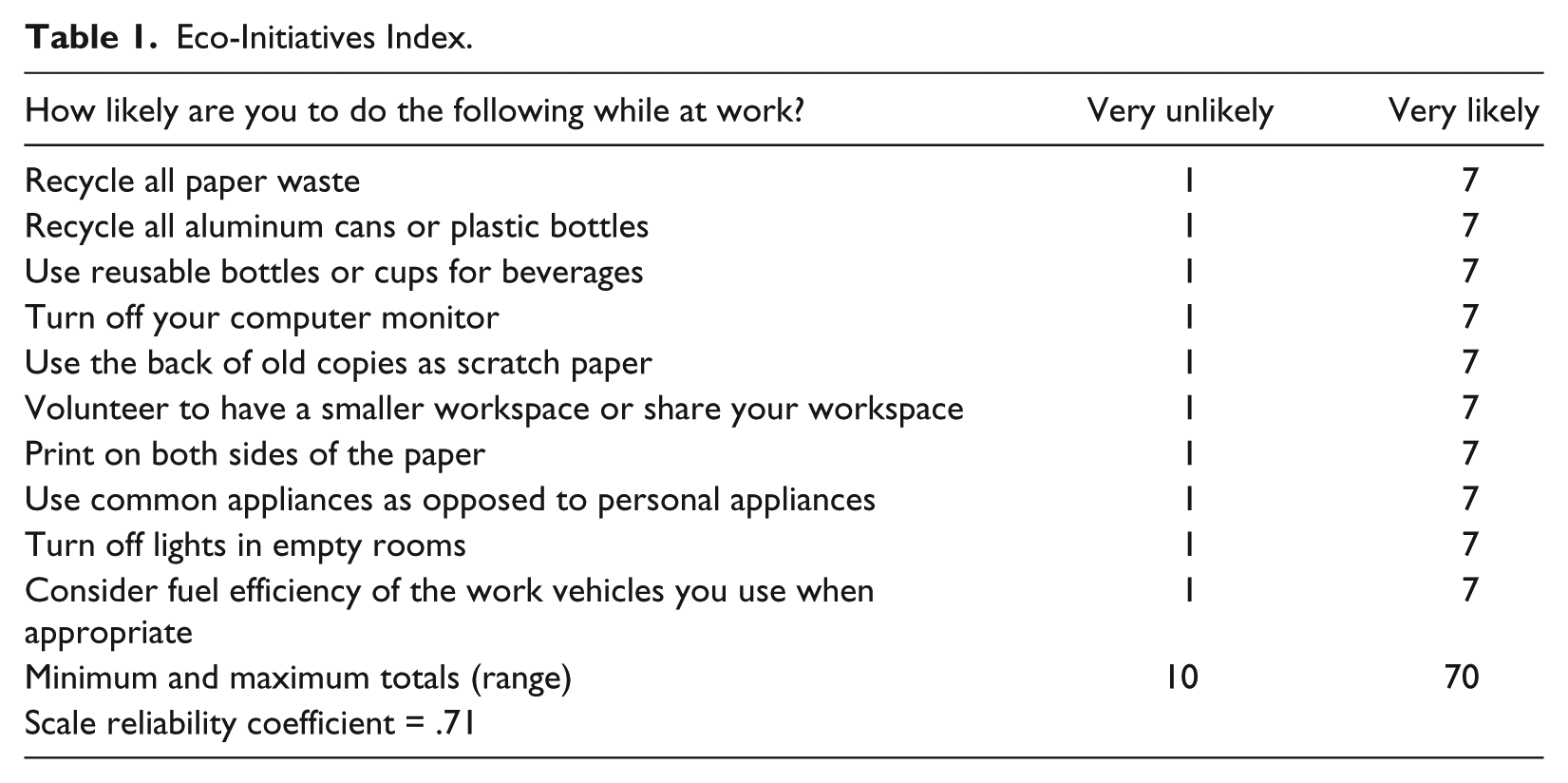
We operationalize eco-initiatives by creating an index score from employee responses to 10 survey questions that asked respondents the likelihood of their participation in a specific pro-environmental behavior while at work. After all the survey questions were evaluated, we determined that 10 questions were applicable to all city employees in the survey population. The questions are available in Table 1. A 7-point Likert-type scale is used to measure responses. The eco-initiatives index score ranges from 10 to 70, with a mean value of 49.96. The scale reliability coefficient for the variable is .71. 5 Descriptive statistics for our independent variables are reported in Table 2.
Eco-Initiatives Index.
Descriptive Statistics and Correlations.
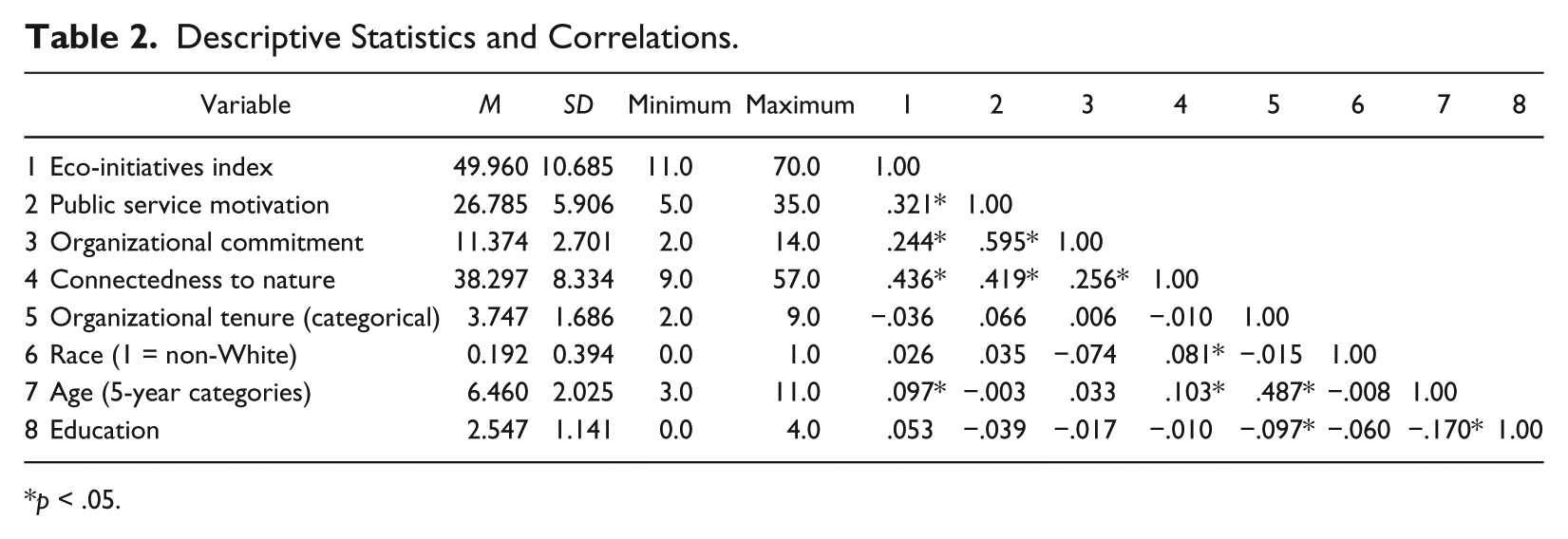
p < .05.
Connectedness to nature
An individual employee’s predisposition toward the environment is an important independent variable in the study, because it is likely related to OCB-E. To capture pre-existing environmental attitudes, we use Mayer and Frantz’s (2004) measure of connectedness to nature. 6 The questions are worded to measure “connectedness” to the environment and not simply an employee’s opinions on the importance of environmental stewardship—which might result in socially desirable responses. The original scale has 14 questions, but we omitted 2 questions at the city’s request due to their politically sensitive nature. The environmental connectedness measure is an index ranging from 12 to 60, with a mean of 38.29. The measure has a scale reliability coefficient of .86.
Organizational commitment
Two questions measured a respondent’s attitudinal organizational commitment (see Mowday et al., 1979). 7 The combined scale ranges from 2 to 14 and has a mean value of 11.37. The scale reliability coefficient is .67.
Public service motivation
PSM is the main independent variable of interest in our models. We operationalize PSM by constructing an index score from employee responses to five survey questions. 8 Researchers have used these five questions to operationalize PSM in prior research (e.g., Alonso & Lewis, 2001; Kim, 2005, 2006; Pandey et al., 2008; Wright & Pandey, 2008). Each question measures employee responses on a 7-point Likert-type scale. The index is a unidimensional measure of PSM that captures the public interest, compassion, and self-sacrifice dimensions suggested by Perry (1996). The PSM index score ranges from 5 to 35, with a mean of 26.78, and a .81 scale reliability coefficient.
Control Variables
In addition to the main dependent and independent variables of interest, there are several demographic variables that we include in our models.
Educational attainment
Van Liere and Dunlap (1980) found a positive relationship between educational attainment and participation in pro-environmental behavior. Dummy variables are created to control for educational attainment. We generate dummy variables for the following groups: less than high school, high school, some college, bachelor’s degree, and more than a bachelor’s degree.
Age
Van Liere and Dunlap (1980) also found a negative relationship between age and participation in pro-environmental behaviors. To control for age, we measured age in 5-year increments (<30, 30-34, 35-39, 40-44, 45-49, 50-54, 55-59, 60-64, and >64) and created a dummy variable for each group.
Minority
Dietz, Stern, and Guagano (1998) found that minorities were more likely to support pro-environmental behavior outside of the workplaces, including consumer spending on environmentally safe products and government spending on environmental protections. We control for minority status with a dummy variable (non-White individuals are coded with a “1,” and those who are White are coded with a “0”).
In addition to demographic characteristics of individuals, contextual factors may influence the likelihood of a person’s participation in OCB-E (Corraliza & Berenguer, 2000; Diekmann & Preisendorfer, 2003; Stern, 2000). To incorporate different employment contexts and work environments into the models, we include an employee’s organizational tenure, workspace, and department. These variables help control for differences in organizational culture, individual status, and physical barriers that could either facilitate or hinder participation in OCB-E and eco-initiatives.
Public sector tenure
We measure public sector tenure in 5-year increments (5 or less, 6-10, 11-15, 16-20, 21-25, 26-30, 31-35, and more than 35 years). A dummy variable is constructed for each category. The dummy variable for those with 5 or fewer years of experience is dropped from the analysis and serves as the comparison group.
Department
To control for differences among departments, we create a dummy variable for each department surveyed. In large organizations, differences in cultures, norms, and leadership might exist among different departments. We recognize that this could influence employee OCB-E. For instance, a solid waste department’s employees might have greater knowledge about recycling initiatives than employees in human resources or finance. The department dummy variable is an attempt to control for these differences. In addition, leaders in different departments might emphasize the importance of environmental conservation and sustainability more than others. Although we are unable to directly operationalize managerial support for environmental conservation as Daily et al. (2009) suggest in their model, including department dummy variables might capture some of this variation due to differences among department heads.
Workspace
We include dummy variable to control for a number of different work environment characteristics (e.g., private office, shared office, reception desk, cubicle, and field) that might influence participation in individual eco-initiatives. For instance, individuals in private workspaces might face less social pressure to participate from their co-workers. Likewise, individuals who spend a large portion of their time in the field might be disconnected from certain messages communicated in the organization that signal environmental sustainability as an area of strategic focus.
Analysis
We use ordinary least squares (OLS) regression to analyze the relationships between the key independent variables and participation in the subset of OCB-Es described as eco-initiatives. Huber–White standard errors are reported to ensure the standard error estimates are robust to a heteroskedastic error distribution. In Table 3, we present the findings of the direct relationships between the main variables of interest and employee participation in eco-initiatives. For the reader to compare models, we present the models hierarchically, beginning with Model 1, a null-model that contains none of the main independent variables of interest.
Employee Participation in Workplace Eco-Initiatives.

Note. Robust standard errors in parentheses. PSM = public service motivation.
p < .10. *p < .05. **p < .01.
We add the independent variables in the order in which we hypothesized about each one’s relationship with participation in eco-initiatives. This provides the reader with the opportunity of seeing the change (all increasing) in the adjusted R2 across the models. With respect to our interpretation of the direct, independent effects of environmental concern (connectedness to nature), organizational commitment, and PSM, we will focus our discussion on the results found in Model 4.
We hypothesized that employees with high levels of environmental concern, or environmental connectedness, would be more likely to translate those concerns into behaviors than employees with low levels of environmental concern. Table 3 provides support for Hypothesis 1 in a positive relationship between connectedness to nature (environmental concern) and participation in eco-initiatives. A 1-unit change in the connectedness to nature scale results in a 0.405-unit increase in an individual’s eco-initiative index. The coefficient is statistically significant at the .01 level.
Drawing on Daily et al.’s (2009) conceptual model, we hypothesized that organizational commitment would be positively related to participation eco-initiatives. Based on the fact that the city in which the study was conducted had signaled—without formally encouraging or mandating—the importance of environmental impact mitigation and sustainability, we argued in that individuals sharing the values and goals of the organization—as demonstrated by organizational commitment—would have higher rates of participation in individual eco-initiatives. The results in Table 3 support Hypothesis 2. According to Model 4, a 1-unit increase in the organizational commitment index will result in a 0.605-unit increase in the eco-initiative index. The result is significant at the .01 level.
Finally, we argued that individuals with strong pro-social motivation, manifest in a connection to a public organization and/or a desire to serve society and the larger community, would transform those motivations into participation in pro-environmental initiatives. We find support for Hypothesis 3. PSM exhibits a positive, direct relationship with employee participation in workplace eco-initiatives. Model 4 in Table 3 indicates that, on average, as PSM increases by 1 unit, an individual’s eco-initiative index will increase 0.328 units.
In Model 5, we introduce the interaction term between PSM and organizational commitment. All of the key independent variables remain statistically significant, and the direction of their relationships with the eco-initiative index remains the same. The significance of the individual coefficient and increased R2 of the entire model indicates support to consider the interactive effect between organizational commitment and PSM. The substantive importance and contours of that effect are discussed below.
Figure 1 shows how PSM conditions the effect of organizational commitment on eco-initiative. In the figure, we see that organizational commitment has the largest average marginal effect on eco-initiative participation when PSM is low. As PSM increases, we see that the average marginal effect of organizational commitment decreases. Ultimately, at higher levels of PSM (above ~29.5), the effect of organizational commitment on the eco-initiative index becomes statistically indistinguishable from zero.
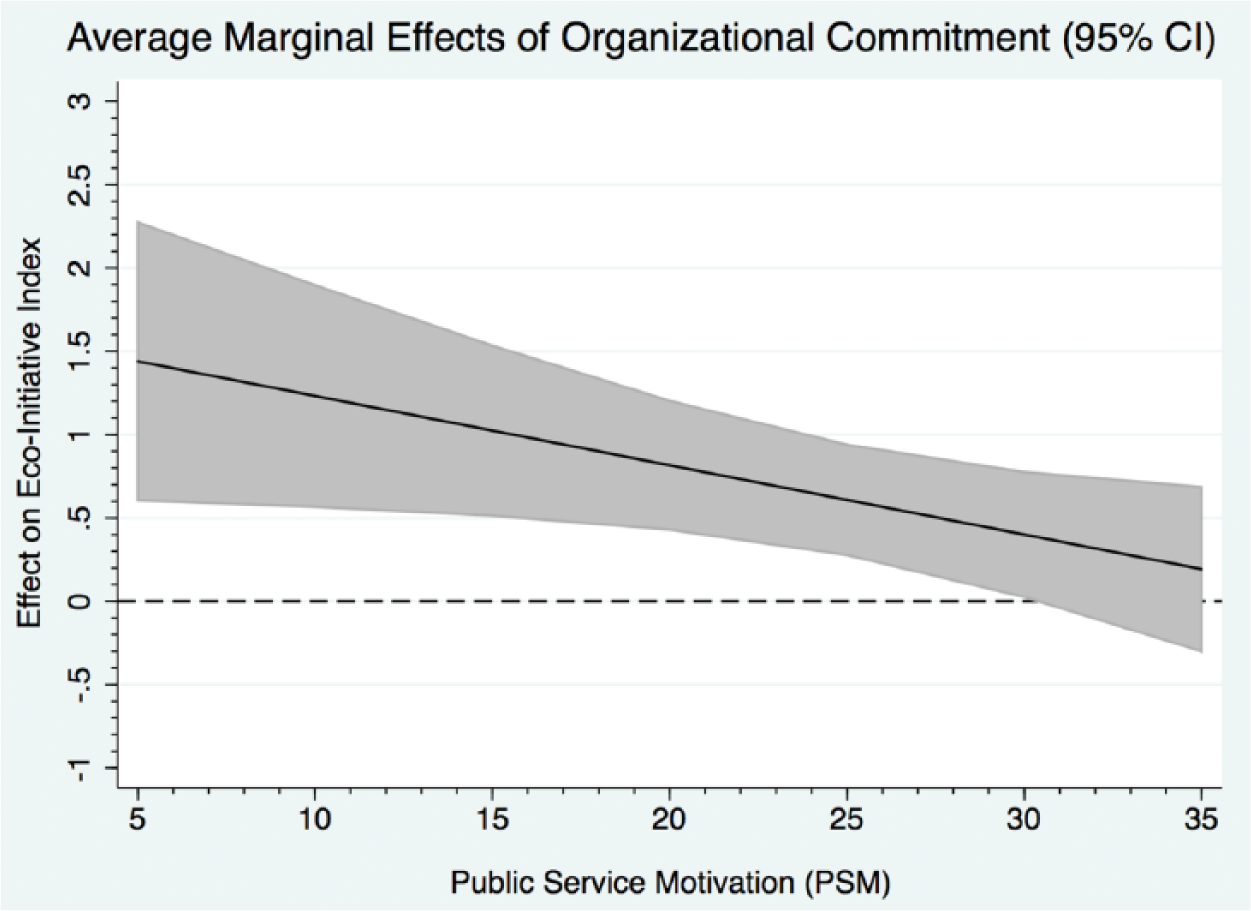
Average marginal effects of Organizational commitment × PSM.
While this partially supports Hypothesis 4b (discussed below), Figure 2 allows us to visually examine the substantive impact of interaction in a different way. Figure 2 demonstrates the amount of predicted linear change in the eco-initiative index with a one-unit change in PSM on organizational commitment at two constant values: one standard deviation above the mean (high organizational commitment) and one standard deviation below the mean (low organizational commitment). The shaded areas around the two lines are the 95% confidence intervals of the predicted value of a respondent’s eco-initiative index values.
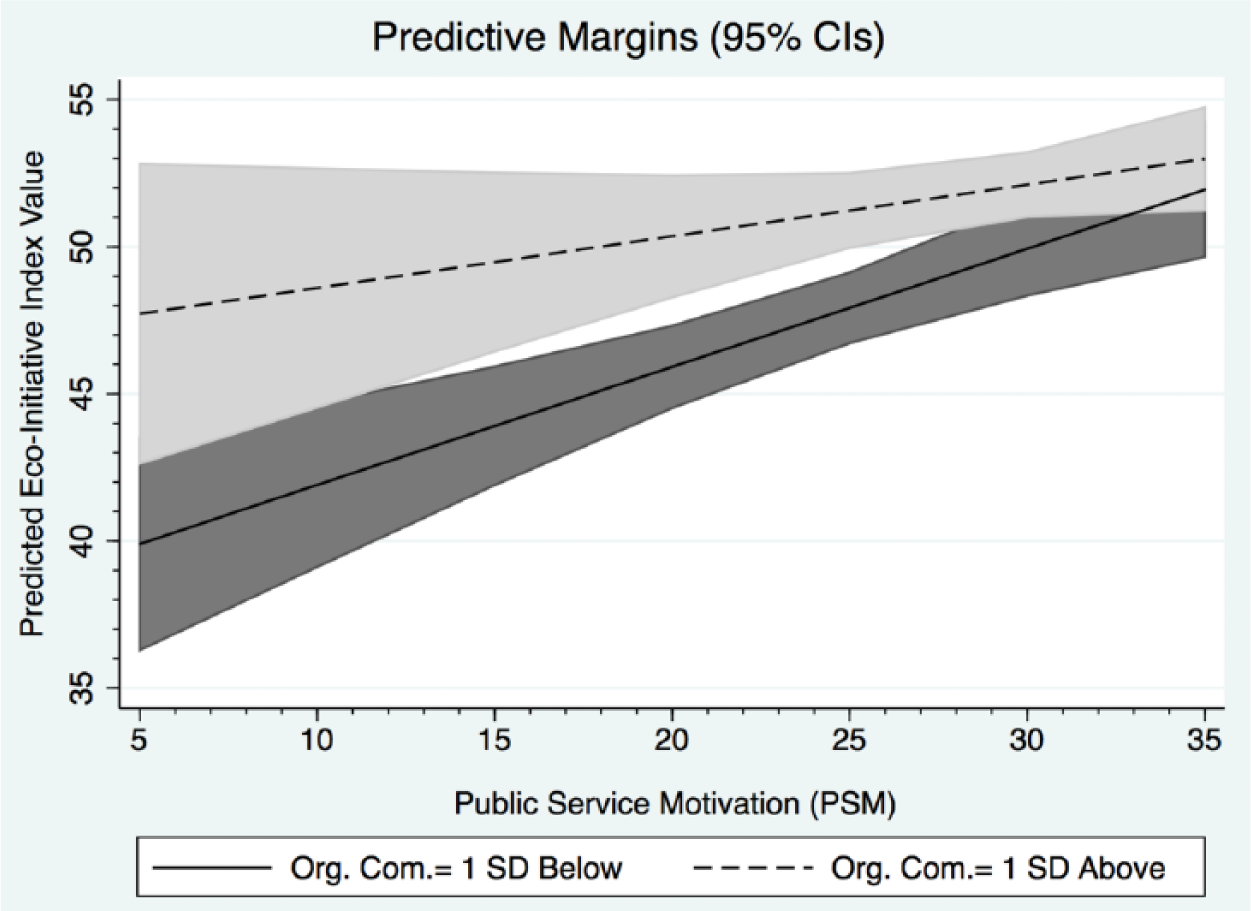
Predicted linear change in DV: Conditional impact of PSM on high and low organizational commitment.
In Figure 2, we see visual partial confirmation of Hypothesis 4a. Employees with high levels of organization commitment and PSM reported higher levels of eco-initiative. In our figure, where we have tested this effect at two values (high and low organizational commitment, ±SD), this difference is statistically significant (i.e., confidence intervals of the two plotted lines do not overlap) for employees with PSM levels ranging from ~11 to 28. We interpret this as partial evidence of the reinforcement effect we hypothesized earlier. PSM and organizational commitment reinforce each other for a meaningful range of PSM values (i.e., below, at, and slightly above average PSM values).
We also note some support for Hypothesis 4b, which introduced a possible substitutive effect. Figure 1 already introduced some of this evidence in displaying the limited importance of the interaction at high levels of PSM. We observe further evidence, in Figure 2, that the predicted value of the eco-initiative index increases at faster rate for those with low organizational commitment across the range of increasing PSM values. This is manifest in the steeper slope of the line. In fact, the figure shows that PSM can act as a substitute for organizational commitment for certain employees. An individual who is low in organizational commitment, but very high PSM, will have approximately the same eco-initiative index score as an individual who is high in both PSM and organizational commitment. These differences are statistically indistinguishable (i.e., confidence intervals overlap) for a portion of high-PSM employees.
Discussion and Conclusion
Our study shares the same empirical limitations as all cross-sectional survey research. Specifically, temporal sequencing and spuriousness are the greatest threats to the causal relationships we propose among connectedness to nature, organizational commitment and PSM and individual eco-initiative participation, a form of OCB-E (Boiral & Paillé, 2012) in the public workplace. We have tried to establish the temporal sequence of events (PSM preceding eco-initiative participation) and mitigate the threat of spuriousness through theoretical founding and through the design of our research (see Perry et al., 2008; Wright, 2008). By measuring PSM with questions anchored in the present and asking about the likelihood of future participation in eco-initiatives—as opposed to past participation—we establish temporal sequencing to the degree possible in cross-sectional research.
Although response bias is always a potential problem in cross-sectional organizational survey research, we took several steps to try to limit bias in the results. First, although the information officers sent out the survey internally, the data were collected for the city by a third party. Second, employees were informed that the data would only be reported to the city in an aggregate form and no unique identifiers would be stored. Third, it was made clear in the invitation to participation that no manager had access—or would have access—to the individual responses. The researchers ensured anonymity to the employees. Finally, we found no issues in the variance of responses on any key variable to suggest systematic bias in the respondents.
To overcome the limitations of cross-sectional survey research, future research on the relationship between PSM and OCB-Es, including eco-initiatives, might include experimental or observational designs. For instance, researchers might measure an individual’s PSM and then place the individual into a treatment condition where they are given a choice between performing an OCB-E (recycling an aluminum can) or a non-OCB-E behaviors (placing aluminum can in trash). Based on our findings, we might predict that individuals higher in PSM will recycle more often than those with lower levels of PSM.
We believe employee motivation (specifically PSM) and extra-role behavior as a framework for inquiry serves as a starting point for future research on public employee participation in OCB-E. To our knowledge, this is the first systematic study to explore underlying motivational forces that affect discretionary participation in pro-environmental behaviors among public employees. We recognize, however, that further theoretical development is needed as it relates to the OCB-E construct. For instance, the range of OCB-Es available for employees to participate in might vary from organization to organization. One organization might adopt a formal policy encompassing more pro-environmental behaviors than a second organization. As a consequence, the behaviors mandated in the first organization are no longer extra-role in nature and fall outside of the scope of OCB-E, but these same behaviors might remain OCB-E in the second organization. This represents a challenge in the operationalization of OCB-E and examining the construct in different organizational and institutional contexts.
Although we narrowed our focus to only eco-initiatives, researchers need to build an understanding of how the range of employee OCB-E might vary across different types of organizations. Pursuing this line of research might allow scholars to connect formal policies requiring pro-environmental behavior in public organizations (e.g., Durant et al., 1983; Paehlke, 1991; Wilson & Rachal, 1977) with employee participation in eco-initiatives. In addition, future research can build on the Daily et al. (2009) framework to examine the role of leadership and managerial support in cultivating motivations and attitudes that lead to OCB-E.
Despite these limitations, the research discussed above offers a number of contributions to our understanding of PSM and eco-initiatives in a public organization. First, the article initiates a discussion of public organizations and environmental sustainability in the public management research literature. Following a discussion of private sector sustainability, we recognize a normative argument that public organizations have a responsibility to act as stewards of community resources. Although this obviously includes financial resources, we discuss how this might also include environmental resources. We found some evidence that public employees, through their motivation and attitudes, stand ready to make a positive, individual impact in environmental policy. Clearly, formal policies are not required for all public employees. In fact, one open question is whether formal policies would discourage those who would otherwise voluntarily participate in OCB-E. 9 For other types of employees, however, organizations might adopt formal policies to advance environmental stewardship. In short, we argue that environmental stewardship and resource conservation are something that we ought to be concerned with and better understand within public organizations. One type of policy clearly does not seem appropriate for all types of public employees.
Second, rather than study organization-wide environmental policy initiatives or mandates as other scholars have (e.g., Durant et al., 1983; Paehlke, 1991; Wilson & Rachal, 1977), we focus on the micro-level employee behaviors that support broader goals and missions. In this article, we argue that pro-environmental behaviors are a form of extra-role behaviors called OCB-E that support the public organization’s stewardship of the public’s natural resources. Specifically, we focused on a subset of OCB-E, described in the literature as individual workplace eco-initiatives (Boiral & Paillé, 2012).
Consequently, we seek to build a better understanding of the motivational reasons public employees have for engaging in these behaviors. To do this, we draw on the work of Daily et al. (2009) but incorporate a theory of PSM to include the pro-social and altruistic motivations that might drive employee participation in eco-initiatives and other OCB-E. PSM provides such a framework to understand individual participation in voluntary pro-environmental behaviors in the public workplace. Given the pro-social nature of the eco-initiatives and PSM’s anchoring in a desire to serve society and willingness to sacrifice to help others, we should not be surprised by the positive relationship between the variables. In addition to shedding light on employee participation in discretionary pro-environmental behaviors, the analysis builds on past research and provides further evidence of the positive relationship between PSM and OCBs (see Christensen & Whiting, 2009; Kim, 2006; Pandey et al., 2008).
That PSM is related to employee participation in discretionary workplace behaviors like eco-initiatives fits into a broader theme of scholarship with management implications where some have started to think of PSM as an organizational resource that can be cultivated and activated by public managers to enhance organizational performance. Mechanisms that can be used to cultivate PSM in the organization include attraction, recruitment, selection (Leisink & Steijn, 2008), the organizational and employment contexts (e.g., Moynihan & Pandey, 2007; Wright & Pandey, 2008), and through leadership (Paarlberg & Lavigna, 2010; Wright, Moynihan, & Pandey, 2012). Recently, experimental evidence finds that PSM can, in fact, be a resource activated through leadership in public organizations (Bellé, 2014; Pedersen, 2013). If PSM is an organizational resource, understanding the full scope of behaviors that might be a result of PSM’s presence is important for public managers.
One of the ways we have nuanced that understanding here is to explore the way PSM may condition other important workplace attitudes like organizational commitment. We found that PSM’s conditional impact is not uniform but that for certain employees it can reinforce other positive workplace attitudes (e.g., organizational commitment) and even serve as a substitute for low levels of organizational commitment when it comes to the performance of OCB-E.
More broadly, by identifying additional domains of behaviors that might be affected by the activation of PSM, scholars can identify more ways that PSM can be related to employee behaviors supportive of public purposes and normative expectations of public employees as stewards of the public’s resources, both financial and environmental. For public managers, this research suggests additional ways that PSM might be related to non-task-related behaviors that support organizational goals.
Footnotes
Declaration of Conflicting Interests
The author(s) declared no potential conflicts of interest with respect to the research, authorship, and/or publication of this article.
Funding
The author(s) received no financial support for the research, authorship, and/or publication of this article.