



Abstract
After decades of management reforms in the public sector, questions on the impact of leadership behavior in public organizations have been attracting increasing attention. This article investigates the relationship between transformational leadership behavior and organizational citizenship behavior as one major extra-role outcome of transformational leadership. Referring to a growing body of research that shows the importance of public service values and employee identification in public administration research, we include public service motivation and organizational goal clarification as mediating variables in our analysis. Structural equation modeling is applied as the method of analysis for a sample of 569 public managers at the local level of Switzerland. The findings of our study support the assumed indirect relationship between leadership and employee behavior and emphasize the relevance of public service values when analyzing leadership behavior in public sector organizations.
Keywords
Introduction
Against the background of demographic change, it becomes more and more difficult for public sector organizations to keep turnover intentions low and motivation for effective performance high (Ingraham, Selden, & Moynihan, 2000). Not only keeping public employees’ motivation high but also increasing followers’ motivation to perform beyond what is written in the employment contract is a primary task of leadership (Bass, 1997). Therefore, superiors need to motivate public employees so they contribute to organizational performance in ways that shape the organizational, social, and psychological context that serves as a catalyst for task activities and processes.
Regarding such contextual performance, the degree of employee behavior that is intended to benefit the organization and that goes beyond existing role expectations is a relevant indicator of performance for public sector organizations. Even though it is well known that performance measurement in public sector organizations is one of the most challenging tasks and no broadly accepted measures exist, public management research did not make use of the insights from organizational behavior research about the importance of contextual performance. But decades of public management reforms and their not very convincing results concerning an increase of public service performance at either the organizational or the individual level (Pollitt, 2006) may open the doors for other perspectives on public service performance. The mostly liberalization- and market-driven management approaches have had an impact on organizational culture and leadership (Pollitt & Bouckaert, 2004). The range of leadership skills for public managers is growing, especially in a competitive environment (Bass, 1985) and leadership is a source of extra-role behaviors that reflect contextual performance (Borman & Motowidlo, 1997). Thus, it is of great interest if leadership behavior in public organizations shows the expected effect on contextual performance.
Many types of leadership in the public sector have been discussed extensively like, for example, leadership in policy positions and in community settings (Van Wart, 2003). However, leadership within public administration “… has received scant attention and would benefit from a research agenda linking explicit and well-articulated models with concrete data in public sector settings” (Van Wart, 2003, p. 214). This article picks up Van Wart’s claim to further explore the relationship between leadership and extra-role behavior as an embodiment for contextual performance in public sector organizations, which has not been the focus of public management research yet. The following research question is at the heart of this article: To what extent does leadership behavior directly foster contextual performance like organizational citizenship behavior (OCB) in the public sector and to what extent is it mediated by employee attitudes and perceptions like public service motivation (PSM) and goal clarity?
This research question is important for two complementary reasons. First, it is linked to distinctive behavioral and attitudinal concepts that are very relevant from a theoretical and empirical viewpoint when it comes to the debate on the effectiveness of leadership behavior in organizations (Purcell & Hutchinson, 2007). In public organizations, the measurement of performance is a difficult task and no broadly accepted measures exist (Boyne, Meier, O’Toole, & Walker, 2007; Brewer & Selden, 2000). Therefore, contextual performance as measured in this study is a relevant but still insufficiently researched way to assess individual performance in public organizations. Second, due to a growing body of research on distinct motives of public service employees and the relevance of values within effective leadership in public sector settings (Paarlberg, Perry, & Hondeghem, 2008; Perry & Wise, 1990; Rainey, 1982), this research is related to one of the most challenging practical questions regarding recent public management reforms: Does the strengthening of transformational leadership in public sector organizations foster performance related behavior of public employees? In answering these questions, we expect to contribute substantially to the current debate on administrative arguments in a time of growing demand for management reforms and leadership discretion that strengthen the performance of public organizations.
To answer our research question, first, we conduct a literature review discussing the main variables and the underlying assumptions of our study. Second, the research design and method will be presented as well as the data source. Following this, we test the theoretical model using structural equation modeling (SEM), drawing on a sample of municipal employees in Switzerland. The survey generated answers from 3,754 public employees from 279 municipalities and uses employee perceptions as a measure of the named latent constructs. Finally, the main findings are discussed and the paths for future research are presented in the conclusion.
Literature Review
Transformational Leadership and Contextual Performance
This study investigates the link between transformational leadership behavior and contextual performance in public administration. Transformational leadership as a leadership concept developed by the political scientist Burns (1978) characterizes leadership behavior that inspires followers to achieve extraordinary outcomes by changing their attitudes and values through the provision of both meaning and understanding and through the alignment of organizational mission and goals (Bass & Riggio, 2006). Four components define transformational leadership: idealized influence, inspirational motivation, intellectual stimulation, and individualized consideration (Bass, 1985). Research has shown that those four leadership behaviors influence the followers’ assessment of their work environment as well as the activation of intrinsic values. (Burns, 1978; House, 1977; Shamir, House, & Arthur, 1993). Thus, Bass (1985) states that transformational leadership behaviors “stimulate followers to perform beyond the level of expectations” (p. 32) and explain individual, group, and organizational outcomes like extra-role contributions (Bass & Avolio, 1990). Contextual performance characterizes such extra-role behavior of employees that contributes to organizational performance in ways that shape the organizational, social, and psychological context that serves as the catalyst for task activities and processes. Contextual activities are not formally part of the job and describe discretionary behaviors such as volunteering, helping, and cooperating with others in the organization to get tasks accomplished (Borman & Motowidlo, 1993). Organizational research has identified diverse concepts of work behaviors that contribute to contextual performance but are often overlooked by traditional measures of work performance, such as OCB, interpersonal citizenship behavior, and pro-social behavior (Borman & Motowidlo, 1997; Brief & Motowidlo, 1986; Organ, 1988, 1997; Podsakoff, MacKenzie, Moorman, & Fetter, 1990; Settoon & Mossholder, 2002; Van Dyne, Graham, & Dienesch, 1994). OCB is used in our research as the measure of extra-role behavior leading to contextual performance; it characterizes individual behavior that maintains and enhances the context of work that supports task performance, for example, through some form of interpersonal helping with an organizationally relevant task or problem. Such behavior, when aggregated, promotes the effective functioning of the organization and goes beyond individual role expectations (Katz, 1964; Smith, Organ, & Near, 1983).
Contextual performance such as OCB is stimulated by transformational leadership behavior because it emphasizes social exchange between leaders and followers in the form of a psychological contract (Boerner, Eisenbeiss, & Griesser, 2007; Podsakoff et al., 1990). This contract is based on meaning and identification with goals and problems of an organization and is provided by the leader. Organizational goals and team objectives, therefore, become the basis of a shared social identity enabling organizational members or “citizens” to help each other, to overlook obstacles at work in the interest of the common goal, and to engage in functions that are not primarily related to the task fulfillment (Kark, Shamir, & Chen, 2003; Podsakoff, MacKenzie, Paine, & Bachrach, 2000). Empirical evidence on the positive relationship between leadership and OCB is found by several studies (Ilies, Nahrgang, & Morgeson, 2007; Podsakoff, MacKenzie, & Bommer, 1996; Podsakoff et al., 1990; Truckenbrodt, 2000).
Although these concepts belong to some of the most prominent theories of organizational behavior research, its application within a public sector context needs to be discussed. Contextual performance is described in the introduction as one suitable approach for measuring performance in public organizations. Performance of public organizations is a widely discussed phenomenon and a common understanding does not exist yet (Boyne et al., 2007; Boyne, Walker, & Brewer, 2010). Due to the lack of objective data, most measures of organizational performance in public organizations such as outcome data from a performance management regime or policy evaluations include subjective interpretation of data and can make perceptual measures of extra-role behaviors such as OCB appropriate for public organizations (Brewer, 2006; Wall et al., 2004). Kim (2005) and Koys (2001) report empirical evidence for a positive relationship between organizational citizenship and perceived performance measures. In addition, OCB is particularly important in organizations without clear measures of output and outcome and can be seen as a process measure of performance for behaviors that lead to a given output or outcome (Ouchi, 1979). However, such approaches cannot serve as a proxy for the whole phenomenon of performance. Rather, they help to understand and measure one facet of the performance of a public organization, which is the goal of this article.
Transformational leadership builds, for example, on motivation through articulation of a vision and long-term goals. Public organizations are particularly characterized by ambiguous, multiple, conflicting, and vague goals (Rainey, 1993; Wildavsky, 1979). Under the assumption of greater goal ambiguity in public organizations, the relevance of contextual performance increases. Employees work and behave in an environment with less clear, sometimes contradictory and not long-term oriented objectives. Against the background of Wilson’s (1989) analysis of public agencies, immediate tasks have a stronger influence on individual behavior than organizational goals and public employees’ tasks might outweigh the influence of goal ambiguity to some extent (Daft, 2010; Rainey, 1993). Thus, extra-role behavior such as OCB can be a corrective in ambiguous and vague situations because individuals benefit from each other’s support and task activities get accomplished better. Furthermore, extra-role behavior in public organizations should be regarded as a construct that not only benefits the individual (e.g., helping others), but even more so it is directed toward the organization and its stakeholders. For example, whistle-blowers adhere to their public service ethic and willingly put themselves at risk to preserve the common good and further the public interest (Brewer & Selden, 1998) or employees promote the welfare of the organization by rule breaking, for example, to provide good customer service (DeHart-Davis, 2007; Morrison, 2006).
The Mediating Role of PSM and Goal Clarity
While some empirical research shows that leadership behavior directly influences extra-role behavior (Ilies et al., 2007; Podsakoff et al., 1996), other research indicates an indirect leadership-OCB link, mediated by employee reactions such as followers’ trust in their leaders (Podsakoff et al., 1990). Such employee reactions on leadership behavior can be subdivided into reactions concerning affective or attitudinal outcomes, reactions building cognitive skills, and those affecting behavior seen in discretionary behavior and task behavior (Purcell & Hutchinson, 2007; Purcell, Kinnie, Hutchinson, Rayton, & Swart, 2003). Measuring a direct relationship between transformational leadership and OCB does not include the interplay between perceived leadership behavior and affective or attitudinal employee reactions. The emphasis of transformational leadership is on the motivational potential of an organization’s mission and, thus, in the activation of attitudinal employee reactions. While transformational leadership influences extra-role behavior by changing employees’ attitudes and values through the provision of both meaning and understanding of an organization’s mission (Burns, 1978; House, 1977; Shamir et al., 1993), the relationship between leadership behavior and OCB in public sector organizations is assumed to be mediated by employee attitudes regarding the service and community oriented values of public organizations. PSM as an individual attitude toward specific public service values that go beyond self-interest and organizational interest (Perry & Porter, 1982; Perry & Wise, 1990; Vandenabeele, 2007) can therefore be characterized as an intrinsic type of motivation that gets strengthened by transformational leadership (Wright & Pandey, 2010). In a public sector setting, transformational leaders are value oriented in the sense that they get employees to put their interest to serve “… a community of people, a state, a nation, or humankind” (Rainey & Steinbauer, 1999, p. 23). Above all, the PSM dimensions commitment to the public interest, compassion, and self-sacrifice are linked to the effects that transformational leaders have on followers. The reward for public employees is primarily the satisfaction of work activities for the public good itself and that is part of a transformational leader’s inspirational motivation in a public environment (Park & Rainey, 2008). Thus, transformational leaders exhibit values that transcend the individual’s self-interest, such as social justice, equality, and benevolence (Avolio & Gardner, 2005; Paarlberg et al., 2008); have an impact on employee morale (Bass, 1998; Dvir, Eden, Avolio, & Shamir, 2002); and positively influence followers to engage in civic virtue (Podsakoff, MacKenzie, & Bommer, 1996). Such leadership behavior motivates followers “to sacrifice their own self-interest by showing followers that their self-interests are fulfilled or linked to community or higher-order needs” (Rainey, 2009, p. 329).
The term of citizenship, in particular, reflects the historic roots of OCB. Organ’s “good soldier syndrome” shows the similarity with civic and democratic virtues—values that form the basis of a well functioning social entity (Denhardt & Denhardt, 2007). Based on research finding that shows positive associations between pro-social motivation and citizenship behavior (Coyle-Shapiro & Kessler, 2003; Rioux & Penner, 2001), PSM is assumed to be positively associated with OCB. Helping co-workers and serving the organization above written role expectations can be seen as serving a community of people within the organization. Coyle-Shapiro and Kessler (2003) explicitly state that public service motives should be further explored as explanatory variables of OCB. The relationship between PSM and OCB has so far been tested only twice. In his research among 1,739 employees of local government agencies in the Republic of Korea, Kim (2005) finds a significant positive relationship between the two constructs and Pandey, Wright, and Moynihan (2008) show that PSM has a positive impact on helpful behaviors typically associated with OCB in their study among 173 state personnel agency employees in the United States. Other researchers have reported empirical evidence for the fostering of citizenship behavior outside the organization through PSM (Brewer, 2003; Houston, 2006).
In our model, we therefore hypothesize the following:
Our second variable mediating the relationship between transformational leadership and contextual performance is goal clarity. As shown in Rauch and Behling’s (1984) definition of leadership, “the process of influencing the activities of an organized group toward goal achievement” (p. 46), scholars have included clear goal setting and the support of subordinates’ goal attainment in their different suggestions for effective leadership (e.g., Sperry, 2002; R. W. Terry, 2001; Yukl, 2008; Yukl & Lepsinger, 2004). Transformational leadership as one form of effective leadership can provide greater goal clarity because leaders play an important role in the management of information and meaning by clearly communicating the mission of an organization (Piccolo & Colquitt, 2006) and help followers view work goals as congruent with their own values (Bono & Judge, 2003). Transformational leaders are able to translate their visions into tangible contributions that can be made by followers through the goal-setting process (Whittington, Goodwin, & Murray, 2004). Thus, leadership that can communicate effectively and model the mission of public organizations is able to align organizations and employees as well as influence those public organizations toward the achievement of their goals (Paarlberg et al., 2008). Due to the effect of transformational leadership behavior on employees’ understanding of an organization’s mission and its relationship with individual goals, we use goal clarity at the followers’ level as mediating variable between transformational leadership and contextual performance in our study.
OCB shows individuals’ primary goal to improve the situation of another person with an organizationally relevant task or problem. Clearer goals can contribute toward a helping behavior that supports co-workers because employees see therein a contribution to the overall goals. But research on the antecedents of OCB (Organ, Podsakoff, & MacKenzie, 2006; Podsakoff et al., 2000) does not provide results for the relationship between goal clarity and OCB. However, according to Rainey (1993), one can expect OCB to be positively influenced by goal clarity while mediated through goal ambiguity. And from a perspective of social exchange theory, goal setting is a source of perceived organizational support (Hutchison & Garstka, 1996) that has shown to be an antecedent of OCB (Moorman, Blakely, & Niehoff, 1998; Shore & Wayne, 1993; Wayne, Shore, & Liden, 1997). Thus, goal clarity can be seen as one of several “positive, beneficial actions directed at employees by the organization and/or its representatives contribute to the establishment of high-quality exchange relationships that create obligations for employees to reciprocate in positive, beneficial ways” (Settoon, Bennett, & Liden, 1996, p. 219).
This leads us to the next hypothesis:
There is no empirical evidence for the relationship between goal clarity and PSM so far. But goal theory points to the importance of goal setting and goal commitment for the enhancement of work motivation and can be regarded as an effective motivational technique for public sector organizations (Perry & Porter, 1982; Wright, 2001, 2004). According to Rainey’s (1993) theory of goal ambiguity in public organizations, goal clarification through leadership helps to reduce goal ambiguity and has an indirect positive effect on employee motivation. Thus, clearer goals “… increase the degree to which employees will incorporate the organization’s goals into their sense of identity and find meaning and self affirmation from the organization’s work” (Moynihan, Pandey, & Wright, 2009, p. 9). According to various definitions of PSM (Brewer & Selden, 1998; Perry & Wise, 1990; Rainey & Steinbauer, 1999; Vandenabeele, 2007), the term “service” in combination with “public” emphasizes an ethical component of service to the community based on public values. Therefore, goal clarification in direction of public values and organizational goals should strengthen this component in the identity and self-concept of public employees.
This leads to the third hypothesis:
Data and Method
Data Collection and Sample Characteristics
The data for this study were collected in a national survey of civil servants at the Swiss municipal level. Switzerland has 2,636 municipalities per January 1, 2009. A total of 1,736 municipalities in the German- and French-speaking areas were contacted by mail inviting them to take part in a national survey on the motivation of Swiss public servants. This means that, apart from the municipalities in the Italian-speaking part of Switzerland, virtually all Swiss municipalities were addressed. To raise participation, the municipal authorities were promised a standardized benchmark report containing the survey’s key results. Of the municipalities contacted, 279 participated in the survey. This is only 16% of all municipalities contacted. The low response rate can be explained by the demanding request of our project. In a first step, the representative of each municipality had to respond if the municipality wants to participate and he also had to deliver first information about the employee situation within the municipality. In a second step, each representative had to deliver the questionnaires to the employees. Due to the dependency on the municipal representatives, the employees might have been empowered to participate unequally (or not empowered at all). In addition to that, Swiss municipalities are frequently surveyed, for example, by two other research projects within the same period. Thus, the rather low response rate of 16% is comprehensible. Depending on their preferences, the survey was administered online or paper-based. The municipalities were responsible for the distribution of the questionnaire to the civil servants and for reporting back to the authors on how many people the questionnaire was given. This information was important to determine the response rate accurately.
The survey was given to 9,852 civil servants. A total of 3,754 questionnaires were returned, yielding a response rate of 38.1%. Due to the fact that respondents report perceived transformational leadership, only high level managers were selected for this study, which reduced the original sample to a sample of 569 respondents. On one hand, this allows excluding low level employees whose supervisors do not have enough room for maneuver to show transformational leadership behavior. On the other hand, the superiors of high level managers in Swiss municipalities are either chief municipal managers or political appointees leading municipal departments. These are the managerial roles where transformational leadership can be expected to take place and where the origin of the concept actually comes from (Burns, 1978).
The representativeness of the sample for Swiss municipalities cannot be determined definitely because population characteristics for administrative employees of Swiss municipalities do not exist. However, the participating municipalities show a big variety regarding population characteristics. On one hand, the biggest city included in the sample has a total of approximately 70,000 inhabitants and 1,670 public employees. The smallest municipalities have around 50 to 100 inhabitants and employ only one public employee who is the municipal manager responsible for the municipal administration and serving the executive council. On the other hand, the 279 municipalities employ 53% men and 47% women. Fifteen percent of all employees have a middle or top management function. In our sample, there are 79% male and 21% female, which shows the overrepresentation of men in supervisory functions when compared with the full sample that has a total of 46% women and 54% men (see Table 1). The full sample also represents the supervisory function in the population very well with a share of 15% of all employees having a middle or top management function.
Sample Characteristics (N = 569).

Rest up to 100% falls in category “others.”
The average age was 47 years. The vast majority of participants hold a college or university degree including higher professional school diploma (74.6%), whereas 40.1% of these held a higher professional diploma. This shows the more professional rather than university oriented educational background in municipal administrations. As to the separation of the German-speaking and the French-speaking parts of Switzerland, an adequate measure is the respondent’s survey language. About 83.0% of the respondents used the German questionnaire and 17%, the French version. The data from 2000 about the relative distribution of languages among all inhabitants of Switzerland are as follows: 64% were German-speaking and 20% French-speaking inhabitants (Lüdi & Werlen, 2005). The comparison of the geographical location of the municipalities in the sample showed that 79% of the respondents worked in a Swiss German municipality and 21% in the French region whereas 72% of the Swiss population lives in the German region and 24% in the French region (Lüdi & Werlen, 2005). Concerning the language of municipal employees, no accurate data are available, but the comparison shows an accurate representation of respondents according to the language of the population of the country.
Measures
The following measures consist of items with response options on a 5-point Likert-type scale ranging from 1 = strongly disagree to 5 = strongly agree. A complete list of the items used in each measure is provided in Appendix A.
Transformational leadership
We used three items adapted from the transformational leadership scale (Bass & Avolio, 1990) relating to the “core” transformational leadership activities of developing a vision and getting employees to put the interest of the organization above their self-interest, which has been identified in earlier research (House, 1977). The scale reliability coefficient (Cronbach’s α) for the reduced three-item scale of transformational leadership is .87 and above the suggested threshold of .70 (Kline, 2000). All standardized lambda estimates range above 0.61.
PSM
The various conceptualizations of PSM have resulted in different operational definitions. In this study, Perry’s (1996) multidimensional measure is taken as a baseline. He developed a list of 24 items measuring four distinct subscales of PSM (Attraction to Policy Making, Commitment to the Public Interest, Compassion, and Self-Sacrifice). For the purpose of this study, we reduced the set of items to a 14-item scale that includes items for all four PSM dimensions. The 14 items were chosen based on previous research on the psychometric testing of the PSM scale (Coursey & Pandey, 2007a; Coursey, Perry, Brudney, & Littlepage, 2008; Kim, 2008; Vandenabeele, 2007) and face validity in the specific context. After model respecification, we used 6 items for the second-order construct with its dimensions of commitment to the public interest, compassion, and self-sacrifice. The attraction to public policy dimension was omitted due to low factor loading below 0.4. This is in line with Perry et al. (2008), who point this out—“Also, in the few PSM confirmatory studies to date, this dimension [i.e. APM] has not fared as well as others” (p. 450)—and other authors who call this dimension insufficient, ambiguous, and value-laden (Coursey & Pandey, 2007b; Kim, 2008). For the dimension of the latent variable PSM, we conducted a confirmatory factor analysis, of which the results confirmed a three first-order and one second-order factor structure, with 2 items for each first-order factor. The fit indices fell within an acceptable range (χ2 = 19.30, df = 6, root mean square error of approximation [RMSEA] = 0.06; comparative fit index [CFI] = 0.99; Tucker–Lewis index [TLI] = 0.96; for commitment to the public interest, compassion, and self-sacrifice, αs = .69, .51, and .54, respectively). All standardized first-order and second-order lambda estimates range above 0.62.
Organizational citizenship behavior
For this latent variable, we used measures for OCB according to Williams and Anderson (1991) and Smith et al. (1983). The latent construct is defined by five variables of OCB directed toward individuals and toward the organization. The scale reliability coefficient (Cronbach’s α) for this latent variable is .74 and all standardized lambda estimates range above 0.41.
Goal clarity
Based on the work by Rainey (1993) and Wright (2004), a three-item measure for goal clarity of the organization was developed. The scale reliability coefficient (Cronbach’s α) for the latent variable goal clarity was .74 and standardized lambda estimates range above 0.61.
To perform meaningful analysis of the causal model, the measures used need to display certain empirical properties. First, convergent validity, which is the degree to which individual questionnaire items measure the same underlying construct, was tested by significance of the standardized coefficient of the individual item (greater than twice its standard error; Anderson & Gerbing, 1988). Appendix B shows that all coefficients exceed twice their standard error and are highly significant. Second, discriminant validity of the factors ensures adequacy of the measurement model indicating that groups of variables measure different latent constructs. The test of interfactor correlations (see Table 2), which are not approaching 1.0, indicates discriminant validity. Furthermore, discriminant validity was measured by a confidence interval test for each factor, which revealed that all of the confidence intervals (correlation estimates ± two standard errors) were in between 0.066 and 0.497 and did not contain 1.0 (Anderson & Gerbing, 1988).
Descriptive Statistics, Reliabilities, and Correlations. a

Sample size = 539.
Mean and standard deviation are calculated as additive indexes.
p < .01.
Data Analysis
The statistical method applied in this study was SEM using Mplus Version 6 (Muthén & Muthén, 1998-2010). Given the Likert-type ordinal items, the estimation is based on a weighted least square parameter (WLSMV) using a tetrachoric correlation matrix and a weight matrix together, which is particularly appropriate because it is distribution free. WLSMV is a diagonally weighted least squares (DWLS) estimation method (Hox, Maas, & Brinkhuis, 2010) as applied for ordinal scales in other studies (Coursey & Pandey, 2007b; Vandenabeele, 2008).
The handling of missing data can affect results of the analysis in a serious way. On one hand, missing data can reduce sample size. On the other hand, results based on data with a non-random missing data process could be biased. Only one variable had up to 1.2% missing values and only 2% of all 569 cases had missing values above the 10% threshold (Hair, Black, Babin, & Anderson, 2009). Therefore, we did not need to worry much about risking a high reduction of the sample size and listwise deletion of missing values was applied.
Model fit is assessed by inferential chi-square and several descriptive goodness-of-fit indices. Because the chi-square statistic is known to be inflated for samples with n > 200 (Kelloway, 1998), chi-square is referred here as descriptive information rather than as a strong inferential test on which a model is accepted or rejected. In addition to chi-square, RMSEA, CFI, and TLI are consulted as fit indices. In SEM, a strict confirmatory approach has often to be given up, because the initially set up and tested model is usually rejected due to low fit. 1 Therefore, models are often modified and tested again using the same data. Except for the above mentioned modification of the 14-item scale of PSM, no further model respecification was necessary.
Results
The bivariate correlations between OCB and the three latent variables transformational leadership, goal clarity, and PSM as listed in Table 2 (rs = .15, .28, .39; p < .01) provided preliminary evidence to support Hypotheses 4 and 5, which state that the latter two variables have positive relationships with OCB. The comparatively low correlation between transformational leadership and OCB gives preliminary evidence for the non-hypothesized relationship between the two variables. Supporting Hypotheses 1, 2, and 3, transformational leadership has positive relationships with PSM and goal clarity (rs = .20, .28; p < .01) as does goal clarity with PSM (r = .20; p < .01).
The structural equation model tests the hypothesized relationships by estimating the overall fit of the model as well as the estimates of all individual parameters. The overall model fit of the hypothetical model was tested according to the generally accepted thresholds for a good model fit (Brown & Cudeck, 1993; Hu & Bentler, 1999: χ2/df < 2.5; RMSEA < 0.06; CFI > 0.95; TLI > 0.95). The results for the hypothetical model showed good fit to the data (χ2 = 250.82; df = 110, RMSEA = 0.05; CFI = 0.98; TLI = 0.97). Figure 1 shows the structural model with its parameter estimates. We found the hypothesized relationships among transformational leadership, PSM, and goal clarity, as well as among PSM, goal clarity, and OCB. The coefficient of the path from transformational leadership to PSM was significant (β = .20, p < .01), as were the coefficients of the paths from transformational leadership to goal clarity (β = .33, p < .001), from goal clarity to PSM (β = .29, p < .001), from PSM to OCB (β = .55, p < .001), and from goal clarity to OCB (β = .25, p < .001). All in all, OCB is explained by 45% of the variance. Transformational leadership and goal clarity explain 16% of PSM, and 11% of the variance of goal clarity is explained by the leadership dimension.
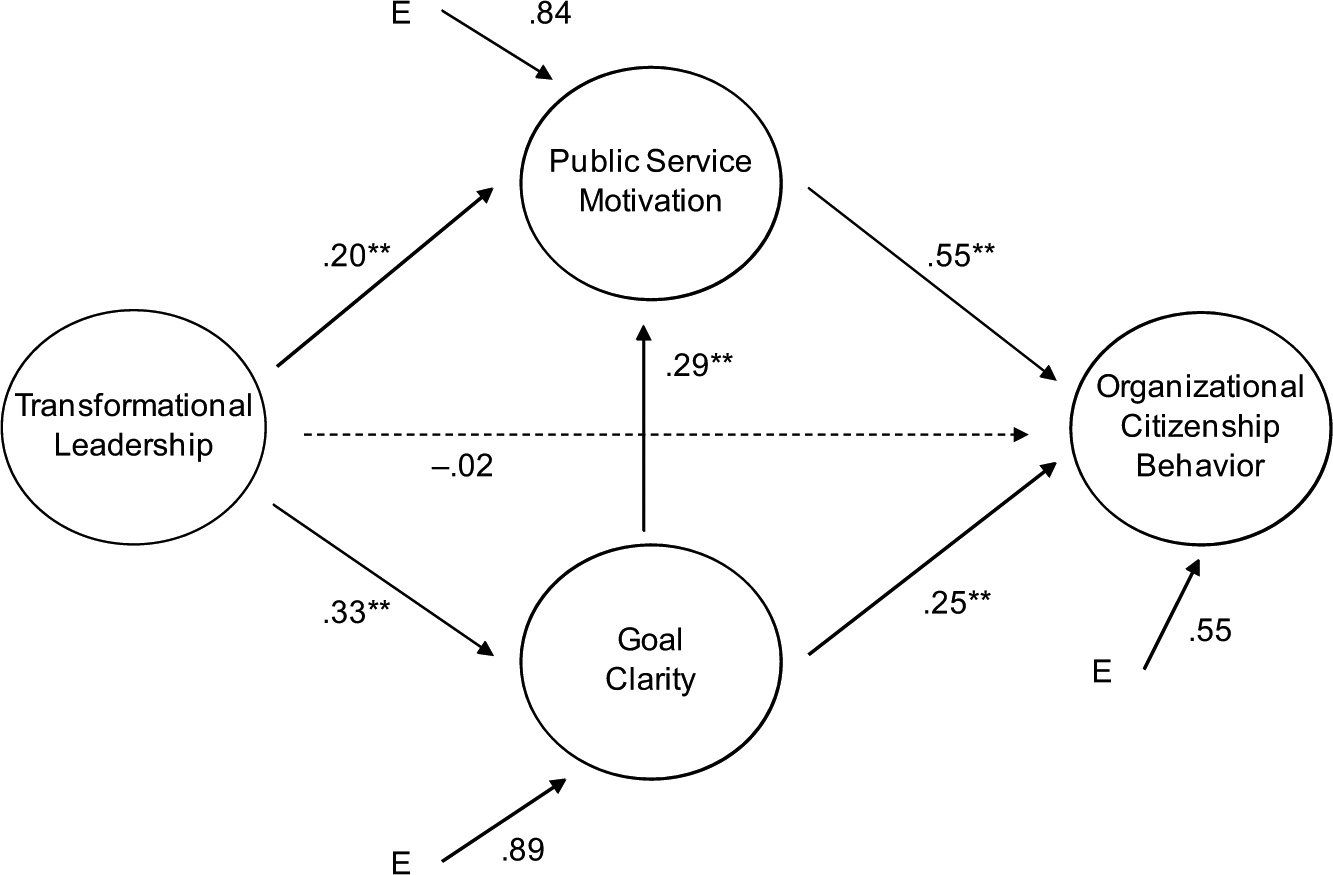
Results of structural equation modeling.
In summary, these results support all five hypotheses. Statistically significant and positive coefficients for the direct paths from PSM and goal clarity to OCB, from transformational leadership to PSM and goal clarity as well as from goal clarity to PSM were found. In contrary to the preliminary results from bivariate correlations, the structural equation model reveals a full mediation effect of transformational leadership on OCB by the two intermediate latent variables. There is no direct effect of transformational leadership on OCB. The relationship between transformational leadership and OCB is mediated by PSM and goal clarity. Indirect effects on OCB can be observed from transformational leadership through PSM (0.11), through goal clarity (0.08), and through goal clarity and PSM (0.05). Thus, the total indirect effect via PSM and goal clarity is 0.24.
Discussion
This study was a response to the call to investigate leadership within public organizations using concrete data in public sector settings (Van Wart, 2003). In the light of management reforms in public organizations during the last decades, the interest in leadership behavior, which is directed more toward an entrepreneurial role of supervisors, has risen. We analyzed the relationship of transformational leadership and extra-role behavior in public administrations using a sample of 569 public managers at the municipal level in Switzerland. Therefore, a structural equation model that comprehends the exogenous latent variable transformational leadership and the endogenous latent variables PSM, goal clarity, and OCB was developed.
An examination of our study results shows that the stated hypotheses are confirmed. The direct, positive impacts of transformational leadership on PSM and goal clarity, as well as those from goal clarity on PSM and OCB and from PSM on OCB, go along with the assumed theoretical links based on literature research. The strongest links exist among PSM and OCB. This supports the results reported by Pandey et al. (2008) and Kim (2005). The higher the employee’s attitudes toward public service, the more they are willing to maintain and enhance a psychological work context that supports task performance.
Although this study did not measure task performance, the results lead to further investigation of the PSM-performance link. Perry and Wise (1990) argue that highly PSM motivated employees would embrace work characterized by attributes such as high task significance and this would lead to higher individual performance (Perry, Hondeghem, & Wise, 2010). Our study contributes to the increasing amount of research regarding PSM and its impact on performance bearing in mind the highly important differentiation between individual and organizational performance. As stated by Perry et al. (2010), research clarifying the link between PSM and collective performance is needed. Therefore, this study contributes to a better understanding of how PSM affects the citizenship behavior of employees and can thus influence the values and culture of a team or a work group. If this is the case, future research should investigate whether there are differences at the organizational level in regard to an organization’s level of PSM. And thus the question arises whether a higher level of PSM within a workforce leads to higher task performance of individuals as proposed by the work on contextual performance or whether it could even be that a more PSM heterogeneous workforce might have positive effects on outcome variables such as organizational performance as discussed by Petrovsky and Ritz (2010).
The second contribution of our research is related to the significance of public values and the constraints of organizational characteristics for transformational leadership in public organizations. If “… the current trend that government leaders and managers manage by contract and network—a significant departure from leading large, centralized, hierarchically arranged institutions in which the leader guides followers who are employees of their organization” (Van Slyke & Alexander, 2006, p. 364) is taken into account. The range of relationships increases and symbolic and value oriented forms of leadership behavior might become more effective when compared with hierarchical leadership behavior. This study contributes important insights into the causal relationships when it comes to the leadership-employee behavior link within public organizations. Public values underlying transformational leadership behavior and extra-role behavior could strengthen the relationship of both variables. Referring to Organ and Ryan (1995), morale can be seen as one of the best predictors of extra-role contributions. In our study, Organ and Ryan’s so-called “m” factor can be explained by PSM, but more empirical evidence needs to be brought forward concerning a leader’s influence on extra-role behavior within public sector settings with specific legal and structural constraints.
In relation to this issue, the rather low direct impact of transformational leadership on OCB raises questions regarding transformational leadership within a public sector setting. A reason for that could be the specific public context encompassing public employees that does not give enough room for transformational leaders to influence followers’ extra-role behavior (Ruscio, 2004). Powerful forces beyond the control of individual leaders, and contextual constraints as well as political and administrative processes, may have an important influence on transformational leadership behavior, which leads to further research (Rainey, 2009; L. D. Terry, 1995). A recently published study by Wright and Pandey (2010) shows mixed results concerning the impact of structural constraints such as red tape on transformational leadership and raises the important issue that leadership behavior might not be affected by constraints set by external authorities as much as expected.
This leads us to the third contribution of this study: the enlargement of our understanding of the role of leadership when it comes to the development of culture in public organizations. Perry (2000) and Moynihan and Pandey (2007) show that institutions can foster PSM. The latter, for example, state the impact of red tape and the organization’s reform orientation toward PSM. Our study does not measure the impact of diverse organizational variables on PSM and OCB; only the leadership dimension is investigated. However, leadership behavior is one important factor, negative or positive, when discussing the influence of organizations and organizational culture on employee behavior (Rainey, 2009). Leadership in public sector organizations, which develops a vision and gets employees to accept it, is therefore closely related to public service values and the development of an organizational culture infused by such values. “[S]ome of these values are also obviously relevant to public sector employees because organizational values alone will not do. The staff also has to think and act inspired by values” (Beck Jørgensen & Bozeman, 2007, p. 367). Our results show that transformational leadership behavior strengthens both the motivation of public employees toward institutional values such as public service values and the perception of goal clarity of the organization, which itself fosters PSM. Employees who report their leaders to be more inspirational, stimulating, and challenging for the overall job goals and whose leaders clarify organizational goals feel more bound to the public institution and to its values. And this, finally, results in higher levels of citizenship behavior of employees.
From a broader perspective, this result has to be seen in relationship with the importance of cultural bases in public organizations when it comes to bureaucrats’ behavior. The value base of transformational leadership and its positive influence on employee motivation and behavior challenges the rational choice theory of bureaucracy and classical principal agent theorists who “… have missed his [Chester Barnard’s] crucial points about the efficacy of social and moral rewards in building and sustaining what are now generally referred to as ‘strong culture organizations’” (DiIulio & DiIulio, 1994, p. 283). Leaders can create and sustain a culture of beliefs and values that support cooperation in the name of the institution among employees because they identify with the institution and sacrifice some aspects of themselves for it (Levitt & March, 1989). This study supports ways of characterizing organizations in which employee behavior is based more on social and moral rewards and values than on a narrow perspective of self-interest.
Limitations and Conclusions
Before concluding our study, its limitations have to be mentioned. The results of this single study with a mono-method approach, using perceived subjective data and not the full original measurement scales, should be viewed with caution. Concerns about possible common method bias in our results are justified, although the extent of common method bias in survey research is not clear (Bagozzi & Yi, 1990; Doty & Glick, 1998; Glick, Jenkins, & Gupta, 1986; Spector, 1987, 1994). A further developed research design with different measurement sources that distinguishes the evaluation of supervisor’s and of employee’s behavior would be more appropriate. Because of the width of our study design, with more than 1,700 municipalities having to be convinced to participate, we were not able to use more than one questionnaire. However, with our sample of 279 organizations, we could reduce bias resulting from common measurement context. Furthermore, we used empirically tested and validated scales to prevent item ambiguity and the respondents’ anonymity was protected by giving evidence that the data collection was fully accomplished by an external organization (Podsakoff, MacKenzie, Jeong-Yeon, & Podsakoff, 2003). In addition, due to missing information in the questionnaire, it was not possible to identify the role of the leaders’ supervisors exactly. It would be of interest to know more about the impact of political and administrative leadership behavior on citizenship behavior. However, under these circumstances, the use of the concept “transformational leadership” is appropriate because it characterizes one type of leadership behavior that is used within research looking at political and administrative leaders. Furthermore, it can be argued that employee behavior predicts employee attitudes such as PSM or employee attitudes predict the perception of leadership behavior and not vice versa. Therefore, we tested several models to analyze whether our reported model holds our theoretical assumptions. However, due to the aforementioned mono-method approach, it is not possible to exclude interaction between these variables absolutely. Therefore, we judge our results as preliminary results for future research in the field of public sector leadership.
Our research calls for more specific leadership research, especially empirical research, regarding the particular role of the public context when assessing concepts of generic and established leadership research. There are different views and a-priori expectations among scholars. One promising future research path is the in-depth investigation of the overall extent of transformational leadership in administrative settings, including comparisons with private sector organizations. A second path could further analyze what kind of specific values, for example, in regard to the work of Beck Jørgensen and Bozeman (2007), can be transformed by transformational leadership behavior in public organizations with their contextual constraints. A third important research task is the inquiry into the relationship between leadership behavior and extra-role behavior using different samples for subordinates and followers.
Finally, how do these results advance our understanding of leadership in the current debates on public management and governance research? To improve government performance, it may be necessary to make changes in governance within a comprehensive framework designed to change core values and commitments (Lynn, Heinrich, & Hill, 2000). One reason for this, as our study shows, is that extra-role behavior supporting task performance increases primarily when public service values and organizational goals get fostered as an outcome of leadership behavior. Or like Paarlberg et al. (2008) put it very concretely as a tactic for administrative practice, “[e]ncourage and reward the development of leaders who communicate and model public service values” (p. 282). That does not mean that structural constraints or new managerial attempts such as strategic planning will get in the way of effective leadership (Wright & Pandey, 2010). But it claims more for transformational leaders who take advantage of these management concepts and integrate them within the context of public organizations to clarify vision, strategies, and goals for followers (Rainey & Watson, 1996) and strengthen a culture of beliefs and values that support cooperation in the name of the institution.
Footnotes
Appendix A
Questionnaire Items:
Transformational Leadership:
Public Service Motivation:
Goal Clarity:
Organizational Citizenship Behavior:
Appendix B
Factor Models
| Lambda (SE) | z value | Standardized loadings | R 2 | Composite reliability | |
|---|---|---|---|---|---|
| Transformational leadership | .87 | ||||
| V1 | 1 (—) | — | 0.83 | .69 | |
| V2 | 2.29 (.54) | 4.26*** | 0.96 | .92 | |
| V3 | 0.83 (.07) | 12.79*** | 0.78 | .61 | |
| Goal clarity | .74 | ||||
| V1 | 1 (—) | — | 0.61 | .37 | |
| V2 | 2.21 (.40) | 5.48*** | 0.86 | .74 | |
| V3 | 1.46 (.19) | 7.54*** | 0.75 | .56 | |
| Organizational citizenship behavior | .70 | ||||
| V1 | 1 (—) | — | 0.41 | .17 | |
| V2 | 1.85 (.28) | 6.68*** | 0.64 | .41 | |
| V3 | 3.04 (.47) | 6.42*** | 0.81 | .65 | |
| V4 | 2.14 (.30) | 7.11*** | 0.69 | .48 | |
| V5 | 3.36 (.52) | 6.47*** | 0.83 | .70 | |
| Public service motivation | .65 | ||||
| Commitment to the public interest | .44 | .69 | |||
| V1 | 1 (—) | — | 0.86 | .74 | |
| V2 | 0.62 (.20) | 3.15** | 0.72 | .52 | |
| Compassion | .42 | .51 | |||
| V1 | 1 (—) | — | 0.62 | .39 | |
| V2 | 1.07 (.24) | 4.39*** | 0.65 | .42 | |
| Self-sacrifice | .58 | .54 | |||
| V1 | 1 (—) | — | 0.65 | .43 | |
| V2 | .92 (.20) | 4.65*** | 0.62 | .39 | |

p < .01. ***p < .001. V = Variable.
Declaration of Conflicting Interests
The author(s) declared no potential conflicts of interest with respect to the research, authorship, and/or publication of this article.
Funding
The author(s) disclosed receipt of the following financial support for the research, authorship, and/or publication of this article: The article is based on research financed by the Swiss National Science Foundation (Project No. 100012-116083).