



Abstract
Collaborative management is thought to enhance policy implementation in urban settings by overcoming governmental fragmentation, creating greater goal consensus, increasing access to resources, and facilitating policy learning. However, empirical studies of this relationship are conspicuously absent, limiting researchers’ ability to predict how collaborative tools will directly and indirectly affect local implementation outcomes. This article investigates the effects of inter- and intralocal collaboration on the implementation of urban sustainability practices, and investigates interaction relationships to test whether two managerial environmental factors—administrative capacity and stakeholder support—influence the effectiveness of collaborative tools. Drawing data from a national survey, the analysis finds evidence that the effectiveness of collaborative tools depends on the policy target, and that administrative capacity and stakeholder support influence the effectiveness of collaboration in policy implementation. These findings have theoretical and practical implications for how public managers utilize collaborative tools in urban sustainability governance.
Improving policy outcomes often calls for public managers to use collaboration as a means to overcome limitations in service delivery, exploit networking opportunities, and buffer against external threats (Agranoff & McGuire, 2003; Innes & Booher, 1999; Meier & O’Toole, 2003, 2008; Provan & Milward, 2001). The challenges inherent in the policy implementation process have been long recognized (Bardach, 1977; Pressman & Wildavsky, 1973). In response, scholars have advanced theories of interorganizational cooperation as a solution to hierarchal inflexibility (Bardach, 1998; Feiock, 2013; O’Toole, 1983; O’Toole & Meier, 1999) and empirically assessed the impact of “network” or “collaborative management” on various policy outcomes. Much of this work suggests that collaborative approaches can improve these outcomes (Agranoff & McGuire, 2003; Meier & O’Toole, 2003; Nicholson-Crotty & O’Toole, 2004; O’Toole & Meier, 2004b; Provan & Milward, 1995); however, other assessments have found obstacles that impede collaborative policy implementation (Goldsmith & Eggers, 2004; Huxham, 2003, 1996a; O’Toole & Meier, 2004a).
We know that collaboration can be a valuable strategic tool of local governance, but systematic understanding of the relationship between interorganizational collaboration and policy implementation remains lacking. This study asks two important yet overlooked questions for collaborative management and urban sustainability research: How do different horizontal and functional collaborative tools affect the implementation of local sustainability policy? How do factors in the managerial environment influence the effectiveness of collaborative tools?
This study begins to fill this lacuna in the literature by investigating the effects of horizontal and functional collaborative tools on the implementation of “green” sustainability practices aimed at enhancing governmental and community-wide energy conservation and climate change protection. This study also examines how two managerial environmental factors—administrative capacity and stakeholder support—influence the effectiveness of collaborative tools used in local green policy implementation.
Gauging the impact of collaborative management tools and the managerial environment on urban sustainability governance is sorely needed. Local government officials have become leaders in adopting and implementing environmental sustainability, energy conservation, and climate change actions (Bulkeley & Betsill, 2003; Krause, Feiock, & Hawkins, 2014; Mazmanian & Kraft, 2009). Yet, there is considerable variation in the degree to which cities engage in and commit to sustainability initiatives (Hawkins, Krause, Feiock, & Curley, 2015; Portney, 2003). Explaining this variation is key to unlocking strategies that could help cities deliver more localized co-benefits, such as energy–cost savings, as well as a global and intergenerational good: preserving the natural environment.
However, urban sustainability policy is a complex, multifaceted issue that cuts across political jurisdictions and administrative boundaries. Local sustainability policymaking in fragmented government settings can create externalities as decisions by one government or agency affect the functions of other governments or agencies, which can lead to inefficient outcomes in service delivery (Feiock, 2013). For example, cities must effectively overcome free-rider obstacles in local greenhouse gas (GHG) mitigation (Kousky & Schneider, 2003). Cities must also find ways to integrate sustainability initiatives and avoid functional “silo effects” that can arise within local government, such as in the case of fragmented water management and land-use planning (B. Mitchell, 2005).
Collaborative governance is thought to be a more promising strategy to deal with these inter- and intrajurisdictional spillover problems (Feiock, 2013; Feiock & Scholz, 2010; Innes & Booher, 2010; Roberts, 2000; Weber & Khademian, 2008). Compared with authoritative and competitive strategies, collaborative approaches are believed to be more advantageous in facilitating information sharing, integrating decision-making authority, and promoting policy consensus and learning. Thus, developing our understanding of collaboration could lead to more effective strategies for addressing urban sustainability problems (Zeemering, 2014).
Local sustainability has been studied for more than a decade but the emphasis has been on identifying the determinants of policy adoption to the neglect of policy implementation and execution. A burgeoning body of work, however, has begun extending theories of collaborative management, administrative capacity, and stakeholder support to explain the extent to which cities broadly engage in sustainability practices (Hawkins & Wang, 2012; Terman & Feiock, 2014; Wang, Hawkins, Lebredo, & Berman, 2012). This study builds upon and expands this research by identifying the ways in which local governments employ different collaborative strategies to enhance green policy implementation and how factors in the managerial environment influence the effectiveness of these strategies.
The findings of this study have important implications for theory and practice. This analysis finds evidence suggesting that horizontal collaboration may be more effective in green implementation targeting not only the broader community but also in-house governmental policies. Administrative capacity and stakeholder support were also found to influence the impact of collaborative tools on green policy implementation in governmental operations and in the community, respectively. These findings could imply that administrative capacity is more important for functional collaboration between agencies of the same city, and that horizontal collaboration between cities could be more useful when facing greater stakeholder opposition to sustainability goals.
The next section of the article puts forth an integrated theoretical framework for analyzing horizontal and functional collaborative tools for local governance. Research hypotheses are then advanced. Following presentation of the research design, the analysis and findings are described, and implications are discussed. Concluding remarks follow.
Strategic Collaborative Tools for Local Governance
Research on collaborative management has gained considerable traction as scholars recognized the need for public managers to operate in nonhierarchal, networked settings to effectively execute policy and organizational strategy and meet program goals. Collaborative public management can be defined as autonomous actors deliberately working together across organizational boundaries, formally or informally, voluntarily or mandated, to create rules and governing structures for solving problems and attaining policy goals that they cannot easily achieve alone (Agranoff & McGuire, 2003; Ansell & Gash, 2008; Bardach, 1998; Meier & O’Toole, 2003; Thomson, Perry, & Miller, 2009; Wood & Gray, 1991). Collaboration is thus not an end, but rather a means to an end; it is explicitly a “tool” of governance that public managers can strategically employ in the execution of policy (Agranoff & McGuire, 2003; McGuire, 2006). And even when collaboration is mandated, collaborating organizations can still have discretion and rely mostly on the “clan-based” mobilization mechanisms that are more characteristic of voluntary arrangements (Rodríguez, Langley, Béland, & Denis, 2007).
Empirical studies have found that collaborative public management can enhance policy implementation and outcomes in public education (Meier & O’Toole, 2003, 2008), community mental health (Provan & Milward, 1995), local economic development (Agranoff & McGuire, 2003), and policing (Nicholson-Crotty & O’Toole, 2004). However, other works have revealed the problematic side of collaboration. Collaborative arrangements have been found to encounter vast difficulties in achieving goal alignment, building trust, creating an equal balance of power, and benefiting collaborators equitably (Goldsmith & Eggers, 2004; Huxham, 2003; Lowndes, 2001; O’Toole & Meier, 2004a). This begs the question, “Under what conditions does collaborative governance facilitate or impede policy implementation efforts?” (Ansell & Gash, 2008).
Framing this question in such a way allows for testing multiple research hypotheses concerning collaborative governance and its effectiveness in the implementation of local green energy and climate protection policies. For example, which collaborative management tools are more effective in implementing such policies? Two general ways in which city managers can collaborate are horizontally across cities and functionally within cities. Horizontal or “interlocal” collaboration can be defined as collaboration between two or more local governments or municipalities in the implementation of policy, whereas functional or “intralocal” collaboration can be defined as collaboration between administrative agencies of the same local government. These collaborative mechanisms are thought to be useful in dealing with interjurisdictional and functional institutional collective action (ICA) dilemmas, or policy problems that involve fragmented local authority and the production of externalities that transcend political boundaries and/or administrative departments (Feiock, 2013; Feiock & Scholz, 2010).
Implementation of green policies at the local level typically confronts such problems because the action of one agency, such as setting a GHG reduction target or installing an alternative transportation system, can have consequences for other actors within the same or a neighboring jurisdiction and influence how they behave. Such functional and horizontal fragmentation gives rise to spillovers that can lead to inefficient outcomes in local service delivery, such as free riding, duplicated services, and common property resource depletion, creating greater need for the use of tools to achieve collective action (Feiock, 2013; Feiock & Scholz, 2010).
Considerable work has focused on interlocal collaboration across political jurisdictions. This form of collaboration can encompass a wide variety of more specific collaborative tools, ranging from informal cross-city information-exchanging partnerships to formal and mutually binding interlocal agreements for service delivery to complex multijurisdictional exchanges of financial resources and other forms of capital (Agranoff & McGuire, 2003; Dowding & Feiock, 2012; Feiock, 2013). Empirical studies have examined either the predictors (Krueger & McGuire, 2005; LeRoux, Brandenburger, & Pandey, 2010; MacManus & Caruson, 2008) or policy effects (Chen & Thurmaier, 2009; Morton, Chen, & Morse, 2008) of interlocal collaboration.
However, local governments are also characterized by fragmentation of responsibilities among agencies within the same local government that can lead to functional ICA dilemmas (Feiock, 2013). For example, sustainability actions such as issuing a residential green buildings mandate could have consequences for local environmental protection, land use, and economic development strategies (Dator, 2010). Thus, functional collaboration across agencies in the same city is needed, yet far fewer studies have focused on forms of intralocal collaboration, such as interagency coordination within cities, to address these functional ICA dilemmas. This analysis estimates the effects of both interlocal and intralocal collaboration on sustainability policy implementation.
Yet, collaboration does not happen in a vacuum. The effectiveness of collaborative tools likely depends on the context in which they are employed. Organizational theorists have long recognized that the external environment helps shape organizational structure and outcomes (Burns & Stalker, 1961; Katz & Kahn, 1978). Similarly, environmental factors or conditions are also thought to influence the effectiveness of collaboration (Ansell & Gash, 2008; Emerson, Nabatchi, & Balogh, 2012; Turrini, Cristofoli, Frosini, & Nasi, 2010). Extant research suggests that environmental forces affect policy implementation and program performance through interaction with structural elements and managerial contributions (O’Toole & Meier, 1999; Meier & O’Toole, 2003, 2008). For example, environmental factors such as resource munificence can influence the effectiveness of collaborative tools in service delivery (Provan & Milward, 1995). This begs the question, “What managerial environmental factors influence the impact of local collaborative tools on policy implementation?”
Previous work links stakeholder support and administrative capacity to collaborative management and policymaking (Ansell & Gash, 2008; Provan & Milward, 2001, 1995; Turrini et al., 2010). Stakeholder support is defined as the level of commitment from citizens and organized groups for policy goals and initiatives. Stakeholders are any group of actors who not only can affect or are affected by organizational objectives (Freeman, 1984) but also have “legitimate claims” to organizational decisions (R. K. Mitchell, Agle, & Wood, 1997). Administrative capacity is broadly defined as governmental organizations’ ability to achieve their mission and goals (Honadle, 1981; Ingraham, Joyce, & Donahue, 2003; Wang et al., 2012). Stakeholder support and administrative capacity are but two factors in the larger array of environmental variables that can affect managerial decisions and outcomes, yet managers lack direct control over these factors. For example, although managers can control what they do with the resources they have, they have considerably less influence over their level of resource abundance. Similarly, managers can gauge stakeholder preferences and incorporate them into strategy, but they have little if any control over such preferences. Because these factors are thought to influence the effectiveness of collaborative strategies, their effects are also estimated in this analysis.
Research Hypotheses
The analysis presented here assesses how collaborative tools affect the extent to which local green policies are implemented, and how administrative capacity and stakeholder support influence these relationships. Several studies have empirically examined the association between collaboration and policy implementation and outcomes, finding positive correlations (Agranoff & McGuire, 2003; Meier & O’Toole, 2003; Nicholson-Crotty & O’Toole, 2004; Provan & Milward, 1995). Inter- and intralocal collaboration should therefore generally enhance local green policy implementation because both collaborative tools can facilitate policy learning and knowledge exchange and overcome ICA dilemmas in urban sustainability governance.
However, the effectiveness of these tools could also depend on the specific policy target. For example, some sustainability policies are directed in-house at city government operations, whereas others are aimed more broadly at the community at large. The difference between these targets is theoretically important. Green policies aimed at the broader community should be more likely to provoke special interests and present more complex hurdles to policy implementation, whereas policies directed governmentally would be comparatively easier to implement and monitor because they are smaller scaled (Bae & Feiock, 2013).
Collaborative tools could influence implementation in either policy target. For example, intralocal collaboration between agencies in the same jurisdiction would likely be needed for implementing a community-wide alternative transportation system. Similarly, joining a regional partnership or forming an interlocal agreement could influence the decision to implement an in-house carbon emissions inventory, for example. In general, however, intralocal collaboration should be especially effective in implementing sustainability policies directed at governmental operations. Policies exclusively for governmental operations would require higher levels of collaboration or coordination among agencies within a city. Moreover, these policies would have arguably less impact on other local governments, thus diminishing the need for public managers to collaborate across cities. The benefits of these policies would be more concentrated within city boundaries (Bae & Feiock, 2013). On the contrary, interlocal collaboration should be more impactful in implementing community-wide policies. Because the spillovers associated with such actions can be exponentially greater, more horizontal intergovernmental collective action is needed to implement green policies aimed at the broader community (Feiock & Scholz, 2010).
To test the impacts of inter- and intralocal collaboration, we need to examine their effect within an explanatory model of green policy implementation that accounts for the influences of stakeholder support and administrative capacity. Satisfying stakeholder groups is believed to enhance network effectiveness (Provan & Milward, 2001) with strategic, principled engagement aimed at generating greater policy consensus and salience through formal and/or informal incorporation of stakeholders who often come from varied perspectives (Innes & Booher, 1999; Rethemeyer & Hatmaker, 2008; Selznick, 1949). Involving stakeholders in the implementation process could increase the success rate of local green initiatives by garnering greater support for sustainability, securing funding, and providing information on local needs (Portney, 2005; Wang et al., 2012). Stakeholder opposition to local initiatives could also detract from the advantages of collaboration and create “collaborative inertia” in policy implementation (Huxham, 1996a, 1996b). Stakeholder support should therefore positively influence the effectiveness of collaboration in local green policy implementation.
Administrative capacity is also thought to enhance collaborative policy implementation. Administrative capacity includes the availability of tangible resources, such as financial and technical capacities, and also intangible resources such as policy expertise, information, and regulatory authority, which are equally indispensable to successful implementation (Bardach, 1998; Ingraham et al., 2003). Furthermore, obstacles to implementation stem from not only a lack of physical and informational resources but also a lack of political capital (Innes & Booher, 1999). It has been long recognized that political commitment to and involvement in policy implementation is important (Mazmanian & Sabatier, 1983). Recent empirical work suggests that involvement and support from elected officials can help shape local energy policy implementation outcomes (Terman & Feiock, 2014).
Capacity constraints can present substantial obstacles to local sustainability efforts (Francis & Feiock, 2011), yet such constraints can be effectively overcome through collaborative arrangements aimed at exchanging tangible and intangible resources. Resource dependence theory suggests that organizations establish relationships with one another to exchange resources needed to achieve organizational goals and objectives (Pfeffer & Salancik, 1978). Imperial (2005) observed extensive evidence of sharing equipment, personnel, and financial resources in effective approaches to collaborative watershed management. By sharing resources, information, and expertise, public managers can build capacity and surmount obstacles to implementation.
However, it is also believed that public managers need capacity in order for collaboration to be effective (Emerson et al., 2012; Provan & Milward, 1995; Turrini et al., 2010; Waugh & Streib, 2006). If collaborative arrangements crystalize into “organizations” in their own right as some have proposed (Bardach, 1998; McGuire, 2006; Thacher, 2004), such structures may need resources or capacity to stabilize collaborative effectiveness and achieve collective goals (Turrini et al., 2010). In sum, the extant work suggests that collaboration may build capacity, but effective collaboration could also require capacity.
Nevertheless, greater stakeholder support and administrative capacity should “lubricate” collaborative tools, rendering them more effective in implementation. But the influence of these factors could also depend on the policy target. For example, administrative capacity should be more impactful on collaborative tools used in the implementation of in-house government policies, where the ability to obtain additional resources is by definition more limited than in collaborative arrangements across local governments. On the contrary, stakeholder support should have greater impact on implementing community-wide policies, because such policies are more likely to provoke organized interests across the community (Bae & Feiock, 2013).
Research Design
Sample and Data
U.S. cities are the units of analysis for this study. This research uses data obtained from a 2010 national survey, Implementation of Energy Efficiency and Sustainability Programs (Francis & Feiock, 2011). The survey was sent to either the city manager or the chief administrative officer (CAO), asking questions concerning the implementation of energy conservation and sustainability programs in their community. The entire sample frame included 500 cities with populations between 20,000 and 50,000, as well as an additional 680 cities with populations more than 50,000. Of the 1,180 municipalities surveyed, 677 surveys were returned with a response rate of about 57%. These 677 responses include cities in 49 states, and have a median population of about 51,700. This study also uses data from the U.S. Census Bureau for city-level demographics and characteristics.
Measurement
Implementation of local green practices was measured with two interval indices: one for implementation in “city government operations” and the other for implementation in the “community at large.” The use of indices to measure sustainability action is a well-established practice in extant research (Krause, 2011, 2012; Lubell, Feiock, & Handy, 2009; Opp & Saunders, 2013; Portney, 2003). 1 The indices were developed based on the following survey question: “Which of the following energy/climate related issues does your jurisdiction officially address (e.g., through regulation or policies) as it relates to government facilities and community at large? (select all that apply).”
The survey listed 13 practices that local governments could engage in at either the government and/or community level. Table 1 lists these practices and the percentages of cities’ implementation of each, which demonstrates a distinct cleavage between the implementation rates of governmental and community-wide policies. Policies targeting governmental operations were nearly twice as likely to be implemented compared with policies targeting the community for most practices listed. Government and community index scores ranged from 0 (no practices implemented) to 13 (all listed practices implemented). Cronbach’s alpha statistics for the government and community indices were .88 and .85, respectively, suggesting high internal consistency of the items used in each dependent variable.
Percentages of Local Green Practices Implemented.

Two independent variables for collaboration were included. An index for “interlocal collaboration” was created by measuring the extent to which local governments engage in intergovernmental collaboration in their sustainability efforts. This variable was developed based on responses to a survey question asking, “Has your government engaged in any of the following collaborative actions relating to sustainability, energy efficiency or climate protection? (check all that apply).” This question had six answers from which respondents could choose: (a) worked with other agencies or local governments in activities such as an inventory of GHG emissions; (b) joined a collaborative partnership with other local entities (such as a regional partnership organization); (c) entered into an informal agreement with one or more local governments on energy issues; (d) entered into a formal agreement with one or more local governments on energy issues; (e) enacted policy or comprehensive plan changes based on regional planning efforts; and (f) government has not engaged in any collaborative actions in these areas. 2 Index scores ranged from 0 to 5, with higher scores indicating greater use of interlocal collaboration (Cronbach’s α = .67).
“Intralocal collaboration” was measured by responses to the question, “To what extent do the various departments in your city coordinate activities with one another on the following issues?” This study used the third issue, “energy/climate protection,” below this question for a measure of intralocal collaboration that directly pertained to the outcome variables of interest. Answers were reported along a 5-point Likert-type scale, 1 = very low coordination to 5 = very high coordination. This ordinal measure captures the extent of collaboration between city agencies of the same local government used in energy and climate protection policy.
A stakeholder support index was created that measures the perceived stakeholder support for local sustainability efforts based on responses to a survey question asking, “To what extent would the following individuals or groups support or oppose energy conservation and climate protection efforts by your government?” Responses were recoded along 5-point Likert-type scales, 1 = strongly oppose to 5 = strongly support. To construct this measure, I first conducted an exploratory factor analysis (EFA) of eight community stakeholder groups listed in the survey: (a) the general public, (b) chamber of commerce, (c) neighborhood associations, (d) environmental groups, (e) homeowners’ associations, (f) corporations, (g) city council/commission, and (h) economic development/planning department.
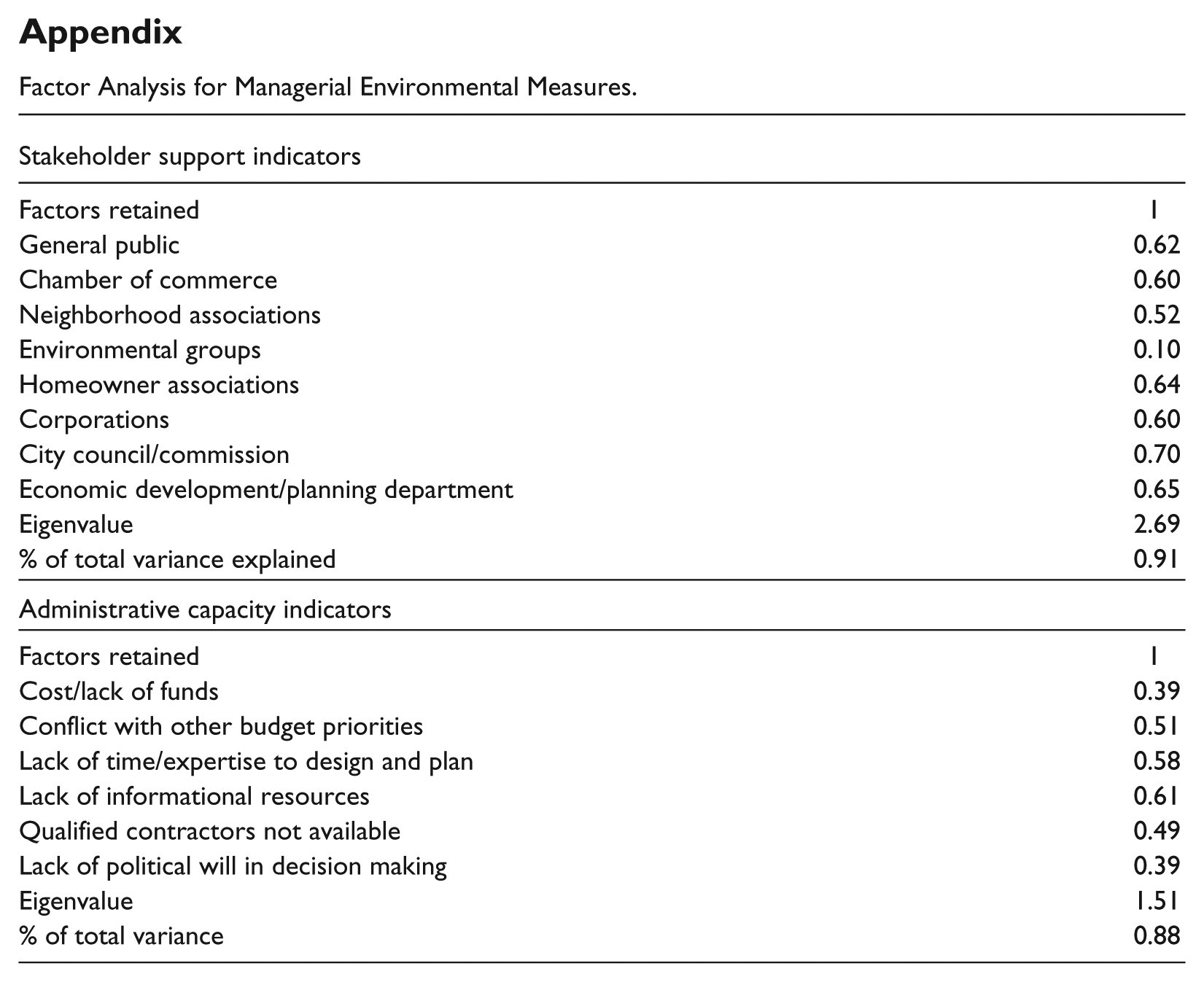
The EFA results are reported in the appendix. The EFA suggested retaining a single factor that explained more than 90% of the total variance in the items, with all but environmental groups loading onto this factor using .30 as a cutoff value. However, given the theoretical importance of support from environmental groups in this particular context, I decided to keep them in the index and account for their influence despite a low factor loading (.10). The factor was thus labeled “stakeholder support” (Cronbach’s α = .75). Index scores ranged from 13 to 40, with higher scores indicating greater perceived support for sustainability efforts.
An administrative capacity variable was also created that measures local governmental capacity for implementing sustainability practices based on responses to the question asking, “On a scale from 1 = not an obstacle to 5 = substantial obstacle, please rate the following factors with respect to your local government’s ability to reduce overall energy consumption.” The survey contained six 5-point Likert-type scale items: (a) cost/lack of funds, (b) conflict with other budget priorities, (c) lack of time/expertise to design and plan, (d) lack of informational resources, (e) qualified contractors not available, and (f) lack of political will in decision making. The items were reversely coded to make model interpretation more intuitive.
Again, I used EFA to determine whether the capacity items represented a unidimensional and shared reality. The results of this EFA are also reported in the appendix. The EFA indicated the likely presence of a single underlying construct that explained about 88% of the total variance in the items, with all six items loading onto this factor using .30 as a cutoff value. This factor was labeled “administrative capacity” (Cronbach’s α = .65). Index scores ranged from 6 to 30, with higher scores indicating greater levels of governmental capacity for green policy implementation.
The explanatory model also includes environmental, demographic, and organizational characteristics of cities. Data for community factors were obtained from the 2010 U.S. Census. Level of education was measured by the percentage of the population with a bachelor’s degree. Similar measures of education have been shown to explain the demand for local sustainability initiatives (Krause, 2011; Zahran, Grover, Brody, & Vedlitz, 2008). Following Lubell, Feiock, and Ramirez De La Cruz (2009), I also included population density as a measure capturing the degree of climate change severity. According to theory, more densely populated cities could create greater pressure for addressing environmental and climate change concerns because land and other natural resources are scarcer. Population size was also included because larger cities may have greater urgency and overall capabilities for engaging in sustainability efforts.
Finally, the literature suggests that membership in ICLEI—Local Governments for Sustainability (previously known as the International Council for Local Environmental Initatives) is perhaps a more substantive gesture of taking sustainability seriously, because it requires a membership fee and the continued implementation of policies and programs aimed at GHG reduction (Sharp, Daley, & Lynch, 2010). ICLEI membership should therefore explain some of the variance in cities’ green implementation efforts. 3 Data on ICLEI membership were obtained from the survey instrument (Francis & Feiock, 2011). Table 2 reports the descriptive statistics for all variables.
Descriptive Statistics.

Analysis and Results
To model the effects of collaborative tools on the implementation of green practices for governmental and community application, a zero-inflated negative binomial (ZINB) model was used because both dependent variables were counts of practices implemented and contained a relatively high proportion of zero outcomes (12.27% and 23.34% for government and community models, respectively). Using the “Countfit” procedure in Stata 14 (Long & Freese, 2006), it was determined based on an examination of the residuals that the ZINB model was the best fit with the data for both the government and the community model. The ZINB model assumes that zero outcomes are the result of two different processes. City population was treated as the likely indicator of greater urgency and capabilities for addressing sustainability concerns and estimated its effect separately via logistic regression within the ZINB model. As anticipated, the coefficients for log population in all models were significant and negatively correlated with the zero counts, suggesting that larger populations were inversely related to the implementation of zero green practices at the government and community levels.
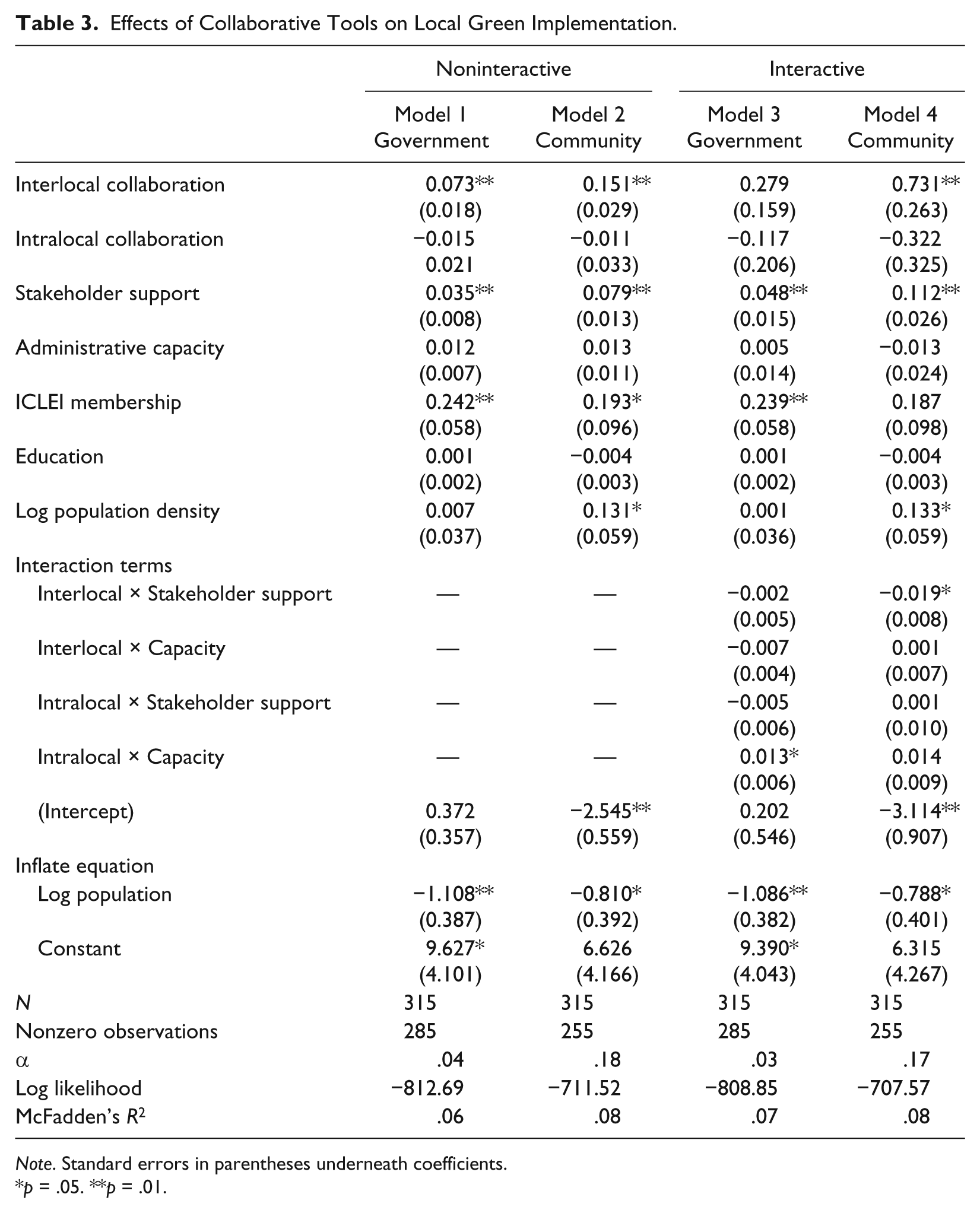
Four ZINB models (two noninteractive and two interactive) were estimated with counts of green practices implemented in city government operations and in the broader community as the dependent variables. Table 3 reports the coefficients and standard errors for each model. In the noninteractive government model (Model 1), although intralocal collaboration does not appear to matter, interlocal collaboration appears to positively influence the count of local green practices implemented at the governmental level (β = .073, p < .01). This finding fails to conform to Hypothesis 1b, which posited that intralocal collaboration should be more effective in implementing policies directed to city government operations. Rather, interlocal collaboration appears to be more influential in the implementation of green government practices.
Effects of Collaborative Tools on Local Green Implementation.
Note. Standard errors in parentheses underneath coefficients.
p = .05. **p = .01.
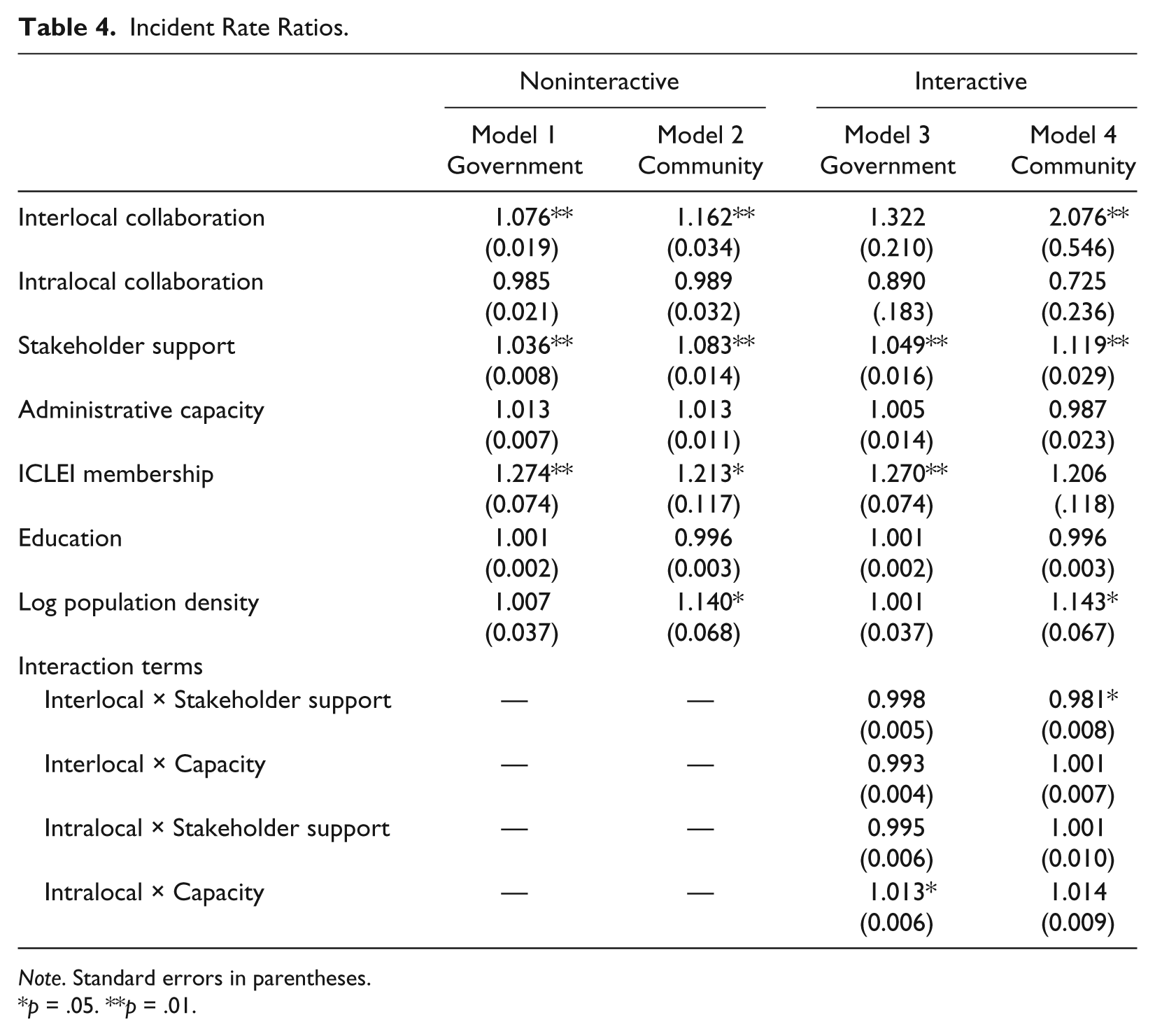
In the noninteractive community model (Model 2), interlocal collaboration appears to be considerably more effective in the implementation of green policies in the community at large (β = .151, p < .001), supporting Hypothesis 1c. However, intralocal collaboration appears to have no influence on the implementation of green policies in the broader community, failing to fully conform to Hypothesis 1a. Incident ratio ratios (IRRs) were also calculated for a substantive interpretation of the findings (Table 4). For every additional interlocal collaborative tool used, the count of local green practices implemented at the community level is expected to increase by 16.2%, holding all other variables in the model constant.
Incident Rate Ratios.
Note. Standard errors in parentheses.
p = .05. **p = .01.
Stakeholder support appears to directly and positively influence implementation in governmental operations and in the broader community. For every one-unit increase in the level of perceived general stakeholder support, holding all else constant, the expected count of local green practices increases by 3.6% and 8.3% at the government and community levels, respectively (Table 4). Thus, stakeholder support appears to have a larger substantive impact on green policies aimed at the broader community. However, administrative capacity appears to have no direct influence on green implementation in governmental operations or in the broader community at least at the .05 level.
ICLEI membership appears to directly increase the count of local green practices implemented in government operations (β = .242, p < .01) and in the community (β = .193, p < .05), but the substantive effect is slightly smaller at the community level (Table 4). This may suggest that joining ICLEI could result in greener city government operations where it could be easier to capture local co-benefits, but such membership will not lead to as much green policy implementation in the community, which could incur higher economic and political costs (Daley, Sharp, & Bae, 2013).
Education appears to have no effect on the implementation of green practices at either level, and population density appears to matter only in the community model. The coefficient (β = .131, p < .05) indicates a positive relationship between population density and the count of green practices at the community level. Substantively, a one-unit increase in log population density, holding all else constant, increases the expected count of green practices at the community level by 14.0% (Table 4). This finding is consistent with previous research (Lubell, Feiock, & Ramirez De La Cruz, 2009), which found that cities with higher population density were more likely to adopt practices that conserve the natural environment.
In the interactive government model (Model 3), neither collaborative tool appears to directly influence the count of green practices at the government level. However, the coefficient for the interaction term between intralocal collaboration and administrative capacity was significant in the positive direction (β = .013, p < .05). This finding conforms to Hypotheses 2a and 2b, suggesting that the greater a city’s capacity for sustainability efforts, the stronger the effect of intralocal collaboration on green implementation in governmental operations. In other words, administrative capacity moderates the relationship between intralocal collaboration and green policy implementation in city government operations. 4 According to Baron and Kenny (1986), a moderator is a “variable that affects the direction and/or strength of the relation between an independent or predictor variable and a dependent or criterion variable” (p. 1174).
Figure 1 displays this moderation effect graphically. 5 The solid, upward sloping line in the graph indicates that when administrative capacity is high, the effectiveness of intralocal collaboration on implementing green practices in governmental operations is enhanced, holding all else constant. However, when such capacity is low (as indicated by the dotted line), greater collaboration between agencies of the same city means fewer green governmental practices are expected to be implemented, holding all else constant. This may suggest that without sufficient capacity, organizations are at a disadvantage in collaborative arrangements and that collaboration could result in worse implementation outcomes. The interaction between interlocal collaboration and administrative capacity was not statistically significant in either Model 3 or Model 4. This could indicate that capacity may not be as influential in the relationship between interlocal collaboration and green policy implementation.

Impact of administrative capacity on intralocal collaboration effectiveness in green policy implementation (government).
Finally, the results for Model 4 indicate that stakeholder support influences the effect of interlocal collaboration on green implementation at the community level, but not in the expected direction specified in Hypothesis 3a. The negative coefficient for the interaction between interlocal collaboration and stakeholder support (β = −.019, p < .05) suggests that an increase in the amount of stakeholder support actually reduces the effectiveness of interlocal collaboration on the implementation of green practices in the community at large. 6 That is, interlocal collaboration is predicted to be more effective in environments with less stakeholder support for sustainability efforts.
Figure 2 shows this effect graphically. 7 While the solid line in the graph indicates that cities with greater stakeholder support for sustainability efforts implement more green practices in the community, on average, the dotted line indicates that the impact of interlocal collaboration on community-wide green policy implementation is higher in low-stakeholder supported environments than in high-stakeholder supported environments. In other words, the results suggest that interlocal collaboration in implementing green policy in the community may be more effective in cities with lower stakeholder support for sustainability efforts.

Impact of stakeholder support on interlocal collaboration effectiveness in green policy implementation (community).
Discussion
These results support the theory that collaboration enhances implementation outcomes and overcomes ICA dilemmas at the horizontal and functional levels. The research also suggests that the impact of local horizontal and functional collaborative tools on green implementation depends on the policy target. The findings indicate that horizontal interlocal collaboration could be more effective in community-wide green implementation where spillovers are usually greater, and also potentially more effective in implementing green practices affecting city government operations only. Public managers could potentially improve their city’s overall green policy implementation efforts by collaborating more with other local governments. For example, collaborating with cities that have more specialized experience and knowledge pertaining to urban sustainability would arguably be more advantageous than collaborating with agencies within the jurisdiction that may have little such policy-relevant experience and knowledge.
The findings also indicate that contextual factors in the managerial environment influence the effectiveness of local collaborative tools. Stakeholder support appears to not only directly influence the implementation of green practices aimed at both policy targets, but also influences the effectiveness of interlocal collaboration in community-wide policy implementation. Although it has been argued that stakeholder support and cohesion can facilitate and/or “stabilize” collaborative implementation or network effectiveness (Turrini et al., 2010), the results reported here indicate that interlocal collaborative tools are more effective in cities with lower stakeholder support. Public managers confronted by community opposition to sustainability goals and initiatives may be able to use interlocal collaboration as a means to enhance green policy outcomes at the community level. Perhaps interlocal collaboration can engage stakeholders in the policy process and create greater goal consensus between otherwise conflicting and skeptical perspectives (Innes & Booher, 1999, 2010).
However, the results also indicate that stakeholder support does not influence the effectiveness of either collaborative tool in green policy implementation at the governmental level. Green policies targeting city government operations are thought to deliver benefits that are less collective in an intergovernmental sense (Bae & Feiock, 2013). Thus, collaborative tools used to implement in-house policies could be less affected by stakeholder support because the costs and benefits of such policies do not reach as far as those aimed at the broader community. In other words, in-house green policies could be less likely to provoke opposition in the community because they are generally less impactful on stakeholders.
Administrative capacity appears to have no direct effect on the implementation of green practices, but it influences the effectiveness of functional intralocal collaboration. The results suggest that building administrative capacity may not by itself enhance green policy efforts, but rather such capacity moderates the relationship between intralocal collaboration and policy implementation at the government level. The more capacity local governments have, the more effective functional intralocal collaboration is in implementing in-house green practices for city operations. This finding supports the theory that resource munificence contributes to network effectiveness, but higher capacity alone does not enhance policy outcomes (Provan & Milward, 1995).
The results also indicate that administrative capacity does not influence the effectiveness of interlocal collaboration. One plausible explanation for this finding is that when public managers collaborate across local governments, they could be less inhibited by a lack of capacity because of opportunities to acquire new information and resources from horizontal boundary spanning (Burt, 2004; Feiock, 2008). In contrast to intralocal collaboration, where opportunities for resource acquisition and policy learning are more limited by definition, the effectiveness of interlocal collaboration may not depend as much on the level of administrative capacity. This could be because interlocal boundary spanning—or bridging local government networks—to obtain resources and information compensates somewhat for the lack of capacity. However, no previous studies have directly examined the differences between inter- and intralocal collaborative tools and their contextual environments in policy implementation, so further research in this vein is needed.
Conclusion
This study contributes to the larger collaborative management and urban sustainability research streams by providing empirical evidence that local collaborative tools affect urban sustainability efforts in different ways depending on whether green policies are implemented in-house or community-wide. Moreover, this study tested the often taken-for-granted assumptions about how managerial environments shape public organizational strategy and outcomes. Two managerial environmental factors—administrative capacity and stakeholder support—were found to influence the effectiveness of collaborative tools in policy implementation efforts, and both affected the usefulness of such tools in important ways. The degree of administrative capacity and stakeholder support were found to influence the impact of intralocal and interlocal collaboration, respectively, on the extent to which local green practices were implemented. The findings offer researchers new insight into what may help determine whether local collaborative strategies are successful or not. The research community is encouraged to revisit this complex yet fundamental relationship in public policy and administration.
Both inter- and intralocal collaborations are correlated with green implementation efforts, but the effect of interlocal collaboration appears to be more impactful for both in-house and community-wide implementation. Interlocal boundary spanning appears to be more effective in implementing sustainability practices not only at the community level where the spillover effects can be magnified but also at the government level where information, resources, and professional guidance for urban sustainability governance is equally needed.
Administrative capacity does not directly affect green implementation, but it indirectly influences the effect of intralocal collaboration on green implementation at the government level. The effectiveness of collaboration between agencies of the same local government in green implementation is enhanced by higher capacity. Also, stakeholder support for policy initiatives affects the effectiveness of interlocal collaboration. Although cities with greater stakeholder support were more likely to implement more green practices, interlocal collaboration appears to be a more effective tool in community-wide implementation when stakeholder support is low.
This study is not without limitations and is but one step in understanding the relationship between collaboration and urban sustainability governance. Analyzing data and changes over time is needed to substantiate the causal impacts suggested in this article. The variables in this analysis also need to be further unpacked to illuminate how more specific collaborative arrangements, such as formal versus informal interlocal agreements, affect green policy implementation. This study was also unable to fully explore the inner workings of collaboration in local green policy efforts and address perhaps bigger questions of collaborative governance. For example, how does policy learning and diffusion take place in collaborative arrangements? What measures do managers take to ensure that collaborative strategies will lead to successful implementation? How does political and/or administrative leadership influence collaborative effectiveness? Future research should begin examining these questions in the context of urban sustainability as well as other policy areas to provide a fuller understanding of what factors determine whether or not collaboration is an effective governance strategy.
Footnotes
Appendix
Factor Analysis for Managerial Environmental Measures.
| Stakeholder support indicators | |
|---|---|
| Factors retained | 1 |
| General public | 0.62 |
| Chamber of commerce | 0.60 |
| Neighborhood associations | 0.52 |
| Environmental groups | 0.10 |
| Homeowner associations | 0.64 |
| Corporations | 0.60 |
| City council/commission | 0.70 |
| Economic development/planning department | 0.65 |
| Eigenvalue | 2.69 |
| % of total variance explained | 0.91 |
| Administrative capacity indicators | |
| Factors retained | 1 |
| Cost/lack of funds | 0.39 |
| Conflict with other budget priorities | 0.51 |
| Lack of time/expertise to design and plan | 0.58 |
| Lack of informational resources | 0.61 |
| Qualified contractors not available | 0.49 |
| Lack of political will in decision making | 0.39 |
| Eigenvalue | 1.51 |
| % of total variance | 0.88 |
Declaration of Conflicting Interests
The author(s) declared no potential conflicts of interest with respect to the research, authorship, and/or publication of this article.
Funding
The author(s) received no financial support for the research, authorship, and/or publication of this article.