



Abstract
Public management scholars have suggested that employee motivation can be accentuated by organizational cultures and contexts. One of the most researched topics in this regard is the concept of public service motivation (PSM). Research shows that PSM works to direct applicants toward public service careers and, once hired, can be linked to motivated activity within public-sector organizations. Similarly, like PSM, a sense of community (SOC) and a sense of community responsibility (SOC-R) have also been posited to act as powerful predictors of employee well-being and engagement. The present study demonstrates that SOC-R is a more powerful predictor of employee engagement compared with PSM and SOC. Concurrently, SOC more strongly predicts employee well-being compared with PSM and SOC-R. The findings bring additional light and clarification to the predictive power of PSM on employee perceptions and behavior, and they demonstrate that community experiences have utility in public service settings.
Keywords
Introduction
Employee motivation has been a central issue in the field of public management for many years as scholars have studied the dualistic benefits motivation can have for employees and the organization. Researchers have been interested in exploring employee motivation, in part, because of the person-centric facets it elicits, including the likelihood of engaging in organizational citizenship behaviors (OCBs) as well as worker satisfaction, happiness, and psychological well-being (Bright, 2008; Locke & Latham, 1990; Malka & Chatman, 2003). In addition, researchers have been focused on determining whether motivation relates to functional organizational outcomes like efficiency, effectiveness, and responsiveness (Brewer & Selden, 2000; Kim, 2005; Ritz, 2009).
In recent years, public management scholars have noted that organizational cultures and contexts can accentuate, promote, and stimulate higher levels of employee motivation (Moynihan & Pandey, 2007; Perry, 2000; Vandenabeele, 2007). In this arena, one of the most researched topics is the concept of public service motivation (PSM). Scholars have suggested that PSM can direct applicants toward public service–oriented careers (Christensen & Wright, 2011; Perry & Wise, 1990), and once hired, a significant body of literature has posited that PSM is linked to motivated activity within public service–oriented organizations (Alonso & Lewis, 2001; Andersen & Kjeldsen, 2013; Bright, 2008; Homberg, McCarthy, & Tabvuma, 2015; Naff & Crum, 1999; Perry & Hondeghem, 2008; Petrovsky & Ritz, 2014; van Loon, Vandenabeele, & Leisink, 2015).
An alternative and parallel set of arguments in the literature is nested primarily in the sister discipline of community psychology in relation to the concepts of sense of community (SOC) and sense of community responsibility (SOC-R). Like PSM, a SOC and a SOC-R have been posited to act as powerful predictors of motivated states, including employee well-being and engagement in public settings (Boyd & Nowell, 2014; Nowell & Boyd, 2010, 2014; Nowell, Izod, Ngaruiya, & Boyd, 2016). However, to date, there has been limited scholarship seeking to clarify the relationship of PSM to SOC and SOC-R, and limited studies showing discriminant validity between these factors in predicting perceptions and behaviors of motivation in public and nonprofit service–oriented organizations. Such an exercise can serve to illuminate core assumptions, strengths, and limitations of theoretical concepts that serve to shape our understanding of human behavior in public organizations. Accordingly, this study addresses this gap by examining whether PSM, SOC, and SOC-R differentially predict two motivational outcomes of key concern to the field of public management: OCB and employee job satisfaction.
PSM in Public Service Organizations
PSM has long been a topic of scholarly interest and is believed to play an important role in distinguishing the field of public administration from similar fields such as business administration (Perry & Hondeghem, 2008; Perry & Vandenabeele, 2015; Wright & Pandey, 2008). Originally defined by Perry and Wise (1990) as “an individual’s predisposition to respond to motives grounded primarily or uniquely in public institutions and organizations” (p. 368), the meaning of PSM has been adapted across disciplines and differs according to nation and region (Bozeman & Su, 2014; Vandenabeele, Scheepers, & Hondeghem, 2006). A concept “native” to the discipline of public administration (Perry & Vandenabeele, 2015, p. 693), PSM is gaining recognition in the fields of economics, organizational behavior, and political science (Bakker, 2015; Gregg, Grout, Ratcliffe, Smith, & Windmeijer, 2011; D. E. Lewis, 2010; Perry & Vandenabeele, 2015). Despite the diverse definitions and concepts provided in the literature, PSM is generally considered to emphasize the unique motives and “other-regarding” behavior of public servants (Clerkin & Coggburn, 2012; Perry, Hondeghem, & Wise, 2010), or the “motives and action in the public domain that are intended to do good for others and shape the well-being of society” (Perry & Hondeghem, 2008, p. 3).
To date, considerable evidence has converged in support of the proposition that higher levels of PSM are associated with an increased likelihood to seek out public service–oriented careers (Bright, 2005, 2009; Vandenabeele, 2008; Wright & Grant, 2010). In addition, PSM has also been theorized to be an important variable in understanding organizational attitudes and behaviors at both the individual and organizational levels of analysis (Petrovsky & Ritz, 2014). However, empirical support of PSM as a motivational force in promoting pro-organizational behavior has been mixed (Alonso & Lewis, 2001; Bright, 2008; Petrovsky & Ritz, 2014; Wright & Pandey, 2008). Although a handful of empirical studies found a positive relationship between PSM and employee behavior (Brewer & Selden, 1998; Cerase & Farinella, 2006; Crewson, 1997; Gould-Williams, Mostafa, & Bottomley, 2013; Homberg et al., 2015; Jensen & Andersen, 2015; Kim, 2006, 2012; Naff & Crum, 1999; Pandey, Wright, & Moynihan, 2008; van Loon et al., 2013), the connection was found in other cases to be nonsignificant or more complicated (Alonso & Lewis, 2001; Bright, 2008; Gabris & Simo, 1995; Wright & Pandey, 2008). Several scholars have argued that the influence of PSM on organizational behavior may be indirect and mediated through other factors (e.g., Bright, 2008; Wright & Pandey, 2008), and this logic continues to persist as evidenced by Bakker’s (2015) recent propositions that public servants with different levels of PSM deal with job demands and job exhaustion differently, and that PSM moderates the positive relationship between job demands and job exhaustion.
Two noteworthy empirical developments in this direction are the investigations of PSM on person–organization fit and transformational leadership (Bellé, 2013). Scholars investigating person–environment fit have theorized that because PSM represents a value-stance that is generally more consistent with the value-stance embraced by public-serving organizations, it increases the likelihood of value congruence for individuals with high PSM employed in a public-serving organization or agency. A significant body of existing research has shown that value congruence is a significant predictor of a number of work-related attitudes and behaviors, and research of the person–environment fit mediational hypothesis has received some preliminary support. For example, Wright and Pandey (2008) found a significant indirect effect of PSM on job satisfaction, mediated by value congruence. Bright (2007) found that PSM had no direct impact on self-reported job performance, and he showed that the relationship between PSM and job satisfaction or turnover intentions was significantly reduced when personal assessments of person–environment fit were present (Bright, 2008). Similarly, Warren and Chen (2013) conducted a meta-analysis which demonstrated that PSM predicts performance outcomes, yet PSM is commonly attenuated by control factors or moderators that are present in various PSM performance studies. More recently, van Loon et al. (2013) showed that the PSM–job satisfaction relationship depends on the societal impact potential (SIP) through the job and organizational type, and Andersen and Kjeldsen (2013) demonstrated that PSM is mediated by a motivation to help specific individual recipients of public services (called user orientation) in private work settings. Homberg et al.’s (2015) recent meta-analysis of the relationship between PSM and job satisfaction showed that the relationship becomes increasingly pronounced and is stronger when jobs explicitly offer individuals opportunities to serve the public. Furthermore, their work demonstrated the positive relationship between PSM and job satisfaction was present across studies (Homberg et al., 2015).
A second model that has received some attention concerns PSM and transformational leadership. Early investigations of this model theorized that transformational leaders could affect organizational attitudes and performance by strengthening PSM in employees. For example, consistent with arguments put forth by Paarlberg and Lavigna (2010), Wright, Moynihan, and Pandey (2012) hypothesized that transformational leadership would have an indirect effect on mission valence through increasing PSM. Results from their study found no direct relationship between transformational leadership and mission valence; however, they did find a statistically significant indirect effect mediated by PSM and goal clarity. Park and Rainey (2008) also found statistically significant associations between transformational leadership and PSM as well as positive relationships of both variables to job satisfaction, self-perceived performance and work quality, and lower turnover intention. However, a recent randomized experimental field design carried out by Bellé (2013) supported an alternative theoretical patterning of these relationships. In his study, transformational leadership was shown to interact with PSM such that individuals with high PSM were more influenced by transformational leadership in relation to performance outcomes. Given previous investigations to the Bellé study were based on cross-sectional data and did not test for interaction effects, whether PSM mediates or moderates the relationship between transformational leadership remains an open question. However, a moderating model is consistent with notions of PSM as an a priori disposition that has been upheld in most job selection models.
As the above research highlights, a great deal is still unknown regarding when, and to what extent, PSM relates to employee attitudes and behavior once on the job (Bright, 2008; Wright & Grant, 2010; Wright & Pandey, 2008). Therefore, more research needs to be conducted to clarify PSM’s ability to directly predict important employee outcomes and to clarify its location in the larger ecosystem of factors that may relate to employee and organizational outcomes in general. For example, a recent study seeking to understand collaborative leadership by Nowell et al. (2016) found no direct significant relationship between PSM and whether individuals are being identified as thought leaders or champions of a collaborative, yet found SOC-R to be significantly related to both of the indicators of collaborative leadership. This finding, along with other recent studies that integrated the perspective of community psychology, suggests that SOC and SOC-R are promising constructs for clarifying the role of PSM and advancing our understanding on organizational behavior. We believe that adding the perspective of community psychology can help us disentangle the mixed findings on PSM’s relationships with organizational outcomes and expand the limited ways we think of extrinsic and intrinsic motivation.
SOC and SOC-R in Public Service Organizations
Within the past several years, management scholars have been promoting an increased focus on the topic of developing communities in organizational settings (Block, 2008; Mintzberg, 2009). For example, Mintzberg argued that an organization with a strong SOC tends to have a workplace where employees are more engaged and producing positive organizational outcomes. In addition, Block (2008) suggested that we need to transform perceptions of isolation and self-interest into experiences that create caring for the community in our midst. There is also a growing consensus in the peer-reviewed literature that community-oriented constructs are needed in organizational settings (Barczak, Smith, & Wilemon, 1987; Brytting & Trollestad, 2000; Dessler, 1999; McBride, 2006; Milliman, Czaplewski, & Ferguson, 2003; Rego, Cunha, & Souto, 2007; Rowley, Kupiec-Teaham, & Leeming, 2007).
In 2014, Boyd and Nowell noted that there was a dearth of community-oriented constructs present in the management literature to facilitate theory building. Efforts to operationalize the experience of community have their theoretical roots in the work of Sarason (1974). Sarason (1974) conceptualized a psychological SOC as a “sense that one was part of a readily available, mutually supportive network of relationships upon which one could depend and as a result of which one did not experience sustained feelings of loneness . . .” (p. 1). McMillan and Chavis (1986) extended this work by providing one of the first consistent frameworks for the measurement of an SOC, which included four core components: (a) membership—a feeling of belonging or of sharing a sense of personal relatedness; (b) influence—a sense of mattering, of making a difference to a group, and of the group mattering to its members; (c) integration and fulfillment of needs—a feeling that members’ needs will be met by the resources received through their membership in the group; and (d) shared emotional connection—the commitment and belief that members have shared and will share history, commonplaces, time together, and similar experiences. This conceptualization of community experience—often termed psychological sense of community or SOC—has inspired a significant body of scholarship aimed at understanding its relationship to various indicators of both well-being and engagement in community/social settings (e.g., Ellaway, Macintyre, & Kearns, 2001; Hughey, Speer, & Peterson, 1999; Pretty, Andrewes, & Collett, 1994; Pretty, Conroy, Dugay, Fowler, & Williams, 1996; Prezza, Arrici, Roberti, & Tedeschi, 2001; Sonn, 2002; Sonn & Fisher, 1996; Talò, Mannarini, & Rochira, 2014). While the term “community” often evokes images of neighborhoods or towns, research has found that individuals develop a SOC in a wide array of social settings, including religious communities (Miers & Fisher, 2002), immigrant communities (Sonn, 2002), student communities (Pretty, 1990), Internet communities (Obst, Zinkiewicz, & Smith, 2002), residential and geographic communities (Brodsky, O’Campo, & Aronson, 1999; Perkins et al., 1990), and workplaces (Cantano, Pretty, Southwell, & Cole, 1993; Mahan, 2000; Pretty & McCarthy, 1991; Pretty, McCarthy, & Catano, 1992).
More recently, work has been completed seeking to clarify the theoretical relationship between SOC and the related concept of SOC-R. One theoretical framework, the Community Experience Framework, that has received some empirical support, argues that the psychology of a community experience can be organized under two overarching and complementary dimensions. The first dimension exemplified in measures of SOC emphasizes community as a resource for meeting key physiological and psychological needs such as the need for inclusion, membership, influence, and identity (i.e., the McMillan & Chavis, 1986, framework). The second dimension emphasizes the experience of community as a responsibility that is born out of an interaction between a given community context and the resulting social identity that is evoked by that context given one’s a priori normative values and beliefs about responsibility. Nowell and Boyd (2010) argued that resource and responsibility were complementary aspects to the experience of community with differential relationships to key outcomes. In particular, they argued that indicators of well-being and satisfaction were likely to be strongly associated with positive experiences of a community as a resource for meeting psychological and physical needs. Consistent with this, significant research exists to date supporting the association between SOC and indicators of well-being (e.g., Ellaway et al., 2001; Pretty et al., 1994; Prezza et al., 2001). However, because SOC is theorized to operate through a mechanism of needs fulfillment, it may have an attenuated relationship to community engagement if members failed to see how such action would improve fulfillment of their needs. In contrast, the experience of community as a responsibility was theorized to influence behavior through the mechanism of cognitive dissonance such that actors who experience a strong SOC-R are going to be motivated to take action to facilitate alignment between their social identity and their behavior. This drive to align one’s sense of self with one’s action has been widely recognized in other literature as a strong driver of behavior (Harmon-Jones, Harmon-Jones, & Levy, 2015). SOC-R operationalizes these feelings of responsibility and therefore is theorized to be a stronger association with engagement relative to SOC. Furthermore, the dynamics associated with cognitive dissonance also suggests a less straightforward relationship of SOC-R to outcomes of positive affect such as well-being and satisfaction. If validated, the Community Experience Framework has significant practical implications for managers as it suggests that feelings of connection to and satisfaction with one workplace may not be the primary motivational element in promoting extra-role engagement.
Recent empirical work (Nowell & Boyd, 2014; Nowell et al., 2016) has provided preliminary support for these propositions. Consistent with the predictions of the community experience framework (Nowell & Boyd, 2010), their work showed SOC to be a stronger predictor of one’s satisfaction with the collaborative while SOC-R was shown to be the stronger predictor of higher order behavioral engagement with the collaborative. Therefore, it is reasonable to assume that SOC and SOC-R hold promise as factors that may help model development in the domain of employee motivation, and aid public managers who are searching for factors that can stimulate motivated states in public service settings. Finally, work has also sought to understand the conceptual distinctions between SOC, SOC-R, and PSM to other related constructs popularized in the organizational sciences such as organizational commitment and organizational identity. In a study by Boyd and Nowell (2015), confirmatory factor analysis (CFA) and discriminant analysis were used to determine whether common measures of these constructs reflected independent or overlapping latent constructs. Results of this analysis supported PSM, SOC, SOC-R, organizational identity, and organizational commitment to reflect related but unique constructs. Nowell et al. (2016) also found significant support that PSM and SOC-R are two distinct constructs in understanding collaborative leadership, and that people who are with high PSM do not necessarily develop a strong sense of responsibility for their community partnership.
SOC, SOC-R, and PSM as Predictors of Organizational Citizenship and Job Satisfaction
SOC, SOC-R, and PSM each have their own narrative present in the literature arguing for their importance in understanding organizational citizenship and job satisfaction (Boyd & Nowell, 2014; Bright, 2008; Burroughs & Eby, 1998; McMillan & Chavis, 1986; Naff & Crum, 1999; Nowell & Boyd, 2014). However, to date, there has been limited integration across perspectives. A recent study (Nowell et al., 2016) suggests that PSM and the experience of community may provide complementary perspectives that help to expand our understanding of behavior within public service–oriented organizations. Specifically, this research found that PSM was significantly associated with the extent to which members of a collaborative reported a psychological SOC-R. Furthermore, SOC-R was shown to fully mediate the relationship of PSM to indicators of collaborative leadership. These findings suggest that PSM, as a global disposition toward public service, may play a role in fostering community-oriented attitudes toward a specific setting and that these attitudes have significant explanatory power in understanding organizational behavior. Although this preliminary study is encouraging, it represents a single attempt to examine the relationship of PSM to community experiences within a given setting. Furthermore, this study was limited in that it focused solely on the outcome of collaborative leadership and only examined one aspect of the community experience—SOC-R. The present study addresses this gap and advances theory by investigating the extent to which PSM, SOC, and SOC-R differentially predict organizational citizenship and job satisfaction in accordance with their respective theories.
OCB
One of the driving forces undergirding the interest in PSM as well as SOC and SOC-R as motivational constructs in the field of public management is their promise for helping to explicate the unique motivations that encourage individuals to go above and beyond to advance the goals of the public organizations that they serve (Kim, 2006; Pandey et al., 2008). In the broader management literature, employees who go above and beyond are commonly characterized as engaging in OCB. Organ (1988) described OCB as “individual behavior that is discretionary, not directly or explicitly recognized by the formal reward system, and that in the aggregate promotes the effective functioning of the organization” (p. 4). In addition, as N. P. Podsakoff, Whiting, Podsakoff, and Blume (2009) note in a recent meta-analysis of OCB, “one of the main reasons for the interest in OCBs is that they are expected to be positively related to measures of organizational effectiveness” (p. 122). Their study showed that OCBs are related to individual-level outcomes (e.g., managerial ratings of employee performance, allocation of rewards), withdrawal-related measures (e.g., employee turnover intentions, actual turnover, and absenteeism), and organizational-level outcomes (e.g., productivity, efficiency, reduced costs, customer satisfaction, and unit-level turnover).
OCBs constitute a form of engagement in organizational life that is critical to organizational functioning and effectiveness (N. P. Podsakoff et al., 2009). PSM, SOC, and SOC-R all posit theoretical relationships to such forms of engagement (Boyd & Nowell, 2014; Nowell & Boyd, 2010; Pandey et al., 2008). However, current literature would suggest that they are distinct constructs that would have a differential relationship to OCB. For example, Nowell and Boyd’s (2010) community experience framework suggests that while both are aspects of the experience of community, SOC and SOC-R operate on different logics. SOC taps into what an individual feels they get out of being part of a community. Accordingly, SOC is theorized to motivate behavior in the workplace through a desire to expand upon the psychosocial benefits that one gains from being a part of their workplace community. However, because this personal gain is mediated by the level and nature of impact an individual believes they are able to have, the relationship between SOC and engagement could be attenuated. By contrast, SOC-R is rooted in social identity theory and driven by an interaction between who an individual believes they are within a given setting and how that type of a person should act in that setting. It therefore views engagement as a behavioral consequence of seeking congruence between one’s behavior and one’s identity. Because congruence is the end unto itself, SOC-R is theorized to have a stronger direct effect on engagement behavior relative to SOC (Boyd & Nowell, 2014; Nowell & Boyd, 2010, 2014). However, to date, the relative influence of SOC and SOC-R on OCB has yet to be investigated. Thus, the following hypothesis is proposed:
PSM likewise has been posited as a key predictor of more active citizenship in organizational settings. However, as described previously, empirical research on this relationship has been mixed (Petrovsky & Ritz, 2014). One possible explanation for the apparent limitations of PSM to predict organizational behavior could relate to the fact that PSM is theorized as a more global predisposition associated with an individual. Although one’s experience in their workplace has been theorized to influence PSM, PSM is expected to transcend any one workplace experience. PSM is commonly characterized as a disposition for public service grounded primarily or uniquely in public institutions and organizations (Perry & Wise, 1990, p. 368), toward the interests of a community of people, a state, a nation, or the public, community, and social service (Brewer & Selden, 1998, p. 417; Rainey & Steinbauer, 1999, p. 20), or concern the interest of a larger political entity (Vandenabeele, 2007, p. 547). PSM appears to be more referent-specific than constructs like altruism (“a consideration of another’s needs rather than one’s own”; Piliavin & Charng, 1990, p. 30) and prosocial motivation—(“a desire to expend effort to benefit other people”; Grant, 2008, p. 49), but definitions of PSM allow for multiple referents (i.e., public service organization, a community, a larger political entity, and the public) and location-based contexts (Giauque, Ritz, Varone, Anderfuhren-Biget, & Waldner, 2011).
The existing narrative in the literature on PSM posits that PSM may serve as a key predictor of an individual’s willingness to go above and beyond in service to a public-serving organization because, in doing so, the individual is able to realize and enact their public service–oriented values (Kim, 2006; Pandey et al., 2008). By contrast, Nowell and Boyd’s (2010) theory would posit that this is because actual engagement in a setting is best understood as an interaction of one’s global values and beliefs with the specific characteristics of a proximal context where one works. In other words, engagement occurs when an individual creates a perception of a specific setting and then comes to the conclusion that this is the type of setting in which a person like them should take responsibility. Consequently, this would suggest that the context-specific SOC-R will be a stronger predictor of OCB relative to PSM (see Figure 1). Thus, the following hypothesis is proposed:
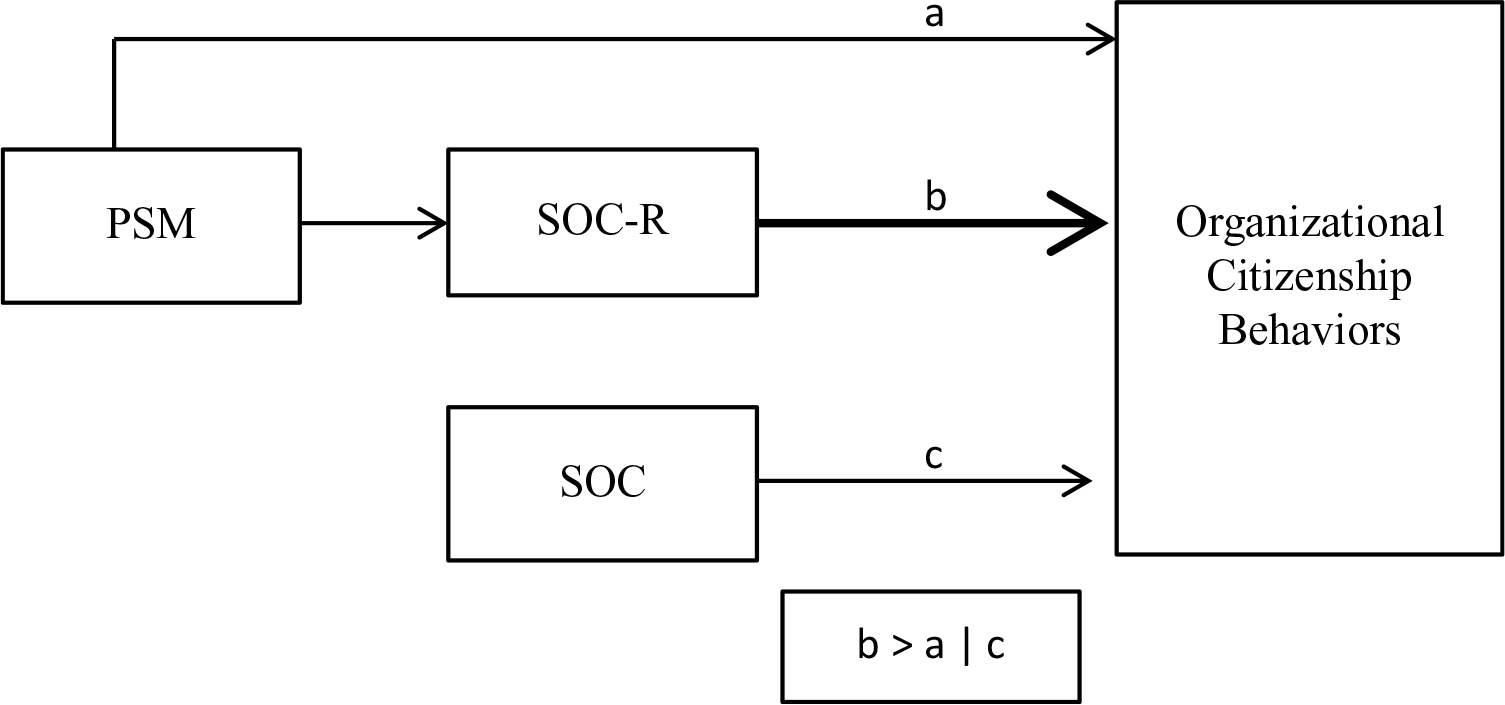
Hypothesized relationships of PSM, SOC-R, and SOC to organizational citizenship behaviors.
Conceptually, PSM and SOC-R share a common theoretical foundation in that both are theorized to be rooted in a priori values and beliefs. For PSM, those values and beliefs manifest into a motivational disposition toward public service that can exist independent of a specific work setting. For SOC-R, those values and beliefs must interact with setting characteristics to evoke a social identity grounded in feelings of duty and obligation for that specific setting. It is therefore reasonable to suspect that a disposition for public service would facilitate the formation of SOC-R (see Figure 1). This would therefore suggest the following hypothesis:
Job Satisfaction
While perhaps not as exalted as OCBs in recent literature, job satisfaction continues to be an outcome of vital interest in the field of public management. Interest in this outcome is rooted in satisfaction as a desirable end for individuals, as well as the theorized ability of job satisfaction to predict numerous other desirable outcomes such as work performance, organizational commitment, turnover, and organizational citizenship (Brown & Peterson, 1993; Donavan, Brown, & Mowen, 2004; Judge, Thoresen, Bono, & Patton, 2001). PSM, SOC, and SOC-R have also all been theorized as key determinants of positive emotional affect and satisfaction within an organization (Boyd & Nowell, 2014; Brewer & Selden, 1998; Bright, 2008; Naff & Crum, 1999; Nowell & Boyd, 2010, 2014). However, as with OCB, the theoretical mechanisms through which these constructs affect job satisfaction are not the same, which therefore suggests differential effects. For example, SOC in the Nowell and Boyd (2010) model emphasizes individual physiological and psychological needs fulfillment. When a community in an organization is experienced as a resource for fulfilling important human needs such as feeling of belonging and emotional connection, one would expect such an experience to positively affect one’s perceptions about that setting. Empirical research has largely supported this claim, finding significant relationships to outcomes such as subjective well-being (Davidson & Cotter, 1991), life satisfaction (Prezza & Costantini, 1998), political participation (Davidson & Cotter, 1989), and relief of loneliness (Pretty et al., 1994). Applied to our current research, this would suggest a direct positive relationship between SOC and job satisfaction. However, the nature of how SOC-R forms suggests a more complex relationship with job satisfaction. Recall that SOC-R is theorized to drive behavior through a mechanism of reducing cognitive dissonance. In other words, individuals with high SOC-R to a specific community or collective are theorized to take action on behalf of that collective to establish psychological congruence between the kind of person they think they are in that setting and their actual behavior in that setting (Nowell & Boyd, 2010). However, the psychological dissonance that makes SOC-R a stronger motivator of behavior is also theorized to attenuate its relationship to indicators of positive affect such as job satisfaction in the absence of action (see Figure 2). Inversely, this would indicate that the relationship of SOC-R to job satisfaction will be fully mediated by its relationship to OCB. In other words, individuals with high SOC-R will only feel satisfied in their job to the extent they are taking action that aligns with these feelings of responsibility. This would suggest the following hypotheses:

Hypothesized relationships of PSM, SOC, and SOC-R to job satisfaction.
Last, the relationship of PSM to job satisfaction is likewise expected to be attenuated and mediated by SOC using the same logic as described above. Specifically, we would expect that the disposition of PSM may increase the likelihood that an individual develops a strong SOC within public-serving contexts. However, it is SOC that is hypothesized to have a stronger direct effect on job satisfaction. In this way, PSM is hypothesized to have an indirect effect on job satisfaction, mediated through SOC (see Figure 2). Thus, the following hypotheses are proposed:
In summary, the present study aims to advance our understanding of the predictive capacities of SOC, SOC-R, and PSM, and test whether they are distinct concepts, which function to affect how members experience and engage in public service–oriented settings.
Method
Participants and Setting
A survey study was conducted in a nonprofit health care organization in the eastern part of the United States. The health care system consists of a central hospital and a handful of much smaller regional units in a 30-mile radius geographic region. The system serves approximately 500 beds, 15,000 inpatients per year, and employs approximately 1,500 employees. The organization was specifically chosen as a study site because the mission statement of the organization explicitly states that the organization exists to fulfill public service outcomes and that employees are expected to act with a servant’s heart. Participants included health care administrators, staff members, physicians, and health care workers. A single reminder was sent via email to potential participants one week after the initial call for responses, and all correspondence with potential respondents was conducted by the researchers. Requests for participation in the study and responses were kept confidential from administrators in the health care system.
In all, 1,522 employees received the email prompt, and complete data for all items collected were obtained from 369 participants (24.24% response rate). The majority of the respondents were full-time (93.2%), female (59.6%), and Caucasian (95.6%). In addition, 46.8% held less than a bachelor’s degree, whereas 19.5% had earned a PhD, MD, or JD degree. They were employed for an average of 15.4 years, and 67.4% were project/program staff, 24.2% were administrators/supervisors/coordinators, and 8.4% were directors/head administrators. The response rate in the study is similar with those found in organizational survey studies, and this is especially true in settings where response enhancing techniques are minimized by formal administrative structures or rules (Anseel, Lievens, Schollaert, & Choragwicka, 2010). In addition, we ran a series of comparative analyses aimed at investigating systematic differences in demographics between our respondent sample and the sample population. These analyses did not find significant differences on full- or part-time status, gender, race, education, organizational tenure, nor organizational role (all ps > .05). Thus, we are confident that our resulting sample is representative of our sample population.
Measures
SOC as resource
SOC was measured by the unidimensional Brief Sense of Community Scale (BSCS; see Peterson, Speer, & McMillan, 2008), which records items as defined in the McMillan and Chavis (1986) model (see items in Table 1). All BSCS items referenced the respondent’s organization, or members of the organization, and used a 7-point Likert-type response option format ranging from strongly agree to strongly disagree (e.g., “I have a say about what goes on in my organization”). Cronbach’s alpha for the BSCS was .936.
CFA Measurement Model Structure of All Predictive Variables in the Study.
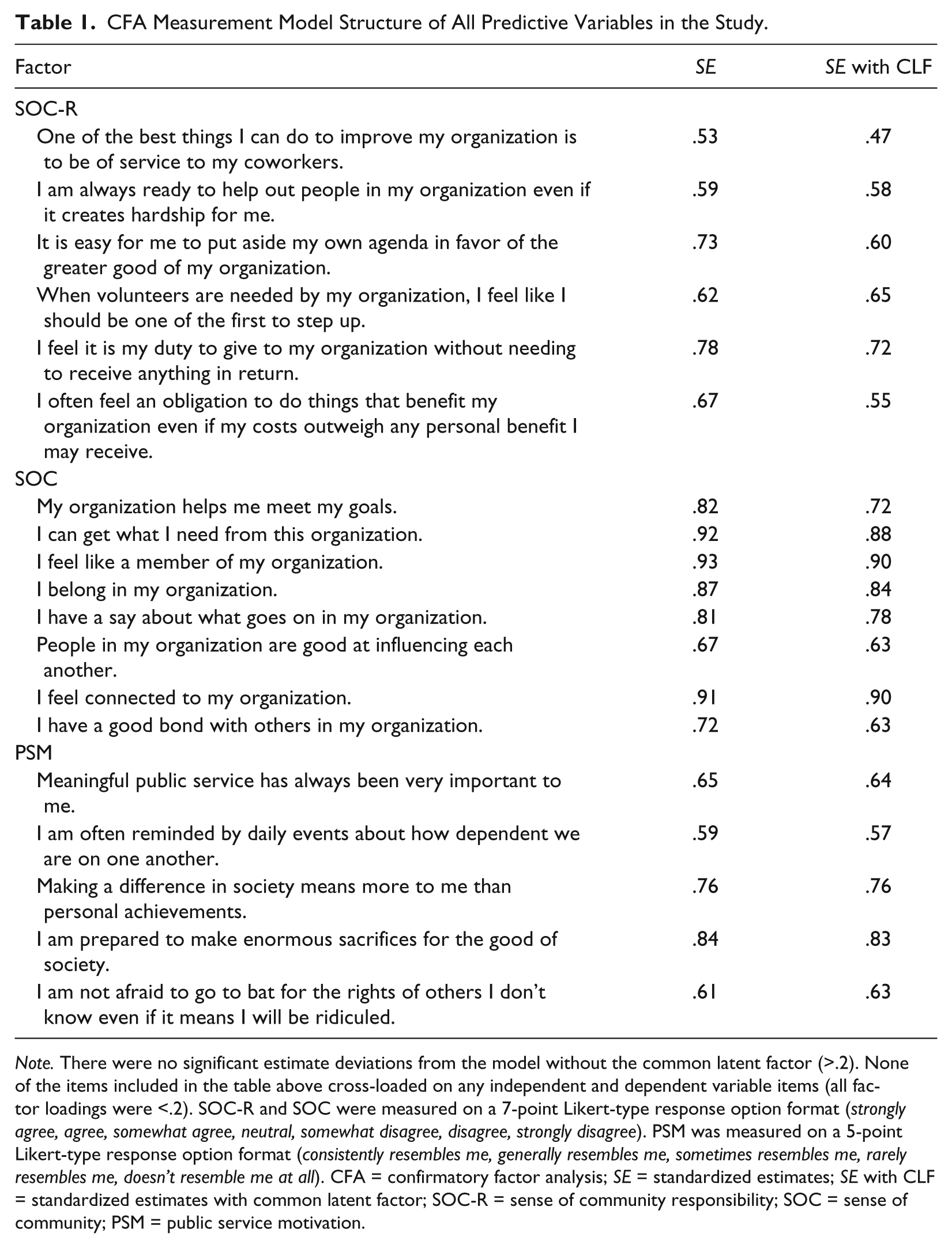
Note. There were no significant estimate deviations from the model without the common latent factor (>.2). None of the items included in the table above cross-loaded on any independent and dependent variable items (all factor loadings were <.2). SOC-R and SOC were measured on a 7-point Likert-type response option format (strongly agree, agree, somewhat agree, neutral, somewhat disagree, disagree, strongly disagree). PSM was measured on a 5-point Likert-type response option format (consistently resembles me, generally resembles me, sometimes resembles me, rarely resembles me, doesn’t resemble me at all). CFA = confirmatory factor analysis; SE = standardized estimates; SE with CLF = standardized estimates with common latent factor; SOC-R = sense of community responsibility; SOC = sense of community; PSM = public service motivation.
SOC-R
SOC-R was measured with a six-item scale previously developed and used by Nowell and Boyd (2014) with modifications to the referent (i.e., an organization and coworkers; see items in Table 1). SOC-R items used a 7-point Likert-type response option format ranging from strongly agree to strongly disagree (e.g., “I am always ready to help out people in my organization even if it creates hardship for me”). Cronbach’s alpha for the SOC-R scale was .819.
PSM
We use a validated five-item global measure of PSM, which assesses personal interest in performing public service work globally (Wright, Christensen, & Pandey, 2013; see items in Table 1). Shortened measures based on Perry’s (1996) scale have been used in a number of studies (Alonso & Lewis, 2001; Christensen & Wright, 2011; Kim, 2005; Naff & Crum, 1999; Pandey et al., 2008). Cronbach’s alpha for the PSM scale was .819.
OCB
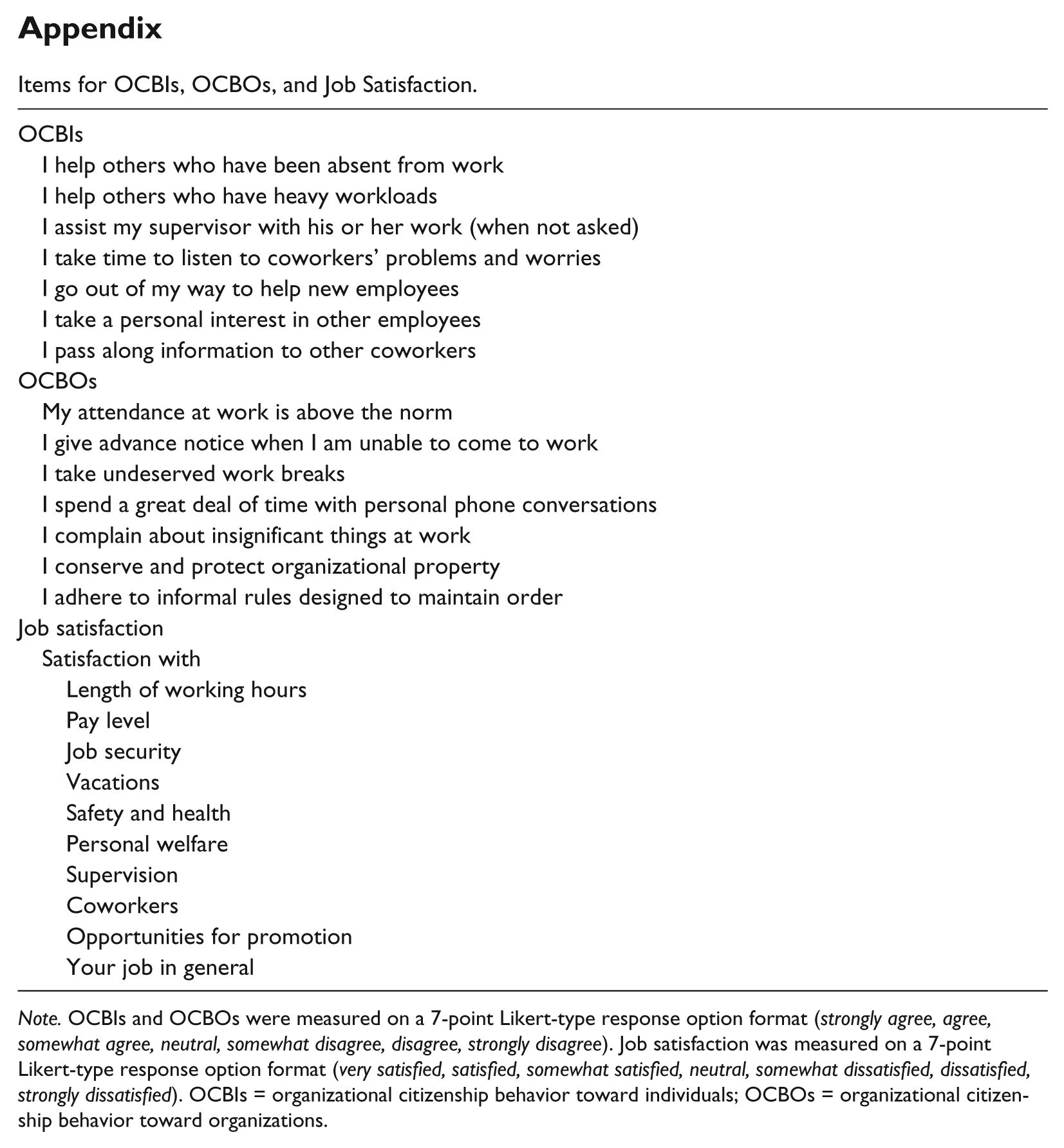
OCB was measured by the scale developed by Williams and Anderson (1991; see the appendix). Seven items measured organizational citizenship behavior toward individuals (OCBIs; for example, “I help others who have heavy workloads; I take time to listen to coworkers’ problems and worries; I go out of my way to help new employees”), and seven items measured organizational citizenship behavior toward organizations (OCBOs; for example, “I conserve and protect organizational property; I adhere to informal rules designed to maintain order; I take undeserved work breaks”). All items were measured on a 7-point Likert-type scale ranging from strongly disagree to strongly agree. Cronbach’s alpha for OCBI was .817, and Cronbach’s alpha for OCBO was .706.
Job satisfaction
Job satisfaction was measured with the Job Descriptive Index (Brodke et al., 2009; see the appendix). Ten items measured satisfaction with Length of Working Hours, Pay Level, Job Security, Vacations, Safety and Health, Personal Welfare, Supervision, Coworkers, Opportunities for Promotion, and Job in General. All items were measured on a 7-point Likert-type scale ranging from strongly disagree to strongly agree. Cronbach’s alpha for the job satisfaction scale was .864.
Confirming SOC, SOC-R, and PSM as Unique Constructs
We analyzed the overall factor structure for SOC, SOC-R, and PSM to confirm they were distinct measurement concepts. Pearson’s correlation revealed that SOC had a weak but significant positive relationship with PSM (r = .128, p < .05) and a moderate positive relationship with SOC-R (r = .378, p < .01). SOC-R had moderate positive relationship with PSM (r = .525, p < .01).
Next, a CFA in AMOS was conducted to validate the item structure for each of the measures (with dependent variables included) to determine whether factors were structurally unique, and to address concerns that some scholars have with common-method bias (Conway & Lance, 2010; Meier & O’Toole, 2013). Because we were interested in studying relative effectsrather than absolute effects, potential inflation of effect sizes is of lesser concern for this study. Regardless, several procedural remedies that Podsakoff, MacKenzie, Lee, and Podsakoff (2003) suggest for minimizing mono-method bias were implemented, including counterbalancing question order and refining scale items (e.g., we used validated scales, concise item construction, avoided double barrels, and used different scale endpoints). Moreover, Podsakoff et al. outlined a series of analyses to examine the extent to which mono-method bias is a concern within a given data set. First, a CFA was computed with each of the three latent factors, the dependent factors, and their corresponding items. The CFA measurement model showed that PSM, SOC, and SOC-R items loaded significantly onto their respective factors (see Table 1), and overall examination of indices showed acceptable model fit: root mean square error of approximation (RMSEA) = .056, comparative fit index (CFI) = .933, and incremental fit index (IFI) = .934. The findings revealed that items appropriately loaded on each of the measures, and all factors were structurally unique.
Next, a second CFA was computed with a common latent factor linked to every item across all scales, and each of the five latent factors and their corresponding items. The change in standardized regression estimates was computed, and none of the items were found to significantly deviate (>.2) from the original model. The second CFA measurement model showed that items loaded significantly onto their respective factors (see Table 1), and overall examination of indices showed an acceptable model fit: RMSEA = .058, CFI = .956, and IFI = .957. The findings revealed items appropriately loaded on each of the measures, all factors were structurally unique, and no statistical evidence of common-method bias was present.
Results
Descriptive statistics were computed for all major variables in the study. The analysis revealed that respondents generally reported positive perceptions for SOC (M = 5.10, S = 1.23), SOC-R (M = 5.09, S = 0.99), and PSM (M = 3.73, S = 0.69). These findings suggest that, on average, the organization is likely fulfilling respondent needs that employees feel responsible for the organization and its internal stakeholders, and that employees feel heightened motivation for public service. Moreover, employees generally reported positive job satisfaction (M = 5.35, S = 1.23) and felt that they engaged in high levels of OCB (OCBI: M = 6.07, S = 0.63; OCBO: M = 6.33, S = 0.59). In addition, because previous studies (Camilleri, 2006; DeHart-Davis, Marlowe, & Pandey, 2006; Naff & Crum, 1999) have suggested that different dimensions of PSM lead to different outcomes for males than for females, a series of t tests were computed to determine whether males and females differed on any of the measures in the study. Findings indicated that no significant differences existed (p > .001). Moreover, SOC and SOC-R exhibited significant bivariate correlations to job satisfaction, but SOC demonstrated a stronger relationship (r = .685, p < .001) compared with SOC-R (r = .375, p < .001). PSM was not significantly correlated to job satisfaction (r = .123, p = .018). SOC, SOC-R, and PSM were each significantly correlated to OCBs, but SOC-R showed stronger relationships (r = .487, p < .001, for OCBI; r = .356, p < .001, for OCBO) compared with SOC (r = .292, p < .001, for OCBI; r = .172, p < .001, for OCBO) and PSM (r = .392, p < .001, for OCBI; r = .245, p < .001, for OCBO). These results provide initial impressions that are consistent with H1, H2, H4, and H6. Finally, OCBs were moderately and positively correlated with each other (r = .422, p < .001), and they were significantly yet less correlated to job satisfaction (r = .288, p < .001, for OCBI; r = .228, p < .001, for OCBO).
Tests of Major Hypotheses
Next, several hypotheses were tested using structural equation modeling (SEM) in AMOS to determine whether SOC, SOC-R, and PSM predicted outcomes in accordance with theory development in the literature. H1 stated that SOC-R will be a stronger predictor of OCBs compared with SOC, and H2 stated that SOC-R will be a stronger predictor of OCBs compared with PSM. In addition, H4 stated that SOC will be a stronger predictor of job satisfaction compared with SOC-R, and H6 stated that SOC will be a stronger predictor of job satisfaction compared with PSM. Direct effects were assessed for SOC-R, SOC, and PSM on OCBs (see Table 2). SOC-R and PSM significantly predicted OCBIs; however, SOC-R had a much higher direct effect compared with PSM. To determine whether the direct effects of SOC-R and PSM were significantly different, two path models were compared. The first model freely estimated the coefficients of SOC-R and PSM, and the second model constrained the coefficients to be equal. A chi-square difference test (χ2 = 72.01, p < .001) showed that the models (and thus the coefficients) were statistically different from each other. For OCBOs, SOC-R was the only predictor that produced a significant direct effect. These results confirm H1 and H2 by indicating that SOC-R appears to be a better predictor of OCBs relative to SOC and PSM.
Direct Effects of SOC-R, SOC, and PSM on OCBs and Job Satisfaction.

Note. Total R2—OCBI: 31.7%; OCBO: 16.5%; and job satisfaction: 49.9%. All analyses controlled for demographic items of full- or part-time status, gender, race, education, organizational tenure, and organizational role. SOC-R = sense of community responsibility; SOC = sense of community; PSM = public service motivation; OCBs = organizational citizenship behaviors; SE = standardized regression estimates; OCBI = organizational citizenship behavior toward individual; OCBO = organizational citizenship behavior toward the organization.
Next, direct effects were assessed for SOC, SOC-R, and PSM on job satisfaction (see Table 2). SOC and SOC-R significantly predicted job satisfaction; however, SOC displayed a much higher direct effect compared with SOC-R. PSM did not produce a significant direct effect on job satisfaction. A chi-square difference test (χ2 = 16.476, p < .001) showed that SOC was a significantly better predictor of job satisfaction compared with SOC-R. These results confirm H4 and H6 by indicating that SOC appears to be a better predictor of job satisfaction compared with SOC-R and PSM.
Mediation tests
Three mediation hypotheses were tested using SEM in AMOS. First, H3 stated that the relationship between PSM and OCBs will be indirect and mediated by SOC-R. In the previous analysis, PSM did not produce a direct effect on OCBOs, and therefore a mediation test was only completed for OCBIs. The direct effect was tested without the mediator for the relationship between PSM and OCBI (see Table 3). PSM was found to have a significant direct effect on OCBIs (SE = .145, p = .044). The indirect effect when SOC-R was entered as the mediator was statistically significant (SE = .102, p < .001). Therefore, in the case of OCBs, H3 was partially confirmed. SOC-R fully mediated the relationship between PSM and OCBIs, but because PSM did not produce a direct effect on OCBOs, a mediation effect for SOC-R could not be assessed.
Mediation Effects.

Note. All analyses controlled for demographic items of full- or part-time status, gender, race, education, organizational tenure, and organizational role. SE = standardized regression estimates; PSM = public service motivation; SOC-R = sense of community responsibility; OCBI = organizational citizenship behavior toward individual; OCBO = organizational citizenship behavior toward the organization; SOC = sense of community.
H5 stated that the relationship between SOC-R and job satisfaction will be mediated by OCB. A direct effect was tested without the mediator for the relationship between SOC-R and job satisfaction (see Table 3). SOC-R was found to have a significant direct effect on job satisfaction (SE = .191, p < .001). Indirect effects were significant when OCBIs and OCBOs were entered as mediators (OCBI: SE = .174, p = .031; OCBO: SE = .161, p = .026), and therefore full mediation was present. H5 was confirmed.
Finally, H7 stated that the relationship between PSM and job satisfaction will be mediated by SOC. Because PSM did not produce a direct effect on job satisfaction, a mediation effect was not possible. Therefore, H7 was not confirmed.
Discussion
Findings from the present study make several important contributions to advancing our understanding of human motivation in public service organizations. This study empirically supports that SOC, SOC-R, and PSM are unique constructs, each tapping into distinct aspects of motivation that differentially predict work outcomes in theoretically consistent ways. PSM focuses on global dispositions toward public service, SOC taps into the psychosocial benefits that individuals perceive they receive from their organization, and SOC-R reflects psychological feelings of obligation and duty toward an organization and its members rooted in the social identity one has developed within that specific setting. Collectively, these three constructs contribute to a more holistic understanding of public employee psychological dispositions toward their workplace.
In addition, our study provides empirical support for several theoretical propositions concerning the relative contributions of these constructs for understanding two key outcomes in organizational settings: OCB and job satisfaction. First, across all models, PSM had less explanatory power in predicting both OCB and job satisfaction. This effect was predicted based on the notion that organizational behavior and attitudes are best viewed as motivated by an interaction between person and environment. As a result, this study contributes to a growing discussion concerning PSM as an indirect versus direct predictor of organizational behavior (Bright, 2008; Pandey et al., 2008; Wright & Pandey, 2008). It adds further support to the proposition that measures which tap global aspects of disposition such as PSM, while good predictors of job choice, may have weaker associations to on-the-job attitudes and behavior. This was particularly true when compared with SOC and SOC-R, which are intended to reflect a person’s relationship to a specific context. Findings further advance both theories of PSM and SOC-R in suggesting that PSM represents a key aspect of the a priori psychological disposition associated with SOC-R. However, findings suggest that PSM accounts for no unique variance in understanding OCB once SOC-R is in the model. Consistent with the arguments of other scholars (e.g., Pandey et al., 2008; Perry & Vandenabeele, 2008; Wright & Pandy, 2008), this finding offers further support for the notion that PSM may be best viewed as indirect predictor of organizational behavior.
This finding also provides additional support for current efforts in the literature to examine PSM and its influence as a function of person–organization fit and person–job fit (Gould-Williams et al., 2013; Kim, 2012; Wright & Pandey, 2008). Specifically, our results provide support for the notion that psychological constructs that reflect human cognition in context rather than in absolute terms are likely to be more powerful in understanding job attitudes and behavior. Constructs like person–job fit, person–organization fit, SOC, and SOC-R share in common an emphasis on setting specific attitudes and identities. This is important as it reminds us that humans are complex and capable of holding multiple and even conflicting attitudes and identities in relation to different social worlds. The addition of SOC and SOC-R to consideration of work-related motivation further expands upon the preceding efforts investigating organization and job fit as the vast majority of this previous work has focused on value congruence. Although value congruence is likely an important factor in understanding the conditions under which PSM may motivate organizational behavior, our findings suggest that other motivational factors such as feelings of community and responsibility may also play a role and can operate independently of value congruence. Understanding the relationship of value congruence to SOC and SOC-R will be an important direction for future research.
These findings have significant implications for public management practice in that job selection practices, which emphasize service-oriented constructs like PSM, can indirectly promote OCB through “stacking the deck” with individuals predisposed to experience a SOC-R toward public service–oriented settings (Crewson, 1997; Gailmard, 2010; G. B. Lewis & Frank, 2002; Mann, 2006). However, if the organization itself is not a setting that evokes a social identity within its members oriented toward feelings of responsibility for that setting, findings from the present study indicate that the benefit of this job selection strategy is likely to be limited. Consequently, understanding the organizational factors that are most strongly associated with the development of SOC-R will be an important area for future research.
This study also helps advance theory and practice in expanding our understanding of the relative importance of what Nowell and Boyd (2010) refer to as the resource versus responsibility aspects of community. SOC—with its emphasis on an organization as a resource for meeting key social–psychological needs such as the need for inclusion, affiliation, and influence—was found to be the strongest predictor of job satisfaction. Conversely, SOC had no unique effect in understanding OCBs. Instead, SOC-R—with its emphasis on duty and obligation toward an organization and its members—was the only significant predictor in the model, accounting for almost 30% of the variance on OCB.
Both job satisfaction and OCB are desirable outcomes for organizations. However, our findings indicate that the set of factors and relationships that facilitate the development of one may not be the same combination that facilitates others. This general idea that different outcomes are associated with a unique portfolio of factors is not new to the field of public management or organizational studies (e.g., Sandström & Carlsson, 2008). However, there has been limited attention to this contingency perspective in scholarship on work motivation. Furthermore, findings indicate that job satisfaction and OCB are not coterminous. Therefore, it would be an error for managers to assume that their staff are satisfied with their workplace simply because they are exhibiting high levels of citizenship behavior and vice versa. As above, advancing our understanding of the unique social ecology of these two constructs will require future research to understand both the psychological dispositions and organizational contexts that serve as antecedents of SOC and SOC-R.
Findings in this study need to take into account a few limitations. First, our findings are based on single informant cross-sectional data. As with all cross-sectional research, the patterning of associations is statistically ambiguous and informed purely by theory. It is also important to note that, while hypothesized in a unidirectional pattern in accordance to the cited theories, in reality there is good reason to believe that the association between one’s disposition toward public service and one’s experience of community within a specific setting may be bidirectional. In other words, because PSM is theorized as a global disposition toward public service, it theoretically would precede any relationship a member has to a specific organization. However, as members have experiences in specific settings, it is reasonable to suggest that one’s global disposition toward public service would evolve. This pattern of association has been posited by other scholars. For example, Wright, Moynihan, and Pandey (2012) looked at transformational leadership as a factor for increasing employee PSM. Similarly, Jacobsen, Hvitved, and Anderson (2014) hypothesized that employee accountability and command systems will influence PSM. Indeed, most research to date on PSM, like ours, suffers from the common limitation of seeking to gain insight into directional hypotheses using cross-sectional data. Although this work contributes by establishing significant patterns of association linked to theorized models, the importance of longitudinal analysis to gain empirical clarity on the patterning of effects over time cannot be understated.
Furthermore, as noted by Petrovsky and Ritz (2014), caution must be exercised when interpreting the absolute effect size as they are likely to be inflated to some extent by common-method bias. However, as noted earlier, our interest in this study is not with the absolute effects but rather the relative effects of PSM, SOC, and SOC-R as they relate to job satisfaction and OCBs. As all relationships are embedded within the same potential for method bias, we have greater confidence in the statistical validity of our hypothesized findings (N. P. Podsakoff et al., 2009).
Second, the current study uses a unidimensional measure of PSM. Although this measure has become widely utilized in PSM research, it is limited in that it does not allow the researcher to investigate whether models may differ if dimensions are examined independently. Testing alternative measures of PSM in this arena is an important direction for future research.
Finally, the current study was conducted in a nonprofit health care setting where public service was at the heart of the institution. Job selection research on PSM has suggested that the mechanism by which PSM operates centers on the perception of opportunity to serve the public good rather than any formal designation of public, private, or nonprofit (Christensen & Wright, 2011). Therefore, studies of PSM in nonprofit public service–oriented settings are warranted. Some work has begun in this area, for example, Word and Carpenter (2013) introduce a modified version of Perry’s (1996) PSM Scale as a model for nonprofit service motivation (their model excluding attraction to policy making) and find that intrinsic motivation is key to nonprofit employee job selection, as well as race, attraction to mission, depth of involvement in sector, and state location. In addition, Word and Park (2015) explore the application of PSM in the nonprofit sector and find that while intrinsic motivation is a factor in job choice, additional factors including work–life balance, advancement, and job security are also important. However, because all members in this study were nested within the same organization, this study cannot speak to whether organizational characteristics might moderate the observed relationships. Consequently, replicating these findings in alternative organizational settings is an important area for future research. Also important for future research is consideration of whether these dynamics may play out differently for individuals in roles that interface more directly with the public.
In summary, this study illuminates the relationship among three unique, yet related, constructs that seek to capture intrinsic motivations for an employee going above and beyond in service to a public organization. In the field of public management, PSM is a primary construct used to explore individual-level participation in public service. In community psychology, SOC and SOC-R are theorized as strong predictors of individual motivation. By clarifying these constructs, their relationship to each other, and their relative strength of association to key outcomes of interest, we are able to advance both theory and practice in identifying the unique motivational profile that is most strongly associated with different aspects of organizational behavior.
Footnotes
Appendix
Items for OCBIs, OCBOs, and Job Satisfaction.
| OCBIs |
| I help others who have been absent from work |
| I help others who have heavy workloads |
| I assist my supervisor with his or her work (when not asked) |
| I take time to listen to coworkers’ problems and worries |
| I go out of my way to help new employees |
| I take a personal interest in other employees |
| I pass along information to other coworkers |
| OCBOs |
| My attendance at work is above the norm |
| I give advance notice when I am unable to come to work |
| I take undeserved work breaks |
| I spend a great deal of time with personal phone conversations |
| I complain about insignificant things at work |
| I conserve and protect organizational property |
| I adhere to informal rules designed to maintain order |
| Job satisfaction |
| Satisfaction with |
| Length of working hours |
| Pay level |
| Job security |
| Vacations |
| Safety and health |
| Personal welfare |
| Supervision |
| Coworkers |
| Opportunities for promotion |
| Your job in general |
Note. OCBIs and OCBOs were measured on a 7-point Likert-type response option format (strongly agree, agree, somewhat agree, neutral, somewhat disagree, disagree, strongly disagree). Job satisfaction was measured on a 7-point Likert-type response option format (very satisfied, satisfied, somewhat satisfied, neutral, somewhat dissatisfied, dissatisfied, strongly dissatisfied). OCBIs = organizational citizenship behavior toward individuals; OCBOs = organizational citizenship behavior toward organizations.
Declaration of Conflicting Interests
The author(s) declared no potential conflicts of interest with respect to the research, authorship, and/or publication of this article.
Funding
The author(s) received no financial support for the research, authorship, and/or publication of this article.