



Abstract
There is significant debate about the appropriate governance structure in a disaster response. Complex disasters exhibit both networked and hierarchical characteristics. One challenge in the field of disaster management is how to structure a response that reconciles the need for centralized coordination among varied responders while retaining flexibility to mutually adjust operations to quickly changing conditions. A key question with both practical and theoretical relevance is, “are there patterns of relationships that are more robust, efficient and effective?” Missing from the current literature is empirical evidence and theory building concerning what actual network structures and characteristics might be associated with effective incident response to complex disasters. In this article, we collected network cognition data from 25 elite, Type 1 Incident Commanders to construct an ideal-type theoretical social network of an effective incident response network. We then analyzed this model to identify a set of propositions concerning the network structure and governance of effective incident response relative to four key network capabilities: (a) rapid adaptation in response to changing conditions, (b) management of distributed information, (c) bilateral coordination, and (d) emergent collective action. Our data suggest that the structure is neither highly integrated nor rigidly centralized. Rather, it is best characterized as a moderate core–periphery structure. Greater theoretical clarity concerning the capabilities associated with this structure is critical for advancing both research and practice in network governance of complex disasters.
Introduction
There continues to be a growing appreciation for the networked character of many public management contexts (O’Toole, 2015), particularly around interventions in complex problem domains that are beyond the scope of any single organization or agency (Crosby & Bryson, 2005). Perhaps nowhere is this more true than in the context of incident response to complex disasters.
Ansell, Boin, and Keller (2010) use the term transboundary disaster to describe a crisis requiring rapid response by multiple jurisdictions and operational areas to a dynamic set of conditions under high levels of collective stress and uncertainty. Although it might be argued that all disasters are likely to be transboundary to some extent, disasters do vary in degree in terms of the number of jurisdictions and functional roles that are activated in response. During a complex disaster, no individual, organization, or agency has the jurisdictional authority, legitimacy, or resource/technical capability to effectively assume hierarchical command and control of the entirety of the response. Rather, these incidents are collectively managed through the actions and interactions of a myriad of local, state, and federal agencies; private and nonprofit organizations; and unincorporated groups of local actors linked together through a fragmented web of formal and informal relationships (e.g., Edwards, 2009; Nolte & Boenigk, 2013). In other words, incident response to disasters is, by its very nature, a networked enterprise. Yet, strong characteristics of hierarchy are also present through the application of the Incident Command System (ICS; Moynihan, 2008a). ICS is a command and control tool that is used to coordinate a networked response in almost all disasters (Irwin, 1989).
In light of this, a question for disaster scholars and managers alike has been how do we effectively characterize, coordinate, and govern action in such a complex and dynamic networked setting? (e.g., Ansell et al., 2010; Choi & Brower, 2006; Comfort, Okada, & Ertan, 2013; Hunt, Smith, Hamerton, & Sargisson, 2014). Adopting a structural network perspective, the pre-eminent question becomes, are there patterns of relationships that are more robust, efficient, and effective? These questions are relevant for how to think about and practice network governance in complex disaster domains. They are also relevant for emergency managers who find themselves facing complex incidents. The mental models they carry around that guide how they manage an incident have bearing on the effectiveness of response. Greater theoretical clarity concerning the capabilities of different network structures under conditions of complexity can lead to better practical application of network principles to the field disaster response.
There is significant debate about the appropriate governance structure in disaster response. Curiously, while scholars generally agree that incident response is not well-characterized as a hierarchy (Comfort, 2007; Drabek & McEntire, 2002, 2003; Hardy & Comfort, 2015; Kapucu, Arslan, & Collins, 2010; Waugh & Streib, 2006), both theory and practice dedicate significant attention to understanding and developing more elaborate systems of command and control (Abbasi, 2014; Hunt et al., 2014). This has led to two competing schools of thought in disaster scholarship (Ansell et al., 2010; Marcum, Bevc, & Butts, 2012). One continues to emphasize the need for centralized control and views negative outcomes of disasters as inadequacies in command (Schneider, 1992). Furthermore, scholars propose that the crisis nature of a disaster means that some form of centralization is often required for effective response (Moynihan, 2008a; Waugh & Streib, 2006). The other side emphasizes the importance of lateral, emergent coordination and argues that failures in disaster response are often the consequence of centralized versus decentralized management and decision making (Comfort, 2007; Drabek & McEntire, 2002, 2003; Gardner, 2013; Majchrzak, Jarvenpaa, & Hollingshead, 2007; Stallings & Quarantelli, 1985). Research suggests that most disasters will include some aspects of spontaneous emergence related to personnel and resources (Britton, 1989; Choi & Brower, 2006; Dynes, 1983; Dynes, Quarantelli, & Kreps, 1981; Neal & Phillips, 1995; Petrescu-Prahova & Butts, 2005; Waugh & Streib, 2006). Practical and theoretical challenges arise from tension between the emergence of spontaneous interorganizational collaboration and the need to establish an ordered emergency response under stressful conditions—something Moynihan (2008a) has called “the crisis management paradox” (p. 206). In the realm of wildfire, conflict has arisen over how Incident Management Teams (IMTs) integrate into a local community and/or fail to create opportunities for local actors to play a role in the management of the fire or inform how the fire is managed (Carroll, Cohn, Seesholtz, & Higgins, 2005; Carroll, Higgins, Cohn, & Burchfield, 2006; Paveglio et al., 2015a). These limited views of who could be included in the response as part of a broader network can hinder effectiveness in perceptions of overall fire management (Paveglio et al., 2015a).
Different structural configurations of networks have been associated with greater performance in different settings (Provan & Milward, 1995; Turrini, Cristofoli, Frosini, & Nasi, 2010). As stated by O’Toole (2015), there is a great deal left unknown about the ways in which networks and networking behavior shape performance in general. Very little is known about the network structure that is associated with effective incident response in disasters. Network scholars recommend that more work is needed to build and test theory related to network-level governance activities, structures, and outcomes, including greater empirical evidence to support conceptual claims (Magsino, 2009; Provan, Fish, & Sydow, 2007; Provan & Kenis, 2008). In this article, we seek to address this gap by theorizing the ideal network structure of incident response based on the collective wisdom of 25 of the most elite and experienced Incident Commanders (ICs) in the United States. Our goal is to move toward a general theory of network structure for governing incident response to disasters.
What Do High-Performing Incident Response Networks Look Like?
The study of network structure focuses on identifying and understanding the consequences of enduring patterns of interaction within a defined domain (Brass, Galaskiewicz, Greve, & Tsai, 2004). The focus of our study is to provide an empirical foundation for theorizing about network structures that might hold particular promise in facilitating the kind of coordinated action among a constantly changing, wide array of disparate responders. A key contribution of neoclassical theories of organizational design is the basic notion that different structural forms tend to facilitate different functions (Blau & Scott, 1962; Burns & Stalker, 1961). The obvious implication of this insight is that the appropriateness of any given structure must be considered in light of the desired functionality and the environment within which one wishes to achieve it (Kenis & Provan, 2009). There are several important common environmental attributes to consider in understanding incident response networks in complex disasters.
First, while there are exceptions in communities that have an unusual exposure to disaster risk, most major disasters are relatively uncommon events in the lives of many of the people who respond to them (Kapucu, Bryer, Garayev, & Arslan, 2010; Wang & Kapucu, 2008). Even with a significant investment in preparedness, formal incident response roles may be largely theoretical for many actors. They may exist in the abstract in plans and procedures without the benefit of informal institutions, relationships, and practiced routines that undergird more commonly encountered situations (for discussion see Feldman & Pentland, 2003; Feldman & Rafaeli, 2002).
Second, significant disasters are—by definition—both complex and dynamic (Ansell et al., 2010; Edwards, 2009). Past experience and approaches must be continually adapted to novel situations and changing response needs (Djalante, Holley, Thomalla, & Carnegie, 2013). Unpredictability, coupled with potentially rapid condition changes, means that roles and relationships among responders can change over time as well. Consequently, the incident response network as a whole must be able to maintain integrity of response while continually transforming as formerly peripheral or uninvolved actors become more central (Abbasi & Kapucu, 2012), previously central actors exit the network and new actors enter, and/or different emergency response functions increase and/or decrease in importance. The longer the duration of the event, the greater number of these adjustments can be expected (Comfort, Dunn, Johnson, Skertich, & Zagorecki, 2004).
Last, significant disasters are inevitably characterized by a high degree of distributed information and goal interdependence across jurisdictions and operational domains. This means that critical information is dispersed across a myriad of actors and must rapidly flow from those who have the information to those who need the information to inform strategic action (Steelman, Nowell, McCaffrey, & Bayoumi, 2014). It further means that unilateral actions by one actor can significantly undermine the goal accomplishment of other responders (Nowell & Steelman, 2013). At the same time, even the most discrete operation may exceed the scope, expertise, jurisdiction, and resources of any given agency—requiring joint action by two or more agencies.
Collectively, this set of conditions suggests a number of capabilities that an incident response network must possess for effective disaster management, as illustrated in Figure 1. From the above discussion, we can surmise that—minimally—a high-performing incident response network must be proficient at four things. First, in light of the often chaotic, unpredictable nature of disasters, the network as a whole must have the flexibility to rapidly adapt to changing conditions by adjusting to variations in network composition and structure (e.g., Comfort, 2007; Djalante et al., 2013; Kapucu, Arslan et al., 2010). In other words, the network must maintain performance over time despite significant changes in size, composition, and configuration as actors enter, exit, and change position within the network. Second, the network must be able to manage distributed information, ensuring that information can flow rapidly from those who have it to those who need it in sufficient time to inform strategic action (e.g., Nowell & Steelman, 2013; Steelman et al., 2014). Third, actors intervening in the theater of operations must be able to bilaterally coordinate to avoid destructive interference that can undermine goal accomplishment (Edwards, 2009; Nowell & Steelman, 2013). Last, beyond just staying out of each other’s way, high-performing incident response networks must be able to act collectively when an opportunity for collaborative advantage among two or more agencies/organizations arises (Nowell & Steelman, 2013).

Requisite capacities of high-performing incident response networks.
Importantly, the network has to be able to do all these things without the benefit of an overriding bureaucratic authority that can mandate subordination of all actors under a single command. There is no entity within the legal framework of the United States that has the authority to coerce cooperation among the collection of private, public, nonprofit, and citizen groups that become active during a transboundary disaster. This fact gives rise to important questions related to what kind of structures are best suited to facilitate high performance incident response.
The Structure of Whole Networks and Associated Capabilities
Although outcomes of network structure in disaster contexts have received modest attention, there is a significant literature in network scholarship dedicated to understanding the capabilities and limitations of different network structures in general. At the whole network level (Provan et al., 2007), discussions of network structure refer to the global configuration of the overall network. This is in contrast to ego networks that focus on the network ties of a specific actor. As numerous configurations of networks have been theorized, here we consider the literature on the capabilities of four prominent structures of whole networks: closed, centralized, decentralized/brokered, and core–periphery network structures.
Perhaps no two structures have received more attention than debates concerning the merits of closed networks versus centralized networks. As illustrated in Figure 2, dense or closed networks refer to a network in which there is a high level of connectivity across all actors in the network. Conversely, highly centralized networks, at their most extreme, link members together exclusively through their connection to a single centralized actor. The ICS that governs incident response worldwide is grounded in a centralized network logic in which resources from various agencies are brought together under the centralized command and control of a single IC. However, as mentioned earlier, the appropriateness of centralized network structure in dynamic contexts has received a significant degree of criticism. If the demands of the setting overwhelm the hub’s capacity, network functionality can collapse. As such, centralized structures are disparaged for their vulnerability and lack of scalability in dynamic contexts (e.g., Bienenstock & Bonacich, 2003; Comfort, Waugh, & Cigler, 2012; Hollenbeck, Ellis, Humphrey, Garza, & Ilgen, 2011). Decentralized or brokered networks are networks characterized by the presence of subgroups that are connected together through a series of brokers.
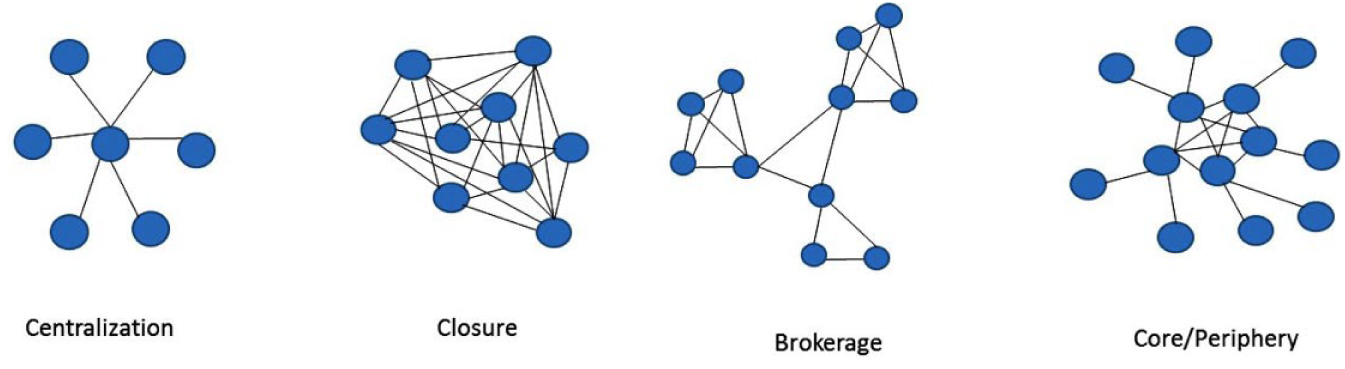
Four network structures.
Finally, a fourth network structure gaining scholarly attention is that of a core–periphery network. In a seminal article, Everett and Borgatti (1999) describe this network structure as characterized by dense connections among a central subgroup of actors at the core of the network surrounded by a peripheral set of actors with more sparse connections. A core–periphery structure is one in which the network is unified in that it cannot be easily divided into multiple structurally independent subnetworks. However, actors within the network differ from one another in how structurally embedded they are to the rest of the network. Core–periphery network structures are theoretically interesting because they are thought to have advantages over fully centralized structures. They also have advantages over fragmented structures in dynamic environments which are too complex to be managed effectively through fully centralized control but still require active coordination and communication among subgroups (Cummings & Cross, 2003; Johnson, Boster, & Palinkas, 2003; Provan & Lemaire, 2012). However, it has also been argued that this design can limit effectiveness of networks to problem solve in nonroutine, complex tasks by marginalizing the contributions of peripheral members (Cummings & Cross, 2003).
Given the different network structures, what can we say about the most appropriate structure for incident response networks in complex disasters? Unfortunately, very little. Although there is a growing literature that seeks to document the network structure of incident response (Comfort, 2007; Comfort & Kapucu, 2006; Kapucu, 2005, 2006; Kapucu, Augustin, & Garayev, 2009; Magsino, 2009; Moynihan, 2009; Nowell & Steelman, 2013; Steelman et al., 2014) and the antecedents of that structure (Kapucu, Arslan et al., 2010; Nowell & Steelman, 2015), there has been limited theoretical development concerning what structures will lead to more capable, scalable, and responsive disaster response networks.
Within the field of public management, a more robust program of research concerning the effectiveness of network structure has been conducted in the context of service delivery networks (e.g., Kenis & Provan, 2009; Milward & Provan, 2000; Provan & Kenis, 2008; Provan & Milward, 1995; Turrini et al., 2010). This body of work proposes that when networks are large, moderately trusting of one another, and united by a common goal, the most advantageous network structure is characterized by a high degree of centralization in which network members are centrally coordinated by a Network Administrative Organization (NAO). An NAO is an administrative entity whose sole purpose is the coordination of the network (Kenis & Provan, 2009; Sandström & Carlsson, 2008).
Moynihan (2009) applies the logic of the NAO to the disaster response context, arguing that IMTs governed by ICS are appropriately characterized as NAOs in disaster response networks, and network dynamics shape how well ICS functions on an incident. Specifically, he found that, despite the ICS emphasis on a single commander, shared authority and governance was common and that prior working relationships and trust were key factors in understanding how the networks functioned. However, he also concluded that network coordination through the ICS structure was often challenged as the size and diversity of the network increased and that this system frequently struggled to incorporate new members into its structure.
Theory building concerning network structure during disasters can be approached in different ways. An inductive approach compares different characteristics of different disaster response networks against reports of network performance in an attempt to identify those characteristics more common in higher performing networks. Given the complex array of nonstructural factors that may affect network performance, the obvious limitation with this approach is a classic missing variable problem. This is exacerbated by the number of networks and disasters that would be required to develop an empirically robust model.
An alternative approach, adopted here, is inductive in nature. However, it is not our inductions concerning the most effective network structure that are of initial interest to us. Rather, we analyze the collective mental models of 25 of some of the most elite and experienced ICs in the United States. Mental models are deeply ingrained assumptions, generalizations, or even pictures or images that influence how we understand the world and take action (Senge, 2006). Based on ICs’ insights from decades of experience managing complex networks during disasters, we constructed a theoretical social network of an effective incident response network. We then examine the structural characteristics of this model to theorize a set of propositions concerning the network structure and governance of effective incident response.
Study Context
Most empirical advances and theory development in the study of disasters have been grounded, at least initially, in case studies of one particular type of disaster. The nature of the phenomenon makes empirical comparison across disaster types difficult. This study focuses specifically on networks associated with the management of complex wildfire disasters in the wildland–urban interface (WUI). The WUI is the place where forests and people mix and is thus a prime target for disaster when a large-scale wildfire takes place.
However, this exercise runs the risk of comparing apples to oranges. As such, it is important to consider what features of a complex wildfire event are common to most disaster contexts and what features are unique. In terms of composition, threats to human populations as well as public and private infrastructure are definitional to a complex wildfire. Accordingly, emergency support functions and the associated cast of responders involved with evacuation, road closures, transportation system restoration, sheltering, mass care, public information, utility restoration, and public safety, among others, are not unique to wildfire. Also, like many natural disasters, the area impacted by a complex wildfire event overlays multiple jurisdictional borders which can include private, municipal, county, state, and federal lands. Last, wildfire response relies heavily on the tools and structures outlined in the ICS. ICS was initially developed in a wildfire context but has since been embraced by the National Incident Management System and Federal Emergency Management Agency (FEMA) as the gold standard for effective incident response across all types of natural and human-made disasters (Jensen & Thompson, 2016; Jensen &Waugh, 2014).
However, wildfire disasters do have several unique features. Arguably, the feature most paramount to the consideration of disaster response networks is the presence of fire suppression operations that occur simultaneously and in concert with emergency response operations. We do not fight hurricanes, earthquakes or tornados, we simply respond to the consequences of them. However, we do “fight” fires. This has several implications. First, it leads to heavy involvement of state and federal land agencies (U.S. Forest Service, The Bureau of Land Management, state forestry, U.S. Parks Service) in the network who have responsibility for wildland fire suppression operations on their respective jurisdictions. Second, because wildfires can burn for days, weeks, or even months, the response phase of the incident can endure for a lengthy period of time and be highly dynamic in terms of the response functions that are required at any given point in time. Last, wildfire suppression operations on highly complex wildfire events are generally managed by a Type 1 Incident Management Team.
An IMT is an element of the ICS. The organizational structure of IMTs exemplifies the top–down, command and control organization for which ICS is known. These teams are organized under the authority of a single IC—often supported by a deputy IC. Under the IC are specialized units representing seven functions related to successful planning and implementation of complex operations: safety, community/agency liaison, public information, operations, logistics, planning, and finance (Irwin, 1989). Each section is led by a section chief or lead staff who reports directly to the IC. During a complex incident, each section can then scale out to have multiple subsections often referred to as branches. Each branch can be further subdivided into different units, strike teams, and task forces (Irwin, 1989).
The elegance of the ICS command structure is that it allows a variety of personnel and resources from a wide array of agencies to be integrated into this incident command organization. For example, on a large-scale wildfire, the incident command organization may include fire personnel from local voluntary fire departments, state forestry agencies, and other federal land agencies. However, the collection of these agencies under the ICS structure does not necessarily constitute a network, any more than the various departments and divisions within a large federal bureaucracy like the U.S. Forest Service constitute a network. When agency resources are legally recruited to serve under the authority of an IC, these relationships are hierarchical and bureaucratically governed. Once under their command, the IC has complete jurisdiction to control these resources without consultation from the parent agencies from which these resources were borrowed. In this way, we differ from Moynihan’s (2009) characterization of incidents governed by an NAO. According to the framework proposed by Provan and Kenis (2008), the key distinction between an NAO and a lead organization is a question of whether the entity seeking to manage the network also has an operational responsibility within the network. Because IMTs have command authority over fire operations, they are an operational player in the network. At the same time, they are also looked to for leadership in coordinating across operational domains not under their jurisdiction. As such, we characterize them as a lead organization.
There is often confusion about hierarchical versus networked aspects of incident command and its position within an incident response network. Because ICS can operate somewhat differently in different contexts, we give a brief overview based on the prevalent model in wildfire management. In the context of wildfire, the jurisdictional entity whose land is burning has authority over that fire. For example, a fire that ignites on U.S. Forest Service land is under the federal jurisdiction of the National Forest, and they have responsibility to manage the incident on their land. Small fires on National Forests are often handled internally using agency resources. However, when the fire escapes initial suppression efforts, the Forest Service may call in or “hire” a more experienced IMT to take command of the incident. Incident command teams range from Type 5 through Type 1 with Type 1 being the most elite. Most confusion concerning the hierarchical versus networked aspect of ICS lies in what it means to “take command of an incident.” The legal authority of an IMT is constrained to the jurisdictional authority of the entity that hired them. Using a legal document often referred to as a “Delegation of Authority,” the responsible land agency can grant the team only as much authority as they themselves possess. For example, if a fire burning on federal lands crosses onto county land, the IMT has limited jurisdiction to conduct fire operations on county land unless they receive a Delegation of Authority from the county government (referred to a Joint Delegation of Authority).
This results in a complex web of bureaucracies of different sizes and levels laterally linked together into a network, yet operations are functionally interdependent and none has legal authority over the other. The core of the incident command organization, including varied resources under its command, is included in this web as a bureaucratic hierarchy. In a wildfire context, the picture becomes more complex as fire operations are only one part of the portfolio of incident response activities. Other activities may include road closures, evacuations, sheltering and mass care of evacuees, and animal evacuations. Each of these functional areas may be under the authority of a different set of agencies or units. Therefore, while IMTs do have command authority to manage part of an incident based on their Delegation(s) of Authority, they rarely have command authority over the entirety of the incident. Yet all these functional areas are highly interdependent. Therefore, managing a complex wildfire incident often involves a simultaneous combination of top–down command of those things you do have authority over, coupled with network management aimed at creating a coherent and coordinated response among all the different actors with legal authority to act unilaterally if they so choose. In this study, we focus specifically on this latter aspect.
Method
To develop a structural model of an effective incident response network to transboundary wildfire, we engaged in a two-phased effort. First, we started with a list of actors and units who have leadership responsibilities over different domains of incident response operations that must be coordinated with the rest of the network for the incident to be managed. This list was developed and validated in previous research (Steelman et al., 2014) through field research on large-scale, transboundary wildfire events ignited on U.S. Forest Service land, and represents the key actors who control key operations or access to critical information. Because this network was designed as a theory-building exercise focused on an abstraction of an idealized incident response network during wildfires, the actors in this network were based on roles common to complex wildfire disasters but did not represent any one wildfire disaster network in particular. For example, the network asked about critical network connections for “Sheriff” but did not specify a specific county. The IMT is represented in the network in terms of the core components outlined in ICS: IC, deputy IC, liaison (LOFR), public information, operations, logistics, planning, safety, and finance. The host agency from which the IMT gains their authority (in this case the National Forest) is representative of the key units/positions with unique responsibilities in fire operations. The remainder of the network comprises numerous actors and agencies who frequently become involved in the emergency response operations during an event. This includes elected officials, sheriffs, highway patrol, and Red Cross. All agencies under command of the IMTs are represented by the team itself and therefore excluded from analysis.
In phase two, the goal was to capture the network cognitions of highly experienced ICs. Scholarship on network cognitions is the study of mental models that actors hold about who is or should be connected to whom and in what ways within a defined network (Balkundi & Kilduff, 2006). Our sample for this study was 25 Type 1 All Hazard ICs and deputy ICs associated with IMTs actively serving under the U.S. Department of Fire and Aviation Management in 2011.
Type 1 commanders and deputy commanders who lead these teams are some of the most experienced incident responders in the world, each having decades of experience serving on IMTs to have achieved the rank of Type 1 IC. A typical path to becoming an IC takes 25 to 30 years, according to a member of the Wildland Fire Leadership Council Committee on Incident Management Succession Planning (Kuo, personal communication, 2015). Understanding their qualification to serve as informants in this study requires some background of the U.S. Department of Fire and Aviation Management certification system. The ICS uses a five-level rating system which corresponds to both the qualifications of incident responders as well as the severity of incidents. Incidents of limited complexity are dubbed as Type 5 incidents whereas the most complex and high-risk incidents are titled Type 1 incidents. The intent behind this rating system is to ensure that there is a match between the incident complexity and the skill and experience of the individuals delegated authority to manage that incident. As incident complexity increases, IMTs of higher rank will be deployed and delegated command. For example, the same wildfire may be initially categorized as a Type 3, then elevated to a Type 2, then a Type 1 as the blaze grows and poses a greater threat to human populations and settlements. The incident can then de-escalate back down to a Type 2 or 3 as the fire is contained and recovery operations ensue. Different management teams would rotate on and off command of the fire as the classification changed.
At the time this research was conducted, there were fewer than 20 Type 1 qualified IMTs staffed in the United States, and they are reserved for only the most severe and high-risk incidents. These teams are deployed nationally and internationally to assist on all manner of hazards, but their primary responsibility is to manage Type 1 wildfires in the United States.
Individuals assigned to leadership roles on IMTs must hold a rank at or higher than the team classification in their assigned role to serve on that team. Classifications are assigned to a given role and team members gain rank progressively through an apprenticeship/task book system where members work their way toward a Type 1 classification. Most never achieve Type 1. Each rank requires a certification process with each level requiring a more intensive portfolio of experience, training, and demonstrated skill.
Each year, the nation’s Type 1 incident and area commanders and deputy commanders attend a national workshop to prepare for the upcoming wildfire season. We were invited to present at this meeting in April of 2012 which presented a unique opportunity to survey this elite group. This group effectively represented the population of active Type 1 qualified ICs trained and certified under the National Wildfire Coordinating Group in 2011. The obvious advantage of this sample was that they were each able to draw from their vast experiences from a multitude of complex wildfire disasters. As such, they were individually a valuable source of insight into which network ties were most critical for effective incident response. As a group, their collective mental model of the critical ties among responders was informed by experiences across literally hundreds of incidents.
To extract this insight, each of the 25 commanders was given a social network roster based on the list described above. This roster was embedded within a square matrix with each actor appearing as both a row and a column. The worksheet contained only one question. ICs were asked to identify who should be in active communication with whom for a wildfire incident to be managed effectively. They were also provided an alternative wording to think about ties between actors who were not in communication with one another during the incident that would result in significant problems. We refer to these ties as the “critical incident response network.” The aim of this data collection was to identify ideal structure of the communication network which were particularly central to decision making and governance in the network.
This data collection resulted in 25 different cognitive representations of the critical network for transboundary incident response to wildfire. These data were then analyzed at the dyadic level for the degree of agreement among ICs concerning the criticality of any given relationship between any two actors. Results from this analysis revealed a distribution with strong agreement concerning the criticality (or lack thereof) of some ties within the network and weak agreement for others. To create an aggregated model, only those ties nominated by 75% or more of respondents were included in the final network. The upper quartile cutoff was used in an effort to identify those connections for which there was consensus among a large majority of our informants. This critical incident response network was then member-checked with the Type 1 ICs in 2013 at a follow up national workshop. Once validated, the network was analyzed both graphically and using social network analysis metrics to discern its structure. Network metrics were calculated in UCINET and graphics were generated in NetDraw.
Findings
Our first step in analysis was to create a social network map that graphically depicted the structure when all critical ties across all responders were considered in aggregate. According to our 25 ICs, an effective incident response network structure looked as shown in Figure 3.
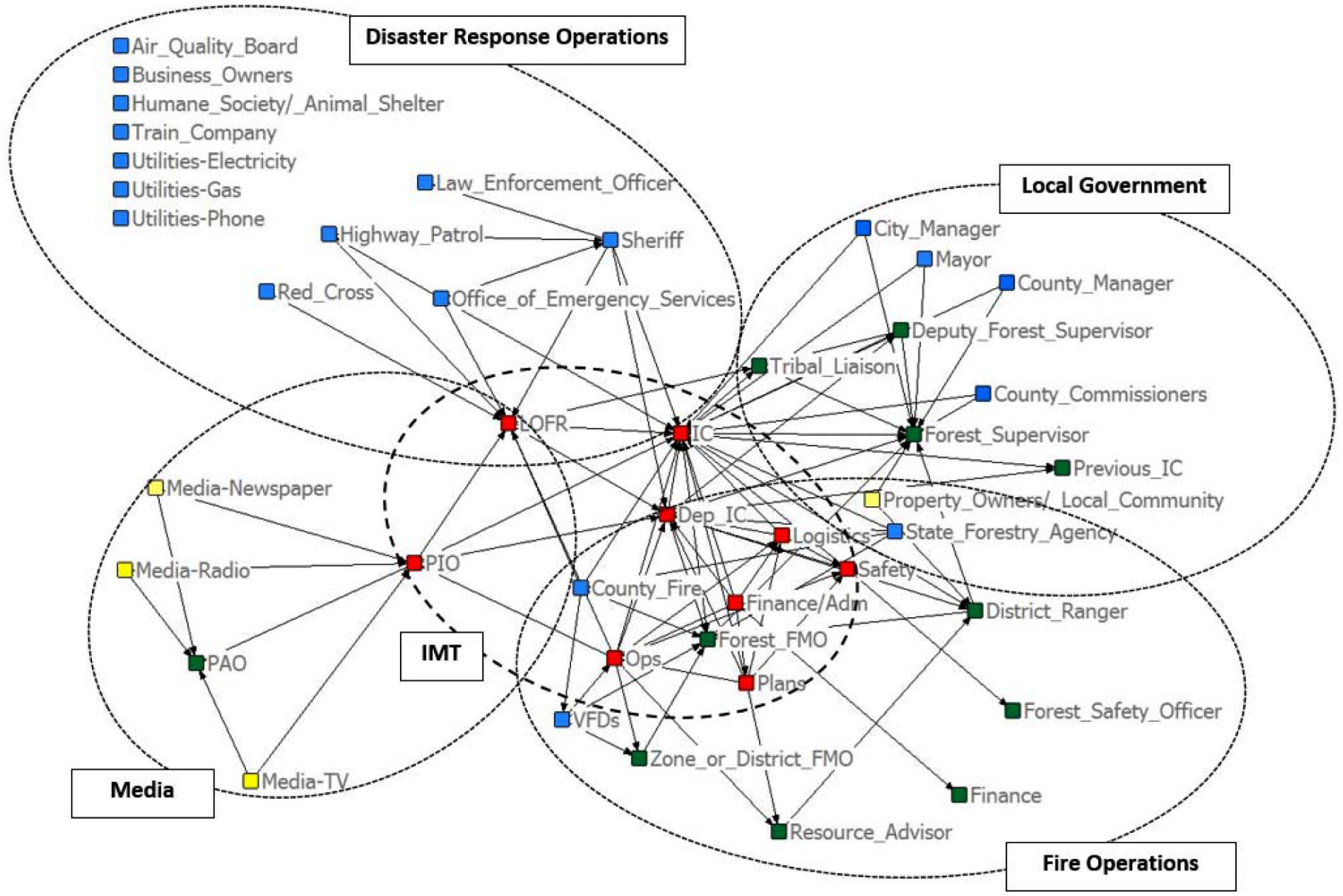
The structure of an effective incident response network per incident.
Graphical depictions of networks are an important first step to theory building as they provide an easily accessible tool for discerning the general structure of a network (e.g., Borgatti, Mehra, Brass, & Labianca, 2009; Brandes, Kenis, & Wagner, 2003). Figure 3 offers several important insights into the critical network as perceived by ICs. First, in the upper left side of the diagram, there are several responders who are completely disconnected from the network. This does not mean that ICs did not feel that it was important for these actors to be linked into the rest of the response network. Rather, ICs could not agree on how these actors should be embedded within the network. There was no tie between these actors and the rest of the network in which there was 75% agreement or better. This is important as it suggests that there is significant institutional ambiguity about how to coordinate with these actors during a large-scale transboundary wildfire.
Second, in looking at the overall organization of the network, the ICs clearly view the IMT as occupying a central position in the network. From there, the network appears to organize itself into functional domains with the lower right of the graph consisting primarily of fire operations leadership, the upper right representing local government, the upper left representing emergency response operations, and the lower left of the graph focusing on actors involved with public information and media.
Third, those on the periphery of the network do not connect randomly but rather appear to connect by way of key brokers. The most dramatic example of this is media (lower left corner), which ICs saw as entirely brokered through the U.S. Forest Service public affairs officer and the IMT public information officer. Certain actors were understood as positioned between functional areas. For example, county fire and volunteer fire departments (VFDs) are located directly between fire operations and emergency response operations. This is likely because the primary responsibility of most county fire and VFDs is emergency response to structural fires. They are strongly aligned with other county emergency responders. However, because the transition from a burning tree to a burning house can be extremely rapid, structure protection resources must be tightly coordinated with wildfire suppression operations.
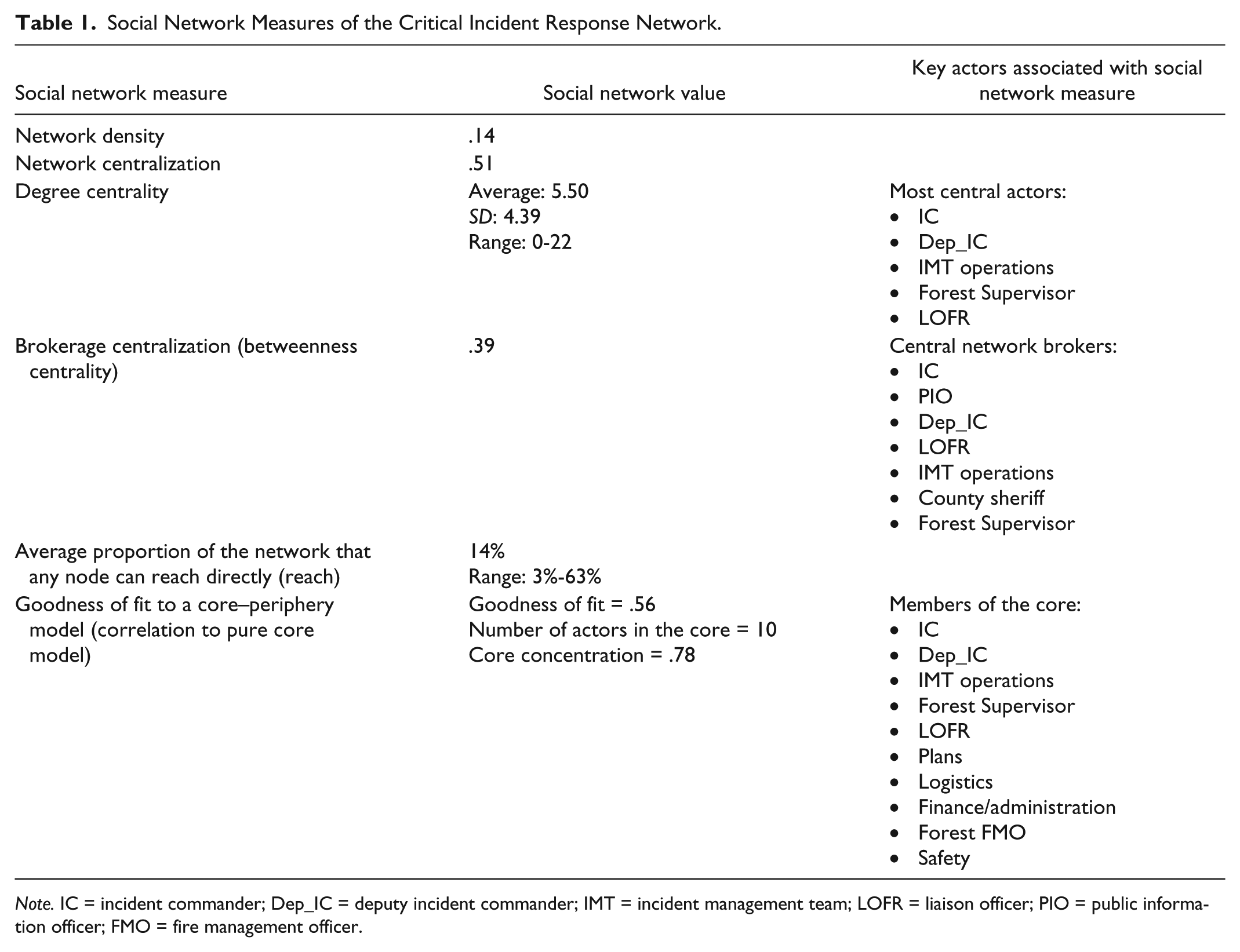
In terms of the overall organization of the network, several social network metrics were calculated to provide additional insight into the structural character of the network. These are summarized in Table 1. Density is perhaps the most well-known network metric and represents the degree to which all actors are connected to all other actors in the network. This is related to Coleman’s (1988) notion of network closure. Centralization focuses on the degree the network is organized around a single actor or set of actors. Based on Freeman’s (1979) approach, centralization is calculated based on the ratio of the difference score between the most central actors and all other actors in the graph. Therefore, though centralization is a measure of network integration, it focuses on the extent to which that integration is concentrated around a few network actors (Wasserman & Faust, 1994). Actor-level degree centrality scores complement a centralization analysis as they provide information about the dispersion of centrality across nodes. They indicate whether the network is centralized around a single actor or multiple actors. Betweenness centrality (Freeman, 1979) speaks to which actors broker connections between two otherwise disconnected others. This reflects Burt’s (1992) notion of structural holes. Everett and Borgatti’s (1999) core–periphery analysis provides a measure of the degree to which the network is characterized by a densely connected core of actors surrounded by a number of less well-connected peripheral actors. Finally, an n-clan analysis seeks to identify subgroups in the network that demonstrated a greater degree of connectedness to each other relative to their connectedness to the rest of the network (Mokken, 1979).
Social Network Measures of the Critical Incident Response Network.
Note. IC = incident commander; Dep_IC = deputy incident commander; IMT = incident management team; LOFR = liaison officer; PIO = public information officer; FMO = fire management officer.
As shown in Table 1, the critical incident response network envisioned by the ICs has a relatively low density and a fair degree of centralization. This indicated that the structure of the critical incident response network is not a cohesive network characterized by a high degree of connectivity among all responders. Network degree centralization indicated a moderately high level of centralization suggesting that, of the linkages that exist within the network, a significant proportion of them are concentrated with a smaller subset of actors rather than being distributed equally. However, different from a star graph in which linkages are concentrated on a single actor, there are several central actors. Consistent with a hierarchical command and control model, the IC is the most central actor, having the greatest number of ties to the rest of the network. This suggests that the IC is coordinating with the greatest number of actors in the network. The deputy IC and operations section leader of the IMT also have relatively higher numbers of connections within the network. However, the Forest Supervisor of the local National Forest is also highly central in the network.
All the most central actors (actors with the most ties) also had high brokerage scores. This stands to reason in a relatively sparsely connected network such as this one. In addition, the county sheriff and IMT public information officer were also identified as central brokers. This means that although these actors did not have as many ties as the central actors, the ties they do possess tend to bridge between otherwise disconnected actors.
All these metrics are consistent with the general architecture of a core–periphery structure. A core–periphery structure is more sparsely connected than we would expect in a closed network (high density). It exhibits a moderately high degree of centralization but is less concentrated than a fully centralized star network. Rather, a core–periphery structure has multiple central actors. The final defining feature of a core–periphery network structure is that there is higher connectivity among core members with more sparse connections moving out toward the periphery. Based on Everett and Borgatti’s (1999) core–periphery metric, which looks at the correlation between the observed network against an idealized core–periphery network, our network produced a moderately strong correlation (.56) suggesting a modified core–periphery network. This is important as it indicates that although the general structure of the network reflects a core–periphery model, it deviates from it in a couple of theoretical important ways that will be discussed more below. The core members identified by this routine were inclusive of the unit leadership of the IMT, but, interestingly, it also included non-IMT members such as the supervisor of the National Forest and the fire management officer of the National Forest. The sheriff was also shown to be close to the core although was excluded from it in the best-fitting model. The concentration of ties within the core indicated a relatively high degree of connectivity among members of the core.
The above analysis indicated that the observed network conformed to the general core–periphery structure. However, the correlation is only moderately strong, suggesting that there are exceptions in which we see tighter linkages within clusters that are not within the core. Results from an n-clan analysis which seek to identify subgroups within a network structure further support this, identifying multiple subclusters of actors who are more tightly connected to each other than to the rest of the network. One of these clusters represents the core itself; the remaining clusters generally map to the circles depicted in Figure 3.
Discussion
The present study provides an empirical foundation for theory building concerning what characteristics of network structure might be associated with effective incident response to disasters. It also illuminates some of the limitations of current models of incident response governance. Paradoxically, current practices in network governance on complex incidents tend to rely on models and tools of governance designed to produce either highly centralized networks or highly decentralized, dense networks of communication. On the centralized end, the command organizational structure that is the hallmark of the ICS is hierarchical in nature with significant attention given to chain of command, reporting structures, and span of control. This model has received significant criticism in the literature for being ill-suited to the dynamic and unpredictable nature of highly complex disasters, with particular challenges levied at this structures inability to coordinate across lateral relationships that cannot be brought under a single unified command (Carroll et al., 2005, Carroll et al., 2006, Paveglio, 2015b). On the other end of the spectrum, prominently used tools for coordinating laterally such as cooperator meetings and conference calls have likewise been found problematic. These approaches generally are associated with a denser network structure that has been criticized for being cumbersome and easily overwhelmed by the number of actors seeking to interact (Pipa, 2006).
Tools of network governance such as ICS facilitate certain communication network structures. In very practical terms, the present study provides a foundation for examining the type of network interactions that is being facilitated by the governance tools we use on incidents. These network structures need to then be compared against the type of structures that can best facilitate a coordinated response across a complex and dynamic array of responders. Although the composition of the network actors in this theory-building exercise was tailored to the context of complex wildfire disasters, we argue that there are ample theories to suggest that the resulting network structure may be applicable to complex disasters in general. As such, we turn our discussion to examining the attributes of the observed core–periphery network with an eye toward considering the consequences of this identified network structure for disasters response in general.
According to the collective mental models of Type 1 ICs who govern under the ICS, the appropriate structure of an incident response network sits at the intersection of several models of network structure, being neither highly integrated (closed) nor rigidly centralized. Rather, it is best characterized as a moderate core–periphery structure in which there are multiple central actors who are linked tightly together and serve as brokers, primarily between the core and the periphery. Furthermore, the periphery, while more sparsely connected than the core, is characterized by a weak subgroup structure clustered around functional roles.
Core–periphery structures have been theorized by scholars as having the potential to benefit from both the cohesion and stability of a closed network while also allowing the flexibility for the network to grow and contract as new members enter and exit the network (Everett & Borgatti, 1999). This structure was evident in the network identified by ICs in this study. In this model, the relatively higher centrality of core members suggests that the core would serve as the most efficient and therefore as the primary hub for managing the flow of information and coordinating action. However, the resulting network was not a pure core–periphery as evidenced by a substantial number of ties connecting peripheral members to each other that occur outside of the core. These ties, while potentially redundant with the core in coordinating the flow of information from one part of the network to another, may increase the resiliency of the network by offering multiple pathways by which information can flow (Nowell, Bodkin, and Bayoumi, 2017). Consequently, this structure may prove more robust to be able to maintain functioning during periods of disruption or failure within the core.
Moynihan (2008a, 2009) observes that the IMT is positioned to play the role as an NAO in governing the network. Our data suggest that, to the extent the IMT serves a network governance role, the role is better characterized as a lead organization who maintains operational responsibility for one area within the network. This distinction is important, in part, because NAOs generally receive authorization to govern the network. In contrast, the IMT has no formal authority to serve as an NAO and its efforts as a lead organization in network governance may come into conflict with its primary operational responsibilities. That said, the IMT is still positioned to be a critical broker, providing the most efficient linkages between fire operations, emergency response operations, local government, and public information. However, while all sections of the IMT are members of the core, not all members of the core are positioned to be brokers. Furthermore, not all members of the core are members of the IMT. This suggests that the notion of the core is not constrained to governance by a single entity such as a lead organization or an NAO but rather can consist of multiple entities. Interestingly, all brokers were represented in the core with the exception of the sheriff who was just on the periphery and brokers between the IMT and the emergency response operations. Of further interest, though they did not emerge numerically as brokers in the critical incident response network, the periphery did contain actors who were centrally positioned between two operational groups. For example, county and voluntary fire departments were shown to be positioned between fire operation and emergency response operations, indicating that they are structurally positioned to serve as brokers, if brokerage through the core fails.
What does all this suggest for management and governance of complex disasters? One of the significant conundrums in the field of disaster management is how to structure a response in a manner that (a) reconciles needs for centralized coordination among the array of responders involved while (b) retaining flexibility to mutually adjust operations quickly to changing conditions on the ground as well as scale up to incorporate new actors. Although ICS has been modified over time in an attempt to address this concern with the incorporation of tools such as area command, unified command, and Joint Delegation(s) of Authority (Bigley & Roberts, 2001; FEMA, n.d.), it remains under scrutiny for what is viewed by some as an overriding emphasis on hierarchal chain of command rather than structures that promote lateral information flow that enable emergent coordination to occur (Gardner, 2013; Majchrzak et al., 2007; Stallings & Quarantelli, 1985). However, ICS is simply a set of tools that can be implemented in a number of different ways. Therefore, an alternative hypothesis is that rigidity may not be a by-product of ICS per se but is afunction of rigidity present in the overly centralized macro network structure within which ICS is commonly implemented. Incident response can vary in terms of how the system as a whole leveraged hierarchical command and control versus lateral coordination–type relationships (Comfort, 2007; Kapucu, Garayev, & Wang, 2013). Findings from the present study suggest some important new directions in creating governance structures at a whole network level that can effectively manage the needs for both functional differentiation as well as cross-functional integration. The ideal network structure during complex disasters is, of course, still an open empirical question. Our data only provide fodder for theorizing what the qualities of an ideal network structure might be. However, we argue that the integration of insights from 25 elite incident commands, in conjunction with network theory, provides a fertile foundation from which to advance the conversation.
We begin with the assertion that complex disasters will necessitate dual needs for both centralized and emergent coordination as well as the ability to the network to integrate new actors into existing operations. Our data revealed a modified core–periphery structure which is supported by network theory as uniquely capable of balancing these two operational needs. Thus we begin with the following proposition:
An important attribute of the critical network identified in this study was the presence of a subgroup structure on the periphery that corresponded to functional areas of operation. Consistent with the advantages of a divisional structure within organizational design (Morgan, 2006), this subgroup structure would offer the opportunity for a given operational area to share information and coordinate efforts among itself rather than having all operations coordinated by the core. However, in disaster response, such functional integration is often hindered by within-agency chain of command and lack of interagency communication infrastructure (e.g., shared radio frequencies) that would enable such lateral coordination to occur in the absence of involvement of the core. In contrast, a functional subgroup structure would allow for decentralized decision making within an operational area such as evacuation while reserving the resources of the core for coordinating across operational areas as incident complexity increase.
Subgroup structure suggests greater information exchange within functional areas, however, it relies heavily on brokers to ensure that operations in one functional area improve rather than interfere with the likelihood of goal accomplishment in another functional area (Nowell, Bodkin, and Bayoumi, 2017). Since the majority of the coordination between operational areas is hypothesized to take place within the core, this suggests the following:
This proposition calls to question what a high capacity broker looks like. There is a significant literature dedicated to this question (Quick & Feldman, 2014; Williams, 2002). Structurally, it stands to reason that brokerage between the core and an operational subgroup will be facilitated by the degree of embeddedness in both those subnetworks. This makes the absence of the sheriff from the core in our critical network interesting. On one hand, the sheriff may be redundant with the IMT liaison officer as the broker between the core and the emergency response operations. On the other hand, the IMT liaison officer(s) are likely to have several strikes against them as network broker. They are most often outsiders, with limited relational capital to assist them in establishing their trustworthiness and legitimacy as a broker, since they have limited access to local actors (Bodin, Crona, & Ernstson, 2006; Buck, Trainor, & Aguirre, 2006; Burt, 2002). Furthermore, they generally do not possess operational command of any aspect of emergency response functions. As suggested by prior research (Provan & Milward, 1995), those seeking to manage and coordinate network activity may be better positioned to do so if they have an operational role. This provides them not only increased credibility but offers opportunity to gain greater insight into the social, political, and technical dynamics of the work to be coordinated. This may suggest that local actors may be important brokers to coordinate between the core and the periphery on a complex incident. This model appears to be evident in the fire operations and local government subgroups, each having two representatives in the core—one representing the IMT and one local to the setting (National Forest Fire Management Officer and Forest Supervisor, respectively).
IMTs have undergone a significant evolution over the past several decades, with greater emphasis being on their relationship to the local context in which they are seeking to intervene. What we are observing in the critical network as identified by ICs may in fact be an evolution in which the integration between the external IMT and the local system is more sophisticated on the fire operations side than it is the emergency operations side. This diagnosis is consistent with recent findings which suggest that incident management on complex incidents is better at coordination on the fire operations side of the incident than the emergency operations. Thus we propose,
The Role of Incident Complexity
As incident complexity increases, both the heterogeneity and size of the number of actors engaged in the response will likewise increase (Bigley & Roberts, 2001; Buck et al., 2006; Comfort et al., 2004; Comfort & Kapucu, 2006). This will inevitably be followed by a subsequent shift in actors as the incident transitions from response to disaster recovery stages (Bigley & Roberts, 2001; Deal, De Bettencourt, & Deal, 2010). Ansell et al. (2010) characterize incident complexity of disasters as a function of the number of jurisdictions that are affected, the number of different operational domains (e.g., evacuation, road closures, sheltering) that are required, and the temporality of the incident. Temporality refers to added complexity that occurs when a disaster is of a longer duration, has roots in historical events (e.g., 9/11), and will have significant ramifications for the affected population into the future.
The critical incident network identified in this study is static and represents a snapshot of a generalized incident network. Because it is based on the mental models of Type 1 ICs, we can assume that it represents their view of the critical network for the average Type 1 incident. However, building upon our previous propositions and current literature, we can theorize how this structure might adapt as network size and heterogeneity increases in response to heightened incident complexity.
First, as the network itself becomes more operationally diversified, we would expect the periphery of the network to naturally specialize further into different operational domains, creating more functional subgroupings. For the network to remain functional, this will require a corresponding increase in the size and heterogeneity of core membership as the diversity of the subgroups will exceed the capacity of the previous cadre of brokers.
However, at some point, as the diversity of operational areas increases, we can expect that this may eventually exceed the capacity of the core to efficiently manage information flow and coordination between operational areas. At this point, we hypothesize that two things may occur.First, we anticipate that the influence of those actors structurally positioned between two highly interdependent operational areas will increase as they take on more network management responsibilities for coordinating bilaterally. Second, The fact that information and coordination are occurring outside the core suggests that there will be increased risk for coordination failures as two operational areas are coordinating with one another but not the rest of the network.
To mitigate this risk, the network may further differentiate into a subcore–periphery structure, with brokerage occurring both between the subcore and its peripheral functional areas as well as between the subcore (see Figure 3).
Conclusion and Directions for Future Research
Although there is general sentiment among scholars and managers alike that understanding networks is vital to understanding management of complex disasters, our progress in this area is hampered by a dearth of models that can inform hypothesis testing concerning the characteristics of effective incident response networks. Without validated models that provide a point of reference for comparison, we are limited in our ability to learn from the critical analysis of actual disaster networks. The present study takes an important step in identifying a set of testable propositions concerning an effective network structure for balancing the often competing needs for centralized coordination and emergent coordination. The value of a validated generalized model of network structure for complex disasters is significant for both research and practice. For scholars, such models provide a theoretical foundation for investigating structural determinants of network failure or success. For disaster managers working in complex transboundary settings, understanding the capabilities and limitations of different network configurations can improve network management, providing them with the mental models they need to manage whole networks more effectively (Provan et al., 2007).
The present study also suggests several important directions for future research. First and most obvious, the propositions for effective network structure in this study were based on the network resulting from the collective mental model of ICs. Type 1 ICs are valuable informants for theory building both because of their breadth of experience with transboundary disasters and their role as network managers during incidents. However, they do represent a particular perspective. As pointed out by different researchers (Mandell & Keast, 2008), networks lend themselves to plurality as perspectives may differ depending on where you sit within the network and the unique set of concerns or interests that brought you to the network (Nowell, Steelman, Velez, & Goddette, 2016). This was illustrated in the present study by the institutional ambiguity of the ICs concerning some of the peripheral network actors and how they should link into the network. This begs the question, how does the critical network as envisioned by ICs compare to the perspectives of other key actors in the network? For example, do county emergency managers envision the composition of the core in the same way as federal Type 1 ICs do?
Second, propositions in the present study were developed based on insight from one specific type of transboundary disaster network. Wildfire is somewhat unique as a disaster context in its dual attention to emergency operations to protect life and property from fire that has already reached populated areas in coordination with fire operations seeking to direct the fire away from populated areas. Other disaster contexts focus primarily on only emergency response and therefore the network composition will reflect this. We anticipate that the basic capabilities and functionality of a core–periphery structure identified in this study will not vary based on network composition. This is an important empirical question for future research.
Last, one of the hypothesized strengths of a moderate core–periphery structure is its capacity to adapt in size and composition while maintaining function in coordinating information flow and connectivity across the network. Testing these propositions will necessitate longitudinal network data to examine how the network performs over time.
Disasters do not respect jurisdictional boundaries. Consequently, the networked nature of complex disasters will continue to be relevant. In light of continued threats of climate change (Intergovernmental Panel on Climate Change, 2014), the potential for large-scale natural disasters will likely only grow into the future. Understanding both the theory and the applications for difference governance structures in disasters will help foster better response that can potentially save lives, property, and infrastructure.
Footnotes
Authors’ Note
All views and conclusions in this document are those of the author and should not be interpreted as representing the opinions or politics of the U.S. Government. Mention of trade names or commercial products does not constitute their endorsement by the U.S. Government.
Declaration of Conflicting Interests
The author(s) declared no potential conflicts of interest with respect to the research, authorship, and/or publication of this article.
Funding
The author(s) disclosed receipt of the following financial support for the research, authorship, and/or publication of this article: This research is part of a larger initiative funded by the National Science Foundation (Grant: CMMI-1161755) and the Joint Fire Science Program (Cooperative Agreement L12AC20571) and led by principal investigators B.N. and T.S.
Author Biographies
 ) focused on advancing the science of adaptive capacity toward more disaster resilient communities. Since 2008, this team has worked in collaboration with the US Forest Service on research aimed to improve inter-agency coordination and communication during large scale wildfire events.