



Abstract
Government decision-making procedures and transparency ensure responsive governance. Yet, there are few attempts to assess how these two factors shape citizens’ intentions to voice opposition to government decisions. We predict that the effect of decision-making procedures on voice is contingent upon the fairness of government decision-making procedures. We also hypothesize that the strength of this effect will vary according to how transparent the decision-making process is. We test these hypotheses using two survey experiments, where we assess how the effect of procedural fairness of a decision-making process on citizen voice varies according to the level of transparency. Findings reveal that participants are least inclined to voice opposition when a decision-making process is fair and transparency high. However, when a decision-making process is unfair, greater transparency did not increase voice. We conclude that transparency can stifle voice for fair decision-making procedures but does not stimulate voice when decision-making procedures are unfair.
Decision-making procedures play an important role in shaping citizen responses to decision outcomes (Tang & Sarsfield-Baldwin, 1996; Tyler, 1997, 2006). For citizens to accept a decision, they must feel that the procedures used to make the decision are fair: that the process is open and inclusive, and that authorities treat those involved respectfully (Tyler, 1988). Conversely, when citizens perceive decision-making procedures as unfair, they are much less inclined to accept the decision and more likely to voice opposition (Van den Bos, Lind, Vermunt, & Wilke, 1997). In this respect, public disclosure of information about the fairness of decision-making procedures is important because it can act as a heuristic that helps citizens make sense of government decisions that are often uncertain or difficult to assess (Van den Bos, 2001). Accordingly, studies have shown that citizen perceptions of procedural fairness shape citizen responses to government decisions across a wide range of settings, which include court rulings (Ramirez, 2008), policing (Sunshine & Tyler, 2003), and public budgeting (Herian, Hamm, Tomkins, & Zillig, 2012).
Yet, while the literature on the relationship between procedural fairness and decision acceptance is well established, it remains unclear how different levels of disclosure about the fairness of government decision-making processes affect citizens’ acceptance of government decisions. Indeed, the question of how transparent government decision-making processes should be is currently heavily debated (Fukuyama, 2015; Roberts, 2015).
Conventional wisdom reasons that citizens, as the owners of government, should generally have unfettered access to information government produces (Stiglitz, 1999). Others argue that exposing citizens to more information about government decision-making procedures can impede their ability to evaluate decision-making procedures (de Fine Licht, 2014; Etzioni, 2010). Rather, concise summaries of decision-making processes are argued to elicit a stronger response from citizens as there is less noise embedded in the message (Mansbridge, 2009; Prat, 2005). Thus, while a basic level of transparency is necessary for citizens to evaluate decision-making procedures, whether more or less transparency strengthens the relationship between procedural fairness of a decision-making process and citizen voice behavior is unclear.
This study addresses the uncertainty surrounding the relationship between decision-making procedural fairness, decision acceptance, and transparency. To do so, we empirically assess how levels of procedural fairness and transparency interact to shape citizens’ intentions to voice opposition to government decisions. Two sets of relationships are predicted. First, in keeping with previous procedural fairness research, we predict that greater procedural fairness reduces intentions to voice opposition to government decisions. Second, we predict that the strength of this relationship will vary according to the level of transparency, such that it is strongest in contexts of low transparency and weakest in contexts of high transparency.
Framing our analysis in this way allows us to contribute to existing literature in two important ways. First, from a practical standpoint, our analysis sheds light on how efforts to communicate the fairness of decision-making procedures can help make government decisions more acceptable, or, in cases procedures appear to be unfair, incite resistance (Fox, 2007; Porumbescu, 2017). Second, in terms of theoretical contributions, this study is the first, to our knowledge, to empirically qualify debates over the effects of more versus less transparency on citizens’ evaluations of decision-making procedures.
We evaluate the relationship between transparency and citizens’ intentions to voice opposition to a government decision using two survey experiments. To enhance the external validity of our findings, we carried out the experiment in two distinct policy contexts—the first pertaining to quality of life and leisure, and the second safety and security. Finally, in our study, intention to voice opposition to a government decision is operationalized as the number of participants who opt to anonymously sign a petition.
Overview of Concepts
Procedural Fairness and the Decision-Making Process
Procedural fairness posits that individuals’ responses to decisions are influenced by “the fairness of the decision-making procedures” (Tyler, 1991, p. 261). Public administration scholars rarely use the concept of procedural fairness to study citizen–state interactions (cf. Van Ryzin, 2011). Nevertheless, given that public policies result from decision-making processes, this line of research helps advance our understanding of citizen responses to public policies. To this end, in keeping with extant research on procedural fairness, we expect that when citizens find procedures underpinning a decision-making process to be unfair, they will engage in attempts to voice opposition to the decision. We elaborate below.
When an individual perceives a lack of procedural fairness in a decision-making process, they are generally less willing to accept the decision (Tyler, 2006), more likely to be dissatisfied with the decision (Tang & Sarsfield-Baldwin, 1996), and, as a result, more likely to voice opposition to the decision (Lind, Kanfer, & Earley, 1990). These findings have been found in both private- and public-sector settings (Garcia-Izquierdo, Moscoso, & Ramos-Villagrasa, 2012; Grimmelikhuijsen & Klijn, 2015; Hinds & Murphy, 2007).
Evaluations of procedural justice stem from perceptions of the way stakeholders are engaged during the decision-making process. From a policy perspective, stakeholders could include citizens, public employees, or department heads. Perceptions of engagement, and therefore procedural fairness, can be assessed along two interrelated dimensions—inclusiveness and respectfulness (Tyler & Blader, 2003). Inclusiveness indicates that the decision-making process included attempts to solicit participation from relevant stakeholders (Lind et al., 1990). Respectful treatment means that the opinions and comments made by all participants, not just those in charge, were given full consideration (Tyler, 1991). It is also important to note that individuals can positively evaluate procedural fairness, despite disagreeing with the outcome of the decision-making process (Tyler, 2006).
Citizen Voice Behavior
In this article, we focus on citizen voice behavior. Voicing discontent constitutes an effort on the part of citizens to exercise a “the fundamental right to call those in authority to justify their decisions” (Fox, 2007, p. 668). Accordingly, within the context of citizen–government relations, voice is understood as an attempt by citizens to participate in government decision-making processes due to discontent with the actions taken by government (John, 2017).
The concept of citizen voice has been frequently used in the public administration literature as a way to explain citizen responses to failure of public services (e.g., James, 2011; James & Moseley, 2014). This is because, in the public-sector context, exit options are either nonexistent or entail great costs. For example, a citizen may be unhappy about certain decisions made by the city government—exit in this case means they have to move to a different town. Alternatively, parents may be displeased with the performance of their children’s school—Here exit would mean transferring their child to a new school. Although possible in both scenarios, the exit option entails high transaction costs and, as such, is generally not very realistic. Instead, individuals can protest the undesirable state of affairs by raising their voice in hopes that doing so will improve things. According to Hirschman, the latter response stands to create the greatest value for all involved because it provides signals that can help improve, for instance, service quality (John, 2017).
Decision-making transparency
Decision-making transparency helps to explicate the procedures that led up to the adoption of a particular decision (Grimmelikhuijsen, Porumbescu, Hong, & Im, 2013) and by doing so can empower citizens to voice their concerns about a certain government decision. For example, decision-making information will typically provide an overview of who participated in the decision-making process, what was discussed, and, in many instances, the tenor of the discussion. In this way, decision-making transparency plays an important role in helping citizens understand how fair a decision-making process was. Minutes of parliamentary meetings are a common example of government information that contributes to decision-making transparency. Another example would be narratives of town hall meetings posted to city e-government websites by city council members.
To date, research on transparency sees this variable in binary terms—either transparency is present or not present. However, because legal mandates require some basic level of disclosure regarding the decision-making process throughout much of the world, a more relevant question today is just how much information is necessary to activate the relationship proposed to exist between the procedural fairness of a decision-making process and citizens’ intentions to express voice.
Figure 1 provides an illustration of just how we expect the level of disclosure to influence the relationship between procedural fairness, decision acceptance, and citizen intentions to voice opposition to government decisions. Table 1 overviews the concepts central to this research.
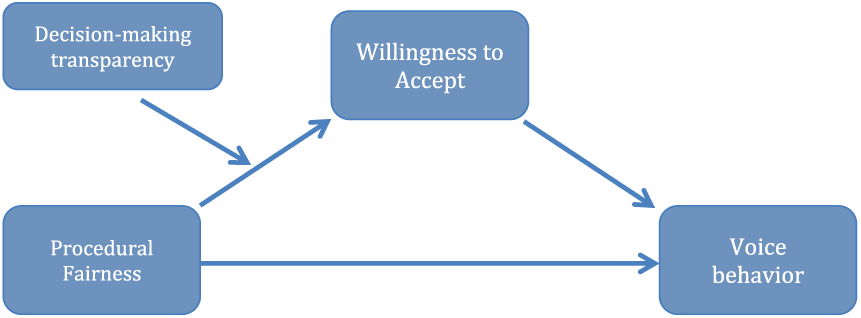
Illustration of relationships.
Key Concepts.
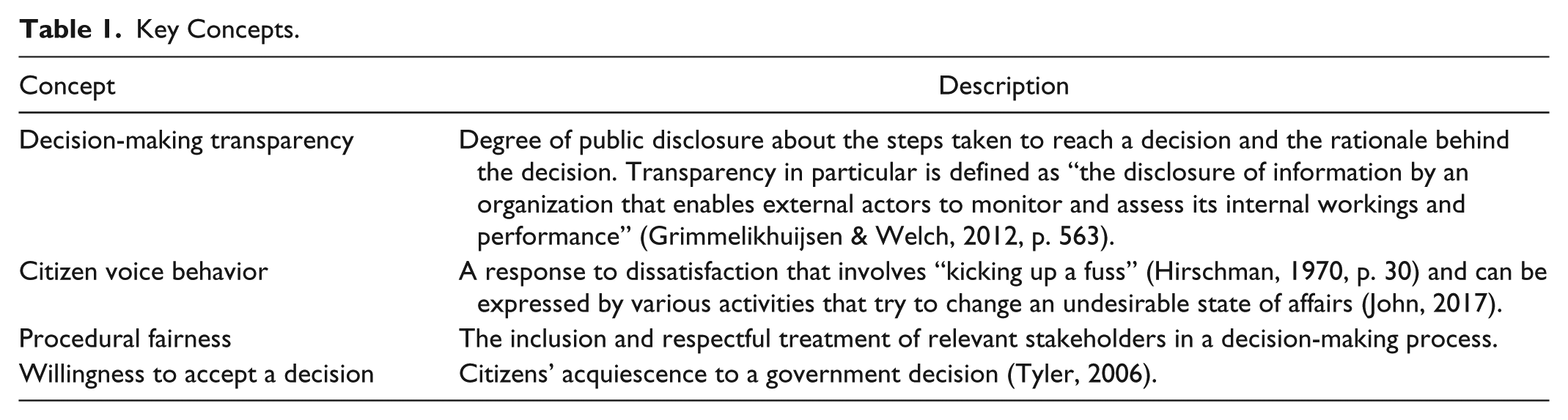
As Figure 1 shows, we expect the effect of procedural fairness on citizen voice to be mediated by decision acceptance. Citizens’ acceptance of a government decision means that they—to some extent—acquiesce to the decision, without necessarily fully agreeing or supporting the decision. Previous research has found that when the procedural fairness of a decision-making process is low, individuals are likely to view the decision-making process as unfair and are consequently less inclined to agree with the decision of authorities, such as judges (Tyler, 1991), police officers (Grimes, 2006), or civil servants (Van Ryzin, 2007). Conversely, when procedural fairness is high, citizens are more likely to view the decision-making process as fair, thereby increasing the extent to which citizens agree with the decision (Tyler, 2006).
Acceptance of a government decision, in turn, is expected to influence intentions to voice opposition to the decision. This is because if citizens are less inclined to accept a decision, they are more likely to voice concerns over the decision. In this sense, greater procedural fairness in a decision-making process can dampen voice, even when the decision itself remains the same. When taken together, we expect the effect of procedural fairness on voice to occur indirectly, by first influencing the extent to which citizens accept government’s decision to adopt a particular decision.
We expect that the indirect effect of procedural fairness on voice (via decision acceptance) will be moderated by the level of transparency, which we operationalize as the amount of information citizens are exposed to regarding the decision-making process. Put differently, we predict the presence of a conditional indirect effect of procedural fairness on voice (Hayes, 2009).
We propose that the indirect effect of procedural fairness on voice will be stronger in contexts of low transparency than it will be in contexts of high transparency. Prat (2005) explains that enhancing transparency of a process can crowd out accountability by drawing attention away from relevant information. Similarly, Dewatripont, Jewitt, and Tirole (1999) show that less detailed information about an agent’s performance (e.g., government) improves a principal’s (e.g., citizens’) capacity to monitor agent performance. Building upon these points, Mansbridge (2009) argues that more limited, yet nevertheless informative forms of transparency are preferred to full transparency when the intention of disclosure is to empower citizens. The reasoning, in part, is that concise summaries are more effective at concentrating attention to key issues. Offering support for this argument, de Fine Licht (2014) shows that “limited” forms of transparency appear more influential in shaping citizens’ evaluations of public policies than more detailed forms of transparency.
In light of the above, we outline the following hypotheses:
The Experiment
Experimental Setting and Procedure
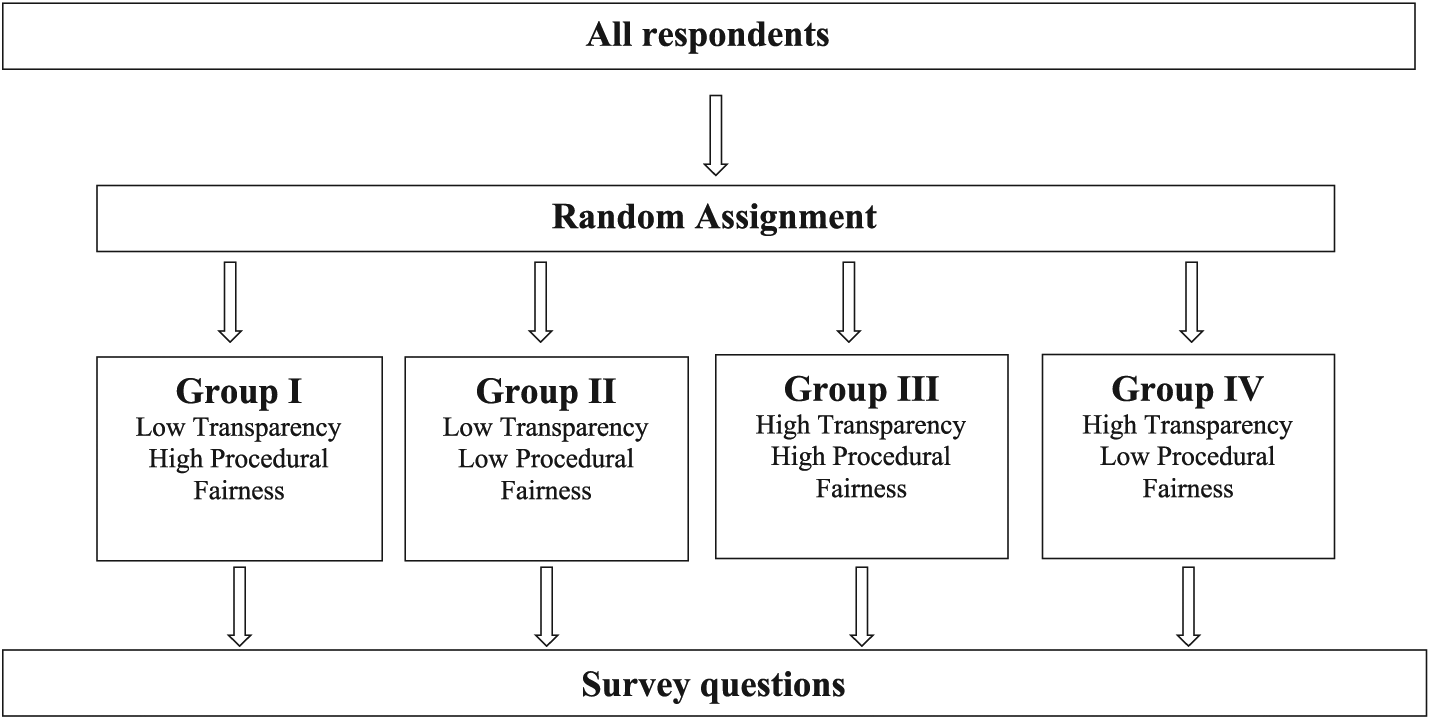
To examine the hypotheses outlined above, we used a scenario-based survey experiment that follows a 2 × 2 factorial, between-participants design. Survey-based experiments are useful because they offer insight into causal mechanisms, while also possessing levels of external validity that are similar to general population samples (Mutz, 2009). We summarized our design in Figure 2.
Experimental design.
Both transparency and procedural fairness served as manipulated variables. Participants were asked to read a short prompt outlining a hypothetical policy that was scheduled for implementation. There were four treatment groups that participants could be assigned to: high transparency, high procedural fairness; high transparency, low procedural fairness; low transparency, high procedural fairness; and low transparency low procedural fairness (see Appendix B for stimuli). 1 Participants were randomly assigned to one of the four treatment groups. To bolster perceived realness of the scenario, all stimuli were designed to simulate a local website.
Furthermore, we tested for evidence of a conditional indirect effects using moderated mediation. Specifically, we examined the impact of procedural fairness upon voice via participants’ willingness to accept government’s decision to adopt a particular decision. 2 We then examined whether the magnitude of the indirect effect varied according to the level of decision-making transparency.
Refining the Mechanism
We are interested in how robust the mechanism we propose is. In particular, we want to know whether this mechanism may hold for some types of policies but not others. Therefore, we use two studies to examine whether the hypothesized effects emerge across two distinct policy areas (for a similar approach, see de Fine Licht, 2014; Van Ryzin, Riccucci, & Li, 2016). The first policy dealt with a hypothetical budget cut (20%) to a Department of Parks and Recreation (quality of life). We chose the Parks and Recreation Department because the majority of issues this unit of local government deals with pertain to quality of life and leisure issues. The second policy dealt with a hypothetical budget cut, of equal magnitude, to the Fire Department. We have chosen the Fire Department as our second policy area because most of the issues this department deals with pertain to public safety and security. This means that a budget cut to the Fire Department is more likely to be politically salient than cuts to the Department of Parks and Recreation. Overall, both experiments are the same in terms of the treatments they use, yet differ in the political salience of the decision (Tetlock 2003). We expect a budget cut to the Parks and Recreation Department to be less contested than a cut to the Fire Department’s budget (cf. de Fine Licht, 2014). We use both scenarios to test whether the proposed mechanism holds across in two different policy contexts.
Sample
In total, 400 participants were recruited from the United States using Amazon’s Mechanical Turk (MTurk). Data collected from MTurk are generally found to be of high quality (e.g., Amir, Rand, & Yak, 2012; Berinsky, Huber, & Lenz, 2012; Horton, Rand, & Zeckhauser, 2011). Participants were recruited through two independent samples—200 participants per experiment. A review of participants’ MTurk work numbers revealed that there was no overlap in respondents across the two experiments. We conducted an a priori power calculation using G*Power to calculate the sample size (Faul, Erdfelder, Lang, & Buchner, 2007). We estimated the sample size based on what we would need to identify a small effect (0.30) and at 80% power.
Sixty-six participants were deleted during the data cleaning for the Quality of Life study and 49 for the Public Safety study. Participants completed one attention check item (i.e., “please select ‘red’ for this question”) embedded in the survey, and participants who failed to select the correct option were excluded from the analysis. In addition, participants who took an unusually short amount of time to complete the survey (i.e., less than 120 s) were excluded, as were participants who took an unusually long time to complete the survey (i.e., more than 15 min). Furthermore, incomplete responses or erroneous responses (e.g., typing 33 when asked about gender) were also discarded. We determined these exclusion criteria based on past research that discusses satisficing behavior of MTurk survey participants (Oppenheimer, Meyvis, & Davidenko, 2009). In addition, we inspected participant’s Internet protocol (IP) addresses to ensure that no participant had completed our study twice (Horton et al., 2011). Following these data cleaning procedures, 134 participants remained for the Quality of Life study and 151 participants for the Public Safety study.
Samples drawn using MTurk cannot be considered reflective of the general population. However, research suggests that they are more diverse than other convenience sampling methods commonly used by researchers when conducting experiments (Buhrmester, Kwang, & Gosling, 2011).
Table 2 illustrates the characteristics of our two samples on dimensions of age, income, education level, gender, and political ideology. Chi-square tests reveal successful randomization in that no statistically significant differences were found across the four treatment groups in both experiments with respect to age, gender, education level, household income, and political ideology (all p values > .121 across both experiments). Furthermore, we examined whether differences existed between participants in both experiments. The t tests revealed that no significant differences existed between participants in both experiments in terms of age, education, household income, and political ideology. However, there were significantly more females in the Parks and Recreation Department experiment (p = .003).
Sample Composition.

Measures
Procedural fairness
Procedural fairness was manipulated along dimensions inclusiveness of respectfulness (Tyler, 1997, 2006). To manipulate inclusiveness, our treatments explain whether opinions of representatives from the department in question and citizens were taken into consideration when arriving at the decision. To manipulate respectfulness, our treatment explains how city officials treated external actors involved in the decision-making process.
For participants assigned to the high procedural fairness condition, the vignettes explained to participants that city officials involved in the decision-making process took the opinions of external stakeholders into consideration and also treated them respectfully. The vignette also explained that the external stakeholders were pleased with the way they were treated by city officials. Conversely, for participants assigned to the low procedural fairness condition, the vignette explained that city officials did not take into consideration external stakeholders’ opinions and also treated the external stakeholders disrespectfully during the decision-making process. Furthermore, the vignette explains that external stakeholders were dismayed by the disrespectful treatment they encountered.
Decision-making transparency
Our manipulation of the level of decision-making transparency draws on work by Mansbridge (2009), who distinguishes between process transparency and rationale transparency. Process transparency concerns disclosure about the process leading up to the decision, whereas rationale transparency concerns explaining the reasons behind the decision. In this article, we focus on process transparency because this form of transparency allows us to expose citizens to more or less detail about the decision-making process and thus the level of fairness of the decision-making procedures.
In the prompt explaining the decision, all participants were exposed to the same piece of information explaining why the decision was taken. In other words, all participants were exposed to the same level of rationale transparency. In manipulating the level of process transparency, participants were exposed to varying amounts of detail about the interactions between external stakeholders and government officials during the decision-making process. Participants assigned to the low decision-making transparency condition were provided with a short concise summary of how city officials behaved toward external stakeholders during the decision-making process. Participants assigned to the high decision-making transparency condition were exposed to a longer more detailed explanation of the nature of the interaction between citizens and government officials. For example, participants in the low procedural fairness, low decision-making transparency condition were told that city officials treated external stakeholders rudely. Those in the low procedural fairness, high decision-making transparency condition were told that the external stakeholders were treated rudely, but then also provided examples of the rude behavior exhibited by city officials.
Decision acceptance
To gauge participants’ willingness to accept government’s decision described in the transparency prompt, participants were asked “How willing or unwilling are you to agree with this decision?” A 7-point Likert-type scale was used to gauge participants’ willingness to accept government’s decision, where a score of 1 corresponded to very unwilling and a score of 7 corresponded to very willing.
Citizen voice
We measured citizen voice by asking them to sign a (hypothetical) petition. This was done as follows.
Participants were asked to read the following statement:
Results
Study 1: Quality of Life Policy Area
Bivariate correlations for all variables can be found in appendix a.
We first assess our manipulation check to understand whether participants perceived the experimental treatments in the way the design intended. Across the four treatment groups, participants in the two high procedural fairness treatment groups perceived the decision-making processes as fairer than those assigned to the two low procedural fairness treatment groups (F = 86.39, p < .000). 3 Furthermore, those participants assigned to the high transparency group perceived the decision-making process as being more transparent than those assigned to the low transparency condition (F = 9.40, p = .003). 4 This offers strong evidence that the manipulations were perceived as intended.
An ANOVA reveals that the effect of the procedural fairness treatment on participants’ willingness to accept the proposed policy was strongly significant, F(3, 134) = 30.42, p = .000, and had a large effect size (partial R2 = .190). Furthermore, the direct effect of transparency was only moderately significant, F(3, 134) = 3.16, p = .078, partial R2 =.024. We also found, as expected, that transparency and procedural fairness had a significant interaction effect, providing initial evidence of the moderating nature of transparency, F(3, 134) = 4.13, p < .044, partial R2 = .031. The overall model (procedural fairness, transparency, and Procedural Fairness × Transparency) explains the variance in decision acceptance rather well (R2 = .211, Adj. R2 = .193). To obtain a more precise understanding of the nature of any differences that exist between groups, post hoc comparisons were carried out, using Bonferroni corrections to adjust for multiple comparisons. The results are illustrated in Table 3.
Post Hoc Comparison for Willingness to Accept Decision (Quality of Life).

Note. Means displayed; standard deviations in parentheses. Unequal superscripts indicate statistically significant difference (p < .05). Applied Bonferroni correction for multiple comparisons. Dependent variable is measured on a 1 to 7 Likert-type scale.
In comparing discrete groups, the most pronounced differences are found between the high procedural fairness, high decision-making transparency group and both of the low procedural fairness groups, irrespective of levels of transparency. Specifically, we find that those in the high procedural fairness, high decision-making transparency group consistently demonstrated a much greater willingness to accept the budget reduction than participants assigned to either of the low procedural fairness groups (p < .000 for both groups).
A similar relationship also exists between the high procedural fairness, low transparency group and both of the low procedural fairness groups. However, here the differences are not as pronounced when compared with the high transparency, high procedural fairness group. This is particularly true for the difference between the high procedural fairness, low transparency group and the low procedural fairness, low transparency group, which was only marginally significant (p = .078). Thus, in contexts of low transparency as well, we find evidence that procedural fairness was conducive to greater willingness to accept government’s decision to cut the Department of Parks and Recreation’s budget by 20%.
The findings until this point suggest procedural fairness and decision-making transparency interact in determining participants’ willingness to accept the decision to reduce funding to the Quality of Life policy area. Specifically, while both high procedural fairness groups were found to have positive significant impact on willingness to accept the budget cut, the high decision-making transparency group exhibited significantly greater willingness to accept this decision than the low decision-making transparency group. Interestingly, however, for the low procedural fairness groups, there was no significant difference between the high transparency group and the low transparency group. In other words, the level of transparency strengthens the impact of decision-making transparency in contexts of high procedural fairness but matters little in contexts of low procedural fairness.
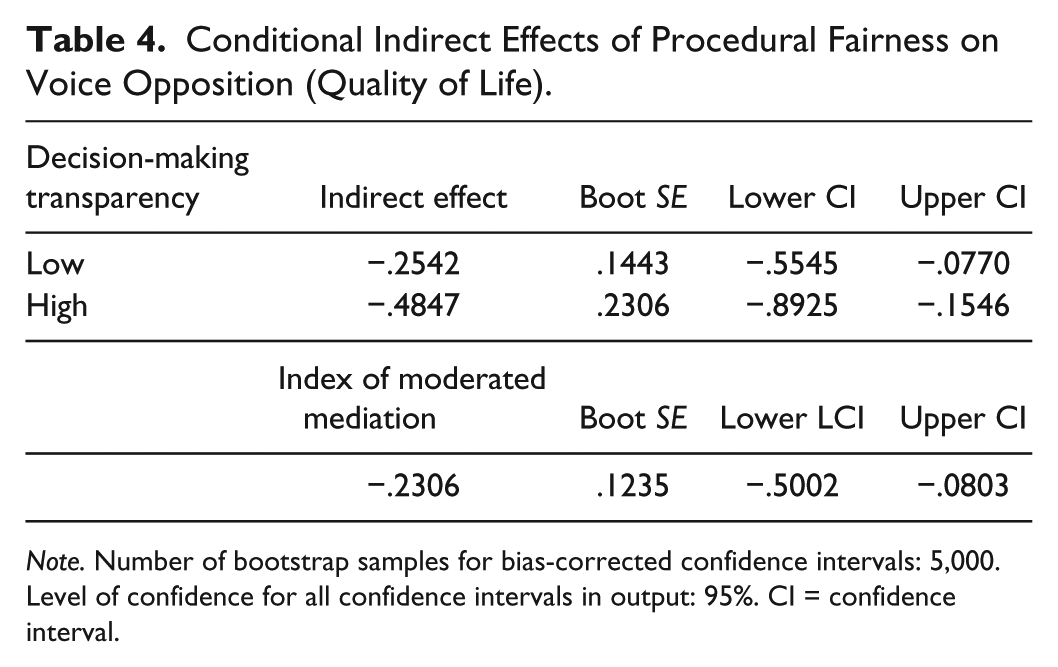
As indicated by our model in Figure 1, we expect the direct effect of procedural fairness to be mediated by decision acceptance and this indirect effect to be moderated by the level of transparency. To fully test this model, we carried out a moderated-mediation analysis. The results are presented in Table 4. 5
Conditional Indirect Effects of Procedural Fairness on Voice Opposition (Quality of Life).
Note. Number of bootstrap samples for bias-corrected confidence intervals: 5,000. Level of confidence for all confidence intervals in output: 95%. CI = confidence interval.
Table 4 reveals that under both decision-making transparency conditions (high and low), the procedural fairness manipulation had a significant negative indirect effect on participants’ voicing opposition to the decision. Put differently, at both levels of decision-making transparency, the high procedural fairness condition increased participants’ willingness to accept the government’s decision to reduce the budget for the Quality of Life policy area, which in turn lowered participants’ proclivity to voice opposition to the decision. This effect was stronger under the high transparency condition than under the low transparency condition. The difference between the high and low conditions is statistically significant: The index of moderated mediation is –.231 and statistically significant at the .05 level.
Study 2: Public Safety Policy Area
Again, we first present results of the manipulation check. As in the Quality of Life policy area, we find strong evidence that those assigned to the high procedural fairness condition perceived the decision-making process as fairer than those assigned to the low procedural fairness condition (F = 53.54, p < .000). 6 Furthermore, there is strong evidence that those assigned to the high transparency condition viewed the decision-making process as more transparent than those assigned to the low transparency condition (F = 17.19, p < .000). 7 This indicates the manipulations worked as intended.
An ANOVA demonstrates that there was a significant effect of procedural fairness on participants’ willingness to accept the government’s decision to reduce the Fire Department’s budget, F(3, 151) = 11.37, p = .001, partial R2 = .072. However, we found no significant direct effect of transparency, F(3, 151) = 0.75, p = .387. The interaction effect between transparency and procedural fairness is not significant and also weaker than in Study 1, F(3, 151) = 2.48, p = .117, partial R2 = .017. Overall, our treatments explain 9.2% of the variance in decision acceptance (adjusted R2 = .73)
Post hoc comparisons using Bonferroni correction for multiple comparisons are presented in Table 5. At a descriptive level, when comparing treatment groups, we observe similar patterns to those observed for the Quality of Life policy area—Those in the high procedural fairness groups exhibited a higher average willingness to accept the decision than those in the low procedural fairness groups. However, interestingly, averages across the four treatment groups are considerably lower than they are for the Quality of Life policy area. This can be observed more clearly from Figure 2, which combines the means for decision acceptance of both experiments in one figure.
Post Hoc Comparison for Willingness to Accept Decision (Public Safety).
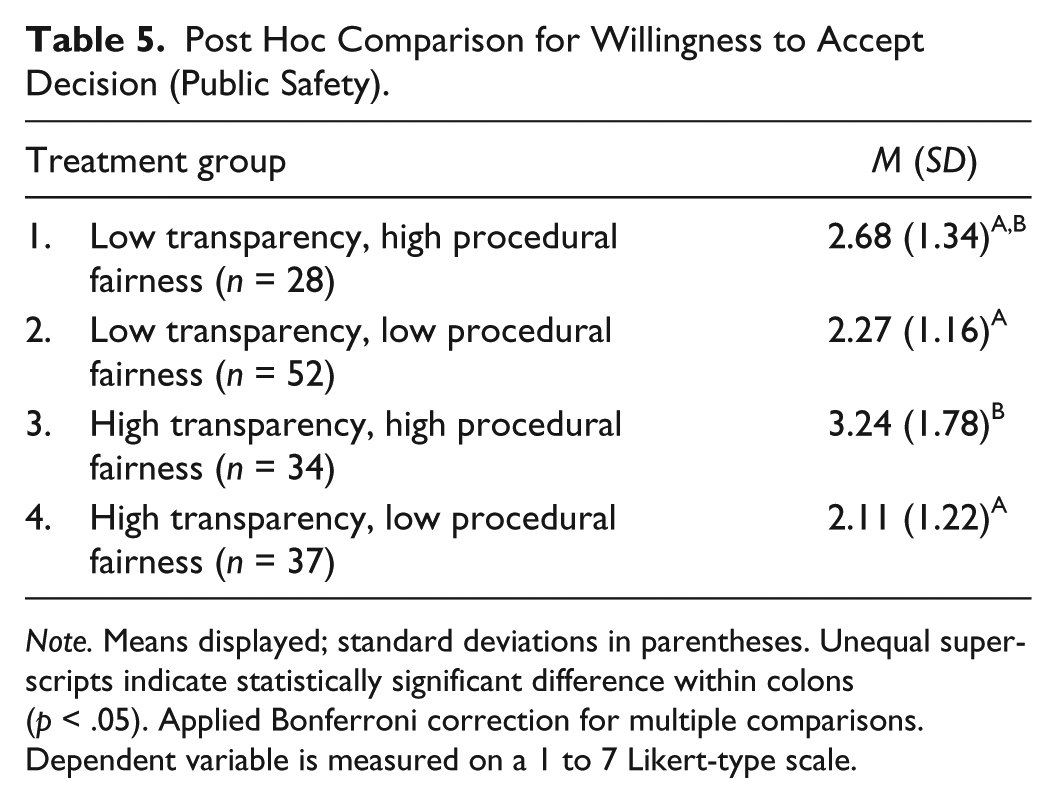
Note. Means displayed; standard deviations in parentheses. Unequal superscripts indicate statistically significant difference within colons (p < .05). Applied Bonferroni correction for multiple comparisons. Dependent variable is measured on a 1 to 7 Likert-type scale.
Furthermore, the only significant differences across treatment groups are found between the high procedural fairness, high transparency group on one hand, and both of the low procedural fairness groups on the other (for the low procedural fairness, low transparency group, p = .01; for the low procedural fairness, high transparency group, p = .004). Those in the high procedural fairness, low transparency group did not differ significantly from either of the low procedural fairness groups. As such, greater procedural fairness only resulted in significantly greater willingness to accept the budget reduction decision for the high transparency group. Conversely, procedural fairness lacked a significant impact on willingness to accept when transparency was low.
Unlike the Quality of Life study, there was no evidence of a significant interaction between procedural fairness and decision-making transparency in determining participants’ willingness to accept the government’s decision to reduce funding to Public Safety (p = .117).
Furthermore, we do not find support for a first-stage moderated-mediation model. Results are illustrated in Table 6. Here, greater decision-making transparency strengthens the negative indirect effect of procedural fairness on voice. This conditional indirect effect under the high decision-making transparency condition is significant. However, there is no evidence of a significant conditional indirect effect for the low decision-making transparency condition. Bootstrapping was used to create 95% bias-corrected confidence intervals around the indirect effect using 5,000 random samples with replacement from the full sample. The index of moderated mediation is –.200 but does not reach statistical significance at the 95% confidence level.
Conditional Indirect Effects of Procedural Fairness on Voice Opposition (Public Safety).
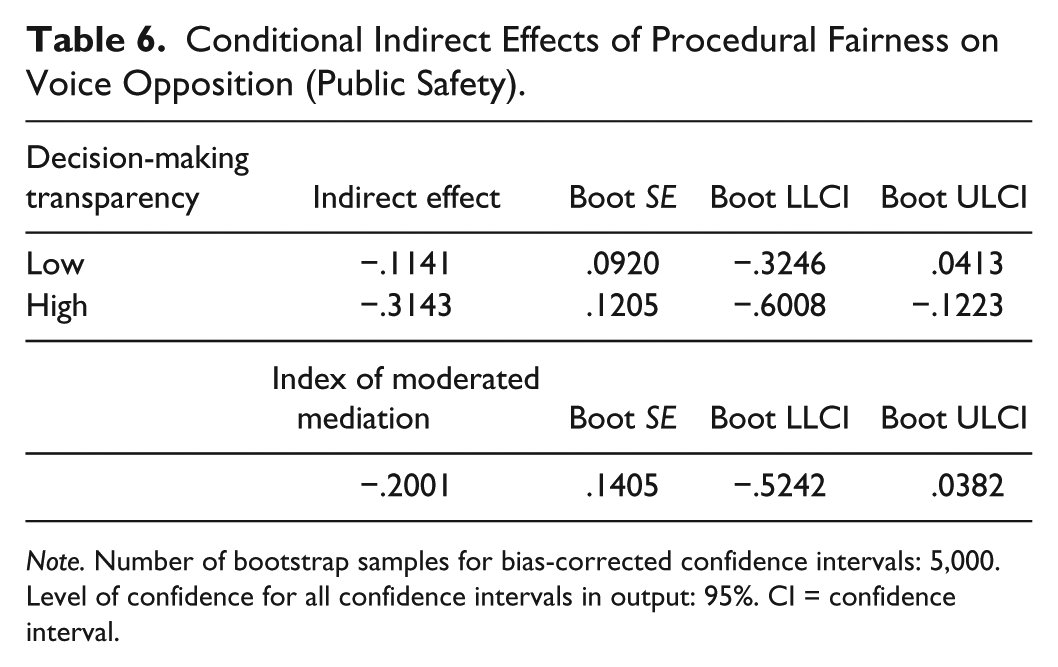
Note. Number of bootstrap samples for bias-corrected confidence intervals: 5,000. Level of confidence for all confidence intervals in output: 95%. CI = confidence interval.
Robustness Checks
While we discuss the results based on the full sample, we also examined the impact of procedural fairness and level of transparency on willingness to accept the decision at different levels of variables that may also influence the relationships of interest to this study. These variables include perceived importance of the department in question and political ideology. We find that, although levels of significance change due to reductions in sample size, the pattern of effects held across different levels of perceived importance and political ideology (conservative–liberal). This is true for both the Public Safety and Quality of Life policy areas. As such, there is no direct evidence to suggest the relationships discussed below will not hold across different segments of the population.
Furthermore, we carried out auxiliary analyses to assess the robustness of our mediating variable, decision acceptance. We measure decision acceptance by asking whether the respondent agreed with the decision. We acknowledge that this is only a one-item measure, which may be sensitive to specific item wording. Therefore, we used an alternative measure that captures a different aspect of decision acceptance: perceived fairness of the decision. 8 For Study 1 (Quality of Life policy area), we found similar—yet stronger—effects on decision acceptance for procedural fairness, F(3, 134) = 104.48, p =.000; transparency, F(3, 134) = 9.86, p = .002; and Procedural Fairness × Transparency, F(3, 134) = 10.17, p = .001. The same is also true for the moderated-mediation analysis—The conditional indirect effects for the low and high transparency conditions were both significant (low transparency: β = –.254, p < .05; β = –.485, p < .05), and the index of moderated mediation was also significant (p < .05), indicating a significant difference between the indirect effects at low and high levels of transparency.
The patterns for Study 2 (Public Safety policy area) were also roughly similar to the original analysis, except for the interaction effect, which was considerably weaker than with the original item: procedural fairness, F(1, 151) = 53.54, p = .000/transparency, F(1, 151) = 1.01, p = .316/Procedural Fairness × Transparency, F(1, 151) = 0.28, p = .599. The mediated moderation analysis shows that under both conditions of low and high transparency, procedural fairness had a positive indirect effect on voice opposition. The same is also true for the moderated-mediation analysis, with one exception. Specifically, when running the moderated-mediation analysis using perceived fairness as the mediator, the conditional indirect effects for both the low and high transparency conditions were both significant (low transparency: β = –.349, p < .05; β = –.403, p < .05). When the analysis was run, using willingness to accept only the conditional indirect effect under the high condition is significant. A further similarity, the index of moderated mediation is also insignificant (p > .05) indicating that the difference between the indirect effects at low and high levels of transparency was not significant.
Discussion and Conclusion
Decision-making procedures play an important role in rendering public organizations responsive and accountable to those they serve. Transparency plays a complementary role by making the public better aware of government efforts to ensure that the decision-making procedures are inclusive and respectful to all involved. Drawing upon a survey experiment and a novel measure of citizen voice behavior, this study explores how the relationship between procedural fairness and intentions to voice opposition to a government decision varied according to the level of transparency. We carried our experiment across two studies to offer insight into the robustness of the mechanisms we test.
Our findings suggest that high procedural fairness increased participants’ willingness to accept the decision across both studies. There was also evidence that the relationship between high procedural fairness and willingness to accept the decision was stronger in contexts of high transparency. Interestingly, a similar pattern was not present for the relationship between low procedural fairness and willingness to accept, in that the level of transparency did not significantly affect the strength of this relationship (Figure 3). This suggests the presence of an asymmetric effect of increased exposure to information about government decision processes. This pattern was observed across both experiments.
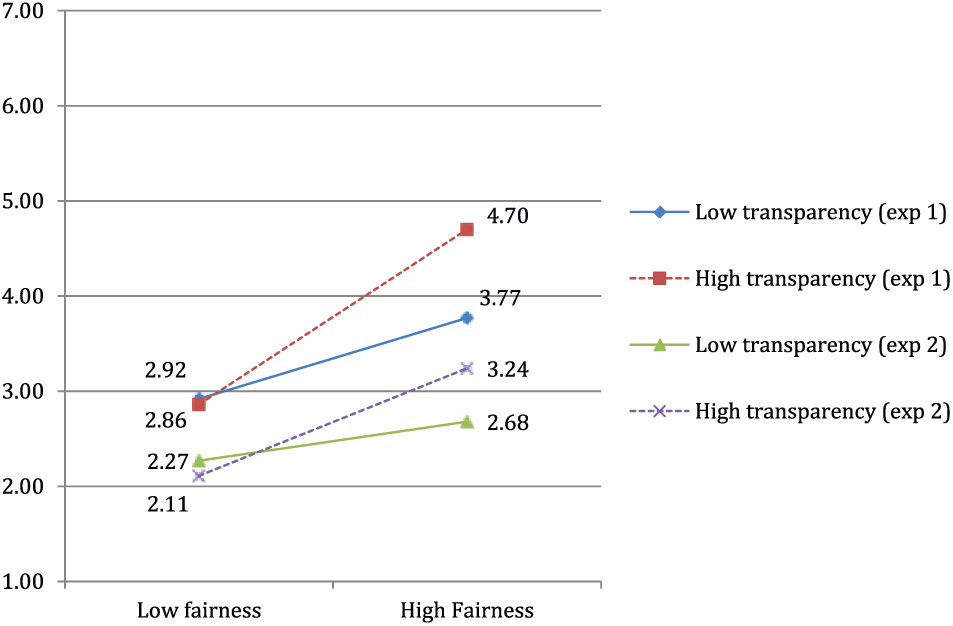
Two-way interaction between procedural fairness and decision-making transparency on willingness to accept.
Furthermore, we find an indirect effect of procedural fairness on intentions to express voice, with this indirect effect larger in contexts of greater transparency. While the indirect effect was significant in both the low and high transparency conditions for the Quality of Life policy area (Study 1), the indirect effect was only significant in the high transparency condition for the Public Safety policy area (Study 2). One final observation is that the overall means for willingness to accept the budget reduction were considerably lower for the Public Safety policy area than they were for the Quality of Life policy area.
Before discussing implications, it is important to overview limitations that pave the way for future research. First, while this study offers evidence of mediation, we should emphasize that we measured, rather than manipulated, our proposed mediating variable. Because we did not manipulate the mediating variable, we are only able to make causal inferences regarding the effects of procedural fairness on participants’ willingness to accept the government’s decision to cut the budget. Therefore, our analyses preclude causal inference with respect to the relationship between willingness to accept the government’s decision and participants’ voice. These limitations notwithstanding, our data do offer evidence to suggest that this mediation model is plausible.
A second limitation is the abstract nature of our experiment. Having a very personal stake in the decision will probably matter, as will intense media and civil society scrutiny of a decision-making process (e.g., van Zyl, 2014). Despite this valid criticism, there is value in exploring theoretical mechanisms with designs like ours. Experimental designs are suitable to make inferences about causality. As such, experiments can provide a window into the effects of transparency on voice that might otherwise be impossible to obtain using alternative research designs.
These limitations notwithstanding, our findings offer four key contributions. First, and perhaps most importantly, our results offer preliminary evidence to suggest that attempts to increase the transparency of the decision-making process may be more effective at building support and acceptance of government decisions and less effective at mobilizing opposition. As our study suggests, relying solely on greater transparency as a tool for empowering citizens may actually effectuate the opposite outcome and stifle voice (see also Bauhr & Grimes, 2014). This is evidenced by our findings that greater transparency had no bearing on the relationship between low procedural fairness and willingness to accept the decision to reduce the funding.
A second contribution of this study comes from the insight it offers into the mechanisms that underpin the relationship between transparency and voice. Specifically, our findings suggest that when attempting to account for this relationship, a number of factors must be taken into consideration. In other words, it is not as simple as assuming that more transparency will result in more voice. Indeed, greater transparency can actually dampen voice when procedural fairness of a decision-making process is high and has little bearing upon citizens’ intentions to express voice when procedural fairness is low. However, it is important to note that these are initial insights into a complex issue and that future research elaborating upon our findings is necessary to derive a more robust understanding of how procedural fairness and transparency interact to shape citizens to voice opposition to government decisions.
The third key contribution of this study is that fairness of government decision-making processes, more than the decision itself, appears to form the basis for citizens’ intentions to voice opposition to government decisions. As we demonstrate, when procedural fairness of a decision-making process is low, participants responded in much the same way, irrespective of just how much they knew about why the decision-making process was unfair. In this sense, if the underlying procedures driving the decision-making process are unfair, just how much information citizens have about these unfair procedures is immaterial when it comes to voice—An unfair decision-making process will likely generate voice irrespective of how much citizens know about the unfair process. On the contrary, greater transparency in instances of a fair decision-making process can lead to greater decision acceptance and lower levels of voice.
Fourth, our findings build on recent evidence (e.g., de Fine Licht, 2014) that the implications of decision-making transparency for citizens’ judgments and behaviors are contingent upon the particular policy area. In our study, participants were much less willing to accept the budget reduction for the Public Safety policy area than they were for the Quality of Life policy area. This indicates evaluations of government policies tend to be anchored in different pieces of information, with decisions affecting policy areas dealing with safety and security issues anchored in features of the outcome, and decisions affecting policy areas dealing with quality of life and leisure issues anchored in features of the processes.
We acknowledge that in reality, a variety of factors interact at the same moment and may lead to different outcomes. For instance, sudden media attention may lead to a different outcome altogether. Also, there may be different actors that trigger voice than the one investigated in this article, such as to journalists or civil society groups (van Zyl, 2014). This article provides evidence that the implications of procedural fairness and in particular transparency for voice are not as straightforward as often assumed. Instead, the relationship between transparency and voice is asymmetric: transparency mitigates intentions to express voice in a fair decision-making process but does not increase voice even under unfair circumstances.
Footnotes
Appendix B
Example of vignettes for Fire Department experiment.
Appendix A
Bivariate Correlations of Key Variables.

| 1 | 2 | 3 | 4 | |
|---|---|---|---|---|
| Parks and Recreation Department | ||||
| 1. Level of transparency | — | |||
| 2. Procedural fairness | −.05 | — | ||
| 3. Willingness to accept decision | .11 | .41** | — | |
| 4. Voice opposition | −.16 | −.01 | −.35** | — |
| Fire Department | ||||
| 1. Level of transparency | — | |||
| 2. Procedural fairness | .13 | — | ||
| 3. Willingness to accept decision | .08 | .272** | — | |
| 4. Voice opposition | .03 | −.03 | .18* | — |
Significant correlations are flagged as follows: *p < .05. **p < .01.
Declaration of Conflicting Interests
The author(s) declared no potential conflicts of interest with respect to the research, authorship, and/or publication of this article.
Funding
The author(s) received no financial support for the research, authorship, and/or publication of this article.