




Abstract
This article details the development and implementation of the Federal Emergency Management Agency (FEMA) Corps program, a federal interagency partnership. While many federal agencies partner through fee-for-service arrangements and contracts, few contemporary examples of interagency program creation and implementation are available. This article develops an interagency collaboration framework by drawing from the collaboration literature, as well as literature on institutions, to examine the development of this unique partnership. This research draws on key informant interviews and content analysis of documentation, including the interagency agreement (IAA), historical records, memos, meeting minutes, and participant observations. Findings suggest that even in formal IAAs, a strong history of informal institutional collaboration may be an important antecedent of forming and implementing collaborative arrangements. Similarly, the presence of a champion may play an important role in cultivating and developing both informal and formal institutions that create an opportunity to collaborate. Finally, the rules-in-use and the rules-in-form may vary at different levels of management. As the federal government increasingly employs interagency partnerships, this article provides lessons for developing relationships, identifying and understanding roles, crossing organizational boundaries, and merging both agency cultures and administrative processes.
Introduction
Over the past two decades, the public management literature has emphasized the prevalence of and potential for interorganizational collaboration and management (Varda, Shoup, & Miller, 2012). While conventional wisdom suggests that government agencies, particularly at the federal level, are siloed and may not be predisposed to collaborative activity, government agencies are increasingly expected to work together to address complex problems facing the communities they serve. This shift toward increased interagency collaboration had been particularly evident under the Obama Administration, where federal agencies were increasingly encouraged to work together to solve some of the nation’s most pressing problems. Numerous task forces, memos, and executive orders suggested, and even mandated, interagency collaboration. However, little is known about the process of cultivating, developing, and implementing interagency collaboration.
Recently, national service programs have been seen as an important vehicle for improving interagency cooperation. On July 15, 2013, the Task Force on Expanding National Service was created, which made policy recommendations on expanding national service opportunities, integrating volunteering and service programs across the federal government, and developing opportunities for interagency agreements (IAAs) between the Corporation for National and Community Service (CNCS) and other federal agencies (CNCS, 2015b). This task force “was inspired by successful national service partnerships that CNCS developed with other federal agencies over the past two years, including: FEMA Corps, School Turnaround AmeriCorps, and STEM AmeriCorps” (CNCS, 2015b). This research examines the development and implementation of an IAA that established the Federal Emergency Management Agency (FEMA) Corps program. Specifically, this article explores how the mechanisms and challenges of integrating various institutional factors affected the creation and implementation of collaborative management practices. While considerable literature has emerged examining the ways that governments work with nonprofit and private partners, there has not been convergence on a unified theory of collaboration among or between government entities, which often have diverse institutional arrangements. Rather, researchers have examined interagency collaborative processes through several lenses, including through institutional, governance, collaboration, or public management lenses. Despite these efforts, a unified, guiding framework of interagency collaboration does not currently exist. As a result, this research draws from several of these veins of literature, including collaborative management and institutional analysis, to describe the cultivation and development of interagency collaboration in one particular interagency initiative—FEMA Corps.
While interagency collaboration between two federal agencies is not a new phenomenon (Fountain, 2013; Kaiser, 2011; U.S. Government Accountability Office [GAO], 2016), it is far less common for agencies to jointly develop and manage programs. Therefore, we consider this case to be groundbreaking, requiring stakeholders to take risks to develop relationships, identify and understand roles, merge agency cultures and policies, and work across organizational boundaries. As there are few contemporary examples of programs developed and implemented in this collaborative manner, this article documents this interagency collaborative process, from inception through implementation. The findings demonstrate how these developments inform eventual collaborative management of the program.
Using key informant interviews and content analysis of legal documents, the development and implementation of FEMA Corps in a policy process context, related to the institutional factors that affect the collaborative process, are examined. To provide an illustrative example of implementation of this unique federal interagency collaboration, specific institutional factors are examined, including antecedents, formulation and negotiation, governance, and patterns of interaction. Culminating from this analysis, we propose a theoretic framework to help guide interagency collaboration research. Interagency collaboration is a complex but emergent phenomenon that warrants future study. Research questions include the following:
By addressing these questions, we believe that we contribute to the evidence base about what makes interagency collaboration likely and successful. Similarly, we believe the proposed process model will provide practitioners with a more nuanced understanding of the important institutional factors that contribute to successful interagency collaboration.
Literature Review
Over the past two decades, public managers, faced with complex problems and limited resources, have turned to collaborative arrangements to generate solutions, often times with other agencies (O’Leary, Gerard, & Bingham, 2006). In these collaborative arrangements, governmental agencies often sacrifice some level of autonomy and pool resources in an attempt to achieve their respective missions (Blau & Rabrenovic, 1991). Collaborative approaches are often cited as beneficial for addressing complex problems because they emphasize the importance of building new policy discourses about the qualities of places, developing collaboration among stakeholders in policy development as well as delivery, widening stakeholder involvement beyond traditional power elites, recognizing different forms of local knowledge, and building rich social networks as a resource of institutional capital through which new initiatives can be taken rapidly and legitimately. (Healey, 1998, p. 1531)
In this article, we employ Thomson and Perry’s (2006) definition of collaboration, which they refer to as a process in which autonomous actors interact through formal and informal negotiation, jointly creating rules and structures governing their relationships and ways to act or decide on the issues that brought them together; it is a process involving shared norms and mutually beneficial interactions. (p. 23)
Despite considerable focus in the public and nonprofit literature on collaboration, particularly between different sectors or among varying levels of government, one particular form of collaboration has only been scarcely studied: interagency collaboration. While there were some early efforts at organizing and describing this emergent phenomenon (Bardach, 2001), the literature dedicated to these arrangements is modest.
To enrich our understanding of interagency collaboration, this literature review draws from several broader literatures, including the processes associated with interorganizational collaboration, collaborative public management, collaborative governance, and institutional analysis. As a result of this review of literature, and informed by subsequent findings from this research, we have proposed a new conceptual model for understanding and analyzing interagency collaboration. Our conceptual model, as well as this literature review, is organized around some of the key dimensions of collaboration that scholarship has identified as being particularly important in the context of interagency collaboration. These dimensions include processes of collaboration, context and antecedents of collaboration, formulation and negotiation, governance and implementation, outcomes, and institutional factors guiding interaction.
Processes of Collaboration
Public administration scholars have developed and tested collaborative process frameworks to better explain how and why collaboration occurs. Scholarship on collaboration is often organized using process frameworks (Ansell & Gash, 2008; Emerson, Nabatchi, & Balogh, 2012; Thomson & Perry, 2006). In these models, the phases or dimensions of collaboration are commonly described. In a comprehensive meta-analysis of 137 studies of collaborative governance, Ansell and Gash (2008) suggest that certain “starting conditions” or antecedents must be present to catalyze collaboration, including information or power asymmetries, incentives for or constraints on participation, and a prehistory of cooperation. They then describe the collaborative process as consisting of several dimensions, including face-to-face dialogue, trust building, commitment to process, shared understanding, and intermediate outcomes, or “small-wins.” Institutional design and facilitative leadership influence this collaborative process.
Thomson and Perry (2006) also suggest that when certain antecedent conditions of collaboration are met, collaborative processes are more likely to occur. They then identify five major categories of collaborative process: governance, administration, organizational autonomy, mutuality, and norms of trust and reciprocity. In describing the “black box” of collaboration, Thomson and Perry (2006) indicate the importance of “repeated interactions, allowing trial-and-error learning to occur” and that these processes allow us to “learn norms of reciprocity and trust, so that over time, institutional change is possible” (p. 29).
It has also been suggested that collaborative governance be studied using a “regimes” lens. Emerson et al. (2012) outline a collaborative governance regime, whereby a regime encompasses “the particular mode of, or system for, public decision making in which cross-boundary collaboration represents the prevailing pattern of behavior and activity” (p. 6). In their process model, the collaborative dynamics of principled engagement, shared motivation, and capacity for joint action are posited to be the drivers of collective action and ultimately impacts. Both the Thomson and Perry (2006) and Emerson et al. (2012) models emphasize the importance of learning and adaptation processes to sustained and successful collaboration.
These frameworks are helpful for understanding collaborative dynamics and planning or anticipating next steps, but are often not specific to particular types and forms of collaboration, such as interagency collaboration. Commonly, these frameworks are organized around several components of collaboration: the antecedent conditions or determinants of collaboration, the administration and governance of collaboration, and the outcomes generated as a result of collaboration. These dimensions, examined specifically with interagency collaboration in mind, are reviewed more closely below.
Interagency collaboration
Recently, the GAO (2016) and Fountain (2013) have published technical reports relating to the implementation of interagency collaboration, but this topic has only been modestly broached in peer-reviewed scholarship. Eugene Bardach (2001) has argued that interagency collaboration is an emerging phenomenon worthy of examination and established criteria for determining success in interagency collaboration, including defining outcomes, minimizing transaction costs, and the exertion of leadership by a particular agency. He posited that interagency collaboration results from the synergy of two different and sometimes competing forces: one whereby collaborators act as craftsmen to construct collaborative structures and processes to improve the likelihood of success, and the second being a more organic, evolutionary process. The next section builds on these ideas to examine important dimensions of these processes.
A proposed conceptual model of interagency collaboration
The remainder of the literature review is focused on contributions that together form our proposed conceptual framework to analyze and understand interagency collaboration. Institutions, such as federal agencies, can have important effects on the development, governance, and sustainability of collaborative endeavors. We posit that these patterns of interaction, guided by such formative scholars such as Elinor Ostrom (Blomquist & deLeon, 2011; Ostrom, 2011), are particularly important when examining interagency collaboration, where administrative turf may be guarded and agencies might be rigid and difficult to merge. We frame our conceptual framework in terms of “institutional factors,” because by understanding the institutions, rules, and social norms that guide joint program development and management, we assert that researchers are better able to understand how to structure agreements and arrangements that generate buy-in from stakeholders and reduce costs of monitoring and compliance. Specifically, “institutions are the prescriptions that humans use to organize all forms of repetitive and structured interactions” (Ostrom, 2005, p. 3), making their focus relevant for today’s public managers working in a collaborative environment. In this research, we found that an institutional analysis framework was particularly relevant and have drawn inspiration from the Institutional Analysis and Development (IAD) framework to examine how institutions, or patterns of interaction, influence various phases of interagency collaboration.
Focusing on rules and institutions, institutional scholars have worked toward developing a more comprehensive theory explaining policy change. The basic premise of the institutional analysis is that rules do simply not accumulate over time, but rather are adapted and reconfigured to form new rules and rosters of actors. The theory maintains a focus on the creation of Common Pool Resources (resources that are shared and used in common) and seeks to explain processes that involve actors, institutions, and rules, and how they work together (McGinnis, 2011). Specific patterns of interaction include the history of previous relationships (Thomson & Perry, 2006), the presence of one or more champions (Bryson, Crosby, & Stone, 2006; Crosby & Bryson, 2005), and legal and contractual interaction (Ring & Van de Ven, 1994; Thomson & Perry, 2006). Relating to governance and outcomes, learning from feedback (Agranoff, 2006; Daniels & Walker, 2001; Emerson et al., 2012), and the establishment of new norms (Siddiki, Kim, & Leach, 2017) can also be considered institutional processes. Ansell and Gash (2008), in their meta-analysis of collaborative governance studies, found that state actors play a vital role in designing appropriate institutions to facilitate collaborative effectiveness. In particular, they found that “institutional design sets the basic ground rules under which collaboration takes place” (Ansell & Gash, 2008, p. 550). We follow these lessons, focusing on institutional factors, but modify and apply them in an interagency collaboration context.
Our proposed conceptual framework is based on four primary categories: (a) context and antecedents, (b) formulation and negotiation, (c) governance and implementation, and (d) outcomes and evaluation. Next we draw on the diversity of literature mentioned above to identify factors that we consider in our research to understand the institutional factors contributing to the development of the FEMA Corps program.
Context and antecedents of interagency collaboration
Studies on interagency collaboration are most common in the fields of social services (Darlington, Feeney, & Rixon, 2005; Nylén, 2007; Page, 2003; Sowa, 2009) or in public health settings (Polivka, 1995; Van Eyk & Baum, 2002), 1 although the concept is gaining favor in the study of bureaucratic cooperation around environmental issues (Thomas, 1997, 2003). Similar to the traditional collaboration literature, these studies of interagency collaboration often describe some common antecedent factors. Often, organizational characteristics, such as agency norms, values, leadership, and cultures, are cited as important factors that drive collaborative decisions (Calanni, Siddiki, Weible, & Leach, 2014; Huxham & Vangen, 2000). Similarly, preexisting relationships and external constraints may promote agencies to work across bureaucratic boundaries.
Rational motives of the organizations involved contribute to the decision to engage in collaboration. In considering the potential for interagency collaboration within the federal government, the Congressional Research Services (Kaiser, 2011) identified 10 potential rationales for federal agencies engaging in IAAs, including
Ending or reducing policy fragmentation,
Improving effectiveness in policy formulation and implementation,
Making agencies aware of different perspectives and orientations,
Mitigating conflict among actors,
Increasing agency productivity,
Enhancing efficiency, reduce redundancy, and cut costs,
Heightening the attention to a priority for cross-cutting programs,
Changing organizational cultures,
Changing bureaucratic and administrative cultures and methods of operation, and
Streamlining and improving congressional and executive oversight.
While these rational incentives undoubtedly undergird the decision to collaborate, other factors also appear important. Other researchers have examined relationships as the primary unit of analysis and have found that strong, preexisting relationships are often important for cultivating collaborative activity (Isett & Provan, 2005; Siddiki et al., 2017; Vangen & Huxham, 2003). However, in the absence of an existing relationship, an externally imposed mandate, that is, from an executive order or court decision, may prompt agencies to work more closely. Similarly, resource dependence, where one agency relies on payments or funding from another agency, may drive agencies to collaborate (Pfeffer & Salancik, 2003; Polivka, 1995). Other forms of interdependence have also been posited to facilitate collaboration (Thomson & Perry, 2006).
Researchers have also found that environmental factors and attributes of the problem contribute to the initial decision to collaborate, particularly between agencies. Intractable or wicked problems that may not be adequately addressed by a singular organization or sector often prompt collaboration (Agranoff, 2006; Provan & Milward, 1991; Sabatier, Leach, Lubell, & Pelkey, 2005). For example, Polivka (1995) suggested several important antecedent conditions, including environmental factors (political, demographic, social, economic), situational factors (awareness, resource dependency, domain similarity, consensus), and task characteristics (scope, complexity, uncertainty). Federalism has also been shown to affect interagency collaboration, particularly between local government agencies and their state-level counterparts, or what Mullin and Daley (2009) refer to as “subnational vertical collaboration” (p. 757). Mullin and Daley found that performance incentives along with other management techniques are strong determinants of vertical interagency collaboration. Among nonnested or nonaffiliated agencies, they found that the political context was highly important to promoting cooperation. Similarly, attributes of the target populations of services being provided may contribute to the interagency coordination. When working with hard-to-reach populations, particularly in the fields of public health (Provan, Milward, & Isett, 2002) or emergency management (Waugh & Streib, 2006), organizations may be more inclined to cooperate.
Formulation and negotiation of interagency collaboration
Similar to other processes associated with planning and strategy, collaboration scholars have addressed issues of design and planning in collaboration. In this literature, scholars have specifically addressed questions of institutional design. According to Ansell and Gash (2008), institutional design refers to the “basic protocols and ground rules for collaboration, which are critical for the procedural legitimacy of the collaborative process” (p. 555). Specifically, scholars have examined goal negotiation processes, establishment of rules that govern collaborative processes, resource allocation, and establishment of evaluative criteria. Researchers have found that the establishment of rules that govern collaborative processes can affect collaborative processes and ultimately collaborative outcomes (Hardy & Koontz, 2010; Siddiki, Carboni, Koski, & Sadiq, 2015; Siddiki & Lupton, 2016). Hardy and Koontz (2009) apply the IAD framework across several watershed partnerships to examine how the design of rules at different levels of analysis affects collaborative performance. They found that group member composition influences the development and adoption of rules-in-use, or the unofficial rules that guide collective behaviors, which ultimately affect the success of the collaboration. Other scholars have demonstrated that in systems without strong accountability mechanisms, members often try to evade rules-in-form, or the formal rules found in contracts and memoranda, by adapting these policies (Guha-Khasnobis, Kanbur, & Ostrom, 2006; Ostrom, 2011).
Other research has supported the proposition that government entities may play an important role in shaping the design and ultimate success of collaborative endeavors. For example, Hardy and Koontz (2009) found that federal policies played an important role in government-led and cross-sector collaboration but may be less important in citizen-centered collaboration. In related research, Hardy and Koontz (2010) found that in urban settings with a strong presence of formal, government actors, collaboration tended to rely on “thick” institutions, such as through policy formulation or remediation, but in rural settings, institutions were developed through planning and relationship-building.
While the establishment of rules may be important to sustaining interagency collaboration, designing these systems has proven to be difficult task. Van Eyk and Baum (2002) found that establishing interagency collaborations in community health services can be an onerous, challenging process. However, they also conclude that partnerships that are built on trust and the open negotiation of power are more likely to succeed. Still others have found that shared values may be the most important determinant of interagency collaborative success (Walter & Petr, 2000). Negotiation of the allocation of resources and rewards in collaborative environments has also proven important to collaborative success (Benson, 1975; Grasse & Ward, 2016; Hudson, Hardy, Henwood, & Wistow, 1999).
Governance and implementation of interagency collaboration
Once interorganizational collaboration has been designed, partnering organizations often consider issues of governance and implementation. In this realm, scholars have attended to the institutions and processes that govern collaboration. In interagency collaboration, the assignment of responsibility is important to maintaining accountability. O’Toole (1985) argued that when policies or programs are implemented through interorganizational means, articulation and assignment of responsibility are paramount to programmatic success. Several structures have been hypothesized to have an effect on network outcomes. These include participant governed networks, where all entities are responsible for sharing and negotiating governance responsibilities; lead-organization governed networks, where one organization serves as a centralized broker in the network; and network administration organizations, where a separate network entity is created to manage and delegate responsibilities (Provan & Kenis, 2008).
Related to the earlier discussion on rules, formalization in relationships has also been shown to be important to interagency collaboration. In examining interagency collaboration among human service organizations in Sweden, Nylén (2007) found that important determinants of effective interagency collaboration were degree of formalization of the partnership as well as the intensity of the relationship. Furthermore, Nylén found that medium–high relationship intensity when combined with low formality may be the most promising combination to improve effectiveness through what she calls “a commitment-based networking strategy” (p. 143). On the contrary, high-intensity relationship, when combined with rigid formalization, “produces ‘a formalized team-building strategy,’ which is simultaneously promising and risky” (Nylén, 2007, p. 143). However, as Darlington et al. (2005) point out, organizations involved in collaboration often do not devote adequate resources to administering their share of collaborative responsibilities. They find that while interagency collaboration is encouraged and often expected in specific domains of government—they examine child protection and mental health services—a lack of organizational support to facilitate these processes often produce barriers to successfully implementing successful IAAs.
Once rules are determined and implemented, they are often adapted. Using an institutional lens to study local food systems, Siddiki and colleagues (2015) examined seven types of rules that govern food policy councils, including position rules, boundary rules, choice rules, scope rules, aggregation rules, information rules, and payoff rules. They found that in local food systems, adaptations to these rules, and ultimately governance mechanism, were important to creating sustainable, lasting collaboration. They found that “adaptations in governance mechanisms are inevitable as policy makers and society face altered natural and social environments” (Siddiki et al., 2015, p. 545).
Implementation of interagency collaboration may create tension not only between involved organizations but also within a single organization. L. J. Johnson, Zorn, Tam, Lamontagne, and Johnson (2003) interviewed a few dozen frontline workers and program managers to determine what factors lead to successful or unsuccessful interagency collaboration. Importantly, they found differences in perceived drivers of success between program chiefs and frontline workers. In particular, program chiefs or managers reported that the most important factors for successful collaboration were willingness to work together and shared visions, while program specialists or frontline workers saw strong leadership and a willingness to work together as drivers. Managers reported good communication, understanding the cultures of cooperating agencies, and no resistance to change as being important to interagency collaboration at higher rates than the frontline workers. Frontline workers viewed commitment and collaborative mandates as being more important drivers of interagency collaboration than their managers (L. J. Johnson et al., 2003).
Outcomes and evaluation of interagency collaboration
Organizations often discuss and establish evaluative metrics during development and design of interagency collaboration (Amirkhanyan, 2009; Ward, Epstein, Varda, & Lane, 2017). However, research has found that the establishment and refinement of performance measures may be particularly difficult in interagency collaboration, where agencies employ different performance measures and are ultimately accountable to different leadership. Negative associations have been identified between interagency partnerships and the design of performance measurement or evaluation (Amirkhanyan, 2009; de Lancer Julnes & Holzer, 2001).
During evaluation, organizations aim to demonstrate impact, either through reporting and learning from evaluative metrics, or showcasing innovation. However, research on joint measurement has primarily highlighted the difficulties associated with these arrangements. Amirkhanyan (2009) found that organizations are far less likely to collaborate when service measurability is high or when performance is already measured in a rigorous manner. Knox and Wang (2016) also found that leadership buy-in, institutionalization, technical capacity, and staff buy-in might be particularly important for adopting performance measurement in small nonprofit organizations.
In related research to this current article, our research team found that dual-agency partnerships might be important venues to introduce and develop joint performance measures (Ward et al., 2017). In research specifically examining the development of joint performance measures, we found that both CNCS and FEMA were developing parallel, but ultimately unrelated performance, measures, rather than developing these measures jointly. While it is common for agencies to initially coalesce around ambiguous goals (Huxham & Vangen, 2000), agencies need to be prepared to initiate the implementation of performance measures and evaluation early in the collaborative process. Therefore, nascent or recently established interagency collaborations may be the most promising venues to experiment with joint performance measurement (Ward et al., 2017).
Finally, interagency collaboration has been shown to produce innovative results that can be transferred over into agency operations, often as unintended consequences (Ward et al., 2017). Previous research on FEMA Corps identified several practices that were developed as a result of the collaboration, but then implemented more widely in both FEMA and CNCS.
In this research, we use the collaboration literature, interagency research, and an institutions framework to formulate a conceptual model of interagency collaboration (see Figure 1). The framework contributes to the approach to blend an institutions lens with collaborative management to both advance the theoretical contributions and build the evidence base for future interagency initiatives, and how they might be implemented and managed. Below, we describe the methods we used to examine this particular example (FEMA Corps) and conclude by linking the findings to these goals.
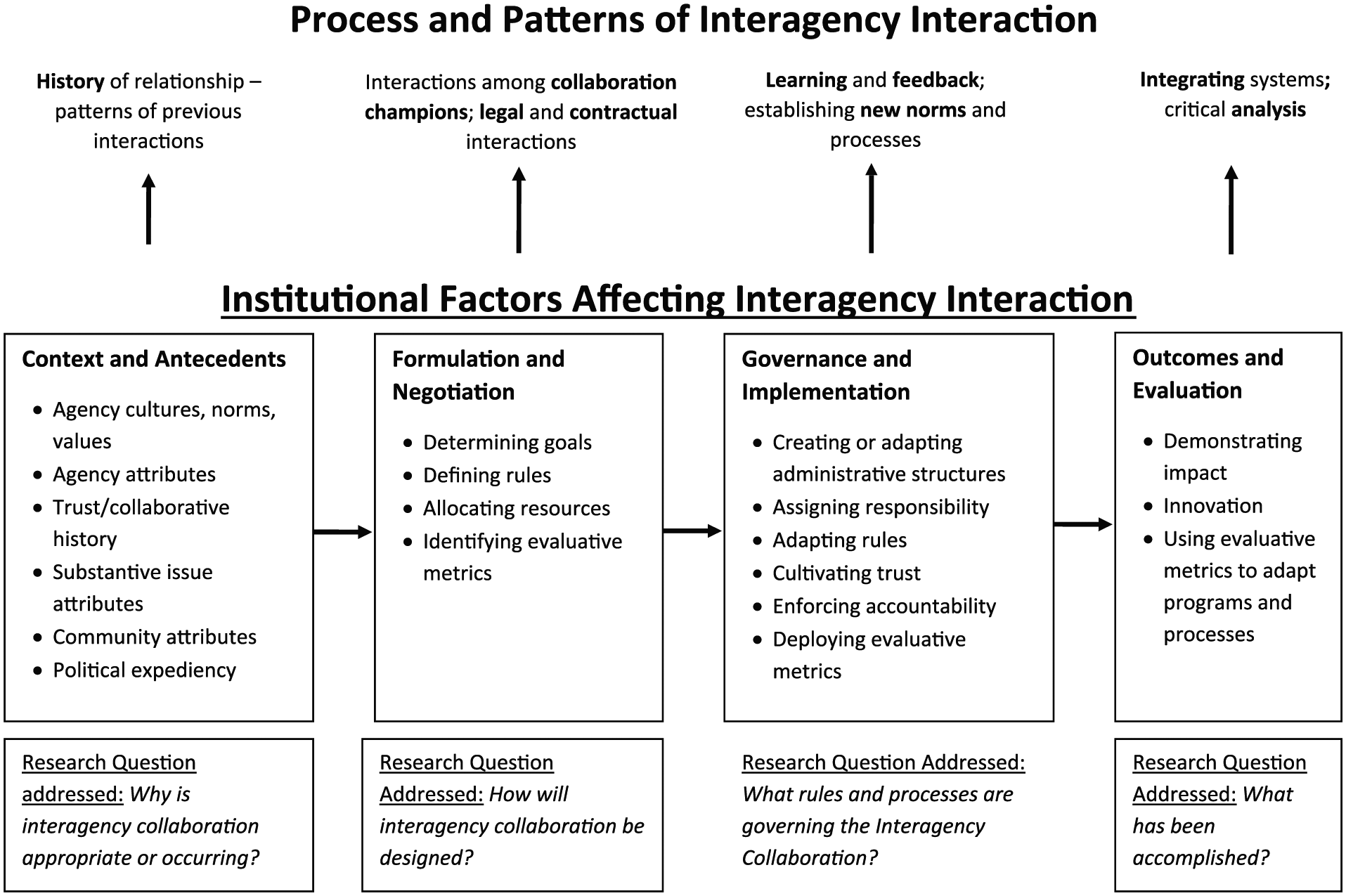
Proposed conceptual model of interagency collaboration.
Method
To answer our research question related to the institutional factors that influenced the development and implementation of FEMA Corps, a qualitative case study approach was utilized. Case studies are often the preferred method for addressing “how” or “why” type research questions (Yin, 2003). Case studies may also be classified as explanatory, exploratory, and descriptive. This research employs an explanatory approach to better understand the perceived success of interagency collaboration in the case of the FEMA Corps program.
Yin (2003) suggests that there are six sources of acceptable evidence in case study analysis: documentation, archival records, interviews, direct observations, participant observations, and physical artifacts. Case studies can be useful when describing processes, particularly when studying relatively unique or uncommon phenomenon. By adopting a case study approach, this research applies these multitheoretical lenses to a real-world example as a way to guide future interagency collaborative efforts.
Case Overview: What Is FEMA Corps?
FEMA Corps was created in 2012 and was borne out of a formal partnership between the FEMA and the CNCS, a federal agency responsible for the AmeriCorps, Senior Corps, and Social Innovation Fund programs. FEMA Corps establishes a new track of 1,600 service Corps Members within AmeriCorps National Civilian Community Corps (NCCC) dedicated to disaster preparedness, response, and recovery. Just like current AmeriCorps NCCC members, FEMA Corps Members serve a 10 month term and are eligible to serve a second year based on their performance. (CNCS, n.d.)
AmeriCorps National Civilian Community Corps (NCCC), the initial programmatic model for structuring and developing FEMA Corps, is also responsible for administering FEMA Corps. Like FEMA Corps, AmeriCorps NCCC is a full-time, team-based residential program for individuals between the ages of 18 and 24. Five regional campuses service the entire United States and are located in Denver, Colorado; Sacramento, California; Baltimore, Maryland; Vicksburg, Mississippi; and Vinton, Iowa. From these campuses, teams of 10 to 12 corps members are deployed for projects ranging from 6 to 8 weeks. Teams are deployed several times during the 10-month service commitment (CNCS, 2015b). Prior to their first deployment, members receive training in Cardiopulmonary resuscitation, first aid, and other disaster-related services. After training, AmeriCorps NCCC teams may be deployed in response to a natural disaster. Between 2000 and 2014, over 15,000 NCCC corps members served on 2,042 disaster projects, accounting for over 5.4 million hours of service (CNCS, 2014).
The CNCS and its AmeriCorps programs have a long and rich history of participating in national disaster relief efforts. Aside from FEMA Corps, other national service assets are available in times of disaster. For example, there are currently 16 AmeriCorps Disasters Response Teams comprised of 2,600 AmeriCorps members who are trained to provide individual assistance, public assistance, volunteer management, community outreach, and capacity building (see Table 1). Other AmeriCorps program members are also available for deployment to disasters, including from AmeriCorps VISTA and Senior Corps, a service program for individuals age 55 and above.
Classification of Service Provided by AmeriCorps Disaster Response Teams.
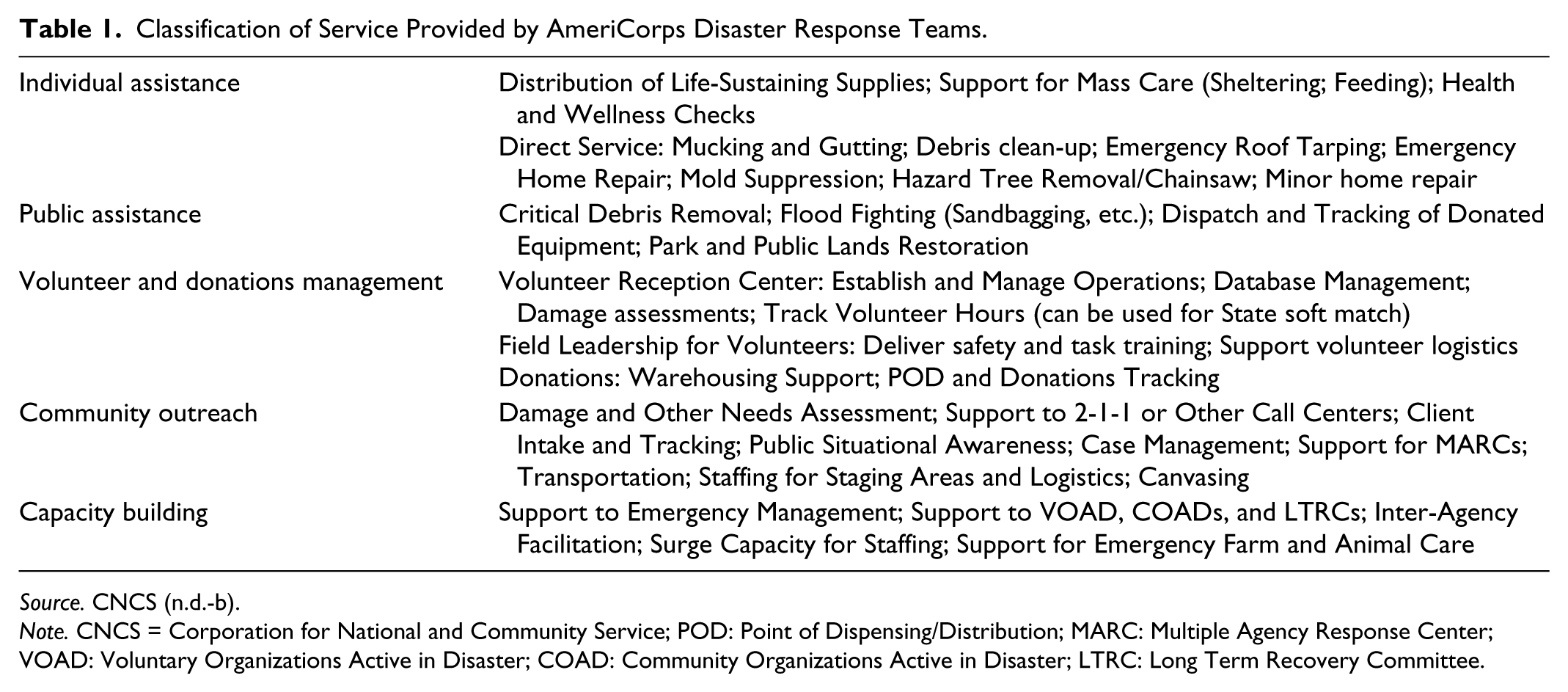
Source. CNCS (n.d.-b).
Note. CNCS = Corporation for National and Community Service; POD: Point of Dispensing/Distribution; MARC: Multiple Agency Response Center; VOAD: Voluntary Organizations Active in Disaster; COAD: Community Organizations Active in Disaster; LTRC: Long Term Recovery Committee.
CNCS continues to view disaster management as an important component of its portfolio. The 2011-2015 CNCS Strategic Plan identified six focus areas, including disaster services, economic opportunity, education, environmental stewardship, healthy futures, and veterans and military families (CNCS, 2011). Specifically, the disaster services area addresses disaster preparation, mitigation, response, and recovery efforts (CNCS, 2011). CNCS also has a Disaster Services Unit (DSU) to facilitate agency-wide coordination in the event of a disaster, as well as to provide expertise, support, and access to national service members.
The role of AmeriCorps programs in disaster relief efforts grew in response to Hurricanes Katrina and Rita in 2005. As a result of these disasters, between 2005 and 2010, over 17,000 AmeriCorps members provided over 8.5 million hours of service to aid in the relief efforts, including rebuilding affected communities. During the same time period, NCCC members accounted for 5,400 of these individuals and have served on 1,040 separate disaster service projects in the Gulf Coast region (CNCS, 2010). In addition to providing direct services, AmeriCorps members have played an important role in improving and sustaining volunteer capacity in disaster response—It is estimated that AmeriCorps members recruited or coordinated over 611,000 volunteers in the Gulf Coast hurricane relief effort (CNCS, 2010).
FEMA and AmeriCorps: Convergence on FEMA Corps
The Department of Homeland Security’s FEMA is the government entity primarily responsible for disaster preparedness, response, and recovery in the United States. For more than 20 years, FEMA and CNCS have coordinated in disaster response and recovery efforts. In particular, members of the AmeriCorps NCCC program have been deployed to nearly every major national disaster (Frumkin & Jastzrab, 2010). Among a sample of AmeriCorps NCCC members who participated in the program in 1999, 30% reported having participated in disaster response (Ward, 2013). More recently, in 2014, 24% of the 274,880 total AmeriCorps NCCC team service hours were spent in natural and other disasters (CNCS, 2015a).
This relationship has been ongoing but has largely developed through ad hoc collaboration during large-scale disasters. In 2012, FEMA partnered with CNCS to establish a unit of AmeriCorps members solely devoted to disaster preparedness, mitigation, response, and recovery. The IAA added up to 1,000 additional service corps members annually within AmeriCorps NCCC. According to CNCS (2015a), FEMA Corps was launched to “enhance the federal government’s disaster capabilities; increase the reliability and diversity of the disaster workforce; expand education and economic opportunity for young people; and achieve significant cost savings for the American taxpayer” (p. 40).
The FEMA Corps program is funded through Stafford Act funding, thus limiting the types of service in which corps members can engage. Corps members work in teams and travel in a regional area; however, in the event of a large disaster, teams may be deployed anywhere in the United States. Similar to traditional AmeriCorps NCCC members, FEMA Corps members are provided with room and board and receive an education award at completion of service. Since the inception of the program, members have worked on the Hurricane Sandy recovery effort in New York and New Jersey, and tornado response and recovery efforts for category 5 tornadoes in Oklahoma, among dozens of other projects.
While FEMA Corps is a relatively new unit of AmeriCorps NCCC, the partnership was built on an existing relationship between FEMA and NCCC over the past two decades. FEMA Corps is jointly operated and administered by a newly formed division of FEMA (the FEMA Corps Branch) and the AmeriCorps NCCC. Members are recruited and selected by AmeriCorps NCCC and more rigorous background checks are performed by FEMA. Members are placed on existing AmeriCorps NCCC campuses and jointly trained by both agencies. Project assignments are arranged by the FEMA Corps branch and deployments are managed jointly with task oversight by FEMA staff, and team-based management (e.g., discipline, team dynamics, lodging, food) oversight is provided by AmeriCorps NCCC regional staff.
Data collection and analysis
Data collection and analysis were guided by dimensions of our proposed conceptual framework to purposefully gain a broad understanding of how stakeholders, institutions, and rules affected the development of this interagency policy. Two data sources were used to inform this research: content analysis of documentation and expert, key informant interviews. Content analysis was used to review documents, including the original IAA, historical records, memos, and institutional memory. Key informant interviews with stakeholders involved in the policy process included a sample of 12 key program administrators representing both FEMA and CNCS. These included people from primarily headquarter-level positions such as, but not limited to, the Assistant Administrator to Response Director, Branch Directors, General Counsel, National Directors, Deputy Administrators, and regional-level staff such as Regional Directors. Ten of these individuals were selected because they were considered influential to policy development at the federal agency level, while two individuals were considered important to interpretation and implementation of these new policies due to their proximity to the front lines.
Content analysis was also employed. We began by reviewing documents to identify existing information regarding the evolution of the FEMA Corps policy process (as it fit into the proposed framework). We created an Excel document where we categorized each piece of the framework as the columns and listed the documents as the rows. We then went through the documents and linked information within them to the various categories of the framework. This provided a foundation by which we could begin to understand the policy process, identify the gaps that we were not able to collect through the documents, and design the interview questionnaire to capture an in-depth narrative of the policy process through the interviews.
Next, interviews were conducted as a team of four interviewers. In total, we conducted 12 structured telephone interviews (two researchers: one note taker, one interviewer), which lasted around 1 hr each. Research has demonstrated that information obtained through telephone interviews is considered comparable with in-person interviews (Cook, White, Stuart, & Magliocco, 2003). Participants were asked similar questions (see Appendix for interview protocol), although knowledge of particular aspects of the policy process was emphasized in some interviews with individuals who had expertise in specific areas. Transcripts were generated for each phone interview and were used in subsequent coding.
Once interviews were complete, we coded each one, taking a team approach to coding. We again created an Excel document that listed each domain of the proposed framework as its own worksheet. We listed each interviewee as the rows in each spreadsheet and delineated the various categories within each framework domain as the columns. We began by team-coding several interviews to establish coding norms and rules. Then, two researchers independently coded interviews, which were then examined for interrater reliability. The group addressed discrepancies until consensus was reached. Once agreements on coding decisions were reached, the entire research team independently coded the interviews using the spreadsheets in Excel. Instances of mention of certain topics/categories were recorded, along with the narrative details from the interviews and notable quotes. Cleaning of the spreadsheets was done in several iterations, through team discussions of areas where we could collapse/expand codes and capture any missing information not recorded. A final cleaned version of the coded interviews was used to write up the results.
Results
Below, the results address our four research questions:
However, findings are organized around the four dimensions of our conceptual framework in Figure 1: (a) context and antecedents, (b) formulation and negotiation, (c) governance and implementation, and (d) outcomes and evaluation. Table 2 provides a summary of these findings.
Summary of Findings From Key Informant Interviews (n = 12).

Note. FEMA = Federal Emergency Management Agency; NCCC = National Civilian Community Corps; IAA = interagency agreement.
Context and Antecedents of Interagency Collaboration
Findings revealed that contextual and antecedent conditions played a key role in FEMA Corps policy development. Several factors in the external environment ripened this policy issue, and respondents reported that a confluence of events enabled the partnership to occur. The dimensions identified in the conceptual framework organize these findings, including agency culture, agency attributes, substantive issue area, community attributes, and the political attributes.
Relating to the substantive issue area, the majority (83%) of respondents reported that in the years preceding program conceptualization, many major natural disasters had occurred, which created stress on the disaster workforce. Hurricanes Katrina and Rita, the devastating tornadoes in Joplin, Missouri, and the BP Oil spill in the Gulf of Mexico were all identified as resource intensive events that created demand for a flexible, efficient corps.
Interviews also revealed that agency culture and attributes drove the agencies to collaboration. Half of the respondents also reported that in the several years preceding the interagency partnerships, FEMA had been engaged in significant workforce reform and was looking for a new talent pipeline. FEMA was aware that they were facing a large, impending wave of retirements among their baby boomer cohort of employees, which prompted a search for new talent. At the same time, AmeriCorps NCCC was looking for innovative ways to expand their programming, driven by two factors: to help maximize campus utilization (campuses can typically accommodate several hundred corps members but are only at maximum capacity several months out the year), and as part of the presidential mandate for federal interagency collaboration, whereby CNCS was charged to identify new opportunities to employ national service as a means to address pressing national issues.
This issue was also politically salient under the administrative and presidential leadership at the time. One important event reported by high-level administrators occurred when FEMA Deputy Administrator Richard Serino had a unique political opportunity to present the idea to the president and his chief of staff at the White House. Administrator Serino was frequently cited as an important champion to the arrangement, without whom FEMA Corps would likely not exist. Together, these factors laid the groundwork for the impetus to initiate development of this partnership.
Internal environmental factors were also crucial in shaping the initiative. The institutions literature suggests the attributes of communities are likely to shape the behavior of individual actors and are therefore influential in the development of a policy. In this case, an established relationship between FEMA and AmeriCorps NCCC that was perceived by both agencies to have been successful appears to be an important antecedent to the development of a formal partnership. Existing infrastructure, policies, and procedures, coupled with a trusted, known relationship that had developed between the agencies over nearly two decades, were identified by respondents as attributes that led to successful policy initiation and implementation.
Respondents also identified other attributes that contributed to success of the policy. Specifically, AmeriCorps corps members were viewed by FEMA as being young and energetic, which infused the organization with enthusiasm during a time when the agency was experiencing a culture shift. The retirement of many long-tenured FEMA personnel created an opportunity for a younger cadre to start working in the agency. FEMA Corps facilitated this shift by providing training to this younger generation of emergency managers, as the field was simultaneously professionalizing and growing. FEMA Corps was seen as a way to fill an impending gap in human capital.
Formulation and Negotiation of Interagency Collaboration
The formulation and negotiation of the interagency collaboration included considerable dealings between high-level staff in both agencies. This process resulted in several formal documents that were designed to guide the development of the interagency collaboration, including the IAA and the Business Case documents. These documents were important tools for articulating both the goals of the interagency collaboration, as well as creating some ground rules to shape the implementation of the new program. Preliminary responsibilities were assigned, although these were purposely vague. A primary issue of concern during these negotiations was the legality and authority of the agencies to implement policies that had unclear legal precedent. To address this issue, legal teams from both agencies reviewed existing statutes and policies, including the Stafford Act, which authorizes FEMA action during disasters.
Within the interagency collaboration, the negotiation and renegotiation of rules strongly influenced the final policy design. As noted above, policies governing collective behaviors may be categorized as rules-in-form (formally adopted policies) and rules-in-use (rules that are actually observed in communities). In collaborative environments where rule enforcement is not strong, the rules-in-use may differ from the rules-in-form. Regarding roles, it was clearly designated that FEMA held operational control, while the NCCC maintained administrative control. In this interagency collaborative endeavor between two federal entities, respondents reported a mix of clearly set parameters, for example, as established by the formal IAA, similar to a memoranda of understanding, and a need for creativity and flexibility required outside the IAA. Overall, respondents indicated that while the rules were somewhat clear in the beginning, they had been undergoing constant, incremental changes throughout both the policy design and implementation phases, with each agency continuously educating one another on their respective policies. When the rules-in-form were not clear, senior leadership from both agencies engaged to clarify these rules, but lower levels of management were also negotiating and renegotiating the rules-in-use.
While the respondents generally felt comfortable about the ways both agencies viewed and utilized established rules between the partners, a discrepancy existed between the IAA (policy) and what happens on the ground (implementation). Nearly 60% of the respondents mentioned that maintaining creativity and flexibility outside of the formal IAA was necessary to maintaining success in the partnership. For example, interview statements indicated that while most formal rules were being set at the AmeriCorps NCCC headquarters and FEMA Corps Branch level, the actual implementation of the policy was defined and articulated by the personnel at the campus/Joint Field Office level. This was not reported to be problematic, but rather necessary to ensure that implementation of policy developed at a high level was successful at the operational level.
Governance and Implementation of Interagency Collaboration
Interactions among stakeholders, a key dimension in the institutional literature, played an important role in the implementation of this partnership. While the agencies’ rich history generated the possibility of the partnership, the prospects of successfully negotiating an agreement were secured early in the process. Respondents all began the “story” of the policy process by citing that high-level administrators within FEMA initiated the original idea. This investment by leadership was cited as being important to successfully implementing the program—One third of respondents cited senior leadership’s ability to break administrative impasses as crucial to the survival of the program. However, individuals who were cited as visionaries of the program were all high-level managers at both organizations. These individuals were reported to have resolved early in the process to overcome the necessary hurdles to make the program a reality. Finally, the campus-level leadership was cited as critical stakeholders, not only knowing how to follow guidelines but also needing the autonomy to make decisions that vary when necessary.
In addition, members of both agencies perceived that a previously established relationship and a history of interactions between the two agencies were important antecedents to the development of the FEMA Corps program. Representatives from both agencies suggested that the previous, less formal arrangement between FEMA and NCCC allowed for both agencies to build trust and establish shared norms. Furthermore, these repeated interactions served as the basis for developing both rules-in-use, as well as rules-in-form.
While the implementation of FEMA Corps required all levels of the federal agencies to be involved, respondents described the creation of the program as top-down, with the design and planning primarily coming from top leadership. The idea for FEMA Corps initially gained traction as a result of high-level political and administrative support. However, many important implementation and governance decisions were ultimately determined at the operational level, in a bottom-up manner (e.g., AmeriCorps NCCC campus staff, FEMA field staff). Interviews revealed that the FEMA and NCCC largely adapted or duplicated existing NCCC programmatic infrastructure to develop FEMA Corps. This arrangement not only reduced the administrative burden on FEMA but also gave NCCC considerable influence over management structures and processes, as demonstrated in the formulation of performance measures (Ward et al., 2017). Legal counsel from both agencies determined that authority existed to jointly create the program without seeking legislative approval. Both agencies worked independently with their respective Office of Management and Budget examiners to formulate an agreement and appropriate funds. Considerable negotiation between each agency’s general counsel and other high-level decision makers occurred to develop the legal framework establishing the partnership.
Outcomes and Evaluation of Interagency Collaboration
Finally, the proposed conceptual framework and the collaboration literature emphasize the importance of demonstrating impact through evaluation of outcomes that shape how policies or collaborations evolve and transform over time. In the FEMA Corps interagency collaboration, outcomes and evaluation were secondary goals to developing sustainable collaborative processes, but are currently in development. The two most notable outcomes mentioned by respondents were (a) the number of innovative practices that resulted because of the program and (b) the difficulty in collecting and combining data. In terms of evaluation, all respondents noted the importance of this activity, noting that this was still very much a task-in-progress. Some respondents noted that evaluation must be considered a shared task between the agencies; otherwise, it would not be sufficiently executed.
One of the primary considerations during conceptualization of the program was the prospect that FEMA Corps would result in significant cost savings. In fact, 50% of respondents expected cost savings to be generated by the program and was cited as the primary rationale for the program. This included a detailed optimization plan that aimed to bring down cost-per-member figures by fully utilizing NCCC campus space and other sunk or fixed costs. Only one interviewee expressed concern about the political costs of a potentially failed partnership for CNCS, citing that this program was a big risk and that failure could mean a greater political cost for CNCS because of its small size and narrow mission. Previous research relating to the outputs and outcomes generated in the first 2 years of the FEMA Corps program has shown high levels of satisfaction among site sponsors, outputs generated, and member development (Ward et al., 2017).
In Figure 2, we map these findings onto our conceptual framework of interagency collaboration, replacing the items presented from the literature (as shown in Figure 1), with the actual findings from this case study. This provides a visualization of the summary of findings at a broad level related to how the various aspects of the policy development played out during the policy design and implementation of the FEMA Corps program. This organizing framework demonstrates the applicability of an institutional lens to the collaborative process of an IAA.

Proposed conceptual model of FEMA Corps interagency collaboration.
Challenges in Designing and Implementing Interagency Collaboration: FEMA Corps
While findings from interviews with stakeholders in this process are largely positive, it is important to address some of the challenges they discussed as well. Different organizational structures and interagency complexities present various levels of challenges. Some of these challenges include the breadth and scope of actors, agency mission misalignment, and determining and sharing financial cost data.
The breadth of actors involved in the implementation produced complexity that often made it difficult to maintain forward momentum. This presented the expected challenges of coordinating many schedules and gaining agreement on some items. However, as a federal initiative, the general counsels, the formal decision makers in the process from each agency, mitigated disagreements or uncertainties. In some sense, this function was a benefit to the many actors involved, as policy uncertainties were referenced by law. When this was not the case, general counsels were able to articulate new precedent for navigating these complex discussions.
Another challenge stemmed from mission misalignment between FEMA (indirect support to survivors) and AmeriCorps NCCC (direct service provision with a strong focus on member development). While the respondents in this study only briefly mentioned competing missions as a challenge, nearly everyone acknowledged that this process of negotiation created an opportunity for both agencies to address larger organizational differences. For example, one respondent told the story of a FEMA supervisor who was very skeptical that a group of young people could do the work that was, at that point, done by long-standing FEMA employees. However, that same supervisor spoke later about his misperception of the goals and ethics of AmeriCorps NCCC members and the benefit that a younger generation would bring to the changing climate at FEMA. The challenge of competing missions appears, in this case, to be one that had the consequence of early misperceptions, followed by evidence that the missions would merge successfully. However, in some cases, this convergence has been slow.
Generating firm financial cost data for the program has been difficult. Furthermore, calculating the cost of the program on a member per capita basis has also proven challenging. Nearly all respondents asserted the benefits of FEMA Corps as a cost saving for the federal government, but it remains a challenge to articulate a cost formula that accurately demonstrates these savings. Specifically, respondents identified several challenges in these areas, including accurately tracking how much faster FEMA field offices were able to get work done as a result of having a FEMA Corps team, costing out the benefits of value-added work or work that might not have been otherwise completed, and accurately accounting for the cost of housing during deployments. However, the current formula mitigates some of these questions by comparing a known cost of each corps member and the known costs to employ FEMA full-time employees (FTEs). While this approach may not be entirely valid because FEMA Corps was intended to supplement, but not supplant FEMA FTEs, this practice has emerged within FEMA as the best approximation of value generated by FEMA Corps to date.
Discussion
In this research, it has been our contention that institutional factors may be particularly important to the development and implementation of interagency collaboration. The institutions literature has proven particularly useful in the study of governance of common pool resources and has been used more recently to better understand the role that governments might play in fostering or cultivating collaboration. In this article, we suggest that institutions may also be particularly important in interagency relationships and interactions, which can lead to longer term, more formal collaborative arrangements where a program may be jointly developed, implemented, administered, or evaluated. With the likelihood of interagency collaboration on the rise, this case study is instructive on several fronts.
This research also contributes to the literature on the role that governments can play in developing the institutional infrastructure and administrative wherewithal to foster collaboration, particularly between federal agencies. In this case, high-level political buy-in resulted in rapid implementation of interagency collaboration, characterized by a strong desire for success of the partnership from leadership and uncharacteristically quick adoption of the policy. Similar to previous findings in the interorganizational and interagency collaboration literature, previous patterns of interaction and a history of informal interagency collaboration were identified as important drivers of more formal collaboration in FEMA Corps. In particular, having a solid understanding of the partnering agencies’ missions and organizational values and norms allows for greater opportunity for goal alignment between agencies. Furthermore, a mandate for government agencies to explore interagency partnerships set by the President of the United States created an additional external impetus to spur collaboration. While it may be difficult to engineer interagency collaboration from scratch when presented with an external mandate, we believe these mandates aimed at creating a more brokered, connected bureaucracy may serve as an important catalyst for agencies to explore deeper, more meaningful joint work. Other important antecedent variables previously identified in the literature were also identified as important, including the presence of a champion (Crosby & Bryson, 2005) and previous legal and contractual interactions (Ring & Van de Ven, 1994; Thomson & Perry, 2006). In the case of FEMA Corps, the idea gained traction due to commitment from leadership, but the development and design of the program were expedited due in part to the previous interactions and trust established between legal teams representing each agency.
Another important antecedent condition found in the interagency collaboration literature relates to the expectations among partnering agencies that there will be either short-term or long-term benefits derived from the arrangement. In this case, clear benefits of the arrangement were reported by both agencies. FEMA cited cost savings and the benefit of hiring alumni who have valuable computer and technology skills that benefit FEMA overall. For the AmeriCorps NCCC, the FEMA Corps program allowed for campus expansion, thus leveraging resources to increase service opportunities for young people. And for CNCS as a whole, it demonstrated that successful interagency partnership is possible. From this, we conclude that interagency partnerships can provide benefits to both agencies, including cost savings, program expansion, and possibly even greater political support during budgetary processes.
While governance in collaboration is frequently difficult in any type of collaboration, it appears to be particularly important to interagency collaboration, both within and between the respective agencies. While frontline administrators reported that they were not always consulted early in the process and that the formulation and initial design was pushed down from agency headquarters in Washington, D.C., without much input from the campuses regarding methods of implementation, they did report that their voice were prominent during implementation. In fact, the findings demonstrated that many rules and procedures were actually developed at the campus/joint field office level and that working through those complexities was constant and collaborative. This leads us to conclude that formal interagency partnerships require a combination of high-level leadership during initiation and local buy-in for successful development and implementation of interagency collaboration. This finding is supported by L. J. Johnson et al.’s (2003) research that demonstrates that there is often tension between lower- and upper-level management, whereby the groups report differences on the important factors to collaborative success.
Rules also played an important role in this partnership. In the beginning, the partnership was built on an existing relationship in which both agencies had previously negotiated and developed formal and informal constitutional level rules for establishing decision-making and management processes. At the collective choice level, all levels of management agreed that the “rules” were continually negotiated. High-level actors discussed less reliance on “formal rules” which were established early in the program formulation phase and were documented in the resultant legal documents. While higher level actors suggested these legal documents were important, but not crucial, to success, lower level actors appeared to rely more heavily on these documents to resolve conflicts when clarifying operational choice rules. One important observation that appears to have facilitated successful implementation is that the agencies took on differing responsibilities: NCCC had administrative responsibility while FEMA took on operational control. While this arrangement was likely facilitated by nearly 20 years of less formal collaboration, this interagency partnership worked to formalize these roles. This finding is supported by recent research that demonstrates that rules-in-form are often different than rules-in-use (Guha-Khasnobis et al., 2006; Hardy & Koontz, 2009; Siddiki et al., 2015). This discrepancy between official and unofficial rules may be particularly important in interagency collaboration, where agencies, particularly at the federal level, have long-standing and somewhat rigid rules. For agencies to jointly develop and execute programs, senior leadership should be aware of and attend to the initial negotiation and constant renegotiation of rules. From this, we conclude that interagency partnerships rely on formalized rules and roles for implementation; however, flexibility for both senior-level leadership and operational leadership to adapt these rules during implementation is a key factor in success.
While early research indicates that FEMA Corps is producing the types of results originally intended (Ward et al., 2017), Nylén’s (2007) research suggests that the formalization of the relationship between the two agencies gives additional reason to be hopeful. FEMA Corps appears to fit what she describes “a commitment-based networking strategy,” where the intensity of the relationship is medium–high, and formality, while present, is still relatively low. Nylén suggests this combination may be promising for improving interagency effectiveness.
In addition, this research identified a potentially important role that national service might play as a catalyst to interagency collaboration. As public problems are increasingly being addressed through networks or coalitions of actors representing all sectors (Heclo, 2010; Sabatier & Weible, 2007), the federal government has been slow to implement such integrated strategies (John, Kettl, Dyer, & Lovan, 1994). Recently, however, AmeriCorps programs have been identified as an important vehicle for improving interagency cooperation. This current research could help guide the implementation of the recommendations generated by the President’s Task Force on Expanding National Service, in which FEMA Corps was identified as a model for interagency collaboration within the federal government. From this, we conclude that as federal interagency partnerships are becoming increasingly common, strong organizational commitment from both agencies, as well as the autonomy to adapt rules during implementation, are required for a successful collaboration. As such, we believe the FEMA Corps case could serve as a guiding model of future interagency partnerships, particularly those with a national service component. While it may be difficult to draw firm conclusions or develop validated generalizations from a case study, we hope that the application of our conceptual model to the case of FEMA Corps will assist other scholars in more clearly understanding and describing interagency collaborative processes.
In summary, this article contributes four primary lessons for continued efforts to develop and implement IAAs:
Interagency partnerships can provide benefits to both agencies, including cost savings, and new opportunities and expansion of programs. However, existing relationships, trust, or collaborative infrastructure will likely expedite the realization of these returns.
Formal interagency partnerships require a combination of high-level leadership and buy-in at the front lines for successful implementation, which may be initially fostered through informal interactions and catalyzed by external factors.
Interagency partnerships rely on formalized rules and roles for implementation. However, flexibility for leadership and discretion for frontline managers to adapt these rules during implementation are key factors for success.
As federal interagency partnerships are becoming increasingly common, strong organizational commitment from both agencies are required for a successful collaboration. As such, we believe the FEMA Corps case could serve as a guiding model of future interagency partnerships, particularly those with a national service component.
This research examined how the FEMA Corps evolved from an informal relationship between two federal agencies, FEMA and CNCS, into the creation of a unique new jointly managed program. As the federal government continues to make federal agency partnerships a long-term strategic goal, this article provides valuable lessons for future efforts. “Working effectively at these boundaries requires new strategies of collaboration and new skills for public managers. Failure to develop these strategies—or an instinct to approach boundaries primarily as political symbolism—worsens the performance of the administrative system” (Kettl, 2006: 10). The findings in this article, although limited to one case example, outline the kinds of challenges to implementation, and factors for success, that others can anticipate in other efforts. As the institutional literature suggests, the common processes that occur during policy formulation and implementation are primarily guided by the rules adopted by the stakeholders involved. This article demonstrates that even at the seemingly complex federal level, these rules can become part of the way the policy is implemented and that can translate to the local levels. While the traditional institutional frameworks such as the IAD often cite bottom-up approaches as the most successful, in some cases, such as federal interagency policy development, this is not a possibility. However, this case example demonstrates how the local levels—in this case where the policies are implemented—can be involved and that a collaborative approach can be successful.
Footnotes
Appendix
Authors’ Note
This article expresses the views of the authors. It does not represent the views of the Office of Management and Budget, the Corporation for National and Community Service, or the U.S. Government. Responsibility for all errors remains with the authors.
Declaration of Conflicting Interests
The author(s) declared no potential conflicts of interest with respect to the research, authorship, and/or publication of this article.
Funding
The author(s) received no financial support for the research, authorship, and/or publication of this article.